

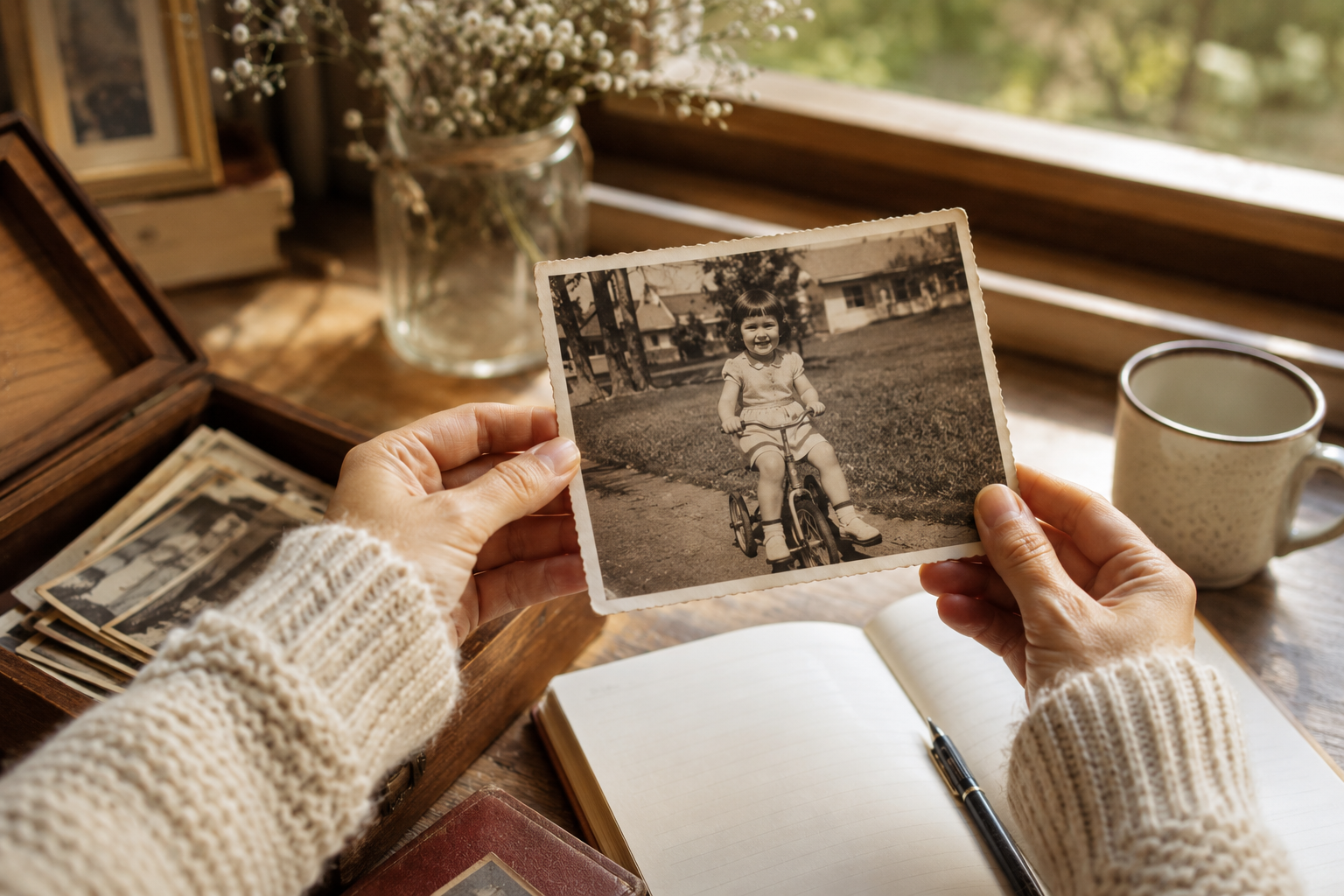
A focused flash memoir prompt about a childhood photograph, the scene it captured, and the quieter truth left outside the frame.
You pull a photo from a shoebox or scroll past one on your phone, and for a second you remember the room around it. The scratchy sweater. The forced smile. The adult voice saying, “Hold still.” Everyone in the picture looks fine, maybe even happy, but you know the photo is only telling part of the story.
If you came here looking for a flash memoir prompt photograph childhood what doesn’t show, this one invites you to look past the frame. A childhood photograph can be sweet, funny, or painful. It can also be incomplete. What matters is not just what the camera caught, but what your memory still carries.
The Prompt
Write about a photograph from your childhood and what it doesn’t show.
This prompt works because photographs often look simple. A birthday cake. A school picture. A family picnic. A child on a porch step. But memory adds another layer. You may remember the argument before the photo, the silence after it, or the thing you were too young to name at the time.
The photograph gives you a concrete place to begin. You do not have to explain your whole childhood. You only have to enter one image and ask what lives outside its edges.
Why This Memory Matters
Childhood photos can be tricky. They can make the past look neater than it was. A picture may show matching pajamas, a clean kitchen, or a bright summer day. It may not show the worry in the house, the loneliness you carried, or the small joy nobody else noticed.
This kind of writing can uncover the gap between appearance and experience. That gap is often where memoir becomes honest.
You might choose a photo where you look happy but remember feeling left out. You might write about a goofy snapshot that does not show how hard your parent worked to make that day happen. Or you might notice the person missing from the picture and realize that absence shaped the whole memory.
A flash memoir prompt photograph childhood what doesn’t show is not asking you to accuse the photo of lying. It is asking you to listen to what the photo cannot say. That can lead to a softer, more layered memory.
How to Approach This Prompt
Begin with one physical detail in the photograph. Choose something small enough to hold in your mind. It could be your shoes, a paper party hat, a chipped table, or the way your hand rests on someone’s shoulder.
Describe what you see before you explain what it means. Let the reader stand in front of the image with you. If you want more practice with this kind of careful observation, the same habits used to annotate literature can help you mark details in your own memories.
Then narrow the memory to one scene. You do not need to cover the whole year, the whole family story, or every feeling connected to the photo. Stay close to the moment around the picture.
Ask yourself: What happened just before this photo? What was I aware of then? What do I understand now that I did not understand as a child?
Try to avoid rushing toward the lesson. Memoir feels stronger when the meaning rises out of the scene. Write the sweater first. Write the smell of the room. Or write the way your cheeks hurt from smiling. Then let the truth arrive.
You can also treat the photo like a text. Look at the edges, the background, and what seems missing. This is similar to close reading in literature, except the “page” is your own life.


A Quick Example
In the photo, I am seven and sitting on the hood of my father’s blue truck. My knees are dusty, and I am wearing a yellow shirt with a cartoon sun on it. I look proud, like the truck belongs to me. What the photo does not show is my mother standing behind my uncle, telling my father we had to leave soon because the baby was crying. It does not show that I had been waiting all afternoon for him to take me fishing. He never said no. He just kept talking to the men in the driveway. In the photo, I am smiling because he finally looked at me. I thought the camera meant the promise was still alive.
Try It Yourself
Find a childhood photograph, or choose one you can remember clearly. Spend a minute looking at it without writing. Notice the clothes, the posture, the background, and the expression on your face.
Then write for ten minutes. Start with the words, “In the photo…” After a few sentences, shift to, “What it doesn’t show…” Let the second sentence open the hidden part of the memory.
You do not have to make the piece dramatic. A quiet truth is enough. Maybe the photo does not show how cold the room was. Maybe it does not show how loved you felt. Or maybe it does not show that you wanted to be somewhere else.
This flash memoir prompt photograph childhood what doesn’t show is useful because it gives you a frame, then asks you to step beyond it. Stay with one image. Trust one detail. Let the memory speak in its own size.
Want More Flash Memoir Prompts?
Explore all 365 prompts in The Memory Trigger: 365 Flash Memoir Writing Prompts.



Get the Free Close Reading Worksheet Pack
Join my email list and receive the printable worksheet pack you can use with any novel or poem.
No spam. Just helpful guides for reading literature well.












