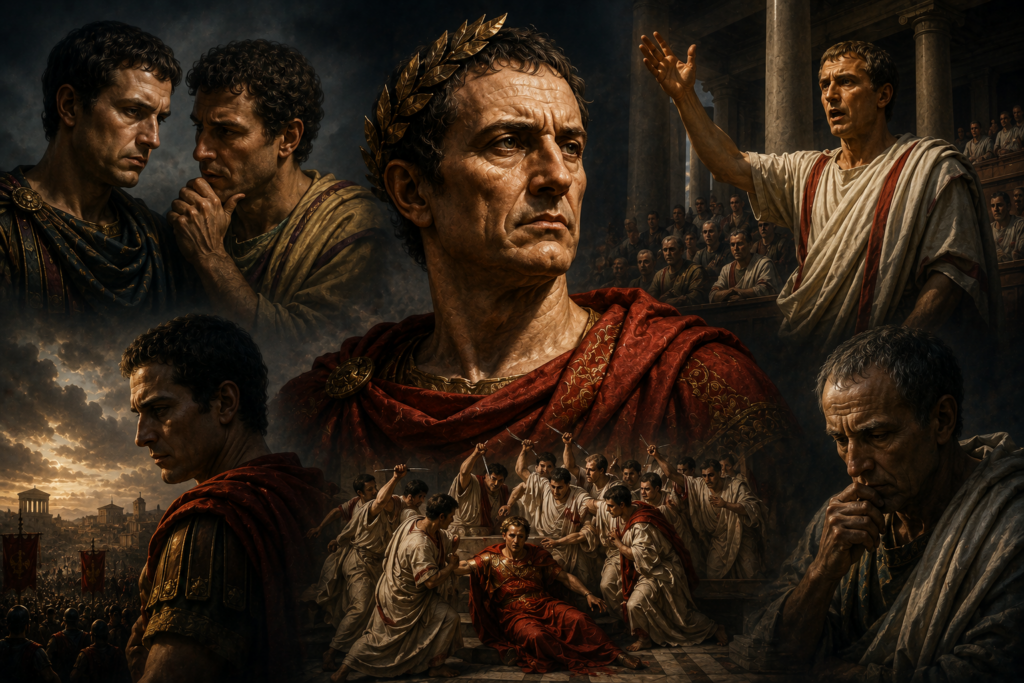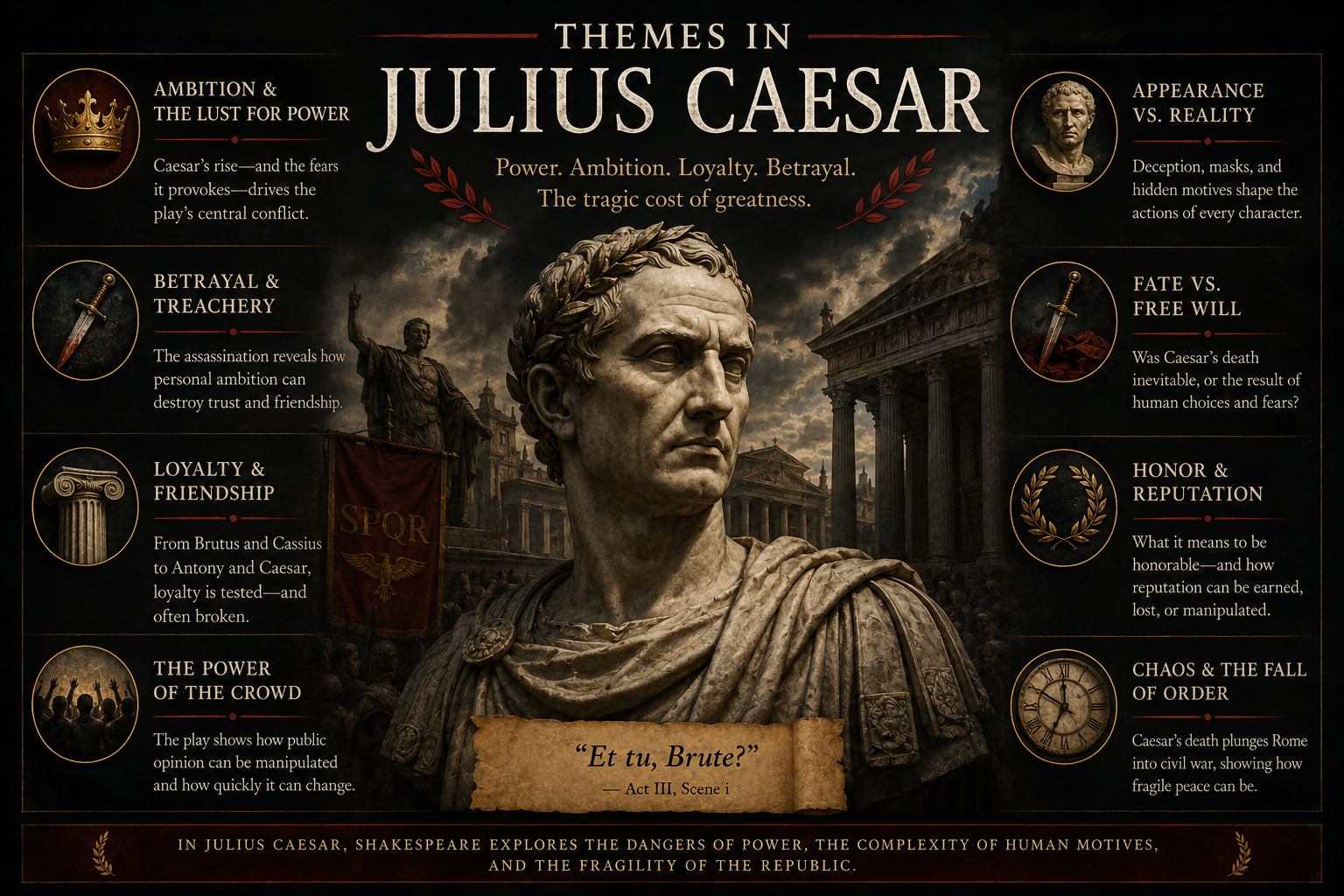
Julius Caesar Character Analysis: Key People, Motivations, and Conflicts

Julius Caesar character analysis

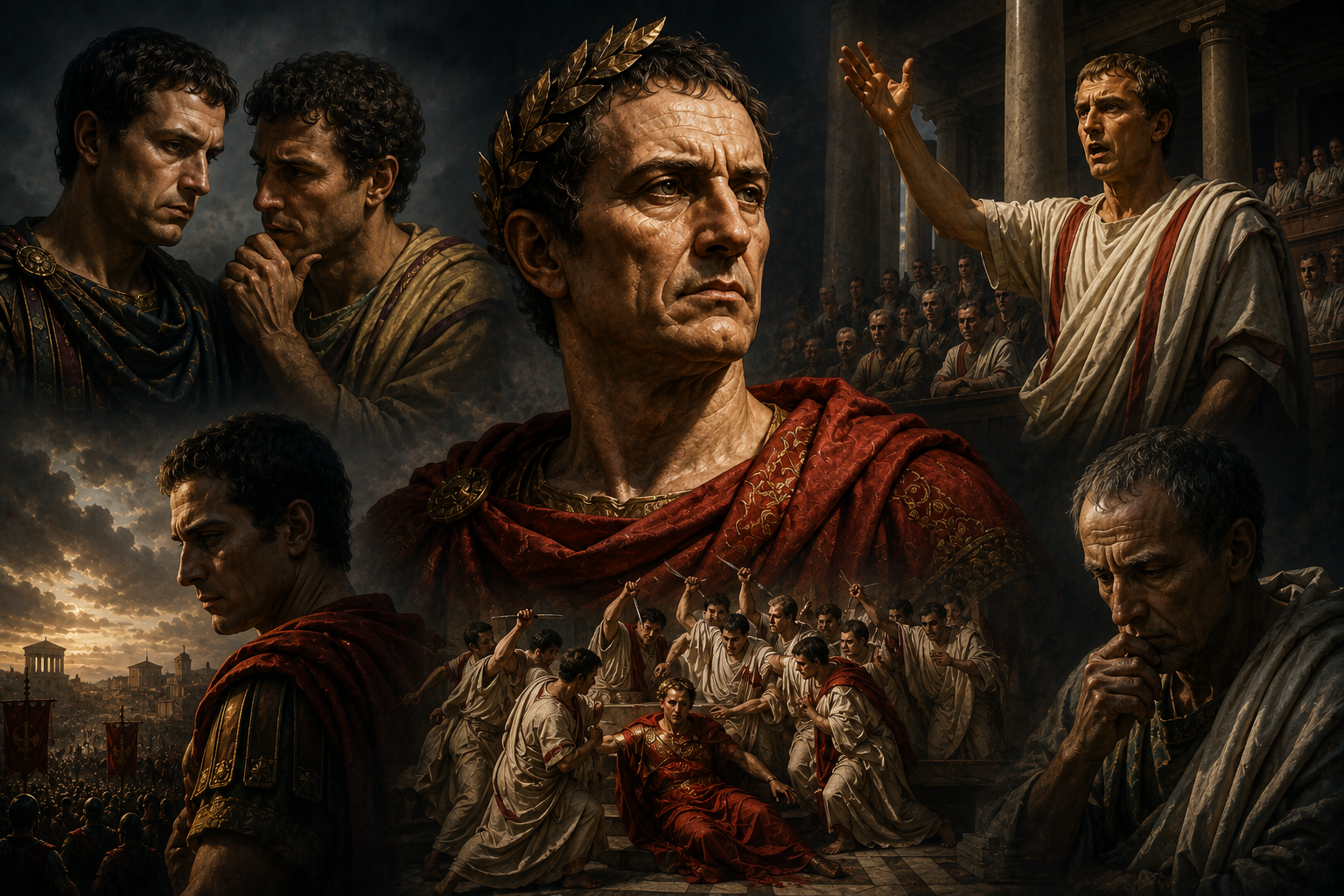
This Julius Caesar character analysis breaks down the main players in Shakespeare’s tragedy. You will see what each person wants, why conflicts grow, and how choices push Rome toward chaos.

In this Guide

Julius Caesar character analysis

Julius Caesar Character Analysis: Why Character Drives the Plot

The play is not just about one murder. It is about why people choose action over peace.

A strong Julius Caesar character analysis starts with motivation. Brutus acts from honor. Cassius acts from jealousy and fear. Antony acts from grief, loyalty, and political skill.

Shakespeare makes each choice feel personal. That is why the plot feels tense even when we know Caesar will die.

If you want a simple method for breaking down character motives, read our guide on how to analyze characters in literature.

Brutus: Honor, Fear, and the Tragic Choice

Brutus is the moral center of the play, but that does not mean he is always right.

For many students, this Julius Caesar character analysis begins with Brutus because his conflict is the clearest. He loves Caesar as a friend, but he fears Caesar may become a tyrant.

His main trait is honor. Brutus wants to protect Rome, not gain power for himself. That makes him different from Cassius.

His flaw is that he trusts ideas more than people. He believes noble reasons can make a violent act look pure. Once he joins the plot, he thinks the public will understand.

This is close to the tragic pattern we see in Hamlet. A thoughtful man faces a moral crisis, but thought does not save him from ruin.

Best quote idea: Brutus often talks about Rome, honor, and the danger of ambition. Use those moments to show how public duty fights with private loyalty.

Julius Caesar Character Analysis of Caesar: Power and Blind Spots

Caesar appears for only part of the play, yet his image controls the whole story.

Caesar is powerful, proud, and loved by many citizens. He also ignores warnings that could save his life.

His main conflict is between public strength and human weakness. He wants to seem fearless. Because of that, he treats danger as something beneath him.

Calpurnia’s dream scares him at first. Then Decius changes the meaning of the dream, and Caesar chooses pride over caution.

Caesar is not shown as a simple villain. Shakespeare leaves room for debate. Is Caesar truly dangerous, or do others fear what he might become?

For a trusted overview of the play, see the Britannica entry on Julius Caesar.

Cassius: Envy, Insight, and Control

Cassius understands people well, but he uses that skill to manipulate them.

A careful Julius Caesar character analysis must take Cassius seriously. He is not just angry. He sees Caesar’s rise as a threat to Roman freedom and to his own status.

Cassius knows Brutus has a good name. So he uses letters, praise, and pressure to pull Brutus into the conspiracy.

His main strength is insight. His main flaw is bitterness. Like Iago in Othello, he can read weakness in others and turn it into action.

Still, Cassius is not foolish. He often gives better practical advice than Brutus. For example, he wants to kill Antony too, but Brutus refuses.

Antony: Grief Turns into Strategy

Antony may seem loyal and emotional at first, but he is also one of the sharpest minds in the play.

No Julius Caesar character analysis feels complete without Antony’s funeral speech. He uses careful language to turn the crowd against the conspirators.

Antony does not attack Brutus directly at first. He repeats that Brutus is honorable, but each repeat makes the crowd doubt it more.

His strength is rhetoric, which means the art of persuasion. He understands public emotion better than Brutus does.

Antony’s conflict is also moral. He mourns Caesar, but he quickly uses Caesar’s death to gain power. Shakespeare lets us feel both his loyalty and his ambition.

You can read the full play through the Folger Shakespeare Library edition of Julius Caesar.

Portia and Calpurnia: Private Warnings in a Public World

Portia and Calpurnia show how private life suffers when public honor takes over.

Portia is Brutus’s wife. She sees that he is troubled and asks to share his burden. Her strength is loyalty, but the political world shuts her out.

Calpurnia is Caesar’s wife. She has a terrible dream and begs Caesar to stay home. Her warning is wise, but Caesar’s pride wins.

Both women sense danger before the men act with care. Their roles show a key idea in the play: Rome praises strength, but it often ignores wisdom.

Julius Caesar Character Analysis: Motivations and Conflicts

Each major character wants something different, and those wants crash into each other.

  • Brutus wants to protect Rome and keep his honor clean.
  • Caesar wants power, respect, and a strong public image.
  • Cassius wants Caesar stopped and wants influence over Brutus.
  • Antony wants revenge for Caesar and control of the crowd.
  • Portia and Calpurnia want truth, safety, and trust inside their homes.

The biggest conflict is not simply Caesar against the conspirators. It is idealism against reality. Brutus believes noble motives can guide politics, but Rome is more violent and unstable than he thinks.

This is why the play works so well for essays. You can argue about who is right, who is blind, and who changes the most.

Use This Julius Caesar Character Analysis in Essays

Good essays do more than describe a character. They explain how a character’s choices shape the play.

When you use Julius Caesar character analysis in a thesis, connect a trait to a result. For example: Brutus’s honor makes him noble, but it also makes him easy to use.

Here is a simple essay move:

  • Name the character’s main trait.
  • Show the conflict that tests that trait.
  • Explain the result of the choice.
  • Connect the result to a larger theme.

For more practice, use this character analysis strategy before you write your next paragraph.

If you want a ready-to-use study tool, try our student-friendly character analysis resource for quote-based notes and essay prep.

Suggested Books for Study

These books can help if you want more context or a stronger grasp of Shakespeare’s language.

  • Julius Caesar by William Shakespeare, Folger Shakespeare Library edition
  • Shakespeare: The World as Stage by Bill Bryson

FAQ: Julius Caesar Character Analysis

Quick answers can help you review before class or plan an essay. 💡

Who is the most important character in Julius Caesar?

Brutus is often the most important character because his choice to join the conspiracy drives the tragedy.

Is Caesar a hero or a villain?

Caesar is more complex than either label. He has pride and power, but the play never proves he would become a tyrant.

What is Brutus’s tragic flaw?

Brutus’s tragic flaw is his idealism. He believes honorable motives can control political violence.

Why is Antony’s funeral speech important?

Antony’s speech turns public opinion against the conspirators. It shows the power of language in politics.

What is the main idea of a Julius Caesar character analysis?

The main idea is that each character’s motive shapes the fall of Caesar and the collapse of Roman order.

Key Takeaway

The best Julius Caesar character analysis shows that the tragedy grows from human choices, not fate alone. Shakespeare’s characters act from honor, fear, pride, and loyalty, but none can control what their actions release.
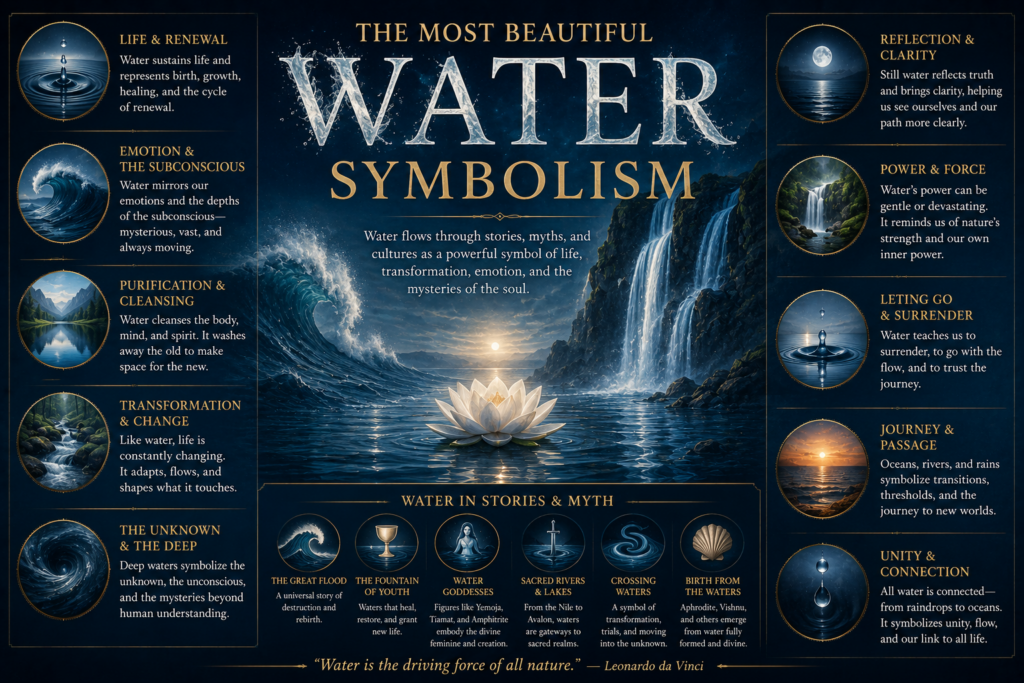
Most Beautiful Water Symbolism in Literature: Meaning, Themes, and Books to Read

water symbolism
water symbolism

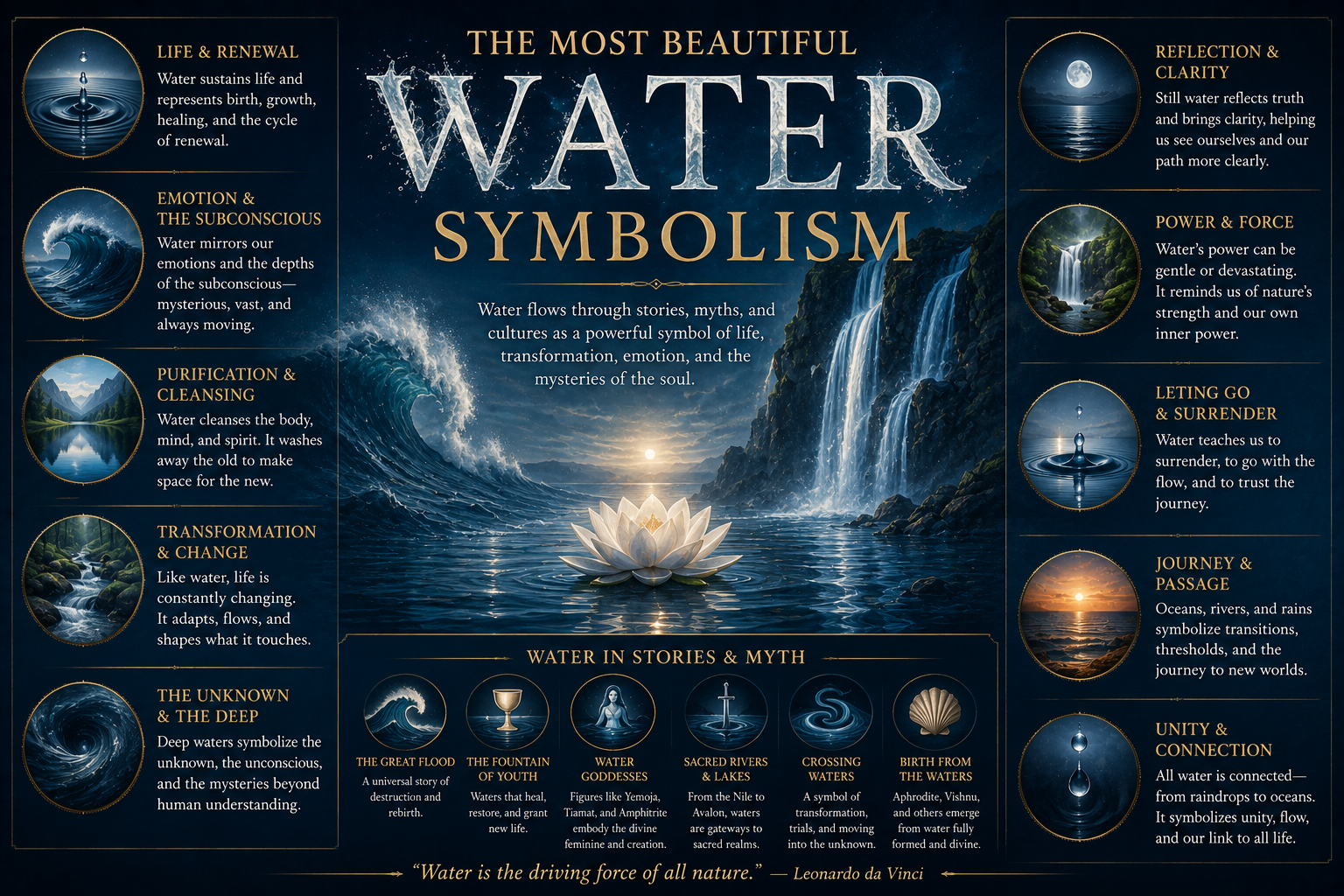
Most Beautiful Water Symbolism shows how rivers, rain, oceans, and lakes can carry deep meaning in a story. Water can stand for life, change, fear, memory, grief, or hope, often in the same scene.

For students, water is one of the easiest symbols to notice because it appears in so many famous books and poems. Once you learn what to look for, it can make a story feel richer and more alive.

In this Guide

  • What water symbolism means
  • Why Most Beautiful Water Symbolism matters
  • Common meanings of water in literature
  • Famous examples from books and poems
  • Recommended books to read
  • FAQs about water symbolism

What Does Water Symbolism Mean?

Water often points to emotions that characters cannot say out loud.

In literature, water is rarely just water. A river can show a journey. Rain can mark sorrow or renewal. An ocean can suggest freedom, danger, or the unknown.

Writers use water because readers already feel its power. We know water can heal, destroy, wash away, and return again. That makes it a strong symbol for human life.

If you want a simple method for spotting symbols, this guide on how to find symbolism in a story can help you build the skill step by step.

Why Most Beautiful Water Symbolism Feels So Powerful

The beauty of water symbolism comes from its many sides.

Most Beautiful Water Symbolism works because water is never only one thing. It can be calm in one scene and violent in the next. It can save a character or trap them.

This is why water feels so human. People also change. We can feel peaceful, afraid, hopeful, or lost, sometimes all in one day.

In many stories, water becomes a mirror. It reflects what a character hides inside. A quiet lake may show calm, but it may also hide pain below the surface.

Most Beautiful Water Symbolism and Common Meanings

Water symbols often connect to life, death, change, and truth.

One common meaning is rebirth. A character who enters water may come out changed. This can feel like a fresh start, even if the story stays painful.

Water can also mean danger. Storms, floods, and deep seas often show forces that people cannot control. This makes water a strong symbol for fate or fear.

Another meaning is memory. Rivers and oceans move, but they also seem ancient. In this way, Most Beautiful Water Symbolism can connect a character’s private life to a larger past.

Water can also suggest truth. A clear pool may show what is hidden. Muddy water may suggest confusion, lies, or moral doubt.

Famous Examples of Water Symbolism in Literature

Many classic works use water to shape mood and meaning.

In The Odyssey by Homer, the sea is both a road and an enemy. Odysseus wants to return home, but the ocean delays him again and again. The water stands for struggle, distance, and the test of human will.

In Moby-Dick by Herman Melville, the ocean feels endless and mysterious. It becomes a place where obsession grows. Captain Ahab’s search across the sea shows how the unknown can pull a person toward ruin.

In Shakespeare’s The Tempest, a storm at sea begins the action. The water helps create fear, magic, and change. It pushes characters into a strange world where old wrongs must face judgment.

In T. S. Eliot’s poem The Waste Land, water is tied to both need and fear. The poem’s dry land suggests spiritual emptiness, while water hints at renewal. You can read more about the poem through the Poetry Foundation.

Most Beautiful Water Symbolism in Modern Reading

Modern readers still connect with water because it feels close to daily life.

Most Beautiful Water Symbolism is not limited to old books. It appears in novels about family, identity, trauma, and survival. Water often helps writers show emotions that are hard to name.

For example, rain in a modern novel may mark grief after a death. A beach may show escape from stress. A river may stand for a choice that cannot be undone.

This is why water symbols work well in class essays. They let you connect setting, character, and theme in a clear way.

Recommended Books with Most Beautiful Water Symbolism

These books are strong choices for students who want to study water symbols.

  • The Odyssey by Homer: A classic journey story where the sea tests courage, pride, and longing for home.
  • Moby-Dick by Herman Melville: A deep study of obsession, mystery, and the danger of chasing one idea too far.

Both books show Most Beautiful Water Symbolism in very different ways. One treats water as a hard path home. The other turns the ocean into a vast space of fear and wonder.

For a wider look at how symbols work in literature, Britannica’s overview of symbolism gives useful background.

How to Write About Water Symbolism in an Essay

A strong essay links the water image to a clear idea.

Start with the scene. Ask what kind of water appears. Is it rain, ocean, river, lake, or flood?

Then ask what the character feels in that moment. Water symbolism is strongest when it connects to conflict, choice, or change.

Last, connect the symbol to a theme. If a character crosses a river, the theme may involve growth or loss. If a storm breaks, the theme may involve fear, guilt, or truth.

For more practice, use this helpful guide on finding symbolism in fiction before you draft your paragraph.

Most Beautiful Water Symbolism and Major Themes

Water often gives a story its emotional center.

Most Beautiful Water Symbolism often links to change. Water moves, shifts, and reshapes the world. Characters who meet water often face a turning point.

It also links to cleansing. A bath, rainfall, or river can suggest a wish to remove guilt or pain. Yet the story may ask whether a person can truly wash the past away.

Water also links to the unknown. Deep water can hide danger, secrets, or truth. This makes it useful in stories about fear and discovery.

FAQs About Most Beautiful Water Symbolism

What is Most Beautiful Water Symbolism in literature?

Most Beautiful Water Symbolism refers to powerful water images that carry deep meaning. These images may show life, change, danger, memory, or renewal.

Why do writers use water as a symbol?

Writers use water because it is familiar and emotional. Readers understand its power to comfort, harm, hide, and reveal.

What does rain usually symbolize?

Rain can symbolize sadness, cleansing, rebirth, or tension. The meaning depends on the scene and the character’s state of mind.

What does the ocean symbolize in books?

The ocean often symbolizes mystery, freedom, danger, or the unknown. In many stories, it also shows how small people feel against nature.

How can I find water symbolism in a story?

Look for repeated water images and ask what changes when they appear. If water appears during a key choice or crisis, it likely has symbolic meaning.

Key Takeaway

Most Beautiful Water Symbolism matters because water can hold many truths at once. It can show hope and fear, peace and danger, life and loss.

When you notice water in a story, slow down. Ask what it reveals about the character, the mood, and the theme. That simple question can open the whole text. 🌊

What Is the Trickster Archetype? A Beginner-Friendly Guide

Trickster archetype
Trickster archetype

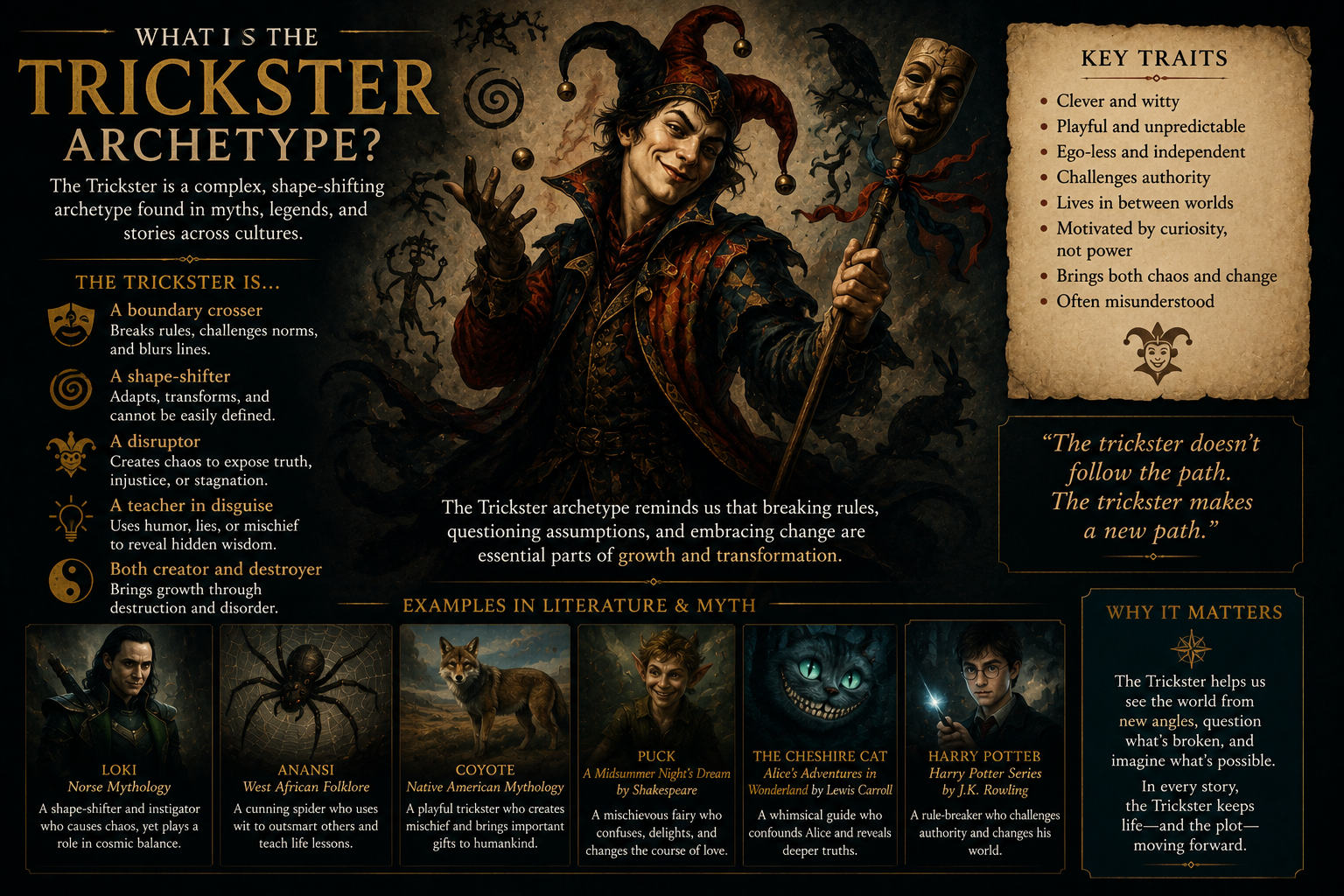
If a character lies, jokes, breaks rules, or tricks others to expose the truth, you may be looking at a trickster. This guide answers What Is the Trickster Archetype? and shows why this character type matters in stories, myths, and plays.

In this Guide

Use this quick map to find what you need.

What Is the Trickster Archetype? A Simple Definition

A trickster is a character who uses cleverness to challenge rules, fool others, or upset the normal order.

When students ask, What Is the Trickster Archetype?, the easiest answer is this: it is a repeated character pattern found across stories. A trickster often bends the truth, changes shape, plays jokes, or tricks people in power.

The trickster is not always evil. Some tricksters help others by exposing lies. Others cause chaos for fun. That mix makes them hard to trust and fun to study.

An archetype is a pattern that appears again and again in literature. The trickster archetype appears in myths, fairy tales, drama, novels, and modern fantasy.

What Is the Trickster Archetype? Why It Matters in Literature

The trickster matters because this character often reveals what a society fears, hides, or refuses to question.

A good answer to What Is the Trickster Archetype? should explain more than behavior. Tricksters do not only play pranks. They test the world of the story.

They may expose a proud king, fool a greedy person, or break a rule that no one else dares to touch. In doing so, they show cracks in the system.

That is why tricksters often appear when a story needs change. They push characters out of comfort and make hidden truths easier to see.

For more background on trickster stories across cultures, see Britannica’s overview of trickster tales.

What Is the Trickster Archetype? Common Traits to Look For

Tricksters are different in each story, but they often share a few clear signs.

If you remember one answer to What Is the Trickster Archetype?, remember this: tricksters use wit as power. They may not be the strongest character, but they know how to outsmart others.

Common signs include disguise, jokes, lies, riddles, and sudden reversals. A trickster may cross boundaries between human and animal, rich and poor, or order and chaos.

Tricksters also create tension. Readers may laugh at them, but they can also cause real harm. That uneasy feeling is part of their role.

When you read, notice how other characters react to the trickster. Fear, anger, and confusion can show how much power the trickster has.

What Is the Trickster Archetype? Famous Examples

Many well-known stories use tricksters to bring humor, conflict, and surprise.

Puck in William Shakespeare’s A Midsummer Night’s Dream is a classic trickster. He uses magic to confuse the lovers, and his mistakes turn the play into a comic mess.

Shakespeare often used clever characters to expose foolish behavior. You can learn more about him through the Poetry Foundation’s Shakespeare page.

Loki from Norse myth is another famous example. He can help the gods, but he also betrays them. That makes him a risky and unstable figure.

Anansi, the spider from West African and Caribbean folklore, often wins through wit. His stories show how a smaller figure can beat stronger enemies through clever plans.

Odysseus in Homer’s The Odyssey also has trickster traits. He survives by using disguise and strategy, especially when he fools the Cyclops Polyphemus.

What Is the Trickster Archetype? How to Analyze It

A strong analysis looks at what the trickster changes in the story.

When you ask What Is the Trickster Archetype? during reading, do not stop at “this character is sneaky.” Ask what the trick reveals.

Does the trickster expose a lie? Does the prank show that a leader is weak? Or, does the character’s chaos lead to growth?

Also look for symbols linked to the trickster. Masks, doors, mirrors, animals, and magic objects may point to hidden meanings. If you need help with that skill, read this guide on how to find symbolism in a story.

Practical tip: Each time the trickster appears, write down what rule gets broken and what truth comes out. That simple note can turn into a strong paragraph for class.

Books That Help You Understand the Trickster Archetype

These books include trickster figures or characters with strong trickster traits.

  • The Odyssey by Homer
  • A Midsummer Night’s Dream by William Shakespeare
  • Anansi Boys by Neil Gaiman

These are not affiliate links, just useful titles to explore.

FAQ: What Is the Trickster Archetype?

Here are quick answers to common student questions.

What Is the Trickster Archetype? in simple words?

It is a character type that uses tricks, jokes, or clever plans to challenge rules and reveal truth.

Is a trickster always a villain?

No. A trickster can help or harm. Many tricksters do both, which makes them complex.

Why do authors use tricksters?

Authors use tricksters to create conflict, question authority, and show hidden problems in a story’s world.

What is a good example of a trickster in literature?

Puck from A Midsummer Night’s Dream is a strong example because he causes confusion through mischief and magic.

Key Takeaway

The trickster is more than a comic troublemaker.

What Is the Trickster Archetype? It is a clever rule-breaker who shakes up the story and helps readers see what others miss.

Flash Memoir Prompt: Last Time You Lived in a Place that Felt Like Home

Flash Memoir home

A tender flash memoir prompt for remembering the last time you lived in a place that felt like home, starting with the small signs your body trusted before your mind had words for it.

Flash Memoir home

The Prompt

Write about the last time you lived in a place that felt like home.

This flash memoir prompt last time lived place felt like home invites you to look at home as more than a building. It may have been a bedroom with bad carpet, a rented apartment above a loud street, a dorm room with one decent lamp, or a house you later had to leave.

The word “home” can carry a lot. It can mean safety. It can mean routine. It can mean the person who always left the porch light on. This prompt works best when you do not try to explain the whole past at once. Instead, choose one moment when the place felt unmistakably yours.

Why This Memory Matters

The last place that felt like home often holds a quiet turning point. You may not have known it was the last time while you were there. You may have packed the boxes, washed the dishes, locked the door, and believed some version of it would come back.

That is what gives this prompt its ache. It asks you to remember home before it became memory. Maybe you were sitting on the kitchen floor after everyone else went to bed. Maybe you heard the same dog bark every morning. Maybe the hallway smelled like laundry soap and rain.

A strong flash memoir piece does not need to prove that the place mattered. It lets the reader feel it through one clear scene. The cup with the crack in it. The heat vent under your feet. The window you checked before sleep. Those details become emotional evidence.

Place can also work like a symbol in memoir. A door, a table, or a patch of sunlight can stand for comfort without needing a long explanation. If you want to think more about how objects carry meaning, this guide on how to find symbolism in a story can help you notice what your memory may already contain.

How to Approach This Prompt

Begin with a physical detail. Do not start with “I felt at home because…” Start with the thing you can still see, smell, hear, or touch.

Maybe it is the scratch on the front door where the key missed the lock. Maybe it is the way the floorboard dipped near the couch. Maybe it is the sound of someone opening a drawer in the kitchen while you pretended to still be asleep.

Once you have one detail, narrow the memory to one scene. A flash memoir prompt last time lived place felt story can become too large if you try to cover every room, every year, and every reason you left. Choose one short moment and stay there.

You might write about your final morning in the place. You might write about an ordinary night weeks before you moved, when nothing special happened except that you felt safe. Ordinary can be powerful because it shows what you lost or what you still carry.

Try writing what you noticed before explaining what it meant. Let the meaning arrive slowly. Readers often trust the scene more when they are allowed to stand inside it first.

If you are a student or new to personal writing, you can treat your own memory the way you might mark up a short story. Circle the objects that repeat in your mind. Notice the mood. Ask what changes between the start and end of the scene. This method is similar to close reading, and this guide on how to annotate literature can give you a simple way to pay closer attention.

A Quick Example

The last place that felt like home had a green kitchen with one drawer that never closed right. Every morning, my mother shoved it with her hip while the kettle began to whistle. I was twenty-three and back in my childhood room after a job fell apart, which should have made me feel ashamed. Instead, I liked the old ceiling crack above my bed. I liked knowing which stair would creak. One November night, I stood in the kitchen eating toast over the sink, and my father came in for water. He did not ask if I had a plan. He just opened the stuck drawer, found a butter knife, and said, “Leave the porch light on for your brother.” I remember thinking I belonged to that sentence.

Try It Yourself

Set a timer for ten minutes and write from the prompt: Write about the last time you lived in a place that felt like home.

Start with one physical detail from that place. Then place yourself inside one moment. You do not have to explain why you left. You do not have to write the full history of your family, your lease, your school, or your move. Let the scene hold the feeling.

If the memory feels tender, write gently. You can keep the piece private. You can change names. You can stop before the hard part and return later. Flash memoir is small on purpose. It gives one memory enough room to breathe.

Before you finish, ask yourself one question: What did that place let me be? The answer may show you the heart of the piece.

Want More Flash Memoir Prompts?

Explore all 365 prompts in The Memory Trigger: 365 Flash Memoir Writing Prompts.

The Memory Trigger

Themes in Shakespeare’s Julius Caesar: A Student-Friendly Guide

Julius Caesar themes

This student-friendly guide explains the themes in Julius Caesar and shows why Shakespeare’s play still feels sharp today.

You will see how power, honor, fear, and words shape the choices behind Caesar’s death. If you need help with the basics first, read this guide on how to identify theme in literature.

In this Guide

Use this section to find the idea you need most.

  • What a theme means in this play
  • Power and public honor
  • Loyalty and betrayal
  • Fate and omens
  • Rhetoric and persuasion
  • Essay help
  • FAQ
Julius Caesar themes

Major themes in Julius Caesar

The play asks what happens when private beliefs meet public danger.

The major themes in Julius Caesar are not just single words like power or betrayal. A true theme is a message about life, people, or society.

Shakespeare shows Rome at a tense moment. Caesar is popular, but some leaders fear he may become a tyrant. Brutus believes he can stop danger before it grows, but his choice brings new chaos.

That tension makes the play rich for students. It does not give easy answers. It asks whether a person can do a violent act for a noble reason.

Political themes in Julius Caesar: power and public honor

Rome is a public world, so reputation can be as powerful as truth.

One of the clearest themes in Julius Caesar is the danger of political power. Caesar may not call himself a king, but many Romans act as if he is close to becoming one.

Cassius uses this fear to pull Brutus into the plot. He knows Brutus cares about Rome and wants to seem honorable. This shows how politics can turn virtue into a tool.

Brutus claims he kills Caesar because he loves Rome more than Caesar. That sounds noble, but the play asks if noble language can hide personal pride.

This theme is easy to compare with Macbeth. In both plays, ambition leads to violence. Yet Brutus is not Macbeth. Brutus thinks he protects the state, which makes his fall more painful.

Personal themes in Julius Caesar: loyalty and betrayal

The most painful conflicts in the play happen between people who trust each other.

Among the themes in Julius Caesar, loyalty and betrayal may feel the most personal. Caesar trusts Brutus, and that trust makes the murder shocking.

Brutus also betrays himself in a way. He says he acts for Rome, but he ignores warnings from Portia, Caesar, and his own doubts.

Portia’s role matters here. She asks Brutus to trust her with his secrets, but he keeps her outside the political world. Their marriage shows how public duty can damage private bonds.

A similar conflict appears in Antigone by Sophocles. A character must choose between law and conscience. In Shakespeare’s play, Brutus faces that kind of choice, but his answer harms the city he hopes to save.

Fate, omens, and the themes in Julius Caesar

Warnings fill the play, but people still choose how to respond.

Fate is one of the themes in Julius Caesar that gives the play its tragic mood. The soothsayer warns Caesar to beware the Ides of March. Calpurnia dreams of danger. Strange signs appear across Rome.

Caesar hears warnings, but he refuses to seem afraid. Brutus sees danger too, but he reads it through his political fear. Both men make choices, even when the play feels haunted by fate.

This is why the play works so well as tragedy. Shakespeare suggests that human pride can make fate feel unavoidable.

How rhetoric shapes the themes in Julius Caesar

Words do not just explain action in this play. They change what people believe.

The themes in Julius Caesar become clearest in the funeral speeches. Brutus speaks in a calm way and asks the crowd to trust his reason.

Antony speaks after him and turns the crowd with emotion. He repeats the word honorable until it sounds bitter. He also uses Caesar’s wounds like proof.

This scene shows how public opinion can shift fast. It also shows that truth often loses when a speaker knows how to move a crowd.

Students may notice a link to Animal Farm by George Orwell. In both works, political language shapes how people see power.

How to write about the play in an essay

A strong essay should connect theme to character choice.

Do not write only that the play is about ambition or betrayal. Instead, explain what Shakespeare says about that idea.

A stronger claim might say: Shakespeare uses Brutus to show that people can mistake pride for moral duty.

Then use evidence from Brutus’s speeches, the conspiracy scene, and Antony’s funeral speech. For extra practice, try the RapidReads Press literature study tools as you shape a claim.

You can also review how theme works in literature before you draft your essay.

Why the play still matters

Shakespeare’s Rome feels old, but its questions are still current.

The play asks how far people should go to stop a leader they fear. It also asks how crowds decide whom to trust.

Those questions matter in school, politics, and daily life. People still use noble words to defend harsh actions. People still mistake confidence for truth.

For background on the play, Britannica has a helpful overview of Julius Caesar by Shakespeare. You can also learn more about Shakespeare through the Poetry Foundation profile of William Shakespeare.

Helpful books to look up on Amazon

These books can help you read the play with more confidence.

  • Julius Caesar by William Shakespeare, Folger Shakespeare Library edition
  • Shakespeare: The World as Stage by Bill Bryson

FAQ about the play

Use these quick answers for review before a quiz or essay.

What are the main themes in Julius Caesar?

The main ideas include power, honor, betrayal, fate, and the danger of persuasive speech.

Is ambition a theme in the play?

Yes. Caesar’s rise creates fear, and Cassius uses that fear to push the conspiracy forward.

Why is Brutus important to the theme?

Brutus shows how a person can do harm while thinking he serves a noble cause.

What does Antony’s speech show?

It shows that language can control public feeling and turn grief into violence.

Key Takeaway

The play is not only about Caesar’s death.

The key insight is this: Shakespeare shows that power becomes dangerous when fear, pride, and persuasive speech replace clear moral judgment.

Best Gothic Hero’s Journey Stories to Read and Study

Gothic Hero's Journey

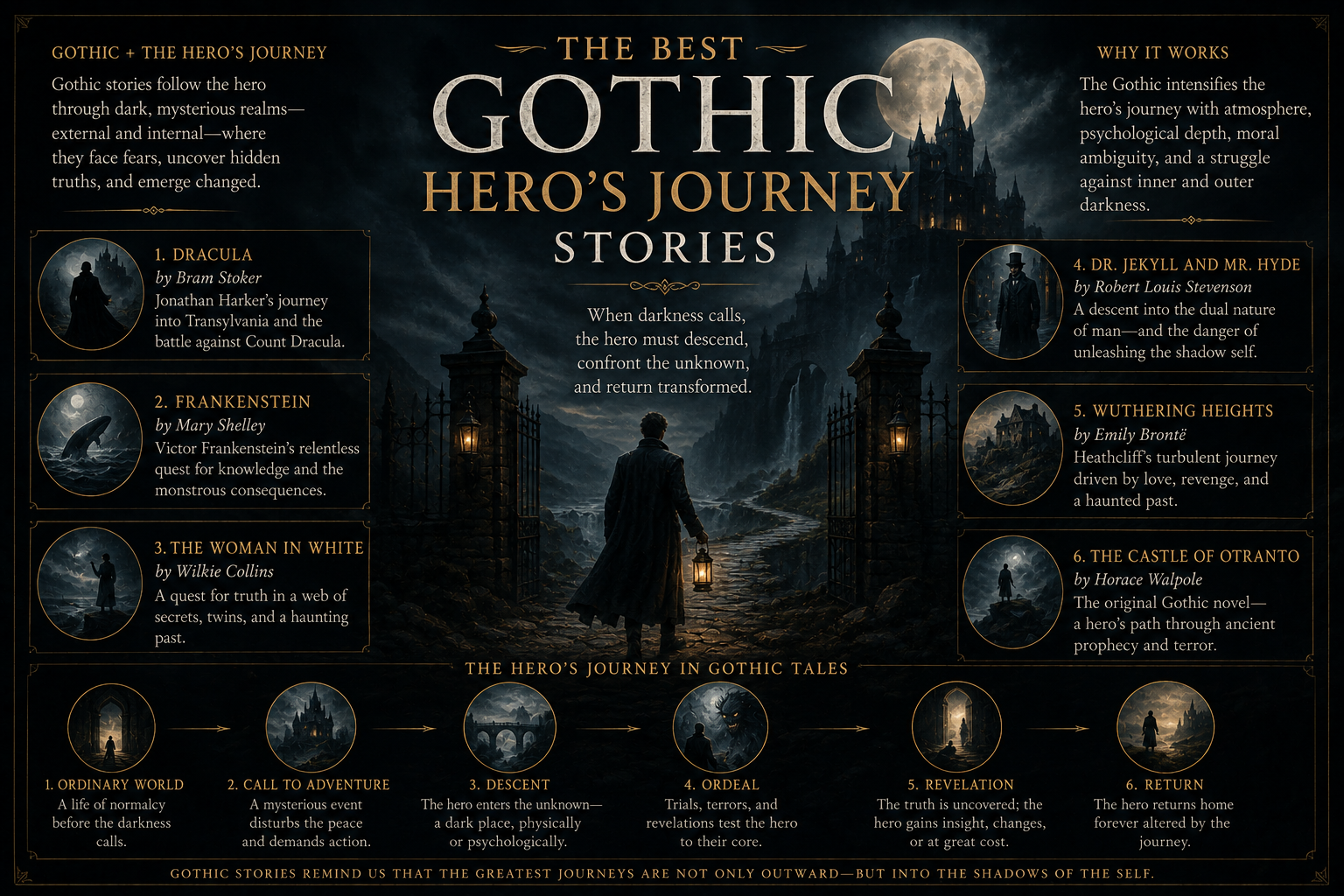
The Best Gothic Hero’s Journey Stories mix dark settings with deep inner change. These stories send characters into fear, mystery, and danger, but the real battle often happens inside the hero.

For students, this blend is powerful because it makes classic literature feel tense and personal. A haunted house or ruined castle can reveal more about a character than a speech ever could.

In this Guide

  • What makes Gothic hero journeys different
  • Key books and examples to read
  • Major symbols and themes
  • How to study these stories for class
  • FAQs about Gothic hero journeys
Gothic Hero's Journey

What Makes the Best Gothic Hero’s Journey Stories Different?

Gothic hero journeys turn the usual adventure story into a darker test of the soul.

In a classic hero’s journey, a character leaves home, faces danger, gains wisdom, and returns changed. In Gothic fiction, that path is less clear. The hero may enter a castle, a mansion, a lab, or a ruined family estate.

The danger is not only outside. It may be guilt, desire, family secrets, or fear of the unknown.

The Best Gothic Hero’s Journey Stories often ask one key question: What happens when a person faces the truth they tried to hide?

This is why Gothic stories work so well in literature classes. They connect plot with character growth. If you want help with that skill, read this guide on how to analyze characters in literature.

Best Gothic Hero’s Journey Stories to Read First

These classic works show how fear can shape a hero’s path.

Frankenstein by Mary Shelley is one of the most important Gothic hero journey stories. Victor Frankenstein seeks knowledge, but his quest leads to horror. His creation also takes a painful journey as he searches for love and meaning.

What makes the novel so rich is its double journey. Victor wants power. The Creature wants belonging. Both are changed by rejection and loss.

Jane Eyre by Charlotte Brontë may not seem like a Gothic quest at first, but it fits the pattern well. Jane moves from Gateshead to Lowood to Thornfield, and each place tests her courage.

Thornfield Hall is the Gothic center of the novel. Its locked rooms and strange sounds reflect secrets in the house. Jane’s real journey is toward self-respect.

Dracula by Bram Stoker turns the hero’s journey into a group struggle. Jonathan Harker travels into danger, but the fight against Dracula becomes shared. The novel uses letters and journals to build fear and suspense.

When students search for the Best Gothic Hero’s Journey Stories, these titles are strong starting points because they balance action with inner conflict.

More Gothic Examples Worth Knowing

Not every Gothic hero wins in a simple way.

Wuthering Heights by Emily Brontë gives readers a darker form of the journey. Heathcliff rises from outsider to powerful figure, but his path is ruled by pain. His story shows how revenge can trap a person instead of free them.

Rebecca by Daphne du Maurier follows a young narrator into the shadow of another woman’s memory. Manderley feels beautiful and unsafe at the same time. The heroine must learn how much of her fear comes from the house and how much comes from her own doubt.

The Strange Case of Dr. Jekyll and Mr. Hyde by Robert Louis Stevenson uses the hero’s journey in a twisted way. Dr. Jekyll crosses a moral line and meets the darkest part of himself. His story warns that hidden desires can grow stronger when denied.

These Best Gothic Hero’s Journey Stories remind readers that a journey does not always lead to peace. Sometimes it leads to truth, and truth can be hard to face.

Symbols and Themes in the Best Gothic Hero’s Journey Stories

Gothic stories use objects and places to show what characters fear most.

One common symbol is the house. A mansion, castle, or locked room often stands for the mind. Hidden rooms suggest hidden truths. Broken walls suggest broken families.

Dark weather is another key symbol. Storms, fog, and cold landscapes make the world feel unsafe. They also reflect the hero’s confusion.

Mirrors and doubles matter too. In Frankenstein, Victor and the Creature reflect each other. In Dr. Jekyll and Mr. Hyde, the double becomes literal.

The Best Gothic Hero’s Journey Stories often explore guilt, identity, and the fear of change. These themes make the genre more than scary. They make it human.

Why Gothic Hero Journeys Still Matter

Modern readers still connect with Gothic stories because fear has not gone away.

Students may not live in castles, but they know what it means to feel trapped. They know what it means to face pressure, secrets, and hard choices.

The Best Gothic Hero’s Journey Stories give shape to those feelings. They turn anxiety into plot. They turn inner conflict into setting.

This is why Gothic fiction keeps returning in books, film, and television. The genre gives us dark spaces where difficult emotions can be seen.

For more background on the genre, see Britannica’s overview of the Gothic novel. For a key Gothic writer, visit the Poetry Foundation page on Edgar Allan Poe.

How to Read the Best Gothic Hero’s Journey Stories for Class

To study these stories well, focus on how the setting shapes the hero.

Ask what place the hero enters. Is it a house, a lab, a school, or a foreign land? Then ask what fear that place brings out.

Track the hero’s choices. Gothic heroes often fail because they ignore warnings or hide the truth. Those choices matter more than the scares.

Watch for moments of self-knowledge. A Gothic hero may not defeat a monster, but they may learn what the monster means.

If you are writing an essay, connect the setting to the character’s change. This is a strong way to build a clear literary argument.

These books are easy to find and useful for class study.

  • Frankenstein by Mary Shelley
  • Jane Eyre by Charlotte Brontë
  • Dracula by Bram Stoker

Each one offers a different kind of Gothic journey. Together, they show why the Best Gothic Hero’s Journey Stories remain important in literary culture.

FAQs About the Best Gothic Hero’s Journey Stories

What is a Gothic hero’s journey?

It is a story where a character enters a dark or mysterious world and faces both danger and inner conflict. The journey often reveals hidden fear, guilt, or truth.

Are the Best Gothic Hero’s Journey Stories always horror stories?

No. Some are scary, but many focus more on suspense, secrets, and emotion. Jane Eyre is a good example.

Why do Gothic stories use old houses so often?

Old houses suggest history, memory, and hidden pain. They often reflect the mind of the hero or the secrets of a family.

Which Gothic hero journey is best for students?

Frankenstein is a strong choice because it is short enough for class study and rich in themes. It also raises big questions about science and responsibility.

Key Takeaway

The Best Gothic Hero’s Journey Stories show that the hardest quest is often the one inside the self. These stories use haunted places, dark symbols, and troubled heroes to explore fear, truth, and change.

That is why they still matter. They make readers ask what we hide, what we seek, and what we become when we face the dark. 🕯️

The Shadow Archetype in Literature: A Student-Friendly Guide

the shadow archetype

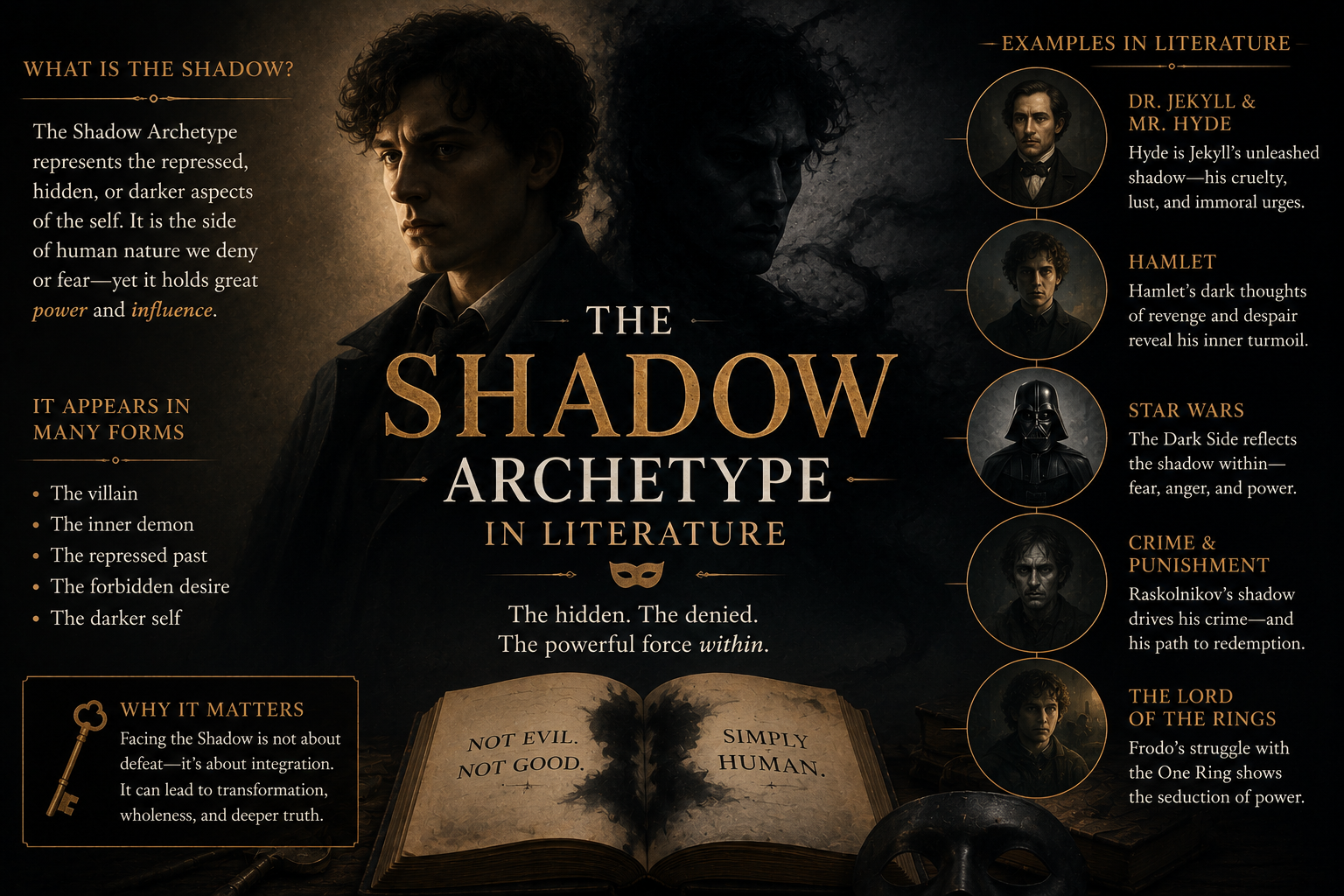
The Shadow Archetype in Literature helps readers understand the darker parts of a character’s mind. It shows fear, guilt, rage, pride, or hidden desire, often through a villain, double, monster, or secret self.

If you study novels, plays, or poems, this idea can help you spot deeper conflict and write stronger analysis.

In this Guide

What Is The Shadow Archetype in Literature?

The shadow is the hidden side of a person or character.

Psychologist Carl Jung used the word “shadow” to describe the parts of the self that people try to deny or hide. These parts are not always evil, but they can become dangerous when ignored. You can read more about Jung’s background at Britannica’s Carl Jung page.

In stories, the shadow may appear as a villain, a monster, a rival, or a secret part of the hero. The Shadow Archetype in Literature often forces a character to face the truth about themselves.

For example, a brave hero may fear failure. A kind person may feel anger. A wise leader may crave power. The shadow brings these hidden feelings into the open.

Why The Shadow Archetype in Literature Matters

The shadow makes stories feel more real because people are not simple.

Most strong characters have inner conflict. They want to be good, but they may feel envy, shame, or pride. This struggle gives a story emotional weight.

The Shadow Archetype in Literature also helps readers understand theme. A story may ask questions like: What happens when people deny guilt? Can someone accept their dark side and still choose good?

This is useful for essays because the shadow connects character, conflict, and symbolism. If you want help with that skill, read this guide on how to find symbolism in a story.

Examples of The Shadow Archetype in Literature

Many famous works use the shadow to reveal hidden fear or desire.

Dr. Jekyll and Mr. Hyde

Robert Louis Stevenson’s Strange Case of Dr. Jekyll and Mr. Hyde is one of the clearest examples. Dr. Jekyll wants to separate his good side from his darker urges.

Mr. Hyde becomes the living form of those urges. The story warns that hiding the shadow does not destroy it. It can make it stronger.

Frankenstein

In Mary Shelley’s Frankenstein, the Creature can be read as Victor Frankenstein’s shadow. Victor wants glory and control, but he refuses to face the cost of his ambition.

The Creature reflects Victor’s fear, guilt, and rejection of responsibility. This makes the novel more than a monster story. It becomes a story about what happens when someone abandons what they create.

Macbeth

In Shakespeare’s Macbeth, Macbeth’s shadow appears through his hunger for power. At first, he seems loyal and brave.

Once ambition takes control, he becomes violent and fearful. His shadow does not arrive from nowhere. It was already inside him.

Lord of the Flies

William Golding’s Lord of the Flies shows the shadow in a group, not just one person. The boys try to build order, but fear and cruelty rise to the surface.

The “beast” is not only outside them. It is also inside them. This makes The Shadow Archetype in Literature a key idea in the novel.

How to Analyze The Shadow Archetype in Literature

You can find the shadow by asking what a character hides.

Look for moments when a character acts against their public image. A noble person may lie. A peaceful person may enjoy power. Or a confident person may fear being weak.

Next, look for symbols tied to darkness, mirrors, masks, monsters, doubles, locked rooms, or night. These details often point to the shadow. For more practice, use this guide on finding symbolism in a story.

When you write about The Shadow Archetype in Literature, do not stop at “this character is dark.” Explain what the shadow reveals. Does it show guilt? Does it expose fear? Does it test the hero’s values?

Useful Questions for Students

  • What part of the character does the shadow reveal?
  • How does the shadow create conflict?
  • Does the character accept the shadow or deny it?
  • What theme does the shadow help show?

Choosing Books with The Shadow Archetype in Literature

Books with strong shadow themes often have deep conflict and strong essay topics.

If you need a book for class, choose a story where the main character changes or faces guilt. These texts often give you more to discuss than a simple good-versus-evil plot.

Look for stories with doubles, secret identities, forbidden desires, or moral failure. These signs often point to The Shadow Archetype in Literature.

This type of book can work well for AP Literature because it supports analysis of character, theme, and structure.

Books to Explore on Amazon

These books are strong choices if you want to study the shadow archetype more closely.

  • Strange Case of Dr. Jekyll and Mr. Hyde by Robert Louis Stevenson
  • Frankenstein by Mary Shelley
  • Lord of the Flies by William Golding

You can also explore poems with dark speakers or divided selves. The Poetry Foundation is a helpful place to read classic and modern poems.

FAQ About The Shadow Archetype in Literature

What is the shadow archetype in simple terms?

The shadow archetype is the hidden side of a character. It may include fear, anger, guilt, or desire that the character does not want to face.

Is the shadow always evil?

No. The shadow is not always evil. It can hold painful truths, buried feelings, or traits a person has denied.

Can a villain be a hero’s shadow?

Yes. A villain can reflect what the hero fears or rejects in themselves. This makes the conflict more personal.

Why is the shadow archetype useful for essays?

It helps you connect character choices to deeper themes. It also gives you a clear way to discuss inner conflict.

Key Takeaway

The Shadow Archetype in Literature shows that the hardest battle is often inside the character. When readers understand the shadow, they can see why stories about monsters, rivals, and secret selves still feel so human.

Flash Memoir Prompt: Last Time You Saw Someone You’ve Now Lost, and What You Talked About

Flash Memoir Lost

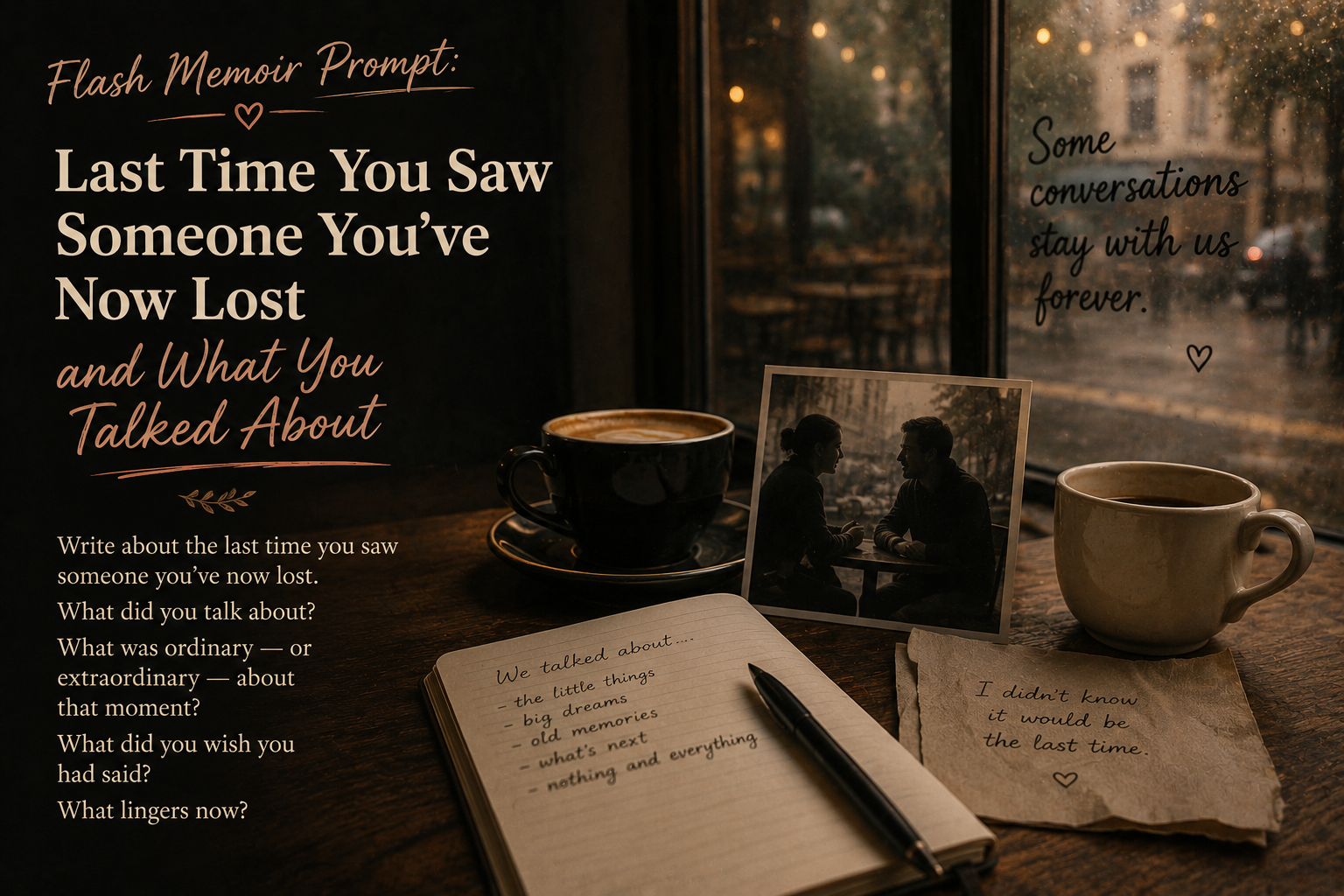
A focused flash memoir prompt for remembering the last time you saw someone you’ve now lost, using one small scene, one real conversation, and one honest emotional detail.

You may remember the room before you remember the words. The kitchen light. The smell of coffee. The coat they were wearing. The way you said goodbye without knowing it was the last time.

This flash memoir prompt last time saw someone you’ve lost asks you to return to that moment gently. You do not have to explain the whole relationship. You do not have to make the memory perfect. You only have to stand inside one brief scene and listen for what was said.

Flash Memoir Lost

The Prompt

Write about the last time you saw someone you’ve now lost, and what you talked about.

This prompt can open a powerful memory because last times often look ordinary while they are happening. We do not usually know they are last times. We talk about errands, weather, dinner, homework, bills, traffic, or some small family joke.

Later, those plain words can carry more weight. A casual goodbye becomes a sentence you replay. A question they asked may feel like a gift you did not notice at the time.

Why This Memory Matters

Writing about a final meeting is not only about grief. It can also be about surprise, regret, gratitude, or even the strange comfort of routine. The person may have died. They may have moved away. The loss may be from a breakup, a friendship that ended, or a family distance that never healed.

The story this prompt uncovers may be very quiet. Maybe nothing dramatic happened. Maybe you shared fries in a hospital cafeteria. Maybe your grandfather asked if your car had enough gas. Maybe a friend hugged you too quickly outside a train station, then walked away into a crowd.

That is what makes this kind of memory so rich for flash memoir. A small scene can hold a large truth. The conversation may seem simple on the surface, but the meaning has changed because you know what came after.

If you enjoy reading closely, this prompt works a little like annotating literature. You return to a moment and notice what you missed the first time. A pause, a gesture, a repeated phrase, or an object on the table may become the detail that helps the whole piece come alive.

How to Approach This Prompt

Begin with a physical detail instead of a full explanation. What do you see first when you bring the memory back? Their hands on a mug? The pattern on the hospital blanket? The screen door closing behind them?

Let that detail lead you into the scene. Keep the memory narrow. Do not try to write the whole history of your relationship in one page. Stay with the last time you saw them and let the reader learn through what happened there.

Try writing what you noticed before you explain what it meant. For example, instead of beginning with “I did not know this would be the last time,” you might begin with “She had lipstick on her front tooth, and I almost told her.” That kind of opening brings the reader into the room with you.

Once you have the scene, write the conversation as closely as you can. It is fine if you do not remember every word. You can write the shape of it. What topic did you circle around? What did they ask? What did you avoid saying?

This flash memoir prompt last time saw someone you’ve lost does not require a perfect ending. In fact, the strongest ending may be a small one. A wave. A door closing. A sentence you understand differently now.

If the person feels hard to write about, you might borrow a tool from character analysis: focus on one revealing action. What did they do in that final scene that shows who they were to you?

A Quick Example

The last time I saw my uncle, he was sitting on an upside-down bucket in his garage, sorting screws into baby food jars. He had always saved strange things, bent nails, cracked washers, rubber bands from newspapers that no one delivered anymore.

I stopped by to return a borrowed ladder. He asked if I was still writing “those little stories,” and I laughed because I thought he was teasing me. He said, “Don’t laugh. Somebody’s got to remember what people say.”

We talked about my car making a noise and whether rain was coming. When I left, he lifted one hand but did not get up. I remember thinking he looked tired. Now I remember the jars, each one labeled in his blocky handwriting, as if he were putting the world in order before he left it.

Try It Yourself

Set a timer for ten minutes and write the scene without stopping. Start with where you were. Then add the person’s face, voice, or hands. Let the conversation appear one line at a time.

You do not need to make the memory beautiful. You do not need to make yourself sound wise. Just write the moment as honestly as you can.

After you finish, look back at the piece and underline one sentence that feels true. That sentence may become your ending. It may also become the beginning of a longer memoir piece later.

If the memory feels tender, take your time. Step away if you need to. You can return tomorrow. A flash memoir prompt last time saw someone you’ve lost should give you a doorway, not push you through it too fast.

Want More Flash Memoir Prompts?

Explore all 365 prompts in The Memory Trigger: 365 Flash Memoir Writing Prompts. Each prompt is designed to help you capture one clear memory at a time, so your life stories feel specific, readable, and true.

The Memory Trigger

Important The Odyssey Quotes Explained: A Student Guide

Odyssey Quotes

A guide to memorable passages and how students can use them in essays.

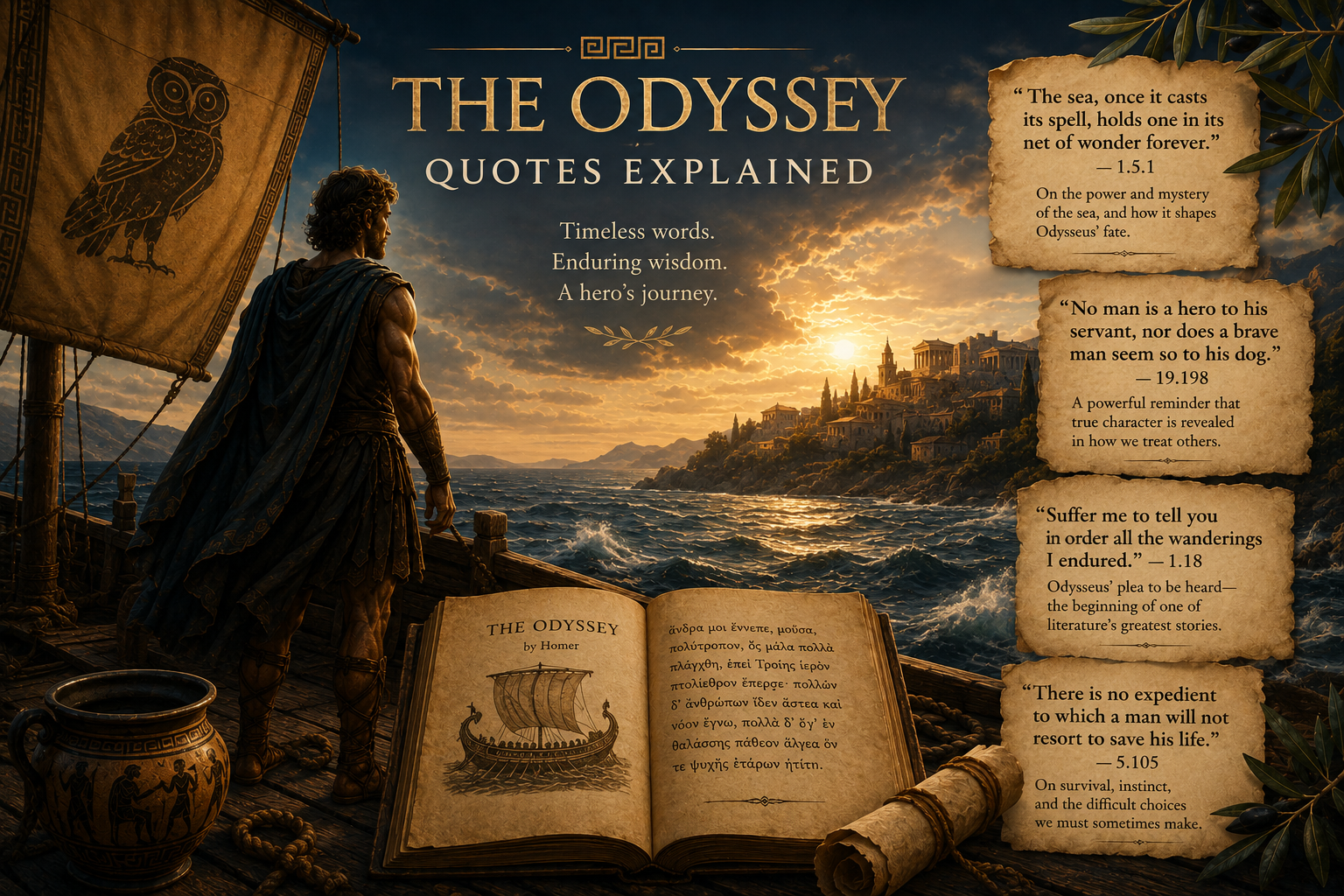
The Odyssey quotes explained can help students see how Homer builds a story about home, honor, loss, and wisdom. This guide uses short public-domain phrases when useful, then explains how each passage can support a strong essay claim.

In this Guide

Use this quick map to find the quote or skill you need.

  • Why the quotes matter
  • Identity and home
  • Pride and consequences
  • Loyalty and endurance
  • Essay tips for quote analysis
  • Books and resources
  • FAQ
Odyssey Quotes

Why The Odyssey quotes explained matter in essays

Great quotes do more than sound important. They reveal how a text thinks.

A useful set of The Odyssey quotes explained should connect each passage to a theme, a character choice, or a major conflict. In The Odyssey, those conflicts often come from temptation, pride, and the hard pull of home.

Homer also uses repeated ideas, such as storytelling and disguise. When you explain a quote, look for what changes in the character or what the line shows about the ancient Greek world.

The Odyssey quotes explained: identity and home

Odysseus spends much of the poem away from Ithaca, yet the idea of home shapes nearly every choice he makes.

“Tell me, O Muse…”

This short opening phrase comes from older public-domain translations of the poem. It shows that the epic begins with an invocation, which is a call for divine help in telling the story.

The line matters because it frames Odysseus as more than one man with a problem. His journey becomes a story about human weakness, clever thought, and survival.

When students search for The Odyssey quotes explained, this opening is one of the best places to start. You can use it to discuss the epic tradition and the role of fate.

“that ingenious hero”

Some public-domain translations describe Odysseus with this phrase. It points to his intelligence, which is often his greatest strength.

Odysseus wins many battles with words before he uses force. This is like Hamlet in Shakespeare’s Hamlet, where thought and speech shape action, even when the results turn painful.

In an essay, this quote can support a claim about Odysseus as a hero of the mind. He is not just brave. He survives because he studies people and adapts.

The Odyssey quotes explained: pride and consequences

Homer often shows that a hero’s strength can turn into a weakness.

“My name is Noman”

In the Cyclops episode, Odysseus uses a false name to escape danger. Older translations often give the name as “Noman,” while many modern classes use “Nobody.”

This moment shows his quick wit. He knows that language can become a weapon.

The quote also sets up a warning. Odysseus escapes through cleverness, but he later reveals too much and brings Poseidon’s anger on himself.

“I am Ulysses son of Laertes”

Older public-domain translations often use Ulysses for Odysseus. This line matters because he announces his true name after the Cyclops episode.

The moment feels heroic, but it also exposes his pride. Odysseus wants glory, and that desire costs him years of suffering.

This is a strong quote for an essay about heroic flaws. Like Achilles in The Iliad, Odysseus is great because of his passion, yet that same passion can harm him.

The Odyssey quotes explained: loyalty and endurance

The poem values cleverness, but it also honors patience and faithfulness.

Argus recognizes his master

Many students remember the scene with Argus, Odysseus’s old dog. The exact wording changes by translation, but the point is clear: Argus knows Odysseus when many people do not.

This scene is short, but it has deep emotional power. It shows that loyalty can outlast time, poverty, and disguise.

The Odyssey quotes explained often focus on Odysseus, but Argus can support a strong paragraph about recognition. Home is not only a place. It is also the bonds that still know you.

Penelope and the bed

Penelope tests Odysseus with the secret of their marriage bed. The scene proves that she is not passive or easily fooled.

Her test mirrors Odysseus’s own cleverness. Both of them use intelligence to protect what matters.

This moment works well in essays about marriage, trust, and identity. It also shows that the return home must be earned, not simply claimed.

How to use The Odyssey quotes explained in an essay

A quote should not sit in your paragraph like decoration. It should help prove your point.

The best The Odyssey quotes explained will follow a simple pattern: claim, quote, explanation, and link back to the thesis. If you need help with that structure, read our guide on how to write a literary analysis essay.

Here is a simple example:

Claim: Odysseus’s cleverness saves him, but his pride delays his return.

Quote: His false name, “Noman,” helps him escape the Cyclops.

Explanation: The name shows his gift for strategy. Yet after he escapes, he reveals his identity, which turns his success into a new danger.

Try to avoid a summary-only paragraph. Teachers want analysis, which means you explain why the words matter.

If you want a ready-to-use reference while you study, try our Odyssey quote study guide and pair it with your class notes.

The Odyssey quotes explained through major themes

The strongest quotes connect to themes that appear across the whole epic.

Home: Odysseus wants Ithaca, but he must learn restraint before he can fully return.

Pride: His desire for fame creates real danger, especially after the Cyclops episode.

Disguise: Odysseus’s hidden identity lets him test others before he acts.

Loyalty: Penelope, Telemachus, and Argus show that faithfulness has its own kind of courage.

Storytelling: Odysseus often survives by shaping how others see him. His words become part of his power.

Books and resources for The Odyssey quotes explained

Good background sources can help you understand the epic without replacing your own reading.

For a clear overview of the poem, visit Britannica’s article on The Odyssey. For the ancient Greek text and older translations, see the Perseus Digital Library.

Relevant books to search for

  • The Odyssey by Homer, translated by Emily Wilson
  • The Odyssey by Homer, translated by Robert Fagles
  • The World of Odysseus by M. I. Finley

Different translations use different wording, so always cite the version your class uses.

FAQ: The Odyssey quotes explained

Quick answers can help you choose the right passage for your essay.

What is the most important quote in The Odyssey?

The opening invocation is one of the most important because it sets up the epic style and introduces Odysseus as a complex hero.

Can I use a paraphrase instead of a quote?

Yes, but use direct quotes for key words or major moments. A short quote often gives stronger proof.

Why do translations of The Odyssey sound different?

Each translator makes choices about tone, rhythm, and word meaning. That is why your essay should name the translation you use.

What themes work best with Odysseus quotes?

Strong themes include home, pride, disguise, loyalty, and identity. Choose the one that fits your thesis.

Key takeaway

The best way to use The Odyssey quotes explained is to connect each phrase to a choice, a consequence, or a theme. A short quote with a clear explanation can make your essay sharper and more convincing.

Ekphrasis Poetry Prompt: The Empty Baseball Field

ekphrasis poetry prompt baseball

Sometimes the strongest poems begin with ordinary scenes. This ekphrasis poetry prompt invites you to look closely at a simple image: an empty baseball field, a lone baseball near home plate, and a faded red wagon waiting beside a fence. Nothing dramatic happens in the scene, yet it raises questions. Who left the wagon behind? Was a game interrupted? Has someone outgrown this place, or are they coming back tomorrow?

Ekphrastic poetry encourages writers to respond to visual art with imagination, emotion, and reflection. If you are new to the form, this ekphrasis poetry prompt offers plenty of room for interpretation.

ekphrasis poetry prompt baseball

Why This Ekphrasis Poetry Prompt Works

The image contains only a few objects, but each one carries symbolic possibilities. The baseball may represent childhood, competition, family traditions, or lost opportunities. The wagon could suggest work, play, memory, or transition. The empty field itself creates a feeling of absence.

Strong ekphrastic poems often emerge from unanswered questions. Instead of describing only what you see, consider what happened before the moment captured in the image and what might happen afterward.

If you would like help examining imagery and symbolism in poetry, see our guide on how to analyze poetry step by step:

Ekphrasis Poetry Prompt Questions

Use one or more of these questions to begin writing:

  • Who owns the wagon, and why was it left behind?
  • Is the baseball forgotten or intentionally placed there?
  • What memory does this field hold?
  • How has the place changed over time?
  • What emotions does the empty field create?
  • If the wagon could speak, what story would it tell?

You do not need to answer every question. Choose the one that sparks the strongest response.

Writing an Ekphrasis Poetry Prompt Response

Approach this ekphrasis poetry prompt from any angle that interests you.

You might write from the perspective of a child who spent every summer at the field. You could imagine an older person returning decades later. Perhaps the wagon becomes a symbol of a friendship that faded. The field may represent a dream that never came true or a season of life that passed too quickly.

Pay close attention to sensory details. What does the dirt smell like? What sounds remain when the crowd is gone? Or what does the afternoon light reveal?

For inspiration on poetic techniques, explore the Academy of American Poets:

https://poets.org

You may also find our guide to literary devices in poetry helpful:

Ekphrasis Poetry Prompt Challenge

Write a poem without mentioning baseball directly.

Allow the wagon, fence, grass, and empty space to carry the emotional weight. See how much meaning you can create through suggestion rather than explanation.

The most memorable poems often emerge from ordinary objects that reveal extraordinary human experiences. This simple scene offers exactly that opportunity.

error

Enjoy this article? Please spread the word :)

Follow by Email
BLUESKY
fb-share-icon
Reddit
LinkedIn
Share
RSS