Symbol vs Motif Explained: A Clear Guide for Literature Students

symbol vs motif
symbol vs motif

Symbol vs Motif Explained is a topic that can confuse even strong readers. Both symbols and motifs add deeper meaning to a story, but they work in different ways.

Once you know the difference, literary analysis gets much easier. You can point to better evidence and explain why an author repeats certain images, objects, or ideas.

In this Guide

Use this guide to move from basic definitions to stronger literary analysis.

What Is a Symbol?

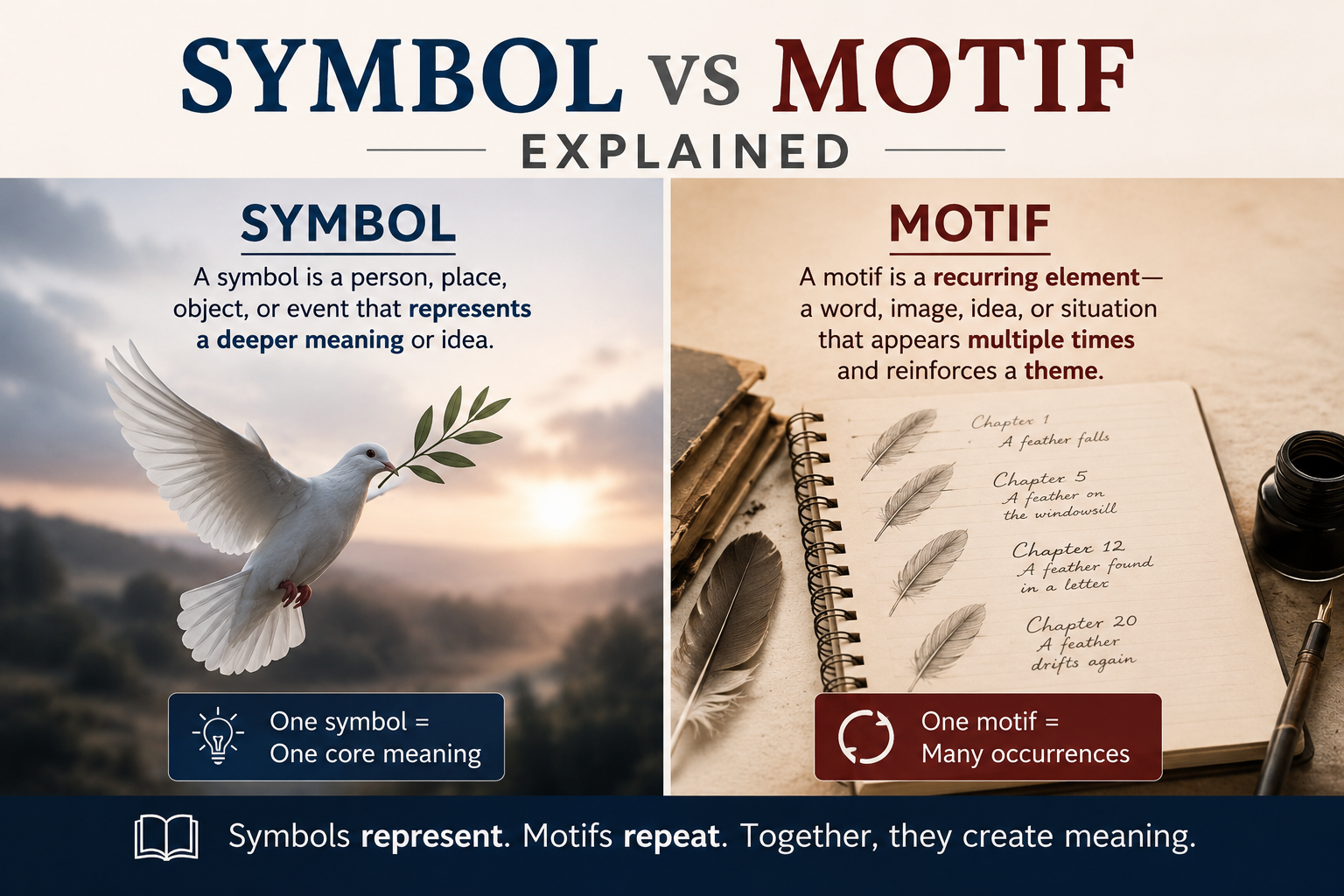
A symbol is something in a story that stands for a larger idea.

A symbol can be an object, place, person, color, animal, or action. It has a literal role in the story, but it also points to a deeper meaning.

For example, in The Great Gatsby, the green light at the end of Daisy’s dock is a symbol. It is a real light, but it also stands for Gatsby’s dream, hope, and desire for a future he may never reach.

In Lord of the Flies, the conch shell is a symbol of order and shared rules. When the conch loses power, the boys’ society falls apart.

If you want more help with this part, read our guide on how to find symbolism in a story.

What Is a Motif?

A motif is a repeated element that helps build a theme.

A motif can be a repeated image, phrase, object, situation, sound, or idea. The key word is repeated. A motif shows up more than once and gains meaning over time.

In Macbeth, blood is a major motif. It appears after murder, during guilt, and in moments of fear. Each return of blood reminds us of violence and moral damage.

In To Kill a Mockingbird, mockingbirds form a motif linked to innocence. The idea returns through Tom Robinson, Boo Radley, and the lesson that it is wrong to harm those who do no harm.

Symbol vs Motif Explained: The Main Difference

The simplest difference is this: a symbol means something, while a motif repeats something.

Symbol vs Motif Explained comes down to function. A symbol is often one meaningful thing. A motif is a pattern that appears across the text.

A symbol can appear only once and still matter. A motif must return often enough for readers to notice a pattern.

Think of it this way: the green light in The Great Gatsby is a symbol. The repeated focus on wealth, parties, cars, and status creates motifs tied to the American Dream and social class.

A symbol can also become part of a motif. If the same symbol appears again and again, it may help form a larger pattern.

Symbol vs Motif Explained Through Literature Examples

Examples make the difference easier to see.

In Romeo and Juliet, light and dark images appear often. Romeo calls Juliet the sun, and the lovers often meet at night. This repeated contrast is a motif because it appears across the play.

The poison near the end of the play works more like a symbol. It stands for the deadly results of hate, secrecy, and rash choices.

In The Scarlet Letter, the letter “A” is a symbol. It stands for shame at first, but its meaning shifts as Hester changes in the eyes of her community.

The repeated focus on public judgment, hidden sin, and watching eyes creates motifs. These patterns help develop the novel’s themes about guilt and social control.

Symbol vs Motif Explained works best when you ask two questions: What does this thing mean? Does it repeat across the text?

How to Use Symbol vs Motif Explained in Literary Analysis

Good analysis does more than name a symbol or motif.

When you write about a symbol, explain its literal role first. Then explain the deeper idea it suggests.

For example: In The Great Gatsby, the green light is a real dock light, but it also represents Gatsby’s dream of winning Daisy and remaking the past.

When you write about a motif, track the pattern. Show where it appears and explain how its meaning grows.

For example: In Macbeth, the blood motif begins with battle and bravery, then shifts toward murder, guilt, and fear.

If you are writing an essay, connect the symbol or motif to a theme. A theme is the larger message about life, society, or human nature.

Here is a simple sentence frame you can use:

The repeated image of blood in Macbeth forms a motif that reveals how guilt follows violent ambition.

This is where Symbol vs Motif Explained becomes useful. It helps you move from “I noticed this” to “I understand why it matters.”

Common Mistakes to Avoid

Many students mix up symbols, motifs, and themes.

A symbol is not the same as a theme. A symbol points to a deeper idea, but the theme is the message the story builds.

A motif is not just “anything that appears.” It needs to repeat in a meaningful way.

Do not call every object a symbol. Sometimes a chair is just a chair. Look for clues like strong description, repeated focus, character reaction, or placement at a key moment.

You can also use our guide to spot symbolism in fiction if you need a clearer method.

Helpful Books for Studying Symbols and Motifs

These books can help you practice close reading and literary analysis.

  • How to Read Literature Like a Professor by Thomas C. Foster
  • The Great Gatsby by F. Scott Fitzgerald

How to Read Literature Like a Professor is useful for learning common patterns in fiction. The Great Gatsby is a strong choice because it has clear symbols, motifs, and themes.

Useful External Resources

Trusted literature sites can help you review key terms.

The Poetry Foundation glossary is a helpful place to check literary terms. You can also explore Britannica’s overview of literature for broader context.

FAQ: Symbol vs Motif Explained

Here are quick answers to common student questions.

What is the easiest way to tell a symbol from a motif?

A symbol stands for a deeper idea. A motif is a repeated pattern that helps build a theme.

Can a symbol also be a motif?

Yes. If a symbol appears again and again, it can become part of a motif.

Is a motif the same as a theme?

No. A motif is a repeated element. A theme is the larger message the author develops.

Why does this difference matter in essays?

It helps you write more precise analysis. You can explain whether an author uses one powerful image or a repeated pattern.

Key Takeaway

Symbol vs Motif Explained is really about meaning and pattern. A symbol points to a deeper idea, while a motif repeats to build a larger theme.
What Is a Motif in Literature?

Motif in Literature
Motif in Literature

What Is a Motif in Literature?

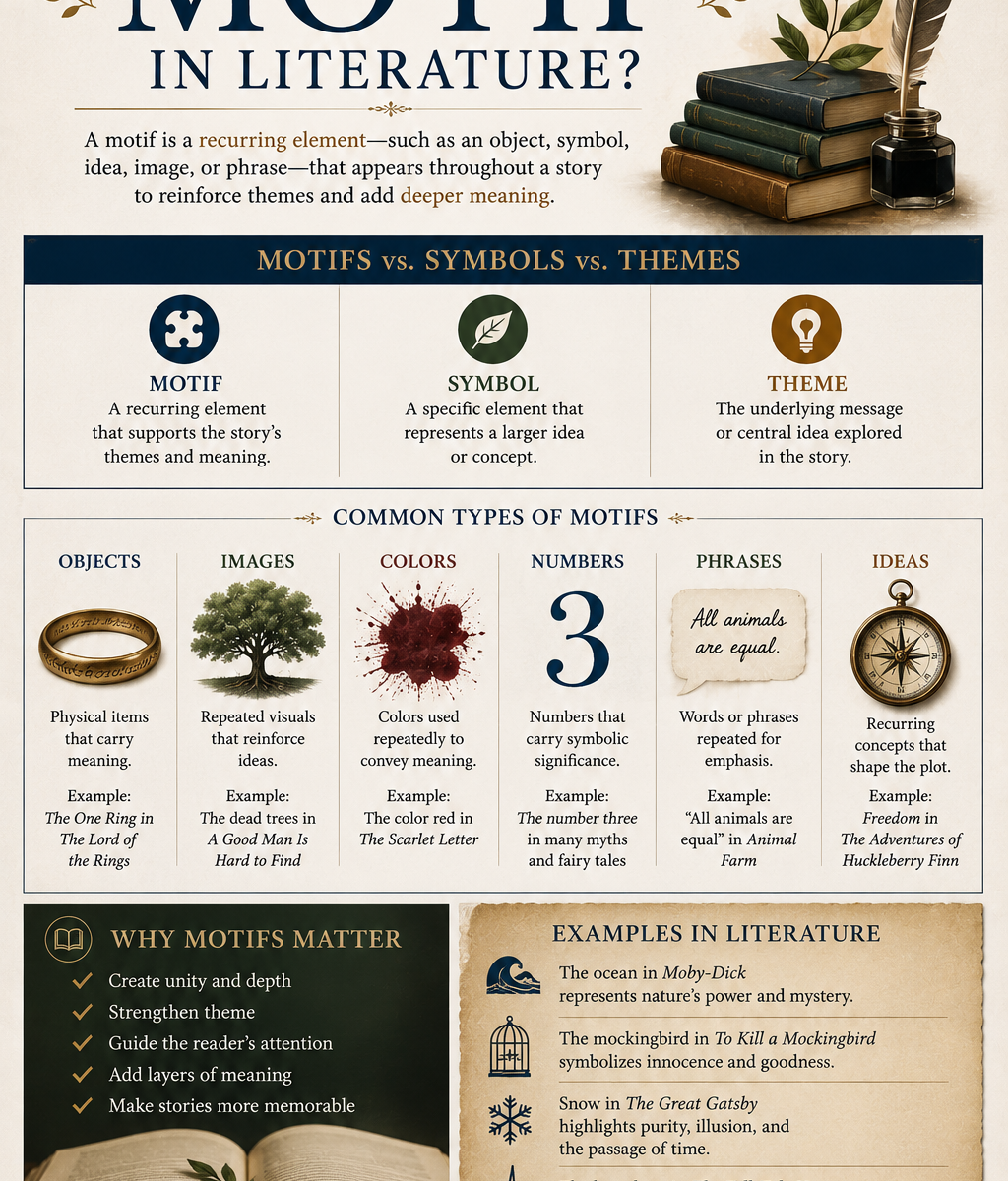
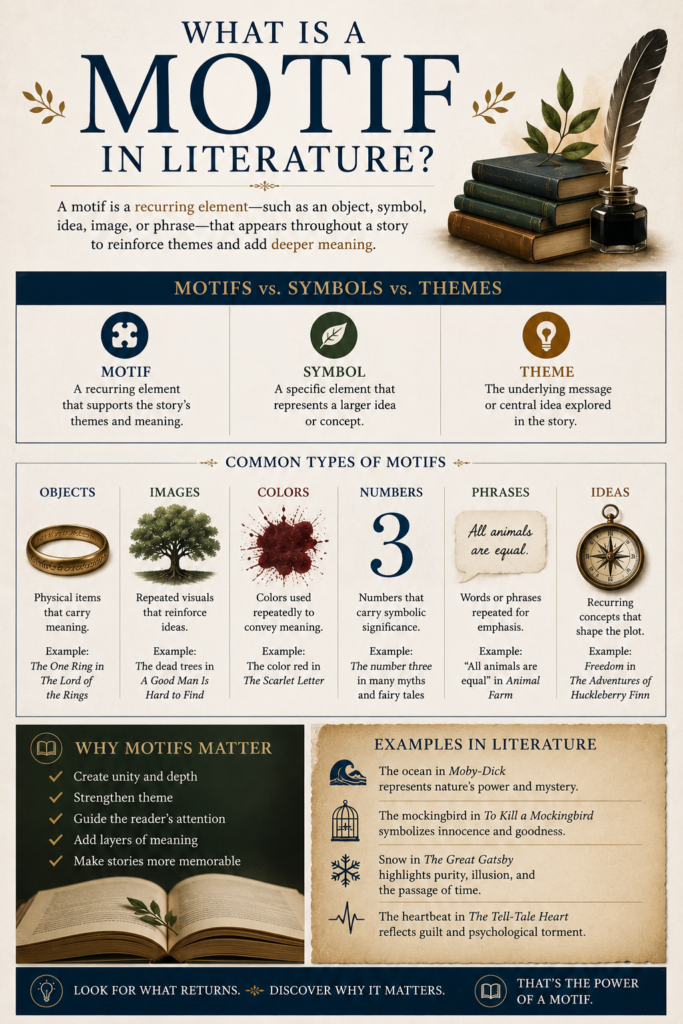
What Is a Motif in Literature? A motif is a repeated detail, image, word, object, or idea that helps build meaning in a story.

Once you know how to spot motifs, you can see how authors guide readers toward deeper themes without stating them directly.

In this Guide

  • What a motif means
  • Why motifs matter
  • Motif vs. theme
  • Famous motif examples
  • How to spot motifs while reading
  • Books that help you practice
  • FAQ

What Is a Motif in Literature? A Simple Definition

A motif is a repeated pattern that adds meaning to a text.

A motif can be an object, color, phrase, sound, place, or action that appears more than once. It is not random. The author repeats it for a reason.

The answer to What Is a Motif in Literature? is simple: it is a clue that points toward a larger idea.

For example, if a novel keeps showing locked doors, the motif may suggest secrets, fear, or limits. The door itself matters, but the repeated pattern matters more.

Why Motifs Matter in Literature

Motifs help readers notice what a story is really about.

Authors use motifs to connect scenes that may seem separate. A repeated image can remind you of a character’s struggle or a story’s main conflict.

Motifs also make literature feel richer. They give a text shape and rhythm. When a motif appears again, it often carries more meaning than it did before.

This is why teachers often ask students to track repeated details. A motif can lead you straight to a strong theme statement.

If you want to compare motifs with other tools writers use, this literary devices list is a helpful place to start.

What Is a Motif in Literature? Motif vs. Theme

A motif repeats. A theme reveals a message.

This is one of the most common points of confusion. A motif is a pattern inside the story. A theme is the deeper idea the story explores.

Think of it this way: rain might be a motif. The theme might be that grief changes how people see the world.

In Macbeth, blood appears again and again. Blood is a motif. It connects to themes of guilt, violence, and moral collapse.

You can read more about Shakespeare’s play through Britannica’s overview of Macbeth.

What Is a Motif in Literature? Common Examples Students Know

Many famous books use motifs that are easy to recognize once you look for them.

In The Great Gatsby by F. Scott Fitzgerald, the green light is a key motif. It appears across the water and comes to represent Gatsby’s hope, longing, and dream of a perfect future.

In To Kill a Mockingbird by Harper Lee, mockingbirds act as a motif tied to innocence. The repeated idea helps readers think about who gets harmed even when they have done no wrong.

In Lord of the Flies by William Golding, the conch shell becomes a motif connected to order and rules. As the boys lose respect for it, their society begins to break apart.

In poetry, a repeated image can work the same way. The Poetry Foundation offers many poems where repeated images carry meaning. You can explore examples at the Poetry Foundation.

How a Motif Builds Theme

A motif often acts like a bridge between details and big ideas.

When a writer repeats a detail, that detail starts to collect meaning. By the end of the story, it may reveal something about love, power, identity, or fear.

For example, a story may repeat images of mirrors. At first, they may seem like simple objects. Later, they may connect to a character’s struggle with self-image or truth.

This is why motifs are useful in essays. They give you evidence you can point to. You can quote the repeated detail, then explain how it supports the theme.

How to Spot a Motif While Reading

Look for details that return at important moments.

When students ask, What Is a Motif in Literature?, the best answer is often found through practice. Notice what keeps coming back.

Pay attention to repeated colors, objects, phrases, weather, places, or actions. Then ask what those details seem to suggest.

A good test is this: if the detail appeared only once, it might just be description. If it returns and gains meaning, it may be a motif.

For more help with related terms, see this guide to common literary devices.

Books to Practice Finding Motifs

These books make motif practice clear and useful.

  • The Great Gatsby by F. Scott Fitzgerald
  • Macbeth by William Shakespeare

Both texts use repeated images in ways that connect strongly to theme. They are also common in high school and college literature classes.

FAQ: What Is a Motif in Literature?

What is a motif in literature in simple words?

A motif is something that repeats in a story and helps create meaning. It can be an image, object, word, or idea.

How is a motif different from a symbol?

A symbol stands for something beyond itself. A motif repeats across the text and often includes symbols, images, or ideas.

Can a character be a motif?

A character is usually not a motif. But a repeated action, phrase, or role connected to a character can become one.

Why do teachers ask about motifs?

Motifs help students find themes. They also give strong evidence for literary analysis essays.

What Is a Motif in Literature? Why should I care?

It helps you read with more insight. Motifs show how small details connect to the story’s bigger message.

Key Takeaway

What Is a Motif in Literature? It is a repeated detail that helps reveal deeper meaning.

Here is a simple reading tip: when something shows up more than once, mark it. Then ask, “What idea does this pattern point toward?” That question can lead you to a stronger analysis.

Internal vs External Conflict Explained: A Student Guide to Literary Conflict

Internal vs External Conflict

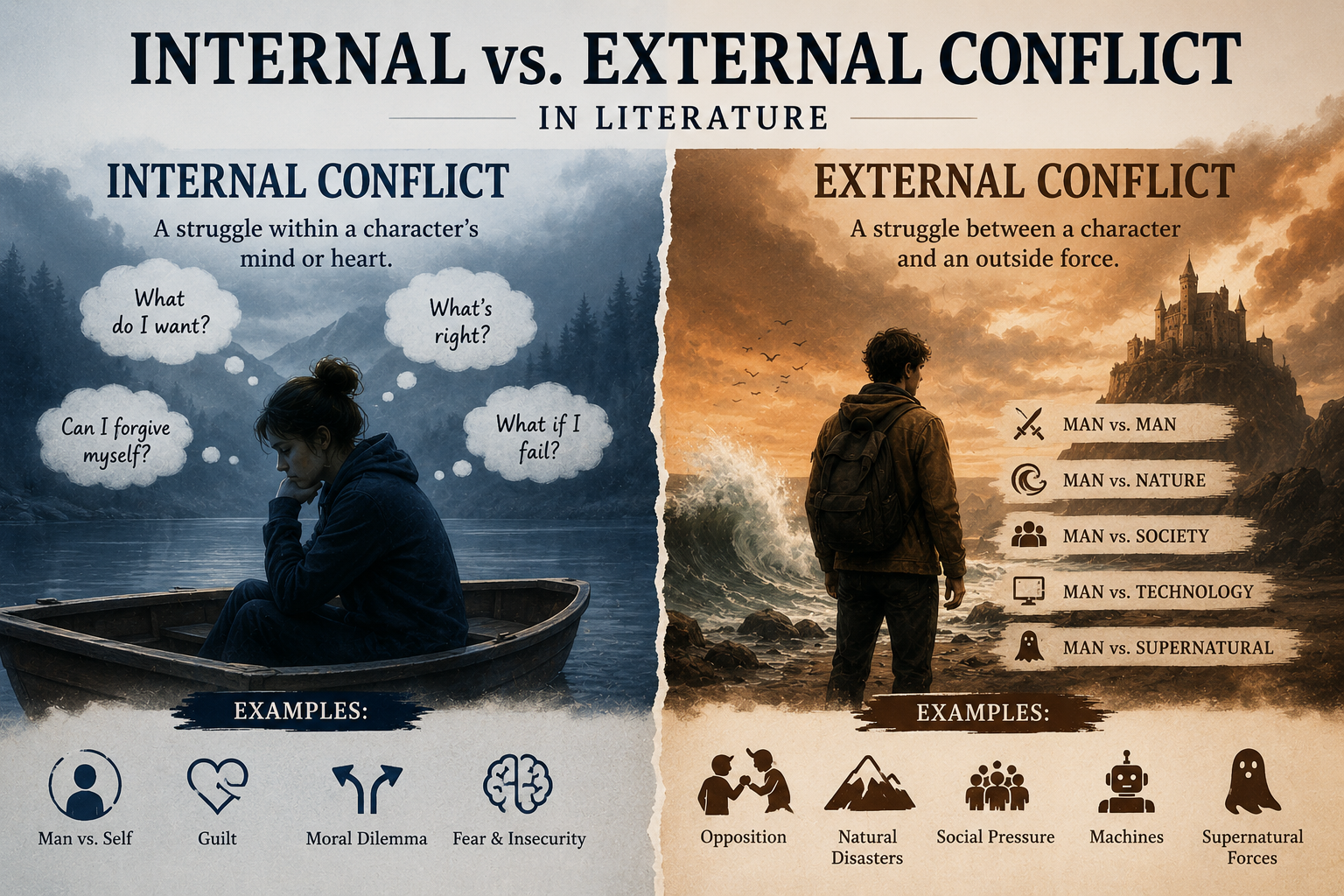
If a story feels tense, conflict is usually the reason. Internal vs External Conflict Explained helps you see whether a character struggles inside their own mind or against a force outside them.

This guide explains the difference in plain language, shows examples from literature, and helps you use conflict in stronger essays.

In this Guide

Internal vs External Conflict

Internal vs External Conflict Explained: The Basic Difference

Conflict is the struggle that drives a story forward.

An internal conflict happens inside a character. It may involve guilt, fear, doubt, desire, or a hard choice.

An external conflict happens between a character and an outside force. That force may be another person, society, nature, or fate.

The easiest way to keep Internal vs External Conflict Explained in your mind is this: internal conflict is private, while external conflict is visible.

A character can have both at the same time. In fact, many strong stories use both because outer problems often expose inner struggles.

What Is Internal Conflict?

Internal conflict is a battle within the character.

A character may want two things that cannot both happen. They may feel pressure to act, but fear the result.

In Shakespeare’s Hamlet, Hamlet struggles with grief, anger, doubt, and the need for revenge. His outer problem is Claudius, but his inner problem is his own hesitation.

That inner struggle makes him more complex. He is not just a prince with a mission. He is a person trapped by thought, pain, and fear.

You can read more about the play through Britannica’s overview of Hamlet.

What Is External Conflict?

External conflict is a struggle against something outside the character.

This kind of conflict is often easier to spot. A character may fight a villain, face unfair laws, survive a storm, or resist social pressure.

In The Hunger Games by Suzanne Collins, Katniss faces the Capitol, the arena, and the other tributes. These are external conflicts because they exist outside her mind.

Yet Katniss also has internal conflict. She must decide how far she will go to survive without losing her sense of right and wrong.

That mix of inner and outer pressure is one reason the story feels so intense.

Internal vs External Conflict Explained Through Literary Examples

Examples make the difference much easier to see.

In Macbeth, Macbeth’s external conflict includes battles, enemies, and threats to his power. His internal conflict comes from ambition, guilt, and fear.

His wife pushes him toward murder, but the deepest struggle happens inside him. He knows what he wants, but he also knows the cost.

In The Great Gatsby, Gatsby’s external conflict includes class barriers and his rivalry with Tom Buchanan. His internal conflict comes from his dream of repeating the past.

This is where Internal vs External Conflict Explained becomes useful. Gatsby’s real tragedy is not only that society blocks him. It is also that he cannot let go of an impossible dream.

For helpful background, see Britannica’s entry on The Great Gatsby.

Internal vs External Conflict Explained for Essay Analysis

Conflict helps you move from plot summary to real analysis.

Use Internal vs External Conflict Explained as a lens. Do not just say what happens. Ask what the conflict reveals about the character, theme, or author’s message.

Start by asking where the pressure comes from. Is it inside the character, outside the character, or both?

Then ask what choice the character faces. A good conflict usually forces a decision, even if the character avoids it for a while.

You can also ask how the conflict changes the character. Does the character grow, break, lie to themselves, or see the world more clearly?

For a deeper method, try our guide on how to read literature like a scholar. It can help you connect conflict to symbols, themes, and character arcs.

Common Mistakes in Internal vs External Conflict Explained

The most common mistake is treating every problem as the same kind of conflict.

If a character feels guilty, that is internal. If a character is chased by an enemy, that is external.

Another mistake is ignoring how the two types connect. A storm, war, or argument may create pressure, but the character’s response can reveal fear, pride, or guilt.

Strong essays often explain that link. The outer conflict shows what the character faces. The inner conflict shows who the character is.

Amazon Books That Show Conflict Well

These books are useful if you want to study conflict in action.

  • Macbeth by William Shakespeare: A strong example of ambition, guilt, and violence.
  • The Hunger Games by Suzanne Collins: A clear example of survival, power, and moral choice.

You can find these titles on Amazon, at school libraries, or through most public library systems.

FAQ: Internal vs External Conflict Explained

What is the main difference between internal and external conflict?

Internal conflict happens inside a character’s mind or heart. External conflict happens between a character and an outside force.

Can a story have both types of conflict?

Yes. Most strong stories use both. The external conflict creates pressure, while the internal conflict shows how the character reacts.

Why is Internal vs External Conflict Explained important for essays?

It helps you write about more than plot. You can explain how conflict reveals theme, character, and meaning.

Is fear an internal or external conflict?

Fear itself is internal. The thing causing the fear may be external, such as a villain, law, storm, or social rule.

Key Takeaway

Internal vs External Conflict Explained comes down to where the struggle happens. Internal conflict is inside the character, external conflict comes from outside, and the best analysis often shows how both work together.

Types of Conflict in Literature: A Student Guide with Clear Examples

Types of Conflict in Literature

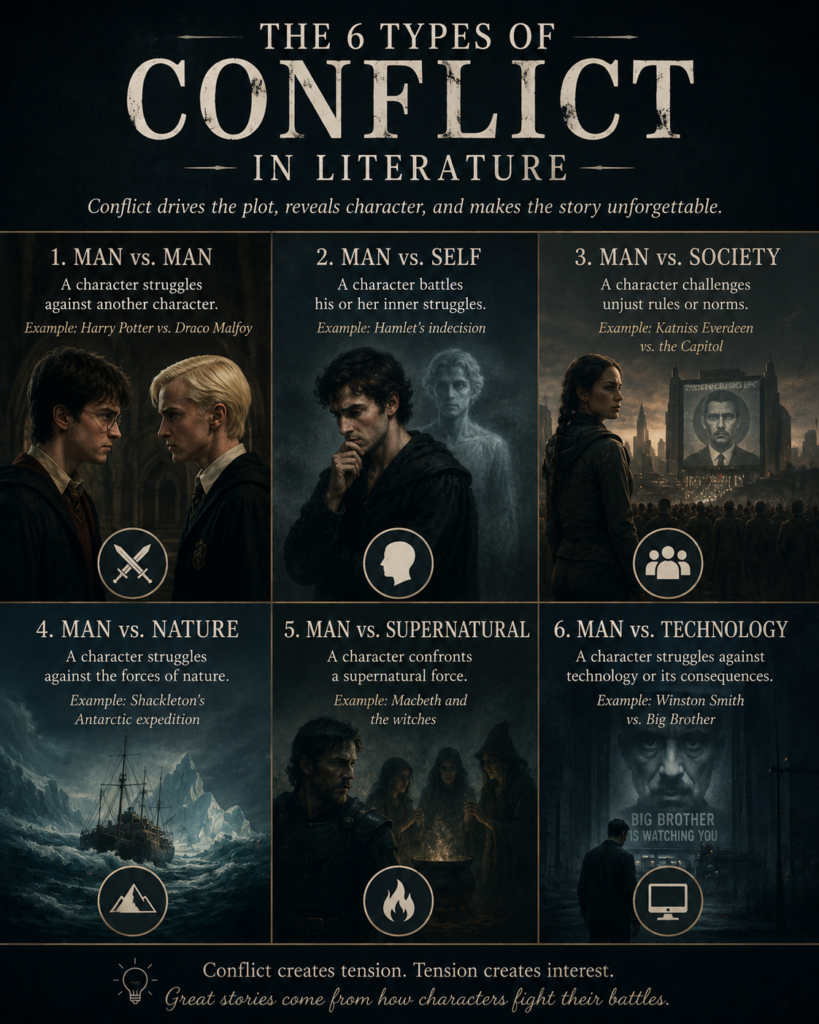
Understanding the Types of Conflict in Literature makes stories easier to read and analyze. Conflict is the struggle that pushes a character to act, change, or fail.

When you know what kind of conflict drives a story, you can write stronger essays and choose books that fit your interests.

In this Guide

Use this guide to move from basic definitions to real literary examples.

  • Why conflict matters in literature
  • The main types of conflict
  • Internal conflict
  • External conflict
  • How to identify conflict in a text
  • Examples from popular books
  • Book suggestions
  • FAQ
Types of Conflict in Literature

Why Types of Conflict in Literature Matter

Conflict gives a story its energy.

Without conflict, a story can feel flat. A character may want something, but there must be a problem in the way.

When students study the Types of Conflict in Literature, they learn to ask better questions. What does the character want? Who or what blocks that goal? What changes because of the struggle?

Conflict also helps reveal theme. In Romeo and Juliet, the conflict between the lovers and their families shows how hate can destroy love. In To Kill a Mockingbird, the conflict between justice and racism helps readers see the cost of doing what is right.

The Main Types of Conflict in Literature

Most stories use more than one conflict, but one usually stands out.

The Types of Conflict in Literature can be split into two broad groups: internal conflict and external conflict.

Internal conflict happens inside a character. The character may face fear, guilt, doubt, or a hard choice.

External conflict happens between a character and an outside force. That force may be another person, a group, nature, technology, fate, or something supernatural.

Many great books combine both. A character may fight an enemy while also fighting fear inside their own mind.

Internal Conflict: Character vs. Self

This type of conflict takes place inside the character’s mind or heart.

In a character vs. self conflict, the main struggle is personal. The character may not know what choice to make. They may feel torn between what they want and what they believe is right.

In Hamlet by William Shakespeare, Hamlet struggles with grief, revenge, and doubt. His enemy is not only Claudius. Hamlet also battles his own thoughts.

In The Catcher in the Rye by J.D. Salinger, Holden Caulfield struggles with sadness and fear of growing up. Much of the novel’s conflict comes from his inner pain.

This conflict is useful in essays because it often connects to character growth. Ask yourself: does the character learn from the struggle, or do they stay trapped?

External Conflict: Character vs. Character

This conflict happens when one character blocks another character’s goal.

Character vs. character conflict is common because people often disagree, compete, or hurt each other. The conflict can be physical, emotional, or moral.

In Harry Potter and the Sorcerer’s Stone by J.K. Rowling, Harry faces Voldemort as a major outside threat. Their conflict grows across the series as Harry learns more about courage and sacrifice.

In Othello by William Shakespeare, Iago works against Othello through lies and manipulation. The conflict is not just about power. It also shows how jealousy can break trust.

When you see this conflict, look at what each character wants. The clash between their goals often drives the plot.

External Conflict: Character vs. Society

This conflict places one person against the rules or beliefs of a group.

In character vs. society conflict, the problem is larger than one enemy. The character may face unfair laws, social pressure, prejudice, or strict traditions.

In The Hunger Games by Suzanne Collins, Katniss Everdeen fights against the Capitol’s cruel control. Her conflict is not only with individual villains. She faces a whole system built on fear.

In Fahrenheit 451 by Ray Bradbury, Guy Montag lives in a society that burns books. His conflict grows when he starts to question the world around him.

This is one of the most powerful Types of Conflict in Literature because it often asks moral questions. What should a person do when society is wrong?

External Conflict: Character vs. Nature

This conflict happens when a character struggles against the natural world.

Nature can include storms, hunger, cold, wild animals, or disease. The key point is that the character faces a force that cannot be reasoned with.

In The Old Man and the Sea by Ernest Hemingway, Santiago struggles with the sea and a great marlin. His battle shows patience, pride, and human endurance.

In Hatchet by Gary Paulsen, Brian must survive alone in the wilderness after a plane crash. The natural world tests his body and mind.

Character vs. nature stories often focus on survival. They may also show how small humans can feel when faced with forces beyond control.

External Conflict: Character vs. Technology

This conflict focuses on machines, science, or systems created by humans.

Character vs. technology is common in science fiction, but it can appear in other genres too. The conflict may involve artificial intelligence, surveillance, weapons, or a machine that changes human life.

In Frankenstein by Mary Shelley, Victor Frankenstein creates life through science and then loses control of what he has made. The novel asks if humans should create something just because they can.

In many dystopian stories, technology helps those in power control people. The danger is not only the machine. The danger is how people use it.

This type of conflict is useful for modern readers because it connects to real questions about privacy, power, and responsibility.

External Conflict: Character vs. Fate or the Supernatural

This conflict involves forces that feel beyond normal human power.

A character may face destiny, prophecy, ghosts, gods, curses, or unseen forces. The struggle often asks whether people control their lives or follow a path already set for them.

In Macbeth by William Shakespeare, the witches give Macbeth a prophecy. He chooses violent actions, but the supernatural pushes him toward ambition and fear.

In Greek tragedy, fate often plays a major role. You can learn more about the tradition of tragic drama through Britannica’s overview of tragedy.

This conflict works well in analysis because it blends choice and pressure. Ask whether the character causes the downfall or becomes trapped by forces outside human control.

How to Identify Types of Conflict in Literature

You can find conflict by tracking what the character wants and what stands in the way.

A quick way to spot the Types of Conflict in Literature is to focus on the main problem. If the problem comes from inside the character, it is internal. If the problem comes from outside, it is external.

Try asking these questions as you read:

  • What does the main character want?
  • What blocks that goal?
  • Is the struggle inside the character or outside the character?
  • Does the conflict change the character?
  • What larger idea does the conflict reveal?

If you want to build stronger reading habits, this guide on how to read literature like a scholar can help you notice deeper patterns in a text.

Types of Conflict in Popular Books

Well-known books often use several conflicts at once.

In Lord of the Flies by William Golding, the boys face nature on the island, but their deeper conflict is with each other and their own fear. The novel shows how quickly order can fall apart.

In Things Fall Apart by Chinua Achebe, Okonkwo faces personal pride, family pressure, and the arrival of colonial power. His conflicts help reveal the strain between tradition and change.

In The Great Gatsby by F. Scott Fitzgerald, Gatsby struggles against class barriers and his own dream of the past. The conflict shows how desire can turn into illusion.

These examples show why the Types of Conflict in Literature matter for essays. Conflict is rarely just a problem. It is often the key to the book’s meaning.

How Conflict Shapes Theme

Conflict and theme often work together.

Theme is the message or insight a story gives about life. Conflict helps create that message because characters reveal who they are under pressure.

In Animal Farm by George Orwell, the animals fight against human control, but they later face corruption inside their own new society. The conflict helps show how power can twist noble ideas.

In The Odyssey, Odysseus faces monsters, storms, and temptation. His long journey shows the value of loyalty and cleverness.

When you write about the Types of Conflict in Literature, do not stop at naming the conflict. Explain what it teaches the reader.

Common Mistakes Students Make with Types of Conflict in Literature

Many students can name conflict, but strong analysis goes one step deeper.

One common mistake is to choose the first conflict that appears. A story may start with one problem but focus on a deeper one later.

Another mistake is to ignore internal conflict. A character may seem to fight a person or society, but the real struggle may be fear, guilt, or pride.

Students also sometimes list the conflict without linking it to theme. A better answer explains how the conflict changes the character or reveals the author’s message.

For deeper reading practice, use scholar-style reading strategies to connect conflict with symbols, setting, and character choices.

Books That Help You Study Conflict

These books are strong choices for students who want clear examples of conflict.

  • Lord of the Flies by William Golding
  • Things Fall Apart by Chinua Achebe

Both novels are often available through school libraries, local bookstores, and Amazon. They also work well for essays because each book includes internal and external conflict.

Helpful Outside Resources

Use trusted literary sources when you need background or context.

The Poetry Foundation is useful for poems, poet biographies, and literary terms. Britannica also offers clear background on major forms, authors, and literary history.

FAQ About Types of Conflict in Literature

Here are quick answers to common student questions.

What are the main Types of Conflict in Literature?

The main types are internal conflict and external conflict. External conflict can include character vs. character, society, nature, technology, fate, or the supernatural.

Can a story have more than one conflict?

Yes. Most strong stories use more than one conflict. One conflict may drive the plot, while another shows the character’s inner struggle.

Why is conflict important in a story?

Conflict creates tension and gives characters a reason to act. It also helps reveal theme and character growth.

How do I write about conflict in an essay?

Name the conflict, give a clear example, and explain why it matters. Connect it to the character’s change or the story’s main idea.

Key Takeaway

The Types of Conflict in Literature help readers see what drives a story. Once you understand the main struggle, you can better explain character, theme, and meaning.

What Is Tone in Writing? A Beginner-Friendly Guide

What is tone in writing

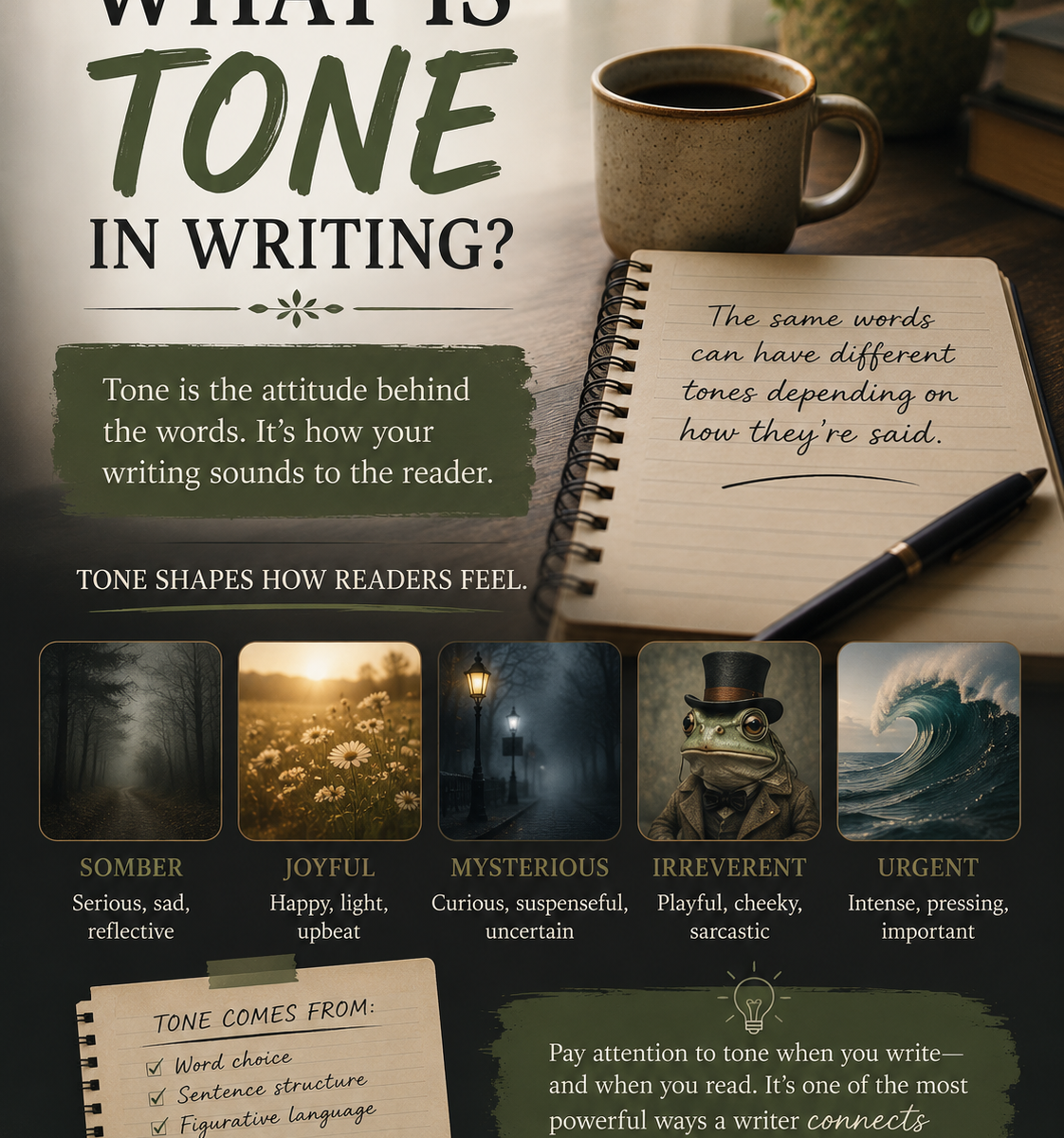
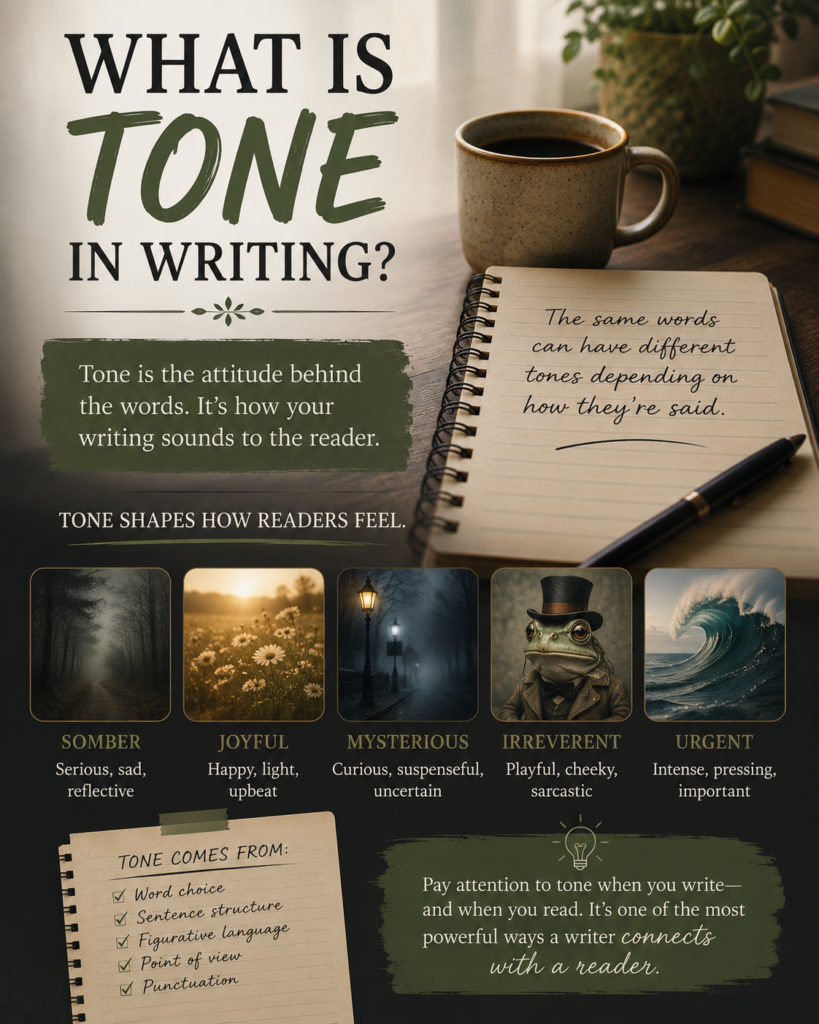
What Is Tone in Writing? It is the attitude a writer shows toward a subject, character, or audience.

Tone helps readers hear the “voice” behind the words. It can make a story feel serious, playful, angry, hopeful, or cold.

In this Guide

What is tone in writing

What Is Tone in Writing?

Tone is the writer’s attitude.

A simple answer to What Is Tone in Writing? is this: tone shows how the author feels about what is happening. That feeling comes through word choice, sentence style, details, and dialogue.

For example, a narrator might describe a storm as “wild and beautiful.” That sounds excited or impressed. Another narrator might call the same storm “cruel and endless.” That sounds fearful or bitter.

Tone is not always direct. A writer may never say, “I feel angry.” Instead, the anger appears in sharp words, short sentences, or harsh images.

What Is Tone in Writing? Why It Matters in Literature

Tone changes how readers understand a scene.

When students ask What Is Tone in Writing?, they are really asking how a writer guides our reaction. Tone can make a character seem foolish, brave, selfish, or kind.

In literature, tone also helps reveal theme. A sad tone may show loss. A mocking tone may point out pride or weakness. A hopeful tone may suggest that change is possible.

On an essay or AP Literature exam, tone is often the key to a strong analysis. If you can explain the tone, you can explain how the author creates meaning.

What Is Tone in Writing? Examples from Famous Literature

Examples make tone easier to hear.

In Edgar Allan Poe’s “The Tell-Tale Heart,” the tone is tense and nervous. The narrator keeps trying to prove he is sane, but his words make him sound more unstable.

In Jane Austen’s Pride and Prejudice, the tone is often witty and ironic. Austen gently mocks pride, social rules, and quick judgments.

In George Orwell’s 1984, the tone is bleak and serious. The cold language helps readers feel the danger of a world where the government controls truth.

The best way to answer What Is Tone in Writing? is to look at how the author’s attitude shapes each passage. Tone is not just what happens. It is how the writing feels about what happens.

What Is Tone in Writing? Tone vs. Mood

Mood and tone are related, but they are not the same.

Tone is the author’s attitude. Mood is the feeling created in the reader.

For example, a story might have a fearful tone because the narrator describes danger with panic. That tone can create a scary mood for the reader.

If you want a deeper breakdown, read our guide on tone vs. mood in literature.

What Is Tone in Writing? How to Spot It While Reading

You can find tone by paying close attention to small choices.

Start with word choice. Ask if the words sound warm, cold, respectful, bitter, excited, or calm.

Then look at sentence style. Short sentences can sound tense or blunt. Longer sentences can feel thoughtful or emotional, depending on the words around them.

Dialogue also gives clues. A character who says, “How wonderful,” may sound sincere in one scene and sarcastic in another.

When you ask What Is Tone in Writing?, do not stop at naming a tone word. Always connect that word to proof from the text.

Common Tone Words Students Can Use

Tone words help you describe the author’s attitude with more care.

  • Serious
  • Playful
  • Angry
  • Hopeful
  • Mocking
  • Sad
  • Respectful
  • Suspicious

Try to avoid vague words like “good” or “bad.” A stronger tone word makes your analysis clearer.

A Practical Tip for Reading Tone

Use this quick method when you read a passage.

Circle two or three words that show attitude. Then write one tone word in the margin.

After that, ask: “How does this tone affect the meaning of the passage?” This turns a simple observation into real literary analysis.

For more help with poetry terms, the Poetry Foundation’s glossary entry on tone is a useful resource. You can also explore broad literary background through Britannica’s overview of literature.

Helpful Books to Read for Tone

These books are useful for seeing tone in action.

  • Pride and Prejudice by Jane Austen
  • 1984 by George Orwell

As you read, pause after key scenes and ask how the author’s attitude comes through.

FAQ: What Is Tone in Writing?

What Is Tone in Writing?

Tone is the author’s attitude toward the subject, characters, or audience. It shows through words, details, and style.

How is tone different from mood?

Tone is the writer’s attitude. Mood is the feeling the reader gets from the text. For a full explanation, see this guide to the difference between tone and mood.

Can a story have more than one tone?

Yes. A story may start with a playful tone and later become serious. Tone can shift as events change.

Why does tone matter in an essay?

Tone helps you explain how the author creates meaning. It gives you a clear path from evidence to interpretation.

Key Takeaway

What Is Tone in Writing? It is the attitude behind the words. To analyze it well, name the tone, prove it with text, and explain why it matters.

Common Symbols in Classic Literature

literature symbols
literature symbols

Common Symbols in Classic Literature: A Student-Friendly Guide

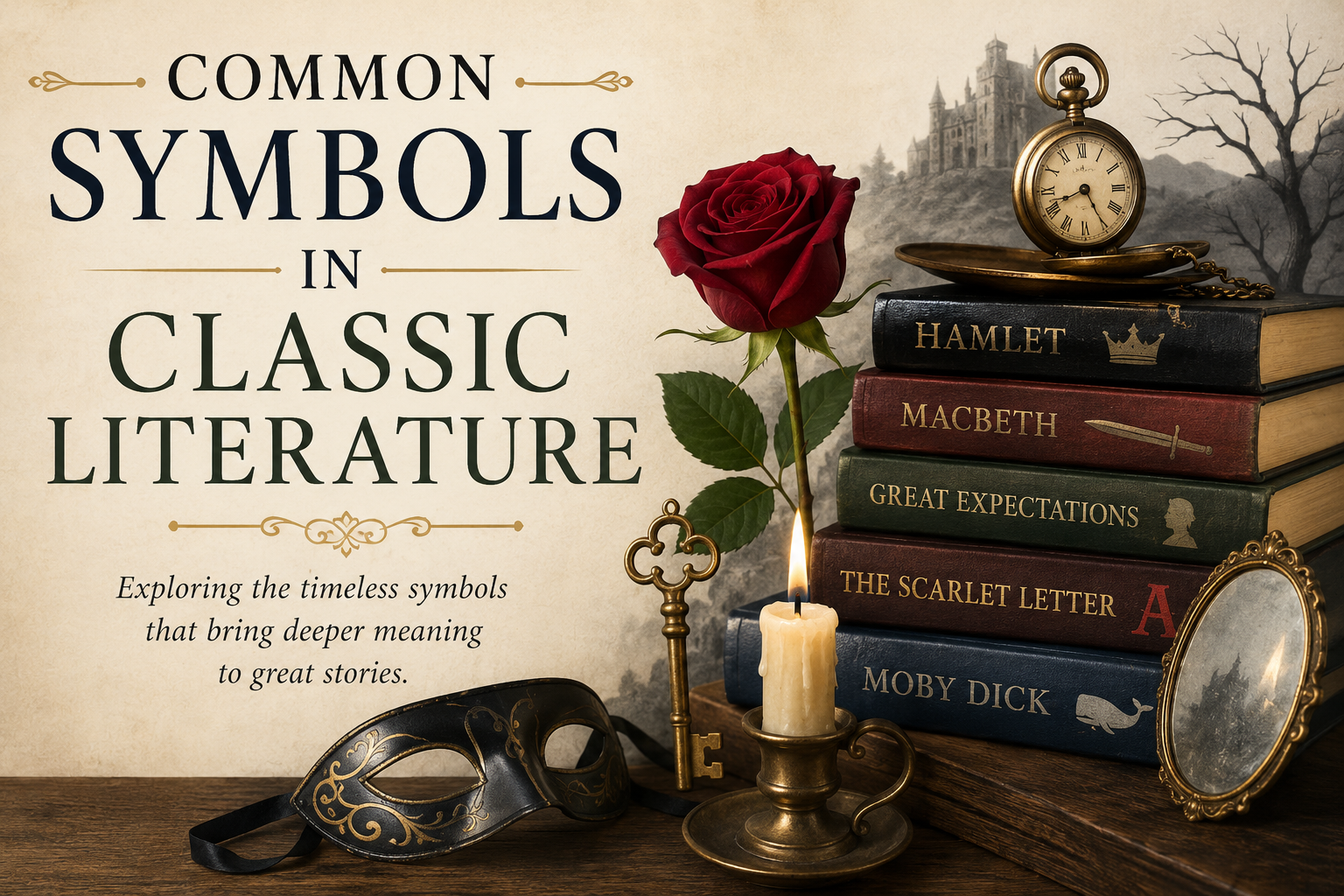
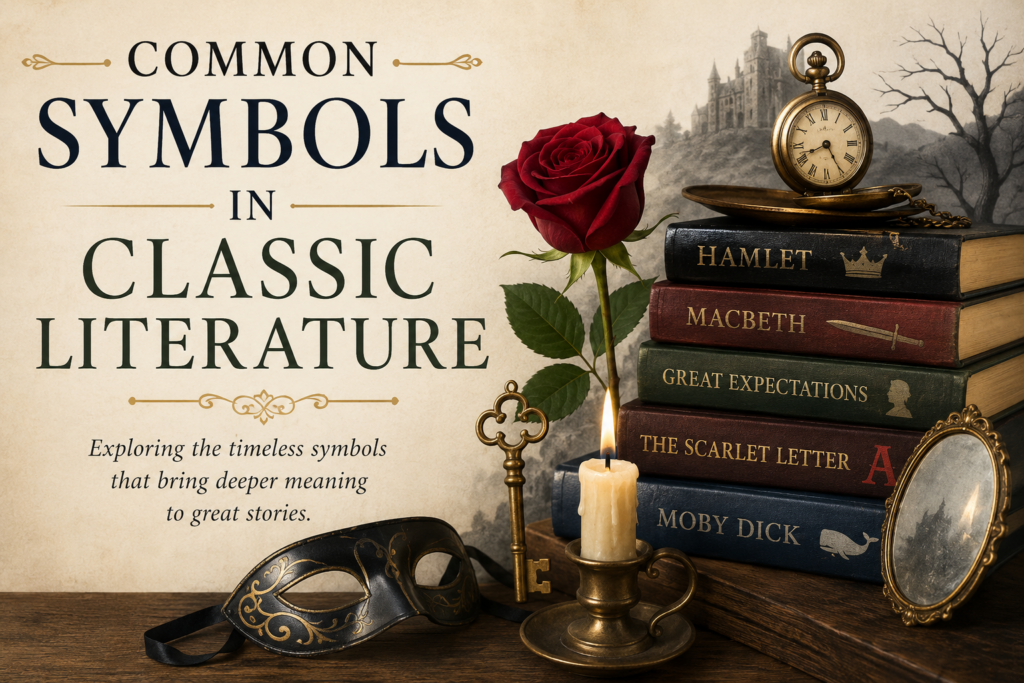
Common Symbols in Classic Literature can help you see deeper meaning in novels, plays, and poems. When you know what certain objects, colors, or places often suggest, you can read with more confidence and write stronger essays.

This guide explains key symbols, gives clear literary examples, and shows how to use them without overthinking every detail.

In this Guide

  • Why symbols matter in classic literature
  • Common symbols and what they often mean
  • Examples from famous books
  • How to analyze symbols in essays
  • Books that help you practice
  • FAQ and key takeaway

Why Common Symbols in Classic Literature Matter

Symbols help writers say more with less.

A symbol is something that stands for more than itself. It can be an object, place, color, animal, or action that points to a bigger idea.

For students, Common Symbols in Classic Literature are useful because they often connect to major themes. A river may suggest change. A locked room may suggest secrets. A storm may suggest conflict or fear.

Symbols do not always mean the same thing in every book. Context matters. Still, knowing common patterns gives you a strong place to start.

Common Symbols in Classic Literature: Light and Darkness

Light and darkness often show knowledge, truth, danger, or moral conflict.

Light often points to truth, hope, or understanding. Darkness often points to fear, confusion, or hidden evil.

In Frankenstein by Mary Shelley, light can suggest knowledge and discovery. Victor Frankenstein wants to “bring light” to science, but his search leads to pain and guilt.

In Heart of Darkness by Joseph Conrad, darkness is not just a setting. It raises questions about cruelty, power, and what people hide inside themselves.

When you see light or darkness in a classic text, ask what the character understands at that moment. Also ask what the writer may be hiding from the reader.

Common Symbols in Classic Literature: Colors

Colors can carry emotional and social meaning.

Red often suggests passion, sin, blood, or shame. White can suggest purity, innocence, emptiness, or coldness. Green often points to hope, envy, nature, or desire.

In The Scarlet Letter by Nathaniel Hawthorne, the red letter “A” is one of the most famous symbols in American literature. It marks Hester Prynne’s shame, but it also becomes a sign of strength.

In The Great Gatsby by F. Scott Fitzgerald, the green light at the end of Daisy’s dock stands for Gatsby’s dream. It also shows how that dream stays just out of reach.

Colors are among the most important Common Symbols in Classic Literature because they can appear many times across a story. Track when a color appears and how the mood changes around it.

Common Symbols in Classic Literature: Nature

Nature often reflects a character’s inner life.

Writers use weather, seasons, gardens, and wild places to show emotion or change. Spring may suggest youth or rebirth. Winter may suggest death, loss, or loneliness.

In Wuthering Heights by Emily Brontë, the wild moors reflect the fierce emotions of the characters. The setting feels harsh, open, and hard to control.

In King Lear by William Shakespeare, the storm shows Lear’s mental collapse. The weather outside mirrors the chaos inside him.

When you study Common Symbols in Classic Literature, pay close attention to setting. A landscape may reveal more than a character says out loud.

Common Symbols in Classic Literature: Animals

Animals often reveal power, fear, guilt, or instinct.

A snake may suggest danger or betrayal. A bird may suggest freedom or a trapped soul. A dog may suggest loyalty, but it can also show violence, depending on the story.

In Macbeth, Shakespeare uses animal images to show disorder and fear. After Duncan’s murder, nature seems broken, which suggests that Macbeth’s crime has damaged the moral order.

In Lord of the Flies by William Golding, the “beast” becomes a symbol of the boys’ fear. It also points to the violence inside human nature.

Animal symbols work best when you connect them to a theme. Do not stop at “the bird means freedom.” Ask who wants freedom and what blocks it.

Common Symbols in Classic Literature: Objects

Objects can carry a story’s biggest ideas.

A letter, ring, mirror, or weapon can gain meaning as the story moves on. The object may start as a normal item, then become tied to guilt, love, power, or memory.

In The Lord of the Rings by J.R.R. Tolkien, the ring stands for power and temptation. It shows how even good people can change when power takes hold.

In Jane Eyre by Charlotte Brontë, the locked room and hidden spaces at Thornfield Hall suggest secrets, fear, and social limits.

Common Symbols in Classic Literature often gain meaning through repetition. If an object appears at key moments, the author likely wants you to notice it.

Common Symbols in Classic Literature: Journeys and Roads

A journey often shows growth, escape, or a search for truth.

Roads and travel can show a character’s movement from innocence to experience. A physical trip may also reflect an inner change.

In The Odyssey by Homer, Odysseus’s journey is about more than getting home. It tests his pride, loyalty, and wisdom.

In The Adventures of Huckleberry Finn by Mark Twain, the river becomes a path toward freedom. Yet it also shows the moral problems of the society around Huck and Jim.

Journey symbols are useful in essays because they often connect to character growth. Ask what the character learns before and after the journey.

How to Analyze Common Symbols in Classic Literature

A symbol should connect to the whole story, not just one scene.

Start with the basic meaning. What is the object, color, place, or action? Then ask how it changes as the story goes on.

Look for repetition. If a symbol appears more than once, note when it appears and who is present. This can reveal a pattern.

Connect the symbol to a theme. A green light is not important only because it is green. It matters because it connects to dreams, wealth, and longing.

If you want a deeper step-by-step method, read this guide on how to find symbolism in a story.

How to Use Symbols in Literature Essays

Strong symbol analysis stays close to the text.

Do not write that a symbol “obviously” means one thing. Instead, prove your idea with evidence from the story.

A simple essay sentence might look like this:

In The Great Gatsby, the green light symbolizes Gatsby’s dream of a perfect future with Daisy, but its distance shows that the dream is impossible to fully reach.

This works because it names the symbol, explains the meaning, and links it to a theme.

For AP Literature or college essays, you should also explain how the symbol affects the reader. Does it create hope? Does it create doubt? Does it make the ending feel tragic?

Best Books for Studying Common Symbols in Classic Literature

These books give students strong practice with symbolism.

  • The Great Gatsby by F. Scott Fitzgerald
  • The Scarlet Letter by Nathaniel Hawthorne
  • Lord of the Flies by William Golding

Each book uses symbols in a clear way, which makes them helpful for essays and class discussion. They are also common choices in high school and college literature courses.

You can also explore trusted resources like the Poetry Foundation’s definition of symbol and Britannica’s overview of Symbolism for more background.

Quick Study Tips for Symbolism

A few simple habits can make symbol analysis much easier.

Mark repeated objects, colors, and places as you read. Write a short note each time one appears.

Ask what changes near the symbol. Does the mood shift? Does a character act in a new way?

Do not force a meaning. Some details are just details. A symbol matters when the story gives it weight.

When in doubt, return to theme. The best symbol analysis explains how one detail supports the bigger message of the work.

FAQ About Common Symbols in Classic Literature

What are the most common symbols in classic literature?

Some of the most common symbols are light, darkness, colors, nature, animals, objects, and journeys. Their meaning depends on the story’s context.

How do I know if something is a symbol?

Look for repetition, strong description, or a link to a major theme. If the author keeps drawing attention to it, it may be symbolic.

Can one symbol have more than one meaning?

Yes. A strong symbol can hold more than one idea. For example, the scarlet letter in Hawthorne’s novel suggests shame, strength, and identity.

Why do teachers ask students to find symbols?

Symbols help students understand theme, character, and conflict. They also lead to stronger literary analysis.

Should I memorize Common Symbols in Classic Literature?

You can learn common patterns, but do not rely on memorization alone. Always use the text to support your interpretation.

Key Takeaway

Common Symbols in Classic Literature are tools for deeper reading, not secret codes with fixed answers. Notice patterns, connect them to theme, and use evidence from the text to explain your ideas clearly.

Examples of Foreshadowing in Famous Books: Clear Literary Examples for Students

Foreshadowing Examples

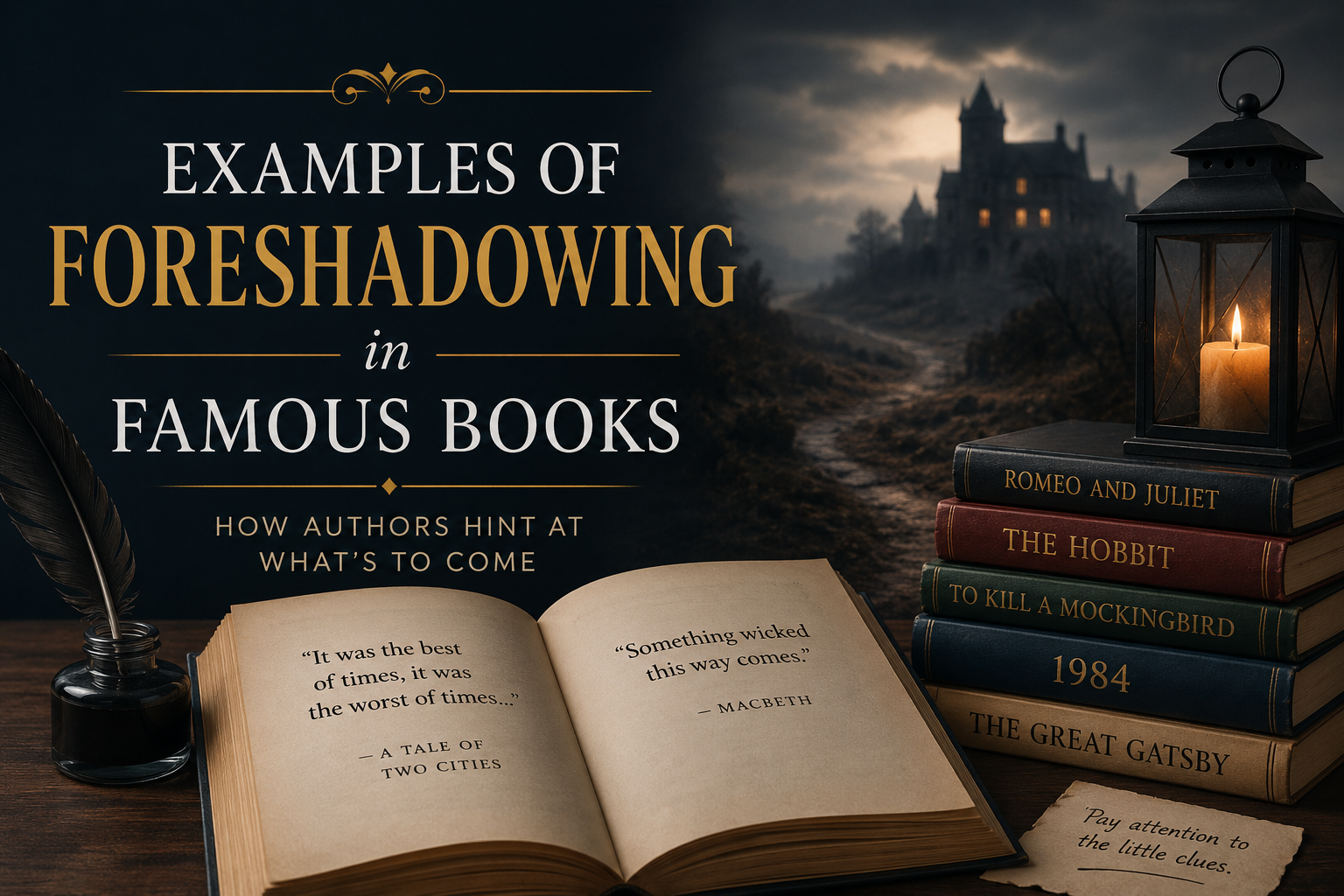
Examples of Foreshadowing in Famous Books can help students see how authors prepare readers for key events before they happen.

Foreshadowing is a clue, hint, image, or line of dialogue that points toward a future moment in the story. Once you know how to spot it, major plot turns often feel less random and more carefully planned.

In this Guide

  • What foreshadowing means
  • Examples of Foreshadowing in Famous Books
  • How each example works
  • How to write about foreshadowing in an essay
  • Books to read for more practice
  • FAQ
Foreshadowing Examples

What Is Foreshadowing?

Foreshadowing gives readers a clue about what may happen later.

It can appear through a warning, a symbol, a dream, a strange detail, or a character’s fear. The clue may be clear right away, or it may only make sense after the ending.

Writers use foreshadowing to build suspense. They also use it to make a story feel complete, since the ending often grows from details planted earlier.

Examples of Foreshadowing in Famous Books: Romeo and Juliet

Shakespeare gives away the tragic ending before the play truly starts.

In Romeo and Juliet, the Prologue calls the lovers “star-crossed” and says they will take their own lives. This is direct foreshadowing because the audience learns that Romeo and Juliet will die.

This does not ruin the play. Instead, it creates dread. Readers watch each happy moment with the knowledge that disaster is ahead.

Romeo also senses danger before he goes to the Capulet party. He says he fears “some consequence yet hanging in the stars.” This line hints that the party will start a chain of events he cannot control.

In an essay, you could argue that Shakespeare uses foreshadowing to make fate feel powerful. The characters make choices, but the early warnings make their deaths seem almost written in the stars.

For background on the play, you can read Britannica’s overview of Romeo and Juliet.

Examples of Foreshadowing in Famous Books: Of Mice and Men

John Steinbeck uses small deaths to prepare us for a much larger one.

In Of Mice and Men, Lennie kills soft animals by accident because he does not know his own strength. Early in the novel, he carries a dead mouse in his pocket. Later, he kills his puppy.

These moments foreshadow the death of Curley’s wife. Lennie does not mean to hurt her, but the earlier scenes show that his strength can turn harmless contact into tragedy.

Candy’s old dog also foreshadows the ending. Carlson shoots the dog because he sees it as weak and useless. Candy later says he should have shot the dog himself.

That moment points toward George’s final choice. George kills Lennie himself rather than let a violent mob do it.

Students can write about how Steinbeck uses foreshadowing to make the ending feel painful but not sudden. The clues show that Lennie’s fate has been building from the start.

Examples of Foreshadowing in Famous Books: Macbeth

The witches in Macbeth turn prophecy into a warning.

At the start of the play, the witches tell Macbeth he will become king. Their words foreshadow his rise to power, but they also lead him toward murder.

Later, the witches give Macbeth new predictions. They say he should beware Macduff, that no one “of woman born” can harm him, and that he is safe until Birnam Wood moves to Dunsinane.

Macbeth thinks these clues mean he cannot lose. In the end, each prophecy comes true in a tricky way. Macduff was born by a surgical birth, and soldiers carry branches from Birnam Wood as they march.

This is one of the best examples of foreshadowing in famous books because the clues are both clear and misleading. Shakespeare lets the audience hear the warnings, but Macbeth misreads them.

In an essay, focus on how the prophecies reveal Macbeth’s flaw. He hears what he wants to hear, which helps cause his fall.

Examples of Foreshadowing in Famous Books: The Great Gatsby

F. Scott Fitzgerald fills The Great Gatsby with signs of coming loss.

Early in the novel, Gatsby reaches toward the green light across the bay. The light stands for Daisy and the future he wants. It also foreshadows that his dream will stay out of reach.

Cars also foreshadow danger. The novel shows careless driving more than once, including a car crash after one of Gatsby’s parties. These moments prepare readers for Myrtle’s death by car later in the story.

Nick’s first chapter also looks back with sadness. He says Gatsby turned out “all right” in the end, but he also hints that Gatsby was destroyed by what preyed on him.

That early tone tells readers not to expect a simple love story. It points toward tragedy before the plot reaches it.

When you discuss this in an essay, connect foreshadowing to the novel’s critique of the American Dream. Gatsby’s future looks bright from a distance, but the early clues show that the dream is fragile.

Examples of Foreshadowing in Famous Books: Lord of the Flies

William Golding uses fear and violence to hint at the boys’ collapse.

In Lord of the Flies, the boys worry about a “beast” on the island. At first, the beast seems like a real creature. Over time, it becomes clear that the true danger comes from the boys themselves.

This fear foreshadows the violence that follows. The boys’ terror gives them an excuse to act cruelly.

Piggy’s glasses also foreshadow the loss of order. At first, the glasses help start fires, which can lead to rescue. When they break, it shows that reason and safety have begun to fail.

The falling rock that kills Piggy also has early hints. The boys play near rocks and use them as tools of power. By the time the rock strikes Piggy, the island has turned fully savage.

This is one of the darker Examples of Foreshadowing in Famous Books because the clues show a moral fall, not just a plot event.

Examples of Foreshadowing in Famous Books: Harry Potter and the Sorcerer’s Stone

J.K. Rowling uses foreshadowing to hide answers in plain sight.

In Harry Potter and the Sorcerer’s Stone, Harry believes Snape is the main threat. Many clues seem to support this idea. Snape acts cold, follows Harry, and seems connected to the mystery.

Yet other clues point to Quirrell. He is nervous, often overlooked, and linked to strange moments that do not seem important at first.

The Mirror of Erised also foreshadows the final scene. It shows deep desire, not truth. Later, Harry can get the Stone because he wants to find it, not use it.

This example helps students see that foreshadowing can work with red herrings. A red herring points readers in the wrong direction, while real clues still sit nearby.

In an essay, you could write that Rowling uses foreshadowing to reward careful readers. The ending feels surprising, but the earlier details make it fair.

Examples of Foreshadowing in Famous Books: To Kill a Mockingbird

Harper Lee uses early danger to prepare us for the final attack.

In To Kill a Mockingbird, Bob Ewell threatens Atticus after the trial. This warning foreshadows his later attack on Jem and Scout.

The children also fear Boo Radley for much of the novel. They imagine him as a monster, but this fear prepares a reversal. In the end, Boo becomes their protector.

Scout’s ham costume also matters. It seems funny at first, but it helps save her during the attack because the costume blocks the knife.

These clues show how Lee mixes danger with childhood misunderstanding. The children do not fully see the threat, but readers can sense it.

This is one of the most useful Examples of Foreshadowing in Famous Books for essays about innocence. The clues show that Scout’s world is less safe than she thinks.

How to Discuss Examples of Foreshadowing in Famous Books in an Essay

A strong essay does more than point out a clue. It explains why the clue matters.

Start by naming the moment that hints at the future. Then explain the later event it prepares. After that, connect both moments to a theme.

Here is a simple sentence frame:

The author uses [early clue] to foreshadow [later event], which reveals [theme or character truth].

For example:

Steinbeck uses Lennie’s dead mouse to foreshadow the death of Curley’s wife, which reveals that Lennie’s innocence cannot protect him from the harm his strength causes.

You can also compare two clues. In Macbeth, the witches’ prophecies foreshadow Macbeth’s rise and his fall. This shows how ambition can twist a warning into false confidence.

When you write about Examples of Foreshadowing in Famous Books, avoid saying only, “This creates suspense.” That is true, but it is not enough.

Ask what the foreshadowing reveals about fate, power, guilt, fear, or desire. That deeper point will make your essay stronger.

Why Authors Use Foreshadowing

Foreshadowing helps a story feel planned instead of random.

It also builds tension. Readers may not know exactly what will happen, but they sense that something important is coming.

Some authors use clear warnings, like the Prologue in Romeo and Juliet. Others use symbols, like Gatsby’s green light.

Foreshadowing can also reveal character. Macbeth hears warnings but trusts his pride. Gatsby sees the green light but cannot accept that the past is gone.

To study more tools that work with foreshadowing, visit this guide to common literary devices.

Books to Read for More Examples of Foreshadowing in Famous Books

These books are useful if you want more practice spotting foreshadowing.

  • Of Mice and Men by John Steinbeck
  • The Great Gatsby by F. Scott Fitzgerald
  • Lord of the Flies by William Golding

Each one uses early clues that become more important by the end. They are also common in high school and college literature classes.

Quick Practice: Find the Foreshadowing

Try this with any novel or play you read.

Look for a strange detail that gets extra attention. Ask if it returns later in a bigger way.

Watch for warnings, dreams, symbols, and repeated images. These often point toward a future conflict.

You can also mark moments where a character says something that feels larger than the scene. In literature, casual lines often carry hidden weight.

FAQ: Examples of Foreshadowing in Famous Books

What is a simple definition of foreshadowing?

Foreshadowing is a hint about something that will happen later in a story.

What is one clear example of foreshadowing?

In Romeo and Juliet, the Prologue says the lovers will die. This directly foreshadows the tragic ending.

Can foreshadowing be a symbol?

Yes. Gatsby’s green light is a symbol that also foreshadows his unreachable dream.

How do I write about foreshadowing in an essay?

Name the clue, explain the later event, and connect both to a theme or character flaw.

Is foreshadowing always obvious?

No. Some clues are easy to spot, while others only make sense after you finish the story.

Key Takeaway

Examples of Foreshadowing in Famous Books show that great endings rarely come from nowhere.

Authors plant clues early, then let those clues grow into conflict, tragedy, or surprise. When students notice those clues, they can write sharper essays and read with more confidence. 📚

How to Identify Theme in Literature

how to identify theme in literature

A Practical Guide to Discovering the Deeper Meaning of Stories and Poems

Many readers enjoy novels and poems but feel unsure about how to explain what the text is really about. Teachers often ask students to identify the theme of a story, yet the idea can feel abstract at first.

Learning how to identify theme in literature becomes easier when you slow down and pay attention to patterns in the text. Themes rarely appear in a single sentence. Instead, they develop through characters, repeated images, conflicts, and the choices authors make throughout a narrative.

Once readers begin noticing these patterns, the theme gradually becomes clear. The process is closely connected to close reading and literary analysis.

If you’re new to that approach, you might begin with:

👉 https://rapidreadspress.com/what-is-close-reading-in-literature/

⭐ Key Takeaway

Themes emerge from patterns across a story. When readers pay attention to characters, conflicts, imagery, and repeated ideas, the deeper meaning of the text begins to appear.

how to identify theme in literature
Image by Carla Paton

📚 In This Guide

In this article you’ll learn:

  • How to identify theme in literature step by step
  • What themes actually are (and what they are not)
  • How patterns in characters and events reveal theme
  • A practical example from Frankenstein (affiliate link)
  • How theme connects to literary analysis

What Is a Theme in Literature?

Understanding how to identify theme in literature begins with a simple definition.

A theme is the central idea or insight that a work of literature explores about life, human nature, or society.

Themes often address questions such as:

  • responsibility
  • love and relationships
  • ambition and power
  • identity
  • isolation
  • morality

Unlike plot, which describes what happens, theme explains what the story suggests about those events.

Many stories explore multiple themes at the same time.

📌 Plot tells the story. Theme reveals what the story means.

Step 1: Look for Repeated Ideas

A helpful way to practice how to identify theme in literature is to look for repetition.

Authors often return to certain ideas or situations throughout a work.

For example, a novel might repeatedly show:

  • characters struggling with social expectations
  • conflicts between ambition and responsibility
  • tensions between freedom and duty

When these ideas appear several times, they often point toward the story’s theme.

Tracking these patterns becomes easier when readers annotate the text.

👉 If you’d like a guide to that process, see:
https://rapidreadspress.com/how-to-annotate-literature/

Step 2: Pay Attention to Character Development

Another key step in how to identify theme in literature involves examining how characters change.

Stories often explore theme through the decisions characters make and the consequences they face.

Ask questions like:

  • What does the protagonist learn?
  • What conflicts shape the character’s choices?
  • How do relationships change over time?

The answers often reveal the story’s deeper message.

Step 3: Notice Symbols and Imagery

Writers frequently use imagery and symbolism to reinforce theme.

Certain objects, settings, or descriptions may appear repeatedly.

Examples include:

  • storms representing emotional turmoil
  • winter symbolizing isolation
  • light suggesting hope or knowledge

These details may seem small, but they often help readers uncover the work’s central ideas.

Example: Identifying Theme in Frankenstein

Mary Shelley’s Frankenstein provides a strong example of how to identify theme in literature (affiliate link).

At first glance, the novel appears to be a Gothic story about a scientist creating a monster. However, a closer reading reveals deeper themes.

Throughout the novel, Victor Frankenstein pursues scientific knowledge without considering the consequences of his actions.

Several patterns reinforce this idea:

Ambition

Victor repeatedly describes his desire to unlock the secrets of nature.

Isolation

Both Victor and the creature become increasingly isolated from society.

Responsibility

Victor refuses to accept responsibility for the being he creates.

When these patterns are viewed together, a major theme emerges:

unchecked ambition can lead to destructive consequences.

This interpretation becomes clearer through careful reading and observation.

📌Themes often appear when readers connect patterns across an entire story.

Step 4: Turn Patterns Into a Thematic Statement

Once you recognize patterns, the next step in how to identify theme in literature is expressing the idea clearly.

Instead of writing a single word like ambition or love, try forming a complete thematic statement.

For example:

Weak theme:

Ambition

Stronger thematic statement:

Ambition without responsibility can lead to harmful consequences.

This type of statement explains the insight the story explores.

How Identifying Theme Supports Literary Analysis

Learning how to identify theme in literature plays an important role in literary study.

Themes often become the foundation of essays and research papers.

For example, a literary essay might explore how imagery, character development, and narrative structure all reinforce a specific theme.

If you’re interested in turning these observations into academic writing, see:

👉 https://rapidreadspress.com/how-to-write-a-literary-analysis-essay/

You may also enjoy this broader guide:

👉 https://rapidreadspress.com/how-to-read-literature-like-a-scholar/

📚 Books That Help Readers Understand Literary Themes

These books offer useful guidance for readers interested in literary interpretation (affiliate links).

How to Read Literature Like a Professor — Thomas C. Foster
Explains recurring literary patterns that often reveal theme.

How to Read Poetry Like a Professor — Thomas C. Foster
A helpful introduction to interpreting imagery and symbolism.

How to Read a Book — Mortimer Adler & Charles Van Doren
A classic guide to thoughtful reading and interpretation.

Conclusion: Theme Emerges Through Careful Reading

Identifying theme does not require guessing what the author intended. Instead, it involves noticing patterns in the text and asking thoughtful questions about what those patterns suggest.

When readers slow down and observe details in characters, imagery, and conflicts, the story’s deeper meaning gradually becomes visible.

With practice, learning how to identify theme in literature becomes one of the most rewarding parts of reading.

FAQ — How to Identify Theme in Literature

What is the easiest way to identify theme in literature?

Look for repeated ideas across the story, especially in character decisions, conflicts, and symbols.

Is theme the same as the moral of the story?

Not exactly. A moral usually offers a clear lesson, while a theme explores broader ideas about life and human behavior.

Can a story have more than one theme?

Yes. Many works of literature explore several themes at once.

Why do teachers ask students to identify theme?

Theme analysis helps readers understand how literature explores complex ideas about society, identity, and human relationships.

error

Enjoy this article? Please spread the word :)

Follow by Email
BLUESKY
fb-share-icon
Reddit
LinkedIn
Share
RSS