

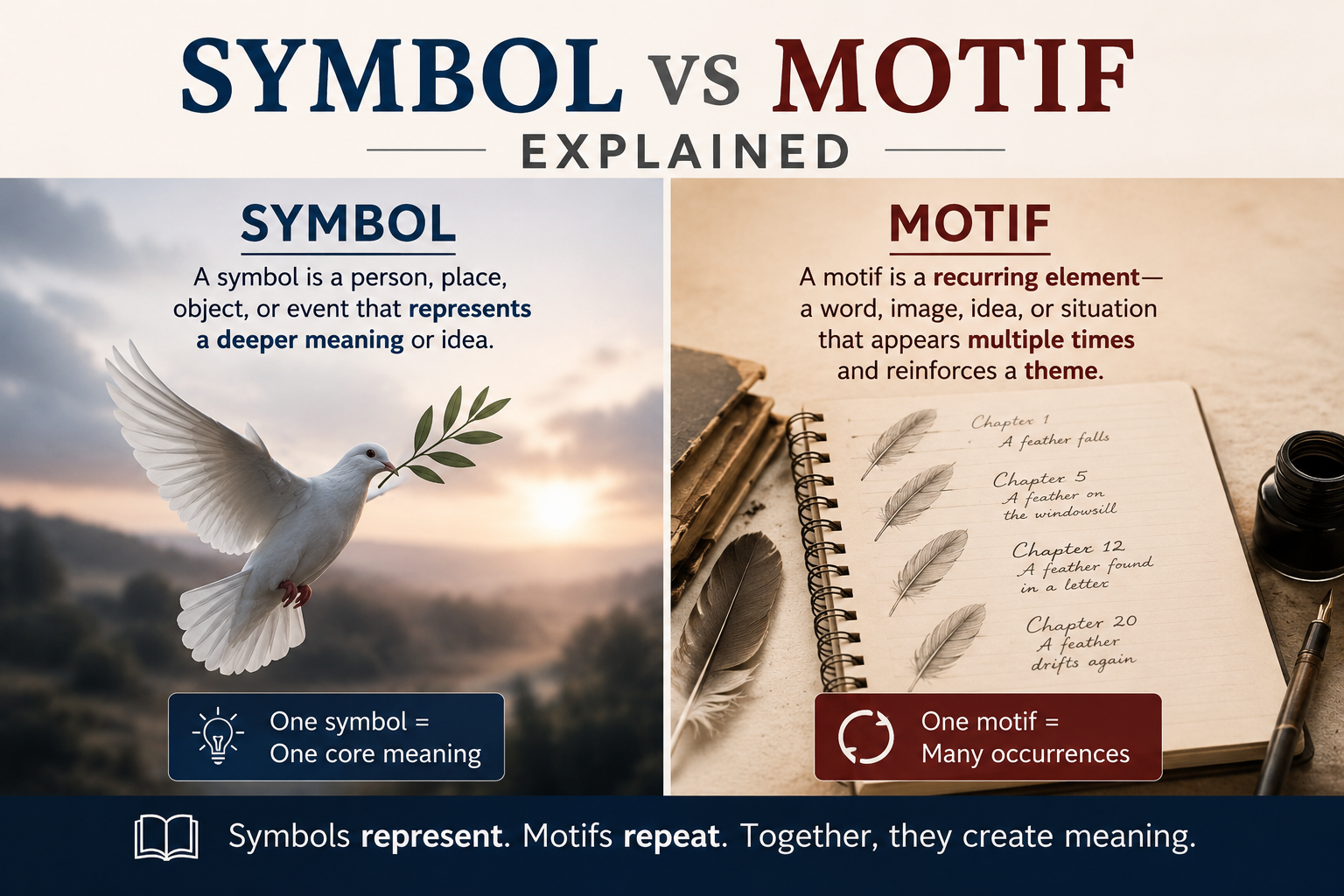
Symbol vs Motif Explained is a topic that can confuse even strong readers. Both symbols and motifs add deeper meaning to a story, but they work in different ways.
Once you know the difference, literary analysis gets much easier. You can point to better evidence and explain why an author repeats certain images, objects, or ideas.
In this Guide
Use this guide to move from basic definitions to stronger literary analysis.
- What Is a Symbol?
- What Is a Motif?
- Symbol vs Motif Explained: The Main Difference
- Symbol vs Motif Explained Through Literature Examples
- How to Use Symbols and Motifs in Analysis
- Common Mistakes to Avoid
- Helpful Books to Read
- FAQ
What Is a Symbol?
A symbol is something in a story that stands for a larger idea.
A symbol can be an object, place, person, color, animal, or action. It has a literal role in the story, but it also points to a deeper meaning.
For example, in The Great Gatsby, the green light at the end of Daisy’s dock is a symbol. It is a real light, but it also stands for Gatsby’s dream, hope, and desire for a future he may never reach.
In Lord of the Flies, the conch shell is a symbol of order and shared rules. When the conch loses power, the boys’ society falls apart.
If you want more help with this part, read our guide on how to find symbolism in a story.
What Is a Motif?
A motif is a repeated element that helps build a theme.
A motif can be a repeated image, phrase, object, situation, sound, or idea. The key word is repeated. A motif shows up more than once and gains meaning over time.
In Macbeth, blood is a major motif. It appears after murder, during guilt, and in moments of fear. Each return of blood reminds us of violence and moral damage.
In To Kill a Mockingbird, mockingbirds form a motif linked to innocence. The idea returns through Tom Robinson, Boo Radley, and the lesson that it is wrong to harm those who do no harm.
Symbol vs Motif Explained: The Main Difference
The simplest difference is this: a symbol means something, while a motif repeats something.
Symbol vs Motif Explained comes down to function. A symbol is often one meaningful thing. A motif is a pattern that appears across the text.
A symbol can appear only once and still matter. A motif must return often enough for readers to notice a pattern.
Think of it this way: the green light in The Great Gatsby is a symbol. The repeated focus on wealth, parties, cars, and status creates motifs tied to the American Dream and social class.
A symbol can also become part of a motif. If the same symbol appears again and again, it may help form a larger pattern.
Symbol vs Motif Explained Through Literature Examples
Examples make the difference easier to see.
In Romeo and Juliet, light and dark images appear often. Romeo calls Juliet the sun, and the lovers often meet at night. This repeated contrast is a motif because it appears across the play.
The poison near the end of the play works more like a symbol. It stands for the deadly results of hate, secrecy, and rash choices.
In The Scarlet Letter, the letter “A” is a symbol. It stands for shame at first, but its meaning shifts as Hester changes in the eyes of her community.
The repeated focus on public judgment, hidden sin, and watching eyes creates motifs. These patterns help develop the novel’s themes about guilt and social control.
Symbol vs Motif Explained works best when you ask two questions: What does this thing mean? Does it repeat across the text?
How to Use Symbol vs Motif Explained in Literary Analysis
Good analysis does more than name a symbol or motif.
When you write about a symbol, explain its literal role first. Then explain the deeper idea it suggests.
For example: In The Great Gatsby, the green light is a real dock light, but it also represents Gatsby’s dream of winning Daisy and remaking the past.
When you write about a motif, track the pattern. Show where it appears and explain how its meaning grows.
For example: In Macbeth, the blood motif begins with battle and bravery, then shifts toward murder, guilt, and fear.
If you are writing an essay, connect the symbol or motif to a theme. A theme is the larger message about life, society, or human nature.
Here is a simple sentence frame you can use:
The repeated image of blood in Macbeth forms a motif that reveals how guilt follows violent ambition.
This is where Symbol vs Motif Explained becomes useful. It helps you move from “I noticed this” to “I understand why it matters.”
Common Mistakes to Avoid
Many students mix up symbols, motifs, and themes.
A symbol is not the same as a theme. A symbol points to a deeper idea, but the theme is the message the story builds.
A motif is not just “anything that appears.” It needs to repeat in a meaningful way.
Do not call every object a symbol. Sometimes a chair is just a chair. Look for clues like strong description, repeated focus, character reaction, or placement at a key moment.
You can also use our guide to spot symbolism in fiction if you need a clearer method.
Helpful Books for Studying Symbols and Motifs
These books can help you practice close reading and literary analysis.
- How to Read Literature Like a Professor by Thomas C. Foster
- The Great Gatsby by F. Scott Fitzgerald
How to Read Literature Like a Professor is useful for learning common patterns in fiction. The Great Gatsby is a strong choice because it has clear symbols, motifs, and themes.
Useful External Resources
Trusted literature sites can help you review key terms.
The Poetry Foundation glossary is a helpful place to check literary terms. You can also explore Britannica’s overview of literature for broader context.
FAQ: Symbol vs Motif Explained
Here are quick answers to common student questions.
What is the easiest way to tell a symbol from a motif?
A symbol stands for a deeper idea. A motif is a repeated pattern that helps build a theme.
Can a symbol also be a motif?
Yes. If a symbol appears again and again, it can become part of a motif.
Is a motif the same as a theme?
No. A motif is a repeated element. A theme is the larger message the author develops.
Why does this difference matter in essays?
It helps you write more precise analysis. You can explain whether an author uses one powerful image or a repeated pattern.
Key Takeaway
Symbol vs Motif Explained is really about meaning and pattern. A symbol points to a deeper idea, while a motif repeats to build a larger theme.


Get the Free Close Reading Worksheet Pack
Join my email list and receive the printable worksheet pack you can use with any novel or poem.
No spam. Just helpful guides for reading literature well.












