What Is an Archetype in Literature? A Beginner-Friendly Guide

literary archetype
literary archetype

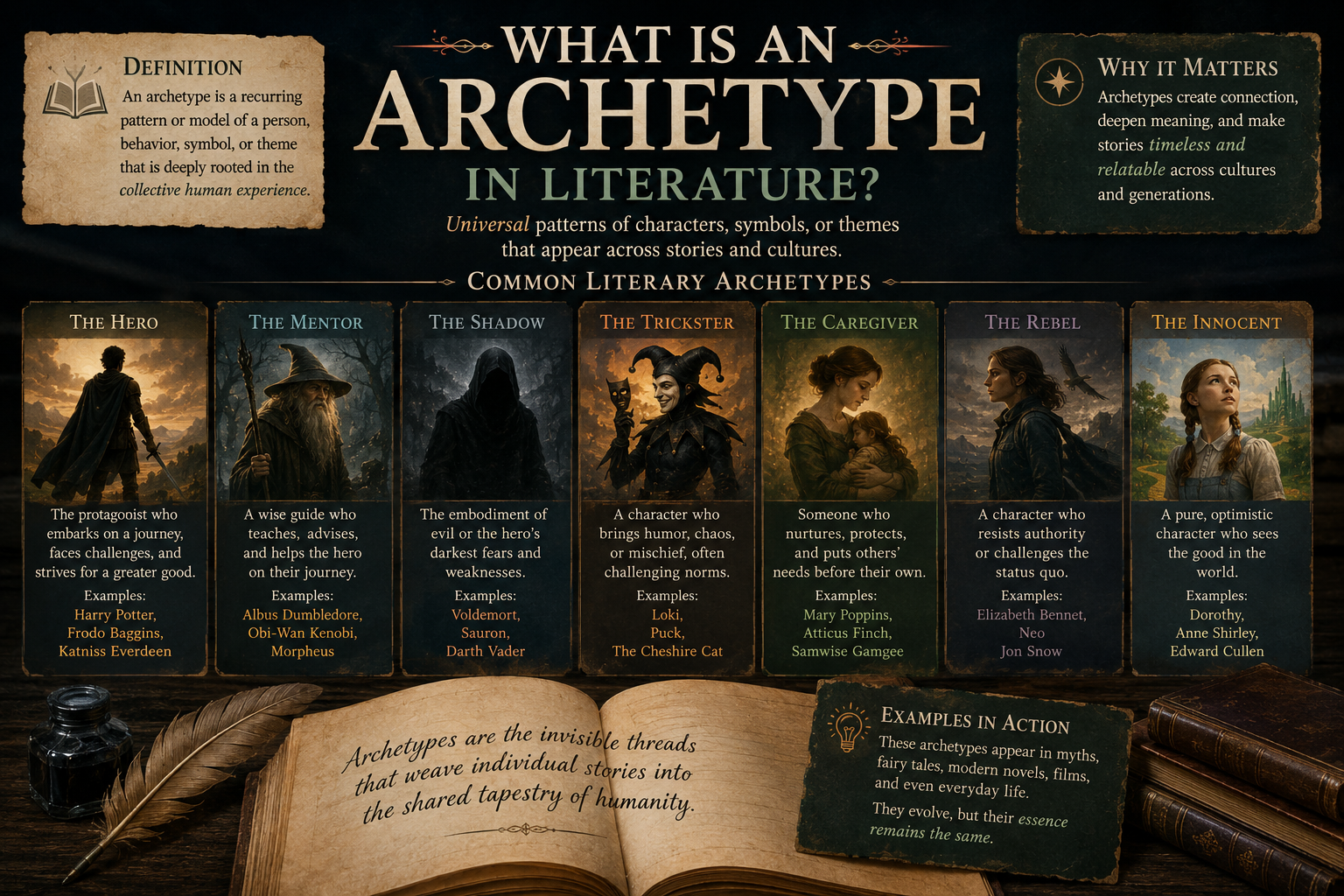
What Is an Archetype in Literature? It is a common pattern, character type, story idea, or symbol that appears again and again across books and cultures.

Once you know how archetypes work, many stories become easier to understand. You start to see why certain heroes, villains, journeys, and lessons feel familiar.

In this Guide

What Is an Archetype in Literature?

Archetypes are story patterns that readers recognize fast.

So, What Is an Archetype in Literature? It is a repeated model that shows up in many stories. It can be a type of character, a plot pattern, a setting, or a symbol.

For example, the “hero” is an archetype. So is the “mentor,” the “quest,” and the “dark forest.” These ideas appear in myths, fairy tales, novels, plays, and films.

An archetype is not the same as a cliché. A cliché feels overused or lazy. An archetype feels familiar because it connects to deep human fears, hopes, and choices.

What Is an Archetype in Literature? Why It Matters

Archetypes help stories speak to readers across time and place.

When you ask, What Is an Archetype in Literature? you are really asking why some stories feel universal. Archetypes help answer that.

They give readers a quick way into a story. If a wise older figure appears, we may expect guidance. If a young hero leaves home, we may expect growth and danger.

Archetypes also help writers build meaning. A character may follow an archetype at first, then break away from it. That change can reveal a theme.

For literary analysis, archetypes can help you explain how a text connects to larger ideas. Love, fear, power, sacrifice, and identity often appear through familiar patterns.

What Is an Archetype in Literature? Common Types

Most archetypes fit into a few broad groups.

What Is an Archetype in Literature? It can be more than one thing. A novel may use character archetypes, plot archetypes, and symbolic archetypes at the same time.

Character Archetypes

A character archetype is a familiar role in a story.

The hero faces a major challenge. The mentor gives wisdom. The villain blocks the hero’s goal. The trickster causes trouble and exposes truth.

In Harry Potter, Harry is the hero, Dumbledore is a mentor, and Voldemort is the villain. These roles are easy to spot, but each character still has unique traits.

Plot Archetypes

A plot archetype is a common story path.

The quest is one of the most famous. A character leaves home, faces tests, and returns changed. You can see this in The Odyssey, The Lord of the Rings, and many adventure stories.

Another plot archetype is the fall. A character loses power or innocence because of pride, greed, or a poor choice. Shakespeare’s tragedies often use this pattern.

Symbolic Archetypes

A symbolic archetype is an image or place with a shared meaning.

Light often suggests truth or hope. Darkness may suggest fear or confusion. Water can suggest rebirth, change, or danger.

If you want help with this part, read our guide on how to find symbolism in a story. Symbolic archetypes often work closely with symbols.

Famous Examples of Archetypes in Literature

Well-known books make archetypes easier to see.

In The Odyssey by Homer, Odysseus follows the quest archetype. He wants to return home, but he must face monsters, temptation, and loss before he gets there.

In Cinderella, the main character fits the innocent hero archetype. She suffers unfair treatment, but she stays kind and gains a new life.

In Romeo and Juliet, the lovers fit the star-crossed lovers archetype. Their love is real, but family conflict and fate push them toward tragedy.

In The Hunger Games, Katniss Everdeen fits the reluctant hero archetype. She does not seek fame or power. She acts because she wants to protect her sister.

These examples show why What Is an Archetype in Literature? is such a useful question. It helps readers compare stories that may seem very different at first.

How to Spot Archetypes While You Read

A simple question can help you find archetypes fast.

Ask yourself: “Have I seen this kind of character, journey, or image before?” If the answer is yes, you may have found an archetype.

Look for repeated roles. Is there a guide, a rebel, a ruler, or an outsider? Then ask what that role adds to the story.

Look at the main conflict too. Is the character on a quest? Are they tempted? Do they face a fall from power? These patterns often point to archetypes.

Pay close attention to places and objects. A garden, desert, storm, or road may carry archetypal meaning. For more help, use this guide to spot symbols in fiction.

Once you know What Is an Archetype in Literature? you can move beyond naming it. The stronger analysis explains why the author uses it.

Archetype vs. Stereotype: What Is the Difference?

These two ideas can look alike, but they are not the same.

An archetype is a broad story pattern with deep meaning. It can be complex and flexible.

A stereotype is a flat or unfair idea about a person or group. It often reduces people to one trait.

For example, a “wise mentor” can be an archetype if the character has depth. But if the character only exists to give advice and has no inner life, the role may feel flat.

Books to Explore Archetypes

These books can help you see archetypes in action.

  • The Odyssey by Homer
  • Mythology by Edith Hamilton
  • The Hero with a Thousand Faces by Joseph Campbell

Joseph Campbell’s book is more advanced, but it is famous for its ideas about the hero’s journey. For background on archetypes, you can also read Britannica’s overview of archetype in literature.

For poetry and myth-based reading, the Poetry Foundation is also a strong source.

FAQ: What Is an Archetype in Literature?

What Is an Archetype in Literature?

An archetype is a common character type, plot pattern, symbol, or idea that appears in many stories. It feels familiar because readers have seen it before in other texts.

What is a simple example of an archetype?

The hero is a simple example. Heroes often face danger, make hard choices, and grow through struggle.

Is an archetype the same as a theme?

No. An archetype is a pattern or role. A theme is the message or big idea the story explores.

Why do authors use archetypes?

Authors use archetypes because they help readers connect to a story quickly. They also help build meaning and deepen conflict.

How can I write about archetypes in an essay?

Name the archetype, give evidence from the text, then explain what it reveals about the character, conflict, or theme.

Key Takeaway

What Is an Archetype in Literature? It is a familiar story pattern that helps readers understand characters, plots, symbols, and themes. When you spot one, do not stop there. Ask what the author does with it and why it matters.
Symbol vs Motif Explained: A Clear Guide for Literature Students

symbol vs motif
symbol vs motif

Symbol vs Motif Explained is a topic that can confuse even strong readers. Both symbols and motifs add deeper meaning to a story, but they work in different ways.

Once you know the difference, literary analysis gets much easier. You can point to better evidence and explain why an author repeats certain images, objects, or ideas.

In this Guide

Use this guide to move from basic definitions to stronger literary analysis.

What Is a Symbol?

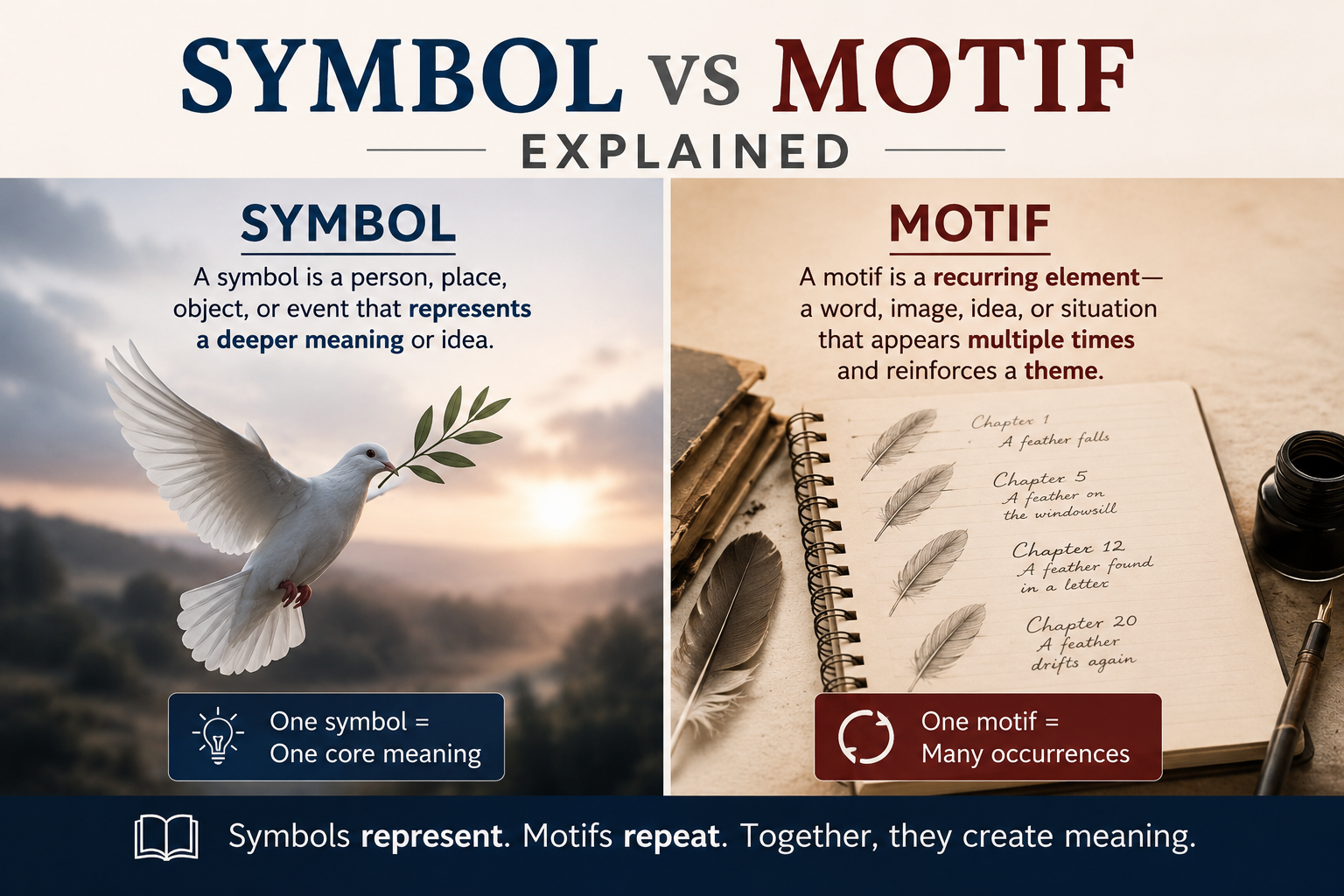
A symbol is something in a story that stands for a larger idea.

A symbol can be an object, place, person, color, animal, or action. It has a literal role in the story, but it also points to a deeper meaning.

For example, in The Great Gatsby, the green light at the end of Daisy’s dock is a symbol. It is a real light, but it also stands for Gatsby’s dream, hope, and desire for a future he may never reach.

In Lord of the Flies, the conch shell is a symbol of order and shared rules. When the conch loses power, the boys’ society falls apart.

If you want more help with this part, read our guide on how to find symbolism in a story.

What Is a Motif?

A motif is a repeated element that helps build a theme.

A motif can be a repeated image, phrase, object, situation, sound, or idea. The key word is repeated. A motif shows up more than once and gains meaning over time.

In Macbeth, blood is a major motif. It appears after murder, during guilt, and in moments of fear. Each return of blood reminds us of violence and moral damage.

In To Kill a Mockingbird, mockingbirds form a motif linked to innocence. The idea returns through Tom Robinson, Boo Radley, and the lesson that it is wrong to harm those who do no harm.

Symbol vs Motif Explained: The Main Difference

The simplest difference is this: a symbol means something, while a motif repeats something.

Symbol vs Motif Explained comes down to function. A symbol is often one meaningful thing. A motif is a pattern that appears across the text.

A symbol can appear only once and still matter. A motif must return often enough for readers to notice a pattern.

Think of it this way: the green light in The Great Gatsby is a symbol. The repeated focus on wealth, parties, cars, and status creates motifs tied to the American Dream and social class.

A symbol can also become part of a motif. If the same symbol appears again and again, it may help form a larger pattern.

Symbol vs Motif Explained Through Literature Examples

Examples make the difference easier to see.

In Romeo and Juliet, light and dark images appear often. Romeo calls Juliet the sun, and the lovers often meet at night. This repeated contrast is a motif because it appears across the play.

The poison near the end of the play works more like a symbol. It stands for the deadly results of hate, secrecy, and rash choices.

In The Scarlet Letter, the letter “A” is a symbol. It stands for shame at first, but its meaning shifts as Hester changes in the eyes of her community.

The repeated focus on public judgment, hidden sin, and watching eyes creates motifs. These patterns help develop the novel’s themes about guilt and social control.

Symbol vs Motif Explained works best when you ask two questions: What does this thing mean? Does it repeat across the text?

How to Use Symbol vs Motif Explained in Literary Analysis

Good analysis does more than name a symbol or motif.

When you write about a symbol, explain its literal role first. Then explain the deeper idea it suggests.

For example: In The Great Gatsby, the green light is a real dock light, but it also represents Gatsby’s dream of winning Daisy and remaking the past.

When you write about a motif, track the pattern. Show where it appears and explain how its meaning grows.

For example: In Macbeth, the blood motif begins with battle and bravery, then shifts toward murder, guilt, and fear.

If you are writing an essay, connect the symbol or motif to a theme. A theme is the larger message about life, society, or human nature.

Here is a simple sentence frame you can use:

The repeated image of blood in Macbeth forms a motif that reveals how guilt follows violent ambition.

This is where Symbol vs Motif Explained becomes useful. It helps you move from “I noticed this” to “I understand why it matters.”

Common Mistakes to Avoid

Many students mix up symbols, motifs, and themes.

A symbol is not the same as a theme. A symbol points to a deeper idea, but the theme is the message the story builds.

A motif is not just “anything that appears.” It needs to repeat in a meaningful way.

Do not call every object a symbol. Sometimes a chair is just a chair. Look for clues like strong description, repeated focus, character reaction, or placement at a key moment.

You can also use our guide to spot symbolism in fiction if you need a clearer method.

Helpful Books for Studying Symbols and Motifs

These books can help you practice close reading and literary analysis.

  • How to Read Literature Like a Professor by Thomas C. Foster
  • The Great Gatsby by F. Scott Fitzgerald

How to Read Literature Like a Professor is useful for learning common patterns in fiction. The Great Gatsby is a strong choice because it has clear symbols, motifs, and themes.

Useful External Resources

Trusted literature sites can help you review key terms.

The Poetry Foundation glossary is a helpful place to check literary terms. You can also explore Britannica’s overview of literature for broader context.

FAQ: Symbol vs Motif Explained

Here are quick answers to common student questions.

What is the easiest way to tell a symbol from a motif?

A symbol stands for a deeper idea. A motif is a repeated pattern that helps build a theme.

Can a symbol also be a motif?

Yes. If a symbol appears again and again, it can become part of a motif.

Is a motif the same as a theme?

No. A motif is a repeated element. A theme is the larger message the author develops.

Why does this difference matter in essays?

It helps you write more precise analysis. You can explain whether an author uses one powerful image or a repeated pattern.

Key Takeaway

Symbol vs Motif Explained is really about meaning and pattern. A symbol points to a deeper idea, while a motif repeats to build a larger theme.

Flash Memoir Prompt: First Time You Realized a Friendship Was Over

flash memoir prompt friendship

A focused flash memoir prompt about the quiet, painful moment when you understood a friendship had ended before anyone said goodbye.

You may remember the moment as a small shift. A seat left empty beside you. A text that sounded polite instead of familiar. A laugh you were no longer part of. The strange thing about losing a friendship is that it often happens before the final conversation, if there ever is one.

This flash memoir prompt first time realized friendship already over asks you to notice that in-between space. The friendship may have looked normal from the outside, but inside you knew something had changed. That is a powerful place to write from because it holds confusion, loyalty, embarrassment, grief, and maybe relief.

flash memoir prompt friendship

The Prompt

Write about the first time you realized a friendship was already over, even though no one had said so.

This prompt can unlock a meaningful memory because it does not ask for the whole history of the friendship. It asks for one moment of recognition. Maybe you were sitting across from someone you used to tell everything to and could not think of one honest thing to say. Maybe you saw them with new friends and felt less jealous than you expected. Maybe you noticed you had stopped saving funny stories for them.

The best flash memoir pieces often begin with a tiny moment that carries a larger truth. This one invites you to write about silence, distance, and the quiet way people sometimes leave each other.

Why This Memory Matters

A friendship ending can feel harder to explain than a breakup. There may be no clear fight, no final line, and no one to blame. That can make the memory slippery. You know it mattered, but you may not know where to begin.

This is where the prompt helps. It asks you to focus on the first time you realized the friendship was already over. That moment has shape. It may have a room, a season, a smell, a sound. It may have a sentence that landed wrong or a pause that lasted too long.

Writing about this kind of memory can reveal who you were then. Maybe you were trying hard to act normal. Maybe you were angry and refused to admit you were hurt. Maybe you kept making excuses for the other person because admitting the truth felt too final.

The story does not need to prove who was right. It does not need to solve the friendship. It only needs to show the moment when your body knew before your words did.

If you are a student or a newer writer, this kind of prompt can also help you build stronger scenes. When you study people in stories, you look for what they say and what they avoid saying. The same skill matters in memoir. This guide on how to analyze characters in literature can help you think about memory with the same close attention.

How to Approach This Prompt

Begin with a physical detail. Do not start by explaining the entire friendship. Start with the cafeteria table, the bus window, the phone screen, the birthday party, the hallway, or the sound of their voice when it no longer sounded like home.

Choose one scene. Keep the memory narrow. If you try to tell how you met, how close you became, what changed, and where you are now, the piece may grow too large. Flash memoir works best when the writer trusts one clear moment.

Write what you noticed before you explain what it meant. For example, instead of starting with “I knew we were no longer friends,” you might begin with, “She saved a chair for someone else and did not look up when I walked in.” That kind of detail lets the reader feel the shift with you.

You can also pay attention to what you did next. Did you pretend not to care? Did you make a joke? Did you leave early? Did you sit there and act like nothing had happened? Your reaction may reveal the emotional truth of the memory.

If you want to sharpen your scene, try marking the details that feel alive on the page. Notice the lines where the tension rises or where the silence says more than speech. This simple practice is close to how to annotate literature, except this time the text is your own life.

For this flash memoir prompt first time realized friendship already over, you do not have to write with blame. You can write with honesty. Let the memory be as mixed as it was.

A Quick Example

At lunch, Maya sat at the far end of the table with her new choir friends. She saw me come in. I know she did because her eyes moved over my face, quick as a camera flash, before she looked back down at her tray. There was one open chair beside her, but her backpack was on it. I stood there with my milk carton getting cold in my hand and waited for her to move it. She did not. Someone at the table said something, and Maya laughed in that high, bright way she used when she wanted people to like her. I walked to another table before anyone could notice I had been waiting. That was the first time I understood we were not in a fight. We were already finished.

Try It Yourself

Set a timer for ten minutes and write the scene without stopping. Begin with the first physical detail you remember. Let the place do some of the work. The chipped table, the message bubble, the empty seat, or the closed bedroom door can carry more feeling than a long explanation.

If the memory still hurts, write it gently. You do not have to name every reason the friendship ended. You can stay with the moment when you realized the truth and let that be enough for today.

This flash memoir prompt first time realized friendship already over is really about recognition. It asks you to recall the instant when pretending became harder than knowing. That instant may be small, but it can hold a whole story.

Want More Flash Memoir Prompts?

Explore all 365 prompts in The Memory Trigger: 365 Flash Memoir Writing Prompts. It is a helpful resource when you want short, focused writing invitations that lead to real memories.

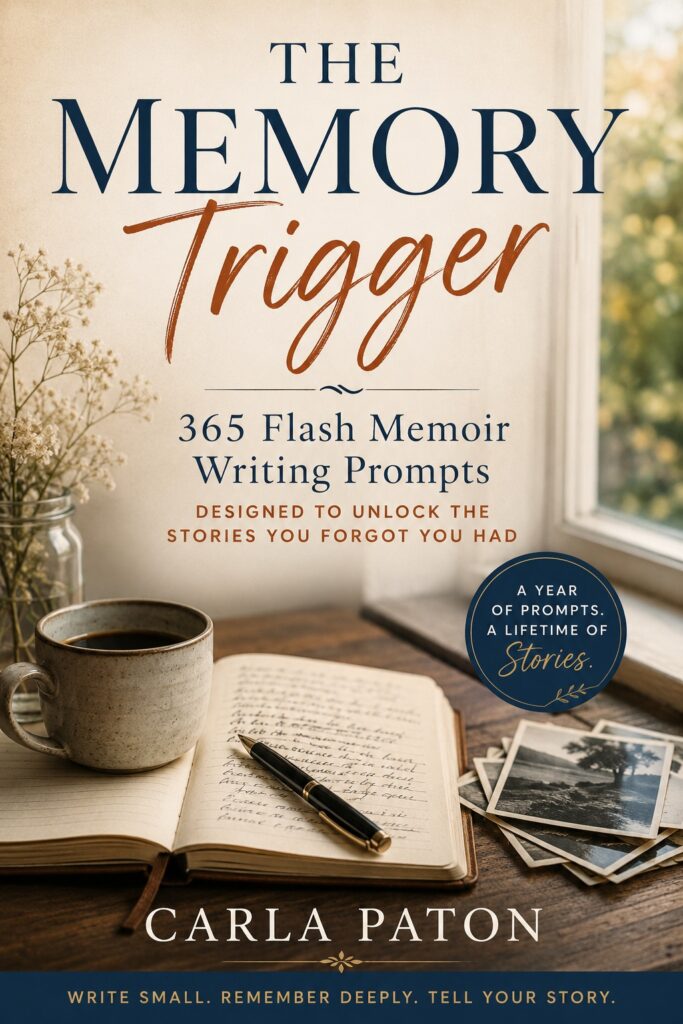
The Memory Trigger

Flash Memoir Prompt: First Time You Were in a Hospital

flash memoir prompt hospital

The first hospital memory may come back through a smell, a waiting room chair, or the quiet moment when someone tried to look brave for you.

The Prompt

Write about the first time you were in a hospital, either as a patient or as a visitor.

This flash memoir prompt: first time in the hospital, either as a patient or a visitor, asks you to return to a place most people remember with unusual clarity. Hospitals have their own world. The lights are too bright. The floors shine. People speak softly, even when nothing quiet is happening.

Your memory may be serious, scary, confusing, or even strangely ordinary. Maybe you were a child with a broken arm. Maybe you visited a grandparent and noticed the cup of melting ice beside the bed. Maybe you were too young to understand what was wrong, but old enough to understand the adults were worried.

A hospital scene can unlock a strong memory because it often holds both fear and care in the same room.

flash memoir prompt hospital

Why This Memory Matters

The first time you enter a hospital, you may notice how different life feels there. Time slows down. People wait. Nurses appear and disappear. A vending machine can seem louder than it should. A small kindness can stay with you for years.

This kind of memory matters because it often shows you meeting vulnerability for the first time. That vulnerability may have been your own. It may have belonged to someone you loved. Either way, the scene can reveal what you thought safety meant at that age.

If you were the patient, you might write about the moment before treatment, when you were told to sit still or be brave. If you were a visitor, you might write about walking into a room and not knowing what to say. Both versions count. A flash memoir does not need a dramatic ending. It needs one honest scene.

You can also explore the tone and mood of the memory. Was the room tense, calm, lonely, hopeful, or oddly funny? The feeling in the room may be more important than the medical reason you were there.

How to Approach This Prompt

Begin with a physical detail. Do not start by explaining the whole hospital visit. Start with the bracelet on your wrist, the squeak of shoes in the hallway, the paper cup of water, or the stiff chair where you waited.

Then narrow the memory to one scene. You might choose the moment you first saw the hospital bed. You might focus on the ride in the elevator. You might write about sitting beside someone and watching their hand move under the blanket.

Try to write what you noticed before you write what it meant. Memoir becomes stronger when readers can stand inside the memory with you. Instead of saying, “I was scared,” show the way you counted ceiling tiles or kept asking the same question.

If the memory feels big, give yourself limits. Write about ten minutes, not the whole day. Write about one room, not the whole building. Write about one person’s voice, not every conversation.

You can treat your memory the way you might treat a short text in class. Look closely at small details, underline what matters in your mind, and ask why it stayed with you. If that kind of close looking helps, this guide on how to annotate literature can also give you a useful way to study your own memory.

For this flash memoir prompt first time hospital either patient, the goal is not to give a medical report. The goal is to capture the human part of the scene.

A Quick Example

I was seven the first time I went to a hospital. My brother had fallen from the monkey bars, and my mother drove with one hand on the wheel and the other pressed against his knee, as if holding him together. In the waiting room, I sat under a poster of a smiling tooth, though we were not there for teeth. My brother stopped crying after a while, which scared me more than the crying. A nurse gave me a grape lollipop from a drawer, even though I was not the patient. I remember holding it in my lap, unopened, while my mother signed forms. It felt wrong to eat something sweet while everyone else looked so serious.

Try It Yourself

Set a timer for ten minutes and write about your first hospital memory. Choose one moment and stay there. Let the smells, sounds, and small gestures lead you.

If you cannot remember exact words, write the feeling of the words. If you cannot remember every person in the room, write the one face you do remember. Flash memoir allows you to work with fragments, as long as you stay honest about what you know.

You might begin with one of these openings: “The first thing I noticed was…” or “No one told me why the room felt so quiet.” You can also start with the object your younger self could not stop looking at.

When you finish, read the piece once and ask what changed inside the scene. Did you understand something new? Did someone comfort you? Did you realize adults could be afraid too? That small shift may be the heart of the memoir.

Want More Flash Memoir Prompts?

If you want to keep building a steady memoir practice, use one small prompt at a time. Explore all 365 prompts in The Memory Trigger: 365 Flash Memoir Writing Prompts.

The Memory Trigger

Themes in Animal Farm: A Student-Friendly Guide

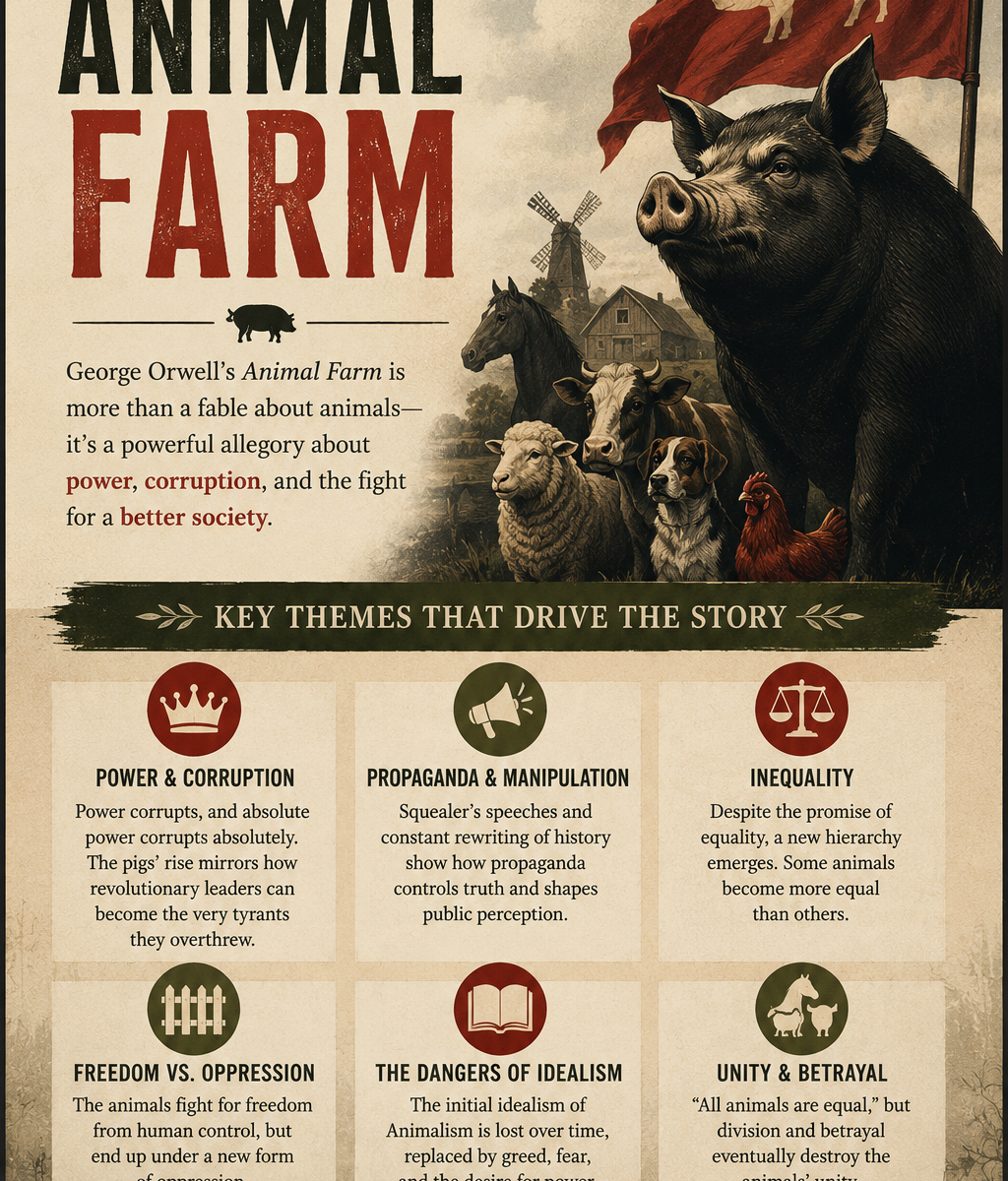
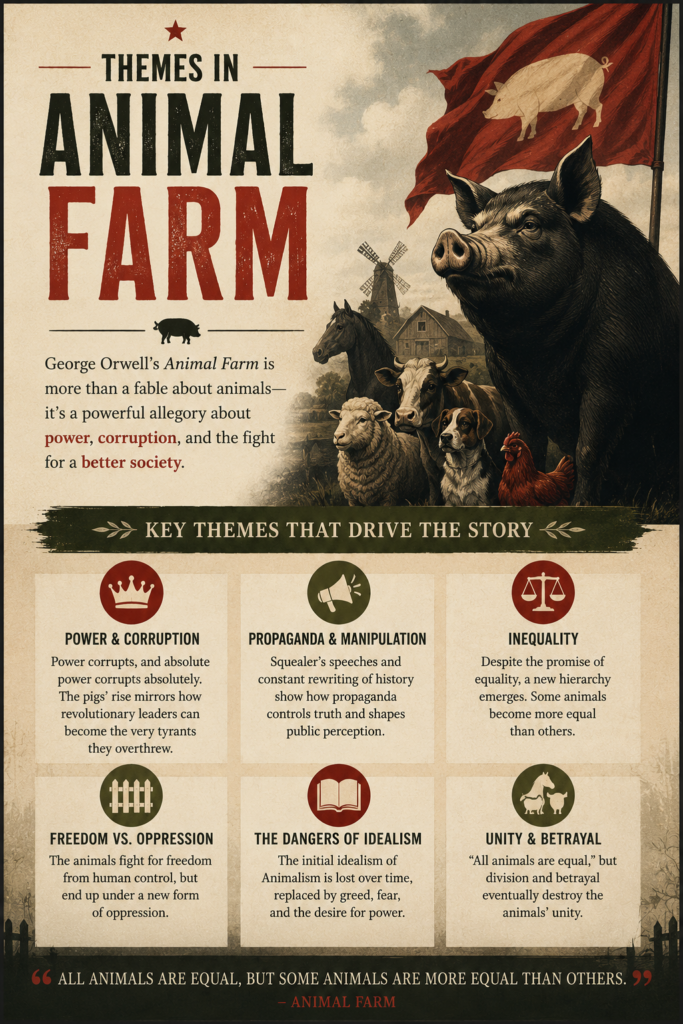
Themes in Animal Farm

George Orwell’s Animal Farm may look simple at first, but it is packed with deeper ideas about power, truth, fear, and class. This guide explains the themes in Animal Farm in a clear way, so students can use them in class talks, essays, and AP Literature analysis.

In this Guide

  • Why the novel’s themes matter
  • Power and corruption
  • Propaganda and language
  • Class and exploitation
  • Fear, silence, and control
  • Idealism and betrayal
  • How to write about the themes
  • Book suggestions
  • FAQ
Themes in Animal Farm

Why the Themes in Animal Farm Matter

Orwell uses a farm to tell a sharp story about politics, human weakness, and the danger of blind trust.

Animal Farm is an allegory. That means the animals, places, and events stand for larger ideas. The farm reflects the Russian Revolution and the rise of Soviet power, but the novel also speaks to any society where leaders abuse trust.

Studying the themes in Animal Farm helps students move beyond plot summary. Instead of only saying what Napoleon does, you can explain what his actions reveal about power.

If you need help connecting theme to character choices, this guide on how to analyze characters in literature can help you build stronger claims.

Power and Corruption: One of the Central Themes in Animal Farm

The novel shows how power can change leaders, especially when no one can hold them accountable.

At the start, the animals dream of freedom. They want to escape Mr. Jones and build a fair society. Old Major’s speech gives them hope, and the rebellion feels like a fresh start.

That hope does not last. Napoleon slowly takes control of the farm. He uses the dogs to scare the other animals, changes the commandments, and gives the pigs special rights.

This makes power and corruption one of the most important themes in Animal Farm. Orwell suggests that leaders may begin with noble words, but power can lead them to greed and cruelty.

A strong essay point could be: Napoleon does not become corrupt by accident. He protects his power by removing rivals, rewriting rules, and making others afraid.

This theme also appears in Shakespeare’s Macbeth. Macbeth gains power through violence, then commits more violence to keep it. Both works show that unchecked power can destroy moral judgment.

Propaganda: One of the Most Important Themes in Animal Farm

Orwell shows that language can shape what people believe, even when the truth is right in front of them.

Squealer is the main voice of propaganda in the novel. He explains Napoleon’s choices, twists facts, and makes the animals doubt their own memories.

When the pigs take the milk and apples, Squealer claims they need them for brain work. When Napoleon changes plans about the windmill, Squealer makes it sound as if Napoleon was right all along.

This is one of the key themes in Animal Farm because Orwell cared deeply about political language. He believed words could be used to hide lies, protect leaders, and weaken public thought.

The changing commandments are a clear symbol of this theme. The rule that says all animals are equal slowly turns into a cruel joke. By the end, equality has become a word with no real meaning.

For more background on Orwell’s life and political views, students can read this short overview from Britannica.

Class, Work, and Exploitation in the Themes in Animal Farm

The farm claims to be equal, but some animals work hard while others enjoy the rewards.

Boxer is the clearest example of exploitation. He is loyal, strong, and honest. His favorite sayings show his faith in the system, even when the system fails him.

Napoleon uses Boxer’s labor but does not protect him. When Boxer grows weak, the pigs sell him instead of giving him care. This moment is one of the saddest parts of the book because it shows how deeply the workers have been betrayed.

Class is one of the major themes in Animal Farm because the rebellion was supposed to end unfair treatment. Instead, the pigs become a new ruling class.

Orwell does not attack the idea of fairness. He attacks leaders who use the language of fairness while they build a system that serves only them.

Fear, Silence, and Control

The animals lose freedom not all at once, but through small steps that train them to stay quiet.

Napoleon uses fear in direct ways. The dogs threaten anyone who might resist. Public confessions and executions shock the animals and make them feel helpless.

Fear also works in quiet ways. The animals worry that Mr. Jones might return. Squealer repeats this fear whenever the pigs need support.

Because of that, many animals stop asking questions. Clover senses that something is wrong, but she cannot explain it clearly. Benjamin understands more than most, yet he rarely acts.

This theme matters because Orwell asks a hard question: What happens when people know something is wrong, but stay silent?

Idealism and Betrayal

The novel begins with a dream of justice, then shows how that dream can be stolen.

Old Major imagines a world where animals control their own labor and live without human abuse. His vision inspires the rebellion, and for a short time, the farm feels full of purpose.

Napoleon betrays that vision. He keeps the songs and slogans when they help him, but he destroys the real meaning behind them.

This is one reason the ending feels so bitter. The animals look from pig to man and from man to pig, but they can no longer tell the difference. The revolution has come full circle.

The theme of betrayed idealism also appears in dystopian works like Orwell’s 1984. In both books, leaders use language and fear to crush independent thought.

Education and Ignorance

Orwell links knowledge to freedom because the animals who cannot read are easier to control.

The pigs learn to read and write well, which gives them power over the farm’s laws and records. Many other animals can only learn a few letters, or they depend on the pigs to explain everything.

This creates an unfair gap. Those who control knowledge control truth. The other animals cannot challenge changes to the commandments because they cannot prove what the words used to say.

This theme is useful for students because it connects to real life. Education is not only about school. It is also about the ability to question, compare facts, and notice when language hides harm.

How to Write About the Themes in Animal Farm

A strong theme paragraph should connect an idea to a pattern in the text.

When you write about themes in Animal Farm, do not just name the theme. Show how Orwell develops it through characters, events, symbols, and changes in tone.

For example, instead of writing, Napoleon is corrupt, write a fuller claim: Orwell shows that power becomes dangerous when a leader controls force, language, and history.

Then use evidence. You might discuss the dogs, Squealer’s speeches, or the changing commandments. Explain why that evidence matters.

Try this simple essay frame:

  • Claim: Orwell presents propaganda as a tool of control.
  • Evidence: Squealer changes facts to defend Napoleon.
  • Analysis: The animals accept lies because they lack power, memory, and education.

Common Symbols Connected to Themes

Symbols help Orwell turn simple farm details into larger political ideas.

The windmill stands for hope, labor, and false promises. The animals work hard on it because they believe it will improve their lives. Napoleon later uses it as a way to demand more labor.

The seven commandments stand for the original values of the rebellion. As the pigs change them, the reader sees truth itself become unstable.

The farmhouse stands for privilege. At first, it represents human corruption. When the pigs move in, it shows that they have become like the old rulers.

These symbols support many themes in Animal Farm, especially corruption, inequality, and the loss of truth.

Relevant Books for Students

If you want to compare Orwell’s ideas with other major works, these books are useful choices:

  • 1984 by George Orwell
  • Lord of the Flies by William Golding

Both books ask how people behave when rules, truth, and power shift. They also pair well with essays about fear and control.

Author and Historical Context

Orwell wrote with deep concern about political lies and the abuse of revolutionary hope.

Animal Farm was published in 1945. It reflects events tied to the Russian Revolution and Joseph Stalin’s rule, but its message is wider than one country or period.

Students can learn more about the book’s publication and context from the British Library’s introduction to Animal Farm.

Knowing the history helps, but the novel still works without it. Orwell’s warning is clear: any society can become unjust if people stop questioning those in power.

FAQ: Themes in Animal Farm

What are the main themes in Animal Farm?

The main themes in Animal Farm include power and corruption, propaganda, class exploitation, fear, education, and betrayal of ideals.

What is the most important theme in Animal Farm?

Power and corruption may be the most central theme. Napoleon’s rise shows how a leader can turn a fight for freedom into a new form of oppression.

How does Orwell show propaganda in the novel?

Orwell uses Squealer, slogans, and changed commandments to show how language can protect lies and control public memory.

Why is Boxer important to the novel’s themes?

Boxer shows how loyal workers can be exploited by leaders who praise their labor but do not value their lives.

Is Animal Farm only about the Russian Revolution?

No. The novel is based on that history, but its themes apply to many societies where power, fear, and propaganda shape public life.

Key Takeaway

The themes in Animal Farm show how freedom can fail when power goes unchecked, truth becomes weak, and ordinary people are taught not to question authority.

How to Find the Theme of a Story: A Simple Step-by-Step Guide

How to Find Story Theme

Learning how to find the Theme of a Story can make reading feel less confusing and more meaningful. A theme is the big idea a story explores, such as courage, greed, love, justice, or growing up.

This guide will show you a clear process you can use for homework, essays, class talks, or your own writing.

In this Guide

  • What theme means
  • How to find the theme step by step
  • How characters reveal theme
  • How conflict and endings point to theme
  • Examples from famous books
  • Common mistakes to avoid
  • Book suggestions
  • FAQ
How to Find Story Theme

What Does Theme Mean in a Story?

Theme is the message or idea a story asks you to think about.

A theme is not just one word. “Love” is a topic. A theme says something about that topic, such as “Love can make people brave.”

Stories can have more than one theme. A novel like To Kill a Mockingbird explores justice, prejudice, courage, and innocence.

If you want a deeper lesson on theme, this guide on how to identify theme in literature gives more examples and tips.

How to Find the Theme of a Story in 5 Clear Steps

A simple process can help you move from plot details to a strong theme statement.

When students ask How to Find the Theme of a Story, the best answer is to look for patterns. Theme is not hidden in one sentence. It grows from the whole story.

Step 1: Ask what the story is mostly about

Start with the main topics. These may be friendship, fear, power, family, freedom, or guilt.

In The Great Gatsby, some topics are wealth, dreams, love, and status. These topics are clues, but they are not full themes yet.

Step 2: Watch what the main character learns

Characters often change because of what they face. That change can point to the theme.

In A Christmas Carol, Ebenezer Scrooge learns that money matters less than kindness and human connection.

Step 3: Notice the main conflict

Conflict shows what the story tests. It may test a character’s honesty, loyalty, courage, or pride.

In Lord of the Flies, the conflict shows how quickly order can break down when fear and power take over.

Step 4: Study the ending

The ending often gives the clearest clue. Ask what the final events suggest about life or people.

Does the hero win? Does someone pay a price? Or, does the story end with hope or warning?

Step 5: Turn the idea into a full sentence

A strong theme statement should make a claim. It should not be just a topic.

Weak: “Friendship.”

Stronger: “True friendship helps people face fear.”

How to Find the Theme of a Story Through Characters

Characters are one of the best places to look for theme.

If you want to know How to Find the Theme of a Story, ask what the main character wants. Then ask what the story teaches them about that desire.

In The Hunger Games, Katniss wants to survive. Over time, the story also shows how love, sacrifice, and public courage can challenge an unfair system.

Look at the choices characters make under pressure. Their choices often reveal the story’s message.

How to Find the Theme of a Story Through Conflict and Ending

Conflict and endings often reveal what the author wants readers to notice.

Another useful way to practice How to Find the Theme of a Story is to ask, “What problem keeps returning?” A repeated problem usually connects to a key theme.

In Romeo and Juliet, the conflict between the two families leads to loss. One theme could be: “Long-held hatred can destroy innocent lives.”

The ending matters because it shows the result of the characters’ actions. If a character lies and loses everything, the story may explore honesty, pride, or trust.

Quick Examples of Theme in Well-Known Literature

Examples can make theme easier to see.

In To Kill a Mockingbird by Harper Lee, one theme is that real courage means doing what is right, even when you may not win.

In Animal Farm by George Orwell, one theme is that power can corrupt people who claim to fight for equality.

Lastly, in The Giver by Lois Lowry, one theme is that a safe life without freedom can cost people their humanity.

If you practice How to Find the Theme of a Story with books you already know, the skill gets easier fast.

Common Mistakes to Avoid When Finding Theme

These mistakes can lead to weak or unclear answers.

Mistake 1: Confusing theme with topic

A topic is one word or a short phrase. A theme is a full idea about that topic.

Topic: “Greed.”

Theme: “Greed can make people ignore what truly matters.”

Mistake 2: Writing a theme that is too broad

“Life is hard” is too general. It could fit almost any story.

Try to make the theme match the actual events in the text.

Mistake 3: Ignoring evidence

A theme needs support. Use character choices, conflict, symbols, or the ending as proof.

For more help with this skill, read our full guide on identifying theme in literature.

Mistake 4: Assuming there is only one theme

Many stories have several themes. Your answer can be right if you can support it with evidence.

How Writers Can Use Theme

Theme is not only for readers. Writers can use it to shape stronger stories.

If you write fiction, ask what your character must learn or face. That question can guide the plot.

You do not need to state the theme directly. Let readers see it through choices, conflict, and change.

Writers who understand How to Find the Theme of a Story often become better at creating theme in their own work.

Helpful Books for Learning Theme

These books are useful for students, teachers, and young writers.

  • How to Read Literature Like a Professor by Thomas C. Foster
  • The Elements of Style by William Strunk Jr. and E.B. White
  • Reading Like a Writer by Francine Prose

Helpful Outside Resources

For author background and literary context, Britannica’s literature overview is a reliable place to start.

For poetry, themes, and close reading, the Poetry Foundation offers poems, poet pages, and learning tools.

FAQ: How to Find the Theme of a Story

What is the easiest way to find the theme?

Look at what the main character learns. Then turn that lesson into a full sentence about life or people.

Can a story have more than one theme?

Yes. Many stories explore several themes. Choose one you can support with strong evidence.

Is theme the same as the moral?

Not always. A moral is usually a clear lesson. A theme can be more complex and open to discussion.

How do I write a theme statement?

Pick a topic, then say what the story suggests about it. Avoid using only one word.

Why is theme important?

Theme helps readers understand why the story matters beyond the plot.

Key Takeaway

How to Find the Theme of a Story comes down to one habit: look for what the story teaches through character choices, conflict, and the ending.

Next time you read, ask, “What does this story seem to say about life?” That question will lead you toward the theme. 📚

Flash Memoir Prompt: First Time You Stood Up for Yourself and Meant It

Flash Memoir Prompt First time

A brief flash memoir prompt first time stood up meant for exploring the moment your voice finally sounded like your own.

Your hand may have shaken. Your face may have gone hot. Maybe your words came out too loud, or too quiet, or in a rush you barely recognized. But something changed in that moment. You stopped trying to keep the peace at any cost. You stopped swallowing the sentence that had been sitting in your throat for years.

This kind of memory is rarely neat. It might have happened in a classroom, a kitchen, a workplace, a car, or a crowded hallway. The first time you stood up for yourself and meant it may not have looked brave to anyone else. But inside, it may have felt like a door opening.

Flash Memoir Prompt First time

The Prompt

Write about the first time you stood up for yourself and meant it.

This flash memoir prompt first time stood up meant invites you to return to one focused moment when you chose your own dignity. It does not ask you to prove you were right. It asks you to remember what it felt like to stop hiding your honest thought.

A prompt like this can unlock a memory because it has tension built into it. There is usually a before and an after. Before, you may have stayed quiet, laughed something off, or told yourself it did not matter. After, even if things were awkward, you knew you had crossed a line in yourself.

Why This Memory Matters

Standing up for yourself can look dramatic, but it can also be very small. It might be one sentence: “Don’t talk to me that way.” It might be refusing to apologize for something you did not do. It might be saying no when everyone expected you to say yes.

These moments matter because they often show a hidden part of your growth. The memory may reveal what you were taught about being “nice,” “easy,” “respectful,” or “difficult.” It may show the first time you questioned those lessons.

For some writers, this prompt leads to a proud memory. For others, it brings up regret, anger, or grief. Maybe you wish someone had stood up for you sooner. Maybe you wish your younger self had known that self-respect was allowed.

If you are trying to understand the deeper meaning of this memory, it can help to think the way a reader thinks about story. What changed? What belief was challenged? What pattern broke? If you enjoy looking for meaning in stories, you may find this guide on how to identify theme in literature useful for reading your own memory with more attention.

Your flash memoir does not need a perfect lesson at the end. In fact, it may be stronger if you let the moment stay a little unresolved. Real courage often feels messy while it is happening.

How to Approach This Prompt

Begin with the body, not the explanation.

What did your body do right before you spoke? Did your throat tighten? Did your palms sweat? Did you look at the floor, the person’s shoes, the edge of a table? A physical detail can pull the reader into the scene faster than a long backstory.

Try to narrow the memory to one scene. Do not start with every reason you finally reached that point. Instead, begin close to the moment. A strong opening might sound like, “I was holding a paper cup of coffee when she said it again,” or “The classroom went quiet after I pushed my chair back.”

Write what you noticed before you explain what it meant. The color of the room, the scrape of a chair, the smell of rain on your jacket, or the sound of your own voice may carry more power than a summary.

You can always add context later. For the first draft, stay inside the scene. Let the reader feel the pressure before the words come out.

If you like to mark up drafts or study the shape of a scene, you might also use simple notes in the margins after you write. Circle the strongest detail. Underline the sentence where the emotional shift happens. This is similar to the close reading process described in how to annotate literature, except this time the text is your own life.

For this flash memoir prompt first time stood up meant, your goal is not to make yourself sound fearless. Your goal is to be honest about the fear and the choice you made anyway.

A Quick Example

I was seventeen, standing behind the counter at the bakery, dusted in flour up to my elbows. My manager had just blamed me for an order I had never taken. Usually I would have nodded, apologized, and cried later in the walk-in freezer where no one could see me. That day, I looked at the pink box in his hand and said, “No. I didn’t write that ticket.” My voice cracked on “no,” which annoyed me, but I kept my eyes on him. The other cashier stopped tying ribbon. For a second, the whole shop seemed to pause, even the oven timer. He frowned, checked the stack of slips, and found the right one. He did not apologize. Still, I felt taller for the rest of my shift.

Try It Yourself

Set a timer for ten minutes and write the scene as directly as you can. Start with where you were and what your body noticed. Then let the words arrive when they arrived in real life.

If the memory feels big, choose one small part of it. You might write only the moment before you spoke, or only what happened right after. A flash memoir does not need to cover the whole history of the relationship or conflict.

Use this flash memoir prompt first time stood up meant as a way to listen for your own turning point. Maybe the scene was loud. Maybe it was quiet. Either way, give the moment space on the page.

Want More Flash Memoir Prompts?

If this prompt opened up a memory, keep going. Short prompts can help you build a steady writing habit without pressure to finish a full essay right away. Explore all 365 prompts in The Memory Trigger: 365 Flash Memoir Writing Prompts.

What Is a Theme in Literature? A Beginner-Friendly Guide

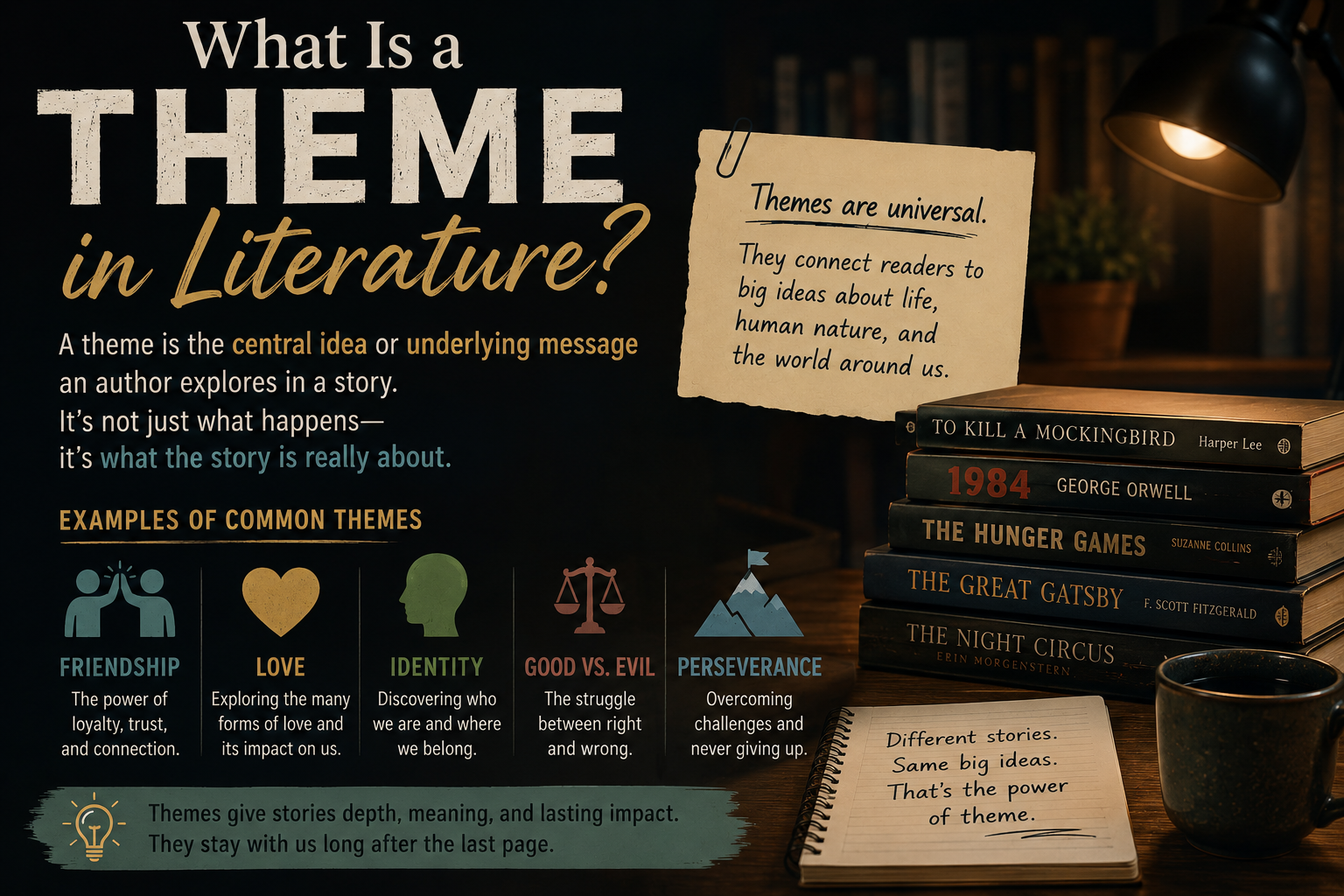
what is theme in literature

If you have ever asked, “What is a Theme in Literature?” you are not alone. Theme can feel confusing at first, but it is one of the most useful ideas in reading and writing about books.

In simple terms, a theme is the deeper message a story shares about life, people, or the world.

In this Guide

  • What a theme means
  • Why theme matters
  • Theme vs. topic
  • Clear examples from famous books
  • How to find a theme
  • Helpful books to read
  • FAQ and key takeaway
what is theme in literature

What Is a Theme in Literature? A Simple Definition

A theme is the main idea or message behind a literary work.

So, What Is a Theme in Literature? It is not just what happens in the plot. It is what the story suggests about human life.

For example, a story may be about a boy at school. That is the plot. The theme might be that courage means standing up for what is right, even when it is hard.

A theme is often not stated directly. Readers must notice patterns, choices, conflicts, and changes in the characters.

Why What Is a Theme in Literature? Matters

Theme helps readers understand why a story matters beyond its events.

When students ask, “What Is a Theme in Literature?” they are really asking how stories create meaning. Theme connects the plot to real life.

Without theme, a story is only a chain of events. With theme, those events point to something larger.

In To Kill a Mockingbird by Harper Lee, the plot centers on a trial and a young girl’s view of her town. One major theme is that moral courage can stand against injustice.

That theme gives the novel its power. It asks readers to think about fairness, fear, and personal responsibility.

What Is a Theme in Literature? Theme vs. Topic

A topic is one word or idea. A theme is a full message about that idea.

This is where many students get stuck. Love, power, family, and fear are topics. They are not full themes by themselves.

If someone asks, “What Is a Theme in Literature?” do not answer with only “love.” A stronger answer would be, “Love can lead people to make brave choices.”

Here is another example. In Romeo and Juliet by William Shakespeare, love is a topic. One possible theme is that intense love can clash with family hate and social pressure.

That answer says more. It explains what the play suggests about love.

Common Theme Examples in Literature

Famous books often explore themes that still feel true today.

In The Great Gatsby by F. Scott Fitzgerald, one theme is that the dream of wealth can hide loneliness and moral emptiness.

In Charlotte’s Web by E. B. White, one theme is that friendship can give ordinary lives deep meaning.

In Lord of the Flies by William Golding, one theme is that people can become cruel when rules and shared values break down.

These examples show why the question “What Is a Theme in Literature?” has no single answer for every book. Different stories explore different truths.

How Authors Build Theme

Authors build theme through choices, not lectures.

A writer may show theme through a character’s mistakes. A character may want power, lose trust, and learn that control has a cost.

Authors also use conflict. When a character faces a hard choice, the story often reveals its deeper message.

Symbols can help too. In The Great Gatsby, the green light can point to Gatsby’s dream and the distance between desire and reality.

If you want a step-by-step method, read this helpful guide on how to identify theme in literature.

What Is a Theme in Literature? How to Write About It

A strong theme statement is clear and specific.

When you answer “What Is a Theme in Literature?” in an essay, avoid one-word answers. Write a sentence that explains the message.

Weak theme statement: “Friendship.”

Stronger theme statement: “True friendship requires loyalty when life becomes difficult.”

Then prove it with details from the text. Use character actions, key scenes, and important lines as evidence.

You can also compare the theme to another work. For poetry terms and close reading help, the Poetry Foundation glossary is a useful resource.

Books That Help You Understand Theme

These books are helpful for students who want more practice with literary ideas.

  • How to Read Literature Like a Professor by Thomas C. Foster
  • They Say / I Say by Gerald Graff and Cathy Birkenstein

These are not required to understand theme, but they can help you write stronger essays and notice deeper meaning in texts.

Practical Tip for Finding Theme

Look at how the main character changes by the end of the story.

Ask yourself: What did the character learn? What mistake did they make? What does the ending suggest about life?

This simple method can help you answer “What Is a Theme in Literature?” with confidence. For more practice, see this guide to finding theme in a story.

FAQ: What Is a Theme in Literature?

What Is a Theme in Literature? in simple words?

A theme is the message or lesson a story suggests about life, people, or society.

Can a book have more than one theme?

Yes. Most novels and plays have more than one theme. A story may explore love, power, guilt, or freedom in different ways.

Is theme the same as the moral?

Not always. A moral is usually a clear lesson. A theme can be more complex and may not give a simple answer.

How do I find the theme quickly?

Focus on the main conflict, the ending, and how the main character changes. Then write the message as a full sentence.

Key Takeaway

What Is a Theme in Literature? It is the deeper message a story gives about life. If you can explain that message and support it with evidence, you are already on the path to strong literary analysis.

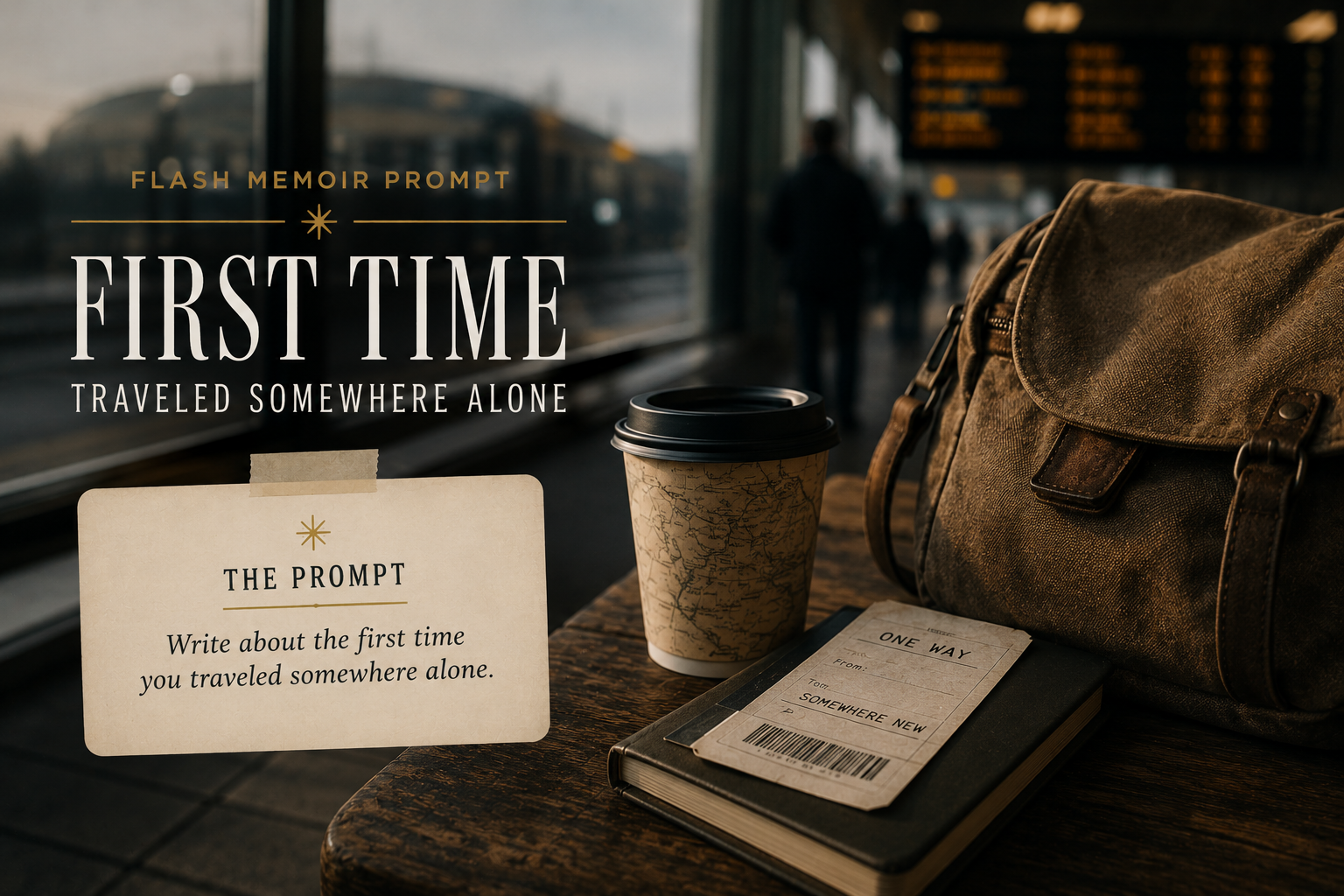
Flash Memoir Prompt: First Time You Traveled Somewhere Alone

Flash memoir prompt alone

A brief, honest writing invitation for remembering the first time you traveled somewhere alone through one clear scene, a few sensory details, and the feeling that followed you. Maybe you can still picture it: your hand on a ticket, your bag feeling heavier than it should, your eyes moving from sign to sign while you tried to look like someone who knew exactly where to go. This flash memoir prompt first time traveled somewhere alone is less about the trip itself and more about the quiet shift that happened when no one else was there to decide the next step.

Flash memoir prompt alone

The Prompt

Write about the first time you traveled somewhere alone.

This prompt can unlock a memory because solo travel often makes ordinary moments feel sharp. A bus station bathroom, a delayed flight, a motel key, a wrong turn, or the first meal alone can hold more meaning than the destination.

When you write from this flash memoir prompt first time traveled somewhere alone, you do not need to cover every mile. You only need to return to the moment when you realized you were responsible for yourself in a new way.

Why This Memory Matters

The first time you travel alone can reveal a version of you that had been waiting for space. Maybe you felt proud. Maybe you felt scared. Maybe you felt both within the same five minutes.

That tension is useful for memoir. A strong flash memoir often lives inside mixed feelings. You might remember acting brave while secretly checking your phone every few minutes. You might remember missing home, then surprising yourself by enjoying the silence.

This kind of memory can also show a change in identity. Before the trip, you may have been someone’s child, roommate, student, partner, or friend. During the trip, you had to become the person who read the schedule, guarded the wallet, asked for help, and chose what to do next.

If you are studying memoir as part of a class, this prompt can also help you practice finding meaning without forcing a moral. Like learning how to identify theme in literature, memoir asks you to notice what a moment keeps pointing toward. Freedom. Fear. Trust. Loneliness. Independence.

The best part is that the memory does not have to be dramatic. You do not need a missed train or a life-changing disaster. Sometimes the most powerful part is sitting alone with a paper cup of coffee and realizing no one knows where you are.

How to Approach This Prompt

Begin with one physical detail from the trip. Choose something you can still see, hear, smell, or touch. It might be the vinyl seat on a bus, the stale air of an airport gate, the pull of a backpack strap, or the blue glow of a phone map at night.

Let that detail lead you into one scene. Do not try to tell the whole story of the trip. A flash memoir works best when it narrows the lens. Pick the moment before departure, the moment you arrived, or the moment you first felt truly alone.

Write what you noticed before you explain what it meant. For example, instead of starting with “I learned to be independent,” start with the vending machine humming beside you while you counted your change. Let readers feel the scene first.

You can also ask yourself one simple question: What did I pretend not to feel? Many first solo trips involve a small performance. You may have pretended to be calm, older, tougher, or more prepared than you were. That gap between outside and inside can become the heart of the piece.

If you like to mark up readings or mentor texts before writing your own, try the same habit with your memory. Notice the details that repeat or stand out, the way you might when you annotate literature. Circle the small moments in your mind and choose the one with the most charge.

For this flash memoir prompt first time traveled somewhere alone, avoid ending too neatly. You do not have to prove that you became fearless. It may be more honest to say you were still afraid, but you kept walking anyway.

A Quick Example

The first time I traveled alone, I took a train to visit my cousin in Chicago. I was seventeen and had memorized the schedule like it was a speech I had to give. At the station, I bought a bottle of orange juice even though I was not thirsty, just so I could look busy. My mother had waved from the parking lot until I turned away first. On the train, I sat by the window and kept my ticket in my sweatshirt pocket, touching it every few minutes to make sure it was still there. When the conductor passed, he barely looked at me. That almost disappointed me. I had expected the world to notice I was doing something brave. Instead, it kept moving, which made me feel both smaller and freer.

Try It Yourself

Set a timer for ten minutes and return to one scene from your first solo trip. Start with where your body was: standing in line, sitting by a window, walking through a station, or waiting near a curb.

Then write toward the feeling you did not fully understand at the time. Were you nervous, proud, lonely, excited, embarrassed, or relieved? Let the emotion stay a little messy. Real memories usually are.

If you get stuck, describe what you carried. A suitcase, a backpack, a purse, a phone charger, a snack, or a folded address can reveal what you thought you needed. It can also reveal what you could not prepare for.

This prompt is not asking for a travel essay. It is asking for a flash of memory. One place. One version of you. One moment when being alone changed the way you heard your own thoughts.

Want More Flash Memoir Prompts?

Explore all 365 prompts in The Memory Trigger: 365 Flash Memoir Writing Prompts. It is designed to help you find small, true stories from everyday life and turn them into focused pieces of memoir.

Themes in The Catcher in the Rye: A Student-Friendly Guide

Catcher themes

The themes in The Catcher in the Rye help readers see why Holden Caulfield feels so lost, angry, and afraid. His voice can sound casual, but the novel raises serious questions about pain, honesty, and what it means to grow up.

In this Guide

Use this guide to review the novel, plan essays, or prepare for class discussion.

  • Why the themes matter
  • Major ideas in the novel
  • Important symbols
  • Essay tips for students
  • FAQ and key takeaway
Catcher themes

Why the Themes in The Catcher in the Rye Matter

This novel is short, but its ideas are deep.

Studying the themes in The Catcher in the Rye helps you move past plot summary. Instead of only saying what Holden does, you can explain what his choices reveal.

Holden tells the story in his own voice. That matters because he often hides his real pain behind jokes, insults, and sharp opinions.

The main conflict is not just Holden against other people. It is also Holden against change, grief, and his fear of adult life.

Major Themes in The Catcher in the Rye

The novel returns to a few strong ideas again and again.

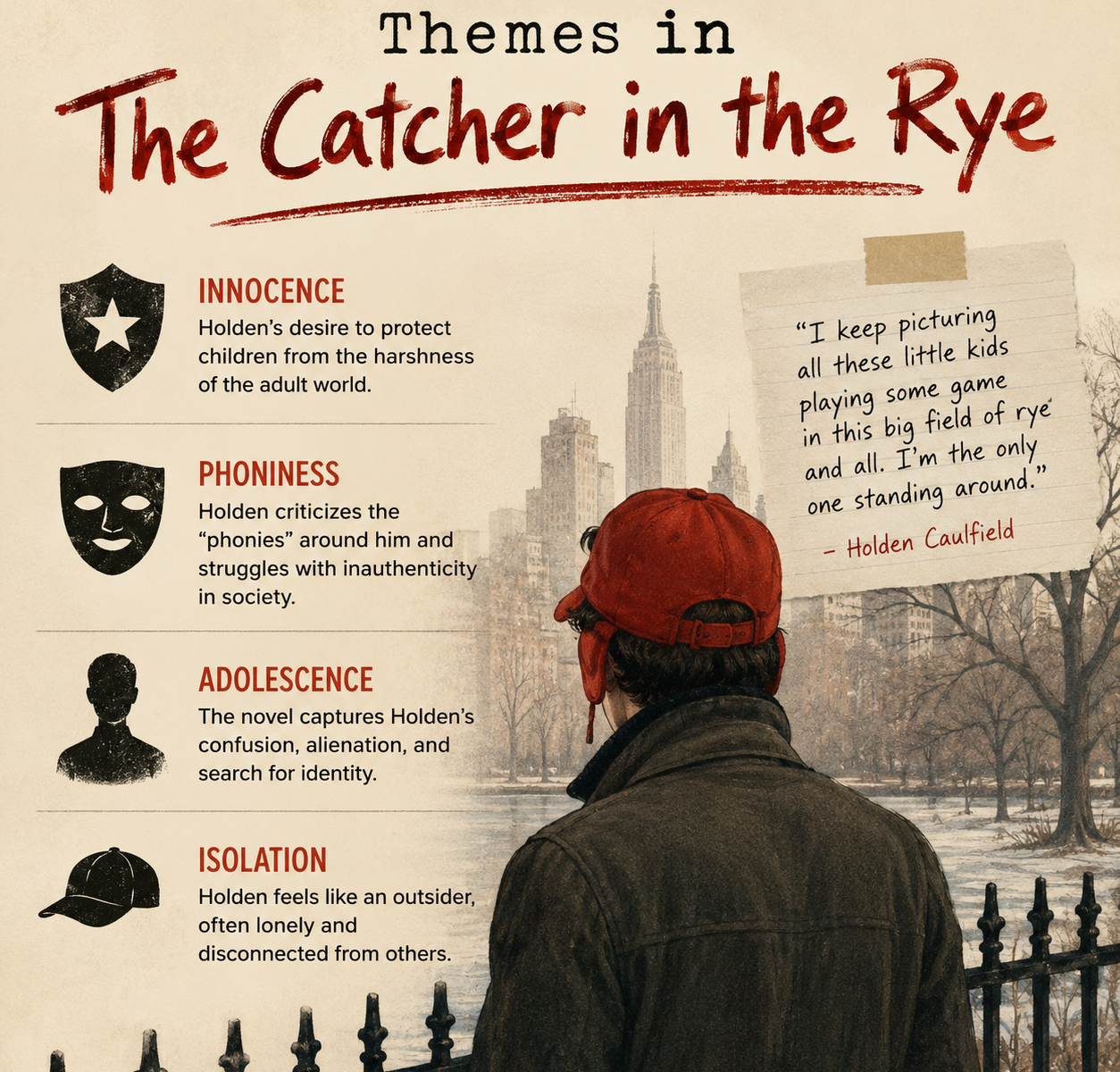
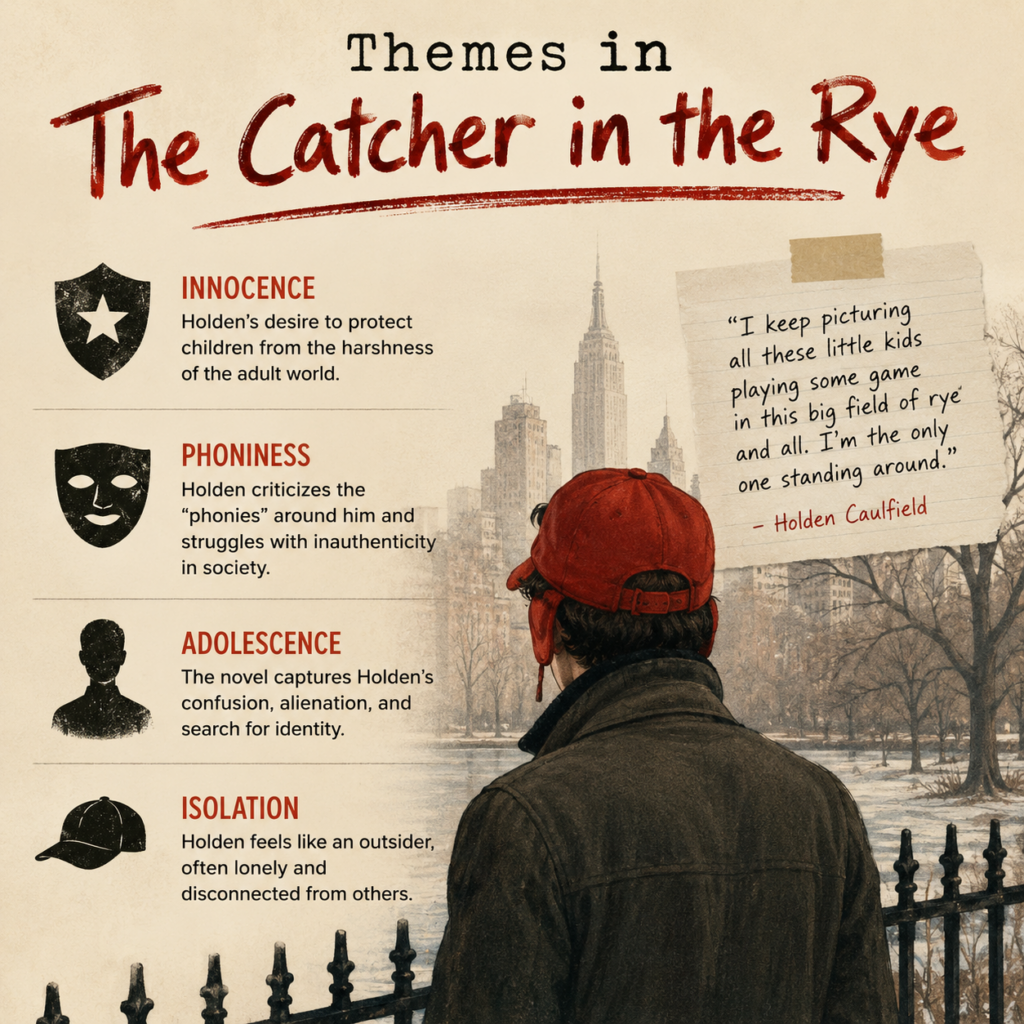
The major themes in The Catcher in the Rye include innocence, phoniness, isolation, grief, and identity. These ideas connect to Holden’s view of the world.

Holden wants people to be honest, but he also lies. He wants connection, but he pushes people away. That tension makes him feel real.

Like Scout in To Kill a Mockingbird, Holden sees adult life as confusing and unfair. Both characters learn that growing up means facing truth, even when truth hurts.

The Theme of Innocence and Protection

Holden wants to protect childhood because it feels safe to him.

One of the clearest themes in The Catcher in the Rye is the loss of innocence. Holden fears that children will be hurt by the adult world.

This is why the image of the “catcher in the rye” matters so much. Holden imagines himself saving children before they fall off a cliff.

The cliff can stand for adulthood, pain, or knowledge that cannot be undone. Holden does not want children to lose their purity.

His love for Phoebe shows this theme in a tender way. She is not perfect, but she reminds him of honesty and warmth.

The Theme of Phoniness

Holden uses the word “phony” to judge people, but the word also reveals his fear.

Holden calls many adults fake. He hates social rules, shallow success, and people who pretend to care.

At school, in hotels, and at parties, Holden feels trapped by manners that seem empty. He often thinks adults perform roles instead of showing real feeling.

Yet Holden is not always honest either. He lies to strangers, changes his story, and hides his feelings.

This makes the theme more complex. The novel does not say Holden is always right. It shows how hard honesty can be when a person feels wounded.

The Theme of Isolation and the Need for Connection

Holden often feels alone, even when he is around people.

Isolation is one of the most painful themes in The Catcher in the Rye. Holden wants someone to understand him, but he rarely lets people get close.

He calls old friends, visits teachers, and talks to strangers. Still, most of these moments fail because Holden feels judged or unsafe.

This pattern is common in literature. In Romeo and Juliet, the young lovers also feel cut off from the adult world around them.

Holden’s loneliness does not mean he hates people. It means he wants real care, but he does not know how to ask for it.

The Theme of Grief and Emotional Pain

Much of Holden’s behavior comes from loss.

Holden’s brother Allie has died, and that loss shapes the whole novel. Holden talks about Allie with love, but also with deep sadness.

He has not made peace with this grief. His anger, fear, and restless travel through New York can be read as signs of inner pain.

The red hunting hat also connects to this theme. It helps Holden feel separate, but it also gives him comfort.

If you want help reading objects like that, see our guide to finding symbolism in a story.

The Theme of Growing Up and Identity

Holden is caught between childhood and adulthood.

He does not want to be a child forever, but he fears the adult world. This conflict shapes his identity.

Holden rejects school, rules, and career talk. He thinks these things push people into fake lives.

At the same time, he cannot escape responsibility. By the end, he starts to see that he cannot control Phoebe’s life or protect every child.

The carousel scene is important here. Holden lets Phoebe reach for the gold ring, even though she might fall. That moment shows a small but real shift.

Key Symbols That Support the Themes

The novel’s symbols make its ideas easier to see.

The red hunting hat shows Holden’s wish to be different and protected. He wears it when he feels unsure or exposed.

The museum shows his desire for a world that does not change. The displays stay the same, unlike people.

The ducks in Central Park show Holden’s worry about survival. He wants to know where they go in winter because he also feels lost.

These symbols help explain the themes in The Catcher in the Rye without turning the novel into a simple lesson. For more support, read this clear guide on how symbols reveal meaning.

How to Write About Themes in The Catcher in the Rye

A strong essay needs a clear claim, not just a topic.

When you write about themes in The Catcher in the Rye, do not say, “This book is about growing up.” That is too broad.

Try a sharper claim: “Salinger shows that growing up requires accepting change, even when change feels dangerous.”

Then use scenes to prove it. The catcher fantasy, the museum, and the carousel can all support that idea.

For quick review before a quiz or essay, you may also want student literature study guide resources.

Helpful Books and Sources

Use outside sources to support your reading, but let the novel lead your ideas.

Books to search on Amazon or at your library:

  • The Catcher in the Rye by J. D. Salinger
  • Franny and Zooey by J. D. Salinger

For background, read Britannica’s overview of The Catcher in the Rye or its short page on J. D. Salinger.

FAQ: Themes in The Catcher in the Rye

Here are quick answers to common student questions.

What are the main themes in The Catcher in the Rye?

The main themes in The Catcher in the Rye are innocence, phoniness, isolation, grief, and growing up.

Why does Holden hate phoniness?

Holden hates phoniness because he sees it as a sign that adults hide truth. He also uses the word to protect himself from pain.

What does the Catcher in the Rye idea mean?

It shows Holden’s wish to protect children from harm, adulthood, and loss of innocence.

Is Holden a reliable narrator?

Not completely. He is honest about some feelings, but he also lies, exaggerates, and avoids painful truths.

Key Takeaway

The themes in The Catcher in the Rye show a teenager who wants truth, love, and safety in a world that feels false and unstable. The novel’s power comes from that conflict.

error

Enjoy this article? Please spread the word :)

Follow by Email
BLUESKY
fb-share-icon
Reddit
LinkedIn
Share
RSS