Flash Memoir Prompt: First Time You Saw Someone You Loved Cry

flash memoir prompt cry

A tender writing invitation about the first time you saw someone you loved cry, told through one small scene, one clear detail, and one honest feeling.

The room changes when someone you love cries for the first time in front of you. Maybe the person was a parent at the kitchen sink, a friend in the passenger seat, a grandparent in a hospital chair, or a sibling trying to stay quiet behind a closed door.

You may remember the sound before you remember the words. A shaky breath. A tissue pulled from a sleeve. The way you suddenly did not know where to put your hands.

This flash memoir prompt first time saw someone loved cry asks you to write about that moment before it turns into a full life story. Stay close to the scene. Let the memory reveal what it wants to reveal.

flash memoir prompt cry

The Prompt

Write about the first time you saw someone you loved cry.

This prompt can unlock a memory because it often marks a shift. Before that moment, you may have seen that person as strong, in charge, funny, distant, or unbreakable. Then, all at once, you saw something more human.

You do not have to explain the whole relationship. You do not have to know every reason behind the tears. A strong flash memoir can begin with what you noticed: the bent head, the red eyes, the silence after someone left the room.

Why This Memory Matters

The first time you saw someone you loved cry may have changed the way you understood them. It may have been the day you realized adults could feel lost. It may have been the first time you saw grief up close. It may have been a small, private moment that never made sense until years later.

These memories matter because they often hold two stories at once. There is the story of what happened in the room, and there is the story of what changed inside you.

Maybe you felt scared. Maybe you felt protective. Maybe you felt embarrassed because you did not know what to say. Those reactions belong in the piece. Memoir is not about making yourself look perfect. It is about telling the truth of how a moment felt from the inside.

If you are a student or a close reader of stories, this kind of prompt can also help you understand character moments in literature. When a character cries, shuts down, or hides pain, the scene often reveals more than a long explanation. You can explore that idea further in this guide on how to analyze characters in literature.

How to Approach This Prompt

Begin with one physical detail. Do not start with the whole backstory. Start with the thing your mind still holds.

Maybe it is your mother’s mascara on a napkin. Maybe it is your father sitting in the driveway after a funeral, the car still running. Maybe it is your best friend laughing too hard before the tears came.

Once you have that detail, narrow the memory to one scene. Where were you? What time of day was it? What could you hear? What did you do with your body? Did you move closer, freeze, leave, hand them something, or pretend not to notice?

Try to write what you noticed before you explain what it meant. For example, instead of opening with “That was when I learned my grandmother was lonely,” you might begin with her spoon resting untouched beside a bowl of soup. The meaning can arrive later.

It may help to give yourself a frame like this:

I saw the tears when _____. I was _____. The room smelled like _____. I wanted to _____. I understood later that _____.

You can change those lines as you write. They are only a doorway.

If you like to mark up your own drafts, try circling the strongest sensory detail after you finish. Then underline the sentence where the emotion feels most true. This is similar to the close-reading habit described in how to annotate literature, except the text is your own life.

A Quick Example

The first time I saw my older brother cry, he was sitting on the back steps with a basketball between his knees. It was almost dark, and the porch light kept flickering like it could not decide whether to help. He had just found out he did not make the varsity team. I expected him to be angry. He was always angry first. Instead, he kept rubbing his thumb over the cracked orange leather of the ball. His face was turned away, but I could see one tear fall onto his wrist. I stood in the doorway with two cans of soda, suddenly unsure if I was allowed to see him like that. I set one can beside him and said nothing. Years later, I think that was the kindest thing I knew how to do.

Try It Yourself

Set a timer for ten minutes and write the scene as plainly as you can. Do not worry about making it beautiful at first. Let the room, the person, and your younger self appear on the page.

If the memory feels heavy, write slowly. You can stop at any point. You can also write around the moment instead of straight through it. Describe the hallway, the weather, the plate on the table, or the shoes by the door.

A flash memoir prompt about the first time you saw someone you loved cry does not need a dramatic ending. Often, the strongest ending is small: what you did next, what you could not say, or what you understand now.

Want More Flash Memoir Prompts?

Explore all 365 prompts in The Memory Trigger: 365 Flash Memoir Writing Prompts. Use them one at a time when you want a short, focused way to return to real memories and shape them into honest pieces of writing.

Flash Memoir Prompt: First Time You Felt Genuinely Proud of Yourself

Rapid Reads Press

Maybe it happened in an empty kitchen, after everyone else had gone to bed: this flash memoir prompt first time felt genuinely proud asks you to return to the private moment when your own approval finally felt like enough.

The Prompt

Write about the first time you felt genuinely proud of yourself, with no one else around to see it.

This prompt works because pride is often tied to an audience. We remember the award, the applause, the grade, the compliment, or the person who finally noticed. But private pride is different. It does not need proof. It arrives quietly, sometimes in a bedroom, a bathroom mirror, a parked car, a school hallway, or at a desk covered in crumbs and paper.

A flash memoir prompt, the first time felt genuinely proud, can help you find a small scene with a large emotional center. The key is to look for the moment when you knew something had changed inside you, even if the rest of the world kept moving like nothing had happened.

Why This Memory Matters

The first time you felt proud of yourself may not look dramatic from the outside. Maybe you finished a hard assignment without help. Maybe you walked away from someone who kept hurting you. Maybe you saved money, fixed something, passed a test, apologized first, told the truth, or stayed calm when you wanted to fall apart.

What matters is the private nature of the moment. Since no one else was there to praise you, the pride had to come from somewhere deeper. That makes the memory powerful. It shows what you value when no one is watching.

This kind of memory can also reveal a theme in your life. You may notice a pattern around independence, courage, discipline, forgiveness, or survival. If you want help thinking about larger meaning in a personal story, this guide on how to identify theme in literature can also help you spot the theme inside your own writing.

Private pride can feel tender because it may be connected to a time when you wanted someone else to notice. Maybe no one did. Maybe that hurt. But the memory is still yours. In fact, the quietness may be what gives it its shape.

How to Approach This Prompt

Begin with one physical detail. Do not start by explaining your whole life or why the moment mattered. Start with what your body knew first.

Maybe your hands were shaking. Maybe your shirt was damp with sweat. Maybe there was a red pen mark on the page, a sink full of dishes, a bus ticket in your pocket, or a glow from a computer screen in a dark room.

Once you have that detail, narrow the memory to one scene. A flash memoir does not need the full backstory. You can hint at what came before, but try to stay close to the moment when pride arrived.

Ask yourself: Where was I? What had I just done? What did I notice in the room? Did I smile, cry, exhale, laugh, or sit very still?

Write what you noticed before you explain what it meant. This helps the reader feel the scene instead of being told how important it was. For example, “I folded the test and put it under my pillow” may say more than “I was proud because I had worked hard.”

After you draft, read your piece like a careful reader. Circle the strongest image. Underline the sentence where the emotion changes. If you enjoy close reading, the same habits used to annotate literature can help you revise your memoir with more care.

Above all, avoid trying to tell every related story at once. Stay with the first real moment. Let it breathe.

A Quick Example

I was sitting on the bathroom floor with my laptop balanced on a towel because the apartment was too loud everywhere else. The tile was cold through my pajama pants. I clicked submit on my college application at 12:17 a.m., then stared at the screen as if it might take the words back. No one knew I had finished it. My mother was asleep. My brother was playing music behind his door. I had written the essay in pieces before school, after work, and once in the laundry room while the dryer thumped beside me. When the confirmation email arrived, I pressed my hand over my mouth. I did not scream. I just sat there, smiling at the sink cabinet, feeling taller than I had all week.

Try It Yourself

Set a timer for ten minutes and write from the prompt without trying to make the memory sound impressive. The moment does not have to be noble or life-changing. It only has to be true.

If you get stuck, begin with this sentence: “No one saw me when I…” Then keep going. Let the sentence lead you into the room, the object, the sound, or the small action that held the feeling.

As you write, remember that pride does not always shout. Sometimes it shows up as relief. Sometimes it feels like a steady breath. Sometimes it is simply the moment you realize, “I did that.” That is enough for this flash memoir prompt first time felt genuinely proud.

Want More Flash Memoir Prompts?

If this prompt helped you uncover a quiet memory, keep gathering those small scenes. They often become the strongest pieces of memoir because they carry real emotional weight without needing to explain too much. Explore all 365 prompts in The Memory Trigger: 365 Flash Memoir Writing Prompts.

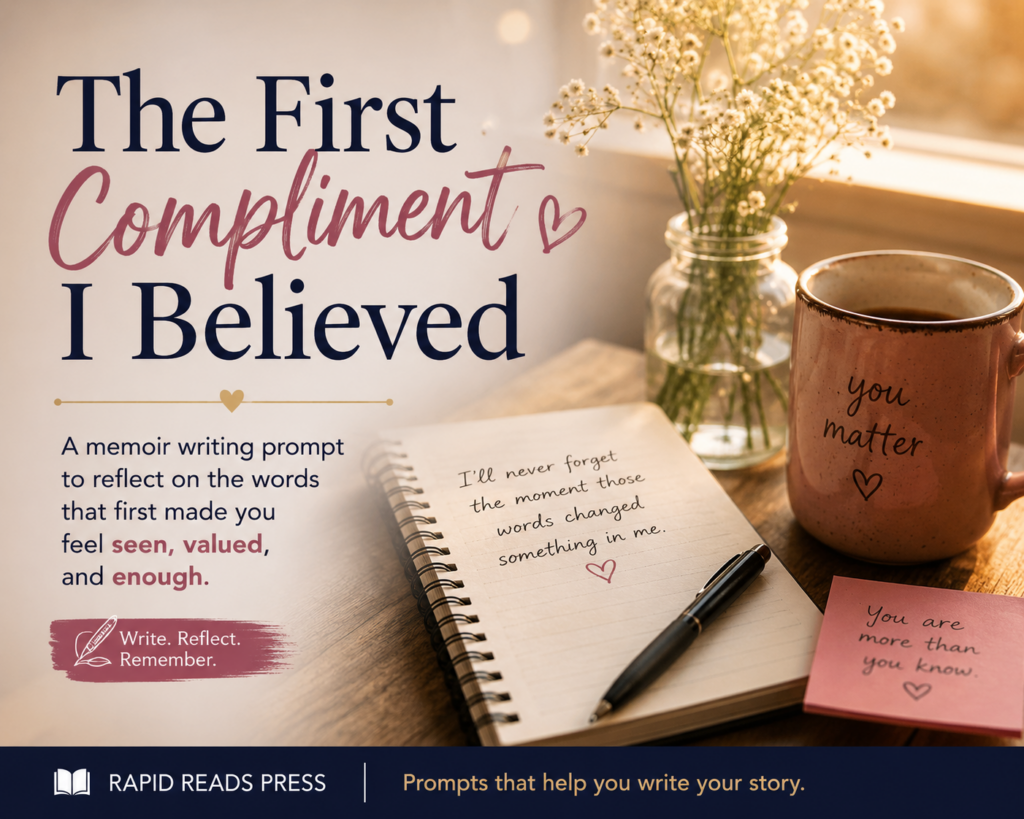
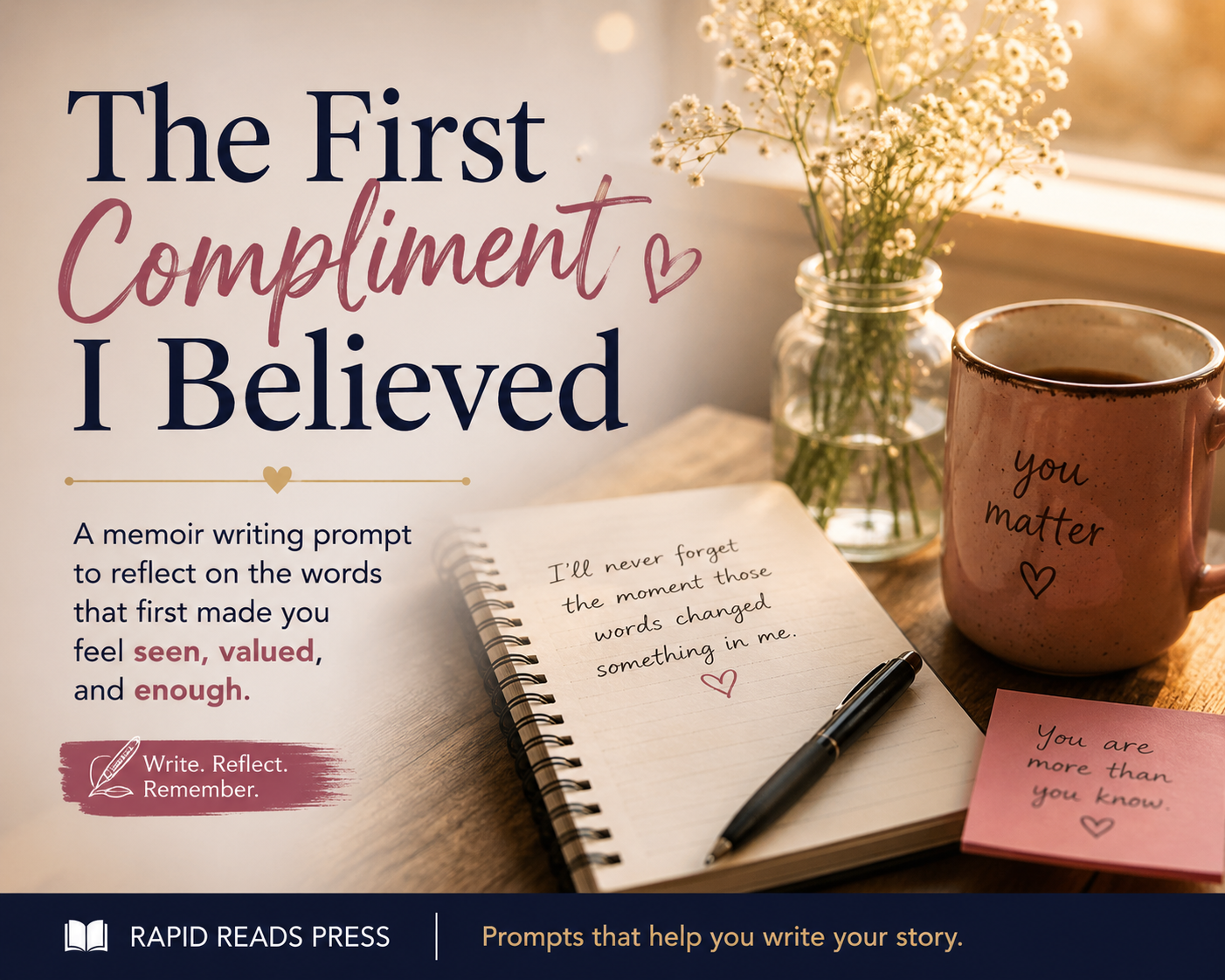
Flash Memoir Prompt: First Time You Were Given a Compliment that You Actually Believed

flash memoir prompt first time given compliment actually believed

A warm flash memoir prompt for remembering the first compliment that felt true, and the small moment when someone else’s words finally reached you.

There is a strange little pause that happens when a compliment lands. Maybe you were used to brushing praise away. Maybe you laughed, changed the subject, or said, “No, I’m not,” before the other person even finished speaking. Then one day, someone said something simple, and for once, you did not argue with it.

This flash memoir prompt, the first time you were given a compliment you actually believed, invites you to return to that exact moment. Not the long history of why compliments were hard to accept. Just the first time one slipped past your defenses and settled somewhere honest.

flash memoir prompt first time given compliment actually believed

The Prompt

Write about the first time you were given a compliment that you actually believed.

This prompt can unlock a meaningful memory because it is rarely just about the compliment. It is about who said it, how they said it, where you were standing, and why those words felt different from all the others.

Maybe the compliment came from a teacher who noticed your writing. Maybe it came from a coach, a grandparent, a friend, or someone you barely knew. Maybe it was not dramatic at all. Sometimes the words we believe are quiet ones, said in a hallway, at a kitchen table, or after a hard day when we had almost given up.

Why This Memory Matters

A believable compliment can mark a shift in how you see yourself. It might be the first time you felt talented, kind, brave, funny, capable, or worth noticing. That kind of memory has power because it shows a moment when your inner story changed.

This prompt may uncover a story about self-doubt. It may bring up a time when you wanted approval but did not know how to receive it. It may also reveal how much one thoughtful sentence can matter when it comes from the right person at the right time.

For student writers, this is a useful prompt because it keeps the memory focused. You do not have to explain your entire childhood or every reason you lacked confidence. You can build the scene around one compliment and let the reader understand the rest through detail.

If you are exploring broader meaning in your writing, you might find it helpful to think about the larger idea behind the scene. This is similar to how readers learn to identify theme in literature. A small moment can point toward a bigger truth without needing to announce it.

How to Approach This Prompt

Begin with the place where the compliment happened. Put yourself back in the room, the car, the classroom, the parking lot, or the store aisle. What were you holding? What could you hear? What did the light look like?

Then narrow the memory to one scene. Avoid trying to tell the whole story of your confidence or insecurity. Stay close to the moment when the words were said.

Write what you noticed before explaining what it meant. Maybe you noticed the person did not smile in a joking way. Maybe they looked you straight in the eye. Maybe their voice was ordinary, which made the compliment feel more real.

You might start with a physical detail, such as your hands under the desk, your shoes on the floor, or the heat in your face. A physical detail can make the emotion easier to write because it gives the memory something solid to stand on.

If you like to mark up memories before drafting, try borrowing a reading habit. Circle the words that carry feeling, underline the turning point, or make a note beside the moment that changed you. These simple moves are close to the skills used when you annotate literature, and they can help you notice what matters in your own story.

As you write, resist the urge to make the compliment sound perfect. Real compliments are often plain. “You’re good at this.” “That was brave.” “I trust you.” “You made the room feel lighter.” The truth of the memory does not need fancy language.

A Quick Example

I was sixteen, wiping down tables at the diner after the lunch rush. My shirt smelled like fryer oil, and my shoes stuck to the floor near the soda machine. Mrs. Alvarez, the owner, stood behind the counter counting change. I had just calmed down a customer who was angry about his order, though my hands shook the whole time. She looked up and said, “You keep your head when people lose theirs.” I waited for the joke or the correction. It did not come. She went back to counting quarters. I stood there with the wet rag in my hand, feeling taller than I had five minutes before. No one had ever called me calm. But that day, I believed her.

Try It Yourself

Set a timer for ten minutes and write the scene as clearly as you can. Do not worry about making it polished. Focus on the moment the compliment was spoken and what happened inside you right after.

If you get stuck, use this sentence starter: “I did not believe compliments back then, but when they said…” Let the memory continue from there.

This flash memoir prompt first time given compliment actually believed works best when you keep it small. One voice. One sentence. One shift. That is enough for a strong flash memoir piece.

Want More Flash Memoir Prompts?

If this prompt helped you remember a moment you had nearly forgotten, keep going. Explore all 365 prompts in The Memory Trigger: 365 Flash Memoir Writing Prompts.
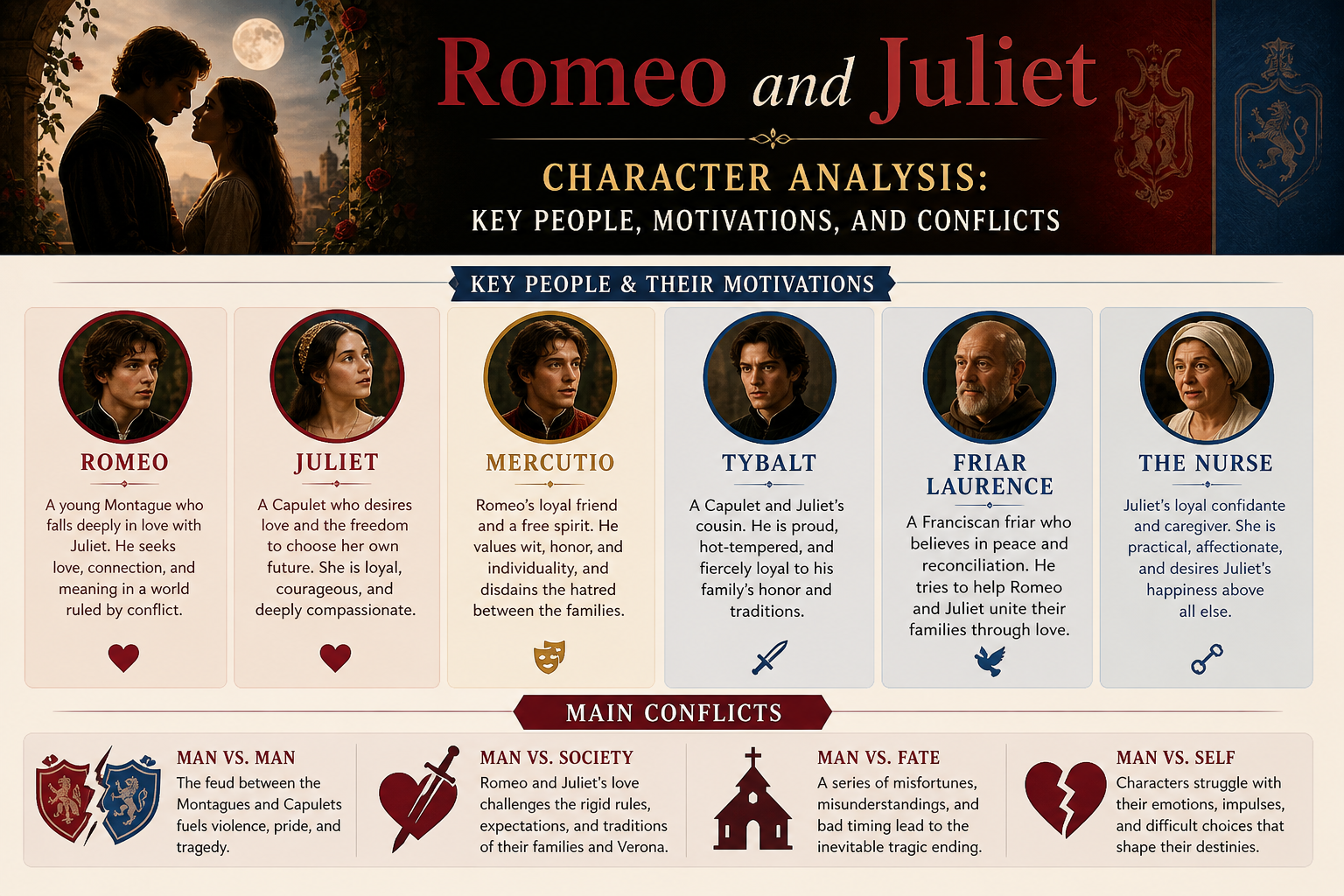
Romeo and Juliet Character Analysis: Key People, Motivations, and Conflicts

Romeo and Juliet character analysis

A practical breakdown of the main characters and how their choices shape the story.

Shakespeare’s tragedy works because each character wants something badly, then acts before the full truth is clear. This Romeo and Juliet character analysis breaks down the main characters, their motives, and the conflicts that push the play toward its tragic end.

This article contains affiliate links.

In this Guide

Romeo and Juliet character analysis

Romeo and Juliet Character Analysis: The Big Picture

The play is not only about young love. It is also about family pressure, pride, anger, and the cost of poor choices.

In a strong Romeo and Juliet character analysis, the key question is not just “Who is good?” or “Who is bad?” A better question is, “What does this person want, and what choice do they make because of it?”

Romeo wants love that feels total. Juliet wants control over her own life. Lord Capulet wants family honor. Tybalt wants respect through violence.

These wants crash into each other. That is why the plot feels fast, tense, and painful.

If you need a simple method for any character essay, this guide to analyzing characters in literature can help you build stronger claims.

Romeo and Juliet Character Analysis of Romeo Montague

Romeo is emotional, romantic, and quick to act. His heart often moves faster than his judgment.

At the start, Romeo feels crushed because Rosaline does not love him back. This matters because it shows how easily he turns love into an obsession.

When he meets Juliet, his feelings shift at once. This does not mean his love is fake. It does mean he trusts intense feeling more than careful thought.

Romeo’s main conflict is between desire and self-control. He wants peace with Tybalt after he marries Juliet, but he cannot control his rage after Mercutio dies.

That choice changes everything. Romeo kills Tybalt, gets banished, and loses the chance to build a future with Juliet in Verona.


For essays, Romeo is a strong example of a tragic character whose best traits create danger. His passion makes him loving, but it also makes him reckless.

image-slider-with-thumbnail1.jpeg
PlayPause
previous arrow
next arrow
image-slider-with-thumbnail1.jpeg
image-slider-with-thumbnail3.jpeg
image-slider-with-thumbnail4.jpeg
ChatGPT Image Jun 27, 2026, 06_33_13 PM
ChatGPT Image Jun 27, 2026, 06_36_37 PM
ChatGPT Image Jun 27, 2026, 06_38_39 PM
ChatGPT Image Jun 27, 2026, 06_31_22 PM
image-slider-with-thumbnail7.jpeg
ChatGPT Image Jun 27, 2026, 06_29_43 PM
ChatGPT Image Jun 27, 2026, 06_27_44 PM
image-slider-with-thumbnail6.jpeg
ChatGPT Image Jun 27, 2026, 06_15_07 PM
image-slider-with-thumbnail5.jpeg
ChatGPT Image Jun 27, 2026, 06_22_43 PM
ChatGPT Image Jun 27, 2026, 06_25_37 PM
ChatGPT Image Jun 27, 2026, 06_19_43 PM
ChatGPT Image Jun 27, 2026, 06_12_00 PM
ChatGPT Image Jun 27, 2026, 06_08_50 PM
ChatGPT Image Jun 26, 2026, 04_54_23 PM
ChatGPT Image Jun 27, 2026, 05_53_51 PM
ChatGPT Image Jun 28, 2026, 08_35_55 AM
previous arrow
next arrow

Romeo and Juliet Character Analysis of Juliet Capulet

Juliet starts the play as an obedient daughter. By the end, she becomes one of Shakespeare’s boldest young characters.

A strong Romeo and Juliet character analysis should treat Juliet as more than Romeo’s love interest. She makes major choices and takes major risks.

Juliet’s main motive is freedom. She wants to love Romeo, but she also wants the right to choose her own future.

Her conflict grows when her parents order her to marry Paris. To them, the match seems smart. To Juliet, it feels like a prison.

Juliet is often more practical than Romeo. She asks serious questions about marriage, timing, and danger. Still, she is young, trapped, and short on safe advice.

Her choice to take Friar Lawrence’s potion shows courage. It also shows how few options she has in a world ruled by family power.

Romeo and Juliet Character Analysis of the Capulets and Montagues

The older generation keeps the feud alive, even when the young people pay the price.

The Capulets and Montagues are not fully explained, which makes their hatred feel even more pointless. Shakespeare shows the effect of the feud, not a clear reason for it.

Lord Capulet can seem caring when he first protects Juliet from an early marriage. Later, he turns harsh when she refuses Paris.

His motive is control. He wants Juliet to obey because her marriage affects his honor and social plans.

Lady Capulet is more distant. She follows the rules of her class and expects Juliet to accept them too.

The Montagues have less stage time, but they also live inside the feud. Their name makes Romeo an enemy before he has done anything to Juliet’s family.

Romeo and Juliet Character Analysis of Key Supporting Characters

The supporting characters shape the lovers’ choices. Some try to help, while others make conflict worse.

Mercutio

Mercutio is witty, loyal, and sharp-tongued. He mocks romantic love and often turns serious moments into jokes.

His death is a turning point. His curse, “A plague o’ both your houses,” points blame at both families.

Tybalt

Tybalt is proud and violent. He sees Romeo’s presence at the Capulet party as an insult that must be answered.

In a Romeo and Juliet character analysis, Tybalt often stands for the feud itself. He does not want peace because his identity depends on family honor.

Benvolio

Benvolio tries to keep the peace. His name even suggests goodwill.

He fails not because he is weak, but because the world around him rewards anger more than patience.

Friar Lawrence

Friar Lawrence wants peace between the families. He sees Romeo and Juliet’s marriage as a chance to end the feud.

His plan is risky. Like Romeo, he acts with hope before he has enough control over the outcome.

The Nurse

The Nurse loves Juliet and gives her comfort. She also helps Juliet meet Romeo in secret.

Yet the Nurse later tells Juliet to marry Paris. This feels like betrayal because Juliet needs moral support, not just practical advice.

Romeo and Juliet Character Analysis Through Major Conflicts

Character conflict drives the play. Each clash reveals what people value most.

Love versus hate is the clearest conflict. Romeo and Juliet love each other, but their families have taught them to hate each other’s names.

Youth versus age also matters. The young characters act from feeling, while the older characters act from custom and status.

Fate versus choice is harder to judge. The prologue calls the lovers “star-crossed,” but their choices still matter.

This is similar to other famous tragedies. In Macbeth, prophecy matters, but Macbeth’s choices cause the bloodshed. In Oedipus Rex, fate is powerful, but human pride makes the ending hurt more.

For helpful background on the play and Shakespeare’s time, see Britannica’s overview of Romeo and Juliet. You can also explore Shakespeare’s sonnets and language at the Poetry Foundation.

How to Use This Romeo and Juliet Character Analysis in Essays

A good essay claim should connect a character trait to a result. Do not stop at “Romeo is emotional.” Explain how that emotion changes the plot.

Try a sentence like this: Romeo’s passion helps him love Juliet deeply, but it also leads him to kill Tybalt before he thinks about the cost.

For Juliet, you might argue that her courage grows as her choices shrink. That kind of claim gives you room to discuss family pressure, marriage, and the potion plan.

Use short quotes and explain them. A quote should support your idea, not replace it.

If you want a step-by-step tool for class notes, try this character analysis practice guide. You can pair it with our character analysis strategy article for essay planning.

Helpful Books for Romeo and Juliet Study

These books can help with close reading, class discussion, and quote-based analysis.

FAQ – Romeo and Juliet Character Analysis

Who is the most important character in Romeo and Juliet?

Romeo and Juliet are both central. Romeo drives many public conflicts, while Juliet shows the deepest personal growth.

What is Romeo’s main flaw?

Romeo’s main flaw is impulsiveness. He acts from intense feeling before he thinks through the result.

What makes Juliet a strong character?

Juliet becomes strong because she makes hard choices under pressure. She challenges family rules and risks her life for her chosen love.

Why is Tybalt important?

Tybalt keeps the feud active. His anger turns Romeo’s secret marriage into a public disaster.

How should I write a Romeo and Juliet character analysis essay?

Pick one character, name a clear trait, and show how that trait affects the plot. Use quotes, then explain what each quote proves.

Key Takeaway

The best Romeo and Juliet character analysis shows how motives lead to choices, and how those choices turn love into tragedy. The play feels timeless because its characters act from feelings students still understand today.

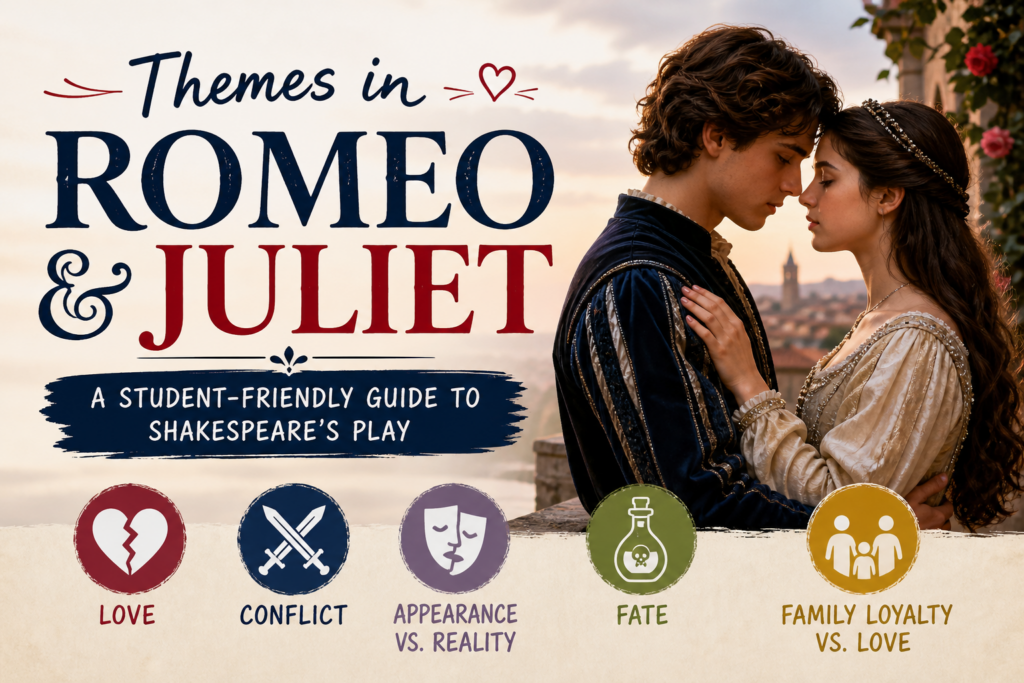
Themes in Romeo and Juliet: An In-Depth Guide

themes in Romeo and Juliet

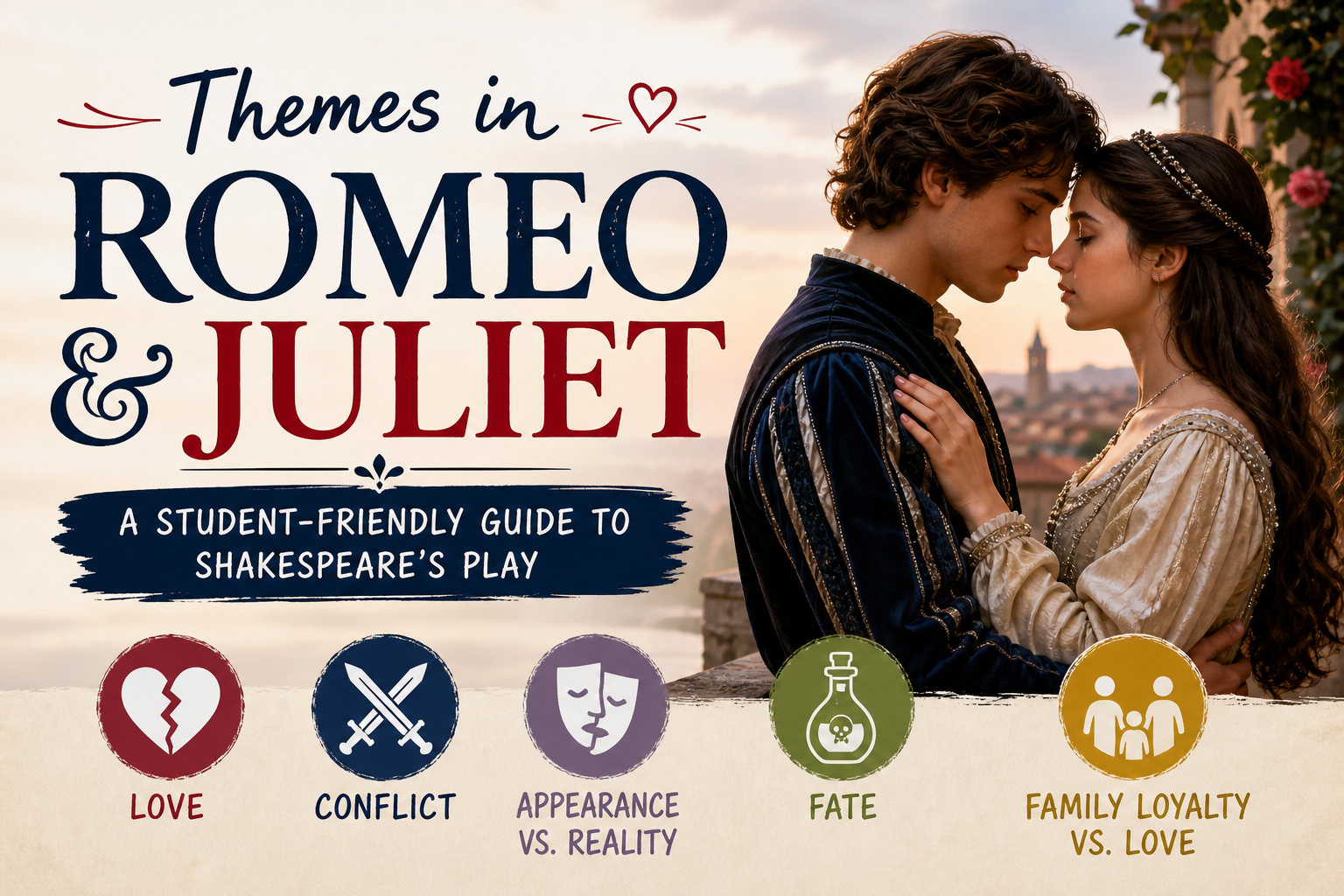
Shakespeare’s tragedy can feel fast, emotional, and hard to sort out at first. This guide explains the major themes in Romeo and Juliet so you can connect the plot to the bigger ideas in the play.

themes in Romeo and Juliet

In this Guide

  • Why theme matters in the play
  • Love and desire
  • Fate and timing
  • Family conflict
  • Youth and identity
  • Writing about theme

This article contains affiliate links.

What Makes the Themes in Romeo and Juliet So Important?

The play is not only about two teenagers who fall in love. It is about what happens when private feelings crash into public hate.

The themes in Romeo and Juliet help readers see why the ending feels both shocking and expected. Shakespeare shows a world where love is powerful, but it is not strong enough to escape anger, pride, and bad choices.

Need a quick refresher before you write? Read our guide on how to identify theme in literature.

Love as One of the Central Themes in Romeo and Juliet

Love in this play is intense, sudden, and dangerous. Romeo and Juliet do not fall in love slowly. They meet, speak, kiss, and decide that life without each other would feel empty.

Among all the themes in Romeo and Juliet, love may be the easiest to notice. Yet Shakespeare does not show love as simple or safe. Love gives the characters courage, but it also pushes them toward risk.

Romeo’s feelings for Rosaline seem dramatic but shallow. His love for Juliet feels deeper because it changes how he sees himself, his family, and his future.

This type of intense love also appears in works like Wuthering Heights by Emily Brontë, where passion can feel larger than reason. In both texts, love has beauty, but it also has a cost.

Fate and Timing in the Themes in Romeo and Juliet

The play asks a hard question: are Romeo and Juliet doomed, or do people make choices that lead to doom?

Fate is one of the most debated themes in Romeo and Juliet. The Prologue calls the lovers “star-cross’d,” which suggests their lives are shaped by forces beyond their control.

Bad timing appears again and again. Romeo meets Juliet right after his pain over Rosaline. The secret wedding happens too fast. Friar Lawrence’s letter never reaches Romeo.

Still, fate does not erase choice. Tybalt chooses violence, Romeo chooses revenge, and the adults choose to keep old hatred alive.

Family Conflict: One of the Harshest Themes in Romeo and Juliet

The feud between the Montagues and Capulets shapes the whole play. It turns ordinary places, such as streets and homes, into unsafe spaces.

Family loyalty should protect young people, but here it traps them. Romeo and Juliet cannot love openly because their names carry a history of hate.

This theme fits with other works about social conflict, such as West Side Story, which is based on Shakespeare’s play. Both stories show how group identity can crush personal desire.

image-slider-with-thumbnail1.jpeg
PlayPause
previous arrow
next arrow
image-slider-with-thumbnail1.jpeg
image-slider-with-thumbnail3.jpeg
image-slider-with-thumbnail4.jpeg
ChatGPT Image Jun 27, 2026, 06_33_13 PM
ChatGPT Image Jun 27, 2026, 06_36_37 PM
ChatGPT Image Jun 27, 2026, 06_38_39 PM
ChatGPT Image Jun 27, 2026, 06_31_22 PM
image-slider-with-thumbnail7.jpeg
ChatGPT Image Jun 27, 2026, 06_29_43 PM
ChatGPT Image Jun 27, 2026, 06_27_44 PM
image-slider-with-thumbnail6.jpeg
ChatGPT Image Jun 27, 2026, 06_15_07 PM
image-slider-with-thumbnail5.jpeg
ChatGPT Image Jun 27, 2026, 06_22_43 PM
ChatGPT Image Jun 27, 2026, 06_25_37 PM
ChatGPT Image Jun 27, 2026, 06_19_43 PM
ChatGPT Image Jun 27, 2026, 06_12_00 PM
ChatGPT Image Jun 27, 2026, 06_08_50 PM
ChatGPT Image Jun 26, 2026, 04_54_23 PM
ChatGPT Image Jun 27, 2026, 05_53_51 PM
ChatGPT Image Jun 28, 2026, 08_35_55 AM
previous arrow
next arrow

Youth, Identity, and Rebellion

Romeo and Juliet are young, but Shakespeare does not treat them as silly. He shows how young people can see truths that adults refuse to face.

Juliet grows quickly across the play. At first, she listens to her parents. Soon, she makes bold choices about love, marriage, and death.

Romeo also tries to step outside his family role. He wants to stop being just a Montague, but the feud pulls him back into violence after Mercutio dies.

Language, Light, and Darkness

Shakespeare uses images of light and darkness to show how love changes the world for Romeo and Juliet.

Juliet is compared to the sun, stars, and bright light. These images make love feel rare and almost sacred.

Darkness is not always evil in the play. Night gives the lovers privacy. Daylight often brings danger, rules, and separation.

This contrast helps readers see one of the quieter themes in Romeo and Juliet: the same world can feel safe or cruel depending on who has power.

Death, Tragedy, and the Cost of Hate

The ending is tragic because the deaths feel avoidable. Many people could have stopped the disaster earlier, but they do not.

Mercutio and Tybalt die before Romeo and Juliet. Their deaths show that the feud harms more than the lovers.

By the final scene, the families understand the cost of hate too late. The peace they reach is real, but it is built on loss.

For background on the play, see Britannica’s overview of Romeo and Juliet. You can also explore the Poetry Foundation’s page on William Shakespeare.

How to Write About the Themes in Romeo and Juliet

A strong theme essay should make a clear claim about what Shakespeare suggests, not just name a topic.

For example, do not only write, “The play is about love.” A stronger claim would be, “Shakespeare presents love as powerful but fragile when society is ruled by hate.”

Use short quotes and explain them in your own words. A quote does not prove your point unless you connect it to the theme.

For more help with this skill, review our student-friendly theme guide.

Helpful Books to Search for on Amazon or at Your Library

These books can help if you want a stronger grasp of the play and Shakespeare’s world.

FAQ: Themes in Romeo and Juliet

These quick answers can help with homework, test review, or essay planning.

What are the main themes in Romeo and Juliet?

The main themes include love, fate, family conflict, youth, violence, and the cost of hate.

Is love shown as good or bad in the play?

Love is shown as powerful and sincere. It becomes tragic because the world around the lovers is hostile.

Does fate cause the tragedy?

Fate plays a major role, but human choices matter too. Shakespeare mixes bad luck with rash action.

Why is family conflict so important?

The feud makes Romeo and Juliet hide their love. It also teaches young people that violence is normal.

Key Takeaway

The key insight: Shakespeare uses Romeo and Juliet’s love story to show how hate can destroy what is most innocent and hopeful.

How to Identify Theme in Literature

how to identify theme in literature

A Practical Guide to Discovering the Deeper Meaning of Stories and Poems

Many readers enjoy novels and poems but feel unsure about how to explain what the text is really about. Teachers often ask students to identify the theme of a story, yet the idea can feel abstract at first.

Learning how to identify theme in literature becomes easier when you slow down and pay attention to patterns in the text. Themes rarely appear in a single sentence. Instead, they develop through characters, repeated images, conflicts, and the choices authors make throughout a narrative.

Once readers begin noticing these patterns, the theme gradually becomes clear. The process is closely connected to close reading and literary analysis.

If you’re new to that approach, you might begin with:

👉 https://rapidreadspress.com/what-is-close-reading-in-literature/

⭐ Key Takeaway

Themes emerge from patterns across a story. When readers pay attention to characters, conflicts, imagery, and repeated ideas, the deeper meaning of the text begins to appear.

how to identify theme in literature
Image by Carla Paton

📚 In This Guide

In this article you’ll learn:

  • How to identify theme in literature step by step
  • What themes actually are (and what they are not)
  • How patterns in characters and events reveal theme
  • A practical example from Frankenstein (affiliate link)
  • How theme connects to literary analysis

What Is a Theme in Literature?

Understanding how to identify theme in literature begins with a simple definition.

A theme is the central idea or insight that a work of literature explores about life, human nature, or society.

Themes often address questions such as:

  • responsibility
  • love and relationships
  • ambition and power
  • identity
  • isolation
  • morality

Unlike plot, which describes what happens, theme explains what the story suggests about those events.

Many stories explore multiple themes at the same time.

📌 Plot tells the story. Theme reveals what the story means.

Step 1: Look for Repeated Ideas

A helpful way to practice how to identify theme in literature is to look for repetition.

Authors often return to certain ideas or situations throughout a work.

For example, a novel might repeatedly show:

  • characters struggling with social expectations
  • conflicts between ambition and responsibility
  • tensions between freedom and duty

When these ideas appear several times, they often point toward the story’s theme.

Tracking these patterns becomes easier when readers annotate the text.

👉 If you’d like a guide to that process, see:
https://rapidreadspress.com/how-to-annotate-literature/

Step 2: Pay Attention to Character Development

Another key step in how to identify theme in literature involves examining how characters change.

Stories often explore theme through the decisions characters make and the consequences they face.

Ask questions like:

  • What does the protagonist learn?
  • What conflicts shape the character’s choices?
  • How do relationships change over time?

The answers often reveal the story’s deeper message.

Step 3: Notice Symbols and Imagery

Writers frequently use imagery and symbolism to reinforce theme.

Certain objects, settings, or descriptions may appear repeatedly.

Examples include:

  • storms representing emotional turmoil
  • winter symbolizing isolation
  • light suggesting hope or knowledge

These details may seem small, but they often help readers uncover the work’s central ideas.

Example: Identifying Theme in Frankenstein

Mary Shelley’s Frankenstein provides a strong example of how to identify theme in literature (affiliate link).

At first glance, the novel appears to be a Gothic story about a scientist creating a monster. However, a closer reading reveals deeper themes.

Throughout the novel, Victor Frankenstein pursues scientific knowledge without considering the consequences of his actions.

Several patterns reinforce this idea:

Ambition

Victor repeatedly describes his desire to unlock the secrets of nature.

Isolation

Both Victor and the creature become increasingly isolated from society.

Responsibility

Victor refuses to accept responsibility for the being he creates.

When these patterns are viewed together, a major theme emerges:

unchecked ambition can lead to destructive consequences.

This interpretation becomes clearer through careful reading and observation.

📌Themes often appear when readers connect patterns across an entire story.

Step 4: Turn Patterns Into a Thematic Statement

Once you recognize patterns, the next step in how to identify theme in literature is expressing the idea clearly.

Instead of writing a single word like ambition or love, try forming a complete thematic statement.

For example:

Weak theme:

Ambition

Stronger thematic statement:

Ambition without responsibility can lead to harmful consequences.

This type of statement explains the insight the story explores.

How Identifying Theme Supports Literary Analysis

Learning how to identify theme in literature plays an important role in literary study.

Themes often become the foundation of essays and research papers.

For example, a literary essay might explore how imagery, character development, and narrative structure all reinforce a specific theme.

If you’re interested in turning these observations into academic writing, see:

👉 https://rapidreadspress.com/how-to-write-a-literary-analysis-essay/

You may also enjoy this broader guide:

👉 https://rapidreadspress.com/how-to-read-literature-like-a-scholar/

📚 Books That Help Readers Understand Literary Themes

These books offer useful guidance for readers interested in literary interpretation (affiliate links).

How to Read Literature Like a Professor — Thomas C. Foster
Explains recurring literary patterns that often reveal theme.

How to Read Poetry Like a Professor — Thomas C. Foster
A helpful introduction to interpreting imagery and symbolism.

How to Read a Book — Mortimer Adler & Charles Van Doren
A classic guide to thoughtful reading and interpretation.

Conclusion: Theme Emerges Through Careful Reading

Identifying theme does not require guessing what the author intended. Instead, it involves noticing patterns in the text and asking thoughtful questions about what those patterns suggest.

When readers slow down and observe details in characters, imagery, and conflicts, the story’s deeper meaning gradually becomes visible.

With practice, learning how to identify theme in literature becomes one of the most rewarding parts of reading.

FAQ — How to Identify Theme in Literature

What is the easiest way to identify theme in literature?

Look for repeated ideas across the story, especially in character decisions, conflicts, and symbols.

Is theme the same as the moral of the story?

Not exactly. A moral usually offers a clear lesson, while a theme explores broader ideas about life and human behavior.

Can a story have more than one theme?

Yes. Many works of literature explore several themes at once.

Why do teachers ask students to identify theme?

Theme analysis helps readers understand how literature explores complex ideas about society, identity, and human relationships.

error

Enjoy this article? Please spread the word :)

Follow by Email
BLUESKY
fb-share-icon
Reddit
LinkedIn
Share
RSS