

Symbol vs Motif Explained: A Clear Guide for Literature Students

symbol vs motif
symbol vs motif

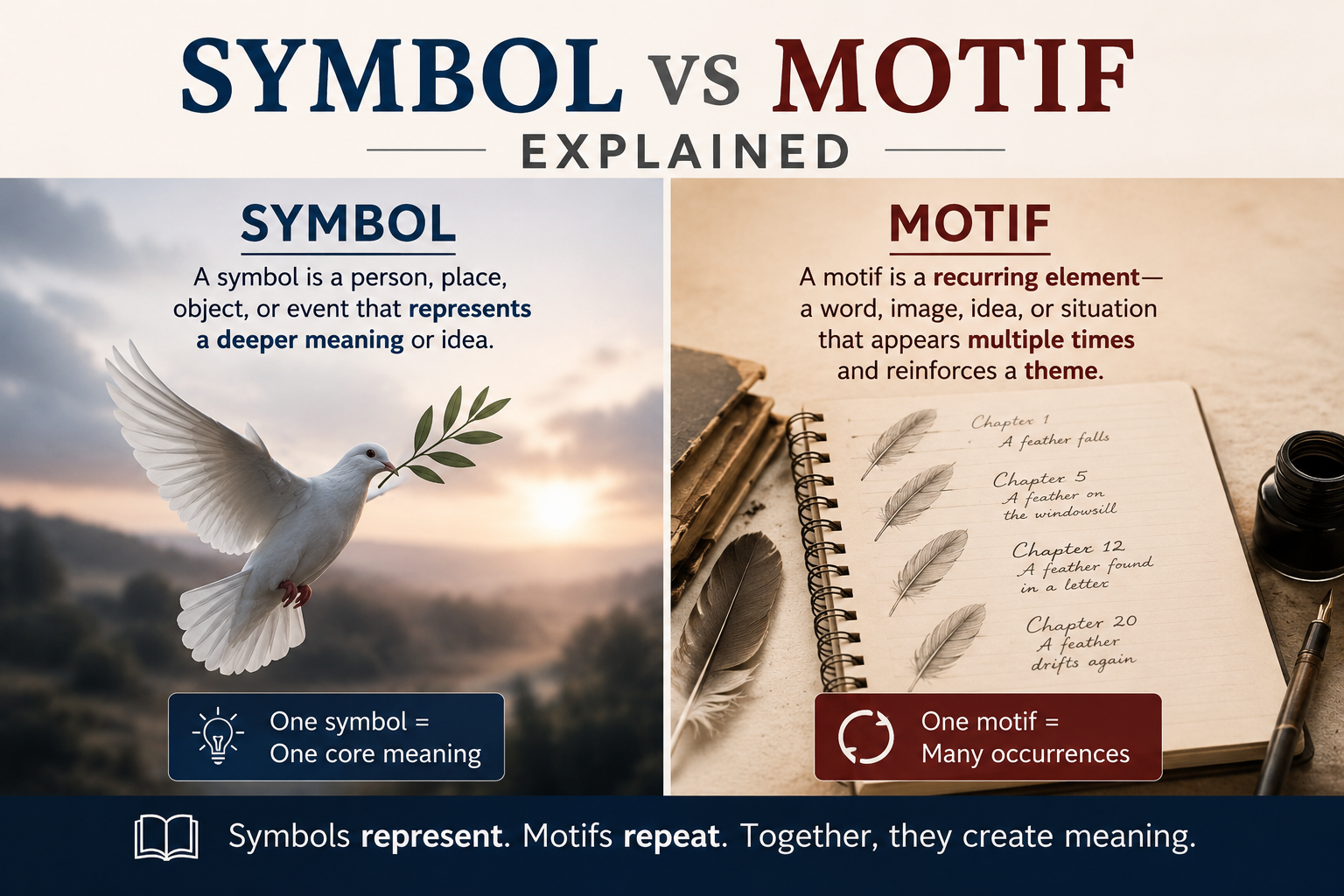
Symbol vs Motif Explained is a topic that can confuse even strong readers. Both symbols and motifs add deeper meaning to a story, but they work in different ways.

Once you know the difference, literary analysis gets much easier. You can point to better evidence and explain why an author repeats certain images, objects, or ideas.

In this Guide

Use this guide to move from basic definitions to stronger literary analysis.

What Is a Symbol?

A symbol is something in a story that stands for a larger idea.

A symbol can be an object, place, person, color, animal, or action. It has a literal role in the story, but it also points to a deeper meaning.

For example, in The Great Gatsby, the green light at the end of Daisy’s dock is a symbol. It is a real light, but it also stands for Gatsby’s dream, hope, and desire for a future he may never reach.

In Lord of the Flies, the conch shell is a symbol of order and shared rules. When the conch loses power, the boys’ society falls apart.

If you want more help with this part, read our guide on how to find symbolism in a story.

What Is a Motif?

A motif is a repeated element that helps build a theme.

A motif can be a repeated image, phrase, object, situation, sound, or idea. The key word is repeated. A motif shows up more than once and gains meaning over time.

In Macbeth, blood is a major motif. It appears after murder, during guilt, and in moments of fear. Each return of blood reminds us of violence and moral damage.

In To Kill a Mockingbird, mockingbirds form a motif linked to innocence. The idea returns through Tom Robinson, Boo Radley, and the lesson that it is wrong to harm those who do no harm.

Symbol vs Motif Explained: The Main Difference

The simplest difference is this: a symbol means something, while a motif repeats something.

Symbol vs Motif Explained comes down to function. A symbol is often one meaningful thing. A motif is a pattern that appears across the text.

A symbol can appear only once and still matter. A motif must return often enough for readers to notice a pattern.

Think of it this way: the green light in The Great Gatsby is a symbol. The repeated focus on wealth, parties, cars, and status creates motifs tied to the American Dream and social class.

A symbol can also become part of a motif. If the same symbol appears again and again, it may help form a larger pattern.

Symbol vs Motif Explained Through Literature Examples

Examples make the difference easier to see.

In Romeo and Juliet, light and dark images appear often. Romeo calls Juliet the sun, and the lovers often meet at night. This repeated contrast is a motif because it appears across the play.

The poison near the end of the play works more like a symbol. It stands for the deadly results of hate, secrecy, and rash choices.

In The Scarlet Letter, the letter “A” is a symbol. It stands for shame at first, but its meaning shifts as Hester changes in the eyes of her community.

The repeated focus on public judgment, hidden sin, and watching eyes creates motifs. These patterns help develop the novel’s themes about guilt and social control.

Symbol vs Motif Explained works best when you ask two questions: What does this thing mean? Does it repeat across the text?

How to Use Symbol vs Motif Explained in Literary Analysis

Good analysis does more than name a symbol or motif.

When you write about a symbol, explain its literal role first. Then explain the deeper idea it suggests.

For example: In The Great Gatsby, the green light is a real dock light, but it also represents Gatsby’s dream of winning Daisy and remaking the past.

When you write about a motif, track the pattern. Show where it appears and explain how its meaning grows.

For example: In Macbeth, the blood motif begins with battle and bravery, then shifts toward murder, guilt, and fear.

If you are writing an essay, connect the symbol or motif to a theme. A theme is the larger message about life, society, or human nature.

Here is a simple sentence frame you can use:

The repeated image of blood in Macbeth forms a motif that reveals how guilt follows violent ambition.

This is where Symbol vs Motif Explained becomes useful. It helps you move from “I noticed this” to “I understand why it matters.”

Common Mistakes to Avoid

Many students mix up symbols, motifs, and themes.

A symbol is not the same as a theme. A symbol points to a deeper idea, but the theme is the message the story builds.

A motif is not just “anything that appears.” It needs to repeat in a meaningful way.

Do not call every object a symbol. Sometimes a chair is just a chair. Look for clues like strong description, repeated focus, character reaction, or placement at a key moment.

You can also use our guide to spot symbolism in fiction if you need a clearer method.

Helpful Books for Studying Symbols and Motifs

These books can help you practice close reading and literary analysis.

  • How to Read Literature Like a Professor by Thomas C. Foster
  • The Great Gatsby by F. Scott Fitzgerald

How to Read Literature Like a Professor is useful for learning common patterns in fiction. The Great Gatsby is a strong choice because it has clear symbols, motifs, and themes.

Useful External Resources

Trusted literature sites can help you review key terms.

The Poetry Foundation glossary is a helpful place to check literary terms. You can also explore Britannica’s overview of literature for broader context.

FAQ: Symbol vs Motif Explained

Here are quick answers to common student questions.

What is the easiest way to tell a symbol from a motif?

A symbol stands for a deeper idea. A motif is a repeated pattern that helps build a theme.

Can a symbol also be a motif?

Yes. If a symbol appears again and again, it can become part of a motif.

Is a motif the same as a theme?

No. A motif is a repeated element. A theme is the larger message the author develops.

Why does this difference matter in essays?

It helps you write more precise analysis. You can explain whether an author uses one powerful image or a repeated pattern.

Key Takeaway

Symbol vs Motif Explained is really about meaning and pattern. A symbol points to a deeper idea, while a motif repeats to build a larger theme.

How to Write a Literary Analysis Essay

how to write a literary analysis essay

A Practical Guide to Turning Close Reading Into Clear Interpretation

Writing about literature can feel intimidating at first. Many students understand a story or poem when they read it, yet struggle to explain their ideas in an essay. The problem is rarely a lack of insight. More often, the challenge is learning how to organize observations and turn them into a clear argument.

Learning how to write a literary analysis essay begins with careful reading. Once you notice patterns in a text—imagery, tone shifts, repeated language—you can begin to ask questions about what those patterns mean. From there, your essay becomes a way of explaining how the author builds meaning.

If you have already practiced annotating literature for close reading, you are closer to literary analysis than you might think. Annotation helps you gather the raw material that eventually becomes interpretation.

👉 If you’re new to annotation, you might first read my guide on
how to annotate literature for close reading.

In this guide, we will walk through the steps scholars use when writing a literary analysis essay, from forming a thesis to organizing paragraphs and supporting claims with textual evidence.

⭐ Key Takeaway

Writing a literary analysis essay begins with careful reading.
When you notice patterns in imagery, language, tone, or structure, those observations can develop into a thesis that explains how a text creates meaning.

how to write a literary analysis essay
Image by Carla Paton

📚 In This Guide

In this article you’ll learn:

  • How to write a literary analysis essay step by step
  • How to develop a strong thesis statement
  • How to use textual evidence effectively
  • How to structure paragraphs for literary analysis
  • How scholars connect close reading with interpretation

How to Write a Literary Analysis Essay

Learning how to write a literary analysis essay is less about summarizing a story and more about explaining how the text works.

Scholars ask questions like:

  • Why does the author repeat certain images?
  • What does a shift in tone reveal about the speaker?
  • How does the structure of the story influence meaning?

Literary analysis focuses on interpretation rather than summary. Instead of retelling what happens in a novel or poem, your goal is to explain what the text suggests about themes, ideas, or human experience.

📖 If you want to deepen your reading process before writing, you may enjoy my article on
how to read literature like a scholar.

Step 1: Begin With Close Reading

Learning how to write a literary analysis essay starts with careful observation of the text.

Before writing anything, scholars spend time reading slowly and annotating.

Look for details such as:

  • imagery
  • tone shifts
  • symbolism
  • repeated language
  • structural changes

These details become the foundation of interpretation.

For example, if a poem repeatedly references winter imagery, you might ask whether winter symbolizes isolation, reflection, or emotional distance.

These early observations eventually lead to your thesis.

Understanding literary devices such as symbolism, imagery, and irony can also strengthen your interpretation when writing literary essays.

✏️ Close reading is where literary analysis begins.

Step 2: Develop a Clear Thesis

A strong thesis explains the insight you discovered while learning how to write a literary analysis essay.

Your thesis is the central argument of your essay.

It should explain:

  • what the text does
  • how it does it
  • why it matters

Example weak thesis:

This poem talks about loneliness.

Example stronger thesis:

Through repeated winter imagery and quiet natural scenes, the poem suggests that solitude can become a space for reflection rather than isolation.

The second thesis points to specific textual evidence and an interpretive idea.

Need more help writing literary essays?

The Literary Analysis Essay Toolkit walks you through every step of the process—from interpreting the assignment to organizing paragraphs and revising your final draft.

📘 Get the Literary Analysis Essay Toolkit

Step 3: Use Textual Evidence

Effective literary essays support ideas with specific passages from the text.

When explaining your interpretation, include short quotations from the text.

Example:

The speaker pauses to “watch his woods fill up with snow,” a quiet moment that emphasizes reflection and stillness.

Then explain why the passage matters.

Avoid dropping quotations into the essay without commentary. Instead, connect the evidence to your interpretation.

Scholars often call this process analysis of textual evidence.

You can explore more close reading techniques through the MLA Style Center, a widely respected academic resource.

Step 4: Organize Body Paragraphs Clearly

Good organization helps readers follow the logic of how to write a literary analysis essay.

Each paragraph should focus on one analytical idea.

A simple structure works well:

Topic sentence — introduces the analytical point
Evidence — quotation or example from the text
Explanation — interpretation of the evidence

Example paragraph structure:

Topic sentence
The poem repeatedly uses winter imagery to create a reflective atmosphere.

Evidence
The speaker pauses to observe snow falling quietly in the woods.

Explanation
This moment of stillness emphasizes contemplation rather than loneliness.

Clear structure helps readers understand how each observation supports your argument.

Step 5: Connect Interpretation to Larger Ideas

Strong literary essays explain why the interpretation matters.

Literature often explores broader themes:

  • identity
  • memory
  • nature
  • love
  • loss
  • human relationships

When writing a literary analysis essay, your goal is to explain how specific textual details contribute to these themes.

Scholars sometimes refer to this process as interpretive reading.

For more on literary criticism and research methods, the Purdue Online Writing Lab offers helpful guidance.

📚 Books That Help With Literary Analysis

These books provide excellent introductions to reading and analyzing literature (affiliate links).

How to Read Literature Like a Professor — Thomas C. Foster
A widely used guide that explains recurring patterns and symbols in literature.

How to Read Poetry Like a Professor — Thomas C. Foster
An accessible introduction to analyzing poetic language and imagery.

How to Read a Book — Mortimer J. Adler & Charles Van Doren
A classic guide to active reading and annotation.

These books reinforce many of the skills involved in writing a literary analysis essay.

Conclusion: Turning Reading Into Interpretation

Learning how to write a literary analysis essay is really about learning to notice details. When you read carefully, annotate patterns, and ask thoughtful questions, your ideas naturally begin to take shape.

A literary essay simply organizes those insights into a clear explanation. Instead of summarizing the story, you guide readers through your interpretation of the text.

With practice, literary analysis becomes less about following rules and more about participating in an ongoing conversation about literature.

FAQ — Writing a Literary Analysis Essay

What is a literary analysis essay?

A literary analysis essay explains how a text creates meaning. Instead of summarizing the story, the essay interprets elements such as imagery, tone, symbolism, and structure.

How long should a literary analysis essay be?

Most academic literary essays range from 3–7 pages, depending on the assignment and level of study.

Do I need to quote from the text?

Yes. Literary analysis relies on textual evidence. Short quotations allow you to show exactly where your interpretation comes from.

What citation style is used in literary essays?

Most literature courses use MLA citation style, especially when referencing primary texts and scholarly criticism.

You can learn more here:
https://style.mla.org







