Symbols in A Tale of Two Cities: What They Mean and Why They Matter

Symbols in A Tale of Two Cities

Charles Dickens fills his novel with images that point to larger ideas. The symbols in A Tale of Two Cities help readers see anger, sacrifice, injustice, and hope more clearly.

This guide explains the most important symbols and shows how each one connects to theme. It is built for students who want clear examples they can use in class or essays.

In this Guide

  • Why symbolism matters in the novel
  • The broken wine cask
  • Light and darkness
  • Knitting and the revolution
  • La Guillotine
  • Imprisonment
  • Resurrection
  • How to write about the symbols
  • FAQ
Symbols in A Tale of Two Cities

Why symbols in A Tale of Two Cities matter

Symbols help Dickens turn big social problems into clear images.

The French Revolution can feel huge and complex. Dickens makes it easier to understand by using objects, colors, and repeated images.

Many symbols in A Tale of Two Cities show how private pain connects to public violence. A broken wine cask is not just a spill. It becomes a warning about hunger and rage.

If you need a simple method for spotting deeper meaning, read our guide on how to find symbolism in a story.

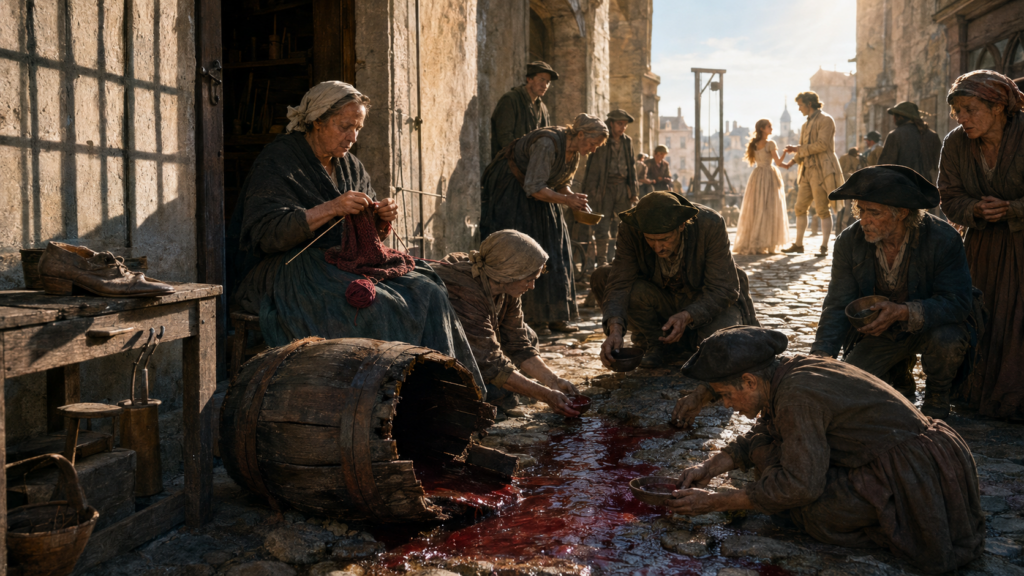
The broken wine cask as one of the key symbols in A Tale of Two Cities

The spilled wine shows how hunger can turn into violence.

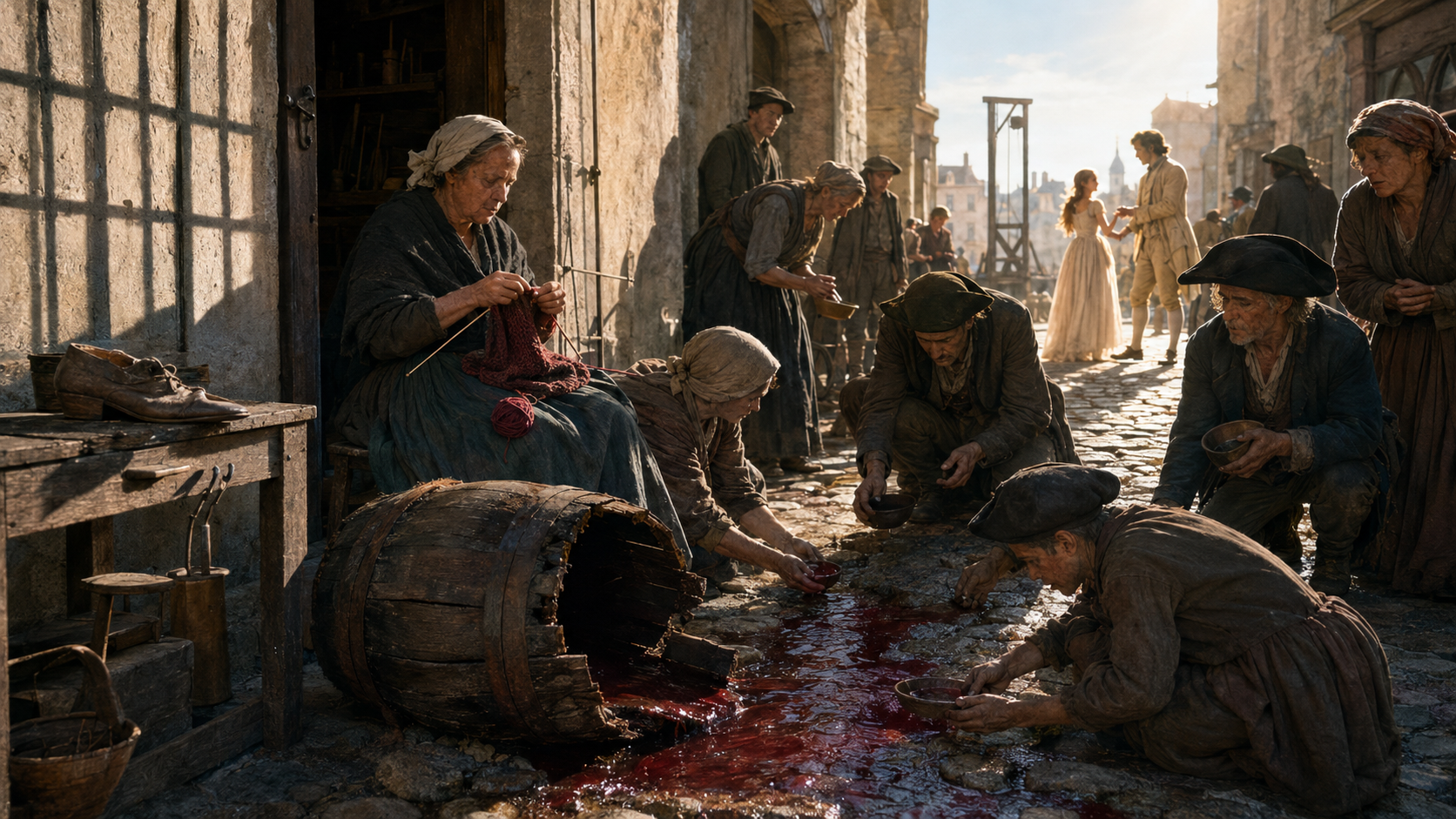
Early in the novel, a wine cask breaks in the street of Saint Antoine. Poor people rush to drink from the muddy ground. The scene is sad, messy, and tense.

The wine looks like blood. Dickens even shows someone writing the word blood on a wall. This moment points ahead to the bloodshed of the French Revolution.

The symbol matters because it links poverty with revenge. The people are not violent for no reason. They are starving, ignored, and pushed too far.

Like the green light in The Great Gatsby, the wine means more than it first seems to mean. It turns a simple object into a sign of desire and danger.

Light and darkness in the symbols in A Tale of Two Cities

Light often points to love, truth, and moral hope.

Dickens uses darkness to show fear, secrecy, and despair. Dr. Manette’s prison past is tied to dark rooms and hidden memories.

Lucie Manette is often linked with light. Her love helps bring her father back into the world after years in prison. She does not fix history, but she gives him a reason to live.

This symbol connects to the theme of **resurrection**. Light suggests that broken people can return to life, even after deep suffering.

The contrast also helps Dickens build mood. A dark street or prison cell makes the reader feel the danger before it reaches the characters.

Knitting as a symbol of revenge

Madame Defarge’s knitting turns a quiet act into a threat.

Knitting may seem harmless at first. In the novel, it becomes a record of names marked for death.

Madame Defarge uses her knitting to hide plans for revenge. This makes the symbol cold and frightening. It shows how hate can become patient and exact.

The symbol also connects to fate. Once a name enters her work, that person seems trapped. The image reminds readers of the Fates in Greek myth, who were tied to the thread of human life.

Here, Dickens shows a dark truth about justice. When justice becomes revenge, it can lose mercy.

La Guillotine and the symbol of public violence

The guillotine shows how a revolution can turn into a machine.

In the novel, La Guillotine is treated almost like a living force. Crowds gather around it. People watch death as if it were a show.

This symbol connects to the theme of mob power. The revolution begins with real anger against cruelty. Yet the guillotine shows how quickly a fight for justice can become cruel too.

Dickens does not excuse the old French nobility. He shows their pride and abuse. But he also warns that violence can spread until no one controls it.

For brief historical background on Dickens and his world, see Britannica’s biography of Charles Dickens.

Prison and chains as symbols in A Tale of Two Cities

Prison stands for both physical pain and mental trauma.

Dr. Manette spends years in the Bastille. Even after he is free, part of him remains trapped by fear and memory.

His shoemaking is a key sign of that trauma. When stress returns, he falls back into the habit he learned in prison. The past still has power over him.

This is one of the most human symbols in A Tale of Two Cities. It shows that freedom is not just about leaving a cell. A person also needs healing.

The Bastille itself becomes a symbol of unfair power. Its fall marks a political change, but Dickens asks whether people can escape cruelty without repeating it.

Resurrection as the central image of the novel

Resurrection means return, renewal, and moral rebirth.

The novel opens with the idea of being recalled to life. Dr. Manette is brought back from mental ruin. Charles Darnay is saved from death more than once.

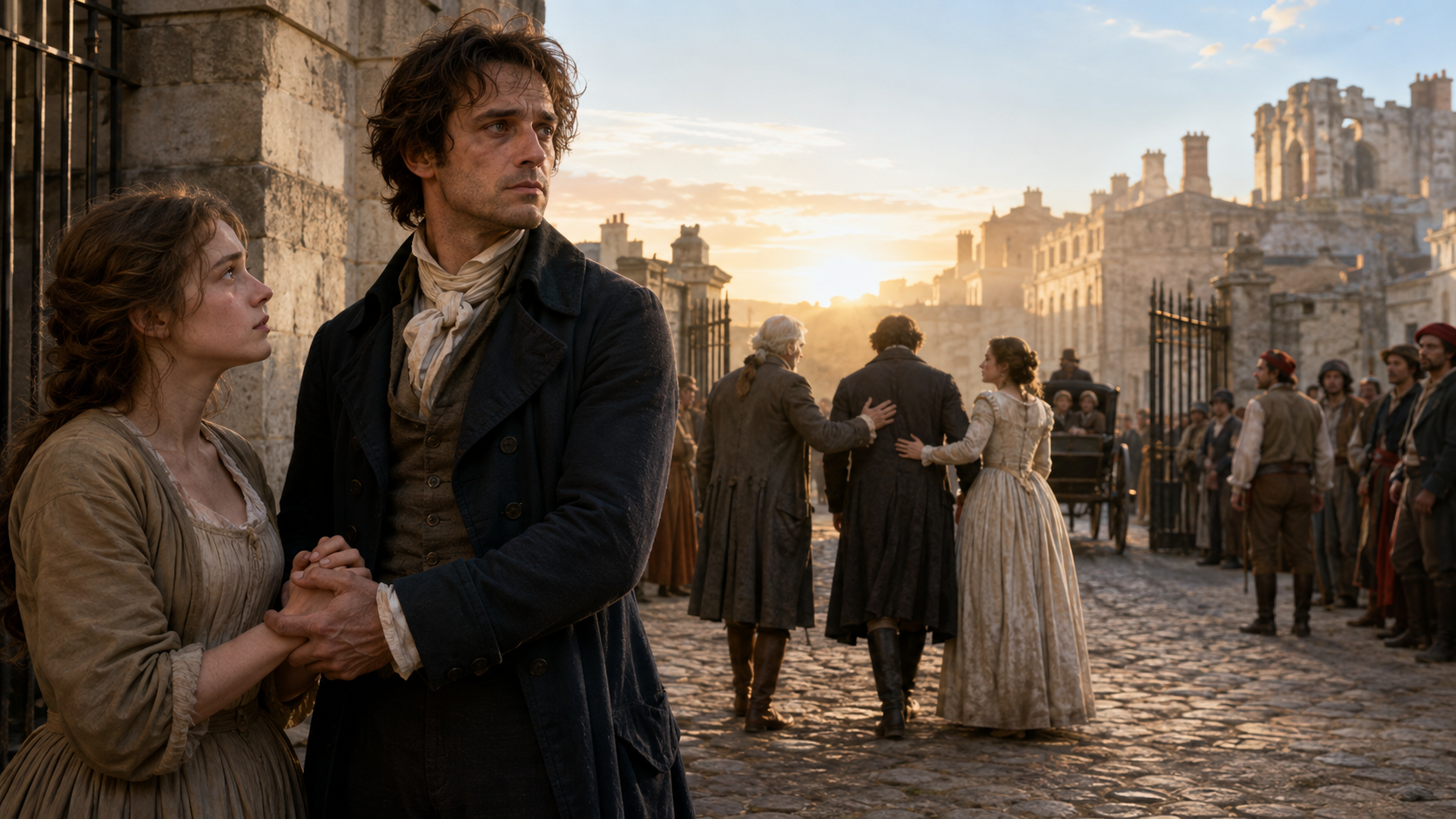
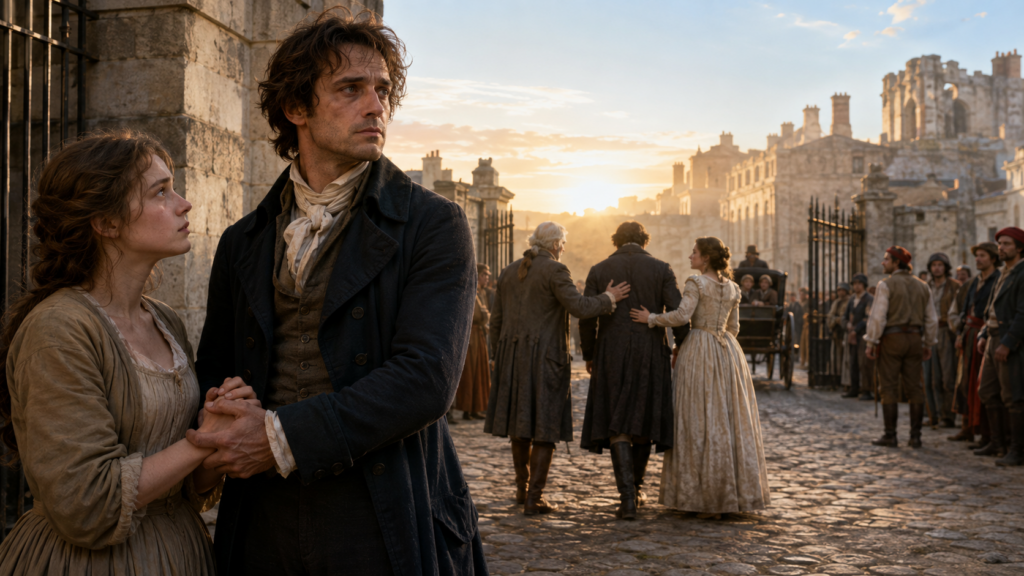
Sydney Carton gives the deepest form of resurrection. He begins as a wasted man who sees little value in himself. By the end, he chooses a sacrifice that gives his life meaning.

This image connects to Christian ideas of selfless love. It also connects to a broader human hope: people can change.

The best symbols in A Tale of Two Cities work this way. They are not just clues. They help readers feel the novel’s moral struggle.

How to study symbols in A Tale of Two Cities for essays

A strong essay links each symbol to a theme and a scene.

Do not just say that wine stands for blood. Explain how the wine scene reveals hunger, anger, and the coming violence.

Try this simple pattern: name the symbol, describe where it appears, then explain what it shows about the novel’s message. Keep the focus on meaning.

For more help, review this step-by-step guide to finding symbolism. If you want extra practice, our literature study resources can help you build stronger notes.

Suggested books for deeper study

These books can help you understand Dickens, revolution, and literary symbols.

  • A Tale of Two Cities by Charles Dickens
  • Charles Dickens by Claire Tomalin

You can also explore the British Library’s Charles Dickens resources for helpful context.

FAQ about symbols in A Tale of Two Cities

Here are short answers to common student questions.

What are the main symbols in A Tale of Two Cities?

The main symbols include the broken wine cask, light and darkness, knitting, La Guillotine, prisons, and resurrection.

What does the wine symbolize in the novel?

The wine symbolizes hunger, blood, and the violence that will come with the French Revolution.

Why is knitting important in A Tale of Two Cities?

Knitting shows Madame Defarge’s revenge. It also suggests fate, since the names she records seem marked for death.

What does resurrection mean in the novel?

Resurrection means a return to life or purpose. Dr. Manette, Darnay, and Carton all connect to this idea.

How should I write about symbolism in an essay?

Choose one symbol, connect it to a clear theme, and use a specific scene as proof.

Key takeaway

The symbols in A Tale of Two Cities matter because they turn history into feeling. Dickens uses objects and images to show how suffering can lead to revenge, but also how love can lead to renewal.

Themes in A Tale of Two Cities: A Student-Friendly Guide

A Tale of Two Cities Themes

The themes in A Tale of Two Cities help students see why Dickens’s novel still matters. This guide explains the major ideas, conflicts, and meanings behind the story in clear language.

Charles Dickens writes about a world split by anger, fear, love, and hope. If you can track those ideas, the novel becomes much easier to understand.

In this Guide

  • Why theme matters in the novel
  • Sacrifice
  • Revolution
  • Justice and revenge
  • Resurrection
  • Class conflict
  • Family and loyalty
  • How to study the themes
  • FAQ
A Tale of Two Cities Themes

Why the themes in A Tale of Two Cities matter

Dickens uses theme to connect private lives with public violence.

A Tale of Two Cities is set in London and Paris during the time of the French Revolution. The story moves between homes, courts, prisons, and streets full of fear.

The themes in A Tale of Two Cities show how history affects real people. Dickens does not treat revolution as a simple event. He shows both the need for change and the danger of hatred.

Students often find the plot complex at first. Theme gives you a path through it. Once you notice repeated ideas like sacrifice, resurrection, and revenge, the novel becomes clearer.

Sacrifice and the themes in A Tale of Two Cities

Sacrifice is one of the novel’s most powerful ideas.

Sydney Carton is the clearest example. At first, he seems wasted and careless. He believes his life has little value.

By the end, Carton gives his life so Charles Darnay can live. His choice is not just brave. It gives meaning to a life he thought was ruined.

This theme links to a common idea in literature: a broken person can still act with grace. In Les Misérables, Jean Valjean also changes through mercy and self-giving love.

One of the key themes in A Tale of Two Cities is that sacrifice can restore hope. Dickens does not say sacrifice erases pain. He shows that it can create a future for others.

Revolution and the themes in A Tale of Two Cities

The novel asks when revolution becomes justice, and when it becomes cruelty.

Dickens does not ignore the suffering of the people with low income in France. The aristocracy has abused its power for years. The people have real reasons to be angry.

Yet the Revolution soon turns violent. The oppressed become willing to destroy anyone linked to the old system. The guillotine becomes a symbol of fear, not freedom.

This is why the themes in A Tale of Two Cities are not simple. Dickens supports justice, but he warns against mob rage. When people lose mercy, even a noble cause can become brutal.

For more historical background, Britannica’s overview of the French Revolution gives helpful context for the world of the novel.

Justice, revenge, and moral blindness

Dickens draws a sharp line between justice and revenge.

Justice seeks what is right. Revenge seeks payback no matter the cost. In the novel, that difference matters.

Madame Defarge has suffered deeply. Her anger comes from real trauma. But her desire for revenge grows so strong that she no longer sees people as individuals.

Charles Darnay becomes a target because of his family name. He rejects his family’s cruelty, but the Revolution still judges him by blood. That is moral blindness.

Among the themes in A Tale of Two Cities, this one is especially useful for essays. Dickens shows that pain can explain revenge, but it does not make revenge right.

From Idea to Novel Blueprint

Resurrection and new life

Resurrection means a return from death, despair, or spiritual loss.

Dr. Manette is “recalled to life” after years in prison. He is alive, but he has lost much of himself. Love helps him return to the world.

Sydney Carton also connects to resurrection. His final act gives him moral rebirth. He does not escape death, but he gains purpose.

The novel’s first book is even called “Recalled to Life.” That phrase prepares readers for one of the deepest themes in A Tale of Two Cities. People can be damaged, but they are not always beyond repair.

This idea also appears in A Christmas Carol, another Dickens work. Scrooge is not physically dead, but he needs a new moral life.

Class conflict and social inequality

The novel shows what can happen when a society treats the poor as disposable.

The French aristocrats live with comfort while common people starve. The Marquis St. Evrémonde is cold and cruel. He sees the poor as beneath him.

Dickens uses this conflict to show why revolution becomes possible. A society built on arrogance cannot stay stable forever.

Still, Dickens does not praise violence as the answer. He shows that class abuse creates rage, and rage can destroy the innocent with the guilty.

That balance makes the themes in A Tale of Two Cities rich for AP Literature and college essays. The book can criticize oppression while also warning against hatred.

Family, loyalty, and love

Love gives many characters the strength to survive.

Lucie Manette is often seen as gentle, but her role matters. Her love helps restore her father after prison. She becomes a source of peace in a violent world.

Charles Darnay shows loyalty by rejecting his family’s corrupt past. He tries to live by a better moral code, even when history catches up with him.

Carton’s love for Lucie also changes him. He does not win her in a romantic sense. Instead, his love leads him toward selfless action.

In this way, the themes in A Tale of Two Cities connect personal love to social hope. Dickens suggests that history may be cruel, but human love can still matter.

Fate, history, and personal choice

The novel asks whether people are trapped by history or free to choose.

Many characters seem caught in forces larger than themselves. The Revolution, family guilt, prison, and public anger shape their lives.

Yet Dickens also shows the power of choice. Darnay chooses to reject his family’s values. Carton chooses sacrifice. Lucie chooses care and loyalty.

This makes the novel more hopeful than it first appears. People cannot control history, but they can control their moral response to it.

For author background, see Britannica’s entry on Charles Dickens.

How to study the themes in A Tale of Two Cities

The best way to study theme is to connect ideas to characters, scenes, and symbols.

Start with a repeated idea. Then ask where it appears and how it changes. For example, resurrection appears with Dr. Manette early in the novel and with Carton near the end.

If you need a simple method, read our guide on how to identify theme in literature. It can help you turn notes into a clear thesis.

When you write about the themes in A Tale of Two Cities, avoid vague claims like “the theme is love.” Try a fuller claim: “Dickens shows that love can restore people who have been damaged by violence and loss.”

Books that pair well with A Tale of Two Cities

These books can help students compare similar ideas across literature.

  • Les Misérables by Victor Hugo
  • Great Expectations by Charles Dickens
  • Animal Farm by George Orwell

Each book explores power, justice, and moral choice in a different way. They are useful for comparison essays and class discussion.

FAQ about themes in A Tale of Two Cities

What is the main theme of A Tale of Two Cities?

The main theme is sacrifice. Sydney Carton’s final choice shows how love and selflessness can give life meaning.

What does resurrection mean in the novel?

Resurrection means return or renewal. Dr. Manette returns from prison, while Carton finds moral renewal through sacrifice.

How does Dickens show the danger of revenge?

He shows revenge through Madame Defarge and the Revolution’s violence. Revenge turns justice into cruelty when mercy disappears.

Why is class conflict important?

Class conflict explains why the Revolution begins. Dickens shows that a society with deep injustice can create deep anger.

Is A Tale of Two Cities against revolution?

Not exactly. Dickens understands why people revolt, but he warns that revolution without mercy can become another form of tyranny.

Key takeaway

The themes in A Tale of Two Cities show a world shaped by injustice, but not defeated by it. Dickens argues that sacrifice, mercy, and love can still create hope in violent times.

Romanticism vs Realism Explained

Romanticism vs Realism

If you have ever mixed up Romanticism and Realism, you are not alone. Romanticism vs Realism Explained can help you spot what a writer values, how a story works, and what kind of world the text wants you to see.

This guide breaks the difference down in plain language, with clear examples from famous literature.

In this Guide

  • The simple difference between the two movements
  • What Romanticism values
  • What Realism values
  • Major themes to compare
  • Examples from literature
  • How to use the difference in analysis
  • Common mistakes to avoid
  • Suggested books
  • FAQ
Romanticism vs Realism

Romanticism vs Realism Explained: The Simple Difference

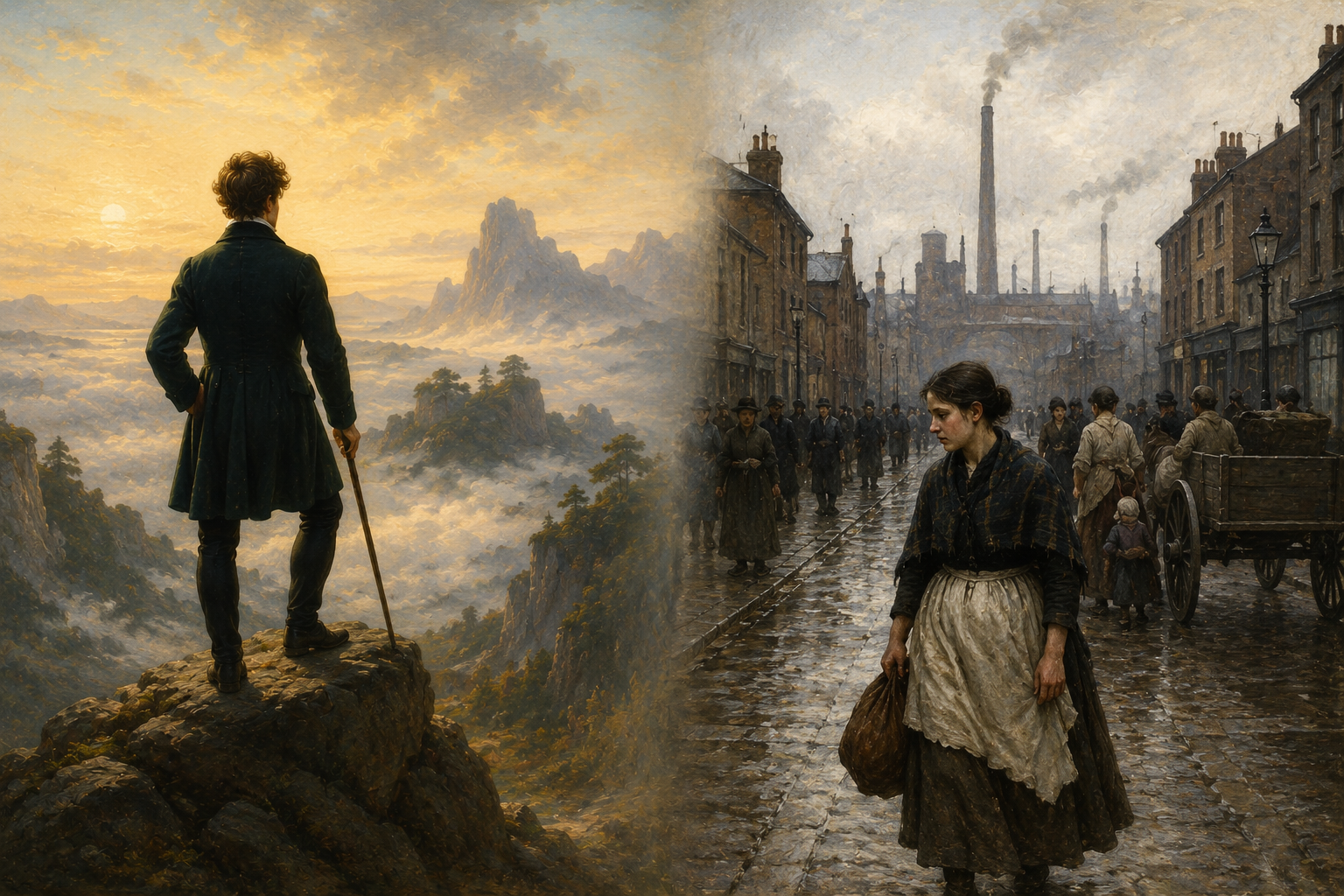
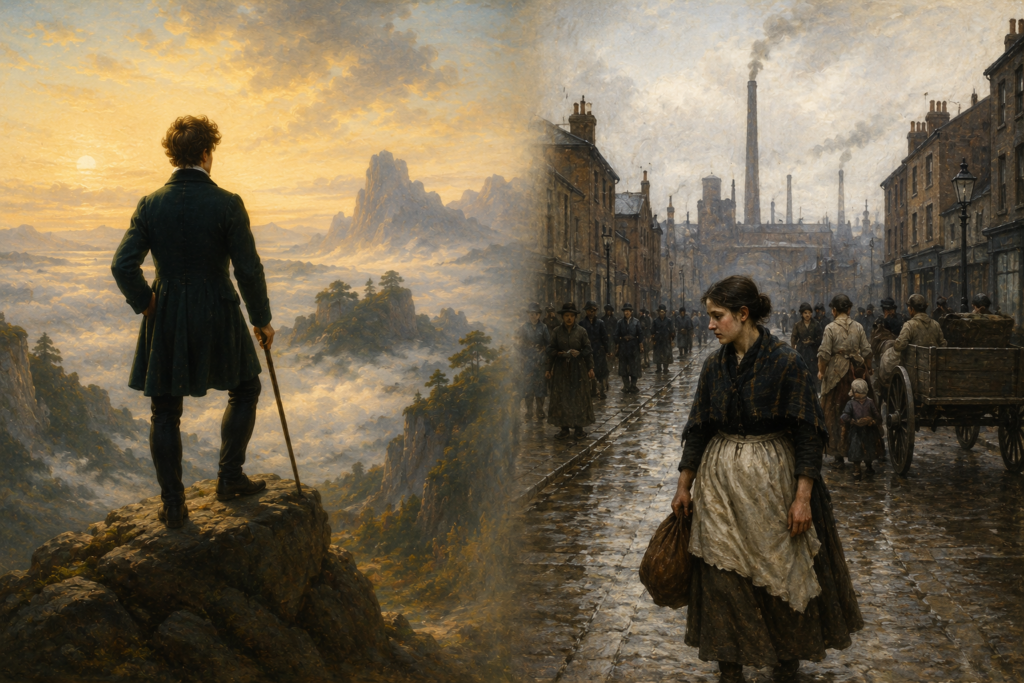
Romanticism focuses on emotion, imagination, nature, and the inner life.

Realism focuses on ordinary life, social problems, believable people, and the world as it is.

At its heart, Romanticism vs Realism Explained means this: Romantic writers often ask, “What does the soul feel?” Realist writers often ask, “What is life really like?”

Romanticism tends to lift life into something intense or mysterious. Realism tends to pull life back down to daily choices, money, work, class, family pressure, and moral limits.

What Romanticism Values

Romanticism began as a reaction against strict reason and social control.

Romantic writers believed that deep feeling could reveal truth. They often valued the individual, especially the person who feels trapped by society.

Nature also matters a lot in Romantic writing. A mountain, storm, forest, or lake can reflect a character’s mind.

In Mary Shelley’s Frankenstein, Victor’s ambition feels larger than normal life. The novel explores mystery, fear, creation, guilt, and isolation. Those are all strong Romantic concerns.

Romantic poetry gives clear examples too. William Wordsworth often treats nature as a source of wisdom. Percy Bysshe Shelley and John Keats use beauty, imagination, and longing to explore human experience.

For a useful overview of the movement, see the Poetry Foundation’s page on Romanticism.

What Realism Values

Realism grew stronger in the 1800s as writers turned toward everyday life.

Realist writers often show people dealing with money, marriage, work, class, and social rules. Their characters may dream, but the world usually pushes back.

Realism does not mean boring. It means the writer tries to make events feel possible and human.

In Gustave Flaubert’s Madame Bovary, Emma wants a grand romantic life. But the novel shows how fantasy, debt, and social pressure shape her choices.

George Eliot’s Middlemarch also fits Realism. It studies marriage, ambition, politics, and moral growth in a small English town.

Britannica offers helpful background on Realism as a wider artistic movement.

Romanticism vs Realism Explained Through Major Themes

The two movements often treat the same topics in very different ways.

Love is a good example. In Romanticism, love may feel powerful, spiritual, or tragic. In Realism, love is often tied to money, status, family approval, and daily habits.

Nature also changes meaning. Romantic writers often see nature as alive with feeling. Realist writers may use nature as setting, but they usually focus more on human society.

The hero is different too. Romantic heroes can seem lonely, intense, gifted, or misunderstood. Realist characters tend to feel more ordinary, with flaws that come from real social life.

When you use Romanticism vs Realism Explained in class, ask what the text seems to trust more: inner feeling or outer reality.

Romanticism vs Realism Explained with Literature Examples

Examples make the difference much easier to see.

In Frankenstein, the story is full of wild landscapes, emotional extremes, and questions about the limits of human power. Victor does not just make a scientific mistake. He crosses a moral and spiritual line.

That is why Romanticism vs Realism Explained helps with Shelley’s novel. The book cares about imagination, fear, ambition, and the hidden cost of desire.

Now compare that with Madame Bovary. Emma also wants a life full of passion and beauty. But Flaubert shows how her dreams clash with ordinary life.

The Realist style makes Emma’s world feel sharp and specific. Her choices have social and financial costs. The novel does not rescue her with fantasy.

You can also compare Romantic poetry with Realist fiction. Wordsworth may turn a walk in nature into a moment of spiritual insight. Eliot may turn a dinner conversation into a study of class, pride, and moral weakness.

How to Use Romanticism vs Realism Explained in Essays

The best analysis does more than label a text.

Do not just write, “This work is Romantic” or “This work is Realist.” Explain how the style shapes meaning.

For Romanticism, look for intense emotion, symbolic nature, mystery, rebellion, and the power of the imagination.

For Realism, look for social detail, believable dialogue, ordinary settings, and pressure from money or class.

A strong essay might say: “Shelley uses Romantic elements to show that Victor’s imagination is both powerful and dangerous.”

A Realist analysis might say: “Flaubert uses detailed social scenes to show that Emma’s fantasies cannot survive the limits of her real world.”

If you want a deeper way to build literary arguments, read how to read literature like a scholar.

Common Mistakes Students Make

One common mistake is thinking Romanticism only means love stories.

In literature, Romanticism is much wider than romance. It deals with emotion, nature, imagination, freedom, and the self.

Another mistake is thinking Realism has no emotion.

Realist novels can be deeply emotional. The difference is that emotion appears inside a believable social world.

Students also sometimes treat movements as strict boxes. Many works mix styles. A novel can have Romantic themes and Realist details.

That is why Romanticism vs Realism Explained works best as a tool, not a rulebook.

Suggested Books to Read

These books are useful if you want to see the contrast for yourself. You can search for them on Amazon, at a local bookstore, or through your library.

  • Frankenstein by Mary Shelley
  • Madame Bovary by Gustave Flaubert

Frankenstein is a strong Romantic text because it explores ambition, nature, terror, and isolation.

Madame Bovary is a strong Realist text because it studies social pressure, desire, debt, and disappointment in daily life.

FAQ: Romanticism vs Realism Explained

What is the main difference between Romanticism and Realism?

Romanticism focuses on emotion, imagination, and the inner life. Realism focuses on ordinary life, social detail, and believable experience.

Is Romanticism only about love?

No. Romanticism can include love, but it also explores nature, freedom, mystery, rebellion, and the power of feeling.

Is Realism the same as being depressing?

No. Realism can be sad, funny, sharp, or hopeful. Its main goal is to show life in a believable way.

Can one book be both Romantic and Realist?

Yes. Many works mix elements. A novel may use Romantic emotion while also showing Realist social detail.

Key Takeaway

Romanticism vs Realism Explained comes down to focus: Romanticism looks inward toward feeling and imagination, while Realism looks outward toward society and daily life. Use that difference to explain how a text creates meaning, not just to name its style.

error

Enjoy this article? Please spread the word :)

Follow by Email
BLUESKY
fb-share-icon
Reddit
LinkedIn
Share
RSS