Flash Memoir Prompt: Smell of a Specific Room in Your Childhood Home

flash memoir prompt smells

A warm, sensory writing invitation for using the smell of one childhood room to uncover a focused memory, a small scene, and an emotional truth you may not have noticed before.

You might think you have forgotten the room until a scent finds you in the middle of an ordinary day. Lemon cleaner in a school hallway. Dust from an old library book. The faint mix of soap and damp towels in someone else’s bathroom. Suddenly, you are back in a room you have not stood in for years.

That is the quiet power of this flash memoir prompt smell specific room childhood home. Smell often reaches memory before language does. It can bring back a room, a person, a season, or a feeling before you know what story wants to be told.

flash memoir prompt smells

The Prompt

Write about the smell of a specific room in your childhood home.

Choose one room only. It might be the kitchen, your bedroom, a basement, a hallway closet, a bathroom, a garage, or a room you were rarely allowed to enter. The key is to stay with the smell long enough for one memory to rise.

This prompt can unlock a meaningful memory because scent often carries more than description. A room can smell like furniture polish, cold air, crayons, dinner, medicine, wet dog, cigarette smoke, fresh sheets, or summer dust. Each smell may lead to a small truth about comfort, fear, love, loneliness, or belonging.

Why This Memory Matters

A childhood room is never just a room. It is a place where rules were learned, secrets were kept, and ordinary days collected meaning. When you begin with smell, you do not have to force a big life lesson. You can let the memory come through the air of the place.

Maybe the kitchen smelled like onions and hot oil every Friday night, and that scent meant people would soon gather. Maybe the laundry room smelled like bleach, and you remember folding towels while your mother was quiet beside you. Maybe your grandfather’s spare room smelled like wood shavings and pipe tobacco, though no one had smoked there for years.

Smell can also reveal mixed feelings. A room may have smelled safe to one child and tense to another. The same scent can hold love and discomfort at once. That is what makes this kind of writing feel honest.

If you are a student or teacher using this prompt for a class, you might notice how one smell can work like a symbol. If you want to think more about how ordinary objects and details carry meaning in literature, this guide on how to find symbolism in a story can help you make that connection.

image-slider-with-thumbnail1.jpeg
PlayPause
previous arrow
next arrow
image-slider-with-thumbnail1.jpeg
image-slider-with-thumbnail3.jpeg
image-slider-with-thumbnail4.jpeg
ChatGPT Image Jun 27, 2026, 06_33_13 PM
ChatGPT Image Jun 27, 2026, 06_36_37 PM
ChatGPT Image Jun 27, 2026, 06_38_39 PM
ChatGPT Image Jun 27, 2026, 06_31_22 PM
image-slider-with-thumbnail7.jpeg
ChatGPT Image Jun 27, 2026, 06_29_43 PM
ChatGPT Image Jun 27, 2026, 06_27_44 PM
image-slider-with-thumbnail6.jpeg
ChatGPT Image Jun 27, 2026, 06_15_07 PM
image-slider-with-thumbnail5.jpeg
ChatGPT Image Jun 27, 2026, 06_22_43 PM
ChatGPT Image Jun 27, 2026, 06_25_37 PM
ChatGPT Image Jun 27, 2026, 06_19_43 PM
ChatGPT Image Jun 27, 2026, 06_12_00 PM
ChatGPT Image Jun 27, 2026, 06_08_50 PM
ChatGPT Image Jun 26, 2026, 04_54_23 PM
ChatGPT Image Jun 27, 2026, 05_53_51 PM
ChatGPT Image Jun 28, 2026, 08_35_55 AM
previous arrow
next arrow

How to Approach This Prompt

Begin with the physical detail before you explain anything. Do not start by saying, “The room made me feel safe,” or “That was a hard time.” Start with what the room smelled like.

You might write one sentence such as: “The back bedroom smelled like cedar, dust, and the powder my aunt kept in a blue glass jar.” From there, stay in one scene. What were you doing in that room? Who was there? What sound came from the next room? What did your body do when you entered?

Try not to tell the whole history of your childhood home. This flash memoir prompt smell specific room childhood home works best when you narrow your focus. One room. One smell. One moment.

If the memory feels blurry, write around it. Describe the floor, the light, the window, the closet, the temperature. Then return to the smell. Often the story appears after the sensory details are already on the page.

You can also use this as a note-taking exercise before writing the full scene. If you like marking up texts or drafts, the same close attention you use when you annotate literature can help here. Circle the details that feel alive. Underline the sentence that surprises you. That sentence may be the center of the piece.

A Quick Example

The downstairs bathroom always smelled like Ivory soap and wet pennies. It had a tiny window over the toilet, painted shut, with a curtain my mother had made from yellow fabric. When my brother and I came in from playing outside, she sent us there to wash our hands before dinner. I remember standing on the cold tile, rubbing soap between my fingers, watching dirt run in gray lines toward the drain. From the kitchen, I could hear plates being set down hard. My father had just come home, and no one knew what mood he had brought with him. That clean soap smell still makes me think of waiting. Dinner was close. Trouble might be close too. I was eight, and I already knew how to listen through walls.

Try It Yourself

Set a timer for ten minutes and write without stopping. Choose the room before you begin. If several rooms come to mind, pick the one with the strongest smell, even if you do not know why it matters yet.

Let the first draft be messy. You are not trying to write a perfect memory. You are trying to follow a scent back to one true scene.

If you get stuck, use this sentence starter: “The room smelled like…” Then keep going. Name the smell as plainly as you can. After that, describe what you saw, what you heard, and what you were afraid or happy to do next.

This flash memoir prompt smell specific room childhood home can lead to a tender piece, a funny one, or a memory with sharper edges. Trust the small details. They often know more than the summary does.

Want More Flash Memoir Prompts?

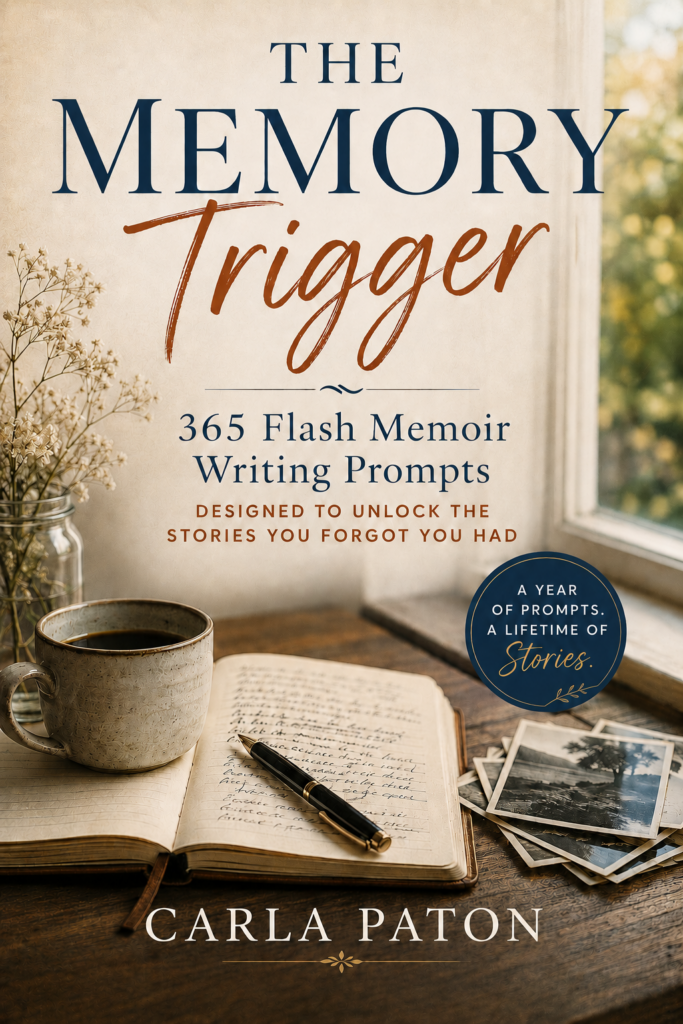
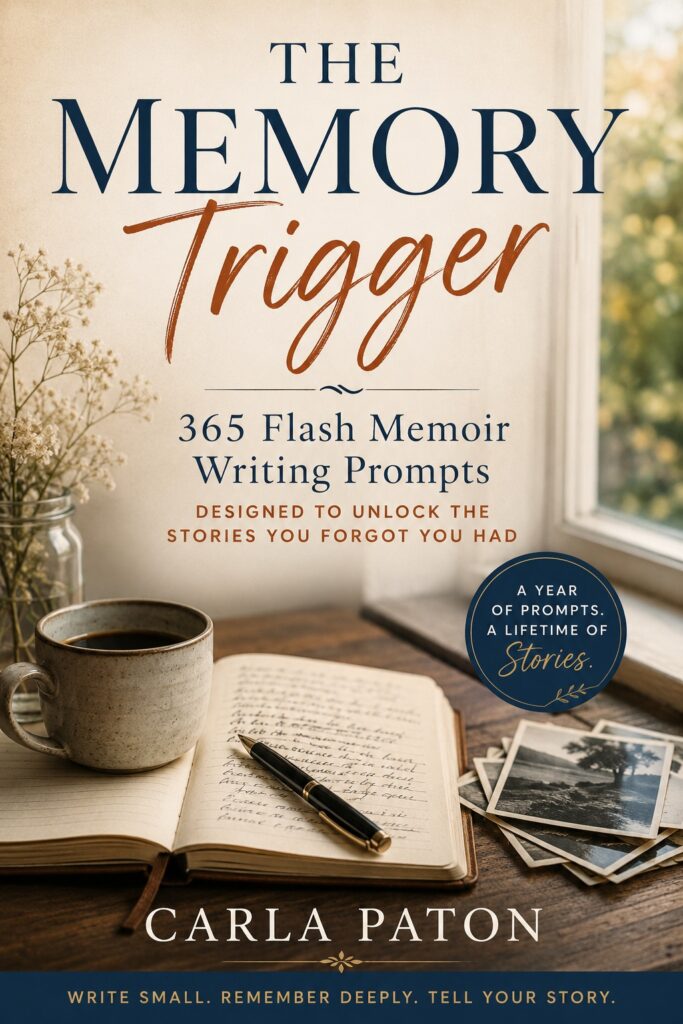
If this prompt opened a memory, keep going with short daily practice. Explore all 365 prompts in The Memory Trigger: 365 Flash Memoir Writing Prompts.

The Memory Trigger

Flash Memoir Prompt: Last Time a Particular Season Felt the Way It Used to Feel

season prompt

A brief, sensory writing invitation for remembering the last time a season felt familiar, whole, and emotionally true in the way it once did.

Maybe it was the first cold night when the heat clicked on and the room smelled faintly dusty. Maybe it was a summer evening when the screen door slapped shut behind someone you loved. Or maybe it was autumn, and for one afternoon the light, the leaves, and the air all matched the version of the season you still carry from childhood.

This flash memoir prompt last time particular season felt familiar asks you to notice that strange moment when time folds. A season returns, but you know you are different. The weather may be the same. The feeling is what has changed.

season prompt

The Prompt

Write about the last time a particular season felt the way it used to feel.

This prompt works because seasons are more than weather. They hold routines, family patterns, school calendars, holidays, sports, chores, clothing, meals, and moods. A single season can store years of memory.

You do not have to explain your whole relationship with winter, spring, summer, or fall. Instead, choose one moment when a season briefly felt like its old self. The memory may be happy, lonely, ordinary, or mixed. What matters is that the feeling was sharp enough for you to remember it now.

Why This Memory Matters

Some seasons stop feeling the same after a move, a loss, a graduation, a divorce, a new job, or a change in health. Sometimes nothing dramatic happens. You just grow up, and one day December no longer feels like December used to feel.

This kind of memory can reveal a quiet before-and-after in your life. Maybe summer used to mean freedom, then became full-time work. Maybe spring used to mean softball games and wet grass, then became allergy medicine and bills. Maybe winter once meant everyone under one roof, until the roof changed.

A flash memoir prompt last time particular season felt old again can help you write about change without naming it too soon. You can begin with the smell of sunscreen, the sound of snow under boots, or the sight of your mother pulling a heavy coat from the hall closet. The meaning can arrive later.

Seasons can also act like symbols in memory. If you enjoy studying how ordinary details carry meaning, this guide on how to find symbolism in a story may help you see your own seasonal images with fresh eyes.

How to Approach This Prompt

Begin with a physical detail. Do not start by explaining the full history of the season. Start with what your body noticed first.

Was the air warm against your arms? Did the snow look blue at dusk? Did the house smell like cut grass, cinnamon, rain, lake water, or furnace dust? Let one detail open the door.

Next, narrow the memory to one scene. A scene has a place, a moment, and someone doing something. You might be sitting on a porch, walking home from school, standing in a grocery store aisle, or driving past a field at sunset.

Try writing the first few lines without explaining what the moment meant. Stay close to the action. Let the reader see what you saw before you tell them why it mattered.

For example, instead of starting with “Christmas never felt the same after my parents split up,” you might start with “My dad plugged in the colored lights, and half the strand went dark.” That small image can carry the larger truth.

If you are a student, you can treat your own memory the way you would treat a passage in class. Circle the strongest detail. Underline the line where the mood changes. This simple habit is close to the skills in how to annotate literature, except this time the text is your own life.

Keep the piece short. Flash memoir is not about saying everything. It is about choosing one bright piece of the truth and holding it still for a moment.

A Quick Example

The last summer that felt like summer was the year I was sixteen and my brother still lived at home. Every night after dinner, we rode our bikes to the corner store with quarters in our pockets. The air smelled like hot pavement and someone’s grill. He always bought grape soda, and I always said it was disgusting, even though I asked for a sip before we got back on our bikes. One night, we stayed out until the streetlights came on, then longer. No one called us. No one needed us. The whole neighborhood seemed to be breathing slowly. By the next summer, he had a job, a car, and a girlfriend. I still rode to the store once or twice, but grape soda just tasted purple.

Try It Yourself

Choose one season and one specific time it felt the way it used to feel. Do not worry if the memory seems small. A small scene can hold a large shift.

Set a timer for ten minutes. Begin with the detail that returns first. Write about where you were, what the air felt like, and what made the moment feel familiar. Then add the small truth underneath it: what had changed, what had ended, or what you wished could stay.

If the writing turns sad, let it. If it turns funny, follow that too. The season may have felt familiar for only five minutes, but five honest minutes can be enough for a strong flash memoir.

Return to the focus of this flash memoir prompt last time particular season felt like itself, and ask one final question: what did that season give me back, even briefly?

Want More Flash Memoir Prompts?

Explore all 365 prompts in The Memory Trigger: 365 Flash Memoir Writing Prompts. Use them one at a time whenever you want a short, focused way to turn real memories into meaningful writing.

The Memory Trigger

Flash Memoir Prompt: Version of Your Family that No Longer Exists

flash memoir family

A focused flash memoir invitation for remembering a version of your family that has faded, changed, or quietly disappeared.

You might notice it at a holiday table, when someone reaches for a serving spoon that used to belong to your grandmother. Or in a photo where everyone is younger, louder, closer, and you realize that exact group of people will never sit in the same room again.

This flash memoir prompt about a version of your family that no longer exists is not only about loss. It can also be about change, distance, growing up, divorce, moving away, old routines, or the strange way families become new families over time.

flash memoir family

The Prompt

Write about a version of your family that no longer exists.

This prompt can open a strong memory because it asks you to look at your family as it once was, not as a full history, but as one lived moment. Maybe the old version of your family was noisy and crowded. Maybe it was quiet because everyone avoided the same subject. Maybe it was happy, but only in the way you understood happiness then.

A good flash memoir prompt version family no longer exists can help you find the small scene that holds the larger truth. You do not need to explain every change. You only need to show the reader what it felt like to be there before everything shifted.

Why This Memory Matters

Families change in ways that can be easy to miss while they are happening. Someone leaves for college. Someone stops calling. A parent remarries. A sibling becomes a stranger for a while. A child grows up and no longer believes the adults know everything.

When you write about a version of your family that no longer exists, you are writing about time. You are also writing about roles. Who made everyone laugh? Who kept the peace? Who always sat in the same chair? Who did you think you were in that family?

This kind of memory may uncover grief, but it may also uncover tenderness. You might remember the family before the big argument, before the move, before the illness, before everyone got their own phones and stopped watching the same movie on the couch.

If you enjoy looking closely at people and their choices, you may find it useful to think like a reader studying a novel. This guide on how to analyze characters in literature can help you notice patterns, motives, and quiet details in real life too.

How to Approach This Prompt

Begin with one physical detail. Choose something small enough to hold in your hand or picture clearly in your mind. A cracked bowl. A bunk bed. A station wagon. A stack of TV trays. A hallway light left on at night.

Then narrow the memory to one scene. Do not try to tell the whole family history at once. The whole story may be too large for a flash memoir piece. One evening can carry enough weight.

Write what you noticed before you explain what it meant. If your parents were still together then, show them passing plates across the table. If your siblings still shared a bedroom, show the line of stuffed animals between the beds. If your grandparents still hosted Sunday dinner, show the smell of soup in the entryway.

Try not to rush toward the lesson. Let the reader stand inside the old version of your family for a moment. Let them hear the voices, see the furniture, and sense what no one said out loud.

After you draft, you can reread your piece and mark the details that feel alive. Writers do this in memoir the same way students mark important lines in a story. If that skill helps you, here is a simple guide on how to annotate literature that can also work for your own drafts.

A Quick Example

Before my parents sold the house, Sunday mornings belonged to pancakes. My father stood at the stove in his robe, flipping them too early, so the middles stayed soft. My mother read the paper at the table and circled grocery coupons with a red pen. My brother and I fought over the syrup bottle even though there was plenty. The dog slept under my chair because I dropped crumbs on purpose. Nothing about it seemed special then. It was just breakfast. Years later, after the divorce and the apartment kitchens and the holidays split into two calendars, I found the old griddle in a box. The handle was loose. I held it for a minute and could almost hear my mother say, “Use a plate, not a napkin.”

Try It Yourself

Set a timer for ten minutes and write about one version of your family that no longer exists. Start with the room, the object, or the sound that brings it back fastest.

You do not have to make the memory neat. You do not have to decide if it was good or bad. Just return to the scene and tell the truth from where you stood then.

If the writing surprises you, follow that surprise. The best flash memoir pieces often begin with a simple image and end with a feeling the writer did not expect to find.

Want More Flash Memoir Prompts?

If this prompt helped you remember a scene you had not thought about in years, keep going. Explore all 365 prompts in The Memory Trigger: 365 Flash Memoir Writing Prompts.

The Memory Trigger

Flash Memoir Prompt: Last Time You Felt Like a Child

Rapid Reads Press

A brief, tender writing invitation about the last time you felt small, safe, silly, scared, or suddenly young again.

Maybe it happened in a grocery store when you reached for the cereal you loved as a kid. Maybe it came over you during a storm, when thunder made you want to call someone older and wiser. Or maybe you felt it while laughing too hard over something completely ridiculous, the kind of laugh that makes you forget your age for a minute.

This flash memoir prompt last time felt like child asks you to notice one of those moments when adulthood loosened its grip. It does not have to be dramatic. In fact, the smaller the scene, the more honest it may become.

childhood prompt

The Prompt

Write about the last time you felt like a child.

This prompt can open a memory because feeling like a child is rarely about age alone. It may be about needing comfort. It may be about wonder. It may be about shame, joy, fear, play, or wanting someone else to take charge for a little while.

When you write from this prompt, try not to rush toward the meaning. Stay with the moment first. What room were you in? What did your hands do? What sound made you feel younger than you are?

Why This Memory Matters

Childhood does not fully disappear. It follows us in habits, cravings, jokes, fears, and soft spots we may not understand until they rise up again.

The last time you felt like a child might reveal a need you rarely admit. Maybe you wanted your mother’s soup when you were sick. Maybe you felt helpless while filling out a confusing form. Maybe you stood in front of a teacher, boss, doctor, or parent and felt your voice shrink.

It could also be a happy memory. You might have felt childlike while sledding, dancing in the kitchen, opening a gift, or walking into a library and smelling old paper. If you want to sharpen the way you notice small details, you might enjoy this guide on how to annotate literature, since close reading can also train you to read your own memories with care.

This kind of memory matters because it shows the meeting point between who you were and who you are now. A flash memoir prompt last time felt like child can help you write about that meeting point without turning it into a long life story.

How to Approach This Prompt

Begin with one physical detail. Choose something your body remembers before your mind explains it.

Maybe your knees were tucked under your chin. Maybe your face burned. Maybe you held a mug with both hands. Maybe you wanted to hide behind someone taller.

Once you find that detail, narrow the memory to one scene. Do not try to cover your whole childhood or explain your entire family history. Stay inside ten minutes, or even two.

Write what you noticed before you write what it meant. For example, instead of starting with “I felt vulnerable,” begin with the coat sleeve you pulled over your hand. Instead of “I was happy,” begin with the way you ran across wet grass in your socks.

You can also pay attention to tone. A memory like this might feel funny on the surface but sad underneath, or tender at first and then sharp. If you want help naming that difference, this simple explanation of tone vs. mood in literature may help you think about the feeling your scene creates.

One clear way to begin is with this sentence: “The last time I felt like a child, I was…” Then name the place. Keep going from there.

A Quick Example

The last time I felt like a child, I was sitting on the paper-covered table at urgent care with my shoes dangling above the floor. I am forty-one, but the crinkle of that paper made me feel eight. The nurse asked when the pain started, and I looked at my husband before I answered, as if he might know better than I did. My throat hurt more from trying not to cry than from being sick. When the doctor said it was only an infection, I nodded like a good student. In the car, I asked if we could stop for a milkshake. I meant it as a joke, but when he said yes, I felt such relief that I turned my face toward the window.

Try It Yourself

Set a timer for ten minutes and write from the prompt without planning the ending. Focus on the moment when you first noticed the feeling. Did it arrive as comfort, panic, delight, or embarrassment?

If the memory feels too big, choose one object from the scene. Write about the blanket, the cereal box, the hospital bracelet, the sidewalk chalk, or the phone in your hand. Let that object carry you into the truth of the moment.

You do not need to explain everything. A strong flash memoir often leaves a little space around the memory. Trust the scene. Trust the detail. Let the childlike feeling show itself through what you saw, said, wanted, or could not say.

This flash memoir prompt last time felt like child works best when you are honest about the exact kind of smallness you felt. Small can mean safe. Small can mean powerless. Small can mean full of wonder. Let your memory decide.

Want More Flash Memoir Prompts?

If this prompt helped you find a scene worth saving, keep going with short, focused memories. Explore all 365 prompts in The Memory Trigger: 365 Flash Memoir Writing Prompts.

The Memory Trigger

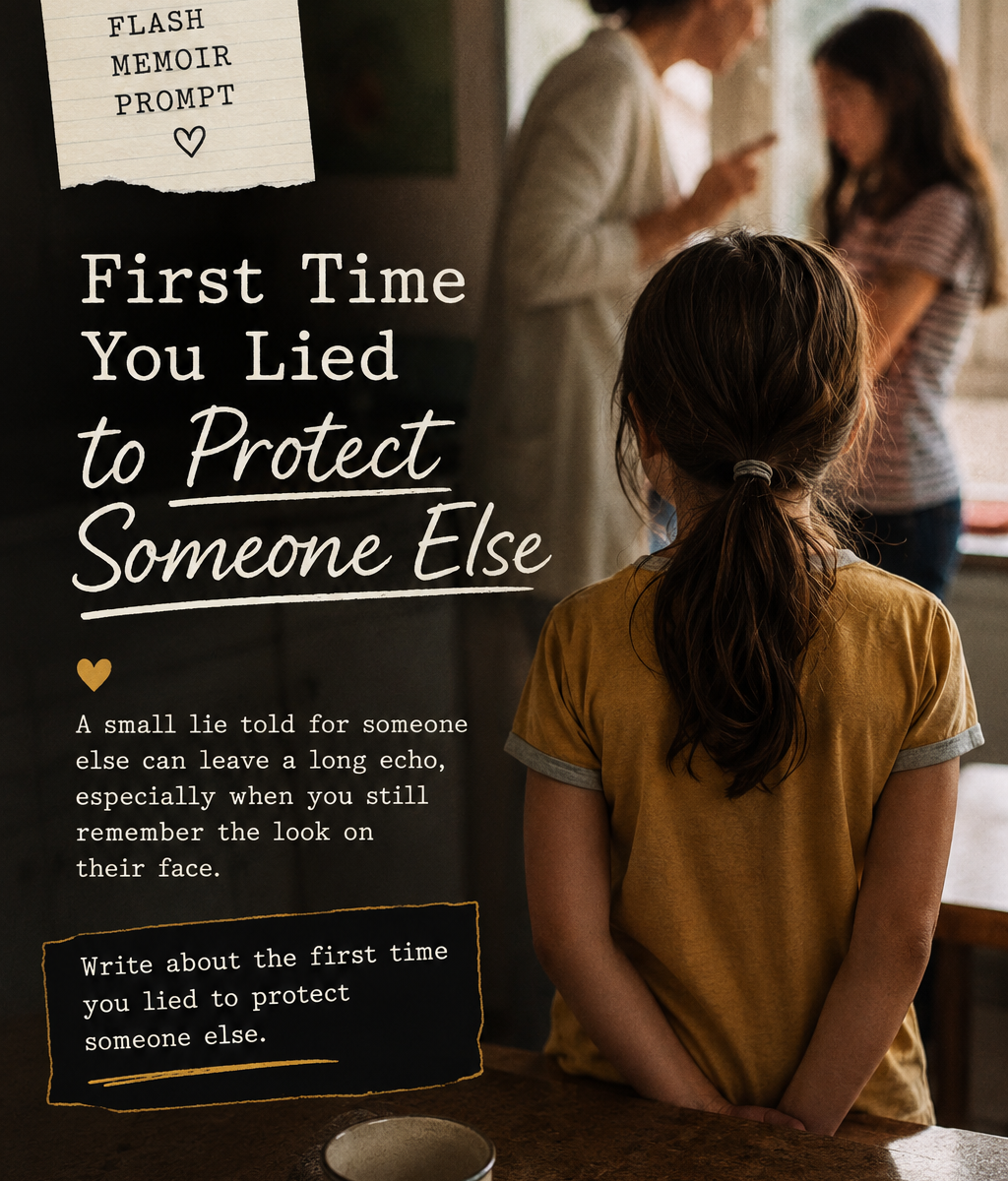
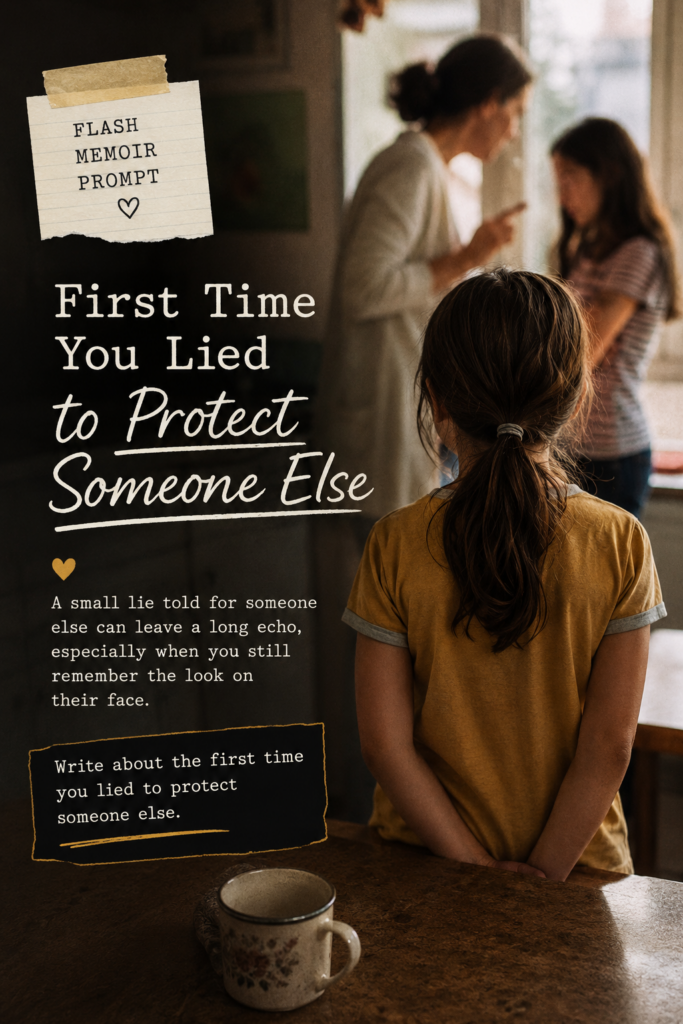
Flash Memoir Prompt: First Time You Lied to Protect Someone Else

flash memoir prompt first time lied protect someone

A small lie told for someone else can leave a long echo, especially when you still remember the look on their face.

If you are looking for a flash memoir prompt about the first time you lied to protect someone, this one asks you to return to a moment when loyalty, fear, love, or pressure shaped what came out of your mouth. Maybe it happened in a kitchen, a classroom, a back seat, or a hallway where everything suddenly felt too quiet.

The lie may have been tiny. “She was with me.” “I broke it.” “He didn’t say that.” At the time, it may have felt fast and necessary. Later, it may have become more complicated.

flash memoir prompt first time lied protect someone

The Prompt

Write about the first time you lied to protect someone else.

This prompt can unlock a strong memory because it puts you inside a choice. You were not just telling a lie. You were deciding who needed protection, what truth might cost, and what kind of person you wanted to be in that moment.

A flash memoir does not need the whole history. It needs one clear scene. Focus on the first time you remember crossing that line for someone else. Let the reader feel the room, hear the question, and understand why the lie came so quickly.

Why This Memory Matters

The first protective lie often reveals a lot about your younger self. It can show who you loved, who scared you, or who you believed deserved saving. It can also show what you did not understand yet.

Maybe you lied for a sibling who had already been in trouble too many times. Maybe you covered for a friend because you knew their parents would overreact. Maybe you protected an adult, even though no child should have had to do that.

This kind of memory can carry more than guilt. It may carry tenderness. It may carry anger. It may carry pride. The emotional truth depends on the scene.

As you write, pay attention to the person you protected. What did they need from you? What did you think would happen if you told the truth? If you enjoy studying motives in fiction, the same skill can help here. Thinking about how to analyze characters in literature can remind you to notice desire, fear, and pressure in real life, too.

The point is not to judge your younger self too quickly. The point is to return to the moment with honesty. What did you know then? What do you know now?

How to Approach This Prompt

Begin with a physical detail instead of an explanation. Start with the sound of a door closing, the sweat under your collar, the chipped mug on the table, or the teacher’s shoes beside your desk.
Then narrow the memory to one scene. Do not begin with, “My brother and I had always been close.” Begin with the moment the question landed in the room.

For example, you might start with: “My mother held the broken lamp cord in her hand and asked whose idea it was.” That first line gives you a place, an object, and a problem.

After that, write what you noticed before you explain what it meant. What did the other person do? Did they look at you, look away, kick your foot, or go still? Small movements can carry the weight of the whole story.

Try not to tell the reader the lesson too soon. Let the scene do some of the work. If the memory has a larger meaning, it will rise from the details.

This flash memoir prompt, the first time you lied to protect someone, also invites you to think about the theme. Was the memory about loyalty? Fear? Family rules? Silence? If you want help naming the deeper idea in a piece of writing, this guide on how to identify theme in literature can help you look beneath the action without forcing a moral.

A Quick Example

The first time I lied to protect someone, I was nine, and my cousin had taken my aunt’s red lipstick from the bathroom drawer. She drew a crooked heart on the hallway mirror, then froze when we heard footsteps. My aunt asked who did it, and my cousin’s face folded in on itself before she even opened her mouth. I said, “I did.” The lipstick felt cold in my hand when my aunt made me clean the glass. My cousin stood behind her, silent, with one red smear on her thumb. I remember feeling proud for about ten seconds. Then I saw my aunt’s disappointment in the mirror, right beside my own face. I had saved my cousin from trouble, but I had stepped into a different kind of trouble, one that followed me longer.

Try It Yourself

Set a timer for ten minutes and write the scene as simply as you can. Start at the moment before the lie. End soon after it leaves your mouth.

You do not have to decide whether the lie was right or wrong before you begin. In fact, it may be better if you do not. Let the younger version of you act first. Let the older version watch closely.

If you get stuck, write the question someone asked you. Then write your answer. The space between those two lines is where the memoir lives.

This flash memoir prompt, the first time you lied to protect someone, works best when you keep the memory small and honest. You are not writing a courtroom defense. You are writing about a human moment when care and fear got tangled together.

Want More Flash Memoir Prompts?

If this prompt opened a memory you did not expect, keep going. Short prompts can help you find stories hiding in ordinary moments, especially the ones you have not thought about in years.

Explore all 365 prompts in The Memory Trigger: 365 Flash Memoir Writing Prompts.

The Memory Trigger

Flash Memoir Prompt: First Time You Were Left Alone Somewhere

flash memoir prompt first time left alone somewhere

A warm, focused writing invitation about the first time you felt truly alone and had to meet the moment by yourself.

flash memoir prompt first time left alone somewhere

The door clicks shut. The car turns the corner. The house goes quiet in a way it never has before.

For a second, nothing has changed. The same couch is there. The same clock ticks. And the same cracked sidewalk stretches outside. Then your body understands before your mind does: no one is coming to handle this for you right now.

If you searched for a flash memoir prompt first time left alone somewhere, this one asks you to return to that sharp little moment when childhood, safety, independence, or fear shifted under your feet.

It might be a memory from a grocery store aisle, a school hallway after practice, a hospital waiting room, a train station, or your own kitchen. The place matters, but the feeling matters more.

The Prompt

Write about the first time you were left alone somewhere and realized you were completely on your own.

This prompt can unlock a powerful memory because it focuses on a clear emotional turn. At first, you may have felt fine. Maybe even proud. Then something changed. The silence grew too large. The adults took too long. The familiar place started to feel strange.

Flash memoir works well when you choose one small scene instead of trying to explain your whole life. This prompt gives you a built-in scene: a person alone in a place, waiting to see what happens next.

Why This Memory Matters

The first time you were left alone may have been scary, exciting, unfair, or strangely calm. You may have discovered you were braver than you thought. You may have learned that certain kinds of freedom come with a cold edge.

This kind of memory often holds a hidden before and after. Before, someone else knew the plan. After, you had to make one.

Maybe you were left at a bus stop and had to ask a stranger for help. Maybe your parent ran into a store and did not come back as fast as promised. And maybe you were old enough to be trusted at home, but young enough to jump at every creak in the walls.

The meaning does not have to be dramatic. A strong memoir moment can come from a small realization: I know where the flashlight is. I can call the neighbor. I can sit still. And I can wait.

That is why this flash memoir prompt first time left alone somewhere can lead to a story about fear, but it can also lead to a story about competence. Or loneliness. Or pride that you did not know how to name at the time.

If you want to explore what your memory is really about after drafting, you might find it helpful to read this guide on how to identify theme in literature. Memoir has themes too, even when the story begins with a simple locked door or an empty room.

How to Approach This Prompt

Start with a physical detail. Do not begin by explaining how old you were or what the memory means now. Begin with the thing your body remembers.

Was the carpet rough under your knees? Was there gum stuck to the bottom of a plastic chair? Did the air smell like floor cleaner, wet wool, popcorn, sunscreen, or dust?

Choose one scene and stay inside it. If you were left alone at a mall, do not write the full story of your family, your whole childhood, and every store in the building. Write the bench outside the shoe store. Write the escalator. And write the moment you stopped pretending you were fine.

Let the facts arrive slowly. Readers do not need every detail at once. They need to feel what you noticed first.

You might begin with a sentence like:

“The kitchen sounded bigger after my mother left.”

Or:

“I counted the red floor tiles because I did not know what else to do.”

Or:

“At first, being alone in the car felt like a prize.”

After that, follow the next small action. Did you check the clock? Lock the door? Walk in circles? Try to act older than you felt?

If you get stuck, write the scene as if you are annotating your own memory. Notice the objects, the sounds, and the moment the mood changes. For more practice with close observation, this guide on how to annotate literature can help you train your eye to notice what carries meaning.
A Quick Example

My father left me in the laundromat with two baskets and a warning not to touch the candy machine. I was nine, old enough, he said, to watch the dryers spin while he ran next door for quarters. The room smelled like hot cotton and soap powder. At first I liked the job. I sat straight in the orange chair and looked serious, like the women folding towels. Then the dryer with our sheets stopped. My father did not come back. The quiet between machine hums got wider. A man came in and nodded at me. I nodded back, too fast. I put one hand on the basket handle and one hand in my pocket around the house key. That was the first time I understood that waiting could feel like work.

Try It Yourself

Set a timer for ten minutes and write one scene from this prompt. Keep your focus tight. Where were you? What did you hear? What did you do with your hands?

Do not worry about making the memory sound important. Let it be ordinary if it was ordinary. A child alone in a quiet house can hold as much tension as a child lost in a crowd.

When you finish, underline the sentence where the realization happens. It may be small, but it is probably the heart of the piece.

This flash memoir prompt first time left alone somewhere is a chance to write about the moment you began to understand your own presence. You were there. You noticed. And you got through it, one choice at a time.

Want More Flash Memoir Prompts?

If you enjoy short writing invitations that help you capture real memories in a few focused paragraphs, the full collection offers a year of daily practice.

Explore all 365 prompts in The Memory Trigger: 365 Flash Memoir Writing Prompts.
 

flash memoir prompt

error

Enjoy this article? Please spread the word :)

Follow by Email
BLUESKY
fb-share-icon
Reddit
LinkedIn
Share
RSS