Themes in Lord of the Flies: A Student-Friendly Guide

themes in Lord of the Flies

William Golding’s novel may look like a survival story, but it is really about human nature under pressure. This guide explains the major themes in Lord of the Flies so students can read the novel with more confidence.

You will see how power, fear, violence, and social order shape the boys’ choices on the island.

In this Guide

  • Why the themes matter
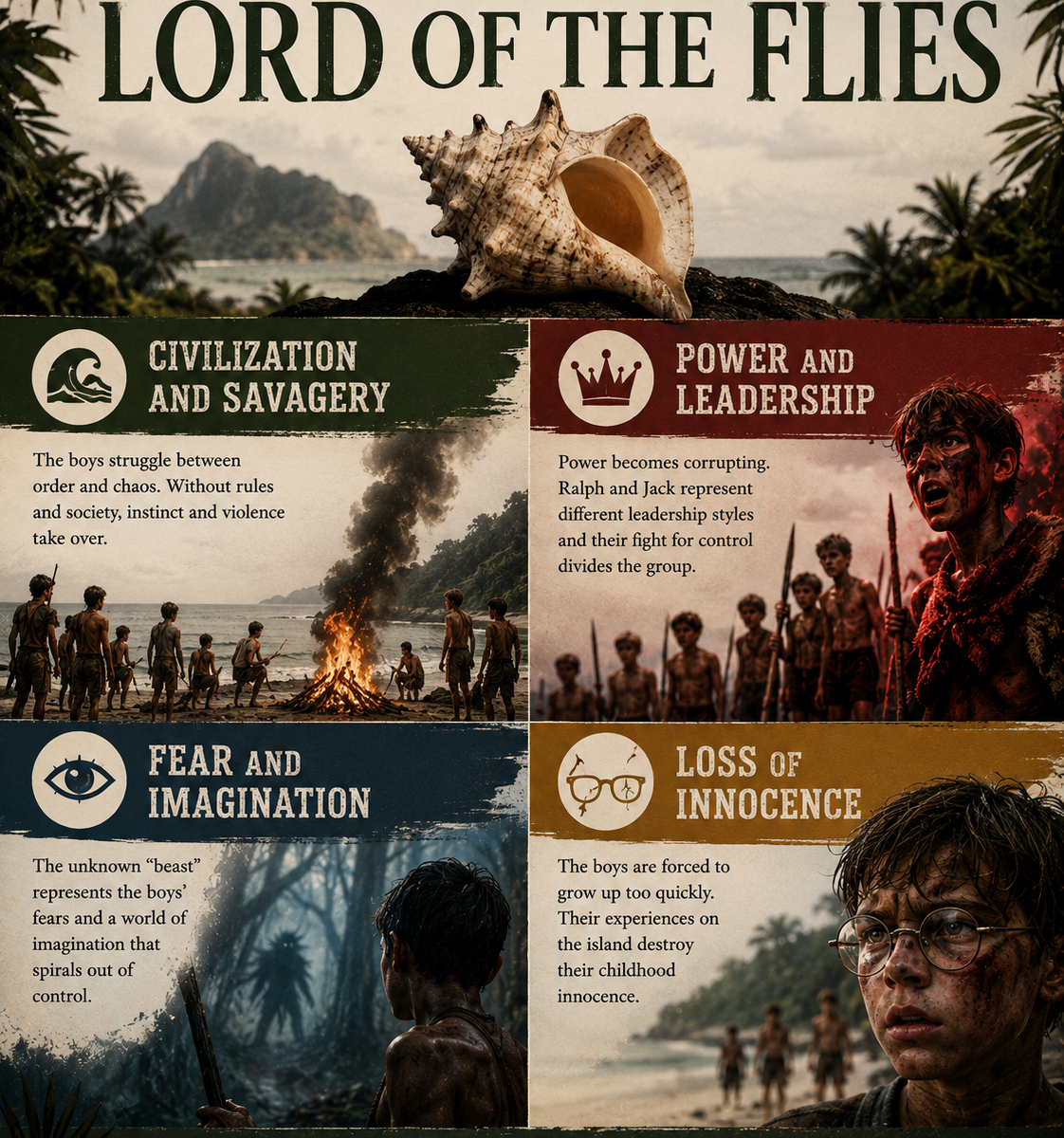
  • Civilization and savagery
  • Power and leadership
  • Fear and imagination
  • Loss of innocence
  • Symbols, essay ideas, and FAQs
themes in Lord of the Flies

Why the Themes in Lord of the Flies Matter

The novel asks a sharp question: what happens when rules disappear?

The main themes in Lord of the Flies help readers see that the island is more than a setting. It becomes a test of society, morality, and fear.

At first, the boys try to copy the adult world. They hold meetings, choose a leader, and use the conch to give each person a turn to speak. Yet that order starts to break down when fear grows and Jack gains power.

This is why the book often appears in high school and AP Literature classes. It gives students a clear way to study conflict, symbols, and character change.

Major Themes in Lord of the Flies: Civilization vs. Savagery

This is the central conflict of the novel.

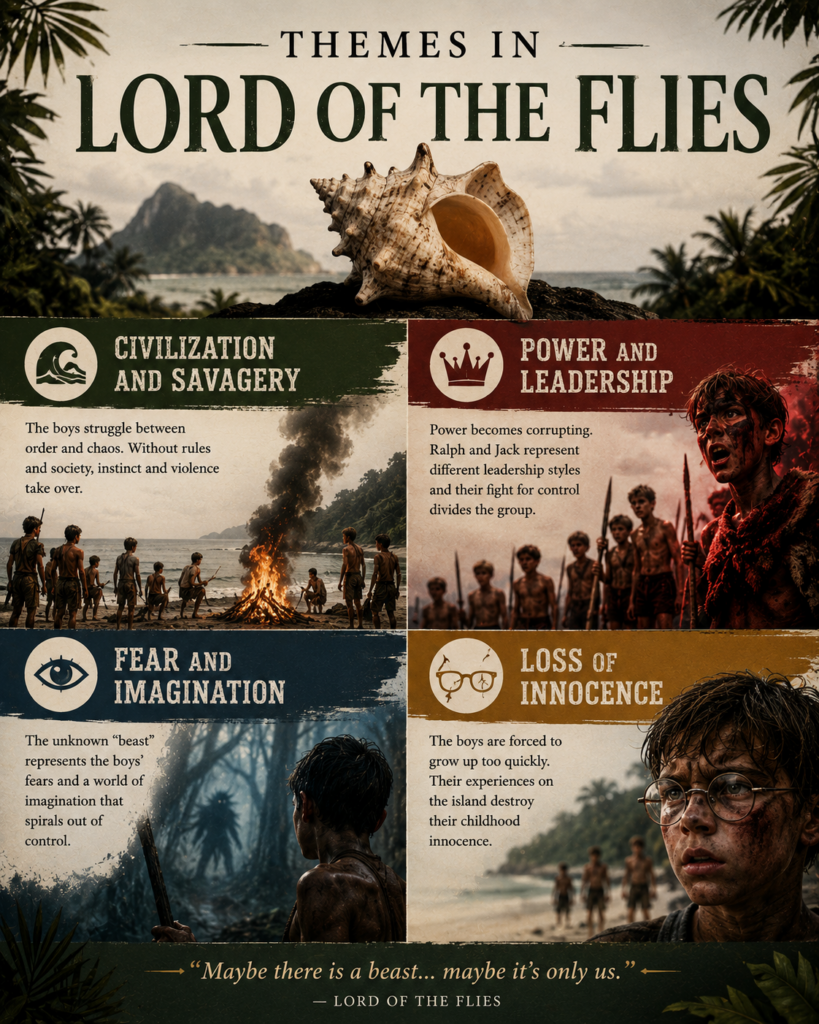
One of the most important themes in Lord of the Flies is the struggle between order and violence. Ralph stands for rules, rescue, and shared responsibility. Jack stands for force, hunting, and control.

The conch shows civilization at first. When the boys respect it, they listen to each other. When they ignore it, the group loses its moral center.

Golding does not suggest that savagery comes from the island itself. The boys bring it with them. This makes the novel darker because the danger is not only outside them. It is inside them too.

A similar idea appears in Shakespeare’s Macbeth. Macbeth does not begin as a monster, but ambition and fear pull him toward violence. In both works, pressure reveals what a person may become.

The Theme of Power and Leadership

The boys’ leaders show two very different ways to gain control.

Ralph becomes leader because other boys trust him. He wants shelters, a signal fire, and a plan for rescue. His power depends on cooperation.

Jack uses fear, excitement, and punishment. He offers meat and the thrill of the hunt. His leadership feels easier because it gives the boys quick rewards.

This theme matters because Golding shows how fragile fair leadership can be. A group may choose safety and rules, but fear can make a harsh leader seem strong.

When you write about the themes in Lord of the Flies, it helps to compare Ralph and Jack. Their conflict is not just personal. It shows two models of society.

Fear, Imagination, and the Beast

The beast is powerful because the boys believe in it.

Fear is one of the most useful themes in Lord of the Flies for essays because it affects nearly every major event. The littluns fear a beast. The older boys try to explain it, but they cannot fully control the panic.

The beast also becomes a tool. Jack uses fear of the beast to gain loyalty. If the boys feel unsafe, they look to him for protection.

Simon understands the truth before the others do. The beast is not a real monster hiding in the jungle. It is the darkness within people.

This idea connects to Arthur Miller’s The Crucible. In that play, fear spreads through a community and makes people act against reason. Golding shows a similar pattern on the island.

Loss of Innocence in Lord of the Flies

The island changes the boys, but it also reveals them.

At the start, the boys act like schoolchildren on an adventure. They swim, explore, and treat the island like a game. That innocent mood does not last.

The deaths of Simon and Piggy mark a painful shift. After these moments, the reader can no longer see the island as a simple place of play.

Ralph’s final tears matter because he now understands what people can do. He cries for Piggy, for Simon, and for the end of his own innocence.

Among the major themes in Lord of the Flies, this one often feels the most personal. Students can trace how childhood trust gives way to guilt and grief.

The Theme of Human Nature

Golding presents a dark view of what people may become without moral limits.

The novel does not claim that every person is evil all the time. Ralph, Piggy, and Simon all show care or reason. Yet the book suggests that goodness needs support from rules, empathy, and courage.

Simon is the clearest moral figure. He helps the littluns, seeks truth, and sees beyond the group’s fear. His death shows how a crowd can destroy a person who stands apart.

This is one reason the themes in Lord of the Flies still matter. The novel asks readers to think about school groups, politics, teams, and any place where people follow a crowd.

Symbols That Support the Themes in Lord of the Flies

Golding uses simple objects to carry big ideas.

The conch stands for order and shared speech. When it breaks, the boys have lost more than a shell. They have lost the system that kept them human.

Piggy’s glasses stand for reason and practical knowledge. They help start the fire, which means they also connect to rescue and hope. When the glasses are stolen, reason is pushed aside.

The signal fire stands for connection to the outside world. When the boys care for it, they still want rescue. When they forget it, they drift further from civilized life.

The Lord of the Flies, the pig’s head on a stick, stands for corruption and inner evil. It gives shape to the fear that has haunted the group.

For a reliable background on the author and novel, students can visit Britannica’s page on William Golding.

How to Write About Themes in Lord of the Flies

A strong theme essay should make a claim, not just name a topic.

Do not write only that the novel is about power. Instead, explain what Golding says about power. For example: Golding shows that fear can make violent leadership seem attractive.

Then support your claim with scenes. You might use the election, Jack’s tribe, the killing of Simon, or the breaking of the conch.

If you need help shaping a thesis and using evidence, see our guide on how to write a literary analysis essay.

You can also build a paragraph around a symbol. For example, Piggy’s glasses show how reason can be useful, but also easy to steal when violence takes over.

For extra practice, you can use our student literature study resources to plan theme notes and essay ideas.

Helpful Books to Read Next

These books can help you understand the novel and its larger literary context.

  • Lord of the Flies by William Golding
  • How to Read Literature Like a Professor by Thomas C. Foster

For more context on major literary terms, the Poetry Foundation glossary is a helpful reference.

FAQ: Themes in Lord of the Flies

What is the main theme of Lord of the Flies?

The main theme is the conflict between civilization and savagery. Golding shows how quickly order can break down when fear and violence take control.

What does the beast symbolize?

The beast symbolizes the darkness within human beings. It is not just a creature the boys fear. It reflects their own capacity for violence.

How does Golding show loss of innocence?

Golding shows it through the boys’ shift from play to cruelty. Simon’s and Piggy’s deaths make the loss clear.

Why is the conch important?

The conch stands for rules, speech, and democracy. When it is destroyed, civilized order has fully collapsed.

How can I write a thesis about this novel?

Choose one theme, make a clear claim about Golding’s message, and connect it to key scenes. For more help, use this literary analysis essay guide.

Key Takeaway

The major themes in Lord of the Flies show that civilization is fragile. Golding’s novel warns that fear, power, and group pressure can reveal the darkest parts of human nature.
What Is a Motif in Literature?

Motif in Literature
Motif in Literature

What Is a Motif in Literature?

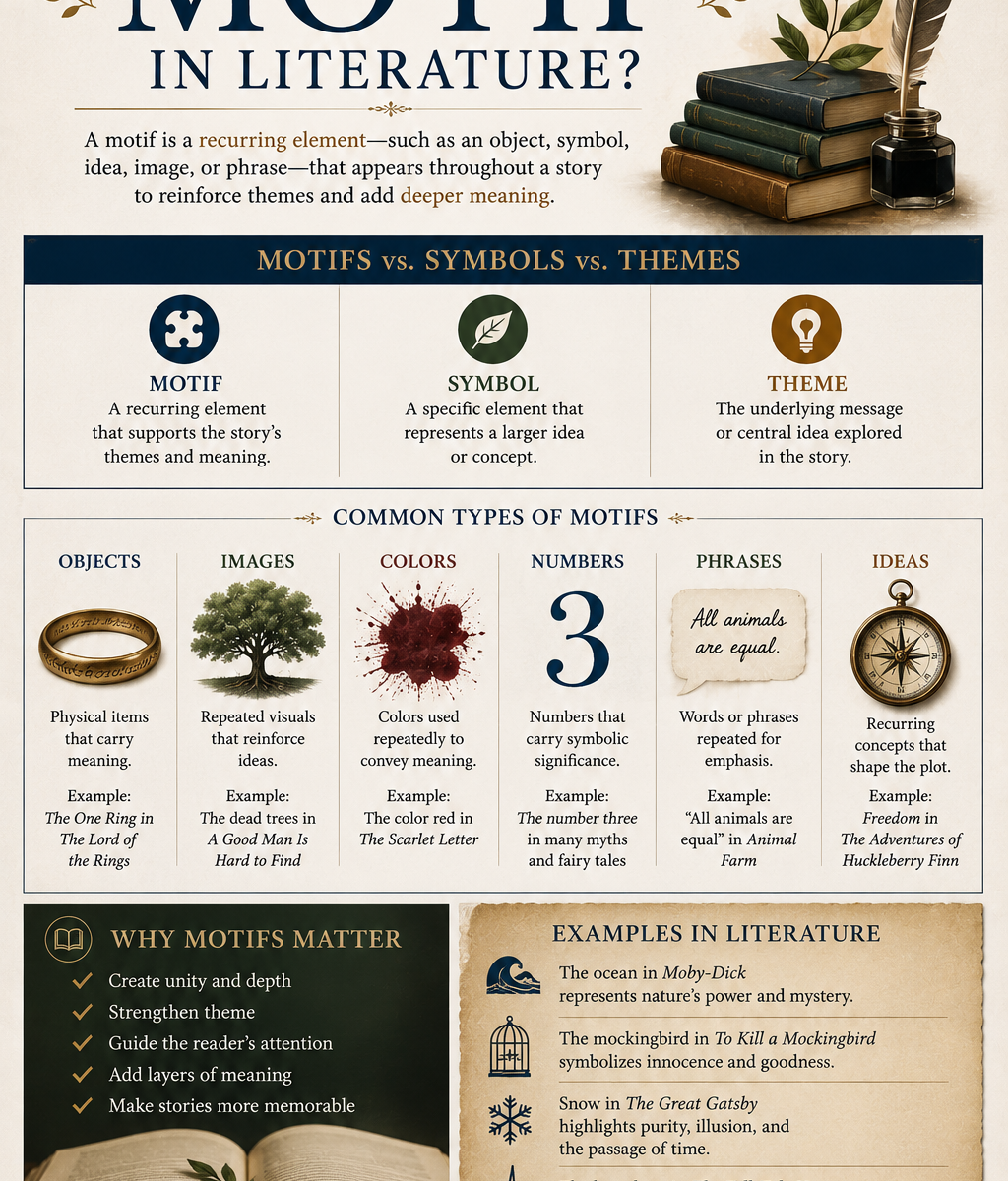
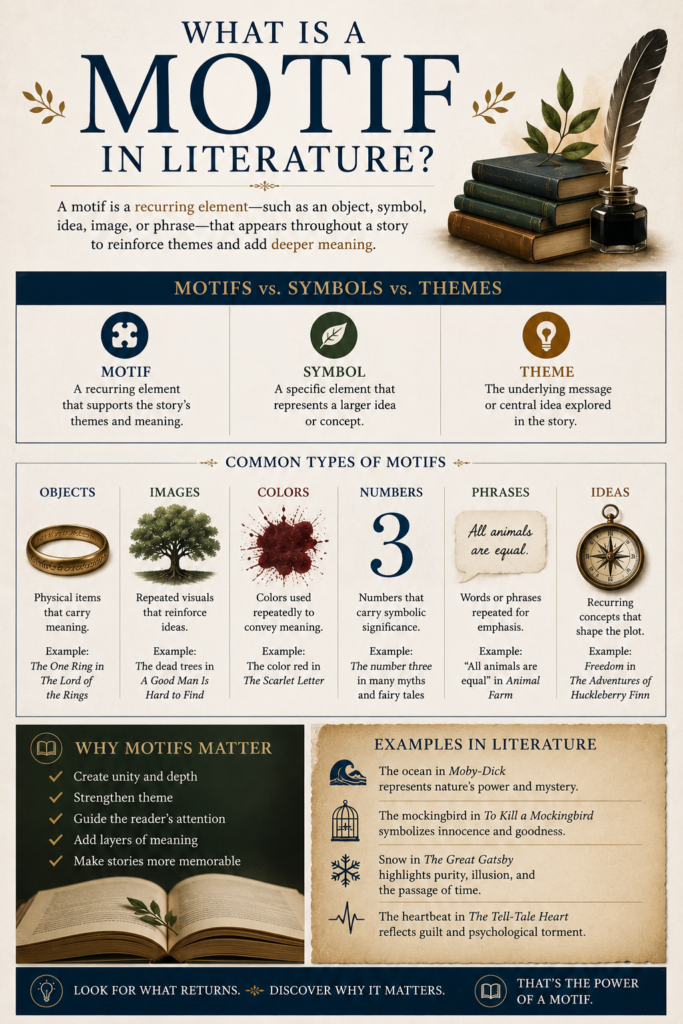
What Is a Motif in Literature? A motif is a repeated detail, image, word, object, or idea that helps build meaning in a story.

Once you know how to spot motifs, you can see how authors guide readers toward deeper themes without stating them directly.

In this Guide

  • What a motif means
  • Why motifs matter
  • Motif vs. theme
  • Famous motif examples
  • How to spot motifs while reading
  • Books that help you practice
  • FAQ

What Is a Motif in Literature? A Simple Definition

A motif is a repeated pattern that adds meaning to a text.

A motif can be an object, color, phrase, sound, place, or action that appears more than once. It is not random. The author repeats it for a reason.

The answer to What Is a Motif in Literature? is simple: it is a clue that points toward a larger idea.

For example, if a novel keeps showing locked doors, the motif may suggest secrets, fear, or limits. The door itself matters, but the repeated pattern matters more.

Why Motifs Matter in Literature

Motifs help readers notice what a story is really about.

Authors use motifs to connect scenes that may seem separate. A repeated image can remind you of a character’s struggle or a story’s main conflict.

Motifs also make literature feel richer. They give a text shape and rhythm. When a motif appears again, it often carries more meaning than it did before.

This is why teachers often ask students to track repeated details. A motif can lead you straight to a strong theme statement.

If you want to compare motifs with other tools writers use, this literary devices list is a helpful place to start.

What Is a Motif in Literature? Motif vs. Theme

A motif repeats. A theme reveals a message.

This is one of the most common points of confusion. A motif is a pattern inside the story. A theme is the deeper idea the story explores.

Think of it this way: rain might be a motif. The theme might be that grief changes how people see the world.

In Macbeth, blood appears again and again. Blood is a motif. It connects to themes of guilt, violence, and moral collapse.

You can read more about Shakespeare’s play through Britannica’s overview of Macbeth.

What Is a Motif in Literature? Common Examples Students Know

Many famous books use motifs that are easy to recognize once you look for them.

In The Great Gatsby by F. Scott Fitzgerald, the green light is a key motif. It appears across the water and comes to represent Gatsby’s hope, longing, and dream of a perfect future.

In To Kill a Mockingbird by Harper Lee, mockingbirds act as a motif tied to innocence. The repeated idea helps readers think about who gets harmed even when they have done no wrong.

In Lord of the Flies by William Golding, the conch shell becomes a motif connected to order and rules. As the boys lose respect for it, their society begins to break apart.

In poetry, a repeated image can work the same way. The Poetry Foundation offers many poems where repeated images carry meaning. You can explore examples at the Poetry Foundation.

How a Motif Builds Theme

A motif often acts like a bridge between details and big ideas.

When a writer repeats a detail, that detail starts to collect meaning. By the end of the story, it may reveal something about love, power, identity, or fear.

For example, a story may repeat images of mirrors. At first, they may seem like simple objects. Later, they may connect to a character’s struggle with self-image or truth.

This is why motifs are useful in essays. They give you evidence you can point to. You can quote the repeated detail, then explain how it supports the theme.

How to Spot a Motif While Reading

Look for details that return at important moments.

When students ask, What Is a Motif in Literature?, the best answer is often found through practice. Notice what keeps coming back.

Pay attention to repeated colors, objects, phrases, weather, places, or actions. Then ask what those details seem to suggest.

A good test is this: if the detail appeared only once, it might just be description. If it returns and gains meaning, it may be a motif.

For more help with related terms, see this guide to common literary devices.

Books to Practice Finding Motifs

These books make motif practice clear and useful.

  • The Great Gatsby by F. Scott Fitzgerald
  • Macbeth by William Shakespeare

Both texts use repeated images in ways that connect strongly to theme. They are also common in high school and college literature classes.

FAQ: What Is a Motif in Literature?

What is a motif in literature in simple words?

A motif is something that repeats in a story and helps create meaning. It can be an image, object, word, or idea.

How is a motif different from a symbol?

A symbol stands for something beyond itself. A motif repeats across the text and often includes symbols, images, or ideas.

Can a character be a motif?

A character is usually not a motif. But a repeated action, phrase, or role connected to a character can become one.

Why do teachers ask about motifs?

Motifs help students find themes. They also give strong evidence for literary analysis essays.

What Is a Motif in Literature? Why should I care?

It helps you read with more insight. Motifs show how small details connect to the story’s bigger message.

Key Takeaway

What Is a Motif in Literature? It is a repeated detail that helps reveal deeper meaning.

Here is a simple reading tip: when something shows up more than once, mark it. Then ask, “What idea does this pattern point toward?” That question can lead you to a stronger analysis.

Themes in Pride and Prejudice: A Student-Friendly Guide

Themes in Pride and Prejudice

Jane Austen’s novel may look like a love story, but its ideas run much deeper. This guide explains the major themes in Pride and Prejudice so students can see how love, class, pride, and choice shape the whole book.

In this Guide

Use this quick map to find the part you need for class, notes, or an essay.

  • Why the ideas matter
  • Pride, prejudice, and self-knowledge
  • Love and marriage
  • Class and reputation
  • Money and limited choices
  • Gender and power
  • Family and education
  • Essay tips and FAQ
Themes in Pride and Prejudice

Why the themes in Pride and Prejudice matter

The novel’s themes help explain why a book from 1813 still feels fresh today.

Austen writes about people who judge too fast, protect their social rank, and search for a life with dignity. Those issues still matter in schools, friendships, and families.

The themes in Pride and Prejudice also help students see Austen’s craft. She does not preach. She uses wit, dialogue, and character change to make her ideas clear.

For helpful background on Austen’s life and era, see this overview from Britannica.

Theme 1: Pride, prejudice, and self-knowledge

Elizabeth and Darcy both have to face the truth about themselves.

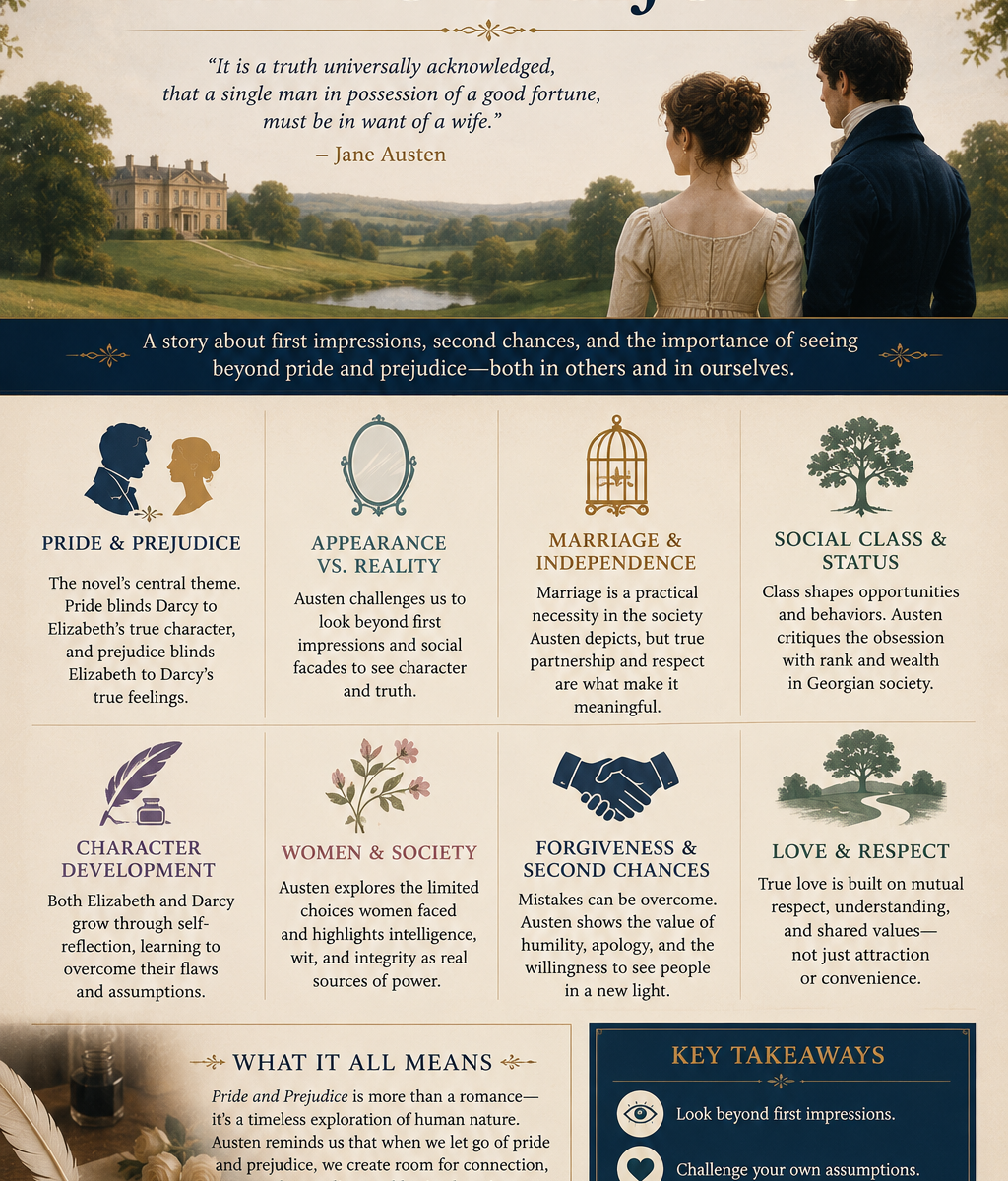
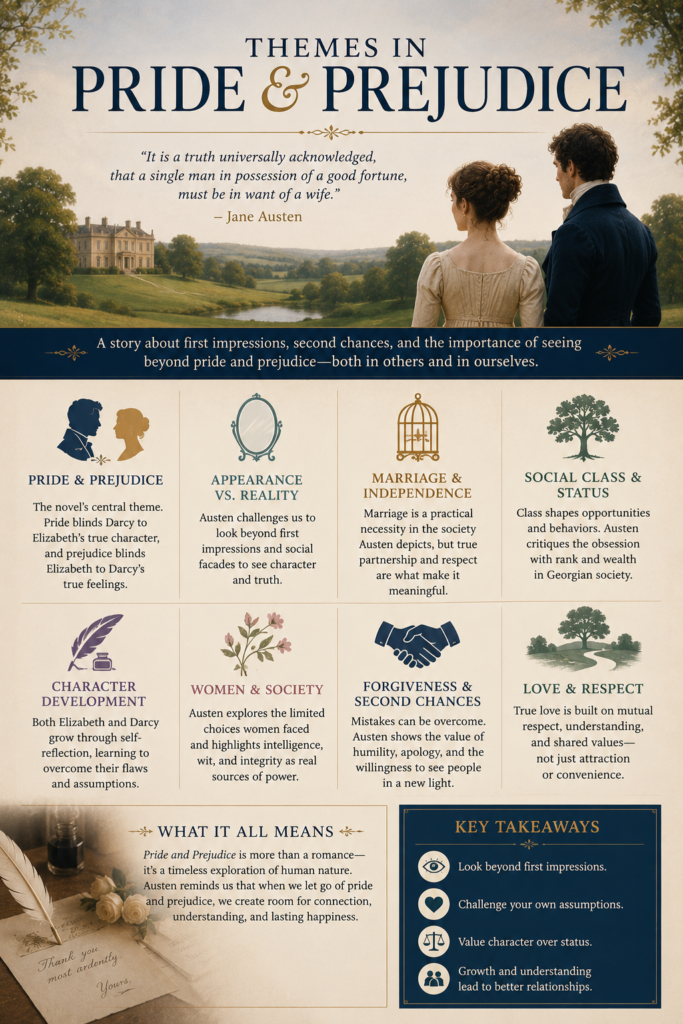
Pride is not always bad in the novel. A person needs self-respect. But Darcy’s pride makes him cold, while Elizabeth’s confidence makes her judge him too quickly.

Prejudice means more than unfair dislike. It also means forming an opinion before you know the facts. Elizabeth believes Wickham because he seems charming. Darcy misreads Elizabeth’s family and social rank.

A central part of the themes in Pride and Prejudice is the need to grow. Elizabeth changes because she can admit error. Darcy changes because he can see how his behavior has hurt others.

This is similar to Pip in Great Expectations. Pip must learn that status does not equal worth. Both novels ask students to notice how a character’s wrong ideas shape the plot.

Theme 2: Love, marriage, and good judgment

Austen shows that love works best when feeling and reason stay linked.

Marriage is a major plot force in the novel. Mrs. Bennet wants her daughters married because their future is at risk. But Austen does not treat marriage as only a business deal.

Elizabeth refuses Mr. Collins because she knows a loveless match would harm her. Charlotte Lucas accepts him because she wants security. Neither choice is simple.

Another key part of the themes in Pride and Prejudice is the question of good judgment. Elizabeth and Darcy reach a strong love only after they face hard truths.

For quicker review, students can use Pride and Prejudice study resources alongside class notes.

Class and reputation as themes in Pride and Prejudice

Social rank affects how characters speak, marry, and judge one another.

Darcy has wealth and status, so others expect him to act with control. The Bennet family has less rank, so their behavior gets watched more closely.

Lady Catherine believes social class should decide marriage. She sees Elizabeth as beneath Darcy. Austen exposes how cruel that belief can be.

Reputation matters too. Lydia’s elopement threatens the whole family because society blames women more harshly than men. This shows a world where public opinion has real power.

The British Library offers useful context on Austen’s world and works at its Jane Austen page.

Theme 4: Money, security, and limited choices

Money is never just background in this novel.

The Bennet estate is entailed, which means the daughters cannot inherit it. This fact creates pressure from the first chapters.

The themes in Pride and Prejudice often connect love to economics. Characters may want romance, but they also need food, shelter, and respect.

Charlotte’s marriage to Mr. Collins can feel sad to modern readers. Yet Austen asks us to see her reason. Charlotte has few safe options, so she chooses stability.

This does not mean Austen supports every practical match. Instead, she shows how unfair systems limit personal freedom.

Theme 5: Gender and power in daily life

Austen shows how women must work within rules they did not create.

The Bennet sisters need marriage because the law and custom do not give them many paths. Their education, income, and public image all affect their futures.

Elizabeth stands out because she speaks with wit and courage. She refuses to obey Lady Catherine. She also refuses to marry without respect.

Among the themes in Pride and Prejudice, gender may be the easiest to connect to class discussion. Students can ask who has power, who lacks it, and how each character responds.

If you want help tracing those patterns, this guide on how to analyze characters in literature can help you build stronger claims.

Theme 6: Family, education, and influence

Family shapes each character’s choices, but it does not fully control them.

Mr. and Mrs. Bennet both affect their daughters. Mr. Bennet is clever, but he often avoids responsibility. Mrs. Bennet cares about security, but her panic causes trouble.

Elizabeth’s mind has been shaped by reading, talk, and sharp observation. Darcy’s values have been shaped by privilege and family pride.

This is one reason many themes in Pride and Prejudice feel personal. Austen shows that people inherit ideas, but they can still revise them.

How to write about themes in Pride and Prejudice

A strong theme paragraph needs a clear claim and proof from the story.

Do not write only that pride is a theme. Go further. Say what Austen suggests about pride, such as: pride becomes harmful when it blocks empathy and honest self-judgment.

Use a character, a choice, and a result. For example, Darcy insults Elizabeth, then later learns why his pride damaged his chance at love.

When writing about themes in Pride and Prejudice, connect the theme to Austen’s message. A theme is not just a topic. It is an idea the novel develops.

You can also review character analysis strategies to make your theme essay more focused.

Helpful books for deeper study

These books can support essays, class projects, or AP Literature prep.

  • Pride and Prejudice by Jane Austen
  • Jane Austen: A Life by Claire Tomalin

To understand the themes in Pride and Prejudice more fully, read the novel slowly and track how each major character changes.

FAQ about themes in Pride and Prejudice

These quick answers can help before a quiz, essay, or class discussion.

What are the main themes in Pride and Prejudice?

The main themes include pride, prejudice, marriage, class, money, gender roles, family influence, and self-knowledge.

What is Austen’s message about marriage?

Austen suggests that marriage should include respect and good judgment. Love matters, but so do character and security.

Why does social class matter so much in the novel?

Class affects how people judge each other and who they see as a proper match. Austen shows that this system can be unfair.

How does Elizabeth change?

Elizabeth learns that cleverness does not make her always right. Her growth comes from honest self-reflection.

Is Darcy’s pride completely bad?

No. Darcy has dignity, but his pride becomes harmful when it makes him look down on others.

Key Takeaway

The best way to read Pride and Prejudice is to watch how judgment changes. Austen shows that love and wisdom grow when people become honest about themselves.

Lord of the Flies Summary and Analysis for Students

Lord of the Flies Summary

A clear overview of the plot, structure, conflicts, and literary meaning.

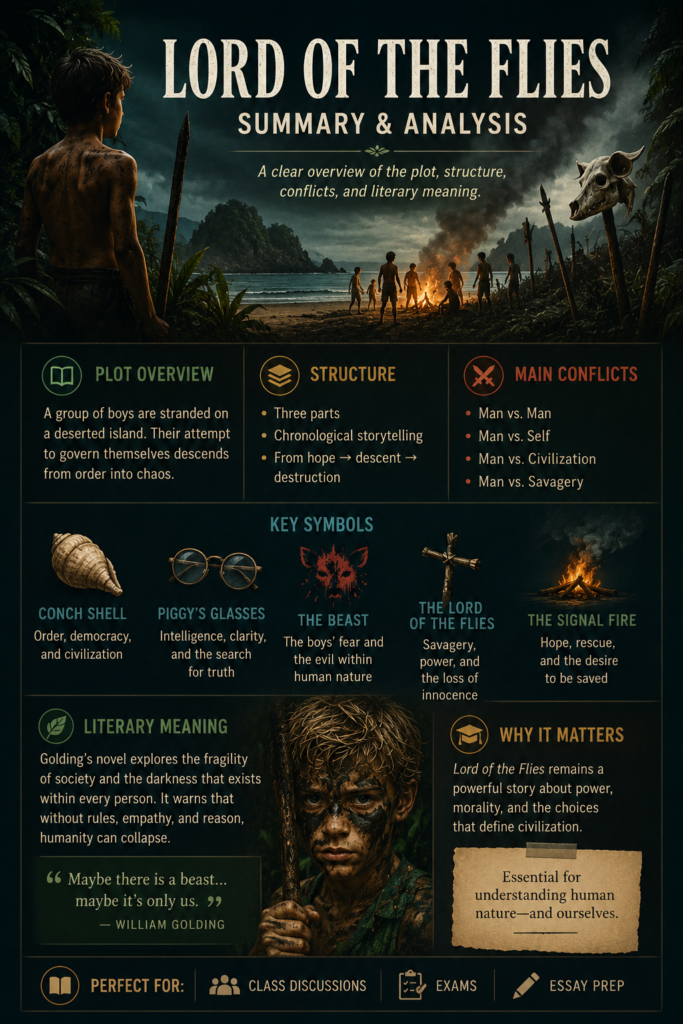
This Lord of the Flies summary and analysis gives students a clear path through William Golding’s famous novel. It covers the plot, main conflicts, key symbols, and deeper meaning without making the book feel harder than it is.

If you need a guided entry point for class, exams, or essay prep, this guide will help you see both what happens and why it matters.

In this Guide

  • Quick overview of the novel
  • Plot summary
  • Structure and conflict
  • Symbols and themes
  • Literary meaning
  • Study tips, book suggestions, and FAQ
Lord of the Flies Summary

Lord of the Flies Summary and Analysis: Quick Overview

Golding turns a survival story into a dark study of human nature.

Lord of the Flies follows a group of British schoolboys who crash on an empty island during a war. At first, the island seems like a place of freedom, but fear and power soon break their fragile order.

Ralph becomes the elected leader, with Piggy as his smart but ignored adviser. Jack, who leads the choirboys, wants control and becomes more focused on hunting than rescue.

A clear Lord of the Flies summary and analysis must notice this shift: the boys do not just lose rules. They lose trust, empathy, and a shared sense of right and wrong.

For basic background on Golding’s life and career, see Britannica’s William Golding biography.

Lord of the Flies Summary and Analysis: Plot by Chapters

The plot moves from hope to fear, then from fear to violence.

The novel opens after a plane crash leaves the boys without adults. Ralph and Piggy find a conch shell, which becomes a tool for calling meetings and giving people the right to speak.

The boys vote Ralph as chief. Jack accepts this at first, but he feels wounded because he wants power. Ralph wants shelters and a signal fire, while Jack wants meat and status.

Soon, the younger boys fear a beast on the island. Ralph tries to keep the group focused on rescue, but the fear spreads. A fire set by the boys burns out of control, and one small child may die.

Jack becomes skilled at hunting pigs. The hunters paint their faces, which lets them act with less shame. The paint works like a mask, much as costumes in plays can free characters from normal rules.

A ship passes the island, but the signal fire is out because Jack and his hunters left their post. Ralph is furious. This moment shows the main split between rescue and power.

Simon, the quiet and thoughtful boy, later finds the pig’s head that Jack’s group has placed on a stick. This head is called the Lord of the Flies. It seems to speak to Simon and tells him that the real beast is inside the boys.

Simon then discovers that the supposed beast on the mountain is only a dead parachutist. When he tries to tell the others, the boys mistake him for the beast during a wild dance and kill him.

After Simon’s death, Jack’s tribe grows stronger. They steal Piggy’s glasses, which are needed to make fire. Ralph and Piggy go to ask for them back, but Roger rolls a rock that kills Piggy and breaks the conch.

In the final chase, Jack’s tribe hunts Ralph across the island. They set the forest on fire to force him out. A naval officer arrives because of the smoke, and the boys are rescued, but their innocence is gone.

The best Lord of the Flies summary and analysis sees the ending as bitter, not simply happy. Rescue comes, but only after the island has shown what fear and violence can do.

Structure of the Novel

The structure works like a slow collapse.

Golding begins with an island that feels open and bright. The boys form meetings, choose a chief, and speak about rules. The conch gives the early chapters a sense of order.

As the story moves forward, the structure becomes darker. Meetings fail. The signal fire goes out. Jack’s tribe replaces speech with chants and force.

By the end, the island looks almost like a war zone. The fire that should have signaled rescue becomes a weapon. That reversal is one reason the structure feels so sharp.

Like Macbeth, the novel shows how the hunger for power can damage judgment. Like Animal Farm, it asks how a community can fall apart when fear and control replace fairness.

Lord of the Flies Summary and Analysis: Major Conflicts

The conflicts are simple on the surface, but they carry deep meaning.

The main conflict is between Ralph and Jack. Ralph stands for rescue, shared rules, and speech. Jack stands for force, hunting, and control.

There is also a conflict inside the group. The boys want safety, but they are drawn to the thrill of violence. Golding shows how a crowd can make people do things they might fear doing alone.

The beast creates another conflict. At first, the boys think it is an outside monster. Simon understands that the real danger comes from within their own hearts.

This part of the Lord of the Flies summary and analysis matters for essays because conflict in the novel is not just action. It reveals what Golding thinks about human nature.

Symbols in Lord of the Flies

Golding’s symbols turn ordinary objects into moral tests.

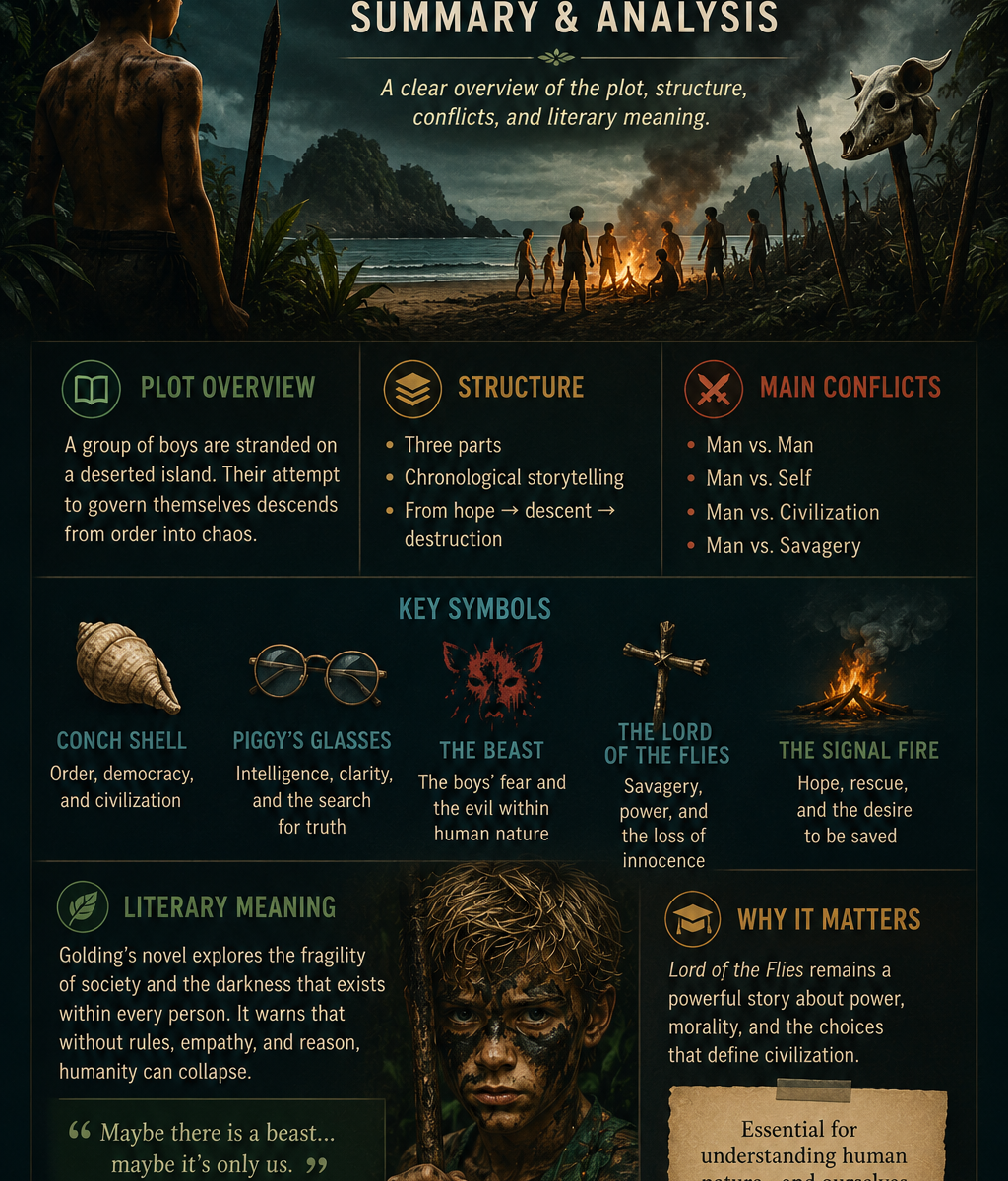
The conch shell stands for order and civil speech. When the conch breaks, the boys no longer respect shared rules.

Piggy’s glasses stand for reason and practical knowledge. They help the boys make fire, but Jack wants them for power, not wisdom.

The signal fire stands for hope and a link to the adult world. When the boys care about the fire, they care about rescue. When they abandon it, they drift toward the island’s violence.

The beast stands for fear. It also shows how people can invent enemies when they do not understand themselves.

The Lord of the Flies, the pig’s head on a stick, is the most disturbing symbol. It suggests decay, evil, and the cruel truth Simon sees before his death.

Key Themes for Students

The novel asks what happens when social rules lose power.

One major theme is civilization versus savagery. Golding does not show this as a simple split between good and bad people. He shows how quickly order can weaken.

Fear is another key theme. The boys fear the beast, but that fear makes them easier to control. Jack uses fear to gain loyalty.

The novel also explores the loss of innocence. The boys begin with games and meetings, but they end with murder and a hunt. Their childhood does not protect them from moral failure.

If you want to move from summary to evidence, try this guide to close reading in literature. It can help you connect symbols, word choice, and theme in your own notes.

Lord of the Flies Summary and Analysis: Literary Meaning

The novel’s meaning is harsh, but it is not hopeless.

Golding suggests that people need more than rules. They need moral courage and respect for others. Without those, rules can become empty sounds.

The boys are not evil because they are children. They are human, and that is the troubling point. Golding asks readers to face the darker parts of human behavior.

A good Lord of the Flies summary and analysis should not stop at the plot. The novel matters because it studies how fear, pride, and group pressure can break a community.

Golding later received the Nobel Prize in Literature. You can read more about his award at The Nobel Prize official site.

How to Study Lord of the Flies

Focus on patterns, not just events.

Track how the conch, fire, and glasses change in meaning. Each object starts with a useful role, then becomes part of a larger moral struggle.

Pay close attention to scenes with crowds. Golding often shows how chants, fear, and shared excitement pull the boys away from reason.

When you write about the novel, use short quotes and explain them closely. For help with that skill, see how close reading works in literature.

Relevant Books to Read Next

These books connect well with Golding’s ideas about power and society.

  • Animal Farm by George Orwell
  • The Coral Island by R. M. Ballantyne
  • Fahrenheit 451 by Ray Bradbury

The Coral Island is especially useful because Golding partly responds to its more hopeful view of boys stranded on an island.

FAQ: Lord of the Flies Summary and Analysis

What is the main idea of Lord of the Flies?

The main idea is that human beings can turn violent when fear, pride, and power replace moral responsibility.

What should a Lord of the Flies summary and analysis include?

It should include the crash, Ralph and Jack’s conflict, Simon’s discovery, Piggy’s death, the final hunt, and the novel’s themes.

Why is the conch important?

The conch stands for order, speech, and shared rules. When it breaks, the boys’ society fully falls apart.

Is Jack the villain of the novel?

Jack acts as the main antagonist, but Golding’s point is larger. Jack shows a violent desire for power that can exist in many people.

Why does Simon matter so much?

Simon understands that the beast is not a monster outside the group. It is the darkness inside human nature.

Key Takeaway

A strong Lord of the Flies summary and analysis shows that the novel is not only about boys on an island. It is about how quickly fear can weaken order, and why moral courage matters.

Symbols in Death of a Salesman: What They Mean and Why They Matter

Symbols in Death of a Salesman

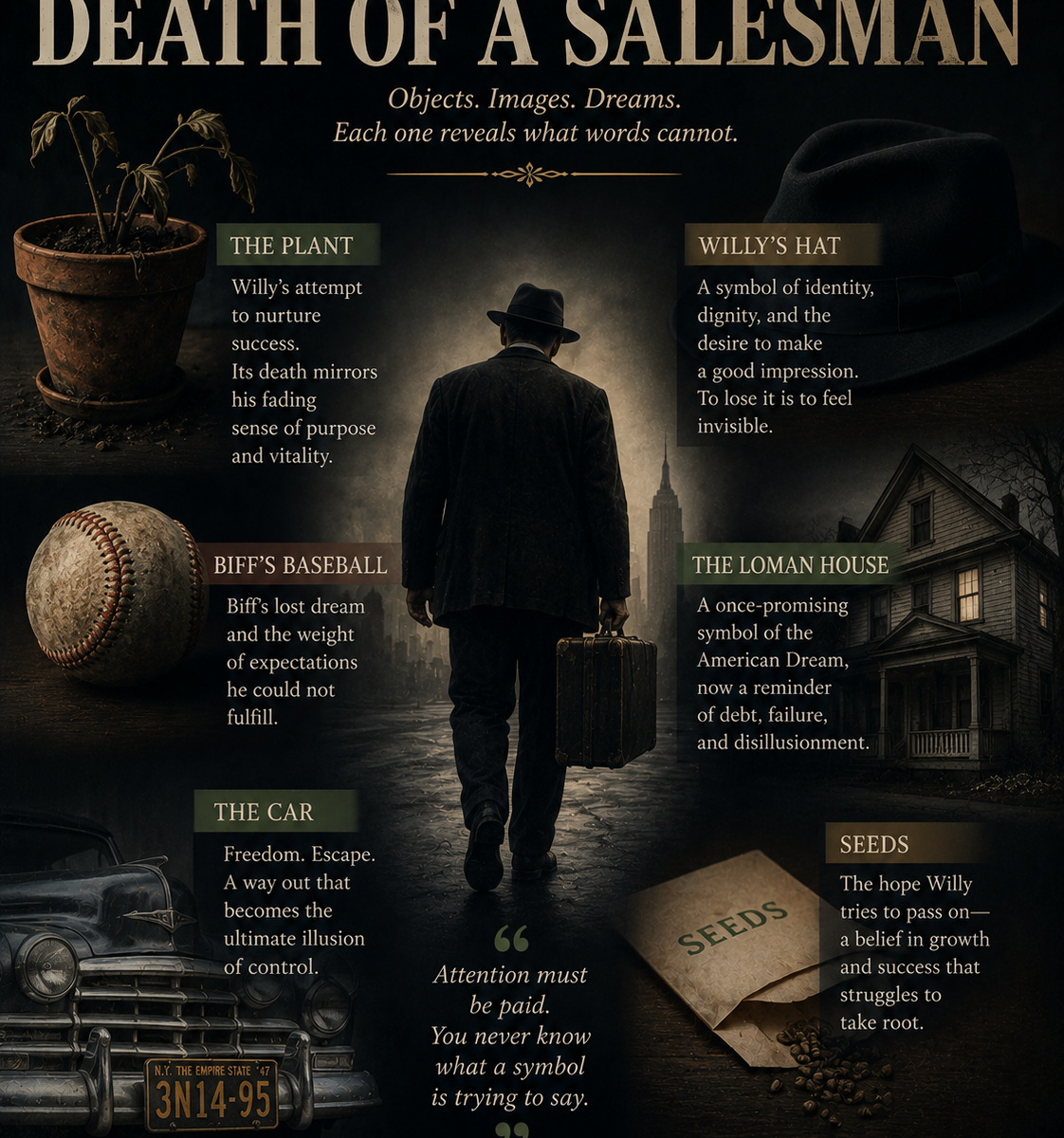
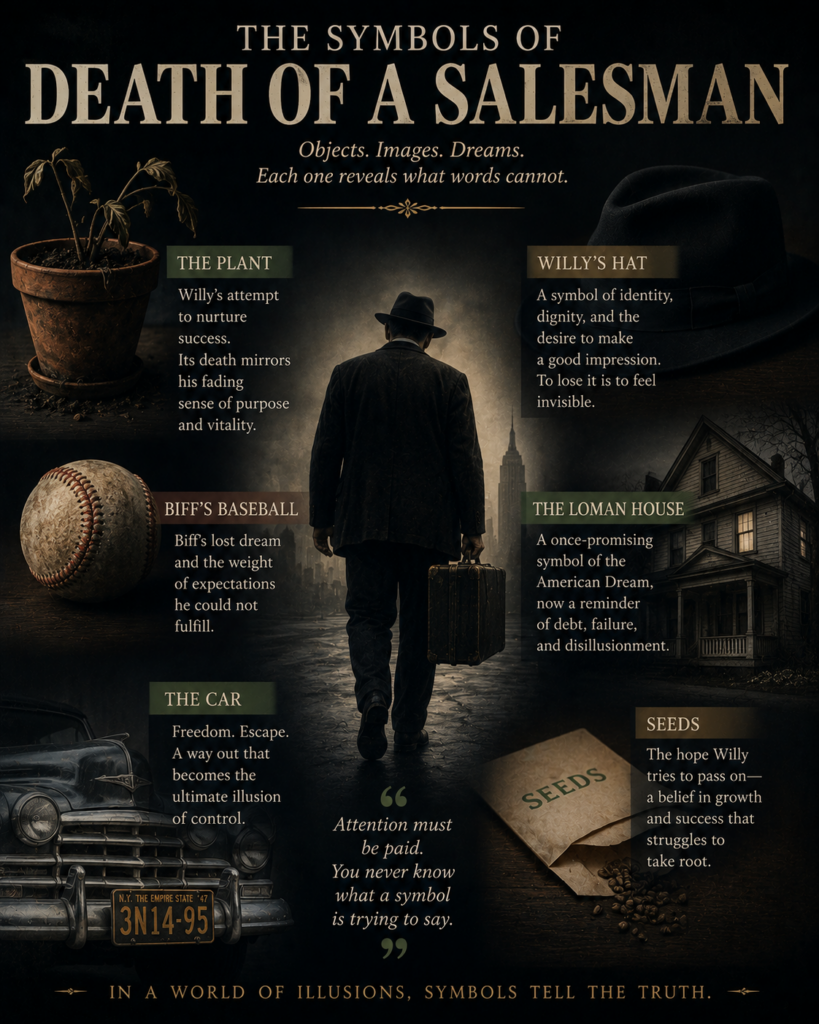
The symbols in Death of a Salesman help Arthur Miller show what Willy Loman wants, fears, and hides from himself. This guide explains the most important images in the play and connects each one to a major theme.

In this Guide

Symbols in Death of a Salesman

Why symbols in Death of a Salesman matter

Miller uses everyday objects to reveal deep pain.

A pair of stockings, a bag of seeds, or the sound of a flute may seem simple at first. Yet each one shows the gap between Willy’s dreams and his real life.

That is why the symbols in Death of a Salesman are so useful for students. They make the play easier to understand because they turn big ideas into clear images.

This is common in literature. In The Great Gatsby, the green light suggests Gatsby’s dream. In Macbeth, blood points to guilt. Miller does the same thing, but with objects from an ordinary home.

Major symbols in Death of a Salesman and what they mean

These symbols show Willy’s hopes, guilt, and fear of failure.

The major symbols in Death of a Salesman are tied to the American Dream. Willy believes success should bring money, respect, and love. The symbols show how that belief breaks down.

Seeds

The seeds are one of the clearest symbols in the play. Near the end, Willy tries to plant seeds in the dark.

On the surface, he wants a garden. On a deeper level, he wants proof that his life has meant something.

The seeds connect to the theme of legacy. Willy fears he has left nothing behind for Biff and Happy. His garden becomes a symbol of the future he failed to grow.

Stockings

Stockings carry guilt. Willy gives new stockings to The Woman, but Linda has to mend her old ones at home.

That image hurts because it reminds Willy of his affair. It also shows how money and shame mix in his mind.

The stockings connect to the theme of betrayal. Willy betrays Linda, but he also betrays the values he claims to protect.

The diamonds

Diamonds are linked to Ben, Willy’s older brother. Ben walked into the jungle and came out rich.

To Willy, the diamonds prove that success is real and visible. They are hard, bright, and valuable.

The problem is that Willy measures life by wealth. The diamonds connect to the theme of false success, since they make money look like the final proof of worth.

The rubber hose

The rubber hose is one of the darkest symbols in the play. Linda finds it near the gas pipe.

It points to Willy’s plan to die by suicide. It also shows that his despair has been hidden inside the house for a long time.

The hose connects to the theme of private suffering. Willy talks big in public, but at home his pain becomes impossible to ignore.

The car

The car stands for Willy’s work life. He travels as a salesman, so the road should mean freedom.

Instead, the car becomes a sign of danger and exhaustion. Willy crashes it, loses focus while he drives, and later uses it as part of his final plan.

The car connects to the theme of the cost of work. Willy’s job drains him until the tool of his career becomes a tool of destruction.

The flute

The flute music opens the play and returns throughout it. It is tied to Willy’s father, who made and sold flutes.

The sound suggests a world before crowded cities and business pressure. It feels softer than Willy’s harsh sales world.

The flute connects to the theme of lost roots. Willy has left behind a simpler life, but he has not found peace in the modern one.

The refrigerator and household objects

The refrigerator keeps breaking, even though Willy is still paying for it. Other household items bring the same problem.

These objects show the trap of consumer life. Willy buys things to feel modern and successful, but debt follows him.

This symbol connects to the theme of empty progress. New products do not fix Willy’s deeper problems.

How symbols in Death of a Salesman connect to theme

Symbolism matters most when it points to the play’s main ideas.

When you study symbols in Death of a Salesman, do not stop at the object. Ask what the object reveals about Willy, his family, or the world he lives in.

The seeds show that Willy wants a future. The stockings show guilt. The diamonds show his belief that money equals value.

These images all connect to the same central problem. Willy has built his life around a dream that does not love him back.

If you want a simple method for spotting clues like these, read our guide on how to find symbolism in a story.

How to write about symbols in Death of a Salesman

A strong paragraph links the object to a theme and a character choice.

For most essays, the symbols in Death of a Salesman work best when you use a clear claim. Do not write that seeds are important. Write that the seeds show Willy’s need to leave proof of his life behind.

Then use a scene. Mention Willy planting seeds in the dark. Explain how that action shows panic, hope, and failure at once.

A good sentence might look like this: The seeds symbolize Willy’s desperate wish to create a legacy after a life that feels wasted.

You can also pair this article with our quick symbolism study notes if you want a faster review before class.

Common mistakes to avoid

Symbolism should make the play clearer, not more confusing.

One mistake is to treat every object as a hidden code. Not every detail needs a secret meaning.

Another mistake is to name the symbol but skip the theme. A symbol matters because it shows something larger, such as guilt, ambition, or family pressure.

It also helps to connect the symbol to a moment in the play. A symbol without a scene can feel weak in an essay.

Helpful books to pair with this guide

These books can help you understand Miller’s play and its background.

  • Death of a Salesman by Arthur Miller
  • Arthur Miller: His Life and Work by Martin Gottfried

For more background on the author, see Britannica’s overview of Arthur Miller.

FAQ about symbols in Death of a Salesman

These quick answers can help you review before a quiz or essay.

What are the main symbols in Death of a Salesman?

The main symbols in Death of a Salesman include seeds, stockings, diamonds, the rubber hose, the car, and the flute.

What do the seeds symbolize?

The seeds symbolize Willy’s wish to leave a legacy. He wants proof that his life has produced something lasting.

What do the stockings symbolize?

The stockings symbolize guilt and betrayal. They remind Willy of his affair and his failure to care for Linda with honesty.

Why is the rubber hose important?

The rubber hose symbolizes Willy’s hidden despair. It shows that his mental pain has become dangerous.

How do symbols support the American Dream theme?

They show how Willy links success to money, status, and being liked. The symbols reveal how that dream damages him and his family.

Key takeaway

The best symbols in Death of a Salesman turn ordinary objects into signs of broken dreams. They matter because they show the emotional cost of chasing success without knowing what success should mean.

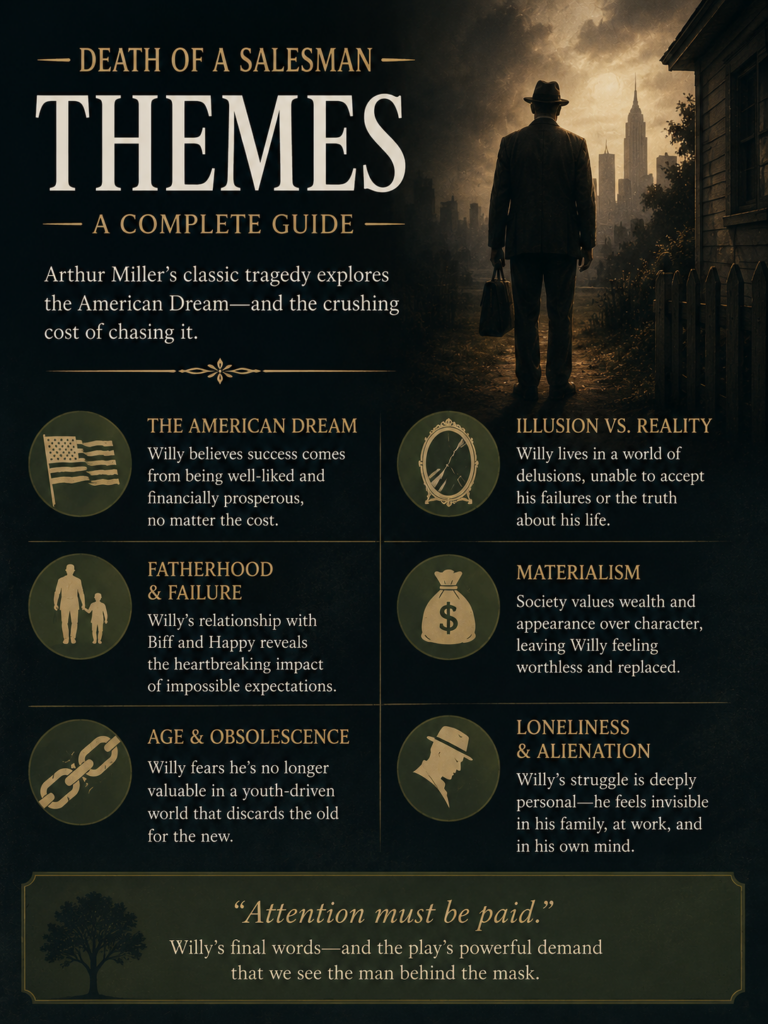
Themes in Death of a Salesman: A Student-Friendly Guide

Themes in Death of a Salesman

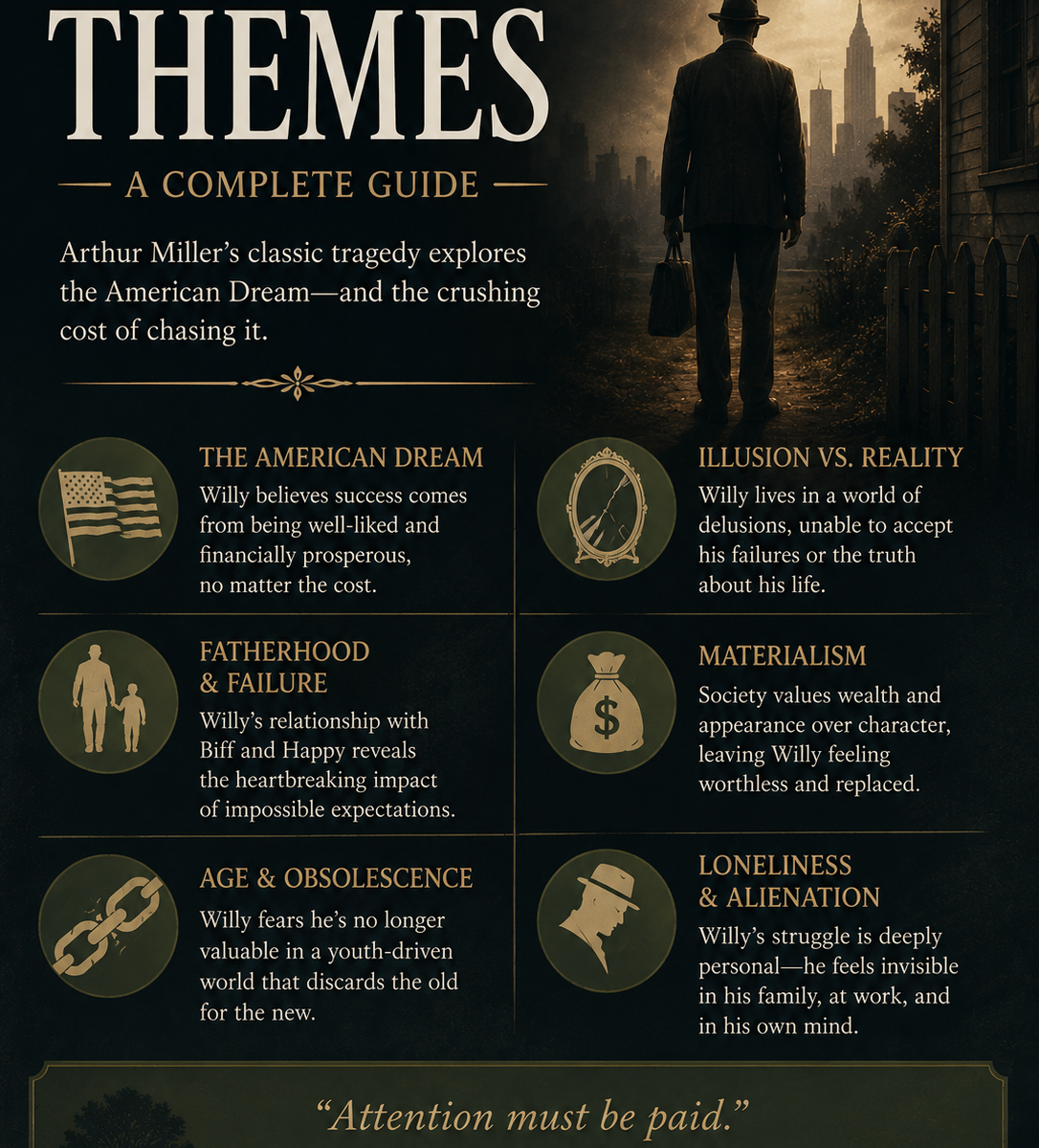
Death of a Salesman is a short play with big questions about dreams, work, family, and self-worth. This guide explains the themes in Death of a Salesman in a clear way so students can read the play with more confidence.

Arthur Miller does not give easy answers. He asks us to look closely at what happens when a person builds a life on a dream that may not be true.

In this Guide

Use these sections to review the play, plan an essay, or prepare for class discussion.

Themes in Death of a Salesman

Why the themes in Death of a Salesman Matter

The play is not only about one salesman. It is about a culture that tells people their value depends on success.

When students study the themes in Death of a Salesman, they often notice that Willy Loman wants more than money. He wants respect. He wants proof that his life mattered.

A theme is not just a topic like money or family. It is the deeper message a work builds around that topic. If you want a quick refresher, see our guide on how to identify theme in literature.

Themes in Death of a Salesman: The American Dream and False Success

Willy believes success comes from charm, popularity, and being well-liked. The play slowly shows how dangerous that belief can be.

Of all the themes in Death of a Salesman, the American Dream is the most famous. Willy thinks America should reward him if he works hard and presents himself well. Yet his life proves that the dream can be unfair, narrow, and cruel.

Biff sees this more clearly than Willy. He knows he has failed by his father’s standards, but he also knows those standards are broken. His conflict shows that a person can only heal by telling the truth.

This theme connects well with The Great Gatsby by F. Scott Fitzgerald. Both works question the dream of wealth and status. Both show people who chase an image of success and lose themselves along the way.

Themes in Death of a Salesman: Family, Love, and Pressure

The Loman family loves each other, but love often turns into pressure. That pressure shapes every major conflict in the play.

The themes in Death of a Salesman become painful inside the home. Willy wants his sons to succeed because he sees them as proof of his own worth. Biff wants freedom, but he also wants his father to understand him.

Linda often tries to protect Willy. Her care is real, but it also keeps some hard truths hidden. Happy copies Willy’s false confidence, which suggests that family patterns can repeat if no one breaks them.

The play asks a hard question: can love still hurt people? Miller’s answer seems to be yes, especially when love comes with impossible demands.

Illusion Versus Reality

Willy often chooses the story he wants over the truth he needs. That gap creates much of the tragedy.

Many themes in Death of a Salesman depend on the battle between illusion and reality. Willy remembers the past as brighter than it was. He also imagines success as something close, even when the facts say otherwise.

The play uses symbols to show this struggle. Seeds suggest Willy’s wish to leave something behind. Stockings remind him of guilt. The flute music points to a simpler life he never chose.

This conflict is clear in Biff’s final honesty. He does not become a perfect hero, but he sees the truth more clearly than his father. That makes his insight important.

Themes in Death of a Salesman: Identity and Self-Worth

Willy’s tragedy grows from the way he ties his identity to his job. When the job rejects him, he feels like his whole life has failed.

The themes in Death of a Salesman show how easy it is to confuse what a person does with who a person is. Willy is not just a worker, yet he has been taught to measure himself as one.

His last name, Loman, sounds like low man. That detail fits his place in the business world. He wants to feel large, but the system makes him feel small.

This theme can remind students of The Metamorphosis by Franz Kafka. Gregor Samsa is also valued for his work until he can no longer perform. Both texts ask what happens when human worth depends on usefulness.

Capitalism, Work, and Human Value

Miller’s play criticizes a world that treats people like products. Willy sells goods, but he also feels forced to sell himself.

The play does not say work is bad. It asks why a person must lose dignity just to survive. Willy gives years to his company, but that loyalty does not protect him.

This makes the play a social critique as well as a family tragedy. For more background on the play and Miller’s place in American drama, visit Britannica’s overview of Death of a Salesman.

Students should notice how work affects every family member. Money problems shape the mood of the house, and success feels like a test no one can pass.

How to Write About themes in Death of a Salesman

A strong essay should connect theme to character choices, symbols, and conflict. Do not just name a theme. Show how the play builds it.

For example, you could argue that Willy’s dream fails because it depends on appearance instead of truth. You could also argue that Biff’s honesty offers the only real escape from the family’s cycle.

If you need help turning ideas into a thesis, review our step-by-step theme guide. You can also explore our student literature study resources for more support with close reading and essay prep.

Here is a simple thesis frame:

  • In Death of a Salesman, Arthur Miller shows that the American Dream becomes harmful when it teaches people to value image over truth.
  • Through Willy and Biff, Miller suggests that self-worth must come from honesty rather than public approval.

Relevant Books for Further Reading

If you want more context, these books pair well with the play:

  • Death of a Salesman by Arthur Miller
  • The Crucible by Arthur Miller
  • A Raisin in the Sun by Lorraine Hansberry

FAQ About the themes in Death of a Salesman

What are the main themes in Death of a Salesman?

The main themes include the American Dream, family pressure, illusion versus reality, self-worth, and the value of work.

What is the most important theme in the play?

The American Dream is often seen as the central theme. Willy believes success will prove his worth, but that belief destroys him.

How does Biff connect to the play’s themes?

Biff challenges Willy’s false dream. His honesty shows that truth can be painful but necessary.

Is Willy Loman a tragic hero?

Many readers see him as a modern tragic figure. He is flawed, but his pain reflects larger problems in society.

Key Takeaway

The themes in Death of a Salesman matter because they still feel real. Miller shows how dreams can inspire people, but he also shows how a false dream can break a family and a life.

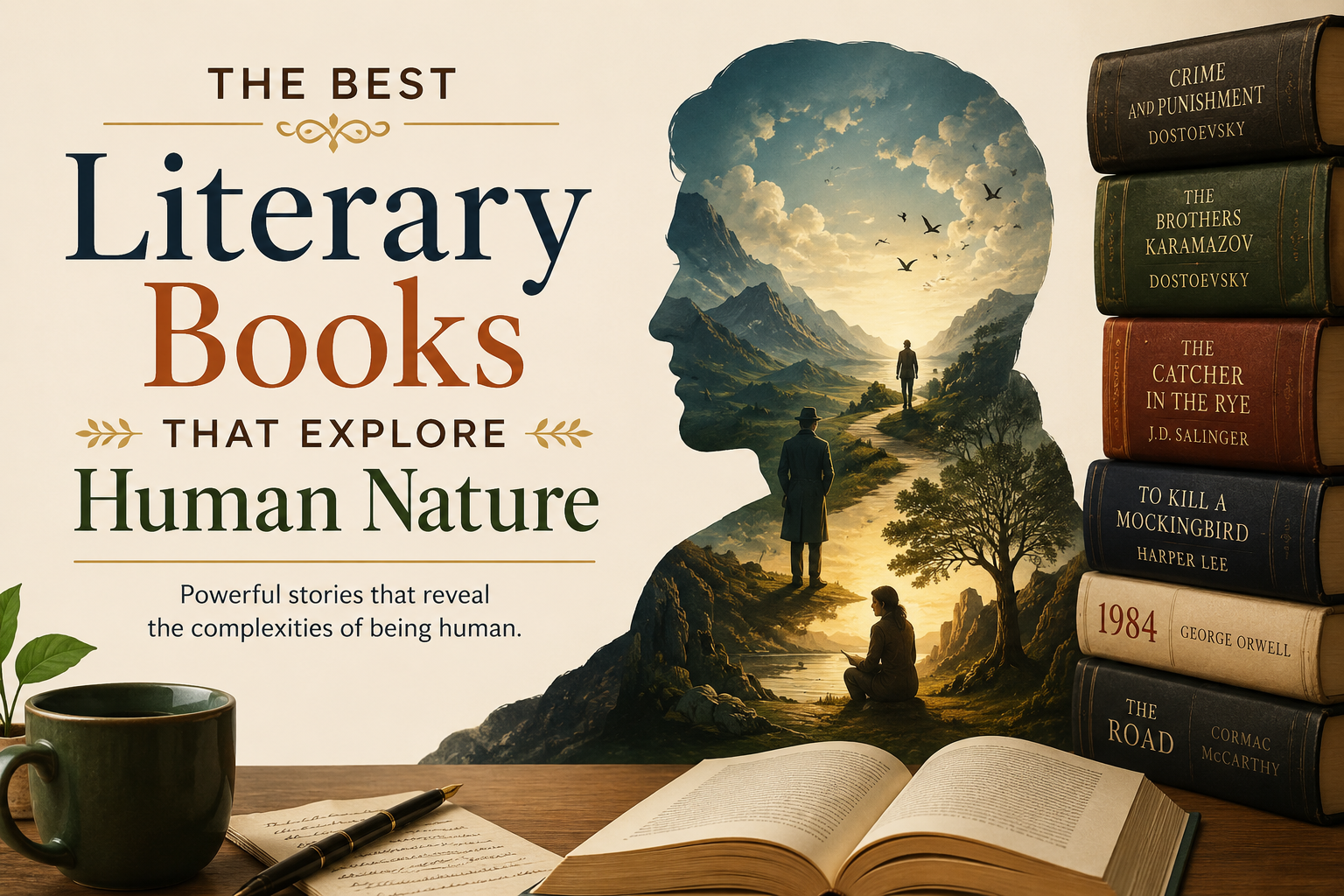
Best Literary Human Nature: Books That Show Who We Really Are

Best human nature books

Great stories help us see the truth about people, even when that truth feels hard to face. Best Literary Human Nature looks at books that explore fear, pride, love, guilt, and moral choice.

These works matter because they ask a simple question: what do people do when life tests them?

In this Guide

  • What Best Literary Human Nature means
  • Why human nature matters in literature
  • Best Literary Human Nature books to read
  • Symbols and themes that reveal character
  • How students can write about human nature
  • FAQs
  • Key takeaway

What Best Literary Human Nature Means

Stories about human nature show what people want, fear, hide, and choose.

The phrase Best Literary Human Nature may sound broad, but the idea is clear. It points to books that reveal how people act under pressure.

Some characters try to do the right thing. Others choose power, comfort, or revenge. Literature lets us watch those choices from a safe distance.

That is why these books stay with us. They do not just tell us what happened. They show us why people behave the way they do.

Why Best Literary Human Nature Stories Still Matter

The best books feel alive because their characters feel real.

Best Literary Human Nature stories matter because readers can see parts of themselves in the characters. A reader may not rule a kingdom like Macbeth, but they may know what ambition feels like.

In William Shakespeare’s Macbeth, ambition grows into violence. Macbeth wants power so badly that he loses his peace, his honor, and his sense of self.

In Mary Shelley’s Frankenstein, Victor wants glory through science. His mistake is not just that he creates life. His deeper failure is that he refuses to care for what he has made.

These stories ask us to think about responsibility. They also ask if people are born flawed or shaped by the choices around them.

Best Literary Human Nature Books to Read

These books are strong choices for students because they are rich, readable, and full of moral conflict.

The Best Literary Human Nature books often focus on a character who faces a hard test. That test may come from society, family, power, or guilt.

To Kill a Mockingbird by Harper Lee

This novel explores justice, fear, and moral courage. Atticus Finch shows that doing the right thing can cost a person comfort and safety.

Scout learns that people are more complex than they first appear. The book asks readers to look past rumor and prejudice.

Lord of the Flies by William Golding

This novel places schoolboys on an island without adult rules. At first, they try to build order. Soon, fear and power begin to take over.

Golding suggests that cruelty can grow when people lose limits. The story is often used in classrooms because it raises sharp questions about civilization and human nature.

Other strong examples

Students may also study The Great Gatsby by F. Scott Fitzgerald or Hamlet by William Shakespeare. Both works show how desire can twist a person’s view of truth.

For helpful background on the idea of human nature, readers can explore Britannica’s overview of human nature.

Best Literary Human Nature Themes Students Should Know

Themes help readers move from “what happened” to “what the story means.”

When students study Best Literary Human Nature, they often notice the same big ideas across different books. These ideas repeat because people face the same inner battles in many times and places.

Ambition and its cost

Ambition can help a character grow. It can also lead to ruin.

Macbeth is the classic example. His desire for power destroys his loyalty and peace of mind.

Goodness under pressure

Many novels ask if a person can stay good when the world is unfair. To Kill a Mockingbird explores this through Atticus, Scout, and the trial of Tom Robinson.

The book does not pretend goodness is easy. It shows that moral courage often feels lonely.

Fear and group behavior

Lord of the Flies shows how fear can spread through a group. The boys begin to follow the loudest voices, not the wisest ones.

This theme matters because people often act differently in a crowd. Literature helps us question that shift.

Symbols That Reveal Human Nature

Symbols give stories deeper meaning without heavy explanation.

In Best Literary Human Nature works, symbols often show what characters cannot say out loud. A symbol may reveal guilt, innocence, power, or loss.

In Lord of the Flies, the conch shell stands for order and shared rules. When the shell loses power, the boys lose their grip on peace.

In Frankenstein, light often connects to knowledge. Yet Shelley shows that knowledge without care can become dangerous.

In The Great Gatsby, the green light stands for Gatsby’s dream. It also shows how desire can trap a person in the past.

Poetry can do this too. The Poetry Foundation’s page on Robert Frost is useful for readers who want to see how poems explore choice and regret.

How to Write About Best Literary Human Nature in an Essay

A strong essay does not just name a theme. It explains how the author builds that theme through character, conflict, and symbol.

If you write about Best Literary Human Nature, start with a clear claim. Do not say, “This book shows human nature.” Say what the book argues about human nature.

For example, an essay on Macbeth could argue that unchecked ambition destroys moral judgment. An essay on Lord of the Flies could argue that fear weakens social order.

Your thesis should be specific, arguable, and tied to the text. If you need help, use this guide on how to write a thesis statement for a literary analysis essay.

After that, choose scenes that prove your point. Focus on what characters say, what they hide, and how they change.

Recommended Books for Best Literary Human Nature Readers

These books are often easy to find and useful for class discussions.

To Kill a Mockingbird by Harper Lee is a strong choice for readers who want a story about justice and moral growth.

Lord of the Flies by William Golding is ideal for readers who want a darker look at fear, power, and group behavior.

Both books work well for essays because they offer clear conflicts and strong symbols. They also give students many ways to discuss Best Literary Human Nature without forcing one simple answer.

Common Mistakes When Reading Human Nature in Literature

It is easy to make human nature sound too simple.

One common mistake is to call a character “good” or “bad” and stop there. Most great books avoid simple labels.

Another mistake is to ignore the setting. A character’s world shapes their choices. Social pressure, fear, and unfair rules often push characters toward action.

A better approach is to ask why a character makes a choice. Then ask what the author wants readers to learn from that choice.

FAQs About Best Literary Human Nature

What does Best Literary Human Nature mean?

Best Literary Human Nature refers to books and stories that reveal how people think, choose, and change. These works often focus on moral conflict.

What is a good book about human nature for students?

To Kill a Mockingbird is a strong choice. It deals with justice, courage, and the way people judge others.

Why do teachers assign books about human nature?

Teachers assign these books because they help students think deeply about character and theme. They also connect literature to real life.

Is human nature a theme?

Human nature is a broad idea, not a theme by itself. A stronger theme would say something specific, such as “fear can make people give up their values.”

How can I find symbols related to human nature?

Look for objects, images, or repeated details that connect to a character’s inner life. Then ask how the symbol changes as the story moves forward.

Key Takeaway

Best Literary Human Nature stories matter because they show people at their most honest moments. They help readers see how fear, desire, guilt, and hope shape human choice.

The strongest literature does not give easy answers. It gives us characters who feel real, choices that matter, and questions we keep asking long after the final page. 📚

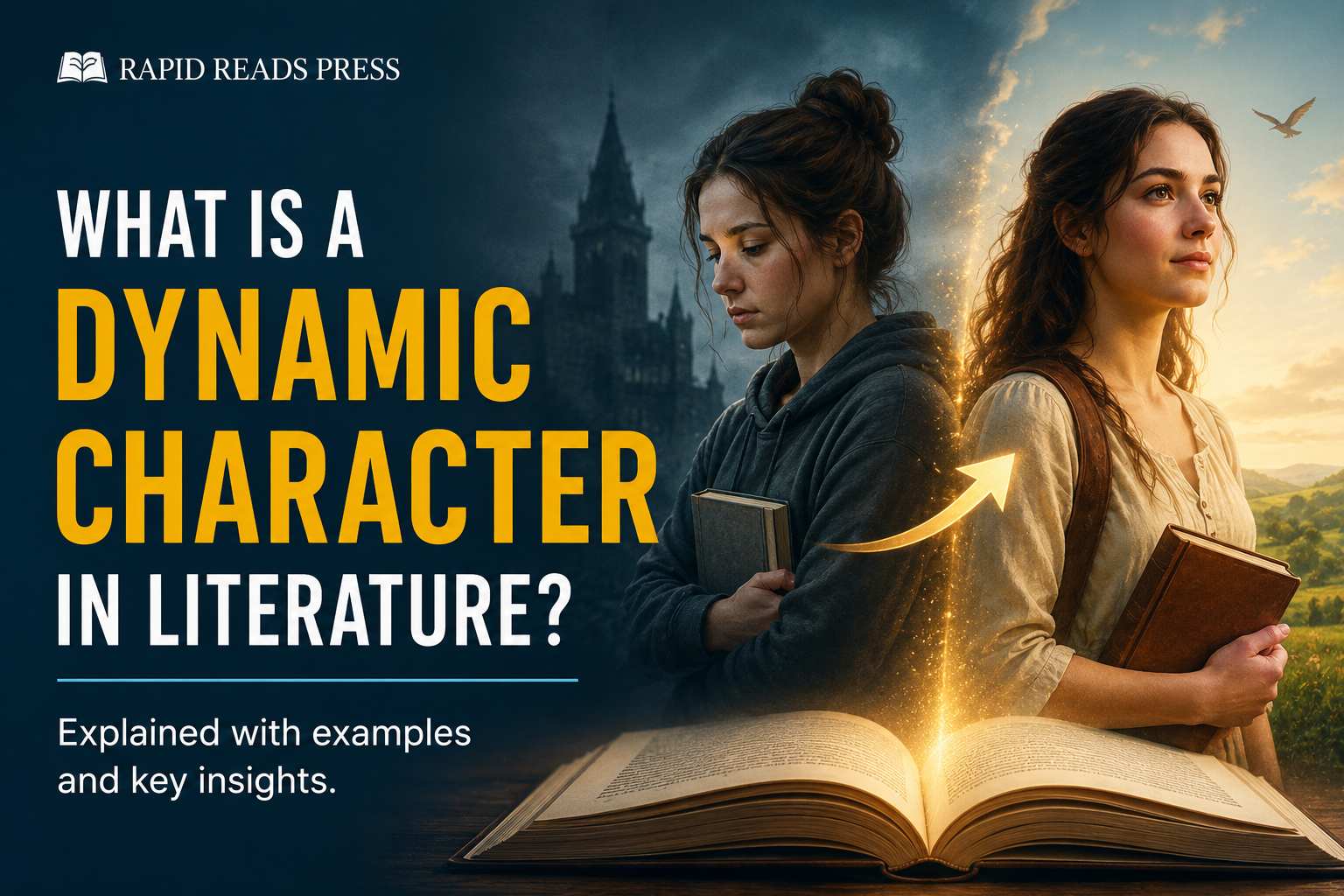
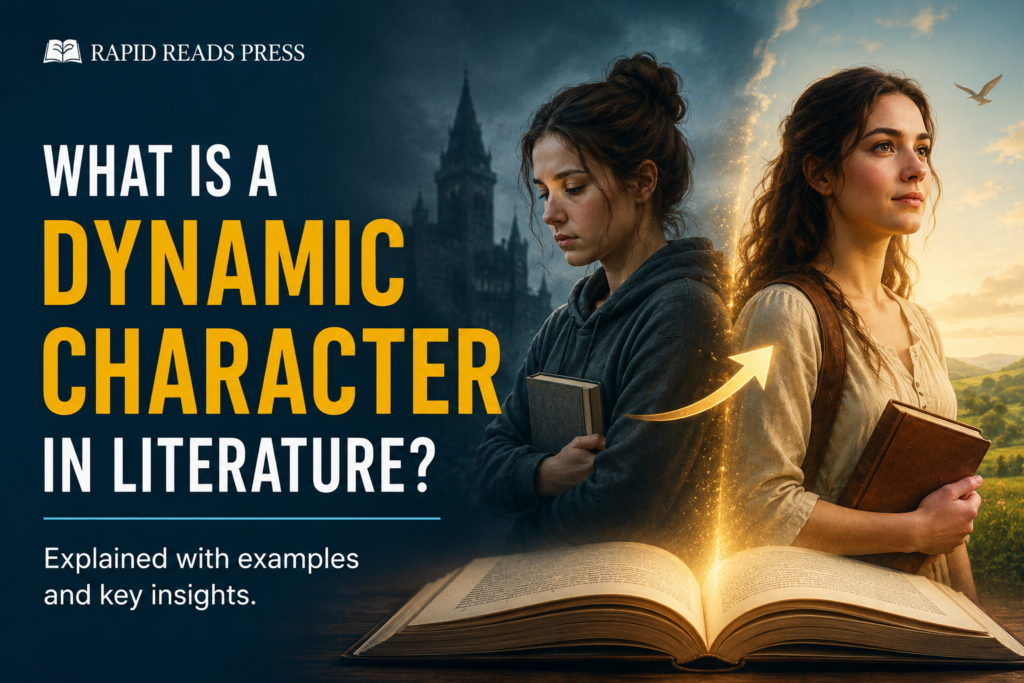
What Is a Dynamic Character in Literature?

dynamic character

It is a character who changes in an important way over the course of a story.

This guide explains the idea in simple terms, shows why it matters, and gives clear examples from books many students know.

In this Guide

  • What a dynamic character means
  • Why dynamic characters matter
  • Dynamic character examples
  • How to spot a dynamic character
  • Books to read for practice
  • FAQ
dynamic character

A Clear Definition

A dynamic character changes in a deep and meaningful way.

The change may involve beliefs, values, goals, or how the character sees the world. It is not just a new haircut, a new job, or a new location.

When students ask, What Is a Dynamic Character in Literature?, the simplest answer is this: a dynamic character learns, grows, falls apart, or becomes someone different because of the story’s events.

For example, Ebenezer Scrooge in A Christmas Carol begins as selfish and cold. By the end, he becomes generous and caring. His change is central to the story.

Why It Matters

Dynamic characters help readers see how conflict can shape a person.

A story feels more powerful when a character has to face hard choices. Those choices can reveal fear, pride, courage, guilt, or love.

What Is a Dynamic Character in Literature? It is often the answer to why a story feels meaningful. The plot may show what happens, but the character’s change shows why it matters.

In many novels, the main character’s growth connects to the theme. If a story is about forgiveness, the dynamic character may need to let go of anger. If a story is about identity, the character may need to understand who they truly are.

If you want a deeper method for studying characters, this guide on how to analyze characters in literature can help you build stronger notes.

Dynamic vs. Static Characters

A dynamic character changes. A static character stays mostly the same.

A static character is not always boring or unimportant. Some static characters help highlight the growth of another character.

In Pride and Prejudice, Elizabeth Bennet is a dynamic character because she changes how she judges Darcy. She learns that her first opinion was not fully fair.

Mr. Collins, on the other hand, stays mostly the same. His lack of growth makes him a useful contrast to Elizabeth’s self-awareness.

So, What Is a Dynamic Character in Literature? Think of a character whose inner life shifts in a clear way from the beginning to the end.

Recognizable Examples

Many famous books use dynamic characters to carry the emotional weight of the story.

Ebenezer Scrooge in A Christmas Carol changes from greedy to generous. His journey shows that moral change is possible.

Elizabeth Bennet in Pride and Prejudice learns to question her own pride and quick judgments. Her growth makes the love story feel earned.

Harry Potter in the Harry Potter series grows from a lonely boy into a braver and more self-aware young man. His change happens across many books, not all at once.

For more context on classic authors and works, you can visit Britannica’s page on Charles Dickens or explore author materials at the Poetry Foundation.

How to Spot a Dynamic Character

Look for a clear before-and-after pattern.

Ask what the character wants at the start. Then ask what the character understands by the end.

A dynamic character often faces a conflict that forces a choice. That choice may expose a flaw, teach a lesson, or push the character toward change.

When thinking about What Is a Dynamic Character in Literature?, focus on inner change. A character may travel far, lose money, or gain power, but those events only matter if they change the character in a real way.

Here are helpful questions:

  • What does the character believe at the beginning?
  • What conflict challenges that belief?
  • What does the character understand at the end?
  • Does the change connect to the theme?

Common Mistakes Students Make

One common mistake is calling every main character dynamic.

A character can be important and still remain static. The key is not how much page time the character gets. The key is whether the character changes in a meaningful way.

Another mistake is confusing mood with growth. A character who feels sad in one chapter and happy in the next has not necessarily changed. A dynamic character has a deeper shift in values, beliefs, or self-understanding.

If you need a full approach, use this character analysis guide to connect traits, conflict, and theme.

Books That Help You Study Dynamic Characters

These books are useful if you want to practice spotting character change:

  • A Christmas Carol by Charles Dickens
  • Pride and Prejudice by Jane Austen

Both books make character growth easy to see, which helps if you are new to literary analysis.

FAQ: What Is a Dynamic Character in Literature?

What Is a Dynamic Character in Literature?

A dynamic character is a character who changes in an important internal way during a story. The change may affect beliefs, values, choices, or self-knowledge.

Does a dynamic character have to become a better person?

No. A dynamic character can improve, but they can also become worse. The main point is that they change in a meaningful way.

Can a minor character be dynamic?

Yes. A minor character can be dynamic if the story shows a clear inner change. Main characters are just more likely to get that kind of attention.

Is a dynamic character the same as a round character?

No. A round character is complex and feels realistic. A dynamic character changes. A character can be both, but the terms do not mean the same thing.

Key Takeaway

What Is a Dynamic Character in Literature? It is a character who changes in a meaningful way because of the story’s conflict.

When you read, track what a character believes at the start and what they understand at the end. That simple habit can lead to stronger essays and better literary analysis. 📚

error

Enjoy this article? Please spread the word :)

Follow by Email
BLUESKY
fb-share-icon
Reddit
LinkedIn
Share
RSS