How to Build a Daily Writing Habit That Sticks

Daily Writing Habit

Every January, countless writers make the same promise: this will be the year they write every day. They buy a fresh notebook, imagine peaceful mornings, and wait for inspiration to arrive. A few weeks later, the notebook is buried under unopened mail. If this sounds familiar, the problem probably is not a lack of discipline or talent. More often, the real obstacle is friction—the small amount of effort required to move from intending to write to actually placing words on the page.
Why Daily Writing Habits So Often Fall Apart

Most writing habits begin with an idealized picture. You imagine a quiet hour, a hot cup of coffee, an inspiring subject, and enough mental space to produce something worthwhile. Unfortunately, that picture depends on several conditions lining up at once. The moment you wake up late, feel tired, face an urgent deadline, or need to care for someone else, the entire plan collapses.

After missing a few days, it is easy to turn a practical problem into a judgment about your character. You may decide that you are lazy, inconsistent, or simply not “a real writer.” Yet repeated failure usually says less about your commitment than it does about the design of your routine. A habit that only works on perfect mornings is not strong enough for ordinary life.

The solution is not to demand more willpower from yourself. It is to make the entrance to writing so easy that you can walk through it on an imperfect day. Instead of preparing for a long, productive session, create a ritual that requires almost no negotiation. The smaller the starting step, the more likely your habit is to survive stress, interruptions, and low motivation.

Make Ten Minutes and One Page Your Only Goal

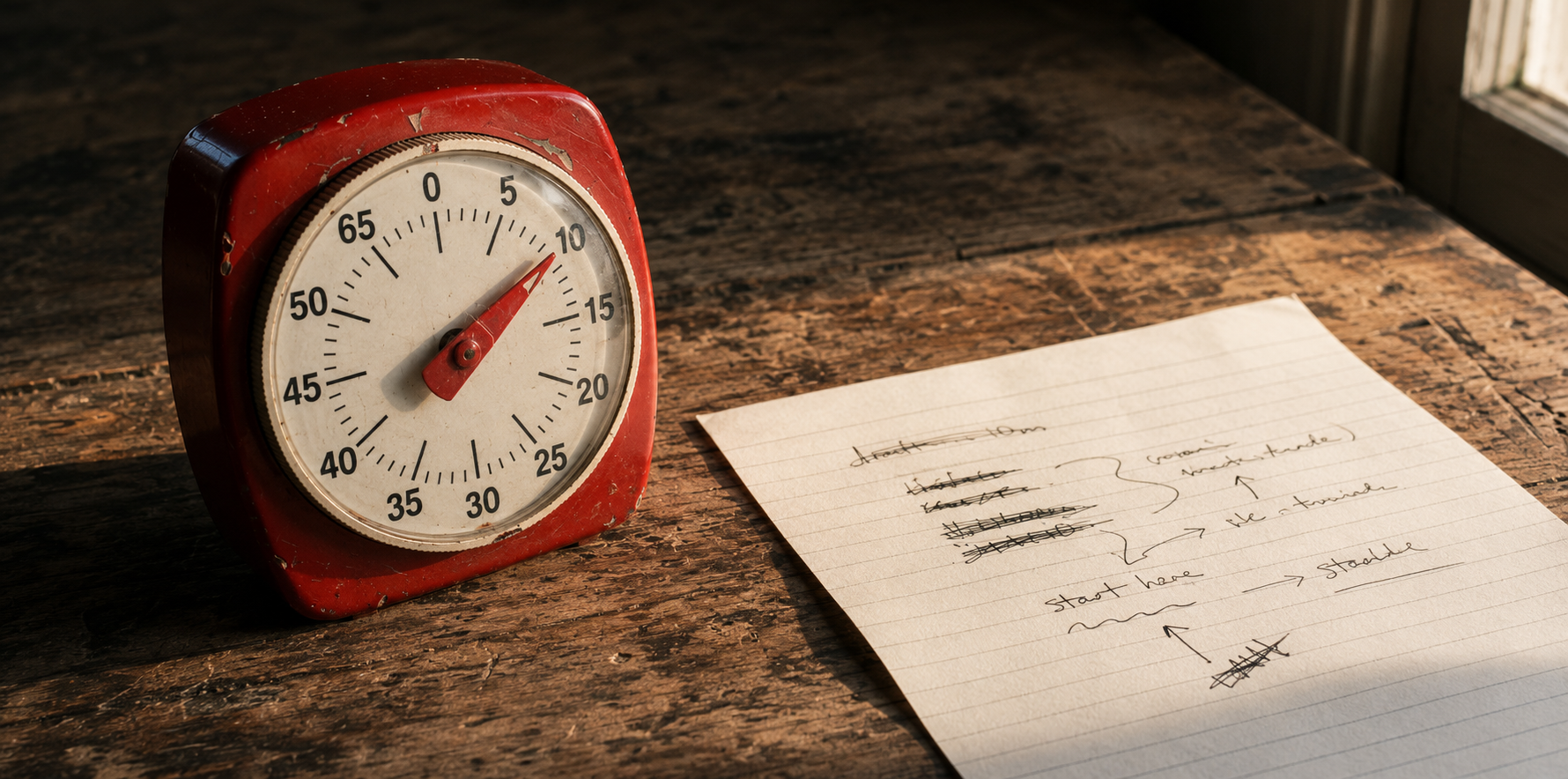
Begin with a rule that is simple enough to remember: write for ten minutes and aim for one page. You may write by hand or type on a computer, depending on which feels more natural. You do not need a topic, an outline, or a quality standard. Your only responsibility is to begin and continue until the timer rings.

A timer turns an open-ended demand into a closed task. “Write today” can mean anything from one sentence to three exhausting hours, which makes it easy to postpone. “Write for ten minutes” has a visible finish line. Even on a busy morning, your brain can understand that the discomfort and effort will end soon.

Treat one page as a direction rather than a test. Some days you may write less, while on others you may continue long after the timer stops. Either result is acceptable because the true goal is showing up. By keeping the official commitment small, you avoid making tomorrow’s session feel more difficult simply because today’s session went well.

Keep Moving Forward Until the Timer Goes Off

During those ten minutes, do not reread what you have written. If you are typing, resist the urge to scroll upward. If you are writing longhand, keep your eyes near the current line. The moment you begin checking earlier sentences, you shift from generating words to judging them—and judgment can quickly bring the page to a halt.

Your inner critic is useful during revision, but it does not belong in the first few minutes of a draft. Its job is to notice repetition, weak phrasing, and unfinished ideas. Those skills matter later. At the beginning, however, they interfere with discovery by demanding that each sentence justify itself before the next sentence can appear.

When you do not know what to say, write about not knowing what to say. Describe the room, record a memory, complain about the weather, or repeat a phrase until a new thought emerges. Some pages will be dull or messy, and that is part of the process. Keep your hand moving until the timer sounds; afterward, you are free to reread, revise, save, or discard the page.

Build a Habit Loop With a Clear Cue and Reward

A durable habit usually contains three elements: a cue, a routine, and a reward. Failed writing plans often use a vague cue such as “sometime in the morning,” pair it with an intimidating routine such as “write something good,” and offer no immediate reward. That structure leaves too much room for delay and makes writing feel like a demand with no clear payoff.

Choose a cue that is specific and already part of your day. You might write immediately after pouring your first cup of coffee, after brushing your teeth, or as soon as you return from taking the dog outside. Preparing your tools in advance can make the cue even stronger. Leave your notebook open on the table, place a pen beside it, or keep the writing document ready on your screen.

Finish the loop with a small, immediate reward. Mark the day on a calendar, add a check to a habit tracker, or place a sticker on the page. The reward may seem trivial, but the visible evidence of completion creates satisfaction and reinforces the routine. If you miss a day, do not treat the chain as permanently broken; simply protect the next opportunity to begin again.

What Thirty Days of Showing Up Can Change

Around the third or fourth week, writing may begin to feel less like a decision. Your cue starts prompting the routine automatically, and skipping the session can feel stranger than completing it. This change does not mean you have suddenly developed extraordinary discipline. It means repetition has reduced the mental effort required to start.

The accumulated pages may also surprise you. Many will contain ordinary observations, awkward sentences, and ideas that lead nowhere. Among them, however, you may find a vivid memory, the image that opens a poem, an unexpected character, or a paragraph that belongs at the beginning of a larger work. These discoveries often emerge only after the obvious thoughts have been written down.

This is one of the quiet rewards of consistency: you stop waiting to feel inspired before you write. Instead, you create the conditions in which inspiration is more likely to appear. You begin to understand that a writer is not someone who produces brilliant work every day, but someone willing to meet the page often enough for worthwhile work to become possible.

Grow Your Writing Practice Without Adding Friction

Once the ten-minute habit feels stable, you can gradually direct the raw material toward a larger purpose. You might review your pages once a week and highlight promising passages. A memory could become an essay, a recurring image could develop into a poem, or a brief scene could grow into fiction. The daily practice supplies material before you ask yourself to shape it.

Expand carefully, because adding too much too quickly can recreate the pressure that caused earlier habits to fail. Rather than jumping from ten minutes to an hour, try fifteen minutes for a week. Keep the original minimum in place: on difficult days, ten minutes still counts. Growth should make the practice more useful, not make the door heavier again.

You can also separate drafting from revision to preserve momentum. Use the daily session for generating new words, then schedule a different time for editing or developing a project. This distinction protects the freedom of the morning page while giving your strongest ideas somewhere to go. The foundation remains simple: a clear cue, a short timer, one page, and permission to write imperfectly.

A daily writing habit does not need to begin with ambition, inspiration, or a dramatic promise. It needs an entrance that remains open when life is busy and your energy is low. Start tomorrow with ten minutes, one page, and no rereading until the timer stops. Keep your hand moving, mark the session as complete, and return the next day. You may have failed before because the door was too heavy; this time, leave it open.


Create a Morning Pages Space That Invites You

Morning Pages space

Morning Pages work best when they feel less like a task and more like a quiet place waiting for you. The goal is not to create a perfect writing studio, buy the ideal notebook, or become a different kind of person overnight. The goal is to make tomorrow morning easier by removing as many decisions, obstacles, and tiny annoyances as possible today.

A welcoming Morning Pages space can be physical, digital, or a simple blend of both. It might be a chair near a window, a corner of the kitchen table, a notes app with a clean document, or a notebook left open beside your coffee mug. What matters is that the space quietly says, “You can begin here.”

Morning Pages space

Start With the Smallest Possible Writing Spot

You do not need an entire room to write Morning Pages. In fact, starting too big can make the habit feel heavier than it needs to be. A single clear surface, one comfortable seat, and enough room for your notebook or device is enough.

Look for the smallest place in your home where you naturally pause in the morning. It might be the end of a dining table, a bedside chair, a desk corner, or even a tray you can place on your lap. The best spot is not always the prettiest one; it is the one you will actually use.

Try to make this space feel ready rather than staged. You are not designing a photo-worthy writing nook. You are creating a low-pressure landing place where your half-awake mind can arrive without negotiation.

Keep Your Notebook Open and Pen Within Reach

A closed notebook can feel surprisingly final. An open notebook, especially one turned to a fresh page, feels like an invitation. It removes the tiny step of searching, flipping, deciding, and preparing before you write.

Keep your pen directly beside the notebook, not somewhere nearby in theory. If you have to open a drawer, search a bag, or test three dried-out pens, friction has already entered the room. Choose a pen that writes smoothly and leave it exactly where your hand expects it to be.

If you write digitally, the same principle applies. Keep your document open, your app easy to access, and your keyboard or device charged. The fewer clicks between waking and writing, the more likely your Morning Pages will happen.

Remove Every Tiny Friction Before Bedtime

Morning resistance often begins the night before. If your writing space is cluttered, your notebook is buried, or your laptop battery is low, your future self has to solve problems before writing a single sentence. That is a lot to ask before coffee.

Before bed, take one minute to reset the space. Clear away dishes, receipts, headphones, or anything unrelated to your pages. Put your notebook in place, uncap nothing, charge what needs charging, and make the first action obvious.

This small evening ritual is not about discipline. It is an act of kindness toward the version of you who will wake up with a busy mind. When everything is already waiting, writing feels less like a decision and more like the next natural step.

Make a Digital Corner That Feels Calm and Clear

If you prefer typing your Morning Pages, create a digital space that feels as uncluttered as a clean desk. Use a dedicated document, folder, or writing app so your pages are not mixed in with work files, errands, or notifications.

Choose a simple layout. A blank document with a date at the top may be enough. Turn off distracting toolbars if you can, use a readable font, and avoid opening email, messages, or social media before you write.

Your digital corner should protect the fragile quiet of the morning. The moment your screen becomes crowded with demands, your attention scatters. Keep this space plain, private, and easy to enter.

Add One Gentle Cue That Says Begin Right Here

A cue helps your mind recognize that it is time to write. It does not need to be dramatic. A cup of tea beside your notebook, a small lamp turned on, a particular playlist, or sitting in the same chair can become a quiet signal.

The best cue is gentle, not demanding. Morning Pages are not improved by pressure. You are simply giving your brain a familiar doorway into the practice, something that says, “This is where we begin.”

Over time, the cue becomes part of the habit. You sit down, touch the pen, open the document, or take the first sip of coffee, and the writing starts to feel more automatic. The space begins to carry some of the effort for you.

Let Tomorrow’s Pages Feel Already Started

One powerful trick is to make the next morning’s pages feel slightly begun before you go to sleep. You might write the date at the top of the next page, draw a small line, or leave a simple prompt like, “This morning I notice…”

This is not about planning what you will write. Morning Pages work because they give your thoughts room to appear as they are. The point is simply to reduce the blank-page feeling, so tomorrow’s first sentence does not have to come out of nowhere.

When the page already has a mark on it, the beginning feels less intimidating. You are not starting from zero; you are continuing something that is waiting for you. That subtle shift can make the difference between postponing and writing.

Creating a Morning Pages space is really about creating ease. You are arranging your surroundings so the habit asks less of you at the most vulnerable part of the day. A notebook left open, a pen in reach, a clear surface, a calm document, and one gentle cue can make writing feel almost inevitable.

You do not have to perfect the space before you begin. Start small, notice what gets in your way, and remove one bit of friction at a time. When your morning environment is ready and waiting, your pages have a much better chance of meeting you there.

Why Morning Pages Clear Your Mind and Spark Ideas

morning pages

Morning pages work because they give your mind somewhere to put everything it has been carrying. Before the day fills with notifications, decisions, conversations, and obligations, three loose pages of writing can act like a mental clearing space. You do not need polished sentences, a big insight, or even a clear topic. You simply write what is there.

This simple practice, often done first thing in the morning, helps drain anxious loops, surface hidden ideas, and turn vague inner noise into something you can see. Once thoughts are on the page, they become less tangled. You stop wrestling with them in your head and start understanding what they are trying to tell you.

morning pages

The Simple Ritual That Drains Mental Clutter

Morning pages are usually written by hand, without stopping, judging, editing, or planning. The point is not to create something beautiful. The point is to empty the mind of all the unfinished fragments floating around: worries, reminders, frustrations, dreams, questions, and random observations.

This works because mental clutter often feels heavier when it stays invisible. A thought like “I have too much to do” can spin endlessly in the background. But when you write it down, it becomes specific. You may discover that “too much” is actually five tasks, one uncomfortable email, and a decision you have been avoiding.

How Freewriting Quietly Lowers Inner Noise

Freewriting lowers inner noise by giving every thought permission to appear without needing to be useful. Instead of trying to silence the mind, morning pages let it speak. That shift matters. When you stop fighting your thoughts, they often lose some of their intensity.

The page becomes a private place where complaints, fears, hopes, and half-formed ideas can exist without consequences. You do not have to explain them to anyone. You do not have to turn them into action immediately. This gentle release can create a quieter, steadier state of mind before the day begins.

Why Pages Before Plans Make Ideas Surface

When you write before you plan, you bypass the part of your mind that wants everything to be practical right away. Plans are useful, but they can also be restrictive. They ask, “What needs to happen?” Morning pages ask, “What is really going on?”

That open-ended question is often where ideas begin. A creative solution, a new project, or a fresh perspective may appear after a few lines of ordinary rambling. Because you are not forcing insight, your mind has room to make unexpected connections. Ideas surface when they are not being chased too aggressively.

Turning Jumbled Thoughts Into Clear Next Steps

At first, morning pages may look messy. One sentence might be about sleep, the next about work, the next about something someone said last week. But even messy writing can reveal patterns. Over time, repeated concerns, desires, and priorities become easier to notice.

Once those patterns are visible, next steps become clearer. You might realize you need to set a boundary, start a project, rest more, make a call, or stop postponing a decision. Morning pages do not magically solve everything, but they often show you the next honest move.

The Brain Science Behind Letting Words Flow

Writing things down can reduce cognitive load, which is the amount of information your brain is trying to hold at once. When thoughts stay in your head, your working memory keeps refreshing them. Putting them on paper gives the brain a break, almost like moving open tabs out of your mind and onto a desk.

Expressive writing has also been linked to emotional processing. Naming feelings and describing experiences can help the brain organize them. Instead of experiencing stress as one large, blurry cloud, writing breaks it into language. And once something has language, it often feels more manageable.

Building a Morning Pages Habit That Lasts

To build the habit, make it easy. Keep a notebook and pen nearby, write before checking your phone, and set a realistic goal. Three pages is traditional, but even one page can help. The practice works best when it feels like a regular ritual, not another performance you have to get right.

It also helps to remember that boring pages still count. Some mornings will feel insightful, while others will be filled with repetition, irritation, or lists of small worries. That is normal. The value comes from showing up consistently and giving your mind a reliable place to unload, wander, and reset.

Morning pages clear your mind because they turn invisible mental noise into visible words. They help you release what is stuck, notice what matters, and create space for ideas that might otherwise stay buried beneath the rush of the day.

They are not about perfect writing. They are about honest attention. By beginning the morning with a few pages of unfiltered thought, you give yourself a calmer mind, a clearer direction, and a better chance of meeting the day with creativity instead of clutter.

error

Enjoy this article? Please spread the word :)

Follow by Email
BLUESKY
fb-share-icon
Reddit
LinkedIn
Share
RSS