

Every January, countless writers make the same promise: this will be the year they write every day. They buy a fresh notebook, imagine peaceful mornings, and wait for inspiration to arrive. A few weeks later, the notebook is buried under unopened mail. If this sounds familiar, the problem probably is not a lack of discipline or talent. More often, the real obstacle is friction—the small amount of effort required to move from intending to write to actually placing words on the page.
Why Daily Writing Habits So Often Fall Apart
Most writing habits begin with an idealized picture. You imagine a quiet hour, a hot cup of coffee, an inspiring subject, and enough mental space to produce something worthwhile. Unfortunately, that picture depends on several conditions lining up at once. The moment you wake up late, feel tired, face an urgent deadline, or need to care for someone else, the entire plan collapses.
After missing a few days, it is easy to turn a practical problem into a judgment about your character. You may decide that you are lazy, inconsistent, or simply not “a real writer.” Yet repeated failure usually says less about your commitment than it does about the design of your routine. A habit that only works on perfect mornings is not strong enough for ordinary life.
The solution is not to demand more willpower from yourself. It is to make the entrance to writing so easy that you can walk through it on an imperfect day. Instead of preparing for a long, productive session, create a ritual that requires almost no negotiation. The smaller the starting step, the more likely your habit is to survive stress, interruptions, and low motivation.
Make Ten Minutes and One Page Your Only Goal
Begin with a rule that is simple enough to remember: write for ten minutes and aim for one page. You may write by hand or type on a computer, depending on which feels more natural. You do not need a topic, an outline, or a quality standard. Your only responsibility is to begin and continue until the timer rings.
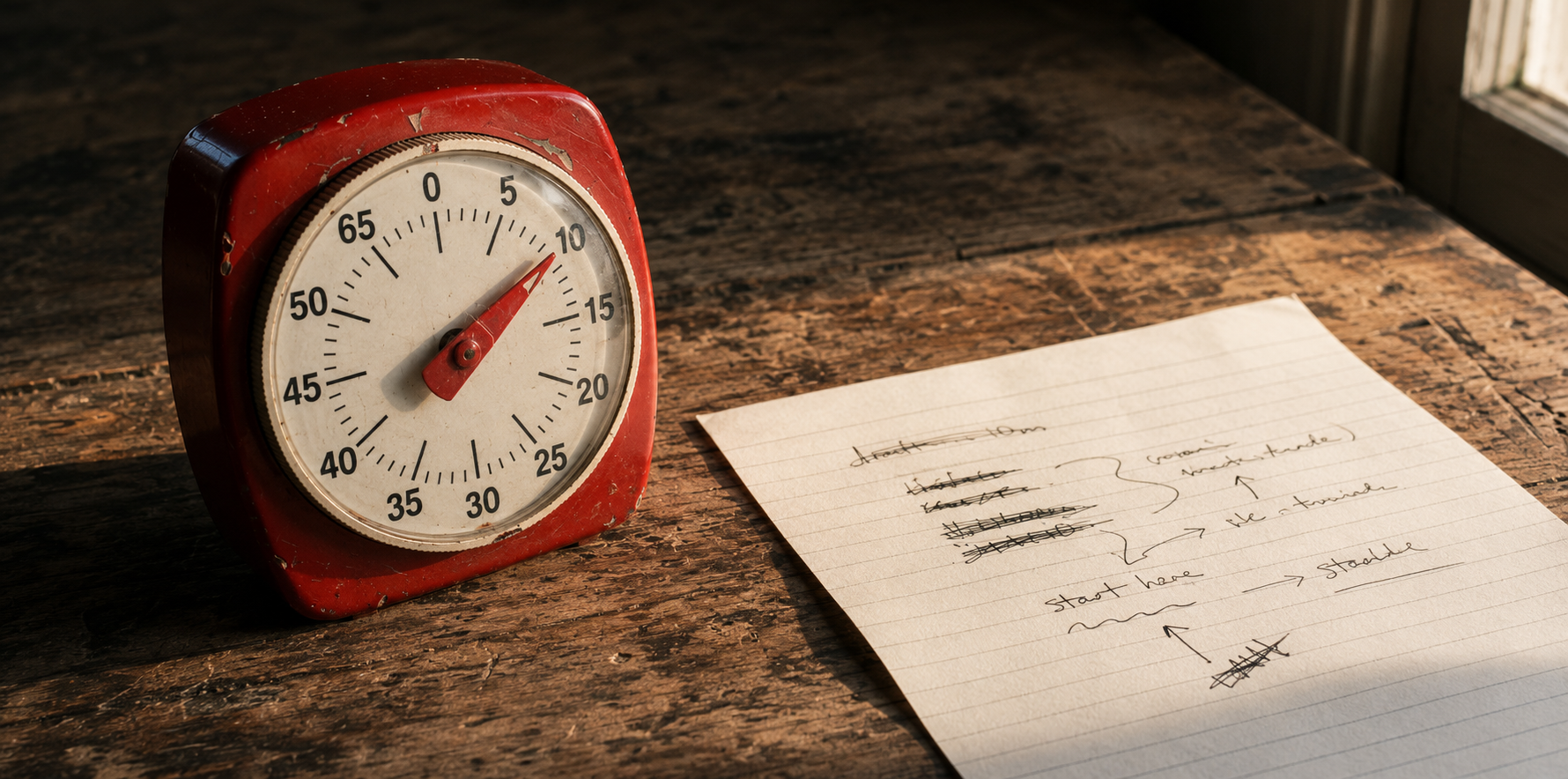
A timer turns an open-ended demand into a closed task. “Write today” can mean anything from one sentence to three exhausting hours, which makes it easy to postpone. “Write for ten minutes” has a visible finish line. Even on a busy morning, your brain can understand that the discomfort and effort will end soon.
Treat one page as a direction rather than a test. Some days you may write less, while on others you may continue long after the timer stops. Either result is acceptable because the true goal is showing up. By keeping the official commitment small, you avoid making tomorrow’s session feel more difficult simply because today’s session went well.
Keep Moving Forward Until the Timer Goes Off
During those ten minutes, do not reread what you have written. If you are typing, resist the urge to scroll upward. If you are writing longhand, keep your eyes near the current line. The moment you begin checking earlier sentences, you shift from generating words to judging them—and judgment can quickly bring the page to a halt.
Your inner critic is useful during revision, but it does not belong in the first few minutes of a draft. Its job is to notice repetition, weak phrasing, and unfinished ideas. Those skills matter later. At the beginning, however, they interfere with discovery by demanding that each sentence justify itself before the next sentence can appear.
When you do not know what to say, write about not knowing what to say. Describe the room, record a memory, complain about the weather, or repeat a phrase until a new thought emerges. Some pages will be dull or messy, and that is part of the process. Keep your hand moving until the timer sounds; afterward, you are free to reread, revise, save, or discard the page.

Build a Habit Loop With a Clear Cue and Reward
A durable habit usually contains three elements: a cue, a routine, and a reward. Failed writing plans often use a vague cue such as “sometime in the morning,” pair it with an intimidating routine such as “write something good,” and offer no immediate reward. That structure leaves too much room for delay and makes writing feel like a demand with no clear payoff.
Choose a cue that is specific and already part of your day. You might write immediately after pouring your first cup of coffee, after brushing your teeth, or as soon as you return from taking the dog outside. Preparing your tools in advance can make the cue even stronger. Leave your notebook open on the table, place a pen beside it, or keep the writing document ready on your screen.
Finish the loop with a small, immediate reward. Mark the day on a calendar, add a check to a habit tracker, or place a sticker on the page. The reward may seem trivial, but the visible evidence of completion creates satisfaction and reinforces the routine. If you miss a day, do not treat the chain as permanently broken; simply protect the next opportunity to begin again.
What Thirty Days of Showing Up Can Change
Around the third or fourth week, writing may begin to feel less like a decision. Your cue starts prompting the routine automatically, and skipping the session can feel stranger than completing it. This change does not mean you have suddenly developed extraordinary discipline. It means repetition has reduced the mental effort required to start.
The accumulated pages may also surprise you. Many will contain ordinary observations, awkward sentences, and ideas that lead nowhere. Among them, however, you may find a vivid memory, the image that opens a poem, an unexpected character, or a paragraph that belongs at the beginning of a larger work. These discoveries often emerge only after the obvious thoughts have been written down.
This is one of the quiet rewards of consistency: you stop waiting to feel inspired before you write. Instead, you create the conditions in which inspiration is more likely to appear. You begin to understand that a writer is not someone who produces brilliant work every day, but someone willing to meet the page often enough for worthwhile work to become possible.
Grow Your Writing Practice Without Adding Friction
Once the ten-minute habit feels stable, you can gradually direct the raw material toward a larger purpose. You might review your pages once a week and highlight promising passages. A memory could become an essay, a recurring image could develop into a poem, or a brief scene could grow into fiction. The daily practice supplies material before you ask yourself to shape it.
Expand carefully, because adding too much too quickly can recreate the pressure that caused earlier habits to fail. Rather than jumping from ten minutes to an hour, try fifteen minutes for a week. Keep the original minimum in place: on difficult days, ten minutes still counts. Growth should make the practice more useful, not make the door heavier again.
You can also separate drafting from revision to preserve momentum. Use the daily session for generating new words, then schedule a different time for editing or developing a project. This distinction protects the freedom of the morning page while giving your strongest ideas somewhere to go. The foundation remains simple: a clear cue, a short timer, one page, and permission to write imperfectly.
A daily writing habit does not need to begin with ambition, inspiration, or a dramatic promise. It needs an entrance that remains open when life is busy and your energy is low. Start tomorrow with ten minutes, one page, and no rereading until the timer stops. Keep your hand moving, mark the session as complete, and return the next day. You may have failed before because the door was too heavy; this time, leave it open.


Get the Free Close Reading Worksheet Pack
Join my email list and receive the printable worksheet pack you can use with any novel or poem.
No spam. Just helpful guides for reading literature well.












