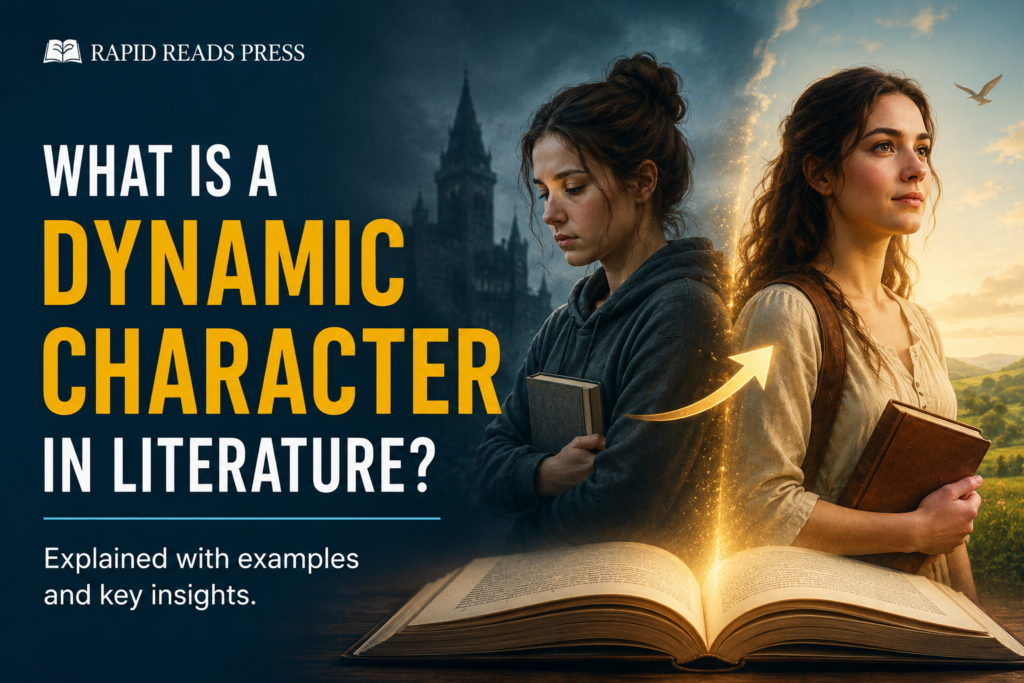
What Is a Dynamic Character in Literature?

dynamic character

It is a character who changes in an important way over the course of a story.

This guide explains the idea in simple terms, shows why it matters, and gives clear examples from books many students know.

In this Guide

  • What a dynamic character means
  • Why dynamic characters matter
  • Dynamic character examples
  • How to spot a dynamic character
  • Books to read for practice
  • FAQ
dynamic character

A Clear Definition

A dynamic character changes in a deep and meaningful way.

The change may involve beliefs, values, goals, or how the character sees the world. It is not just a new haircut, a new job, or a new location.

When students ask, What Is a Dynamic Character in Literature?, the simplest answer is this: a dynamic character learns, grows, falls apart, or becomes someone different because of the story’s events.

For example, Ebenezer Scrooge in A Christmas Carol begins as selfish and cold. By the end, he becomes generous and caring. His change is central to the story.

Why It Matters

Dynamic characters help readers see how conflict can shape a person.

A story feels more powerful when a character has to face hard choices. Those choices can reveal fear, pride, courage, guilt, or love.

What Is a Dynamic Character in Literature? It is often the answer to why a story feels meaningful. The plot may show what happens, but the character’s change shows why it matters.

In many novels, the main character’s growth connects to the theme. If a story is about forgiveness, the dynamic character may need to let go of anger. If a story is about identity, the character may need to understand who they truly are.

If you want a deeper method for studying characters, this guide on how to analyze characters in literature can help you build stronger notes.

Dynamic vs. Static Characters

A dynamic character changes. A static character stays mostly the same.

A static character is not always boring or unimportant. Some static characters help highlight the growth of another character.

In Pride and Prejudice, Elizabeth Bennet is a dynamic character because she changes how she judges Darcy. She learns that her first opinion was not fully fair.

Mr. Collins, on the other hand, stays mostly the same. His lack of growth makes him a useful contrast to Elizabeth’s self-awareness.

So, What Is a Dynamic Character in Literature? Think of a character whose inner life shifts in a clear way from the beginning to the end.

Recognizable Examples

Many famous books use dynamic characters to carry the emotional weight of the story.

Ebenezer Scrooge in A Christmas Carol changes from greedy to generous. His journey shows that moral change is possible.

Elizabeth Bennet in Pride and Prejudice learns to question her own pride and quick judgments. Her growth makes the love story feel earned.

Harry Potter in the Harry Potter series grows from a lonely boy into a braver and more self-aware young man. His change happens across many books, not all at once.

For more context on classic authors and works, you can visit Britannica’s page on Charles Dickens or explore author materials at the Poetry Foundation.

How to Spot a Dynamic Character

Look for a clear before-and-after pattern.

Ask what the character wants at the start. Then ask what the character understands by the end.

A dynamic character often faces a conflict that forces a choice. That choice may expose a flaw, teach a lesson, or push the character toward change.

When thinking about What Is a Dynamic Character in Literature?, focus on inner change. A character may travel far, lose money, or gain power, but those events only matter if they change the character in a real way.

Here are helpful questions:

  • What does the character believe at the beginning?
  • What conflict challenges that belief?
  • What does the character understand at the end?
  • Does the change connect to the theme?

Common Mistakes Students Make

One common mistake is calling every main character dynamic.

A character can be important and still remain static. The key is not how much page time the character gets. The key is whether the character changes in a meaningful way.

Another mistake is confusing mood with growth. A character who feels sad in one chapter and happy in the next has not necessarily changed. A dynamic character has a deeper shift in values, beliefs, or self-understanding.

If you need a full approach, use this character analysis guide to connect traits, conflict, and theme.

Books That Help You Study Dynamic Characters

These books are useful if you want to practice spotting character change:

  • A Christmas Carol by Charles Dickens
  • Pride and Prejudice by Jane Austen

Both books make character growth easy to see, which helps if you are new to literary analysis.

FAQ: What Is a Dynamic Character in Literature?

What Is a Dynamic Character in Literature?

A dynamic character is a character who changes in an important internal way during a story. The change may affect beliefs, values, choices, or self-knowledge.

Does a dynamic character have to become a better person?

No. A dynamic character can improve, but they can also become worse. The main point is that they change in a meaningful way.

Can a minor character be dynamic?

Yes. A minor character can be dynamic if the story shows a clear inner change. Main characters are just more likely to get that kind of attention.

Is a dynamic character the same as a round character?

No. A round character is complex and feels realistic. A dynamic character changes. A character can be both, but the terms do not mean the same thing.

Key Takeaway

What Is a Dynamic Character in Literature? It is a character who changes in a meaningful way because of the story’s conflict.

When you read, track what a character believes at the start and what they understand at the end. That simple habit can lead to stronger essays and better literary analysis. 📚
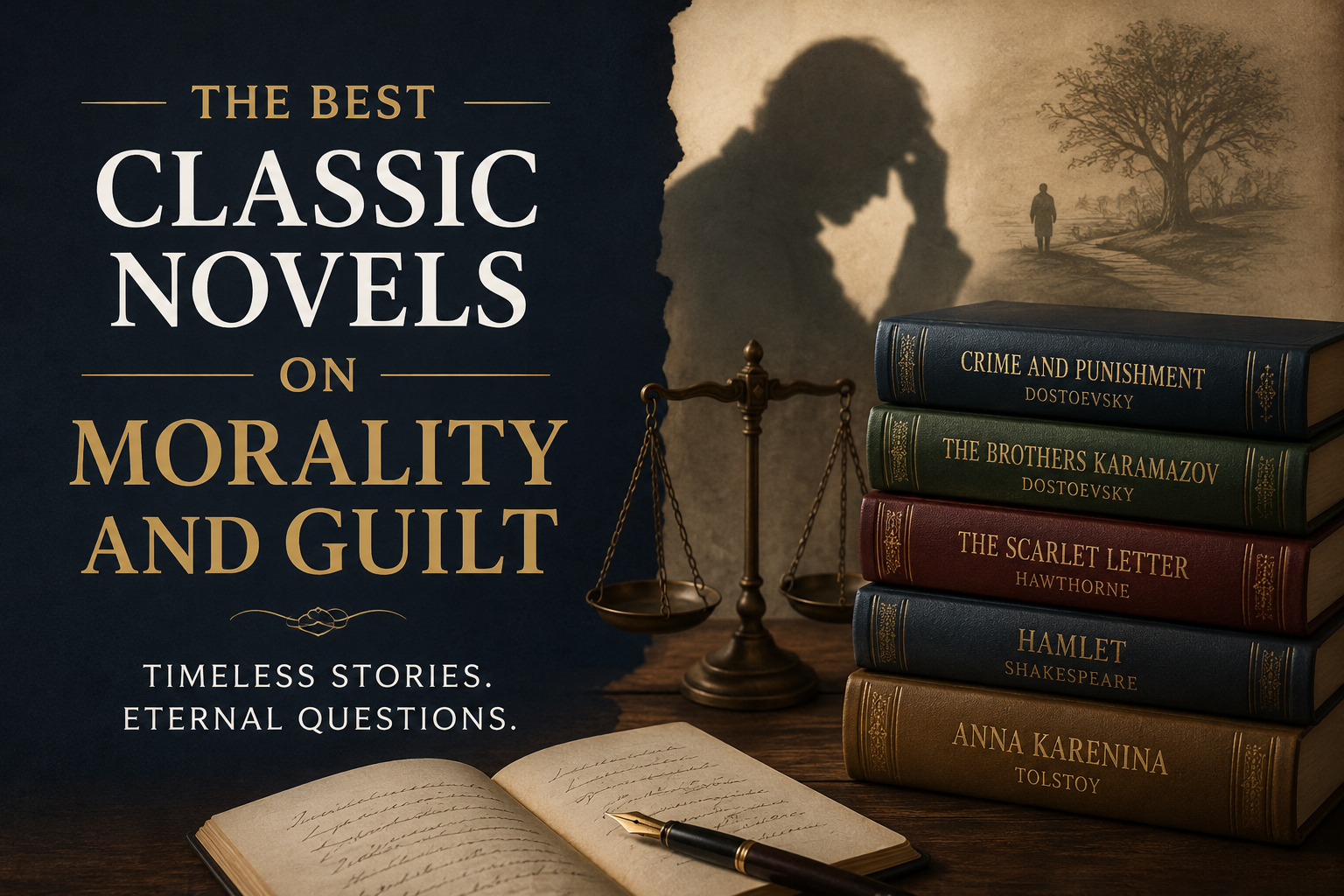
Best Classic Morality and Guilt Books

Best Classic Morality and Guilt Books

Best Classic Morality and Guilt stories ask a hard question: what happens when a person knows they have done wrong? These classics help students see how shame, choice, and conscience shape unforgettable characters.

From murder to betrayal, these books show that guilt is not just a feeling. It can become a force that changes a whole life.

In this Guide

  • Why morality and guilt matter in classic literature
  • Best Classic Morality and Guilt books to read first
  • Common symbols and themes
  • How to study these works
  • Recommended books
  • FAQs

Why Best Classic Morality and Guilt Stories Still Matter

The strongest classics make guilt feel personal.

Best Classic Morality and Guilt works still matter because they deal with choices that never go away. People still lie, hide secrets, harm others, and face the pain of regret.

These stories also help readers think about justice. Is punishment enough? Can a person change after doing wrong?

In many classics, guilt becomes a hidden judge. A character may escape the law, but they cannot escape their own mind.

Best Classic Morality and Guilt Books to Read First

Start with books where the moral conflict is clear and powerful.

A strong Best Classic Morality and Guilt reading list should include stories with deep inner conflict. These books are often taught in high school, AP Literature, and college because they reward close reading.

Crime and Punishment by Fyodor Dostoevsky

Raskolnikov commits murder and tries to prove he is above ordinary moral rules. His guilt slowly breaks down his pride.

This novel is one of the most important Best Classic Morality and Guilt texts because it turns a crime into a battle inside the soul. You can read more background at Britannica.

The Scarlet Letter by Nathaniel Hawthorne

Hester Prynne is publicly shamed for adultery, while another guilty character hides in silence. The novel asks whether public shame or private guilt hurts more.

Its famous red letter becomes one of the clearest symbols of sin, judgment, and identity in American literature.

Macbeth by William Shakespeare

Macbeth kills King Duncan to gain power. After that, guilt follows him through fear, visions, and violence.

Lady Macbeth also shows how guilt can turn inward. Her need to wash imagined blood from her hands is one of Shakespeare’s most famous images.

Symbols and Themes in Best Classic Morality and Guilt Literature

Symbols often show what characters cannot say out loud.

In Best Classic Morality and Guilt literature, symbols make inner pain visible. Blood, stains, locked rooms, and letters often stand for moral damage.

In Macbeth, blood shows guilt that cannot be washed away. In The Scarlet Letter, the letter A changes meaning as Hester changes.

One major theme is the split between public life and private truth. A character may look calm, but guilt grows beneath the surface.

Another key theme is confession. Many classics ask whether telling the truth can free a person, even if it brings punishment.

How to Study Best Classic Morality and Guilt Texts

Close reading helps you see how guilt works on the page.

When you read Best Classic Morality and Guilt texts, track the moments when a character tries to excuse their actions. Those moments often reveal the deepest moral conflict.

Pay attention to repeated images. If blood, darkness, illness, or silence appears more than once, the author is likely building meaning.

It also helps to mark key passages. If you want a simple method, use this guide on how to annotate literature while you read.

For poetry and shorter works, the same skills apply. The Poetry Foundation has helpful author pages and poem texts, including works that explore conscience and sin at Poetry Foundation.

Recommended Best Classic Morality and Guilt Books

These books are worth reading, buying, or borrowing for study.

These Best Classic Morality and Guilt picks are useful for essays because each one has strong symbols and clear moral questions.

  • Crime and Punishment by Fyodor Dostoevsky
  • The Scarlet Letter by Nathaniel Hawthorne

If you want one play, choose Macbeth by William Shakespeare. It is short, intense, and rich with guilt imagery.

Best Classic Morality and Guilt Questions for Class Discussion

Good questions turn reading into real debate.

A Best Classic Morality and Guilt discussion should move beyond plot. Ask what the text says about blame, truth, and change.

Is guilt useful if it leads to growth? Or does it only destroy the person who feels it?

You can also ask whether society judges fairly. In some classics, public punishment looks moral, but the reader sees hypocrisy behind it.

FAQ

What makes Best Classic Morality and Guilt books important?

They show how people deal with wrong choices. They also help readers think about justice, shame, and forgiveness.

Which classic is easiest to start with?

Macbeth is a good first choice. It is short, dramatic, and full of clear guilt symbols.

Why do so many classics focus on guilt?

Guilt creates strong conflict. It pushes characters to hide, confess, or fall apart.

How can I write an essay about morality and guilt?

Choose one character and track how guilt changes them. Then connect that change to symbols or repeated images.

Key Takeaway

Best Classic Morality and Guilt literature stays powerful because it studies the cost of human choices. These stories remind us that the hardest punishment often begins inside the mind.

Macbeth Quotes Explained: Important Passages for Students

Macbeth quotes

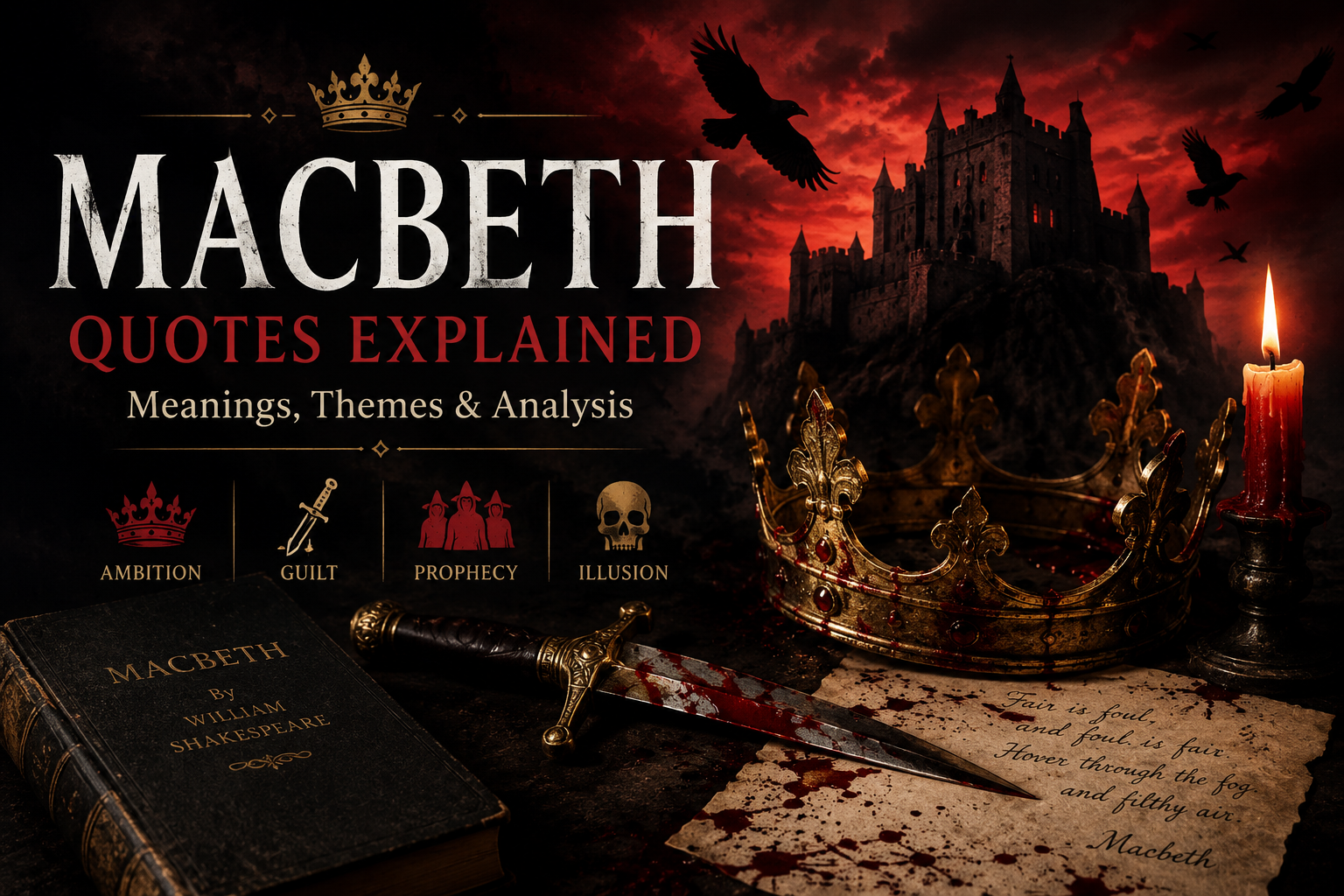
Macbeth is full of short lines that carry huge meaning. This guide offers Macbeth quotes explained in clear language so you can connect famous passages to theme and character change. Each quote below shows what the words mean and how to use them in an essay.

In this Guide

Use this quick map to find the passages that fit your class notes or essay topic.

  • How to read important quotes
  • Ambition and temptation
  • Guilt and fear
  • Appearance and reality
  • Fate and choice
  • Essay tips and study tools
Macbeth quotes

Macbeth quotes explained: how to read the play

A strong quote is not just a famous line. It is proof of how the play builds meaning.

Start with context. Ask who speaks and what has just happened. Then explain how the line reveals a conflict, fear, or desire.

Do not drop a quote into a paragraph and move on. Your job is to show why the words matter. If you need help with that skill, read our guide on how to write a literary analysis essay.

Macbeth quotes explained for ambition and temptation

Macbeth’s rise begins with a promise, but his choices turn that promise into a trap.

“Stars, hide your fires”

Macbeth says this after he starts to imagine himself as king. He wants the stars to hide their light because he knows his thoughts are dark.

This line shows **secret ambition**. Macbeth does not act yet, but his mind has already crossed a moral line.

“Vaulting ambition”

Macbeth admits that ambition is the main force pushing him toward murder. The image suggests a rider who leaps too far and falls.

This is useful for essays about self-destruction. Like Victor Frankenstein, Macbeth wants power before he has the wisdom to handle it.

These Macbeth quotes work well when your claim focuses on how desire can overpower conscience.

Macbeth quotes explained for guilt and fear

After the murder of Duncan, guilt does not fade. It grows until it shapes how Macbeth and Lady Macbeth see the world.

“Sleep no more!”

Macbeth hears this cry after he kills Duncan. Sleep usually means peace, but Macbeth has destroyed that peace for himself.

The line suggests that guilt becomes a punishment. No guard has caught Macbeth yet, but his mind is already attacking him.

“Out, damned spot!”

Lady Macbeth imagines blood on her hands. The spot is not real, but her guilt is.

Earlier, she seemed cold and strong. By this point, Shakespeare shows that denial cannot protect her forever.

For a comparison, think of Raskolnikov in Crime and Punishment. In both works, the crime happens once, but the guilt keeps returning.

Macbeth quotes explained for appearance and reality

Many characters in the play hide what they want. Shakespeare uses false faces, strange language, and broken trust to show that appearances can mislead.

“Fair is foul, and foul is fair”

The witches speak this line near the start of the play. It means that good and evil will seem mixed up.

The line prepares us for a world where truth is hard to read. Macbeth looks loyal, but he plans betrayal.

“False face must hide what the false heart doth know”

Macbeth says he must hide his plan behind a false expression. His face becomes a mask.

This quote is strong evidence for essays about deception. It shows that Macbeth understands the evil of his choice, yet he chooses to act anyway.

Macbeth quotes explained for fate and choice

The witches predict Macbeth’s future, but they do not force his hand. That tension makes the play feel tragic.

“If chance will have me king”

At first, Macbeth wonders if fate will make him king without action. This shows hesitation.

Soon, he stops waiting. His shift matters because tragedy often grows from a person’s own decisions.

“I am in blood”

Macbeth feels trapped by the violence he has caused. He thinks he has gone too far to turn back.

This line shows how one crime leads to another. Macbeth quotes explained in this way help students argue that fate may tempt him, but choice destroys him.

How to use Macbeth quotes in essays

Good quote analysis connects words on the page to a clear claim. Keep your explanation focused and direct.

When you use Macbeth quotes in an essay, follow a simple pattern:

  1. Make a claim about the character or theme.
  2. Give brief context for the quote.
  3. Use a short quotation.
  4. Explain the words that prove your point.

For example, you might write: Macbeth’s line “Stars, hide your fires” shows that he knows his ambition is morally wrong. He wants darkness to cover his thoughts, which proves that guilt begins before the murder.

For quick review before a quiz, pair this post with our Macbeth quote study notes.

Helpful books for Macbeth students

These editions and study books can help you read the play with stronger notes.

  • Macbeth by William Shakespeare, Folger Shakespeare Library edition
  • Shakespeare After All by Marjorie Garber

Choose an edition with footnotes if the language feels hard. The notes can explain old words without replacing your own thinking.

Trusted online resources

Use reliable sources when you need background on Shakespeare or the play’s history.

For a clear overview, see Britannica’s article on Macbeth. For the full public-domain text with helpful tools, visit the Folger Shakespeare Library text of Macbeth.

FAQ: Macbeth quotes explained

Here are quick answers to common student questions about choosing and analyzing quotes.

What is the best Macbeth quote for ambition?

“Vaulting ambition” is one of the clearest choices. It shows that Macbeth understands the motive behind his crime.

What quote shows Macbeth’s guilt?

“Sleep no more!” is a strong guilt quote. It shows that Macbeth loses inner peace after killing Duncan.

What quote shows Lady Macbeth’s guilt?

“Out, damned spot!” shows her guilt in a vivid way. She imagines blood that cannot be washed away.

How many quotes should I use in a Macbeth essay?

Use enough to support your claim, not to fill space. Two well-explained quotes are often stronger than many rushed ones.

Key Takeaway

Macbeth quotes explained well do more than define old words. They show how ambition, guilt, and choice push Macbeth from brave soldier to tragic tyrant.

Count Dracula as a Symbol of Fear and Corruption in Dracula

Count Dracula as a symbol of fear and corruption

Count Dracula is one of the most famous villains in literature, yet his role goes far beyond a simple monster. In Dracula, he represents something deeper and more unsettling. He stands as a symbol of fear, moral decay, and the spread of corruption within society.

When readers look closely at his actions, his influence, and his presence in the novel, they begin to see that Dracula is not just a character. He is a force that threatens both the body and the soul.

This article contains affiliate links.

In this Guide 📚

  • What Dracula represents in the novel
  • How fear shapes his character
  • How corruption spreads through his victims
  • Why Dracula’s power goes beyond physical danger
  • What his defeat reveals about the novel’s message
Count Dracula as a symbol of fear and corruption
Image by Carla Paton

Count Dracula as a Symbol of Fear and Corruption

Dracula is more than a villain. He represents a deeper threat that spreads through fear and moral decay.

At the beginning of the novel, Count Dracula appears calm, polite, and even refined. Jonathan Harker meets a nobleman who speaks with care and shows control. Yet something feels wrong from the start. His strange habits and silent movements create unease long before his true nature is revealed.

This early tension matters because it shows that fear does not always appear in obvious ways. Dracula does not rely on loud violence at first. He creates fear through mystery and uncertainty. Readers feel this same unease as Harker slowly realizes he is trapped in the castle.

📌 Key Insight: Fear in Dracula begins with the unknown, not with open danger.

Count Dracula as a symbol of fear and corruption
Image by Carla Paton

How Dracula Represents Fear

Dracula’s power comes from his ability to appear, disappear, and remain unseen.

As the novel moves forward, Dracula’s supernatural abilities deepen this fear. He can change form, travel through darkness, and strike without warning. These traits make him difficult to fight because he cannot be understood in normal terms.

The characters struggle not just against a physical enemy, but against something they cannot fully explain. This sense of helplessness increases the tension of the story. Fear grows stronger when people feel they have no control.

Dracula’s presence also creates fear in the minds of his victims. He invades their thoughts and weakens their sense of self. This makes his threat feel personal and psychological, not just physical.

💬 “Fear grows strongest when it cannot be clearly seen or understood.”

Count Dracula as a symbol of fear and corruption
Image by Carla Paton

How Dracula Symbolizes Corruption

Dracula does not only harm his victims—he changes them.

One of the clearest examples of corruption appears in Lucy Westenra. She begins as kind and gentle, yet after Dracula’s attacks, she transforms into something dangerous. Her change shows how Dracula spreads his influence like a disease.

This transformation is not just about becoming a vampire. It represents the loss of innocence and moral stability. Lucy becomes a version of herself that reflects Dracula’s influence rather than her own character.

Mina Harker’s experience deepens this idea. Even though she is strong and intelligent, Dracula forms a connection with her that threatens her mind and identity. This shows that no one is fully safe from corruption, even those with strong character.

📌 Key Insight: Corruption in Dracula spreads quietly, often before anyone realizes it is happening.

Dracula’s Power Over Others

Dracula seeks control, not just survival.

Dracula does not act randomly. He plans carefully and moves with purpose. His journey from Transylvania to England shows his desire to expand his reach. He wants to spread his influence into new places and create more victims.

This ambition makes him more than a monster. He becomes a symbol of invading corruption that moves through society. His goal is not only to exist, but to multiply his power through others.

The group led by Van Helsing must work together to stop him. Their unity stands in contrast to Dracula’s isolation and control. This contrast highlights the difference between community and corruption.

💬 “Where Dracula divides and dominates, the others unite and resist.”

What Dracula’s Defeat Reveals

The ending of the novel shows that fear and corruption can be overcome.

Dracula’s defeat does not come from one person alone. It requires trust, courage, and shared purpose. Each character plays a role in stopping him, which suggests that evil cannot be defeated in isolation.

The novel presents a clear message. Fear may spread quickly, and corruption may take root, but they are not unstoppable. When people stand together with conviction, they can resist even the darkest forces.

This ending gives the story its lasting meaning. Dracula may be powerful, but he is not invincible.

Count Dracula as a symbol of fear and corruption
Image by Carla Paton

Why This Symbol Still Matters Today

Dracula remains powerful because his meaning goes beyond the story.

Readers still connect with Dracula because he represents fears that feel real. The fear of losing control, the fear of hidden danger, and the fear of moral decline all appear in modern life as well.

His character reminds us that the greatest threats are often the ones that spread quietly. They do not always appear as clear enemies. Instead, they work beneath the surface, shaping thoughts and actions over time.

Key Takeaway ✨

Count Dracula represents both fear and corruption, showing how evil can spread through secrecy, influence, and control—but also how it can be defeated through courage and unity.

FAQ – Count Dracula as a symbol of fear and corruption

Why is Dracula considered a symbol instead of just a villain?

Because his actions represent larger ideas like fear, moral decay, and loss of control rather than simple physical danger.

How does Dracula create fear in the novel?

He uses mystery, unpredictability, and psychological control, which makes him difficult to understand and resist.

What does Lucy’s transformation represent?

It shows how corruption spreads and how innocence can be lost through Dracula’s influence.

Why is Mina important to the symbolism?

She shows that even strong individuals can be affected, which makes Dracula’s threat more serious.

What is the main message of Dracula?

That fear and corruption are powerful, but they can be overcome through unity and moral strength.

Want to Go Deeper? 📖

If you want a full breakdown of Dracula with themes, characters, and analysis, check out the full guide here:
👉 https://rapidreadspress.com/product/dracula-study-guide/

Dracula Study guide

If you want to learn how to write essays like this step by step:
👉 https://rapidreadspress.com/product/literary-analysis-essay-examples/ (includes this analysis)

Lastly, for background on the novel’s publication and literary importance, Britannica provides a helpful overview of Dracula.

The Theme of Ambition in Frankenstein

theme of ambition in Frankenstein

Victor Frankenstein’s fatal obsession.

Mary Shelley’s Frankenstein remains one of the most widely studied novels in English literature. Beneath its famous story of a scientist and his creation lies a powerful idea that shapes the entire novel: the theme of ambition in Frankenstein. Victor Frankenstein’s intense desire for knowledge drives the plot forward and ultimately leads to tragedy for nearly everyone involved.

Shelley’s novel explores what happens when the pursuit of knowledge becomes an obsession. Victor begins with curiosity and hope, yet his ambition slowly separates him from moral responsibility, family, and humanity itself. The result is one of literature’s clearest warnings about the dangers of uncontrolled ambition.

This guide explores how the theme of ambition in Frankenstein appears throughout the novel and why it remains relevant for readers today.

This article contains affiliate links.

In this Guide:

What the Theme of Ambition in Frankenstein Means
Victor Frankenstein’s Desire for Knowledge
How Ambition Leads to Isolation
The Consequences of Victor’s Ambition
The Moral Warning of the Novel
Key Takeaway
FAQ About the Theme of Ambition in Frankenstein

theme of ambition in Frankenstein

What the Theme of Ambition in Frankenstein Means

Ambition is the strong desire to achieve something great. In literature, ambition often drives characters to pursue power, knowledge, or success. In Mary Shelley’s novel, the theme of ambition in Frankenstein focuses on the dangers of pursuing discovery without considering its moral consequences.

Victor Frankenstein dreams of achieving a scientific breakthrough that will make him famous. He wants to unlock the secret of life itself. At first, this ambition appears admirable. Curiosity and discovery have always been part of scientific progress.

However, Shelley shows that ambition becomes dangerous when it is guided by pride rather than responsibility. Victor becomes so focused on creating life that he stops asking whether he should attempt such an experiment.

💡 Key idea: Ambition in the novel is not evil by itself. The danger arises when ambition outstrips wisdom, empathy, and responsibility.

Victor Frankenstein’s Desire for Knowledge

Victor’s ambition begins in childhood. From an early age, he becomes fascinated with the mysteries of nature and the possibility of scientific discovery. When he later studies natural philosophy at the university of Ingolstadt, his curiosity develops into an intense desire to achieve something extraordinary.

Victor imagines that discovering how to create life will bring him honor and benefit humanity. He believes future generations will admire him as a scientific pioneer. This moment shows that Victor ties his ambition closely to pride.

As Victor explains in the novel, he hopes to “pour a torrent of light into our dark world.” His goal sounds noble, yet his ambition gradually becomes an obsession.

This stage of the story illustrates one of the most important aspects of the theme of ambition in Frankenstein: ambition often begins with good intentions before slowly becoming destructive.

How Ambition Leads to Isolation

As Victor works toward his experiment, he becomes increasingly isolated from the people around him. He spends months alone in his laboratory, neglecting his friends, his family, and even his own health.

Shelley uses this period of isolation to show how ambition can distort judgment. Victor becomes so focused on his experiment that he forgets the world beyond his work.

He later admits that his obsession consumed him completely. His relationships disappear. Victor’s physical health declines. His emotional stability weakens.

📖 “I seemed to have lost all soul or sensation but for this one pursuit.”

Victor’s isolation reveals a key part of the theme of ambition in Frankenstein: ambition can slowly separate a person from the human connections that normally guide moral choices.

theme of ambition in Frankenstein
Image by Carla Paton

The Consequences of Victor’s Ambition

The turning point of the novel occurs when Victor finally succeeds in creating life. Instead of feeling triumph, he experiences immediate horror. The creature’s appearance frightens him, and he abandons the being almost instantly.

This moment reveals the true problem with Victor’s ambition. He wanted the glory of discovery, yet he never considered the responsibility that would follow.

The creature’s suffering becomes the most tragic result of Victor’s ambition. Without guidance or companionship, the creature experiences rejection wherever he goes. His loneliness eventually turns into anger and revenge.

Several innocent characters die as a result of the conflict between creator and creation. Victor’s family suffers deeply, and his own life becomes defined by guilt and grief.

Shelley shows that the theme of ambition in Frankenstein extends beyond Victor himself. His choices harm many others, proving that uncontrolled ambition rarely affects only one person.

The Moral Warning of the Novel

By the end of the novel, Victor finally recognizes the dangers of his obsession. He reflects on how his desire for greatness blinded him to the ethical consequences of his work.

Mary Shelley presents Victor’s story as a warning. Scientific discovery can lead to progress and knowledge, but it must be guided by responsibility and wisdom.

The novel was written during a time when science and technology were advancing rapidly. Shelley’s story asks an important question that still matters today:

Just because something can be done, should it be done?

The theme of ambition in Frankenstein reminds readers that knowledge without moral reflection can produce suffering instead of progress.

📚 If you want to explore the novel more deeply, you can read the original text here: Frankenstein by Mary Shelley.

Key Takeaway

The theme of ambition in Frankenstein reveals how the pursuit of knowledge can become dangerous when it is driven by pride rather than responsibility. Victor Frankenstein’s obsession with discovery isolates him from others and ultimately leads to tragedy. Mary Shelley’s novel reminds readers that true progress requires both intelligence and moral wisdom.

FAQ – The Theme of Ambition in Frankenstein

What is the theme of ambition in Frankenstein?

The theme of ambition in Frankenstein explores the dangers of pursuing knowledge or success without considering moral responsibility. Victor Frankenstein’s obsession with creating life leads to suffering for himself and others.

Why is Victor Frankenstein considered ambitious?

Victor is driven by a desire to achieve scientific greatness. He hopes to unlock the secret of life and gain recognition for a discovery that no one else has achieved.

Is ambition portrayed as good or bad in Frankenstein?

Ambition itself is not entirely negative. The novel suggests that ambition becomes dangerous when it is driven by pride and ignores ethical consequences.

What lesson does Frankenstein teach about ambition?

The novel warns that great achievements must be balanced with responsibility. Without moral awareness, even brilliant discoveries can lead to destruction.

📘 Want to see real examples of literary analysis essays like this?

📗 Need help studying the novel?

Frankenstein Study Guide

error

Enjoy this article? Please spread the word :)

Follow by Email
BLUESKY
fb-share-icon
Reddit
LinkedIn
Share
RSS