The Joy Luck Club Summary and Analysis for Students

Joy Luck Club Summary

This guide offers The Joy Luck Club summary and analysis for students who need a clear path into Amy Tan’s novel. We will cover the plot, the structure, the main conflicts, and the deeper literary meaning.

Tan’s book can feel complex at first because it moves between voices and time periods. Once you see how the stories connect, the novel becomes much easier to understand.

In this Guide

Use this section to find the part of the novel you need most.

  • The Joy Luck Club summary and analysis: quick overview
  • Plot summary
  • Structure and point of view
  • Major conflicts
  • Themes and symbols
  • Study tips and FAQ
Joy Luck Club Summary

The Joy Luck Club summary and analysis: Quick Overview

Amy Tan’s novel is about mothers and daughters who love each other, yet often fail to understand each other.

The Joy Luck Club, published in 1989, follows four Chinese immigrant mothers and their American-born daughters in San Francisco. The older women carry painful memories from China. Their daughters face pressure to define themselves in America.

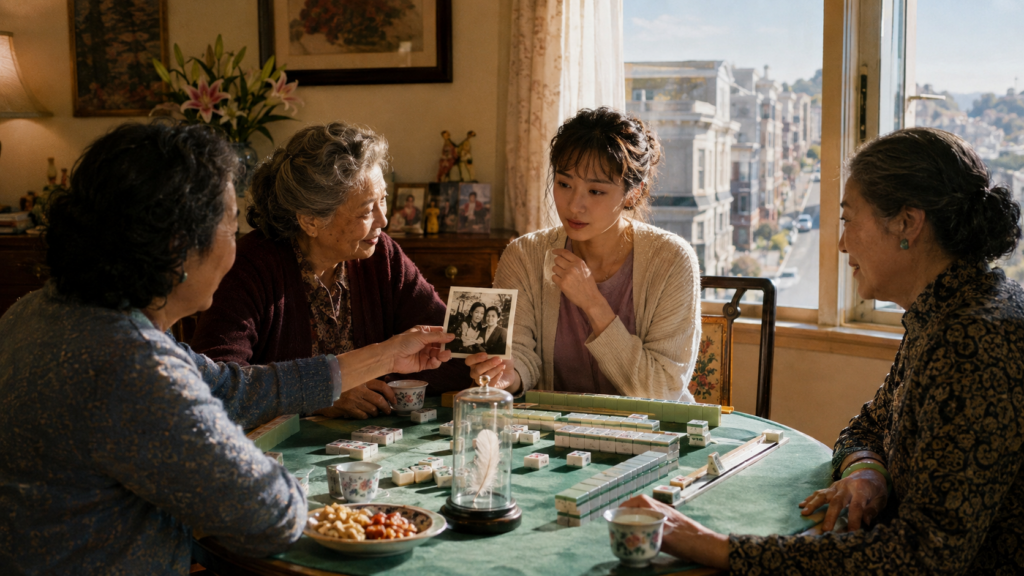
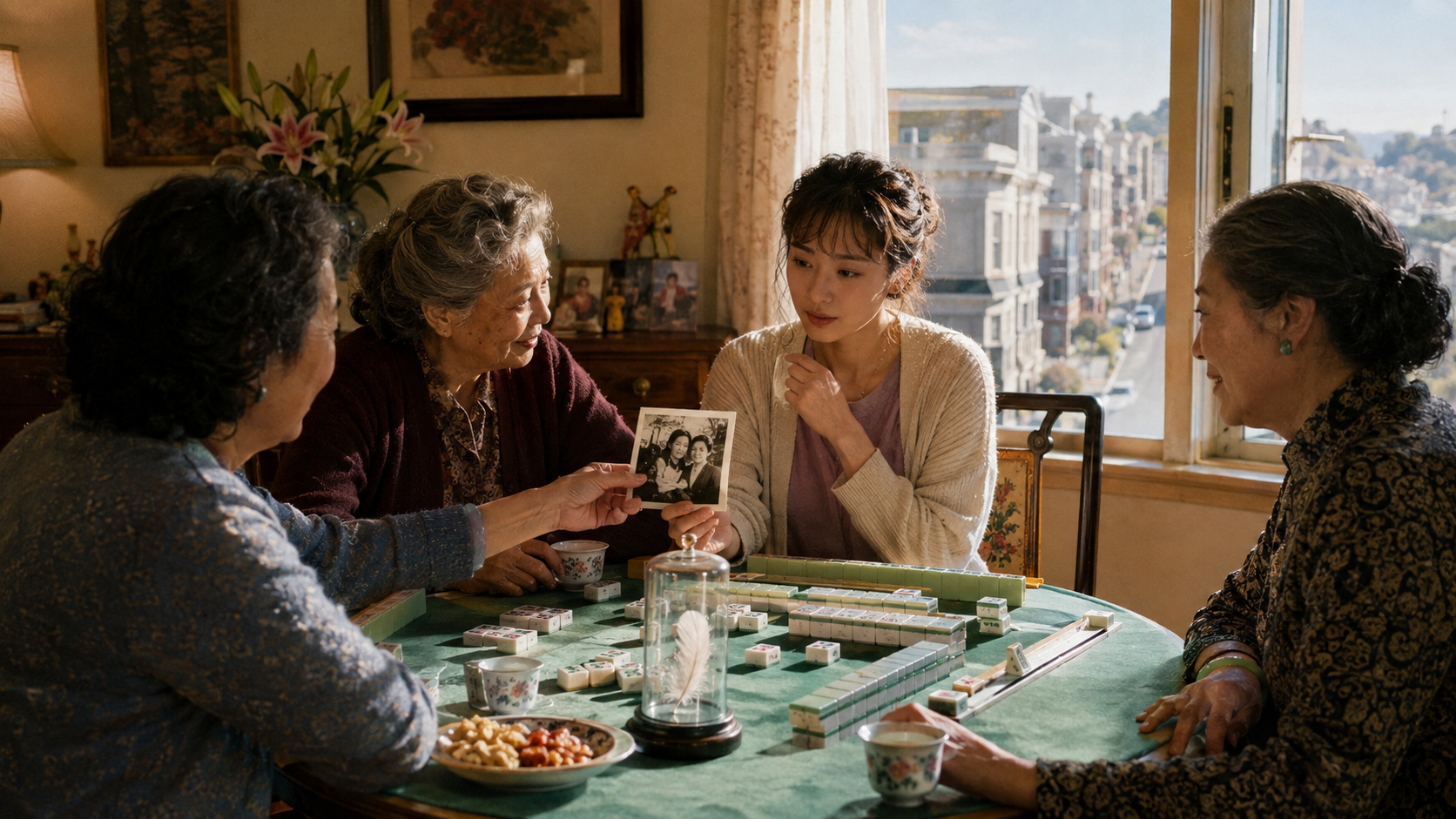
The title refers to a club started by Suyuan Woo. The women gather to play mahjong, share food, and protect hope during hard times. After Suyuan dies, her daughter Jing-mei takes her place at the table.

For class, The Joy Luck Club summary and analysis should focus on how stories pass from mother to daughter. The novel suggests that family history can hurt, but it can also heal.

If you want to study Tan’s life and career, the Britannica profile of Amy Tan gives helpful background.

Plot Summary of The Joy Luck Club

The novel does not follow one straight timeline, but its core story is easy to trace.

Jing-mei Woo has recently lost her mother, Suyuan. She joins the Joy Luck Club in her mother’s place and learns that Suyuan left behind twin daughters in China during wartime.

Jing-mei feels unsure about her role. She worries that she does not know enough about her mother to carry her story forward.

The novel then moves through the lives of the other families. An-mei Hsu teaches her daughter Rose to know her own worth. Lindo Jong teaches Waverly about strength, even when their pride causes tension.

Ying-ying St. Clair watches her daughter Lena accept an unequal marriage. Ying-ying wants Lena to find the voice she herself lost years before.

By the end, Jing-mei travels to China and meets her half-sisters. This final scene brings the novel’s emotional threads together. Jing-mei begins to understand Suyuan not as a distant mother, but as a full person with grief, courage, and hope.

The Joy Luck Club summary and analysis of Structure

The structure mirrors the way memory works: broken, personal, and powerful.

The novel is made of linked stories, not one simple chapter-by-chapter plot. Each family gets moments of focus, and each voice adds a new piece to the whole.

In The Joy Luck Club summary and analysis, this structure matters because it shows how identity is built from many stories. No single woman can explain the full meaning of the book alone.

The structure is similar to The House on Mango Street by Sandra Cisneros. Both books use short connected sections to build a larger portrait of family, place, and selfhood.

This form also asks readers to pay close attention. A small detail in one story may matter much more later. If you need help with that skill, see our guide on how close reading works in literature.

The Joy Luck Club summary and analysis of Themes

The novel’s themes center on voice, memory, and the hard work of understanding family.

The Joy Luck Club summary and analysis often starts with the theme of mother-daughter love. The mothers want to protect their daughters from pain. The daughters often hear that protection as control.

Another key theme is cultural identity. The daughters grow up in America, while their mothers carry Chinese customs and memories. This gap leads to conflict, but it also creates a rich double vision of the world.

Storytelling is one of the novel’s most important powers. The mothers tell stories so their daughters will not lose the past. The daughters learn that these stories are not just family gossip. They are maps for survival.

The novel also explores silence. Many characters do not say what they feel until pain forces the truth out. Tan shows that silence can protect people, but it can also trap them.

The Joy Luck Club summary and analysis of Conflict

Most of the novel’s conflict comes from love that has not found the right words.

The main conflict is between mothers and daughters. The mothers speak from memory, fear, and sacrifice. The daughters speak from desire, pride, and confusion.

Waverly and Lindo clash over success and independence. Waverly thinks her mother judges her. Lindo sees a daughter who does not always understand the cost of strength.

Rose and An-mei face a different conflict. Rose has learned to stay quiet in her marriage. An-mei wants her to speak with courage, because she knows what silence can cost.

Jing-mei and Suyuan’s conflict continues even after Suyuan dies. Jing-mei believed she disappointed her mother. The trip to China helps her see that her mother gave her a story, not just a set of demands.

Important Symbols in The Joy Luck Club

Tan uses objects and games to show hidden emotional truths.

Mahjong stands for community and survival. The game brings the women together when life feels unstable. It also gives the novel its main gathering place.

The swan feather stands for hope passed from mother to daughter. It suggests that even a small object can carry a large dream.

Chess in Waverly’s story stands for strategy and pressure. Waverly learns how to win, but she also learns how success can strain a family bond.

Food often reveals love that characters cannot say out loud. Meals show care, judgment, memory, and tension at the same time.

Why the Ending Matters

The ending gives Jing-mei a new sense of belonging.

When Jing-mei meets her sisters in China, she does more than complete a family reunion. She becomes a bridge between Suyuan’s past and the family’s future.

The photograph at the end matters because it joins three daughters through one mother’s story. Jing-mei finally sees that she is not separate from her mother’s history. She is part of it.

This ending does not solve every problem in the novel. It gives emotional closure because Jing-mei accepts the duty to remember.

How to Write About The Joy Luck Club in Class

Strong essays about this novel focus on how form and meaning work together.

A good thesis might argue that Tan uses shifting points of view to show how family truth changes from one generation to the next.

You can also write about symbols. For example, mahjong is not just a game. It is a sign of friendship, survival, and memory.

When you quote the novel, do not just drop in a line. Explain who speaks, what the moment reveals, and why the detail matters. For more help, review this guide to close reading a literary passage.

From Idea to Novel Blueprint

These books pair well with Tan’s novel for essays or independent reading.

  • The Joy Luck Club by Amy Tan
  • The Woman Warrior by Maxine Hong Kingston

If you compare these books, look at how each one uses memory and family stories to explore identity.

FAQ About The Joy Luck Club

Here are quick answers to common student questions.

What should I include in The Joy Luck Club summary and analysis?

Include the main family relationships, the linked-story structure, the mother-daughter conflicts, and the themes of memory and identity.

Who is the main character?

Jing-mei Woo is often seen as the central figure because her story frames the novel. Still, the book works as a shared portrait of several women.

What is the main message of the novel?

The novel shows that understanding family often requires listening to painful stories from the past.

Why is the structure confusing?

The book moves across different voices and memories. Once you track each mother-daughter pair, the structure becomes clearer.

Is The Joy Luck Club hard to read?

It can feel complex at first, but the language is clear. The challenge comes from the shifting points of view.

Key Takeaway

The novel is about learning to hear the stories that shaped you.

The Joy Luck Club summary and analysis shows that Amy Tan’s novel is not just about conflict between generations. It is about how love, memory, and language can cross a painful gap.

For students, the best way into the book is to follow the stories. Each one adds a new layer to the meaning of family.
The Grapes of Wrath Summary and Analysis for Students

Grapes of wrath summary

This guide offers a The Grapes of Wrath summary and analysis for students who need a clear path into John Steinbeck’s novel. We will cover the plot, structure, conflicts, themes, and deeper meaning without making the book feel harder than it is.

In this Guide

  • Plot overview
  • Historical context
  • Structure and style
  • Major conflicts
  • Key themes
  • Study tips and FAQ
Grapes of wrath summary

The Grapes of Wrath Summary and Analysis: Plot Overview

Steinbeck’s novel follows one family, but it speaks for many people hurt by poverty and broken systems.

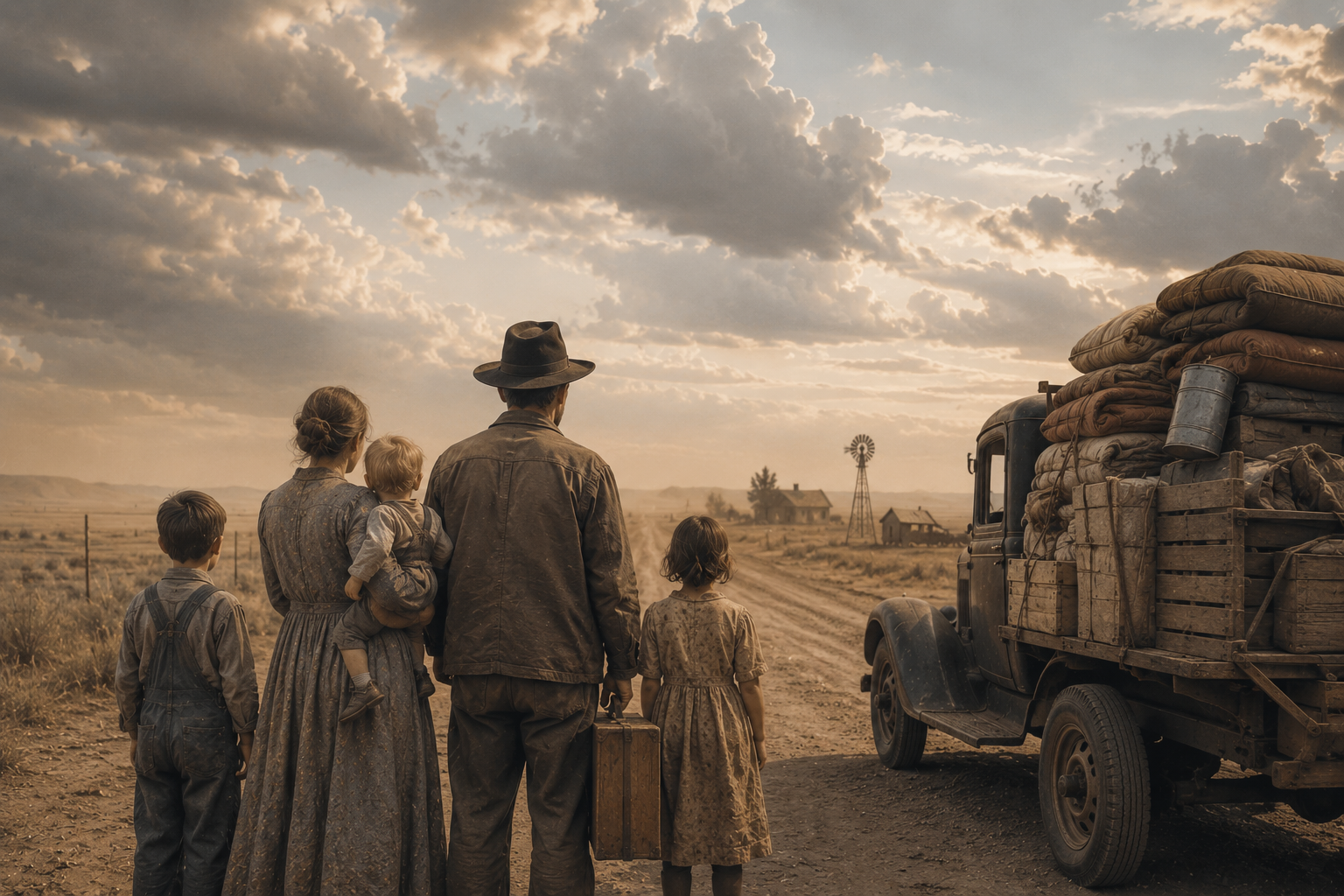
The story begins in Oklahoma during the Dust Bowl. Tom Joad comes home from prison and finds that his family has lost its farm. Banks and landowners have pushed tenant farmers off the land, so the Joads pack a truck and head west to California.

This part of The Grapes of Wrath summary and analysis shows the novel’s main pattern: hope meets hardship. The Joads believe California will offer work, food, and safety. On the road, they face death, hunger, fear, and cruel treatment.

Grampa dies soon after the trip starts. Grandma dies before the family reaches California. Noah leaves the family, and Connie runs away from his pregnant wife, Rose of Sharon. Each loss makes the family smaller, but Ma Joad works hard to keep everyone together.

In California, the Joads find that work is scarce and wages are low. Many workers compete for the same jobs. Owners use hunger to force people to accept almost any pay.

Jim Casy, a former preacher, becomes a labor organizer. He is killed by men who want to stop worker protests. Tom kills Casy’s attacker and must hide. Before he leaves, Tom tells Ma that he will keep fighting for poor people wherever they suffer.

The novel ends after a flood ruins the family’s shelter. Rose of Sharon gives birth to a stillborn baby. In the final scene, she breastfeeds a starving man, turning grief into an act of mercy.

Historical Context Behind The Grapes of Wrath Summary and Analysis

The novel makes more sense when you know the real crisis behind it.

The Grapes of Wrath was published in 1939, near the end of the Great Depression. Many families had lost jobs, savings, and homes. In the Great Plains, drought and poor farming methods helped create the Dust Bowl.

Without this context, The Grapes of Wrath summary and analysis can feel like a long road story. With context, it becomes a story about economic power, forced migration, and survival.

Steinbeck based the novel on real reports and his own visits to migrant camps. You can read more about the author’s life through Britannica’s John Steinbeck biography. For background on the Dust Bowl, the Library of Congress Dust Bowl overview is a strong source.

The book also caused debate. Some readers praised it for showing the pain of farmworkers. Others attacked it because it blamed rich owners and unfair systems.

Structure and Style in The Grapes of Wrath Summary and Analysis

Steinbeck’s structure is one reason the novel feels larger than one family’s story.

The book uses two kinds of chapters. Some chapters follow the Joad family closely. Others zoom out and describe groups of migrants, banks, cars, roads, diners, and camps.

For students, The Grapes of Wrath summary and analysis becomes clearer when you notice this pattern. The Joad chapters make the story personal. The wider chapters show that the Joads are part of a national crisis.

This structure is a bit like the way Victor Hugo uses personal stories in Les Misérables to show a whole society under pressure. Steinbeck does not want readers to pity only one family. He wants readers to see a system that hurts thousands.

His language often sounds plain, but it carries strong emotion. He uses biblical echoes, folk speech, and images of land, dust, machines, and hunger. These patterns reward close study, so a guide to close reading in literature can help you track them.

Major Conflicts in the Novel

The conflicts in the novel move from private pain to public struggle.

The first conflict is people against nature. Drought, dust, and flood shape the Joads’ lives. Nature is not evil, but it makes survival harder.

The second conflict is people against society. Banks take land. Police harass migrants. Owners cut wages. The Joads learn that poverty is not just bad luck.

The third conflict is inside the characters. Tom must decide what kind of man he wants to be after prison. Ma must stay strong even when the family falls apart. Rose of Sharon must face loss and still choose compassion.

These conflicts build the novel’s central question: how can people keep their dignity when the world treats them as cheap labor?

Key Themes in The Grapes of Wrath Summary and Analysis

The novel’s themes focus on justice, family, anger, and human worth.

A good The Grapes of Wrath summary and analysis should start with human dignity. Steinbeck shows that the migrants are not lazy or weak. They are skilled, proud people trapped by forces bigger than themselves.

Family is another major theme. At first, the Joads think of family as blood relatives. By the end, the idea grows. Casy’s beliefs and Tom’s final speech suggest that all suffering people are connected.

Wrath also matters. The title comes from “The Battle Hymn of the Republic,” which uses biblical language about judgment. Steinbeck suggests that anger can grow when injustice lasts too long.

The final scene with Rose of Sharon is one of the most debated endings in American literature. It is shocking, but it is not only meant to shock. It shows that care can survive even after great loss.

Symbols and Motifs to Watch

Small details in the novel often point to larger ideas.

The turtle near the start is a key symbol. It crosses a road slowly while cars threaten it. Like the migrants, it keeps moving despite danger.

The truck becomes a symbol of hope and pressure. It carries the Joads west, but it also holds their fear and grief. Every mile brings promise and risk.

Dust represents loss and damage. It covers farms, homes, and bodies. It reminds readers that the land itself has changed.

Food appears often because hunger drives the plot. When people share food, they show community. When owners destroy food to protect prices, they show cruelty.

How to Use The Grapes of Wrath Summary and Analysis for Class

A strong study plan turns summary into real interpretation.

If you use The Grapes of Wrath summary and analysis for an essay, do not stop at what happens. Ask why Steinbeck tells the story this way. Look at how each chapter builds pressure.

Track Tom, Ma, Casy, and Rose of Sharon. Each one shows a different response to suffering. Tom moves toward action. Ma protects the family. Casy gives the novel its moral voice. Rose of Sharon turns sorrow into care.

For a quick support tool, you may also find this student reading guide useful as you plan notes or review before class.

Good essay topics include the role of community, the meaning of the ending, the use of intercalary chapters, and the link between poverty and power.

These books can help you understand Steinbeck, the Dust Bowl, and American social fiction.

  • The Grapes of Wrath by John Steinbeck
  • Of Mice and Men by John Steinbeck
  • The Worst Hard Time by Timothy Egan

FAQ

What is the main point of The Grapes of Wrath?

The main point is that poverty is often caused by unfair systems, not personal failure. Steinbeck also shows the power of shared care.

What should a The Grapes of Wrath summary and analysis include?

It should include the Joads’ journey, the Dust Bowl context, the labor conflict in California, and the novel’s major themes.

Why is Jim Casy important?

Casy gives the novel many of its moral ideas. He moves from preacher to worker activist and inspires Tom’s later choices.

What does the ending mean?

The ending shows mercy after loss. Rose of Sharon’s act suggests that human kindness can answer suffering in a powerful way.

Is The Grapes of Wrath hard to read?

Some chapters feel slow because Steinbeck shifts between the Joads and wider social scenes. Once you see the pattern, the novel becomes easier to follow.

Key Takeaway

The Grapes of Wrath is more than a migration story. It is a novel about dignity, anger, and the need to care for others when systems fail.

Jane Eyre Summary and Analysis for Students

Jane Eyre Summary

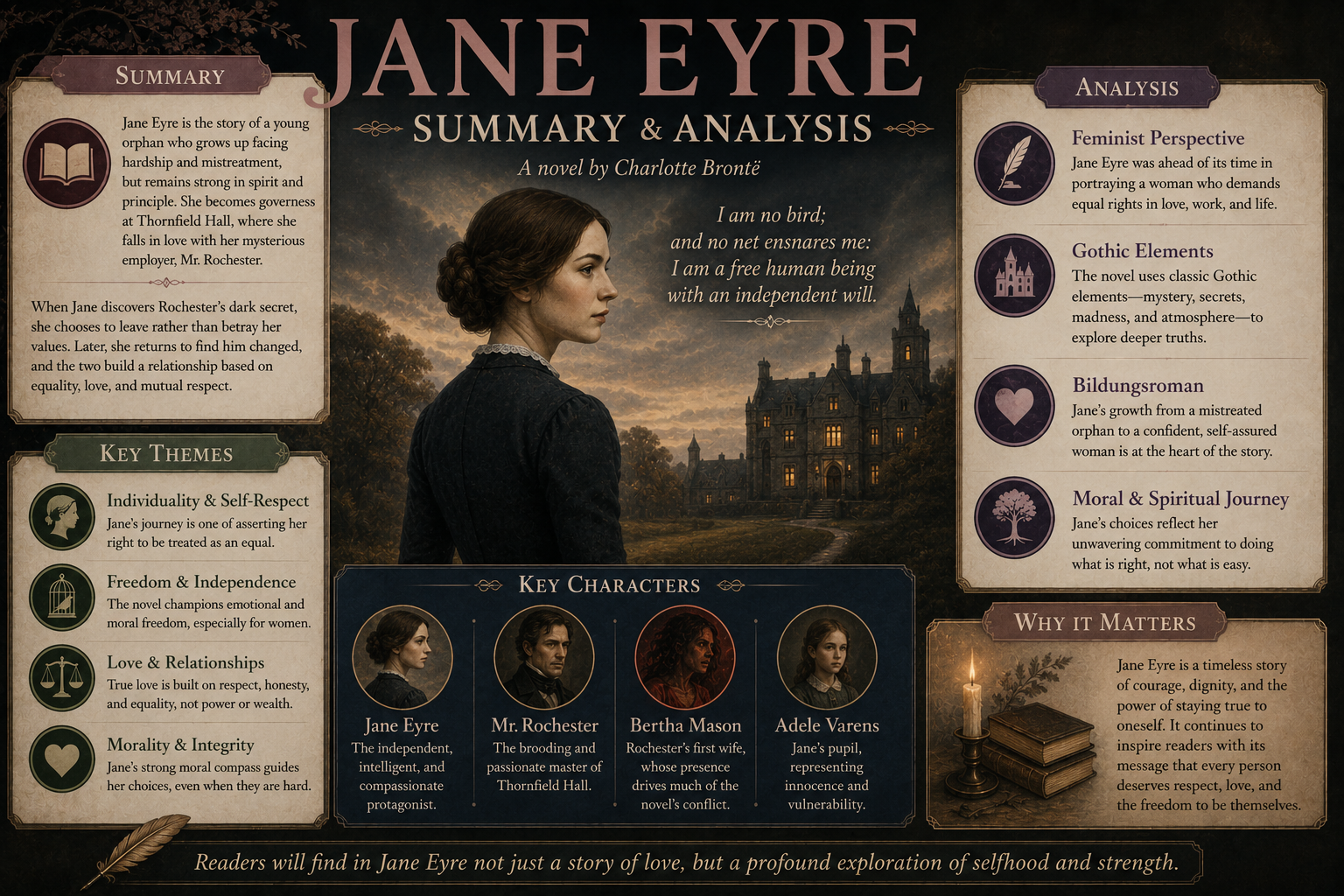
Jane Eyre is one of the most important novels of the Victorian age. This Jane Eyre summary and analysis gives students a clear path through the plot, structure, conflicts, and deeper meaning.

Charlotte Brontë tells a story about a young woman who wants love, faith, and freedom without losing herself.

In this Guide

Use this guide as a map before class, essays, or exams.

  • Quick overview
  • Plot summary by major stage
  • Structure and point of view
  • Main conflicts
  • Themes, symbols, and meaning
  • Helpful books and FAQ
Jane Eyre Summary

Jane Eyre summary and analysis: quick overview

The novel follows Jane from a harsh childhood to a hard-won adult life.

Jane is an orphan raised by cruel relatives at Gateshead. She later goes to Lowood School, becomes a governess at Thornfield Hall, and falls in love with Mr. Rochester.

This Jane Eyre summary and analysis matters because the novel is not just a romance. It is also a story about self-respect, moral choice, and the right to speak.

For a short reference overview, see Britannica on Jane Eyre.

Jane Eyre summary and analysis: plot by major stages

Brontë builds Jane’s life in clear stages, and each place tests her in a new way.

Gateshead: Jane learns she is unwanted

Jane lives with her aunt, Mrs. Reed, and her cousins. They treat her as a burden, not a child with feelings.

The red-room scene is one of the novel’s key moments. Jane is locked in the room where her uncle died, and her fear shows how trapped she feels.

Lowood: Jane learns discipline and loss

At Lowood School, Jane meets Helen Burns, a gentle girl with deep faith. Helen teaches Jane patience, but her death also shows the cruelty of neglect.

Mr. Brocklehurst uses religion to control the girls. Brontë criticizes this false form of faith.

Thornfield: Jane finds love and danger

Jane becomes a governess at Thornfield Hall. She meets Mr. Rochester, who treats her as an equal in conversation.

They fall in love, but the wedding stops when Jane learns Rochester already has a wife, Bertha Mason, hidden in the attic. Jane leaves because she will not become his mistress.

Moor House: Jane faces a different kind of trap

Jane is rescued by the Rivers family, who later turn out to be her cousins. St. John Rivers asks Jane to marry him and serve as a missionary wife.

His offer is respectable, but it has no love. Jane refuses because it would crush her spirit.

Ferndean: Jane returns by choice

Jane later returns to Rochester after a fire destroys Thornfield. Bertha dies in the fire, and Rochester loses his sight and one hand.

Jane marries him only after they can meet on more equal ground. Use this Jane Eyre summary and analysis to notice that Jane’s happy ending depends on freedom, not surrender.

How Jane Eyre is structured

The novel has a life-story shape that helps readers track Jane’s growth.

Jane Eyre is a first-person novel. Jane tells her own story as an adult, so we see both her childhood feelings and her mature judgment.

A Jane Eyre summary and analysis should also note that the book is a Bildungsroman, or coming-of-age novel. Like Great Expectations by Charles Dickens, it follows a young person through pain, mistakes, and self-knowledge.

The setting changes as Jane changes. Gateshead shows rejection, Lowood shows discipline, Thornfield shows desire, and Ferndean shows chosen love.

If you want to study Brontë’s word choices more closely, this guide to close reading in literature can help.

Main conflicts in Jane Eyre

The novel’s conflicts are personal, social, and moral.

Jane versus society is one major conflict. Jane is poor, female, and often powerless, but she refuses to accept shame as her proper place.

Jane versus herself is just as important. She wants love, but she also knows that love without respect can destroy her.

Jane versus Rochester creates the central romantic tension. Rochester loves Jane, but he tries to hide the truth about Bertha, which makes their first union morally wrong.

Jane versus St. John tests her in another way. St. John offers duty without passion, while Rochester offers passion that must be purified by honesty.

Themes in Jane Eyre summary and analysis

Brontë uses Jane’s story to ask what a person needs in order to live with dignity.

Independence and self-respect

Jane’s strongest trait is her sense of inner worth. She has little money or status, but she believes her soul is equal to anyone else’s.

For students, Jane Eyre summary and analysis often begins with this point. Jane does not reject love. She rejects love that demands the loss of self.

Love and equality

Jane and Rochester’s best moments come when they speak honestly. Their worst moments come when power is uneven.

Like Elizabeth Bennet in Pride and Prejudice, Jane must judge whether a man’s love respects her mind as well as her heart.

Religion and moral choice

The novel offers different forms of faith. Helen Burns shows patient faith, Mr. Brocklehurst shows cruel hypocrisy, and St. John shows duty without warmth.

Jane’s faith is tied to conscience. She leaves Rochester because she believes love must answer to moral truth.

Class and gender

Jane lives in a world where class shapes every chance she has. As a governess, she is educated but not rich, so she stands between social groups.

Brontë also shows how women had narrow choices. Jane wants work, love, and respect, not a life chosen for her by others.

Symbols and Gothic elements

The novel uses dark, strange, and intense images to reveal hidden fears.

The red-room stands for childhood trauma and social punishment. Jane is treated as if her anger is a crime.

Thornfield Hall stands for mystery and buried truth. The house looks grand, but it hides pain in its upper rooms.

Fire often marks passion, danger, and change. It destroys Thornfield, but it also clears the way for a more honest life.

These Gothic touches connect Jane Eyre to novels like Wuthering Heights, where setting and emotion feel closely linked.

Literary meaning and why Jane Eyre still matters

Jane’s story still feels modern because she fights for a voice.

This Jane Eyre summary and analysis also shows why the novel is more than a love story. Jane’s final happiness comes because she chooses it from a place of strength.

The famous line about Jane being no bird captures the heart of the book. She refuses to be caged by gender, class, fear, or romance.

To learn more about Charlotte Brontë as a writer, see the Poetry Foundation biography of Charlotte Brontë.

For more study support, our student literature guides can help you review major novels with clearer notes.

Helpful books for Jane Eyre study

These books are useful for students who want more context or a reliable edition.

  • Jane Eyre by Charlotte Brontë, Penguin Classics edition
  • The Madwoman in the Attic by Sandra M. Gilbert and Susan Gubar

You can look for these through a school library, local bookstore, or Amazon Books.

FAQ: Jane Eyre summary and analysis

Here are quick answers to common student questions.

What should a Jane Eyre summary and analysis include?

It should cover Jane’s life stages, her conflicts, major themes, key symbols, and the meaning of her final choice.

What is the main message of Jane Eyre?

The novel argues that love must include equality, honesty, and self-respect.

Why does Jane leave Rochester?

Jane leaves because Rochester is already married. She loves him, but she will not betray her conscience.

Is Jane Eyre a feminist novel?

Many readers see it that way because Jane demands dignity, work, and moral freedom in a world that limits women.

Key Takeaway

A strong Jane Eyre summary and analysis should show how Jane moves from isolation to self-command. The novel’s power comes from one clear idea: Jane wants love, but never at the cost of her soul.

Lord of the Flies Summary and Analysis for Students

Lord of the Flies Summary

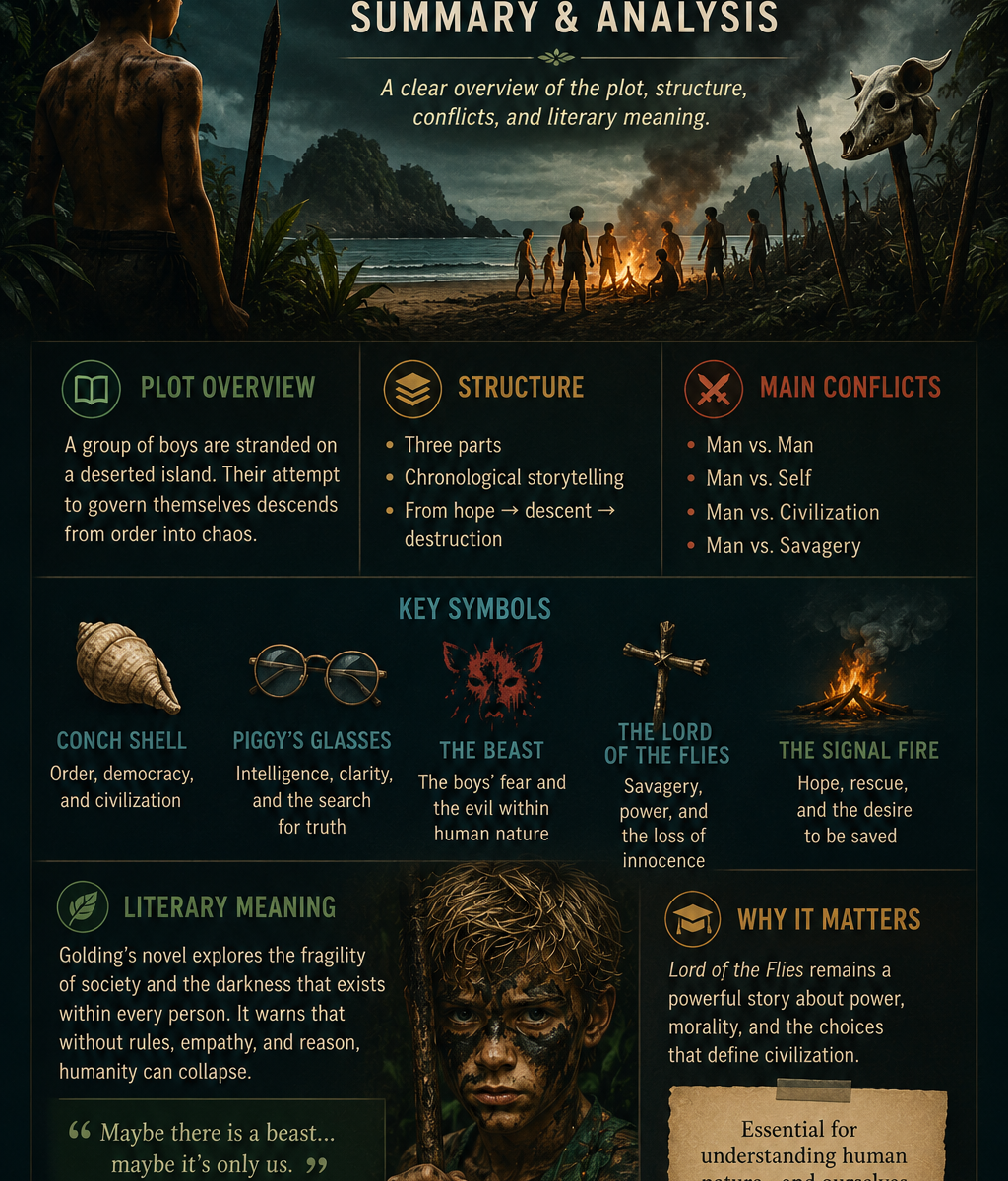
A clear overview of the plot, structure, conflicts, and literary meaning.

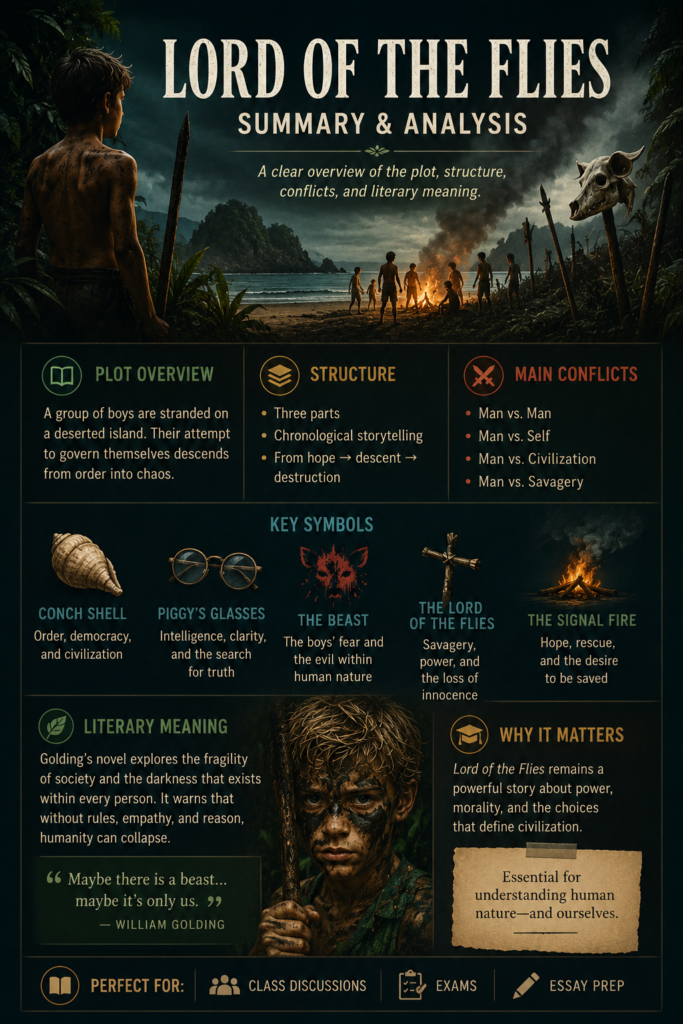
This Lord of the Flies summary and analysis gives students a clear path through William Golding’s famous novel. It covers the plot, main conflicts, key symbols, and deeper meaning without making the book feel harder than it is.

If you need a guided entry point for class, exams, or essay prep, this guide will help you see both what happens and why it matters.

In this Guide

  • Quick overview of the novel
  • Plot summary
  • Structure and conflict
  • Symbols and themes
  • Literary meaning
  • Study tips, book suggestions, and FAQ
Lord of the Flies Summary

Lord of the Flies Summary and Analysis: Quick Overview

Golding turns a survival story into a dark study of human nature.

Lord of the Flies follows a group of British schoolboys who crash on an empty island during a war. At first, the island seems like a place of freedom, but fear and power soon break their fragile order.

Ralph becomes the elected leader, with Piggy as his smart but ignored adviser. Jack, who leads the choirboys, wants control and becomes more focused on hunting than rescue.

A clear Lord of the Flies summary and analysis must notice this shift: the boys do not just lose rules. They lose trust, empathy, and a shared sense of right and wrong.

For basic background on Golding’s life and career, see Britannica’s William Golding biography.

Lord of the Flies Summary and Analysis: Plot by Chapters

The plot moves from hope to fear, then from fear to violence.

The novel opens after a plane crash leaves the boys without adults. Ralph and Piggy find a conch shell, which becomes a tool for calling meetings and giving people the right to speak.

The boys vote Ralph as chief. Jack accepts this at first, but he feels wounded because he wants power. Ralph wants shelters and a signal fire, while Jack wants meat and status.

Soon, the younger boys fear a beast on the island. Ralph tries to keep the group focused on rescue, but the fear spreads. A fire set by the boys burns out of control, and one small child may die.

Jack becomes skilled at hunting pigs. The hunters paint their faces, which lets them act with less shame. The paint works like a mask, much as costumes in plays can free characters from normal rules.

A ship passes the island, but the signal fire is out because Jack and his hunters left their post. Ralph is furious. This moment shows the main split between rescue and power.

Simon, the quiet and thoughtful boy, later finds the pig’s head that Jack’s group has placed on a stick. This head is called the Lord of the Flies. It seems to speak to Simon and tells him that the real beast is inside the boys.

Simon then discovers that the supposed beast on the mountain is only a dead parachutist. When he tries to tell the others, the boys mistake him for the beast during a wild dance and kill him.

After Simon’s death, Jack’s tribe grows stronger. They steal Piggy’s glasses, which are needed to make fire. Ralph and Piggy go to ask for them back, but Roger rolls a rock that kills Piggy and breaks the conch.

In the final chase, Jack’s tribe hunts Ralph across the island. They set the forest on fire to force him out. A naval officer arrives because of the smoke, and the boys are rescued, but their innocence is gone.

The best Lord of the Flies summary and analysis sees the ending as bitter, not simply happy. Rescue comes, but only after the island has shown what fear and violence can do.

Structure of the Novel

The structure works like a slow collapse.

Golding begins with an island that feels open and bright. The boys form meetings, choose a chief, and speak about rules. The conch gives the early chapters a sense of order.

As the story moves forward, the structure becomes darker. Meetings fail. The signal fire goes out. Jack’s tribe replaces speech with chants and force.

By the end, the island looks almost like a war zone. The fire that should have signaled rescue becomes a weapon. That reversal is one reason the structure feels so sharp.

Like Macbeth, the novel shows how the hunger for power can damage judgment. Like Animal Farm, it asks how a community can fall apart when fear and control replace fairness.

Lord of the Flies Summary and Analysis: Major Conflicts

The conflicts are simple on the surface, but they carry deep meaning.

The main conflict is between Ralph and Jack. Ralph stands for rescue, shared rules, and speech. Jack stands for force, hunting, and control.

There is also a conflict inside the group. The boys want safety, but they are drawn to the thrill of violence. Golding shows how a crowd can make people do things they might fear doing alone.

The beast creates another conflict. At first, the boys think it is an outside monster. Simon understands that the real danger comes from within their own hearts.

This part of the Lord of the Flies summary and analysis matters for essays because conflict in the novel is not just action. It reveals what Golding thinks about human nature.

Symbols in Lord of the Flies

Golding’s symbols turn ordinary objects into moral tests.

The conch shell stands for order and civil speech. When the conch breaks, the boys no longer respect shared rules.

Piggy’s glasses stand for reason and practical knowledge. They help the boys make fire, but Jack wants them for power, not wisdom.

The signal fire stands for hope and a link to the adult world. When the boys care about the fire, they care about rescue. When they abandon it, they drift toward the island’s violence.

The beast stands for fear. It also shows how people can invent enemies when they do not understand themselves.

The Lord of the Flies, the pig’s head on a stick, is the most disturbing symbol. It suggests decay, evil, and the cruel truth Simon sees before his death.

Key Themes for Students

The novel asks what happens when social rules lose power.

One major theme is civilization versus savagery. Golding does not show this as a simple split between good and bad people. He shows how quickly order can weaken.

Fear is another key theme. The boys fear the beast, but that fear makes them easier to control. Jack uses fear to gain loyalty.

The novel also explores the loss of innocence. The boys begin with games and meetings, but they end with murder and a hunt. Their childhood does not protect them from moral failure.

If you want to move from summary to evidence, try this guide to close reading in literature. It can help you connect symbols, word choice, and theme in your own notes.

Lord of the Flies Summary and Analysis: Literary Meaning

The novel’s meaning is harsh, but it is not hopeless.

Golding suggests that people need more than rules. They need moral courage and respect for others. Without those, rules can become empty sounds.

The boys are not evil because they are children. They are human, and that is the troubling point. Golding asks readers to face the darker parts of human behavior.

A good Lord of the Flies summary and analysis should not stop at the plot. The novel matters because it studies how fear, pride, and group pressure can break a community.

Golding later received the Nobel Prize in Literature. You can read more about his award at The Nobel Prize official site.

How to Study Lord of the Flies

Focus on patterns, not just events.

Track how the conch, fire, and glasses change in meaning. Each object starts with a useful role, then becomes part of a larger moral struggle.

Pay close attention to scenes with crowds. Golding often shows how chants, fear, and shared excitement pull the boys away from reason.

When you write about the novel, use short quotes and explain them closely. For help with that skill, see how close reading works in literature.

Relevant Books to Read Next

These books connect well with Golding’s ideas about power and society.

  • Animal Farm by George Orwell
  • The Coral Island by R. M. Ballantyne
  • Fahrenheit 451 by Ray Bradbury

The Coral Island is especially useful because Golding partly responds to its more hopeful view of boys stranded on an island.

FAQ: Lord of the Flies Summary and Analysis

What is the main idea of Lord of the Flies?

The main idea is that human beings can turn violent when fear, pride, and power replace moral responsibility.

What should a Lord of the Flies summary and analysis include?

It should include the crash, Ralph and Jack’s conflict, Simon’s discovery, Piggy’s death, the final hunt, and the novel’s themes.

Why is the conch important?

The conch stands for order, speech, and shared rules. When it breaks, the boys’ society fully falls apart.

Is Jack the villain of the novel?

Jack acts as the main antagonist, but Golding’s point is larger. Jack shows a violent desire for power that can exist in many people.

Why does Simon matter so much?

Simon understands that the beast is not a monster outside the group. It is the darkness inside human nature.

Key Takeaway

A strong Lord of the Flies summary and analysis shows that the novel is not only about boys on an island. It is about how quickly fear can weaken order, and why moral courage matters.

error

Enjoy this article? Please spread the word :)

Follow by Email
BLUESKY
fb-share-icon
Reddit
LinkedIn
Share
RSS