Flash Memoir Prompt: Last Time You Did Something with a Parent before They Became Older

Memoir Prompt parent

A brief writing invitation for remembering the last ordinary thing you shared with a parent before age changed the way you saw them.

Maybe you did not know it was the last time. You were carrying groceries together, walking through an airport, painting a fence, or sitting in the front seat while your parent drove too fast and knew every shortcut.

Then, later, something shifted. They stopped climbing ladders. They handed you the keys. They asked you to read the small print. This flash memoir prompt last time something parent before old age became visible asks you to return to that earlier scene, when your parent still seemed like the stronger one.

Memoir Prompt parent

The Prompt

Write about the last time you did something with a parent before they became older.

This prompt can unlock a memory you may have passed over because it seemed normal at the time. The day itself may not have announced anything. There may have been no hospital room, no dramatic talk, no clear goodbye to who your parent had been.

That is what gives the memory power. Often, we notice change only after it has already happened. A flash memoir prompt about the last time you did something with a parent before age changed them can help you study the small evidence: a hand on a steering wheel, a laugh across a table, a parent carrying something you would later carry for them.

Why This Memory Matters

This kind of story often lives in the space between childhood and adulthood. Even if you were already grown, your parent may still have felt fixed in your mind. Capable. Busy. Hard to impress. Hard to imagine as fragile.

Then one memory, when viewed from years later, becomes a hinge. Maybe it was the last hike before their knees started to fail. Maybe it was the last road trip before night driving became too much. Maybe it was the last time they lifted a grandchild, danced at a wedding, or stood at the grill like the whole backyard depended on them.

The story is not only about age. It is about what you did not know you were losing. It is about the moment before the roles began to tilt.

When you write this memory, try not to turn your parent into a symbol too quickly. Let them be a person first. If they complained, include that. If they were stubborn, proud, silly, or distracted, let that stay in the scene. A real parent on the page will feel more honest than a perfect one.

If you want a helpful way to think about your parent as a person in the story, you might borrow tools from literature. This guide on how to analyze characters in literature can help you notice habits, contradictions, and choices without flattening someone into one simple role.

How to Approach This Prompt

Begin with one physical detail. Do not start by explaining your whole relationship. Start with your father’s work boots by the back door. Start with your mother’s sunglasses on the dashboard. Start with the paper cup of gas station coffee your parent balanced between their knees.

Then narrow the memory to one scene. A scene gives the reader a place to stand. Instead of covering a decade of decline, choose the afternoon at the lake, the grocery run after church, or the last time your parent helped you move a couch.

Write what you noticed before you explain what it meant. At the time, maybe you noticed your parent’s quick walk, their joke, their impatience, or the way they waved away help. Years later, you may see that memory differently. Let both versions exist.

You can use this simple starting line if you need one: “The last time I remember my parent seeming young was when…” Then move right into action.

Keep the first draft small. You do not have to tell the whole story of illness, aging, family duty, or grief. This flash memoir prompt last time something parent before age changed the family works best when you stay close to one moment and let the meaning rise from the details.

If marking up memories helps you think, you may enjoy using the same habits readers use with books. This guide on how to annotate literature can also work for memoir drafts. Circle the strongest image. Underline the sentence that feels most true. Ask what the scene is really about.

A Quick Example

The last time my mother seemed young to me was at the garden center in April. She lifted two bags of potting soil into the cart before I could stop her. “Don’t fuss,” she said, wiping her hands on her jeans. She had dirt under one thumbnail and a blue sweatshirt tied around her waist. I was thirty-two, with my own mortgage and my own gray hairs starting, but beside her I still felt like a child sent to fetch the marigolds. We argued over tomato plants. She wanted the tall ones. I wanted the cheap ones. She won, of course. Three summers later, I would kneel in her yard and plant everything myself while she watched from a folding chair. But that day she pushed the cart, fast and crooked, like she had somewhere important to be.

Try It Yourself

Set a timer for ten minutes and write the scene as plainly as you can. Choose one shared action: driving, cooking, shopping, fixing, walking, waiting. Let the memory stay ordinary.

If emotion arrives, let it in, but do not force a big ending. You might close on an object, a gesture, or a line of dialogue. The quietest ending may be the one that stays with the reader.

This flash memoir prompt last time something parent before they became old may bring up tenderness, regret, gratitude, or surprise. You do not need to solve those feelings today. Just put one true moment on the page.

Want More Flash Memoir Prompts?

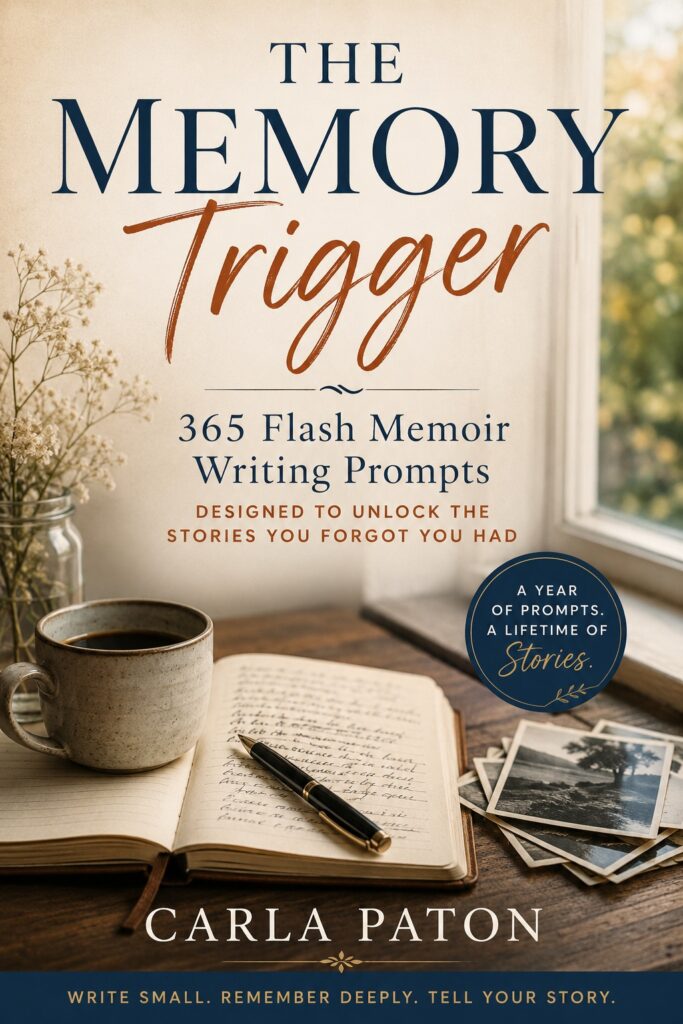
If this prompt helped you remember one clear scene, keep going. Short prompts can open doors you did not know were still there. Explore all 365 prompts in The Memory Trigger: 365 Flash Memoir Writing Prompts.

The Memory Trigger

Flash Memoir Prompt: Version of Your Family that No Longer Exists

flash memoir family

A focused flash memoir invitation for remembering a version of your family that has faded, changed, or quietly disappeared.

You might notice it at a holiday table, when someone reaches for a serving spoon that used to belong to your grandmother. Or in a photo where everyone is younger, louder, closer, and you realize that exact group of people will never sit in the same room again.

This flash memoir prompt about a version of your family that no longer exists is not only about loss. It can also be about change, distance, growing up, divorce, moving away, old routines, or the strange way families become new families over time.

flash memoir family

The Prompt

Write about a version of your family that no longer exists.

This prompt can open a strong memory because it asks you to look at your family as it once was, not as a full history, but as one lived moment. Maybe the old version of your family was noisy and crowded. Maybe it was quiet because everyone avoided the same subject. Maybe it was happy, but only in the way you understood happiness then.

A good flash memoir prompt version family no longer exists can help you find the small scene that holds the larger truth. You do not need to explain every change. You only need to show the reader what it felt like to be there before everything shifted.

Why This Memory Matters

Families change in ways that can be easy to miss while they are happening. Someone leaves for college. Someone stops calling. A parent remarries. A sibling becomes a stranger for a while. A child grows up and no longer believes the adults know everything.

When you write about a version of your family that no longer exists, you are writing about time. You are also writing about roles. Who made everyone laugh? Who kept the peace? Who always sat in the same chair? Who did you think you were in that family?

This kind of memory may uncover grief, but it may also uncover tenderness. You might remember the family before the big argument, before the move, before the illness, before everyone got their own phones and stopped watching the same movie on the couch.

If you enjoy looking closely at people and their choices, you may find it useful to think like a reader studying a novel. This guide on how to analyze characters in literature can help you notice patterns, motives, and quiet details in real life too.

How to Approach This Prompt

Begin with one physical detail. Choose something small enough to hold in your hand or picture clearly in your mind. A cracked bowl. A bunk bed. A station wagon. A stack of TV trays. A hallway light left on at night.

Then narrow the memory to one scene. Do not try to tell the whole family history at once. The whole story may be too large for a flash memoir piece. One evening can carry enough weight.

Write what you noticed before you explain what it meant. If your parents were still together then, show them passing plates across the table. If your siblings still shared a bedroom, show the line of stuffed animals between the beds. If your grandparents still hosted Sunday dinner, show the smell of soup in the entryway.

Try not to rush toward the lesson. Let the reader stand inside the old version of your family for a moment. Let them hear the voices, see the furniture, and sense what no one said out loud.

After you draft, you can reread your piece and mark the details that feel alive. Writers do this in memoir the same way students mark important lines in a story. If that skill helps you, here is a simple guide on how to annotate literature that can also work for your own drafts.

A Quick Example

Before my parents sold the house, Sunday mornings belonged to pancakes. My father stood at the stove in his robe, flipping them too early, so the middles stayed soft. My mother read the paper at the table and circled grocery coupons with a red pen. My brother and I fought over the syrup bottle even though there was plenty. The dog slept under my chair because I dropped crumbs on purpose. Nothing about it seemed special then. It was just breakfast. Years later, after the divorce and the apartment kitchens and the holidays split into two calendars, I found the old griddle in a box. The handle was loose. I held it for a minute and could almost hear my mother say, “Use a plate, not a napkin.”

Try It Yourself

Set a timer for ten minutes and write about one version of your family that no longer exists. Start with the room, the object, or the sound that brings it back fastest.

You do not have to make the memory neat. You do not have to decide if it was good or bad. Just return to the scene and tell the truth from where you stood then.

If the writing surprises you, follow that surprise. The best flash memoir pieces often begin with a simple image and end with a feeling the writer did not expect to find.

Want More Flash Memoir Prompts?

If this prompt helped you remember a scene you had not thought about in years, keep going. Explore all 365 prompts in The Memory Trigger: 365 Flash Memoir Writing Prompts.

The Memory Trigger

Flash Memoir Prompt: Last Time You Cried in Front of Someone Else

Memoir prompt cried

Your tears may have come at the worst possible time: in a hallway, across a kitchen table, during a phone call, or beside someone who suddenly saw more of you than you meant to show.

Memoir prompt cried

The Prompt

Write about the last time you cried in front of someone else.

This flash memoir prompt last time cried front someone asks you to return to a moment when emotion became visible. That can be uncomfortable, but it can also lead to honest writing. Tears change a scene. They shift the room, the conversation, and sometimes the relationship.

You do not have to explain your whole life to write this piece. You only need one moment. Who was there? Where were you standing or sitting? What happened in the seconds before you realized you were crying?

Why This Memory Matters

Crying in front of someone else can feel like losing control, but in memoir, that loss of control often reveals the truth of the scene. Maybe you cried because you were hurt. Maybe you cried from relief. Maybe you had been holding yourself together for so long that one kind question broke the seal.

The person who saw you cry matters too. A parent, teacher, friend, nurse, stranger, partner, or child can change the meaning of the memory. Were they gentle? Awkward? Silent? Did they look away, hand you a tissue, make a joke, or cry too?

This kind of memory can uncover a story about trust. It may show who felt safe to you, who did not, or who surprised you. It may also reveal something about how you were taught to handle emotion. Some people grew up hearing, “Don’t cry.” Others were comforted right away. Many of us carry mixed lessons.

A strong flash memoir does not need a dramatic event. The real story might be the tiny action that followed the tears. A hand on your shoulder. A door closing softly. Someone saying your name in a different voice. These details help readers feel the moment without needing a long explanation.

How to Approach This Prompt

For this flash memoir prompt last time cried front someone, begin with a physical detail. Do not start by explaining the whole problem. Start with the body.

Maybe your throat tightened. Maybe your face felt hot. Or maybe you stared at the floor because eye contact would make the tears fall faster. Write that first.

Then narrow the memory to one scene. Keep yourself in one place if you can. A car parked outside a school. A doctor’s office. A living room after everyone else went to bed. The smaller the scene, the easier it is to make it vivid.

Write what you noticed before you write what it meant. What color was the room? What did the other person do with their hands? Was there a sound in the background, like a dishwasher, traffic, or a phone buzzing on the table?

If you want help paying closer attention to small details, the same habits used when you annotate literature can help with memoir. Notice what repeats. Notice what feels charged. Notice where the silence sits.

You can also think of the other person in the scene the way you might study a character. What did their reaction reveal? If that idea interests you, this guide to analyzing characters in literature can give you a useful lens for real-life people too.

Avoid trying to tell the entire relationship history at once. You can hint at it through one action. If your sister passed you a napkin without looking at you, that may say more than three paragraphs of background.

A Quick Example

I cried in front of my boss in the copy room, which felt like the least dignified place possible. The printer had jammed again, and I was holding a stack of half-warm papers against my chest. She asked, “Are you okay?” in a voice so normal and kind that I could not answer. My eyes filled before I could turn away. I hated the buzzing light above us. I hated the smell of toner. She did not ask for details. She just closed the copy room door and said, “Take a minute.” That made me cry harder. It was not because of the printer. It was because someone had finally noticed I was not fine, and she did not make me prove it.

Try It Yourself

Set a timer for ten minutes and write the scene without stopping. Use the prompt exactly as it is: write about the last time you cried in front of someone else.

Do not worry about sounding polished. Focus on what happened in the room. Let the meaning rise from the details. If you get stuck, return to the body: your face, your hands, your breath, your voice.

You might find that the memory is softer than you expected. You might also find that it still stings. Either response is welcome on the page. The goal is not to judge the tears. The goal is to remember them clearly enough to understand what they carried.

This flash memoir prompt last time cried front someone works best when you let the scene stay small. One person. One moment. One visible emotion. That is enough for a powerful piece of writing.

Want More Flash Memoir Prompts?

Explore all 365 prompts in The Memory Trigger: 365 Flash Memoir Writing Prompts.

The Memory Trigger


Flash Memoir Prompt: Last Time You Talked to a Version of Yourself that No Longer Exists

memoir version of yourself

A brief, tender writing invitation to explore the last time you talked to a version of yourself that no longer exists, using one clear memory, one physical detail, and one emotional truth.

Maybe it happened while deleting old photos. Maybe you found a message thread from years ago and barely recognized the person typing your words. The jokes were familiar, but the need inside them was not. You were trying so hard to be liked, brave, difficult, invisible, impressive, or fine.

This flash memoir prompt last time talked version no longer exists asks you to pause at that strange edge between who you were and who you are now. It is not about judging your old self. It is about meeting them for one small scene and noticing what they still have to tell you.

memoir version of yourself

The Prompt

Write about the last time you talked to a version of yourself that no longer exists.

This prompt can unlock a memory because it gives you a person to write toward. That person is you, but also not quite you anymore. Maybe it is the student who thought one bad grade would ruin everything. Maybe it is the parent who had no idea how tired they were. Maybe it is the younger you who stayed too long in a place that made them small.

A flash memoir prompt last time talked version no longer exists works best when you choose one real moment. Do not try to explain your whole life change. Instead, look for a final conversation, a private thought, a mirror glance, a journal entry, or a moment when you realize, “I do not live in that old self anymore.”

Why This Memory Matters

We often change without a ceremony. There is no bell when we become less afraid. There is no receipt when we stop needing approval from someone who once held too much power. One day, we answer differently. One day, we walk away sooner. One day, we read an old note and think, “Oh, I remember being that person.”

This kind of memory matters because it shows growth without turning it into a speech. The old version of you might have been hopeful, lonely, stubborn, proud, or scared. They might have been doing the best they could with what they knew.

Writing about them with care can help you see the distance you have traveled. It can also help you avoid making your past self the villain. In memoir, the strongest moments often come from honest attention, not perfect wisdom.

If you are a student or newer writer, this prompt is also a useful way to study tone. Are you writing with regret, kindness, humor, or relief? If you want help noticing that difference, this guide to tone vs. mood in literature can help you name the feeling your scene creates.

How to Approach This Prompt

Begin with a physical detail. Choose something small enough to hold the scene in place. A cracked phone screen. A bathroom mirror. A school hallway. A coffee cup you gripped too tightly. A sweatshirt you wore during a hard year.

Then write the scene before you explain it. What did you see? What did your body feel like? What words were said out loud, if any? Memoir becomes more powerful when the reader can stand inside the moment with you.

Try starting with this sentence: “The last time I felt like that version of me, I was…” Let the sentence lead you into one place. Keep the frame tight. You do not need to tell every reason that version of you disappeared.

You might also write as if you are speaking directly to your old self. Use “you” if it feels natural. For example: “You thought silence would keep the peace. You did not know it was costing you sleep.” This can create a quiet conversation between past and present.

If you get stuck, slow down and observe the memory like a reader. Notice what repeats, what feels strange now, and what detail carries the most emotion. For more practice with close attention, you might enjoy this guide on how to annotate literature, since the same skill can help you read your own memories more carefully.

The goal is not to prove you are better now. The goal is to tell the truth about a small ending. This flash memoir prompt last time talked version no longer exists is really about the quiet goodbye we do not always know we are saying.

A Quick Example

I found her in the notes app, between a grocery list and a half-written apology. She was twenty-three and convinced that if she explained herself clearly enough, everyone would understand and stay. The note began, “I know I’m probably overreacting.” I sat on the edge of my bed in my work clothes, shoes still on, and read the whole thing twice. Outside, someone was dragging trash bins to the curb. I wanted to reach through the screen and take the phone from her hand. I wanted to say, “You are allowed to be upset before someone else agrees with you.” Instead, I deleted the note. Then I opened a blank one and wrote, “I believe you.”

Try It Yourself

Set a timer for ten minutes and write one scene. Choose the last time you remember being close to that old version of yourself. Do not worry about making it polished. Just stay near the moment.

You may write about a conversation with another person, or you may write about a silent exchange with yourself. A photograph can count. A journal page can count. A song that pulls you back into an old room can count.

When you finish, read it once and underline the sentence that feels most true. That sentence may be the heart of the piece. If you revise later, build around it, but do not rush to explain it away.

Want More Flash Memoir Prompts?

If this prompt opened a memory you did not expect, keep following that thread. Short prompts can lead to honest writing because they ask for one clear scene instead of a whole life story. Explore all 365 prompts in The Memory Trigger: 365 Flash Memoir Writing Prompts.

The Memory Trigger

Flash Memoir Prompt: Last Time You Visited a Place that No Longer Exists

memoir place

A brief writing invitation for returning to a vanished place through one sharp memory, a few sensory details, and the feeling you did not understand at the time.

You know the strange little shock of driving past a familiar corner and seeing something else there. The diner is now a pharmacy. The school has been torn down. The apartment building where your grandmother lived has become a parking lot with fresh white lines. For a second, your body remembers where the door should be before your mind catches up.

This flash memoir prompt last time visited place no longer exists invites you to pause in that strange gap. The place may be gone, but your memory of it still has walls, smells, sounds, and weather. That is enough to begin.

memoir place

The Prompt

Write about the last time you visited a place that no longer exists.

This prompt works because it gives you a clear frame. You are not writing the entire history of the place. You are writing about the last visit, even if you did not know it was the last. That detail gives the memory quiet power.

Maybe the place was a childhood home, a corner store, a church basement, a movie theater, a beach house, a factory, a playground, or a restaurant with sticky menus and too many laminated desserts. What matters is that the place once held part of your life, and now it is gone.

Why This Memory Matters

Places can disappear faster than we expect. A building gets sold. A neighborhood changes. A family moves away. A storm takes what seemed permanent. Then memory has to do the work that brick, carpet, wood, and paint used to do.

Writing about a place that no longer exists can uncover more than nostalgia. It may reveal who you were the last time you stood there. Were you rushing? Were you bored? Were you relieved to leave? Did you know something was ending, or did the moment feel completely ordinary?

That contrast is often where the memoir lives. The scene may look small on the surface. You bought a soda. You waited for your mother. You locked a door. You sat on the curb. But beneath it, there may be loss, change, guilt, freedom, or tenderness.

This is also a strong prompt for noticing symbols in real life. A cracked sign, an empty classroom, or a key that no longer opens anything can carry more meaning than a long explanation. If you want to think more about how objects and places gather meaning, you might enjoy this guide on how to find symbolism in a story.

How to Approach This Prompt

Begin with one physical detail. Do not start by explaining why the place mattered. Start with the chipped tile by the entrance, the smell of fried onions, the squeak of the screen door, or the way dust floated in the light.

Then narrow the memory to one scene. You do not need to cover every visit you ever made. Stay with the last time. Where were you standing? Who was with you? What did you touch? What sound do you still hear when you think of that place?

Try to write what you noticed before you write what it meant. For example, instead of opening with “I was sad because my childhood was ending,” show yourself packing books into a cardboard box while a neighbor’s dog barked outside. Let the reader feel the ending before you name it.

If the memory feels blurry, treat it like a page you are studying closely. Circle the details in your mind. Ask what seems important now that did not seem important then. Readers who use writing prompts for school or personal practice may also find it helpful to review how to annotate literature, because the same habit of close attention can help you read your own memories.

For this flash memoir prompt last time visited place no longer exists, resist the urge to write a full tribute. You can always write more later. For now, choose one doorway, one room, one goodbye you did not know was a goodbye.

A Quick Example

The last time I went to Allen’s Roller Rink, the carpet still had purple lightning bolts on it, though most of them had faded to gray. My brother and I were too old for the place by then, but our cousin begged to go for her birthday. I remember sitting on the bench with one skate half-laced, watching the disco ball throw tiny squares of light onto the snack counter. The nacho cheese machine made its tired cough. Nobody said the rink was closing the next month. We just skated in circles until our ankles hurt. When I heard later that it had become a storage warehouse, I thought of that disco ball, still turning in my mind, lighting up a room that was already leaving.

Try It Yourself

Set a timer for ten minutes and write the first version without stopping to fix it. Start with the sentence, “The last time I went there…” and let the place appear through detail.

If you get stuck, focus on the moment of arrival or the moment of leaving. Those edges often hold the strongest memories. You might remember the hand on the door, the last look over your shoulder, or the strange feeling of walking away without knowing you would never return.

You do not have to make the piece dramatic. A quiet memory can still matter. The goal is to catch one true scene before it fades further. This flash memoir prompt last time visited place no longer exists is really an invitation to give shape to something the world has erased.

Want More Flash Memoir Prompts?

If you want a year of short, focused writing invitations, explore all 365 prompts in The Memory Trigger: 365 Flash Memoir Writing Prompts.

The Memory Trigger

Flash Memoir Prompt: Last Time You Felt Like a Child

Rapid Reads Press

A brief, tender writing invitation about the last time you felt small, safe, silly, scared, or suddenly young again.

Maybe it happened in a grocery store when you reached for the cereal you loved as a kid. Maybe it came over you during a storm, when thunder made you want to call someone older and wiser. Or maybe you felt it while laughing too hard over something completely ridiculous, the kind of laugh that makes you forget your age for a minute.

This flash memoir prompt last time felt like child asks you to notice one of those moments when adulthood loosened its grip. It does not have to be dramatic. In fact, the smaller the scene, the more honest it may become.

childhood prompt

The Prompt

Write about the last time you felt like a child.

This prompt can open a memory because feeling like a child is rarely about age alone. It may be about needing comfort. It may be about wonder. It may be about shame, joy, fear, play, or wanting someone else to take charge for a little while.

When you write from this prompt, try not to rush toward the meaning. Stay with the moment first. What room were you in? What did your hands do? What sound made you feel younger than you are?

Why This Memory Matters

Childhood does not fully disappear. It follows us in habits, cravings, jokes, fears, and soft spots we may not understand until they rise up again.

The last time you felt like a child might reveal a need you rarely admit. Maybe you wanted your mother’s soup when you were sick. Maybe you felt helpless while filling out a confusing form. Maybe you stood in front of a teacher, boss, doctor, or parent and felt your voice shrink.

It could also be a happy memory. You might have felt childlike while sledding, dancing in the kitchen, opening a gift, or walking into a library and smelling old paper. If you want to sharpen the way you notice small details, you might enjoy this guide on how to annotate literature, since close reading can also train you to read your own memories with care.

This kind of memory matters because it shows the meeting point between who you were and who you are now. A flash memoir prompt last time felt like child can help you write about that meeting point without turning it into a long life story.

How to Approach This Prompt

Begin with one physical detail. Choose something your body remembers before your mind explains it.

Maybe your knees were tucked under your chin. Maybe your face burned. Maybe you held a mug with both hands. Maybe you wanted to hide behind someone taller.

Once you find that detail, narrow the memory to one scene. Do not try to cover your whole childhood or explain your entire family history. Stay inside ten minutes, or even two.

Write what you noticed before you write what it meant. For example, instead of starting with “I felt vulnerable,” begin with the coat sleeve you pulled over your hand. Instead of “I was happy,” begin with the way you ran across wet grass in your socks.

You can also pay attention to tone. A memory like this might feel funny on the surface but sad underneath, or tender at first and then sharp. If you want help naming that difference, this simple explanation of tone vs. mood in literature may help you think about the feeling your scene creates.

One clear way to begin is with this sentence: “The last time I felt like a child, I was…” Then name the place. Keep going from there.

A Quick Example

The last time I felt like a child, I was sitting on the paper-covered table at urgent care with my shoes dangling above the floor. I am forty-one, but the crinkle of that paper made me feel eight. The nurse asked when the pain started, and I looked at my husband before I answered, as if he might know better than I did. My throat hurt more from trying not to cry than from being sick. When the doctor said it was only an infection, I nodded like a good student. In the car, I asked if we could stop for a milkshake. I meant it as a joke, but when he said yes, I felt such relief that I turned my face toward the window.

Try It Yourself

Set a timer for ten minutes and write from the prompt without planning the ending. Focus on the moment when you first noticed the feeling. Did it arrive as comfort, panic, delight, or embarrassment?

If the memory feels too big, choose one object from the scene. Write about the blanket, the cereal box, the hospital bracelet, the sidewalk chalk, or the phone in your hand. Let that object carry you into the truth of the moment.

You do not need to explain everything. A strong flash memoir often leaves a little space around the memory. Trust the scene. Trust the detail. Let the childlike feeling show itself through what you saw, said, wanted, or could not say.

This flash memoir prompt last time felt like child works best when you are honest about the exact kind of smallness you felt. Small can mean safe. Small can mean powerless. Small can mean full of wonder. Let your memory decide.

Want More Flash Memoir Prompts?

If this prompt helped you find a scene worth saving, keep going with short, focused memories. Explore all 365 prompts in The Memory Trigger: 365 Flash Memoir Writing Prompts.

The Memory Trigger

Flash Memoir Prompt: Last Meal You Shared with Someone before Things Changed Between You

flash memoir prompt meal

The table might have looked ordinary at the time, but this flash memoir prompt last meal shared someone before asks you to notice the small details that came before a relationship shifted.

Maybe the meal was quiet. Maybe it was too cheerful, full of jokes that now feel strange in hindsight. Maybe you remember the takeout containers, the chipped plate, the way someone kept checking their phone, or the sentence you almost said and then swallowed.

A last meal is rarely announced as a last meal. That is what makes it powerful. You only understand it later, after the friendship cools, the romance ends, the family changes, or someone leaves. When you write about it, you are not just writing about food. You are writing about the moment before the before became after.

flash memoir prompt meal

The Prompt

Write about the last meal you shared with someone before things changed between you.

This prompt works because it gives your memory a clear frame. You do not have to explain the whole relationship. You only have to return to one meal. A kitchen table, a diner booth, a school cafeteria tray, or a paper bag of drive-thru food can hold more emotional truth than a long explanation.

The flash memoir prompt last meal shared someone before invites you to focus on what you could see, hear, taste, and feel in that one scene. The meaning can come later. First, let the moment breathe.

Why This Memory Matters

Meals often carry more tension than we admit. People talk around hard news. They pass the salt instead of saying what they mean. They fill silence with comments about the food, the weather, or who paid last time.

That last meal may reveal a turning point you did not recognize yet. Maybe your best friend was already pulling away. Maybe your parent was trying to act normal. Maybe you and your partner both knew something had changed, but neither of you wanted to name it beside the bread basket.

This kind of memory can help you write about change without forcing a big lesson. The scene itself can do the work. A half-finished bowl of soup, a cold cup of coffee, or the way someone folded their napkin can show distance, care, regret, or confusion.

If you enjoy reading closely, this prompt feels a little like learning how to analyze characters in literature. You are watching a real person through gesture, dialogue, and choice. The difference is that one of the characters is you.

How to Approach This Prompt

Begin with one physical detail from the meal. Do not start by explaining the entire relationship or how it ended. Start with the plate, the booth, the smell of garlic, the waxy fast-food cup, or the sound of a chair scraping the floor.

Then narrow the memory to one scene. Keep yourself at the table. Let the reader sit there with you. What did the other person order? Did they eat fast or slowly? Did you look at them while they spoke, or did you study the rim of your glass?

Write what you noticed before you write what it meant. This is important. If you begin with “I knew we were falling apart,” the scene may become too neat. If you begin with “He tore his napkin into tiny squares,” the reader can feel the tension before you explain it.

You can also use this prompt as a form of self-annotation. Look back at the scene the way you might mark a passage in a book. If that appeals to you, this guide on how to annotate literature may give you ideas for noticing patterns, repeated images, and quiet clues.

Try writing for ten minutes without stopping. If you get stuck, describe the food. If that feels too simple, stay with it anyway. Food is often where memory hides.

A Quick Example

We ate pancakes at the diner near the bus station, the one with the blue vinyl seats split at the corners. My brother poured too much syrup and laughed like he had nowhere to be. I remember wanting to tell him I was scared he would disappear again, but the waitress came by with coffee, and the moment passed. He gave me the last strip of bacon from his plate, which was his way of being kind without having to say anything serious. Two days later, he called from another state. He said he needed a fresh start. For years, I thought our goodbye happened on the phone, but it didn’t. It happened in that booth, while the syrup bottle stuck to my hand.

Try It Yourself

Use this flash memoir prompt last meal shared someone before as a way to enter one exact moment. Do not worry about making the memory sound dramatic. The truth may be quiet.

Set a timer for ten or fifteen minutes. Write the meal as a scene. Include one line of dialogue if you remember it. If you do not, write the silence. Let the ending land gently, without trying to wrap up the whole relationship.

You may discover that the meal was not only sad. It might hold humor, tenderness, denial, anger, or love. Let the memory be mixed. Real memories usually are.

Want More Flash Memoir Prompts?

If this prompt opened a door, keep going. Short prompts can help you build a steady writing habit without needing a full life story planned in advance. Explore all 365 prompts in The Memory Trigger: 365 Flash Memoir Writing Prompts.

The Memory Trigger

Flash Memoir Prompt: First Time You Wore Something that Made You Feel Like a Different Version of Yourself

Flash memoir prompt clothes

A warm writing invitation about the first time clothing changed how you stood, moved, or saw yourself in the mirror.

You may still remember the weight of it: a borrowed jacket, a stiff uniform, a dress that felt too grown-up, a pair of shoes that made noise on the floor. Maybe you caught your reflection and paused. For one second, you were still yourself, but also someone new.

This flash memoir prompt first time wore something made you feel different is about more than fashion. It is about identity, courage, disguise, belonging, and the strange power of fabric to tell us who we are allowed to become.

Flash memoir prompt clothes

The Prompt

Write about the first time you wore something that made you feel like a different version of yourself.

This prompt can unlock a clear and powerful memory because clothing is physical. You can describe how it felt on your skin, how it fit, how others looked at you, and what changed inside you when you put it on.

You do not have to write about a dramatic outfit. The memory might be small: a hand-me-down coat, a sports jersey, a graduation robe, makeup for the first time, a tie for a funeral, or a uniform for your first job. The meaning often lives in the small details.

Why This Memory Matters

Clothes can make us feel visible, hidden, older, braver, awkward, proud, or trapped. A simple shirt can carry a whole story.

Maybe the outfit helped you act like the person you wanted to become. Maybe it made you feel like you were pretending. Maybe someone else chose it for you, and the memory still holds anger or shame. Maybe you wore it because you needed to fit in, even if it did not feel like you.

This flash memoir prompt first time wore something made you feel like a different person can reveal a turning point. It asks: Who were you before you put it on? Who did you become after? Even if the change lasted only one afternoon, that moment may still matter.

For student writers, this is also a useful way to practice finding a theme in a personal story. If you want help thinking about deeper meaning, you might enjoy this guide on how to identify theme in literature. The same skill can help when you read your own memories closely.

How to Approach This Prompt

Begin with one physical detail. Do not start by explaining your whole life or telling the reader what the outfit meant. Start with the zipper that stuck, the tag scratching your neck, the sleeves hanging past your wrists, or the click of heels on tile.

Then narrow the memory to one scene. Where were you? A bedroom, school hallway, church bathroom, locker room, store dressing room, or front porch? Keep the camera close.

Write what you noticed before you explain what it meant. If people stared, describe that. If no one noticed, describe that too. Sometimes the private change matters more than the public reaction.

You might ask yourself these questions before you draft:

  • Who chose the clothing?
  • Did you want to wear it?
  • What did you think when you saw yourself?
  • How did your body move differently?
  • What did the outfit make possible?

If you are using this as classroom writing practice, you can also annotate your own draft the way you would annotate a story. Mark the sensory details, emotional shift, and strongest sentence. This simple guide to how to annotate literature can help you practice noticing what a piece of writing is doing.

Avoid trying to tell every clothing memory you have. Choose the one moment where something changed. Flash memoir works best when it feels small on the outside and large on the inside.

A Quick Example

The first time I wore my dad’s old leather jacket, I was sixteen and trying to look like I had somewhere to go. The jacket smelled like cold air, motor oil, and the peppermint gum he kept in his truck. It was too wide in the shoulders, so I pulled my hands into the sleeves and pretended that was the style. When I walked into school, nobody said anything. That disappointed me more than I wanted to admit. But in the bathroom mirror, under the buzzing light, I saw a version of myself who looked less afraid. I stood up straighter. I fixed my hair. For the rest of the day, I kept one hand in the pocket, holding onto the torn lining like proof.

Try It Yourself

Set a timer for ten minutes. Write the scene as if you are back in the room where you first put the item on. Let the mirror, the fabric, and your body lead the memory.

Do not worry about making the piece perfect. Your first draft only needs to find the moment. You can shape the meaning later.

If you get stuck, write one sentence that begins with, “When I saw myself, I thought…” Then keep going. This flash memoir prompt first time wore something made you see yourself differently is really an invitation to explore change, even if that change began with a button, a hem, or a pair of shoes.

Want More Flash Memoir Prompts?

If this memory opened a door, keep writing. Explore all 365 prompts in The Memory Trigger: 365 Flash Memoir Writing Prompts.
error

Enjoy this article? Please spread the word :)

Follow by Email
BLUESKY
fb-share-icon
Reddit
LinkedIn
Share
RSS