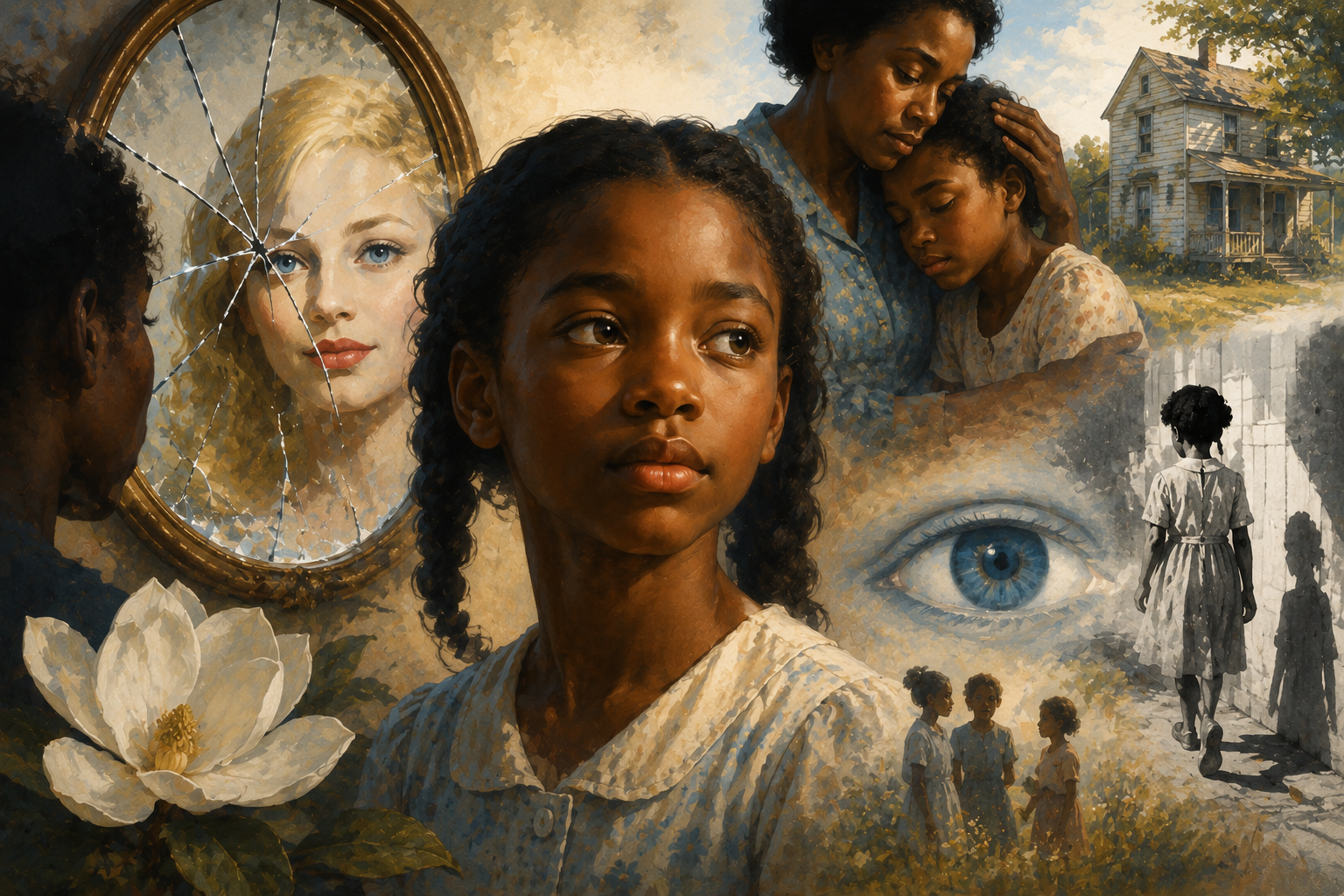
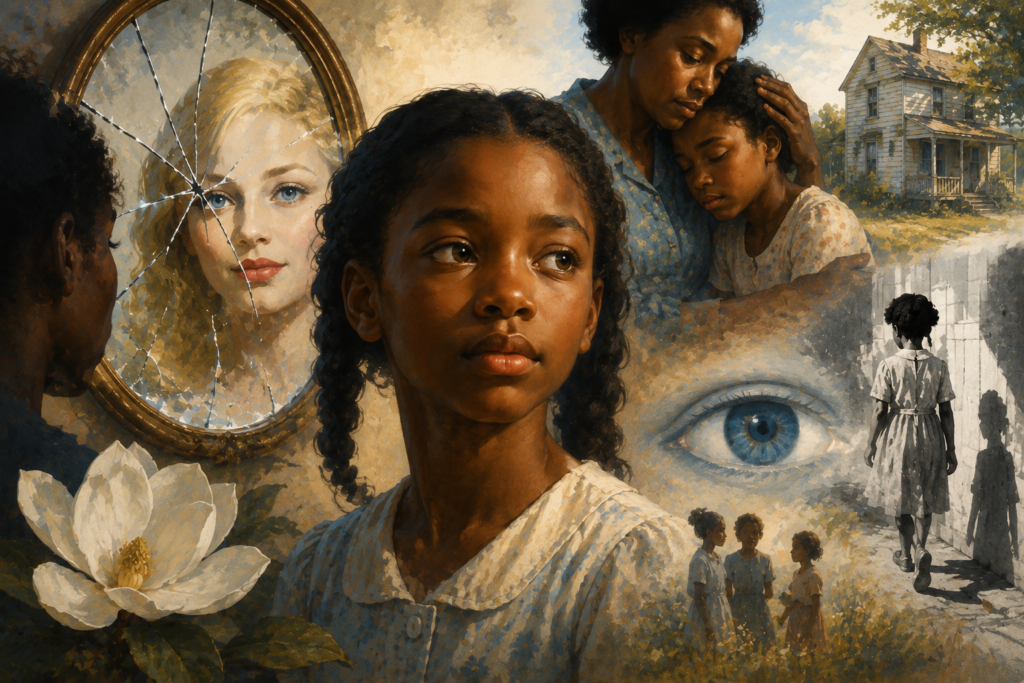
Toni Morrison’s The Bluest Eye gives students many passages that feel quiet at first, then grow sharper the more you study them. This guide to The Bluest Eye quotes explained shows what the major moments mean and how to use them in essays.
In this Guide
- Why Morrison’s language matters
- Beauty and shame
- Family, harm, and silence
- Voice, structure, and symbols
- How to use passages in essays
- Related books and resources
- FAQ

The Bluest Eye quotes explained: why Morrison’s language matters
Morrison builds meaning through pattern, contrast, and point of view.
Because Toni Morrison’s novel is still under copyright, this guide paraphrases key passages instead of reprinting long quotes. Use your own copy for exact wording, page numbers, and citation style.
Anyone searching for The Bluest Eye quotes explained should look for pressure points. Notice where a character wants love, where a community repeats a cruel idea, or where the narration shifts.
Morrison does not just tell us that beauty standards hurt Pecola. She shows how those standards enter school, home life, movies, and casual speech.
That is why close reading matters. A single passage can reveal the novel’s view of race, gender, poverty, and childhood pain.
The broken school-reader opening
One of the most important passages echoes a children’s reader about a neat house and a happy family. Morrison changes the rhythm until the language feels rushed and unstable.
This is a strong place for The Bluest Eye quotes explained because the style does part of the argument. The form exposes the lie of the perfect American home.
In an essay, you could argue that Morrison uses a familiar schoolbook sound to question what children are taught to value. The passage asks who gets included in that happy picture and who gets pushed out.
For a public-domain comparison, think of Shakespeare’s Othello, where Iago warns, ‘O, beware, my lord, of jealousy.’ Shakespeare names the danger out loud. Morrison often shows danger through broken patterns and repeated images.
The Bluest Eye quotes explained through beauty and shame
The novel’s beauty passages show how racism can become personal and painful.
Pecola’s wish for blue eyes
Pecola believes blue eyes would change how others see her. Her wish is not simple vanity.
It shows how a cruel culture can teach a child to reject herself. Pecola wants a new face because she thinks love depends on being seen as beautiful.
For The Bluest Eye quotes explained in essays, connect this passage to internalized racism, not just appearance. Morrison shows how beauty can become a social rule.
A strong thesis might say that Pecola’s wish reveals the violence of beauty standards. The desire for blue eyes becomes proof that the world has failed her.
Claudia and the blue-eyed doll
Claudia’s reaction to the doll gives readers a sharp contrast with Pecola’s desire. Claudia does not worship the doll’s beauty.
Her anger asks an important question: why should one kind of beauty be treated as natural or superior?
This moment helps students show contrast. Claudia questions the system that Pecola absorbs.
You can compare this to Jane Eyre by Charlotte Brontë, where appearance affects how people judge worth. Morrison’s novel is harsher because the standard is tied to racial power.
The Bluest Eye quotes explained through family and harm
These passages need careful wording because Morrison shows harm without asking readers to excuse it.
Cholly’s past
Morrison gives Cholly a history marked by fear, humiliation, and violence. That history does not forgive his later actions.
It helps readers see how trauma can move across time. The novel asks us to study causes without removing blame.
In an essay, avoid saying Cholly is simply evil or simply a victim. Morrison’s characterization is more complex than that.
Pauline’s movie dreams
Pauline learns to measure beauty through films and idealized images. Over time, those images shape how she sees herself and her family.
Her story shows that beauty standards do not stay on movie screens. They enter daily life and affect how people give or withhold care.
This passage works well in essays about illusion. Pauline wants order and beauty, but the version she follows comes from a world that rejects her.
For background on Morrison’s life and awards, see Britannica’s profile of Toni Morrison.
The Bluest Eye quotes explained through voice, structure, and symbols
Morrison’s structure helps readers feel the damage the characters cannot always name.
Claudia’s narration
Claudia looks back on childhood with a voice that mixes memory and later understanding. This layered voice matters.
The child voice shows confusion. The adult voice adds insight.
In an essay, you can argue that Claudia’s narration protects Pecola from being reduced to a symbol. Claudia remembers Pecola as a person who was failed by others.
The marigolds
The marigolds connect personal tragedy to a larger failure of care. When they do not grow, the image suggests that something is wrong with the soil of the community.
This symbol is useful because it links nature with moral responsibility. The novel asks whether the community helped create the conditions for Pecola’s suffering.
Blue eyes
Blue eyes become a false promise. Pecola thinks they will bring safety and love.
Instead, the symbol shows how deeply she has accepted the world’s cruel judgment. The image is beautiful on the surface, but painful in meaning.
For more context on Morrison’s literary importance, see the Nobel Prize biography of Toni Morrison.
How to use The Bluest Eye quotes explained in essays
The best essay paragraphs move from evidence to meaning.
Do not drop a passage into a paragraph and hope it proves your point. Set up the context first. Then name the technique and explain the effect.
- Choose a short passage from your copy of the novel.
- Identify the speaker or narrator.
- Name one craft choice, such as symbol, contrast, or repetition.
- Tie the passage back to your thesis.
The strongest The Bluest Eye quotes explained make a claim about how Morrison writes, not only what happens in the plot.
If you need a full structure for your paper, this guide to writing a literary analysis essay can help you build stronger body paragraphs.
If you want a fast note system, try our printable quote organizer for literature essays.
Essay angles students can build from these passages
Many students know what a passage means, but they struggle to turn it into a thesis. Start with a focused claim.
- Beauty as a social lesson: The novel shows that beauty standards are taught, not natural.
- Childhood and damage: Morrison shows how children suffer under adult systems.
- Community responsibility: Pecola’s tragedy is not hers alone.
- Voice and memory: Claudia’s narration turns memory into moral witness.
A weak essay says, “This quote shows Pecola is sad.” A stronger essay says the passage shows how racist beauty ideals shape Pecola’s view of herself.
Books to read with The Bluest Eye
You can find these through your school library, local bookstore, or Amazon. No affiliate links are included here.
- The Bluest Eye by Toni Morrison
- Their Eyes Were Watching God by Zora Neale Hurston
Hurston’s novel pairs well with Morrison’s because both works explore Black womanhood, voice, and self-definition in American literature.
FAQ: The Bluest Eye quotes explained
What should students focus on when studying key passages?
Focus on context, speaker, symbol, and effect. Ask how Morrison’s language shapes the meaning.
Can I quote The Bluest Eye in a school essay?
Yes. Use brief excerpts from your own copy and cite page numbers in the format your teacher requires.
What is one of the most important passage topics?
Pecola’s desire for blue eyes is central because it shows how racism and beauty standards harm her sense of self.
How should I write about difficult scenes?
Use respectful language. Explain what the scene reveals about power, trauma, and responsibility without treating harm as a plot twist.
Why does Morrison use symbols like marigolds?
Symbols help Morrison connect private pain to a wider social failure. They make the novel’s moral questions visible.
Key takeaway
The Bluest Eye is not just a novel with memorable passages. Its language shows how a culture teaches people what to value and whom to ignore.