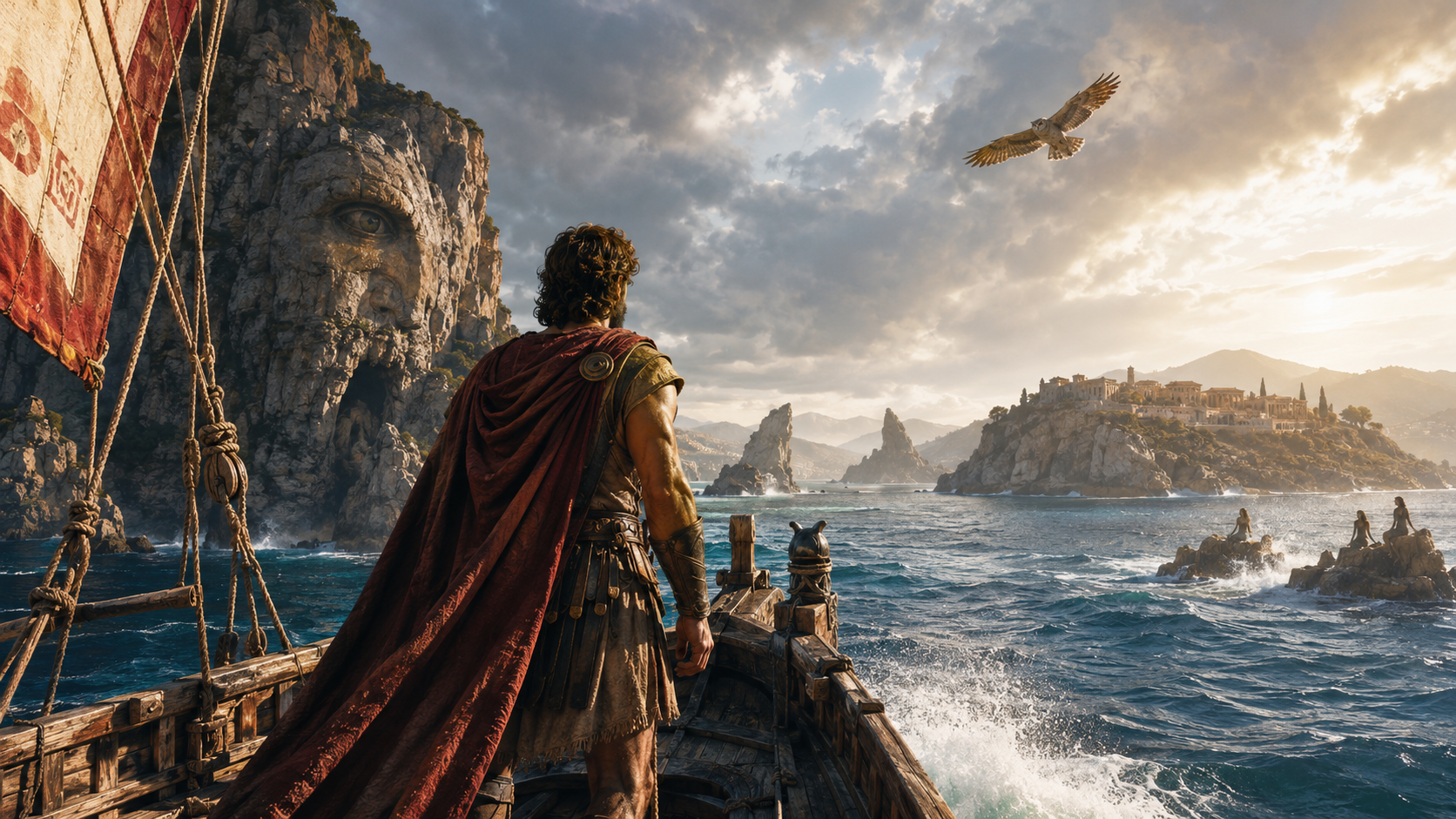
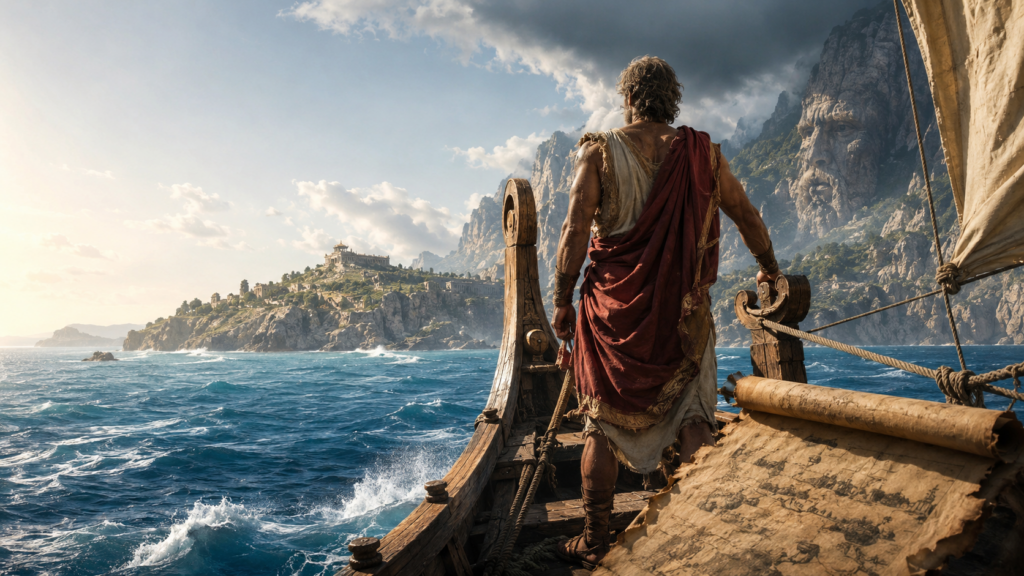
Before you see a new movie adaptation of The Odyssey, it helps to know why this ancient story has lasted for nearly three thousand years. Homer’s epic is not just a tale about a hero trying to get home. It is a story about war, temptation, loyalty, pride, suffering, and the difficult return to ordinary life after extraordinary violence. At its heart, The Odyssey asks a simple but powerful question: what does it take to come home changed, and still be recognized as yourself?
How The Odyssey Begins After the Trojan War
The Odyssey begins after the events of the Trojan War, a legendary conflict between the Greeks and the city of Troy. Odysseus, king of Ithaca, was one of the Greek leaders who fought in that war and played a major role in its ending. He is often credited with the idea of the Trojan Horse, the clever trick that allowed the Greeks to enter Troy and win after ten long years of fighting.
But the story does not begin with triumph. Instead, it begins with delay, loss, and exhaustion. The war is over, but Odysseus has not returned home. While other warriors have either reached their kingdoms or met terrible fates, Odysseus remains missing, trapped in a long and dangerous journey across the sea.
This is important because The Odyssey is not really about winning a war. It is about what happens after victory, when a soldier must face the consequences of his choices and find his way back to family, identity, and peace. The epic begins in a world where the battlefield is behind Odysseus, but his greatest test is still ahead.
Who Odysseus Is and Why His Journey Matters
Odysseus is not the strongest Greek hero, nor the most perfect. His defining trait is intelligence. He is known for his cunning, his ability to improvise, and his talent for surviving impossible situations. He can lie, disguise himself, persuade enemies, and think his way out of danger when brute force would fail.
That cleverness makes him fascinating, but it also gets him into trouble. Odysseus is proud, sometimes reckless, and often unable to resist proving how smart or important he is. One of the key tensions in the story is whether his intelligence will save him or whether his ego will keep creating new disasters.
His journey matters because it turns the idea of heroism inside out. Instead of focusing only on glory, The Odyssey focuses on endurance. Odysseus must survive storms, monsters, divine anger, temptation, grief, and loneliness. His goal is not to conquer a kingdom, but to return to the one he already has.
The world of The Odyssey is filled with gods who interfere constantly in human lives. Athena, goddess of wisdom, often supports Odysseus because she admires his intelligence and courage. Poseidon, god of the sea, becomes his great enemy, especially after Odysseus blinds Poseidon’s son, the Cyclops Polyphemus.
Many of the famous episodes in the story involve strange lands and supernatural threats. Odysseus encounters the Lotus-Eaters, whose fruit makes men forget their desire to go home. He faces the Cyclops, escapes the witch-goddess Circe, travels to the underworld, hears the deadly song of the Sirens, and must navigate between the sea monsters Scylla and Charybdis.
These trials are not just random adventures. Each one tests a different part of Odysseus and his crew: discipline, memory, loyalty, courage, restraint, and judgment. In a movie adaptation, these episodes may become spectacular action sequences, but their deeper meaning lies in how each temptation pulls Odysseus further from—or closer to—home.
What Penelope and Ithaca Add to the Story
While Odysseus struggles across the sea, his wife Penelope waits in Ithaca. She is surrounded by suitors who believe Odysseus is dead and pressure her to marry one of them. These men invade the palace, consume the household’s wealth, and threaten the future of Odysseus’ family and kingdom.
Penelope is one of the most important figures in the story because she mirrors Odysseus in intelligence and patience. She delays the suitors through clever tricks, including weaving and unweaving a burial shroud to postpone choosing a new husband. Like Odysseus, she survives through strategy rather than force.
Ithaca gives the epic its emotional center. Without Penelope, their son Telemachus, and the threatened household, Odysseus’ journey would be just a series of adventures. The home he is trying to reach is not merely a place on a map. It represents love, order, memory, kingship, and the possibility of becoming whole again.
Key Themes to Watch for in the Adaptation
One major theme to watch for is the meaning of homecoming. The Odyssey is the great ancient story of “nostos,” or return. But coming home is not simple. Odysseus must prove who he is, confront what has changed, and reclaim his place without losing the hard-won wisdom of his journey.
Another important theme is the danger of pride. Odysseus survives because he is clever, but he suffers because he cannot always control his need for recognition. The story repeatedly asks whether greatness requires humility, and whether a hero can learn to master himself as well as his enemies.
Loyalty is also central. Penelope’s loyalty, Telemachus’ growth, the faithfulness of certain servants, and the failures of Odysseus’ crew all shape the story’s emotional stakes. As you watch the adaptation, pay attention not only to the monsters and gods, but to who remains faithful when hope seems lost.
The Odyssey endures because it combines adventure with deep human questions. It has monsters, magic, storms, and divine battles, but its true power comes from the longing to return home after being changed by hardship. Before seeing the movie, remember that Odysseus’ voyage is both physical and spiritual. He is sailing toward Ithaca, but he is also trying to rediscover who he is, what he owes to the people who love him, and whether he can finally become worthy of the home he has spent so long trying to reach.
Christopher Nolan’s The Odysseybrings Homer’s ancient story to the screen as a vast IMAX adventure. Matt Damon plays Odysseus, the king of Ithaca who struggles to return home after the Trojan War. The film includes the Cyclops, Circe, Calypso, the Sirens, Penelope, Telemachus, and many of the characters audiences expect to see.
Yet Nolan does not simply illustrate Homer’s poem.
The central difference in The Odyssey movie vs. Homer’s epic involves the kind of hero at the story’s center. Homer presents Odysseus as a brilliant, deceptive, and morally difficult survivor. Nolan turns him into a war-weary man who questions whether he deserves to return home.
The movie preserves the journey, but it changes what the journey means.
Spoiler warning: This article discusses major events and the ending of Christopher Nolan’s 2026 film.
Is Christopher Nolan’s The Odyssey Faithful to Homer?
Nolan’s film remains faithful to the broad outline of the epic. Odysseus leaves Troy and spends years trying to reach Ithaca. He loses his men, confronts monsters, encounters powerful women, and eventually returns to a household threatened by Penelope’s suitors.
The movie also preserves many of the poem’s central themes. Homecoming, loyalty, hospitality, identity, pride, and recognition still shape the story.
However, adaptation requires selection. Homer’s poem contains 24 books, a large cast, several embedded stories, and an unusual structure. Nolan compresses events, removes characters, and changes motivations to create a more unified film.
The result is not a literal translation of the poem. It is a modern interpretation of it.
Nolan Makes Odysseus More Remorseful
The largest change concerns Odysseus himself.
Homer introduces a hero known for his many turns. Odysseus changes his manner, identity, and story whenever circumstances require it. He lies easily and often. Some lies protect him, while others seem to reveal how much he enjoys controlling a story.
His cleverness allows him to survive.
Nolan reduces this playful trickster quality. His Odysseus still possesses intelligence and military skill, but guilt weighs heavily on him. The destruction of Troy has left him troubled by the human cost of his own strategies.
The film treats the Trojan Horse as more than a clever victory. It becomes the source of Odysseus’s moral injury. His success helped the Greeks destroy a city, but that success also leaves him questioning the kind of man he has become.
This change gives the movie a more modern concern with war trauma and personal responsibility. Homer asks how a complicated man can recover his home and identity. Nolan asks whether a man responsible for terrible violence can return home unchanged.
The Trojan Horse Becomes a Major Part of the Story
Homer’s Odyssey does not show the fall of Troy as a continuous action sequence. Characters remember and retell events from the war, including the story of the wooden horse.
Nolan places the Trojan Horse near the beginning of the film and gives the fall of Troy a much larger role. This allows viewers to witness the event that haunts Odysseus throughout his journey.
The film also introduces Sinon, played by Elliot Page. Sinon comes primarily from Virgil’s Aeneid, not Homer’s Odyssey. In the later Roman epic, Sinon helps convince the Trojans to bring the wooden horse inside their city.
By adding Sinon, Nolan combines material from different parts of the classical tradition. Sinon also becomes a reminder of the ordinary soldiers used and forgotten by powerful leaders.
The change connects the spectacular opening of the movie to its deeper question: What does a victorious commander owe the people who suffered because of his plans?
The Movie Reduces the Direct Role of the Gods
The gods appear throughout Homer’s epic.
Athena disguises herself, guides Telemachus, assists Odysseus, and helps restore order in Ithaca. Poseidon’s anger keeps Odysseus from reaching home. Zeus makes decisions that shape the journey, while Hermes provides direct assistance during the encounters with Calypso and Circe.
Nolan’s world feels more human and less openly controlled by Olympus. Athena remains present, but much of the poem’s direct divine intervention disappears. Zeus, Poseidon, and Hermes do not repeatedly enter scenes to explain or alter events.
This change affects the question of responsibility.
In Homer, the gods influence human lives according to their loyalties and desires. People still make choices, but divine favor can determine whether those choices succeed.
In the film, Odysseus cannot blame every loss on a hostile god. His decisions carry more of the moral burden.
Students comparing the two versions should pay close attention to this difference. Removing direct intervention does not merely make the movie more realistic. It changes the relationship between fate and free will.
The Cyclops Scene Changes Odysseus’s Famous Mistake
The encounter with Polyphemus is one of the best-known episodes in the poem.
Homer’s Odysseus tells the Cyclops that his name is “Nobody.” After Odysseus blinds him, Polyphemus cries out that Nobody is hurting him. The other Cyclopes assume that he does not need help.
The plan works, but Odysseus cannot resist claiming credit. Once safely aboard his ship, he reveals his real name. Polyphemus then calls upon his father, Poseidon, to punish Odysseus.
This moment captures the contradiction within Homer’s hero. His cleverness saves him, but his pride creates a new disaster.
Nolan removes much of the verbal exchange, including the famous “Nobody” trick. His Odysseus also avoids the boast that causes so much harm in the poem.
The movie keeps the horror of the Cyclops but reduces the episode’s focus on language and pride. This choice supports Nolan’s more remorseful hero, though it removes one of Homer’s clearest examples of Odysseus defeating himself.
Calypso Changes from Captor to Caregiver
In Homer’s poem, Calypso keeps Odysseus on her island for seven years. She wants him to remain with her and offers him immortality. Odysseus longs for Ithaca despite the comfort and beauty surrounding him.
The movie presents Calypso differently.
Nolan’s Calypso gives Odysseus lotus flowers that dull his memories. The lotus originally belongs to another episode in Homer’s poem, where the Lotus-Eaters cause Odysseus’s men to forget their desire for home.
By combining Calypso with the lotus, Nolan turns her island into a place of emotional escape. Forgetfulness temporarily protects Odysseus from his memories of war.
Calypso therefore seems less like a jealous captor and more like a caretaker offering relief. When Odysseus remembers home, she allows him to leave.
The change fits the movie’s interest in memory and trauma. It also reduces some of the troubling power and sexual imbalance found in Homer’s version.
Circe Exposes Greed Instead of Seducing Odysseus
Homer’s Circe transforms Odysseus’s men into pigs. Hermes gives Odysseus the protection he needs to resist her magic. Odysseus then becomes Circe’s lover and remains on her island for a year.
The film keeps the transformation but changes its meaning.
Nolan’s Circe turns the men into pigs to expose the greed already within them. The punishment becomes a visible sign of their behavior rather than simply an act of enchantment. Her relationship with Odysseus also loses much of the poem’s sexual element.
This version supports the film’s broader concern with appetite. The men consume food without restraint, the suitors consume Odysseus’s household, and war consumes human lives.
Circe’s magic reveals what uncontrolled desire can make of a person.
The Phaeacians and Homer’s Storytelling Frame Disappear
Homer does not present most of Odysseus’s adventures as they happen.
Odysseus tells the Phaeacians about the Cyclops, Circe, the Sirens, and other dangers after those events have already occurred. This structure turns Odysseus into the narrator of his own legend.
That matters because Odysseus is an accomplished storyteller and liar. Readers must consider how he shapes his account and presents himself to his hosts.
Nolan removes the Phaeacian frame and shows the adventures more directly. This makes the movie easier to follow, but it also removes an important layer of uncertainty.
Homer asks readers to listen to a survivor tell his own story. Nolan asks viewers to witness the survivor’s experiences.
Some Women Gain New Motivations but Lose Mythic Power
Nolan has said that he wanted viewers to see the people behind the poem’s female icons. Helen, for example, carries visible and emotional consequences from the Trojan War. Penelope remains central to the questions of loyalty, memory, and home.
Other changes are more complicated.
Athena loses much of the direct power she exercises in Homer. Calypso becomes more of a sympathetic listener, while Circe’s role is shortened and separated from her year-long relationship with Odysseus.
These choices make the women more psychologically modern in some scenes, but they can also reduce their narrative power. Critics have already disagreed about whether Nolan deepens these characters or makes them secondary to Odysseus’s guilt.
This tension gives students a useful comparison topic: Does making a mythological woman more realistic necessarily make her more complex?
The Movie Changes the Meaning of the Ending
Homer’s poem does not end immediately after Odysseus kills the suitors and reunites with Penelope.
The families of the dead suitors threaten further violence. Athena, acting with Zeus’s approval, brings the conflict to an end. Divine intervention restores peace to Ithaca.
Nolan gives the story a different conclusion.
At the end of the film, Odysseus sails west with Penelope. He does not leave in search of more glory or wealth. He intends to honor the men who died under his command.
Homer closes with order restored. Nolan closes with a debt that still needs to be paid.
That difference reveals the movie’s central purpose. Nolan is less interested in whether Odysseus can reclaim his throne than in whether he can accept responsibility for the cost of his return.
What Is the Biggest Difference Between the Movie and the Poem?
The greatest difference in The Odyssey movie vs. Homer’s epic is the moral direction of Odysseus’s journey.
Homer’s hero must survive long enough to recover his name, household, marriage, and authority. His flaws complicate his heroism, but the poem does not require him to reject the values of his warrior culture.
Nolan’s hero must confront the damage created by those same values. His journey home becomes a reckoning with war, leadership, and guilt.
The film therefore changes the epic from a story of recovery into a story of attempted redemption.
That change may disappoint viewers who want Homer’s unpredictable trickster in full. It may also help modern audiences see why this ancient journey still speaks to questions about power and responsibility.
Frequently Asked Questions
Does The Odyssey movie follow Homer’s book?
The movie follows the epic’s central journey and includes many famous characters and episodes. It changes some motivations, removes the Phaeacian storytelling frame, reduces direct divine intervention, and gives Odysseus a stronger sense of remorse.
Did Homer write about the Trojan Horse?
The Trojan Horse is mentioned and remembered in Homeric poetry, but The Odyssey does not present the fall of Troy as the extended opening action shown in Nolan’s film. The character Sinon comes from Virgil’s Aeneid rather than The Odyssey.
Why are the gods less visible in Nolan’s movie?
Reducing the gods’ direct involvement places more responsibility on Odysseus and other human characters. Events feel less like divine punishment and more like consequences of human choices.
Is Nolan’s Odysseus different from Homer’s Odysseus?
Yes. Homer’s Odysseus is a clever trickster who lies, adapts, and sometimes creates trouble through pride. Nolan’s Odysseus is more openly troubled by war and concerned with making amends.
Should I read The Odyssey after watching the movie?
Yes. The film provides the scale and excitement of the journey, while the poem offers a more complicated hero, a larger role for the gods, and a layered storytelling structure that no single movie can reproduce.
Key Takeaway
Christopher Nolan’s The Odyssey does more than place Homer’s monsters on an IMAX screen. It reshapes the ancient epic around guilt and responsibility. Homer’s Odysseus fights to recover his former life. Nolan’s Odysseus must decide what kind of life he can build after everything he has done.
Both versions ask whether a person can truly return home. They offer very different answers.