

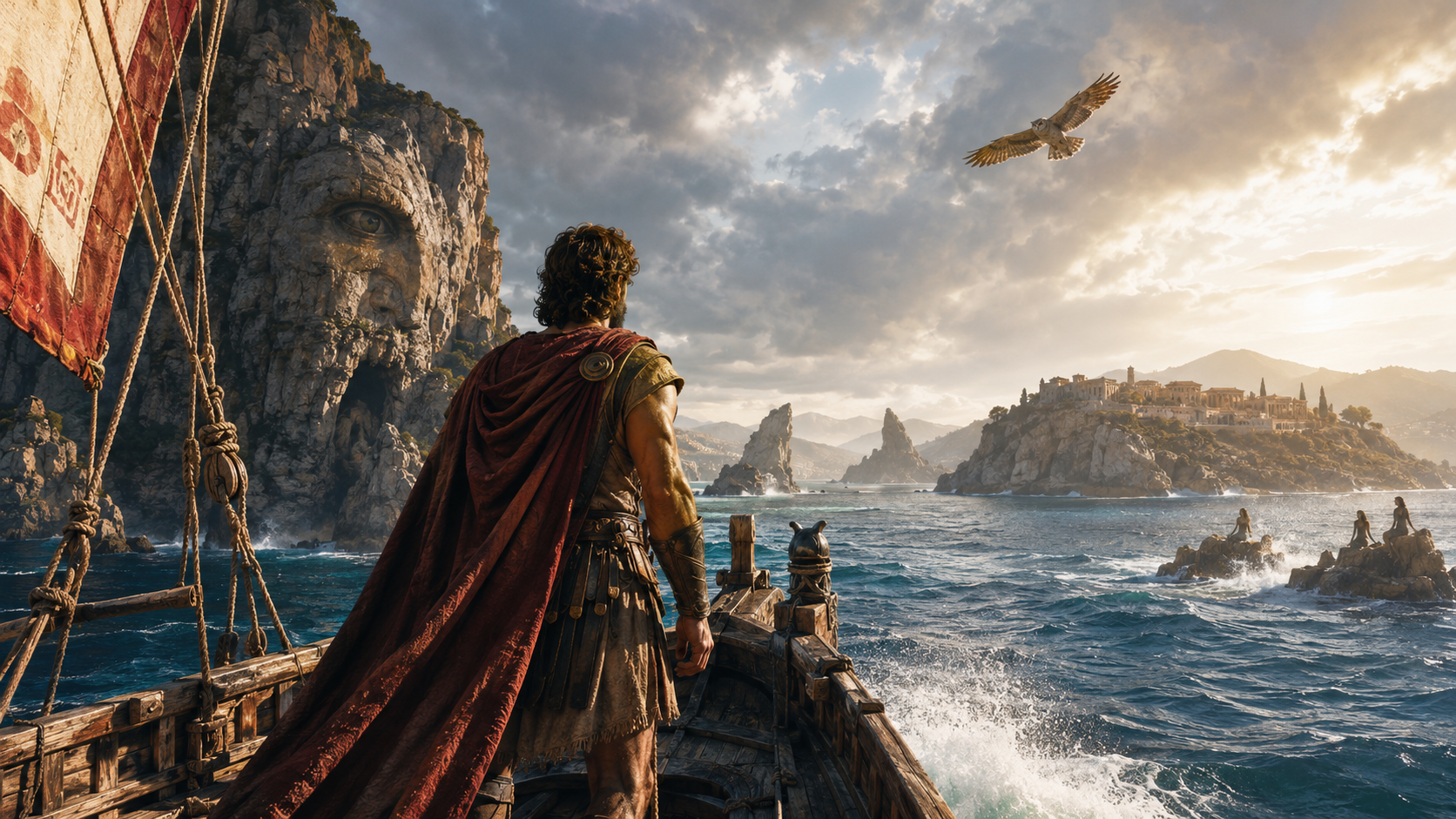
Before you see a new movie adaptation of The Odyssey, it helps to know why this ancient story has lasted for nearly three thousand years. Homer’s epic is not just a tale about a hero trying to get home. It is a story about war, temptation, loyalty, pride, suffering, and the difficult return to ordinary life after extraordinary violence. At its heart, The Odyssey asks a simple but powerful question: what does it take to come home changed, and still be recognized as yourself?
How The Odyssey Begins After the Trojan War
The Odyssey begins after the events of the Trojan War, a legendary conflict between the Greeks and the city of Troy. Odysseus, king of Ithaca, was one of the Greek leaders who fought in that war and played a major role in its ending. He is often credited with the idea of the Trojan Horse, the clever trick that allowed the Greeks to enter Troy and win after ten long years of fighting.
But the story does not begin with triumph. Instead, it begins with delay, loss, and exhaustion. The war is over, but Odysseus has not returned home. While other warriors have either reached their kingdoms or met terrible fates, Odysseus remains missing, trapped in a long and dangerous journey across the sea.
This is important because The Odyssey is not really about winning a war. It is about what happens after victory, when a soldier must face the consequences of his choices and find his way back to family, identity, and peace. The epic begins in a world where the battlefield is behind Odysseus, but his greatest test is still ahead.
Who Odysseus Is and Why His Journey Matters
Odysseus is not the strongest Greek hero, nor the most perfect. His defining trait is intelligence. He is known for his cunning, his ability to improvise, and his talent for surviving impossible situations. He can lie, disguise himself, persuade enemies, and think his way out of danger when brute force would fail.
That cleverness makes him fascinating, but it also gets him into trouble. Odysseus is proud, sometimes reckless, and often unable to resist proving how smart or important he is. One of the key tensions in the story is whether his intelligence will save him or whether his ego will keep creating new disasters.
His journey matters because it turns the idea of heroism inside out. Instead of focusing only on glory, The Odyssey focuses on endurance. Odysseus must survive storms, monsters, divine anger, temptation, grief, and loneliness. His goal is not to conquer a kingdom, but to return to the one he already has.

The Gods, Monsters, and Trials on His Route
The world of The Odyssey is filled with gods who interfere constantly in human lives. Athena, goddess of wisdom, often supports Odysseus because she admires his intelligence and courage. Poseidon, god of the sea, becomes his great enemy, especially after Odysseus blinds Poseidon’s son, the Cyclops Polyphemus.
Many of the famous episodes in the story involve strange lands and supernatural threats. Odysseus encounters the Lotus-Eaters, whose fruit makes men forget their desire to go home. He faces the Cyclops, escapes the witch-goddess Circe, travels to the underworld, hears the deadly song of the Sirens, and must navigate between the sea monsters Scylla and Charybdis.
These trials are not just random adventures. Each one tests a different part of Odysseus and his crew: discipline, memory, loyalty, courage, restraint, and judgment. In a movie adaptation, these episodes may become spectacular action sequences, but their deeper meaning lies in how each temptation pulls Odysseus further from—or closer to—home.
What Penelope and Ithaca Add to the Story
While Odysseus struggles across the sea, his wife Penelope waits in Ithaca. She is surrounded by suitors who believe Odysseus is dead and pressure her to marry one of them. These men invade the palace, consume the household’s wealth, and threaten the future of Odysseus’ family and kingdom.
Penelope is one of the most important figures in the story because she mirrors Odysseus in intelligence and patience. She delays the suitors through clever tricks, including weaving and unweaving a burial shroud to postpone choosing a new husband. Like Odysseus, she survives through strategy rather than force.
Ithaca gives the epic its emotional center. Without Penelope, their son Telemachus, and the threatened household, Odysseus’ journey would be just a series of adventures. The home he is trying to reach is not merely a place on a map. It represents love, order, memory, kingship, and the possibility of becoming whole again.
Key Themes to Watch for in the Adaptation
One major theme to watch for is the meaning of homecoming. The Odyssey is the great ancient story of “nostos,” or return. But coming home is not simple. Odysseus must prove who he is, confront what has changed, and reclaim his place without losing the hard-won wisdom of his journey.
Another important theme is the danger of pride. Odysseus survives because he is clever, but he suffers because he cannot always control his need for recognition. The story repeatedly asks whether greatness requires humility, and whether a hero can learn to master himself as well as his enemies.
Loyalty is also central. Penelope’s loyalty, Telemachus’ growth, the faithfulness of certain servants, and the failures of Odysseus’ crew all shape the story’s emotional stakes. As you watch the adaptation, pay attention not only to the monsters and gods, but to who remains faithful when hope seems lost.
The Odyssey endures because it combines adventure with deep human questions. It has monsters, magic, storms, and divine battles, but its true power comes from the longing to return home after being changed by hardship. Before seeing the movie, remember that Odysseus’ voyage is both physical and spiritual. He is sailing toward Ithaca, but he is also trying to rediscover who he is, what he owes to the people who love him, and whether he can finally become worthy of the home he has spent so long trying to reach.


Get the Free Close Reading Worksheet Pack
Join my email list and receive the printable worksheet pack you can use with any novel or poem.
No spam. Just helpful guides for reading literature well.












