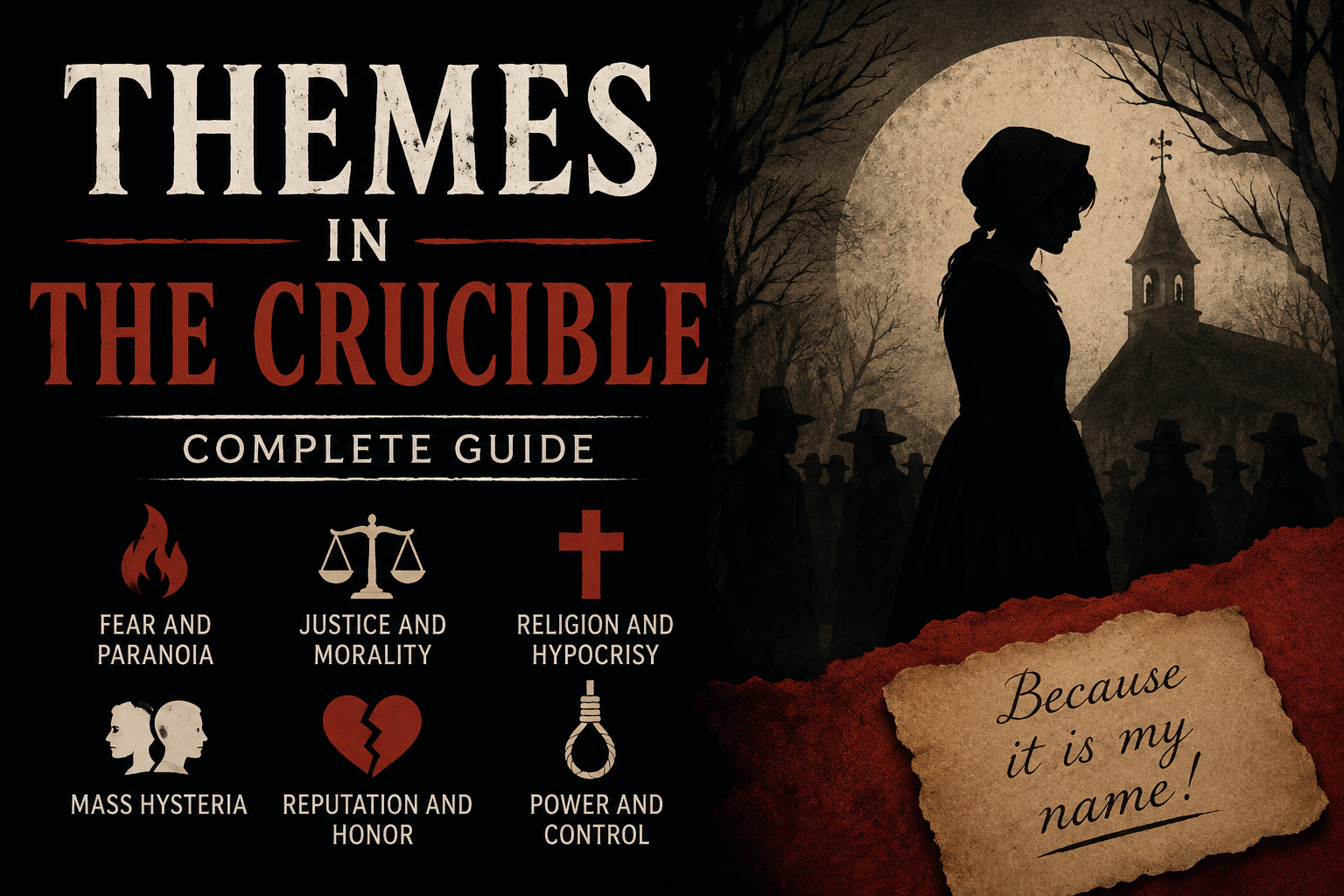
Themes in The Crucible: A Student-Friendly Guide

Themes in The Crucible

The main themes in The Crucible help students see why Arthur Miller’s Salem drama still feels tense and modern. In this guide, we will look at fear, public shame, power, justice, and truth so you can discuss the play with more confidence.
Themes in The Crucible

In this Guide

Use this table of contents to find the idea you need.

  • Why the play’s themes matter
  • Fear and mass hysteria
  • Reputation and public shame
  • Power and corrupt authority
  • Justice and truth
  • Essay tips and study resources
  • FAQ

Why the themes in The Crucible Matter

Arthur Miller wrote about Salem, but he was also speaking to his own time.

The Crucible is set during the Salem witch trials of 1692. In that world, a rumor can ruin a life. A court can twist faith into a weapon. A person can lose everything by telling the truth.

The themes in The Crucible matter because the play asks a hard question: what happens when a society values fear more than honesty?

Miller wrote the play during the age of McCarthyism, when many Americans were accused of Communist ties with weak proof. You can read more about Miller’s life at Britannica, or learn about McCarthyism from the National Archives.

Themes in The Crucible: Fear and Mass Hysteria

Fear spreads faster than facts in Salem.

At the start of the play, the town is already tense. People worry about sin, reputation, and punishment. When the girls begin to accuse others of witchcraft, fear takes over the town.

Mass hysteria means a group panic becomes more powerful than reason. In Salem, people accept wild claims because they are scared. They fear the Devil, but they also fear being accused.

Abigail Williams uses this fear to gain control. Once the court believes her, she can point at almost anyone. Her words become more powerful than evidence.

These themes in The Crucible connect to George Orwell’s Animal Farm. In both works, fear helps leaders control a group. People stop asking questions because the cost feels too high.

Themes in The Crucible: Reputation and Public Shame

In Salem, a good name can matter more than a good heart.

Reputation is one of the most painful forces in the play. Many characters care deeply about how others see them. They know that one bad rumor can lead to court, prison, or death.

Reverend Parris fears damage to his position. He worries that trouble in his house will make him look weak. His first concern is not truth, but public image.

John Proctor also struggles with his reputation. He has sinned, and he feels deep guilt. Yet his main conflict is not only private guilt. He must decide whether to save his life with a lie or keep his name clean by telling the truth.

The themes in The Crucible become personal here. Miller shows that shame can trap people. Nathaniel Hawthorne’s The Scarlet Letter also studies public shame, but Miller makes shame feel like a public trial.

Power, Control, and Corrupt Authority

The play shows how power can become dangerous when no one can question it.

The court in Salem claims to serve God and justice. Yet it often acts with pride and fear. Judge Danforth refuses to admit the court may be wrong because that would weaken his authority.

This makes the court more dangerous. If the judges admit one mistake, the whole system starts to fall apart. So they protect the court, even when innocent people suffer.

Abigail’s power is different. She has no official office, but she learns how to use the court. Her false claims give her control over adults who once had power over her.

This theme is useful for AP Literature essays because it shows conflict between public power and private truth. The play asks whether authority deserves respect when it refuses proof.

Justice, Lies, and the Demand for Proof

The Crucible turns the court into a place where truth becomes hard to recognize.

A fair court should ask for proof. In Salem, the court often accepts fear as proof. It trusts dramatic words, screams, and visions that no one else can see.

This is why the play feels so tense. The accused cannot defend themselves in a normal way. If they deny witchcraft, the court may see the denial as more proof of guilt.

Mary Warren’s failed confession shows this problem. She tries to tell the truth, but pressure breaks her. The court’s mood matters more than her facts.

Miller does not suggest that justice is simple. He shows that a legal system can fail when leaders care more about control than evidence.

Truth, Integrity, and Personal Courage

The play’s deepest question is whether truth is worth suffering for.

John Proctor is not a perfect hero. That is part of why students often find him interesting. He has lied before, and he has hurt others. Still, he wants to become honest before the end.

His final choice is painful. If he signs a false confession, he may live. If he refuses, he will die. His decision shows that integrity can cost more than comfort.

Elizabeth Proctor helps us see this theme too. She admits her own limits and gives John space to choose. Her quiet strength matters because she does not force him to become a symbol.

This theme also appears in Sophocles’ Antigone. Antigone, like Proctor, faces a state that demands obedience. Both characters must choose between survival and moral truth.

How to Write About Themes in The Crucible

A strong essay connects a theme to a clear claim about the whole play.

When you write about themes in The Crucible, do not just name the idea. Explain what Miller says about that idea. For example, do not write, “Fear is a theme.” Write, “Miller shows that fear can destroy justice when people value safety over truth.”

That second sentence gives you an argument. It tells your reader what the play reveals about fear.

Use short quotations if your teacher allows them. Then explain how the words prove your claim. The best analysis spends more time on meaning than plot summary.

If you need help with structure, use our guide to writing a literary analysis essay. It can help you build a clear thesis and stronger body paragraphs.

Recommended Books for Deeper Study

These books can help you understand the play and its background.

  • The Crucible by Arthur Miller
  • Arthur Miller: His Life and Work by Martin Gottfried

FAQ: Themes in The Crucible

Here are quick answers to common student questions.

What are the main themes in The Crucible?

The main themes in The Crucible include fear, reputation, power, justice, and integrity. Each theme connects to the Salem trials and Miller’s view of panic in society.

What is the most important theme in the play?

Many students choose fear as the most important theme. Fear drives the accusations and makes people accept weak proof.

How does reputation affect John Proctor?

Proctor wants to protect his name, but he also wants to be honest. His final choice shows that integrity matters more to him than survival.

Why did Arthur Miller write about Salem?

Miller used Salem to comment on his own time. He saw links between the witch trials and anti-Communist fear in the 1950s.

How can I write a strong theme paragraph?

Start with a claim about what the play says. Use one clear example from the text, then explain how it supports your idea.

Key Takeaway

The strongest themes in The Crucible show how fear can twist truth, damage justice, and test a person’s character. Miller’s play lasts because those problems still feel real today.
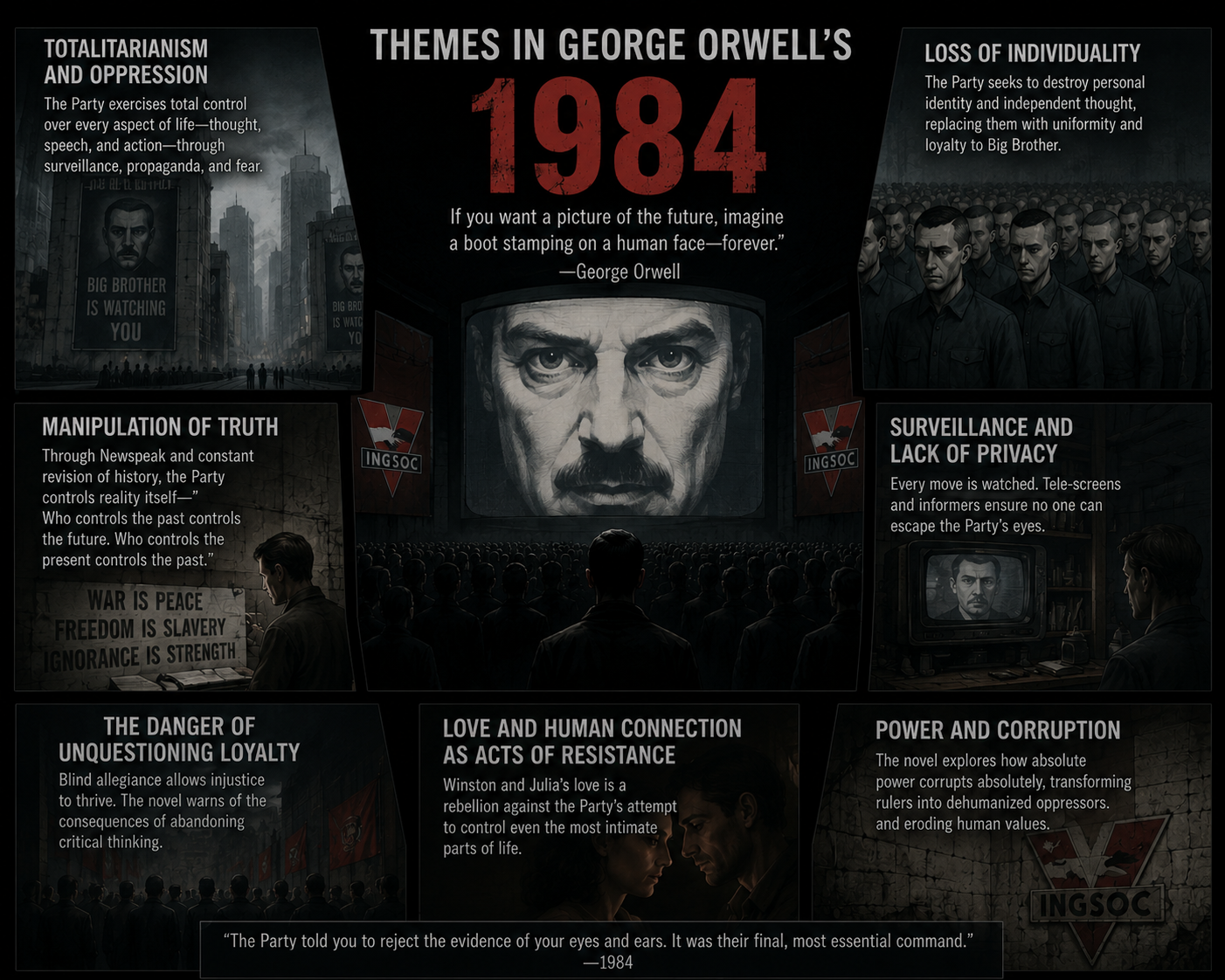
Themes in 1984: A Student-Friendly Guide to Orwell’s Big Ideas

themes in 1984

George Orwell’s 1984 is more than a dark story about a future society. The themes in 1984 help students see how power can shape truth, language, fear, and private thought.

This guide breaks down the major ideas you should notice for class discussion, close reading, and essays.

This article contains affiliate links.

In this Guide

Use this guide as a quick map before you write or review.

  • Understanding the major ideas in the novel
  • Power and control
  • Language and thought
  • Truth and memory
  • Fear and loyalty
  • Individual freedom
  • Books to read next
  • FAQ
themes in 1984

Understanding the Themes in 1984

Orwell uses Winston’s world to ask a simple but scary question: what happens when a government controls not just actions, but minds?

A theme is a big idea a text explores. In 1984, Orwell does not give readers easy answers. He shows a world where people may obey because they are afraid, tired, watched, or unsure what is true.

To study the novel well, do more than name the theme. Ask how Orwell builds it through setting, conflict, symbols, and character choices. If you need help with that step, see our guide on how to analyze characters in literature.

Winston matters because he wants the truth, even when truth feels dangerous. His struggle turns the novel’s ideas into a human story.

Themes in 1984: Power and Control

These themes in 1984 show that power works best when people believe they have no safe place to resist.

The Party controls public life through laws, screens, slogans, and punishment. Yet its deeper goal is mental control. It wants citizens to accept whatever the Party says, even if it changes from day to day.

Big Brother is the face of this power. He may or may not exist as a real person, but that almost does not matter. His image makes people feel watched at all times.

The telescreens are a clear symbol of this control. They turn private rooms into public spaces. Winston cannot fully relax, even in his own home.

This theme connects to many dystopian works. In The Hunger Games by Suzanne Collins, public fear and public display help the Capitol stay in power. In 1984, the Party goes even deeper because it tries to own thought itself.

Themes in 1984: Language and Thought

Orwell shows that language is not just a tool for speech. It can shape what people are able to think.

Newspeak is one of the most important ideas in the novel. The Party creates it to shrink language over time. If words for rebellion, freedom, or justice vanish, people may find it harder to imagine those ideas.

This is why the Party cares so much about words. It knows that clear language can protect clear thought. Confused language can hide lies.

The themes in 1984 become most clear when we see how slogans twist meaning. Phrases like War is Peace and Freedom is Slavery are not meant to make sense. They train people to accept contradiction without protest.

Students can compare this to propaganda in Shakespeare’s Julius Caesar. Mark Antony uses public speech to move the crowd. Orwell’s Party uses speech to block thought before it begins.

Themes in 1984: Truth, Memory, and History

In Orwell’s world, truth is not treated as something to discover. It is treated as something the Party can edit.

Winston works at the Ministry of Truth, but the name is a lie. His job is to change old records so the Party always appears right. If a prediction fails, the record changes. If a person becomes an enemy, the record erases that person.

This attack on history is one of the novel’s strongest warnings. If people cannot trust records, memory, or facts, they become easier to control.

When students study themes in 1984, this one often leads to strong essays. You can focus on how Orwell links truth to freedom. If citizens lose the past, they lose the power to question the present.

For more background on Orwell’s life and political concerns, visit Britannica’s overview of George Orwell.

Fear, Surveillance, and Self-Censorship

The Party does not need to punish everyone. It only needs people to believe punishment is always possible.

Fear shapes daily life in 1984. Citizens fear the Thought Police, their neighbors, and even their children. This fear causes people to hide their real feelings.

That is why surveillance is so powerful. The telescreen may not catch every action, but it changes behavior. People learn to police themselves.

This idea feels modern because many readers know what it means to act differently when they feel watched. Orwell pushes that feeling to an extreme. He asks what happens when privacy no longer exists.

Individual Freedom and Private Identity

Winston’s rebellion starts small because even small private acts matter in this world.

At first, Winston does not lead a movement. He writes in a diary. He remembers. He loves Julia. These acts matter because the Party wants no inner life outside its control.

The diary is especially important. It gives Winston a place to speak honestly, even if no one else reads it. In a world built on falsehood, private truth becomes a form of resistance.

Julia’s rebellion is different from Winston’s. She cares less about history and more about personal pleasure. Their differences help readers see that freedom can mean more than one thing.

To build a stronger essay, compare how Winston and Julia respond to control. Our character analysis guide can help you connect their choices to the novel’s larger ideas.

Why the Themes in 1984 Still Matter

Orwell’s novel still speaks to readers because it studies problems that do not belong to one time period.

The novel asks readers to care about truth, language, privacy, and power. These ideas matter in governments, schools, media, and personal life.

The key lesson is not only that total power is dangerous. Orwell also shows that people must protect the habits that keep freedom alive. Those habits include honest speech, memory, questions, and private thought.

This is why 1984 often appears in high school, AP Literature, and college courses. It gives students a strong way to discuss politics, ethics, and human behavior through fiction.

Books to Read Next

These books pair well with Orwell’s novel because they also ask how society shapes freedom and truth.

For a wider look at dystopian fiction as a genre, see Britannica’s page on dystopia.

FAQ About Themes in 1984

Use these quick answers for review before a quiz, seminar, or essay.

What are the main themes in 1984?

The main themes in 1984 include power, language, truth, fear, surveillance, and individual freedom. Each theme shows how the Party controls people from the outside and the inside.

What is the most important theme in 1984?

Many students choose control of truth as the most important theme. If the Party can rewrite facts, citizens lose the ability to challenge power.

How does Newspeak support the novel’s themes?

Newspeak limits thought by limiting words. Orwell suggests that people need rich, clear language to think freely.

Why does Winston keep a diary?

The diary lets Winston claim a private voice. It is a small act of rebellion because the Party wants to control even personal thoughts.

Key Takeaway

The themes in 1984 show how freedom can disappear when power controls truth, language, and private life. Orwell’s warning is clear: a free mind needs facts, memory, and the courage to question authority.

Romeo and Juliet Character Analysis: Key People, Motivations, and Conflicts

Romeo and Juliet character analysis

A practical breakdown of the main characters and how their choices shape the story.

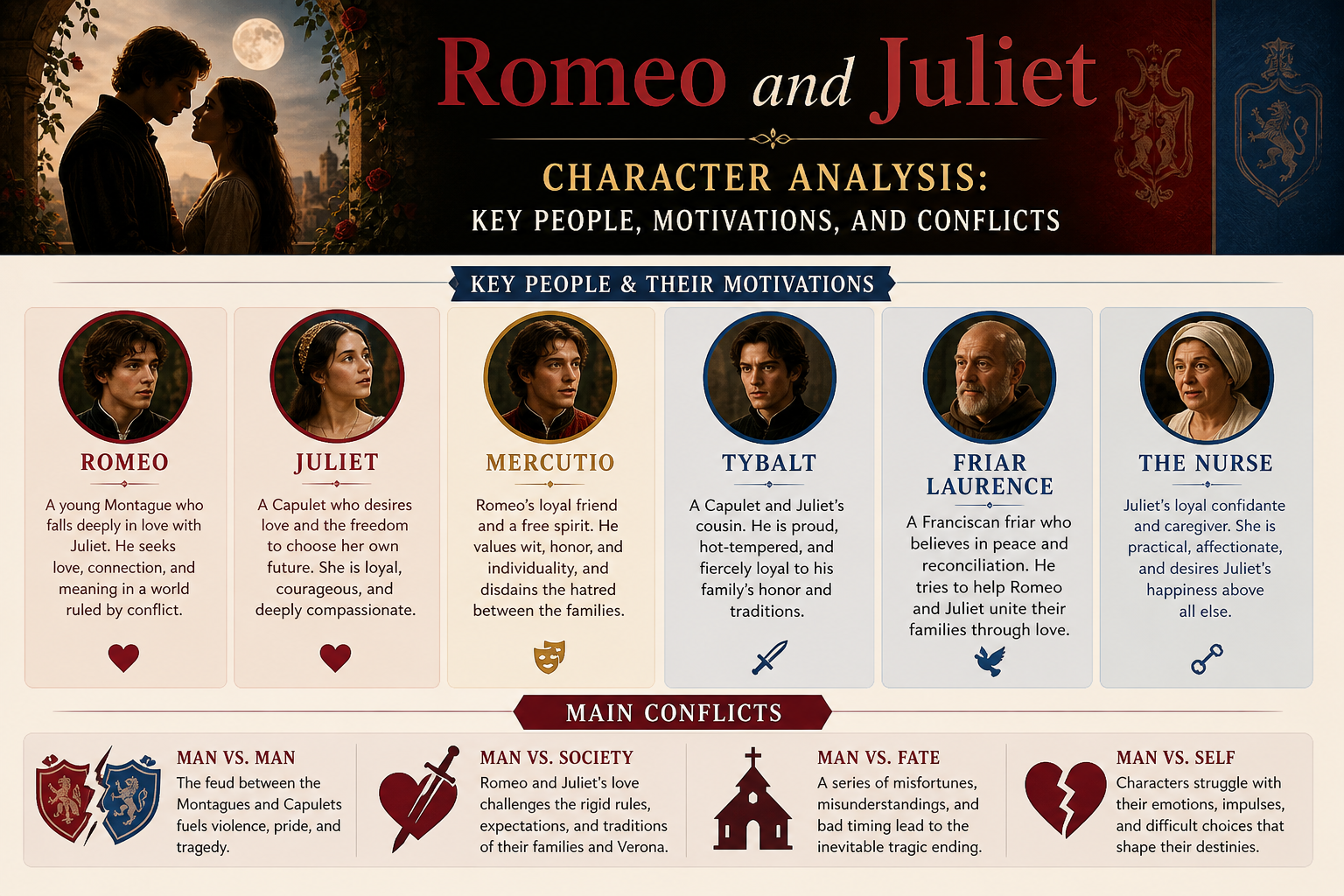
Shakespeare’s tragedy works because each character wants something badly, then acts before the full truth is clear. This Romeo and Juliet character analysis breaks down the main characters, their motives, and the conflicts that push the play toward its tragic end.

This article contains affiliate links.

In this Guide

Romeo and Juliet character analysis

Romeo and Juliet Character Analysis: The Big Picture

The play is not only about young love. It is also about family pressure, pride, anger, and the cost of poor choices.

In a strong Romeo and Juliet character analysis, the key question is not just “Who is good?” or “Who is bad?” A better question is, “What does this person want, and what choice do they make because of it?”

Romeo wants love that feels total. Juliet wants control over her own life. Lord Capulet wants family honor. Tybalt wants respect through violence.

These wants crash into each other. That is why the plot feels fast, tense, and painful.

If you need a simple method for any character essay, this guide to analyzing characters in literature can help you build stronger claims.

Romeo and Juliet Character Analysis of Romeo Montague

Romeo is emotional, romantic, and quick to act. His heart often moves faster than his judgment.

At the start, Romeo feels crushed because Rosaline does not love him back. This matters because it shows how easily he turns love into an obsession.

When he meets Juliet, his feelings shift at once. This does not mean his love is fake. It does mean he trusts intense feeling more than careful thought.

Romeo’s main conflict is between desire and self-control. He wants peace with Tybalt after he marries Juliet, but he cannot control his rage after Mercutio dies.

That choice changes everything. Romeo kills Tybalt, gets banished, and loses the chance to build a future with Juliet in Verona.

For essays, Romeo is a strong example of a tragic character whose best traits create danger. His passion makes him loving, but it also makes him reckless.

image-slider-with-thumbnail1.jpeg
PlayPause
previous arrow
next arrow
image-slider-with-thumbnail1.jpeg
image-slider-with-thumbnail3.jpeg
image-slider-with-thumbnail4.jpeg
ChatGPT Image Jun 27, 2026, 06_33_13 PM
ChatGPT Image Jun 27, 2026, 06_36_37 PM
ChatGPT Image Jun 27, 2026, 06_38_39 PM
ChatGPT Image Jun 27, 2026, 06_31_22 PM
image-slider-with-thumbnail7.jpeg
ChatGPT Image Jun 27, 2026, 06_29_43 PM
ChatGPT Image Jun 27, 2026, 06_27_44 PM
image-slider-with-thumbnail6.jpeg
ChatGPT Image Jun 27, 2026, 06_15_07 PM
image-slider-with-thumbnail5.jpeg
ChatGPT Image Jun 27, 2026, 06_22_43 PM
ChatGPT Image Jun 27, 2026, 06_25_37 PM
ChatGPT Image Jun 27, 2026, 06_19_43 PM
ChatGPT Image Jun 27, 2026, 06_12_00 PM
ChatGPT Image Jun 27, 2026, 06_08_50 PM
ChatGPT Image Jun 26, 2026, 04_54_23 PM
ChatGPT Image Jun 27, 2026, 05_53_51 PM
ChatGPT Image Jun 28, 2026, 08_35_55 AM
previous arrow
next arrow

Romeo and Juliet Character Analysis of Juliet Capulet

Juliet starts the play as an obedient daughter. By the end, she becomes one of Shakespeare’s boldest young characters.

A strong Romeo and Juliet character analysis should treat Juliet as more than Romeo’s love interest. She makes major choices and takes major risks.

Juliet’s main motive is freedom. She wants to love Romeo, but she also wants the right to choose her own future.

Her conflict grows when her parents order her to marry Paris. To them, the match seems smart. To Juliet, it feels like a prison.

Juliet is often more practical than Romeo. She asks serious questions about marriage, timing, and danger. Still, she is young, trapped, and short on safe advice.

Her choice to take Friar Lawrence’s potion shows courage. It also shows how few options she has in a world ruled by family power.

Romeo and Juliet Character Analysis of the Capulets and Montagues

The older generation keeps the feud alive, even when the young people pay the price.

The Capulets and Montagues are not fully explained, which makes their hatred feel even more pointless. Shakespeare shows the effect of the feud, not a clear reason for it.

Lord Capulet can seem caring when he first protects Juliet from an early marriage. Later, he turns harsh when she refuses Paris.

His motive is control. He wants Juliet to obey because her marriage affects his honor and social plans.

Lady Capulet is more distant. She follows the rules of her class and expects Juliet to accept them too.

The Montagues have less stage time, but they also live inside the feud. Their name makes Romeo an enemy before he has done anything to Juliet’s family.

Romeo and Juliet Character Analysis of Key Supporting Characters

The supporting characters shape the lovers’ choices. Some try to help, while others make conflict worse.

Mercutio

Mercutio is witty, loyal, and sharp-tongued. He mocks romantic love and often turns serious moments into jokes.

His death is a turning point. His curse, “A plague o’ both your houses,” points blame at both families.

Tybalt

Tybalt is proud and violent. He sees Romeo’s presence at the Capulet party as an insult that must be answered.

In a Romeo and Juliet character analysis, Tybalt often stands for the feud itself. He does not want peace because his identity depends on family honor.

Benvolio

Benvolio tries to keep the peace. His name even suggests goodwill.

He fails not because he is weak, but because the world around him rewards anger more than patience.

Friar Lawrence

Friar Lawrence wants peace between the families. He sees Romeo and Juliet’s marriage as a chance to end the feud.

His plan is risky. Like Romeo, he acts with hope before he has enough control over the outcome.

The Nurse

The Nurse loves Juliet and gives her comfort. She also helps Juliet meet Romeo in secret.

Yet the Nurse later tells Juliet to marry Paris. This feels like betrayal because Juliet needs moral support, not just practical advice.

Romeo and Juliet Character Analysis Through Major Conflicts

Character conflict drives the play. Each clash reveals what people value most.

Love versus hate is the clearest conflict. Romeo and Juliet love each other, but their families have taught them to hate each other’s names.

Youth versus age also matters. The young characters act from feeling, while the older characters act from custom and status.

Fate versus choice is harder to judge. The prologue calls the lovers “star-crossed,” but their choices still matter.

This is similar to other famous tragedies. In Macbeth, prophecy matters, but Macbeth’s choices cause the bloodshed. In Oedipus Rex, fate is powerful, but human pride makes the ending hurt more.

For helpful background on the play and Shakespeare’s time, see Britannica’s overview of Romeo and Juliet. You can also explore Shakespeare’s sonnets and language at the Poetry Foundation.

How to Use This Romeo and Juliet Character Analysis in Essays

A good essay claim should connect a character trait to a result. Do not stop at “Romeo is emotional.” Explain how that emotion changes the plot.

Try a sentence like this: Romeo’s passion helps him love Juliet deeply, but it also leads him to kill Tybalt before he thinks about the cost.

For Juliet, you might argue that her courage grows as her choices shrink. That kind of claim gives you room to discuss family pressure, marriage, and the potion plan.

Use short quotes and explain them. A quote should support your idea, not replace it.

If you want a step-by-step tool for class notes, try this character analysis practice guide. You can pair it with our character analysis strategy article for essay planning.

Helpful Books for Romeo and Juliet Study

These books can help with close reading, class discussion, and quote-based analysis.

FAQ – Romeo and Juliet Character Analysis

Who is the most important character in Romeo and Juliet?

Romeo and Juliet are both central. Romeo drives many public conflicts, while Juliet shows the deepest personal growth.

What is Romeo’s main flaw?

Romeo’s main flaw is impulsiveness. He acts from intense feeling before he thinks through the result.

What makes Juliet a strong character?

Juliet becomes strong because she makes hard choices under pressure. She challenges family rules and risks her life for her chosen love.

Why is Tybalt important?

Tybalt keeps the feud active. His anger turns Romeo’s secret marriage into a public disaster.

How should I write a Romeo and Juliet character analysis essay?

Pick one character, name a clear trait, and show how that trait affects the plot. Use quotes, then explain what each quote proves.

Key Takeaway

The best Romeo and Juliet character analysis shows how motives lead to choices, and how those choices turn love into tragedy. The play feels timeless because its characters act from feelings students still understand today.
Themes in Romeo and Juliet: An In-Depth Guide

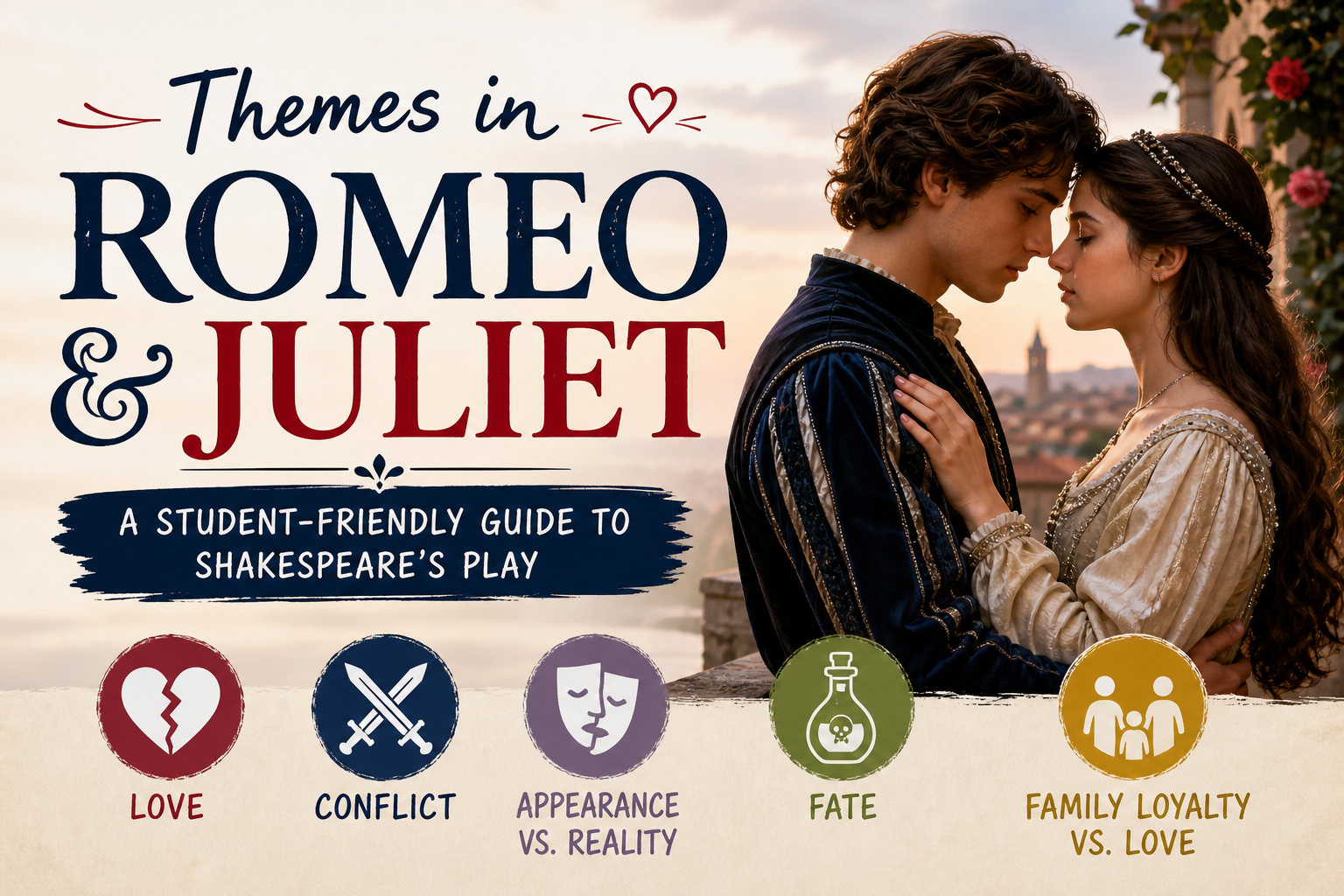
themes in Romeo and Juliet

Shakespeare’s tragedy can feel fast, emotional, and hard to sort out at first. This guide explains the major themes in Romeo and Juliet so you can connect the plot to the bigger ideas in the play.

themes in Romeo and Juliet

In this Guide

  • Why theme matters in the play
  • Love and desire
  • Fate and timing
  • Family conflict
  • Youth and identity
  • Writing about theme

This article contains affiliate links.

What Makes the Themes in Romeo and Juliet So Important?

The play is not only about two teenagers who fall in love. It is about what happens when private feelings crash into public hate.

The themes in Romeo and Juliet help readers see why the ending feels both shocking and expected. Shakespeare shows a world where love is powerful, but it is not strong enough to escape anger, pride, and bad choices.

Need a quick refresher before you write? Read our guide on how to identify theme in literature.

Love as One of the Central Themes in Romeo and Juliet

Love in this play is intense, sudden, and dangerous. Romeo and Juliet do not fall in love slowly. They meet, speak, kiss, and decide that life without each other would feel empty.

Among all the themes in Romeo and Juliet, love may be the easiest to notice. Yet Shakespeare does not show love as simple or safe. Love gives the characters courage, but it also pushes them toward risk.

Romeo’s feelings for Rosaline seem dramatic but shallow. His love for Juliet feels deeper because it changes how he sees himself, his family, and his future.

This type of intense love also appears in works like Wuthering Heights by Emily Brontë, where passion can feel larger than reason. In both texts, love has beauty, but it also has a cost.

Fate and Timing in the Themes in Romeo and Juliet

The play asks a hard question: are Romeo and Juliet doomed, or do people make choices that lead to doom?

Fate is one of the most debated themes in Romeo and Juliet. The Prologue calls the lovers “star-cross’d,” which suggests their lives are shaped by forces beyond their control.

Bad timing appears again and again. Romeo meets Juliet right after his pain over Rosaline. The secret wedding happens too fast. Friar Lawrence’s letter never reaches Romeo.

Still, fate does not erase choice. Tybalt chooses violence, Romeo chooses revenge, and the adults choose to keep old hatred alive.

Family Conflict: One of the Harshest Themes in Romeo and Juliet

The feud between the Montagues and Capulets shapes the whole play. It turns ordinary places, such as streets and homes, into unsafe spaces.

Family loyalty should protect young people, but here it traps them. Romeo and Juliet cannot love openly because their names carry a history of hate.

This theme fits with other works about social conflict, such as West Side Story, which is based on Shakespeare’s play. Both stories show how group identity can crush personal desire.

image-slider-with-thumbnail1.jpeg
PlayPause
previous arrow
next arrow
image-slider-with-thumbnail1.jpeg
image-slider-with-thumbnail3.jpeg
image-slider-with-thumbnail4.jpeg
ChatGPT Image Jun 27, 2026, 06_33_13 PM
ChatGPT Image Jun 27, 2026, 06_36_37 PM
ChatGPT Image Jun 27, 2026, 06_38_39 PM
ChatGPT Image Jun 27, 2026, 06_31_22 PM
image-slider-with-thumbnail7.jpeg
ChatGPT Image Jun 27, 2026, 06_29_43 PM
ChatGPT Image Jun 27, 2026, 06_27_44 PM
image-slider-with-thumbnail6.jpeg
ChatGPT Image Jun 27, 2026, 06_15_07 PM
image-slider-with-thumbnail5.jpeg
ChatGPT Image Jun 27, 2026, 06_22_43 PM
ChatGPT Image Jun 27, 2026, 06_25_37 PM
ChatGPT Image Jun 27, 2026, 06_19_43 PM
ChatGPT Image Jun 27, 2026, 06_12_00 PM
ChatGPT Image Jun 27, 2026, 06_08_50 PM
ChatGPT Image Jun 26, 2026, 04_54_23 PM
ChatGPT Image Jun 27, 2026, 05_53_51 PM
ChatGPT Image Jun 28, 2026, 08_35_55 AM
previous arrow
next arrow

Youth, Identity, and Rebellion

Romeo and Juliet are young, but Shakespeare does not treat them as silly. He shows how young people can see truths that adults refuse to face.

Juliet grows quickly across the play. At first, she listens to her parents. Soon, she makes bold choices about love, marriage, and death.

Romeo also tries to step outside his family role. He wants to stop being just a Montague, but the feud pulls him back into violence after Mercutio dies.

Language, Light, and Darkness

Shakespeare uses images of light and darkness to show how love changes the world for Romeo and Juliet.

Juliet is compared to the sun, stars, and bright light. These images make love feel rare and almost sacred.

Darkness is not always evil in the play. Night gives the lovers privacy. Daylight often brings danger, rules, and separation.

This contrast helps readers see one of the quieter themes in Romeo and Juliet: the same world can feel safe or cruel depending on who has power.

Death, Tragedy, and the Cost of Hate

The ending is tragic because the deaths feel avoidable. Many people could have stopped the disaster earlier, but they do not.

Mercutio and Tybalt die before Romeo and Juliet. Their deaths show that the feud harms more than the lovers.

By the final scene, the families understand the cost of hate too late. The peace they reach is real, but it is built on loss.

For background on the play, see Britannica’s overview of Romeo and Juliet. You can also explore the Poetry Foundation’s page on William Shakespeare.

How to Write About the Themes in Romeo and Juliet

A strong theme essay should make a clear claim about what Shakespeare suggests, not just name a topic.

For example, do not only write, “The play is about love.” A stronger claim would be, “Shakespeare presents love as powerful but fragile when society is ruled by hate.”

Use short quotes and explain them in your own words. A quote does not prove your point unless you connect it to the theme.

For more help with this skill, review our student-friendly theme guide.

Helpful Books to Search for on Amazon or at Your Library

These books can help if you want a stronger grasp of the play and Shakespeare’s world.

FAQ: Themes in Romeo and Juliet

These quick answers can help with homework, test review, or essay planning.

What are the main themes in Romeo and Juliet?

The main themes include love, fate, family conflict, youth, violence, and the cost of hate.

Is love shown as good or bad in the play?

Love is shown as powerful and sincere. It becomes tragic because the world around the lovers is hostile.

Does fate cause the tragedy?

Fate plays a major role, but human choices matter too. Shakespeare mixes bad luck with rash action.

Why is family conflict so important?

The feud makes Romeo and Juliet hide their love. It also teaches young people that violence is normal.

Key Takeaway

The key insight: Shakespeare uses Romeo and Juliet’s love story to show how hate can destroy what is most innocent and hopeful.

Themes in To Kill a Mockingbird: A Complete Guide

Themes in To Kill a Mockingbird

Understanding the Major Themes in To Kill a Mockingbird
A novel about growing up, justice, and moral courage in a divided society.

The major themes in To Kill a Mockingbird (affiliate link) help readers understand why this novel is still widely taught in schools today. On the surface, the story is about Scout Finch growing up in a small Southern town, but beneath that story, the novel explores serious issues like racism, injustice, empathy, courage, and innocence. Harper Lee uses the experiences of Scout and Jem to show how people learn right and wrong in a complicated world. The trial of Tom Robinson is the central event of the novel, but the book is really about moral growth and learning to see the world from other people’s perspectives.

In this guide, we will look at the most important themes in To Kill a Mockingbird and how they appear throughout the novel.

In This Guide

Racism and Injustice
Moral Courage
Coming of Age
Empathy
Social Class
Good vs Evil
Education
Innocence

Themes in To Kill a Mockingbird
Image by Carla Paton

Racism and Injustice in To Kill a Mockingbird

The trial of Tom Robinson shows how prejudice can destroy justice.

One of the most important themes in To Kill a Mockingbird is racism and injustice. This theme is most clearly shown during the trial of Tom Robinson. Even though Atticus proves that Tom Robinson is innocent, the jury still finds him guilty. This shows that racism in Maycomb is so powerful that it overrides truth and justice. The courtroom is supposed to be a place of fairness, but in this case, prejudice determines the outcome.

The novel also shows the hypocrisy of Maycomb. Many people in the town believe they are good and moral, yet they support a system that treats Black citizens unfairly. Scout even notices that her teacher criticizes Hitler for prejudice while ignoring racism in her own town. Harper Lee uses this contrast to show that people often recognize injustice in other places but fail to see it in their own communities.

Tom Robinson represents the most tragic example of this theme. He is an innocent man who is destroyed by a racist society, which connects directly to the symbol of the mockingbird — an innocent creature harmed by others.

Moral Courage in To Kill a Mockingbird

Doing what is right even when you know you might lose.

Another major theme in To Kill a Mockingbird is moral courage. Atticus Finch represents this theme more than any other character. He agrees to defend Tom Robinson even though he knows the town will criticize him and that he will probably lose the case. Atticus explains that he must defend Tom because he has to live with his own conscience.

The novel also shows courage through Mrs. Dubose, who fights to overcome her morphine addiction before she dies. Atticus explains to Jem that real courage is not about physical strength, but about doing what is right even when you know the situation is difficult or hopeless.

Even Scout shows courage when she stands up for Walter Cunningham and when she unknowingly stops the mob at the jail by speaking politely to Mr. Cunningham. The novel shows that courage can be quiet and moral, not just physical.

Coming of Age in To Kill a Mockingbird

Scout and Jem grow up and learn that the world is not always fair.

To Kill a Mockingbird is a coming-of-age novel because Scout and Jem grow up and learn important lessons about the world. At the beginning of the novel, they are innocent and believe that the world is fair. They believe Boo Radley is a monster and that the legal system always tells the truth.

As the novel progresses, Jem and Scout begin to understand that people are more complicated and that the world is not always fair. Jem especially struggles after Tom Robinson is found guilty because he believed that the truth would lead to justice. This moment represents Jem’s loss of innocence.

By the end of the novel, Scout learns the most important lesson of all — empathy. When she stands on Boo Radley’s porch and sees the world from his perspective, she finally understands what Atticus has been trying to teach her.

Empathy in To Kill a Mockingbird

“You never really understand a person until you climb into his skin and walk around in it.”

Empathy is one of the central themes in To Kill a Mockingbird. Atticus teaches Scout that she must try to understand people by seeing the world from their perspective. This lesson appears many times in the novel and helps Scout understand Boo Radley, Mayella Ewell, and even the people who hate Atticus.

Scout shows empathy when she understands why Walter Cunningham cannot accept lunch money and when she speaks to Mr. Cunningham at the jail. Her kindness reminds him that he is part of a community, and the mob leaves. This moment shows that empathy can be powerful enough to stop violence.

By the end of the novel, Scout understands Boo Radley and realizes that he has been protecting them the entire time. The novel suggests that many conflicts and injustices happen because people fail to understand one another.

Social Class in To Kill a Mockingbird

Maycomb is divided into strict social groups.

Social class is another important theme in To Kill a Mockingbird. The town of Maycomb is divided into different social groups, including wealthy families, poor farmers like the Cunninghams, and very poor families like the Ewells. Black citizens are at the bottom of the social structure because of racism.

The Ewells are especially important because even though they are poor and uneducated, they are still treated as socially superior to Black citizens. This shows that race is more important than class in Maycomb’s social system.

Through these social divisions, Harper Lee shows that social class is often unfair and does not reflect a person’s character or morality.

Good vs Evil in To Kill a Mockingbird

The novel shows both kindness and cruelty in human nature.

The novel explores the theme of good versus evil by showing both kindness and cruelty. Characters like Atticus, Scout, Jem, and Boo Radley represent kindness, compassion, and moral courage. Characters like Bob Ewell represent cruelty, hatred, and ignorance.

However, the novel does not suggest that people are completely good or completely evil. Instead, it shows that most people are a mixture of both. Mayella Ewell is a good example of this because she is both a victim and a person who causes injustice.

The conflict between good and evil is most clearly shown in the trial and in Bob Ewell’s attack on Scout and Jem. Boo Radley’s rescue of the children shows that good can exist even in a world where evil is present.

Education in To Kill a Mockingbird

The novel shows that true education is moral education.

Education is an important theme in the novel, but Harper Lee suggests that education is not just what students learn in school. Scout’s teacher represents formal education, but she does not understand the students or the town of Maycomb. In contrast, Atticus and Calpurnia teach Scout important life lessons about empathy, respect, and responsibility.

The novel suggests that true education means learning how to think, how to understand people, and how to do what is right.

Innocence in To Kill a Mockingbird

The mockingbird represents innocent people who are harmed by society.

Innocence is one of the most important themes in To Kill a Mockingbird, and it is closely connected to the symbol of the mockingbird. A mockingbird represents innocence because it does no harm and only brings beauty into the world. Tom Robinson and Boo Radley are both compared to mockingbirds because they are innocent but are harmed by others.

Children also represent innocence in the novel. Scout and Jem begin the story as innocent children, but as they learn about racism and injustice, they lose some of that innocence and gain understanding.

The novel suggests that innocence is something valuable that should be protected.

Why These Themes Matter

If you understand the themes in To Kill a Mockingbird, you understand the novel. Most essay questions and test questions focus on themes, especially racism, courage, innocence, and empathy. These themes help explain the characters, the symbols, and the major events in the story.

If you are studying the novel for school, it is important to understand:

  • What each theme means
  • Which characters represent each theme
  • Which events develop each theme
  • Which quotes connect to each theme

For a full breakdown of chapter summaries, character analysis, symbols, quotes, essay topics, and test questions, you can use this complete study guide:
https://rapidreadspress.com/product/to-kill-a-mockingbird-study-guide/

To Kill a Mockingbird Study Guide

If you are writing a literary analysis essay, this guide may also help:
https://rapidreadspress.com/product/literary-analysis-essay-examples/

For more historical background on the novel and the Civil Rights era, you can also visit:
https://www.britannica.com/topic/To-Kill-a-Mockingbird
https://www.history.com/topics/civil-rights-movement

Key Takeaway

The most important themes in To Kill a Mockingbird are racism and injustice, moral courage, empathy, innocence, and coming of age. The novel teaches that doing what is right is not always easy, that people must try to understand one another, and that innocent people must be protected. Scout’s journey from innocence to understanding is what gives the novel its lasting meaning.

FAQ – Themes in To Kill a Mockingbird

What is the main theme in To Kill a Mockingbird?

The main theme is racism and injustice, shown through Tom Robinson’s trial.

What theme does Atticus represent?

Atticus represents moral courage and justice.

What theme does Boo Radley represent?

Boo Radley represents empathy and innocence.

Is To Kill a Mockingbird a coming-of-age novel?

Yes, it is a coming-of-age novel because Scout and Jem grow up and learn important moral lessons.

Why is the mockingbird important?

The mockingbird represents innocent people who are harmed by society, especially Tom Robinson and Boo Radley.

The Theme of the American Dream in The Great Gatsby

American Dream in The Great Gatsby

F. Scott Fitzgerald’s The Great Gatsby is one of the most important novels for studying the American Dream in The Great Gatsby.

At first glance, the novel seems filled with success, wealth, glamour, and hope. Yet as the story unfolds, Fitzgerald shows that this dream has become twisted by money, status, and illusion. Gatsby’s longing for Daisy, the carelessness of the wealthy, and Nick’s growing disappointment all reveal that the dream of happiness and self-made success is far more fragile than it appears.

If you are trying to understand the American Dream in The Great Gatsby, this guide will help you see how Fitzgerald turns a national ideal into one of the novel’s deepest tragedies.

If you are reading the novel for class, you may also find the The Great Gatsby Study Guide, the The Great Gatsby PDF Novel for Students, and Literary Analysis Essay Examples helpful as you read and write.

In this Guide

A quick look at what the American Dream in The Great Gatsby means, how Gatsby represents it, why Daisy matters so much, what East and West Egg reveal, how Nick responds to the dream’s collapse, and how to write about this theme in your own essay.

  • What Is the American Dream in The Great Gatsby?
  • How Gatsby Represents the American Dream
  • Why Daisy Matters in Gatsby’s Dream
  • Wealth, Class, and the Corruption of the Dream
  • Nick Carraway and the Failure of the Dream
  • Symbols That Strengthen the Theme
  • Why the Theme Still Matters Today
  • Key Takeaway
  • FAQ
American Dream in The Great Gatsby
Image by Carla Paton

What Is the American Dream in The Great Gatsby? 🎯

The American Dream is the belief that people can build a better life through effort, ambition, and determination. In many versions of that dream, success means freedom, happiness, and the chance to rise above one’s past.

In The Great Gatsby, Fitzgerald begins with that familiar idea, but he does not leave it untouched. He shows what happens when the dream becomes tied to wealth without morality, desire without truth, and status without substance.

Gatsby seems to embody the dream because he rises from poverty and creates a new identity. Yet the novel keeps asking a painful question: what happens when success looks impressive on the outside but is empty at the center?

Fitzgerald’s answer is bleak.

In this world, money can buy luxury, but it cannot restore the past, create real love, or produce moral depth.

The American Dream in The Great Gatsby is not simply about success. It is about the collapse of success when it is built on illusion.


💡 A strong theme statement for this novel is: Fitzgerald shows that the American Dream becomes corrupted when people measure success only by wealth, beauty, and social status.

How Gatsby Represents the American Dream 💼

This section shows how Gatsby’s life story makes him the clearest symbol of the American Dream in The Great Gatsby.

Jay Gatsby is the novel’s most dramatic example of reinvention. He was born James Gatz, and he comes from a poor background. Instead of accepting that life, he creates a new version of himself. He becomes polished, wealthy, mysterious, and socially visible.

On the surface, Gatsby looks like proof that the American Dream works. He has climbed upward. He owns a grand mansion. He hosts dazzling parties. People know his name, even if they know almost nothing true about him.

That outward rise makes Gatsby seem powerful, but Fitzgerald keeps showing that his success is unstable. Gatsby’s dream is not rooted in peace or wisdom. It is rooted in longing. He does not want wealth for its own sake. He wants what he thinks wealth can recover. He wants Daisy. He wants the past. He wants a perfect version of life that never truly existed.

That is what makes Gatsby such a powerful figure in the novel. He is admirable in some ways because he believes so deeply, but he is also tragic because his dream is based on a fantasy. Gatsby represents both the hope and the danger of the American Dream in The Great Gatsby. He rises, but he rises toward something that cannot last.

“Can’t repeat the past?” Gatsby cries. “Why of course you can!”
That line captures the heart of his tragedy. Gatsby is not chasing a future. He is trying to purchase a lost moment and force it back into being.

Why Daisy Matters in Gatsby’s Dream 🌼

This section explains why Daisy is central to the American Dream in The Great Gatsby and why Gatsby’s dream becomes so personal.

Daisy Buchanan is far more than a love interest. She becomes Gatsby’s symbol of arrival. To him, Daisy represents beauty, refinement, wealth, and the life he believes he was meant to have. She is tied to his memories of hope and possibility, and she becomes the emotional center of everything he builds.

Gatsby’s house, his parties, and even his carefully shaped image all point back to Daisy. He believes that if he can win her back, then all of his striving will finally mean something.

This is where Fitzgerald deepens the theme. Gatsby is not just chasing money. He is chasing a version of fulfillment that he attaches to Daisy. The problem is that Daisy is not the ideal he imagines. She is real, limited, and shaped by her own comfort and fear.

Gatsby loves an image of Daisy more than the actual woman standing before him. That gap between ideal and reality is one of the main reasons the American Dream in The Great Gatsby fails.

Gatsby thinks desire can be completed through wealth and persistence, but Daisy cannot carry the meaning he places on her. She is not the dream itself. She is the mirror Gatsby uses to reflect his dream back to himself.

Wealth, Class, and the Corruption of the Dream 💰

This section explores how Fitzgerald uses social class to expose the corruption of the American Dream in The Great Gatsby.

One of the sharpest truths in the novel is that money is not all the same. Gatsby has wealth, but he does not belong to the old-money world of Tom and Daisy Buchanan. Fitzgerald draws this difference clearly through West Egg and East Egg.

West Egg is flashy, restless, and newly rich. East Egg is older, colder, and protected by inherited class. Gatsby can buy a mansion across the bay, but he still cannot fully cross the invisible line that separates him from people like Daisy and Tom.

This matters because the American Dream is supposed to promise movement and opportunity. In theory, a person should be able to rise. In practice, Fitzgerald shows that class barriers remain firmly in place.

Tom Buchanan, for all his cruelty and selfishness, never has to earn his position. Daisy floats inside that same protected world. Gatsby, by contrast, must perform his way into visibility. Even then, he remains vulnerable.

The wealthy in the novel are careless because they know they will be protected by money. Gatsby believes money will give him entry into their world, but Fitzgerald shows that it never fully can. The American Dream in The Great Gatsby is corrupted because social power is guarded by class, not awarded by merit alone.


📌 In Gatsby’s world, money can buy spectacle, but it cannot buy belonging.

Nick Carraway and the Failure of the Dream 👀

This section looks at how Nick helps readers understand the true meaning of the American Dream in The Great Gatsby.

Nick Carraway begins the novel as an observer who is curious about wealth and fascinated by Gatsby. He enters this world with some distance, but he is still drawn to its excitement. Over time, though, he sees what lies underneath the glitter.

He watches the wealthy move through life with carelessness. He sees how easily Tom and Daisy hurt other people and retreat back into their privilege. He sees how Gatsby’s grand hope ends in abandonment.

Nick becomes one of the clearest voices of moral judgment in the novel because he recognizes that Gatsby’s dream, though flawed, is at least sincere. Gatsby believes in something. Tom and Daisy believe in comfort. That difference matters.

Nick does not leave the novel thinking Gatsby was wise, but he does leave believing Gatsby had a depth of longing the others lacked.

This is one reason Fitzgerald’s treatment of the American Dream in The Great Gatsby feels so complex. Gatsby is not simply mocked. He is mourned. Nick sees that the dream has failed, yet he also sees that the human desire behind it was real. That tension gives the novel much of its emotional force.


💬 Nick’s point of view matters because he helps us see two truths at once: Gatsby’s dream is beautiful in its hope and devastating in its unreality.

Symbols That Strengthen the Theme ✨

This section highlights the symbols that deepen the American Dream in The Great Gatsby and make the theme more memorable.

Fitzgerald does not rely on plot alone. He strengthens the theme through symbols that carry emotional and social meaning. The most famous is the green light at the end of Daisy’s dock.

For Gatsby, it stands for hope, longing, and the future he keeps reaching toward. It seems close enough to touch, yet it always remains distant. That makes it a perfect symbol for the American Dream in the novel. The dream is visible, attractive, and endlessly receding.

The Valley of Ashes offers a darker image. It shows the waste produced by wealth and ambition. While the rich enjoy luxury, others live among the remains. This setting reminds readers that dream and ruin exist side by side.

The eyes of Doctor T. J. Eckleburg suggest spiritual emptiness and moral blindness. In a world where money shapes value, deeper judgment seems absent or ignored. Together, these symbols show that the American Dream in The Great Gatsby is never just a private wish. It is tied to a whole culture of desire, decay, and false promise.


📝 Essay Tip: If you write about theme, connect symbol + character + outcome. For example, Gatsby reaches toward the green light, but he never reaches lasting fulfillment.

Why the Theme Still Matters Today 📚

This section explains why the American Dream in The Great Gatsby still speaks so strongly to modern readers.

The novel still matters because its questions have not disappeared. People still wrestle with the meaning of success. They still confuse appearance with fulfillment. They still chase versions of life that look beautiful from a distance but prove hollow up close.

Fitzgerald’s novel endures because it speaks to that tension with unusual clarity.

It asks whether ambition can remain healthy when it loses touch with truth.

It asks whether wealth can ever satisfy deeper emotional needs.

It asks whether a society built on image and status can still support real human connection.

Those are not old questions. They are current ones. Students keep returning to this novel because the American Dream in The Great Gatsby feels both historical and immediate. The clothes, cars, and parties belong to the 1920s, but the hunger beneath them still feels familiar. That is part of what makes Fitzgerald’s novel such a powerful work of literature. It turns one man’s dream into a larger warning about a culture’s values.

Key Takeaway

The American Dream in The Great Gatsby begins as a promise of self-made success and happiness, but Fitzgerald shows how easily that promise can be corrupted by wealth, illusion, and shallow social values. Gatsby’s rise is impressive, yet his dream fails because it depends on money, fantasy, and a past that cannot be recovered. Through Gatsby, Daisy, Nick, and the novel’s powerful symbols, Fitzgerald reveals that success without truth or moral depth leads to emptiness rather than fulfillment.

FAQ – The American Dream in The Great Gatsby

What is the American Dream in The Great Gatsby?

In the novel, the American Dream is the belief that a person can rise through ambition and effort to achieve success and happiness. Fitzgerald shows that this dream becomes corrupted when it is reduced to money, status, and appearance.

How does Gatsby represent the American Dream?

Gatsby represents the dream because he rises from poverty and reinvents himself as a wealthy man. At the same time, his story shows the dream’s weakness because his success cannot give him the love, truth, or peace he wants.

Why is Daisy important to the theme?

Daisy is important because Gatsby connects her to everything he wants. She becomes a symbol of beauty, wealth, and arrival. His love for her reveals how the dream becomes tangled with illusion.

What symbols connect to the American Dream in The Great Gatsby?

The green light, the Valley of Ashes, and the eyes of Doctor T. J. Eckleburg all strengthen the theme. They represent hope, social decay, and moral emptiness.

Is Gatsby’s dream noble or foolish?

It is both. Gatsby’s hope gives him emotional depth, which makes him more admirable than some other characters. Yet his dream is also unrealistic because it depends on fantasy and on repeating the past.

What is a good thesis statement for this theme?

A strong thesis statement could be: In The Great Gatsby, F. Scott Fitzgerald shows that the American Dream becomes corrupted when ambition is driven by wealth, illusion, and the desire to recover an idealized past.

The Great Gatsby study guide

The Theme of Ambition in Frankenstein

theme of ambition in Frankenstein

Victor Frankenstein’s fatal obsession.

Mary Shelley’s Frankenstein remains one of the most widely studied novels in English literature. Beneath its famous story of a scientist and his creation lies a powerful idea that shapes the entire novel: the theme of ambition in Frankenstein. Victor Frankenstein’s intense desire for knowledge drives the plot forward and ultimately leads to tragedy for nearly everyone involved.

Shelley’s novel explores what happens when the pursuit of knowledge becomes an obsession. Victor begins with curiosity and hope, yet his ambition slowly separates him from moral responsibility, family, and humanity itself. The result is one of literature’s clearest warnings about the dangers of uncontrolled ambition.

This guide explores how the theme of ambition in Frankenstein appears throughout the novel and why it remains relevant for readers today.

This article contains affiliate links.

In this Guide:

What the Theme of Ambition in Frankenstein Means
Victor Frankenstein’s Desire for Knowledge
How Ambition Leads to Isolation
The Consequences of Victor’s Ambition
The Moral Warning of the Novel
Key Takeaway
FAQ About the Theme of Ambition in Frankenstein

theme of ambition in Frankenstein

What the Theme of Ambition in Frankenstein Means

Ambition is the strong desire to achieve something great. In literature, ambition often drives characters to pursue power, knowledge, or success. In Mary Shelley’s novel, the theme of ambition in Frankenstein focuses on the dangers of pursuing discovery without considering its moral consequences.

Victor Frankenstein dreams of achieving a scientific breakthrough that will make him famous. He wants to unlock the secret of life itself. At first, this ambition appears admirable. Curiosity and discovery have always been part of scientific progress.

However, Shelley shows that ambition becomes dangerous when it is guided by pride rather than responsibility. Victor becomes so focused on creating life that he stops asking whether he should attempt such an experiment.

💡 Key idea: Ambition in the novel is not evil by itself. The danger arises when ambition outstrips wisdom, empathy, and responsibility.

Victor Frankenstein’s Desire for Knowledge

Victor’s ambition begins in childhood. From an early age, he becomes fascinated with the mysteries of nature and the possibility of scientific discovery. When he later studies natural philosophy at the university of Ingolstadt, his curiosity develops into an intense desire to achieve something extraordinary.

Victor imagines that discovering how to create life will bring him honor and benefit humanity. He believes future generations will admire him as a scientific pioneer. This moment shows that Victor ties his ambition closely to pride.

As Victor explains in the novel, he hopes to “pour a torrent of light into our dark world.” His goal sounds noble, yet his ambition gradually becomes an obsession.

This stage of the story illustrates one of the most important aspects of the theme of ambition in Frankenstein: ambition often begins with good intentions before slowly becoming destructive.

How Ambition Leads to Isolation

As Victor works toward his experiment, he becomes increasingly isolated from the people around him. He spends months alone in his laboratory, neglecting his friends, his family, and even his own health.

Shelley uses this period of isolation to show how ambition can distort judgment. Victor becomes so focused on his experiment that he forgets the world beyond his work.

He later admits that his obsession consumed him completely. His relationships disappear. Victor’s physical health declines. His emotional stability weakens.

📖 “I seemed to have lost all soul or sensation but for this one pursuit.”

Victor’s isolation reveals a key part of the theme of ambition in Frankenstein: ambition can slowly separate a person from the human connections that normally guide moral choices.

theme of ambition in Frankenstein
Image by Carla Paton

The Consequences of Victor’s Ambition

The turning point of the novel occurs when Victor finally succeeds in creating life. Instead of feeling triumph, he experiences immediate horror. The creature’s appearance frightens him, and he abandons the being almost instantly.

This moment reveals the true problem with Victor’s ambition. He wanted the glory of discovery, yet he never considered the responsibility that would follow.

The creature’s suffering becomes the most tragic result of Victor’s ambition. Without guidance or companionship, the creature experiences rejection wherever he goes. His loneliness eventually turns into anger and revenge.

Several innocent characters die as a result of the conflict between creator and creation. Victor’s family suffers deeply, and his own life becomes defined by guilt and grief.

Shelley shows that the theme of ambition in Frankenstein extends beyond Victor himself. His choices harm many others, proving that uncontrolled ambition rarely affects only one person.

The Moral Warning of the Novel

By the end of the novel, Victor finally recognizes the dangers of his obsession. He reflects on how his desire for greatness blinded him to the ethical consequences of his work.

Mary Shelley presents Victor’s story as a warning. Scientific discovery can lead to progress and knowledge, but it must be guided by responsibility and wisdom.

The novel was written during a time when science and technology were advancing rapidly. Shelley’s story asks an important question that still matters today:

Just because something can be done, should it be done?

The theme of ambition in Frankenstein reminds readers that knowledge without moral reflection can produce suffering instead of progress.

📚 If you want to explore the novel more deeply, you can read the original text here: Frankenstein by Mary Shelley.

Key Takeaway

The theme of ambition in Frankenstein reveals how the pursuit of knowledge can become dangerous when it is driven by pride rather than responsibility. Victor Frankenstein’s obsession with discovery isolates him from others and ultimately leads to tragedy. Mary Shelley’s novel reminds readers that true progress requires both intelligence and moral wisdom.

FAQ – The Theme of Ambition in Frankenstein

What is the theme of ambition in Frankenstein?

The theme of ambition in Frankenstein explores the dangers of pursuing knowledge or success without considering moral responsibility. Victor Frankenstein’s obsession with creating life leads to suffering for himself and others.

Why is Victor Frankenstein considered ambitious?

Victor is driven by a desire to achieve scientific greatness. He hopes to unlock the secret of life and gain recognition for a discovery that no one else has achieved.

Is ambition portrayed as good or bad in Frankenstein?

Ambition itself is not entirely negative. The novel suggests that ambition becomes dangerous when it is driven by pride and ignores ethical consequences.

What lesson does Frankenstein teach about ambition?

The novel warns that great achievements must be balanced with responsibility. Without moral awareness, even brilliant discoveries can lead to destruction.

📘 Want to see real examples of literary analysis essays like this?

📗 Need help studying the novel?

Frankenstein Study Guide

How to Analyze Characters in Literature

how to analyze characters in literature

A simple step-by-step guide to understanding fictional characters and writing stronger literary analysis essays

Understanding characters is one of the most important skills in literary analysis. Stories are built around people: their decisions, their desires, and their flaws. When readers learn how to analyze characters in literature, they begin to see how authors shape meaning through personality, conflict, and change.

A strong character analysis does more than describe someone in a story. It explains why the character acts the way they do and what their actions reveal about the themes of the work. Literary scholars often look closely at a character’s motivations, relationships, and development across the narrative.

In this guide, you’ll learn simple methods you can use to analyze characters in any novel, play, or poem—from Jane Austen’s sharp social portraits to the dark psychological figures in Gothic fiction.

This article contains affiliate links.

In This Guide 📚

What character analysis means
How authors create characters through characterization
How to analyze a character’s motivations
How to examine relationships between characters
How to track character development
Example character analysis from classic literature
Questions you can ask while reading

how to analyze characters in literature

What Character Analysis Means

Understanding the foundations of how to analyze characters in literature.

Character analysis is the process of examining a character’s traits, actions, motivations, and development in order to understand their role in a story. Instead of simply describing whether a character is “good” or “bad,” literary analysis asks deeper questions about why the character behaves the way they do and how those actions shape the narrative.

In literature, characters are created through a technique called characterization. This is the way authors reveal personality, beliefs, and emotional struggles through description, dialogue, and behavior.

💡 Key insight:
Character analysis connects personality to meaning.

When you understand a character’s motives and choices, you begin to see how the author explores larger themes like love, ambition, morality, or social pressure.

If you’re new to literary analysis, start with this guide first:
https://rapidreadspress.com/how-to-read-literature-like-a-scholar/

Direct and Indirect Characterization

One of the first steps in learning how to analyze characters in literature.

Authors reveal characters in two main ways:

Direct characterization happens when the narrator explicitly describes a character’s personality.

Example:
“The gentleman was proud and reserved.”

Indirect characterization happens when readers learn about a character through actions, speech, and relationships.

These clues appear through:
dialogue
behavior
appearance
thoughts
how others respond to them

Most authors rely heavily on indirect characterization because it allows readers to interpret the character themselves.

👉 Related guide:
https://rapidreadspress.com/literary-devices-list/

Analyze a Character’s Motivations

Understanding why characters act the way they do.

A key part of learning how to analyze characters in literature is asking what drives a character’s decisions.

Characters rarely act randomly. Their behavior usually comes from:

fear
desire
love
ambition
social pressure

📖 Example from Pride and Prejudice

Elizabeth Bennet often appears witty and confident, but her judgments are shaped by pride and prejudice of her own. When she rejects Mr. Darcy’s first proposal, her decision reveals both moral strength and personal bias.

Her character becomes clearer when we examine why she believes Darcy is arrogant and how those assumptions change.

Through Elizabeth’s development, Jane Austen explores themes of self-knowledge and social misunderstanding.

Examine Relationships Between Characters

Characters are often defined by their relationships.

A character rarely exists alone in literature. Instead, authors reveal personality through interactions with others.

When analyzing characters, consider:

How does the character treat friends or family?
How do other characters react to them?
Do their relationships change over time?

📖 Example from Frankenstein

Victor Frankenstein’s relationship with his creation reveals his deepest flaws. Instead of taking responsibility for the being he brings to life, Victor abandons the creature immediately.

This decision drives the tragedy of the novel.

The creature’s loneliness and anger reflect Victor’s moral failure, turning the story into a meditation on responsibility and creation.

👉 If you want to see how themes connect to characters, read:
https://rapidreadspress.com/how-to-identify-theme-in-literature/

Track Character Development

Look at how the character changes during the story.

Many of the most memorable literary characters undergo significant transformation.

A useful technique when learning how to analyze characters in literature is to compare:

the character at the beginning of the story
the character at the end

This change is called a character arc.

📖 Example from Emma

In Jane Austen’s Emma, the main character begins as confident and somewhat self-satisfied. She enjoys arranging relationships between others and believes she understands people perfectly.

Yet over time, Emma realizes her mistakes. She learns humility and emotional awareness.

Her transformation reveals one of the novel’s central themes: true maturity requires self-reflection.

Look for Symbolic or Thematic Meaning

Sometimes a character represents a larger idea.

In some works of literature, characters symbolize broader themes or philosophical ideas.

For example:

Dracula often represents fear of the unknown and cultural anxiety in Gothic fiction.

He is not only a villain but also a symbol of the anxieties surrounding modernity and foreign influence in Victorian England.

By examining how Dracula interacts with other characters and environments, readers see how Bram Stoker uses the character to explore fear, power, and desire.

Ask Questions While Reading

Simple questions that help you analyze characters more deeply.

When reading literature, pause occasionally and ask yourself:

What does this character want most?
What are their greatest fears?
How do they treat others?
What mistakes do they make?
How do they change?

These questions help transform passive reading into active literary analysis.

If you want to take better notes while reading fiction, this guide may help:
https://rapidreadspress.com/how-to-take-notes-while-reading-a-novel/

Example Character Analysis (Short Model)

Elizabeth Bennet in Pride and Prejudice represents the struggle between perception and truth. At first she believes she understands Darcy perfectly, interpreting his reserved manner as arrogance. Her judgments seem reasonable based on the limited information she receives. Yet as new facts emerge, Elizabeth gradually recognizes her own bias. This realization reshapes her understanding of Darcy and of herself. Through Elizabeth’s journey, Jane Austen illustrates how personal pride and social expectations can distort perception. The character’s development ultimately reveals that self-knowledge is necessary for genuine love and moral growth.

how to analyze characters in literature
Image by Carla Paton

How to Read Literature Like a Professor — Thomas C. Foster
Reading Like a Writer — Francine Prose
How to Read a Book — Mortimer Adler

Improve Your Literary Analysis Essays

If you want help structuring your essays, outlining arguments, and organizing quotes, you might find this useful:

👉 https://rapidreadspress.com/product/the-literary-analysis-essay-toolkit/

This toolkit includes templates and worksheets designed to make literary analysis essays much easier to write.

Key Takeaway 💡

Learning how to analyze characters in literature means moving beyond simple description. Instead of asking whether a character is “good” or “bad,” strong literary analysis explores motivations, relationships, and change. By examining these elements closely, readers uncover the deeper themes that authors embed within their stories.

FAQ – How to analyze characters in literature

What is character analysis in literature?

Character analysis is the process of examining a character’s traits, motivations, actions, and development in order to understand their role and meaning within a literary work.

Why is character analysis important?

Characters often carry the central themes of a story. Understanding them helps readers interpret the deeper message of the work.

What are the main things to analyze in a character?

Most literary analyses focus on personality traits, motivations, relationships, and how the character changes throughout the story.

What is characterization?

Characterization is the method authors use to reveal a character’s personality through description, actions, dialogue, and interactions with others.

For a deeper look at literary techniques, see:
https://rapidreadspress.com/literary-devices-list/

Tone vs Mood in Literature: What’s the Difference?

tone vs mood in literature

How authors shape emotion in stories—and how readers experience it

Many students confuse tone and mood because both describe feelings in a piece of writing. Yet they refer to two very different things.

Tone is the author’s attitude toward the subject. Mood is the feeling the reader experiences.

Understanding this difference can dramatically improve your literary analysis essays. Once you can identify tone and mood, you start seeing how authors guide readers’ emotions through word choice, imagery, and narrative voice.

In this guide, you’ll learn the clear difference between tone and mood, how to recognize them in classic literature, and how to write about them in literary analysis.

This article contains affiliate links.

tone vs mood in literature
Image by Carla Paton

In This Guide 📚

  • What Is Tone in Literature?
  • What Is Mood in Literature?
  • Tone vs Mood in Literature: The Key Difference
  • Examples from Classic Literature
  • How Authors Create Tone and Mood
  • How to Identify Tone and Mood While Reading
  • Why Tone and Mood Matter in Literary Analysis
  • Key Takeaway
  • FAQ

What Is Tone in Literature?

Tone reveals the author’s attitude toward the subject, characters, or events.

Tone comes from word choice, narration, and perspective. It reflects how the author or narrator feels about what is happening in the story.

Common tones include:

  • ironic
  • serious
  • playful
  • critical
  • hopeful
  • melancholic

For example, Jane Austen’s Pride and Prejudice uses a famously ironic tone.

The opening line says:

“It is a truth universally acknowledged, that a single man in possession of a good fortune, must be in want of a wife.”

The narrator sounds confident and formal. Yet the statement is clearly sarcastic. Austen uses this ironic tone to gently mock the social expectations surrounding marriage.

Tone tells us how the author feels about the world of the story.

📌 Quick Tip

Tone often appears through the narrator’s voice. Ask yourself:

Does the narrator sound amused, serious, critical, or sympathetic?

What Is Mood in Literature?

Mood is the emotional atmosphere a reader experiences while reading.

Where tone belongs to the author, mood belongs to the reader. It describes the feeling created by the setting, imagery, and events of the story.

Common moods include:

  • suspenseful
  • eerie
  • romantic
  • tense
  • hopeful
  • gloomy

Mood often changes from scene to scene.

For example, in Emily Brontë’s Wuthering Heights, the bleak landscape and passionate dialogue create a dark and intense atmosphere.

Heathcliff cries:

“I cannot live without my life! I cannot live without my soul!”

The emotional language and gothic setting create a haunting mood that surrounds the entire novel.

Mood pulls readers into the emotional world of the story.

📌 Remember

Tone = author’s attitude
Mood = reader’s emotional experience

Tone vs Mood in Literature: The Key Difference

Here is the simplest way to understand tone vs mood in literature:

ElementMeaningWho Controls It
ToneAuthor’s attitude toward the subjectThe author
MoodEmotional atmosphere felt by readersThe reader

Tone often influences mood, but they are not identical.

For example:

A sarcastic tone might create a humorous mood.

A dark tone might produce a tense or fearful mood.

But readers may react differently depending on their interpretation.

💡 Think of tone like a speaker’s voice and mood like the listener’s reaction.

Examples of Tone vs Mood in Classic Literature

Looking at famous works helps clarify the difference.

Example 1: Pride and Prejudice

Tone: ironic, witty
Mood: light, humorous, socially observant

Austen’s narrator frequently mocks social conventions through clever dialogue and narration.

For instance, Mr. Bennet often speaks sarcastically to his wife, which reinforces the novel’s playful tone.

Yet the overall mood remains warm and entertaining.

Example 2: Frankenstein

Tone: reflective and tragic
Mood: eerie and unsettling

In Mary Shelley’s Frankenstein, Victor Frankenstein often narrates his story with regret and guilt.

The gloomy landscapes, isolated laboratories, and tragic consequences create a dark mood for readers.

The tone of regret from Victor strengthens the feeling of dread.

Example 3: Dracula

Tone: suspenseful and ominous
Mood: fearful and mysterious

In Bram Stoker’s Dracula, letters and journal entries describe eerie castles, strange behavior, and supernatural events.

The author’s ominous tone creates a powerful mood of suspense that keeps readers anxious about what will happen next.

How Authors Create Tone and Mood

Authors shape tone and mood through several literary techniques.

Word Choice (Diction)

Words carry emotional weight.

Compare these descriptions:

  • “a quiet forest”
  • “a dark, suffocating forest”

The second description creates a more ominous mood.

Setting

Setting strongly affects mood.

A fog-covered castle produces suspense.
A sunny garden produces peace.

Imagery

Imagery appeals to the senses and intensifies emotional reactions.

Descriptions of sound, smell, and sight help build atmosphere.

Dialogue

Dialogue reveals tone through character attitudes.

Sarcastic dialogue creates a humorous tone.
Serious dialogue creates a tense tone.

How to Identify Tone and Mood While Reading

Students often struggle to identify tone and mood in literature.

Try these steps.

Step 1: Examine Word Choice

Look at adjectives and descriptive phrases.

Do the words sound critical, joyful, or gloomy?

Step 2: Consider the Narrator’s Perspective

Ask:

How does the narrator feel about the characters or events?

Step 3: Notice Your Emotional Reaction

Ask yourself:

How does this scene make me feel?

That feeling usually reveals the mood.

📚 Related Reading

If you want to strengthen your literary analysis skills, these guides can help:

Why Tone and Mood Matter in Literary Analysis

Understanding tone vs mood in literature helps readers move beyond simply summarizing a story.

Instead, you begin to analyze how the story works emotionally.

Tone reveals the author’s perspective.

Mood reveals the emotional impact on readers.

When you discuss these elements in essays, you show a deeper level of literary understanding.

These books help readers analyze language and literary techniques more closely.

Key Takeaway ✨

Tone and mood work together to shape a reader’s emotional experience.

Tone expresses the author’s attitude.

Mood describes the feeling created in the reader.

Once you learn to recognize both, literature becomes far richer and more meaningful.

📦 Want help writing literary analysis essays?

The Literary Analysis Essay Toolkit includes step-by-step guides, templates, and examples that make analyzing literature much easier.

FAQ – Tone vs Mood

What is the difference between tone and mood in literature?

Tone is the author’s attitude toward the subject. Mood is the emotional atmosphere that readers experience while reading.

Can tone and mood be the same?

Sometimes tone and mood align. A cheerful tone may create a happy mood. However, they are not identical because tone belongs to the author while mood belongs to the reader.

How do authors create mood?

Authors create mood through setting, imagery, word choice, and narrative perspective.

Why do students confuse tone and mood?

Both involve emotions in literature, so they are easy to mix up. The key difference is who experiences the feeling.

How to Write a Thesis Statement for a Literary Analysis Essay

thesis statement for a literary analysis essay

A simple guide to crafting clear, focused arguments about literature

Many students understand the plot of a novel or poem but struggle to explain what the text means. When it comes time to write a literary essay, the most difficult part is often the thesis statement.

A thesis statement is the sentence that explains the main argument of your essay. It tells readers what interpretation you will defend and guides the structure of the entire paper.

Learning how to write a thesis statement for a literary analysis essay can transform the writing process. Instead of feeling lost, you gain a clear direction for your argument and a framework for organizing your ideas.

In this guide, we will explore how thesis statements work, examine examples from classic literature, and practice building strong claims that support thoughtful literary analysis.

This article contains affiliate links.

thesis statement for a literary analysis essay
Image by Carla Paton

In This Guide

In this article, you’ll learn:

• what a thesis statement does in literary analysis
• the difference between weak and strong thesis statements
• examples from classic novels
• a simple formula for writing a thesis
• common mistakes students make
• a practice exercise to strengthen your skills

What a Thesis Statement Does in Literary Analysis

A thesis statement explains what interpretation your essay will argue about a literary text.

Instead of summarizing the plot, a thesis identifies how the author creates meaning through elements such as:

  • theme
  • symbolism
  • characterization
  • imagery
  • narrative structure

Your thesis becomes the central claim that every paragraph in your essay will support.

For example, in Mary Shelley’s Frankenstein, the novel explores the dangers of ambition and scientific curiosity. A literary analysis essay might examine how Victor Frankenstein’s obsession with knowledge leads to tragic consequences.


A thesis for that essay might argue that Shelley uses Victor’s ambition to critique the pursuit of knowledge without moral responsibility.

This statement gives the essay a clear focus and prepares the reader for the argument that follows.

For more strategies on interpreting literature, see:

How to Read Literature Like a Scholar
https://rapidreadspress.com/how-to-read-literature-like-a-scholar/

Weak vs. Strong Thesis Statements

Not all thesis statements are equally effective. Many students begin with statements that describe the topic but fail to make a clear argument.

Weak thesis statements often summarize the story or present an obvious observation.

Example from Pride and Prejudice:

Weak thesis:

Elizabeth Bennet learns important lessons during the novel.

This statement is true, but it does not explain what those lessons are or why they matter.

A stronger thesis presents a specific interpretation.

Strong thesis:

In Pride and Prejudice, Jane Austen uses Elizabeth Bennet’s changing perception of Darcy to show how pride and prejudice distort judgment.

This version makes a clear claim and suggests how the author develops the theme.

The difference is simple:

Weak thesis → describes the story
Strong thesis → interprets the story

Thesis Statement Examples from Classic Literature

Looking at examples from well-known works can help illustrate how literary thesis statements function.

Consider Emily Brontë’s Wuthering Heights.

A weak thesis might say:

The novel shows the intense relationship between Catherine and Heathcliff.

A stronger thesis could be:

In Wuthering Heights, Emily Brontë uses the wild moorland landscape to reflect the destructive passion between Catherine and Heathcliff.

This statement connects setting and theme, giving the essay a clear analytical direction.

Another example can be found in Jane Austen’s Emma.

Weak thesis:

Emma learns about her mistakes.

Stronger thesis:

In Emma, Jane Austen portrays Emma Woodhouse’s misguided attempts to control the lives of others as a critique of social arrogance and misplaced confidence.

This thesis identifies the character arc while explaining the novel’s larger idea.

📘 Need more help writing literary essays?

The Literary Analysis Essay Toolkit walks you through every step of the process—from interpreting the assignment to organizing paragraphs and revising your final draft.

Get the Literary Analysis Essay Toolkit

A Simple Formula for Writing a Literary Thesis

Students often find thesis statements easier when they follow a simple structure.

A useful formula is:

Author + literary device or element + interpretation of meaning

Example structure:

In [Title], [Author] uses [literary element] to reveal [interpretation].

Example from Frankenstein (affiliate link):

In Frankenstein, Mary Shelley uses Victor Frankenstein’s relentless ambition to warn about the dangers of pursuing knowledge without responsibility.

Example from Dracula (affiliate link):

In Dracula, Bram Stoker uses imagery of darkness and decay to create a sense of moral and supernatural danger.

This structure works well because it identifies:

• the text
• the literary technique
• the interpretation

If you want help recognizing literary techniques, see:

Literary Devices List: 32 Literary Devices Explained
https://rapidreadspress.com/literary-devices-list/

Common Thesis Statement Mistakes

Even strong essays can suffer from weak thesis statements if writers fall into a few common traps.

One common mistake is writing a thesis that is too vague.

Example:

The novel explores important themes.

This statement does not explain which themes or how the author develops them.

Another mistake is writing a thesis that simply summarizes the story.

Example:

Victor Frankenstein creates a monster and regrets it.

This is a plot summary rather than an interpretation.

A good thesis should always answer the question:

What idea does the text reveal?

Finally, avoid thesis statements that attempt to cover too many ideas at once. A focused claim leads to a clearer essay.

Practice Exercise

Try creating a thesis statement using the following example.

Consider this prompt based on Sense and Sensibility:

Analyze how Jane Austen contrasts the characters of Elinor and Marianne Dashwood.

Start by identifying the literary focus.

Character contrast.

Next consider what idea the contrast reveals.

Perhaps Austen explores the tension between emotional expression and social restraint.

A thesis might look like this:

In Sense and Sensibility, Jane Austen contrasts Elinor’s restraint with Marianne’s emotional openness to explore the balance between reason and feeling.

Practicing with different works helps strengthen your ability to develop clear literary arguments.

Key Takeaway

A thesis statement is the foundation of every literary analysis essay.

When you learn how to write a thesis statement for a literary analysis essay, you move beyond summarizing a story and begin interpreting how literature communicates deeper meaning.

A strong thesis presents a clear claim, identifies the literary elements involved, and guides the structure of the entire essay.

Recommended Books

These books provide helpful insights into literary analysis and writing about literature.

📚 How to Read Literature Like a Professor – Thomas C. Foster

📚 Reading Like a Writer – Francine Prose

📚 How to Read and Why – Harold Bloom

These resources expand on the critical reading skills discussed in this guide.

FAQ Thesis Statements Frequently Asked Questions

What is a thesis statement in literary analysis?

A thesis statement is the main argument of a literary essay. It explains the interpretation the writer will defend about the text.

How long should a literary thesis statement be?

Most thesis statements are one or two sentences that clearly present the essay’s argument.

Should a thesis include literary devices?

Often yes. Many strong literary theses identify elements such as symbolism, imagery, characterization, or theme.

Can a thesis statement be a question?

Generally no. A thesis should make a clear claim, not ask a question.

error

Enjoy this article? Please spread the word :)

Follow by Email
BLUESKY
fb-share-icon
Reddit
LinkedIn
Share
RSS