

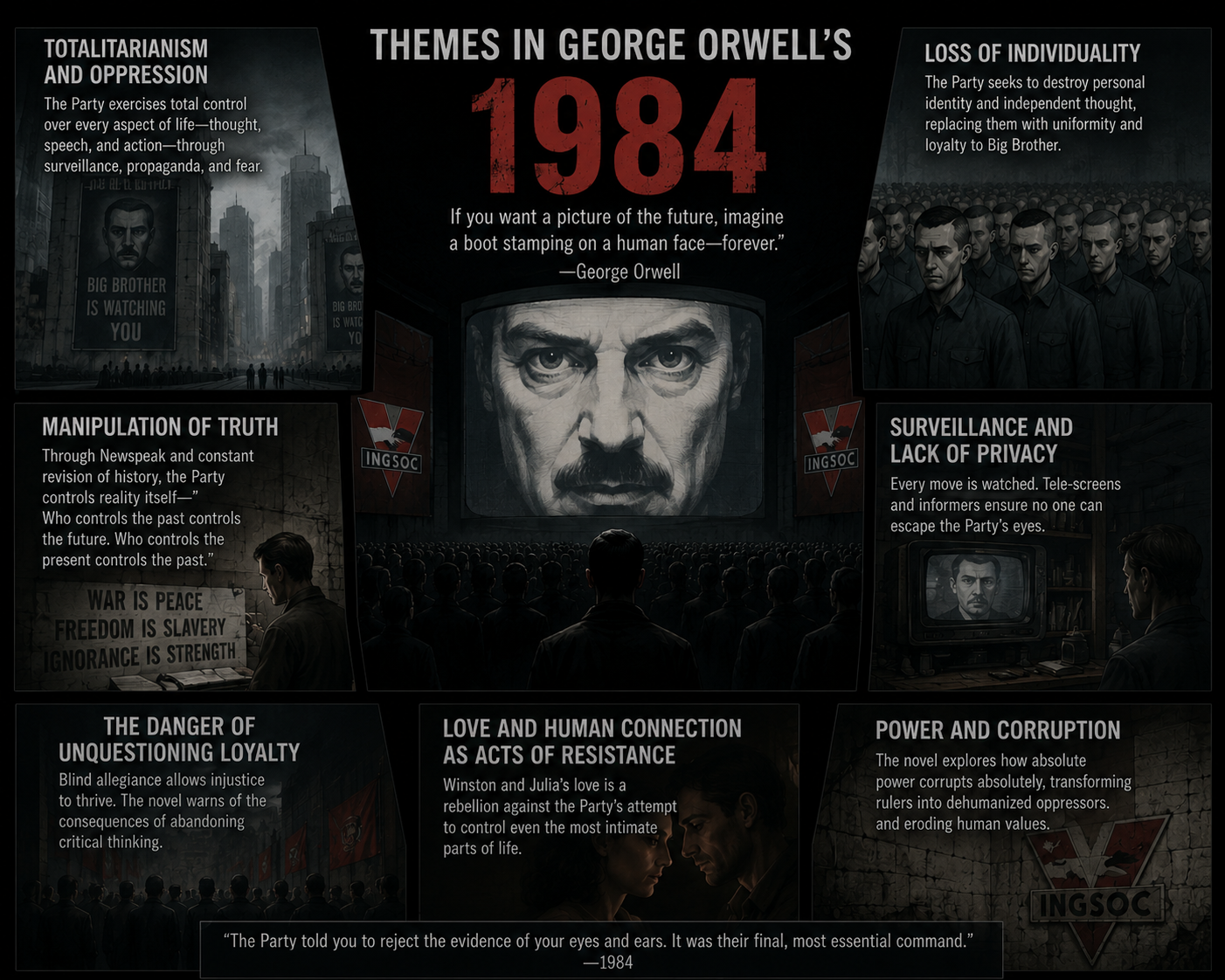
George Orwell’s 1984 is more than a dark story about a future society. The themes in 1984 help students see how power can shape truth, language, fear, and private thought.
This guide breaks down the major ideas you should notice for class discussion, close reading, and essays.
This article contains affiliate links.
In this Guide
Use this guide as a quick map before you write or review.
- Understanding the major ideas in the novel
- Power and control
- Language and thought
- Truth and memory
- Fear and loyalty
- Individual freedom
- Books to read next
- FAQ
Understanding the Themes in 1984
Orwell uses Winston’s world to ask a simple but scary question: what happens when a government controls not just actions, but minds?
A theme is a big idea a text explores. In 1984, Orwell does not give readers easy answers. He shows a world where people may obey because they are afraid, tired, watched, or unsure what is true.
To study the novel well, do more than name the theme. Ask how Orwell builds it through setting, conflict, symbols, and character choices. If you need help with that step, see our guide on how to analyze characters in literature.
Winston matters because he wants the truth, even when truth feels dangerous. His struggle turns the novel’s ideas into a human story.
Themes in 1984: Power and Control
These themes in 1984 show that power works best when people believe they have no safe place to resist.
The Party controls public life through laws, screens, slogans, and punishment. Yet its deeper goal is mental control. It wants citizens to accept whatever the Party says, even if it changes from day to day.
Big Brother is the face of this power. He may or may not exist as a real person, but that almost does not matter. His image makes people feel watched at all times.
The telescreens are a clear symbol of this control. They turn private rooms into public spaces. Winston cannot fully relax, even in his own home.
This theme connects to many dystopian works. In The Hunger Games by Suzanne Collins, public fear and public display help the Capitol stay in power. In 1984, the Party goes even deeper because it tries to own thought itself.
Themes in 1984: Language and Thought
Orwell shows that language is not just a tool for speech. It can shape what people are able to think.
Newspeak is one of the most important ideas in the novel. The Party creates it to shrink language over time. If words for rebellion, freedom, or justice vanish, people may find it harder to imagine those ideas.
This is why the Party cares so much about words. It knows that clear language can protect clear thought. Confused language can hide lies.
The themes in 1984 become most clear when we see how slogans twist meaning. Phrases like War is Peace and Freedom is Slavery are not meant to make sense. They train people to accept contradiction without protest.
Students can compare this to propaganda in Shakespeare’s Julius Caesar. Mark Antony uses public speech to move the crowd. Orwell’s Party uses speech to block thought before it begins.
Themes in 1984: Truth, Memory, and History
In Orwell’s world, truth is not treated as something to discover. It is treated as something the Party can edit.
Winston works at the Ministry of Truth, but the name is a lie. His job is to change old records so the Party always appears right. If a prediction fails, the record changes. If a person becomes an enemy, the record erases that person.
This attack on history is one of the novel’s strongest warnings. If people cannot trust records, memory, or facts, they become easier to control.
When students study themes in 1984, this one often leads to strong essays. You can focus on how Orwell links truth to freedom. If citizens lose the past, they lose the power to question the present.
For more background on Orwell’s life and political concerns, visit Britannica’s overview of George Orwell.
Fear, Surveillance, and Self-Censorship
The Party does not need to punish everyone. It only needs people to believe punishment is always possible.
Fear shapes daily life in 1984. Citizens fear the Thought Police, their neighbors, and even their children. This fear causes people to hide their real feelings.
That is why surveillance is so powerful. The telescreen may not catch every action, but it changes behavior. People learn to police themselves.
This idea feels modern because many readers know what it means to act differently when they feel watched. Orwell pushes that feeling to an extreme. He asks what happens when privacy no longer exists.
Individual Freedom and Private Identity
Winston’s rebellion starts small because even small private acts matter in this world.
At first, Winston does not lead a movement. He writes in a diary. He remembers. He loves Julia. These acts matter because the Party wants no inner life outside its control.
The diary is especially important. It gives Winston a place to speak honestly, even if no one else reads it. In a world built on falsehood, private truth becomes a form of resistance.
Julia’s rebellion is different from Winston’s. She cares less about history and more about personal pleasure. Their differences help readers see that freedom can mean more than one thing.
To build a stronger essay, compare how Winston and Julia respond to control. Our character analysis guide can help you connect their choices to the novel’s larger ideas.
Why the Themes in 1984 Still Matter
Orwell’s novel still speaks to readers because it studies problems that do not belong to one time period.
The novel asks readers to care about truth, language, privacy, and power. These ideas matter in governments, schools, media, and personal life.
The key lesson is not only that total power is dangerous. Orwell also shows that people must protect the habits that keep freedom alive. Those habits include honest speech, memory, questions, and private thought.
This is why 1984 often appears in high school, AP Literature, and college courses. It gives students a strong way to discuss politics, ethics, and human behavior through fiction.
Books to Read Next
These books pair well with Orwell’s novel because they also ask how society shapes freedom and truth.
- Brave New World by Aldous Huxley
- Fahrenheit 451 by Ray Bradbury
For a wider look at dystopian fiction as a genre, see Britannica’s page on dystopia.
FAQ About Themes in 1984
Use these quick answers for review before a quiz, seminar, or essay.
What are the main themes in 1984?
The main themes in 1984 include power, language, truth, fear, surveillance, and individual freedom. Each theme shows how the Party controls people from the outside and the inside.
What is the most important theme in 1984?
Many students choose control of truth as the most important theme. If the Party can rewrite facts, citizens lose the ability to challenge power.
How does Newspeak support the novel’s themes?
Newspeak limits thought by limiting words. Orwell suggests that people need rich, clear language to think freely.
Why does Winston keep a diary?
The diary lets Winston claim a private voice. It is a small act of rebellion because the Party wants to control even personal thoughts.
Key Takeaway
The themes in 1984 show how freedom can disappear when power controls truth, language, and private life. Orwell’s warning is clear: a free mind needs facts, memory, and the courage to question authority.


Get the Free Close Reading Worksheet Pack
Join my email list and receive the printable worksheet pack you can use with any novel or poem.
No spam. Just helpful guides for reading literature well.












