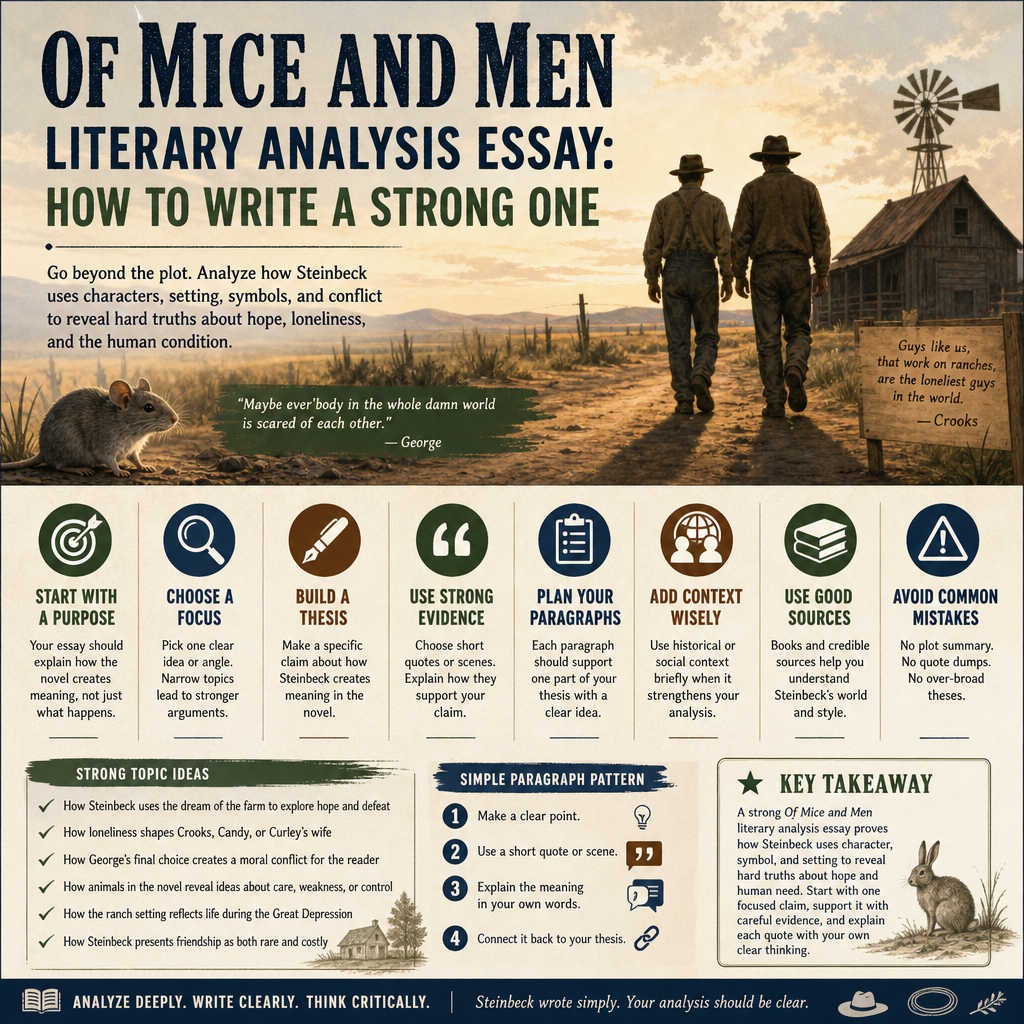
Of Mice and Men Literary Analysis Essay: How to Write a Strong One

Mice and Men

Writing an Of Mice and Men literary analysis essay can feel tough because the book is short but full of meaning. This guide will help you move from topic idea to thesis, then from evidence to a clear final draft.

You will learn how to build an argument about Steinbeck’s novel without just retelling the plot.
Mice and Men

In this Guide

Use this guide as a quick map before you write.

  • What a literary analysis essay should do
  • How to choose a strong focus
  • Thesis statement examples
  • Topic ideas for Of Mice and Men
  • Evidence suggestions from the novel
  • Helpful books and sources
  • FAQ and final takeaway

Start Your Of Mice and Men Literary Analysis Essay with a Clear Purpose

A strong essay should explain how a text creates meaning, not just what happens in the story.

In Of Mice and Men, John Steinbeck tells a simple story about George and Lennie, two workers who hope for a better life. Your job is to look deeper. Ask how Steinbeck uses character, setting, symbols, conflict, or tone to shape the reader’s view.

A plot summary says, ‘George and Lennie want a farm.’ A literary analysis says, ‘Steinbeck uses the dream of the farm to show how hope can both comfort and mislead people who live with little power.’

If you need a wider overview of essay structure, read our guide to writing a literary analysis essay. It pairs well with this Of Mice and Men literary analysis essay plan.

Choose a Focus for Your Of Mice and Men Literary Analysis Essay

Your essay becomes stronger when it studies one clear idea instead of many broad themes.

Many students start with a theme like loneliness or the American Dream. That is a good start, but it is not enough yet. You need an angle that shows what Steinbeck says about that theme.

For example, ‘loneliness’ is too broad. A sharper focus would be: ‘Steinbeck shows that loneliness can make people both cruel and desperate for connection.’

This focus keeps your Of Mice and Men literary analysis essay from drift. It also helps each body paragraph serve one main claim.

Think of how this works in other well-known books. In The Great Gatsby, a student should not just write about wealth. A stronger essay asks how wealth changes how people treat others.

Build a Thesis for an Of Mice and Men Literary Analysis Essay

Your thesis is the main argument your whole essay must prove.

A good thesis names the text, gives a clear claim, and points to how the author creates meaning. It should not sound like a fact from the plot.

Weak thesis: In Of Mice and Men, George and Lennie have a dream.

Stronger thesis: In Of Mice and Men, Steinbeck uses George and Lennie’s dream of owning land to show how hope can help people survive hardship, even when that hope is fragile.

Here are more thesis statement examples you can adapt:

  • Theme thesis: Steinbeck presents loneliness as a force that damages people’s sense of worth and pushes them to seek control over others.
  • Character thesis: Through George’s care for Lennie, Steinbeck shows that love can become a heavy moral burden in an unfair world.
  • Symbol thesis: The rabbits in Of Mice and Men symbolize Lennie’s dream of safety, but they also reveal how far that dream is from reality.
  • Setting thesis: Steinbeck uses the ranch as a harsh social world where workers compete for status because they lack real security.

Your Of Mice and Men literary analysis essay will feel much more focused if every paragraph connects back to one of these kinds of claims.

If thesis writing slows you down, the Literary Analysis Essay Toolkit gives you thesis frames, paragraph planners, and revision checklists made for student essays.

Use Evidence in Your Of Mice and Men Literary Analysis Essay

Good evidence does not speak for itself, so you must explain how it supports your claim.

Choose short quotes or moments that reveal a pattern. You do not need the longest quote. You need the most useful one.

For a theme essay on loneliness, you might study Crooks’s room and his talk with Lennie. Crooks lives apart from the other men, and his bitterness grows from that forced isolation.

For an essay on dreams, you might use the repeated description of the farm. The dream returns at key moments, which shows how much George and Lennie need it.

For an essay on power, you might study Curley’s behavior or the way the ranch workers treat Candy after his dog grows old. These scenes reveal a world where weakness can make a person unsafe.

Use this simple pattern in each body paragraph:

  • Make a clear point.
  • Use a short quote or scene.
  • Explain the meaning in your own words.
  • Connect it back to the thesis.

This pattern works for an Of Mice and Men literary analysis essay, but it also works for novels like To Kill a Mockingbird or Lord of the Flies.

Of Mice and Men Literary Analysis Essay Topic Ideas

The best topic gives you room to argue, not just describe.

Here are strong topic angles for your essay:

  • How Steinbeck uses the dream of the farm to explore hope and defeat
  • How loneliness shapes Crooks, Candy, or Curley’s wife
  • How George’s final choice creates a moral conflict for the reader
  • How animals in the novel reveal ideas about care, weakness, or control
  • How the ranch setting reflects life during the Great Depression
  • How Steinbeck presents friendship as both rare and costly

Once you pick a topic, turn it into a question. For example: ‘How does Steinbeck use Candy’s dog to prepare the reader for the ending?’ Your answer can become your thesis.

This step will help your Of Mice and Men literary analysis essay sound more original and less like a report.

Plan Body Paragraphs Before You Draft

A simple plan can save you from a messy essay.

Each body paragraph should cover one part of your thesis. If your thesis is about hope, loneliness, or moral choice, each paragraph should show a different piece of that idea.

Here is a sample plan for a thesis about the dream of the farm:

  • Body paragraph 1: The farm gives George and Lennie comfort in a hard world.
  • Body paragraph 2: The dream attracts others because many characters feel trapped.
  • Body paragraph 3: The collapse of the dream shows the limits of hope in an unfair society.

Be careful with your topic sentences. Do not start every paragraph with plot. Start with an idea.

Plot-based: Lennie talks about rabbits again.

Analysis-based: Lennie’s repeated focus on rabbits shows his need for a safe future he can understand.

For more help with paragraph shape, our literary analysis essay guide breaks down claims, evidence, and commentary in a clear way.

Add Context Without Letting It Take Over

Context can help, but the novel must stay at the center of your essay.

Of Mice and Men connects to the Great Depression, migrant labor, and the struggle for economic security. These facts can support your analysis, but they should not replace close reading.

A useful sentence might say: ‘The ranch reflects the unstable lives of workers during the Great Depression, which makes George and Lennie’s dream feel urgent.’

For quick background, you can use Britannica’s biography of John Steinbeck. You can also read the Nobel Prize profile on Steinbeck for a short view of his literary importance.

Helpful Books to Consider

These books can help you understand Steinbeck’s world and style.

If you shop on Amazon or use your school library, look for these titles:

  • Of Mice and Men by John Steinbeck
  • The Grapes of Wrath by John Steinbeck
  • Steinbeck: A Life in Letters edited by Elaine Steinbeck and Robert Wallsten

The first title is the main text. The other books can help you see Steinbeck’s wider concerns with work, poverty, and human dignity.

Common Mistakes to Avoid in an Of Mice and Men Literary Analysis Essay

Small choices can weaken your essay even when your idea is strong.

Do not write a full plot summary. Your teacher already knows the story. Focus on what Steinbeck does and why it matters.

Do not use quotes without commentary. After each quote, explain the word choice, symbol, contrast, or character action that supports your claim.

Do not make your thesis too broad. A claim like ‘Steinbeck shows life is hard’ is true, but it is not specific enough for a strong essay.

Do not ignore the ending. Even if your essay is not only about the final scene, the ending often changes how readers understand earlier dreams and choices.

FAQ: Of Mice and Men Literary Analysis Essay

Here are quick answers to common student questions.

What is a good thesis for an Of Mice and Men literary analysis essay?

A good thesis makes a clear claim about how Steinbeck creates meaning. For example: ‘Steinbeck uses George and Lennie’s dream to show how hope can comfort people who live with fear and uncertainty.’

What themes can I write about?

You can write about loneliness, dreams, friendship, power, mercy, or social inequality. Pick one theme and make a specific claim about it.

How many quotes should I use?

Use enough quotes to prove your points, but do not overload the essay. One strong quote or scene per body paragraph often works well.

Should I include historical context?

Yes, but keep it brief. Use context only when it helps explain the novel’s setting, conflict, or characters.

Can I write about George’s final choice?

Yes. That topic works well because it lets you analyze love, responsibility, and moral conflict in one focused argument.

Key Takeaway

A strong ending should remind you what matters most.

A strong Of Mice and Men literary analysis essay does not just explain the story. It proves how Steinbeck uses character, symbol, and setting to reveal hard truths about hope and human need.

Start with one focused claim, support it with careful evidence, and explain each quote with your own clear thinking. That is the heart of literary analysis. ✍️
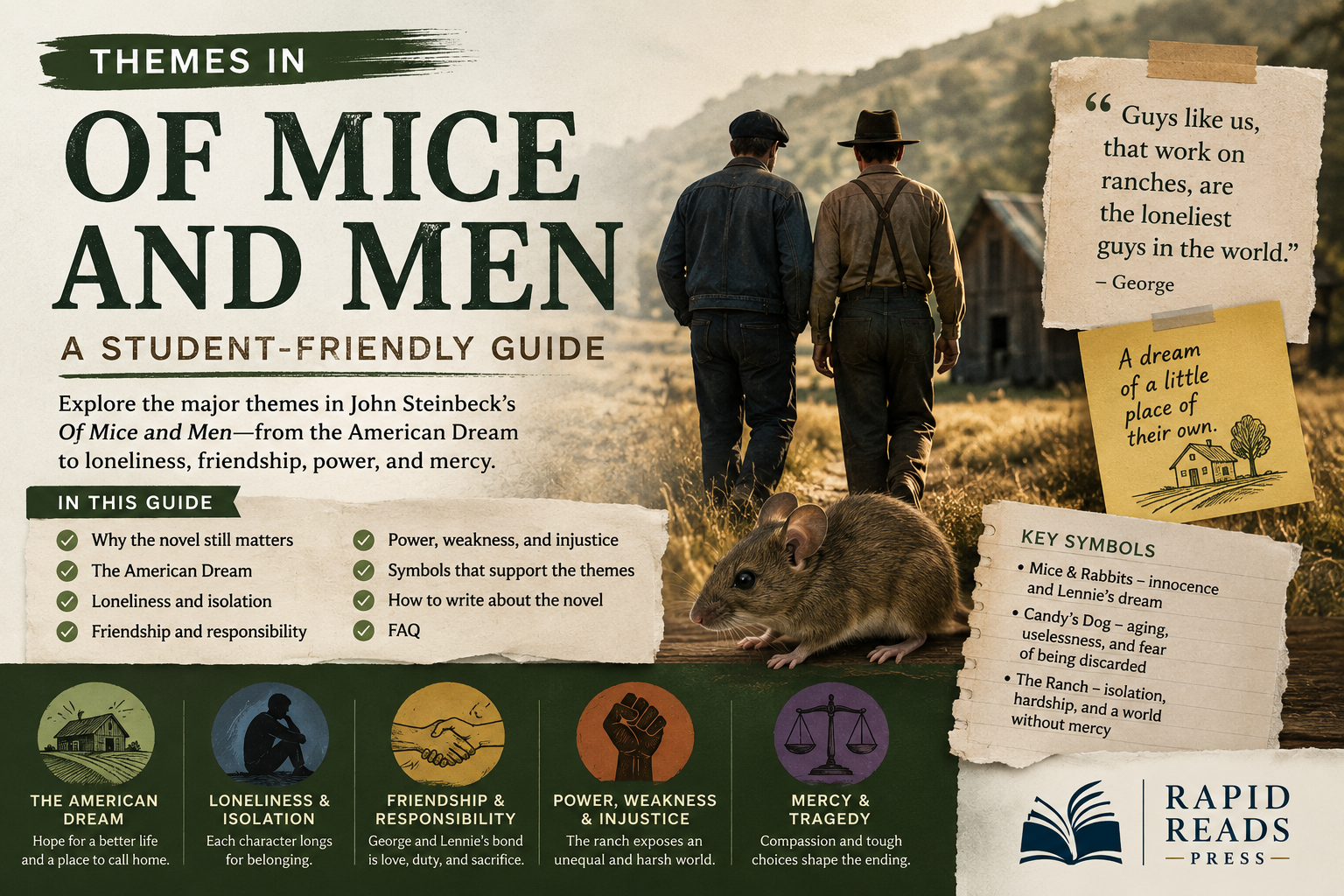
Themes in Of Mice and Men: A Student-Friendly Guide

themes in of mice and men

The themes in Of Mice and Men help students see why John Steinbeck’s short novel still feels powerful. The book is about two migrant workers, but it also asks hard questions about dreams, loneliness, power, and mercy.

This guide explains the major ideas in clear language so you can use them in class discussion, essays, or AP Literature notes.

This article contains affiliate links.

In this Guide

  • Why the novel still matters
  • The American Dream
  • Loneliness and isolation
  • Friendship and responsibility
  • Power, weakness, and injustice
  • Symbols that support the themes
  • How to write about the novel
  • FAQ
themes in of mice and men

Why the themes in Of Mice and Men Still Matter

Steinbeck writes about a small group of workers, but their problems feel much bigger than one ranch.

The themes in Of Mice and Men matter because they connect private pain to public hardship. George and Lennie want a home, safety, and control over their lives. Those hopes sound simple, but the world around them makes those hopes hard to reach.

The novel takes place during the Great Depression, when many workers moved from job to job. They had little money and almost no security. You can learn more about Steinbeck’s life and context through the Britannica profile of John Steinbeck.

Like The Grapes of Wrath, this book shows how poverty can crush people’s plans. It also shows how people hold on to hope even when hope seems fragile.

Main Themes in Of Mice and Men Students Should Know

Most strong essays on this novel start with a theme and then connect it to character choices.

The main themes in Of Mice and Men include the dream of a better life, the pain of loneliness, and the abuse of power. These ideas do not sit apart from each other. They overlap in almost every major scene.

George and Lennie’s dream farm gives them hope. Candy joins the dream because he fears becoming useless. Crooks wants in for a moment because he also wants safety and belonging.

Each character shows a different side of the same problem. They all want a place where they matter. Steinbeck suggests that this need is human, but the world of the ranch makes it hard to protect.

The American Dream in Of Mice and Men

The dream farm is the heart of the novel’s hope and heartbreak.

George and Lennie dream of owning a small piece of land. They want rabbits, crops, and freedom from bosses. To them, the farm means dignity.

This dream is powerful because it is so modest. They do not want to be rich. They just want peace and control over their days.

Yet the novel keeps warning us that the dream may not survive. George has told the story many times, almost like a bedtime tale. Lennie loves to hear it because it makes the future feel safe.

In this way, Steinbeck questions the American Dream. He asks whether hard work is enough when poverty, disability, and social class stand in the way.

Loneliness and Isolation

Nearly every character in the novel feels cut off from others.

George says that ranch workers are the loneliest people in the world. They travel alone, spend their money, and move on. His friendship with Lennie makes him different.

Crooks is isolated because of racism. He lives apart from the other men and knows that the dream of equality is not real for him. Curley’s wife is isolated because she is the only woman on the ranch and because the men treat her as a threat instead of a person.

Candy fears loneliness too. After his old dog is killed, he sees his own future more clearly. He worries that age will leave him unwanted.

This theme helps explain why the dream farm matters so much. It is not only about land. It is about escape from being alone.

Friendship, Loyalty, and Responsibility

George and Lennie’s bond gives the novel its emotional center.

George often complains about Lennie, but he still protects him. Lennie depends on George for almost everything. Their friendship is not simple, but it is real.

Steinbeck shows that loyalty can be both loving and painful. George cares for Lennie, but that care also traps him. He cannot live the free life he sometimes imagines.

This makes the ending so hard. George’s final choice forces readers to ask what mercy means. Is it an act of love, an act of despair, or both?

Students can compare this to works like Romeo and Juliet, where love leads to painful choices. In both texts, strong bonds shape tragic endings.

Power, Weakness, and Injustice

The ranch has a clear social order, and the weakest people suffer most.

Curley uses his status to threaten others. He is the boss’s son, so men fear him even when they dislike him. His power does not make him wise or kind.

Other characters lack power for different reasons. Lennie has great physical strength, but he has little social protection. Crooks is smart and sharp, but racism limits his life. Curley’s wife has some power over Crooks in one scene, yet she also has almost no freedom of her own.

Steinbeck does not present power as simple. A person can be hurt in one moment and hurt someone else in the next. That makes the novel more honest and more troubling.

How Symbolism Supports the Themes in Of Mice and Men

Symbols help Steinbeck show big ideas through small details.

When you study the themes in Of Mice and Men, pay close attention to animals, settings, and repeated images. Lennie’s dead mouse, Candy’s dog, and the rabbits all point to innocence, danger, and loss.

Candy’s dog is one of the clearest symbols. The dog is old and no longer useful, so the men decide it should die. This moment reflects Candy’s fear that the ranch will one day treat him the same way.

The rabbits symbolize Lennie’s dream of comfort. They also show how gentle desires can become dangerous when Lennie cannot control his strength.

If you want more help with this skill, read our guide on how to find symbolism in a story. It can help you turn small details into stronger essay points.

Fate, Foreshadowing, and Tragedy

The novel feels tragic because the ending is prepared from the start.

Steinbeck uses foreshadowing to build dread. Lennie kills small animals by accident. George tells him to hide in the brush if trouble comes. Candy regrets not killing his own dog himself.

These moments prepare us for the ending. They make the final scene feel shocking but not random.

The structure is close to classical tragedy. A character has a deep flaw or limit, the world gives little mercy, and the result feels almost unavoidable. Lennie does not mean harm, but his lack of control creates danger.

Nature, Violence, and the Loss of Innocence

The natural world in the novel looks peaceful, but danger is never far away.

The book opens near the river, a place that seems calm and safe. By the end, the same setting becomes the place of George’s terrible choice. Steinbeck uses this return to show how innocence has been lost.

Animals are central to this idea. Lennie loves soft things, but his touch often ends in harm. The pattern shows the gap between intention and result.

This theme is useful for essays because it links character, plot, and symbol. Lennie wants gentleness, but the world of the novel turns gentleness into grief.

How to Write About the Themes in Of Mice and Men

A strong essay needs a clear claim, not just a topic.

A strong essay about the themes in Of Mice and Men should explain what Steinbeck is saying about human life. Do not just write that loneliness is a theme. Write what the novel argues about loneliness.

For example, you could argue that Steinbeck shows loneliness as both a personal pain and a social problem. Then you could use Crooks, Candy, and Curley’s wife as proof.

You can also connect symbols to theme. The dream farm is not only a setting George and Lennie want. It represents the hope that people can build a life where they are safe and valued.

For extra support, our student literature study guide can help you organize notes, themes, and evidence before you draft.

Need more practice with symbols? Our guide to reading symbols in fiction is a useful next step.

Helpful Related Books

These books pair well with Steinbeck’s novel because they explore class, dreams, justice, and social pressure.

  • The Grapes of Wrath by John Steinbeck
  • To Kill a Mockingbird by Harper Lee
  • Death of a Salesman by Arthur Miller

For more author background, the Nobel Prize biography of John Steinbeck gives a helpful overview of his work and reputation.

FAQ About the Themes in Of Mice and Men

Use these quick answers to review before a quiz, class talk, or essay draft.

What are the main themes in Of Mice and Men?

The main themes are dreams, loneliness, friendship, power, and injustice. The novel shows how hard it is for vulnerable people to find safety.

What does the dream farm represent?

The dream farm represents hope, freedom, and belonging. It gives George, Lennie, and Candy a reason to imagine a better future.

Why is loneliness so important in the novel?

Loneliness shapes almost every character. Steinbeck shows that people need connection, but prejudice, fear, and poverty keep them apart.

Is George and Lennie’s friendship healthy?

It is caring, but it is also unequal. George protects Lennie, yet he also carries a heavy burden because Lennie cannot live safely on his own.

How does Steinbeck use symbolism?

He uses animals, the dream farm, and the river setting to show deeper ideas. These symbols connect hope with loss.

Key Takeaway

The themes in Of Mice and Men show that people need dreams and companionship, but harsh social forces can destroy both. Steinbeck’s novel stays powerful because its tragedy feels deeply human.

Symbols in 1984: What They Mean and Why They Matter

symbols in 1984

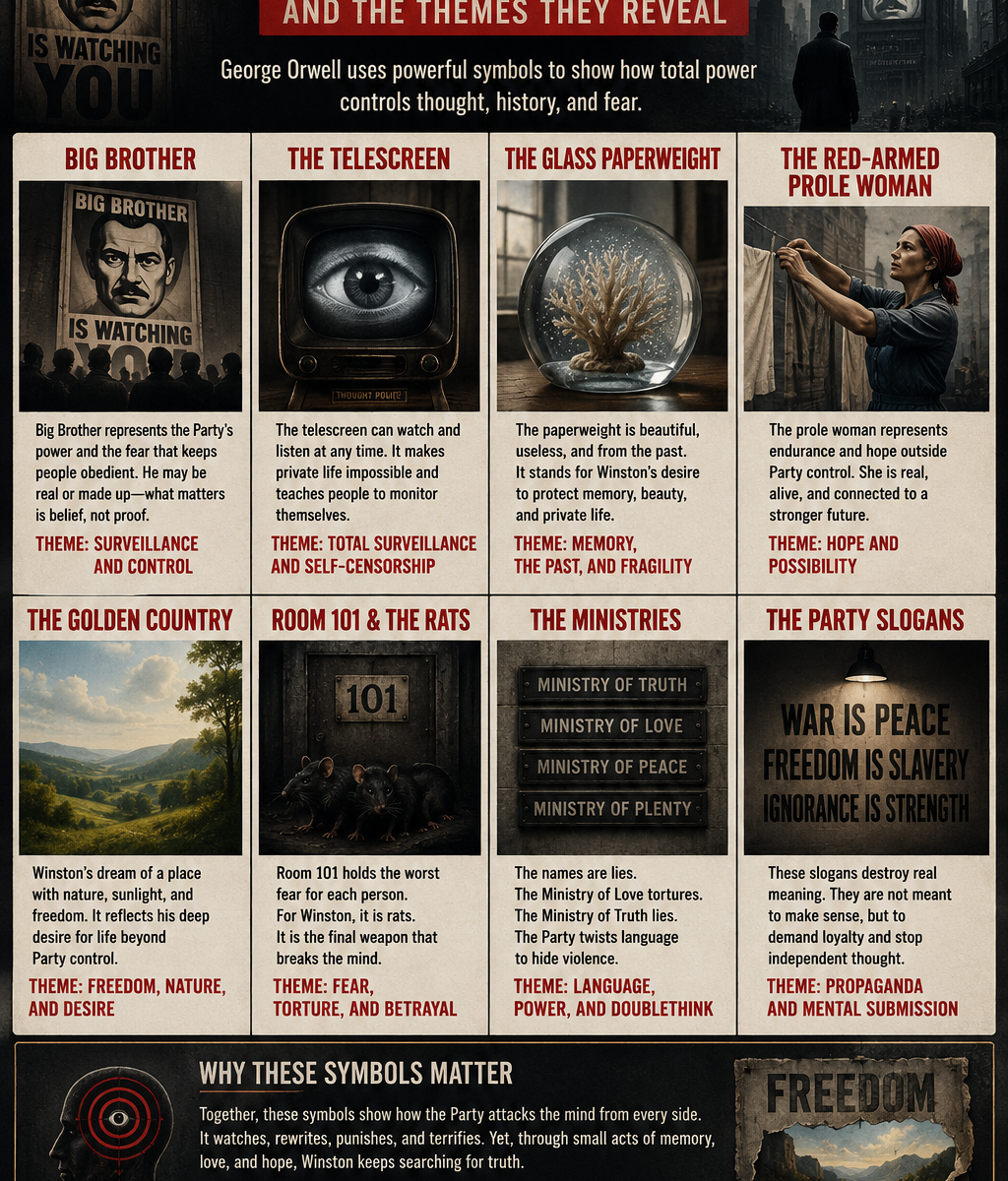
George Orwell uses strong images to show how a government can control thought, history, and fear. This guide explains the most important symbols in 1984 and connects each one to a major theme in the novel.

If you need a quick review of the basics, see our guide on how to find symbolism in a story.

In this Guide

  • What symbolism does in the novel
  • Big Brother and the telescreen
  • The paperweight, the prole woman, and the Golden Country
  • Room 101, rats, and fear
  • How to write about these symbols
  • FAQ and key takeaway

This article contains affiliate links.

symbols in 1984

What Symbols in 1984 Do

Orwell’s symbols make abstract ideas feel concrete and hard to ignore.

The main symbols in 1984 help readers see how total power works. Instead of only telling us that the Party is cruel, Orwell gives us objects and images that show fear, control, and lost freedom.

This is why symbolism matters in literature. A symbol can carry a larger meaning, like the green light in The Great Gatsby or the conch in Lord of the Flies.

In Orwell’s novel, symbols often show the gap between private life and public control. Winston wants truth and love, but the Party tries to own both.

Big Brother as One of the Key Symbols in 1984

Big Brother stands for the Party’s power and the fear that keeps people obedient.

The famous poster says, “Big Brother is watching you.” This image appears across the city and makes people feel watched even when no one may be there.

Big Brother may be a real person, or he may be a made-up figure. That uncertainty is part of the point. The Party does not need proof. It needs belief.

As one of the central symbols in 1984, Big Brother connects to the theme of surveillance. He also shows how a government can replace family, faith, and personal loyalty with loyalty to the state.

The Telescreen and Total Surveillance

The telescreen turns private space into public property.

Winston’s telescreen can send out Party messages, but it can also watch him. He cannot fully turn it off. Even his face and body can betray him.

This symbol matters because it makes control feel constant. The Party does not only punish crimes. It hunts for thoughts, doubts, and small signs of rebellion.

The telescreen also connects to the theme of self-censorship. Winston learns to hide his feelings because the world around him has no safe corner.

The Glass Paperweight and the Lost Past

The paperweight shows Winston’s desire to protect beauty, memory, and private life.

Winston buys the glass paperweight because it feels useless in the Party’s world. It is old, delicate, and connected to a time before constant control.

The piece of coral inside the glass seems sealed away from history. Winston imagines his room above Mr. Charrington’s shop in the same way. It feels like a small world where he and Julia can exist apart from the Party.

When the Thought Police smash the paperweight, the meaning becomes clear. The Party can break private dreams as easily as glass.

This is one of the most painful symbols in 1984 because it links memory to fragility. The past can matter deeply, but it can also be destroyed.

The Red-Armed Prole Woman

The prole woman symbolizes endurance and a hope that exists outside Party control.

Winston watches her as she hangs laundry and sings. She is not rich or powerful, but she seems alive in a way Party members are not.

Her body, voice, and daily work suggest strength. Winston starts to believe that the proles may hold the future because they have not been fully emptied by Party life.

This symbol connects to the theme of hope. Orwell does not make that hope simple, though. The proles have numbers, but they lack political awareness.

The Golden Country

The Golden Country represents freedom, natural life, and desire without fear.

Winston dreams of a place with grass, sunlight, and open space. It feels like the opposite of London, where rooms are watched and language is policed.

When Winston later meets Julia in the countryside, the setting echoes this dream. For a short time, nature seems to offer a space beyond Party control.

Yet the Golden Country is never fully safe. As with many symbols in 1984, it shows both hope and danger. Freedom exists in Winston’s mind, but the Party works to reach even there.

Room 101, Rats, and Fear

Room 101 symbolizes the final weapon of the Party: personal terror.

O’Brien tells Winston that everyone knows what waits in Room 101. It is the worst thing in the world for that person. For Winston, it is rats.

The rats are not just animals. They represent panic that cannot be argued with. Winston can resist pain for a time, but pure fear breaks the part of him that loves Julia.

This symbol connects to the theme of betrayal. The Party does not only want Winston to obey. It wants him to give up the person he loves most.

The Ministries and Party Slogans

The false names of the Ministries show how language can hide violence.

The Ministry of Love deals with torture. The Ministry of Truth spreads lies. These names are cruel because they force people to accept the opposite of reality.

The Party slogans work the same way. Their purpose is not clear thought. Their purpose is mental submission.

These are important symbols in 1984 because they connect language to power. If the Party can control words, it can weaken a person’s ability to resist.

Why Symbols in 1984 Matter for Themes

The novel’s symbols all point back to the same core question: who gets to control reality?

Big Brother and the telescreen show public control. The paperweight and Golden Country show private hope. Room 101 shows how fear can destroy even deep love.

Together, the symbols in 1984 reveal how the Party attacks the mind from every side. It changes history, watches behavior, twists language, and uses fear when all else fails.

For more background on the novel, you can read Britannica’s overview of Nineteen Eighty-four.

How to Write About Symbols in 1984

A strong paragraph should name the symbol, explain its meaning, and connect it to a theme.

Do not stop at saying that Big Brother is a symbol of control. Show how the poster, the watching eyes, and the repeated slogan make people police themselves.

You can use this simple sentence frame: In 1984, [symbol] represents [idea] because [specific detail], which helps Orwell develop the theme of [theme].

For more help with this skill, review our step-by-step post on finding symbols in fiction.

Books to Pair with 1984

These books pair well with Orwell’s novel because they also explore power, language, and freedom.

FAQ About Symbols in 1984

These quick answers can help with homework, essays, or class discussion.

What is the most important symbol in 1984?

Big Brother is often the most important symbol because he represents the Party’s total power and constant watchfulness.

What does the paperweight symbolize in 1984?

The paperweight symbolizes Winston’s love of the past and his hope for a private life outside Party control.

What do rats symbolize in 1984?

Rats symbolize Winston’s deepest fear. They also show how the Party uses terror to force betrayal.

Why does Orwell use so many symbols?

Orwell uses symbols to make political control feel personal. The images help readers see how power reaches into daily life.

Are the symbols in 1984 still relevant today?

Yes. Many readers still connect the novel’s symbols to debates about privacy, propaganda, and truth.

Key Takeaway

The most important symbols in 1984 show how the Party controls people through fear, false language, lost memory, and constant surveillance. Orwell’s images matter because they turn big political ideas into scenes we can feel.

Themes in 1984: A Student-Friendly Guide to Orwell’s Big Ideas

themes in 1984

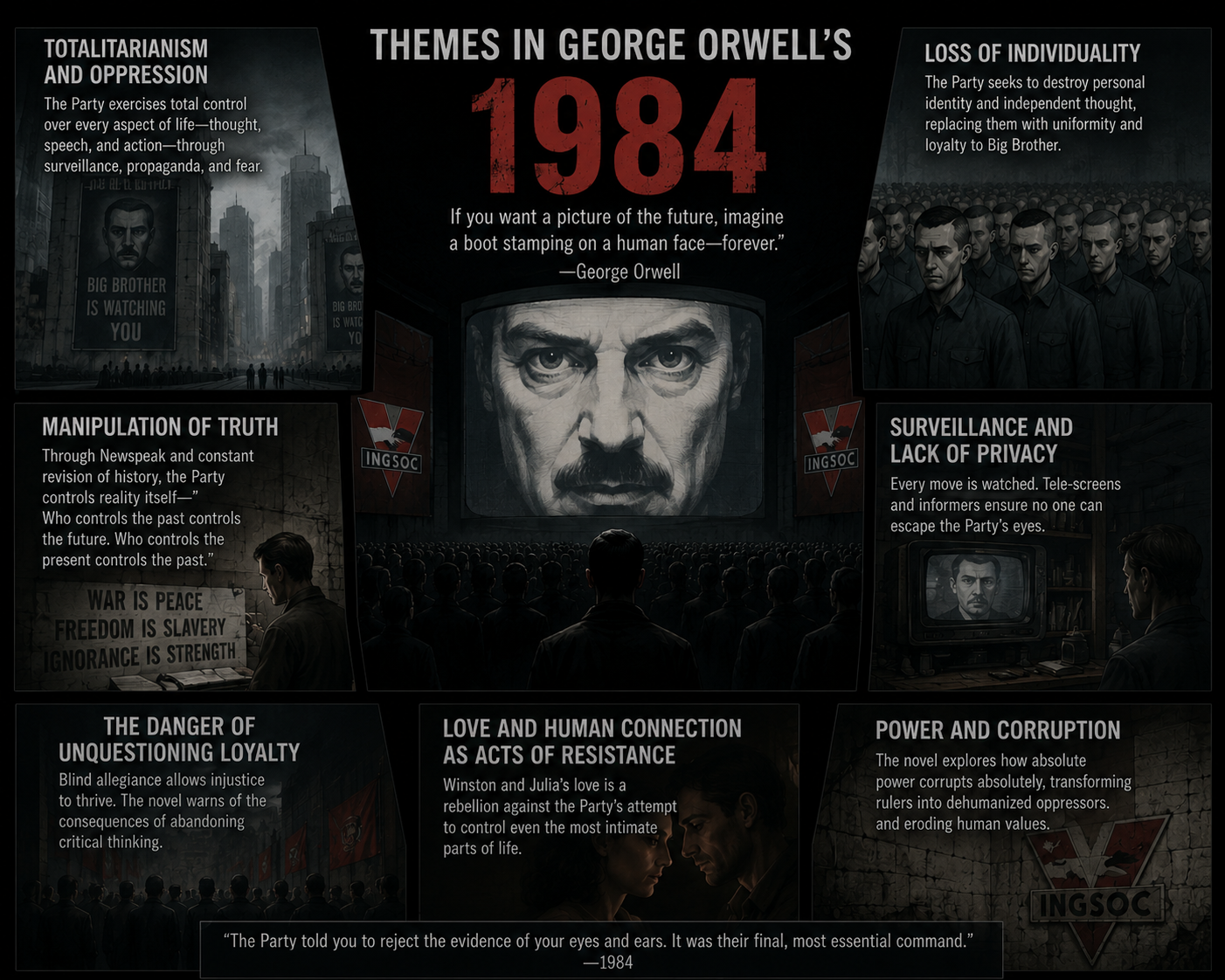
George Orwell’s 1984 is more than a dark story about a future society. The themes in 1984 help students see how power can shape truth, language, fear, and private thought.

This guide breaks down the major ideas you should notice for class discussion, close reading, and essays.

This article contains affiliate links.

In this Guide

Use this guide as a quick map before you write or review.

  • Understanding the major ideas in the novel
  • Power and control
  • Language and thought
  • Truth and memory
  • Fear and loyalty
  • Individual freedom
  • Books to read next
  • FAQ
themes in 1984

Understanding the Themes in 1984

Orwell uses Winston’s world to ask a simple but scary question: what happens when a government controls not just actions, but minds?

A theme is a big idea a text explores. In 1984, Orwell does not give readers easy answers. He shows a world where people may obey because they are afraid, tired, watched, or unsure what is true.

To study the novel well, do more than name the theme. Ask how Orwell builds it through setting, conflict, symbols, and character choices. If you need help with that step, see our guide on how to analyze characters in literature.

Winston matters because he wants the truth, even when truth feels dangerous. His struggle turns the novel’s ideas into a human story.

Themes in 1984: Power and Control

These themes in 1984 show that power works best when people believe they have no safe place to resist.

The Party controls public life through laws, screens, slogans, and punishment. Yet its deeper goal is mental control. It wants citizens to accept whatever the Party says, even if it changes from day to day.

Big Brother is the face of this power. He may or may not exist as a real person, but that almost does not matter. His image makes people feel watched at all times.

The telescreens are a clear symbol of this control. They turn private rooms into public spaces. Winston cannot fully relax, even in his own home.

This theme connects to many dystopian works. In The Hunger Games by Suzanne Collins, public fear and public display help the Capitol stay in power. In 1984, the Party goes even deeper because it tries to own thought itself.

Themes in 1984: Language and Thought

Orwell shows that language is not just a tool for speech. It can shape what people are able to think.

Newspeak is one of the most important ideas in the novel. The Party creates it to shrink language over time. If words for rebellion, freedom, or justice vanish, people may find it harder to imagine those ideas.

This is why the Party cares so much about words. It knows that clear language can protect clear thought. Confused language can hide lies.

The themes in 1984 become most clear when we see how slogans twist meaning. Phrases like War is Peace and Freedom is Slavery are not meant to make sense. They train people to accept contradiction without protest.

Students can compare this to propaganda in Shakespeare’s Julius Caesar. Mark Antony uses public speech to move the crowd. Orwell’s Party uses speech to block thought before it begins.

Themes in 1984: Truth, Memory, and History

In Orwell’s world, truth is not treated as something to discover. It is treated as something the Party can edit.

Winston works at the Ministry of Truth, but the name is a lie. His job is to change old records so the Party always appears right. If a prediction fails, the record changes. If a person becomes an enemy, the record erases that person.

This attack on history is one of the novel’s strongest warnings. If people cannot trust records, memory, or facts, they become easier to control.

When students study themes in 1984, this one often leads to strong essays. You can focus on how Orwell links truth to freedom. If citizens lose the past, they lose the power to question the present.

For more background on Orwell’s life and political concerns, visit Britannica’s overview of George Orwell.

Fear, Surveillance, and Self-Censorship

The Party does not need to punish everyone. It only needs people to believe punishment is always possible.

Fear shapes daily life in 1984. Citizens fear the Thought Police, their neighbors, and even their children. This fear causes people to hide their real feelings.

That is why surveillance is so powerful. The telescreen may not catch every action, but it changes behavior. People learn to police themselves.

This idea feels modern because many readers know what it means to act differently when they feel watched. Orwell pushes that feeling to an extreme. He asks what happens when privacy no longer exists.

Individual Freedom and Private Identity

Winston’s rebellion starts small because even small private acts matter in this world.

At first, Winston does not lead a movement. He writes in a diary. He remembers. He loves Julia. These acts matter because the Party wants no inner life outside its control.

The diary is especially important. It gives Winston a place to speak honestly, even if no one else reads it. In a world built on falsehood, private truth becomes a form of resistance.

Julia’s rebellion is different from Winston’s. She cares less about history and more about personal pleasure. Their differences help readers see that freedom can mean more than one thing.

To build a stronger essay, compare how Winston and Julia respond to control. Our character analysis guide can help you connect their choices to the novel’s larger ideas.

Why the Themes in 1984 Still Matter

Orwell’s novel still speaks to readers because it studies problems that do not belong to one time period.

The novel asks readers to care about truth, language, privacy, and power. These ideas matter in governments, schools, media, and personal life.

The key lesson is not only that total power is dangerous. Orwell also shows that people must protect the habits that keep freedom alive. Those habits include honest speech, memory, questions, and private thought.

This is why 1984 often appears in high school, AP Literature, and college courses. It gives students a strong way to discuss politics, ethics, and human behavior through fiction.

Books to Read Next

These books pair well with Orwell’s novel because they also ask how society shapes freedom and truth.

For a wider look at dystopian fiction as a genre, see Britannica’s page on dystopia.

FAQ About Themes in 1984

Use these quick answers for review before a quiz, seminar, or essay.

What are the main themes in 1984?

The main themes in 1984 include power, language, truth, fear, surveillance, and individual freedom. Each theme shows how the Party controls people from the outside and the inside.

What is the most important theme in 1984?

Many students choose control of truth as the most important theme. If the Party can rewrite facts, citizens lose the ability to challenge power.

How does Newspeak support the novel’s themes?

Newspeak limits thought by limiting words. Orwell suggests that people need rich, clear language to think freely.

Why does Winston keep a diary?

The diary lets Winston claim a private voice. It is a small act of rebellion because the Party wants to control even personal thoughts.

Key Takeaway

The themes in 1984 show how freedom can disappear when power controls truth, language, and private life. Orwell’s warning is clear: a free mind needs facts, memory, and the courage to question authority.

Book & Literature News: Children’s Booker Judge, Festivals, Libraries, and Immigrant Storytelling

Here is a roundup of recent developments in literature for May 1, 2026. Today’s stories move from major prize judging and community festivals to library support, immigrant identity, and the moral power of fiction.

Photo by Hugo Breyer on Unsplash

Sanchita Basu De Sarkar Joins the Children’s Booker Prize Judging Panel

British-Indian bookseller Sanchita Basu De Sarkar has been named one of the adult judges for the 2027 Children’s Booker Prize. Her role highlights the growing importance of booksellers in shaping conversations about children’s literature. Booksellers often see firsthand what young readers choose, revisit, and recommend to others.

This matters because children’s prizes can help bring fresh voices to wider attention. A judge with deep experience in bookselling may help spotlight stories that connect with readers beyond classroom lists and bestseller tables.

Swindon Festival of Literature Opens with a Free Woodland Event

The Swindon Festival of Literature is preparing to begin with a free public celebration set in the woods. The event aims to make literature feel lively, open, and connected to the local community. By placing books and storytelling in a natural setting, the festival is also inviting people who may not usually attend formal literary events.

For readers, this shows how festivals can turn literature into a shared experience. Free events lower barriers and remind us that book culture is not only found in libraries, classrooms, or bookshops.

Thayer Memorial Library Receives Gift to Support Literary Collections

Thayer Memorial Library in Lancaster, MA has received an unrestricted gift from Rich Marcello, president of the Seven Bridge Writers’ Collaborative. The donation will support the library’s ongoing work with reading, writing, and literary culture. Because the gift is unrestricted, the library has flexibility in deciding how to use it where it is needed most.

That kind of support can make a real difference for readers and writers in a local community. Strong library collections help people discover new books, build better reading strategies, and stay connected to literary life close to home.

Hasan Dudar Reflects on Palestinian American Identity in Carryout

In a conversation with Electric Literature, author Hasan Dudar discusses his work Carryout and the experience of being Palestinian American in Toledo, Ohio. The piece explores the tension between feeling “othered” and finding a sense of belonging. Dudar reflects on immigrant life, cultural memory, and the pull of a homeland that remains emotionally present.

This story matters because literature often gives shape to experiences that are hard to explain in everyday speech. For readers, it offers a way to think about identity, family, and place without reducing them to simple labels.

A New Essay Looks at Truth, Falsity, and Moral Questions in Fiction

An essay from Word on Fire considers how fiction can draw readers into difficult questions about truth, falsehood, and moral judgment. The discussion centers on the idea that stories do more than entertain; they help readers test values and choices through imagined lives. Good fiction often works because it refuses easy answers.

For anyone interested in literary analysis, this is a useful reminder that stories can be both art and argument. The best novels and short stories often ask readers to think carefully about motive, consequence, and theme.

Taken together, these stories show literature moving across many spaces: prize panels, forests, libraries, essays, and immigrant communities. The current book world seems especially focused on access, identity, and the ways stories help readers make sense of complicated truths.

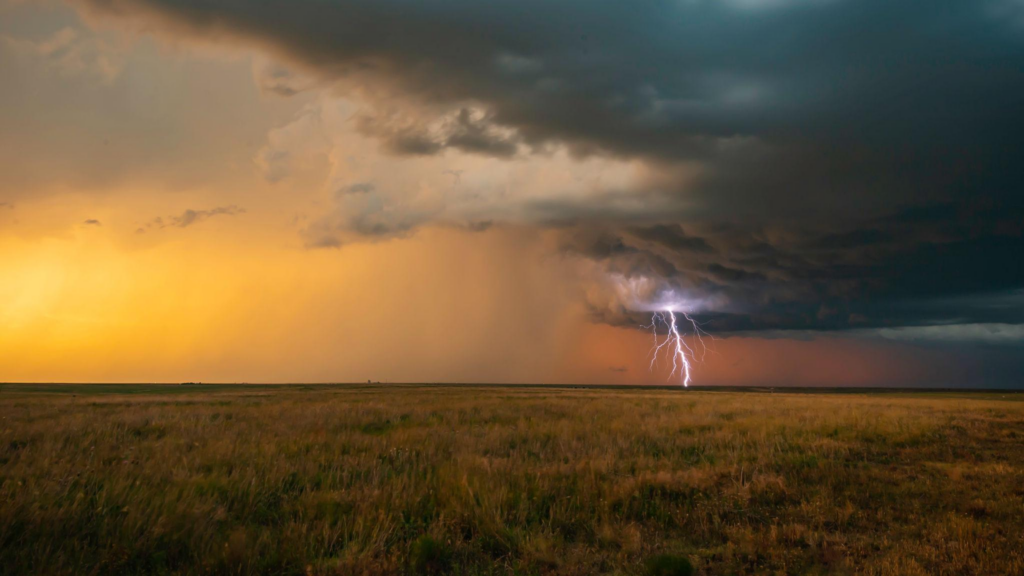
Reading the Landscape: Nature and Isolation in Western Writing

nature and isolation in Western writing

How the American West shapes theme, character, and meaning in literature

The American West is more than a backdrop. In nature and isolation in Western writing, the land shapes how characters think, feel, and survive. Wide skies, long distances, and quiet towns create a kind of pressure that shows up in the writing itself. When you read Western literature, the land is never just scenery. It acts on people. It tests them. Sometimes, it often leaves them alone with themselves.

This guide will help you read the Western landscape as part of the story. You will see how nature creates isolation, how that isolation shapes character, and how both work together to build meaning.

This article contains affiliate links.

In This Guide

  • What makes the Western landscape different in literature
  • How isolation functions as a theme
  • Key examples from American writing
  • How to analyze landscape in any text
  • Quick reading prompts you can use right away
  • FAQ – Nature and isolation in Western writing

Across many regions, setting supports the story. In Western writing, setting often drives it.

The land is open and exposed. There are fewer boundaries, fewer crowds, and fewer places to hide. This creates a different kind of tension. Characters cannot rely on social structures in the same way they might in a city or a small, dense town. The result is a stronger focus on the individual.

Distance matters here. A long road or an empty field is not just visual detail. It suggests time, effort, and sometimes risk. When a character travels across that space, the journey becomes part of the meaning of the story.

Silence also plays a role. In Western landscapes, quiet is not peaceful in a simple sense. It can feel heavy. Sometimes it forces reflection. It can leave characters facing thoughts they would rather avoid.

Nature and Isolation in Western Writing: What Makes the Landscape Unique

Isolation in Western writing is rarely just about being alone. It often reveals something deeper about identity, fear, or belief.

Characters in these settings tend to face three kinds of isolation:

First, physical isolation. The land itself separates people. Homes are far apart. Help is not close. This creates a sense of vulnerability that shapes decisions.

Second, emotional isolation. Without constant interaction, characters may struggle to express what they feel. This can lead to restraint, distance, or quiet tension between people.

Third, existential isolation. The scale of the landscape can make a person feel small. This often leads to questions about purpose, meaning, and place in the world.

You can see this clearly in works like My Ántonia by Willa Cather, where the Nebraska prairie creates both freedom and loneliness, or in Blood Meridian by Cormac McCarthy, where the harsh land reflects a deeper moral emptiness.

Nature as a Force, Not a Backdrop

In Western writing, nature often acts on characters rather than sitting behind them.

Weather can shape the plot. A storm may delay travel or create danger. Heat can wear a character down. Cold can isolate them further. These are not small details. They influence what characters can do and how they feel.

The land can also mirror inner states. A dry, empty desert may reflect a sense of loss. A wide, open field may suggest possibility, but also uncertainty. Writers use these connections to deepen meaning without stating it directly.

This is especially clear in The Grapes of Wrath by John Steinbeck, where the Dust Bowl is both a real event and a symbol of hardship and displacement.

How Isolation Shapes Character

Characters in Western settings often develop in response to the land.

They may become self-reliant. With fewer resources and less support, they learn to solve problems on their own. This can create strength, but it can also lead to emotional distance.

They may become observant. In a quiet landscape, small details matter. A change in weather, a distant figure, or a shift in light can carry meaning. Characters learn to notice what others might miss.

They may struggle with connection. When people are spread out, relationships can feel fragile. This can lead to missed opportunities or unspoken feelings.

When you read, watch how a character changes over time. Ask how much of that change comes from the land itself. In Western writing, the answer is often more than you expect.

How to Analyze Landscape in Any Text

You can apply a simple method when reading Western literature or any text where setting matters.

Start by asking what the land looks like. Focus on specific details. Is it open or closed, harsh or gentle, quiet or active?

Then ask how the land affects the character’s choices. Does it limit them, push them, or shape their path?

Next, look for emotional connections. Does the landscape reflect what the character feels, or does it contrast with it?

Finally, connect the setting to theme. Ask what the landscape suggests about larger ideas like freedom, survival, loneliness, or hope.

This approach keeps your analysis grounded in the text while still reaching deeper meaning.

Quick Reading Prompts

Use these when you are working through a Western text:

  • What does the landscape make possible, and what does it take away?
  • How does distance affect the character’s decisions?
  • Where do you see silence or emptiness, and what do they mean?
  • How would the story change in a different setting?

These questions can turn a simple reading into a more thoughtful analysis.

Why This Matters for Literary Analysis

When you begin to read landscape as part of the story, texts open up in new ways. You start to see how meaning is built through more than dialogue or plot. The environment becomes part of the language of the work.

For students, this skill strengthens essays and close readings. For general readers, it deepens the experience of the story. It allows you to see how writers use place to explore what it means to be human.

Key Takeaway

In Western writing, the landscape is never neutral. It shapes isolation, defines character, and carries meaning. When you learn to read the land, you begin to understand the story at a deeper level.

If you want step-by-step support with literary analysis, you can use these tools:

Literary Analysis Essay Examples

Literary Analysis Essay Toolkit

FAQ: Nature and Isolation in Western Writing

Why is the landscape so important in Western writing?

In Western literature, the landscape shapes the story in direct ways. The size of the land, the distance between people, and the quiet all affect how characters think and act. The setting often creates pressure that drives decisions, conflict, and growth.

What does isolation mean in Western literature?

Isolation in Western writing goes beyond being alone. It can be physical, emotional, or even spiritual. Characters may be separated by distance, struggle to connect with others, or feel small in a vast world. This isolation often reveals deeper truths about identity and purpose.

How does nature influence character development?

Nature often forces characters to adapt. Harsh weather, long distances, and limited resources can make characters more independent, but also more distant from others. These conditions shape how they respond to conflict and how they relate to the world around them.

How can I analyze landscape in a literary essay?

Start by describing the setting clearly. Then connect it to character choices and emotional tone. Finally, explain how the landscape supports the theme. Focus on how the environment influences action and meaning, rather than treating it as background detail.

Is this approach useful outside of Western literature?

Yes. While it is especially clear in Western writing, this approach works in any text where setting matters. Learning to read landscape as part of the story will strengthen your analysis across many types of literature.

What are examples of books that show nature and isolation in the American West?

Works like My Ántonia by Willa Cather, The Grapes of Wrath by John Steinbeck, and Blood Meridian by Cormac McCarthy all explore how the Western landscape shapes human experience. Each text uses the land to reflect deeper emotional and thematic concerns.

error

Enjoy this article? Please spread the word :)

Follow by Email
BLUESKY
fb-share-icon
Reddit
LinkedIn
Share
RSS