

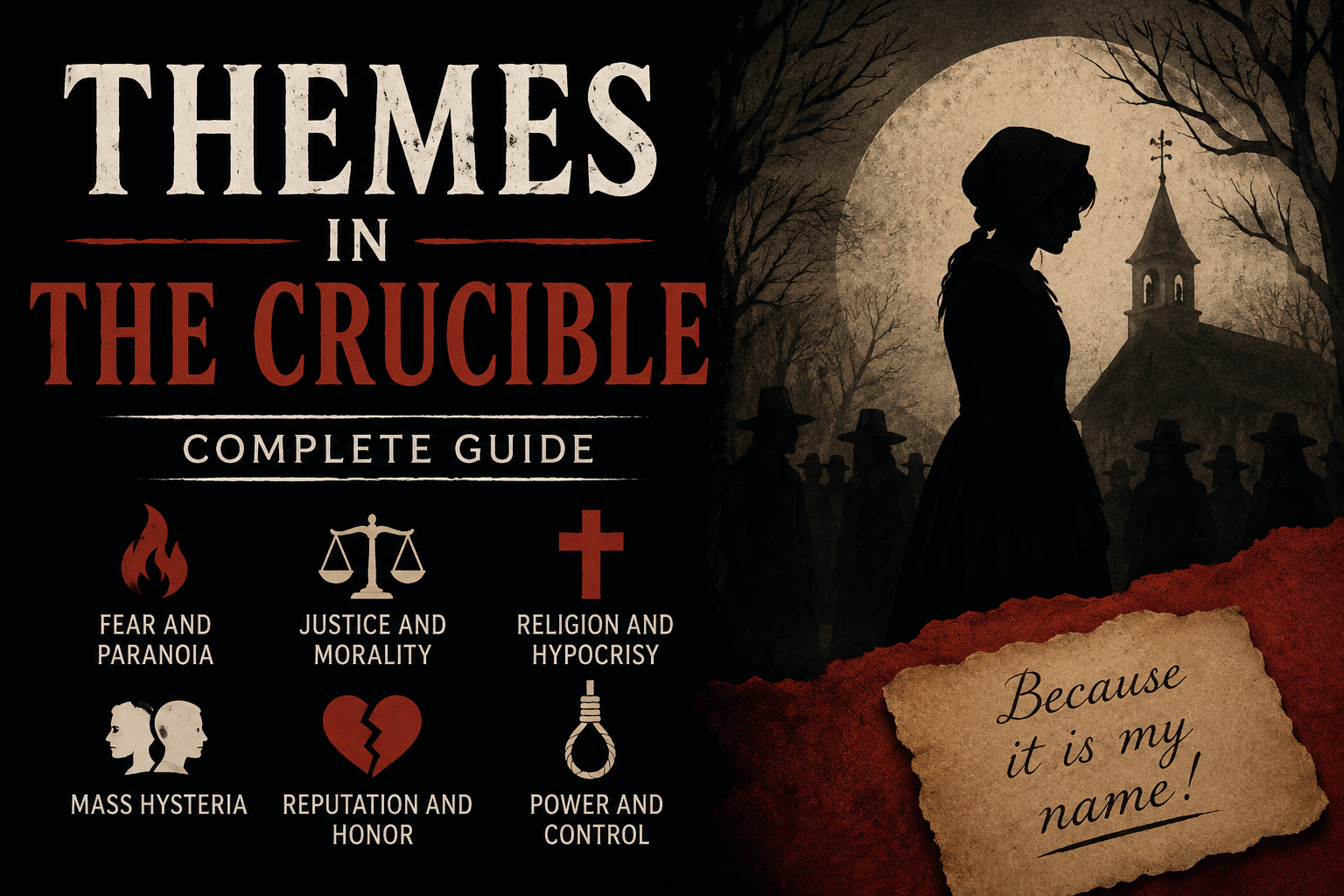
The main themes in The Crucible help students see why Arthur Miller’s Salem drama still feels tense and modern. In this guide, we will look at fear, public shame, power, justice, and truth so you can discuss the play with more confidence.
In this Guide
Use this table of contents to find the idea you need.
- Why the play’s themes matter
- Fear and mass hysteria
- Reputation and public shame
- Power and corrupt authority
- Justice and truth
- Essay tips and study resources
- FAQ
Why the themes in The Crucible Matter
Arthur Miller wrote about Salem, but he was also speaking to his own time.
The Crucible is set during the Salem witch trials of 1692. In that world, a rumor can ruin a life. A court can twist faith into a weapon. A person can lose everything by telling the truth.
The themes in The Crucible matter because the play asks a hard question: what happens when a society values fear more than honesty?
Miller wrote the play during the age of McCarthyism, when many Americans were accused of Communist ties with weak proof. You can read more about Miller’s life at Britannica, or learn about McCarthyism from the National Archives.
Themes in The Crucible: Fear and Mass Hysteria
Fear spreads faster than facts in Salem.
At the start of the play, the town is already tense. People worry about sin, reputation, and punishment. When the girls begin to accuse others of witchcraft, fear takes over the town.
Mass hysteria means a group panic becomes more powerful than reason. In Salem, people accept wild claims because they are scared. They fear the Devil, but they also fear being accused.
Abigail Williams uses this fear to gain control. Once the court believes her, she can point at almost anyone. Her words become more powerful than evidence.
These themes in The Crucible connect to George Orwell’s Animal Farm. In both works, fear helps leaders control a group. People stop asking questions because the cost feels too high.
Themes in The Crucible: Reputation and Public Shame
In Salem, a good name can matter more than a good heart.
Reputation is one of the most painful forces in the play. Many characters care deeply about how others see them. They know that one bad rumor can lead to court, prison, or death.
Reverend Parris fears damage to his position. He worries that trouble in his house will make him look weak. His first concern is not truth, but public image.
John Proctor also struggles with his reputation. He has sinned, and he feels deep guilt. Yet his main conflict is not only private guilt. He must decide whether to save his life with a lie or keep his name clean by telling the truth.
The themes in The Crucible become personal here. Miller shows that shame can trap people. Nathaniel Hawthorne’s The Scarlet Letter also studies public shame, but Miller makes shame feel like a public trial.
Power, Control, and Corrupt Authority
The play shows how power can become dangerous when no one can question it.
The court in Salem claims to serve God and justice. Yet it often acts with pride and fear. Judge Danforth refuses to admit the court may be wrong because that would weaken his authority.
This makes the court more dangerous. If the judges admit one mistake, the whole system starts to fall apart. So they protect the court, even when innocent people suffer.
Abigail’s power is different. She has no official office, but she learns how to use the court. Her false claims give her control over adults who once had power over her.
This theme is useful for AP Literature essays because it shows conflict between public power and private truth. The play asks whether authority deserves respect when it refuses proof.
Justice, Lies, and the Demand for Proof
The Crucible turns the court into a place where truth becomes hard to recognize.
A fair court should ask for proof. In Salem, the court often accepts fear as proof. It trusts dramatic words, screams, and visions that no one else can see.
This is why the play feels so tense. The accused cannot defend themselves in a normal way. If they deny witchcraft, the court may see the denial as more proof of guilt.
Mary Warren’s failed confession shows this problem. She tries to tell the truth, but pressure breaks her. The court’s mood matters more than her facts.
Miller does not suggest that justice is simple. He shows that a legal system can fail when leaders care more about control than evidence.
Truth, Integrity, and Personal Courage
The play’s deepest question is whether truth is worth suffering for.
John Proctor is not a perfect hero. That is part of why students often find him interesting. He has lied before, and he has hurt others. Still, he wants to become honest before the end.
His final choice is painful. If he signs a false confession, he may live. If he refuses, he will die. His decision shows that integrity can cost more than comfort.
Elizabeth Proctor helps us see this theme too. She admits her own limits and gives John space to choose. Her quiet strength matters because she does not force him to become a symbol.
This theme also appears in Sophocles’ Antigone. Antigone, like Proctor, faces a state that demands obedience. Both characters must choose between survival and moral truth.
How to Write About Themes in The Crucible
A strong essay connects a theme to a clear claim about the whole play.
When you write about themes in The Crucible, do not just name the idea. Explain what Miller says about that idea. For example, do not write, “Fear is a theme.” Write, “Miller shows that fear can destroy justice when people value safety over truth.”
That second sentence gives you an argument. It tells your reader what the play reveals about fear.
Use short quotations if your teacher allows them. Then explain how the words prove your claim. The best analysis spends more time on meaning than plot summary.
If you need help with structure, use our guide to writing a literary analysis essay. It can help you build a clear thesis and stronger body paragraphs.
Recommended Books for Deeper Study
These books can help you understand the play and its background.
- The Crucible by Arthur Miller
- Arthur Miller: His Life and Work by Martin Gottfried
FAQ: Themes in The Crucible
Here are quick answers to common student questions.
What are the main themes in The Crucible?
The main themes in The Crucible include fear, reputation, power, justice, and integrity. Each theme connects to the Salem trials and Miller’s view of panic in society.
What is the most important theme in the play?
Many students choose fear as the most important theme. Fear drives the accusations and makes people accept weak proof.
How does reputation affect John Proctor?
Proctor wants to protect his name, but he also wants to be honest. His final choice shows that integrity matters more to him than survival.
Why did Arthur Miller write about Salem?
Miller used Salem to comment on his own time. He saw links between the witch trials and anti-Communist fear in the 1950s.
How can I write a strong theme paragraph?
Start with a claim about what the play says. Use one clear example from the text, then explain how it supports your idea.
Key Takeaway
The strongest themes in The Crucible show how fear can twist truth, damage justice, and test a person’s character. Miller’s play lasts because those problems still feel real today.


Get the Free Close Reading Worksheet Pack
Join my email list and receive the printable worksheet pack you can use with any novel or poem.
No spam. Just helpful guides for reading literature well.












