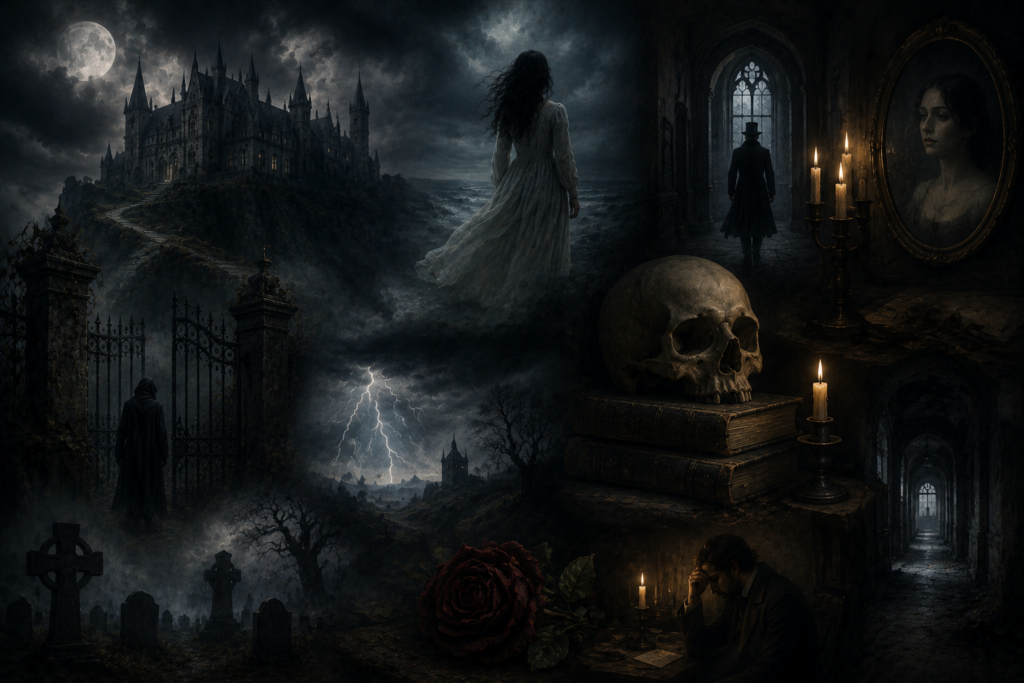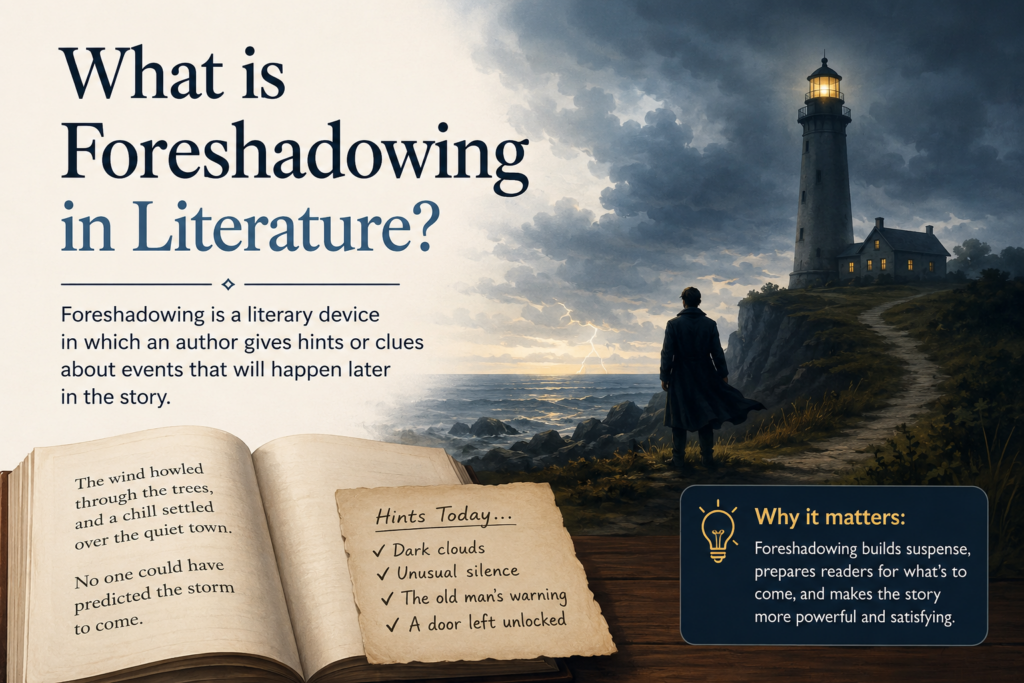
Common Gothic Themes in Literature

gothic themes

Gothic stories are full of dark houses, buried secrets, strange fears, and characters who feel trapped. This guide explains Common Gothic Themes in Literature so students can read, study, and choose Gothic texts with more confidence.

In this Guide

  • What makes a story Gothic
  • Fear and the unknown
  • Decay, ruin, and haunted places
  • Madness and the unstable mind
  • Isolation and entrapment
  • The supernatural and doubt
  • Guilt, sin, and hidden pasts
  • How to study Gothic themes
  • Suggested books
  • FAQ
gothic themes

What Makes Gothic Literature Gothic?

Gothic literature uses fear, mystery, and emotional pressure to explore deep human problems.

A Gothic story is not just “scary.” It often asks serious questions about power, guilt, death, family, faith, and the mind.

You might see castles, storms, locked rooms, ghosts, ruined homes, or strange family histories. These details create mood, but they also point to theme.

When you study Common Gothic Themes in Literature, look past the creepy setting. Ask what fear reveals about the characters and their world.

Common Gothic Themes in Literature: Fear and the Unknown

Fear in Gothic fiction often comes from what characters cannot explain.

Many Gothic stories build tension through mystery. A character hears a sound, sees a shadow, or senses that something is wrong, but the truth stays hidden.

In Dracula by Bram Stoker, fear grows because Count Dracula does not fit normal human rules. He moves between life and death, body and spirit, home and foreign land.

In The Turn of the Screw by Henry James, the fear comes from doubt. Are the ghosts real, or is the narrator losing her grip on reality?

This is one reason Common Gothic Themes in Literature work so well for essays. They leave space for debate, and strong essays often grow from uncertain answers.

Decay, Ruin, and Haunted Places

Gothic settings often show that something has gone wrong long before the story begins.

Old mansions, broken castles, and dark rooms are more than spooky backdrops. They can show family decay, moral failure, or a past that refuses to stay buried.

In Edgar Allan Poe’s “The Fall of the House of Usher,” the crumbling house mirrors the ruined Usher family. The building and the people seem to break down together.

In Jane Eyre by Charlotte Brontë, Thornfield Hall hides a terrible secret. The house looks grand, but its locked rooms reveal pain, control, and shame.

When you see a decaying place in Gothic fiction, ask what else is decaying. It may be a family, a mind, a marriage, or a moral code.

Madness and the Unstable Mind

Many Gothic stories blur the line between real danger and inner fear.

Characters may doubt their senses. They may become obsessed, overly suspicious, or unable to trust their own thoughts.

In Poe’s “The Tell-Tale Heart,” the narrator claims to be sane while describing murder and guilt in a frantic voice. The story makes readers question his mind from the start.

In Frankenstein by Mary Shelley, Victor Frankenstein’s obsession leads him away from human connection. His mind becomes trapped by ambition, fear, and regret.

This theme matters because Gothic literature often treats the mind like a haunted house. The most terrifying space may not be a castle. It may be the self.

Isolation and Entrapment

Gothic characters often feel cut off from safety, reason, or love.

Isolation can be physical, like a character stuck in a remote castle. It can also be emotional, like a character who cannot confess the truth.

In Wuthering Heights by Emily Brontë, the lonely moors help create a harsh emotional world. Characters feel trapped by desire, pride, and old wounds.

In many Gothic works, women face locked rooms, forced marriages, or social rules that limit their choices. These trapped spaces often show larger problems with power.

As you study Common Gothic Themes in Literature, pay attention to who has freedom and who does not. Gothic stories often turn that question into conflict.

The Supernatural and Uncertainty

Ghosts, monsters, curses, and strange events help Gothic writers test what readers believe.

Sometimes the supernatural is real inside the story. Sometimes it may be a symbol, a trick, or a sign of mental collapse.

In Dracula, the vampire is a real threat. In other works, like The Turn of the Screw, readers must decide whether the supernatural exists or comes from the narrator’s fear.

This uncertainty creates suspense. It also lets writers explore religion, science, grief, and doubt.

For a helpful background on the Gothic novel as a literary form, visit Britannica’s overview of the Gothic novel.

Guilt, Sin, and Hidden Pasts

Gothic stories often show that secrets do not stay buried.

A family may hide a crime. A character may deny guilt. A house may contain evidence of an old wrong.

In Frankenstein, Victor refuses to take full responsibility for the creature he creates. His guilt follows him, even when he tries to escape it.

In Jane Eyre, Rochester’s hidden past shapes the plot and tests Jane’s sense of self-worth. The secret in the attic becomes a symbol of moral disorder.

Among Common Gothic Themes in Literature, guilt is one of the most useful for analysis. It connects character choices to setting, mood, and plot.

How Common Gothic Themes in Literature Shape Characters

Gothic themes place characters under pressure and reveal who they are.

Fear can expose courage or weakness. Isolation can reveal desire. Guilt can push a character toward confession, denial, or ruin.

Victor Frankenstein is not just a scientist in a scary story. He is a man who tries to control life, then fails to face the cost.

Jane Eyre is not just a heroine in a dark house. She must decide whether love is worth losing her values.

When you connect theme to character choice, your analysis becomes stronger. If you need help with that skill, read this guide on how to identify theme in literature.

How to Spot Common Gothic Themes in Literature for Class

A clear method can make Gothic texts less confusing.

Start with the setting. Ask why the story takes place in a ruined house, dark room, remote landscape, or strange city.

Then study the fear. Ask what the main character fears most and whether that fear is physical, emotional, moral, or social.

Next, look for secrets. Gothic plots often move forward when hidden truths rise to the surface.

Finally, connect the pattern to a larger idea. A ghost may represent grief. A locked room may suggest control. A monster may reveal guilt or rejection.

This approach helps you turn Common Gothic Themes in Literature into strong topic sentences for essays.

Choosing Gothic Literature for an Essay or Project

The best Gothic text for school depends on what you want to study.

Choose Frankenstein if you want themes about science, ambition, creation, and responsibility.

Choose Dracula if you want themes about fear, invasion, gender roles, and the supernatural.

Or choose Jane Eyre if you want a mix of Gothic mood, romance, independence, and moral choice.

If your teacher asks for a theme-based paper, pick a text that gives you repeated patterns. Repeated images, settings, and conflicts often lead to the best claims.

Suggested Gothic Books to Read

If you want to build a Gothic reading list, these books are strong choices for students.

  • Frankenstein by Mary Shelley
  • Dracula by Bram Stoker

Both are widely taught, easy to research, and rich in Gothic themes. You can find them in libraries, bookstores, or on Amazon by searching the title and author.

Helpful Resources for Gothic Literature

Good outside sources can help you understand literary history and author background.

The Poetry Foundation’s page on Edgar Allan Poe is useful if you study Gothic short fiction or poetry.

You can also review this student guide to identifying theme before you write about Common Gothic Themes in Literature.

FAQ About Common Gothic Themes in Literature

What are the most common Gothic themes?

The most common Gothic themes include fear, isolation, madness, guilt, secrecy, decay, and the supernatural.

Why do Gothic stories use old houses and castles?

Old buildings often symbolize hidden history, family decline, or secrets from the past.

Is Gothic literature the same as horror?

Not exactly. Gothic literature can be scary, but it focuses more on mood, mystery, psychology, and deep themes.

What is a good Gothic book for beginners?

Frankenstein is a strong choice because it has a clear plot and many themes students can analyze.

Key Takeaway

Common Gothic Themes in Literature help readers see fear as more than a scare tactic. In Gothic stories, fear reveals hidden guilt, broken systems, trapped minds, and the dark parts of human nature.
The Shadow Archetype in Literature: A Student-Friendly Guide

the shadow archetype

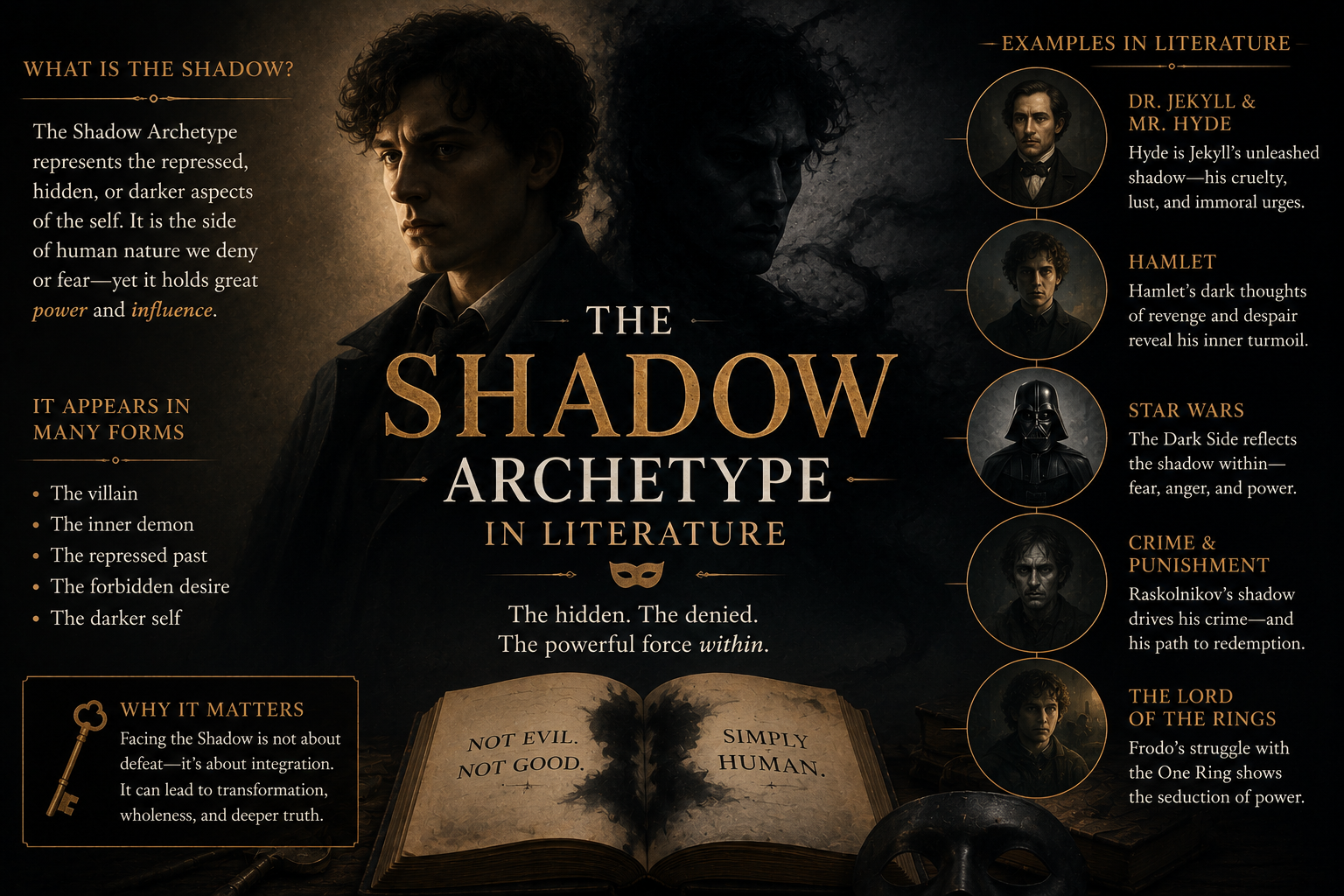
The Shadow Archetype in Literature helps readers understand the darker parts of a character’s mind. It shows fear, guilt, rage, pride, or hidden desire, often through a villain, double, monster, or secret self.

If you study novels, plays, or poems, this idea can help you spot deeper conflict and write stronger analysis.

In this Guide

What Is The Shadow Archetype in Literature?

The shadow is the hidden side of a person or character.

Psychologist Carl Jung used the word “shadow” to describe the parts of the self that people try to deny or hide. These parts are not always evil, but they can become dangerous when ignored. You can read more about Jung’s background at Britannica’s Carl Jung page.

In stories, the shadow may appear as a villain, a monster, a rival, or a secret part of the hero. The Shadow Archetype in Literature often forces a character to face the truth about themselves.

For example, a brave hero may fear failure. A kind person may feel anger. A wise leader may crave power. The shadow brings these hidden feelings into the open.

Why The Shadow Archetype in Literature Matters

The shadow makes stories feel more real because people are not simple.

Most strong characters have inner conflict. They want to be good, but they may feel envy, shame, or pride. This struggle gives a story emotional weight.

The Shadow Archetype in Literature also helps readers understand theme. A story may ask questions like: What happens when people deny guilt? Can someone accept their dark side and still choose good?

This is useful for essays because the shadow connects character, conflict, and symbolism. If you want help with that skill, read this guide on how to find symbolism in a story.

Examples of The Shadow Archetype in Literature

Many famous works use the shadow to reveal hidden fear or desire.

Dr. Jekyll and Mr. Hyde

Robert Louis Stevenson’s Strange Case of Dr. Jekyll and Mr. Hyde is one of the clearest examples. Dr. Jekyll wants to separate his good side from his darker urges.

Mr. Hyde becomes the living form of those urges. The story warns that hiding the shadow does not destroy it. It can make it stronger.

Frankenstein

In Mary Shelley’s Frankenstein, the Creature can be read as Victor Frankenstein’s shadow. Victor wants glory and control, but he refuses to face the cost of his ambition.

The Creature reflects Victor’s fear, guilt, and rejection of responsibility. This makes the novel more than a monster story. It becomes a story about what happens when someone abandons what they create.

Macbeth

In Shakespeare’s Macbeth, Macbeth’s shadow appears through his hunger for power. At first, he seems loyal and brave.

Once ambition takes control, he becomes violent and fearful. His shadow does not arrive from nowhere. It was already inside him.

Lord of the Flies

William Golding’s Lord of the Flies shows the shadow in a group, not just one person. The boys try to build order, but fear and cruelty rise to the surface.

The “beast” is not only outside them. It is also inside them. This makes The Shadow Archetype in Literature a key idea in the novel.

How to Analyze The Shadow Archetype in Literature

You can find the shadow by asking what a character hides.

Look for moments when a character acts against their public image. A noble person may lie. A peaceful person may enjoy power. Or a confident person may fear being weak.

Next, look for symbols tied to darkness, mirrors, masks, monsters, doubles, locked rooms, or night. These details often point to the shadow. For more practice, use this guide on finding symbolism in a story.

When you write about The Shadow Archetype in Literature, do not stop at “this character is dark.” Explain what the shadow reveals. Does it show guilt? Does it expose fear? Does it test the hero’s values?

Useful Questions for Students

  • What part of the character does the shadow reveal?
  • How does the shadow create conflict?
  • Does the character accept the shadow or deny it?
  • What theme does the shadow help show?

Choosing Books with The Shadow Archetype in Literature

Books with strong shadow themes often have deep conflict and strong essay topics.

If you need a book for class, choose a story where the main character changes or faces guilt. These texts often give you more to discuss than a simple good-versus-evil plot.

Look for stories with doubles, secret identities, forbidden desires, or moral failure. These signs often point to The Shadow Archetype in Literature.

This type of book can work well for AP Literature because it supports analysis of character, theme, and structure.

Books to Explore on Amazon

These books are strong choices if you want to study the shadow archetype more closely.

  • Strange Case of Dr. Jekyll and Mr. Hyde by Robert Louis Stevenson
  • Frankenstein by Mary Shelley
  • Lord of the Flies by William Golding

You can also explore poems with dark speakers or divided selves. The Poetry Foundation is a helpful place to read classic and modern poems.

FAQ About The Shadow Archetype in Literature

What is the shadow archetype in simple terms?

The shadow archetype is the hidden side of a character. It may include fear, anger, guilt, or desire that the character does not want to face.

Is the shadow always evil?

No. The shadow is not always evil. It can hold painful truths, buried feelings, or traits a person has denied.

Can a villain be a hero’s shadow?

Yes. A villain can reflect what the hero fears or rejects in themselves. This makes the conflict more personal.

Why is the shadow archetype useful for essays?

It helps you connect character choices to deeper themes. It also gives you a clear way to discuss inner conflict.

Key Takeaway

The Shadow Archetype in Literature shows that the hardest battle is often inside the character. When readers understand the shadow, they can see why stories about monsters, rivals, and secret selves still feel so human.

What Is an Archetype in Literature? A Beginner-Friendly Guide

literary archetype
literary archetype

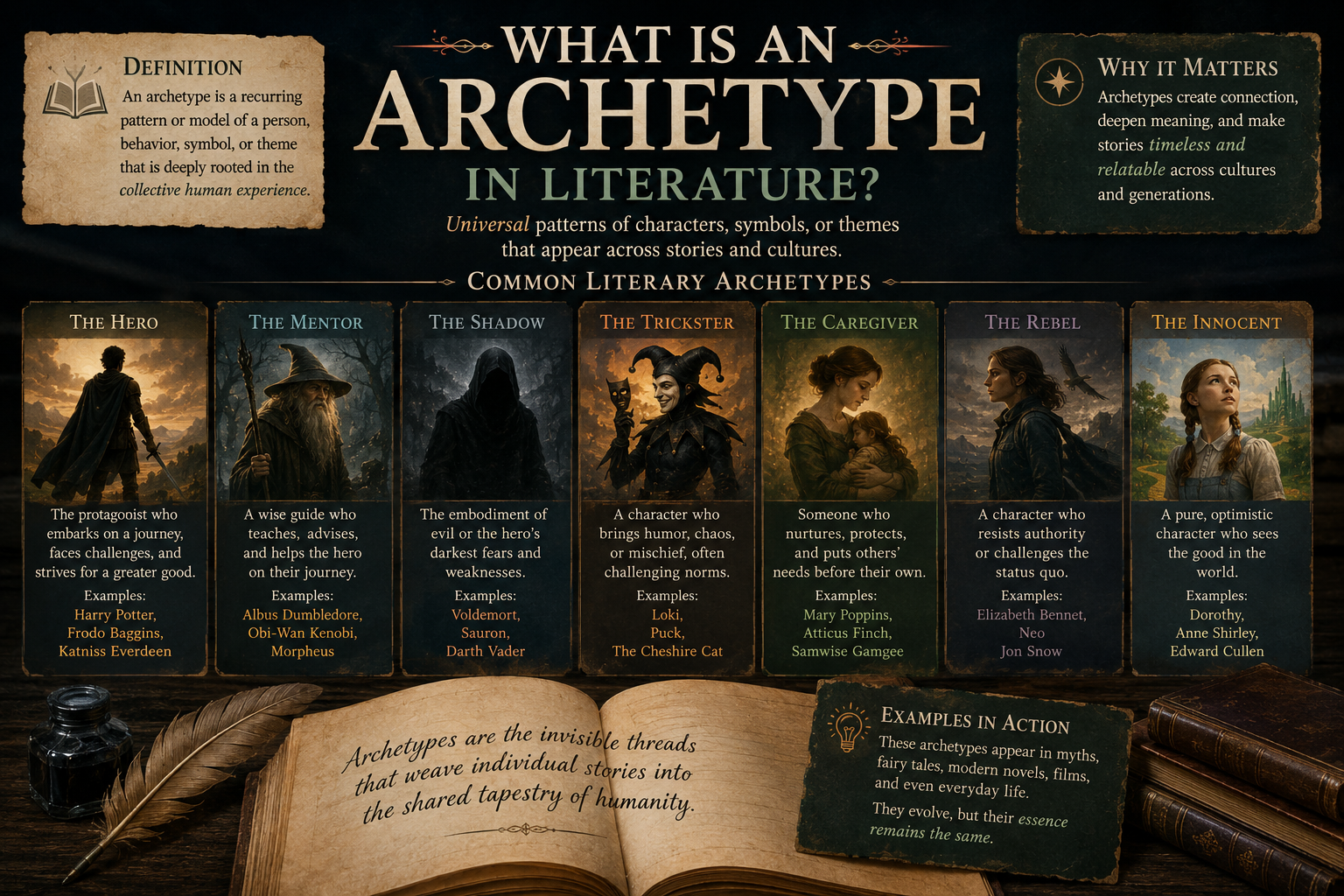
What Is an Archetype in Literature? It is a common pattern, character type, story idea, or symbol that appears again and again across books and cultures.

Once you know how archetypes work, many stories become easier to understand. You start to see why certain heroes, villains, journeys, and lessons feel familiar.

In this Guide

What Is an Archetype in Literature?

Archetypes are story patterns that readers recognize fast.

So, What Is an Archetype in Literature? It is a repeated model that shows up in many stories. It can be a type of character, a plot pattern, a setting, or a symbol.

For example, the “hero” is an archetype. So is the “mentor,” the “quest,” and the “dark forest.” These ideas appear in myths, fairy tales, novels, plays, and films.

An archetype is not the same as a cliché. A cliché feels overused or lazy. An archetype feels familiar because it connects to deep human fears, hopes, and choices.

What Is an Archetype in Literature? Why It Matters

Archetypes help stories speak to readers across time and place.

When you ask, What Is an Archetype in Literature? you are really asking why some stories feel universal. Archetypes help answer that.

They give readers a quick way into a story. If a wise older figure appears, we may expect guidance. If a young hero leaves home, we may expect growth and danger.

Archetypes also help writers build meaning. A character may follow an archetype at first, then break away from it. That change can reveal a theme.

For literary analysis, archetypes can help you explain how a text connects to larger ideas. Love, fear, power, sacrifice, and identity often appear through familiar patterns.

What Is an Archetype in Literature? Common Types

Most archetypes fit into a few broad groups.

What Is an Archetype in Literature? It can be more than one thing. A novel may use character archetypes, plot archetypes, and symbolic archetypes at the same time.

Character Archetypes

A character archetype is a familiar role in a story.

The hero faces a major challenge. The mentor gives wisdom. The villain blocks the hero’s goal. The trickster causes trouble and exposes truth.

In Harry Potter, Harry is the hero, Dumbledore is a mentor, and Voldemort is the villain. These roles are easy to spot, but each character still has unique traits.

Plot Archetypes

A plot archetype is a common story path.

The quest is one of the most famous. A character leaves home, faces tests, and returns changed. You can see this in The Odyssey, The Lord of the Rings, and many adventure stories.

Another plot archetype is the fall. A character loses power or innocence because of pride, greed, or a poor choice. Shakespeare’s tragedies often use this pattern.

Symbolic Archetypes

A symbolic archetype is an image or place with a shared meaning.

Light often suggests truth or hope. Darkness may suggest fear or confusion. Water can suggest rebirth, change, or danger.

If you want help with this part, read our guide on how to find symbolism in a story. Symbolic archetypes often work closely with symbols.

Famous Examples of Archetypes in Literature

Well-known books make archetypes easier to see.

In The Odyssey by Homer, Odysseus follows the quest archetype. He wants to return home, but he must face monsters, temptation, and loss before he gets there.

In Cinderella, the main character fits the innocent hero archetype. She suffers unfair treatment, but she stays kind and gains a new life.

In Romeo and Juliet, the lovers fit the star-crossed lovers archetype. Their love is real, but family conflict and fate push them toward tragedy.

In The Hunger Games, Katniss Everdeen fits the reluctant hero archetype. She does not seek fame or power. She acts because she wants to protect her sister.

These examples show why What Is an Archetype in Literature? is such a useful question. It helps readers compare stories that may seem very different at first.

How to Spot Archetypes While You Read

A simple question can help you find archetypes fast.

Ask yourself: “Have I seen this kind of character, journey, or image before?” If the answer is yes, you may have found an archetype.

Look for repeated roles. Is there a guide, a rebel, a ruler, or an outsider? Then ask what that role adds to the story.

Look at the main conflict too. Is the character on a quest? Are they tempted? Do they face a fall from power? These patterns often point to archetypes.

Pay close attention to places and objects. A garden, desert, storm, or road may carry archetypal meaning. For more help, use this guide to spot symbols in fiction.

Once you know What Is an Archetype in Literature? you can move beyond naming it. The stronger analysis explains why the author uses it.

Archetype vs. Stereotype: What Is the Difference?

These two ideas can look alike, but they are not the same.

An archetype is a broad story pattern with deep meaning. It can be complex and flexible.

A stereotype is a flat or unfair idea about a person or group. It often reduces people to one trait.

For example, a “wise mentor” can be an archetype if the character has depth. But if the character only exists to give advice and has no inner life, the role may feel flat.

Books to Explore Archetypes

These books can help you see archetypes in action.

  • The Odyssey by Homer
  • Mythology by Edith Hamilton
  • The Hero with a Thousand Faces by Joseph Campbell

Joseph Campbell’s book is more advanced, but it is famous for its ideas about the hero’s journey. For background on archetypes, you can also read Britannica’s overview of archetype in literature.

For poetry and myth-based reading, the Poetry Foundation is also a strong source.

FAQ: What Is an Archetype in Literature?

What Is an Archetype in Literature?

An archetype is a common character type, plot pattern, symbol, or idea that appears in many stories. It feels familiar because readers have seen it before in other texts.

What is a simple example of an archetype?

The hero is a simple example. Heroes often face danger, make hard choices, and grow through struggle.

Is an archetype the same as a theme?

No. An archetype is a pattern or role. A theme is the message or big idea the story explores.

Why do authors use archetypes?

Authors use archetypes because they help readers connect to a story quickly. They also help build meaning and deepen conflict.

How can I write about archetypes in an essay?

Name the archetype, give evidence from the text, then explain what it reveals about the character, conflict, or theme.

Key Takeaway

What Is an Archetype in Literature? It is a familiar story pattern that helps readers understand characters, plots, symbols, and themes. When you spot one, do not stop there. Ask what the author does with it and why it matters.

What Is a Motif in Literature?

Motif in Literature
Motif in Literature

What Is a Motif in Literature?

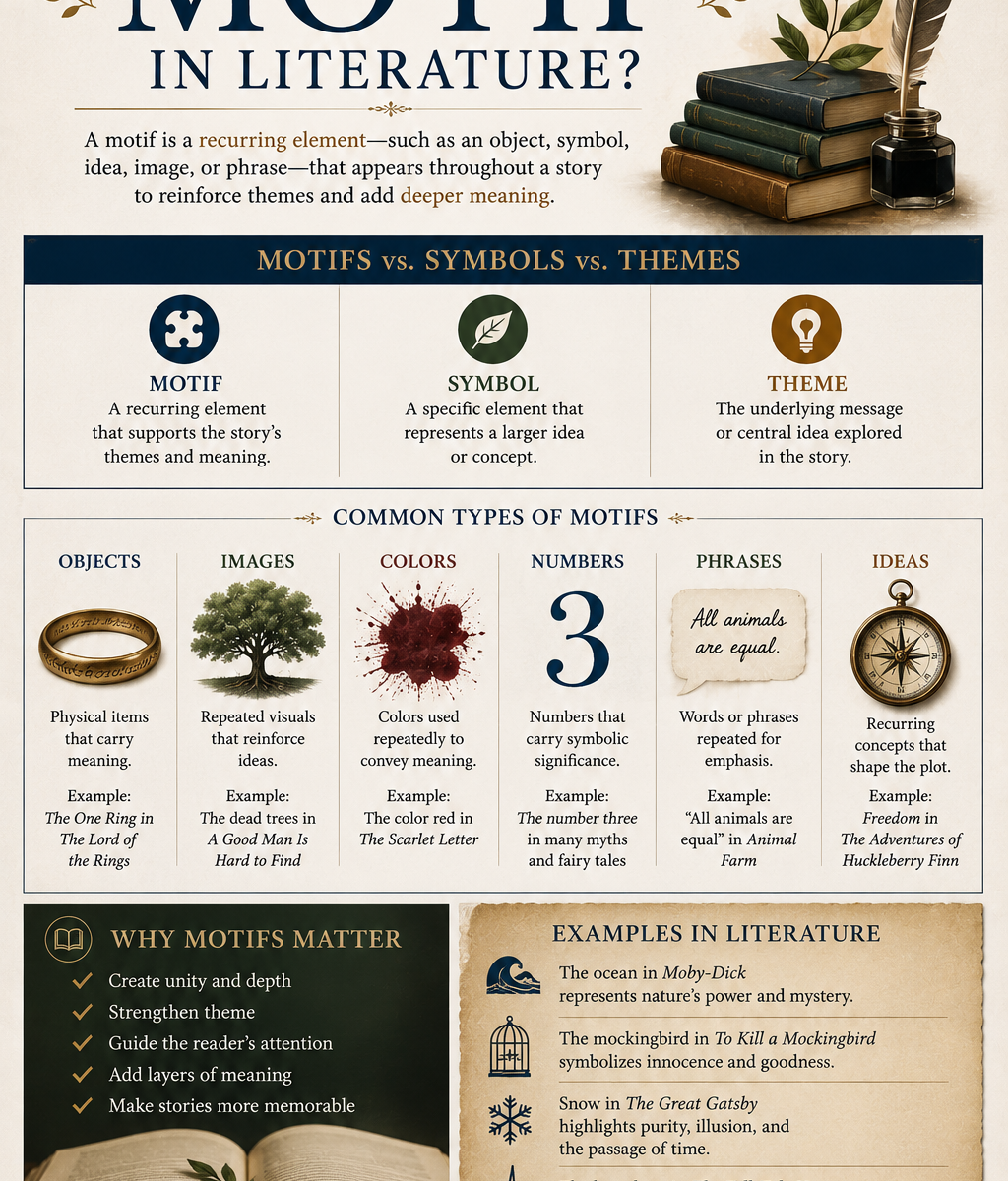
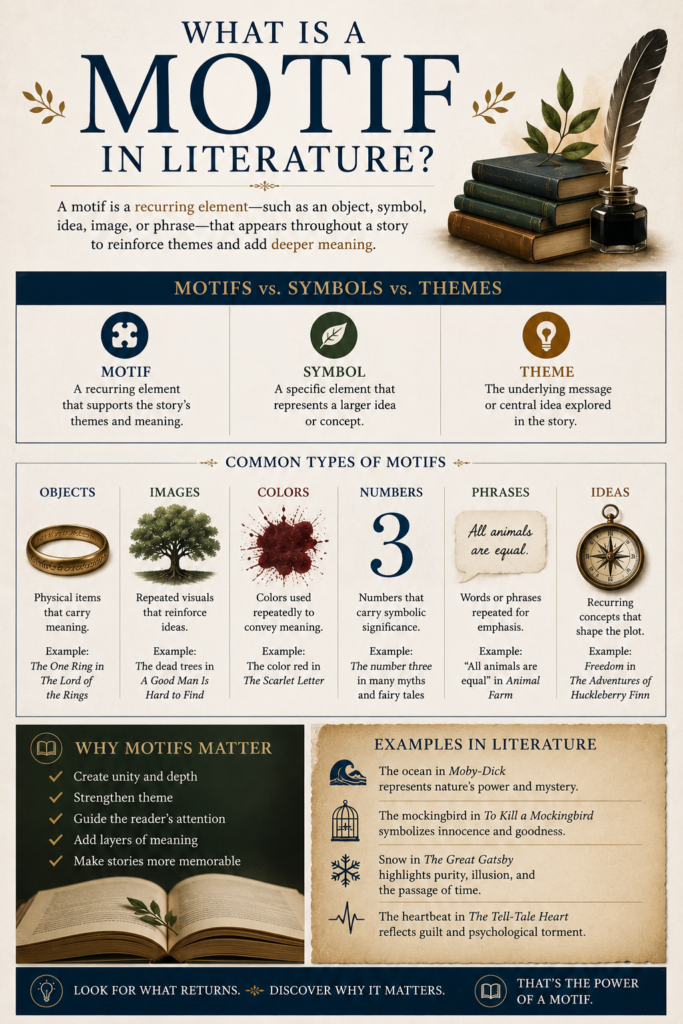
What Is a Motif in Literature? A motif is a repeated detail, image, word, object, or idea that helps build meaning in a story.

Once you know how to spot motifs, you can see how authors guide readers toward deeper themes without stating them directly.

In this Guide

  • What a motif means
  • Why motifs matter
  • Motif vs. theme
  • Famous motif examples
  • How to spot motifs while reading
  • Books that help you practice
  • FAQ

What Is a Motif in Literature? A Simple Definition

A motif is a repeated pattern that adds meaning to a text.

A motif can be an object, color, phrase, sound, place, or action that appears more than once. It is not random. The author repeats it for a reason.

The answer to What Is a Motif in Literature? is simple: it is a clue that points toward a larger idea.

For example, if a novel keeps showing locked doors, the motif may suggest secrets, fear, or limits. The door itself matters, but the repeated pattern matters more.

Why Motifs Matter in Literature

Motifs help readers notice what a story is really about.

Authors use motifs to connect scenes that may seem separate. A repeated image can remind you of a character’s struggle or a story’s main conflict.

Motifs also make literature feel richer. They give a text shape and rhythm. When a motif appears again, it often carries more meaning than it did before.

This is why teachers often ask students to track repeated details. A motif can lead you straight to a strong theme statement.

If you want to compare motifs with other tools writers use, this literary devices list is a helpful place to start.

What Is a Motif in Literature? Motif vs. Theme

A motif repeats. A theme reveals a message.

This is one of the most common points of confusion. A motif is a pattern inside the story. A theme is the deeper idea the story explores.

Think of it this way: rain might be a motif. The theme might be that grief changes how people see the world.

In Macbeth, blood appears again and again. Blood is a motif. It connects to themes of guilt, violence, and moral collapse.

You can read more about Shakespeare’s play through Britannica’s overview of Macbeth.

What Is a Motif in Literature? Common Examples Students Know

Many famous books use motifs that are easy to recognize once you look for them.

In The Great Gatsby by F. Scott Fitzgerald, the green light is a key motif. It appears across the water and comes to represent Gatsby’s hope, longing, and dream of a perfect future.

In To Kill a Mockingbird by Harper Lee, mockingbirds act as a motif tied to innocence. The repeated idea helps readers think about who gets harmed even when they have done no wrong.

In Lord of the Flies by William Golding, the conch shell becomes a motif connected to order and rules. As the boys lose respect for it, their society begins to break apart.

In poetry, a repeated image can work the same way. The Poetry Foundation offers many poems where repeated images carry meaning. You can explore examples at the Poetry Foundation.

How a Motif Builds Theme

A motif often acts like a bridge between details and big ideas.

When a writer repeats a detail, that detail starts to collect meaning. By the end of the story, it may reveal something about love, power, identity, or fear.

For example, a story may repeat images of mirrors. At first, they may seem like simple objects. Later, they may connect to a character’s struggle with self-image or truth.

This is why motifs are useful in essays. They give you evidence you can point to. You can quote the repeated detail, then explain how it supports the theme.

How to Spot a Motif While Reading

Look for details that return at important moments.

When students ask, What Is a Motif in Literature?, the best answer is often found through practice. Notice what keeps coming back.

Pay attention to repeated colors, objects, phrases, weather, places, or actions. Then ask what those details seem to suggest.

A good test is this: if the detail appeared only once, it might just be description. If it returns and gains meaning, it may be a motif.

For more help with related terms, see this guide to common literary devices.

Books to Practice Finding Motifs

These books make motif practice clear and useful.

  • The Great Gatsby by F. Scott Fitzgerald
  • Macbeth by William Shakespeare

Both texts use repeated images in ways that connect strongly to theme. They are also common in high school and college literature classes.

FAQ: What Is a Motif in Literature?

What is a motif in literature in simple words?

A motif is something that repeats in a story and helps create meaning. It can be an image, object, word, or idea.

How is a motif different from a symbol?

A symbol stands for something beyond itself. A motif repeats across the text and often includes symbols, images, or ideas.

Can a character be a motif?

A character is usually not a motif. But a repeated action, phrase, or role connected to a character can become one.

Why do teachers ask about motifs?

Motifs help students find themes. They also give strong evidence for literary analysis essays.

What Is a Motif in Literature? Why should I care?

It helps you read with more insight. Motifs show how small details connect to the story’s bigger message.

Key Takeaway

What Is a Motif in Literature? It is a repeated detail that helps reveal deeper meaning.

Here is a simple reading tip: when something shows up more than once, mark it. Then ask, “What idea does this pattern point toward?” That question can lead you to a stronger analysis.

Types of Conflict in Literature: A Student Guide with Clear Examples

Types of Conflict in Literature

Understanding the Types of Conflict in Literature makes stories easier to read and analyze. Conflict is the struggle that pushes a character to act, change, or fail.

When you know what kind of conflict drives a story, you can write stronger essays and choose books that fit your interests.

In this Guide

Use this guide to move from basic definitions to real literary examples.

  • Why conflict matters in literature
  • The main types of conflict
  • Internal conflict
  • External conflict
  • How to identify conflict in a text
  • Examples from popular books
  • Book suggestions
  • FAQ
Types of Conflict in Literature

Why Types of Conflict in Literature Matter

Conflict gives a story its energy.

Without conflict, a story can feel flat. A character may want something, but there must be a problem in the way.

When students study the Types of Conflict in Literature, they learn to ask better questions. What does the character want? Who or what blocks that goal? What changes because of the struggle?

Conflict also helps reveal theme. In Romeo and Juliet, the conflict between the lovers and their families shows how hate can destroy love. In To Kill a Mockingbird, the conflict between justice and racism helps readers see the cost of doing what is right.

The Main Types of Conflict in Literature

Most stories use more than one conflict, but one usually stands out.

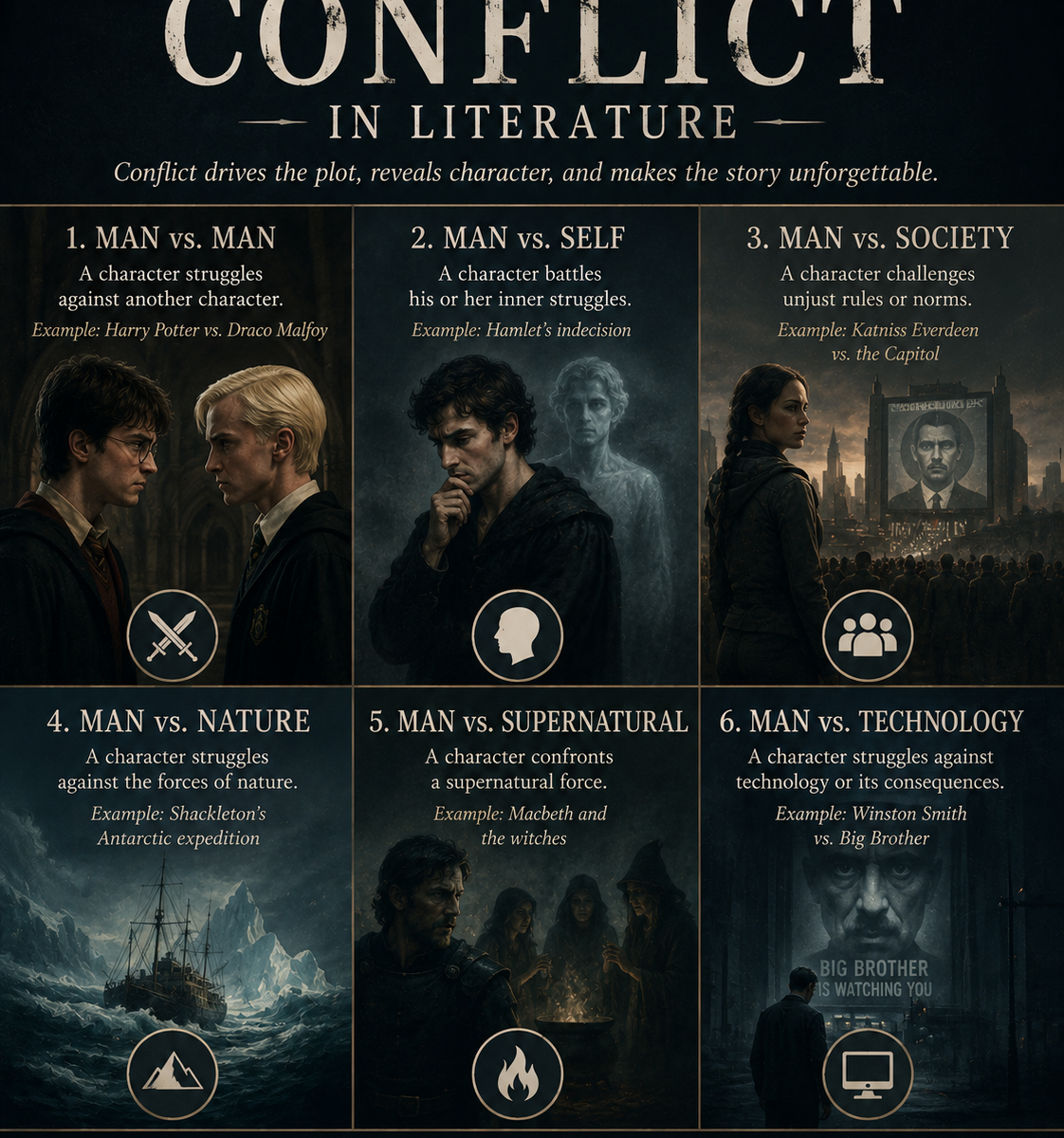
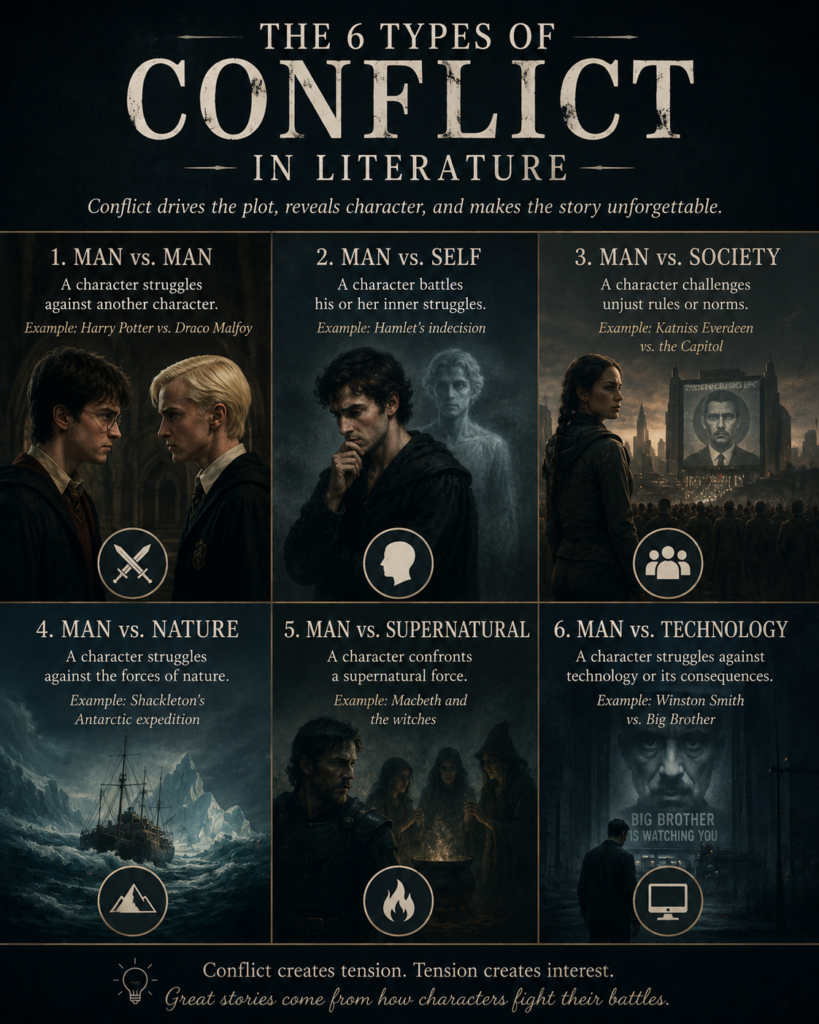
The Types of Conflict in Literature can be split into two broad groups: internal conflict and external conflict.

Internal conflict happens inside a character. The character may face fear, guilt, doubt, or a hard choice.

External conflict happens between a character and an outside force. That force may be another person, a group, nature, technology, fate, or something supernatural.

Many great books combine both. A character may fight an enemy while also fighting fear inside their own mind.

Internal Conflict: Character vs. Self

This type of conflict takes place inside the character’s mind or heart.

In a character vs. self conflict, the main struggle is personal. The character may not know what choice to make. They may feel torn between what they want and what they believe is right.

In Hamlet by William Shakespeare, Hamlet struggles with grief, revenge, and doubt. His enemy is not only Claudius. Hamlet also battles his own thoughts.

In The Catcher in the Rye by J.D. Salinger, Holden Caulfield struggles with sadness and fear of growing up. Much of the novel’s conflict comes from his inner pain.

This conflict is useful in essays because it often connects to character growth. Ask yourself: does the character learn from the struggle, or do they stay trapped?

External Conflict: Character vs. Character

This conflict happens when one character blocks another character’s goal.

Character vs. character conflict is common because people often disagree, compete, or hurt each other. The conflict can be physical, emotional, or moral.

In Harry Potter and the Sorcerer’s Stone by J.K. Rowling, Harry faces Voldemort as a major outside threat. Their conflict grows across the series as Harry learns more about courage and sacrifice.

In Othello by William Shakespeare, Iago works against Othello through lies and manipulation. The conflict is not just about power. It also shows how jealousy can break trust.

When you see this conflict, look at what each character wants. The clash between their goals often drives the plot.

External Conflict: Character vs. Society

This conflict places one person against the rules or beliefs of a group.

In character vs. society conflict, the problem is larger than one enemy. The character may face unfair laws, social pressure, prejudice, or strict traditions.

In The Hunger Games by Suzanne Collins, Katniss Everdeen fights against the Capitol’s cruel control. Her conflict is not only with individual villains. She faces a whole system built on fear.

In Fahrenheit 451 by Ray Bradbury, Guy Montag lives in a society that burns books. His conflict grows when he starts to question the world around him.

This is one of the most powerful Types of Conflict in Literature because it often asks moral questions. What should a person do when society is wrong?

External Conflict: Character vs. Nature

This conflict happens when a character struggles against the natural world.

Nature can include storms, hunger, cold, wild animals, or disease. The key point is that the character faces a force that cannot be reasoned with.

In The Old Man and the Sea by Ernest Hemingway, Santiago struggles with the sea and a great marlin. His battle shows patience, pride, and human endurance.

In Hatchet by Gary Paulsen, Brian must survive alone in the wilderness after a plane crash. The natural world tests his body and mind.

Character vs. nature stories often focus on survival. They may also show how small humans can feel when faced with forces beyond control.

External Conflict: Character vs. Technology

This conflict focuses on machines, science, or systems created by humans.

Character vs. technology is common in science fiction, but it can appear in other genres too. The conflict may involve artificial intelligence, surveillance, weapons, or a machine that changes human life.

In Frankenstein by Mary Shelley, Victor Frankenstein creates life through science and then loses control of what he has made. The novel asks if humans should create something just because they can.

In many dystopian stories, technology helps those in power control people. The danger is not only the machine. The danger is how people use it.

This type of conflict is useful for modern readers because it connects to real questions about privacy, power, and responsibility.

External Conflict: Character vs. Fate or the Supernatural

This conflict involves forces that feel beyond normal human power.

A character may face destiny, prophecy, ghosts, gods, curses, or unseen forces. The struggle often asks whether people control their lives or follow a path already set for them.

In Macbeth by William Shakespeare, the witches give Macbeth a prophecy. He chooses violent actions, but the supernatural pushes him toward ambition and fear.

In Greek tragedy, fate often plays a major role. You can learn more about the tradition of tragic drama through Britannica’s overview of tragedy.

This conflict works well in analysis because it blends choice and pressure. Ask whether the character causes the downfall or becomes trapped by forces outside human control.

How to Identify Types of Conflict in Literature

You can find conflict by tracking what the character wants and what stands in the way.

A quick way to spot the Types of Conflict in Literature is to focus on the main problem. If the problem comes from inside the character, it is internal. If the problem comes from outside, it is external.

Try asking these questions as you read:

  • What does the main character want?
  • What blocks that goal?
  • Is the struggle inside the character or outside the character?
  • Does the conflict change the character?
  • What larger idea does the conflict reveal?

If you want to build stronger reading habits, this guide on how to read literature like a scholar can help you notice deeper patterns in a text.

Types of Conflict in Popular Books

Well-known books often use several conflicts at once.

In Lord of the Flies by William Golding, the boys face nature on the island, but their deeper conflict is with each other and their own fear. The novel shows how quickly order can fall apart.

In Things Fall Apart by Chinua Achebe, Okonkwo faces personal pride, family pressure, and the arrival of colonial power. His conflicts help reveal the strain between tradition and change.

In The Great Gatsby by F. Scott Fitzgerald, Gatsby struggles against class barriers and his own dream of the past. The conflict shows how desire can turn into illusion.

These examples show why the Types of Conflict in Literature matter for essays. Conflict is rarely just a problem. It is often the key to the book’s meaning.

How Conflict Shapes Theme

Conflict and theme often work together.

Theme is the message or insight a story gives about life. Conflict helps create that message because characters reveal who they are under pressure.

In Animal Farm by George Orwell, the animals fight against human control, but they later face corruption inside their own new society. The conflict helps show how power can twist noble ideas.

In The Odyssey, Odysseus faces monsters, storms, and temptation. His long journey shows the value of loyalty and cleverness.

When you write about the Types of Conflict in Literature, do not stop at naming the conflict. Explain what it teaches the reader.

Common Mistakes Students Make with Types of Conflict in Literature

Many students can name conflict, but strong analysis goes one step deeper.

One common mistake is to choose the first conflict that appears. A story may start with one problem but focus on a deeper one later.

Another mistake is to ignore internal conflict. A character may seem to fight a person or society, but the real struggle may be fear, guilt, or pride.

Students also sometimes list the conflict without linking it to theme. A better answer explains how the conflict changes the character or reveals the author’s message.

For deeper reading practice, use scholar-style reading strategies to connect conflict with symbols, setting, and character choices.

Books That Help You Study Conflict

These books are strong choices for students who want clear examples of conflict.

  • Lord of the Flies by William Golding
  • Things Fall Apart by Chinua Achebe

Both novels are often available through school libraries, local bookstores, and Amazon. They also work well for essays because each book includes internal and external conflict.

Helpful Outside Resources

Use trusted literary sources when you need background or context.

The Poetry Foundation is useful for poems, poet biographies, and literary terms. Britannica also offers clear background on major forms, authors, and literary history.

FAQ About Types of Conflict in Literature

Here are quick answers to common student questions.

What are the main Types of Conflict in Literature?

The main types are internal conflict and external conflict. External conflict can include character vs. character, society, nature, technology, fate, or the supernatural.

Can a story have more than one conflict?

Yes. Most strong stories use more than one conflict. One conflict may drive the plot, while another shows the character’s inner struggle.

Why is conflict important in a story?

Conflict creates tension and gives characters a reason to act. It also helps reveal theme and character growth.

How do I write about conflict in an essay?

Name the conflict, give a clear example, and explain why it matters. Connect it to the character’s change or the story’s main idea.

Key Takeaway

The Types of Conflict in Literature help readers see what drives a story. Once you understand the main struggle, you can better explain character, theme, and meaning.

What Is Mood in Literature? A Beginner-Friendly Guide

mood in literature

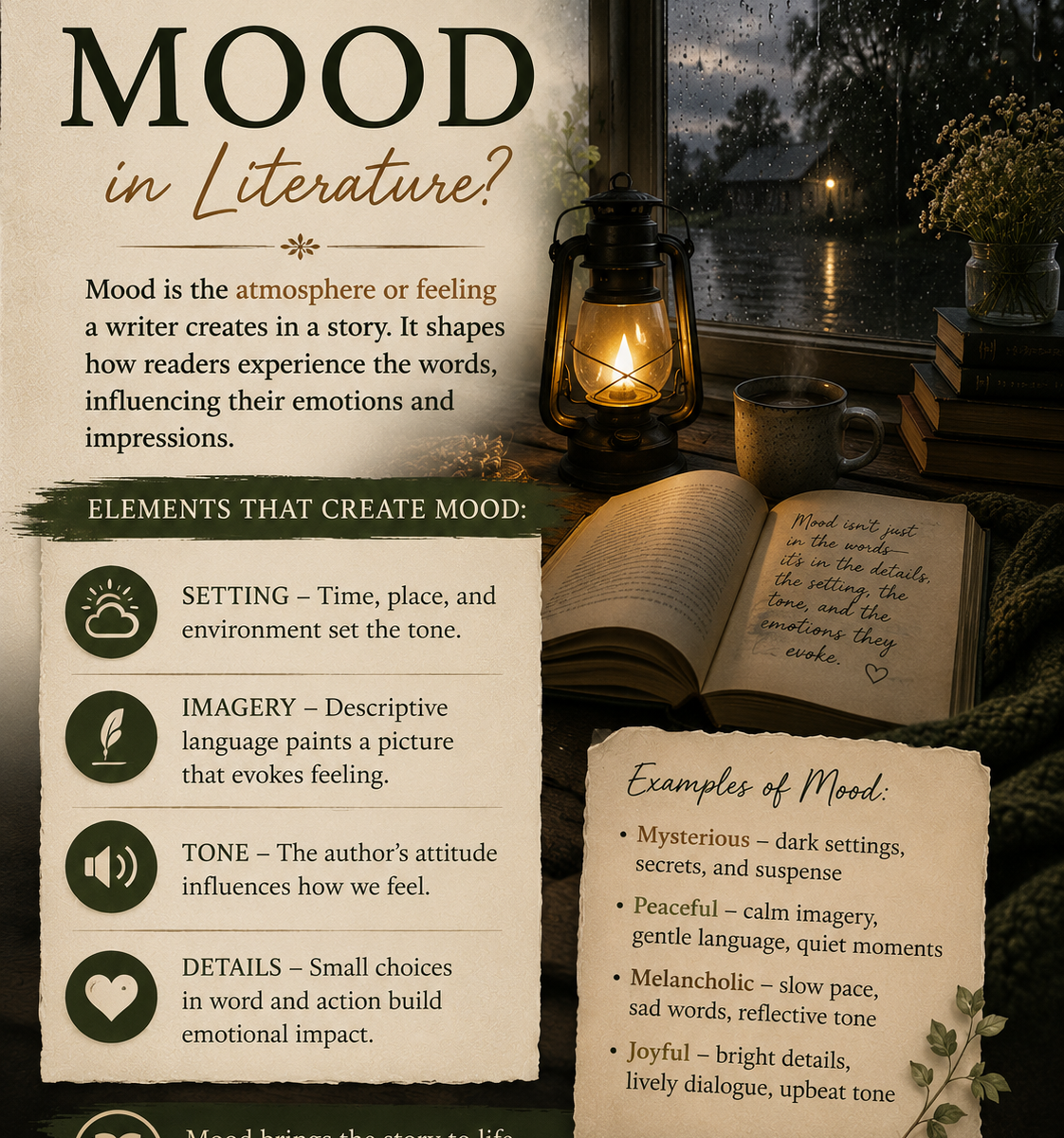
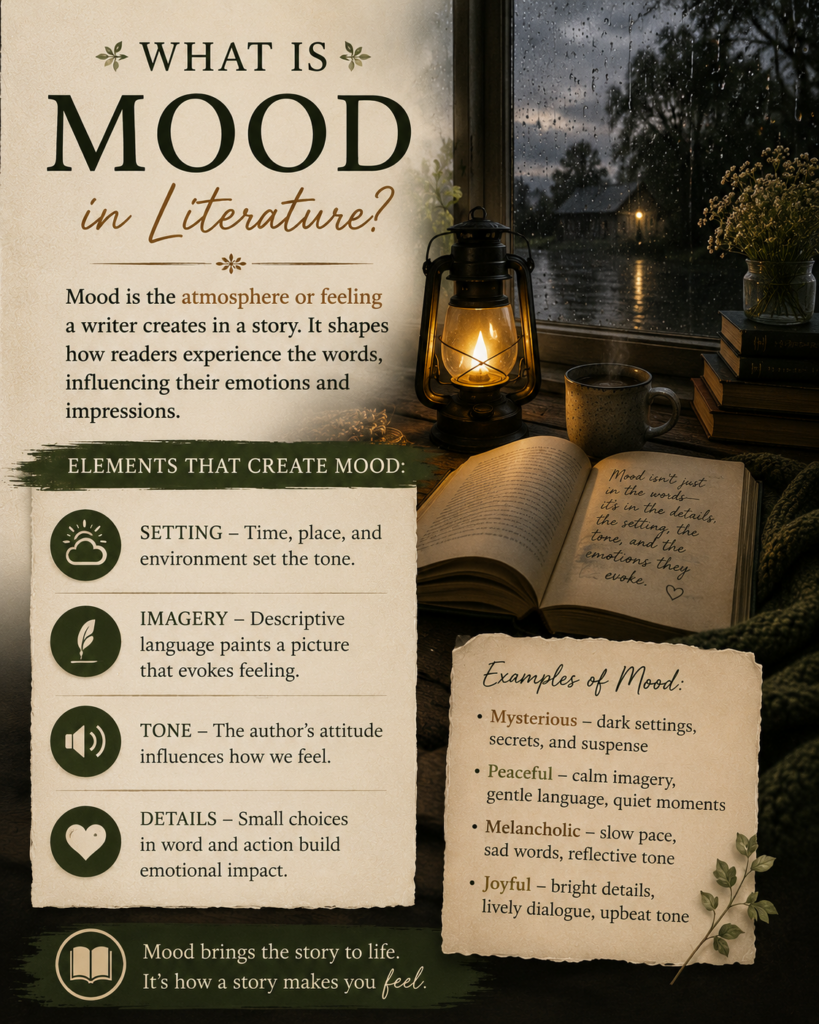
What Is Mood in Literature? It is the feeling a story or poem creates for the reader. Mood can make a scene feel scary, peaceful, tense, hopeful, or sad.

Writers build mood through setting, word choice, imagery, and details. Once you know how mood works, you can read literature with more confidence.

In this Guide

mood in literature

What Is Mood in Literature? A Simple Definition

Mood is the emotional atmosphere of a text.

When students ask What Is Mood in Literature?, the simplest answer is this: mood is how the writing makes you feel. It is not always one emotion. A story can shift from calm to fearful, or from hopeful to tragic.

For example, a dark forest at night may create a mood of fear. A warm kitchen with fresh bread may create comfort. The mood comes from the details the writer chooses.

Mood is different from tone. Tone is the writer’s attitude toward the subject. Mood is the feeling created in the reader. If you want a deeper comparison, read this guide on tone vs. mood in literature.

What Is Mood in Literature? Why It Matters

Mood helps readers feel the meaning of a text, not just understand it.

A strong answer to What Is Mood in Literature? should explain why mood matters. Mood shapes the way we react to characters, events, and themes.

In a ghost story, mood can make a simple hallway feel dangerous. In a love poem, mood can make a short moment feel full of longing. Mood guides the reader’s emotional response.

Mood also supports theme. If a story has a lonely mood, it may explore isolation. If a poem has a peaceful mood, it may suggest acceptance or healing.

What Is Mood in Literature? Examples from Famous Texts

Examples make mood easier to see.

In Edgar Allan Poe’s “The Tell-Tale Heart,” the mood is tense and disturbed. The narrator’s panic, the repeated sound of the heartbeat, and the dark setting all create fear.

In To Kill a Mockingbird by Harper Lee, some scenes have a warm and curious mood, especially when Scout describes childhood in Maycomb. Other scenes feel tense because the novel deals with racism and injustice.

In Romeo and Juliet by William Shakespeare, the mood often shifts. The balcony scene feels romantic and hopeful. Later scenes feel tragic as conflict grows.

In Robert Frost’s poem “Stopping by Woods on a Snowy Evening,” the mood is quiet and thoughtful. The snowy setting and soft rhythm create calm, but there is also a hint of sadness.

You can explore more poems and author pages through the Poetry Foundation, which is a helpful source for poetry study.

What Is Mood in Literature? How to Spot It

Look for the choices that shape your feelings as you read.

If you still wonder What Is Mood in Literature?, pause during a scene and ask, “What feeling is this passage giving me?” Then look for proof in the text.

Start with the setting. A storm, a locked room, or an empty street can create unease. A sunny field or a busy home can create warmth.

Next, study word choice. Words like “shattered,” “cold,” and “silent” may create a bleak mood. Words like “golden,” “soft,” and “bright” may create a gentle mood.

Pay attention to imagery too. Imagery uses sensory details, such as sight, sound, touch, smell, and taste. These details help the reader feel present in the scene.

Common Mood Words in Literature

Knowing mood words can help you write stronger answers in class.

Here are useful mood words you may see in literature:

  • Joyful
  • Gloomy
  • Suspenseful
  • Peaceful
  • Lonely
  • Angry
  • Mysterious
  • Hopeful

Try to choose the most exact word. “Sad” may work, but “grief-stricken” or “lonely” may fit better if the text supports it.

Mood vs. Tone: A Quick Reminder

Tone and mood are related, but they are not the same thing.

Mood is the feeling created for the reader. Tone is the author’s or speaker’s attitude. A narrator may have a bitter tone, while the mood for the reader may feel uneasy.

For a fuller breakdown with examples, visit this guide to tone and mood differences.

Books That Teach Mood Well

These works are useful if you want to practice finding mood.

  • The Tell-Tale Heart and Other Writings by Edgar Allan Poe
  • To Kill a Mockingbird by Harper Lee

Both books use setting, imagery, and tension in clear ways. They are strong choices for students who want to study mood in action.

Practical Reading Tip for Analyzing Mood

Use a simple question to guide your notes.

When you read a scene, write one mood word in the margin. Then underline two details that create that mood. This helps you move from feeling to evidence.

For example, if you write “tense,” look for details like short sentences, dark images, or nervous actions. Your analysis will be much stronger when you connect the mood to specific words from the text.

FAQ: What Is Mood in Literature?

What Is Mood in Literature? Short answer

Mood is the feeling or atmosphere a text creates for the reader. It can be scary, calm, sad, hopeful, or tense.

How is mood different from tone?

Mood is what the reader feels. Tone is the writer’s or speaker’s attitude toward the subject.

What creates mood in a story?

Setting, word choice, imagery, pacing, and character actions can all help create mood.

Can the mood change in one story?

Yes. Many stories shift mood as events change. A scene may begin peaceful and turn frightening.

Why do teachers ask about mood?

Teachers ask about mood because it helps students connect emotion, language, and meaning in a text.

Key Takeaway

What Is Mood in Literature? Mood is the feeling a text creates in the reader. To analyze it well, name the feeling, find the details that create it, and explain how those details shape the meaning.

What Is a Theme in Literature? A Beginner-Friendly Guide

what is theme in literature

If you have ever asked, “What is a Theme in Literature?” you are not alone. Theme can feel confusing at first, but it is one of the most useful ideas in reading and writing about books.

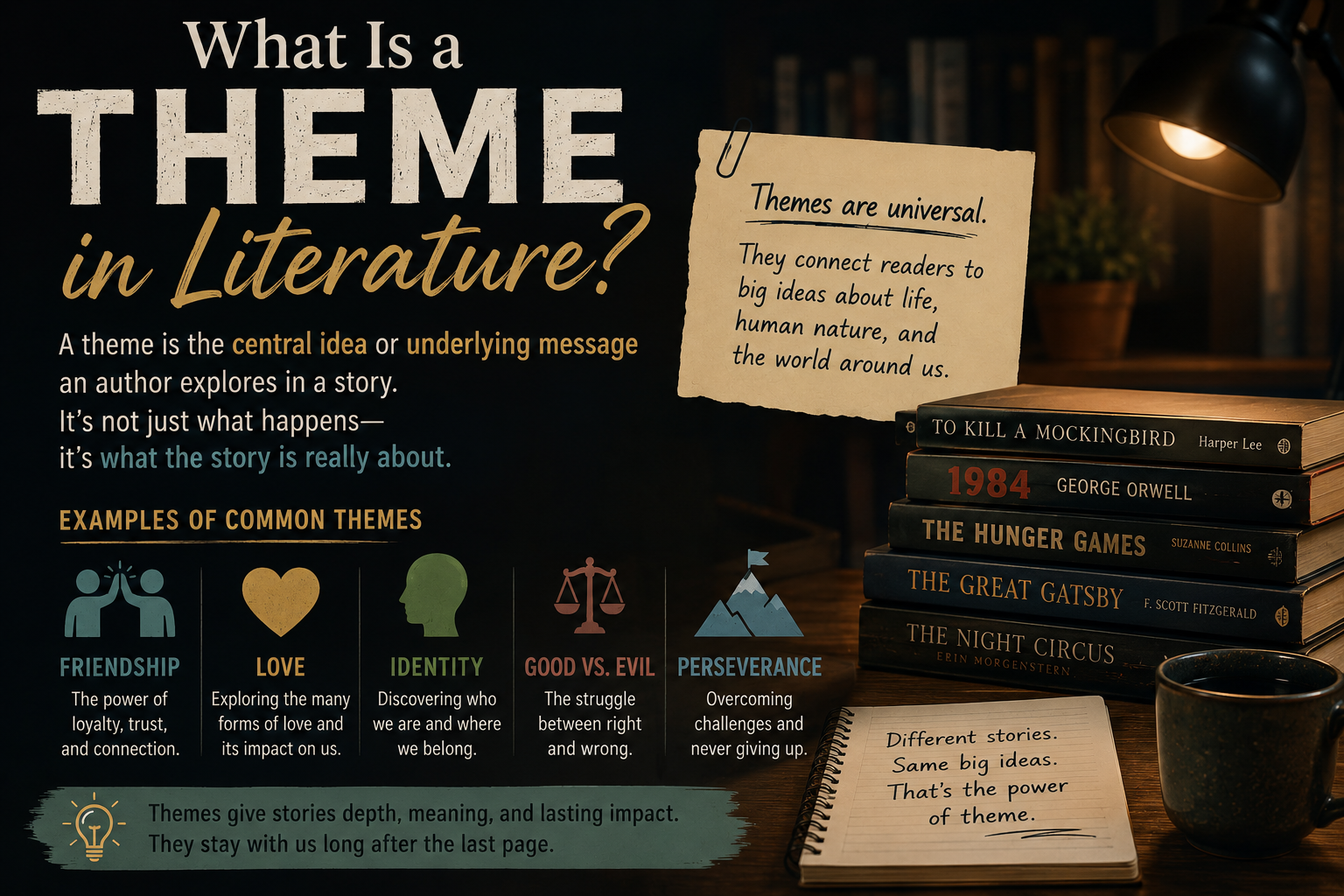
In simple terms, a theme is the deeper message a story shares about life, people, or the world.

In this Guide

  • What a theme means
  • Why theme matters
  • Theme vs. topic
  • Clear examples from famous books
  • How to find a theme
  • Helpful books to read
  • FAQ and key takeaway
what is theme in literature

What Is a Theme in Literature? A Simple Definition

A theme is the main idea or message behind a literary work.

So, What Is a Theme in Literature? It is not just what happens in the plot. It is what the story suggests about human life.

For example, a story may be about a boy at school. That is the plot. The theme might be that courage means standing up for what is right, even when it is hard.

A theme is often not stated directly. Readers must notice patterns, choices, conflicts, and changes in the characters.

Why What Is a Theme in Literature? Matters

Theme helps readers understand why a story matters beyond its events.

When students ask, “What Is a Theme in Literature?” they are really asking how stories create meaning. Theme connects the plot to real life.

Without theme, a story is only a chain of events. With theme, those events point to something larger.

In To Kill a Mockingbird by Harper Lee, the plot centers on a trial and a young girl’s view of her town. One major theme is that moral courage can stand against injustice.

That theme gives the novel its power. It asks readers to think about fairness, fear, and personal responsibility.

What Is a Theme in Literature? Theme vs. Topic

A topic is one word or idea. A theme is a full message about that idea.

This is where many students get stuck. Love, power, family, and fear are topics. They are not full themes by themselves.

If someone asks, “What Is a Theme in Literature?” do not answer with only “love.” A stronger answer would be, “Love can lead people to make brave choices.”

Here is another example. In Romeo and Juliet by William Shakespeare, love is a topic. One possible theme is that intense love can clash with family hate and social pressure.

That answer says more. It explains what the play suggests about love.

Common Theme Examples in Literature

Famous books often explore themes that still feel true today.

In The Great Gatsby by F. Scott Fitzgerald, one theme is that the dream of wealth can hide loneliness and moral emptiness.

In Charlotte’s Web by E. B. White, one theme is that friendship can give ordinary lives deep meaning.

In Lord of the Flies by William Golding, one theme is that people can become cruel when rules and shared values break down.

These examples show why the question “What Is a Theme in Literature?” has no single answer for every book. Different stories explore different truths.

How Authors Build Theme

Authors build theme through choices, not lectures.

A writer may show theme through a character’s mistakes. A character may want power, lose trust, and learn that control has a cost.

Authors also use conflict. When a character faces a hard choice, the story often reveals its deeper message.

Symbols can help too. In The Great Gatsby, the green light can point to Gatsby’s dream and the distance between desire and reality.

If you want a step-by-step method, read this helpful guide on how to identify theme in literature.

What Is a Theme in Literature? How to Write About It

A strong theme statement is clear and specific.

When you answer “What Is a Theme in Literature?” in an essay, avoid one-word answers. Write a sentence that explains the message.

Weak theme statement: “Friendship.”

Stronger theme statement: “True friendship requires loyalty when life becomes difficult.”

Then prove it with details from the text. Use character actions, key scenes, and important lines as evidence.

You can also compare the theme to another work. For poetry terms and close reading help, the Poetry Foundation glossary is a useful resource.

Books That Help You Understand Theme

These books are helpful for students who want more practice with literary ideas.

  • How to Read Literature Like a Professor by Thomas C. Foster
  • They Say / I Say by Gerald Graff and Cathy Birkenstein

These are not required to understand theme, but they can help you write stronger essays and notice deeper meaning in texts.

Practical Tip for Finding Theme

Look at how the main character changes by the end of the story.

Ask yourself: What did the character learn? What mistake did they make? What does the ending suggest about life?

This simple method can help you answer “What Is a Theme in Literature?” with confidence. For more practice, see this guide to finding theme in a story.

FAQ: What Is a Theme in Literature?

What Is a Theme in Literature? in simple words?

A theme is the message or lesson a story suggests about life, people, or society.

Can a book have more than one theme?

Yes. Most novels and plays have more than one theme. A story may explore love, power, guilt, or freedom in different ways.

Is theme the same as the moral?

Not always. A moral is usually a clear lesson. A theme can be more complex and may not give a simple answer.

How do I find the theme quickly?

Focus on the main conflict, the ending, and how the main character changes. Then write the message as a full sentence.

Key Takeaway

What Is a Theme in Literature? It is the deeper message a story gives about life. If you can explain that message and support it with evidence, you are already on the path to strong literary analysis.

What Is Irony in Literature? A Beginner-Friendly Guide

Literary Irony

Have you ever read a scene where the reader knows the truth, but a character does not? That gap is one reason students ask, What Is Irony in Literature? Irony can make a story more powerful, more painful, or more funny.

In this Guide

Literary Irony

What Is Irony in Literature? A Simple Definition

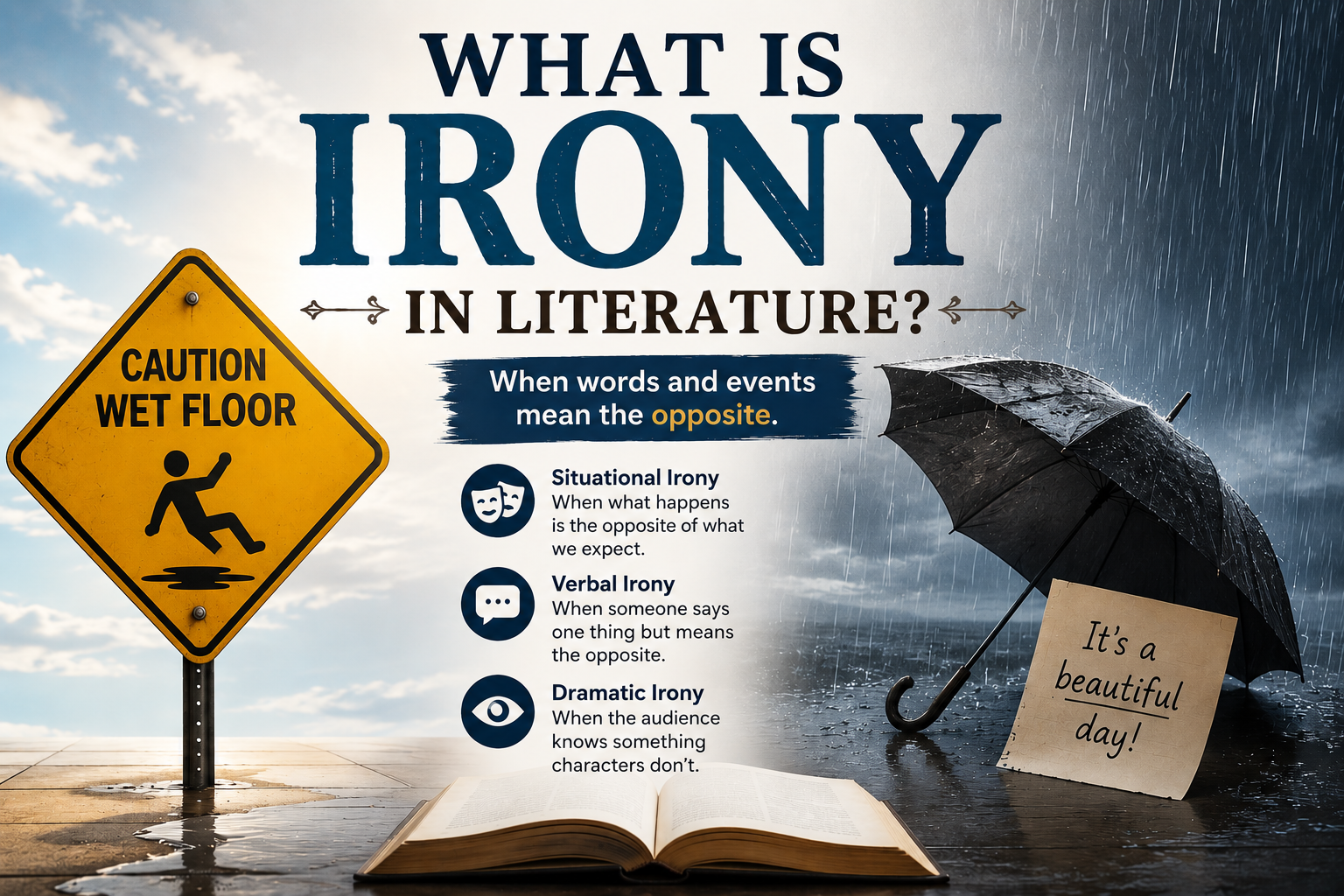
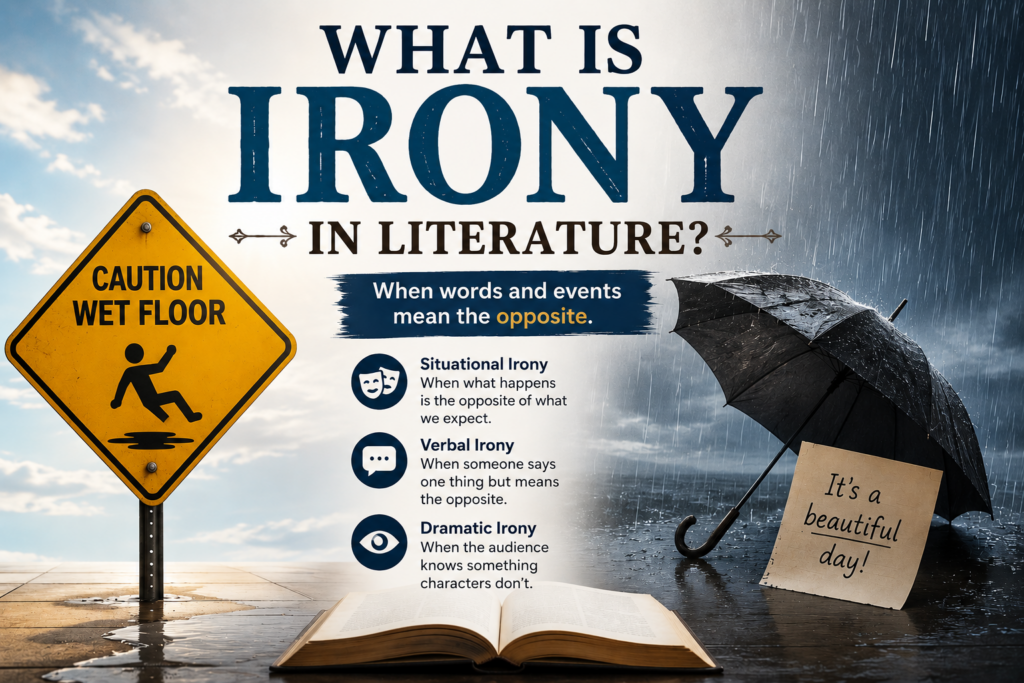
Irony happens when there is a clear gap between what seems true and what is actually true.

In literature, irony often appears when words, events, or situations do not match what we expect. The mismatch creates meaning.

When teachers ask, What Is Irony in Literature?, they are usually asking you to notice this gap. Irony is not just a random surprise. It must reveal something important about a character, theme, or conflict.

For example, if a fire station burns down, that is ironic because the place meant to stop fires becomes a victim of fire. In a story, that kind of twist can point to weakness, pride, bad luck, or a deeper message.

What Is Irony in Literature? Common Types to Know

Most classroom discussions focus on a few major forms of irony.

Verbal Irony

Verbal irony happens when a speaker says one thing but means something different.

This is not always sarcasm, though sarcasm is one type of verbal irony. Sarcasm is often sharp or mocking. Verbal irony can be gentle, funny, bitter, or serious.

In Jane Austen’s Pride and Prejudice, the famous opening line sounds serious: “It is a truth universally acknowledged…” Yet Austen is also mocking the way society treats marriage and money.

Dramatic Irony

Dramatic irony happens when the audience knows something a character does not know.

Shakespeare uses this often. In Romeo and Juliet, the audience knows Juliet is alive, but Romeo believes she is dead. This makes the scene heartbreaking because we can see the truth before he can.

Dramatic irony can create suspense because readers wait for the character to learn what they already know.

Situational Irony

Situational irony happens when the result of an event is the opposite of what we expect.

O. Henry’s “The Gift of the Magi” is a classic example. Della sells her hair to buy Jim a chain for his watch. Jim sells his watch to buy Della combs for her hair.

Their gifts become useless in a practical sense, but the irony shows their deep love.

What Is Irony in Literature? Why It Matters in Stories

Irony helps writers say more without spelling everything out.

A simple answer to What Is Irony in Literature? is this: it is a tool that reveals hidden truth. It can show that a character is blind to reality. It can expose unfair rules in society. It can also make a happy scene feel uneasy.

Irony often works with tone and foreshadowing. If you want to compare it with other story tools, visit our literary devices list.

Irony matters because it asks readers to think. Instead of just accepting what a character says, we must ask what the story really means.

What Is Irony in Literature? Famous Examples

Well-known books and plays use irony to build theme, conflict, and emotion.

Romeo and Juliet by William Shakespeare

The ending of Romeo and Juliet is full of dramatic irony. Romeo believes Juliet is dead, but the audience knows she has taken a sleeping potion.

This irony makes the tragedy feel even worse. The audience sees that the disaster could have been avoided.

“The Gift of the Magi” by O. Henry

This short story is one of the clearest examples of situational irony. Both main characters give up their most valuable item to buy a gift for the other.

The twist is painful and sweet at the same time. The gifts no longer work, but the love behind them becomes clear.

Animal Farm by George Orwell

In Animal Farm, the animals rebel because they want freedom. Over time, their new leaders become just as cruel as the humans they replaced.

This irony supports Orwell’s warning about power. The story shows how a revolution can fail when leaders become corrupt.

For more background on the term, you can explore Britannica’s entry on irony.

How to Spot Irony While You Read

The best way to find irony is to look for a gap.

Ask yourself what a character believes. Then ask what the reader knows. If those answers do not match, you may have dramatic irony.

Next, look at what a character says. If the words do not match the true meaning, you may have verbal irony.

Then check the outcome of a scene. If the result flips what you expected, you may have situational irony.

When you ask What Is Irony in Literature? during analysis, do not stop at naming the type. Explain what the irony does. Does it create humor? Does it reveal a flaw? Does it support the theme?

How to Answer What Is Irony in Literature? in an Essay

A strong essay answer should define irony, identify the type, and explain its effect.

Here is a simple sentence frame:

The author uses irony when [describe the gap] to show [explain the meaning].

For example:

Shakespeare uses dramatic irony when the audience knows Juliet is alive but Romeo does not, which makes the ending of the play more tragic.

This kind of answer is clear because it does more than label the device. It connects the device to meaning.

Books That Help You Practice Irony

These books are easy to find on Amazon or at most libraries. They give clear examples of irony in action.

  • The Gift of the Magi and Other Stories by O. Henry
  • Animal Farm by George Orwell

To review irony alongside other terms, you can also use our guide to common literary devices.

FAQ: What Is Irony in Literature?

What Is Irony in Literature?

Irony in literature is a gap between what is expected and what is true. That gap helps create meaning, humor, tension, or surprise.

Is irony the same as sarcasm?

No. Sarcasm is a sharp form of verbal irony. Irony is broader and can appear in speech, events, or whole plots.

What is the easiest type of irony to spot?

Dramatic irony is often the easiest to spot. If you know something a character does not know, you are likely seeing dramatic irony.

Why do authors use irony?

Authors use irony to reveal truth in a clever way. It can expose a character’s mistake, criticize society, or make a scene more emotional.

How can I write about irony in a paragraph?

Name the type of irony, describe the gap, and explain why it matters. Always connect irony to theme or character.

Key Takeaway

Irony is all about contrast. When you notice a gap between appearance and reality, pause and ask what the author wants you to understand. That one habit can make your reading and analysis much stronger.

Common Symbols in Classic Literature

literature symbols
literature symbols

Common Symbols in Classic Literature: A Student-Friendly Guide

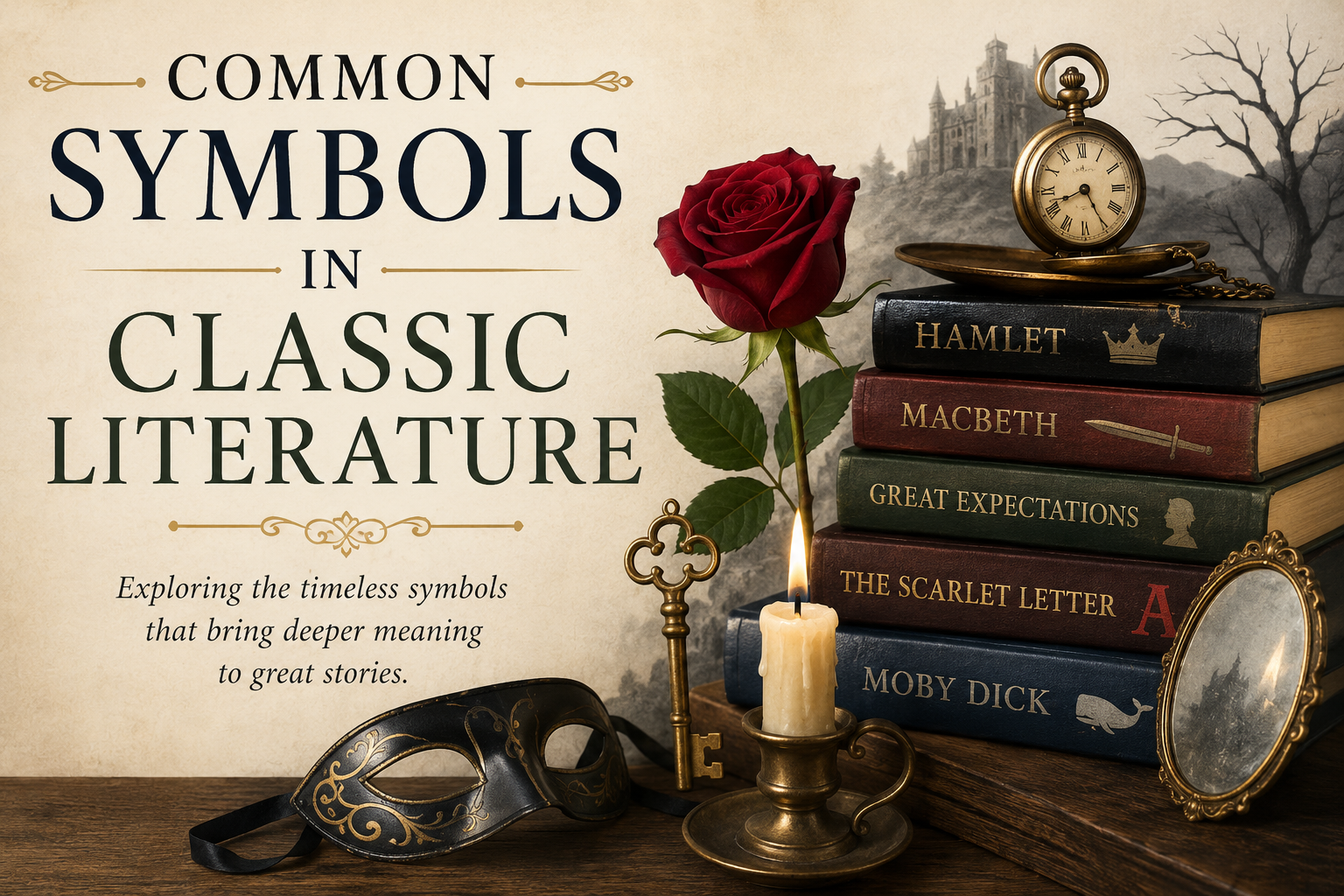
Common Symbols in Classic Literature can help you see deeper meaning in novels, plays, and poems. When you know what certain objects, colors, or places often suggest, you can read with more confidence and write stronger essays.

This guide explains key symbols, gives clear literary examples, and shows how to use them without overthinking every detail.

In this Guide

  • Why symbols matter in classic literature
  • Common symbols and what they often mean
  • Examples from famous books
  • How to analyze symbols in essays
  • Books that help you practice
  • FAQ and key takeaway

Why Common Symbols in Classic Literature Matter

Symbols help writers say more with less.

A symbol is something that stands for more than itself. It can be an object, place, color, animal, or action that points to a bigger idea.

For students, Common Symbols in Classic Literature are useful because they often connect to major themes. A river may suggest change. A locked room may suggest secrets. A storm may suggest conflict or fear.

Symbols do not always mean the same thing in every book. Context matters. Still, knowing common patterns gives you a strong place to start.

Common Symbols in Classic Literature: Light and Darkness

Light and darkness often show knowledge, truth, danger, or moral conflict.

Light often points to truth, hope, or understanding. Darkness often points to fear, confusion, or hidden evil.

In Frankenstein by Mary Shelley, light can suggest knowledge and discovery. Victor Frankenstein wants to “bring light” to science, but his search leads to pain and guilt.

In Heart of Darkness by Joseph Conrad, darkness is not just a setting. It raises questions about cruelty, power, and what people hide inside themselves.

When you see light or darkness in a classic text, ask what the character understands at that moment. Also ask what the writer may be hiding from the reader.

Common Symbols in Classic Literature: Colors

Colors can carry emotional and social meaning.

Red often suggests passion, sin, blood, or shame. White can suggest purity, innocence, emptiness, or coldness. Green often points to hope, envy, nature, or desire.

In The Scarlet Letter by Nathaniel Hawthorne, the red letter “A” is one of the most famous symbols in American literature. It marks Hester Prynne’s shame, but it also becomes a sign of strength.

In The Great Gatsby by F. Scott Fitzgerald, the green light at the end of Daisy’s dock stands for Gatsby’s dream. It also shows how that dream stays just out of reach.

Colors are among the most important Common Symbols in Classic Literature because they can appear many times across a story. Track when a color appears and how the mood changes around it.

Common Symbols in Classic Literature: Nature

Nature often reflects a character’s inner life.

Writers use weather, seasons, gardens, and wild places to show emotion or change. Spring may suggest youth or rebirth. Winter may suggest death, loss, or loneliness.

In Wuthering Heights by Emily Brontë, the wild moors reflect the fierce emotions of the characters. The setting feels harsh, open, and hard to control.

In King Lear by William Shakespeare, the storm shows Lear’s mental collapse. The weather outside mirrors the chaos inside him.

When you study Common Symbols in Classic Literature, pay close attention to setting. A landscape may reveal more than a character says out loud.

Common Symbols in Classic Literature: Animals

Animals often reveal power, fear, guilt, or instinct.

A snake may suggest danger or betrayal. A bird may suggest freedom or a trapped soul. A dog may suggest loyalty, but it can also show violence, depending on the story.

In Macbeth, Shakespeare uses animal images to show disorder and fear. After Duncan’s murder, nature seems broken, which suggests that Macbeth’s crime has damaged the moral order.

In Lord of the Flies by William Golding, the “beast” becomes a symbol of the boys’ fear. It also points to the violence inside human nature.

Animal symbols work best when you connect them to a theme. Do not stop at “the bird means freedom.” Ask who wants freedom and what blocks it.

Common Symbols in Classic Literature: Objects

Objects can carry a story’s biggest ideas.

A letter, ring, mirror, or weapon can gain meaning as the story moves on. The object may start as a normal item, then become tied to guilt, love, power, or memory.

In The Lord of the Rings by J.R.R. Tolkien, the ring stands for power and temptation. It shows how even good people can change when power takes hold.

In Jane Eyre by Charlotte Brontë, the locked room and hidden spaces at Thornfield Hall suggest secrets, fear, and social limits.

Common Symbols in Classic Literature often gain meaning through repetition. If an object appears at key moments, the author likely wants you to notice it.

Common Symbols in Classic Literature: Journeys and Roads

A journey often shows growth, escape, or a search for truth.

Roads and travel can show a character’s movement from innocence to experience. A physical trip may also reflect an inner change.

In The Odyssey by Homer, Odysseus’s journey is about more than getting home. It tests his pride, loyalty, and wisdom.

In The Adventures of Huckleberry Finn by Mark Twain, the river becomes a path toward freedom. Yet it also shows the moral problems of the society around Huck and Jim.

Journey symbols are useful in essays because they often connect to character growth. Ask what the character learns before and after the journey.

How to Analyze Common Symbols in Classic Literature

A symbol should connect to the whole story, not just one scene.

Start with the basic meaning. What is the object, color, place, or action? Then ask how it changes as the story goes on.

Look for repetition. If a symbol appears more than once, note when it appears and who is present. This can reveal a pattern.

Connect the symbol to a theme. A green light is not important only because it is green. It matters because it connects to dreams, wealth, and longing.

If you want a deeper step-by-step method, read this guide on how to find symbolism in a story.

How to Use Symbols in Literature Essays

Strong symbol analysis stays close to the text.

Do not write that a symbol “obviously” means one thing. Instead, prove your idea with evidence from the story.

A simple essay sentence might look like this:

In The Great Gatsby, the green light symbolizes Gatsby’s dream of a perfect future with Daisy, but its distance shows that the dream is impossible to fully reach.

This works because it names the symbol, explains the meaning, and links it to a theme.

For AP Literature or college essays, you should also explain how the symbol affects the reader. Does it create hope? Does it create doubt? Does it make the ending feel tragic?

Best Books for Studying Common Symbols in Classic Literature

These books give students strong practice with symbolism.

  • The Great Gatsby by F. Scott Fitzgerald
  • The Scarlet Letter by Nathaniel Hawthorne
  • Lord of the Flies by William Golding

Each book uses symbols in a clear way, which makes them helpful for essays and class discussion. They are also common choices in high school and college literature courses.

You can also explore trusted resources like the Poetry Foundation’s definition of symbol and Britannica’s overview of Symbolism for more background.

Quick Study Tips for Symbolism

A few simple habits can make symbol analysis much easier.

Mark repeated objects, colors, and places as you read. Write a short note each time one appears.

Ask what changes near the symbol. Does the mood shift? Does a character act in a new way?

Do not force a meaning. Some details are just details. A symbol matters when the story gives it weight.

When in doubt, return to theme. The best symbol analysis explains how one detail supports the bigger message of the work.

FAQ About Common Symbols in Classic Literature

What are the most common symbols in classic literature?

Some of the most common symbols are light, darkness, colors, nature, animals, objects, and journeys. Their meaning depends on the story’s context.

How do I know if something is a symbol?

Look for repetition, strong description, or a link to a major theme. If the author keeps drawing attention to it, it may be symbolic.

Can one symbol have more than one meaning?

Yes. A strong symbol can hold more than one idea. For example, the scarlet letter in Hawthorne’s novel suggests shame, strength, and identity.

Why do teachers ask students to find symbols?

Symbols help students understand theme, character, and conflict. They also lead to stronger literary analysis.

Should I memorize Common Symbols in Classic Literature?

You can learn common patterns, but do not rely on memorization alone. Always use the text to support your interpretation.

Key Takeaway

Common Symbols in Classic Literature are tools for deeper reading, not secret codes with fixed answers. Notice patterns, connect them to theme, and use evidence from the text to explain your ideas clearly.

What Is Foreshadowing in Literature?

Foreshadowing in Literature

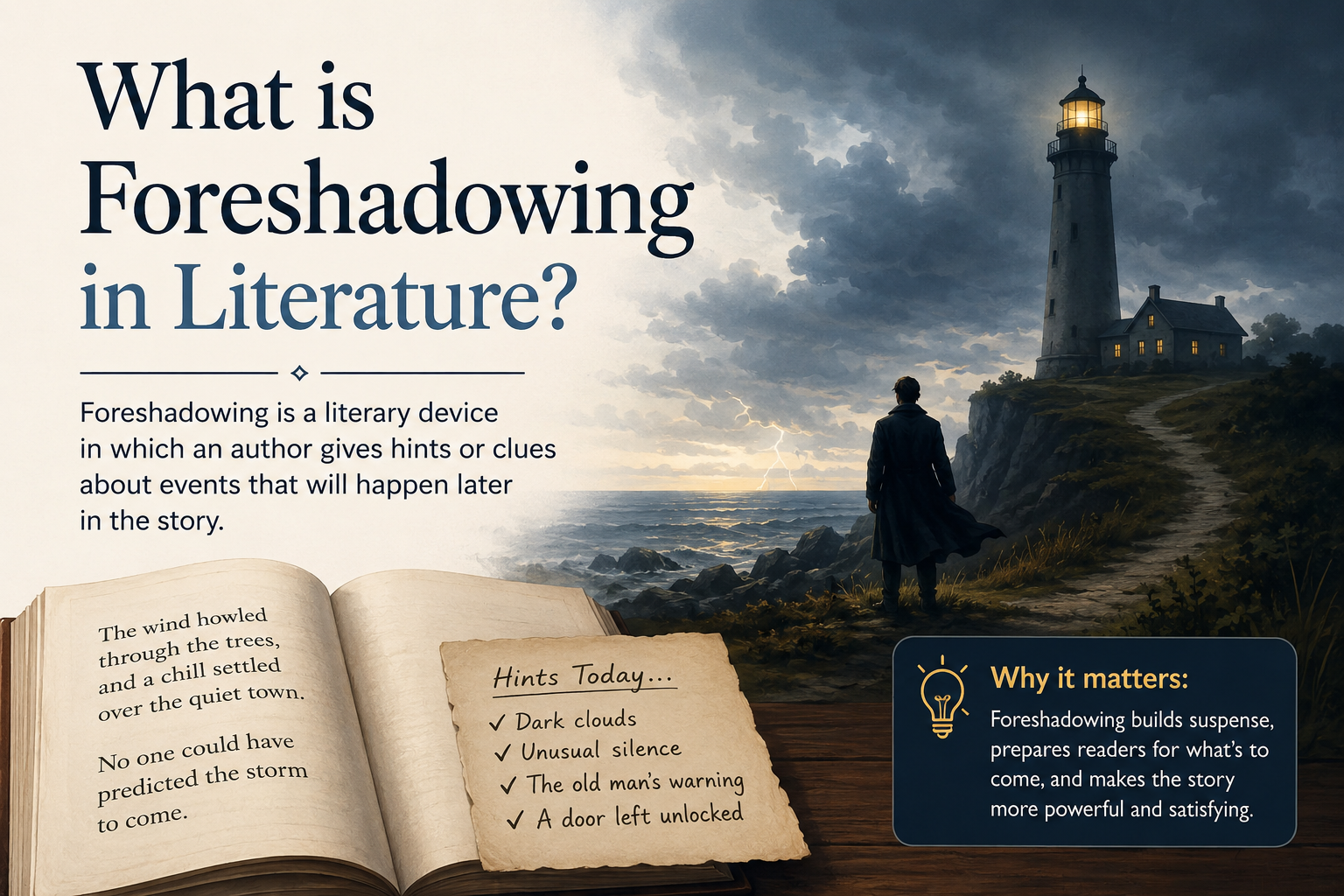
What Is Foreshadowing in Literature? It is a clue that hints at what may happen later in a story. Writers use it to build suspense, shape mood, and help readers notice that every detail can matter.

In this Guide

  • What foreshadowing means
  • Why writers use it
  • Common types of foreshadowing
  • Famous examples from literature
  • How to spot it as you read
  • Book suggestions
  • FAQ
Foreshadowing in Literature

What Is Foreshadowing in Literature? A Simple Definition

Foreshadowing is a hint that points toward a future event in a story.

So, What Is Foreshadowing in Literature? In simple terms, it is when an author plants a clue early so something later feels planned, not random.

Foreshadowing can be clear or subtle. A character may make a warning, a storm may signal danger, or an object may appear before it becomes important.

This device helps readers feel curious. It also rewards close reading because small details may gain meaning later.

If you want to study more tools like this, visit our literary devices list.

What Is Foreshadowing in Literature? Why It Matters

Foreshadowing gives a story shape and purpose.

What Is Foreshadowing in Literature? It is not just a “hint.” It is a way for writers to guide our expectations.

When used well, foreshadowing makes an ending feel earned. Readers may think, “I should have seen that coming,” which can make the story more powerful.

It also creates suspense. If a novel opens with a strange noise in the dark, we expect that noise to matter later.

Foreshadowing can also reveal theme. In many tragedies, early warnings show that fate, pride, or fear may lead to disaster.

What Is Foreshadowing in Literature? Common Types to Know

Foreshadowing can appear in more than one form.

Direct foreshadowing gives a clear warning. A character might say, “Nothing good will come from this.” That line tells readers to expect trouble.

Indirect foreshadowing is more hidden. A broken mirror, a dark dream, or a strange silence may hint at future conflict.

Symbolic foreshadowing uses images or objects. For example, a dying plant might suggest a failing relationship.

So, What Is Foreshadowing in Literature? It is any early clue that prepares readers for what comes next, even if they do not notice it right away.

Famous Examples of Foreshadowing

Well-known stories often use foreshadowing to build tension and meaning.

In Romeo and Juliet by William Shakespeare, Romeo has dark feelings about going to the Capulet party. His fear hints at the tragedy that follows.

In Of Mice and Men by John Steinbeck, the death of Candy’s dog foreshadows the later death of Lennie. Both scenes deal with mercy, weakness, and painful choices.

In Harry Potter and the Sorcerer’s Stone by J.K. Rowling, small details about Harry’s scar and Voldemort hint at a much larger conflict.

In The Lottery by Shirley Jackson, the nervous mood and strange village ritual foreshadow the shocking ending. The story shows how ordinary details can hide danger.

For more on literary terms and reading context, you can explore Britannica’s entry on foreshadowing.

How Foreshadowing Is Different from a Spoiler

A spoiler tells you what will happen. Foreshadowing only hints at it.

This difference matters. A spoiler removes surprise, but foreshadowing creates interest.

Good foreshadowing does not give away the whole plot. It gives just enough detail to make readers wonder.

When readers look back, the clue makes sense. That is why foreshadowing can make a story feel carefully built.

How to Spot Foreshadowing While You Read

Look for details that seem unusual, repeated, or too specific to ignore.

If a writer spends time on an object, warning, dream, or odd line of dialogue, mark it. Ask, “Why did the author include this?”

Pay close attention to first chapters. Many writers place key clues near the start of a story.

Also watch for changes in mood. A sudden shift from calm to tense may signal that something important is coming.

To connect foreshadowing with other story tools, review this guide to literary devices.

Books That Help You Study Foreshadowing

These books are useful if you want strong examples of foreshadowing in action:

  • Romeo and Juliet by William Shakespeare
  • Of Mice and Men by John Steinbeck
  • Harry Potter and the Sorcerer’s Stone by J.K. Rowling

FAQ: What Is Foreshadowing in Literature?

What Is Foreshadowing in Literature?

Foreshadowing is a clue that hints at a future event in a story. It helps readers expect that something important may happen later.

Why do authors use foreshadowing?

Authors use foreshadowing to build suspense, prepare readers, and make the ending feel connected to the rest of the story.

Is foreshadowing always obvious?

No. Some foreshadowing is clear, but some is hidden. Readers may only notice it after they finish the story.

What is an easy example of foreshadowing?

If a character says, “I have a bad feeling about this,” that line may foreshadow danger or conflict later.

Can foreshadowing be a symbol?

Yes. A symbol, such as a storm or broken object, can foreshadow a future event or emotional change.

Key Takeaway

What Is Foreshadowing in Literature? It is a clue that points ahead. When you read, circle strange details and ask how they might matter later. That simple habit can make your analysis much stronger.