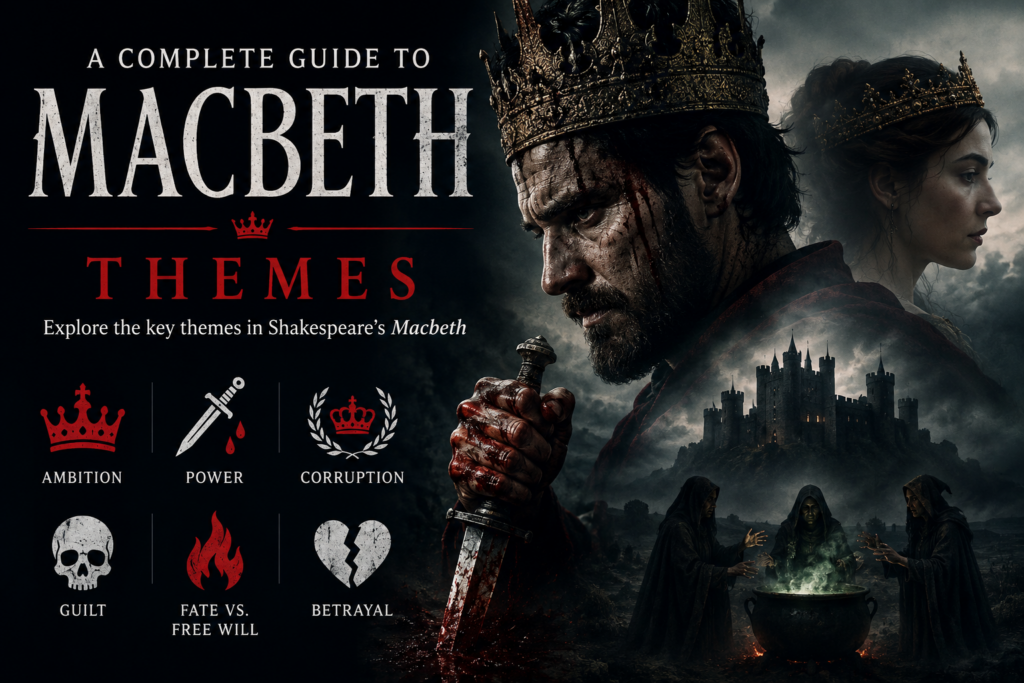

Themes in Macbeth: A Student-Friendly Guide

Themes in Macbeth

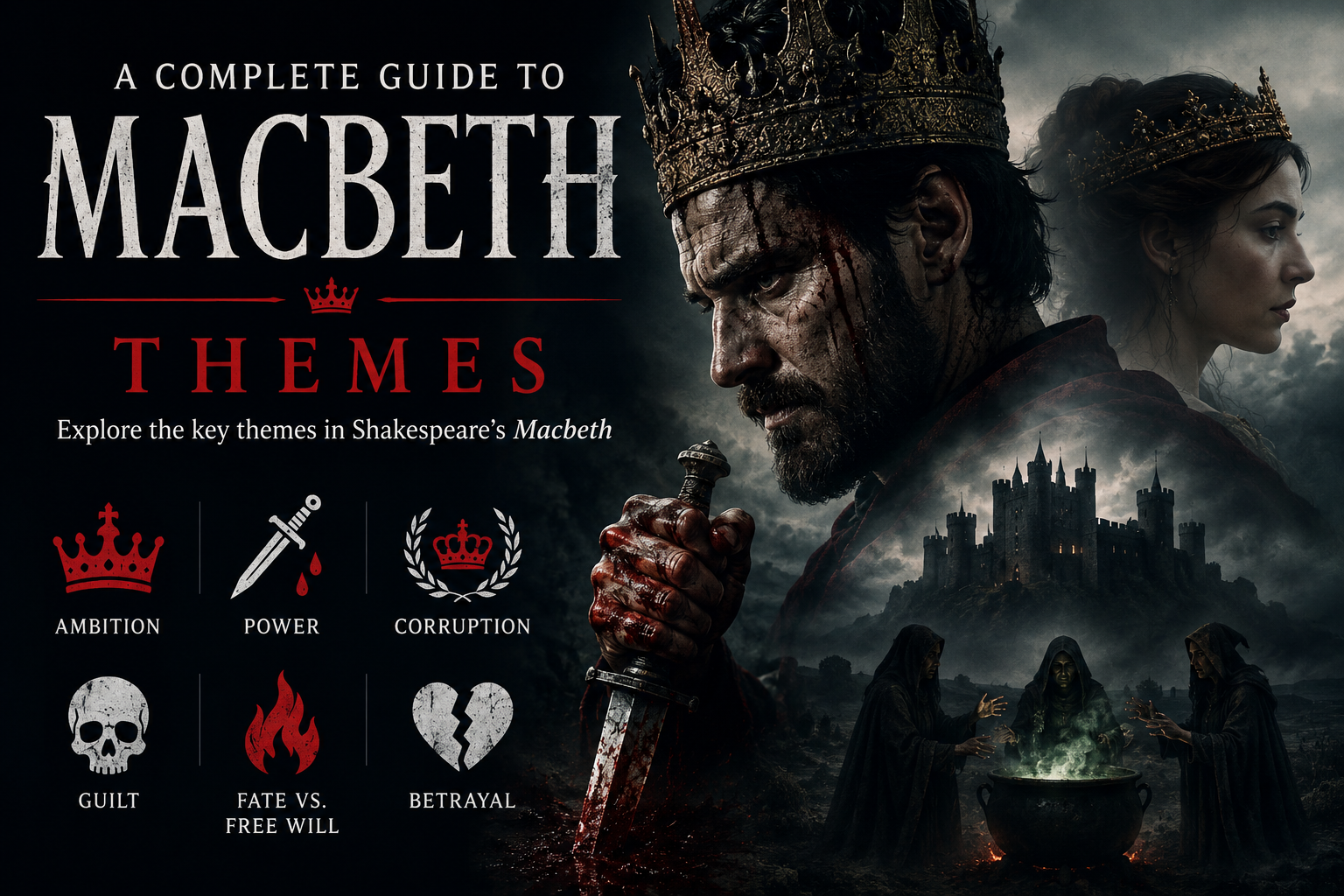
The themes in Macbeth help explain why Shakespeare’s tragedy still feels intense and easy to debate. This guide breaks down ambition, guilt, fate, power, and false appearances in a way students can use for class essays.

In this Guide

  • Why the play’s themes matter
  • Ambition and moral collapse
  • Guilt and the mind
  • Fate and free will
  • Appearance versus reality
  • Power, disorder, and kingship
  • Books, links, and FAQ
Themes in Macbeth

Why the themes in Macbeth matter

Shakespeare uses themes to turn a murder story into a study of human weakness.

Macbeth is not only about a man who wants to be king. It is about what happens when desire outruns conscience.

Theme helps you move beyond plot summary. Instead of saying, “Macbeth kills Duncan,” you can ask why he does it, what it costs him, and what Shakespeare may be saying about power.

If you want help connecting theme to a character’s choices, this guide on how to analyze characters in literature can help you build stronger paragraphs.

Themes in Macbeth: Ambition and its dangers

Ambition drives Macbeth forward, but it also destroys his judgment.

Of all the themes in Macbeth, ambition is the one most students notice first. Macbeth begins as a brave soldier, but the witches’ prophecy wakes a desire he cannot control.

Lady Macbeth also links ambition to action. She pushes Macbeth to prove himself by taking the crown. Yet both characters learn that getting power does not bring peace.

Shakespeare does not say ambition is always evil. The problem is ambition without moral limits. Macbeth wants greatness, but he cuts himself off from loyalty, mercy, and truth.

This idea appears in other classics too. In Mary Shelley’s Frankenstein, Victor wants to master life itself, and his unchecked desire leads to ruin.

Themes in Macbeth: Guilt and the divided mind

Guilt becomes a punishment that no crown can erase.

One of the strongest themes in Macbeth is guilt. After Duncan’s murder, Macbeth hears voices and fears he will never sleep again.

Sleep becomes a key symbol. To Macbeth, sleep means innocence and calm. Once he murders Duncan, he loses both.

Lady Macbeth tries to reject guilt at first. She tells Macbeth that a little water will clear them. Later, she sleepwalks and imagines blood on her hands.

The famous “Out, damned spot!” scene shows that guilt lives inside the mind. No public victory can silence private shame.

This theme is similar to Dostoevsky’s Crime and Punishment, where a murderer’s inner life becomes part of the punishment.

Themes in Macbeth: Fate, prophecy, and free will

The witches predict the future, but Macbeth chooses how to act.

The witches create one of the play’s biggest questions. Is Macbeth trapped by fate, or does he freely choose evil?

The prophecy says Macbeth will become king. It does not say he must murder Duncan. That gap matters.

Macbeth treats the prophecy like permission. He lets the idea of kingship shape his choices until he becomes dependent on more predictions.

Shakespeare keeps the answer uneasy. Fate may tempt Macbeth, but it does not force the dagger into his hand.

Themes in Macbeth: Appearance versus reality

Many characters hide truth behind a false face.

Appearance versus reality is one of the key themes in Macbeth because the play is full of masks. Characters speak with loyalty while they plan betrayal.

Lady Macbeth tells her husband to “look like the innocent flower” while hiding a deadly purpose. This image makes deception seem beautiful on the surface, but rotten underneath.

Duncan also misreads people. He trusts Macbeth just as he once trusted the old Thane of Cawdor. His kindness makes the betrayal feel more painful.

The witches add to this confusion with lines like “Fair is foul, and foul is fair.” In their world, moral signs cannot be trusted.

Other important themes in Macbeth

The play also explores power, disorder, and what makes a ruler legitimate.

These themes in Macbeth matter because Duncan’s murder breaks more than a family line. It damages the natural and political order of Scotland.

After Duncan dies, strange events follow. Darkness covers the day, animals act against nature, and Scotland becomes filled with fear.

Macbeth holds the title of king, but he lacks true authority. He rules through violence, not justice.

Malcolm’s return suggests that good kingship depends on self-control and care for the people. Shakespeare contrasts tyranny with lawful rule.

For more background on Shakespeare’s life and world, see Britannica’s William Shakespeare biography. You can also read the full play at the Folger Shakespeare Library.

How to write about the themes in a Macbeth essay

A strong theme paragraph connects a big idea to a specific choice or image.

Start with a clear claim. For example, Shakespeare shows that ambition becomes destructive when it breaks away from conscience.

Then use a short quote or scene. The dagger vision, the sleepwalking scene, or the witches’ prophecies can all support a strong point.

After the evidence, explain how the moment reveals meaning. Do not stop at what happened. Show why it matters.

Helpful books for studying Macbeth

A good edition can make the play much easier to understand.

  • Macbeth by William Shakespeare, Folger Shakespeare Library edition
  • Shakespeare: The World as Stage by Bill Bryson

FAQ about themes in Macbeth

Here are short answers to common student questions.

What are the main themes in Macbeth?

The main themes are ambition, guilt, fate versus free will, appearance versus reality, and the abuse of power.

What is the most important theme in Macbeth?

Ambition is often seen as the central theme because it causes Macbeth’s rise and fall.

How does guilt affect Macbeth?

Guilt makes Macbeth fearful, restless, and violent. Instead of stopping him, it pushes him deeper into crime.

Do the witches control Macbeth?

No. They tempt him with prophecy, but Macbeth still makes his own choices.

Key Takeaway

The themes in Macbeth show how quickly power can corrupt a person who ignores conscience. Shakespeare’s play lasts because its questions about desire, fear, and moral choice still feel real today.
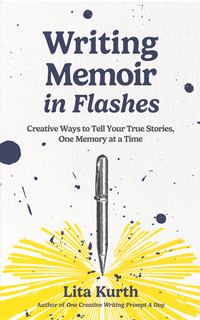
Book Review: Lita Kurth’s Writing Memoir in Flashes

Writing Memoir in Flashes: Creative Ways to Tell Your True Stories, One Memory at a Time by Lita Kurth

My rating: 5 of 5 stars

A Practical, Encouraging Guide That Helped Me Write a Publishable Flash Memoir

Lita Kurth’s Writing Memoir in Flashes is one of the most useful writing books I have read in a long time because it does exactly what a good creative writing guide should: it makes you want to stop reading and start writing. This book is warm, practical, generous, and deeply encouraging without ever claiming that memoir is easy. Kurth recognizes that writing true stories can be sensitive work. It can evoke sadness, embarrassment, humor, desire, remorse, and astonishment. Rather than seeing them as hurdles, she shows how they can become the very substance of a vigorous flash memoir.

I liked the book’s emphasis on small moments the most. Kurth does not ask any writer to make sense of their life or pin down a clear meaning to their past. She asks them to begin with an image, an object, a family saying, a food memory, a first time, a last time, or a single strong scene. Such a strategy makes memoir possible. Furthermore, it pays tribute to how memory works. Life does not have easily recognizable or clean chapters. We remember the drawer, the scent, the weird thing someone said, the room where something shifted.

The prompts are superb. They strike a level of specificity that snowballs the writer into action while leaving enough room to lead somewhere unexpected. I was drawn back to memories I hadn’t thought of in years. Most importantly, the exercises produced actual pages, not mere inspiration. I have already written a flash memoir using these methods, and it was accepted for publication. This is likely the highest compliment I can pay it. It does not simply make you feel like a writer. It helped me write something substantial to share with the world.

Kurth’s tone is also strong. She writes like a teacher who believes in her students but refuses to lie to them. She promotes honest, detailed writing, revision, reading aloud, and reflection on truth, fairness, and others’ privacy. I found the writing about families and the ethical questions surrounding memoir particularly helpful. The pages present the complexity of writing about oneself.

For some readers, the only flaw is that the book feels more like a workshop than a craft book. Through examples, reflections, prompts, and advice, it has a conversational feel. I liked this, but if you’re after a strict step-by-step system, you may find it a little loose. Nevertheless, this ambiguity fits the subject closely. This book respects that flash memoir often begins in fragments.

Overall, Writing Memoir in Flashes is an effective and emotionally astute guide for anyone seeking to write true stories, one memory at a time. It is especially valuable for writers who feel their lives are too banal to matter. Kurth demonstrates that no life is too insignificant for art when the writer pays sufficient attention.

View all my reviews

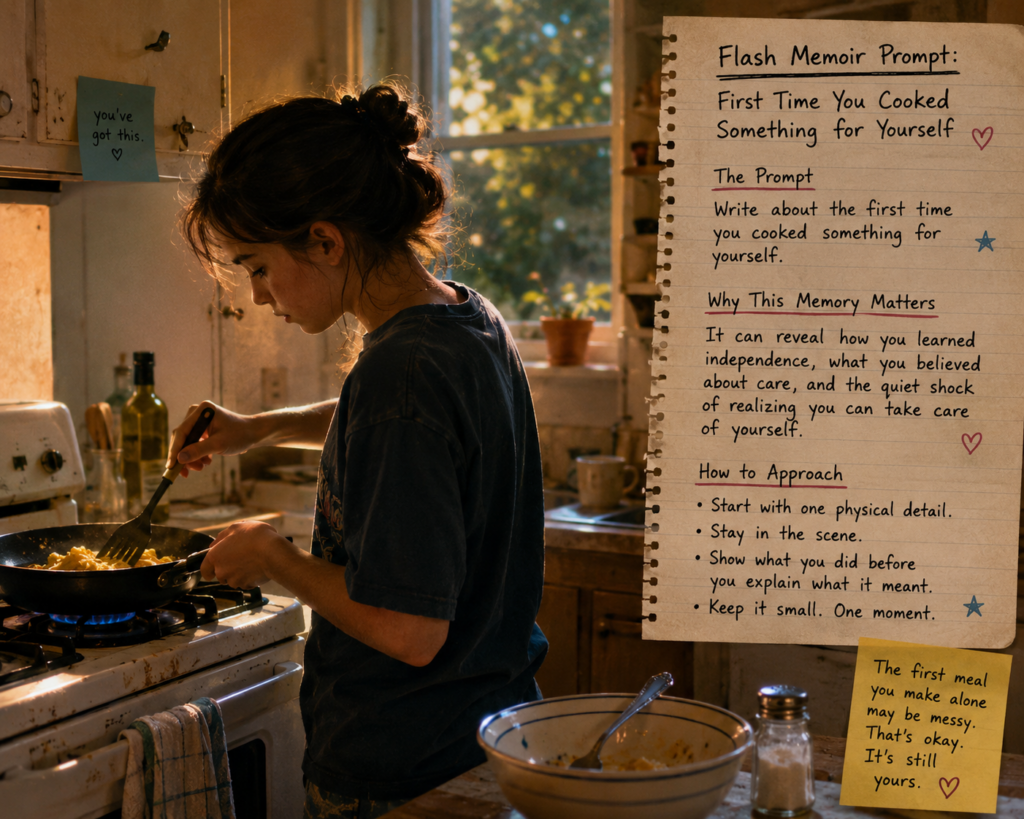
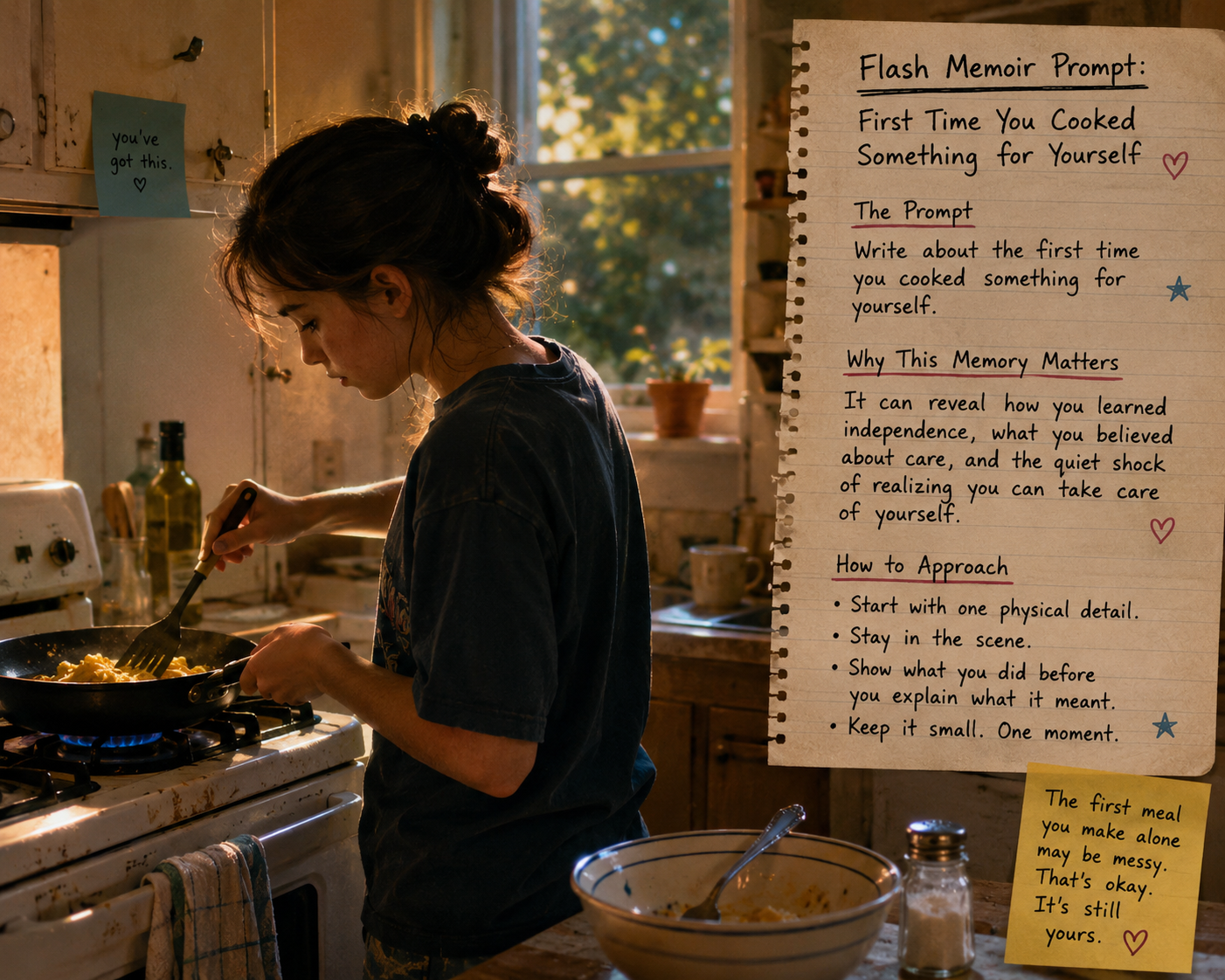
Flash Memoir Prompt: First Time You Cooked Something for Yourself

flash memoir prompt

That first meal you made alone may have tasted strange, smoky, or better than expected, but it probably carried a small charge of independence. This flash memoir prompt about the first time you cooked something invites you to return to one simple kitchen moment and notice what changed inside you.

flash memoir prompt

The Prompt

Write about the first time you cooked something for yourself.

At first, this may seem like a small memory. Maybe you made scrambled eggs before school. Maybe you heated soup in a dented pot. Maybe you burned toast and called it dinner anyway.

But food memories often hold more than food. They hold hunger, need, pride, loneliness, freedom, and the quiet shock of realizing you can take care of yourself in some small way. A flash memoir prompt first time cooked something gives you a clear scene to enter, which helps you avoid trying to explain your whole life at once.

Stay with the moment. The pan. The smell. The mistake. The bite you took when nobody else was watching.

Why This Memory Matters

The first time you cooked for yourself may have marked a shift you did not understand at the time. You may have been a child trying to prove you were grown. You may have been a college student with an empty fridge and a cheap saucepan. You may have been newly alone, feeding yourself because no one else was there to do it.

This memory can reveal how you learned independence. It can also reveal what you believed about care. Did cooking feel like freedom? Did it feel like proof that you had been left to figure things out too soon? Did it feel funny, clumsy, or proud?

You do not need a dramatic scene for this prompt to work. A burned grilled cheese can carry a whole story. So can a bowl of instant noodles eaten at a quiet table. The meaning often hides in the ordinary detail.

If you are a student, this kind of writing can also help you practice finding meaning in a scene. The same skill appears when you identify theme in literature: you notice what happens, then ask what deeper truth it points toward.

How to Approach This Prompt

Begin with one physical detail. Do not start by explaining your age, your family, or the whole situation. Start with the thing you remember most clearly.

Maybe it was the sound of oil popping in the pan. Maybe it was the sticky handle of a wooden spoon. Maybe it was the way the microwave light made the kitchen look yellow at night.

Once you have that detail, narrow the memory to one scene. Keep yourself in the kitchen or wherever you cooked. Let the reader see what you did with your hands. Let them hear the cupboard door, the timer, the scrape of a fork on a plate.

Try to write what you noticed before you explain what it meant. For example, instead of starting with “That was the day I became independent,” you might write, “I stood on a chair to reach the skillet and hoped my mother would not hear it hit the stove.” That sentence gives the reader a scene. The meaning can arrive later.

If you like marking up stories for important details, you can use a similar habit in your own draft. After you write, reread and underline the strongest images. This guide on how to annotate literature can help you think about what to notice on the page, even when the page is your own memory.

For this flash memoir prompt first time cooked something, avoid trying to tell every meal that came after. You are not writing your full history with food. You are writing one moment when you met yourself in a new way.

A Quick Example

I was eleven when I made my first egg. My father was asleep on the couch, one arm over his eyes, and the house had that late-afternoon heat that made everyone quiet. I pulled the small pan from the lower cabinet and cracked the egg too hard. Half the shell fell in. I picked it out with my fingers, proud and disgusted at the same time. The butter browned before I knew what to do, so the egg came out with crisp edges and a soft middle. I ate it standing at the counter with too much salt. Nobody clapped. Nobody asked if I was hungry. But when I washed the plate, I remember thinking, I did that. It was a small thought, but it stayed.

Try It Yourself

Set a timer for ten minutes and write the scene without stopping. Begin with the kitchen, the tool, or the first thing that went wrong. Let the memory stay small.

If you get stuck, write this sentence and keep going: “The first thing I remember is…” Then name the object in your hand or the smell in the room.

You do not have to make the memory neat. You do not have to turn it into a lesson. Just tell the truth of what it felt like to feed yourself that first time, whether it felt happy, lonely, awkward, or brave.

When you finish, read your piece once and look for the sentence that feels most alive. That sentence may be the heart of the memoir.

Want More Flash Memoir Prompts?

If this flash memoir prompt first time cooked something helped you find a clear memory, keep going with short, focused writing sessions. Explore all 365 prompts in The Memory Trigger: 365 Flash Memoir Writing Prompts.

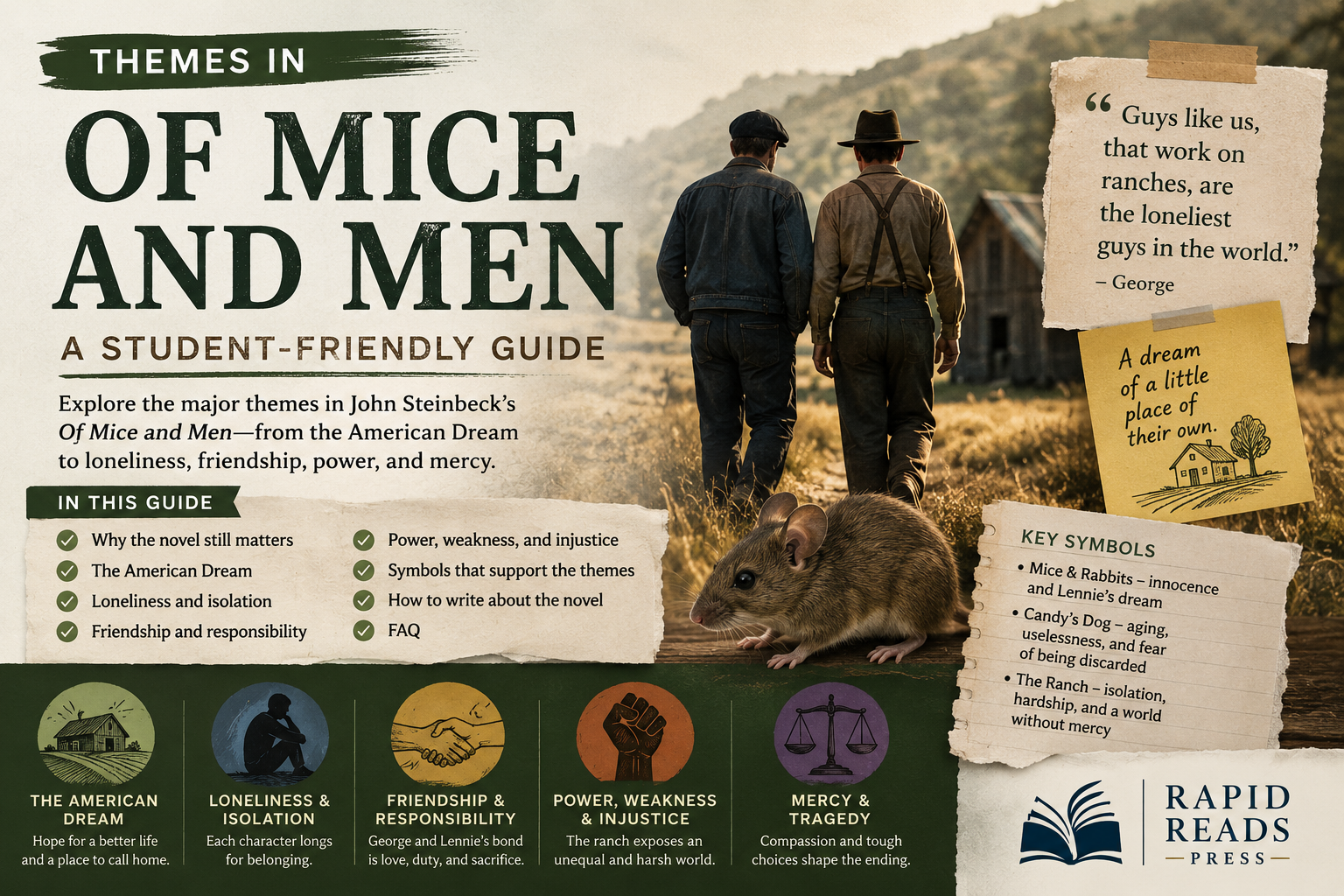
Themes in Of Mice and Men: A Student-Friendly Guide

themes in of mice and men

The themes in Of Mice and Men help students see why John Steinbeck’s short novel still feels powerful. The book is about two migrant workers, but it also asks hard questions about dreams, loneliness, power, and mercy.

This guide explains the major ideas in clear language so you can use them in class discussion, essays, or AP Literature notes.

This article contains affiliate links.

In this Guide

  • Why the novel still matters
  • The American Dream
  • Loneliness and isolation
  • Friendship and responsibility
  • Power, weakness, and injustice
  • Symbols that support the themes
  • How to write about the novel
  • FAQ
themes in of mice and men

Why the themes in Of Mice and Men Still Matter

Steinbeck writes about a small group of workers, but their problems feel much bigger than one ranch.

The themes in Of Mice and Men matter because they connect private pain to public hardship. George and Lennie want a home, safety, and control over their lives. Those hopes sound simple, but the world around them makes those hopes hard to reach.

The novel takes place during the Great Depression, when many workers moved from job to job. They had little money and almost no security. You can learn more about Steinbeck’s life and context through the Britannica profile of John Steinbeck.

Like The Grapes of Wrath, this book shows how poverty can crush people’s plans. It also shows how people hold on to hope even when hope seems fragile.

Main Themes in Of Mice and Men Students Should Know

Most strong essays on this novel start with a theme and then connect it to character choices.

The main themes in Of Mice and Men include the dream of a better life, the pain of loneliness, and the abuse of power. These ideas do not sit apart from each other. They overlap in almost every major scene.

George and Lennie’s dream farm gives them hope. Candy joins the dream because he fears becoming useless. Crooks wants in for a moment because he also wants safety and belonging.

Each character shows a different side of the same problem. They all want a place where they matter. Steinbeck suggests that this need is human, but the world of the ranch makes it hard to protect.

The American Dream in Of Mice and Men

The dream farm is the heart of the novel’s hope and heartbreak.

George and Lennie dream of owning a small piece of land. They want rabbits, crops, and freedom from bosses. To them, the farm means dignity.

This dream is powerful because it is so modest. They do not want to be rich. They just want peace and control over their days.

Yet the novel keeps warning us that the dream may not survive. George has told the story many times, almost like a bedtime tale. Lennie loves to hear it because it makes the future feel safe.

In this way, Steinbeck questions the American Dream. He asks whether hard work is enough when poverty, disability, and social class stand in the way.

Loneliness and Isolation

Nearly every character in the novel feels cut off from others.

George says that ranch workers are the loneliest people in the world. They travel alone, spend their money, and move on. His friendship with Lennie makes him different.

Crooks is isolated because of racism. He lives apart from the other men and knows that the dream of equality is not real for him. Curley’s wife is isolated because she is the only woman on the ranch and because the men treat her as a threat instead of a person.

Candy fears loneliness too. After his old dog is killed, he sees his own future more clearly. He worries that age will leave him unwanted.

This theme helps explain why the dream farm matters so much. It is not only about land. It is about escape from being alone.

Friendship, Loyalty, and Responsibility

George and Lennie’s bond gives the novel its emotional center.

George often complains about Lennie, but he still protects him. Lennie depends on George for almost everything. Their friendship is not simple, but it is real.

Steinbeck shows that loyalty can be both loving and painful. George cares for Lennie, but that care also traps him. He cannot live the free life he sometimes imagines.

This makes the ending so hard. George’s final choice forces readers to ask what mercy means. Is it an act of love, an act of despair, or both?

Students can compare this to works like Romeo and Juliet, where love leads to painful choices. In both texts, strong bonds shape tragic endings.

Power, Weakness, and Injustice

The ranch has a clear social order, and the weakest people suffer most.

Curley uses his status to threaten others. He is the boss’s son, so men fear him even when they dislike him. His power does not make him wise or kind.

Other characters lack power for different reasons. Lennie has great physical strength, but he has little social protection. Crooks is smart and sharp, but racism limits his life. Curley’s wife has some power over Crooks in one scene, yet she also has almost no freedom of her own.

Steinbeck does not present power as simple. A person can be hurt in one moment and hurt someone else in the next. That makes the novel more honest and more troubling.

How Symbolism Supports the Themes in Of Mice and Men

Symbols help Steinbeck show big ideas through small details.

When you study the themes in Of Mice and Men, pay close attention to animals, settings, and repeated images. Lennie’s dead mouse, Candy’s dog, and the rabbits all point to innocence, danger, and loss.

Candy’s dog is one of the clearest symbols. The dog is old and no longer useful, so the men decide it should die. This moment reflects Candy’s fear that the ranch will one day treat him the same way.

The rabbits symbolize Lennie’s dream of comfort. They also show how gentle desires can become dangerous when Lennie cannot control his strength.

If you want more help with this skill, read our guide on how to find symbolism in a story. It can help you turn small details into stronger essay points.

Fate, Foreshadowing, and Tragedy

The novel feels tragic because the ending is prepared from the start.

Steinbeck uses foreshadowing to build dread. Lennie kills small animals by accident. George tells him to hide in the brush if trouble comes. Candy regrets not killing his own dog himself.

These moments prepare us for the ending. They make the final scene feel shocking but not random.

The structure is close to classical tragedy. A character has a deep flaw or limit, the world gives little mercy, and the result feels almost unavoidable. Lennie does not mean harm, but his lack of control creates danger.

Nature, Violence, and the Loss of Innocence

The natural world in the novel looks peaceful, but danger is never far away.

The book opens near the river, a place that seems calm and safe. By the end, the same setting becomes the place of George’s terrible choice. Steinbeck uses this return to show how innocence has been lost.

Animals are central to this idea. Lennie loves soft things, but his touch often ends in harm. The pattern shows the gap between intention and result.

This theme is useful for essays because it links character, plot, and symbol. Lennie wants gentleness, but the world of the novel turns gentleness into grief.

How to Write About the Themes in Of Mice and Men

A strong essay needs a clear claim, not just a topic.

A strong essay about the themes in Of Mice and Men should explain what Steinbeck is saying about human life. Do not just write that loneliness is a theme. Write what the novel argues about loneliness.

For example, you could argue that Steinbeck shows loneliness as both a personal pain and a social problem. Then you could use Crooks, Candy, and Curley’s wife as proof.

You can also connect symbols to theme. The dream farm is not only a setting George and Lennie want. It represents the hope that people can build a life where they are safe and valued.

For extra support, our student literature study guide can help you organize notes, themes, and evidence before you draft.

Need more practice with symbols? Our guide to reading symbols in fiction is a useful next step.

Helpful Related Books

These books pair well with Steinbeck’s novel because they explore class, dreams, justice, and social pressure.

  • The Grapes of Wrath by John Steinbeck
  • To Kill a Mockingbird by Harper Lee
  • Death of a Salesman by Arthur Miller

For more author background, the Nobel Prize biography of John Steinbeck gives a helpful overview of his work and reputation.

FAQ About the Themes in Of Mice and Men

Use these quick answers to review before a quiz, class talk, or essay draft.

What are the main themes in Of Mice and Men?

The main themes are dreams, loneliness, friendship, power, and injustice. The novel shows how hard it is for vulnerable people to find safety.

What does the dream farm represent?

The dream farm represents hope, freedom, and belonging. It gives George, Lennie, and Candy a reason to imagine a better future.

Why is loneliness so important in the novel?

Loneliness shapes almost every character. Steinbeck shows that people need connection, but prejudice, fear, and poverty keep them apart.

Is George and Lennie’s friendship healthy?

It is caring, but it is also unequal. George protects Lennie, yet he also carries a heavy burden because Lennie cannot live safely on his own.

How does Steinbeck use symbolism?

He uses animals, the dream farm, and the river setting to show deeper ideas. These symbols connect hope with loss.

Key Takeaway

The themes in Of Mice and Men show that people need dreams and companionship, but harsh social forces can destroy both. Steinbeck’s novel stays powerful because its tragedy feels deeply human.

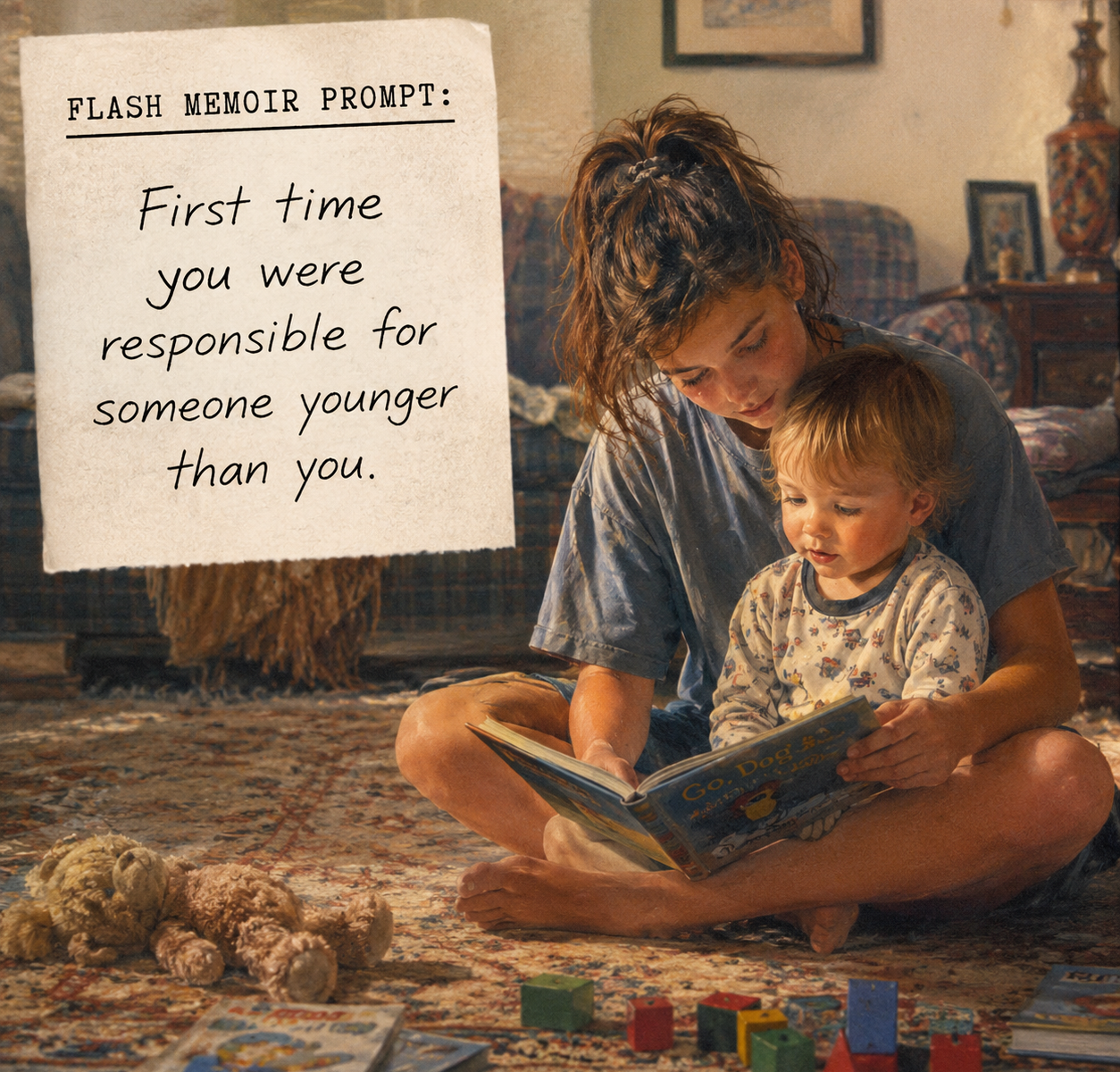
Flash Memoir Prompt: First Time You Were Responsible for Someone Younger Than You

flash memoir prompt

A focused flash memoir prompt about the first time someone younger depended on you, and what that moment revealed about care, pressure, and growing up fast.

Maybe you remember the weight of a smaller hand in yours, or the sound of a baby crying while every adult seemed too far away. Maybe you were only a kid yourself, but for one afternoon, one bus ride, or one long evening, you were the person in charge.

This flash memoir prompt first time responsible someone younger invites you to write about that shift. It may have lasted ten minutes. It may have felt like an entire year. Either way, the moment mattered because someone looked to you, and you had to decide what kind of older person you would be.

flash memoir prompt

The Prompt

Write about the first time you were responsible for someone younger than you.

This prompt can unlock a meaningful memory because responsibility often arrives before we feel ready. You might remember babysitting a sibling, walking a cousin home from school, watching a younger neighbor at the pool, or helping a child stay calm during a confusing moment.

The story does not need to be dramatic. In fact, a small scene may work better. A spilled cup of juice, a missed bus stop, a scraped knee, or a bedtime you were supposed to enforce can carry more truth than a long summary of your childhood.

Why This Memory Matters

The first time you were responsible for someone younger often reveals a quiet turning point. You may have felt proud, annoyed, nervous, or oddly powerful. You may have copied the adults around you, then realized you did not fully understand what they carried every day.

This kind of memory can show how you learned care. It can also show how responsibility can feel unfair when it lands too early. Some people remember feeling trusted. Others remember feeling trapped. Both are honest places to begin.

As you write, pay attention to what the younger person needed from you. Did they need food, comfort, directions, entertainment, protection, patience? Their need helps shape the scene. It also helps reveal your younger self as a character on the page.

If you enjoy thinking about people on the page in that way, you might find it useful to read about how to analyze characters in literature. Memoir works differently from fiction, but the same careful attention to choices, motives, and reactions can help you understand your own memory.

How to Approach This Flash Memoir Prompt: First Time Responsible Someone Younger

Begin with one physical detail. Do not start by explaining your whole family history. Start with the backpack you carried, the sticky hand you held, the baby bottle you warmed, or the television volume you kept turning down because you were afraid the noise meant you were doing something wrong.

Then narrow the memory to one scene. Choose a clear moment when the responsibility became real. Maybe an adult handed you a list. Maybe your little brother started to cry after acting brave. Maybe you realized you had to cross a busy street with someone who trusted you completely.

Write what you noticed before you explain what it meant. Let the reader see the room, hear the younger child’s voice, and feel your worry in your body. Meaning can come later. Often, the strongest flash memoirs let the moment speak first.

Try asking yourself one simple question: When did I realize I was the oldest person available? That answer may lead you straight into the memory.

You can also mark up your draft the way you might mark a story for school. Circle the sensory details. Underline the moment when the feeling changes. If that habit helps, this guide on how to annotate literature can give you a simple way to notice what matters in a text, including your own.

For this flash memoir prompt first time responsible someone younger, avoid trying to cover every time you babysat or every way you helped at home. Stay with the first time the role surprised you. The smaller the scene, the stronger the memory may become.

A Quick Example

My mother left us in the cereal aisle while she ran back for milk. “Watch your sister,” she said, like it was the easiest thing in the world. My sister was three and wearing one red mitten because she had dropped the other somewhere near the apples. I was nine. I remember standing between her and the cart, trying to look serious. She reached for a box with a cartoon tiger on it, and the whole row shifted forward. I grabbed the boxes before they fell, my heart banging like I had saved her from traffic. When Mom came back, my sister was smiling, chewing on the mitten string. Nobody praised me. But I felt taller walking out of the store.

Try It Yourself

Set a timer for ten minutes and write the scene as you remember it. Do not worry about making it polished. Focus on the moment when you first felt responsible and what your body did in response.

If you get stuck, begin with this sentence: “I was supposed to watch them for just a little while.” Then follow the memory wherever it goes. Let it be funny if it was funny. Let it be tense if it was tense. Let your younger self be imperfect.

This flash memoir prompt first time responsible someone younger is really about a small transfer of trust. Someone younger depended on you, even briefly, and you learned something about care that may have stayed with you longer than anyone knew.

Want More Flash Memoir Prompts?

If you want to keep building a daily writing habit, choose one memory at a time and give it a clear scene. Explore all 365 prompts in The Memory Trigger: 365 Flash Memoir Writing Prompts.

Hamlet Summary and Analysis for Students

Rapid Reads Press

Shakespeare’s Hamlet can feel complex at first, but the story becomes clearer when you track the choices behind each scene. This Hamlet summary and analysis gives students a simple path through the plot, major conflicts, structure, and meaning.

In this Guide

Use these sections to find the part of the play you need most.

  • Quick overview
  • Act-by-act plot guide
  • Main characters
  • Key conflicts
  • Themes and symbols
  • Study tips
  • FAQ

Hamlet Summary and Analysis: Quick Overview

Hamlet is a revenge tragedy about grief, doubt, and the danger of delay.

The play takes place in Denmark. Prince Hamlet returns home after his father, King Hamlet, dies. His mother, Gertrude, has quickly married Claudius, the dead king’s brother.

Hamlet soon meets the ghost of his father. The ghost says Claudius murdered him and tells Hamlet to seek revenge.

This news traps Hamlet between action and thought. He wants justice, but he also wants proof. That inner struggle drives the whole play.

Hamlet Summary and Analysis by Act

Each act moves Hamlet closer to a final choice he cannot avoid.

A useful Hamlet summary and analysis often starts with the ghost because it gives the play its central problem. Hamlet must decide if the ghost tells the truth or if it tempts him toward sin.

Act 1

The guards at Elsinore Castle see a ghost that looks like the dead king. Hamlet later meets it, and the ghost claims Claudius poured poison into his ear.

Hamlet swears to remember his father. He also says he may act strange so he can watch others without clear blame.

Act 2

Claudius and Gertrude worry about Hamlet’s behavior. They ask Rosencrantz and Guildenstern, Hamlet’s old friends, to spy on him.

Polonius thinks Hamlet has gone mad because Ophelia rejected him. Hamlet, though, seems more aware than others know.

A group of actors arrives. Hamlet plans to use a play to test Claudius’s guilt.

Act 3

Hamlet gives his famous “To be, or not to be” speech. He weighs life, death, pain, and fear.

The court watches the play Hamlet has arranged. When the actors show a murder like the one described by the ghost, Claudius reacts with guilt.

Later, Hamlet visits Gertrude. He kills Polonius by mistake, thinking Claudius hides behind a curtain.

Act 4

Claudius sends Hamlet to England with secret orders for his death. Hamlet escapes and returns to Denmark.

Ophelia loses her grip on reason after her father dies. She later drowns, and her death deepens the tragedy.

Laertes comes home angry and ready to avenge Polonius. Claudius uses that anger to plan Hamlet’s death.

Act 5

Hamlet returns wiser but still marked by loss. In the graveyard, he sees the skull of Yorick and faces the truth that all people die.

The final duel begins between Hamlet and Laertes. Poisoned weapons and a poisoned cup lead to the deaths of Gertrude, Laertes, Claudius, and Hamlet.

Main Characters and Their Roles

The characters in Hamlet often reveal truth through what they hide.

  • Hamlet: The prince of Denmark. He is thoughtful, angry, and trapped by doubt.
  • Claudius: Hamlet’s uncle and the new king. He is clever, guilty, and hungry for power.
  • Gertrude: Hamlet’s mother. Her quick marriage makes Hamlet feel betrayed.
  • Ophelia: Polonius’s daughter. She is caught between family duty and love for Hamlet.
  • Polonius: A court adviser who loves control but often misreads people.
  • Laertes: Ophelia’s brother. He acts fast, which makes him a sharp contrast to Hamlet.

Hamlet Summary and Analysis of Key Conflicts

The play’s conflicts come from revenge, mistrust, and moral fear.

This Hamlet summary and analysis should make one point clear: Hamlet does not delay because he is lazy. He delays because every choice seems dangerous.

Hamlet vs. Claudius is the main outer conflict: Hamlet wants to expose and punish Claudius, but Claudius controls the court.

Hamlet vs. himself is the deeper conflict. He wants action, yet he fears error, sin, and the unknown after death.

Hamlet vs. the court shows how power creates false behavior. Almost everyone watches someone else, which makes honesty rare.

Themes and Symbols in Hamlet

Shakespeare builds meaning through repeated images, hard choices, and sharp contrasts.

Revenge is the most obvious theme. Hamlet, Laertes, and Fortinbras all want to answer a father’s death, but each man responds in a different way.

Madness is harder to judge. Hamlet may act mad by choice, but Ophelia’s pain seems real and tragic.

Death shadows the whole play. The graveyard scene forces Hamlet to see that kings, fools, and princes all end the same way.

Poison works as both a plot device and a symbol. Claudius poisons the old king, but lies also poison the life of Denmark.

If you want to dig into these details, try close reading in literature. It helps you notice how words, images, and patterns shape meaning.

Structure and Soliloquies

The shape of the play lets us hear Hamlet’s private mind while the public world falls apart.

Hamlet follows the pattern of a revenge tragedy, but Shakespeare makes the form more complex. Instead of rushing toward revenge, Hamlet tests, thinks, and doubts.

The soliloquies are key because Hamlet speaks alone to the audience. These speeches show the gap between what he feels inside and what he shows at court.

The play within the play is also important. Hamlet uses art to reveal truth, much like a detective uses evidence.

Why This Hamlet Summary and Analysis Matters for Students

Hamlet still matters because it asks questions students know well.

Use this Hamlet summary and analysis to see that the play is not only about revenge. It is also about grief, trust, family pressure, and the fear of making the wrong choice.

Like Macbeth, the play shows how ambition can destroy a nation. Unlike Macbeth, Hamlet knows too much and acts too late.

That difference makes Hamlet feel modern. He is not a simple hero. He is a person who thinks deeply and suffers because of it.

How to Study Hamlet Without Getting Lost

Read for choices, not just events.

Before each scene, ask what Hamlet wants and what blocks him. This keeps the plot clear.

Mark moments when characters spy, lie, or perform a role. These patterns help you write stronger essays.

If you want a simple companion for class notes, try this student literature study guide as you review scenes and quotes.

Recommended Books for Deeper Study

These books can help if you want more context after the play.

You can look for these on Amazon or at a library.

  • Hamlet by William Shakespeare, edited by Ann Thompson and Neil Taylor
  • Shakespeare: The World as Stage by Bill Bryson

Further Reading

These trusted sources give more background on Shakespeare and the play.

FAQ

Here are quick answers to common student questions about the play.

What is the main point of a Hamlet summary and analysis?

A Hamlet summary and analysis explains the plot and shows how Shakespeare uses conflict, language, and character choices to create meaning.

Why does Hamlet delay his revenge?

Hamlet delays because he wants proof and fears the moral cost of murder. His mind keeps testing every action.

Is Hamlet really mad?

The play leaves this partly open. Hamlet says he will act strange, but his grief and anger may also push him close to real madness.

What is the main theme of Hamlet?

One main theme is the struggle between thought and action. The play asks what happens when a person knows the truth but cannot act with peace.

Key Takeaway

The best Hamlet summary and analysis shows that the play is more than a revenge story. It is a study of grief, doubt, and the heavy cost of truth.

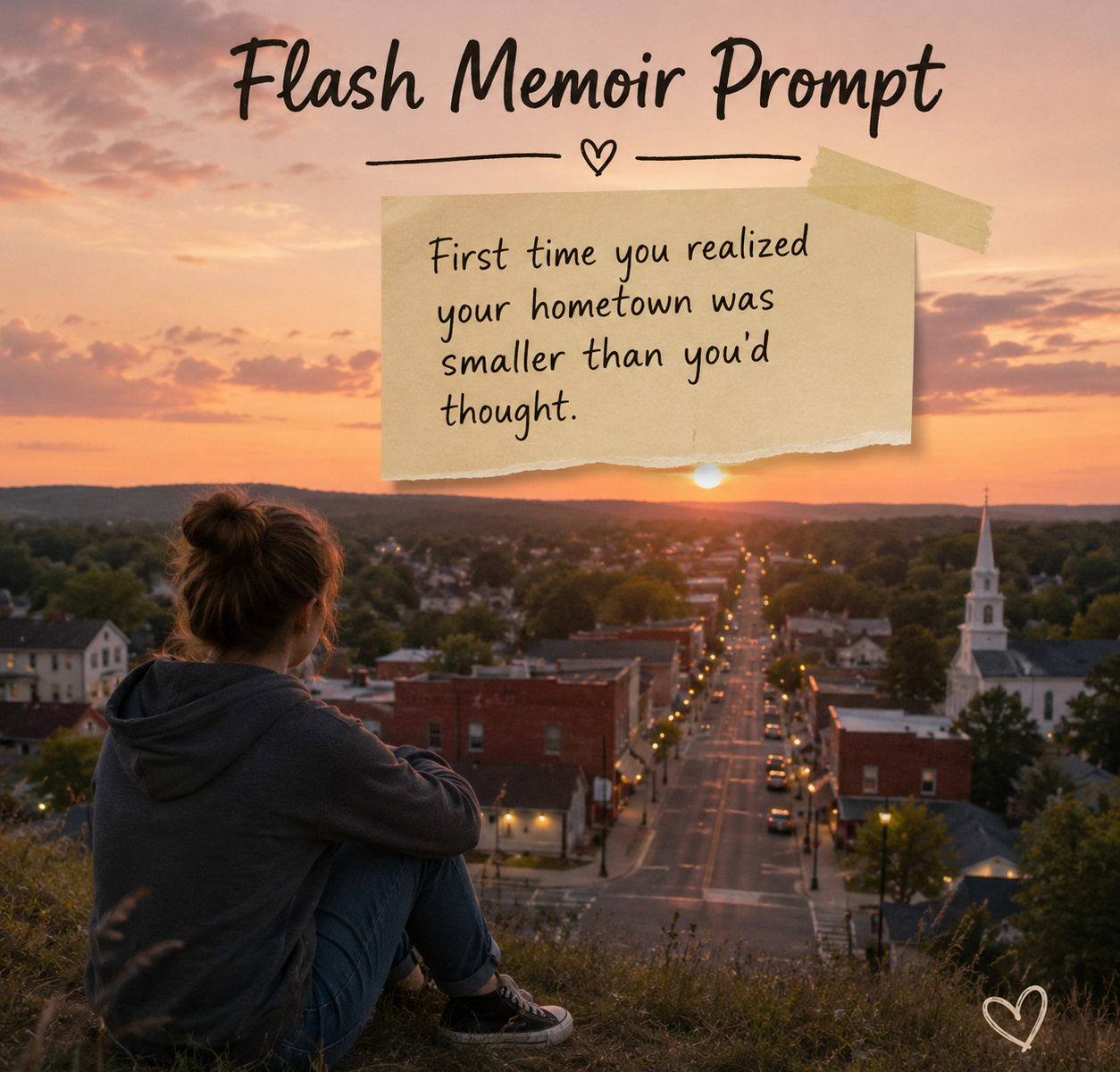
Flash Memoir Prompt: First Time You Realized Your Hometown Was Smaller Than You’d Thought

small hometown writing prompt

A brief writing invitation for capturing the moment your familiar town suddenly felt smaller, tighter, or more knowable than it had before.

Hometown flash memoir

The Prompt

Maybe it happened in a grocery store aisle, when your teacher knew your uncle’s bad leg and the checker remembered your mother’s brand of coffee. Maybe it happened after you left for a bigger place and came home to find the same three cars parked outside the diner. The flash memoir prompt first time realized hometown smaller asks you to return to one of those moments when the map in your mind changed size.

Write about the first time you realized your hometown was smaller than you’d thought.

This prompt works because it begins with a shift in perception. As children, we often think our hometown is the whole world. The streets feel endless. The school feels huge. The grown-ups seem separate from one another. Then one day, we notice the threads. Everyone knows everyone. News travels faster than we expected. A place that once felt wide starts to feel close, maybe even too close.

That change can carry humor, comfort, embarrassment, grief, or pride. You do not need a dramatic event. A small moment of recognition is enough.

Why This Memory Matters

The first time you realized your hometown was smaller than you’d thought may have been the first time you understood community. It may also have been the first time you understood limits.

Maybe you saw your principal at the pharmacy and felt shocked that he existed outside school. Maybe you learned that two families you thought were strangers had been arguing for twenty years. Perhaps your first job taught you that every customer already knew your last name, your parents, and what street you lived on.

These memories matter because they show how a place can hold you and hem you in at the same time. A small town can feel safe because someone always notices. It can also feel heavy because someone always notices.

Your story might uncover a quiet loss of innocence. It might show the moment you stopped seeing your hometown as a magical, endless place and started seeing it as a network of real people with histories, habits, and secrets.

It can also reveal who you were at that age. Were you proud to be known? Did you want to disappear? Did the smallness make you laugh? Or, did it make you want to leave?

For a flash memoir, the goal is not to explain your whole relationship with your hometown. The goal is to let one scene do the work. A parking lot, a church basement, a football game, or a waiting room can say more than a full biography if you choose the right detail. If you want to think more about how places and objects carry meaning, this guide on how to find symbolism in a story can help you notice what your memory is really holding.

How to Approach This Prompt

Begin with one physical detail from the moment. Do not start by explaining your town’s history. Start with the bell over the diner door, the smell of cut grass near the ball field, or the bulletin board at the post office with the same curled flyers from last month.

Then narrow the memory to one scene. The flash memoir prompt first time realized hometown smaller works best when you avoid trying to tell every hometown story at once. Choose the moment when the feeling arrived.

Ask yourself: Where was I standing? Who was there? What did someone say that made the town feel smaller? What did I notice before I understood what it meant?

That last question is important. In memoir, meaning often comes after the image. Let the reader see what you saw first. Maybe you noticed your father lower his voice when a certain man walked in. Perhaps you noticed your babysitter’s picture on the wall of the old high school. Maybe you noticed that the cashier knew your report card grade before you had told anyone.

Try writing the scene in real time. Hold off on the lesson for a few lines. Let the moment feel slightly awkward, funny, or strange before you explain it.

You can also pay attention to the edge of town. Many writers discover this memory through boundaries: the last streetlight, the county road, the water tower, the field behind the school. If landscape shaped your sense of home, you may enjoy this reflection on nature, isolation, and western writing, especially if your hometown felt both open and closed.

Keep the piece short. Aim for one page or less. A strong flash memoir often ends when the realization lands. You do not have to solve your feelings about the place. You only have to show the moment it changed size.

A Quick Example

I was twelve the first time I understood that Maple Ridge was not as big as I thought. I was in the hardware store with my dad, waiting by a wall of paint chips, when the owner asked if my math test had gone better on Friday. Wait, I had not told my dad about the first test, much less the second one. My ears burned. Dad looked down at me, half amused, half curious. The owner just kept sorting keys like he had asked about the weather. Outside, Main Street looked the same: two stoplights, the bank clock, the bakery window fogged with heat. But something had shifted. The town was no longer a place full of strangers. It was one big room, and somehow everybody had heard me drop my pencil.

Try It Yourself

Set a timer for ten minutes and write about the first time your hometown felt smaller than you had imagined. Use the flash memoir prompt first time realized hometown smaller as a doorway into one clear scene.

Do not worry about making the piece neat at first. Write the sound of a familiar name spoken by the wrong person. Write the face you recognized when you did not expect to. Or, write the moment you felt seen, trapped, loved, exposed, or amused.

When you revise, cut anything that explains too much too soon. Look for the detail that carries the emotion. It might be a street sign, a school hallway, a church potluck table, or a cashier who knew more than you wanted them to know.

If the memory feels tender, stay gentle with it. If it feels funny, let it be funny. Small-town stories often hold mixed feelings. That is what makes them worth writing.

Want More Flash Memoir Prompts?

If you enjoyed this flash memoir prompt first time realized hometown smaller, keep collecting these small but revealing moments. Explore all 365 prompts in The Memory Trigger: 365 Flash Memoir Writing Prompts.

Themes in Hamlet: A Student-Friendly Guide

Rapid Reads Press

Understanding the themes in Hamlet helps you see why Shakespeare’s play still feels sharp, strange, and personal. The play explores revenge, death, truth, power, and family pressure through one young man’s crisis.

The themes in Hamlet can feel complex at first, but they connect to choices students still debate today. If you need help with the basics of theme, start with this guide on how to identify theme in literature.

In this Guide

Use this section as a quick map before you read the full guide.

  • Why the play’s themes still matter
  • Major ideas students should notice
  • Revenge and delay
  • Death and grief
  • Appearance versus reality
  • Madness and truth
  • Power and corruption
  • Women and limited choices
  • Essay tips and FAQ

Why the themes in Hamlet matter

Hamlet is more than a famous tragedy about a prince and a ghost.

The themes in Hamlet matter because they turn a revenge plot into a study of the human mind. Hamlet wants justice, but he also wants proof. He wants action, but he cannot escape thought.

That conflict makes the play useful for high school, AP Literature, and college essays. It gives you room to discuss character, symbol, structure, and meaning.

Shakespeare also makes the play feel unstable. People spy, lie, perform roles, and hide motives. Because of this, the audience must ask the same question Hamlet asks: What is true?

Major themes in Hamlet students should know

Most of the play’s big ideas overlap, so it helps to study them together.

Most themes in Hamlet grow from one central problem: a murder has broken the moral order of Denmark. King Hamlet is dead, Claudius has taken the throne, and Hamlet feels trapped inside a corrupt court.

The play asks hard questions. Is revenge justice? Can grief become dangerous? Can a person trust what they see? What happens when power depends on lies?

These questions do not have easy answers. That is one reason the play works so well for literary analysis.

Revenge and the Cost of Delay

Hamlet is a revenge tragedy, but Shakespeare makes revenge feel morally risky.

The ghost tells Hamlet that Claudius murdered King Hamlet. This command gives Hamlet a clear mission: punish the killer. Yet Hamlet does not act at once.

His delay is one of the most debated parts of the play. Some readers see him as weak. Others see him as careful because he fears sin, false evidence, or moral failure.

Revenge also spreads damage. Polonius dies, Ophelia suffers, Laertes seeks revenge, and the court falls apart. The play suggests that revenge may start as a search for justice, but it can become a force that destroys almost everyone near it.

This is different from a simple hero story. Hamlet does not win by taking revenge. He pays for it with his life.

Death, Grief, and the Fear of the Unknown

Death shapes the play from the first scene to the final stage image.

Hamlet begins in grief. His father has died, and his mother has married Claudius soon after. Hamlet feels that the world has become rotten because love, family, and loyalty seem false.

His grief turns into deep thought about death itself. In the famous soliloquy that begins with To be, or not to be, Hamlet asks whether life is worth the pain. He also fears what may come after death.

The graveyard scene makes this theme more physical. Hamlet holds Yorick’s skull and faces the fact that status, beauty, and power all end the same way.

You can compare this to Macbeth, where death also becomes part of a broken moral world. In both plays, ambition and violence make life feel unstable.

Appearance Versus Reality

In Hamlet, almost nothing is as simple as it first appears.

Characters perform roles. Claudius acts like a good king, but he hides murder. Hamlet acts mad, but his act may reveal truths others refuse to see. Polonius acts wise, but he often misunderstands the people around him.

This theme appears in the play-within-the-play, where actors perform a story like King Hamlet’s murder. Hamlet uses theater to expose reality. That choice shows one of Shakespeare’s boldest ideas: sometimes art can reveal the truth better than direct speech.

Students should watch words like seems, show, and play. They point to the gap between public image and private truth.

Madness, Performance, and Truth

Hamlet’s madness is one of the play’s most famous puzzles.

Hamlet says he will put on an antic disposition, which means he plans to act mad. This gives him freedom to speak in strange ways, insult people, and test Claudius.

Yet the play makes us wonder if the act becomes real. Hamlet’s grief, anger, and isolation put real pressure on his mind. His language can sound controlled one moment and wild the next.

Ophelia’s madness is different. She has less power and fewer choices. After her father’s death and Hamlet’s rejection, her mind breaks under the weight of loss.

This contrast matters. Hamlet’s madness gives him some control. Ophelia’s madness shows how little control she has.

Corruption, Power, and the Diseased State

Denmark is often described as sick, rotten, or infected.

One of the play’s most famous lines says that something is rotten in the state of Denmark. That image is not only about Claudius. It describes the whole court.

Claudius gains power through murder. After that, spying becomes normal. Polonius spies on Hamlet. Claudius and Polonius spy on Hamlet and Ophelia. Rosencrantz and Guildenstern spy on Hamlet for the king.

The court becomes a place where trust cannot survive. Private life turns into public strategy.

This theme helps explain why the ending is so violent. A corrupt state cannot heal itself because the people in power protect the lie that made them powerful.

Women, Control, and Limited Choices

Gertrude and Ophelia reveal how little freedom women have in the world of the play.

Gertrude is judged harshly by Hamlet for marrying Claudius. The play never gives her much space to explain her choice. This silence makes her hard to read.

Ophelia is controlled by her father, her brother, and the court. They tell her how to act toward Hamlet. She becomes part of a political plan, not a person with full freedom.

Her tragedy shows how power can crush someone who has no voice. In this way, the play asks us to notice not only what characters do, but what choices society allows them to make.

You might compare Ophelia to Antigone from Sophocles’ Antigone. Both young women face pressure from powerful men, but they respond in very different ways.

How the themes in Hamlet work together

The play’s ideas connect through Hamlet’s search for truth and justice.

The themes in Hamlet do not stand alone. Revenge connects to death because revenge leads to more death. Appearance connects to power because Claudius depends on a false image. Madness connects to truth because strange speech often reveals hidden facts.

This web of ideas gives the play its depth. A strong essay should not treat each theme as a separate box. It should show how one idea affects another.

For example, you could argue that Hamlet delays revenge because he lives in a world where appearance cannot be trusted. That claim links revenge, truth, and performance in one clear reading.

Symbols and Motifs That Support the Themes

Shakespeare uses repeated images to make the play’s ideas easier to see.

The ghost represents the past, guilt, and the demand for revenge. It forces Hamlet to face a crime that the court wants to hide.

Yorick’s skull represents death as the final truth. It strips away rank and pride.

Poison represents hidden corruption. Claudius uses poison to kill King Hamlet, and poison returns at the end as the court destroys itself.

Acting and theater represent the gap between surface and truth. Hamlet uses performance to uncover what normal speech cannot prove.

Essay Tips for Writing About Hamlet

A good theme essay makes a clear claim instead of naming a broad topic.

When you write about themes in Hamlet, avoid claims like death is a theme. That is true, but it is too simple.

Try a stronger claim: Shakespeare presents death as both a mystery and a certainty, which makes Hamlet fear action even when he knows revenge is expected.

Use short quotations and explain them closely. Do not let plot summary take over. Your teacher wants to see what the evidence means.

If you need a step-by-step method, review how theme works in literature before you draft your thesis.

Authoritative Resources for Hamlet Study

Reliable sources can help you check context, plot details, and background.

The Britannica overview of Hamlet gives a clear summary of the play and its place in literature.

The Folger Shakespeare Library Hamlet page offers trusted text resources and study support.

Suggested Books for Studying Hamlet

These editions and guides are useful for class reading, essay prep, and review.

  • Hamlet by William Shakespeare, Folger Shakespeare Library edition
  • Hamlet by William Shakespeare, Arden Shakespeare edition
  • Shakespeare: The Invention of the Human by Harold Bloom

FAQ About Hamlet Themes

Use these quick answers to review before a quiz, essay, or class discussion.

What are the main themes in Hamlet?

The main themes in Hamlet include revenge, death, appearance versus reality, madness, corruption, and moral uncertainty.

What is the most important theme in Hamlet?

Revenge is often the central theme because it drives the plot. Still, the play treats revenge as a moral problem, not a simple duty.

How does Hamlet show appearance versus reality?

Many characters hide their true motives. Claudius appears noble, Hamlet acts mad, and the court uses spying to uncover secrets.

Why is death such a major theme?

Death pushes Hamlet into grief, fear, and deep thought. The graveyard scene makes this theme clear and physical.

How can I write a strong essay about Hamlet?

Make a clear claim about what Shakespeare suggests through a theme. Then use short quotes and explain how they support your idea.

Key Takeaway

The best way to study Hamlet is to see how its ideas connect.

The play is not just about revenge. It is about what happens when grief, lies, power, and doubt trap a person who wants the truth.

Flash Memoir Prompt: First Time You Felt Genuinely Proud of Yourself

Rapid Reads Press

Maybe it happened in an empty kitchen, after everyone else had gone to bed: this flash memoir prompt first time felt genuinely proud asks you to return to the private moment when your own approval finally felt like enough.

The Prompt

Write about the first time you felt genuinely proud of yourself, with no one else around to see it.

This prompt works because pride is often tied to an audience. We remember the award, the applause, the grade, the compliment, or the person who finally noticed. But private pride is different. It does not need proof. It arrives quietly, sometimes in a bedroom, a bathroom mirror, a parked car, a school hallway, or at a desk covered in crumbs and paper.

A flash memoir prompt, the first time felt genuinely proud, can help you find a small scene with a large emotional center. The key is to look for the moment when you knew something had changed inside you, even if the rest of the world kept moving like nothing had happened.

Why This Memory Matters

The first time you felt proud of yourself may not look dramatic from the outside. Maybe you finished a hard assignment without help. Maybe you walked away from someone who kept hurting you. Maybe you saved money, fixed something, passed a test, apologized first, told the truth, or stayed calm when you wanted to fall apart.

What matters is the private nature of the moment. Since no one else was there to praise you, the pride had to come from somewhere deeper. That makes the memory powerful. It shows what you value when no one is watching.

This kind of memory can also reveal a theme in your life. You may notice a pattern around independence, courage, discipline, forgiveness, or survival. If you want help thinking about larger meaning in a personal story, this guide on how to identify theme in literature can also help you spot the theme inside your own writing.

Private pride can feel tender because it may be connected to a time when you wanted someone else to notice. Maybe no one did. Maybe that hurt. But the memory is still yours. In fact, the quietness may be what gives it its shape.

How to Approach This Prompt

Begin with one physical detail. Do not start by explaining your whole life or why the moment mattered. Start with what your body knew first.

Maybe your hands were shaking. Maybe your shirt was damp with sweat. Maybe there was a red pen mark on the page, a sink full of dishes, a bus ticket in your pocket, or a glow from a computer screen in a dark room.

Once you have that detail, narrow the memory to one scene. A flash memoir does not need the full backstory. You can hint at what came before, but try to stay close to the moment when pride arrived.

Ask yourself: Where was I? What had I just done? What did I notice in the room? Did I smile, cry, exhale, laugh, or sit very still?

Write what you noticed before you explain what it meant. This helps the reader feel the scene instead of being told how important it was. For example, “I folded the test and put it under my pillow” may say more than “I was proud because I had worked hard.”

After you draft, read your piece like a careful reader. Circle the strongest image. Underline the sentence where the emotion changes. If you enjoy close reading, the same habits used to annotate literature can help you revise your memoir with more care.

Above all, avoid trying to tell every related story at once. Stay with the first real moment. Let it breathe.

A Quick Example

I was sitting on the bathroom floor with my laptop balanced on a towel because the apartment was too loud everywhere else. The tile was cold through my pajama pants. I clicked submit on my college application at 12:17 a.m., then stared at the screen as if it might take the words back. No one knew I had finished it. My mother was asleep. My brother was playing music behind his door. I had written the essay in pieces before school, after work, and once in the laundry room while the dryer thumped beside me. When the confirmation email arrived, I pressed my hand over my mouth. I did not scream. I just sat there, smiling at the sink cabinet, feeling taller than I had all week.

Try It Yourself

Set a timer for ten minutes and write from the prompt without trying to make the memory sound impressive. The moment does not have to be noble or life-changing. It only has to be true.

If you get stuck, begin with this sentence: “No one saw me when I…” Then keep going. Let the sentence lead you into the room, the object, the sound, or the small action that held the feeling.

As you write, remember that pride does not always shout. Sometimes it shows up as relief. Sometimes it feels like a steady breath. Sometimes it is simply the moment you realize, “I did that.” That is enough for this flash memoir prompt first time felt genuinely proud.

Want More Flash Memoir Prompts?

If this prompt helped you uncover a quiet memory, keep gathering those small scenes. They often become the strongest pieces of memoir because they carry real emotional weight without needing to explain too much. Explore all 365 prompts in The Memory Trigger: 365 Flash Memoir Writing Prompts.

The Crucible Literary Analysis Essay: How to Write One

The Crucible literary analysis essay

Writing The Crucible literary analysis essay can feel hard because the play is both a courtroom drama and a warning about fear. This guide will help you build a clear thesis, choose strong evidence, and turn your ideas into a smart essay.

A focused The Crucible literary analysis essay should do more than retell the Salem witch trials. It should explain how Arthur Miller uses character, conflict, and language to reveal a deeper meaning.

The Crucible literary analysis essay

In this Guide

  • Why The Crucible works so well for analysis
  • The Crucible literary analysis essay: start with a real argument
  • Topic ideas that give you something to prove
  • Thesis statement examples
  • How to use evidence without plot summary
  • Helpful books and links
  • FAQ

Why The Crucible Still Works for Literary Analysis

Miller’s play gives students a rich way to study fear, power, guilt, and reputation.

The Crucible is set during the Salem witch trials, but it also speaks to Miller’s own time. He wrote it during the Red Scare, when many Americans feared communism and public accusation could destroy a life.

That double meaning gives you a lot to analyze. You can write about the events in Salem, but you can also explore why Miller wrote the play for a modern audience.

For helpful background, read Britannica’s overview of Arthur Miller. You can also review the real Salem witch trials to understand the history behind the drama.

The Crucible literary analysis essay: Start with a Real Argument

Your essay needs a claim that someone could debate.

A weak thesis says that fear is important in the play. That is true, but it is too broad. A stronger thesis explains what fear does and why it matters.

Your The Crucible literary analysis essay should answer a question like this: How does Miller show that fear can damage truth, justice, or personal identity?

Think of it like Macbeth. A weak essay might say Macbeth wants power. A stronger essay would argue that Shakespeare shows ambition as a force that destroys moral judgment.

The same rule applies here. Do not just name a theme. Make a claim about how that theme works.

If you need a full refresher on essay basics, this guide to how to write a literary analysis essay can help you review the core steps.

The Crucible Literary Analysis Essay Topic Ideas That Actually Work

The best topics give you a pattern to track across the play.

Here are useful directions for your essay:

  • Reputation and fear: Argue that characters protect their names even when truth is at risk.
  • Power and accusation: Explore how Abigail and the court use public fear to control others.
  • John Proctor’s moral growth: Show how Proctor moves from private guilt to public courage.
  • Religion and authority: Analyze how spiritual language becomes a tool of control.
  • Hysteria as a social force: Explain how fear spreads when people stop using reason.

Try to avoid topics that only describe the plot. For example, do not write only about what Abigail does. Write about how Miller uses Abigail to show the danger of unchecked power.

Sample Thesis Statements for The Crucible literary analysis essay

A strong thesis gives your essay direction before the first body paragraph begins.

A The Crucible literary analysis essay works best when the thesis names the theme and explains Miller’s message. Use these examples as models, not copy-and-paste answers.

In The Crucible, Arthur Miller shows that fear can destroy justice because a frightened society rewards accusation more than truth.

Through John Proctor’s conflict between guilt and honor, Miller argues that integrity becomes most meaningful when it costs something.

Miller presents Abigail Williams as more than a villain; he uses her rise to power to show how weak systems can reward lies.

In The Crucible, public reputation becomes a trap because characters fear shame more than moral failure.

Notice how each thesis makes a point. None of them simply says that the play has themes. Each one explains what Miller suggests about human behavior.

How to Structure Your The Crucible Literary Analysis Essay

A clear structure helps your reader follow your thinking.

Start with a short introduction. Give brief context, name the play and author, then end with your thesis.

Each body paragraph should focus on one idea. Begin with a topic sentence, then bring in one quoted detail or scene. Explain how that evidence proves your claim.

Your conclusion should not just repeat the thesis. Instead, show why your argument matters. By the end, The Crucible literary analysis essay should leave the reader with a sharper view of Miller’s warning.

If you want a faster way to plan your outline, thesis, quote notes, and commentary, check out The Literary Analysis Essay Toolkit. It is built to help students move from a blank page to a polished draft.

Use Evidence Without Retelling the Plot

Your teacher already knows what happens in the play.

Plot summary tells the reader that Proctor refuses to sign his confession. Analysis explains why that moment matters. It shows how the scene connects to identity, truth, and moral courage.

A helpful pattern is simple: make a claim, use evidence, and explain the meaning.

For example, you might discuss Proctor’s final choice. The evidence is his refusal to give the court a signed lie. The analysis should explain how Miller turns his name into a symbol of personal honor.

This is like writing about Hester Prynne in The Scarlet Letter. You would not only say she wears the scarlet letter. You would explain how the symbol changes meaning as the story develops.

Strong Evidence to Consider

Good evidence comes from major choices, repeated ideas, and key conflicts.

You may want to look closely at these parts of the play:

  • Proctor’s private guilt after his affair with Abigail
  • Abigail’s control over the other girls
  • Hale’s change from confidence to doubt
  • Elizabeth’s struggle with honesty and forgiveness
  • The court’s refusal to question its own power
  • Proctor’s final choice about his name

Do not use a quote just because it sounds famous. Pick evidence that helps prove your thesis.

When you write your commentary, ask: What does this moment reveal about the character? What does it suggest about society? How does it support Miller’s message?

Common Mistakes to Avoid

Most weak essays fail because they stay too general.

One common mistake is writing about the whole play at once. Choose a focused path. A paper about fear will be stronger if it studies one effect of fear, such as false confession or public shame.

Another mistake is treating characters like real people only. They do have emotions, but they are also literary tools. Ask why Miller shapes them this way.

Do not use modern slang or casual judgment. Instead of saying Abigail is just evil, explain how Miller uses her to expose fear, desire, and weak authority.

Books That Can Help

These books can support your reading and help you understand the play’s background.

  • The Crucible by Arthur Miller
  • Why I Wrote The Crucible by Arthur Miller
  • The Salem Witch Trials Reader edited by Frances Hill

You do not need to read every source before you write. Even a short background source can help you avoid shallow claims.

FAQ About The Crucible Literary Analysis Essay

These quick answers can help you plan with less stress.

What is the best topic for a The Crucible literary analysis essay?

A strong topic focuses on a theme with a clear argument. Reputation, fear, power, and integrity all work well.

Can I write about John Proctor?

Yes. Proctor is a strong choice if you focus on his moral conflict, not just his actions.

How many quotes should I use?

Use enough evidence to prove your point. For most school essays, one or two strong quotes per body paragraph is better than many weak ones.

Should I mention McCarthyism?

You can, if it supports your thesis. Keep the focus on the play unless your assignment asks for historical context.

Key Takeaway

A strong The Crucible literary analysis essay makes a clear claim about Miller’s message and proves it with focused evidence. Do not retell the play. Show how it works and why it still matters.

error

Enjoy this article? Please spread the word :)

Follow by Email
BLUESKY
fb-share-icon
Reddit
LinkedIn
Share
RSS