
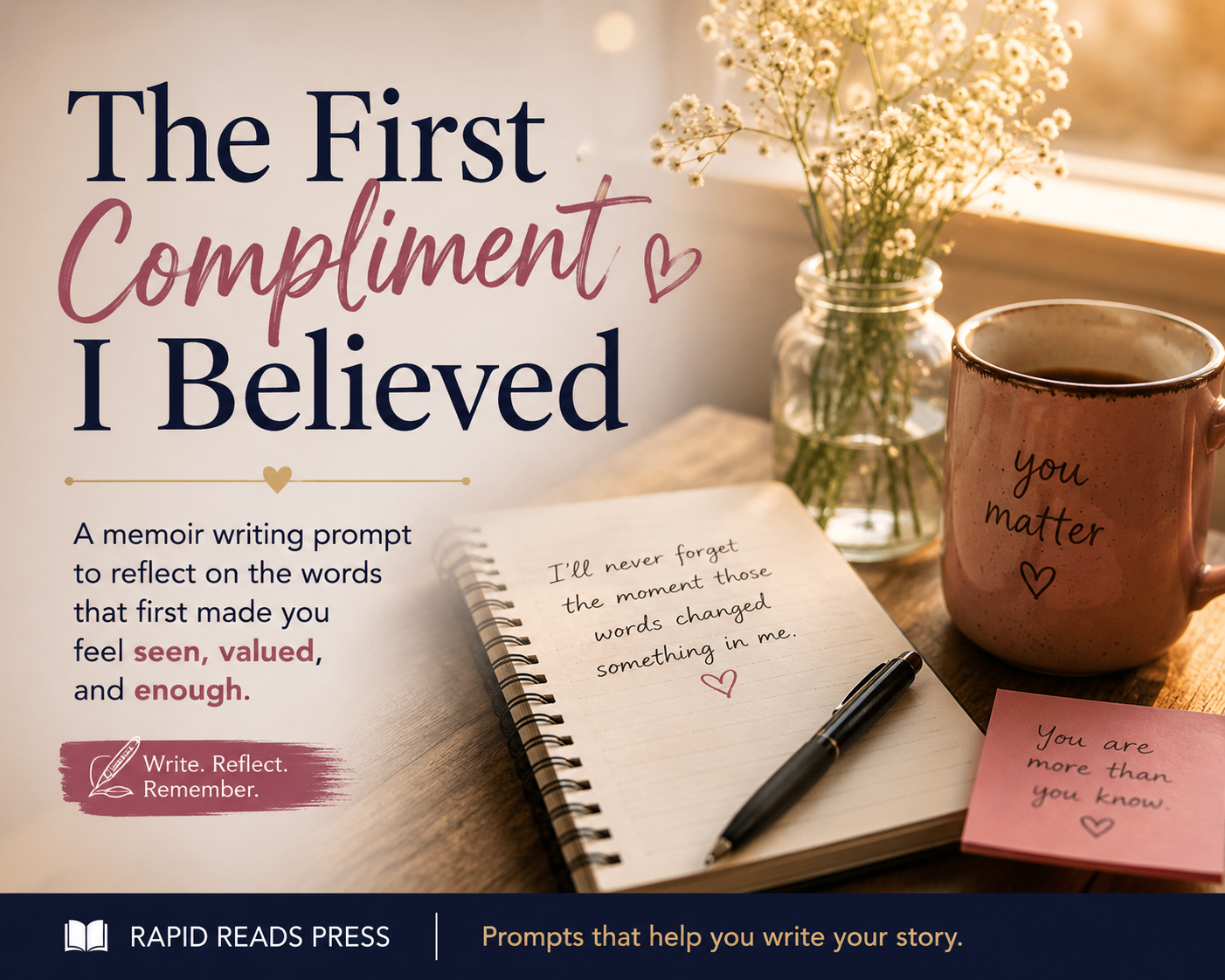
Flash Memoir Prompt: First Time You Were Given a Compliment that You Actually Believed

flash memoir prompt first time given compliment actually believed

A warm flash memoir prompt for remembering the first compliment that felt true, and the small moment when someone else’s words finally reached you.

There is a strange little pause that happens when a compliment lands. Maybe you were used to brushing praise away. Maybe you laughed, changed the subject, or said, “No, I’m not,” before the other person even finished speaking. Then one day, someone said something simple, and for once, you did not argue with it.

This flash memoir prompt, the first time you were given a compliment you actually believed, invites you to return to that exact moment. Not the long history of why compliments were hard to accept. Just the first time one slipped past your defenses and settled somewhere honest.
flash memoir prompt first time given compliment actually believed

The Prompt

Write about the first time you were given a compliment that you actually believed.

This prompt can unlock a meaningful memory because it is rarely just about the compliment. It is about who said it, how they said it, where you were standing, and why those words felt different from all the others.

Maybe the compliment came from a teacher who noticed your writing. Maybe it came from a coach, a grandparent, a friend, or someone you barely knew. Maybe it was not dramatic at all. Sometimes the words we believe are quiet ones, said in a hallway, at a kitchen table, or after a hard day when we had almost given up.

Why This Memory Matters

A believable compliment can mark a shift in how you see yourself. It might be the first time you felt talented, kind, brave, funny, capable, or worth noticing. That kind of memory has power because it shows a moment when your inner story changed.

This prompt may uncover a story about self-doubt. It may bring up a time when you wanted approval but did not know how to receive it. It may also reveal how much one thoughtful sentence can matter when it comes from the right person at the right time.

For student writers, this is a useful prompt because it keeps the memory focused. You do not have to explain your entire childhood or every reason you lacked confidence. You can build the scene around one compliment and let the reader understand the rest through detail.

If you are exploring broader meaning in your writing, you might find it helpful to think about the larger idea behind the scene. This is similar to how readers learn to identify theme in literature. A small moment can point toward a bigger truth without needing to announce it.

How to Approach This Prompt

Begin with the place where the compliment happened. Put yourself back in the room, the car, the classroom, the parking lot, or the store aisle. What were you holding? What could you hear? What did the light look like?

Then narrow the memory to one scene. Avoid trying to tell the whole story of your confidence or insecurity. Stay close to the moment when the words were said.

Write what you noticed before explaining what it meant. Maybe you noticed the person did not smile in a joking way. Maybe they looked you straight in the eye. Maybe their voice was ordinary, which made the compliment feel more real.

You might start with a physical detail, such as your hands under the desk, your shoes on the floor, or the heat in your face. A physical detail can make the emotion easier to write because it gives the memory something solid to stand on.

If you like to mark up memories before drafting, try borrowing a reading habit. Circle the words that carry feeling, underline the turning point, or make a note beside the moment that changed you. These simple moves are close to the skills used when you annotate literature, and they can help you notice what matters in your own story.

As you write, resist the urge to make the compliment sound perfect. Real compliments are often plain. “You’re good at this.” “That was brave.” “I trust you.” “You made the room feel lighter.” The truth of the memory does not need fancy language.

A Quick Example

I was sixteen, wiping down tables at the diner after the lunch rush. My shirt smelled like fryer oil, and my shoes stuck to the floor near the soda machine. Mrs. Alvarez, the owner, stood behind the counter counting change. I had just calmed down a customer who was angry about his order, though my hands shook the whole time. She looked up and said, “You keep your head when people lose theirs.” I waited for the joke or the correction. It did not come. She went back to counting quarters. I stood there with the wet rag in my hand, feeling taller than I had five minutes before. No one had ever called me calm. But that day, I believed her.

Try It Yourself

Set a timer for ten minutes and write the scene as clearly as you can. Do not worry about making it polished. Focus on the moment the compliment was spoken and what happened inside you right after.

If you get stuck, use this sentence starter: “I did not believe compliments back then, but when they said…” Let the memory continue from there.

This flash memoir prompt first time given compliment actually believed works best when you keep it small. One voice. One sentence. One shift. That is enough for a strong flash memoir piece.

Want More Flash Memoir Prompts?

If this prompt helped you remember a moment you had nearly forgotten, keep going. Explore all 365 prompts in The Memory Trigger: 365 Flash Memoir Writing Prompts.
Themes in The Crucible: A Student-Friendly Guide

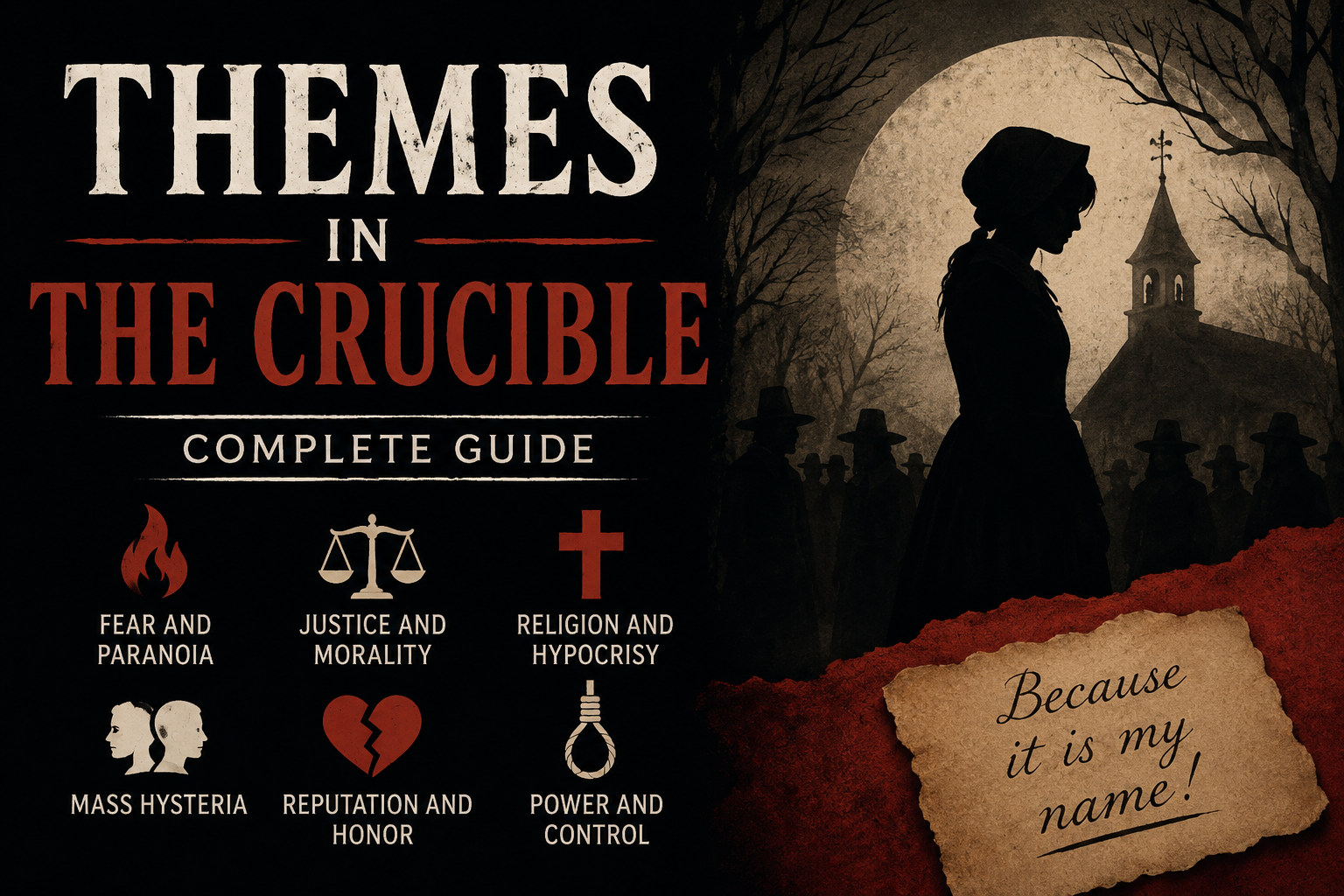
Themes in The Crucible

The main themes in The Crucible help students see why Arthur Miller’s Salem drama still feels tense and modern. In this guide, we will look at fear, public shame, power, justice, and truth so you can discuss the play with more confidence.

Themes in The Crucible

In this Guide

Use this table of contents to find the idea you need.

  • Why the play’s themes matter
  • Fear and mass hysteria
  • Reputation and public shame
  • Power and corrupt authority
  • Justice and truth
  • Essay tips and study resources
  • FAQ

Why the themes in The Crucible Matter

Arthur Miller wrote about Salem, but he was also speaking to his own time.

The Crucible is set during the Salem witch trials of 1692. In that world, a rumor can ruin a life. A court can twist faith into a weapon. A person can lose everything by telling the truth.

The themes in The Crucible matter because the play asks a hard question: what happens when a society values fear more than honesty?

Miller wrote the play during the age of McCarthyism, when many Americans were accused of Communist ties with weak proof. You can read more about Miller’s life at Britannica, or learn about McCarthyism from the National Archives.

Themes in The Crucible: Fear and Mass Hysteria

Fear spreads faster than facts in Salem.

At the start of the play, the town is already tense. People worry about sin, reputation, and punishment. When the girls begin to accuse others of witchcraft, fear takes over the town.

Mass hysteria means a group panic becomes more powerful than reason. In Salem, people accept wild claims because they are scared. They fear the Devil, but they also fear being accused.

Abigail Williams uses this fear to gain control. Once the court believes her, she can point at almost anyone. Her words become more powerful than evidence.

These themes in The Crucible connect to George Orwell’s Animal Farm. In both works, fear helps leaders control a group. People stop asking questions because the cost feels too high.

Themes in The Crucible: Reputation and Public Shame

In Salem, a good name can matter more than a good heart.

Reputation is one of the most painful forces in the play. Many characters care deeply about how others see them. They know that one bad rumor can lead to court, prison, or death.

Reverend Parris fears damage to his position. He worries that trouble in his house will make him look weak. His first concern is not truth, but public image.

John Proctor also struggles with his reputation. He has sinned, and he feels deep guilt. Yet his main conflict is not only private guilt. He must decide whether to save his life with a lie or keep his name clean by telling the truth.

The themes in The Crucible become personal here. Miller shows that shame can trap people. Nathaniel Hawthorne’s The Scarlet Letter also studies public shame, but Miller makes shame feel like a public trial.

Power, Control, and Corrupt Authority

The play shows how power can become dangerous when no one can question it.

The court in Salem claims to serve God and justice. Yet it often acts with pride and fear. Judge Danforth refuses to admit the court may be wrong because that would weaken his authority.

This makes the court more dangerous. If the judges admit one mistake, the whole system starts to fall apart. So they protect the court, even when innocent people suffer.

Abigail’s power is different. She has no official office, but she learns how to use the court. Her false claims give her control over adults who once had power over her.

This theme is useful for AP Literature essays because it shows conflict between public power and private truth. The play asks whether authority deserves respect when it refuses proof.

Justice, Lies, and the Demand for Proof

The Crucible turns the court into a place where truth becomes hard to recognize.

A fair court should ask for proof. In Salem, the court often accepts fear as proof. It trusts dramatic words, screams, and visions that no one else can see.

This is why the play feels so tense. The accused cannot defend themselves in a normal way. If they deny witchcraft, the court may see the denial as more proof of guilt.

Mary Warren’s failed confession shows this problem. She tries to tell the truth, but pressure breaks her. The court’s mood matters more than her facts.

Miller does not suggest that justice is simple. He shows that a legal system can fail when leaders care more about control than evidence.

Truth, Integrity, and Personal Courage

The play’s deepest question is whether truth is worth suffering for.

John Proctor is not a perfect hero. That is part of why students often find him interesting. He has lied before, and he has hurt others. Still, he wants to become honest before the end.

His final choice is painful. If he signs a false confession, he may live. If he refuses, he will die. His decision shows that integrity can cost more than comfort.

Elizabeth Proctor helps us see this theme too. She admits her own limits and gives John space to choose. Her quiet strength matters because she does not force him to become a symbol.

This theme also appears in Sophocles’ Antigone. Antigone, like Proctor, faces a state that demands obedience. Both characters must choose between survival and moral truth.

How to Write About Themes in The Crucible

A strong essay connects a theme to a clear claim about the whole play.

When you write about themes in The Crucible, do not just name the idea. Explain what Miller says about that idea. For example, do not write, “Fear is a theme.” Write, “Miller shows that fear can destroy justice when people value safety over truth.”

That second sentence gives you an argument. It tells your reader what the play reveals about fear.

Use short quotations if your teacher allows them. Then explain how the words prove your claim. The best analysis spends more time on meaning than plot summary.

If you need help with structure, use our guide to writing a literary analysis essay. It can help you build a clear thesis and stronger body paragraphs.

Recommended Books for Deeper Study

These books can help you understand the play and its background.

  • The Crucible by Arthur Miller
  • Arthur Miller: His Life and Work by Martin Gottfried

FAQ: Themes in The Crucible

Here are quick answers to common student questions.

What are the main themes in The Crucible?

The main themes in The Crucible include fear, reputation, power, justice, and integrity. Each theme connects to the Salem trials and Miller’s view of panic in society.

What is the most important theme in the play?

Many students choose fear as the most important theme. Fear drives the accusations and makes people accept weak proof.

How does reputation affect John Proctor?

Proctor wants to protect his name, but he also wants to be honest. His final choice shows that integrity matters more to him than survival.

Why did Arthur Miller write about Salem?

Miller used Salem to comment on his own time. He saw links between the witch trials and anti-Communist fear in the 1950s.

How can I write a strong theme paragraph?

Start with a claim about what the play says. Use one clear example from the text, then explain how it supports your idea.

Key Takeaway

The strongest themes in The Crucible show how fear can twist truth, damage justice, and test a person’s character. Miller’s play lasts because those problems still feel real today.

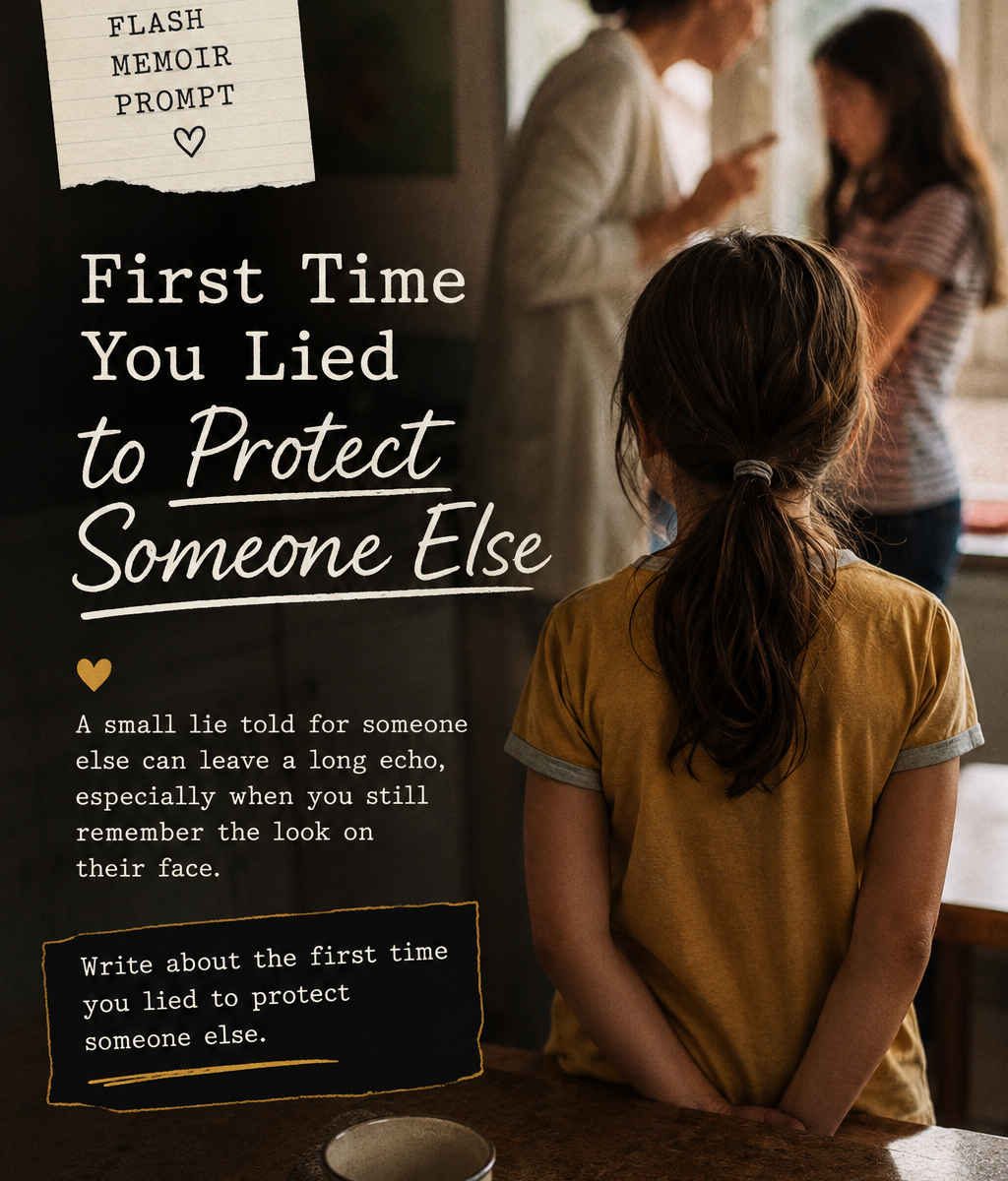
Flash Memoir Prompt: First Time You Lied to Protect Someone Else

flash memoir prompt first time lied protect someone

A small lie told for someone else can leave a long echo, especially when you still remember the look on their face.

If you are looking for a flash memoir prompt about the first time you lied to protect someone, this one asks you to return to a moment when loyalty, fear, love, or pressure shaped what came out of your mouth. Maybe it happened in a kitchen, a classroom, a back seat, or a hallway where everything suddenly felt too quiet.

The lie may have been tiny. “She was with me.” “I broke it.” “He didn’t say that.” At the time, it may have felt fast and necessary. Later, it may have become more complicated.

flash memoir prompt first time lied protect someone

The Prompt

Write about the first time you lied to protect someone else.

This prompt can unlock a strong memory because it puts you inside a choice. You were not just telling a lie. You were deciding who needed protection, what truth might cost, and what kind of person you wanted to be in that moment.

A flash memoir does not need the whole history. It needs one clear scene. Focus on the first time you remember crossing that line for someone else. Let the reader feel the room, hear the question, and understand why the lie came so quickly.

Why This Memory Matters

The first protective lie often reveals a lot about your younger self. It can show who you loved, who scared you, or who you believed deserved saving. It can also show what you did not understand yet.

Maybe you lied for a sibling who had already been in trouble too many times. Maybe you covered for a friend because you knew their parents would overreact. Maybe you protected an adult, even though no child should have had to do that.

This kind of memory can carry more than guilt. It may carry tenderness. It may carry anger. It may carry pride. The emotional truth depends on the scene.

As you write, pay attention to the person you protected. What did they need from you? What did you think would happen if you told the truth? If you enjoy studying motives in fiction, the same skill can help here. Thinking about how to analyze characters in literature can remind you to notice desire, fear, and pressure in real life, too.

The point is not to judge your younger self too quickly. The point is to return to the moment with honesty. What did you know then? What do you know now?

How to Approach This Prompt

Begin with a physical detail instead of an explanation. Start with the sound of a door closing, the sweat under your collar, the chipped mug on the table, or the teacher’s shoes beside your desk.

Then narrow the memory to one scene. Do not begin with, “My brother and I had always been close.” Begin with the moment the question landed in the room.

For example, you might start with: “My mother held the broken lamp cord in her hand and asked whose idea it was.” That first line gives you a place, an object, and a problem.

After that, write what you noticed before you explain what it meant. What did the other person do? Did they look at you, look away, kick your foot, or go still? Small movements can carry the weight of the whole story.

Try not to tell the reader the lesson too soon. Let the scene do some of the work. If the memory has a larger meaning, it will rise from the details.

This flash memoir prompt, the first time you lied to protect someone, also invites you to think about the theme. Was the memory about loyalty? Fear? Family rules? Silence? If you want help naming the deeper idea in a piece of writing, this guide on how to identify theme in literature can help you look beneath the action without forcing a moral.

A Quick Example

The first time I lied to protect someone, I was nine, and my cousin had taken my aunt’s red lipstick from the bathroom drawer. She drew a crooked heart on the hallway mirror, then froze when we heard footsteps. My aunt asked who did it, and my cousin’s face folded in on itself before she even opened her mouth. I said, “I did.” The lipstick felt cold in my hand when my aunt made me clean the glass. My cousin stood behind her, silent, with one red smear on her thumb. I remember feeling proud for about ten seconds. Then I saw my aunt’s disappointment in the mirror, right beside my own face. I had saved my cousin from trouble, but I had stepped into a different kind of trouble, one that followed me longer.

Try It Yourself

Set a timer for ten minutes and write the scene as simply as you can. Start at the moment before the lie. End soon after it leaves your mouth.

You do not have to decide whether the lie was right or wrong before you begin. In fact, it may be better if you do not. Let the younger version of you act first. Let the older version watch closely.

If you get stuck, write the question someone asked you. Then write your answer. The space between those two lines is where the memoir lives.

This flash memoir prompt, the first time you lied to protect someone, works best when you keep the memory small and honest. You are not writing a courtroom defense. You are writing about a human moment when care and fear got tangled together.

Want More Flash Memoir Prompts?

If this prompt opened a memory you did not expect, keep going. Short prompts can help you find stories hiding in ordinary moments, especially the ones you have not thought about in years.

Explore all 365 prompts in The Memory Trigger: 365 Flash Memoir Writing Prompts.
The Memory Trigger

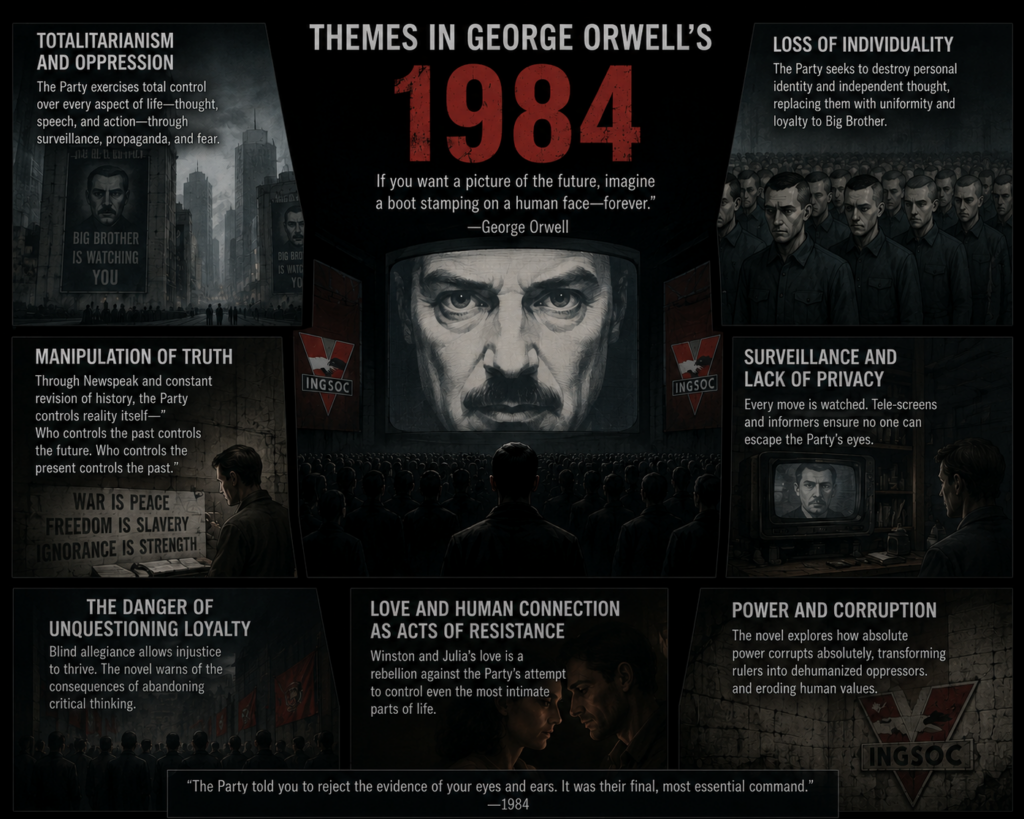
Symbols in 1984: What They Mean and Why They Matter

symbols in 1984

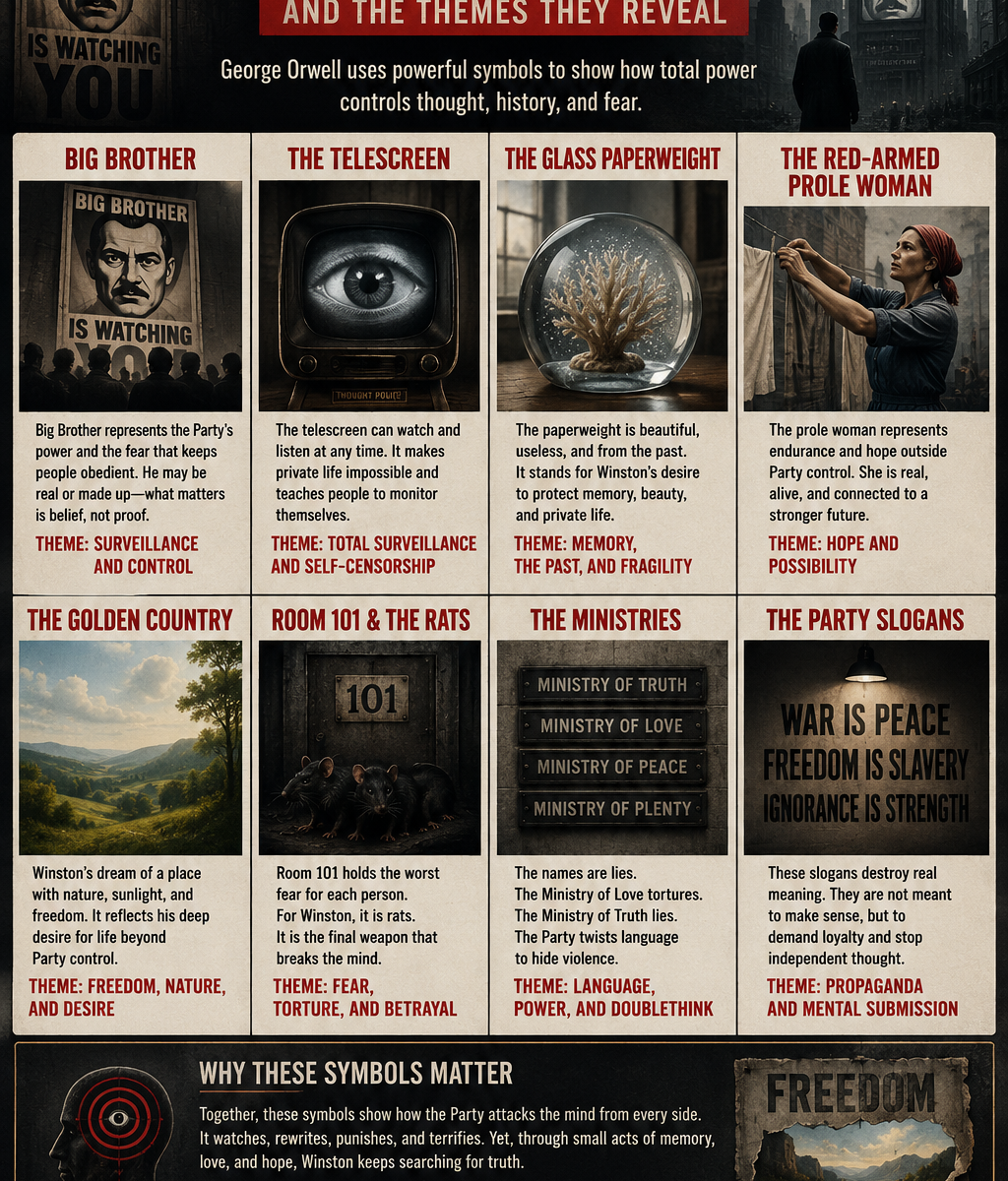
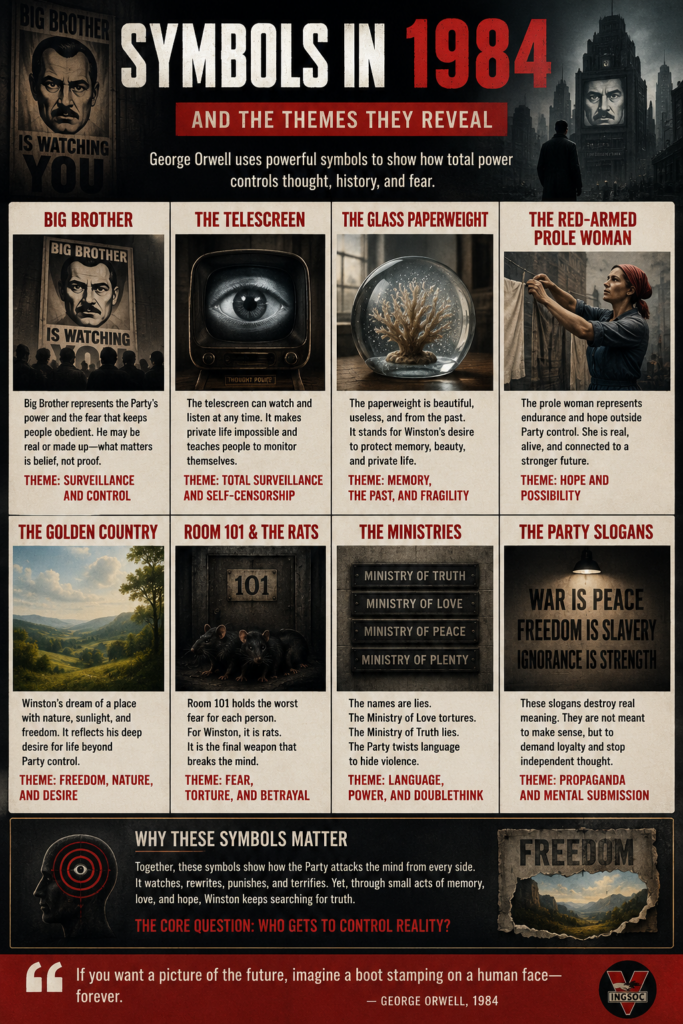
George Orwell uses strong images to show how a government can control thought, history, and fear. This guide explains the most important symbols in 1984 and connects each one to a major theme in the novel.

If you need a quick review of the basics, see our guide on how to find symbolism in a story.

In this Guide

  • What symbolism does in the novel
  • Big Brother and the telescreen
  • The paperweight, the prole woman, and the Golden Country
  • Room 101, rats, and fear
  • How to write about these symbols
  • FAQ and key takeaway

This article contains affiliate links.

symbols in 1984

What Symbols in 1984 Do

Orwell’s symbols make abstract ideas feel concrete and hard to ignore.

The main symbols in 1984 help readers see how total power works. Instead of only telling us that the Party is cruel, Orwell gives us objects and images that show fear, control, and lost freedom.

This is why symbolism matters in literature. A symbol can carry a larger meaning, like the green light in The Great Gatsby or the conch in Lord of the Flies.

In Orwell’s novel, symbols often show the gap between private life and public control. Winston wants truth and love, but the Party tries to own both.

Big Brother as One of the Key Symbols in 1984

Big Brother stands for the Party’s power and the fear that keeps people obedient.

The famous poster says, “Big Brother is watching you.” This image appears across the city and makes people feel watched even when no one may be there.

Big Brother may be a real person, or he may be a made-up figure. That uncertainty is part of the point. The Party does not need proof. It needs belief.

As one of the central symbols in 1984, Big Brother connects to the theme of surveillance. He also shows how a government can replace family, faith, and personal loyalty with loyalty to the state.

The Telescreen and Total Surveillance

The telescreen turns private space into public property.

Winston’s telescreen can send out Party messages, but it can also watch him. He cannot fully turn it off. Even his face and body can betray him.

This symbol matters because it makes control feel constant. The Party does not only punish crimes. It hunts for thoughts, doubts, and small signs of rebellion.

The telescreen also connects to the theme of self-censorship. Winston learns to hide his feelings because the world around him has no safe corner.

The Glass Paperweight and the Lost Past

The paperweight shows Winston’s desire to protect beauty, memory, and private life.

Winston buys the glass paperweight because it feels useless in the Party’s world. It is old, delicate, and connected to a time before constant control.

The piece of coral inside the glass seems sealed away from history. Winston imagines his room above Mr. Charrington’s shop in the same way. It feels like a small world where he and Julia can exist apart from the Party.

When the Thought Police smash the paperweight, the meaning becomes clear. The Party can break private dreams as easily as glass.

This is one of the most painful symbols in 1984 because it links memory to fragility. The past can matter deeply, but it can also be destroyed.

The Red-Armed Prole Woman

The prole woman symbolizes endurance and a hope that exists outside Party control.

Winston watches her as she hangs laundry and sings. She is not rich or powerful, but she seems alive in a way Party members are not.

Her body, voice, and daily work suggest strength. Winston starts to believe that the proles may hold the future because they have not been fully emptied by Party life.

This symbol connects to the theme of hope. Orwell does not make that hope simple, though. The proles have numbers, but they lack political awareness.

The Golden Country

The Golden Country represents freedom, natural life, and desire without fear.

Winston dreams of a place with grass, sunlight, and open space. It feels like the opposite of London, where rooms are watched and language is policed.

When Winston later meets Julia in the countryside, the setting echoes this dream. For a short time, nature seems to offer a space beyond Party control.

Yet the Golden Country is never fully safe. As with many symbols in 1984, it shows both hope and danger. Freedom exists in Winston’s mind, but the Party works to reach even there.

Room 101, Rats, and Fear

Room 101 symbolizes the final weapon of the Party: personal terror.

O’Brien tells Winston that everyone knows what waits in Room 101. It is the worst thing in the world for that person. For Winston, it is rats.

The rats are not just animals. They represent panic that cannot be argued with. Winston can resist pain for a time, but pure fear breaks the part of him that loves Julia.

This symbol connects to the theme of betrayal. The Party does not only want Winston to obey. It wants him to give up the person he loves most.

The Ministries and Party Slogans

The false names of the Ministries show how language can hide violence.

The Ministry of Love deals with torture. The Ministry of Truth spreads lies. These names are cruel because they force people to accept the opposite of reality.

The Party slogans work the same way. Their purpose is not clear thought. Their purpose is mental submission.

These are important symbols in 1984 because they connect language to power. If the Party can control words, it can weaken a person’s ability to resist.

Why Symbols in 1984 Matter for Themes

The novel’s symbols all point back to the same core question: who gets to control reality?

Big Brother and the telescreen show public control. The paperweight and Golden Country show private hope. Room 101 shows how fear can destroy even deep love.

Together, the symbols in 1984 reveal how the Party attacks the mind from every side. It changes history, watches behavior, twists language, and uses fear when all else fails.

For more background on the novel, you can read Britannica’s overview of Nineteen Eighty-four.

How to Write About Symbols in 1984

A strong paragraph should name the symbol, explain its meaning, and connect it to a theme.

Do not stop at saying that Big Brother is a symbol of control. Show how the poster, the watching eyes, and the repeated slogan make people police themselves.

You can use this simple sentence frame: In 1984, [symbol] represents [idea] because [specific detail], which helps Orwell develop the theme of [theme].

For more help with this skill, review our step-by-step post on finding symbols in fiction.

Books to Pair with 1984

These books pair well with Orwell’s novel because they also explore power, language, and freedom.

FAQ About Symbols in 1984

These quick answers can help with homework, essays, or class discussion.

What is the most important symbol in 1984?

Big Brother is often the most important symbol because he represents the Party’s total power and constant watchfulness.

What does the paperweight symbolize in 1984?

The paperweight symbolizes Winston’s love of the past and his hope for a private life outside Party control.

What do rats symbolize in 1984?

Rats symbolize Winston’s deepest fear. They also show how the Party uses terror to force betrayal.

Why does Orwell use so many symbols?

Orwell uses symbols to make political control feel personal. The images help readers see how power reaches into daily life.

Are the symbols in 1984 still relevant today?

Yes. Many readers still connect the novel’s symbols to debates about privacy, propaganda, and truth.

Key Takeaway

The most important symbols in 1984 show how the Party controls people through fear, false language, lost memory, and constant surveillance. Orwell’s images matter because they turn big political ideas into scenes we can feel.

Themes in 1984: A Student-Friendly Guide to Orwell’s Big Ideas

themes in 1984

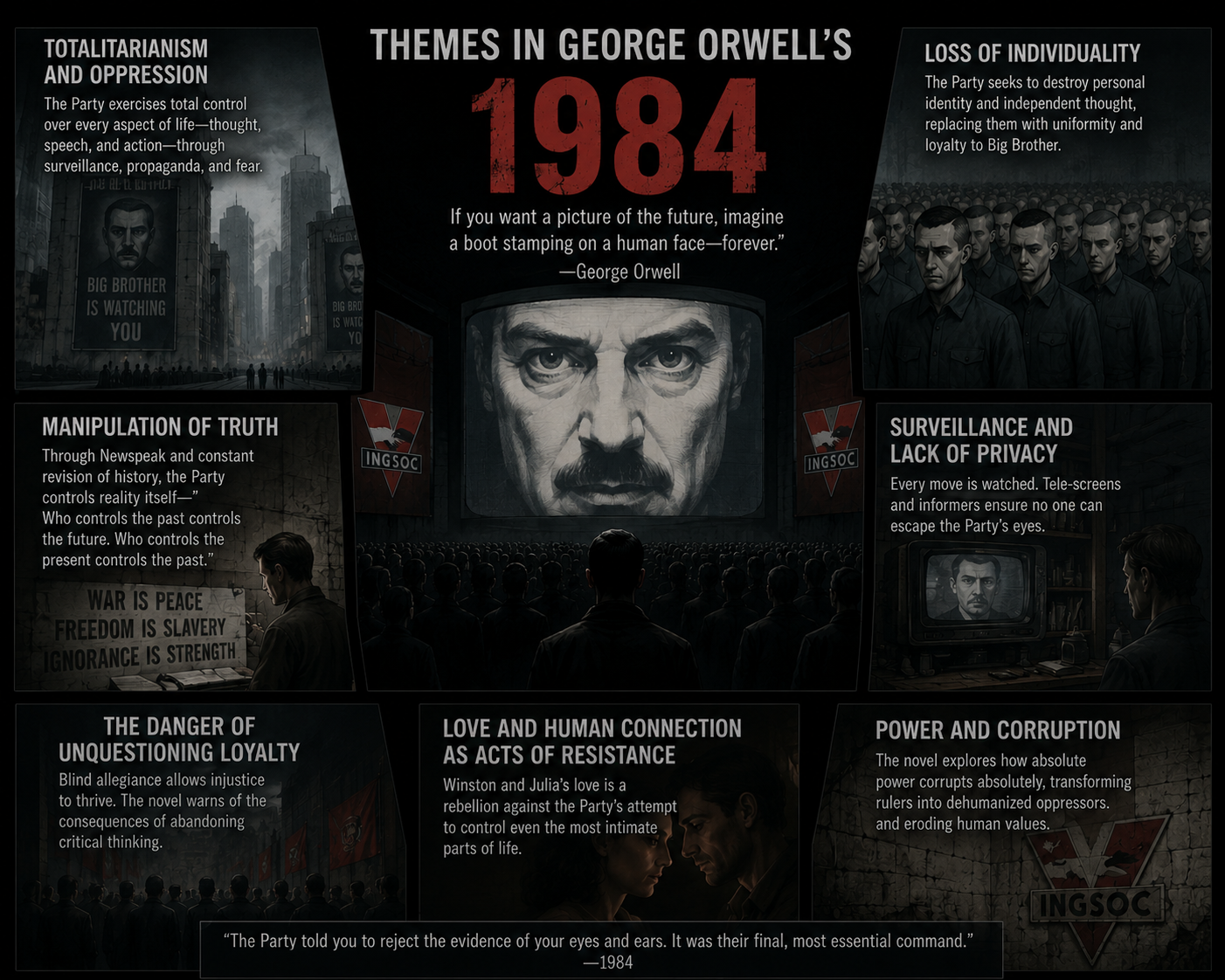
George Orwell’s 1984 is more than a dark story about a future society. The themes in 1984 help students see how power can shape truth, language, fear, and private thought.

This guide breaks down the major ideas you should notice for class discussion, close reading, and essays.

This article contains affiliate links.

In this Guide

Use this guide as a quick map before you write or review.

  • Understanding the major ideas in the novel
  • Power and control
  • Language and thought
  • Truth and memory
  • Fear and loyalty
  • Individual freedom
  • Books to read next
  • FAQ
themes in 1984

Understanding the Themes in 1984

Orwell uses Winston’s world to ask a simple but scary question: what happens when a government controls not just actions, but minds?

A theme is a big idea a text explores. In 1984, Orwell does not give readers easy answers. He shows a world where people may obey because they are afraid, tired, watched, or unsure what is true.

To study the novel well, do more than name the theme. Ask how Orwell builds it through setting, conflict, symbols, and character choices. If you need help with that step, see our guide on how to analyze characters in literature.

Winston matters because he wants the truth, even when truth feels dangerous. His struggle turns the novel’s ideas into a human story.

Themes in 1984: Power and Control

These themes in 1984 show that power works best when people believe they have no safe place to resist.

The Party controls public life through laws, screens, slogans, and punishment. Yet its deeper goal is mental control. It wants citizens to accept whatever the Party says, even if it changes from day to day.

Big Brother is the face of this power. He may or may not exist as a real person, but that almost does not matter. His image makes people feel watched at all times.

The telescreens are a clear symbol of this control. They turn private rooms into public spaces. Winston cannot fully relax, even in his own home.

This theme connects to many dystopian works. In The Hunger Games by Suzanne Collins, public fear and public display help the Capitol stay in power. In 1984, the Party goes even deeper because it tries to own thought itself.

Themes in 1984: Language and Thought

Orwell shows that language is not just a tool for speech. It can shape what people are able to think.

Newspeak is one of the most important ideas in the novel. The Party creates it to shrink language over time. If words for rebellion, freedom, or justice vanish, people may find it harder to imagine those ideas.

This is why the Party cares so much about words. It knows that clear language can protect clear thought. Confused language can hide lies.

The themes in 1984 become most clear when we see how slogans twist meaning. Phrases like War is Peace and Freedom is Slavery are not meant to make sense. They train people to accept contradiction without protest.

Students can compare this to propaganda in Shakespeare’s Julius Caesar. Mark Antony uses public speech to move the crowd. Orwell’s Party uses speech to block thought before it begins.

Themes in 1984: Truth, Memory, and History

In Orwell’s world, truth is not treated as something to discover. It is treated as something the Party can edit.

Winston works at the Ministry of Truth, but the name is a lie. His job is to change old records so the Party always appears right. If a prediction fails, the record changes. If a person becomes an enemy, the record erases that person.

This attack on history is one of the novel’s strongest warnings. If people cannot trust records, memory, or facts, they become easier to control.

When students study themes in 1984, this one often leads to strong essays. You can focus on how Orwell links truth to freedom. If citizens lose the past, they lose the power to question the present.

For more background on Orwell’s life and political concerns, visit Britannica’s overview of George Orwell.

Fear, Surveillance, and Self-Censorship

The Party does not need to punish everyone. It only needs people to believe punishment is always possible.

Fear shapes daily life in 1984. Citizens fear the Thought Police, their neighbors, and even their children. This fear causes people to hide their real feelings.

That is why surveillance is so powerful. The telescreen may not catch every action, but it changes behavior. People learn to police themselves.

This idea feels modern because many readers know what it means to act differently when they feel watched. Orwell pushes that feeling to an extreme. He asks what happens when privacy no longer exists.

Individual Freedom and Private Identity

Winston’s rebellion starts small because even small private acts matter in this world.

At first, Winston does not lead a movement. He writes in a diary. He remembers. He loves Julia. These acts matter because the Party wants no inner life outside its control.

The diary is especially important. It gives Winston a place to speak honestly, even if no one else reads it. In a world built on falsehood, private truth becomes a form of resistance.

Julia’s rebellion is different from Winston’s. She cares less about history and more about personal pleasure. Their differences help readers see that freedom can mean more than one thing.

To build a stronger essay, compare how Winston and Julia respond to control. Our character analysis guide can help you connect their choices to the novel’s larger ideas.

Why the Themes in 1984 Still Matter

Orwell’s novel still speaks to readers because it studies problems that do not belong to one time period.

The novel asks readers to care about truth, language, privacy, and power. These ideas matter in governments, schools, media, and personal life.

The key lesson is not only that total power is dangerous. Orwell also shows that people must protect the habits that keep freedom alive. Those habits include honest speech, memory, questions, and private thought.

This is why 1984 often appears in high school, AP Literature, and college courses. It gives students a strong way to discuss politics, ethics, and human behavior through fiction.

Books to Read Next

These books pair well with Orwell’s novel because they also ask how society shapes freedom and truth.

For a wider look at dystopian fiction as a genre, see Britannica’s page on dystopia.

FAQ About Themes in 1984

Use these quick answers for review before a quiz, seminar, or essay.

What are the main themes in 1984?

The main themes in 1984 include power, language, truth, fear, surveillance, and individual freedom. Each theme shows how the Party controls people from the outside and the inside.

What is the most important theme in 1984?

Many students choose control of truth as the most important theme. If the Party can rewrite facts, citizens lose the ability to challenge power.

How does Newspeak support the novel’s themes?

Newspeak limits thought by limiting words. Orwell suggests that people need rich, clear language to think freely.

Why does Winston keep a diary?

The diary lets Winston claim a private voice. It is a small act of rebellion because the Party wants to control even personal thoughts.

Key Takeaway

The themes in 1984 show how freedom can disappear when power controls truth, language, and private life. Orwell’s warning is clear: a free mind needs facts, memory, and the courage to question authority.

Literature News Roundup: Pulitzer Risk-Taking, Lord of the Flies on TV, and Access Battles

literature news roundup

This literature news roundup for May 8, 2026, looks at recent developments in literature, from major prizes to debates over access to books. Today’s stories show how classic novels, experimental fiction, poetry, and community reading programs are all shaping the book world right now.

This article contains affiliate links.

literature news roundup

Lord of the Flies Heads to Television for the First Time

William Golding’s Lord of the Flies is getting its first television adaptation as a new miniseries. The news is striking because the novel, now a staple of classrooms and classic literature discussions, was once rejected many times before it found a publisher.

The story’s path from nearly unpublished manuscript to screen adaptation shows how unpredictable literary success can be. Readers who know the book for its dark look at power, fear, and group behavior may find the new version a fresh way to revisit its central conflict.

It also reminds us that adaptations can introduce older books to new audiences. For students and longtime readers alike, the miniseries may spark renewed interest in Golding’s harsh but powerful vision of human nature.

Daniel Kraus Wins Pulitzer for a One-Sentence War Novel

Daniel Kraus’s Angel Down has won a Pulitzer Prize, drawing attention for both its subject and its daring form. The novel is described as a punctuation-free war story written as a single sentence, a choice that turns style into part of the reading experience.

This kind of formal risk matters because it challenges what readers expect a novel to do. Instead of using a familiar structure, Kraus appears to use breathless momentum to mirror fear, chaos, and survival.

The Pulitzer recognition suggests that ambitious experiments in fiction still have a strong place in literary culture. For readers interested in literary analysis, Angel Down may become a fascinating example of how form and meaning work together.

Russian Officials Seize British Children’s Books

Russian customs officials have reportedly seized a shipment of British children’s books, labeling some of the material as “extremist literature.” The incident raises fresh concerns about censorship, especially when the books involved are meant for young readers.

Children’s literature often plays a major role in helping young people understand other cultures, emotions, and ideas. When books for children are blocked or restricted, it can limit curiosity and narrow the range of stories available to families and schools.

For readers, this story is a reminder that book access is not just a publishing issue. It is also tied to politics, education, and the freedom to encounter different viewpoints through reading.

Marianne Boruch Receives the Jackson Poetry Prize

Marianne Boruch has won the $100,000 Jackson Poetry Prize, an award honoring a poet with a strong and lasting body of work. Judges praised her attention to both the natural world and the inner life, pointing to the deeply human quality of her writing.

The award arrives at a time when many readers and writers are asking what art means in an age shaped by artificial intelligence. Boruch’s win highlights the value of careful observation, emotional depth, and the surprises that come from lived experience.

For readers who want to better understand poems like hers, learning how to approach poetry can make the form feel more open and rewarding. Prizes like this also help bring serious public attention to poets whose work may otherwise reach a smaller audience.

Bookmobiles Bring Reading Beyond Library Walls

Two recent stories show how bookmobiles continue to matter in communities where access to books is not always simple. In East Baton Rouge Parish, library buses and vans are bringing books and library services directly to people across the area.

Meanwhile, the Native women-led NDN Girls Book Club is working to raise funds for a permanent bookmobile. After earlier trips across Navajo and Hopi reservations and through Southeast Alaska, the group hopes to expand its reach across Indian Country.

These programs matter because they treat reading as something that should travel to meet people where they are. They also show that the future of books is not only digital or urban; it can be local, mobile, and built around trust.

Closing Thoughts

These stories point to a lively and sometimes tense moment in literature. Awards are honoring bold forms, classic books are finding new screens, and communities are fighting to keep reading accessible.

At the same time, censorship concerns show that the freedom to read remains uneven around the world. Together, this week’s developments suggest that books still carry real power—on the page, on screen, and in public life.

Flash Memoir Prompt: First Time You Were Left Alone Somewhere

flash memoir prompt first time left alone somewhere

A warm, focused writing invitation about the first time you felt truly alone and had to meet the moment by yourself.

flash memoir prompt first time left alone somewhere

The door clicks shut. The car turns the corner. The house goes quiet in a way it never has before.

For a second, nothing has changed. The same couch is there. The same clock ticks. And the same cracked sidewalk stretches outside. Then your body understands before your mind does: no one is coming to handle this for you right now.

If you searched for a flash memoir prompt first time left alone somewhere, this one asks you to return to that sharp little moment when childhood, safety, independence, or fear shifted under your feet.

It might be a memory from a grocery store aisle, a school hallway after practice, a hospital waiting room, a train station, or your own kitchen. The place matters, but the feeling matters more.

The Prompt

Write about the first time you were left alone somewhere and realized you were completely on your own.

This prompt can unlock a powerful memory because it focuses on a clear emotional turn. At first, you may have felt fine. Maybe even proud. Then something changed. The silence grew too large. The adults took too long. The familiar place started to feel strange.

Flash memoir works well when you choose one small scene instead of trying to explain your whole life. This prompt gives you a built-in scene: a person alone in a place, waiting to see what happens next.

Why This Memory Matters

The first time you were left alone may have been scary, exciting, unfair, or strangely calm. You may have discovered you were braver than you thought. You may have learned that certain kinds of freedom come with a cold edge.

This kind of memory often holds a hidden before and after. Before, someone else knew the plan. After, you had to make one.

Maybe you were left at a bus stop and had to ask a stranger for help. Maybe your parent ran into a store and did not come back as fast as promised. And maybe you were old enough to be trusted at home, but young enough to jump at every creak in the walls.

The meaning does not have to be dramatic. A strong memoir moment can come from a small realization: I know where the flashlight is. I can call the neighbor. I can sit still. And I can wait.

That is why this flash memoir prompt first time left alone somewhere can lead to a story about fear, but it can also lead to a story about competence. Or loneliness. Or pride that you did not know how to name at the time.

If you want to explore what your memory is really about after drafting, you might find it helpful to read this guide on how to identify theme in literature. Memoir has themes too, even when the story begins with a simple locked door or an empty room.

How to Approach This Prompt

Start with a physical detail. Do not begin by explaining how old you were or what the memory means now. Begin with the thing your body remembers.

Was the carpet rough under your knees? Was there gum stuck to the bottom of a plastic chair? Did the air smell like floor cleaner, wet wool, popcorn, sunscreen, or dust?

Choose one scene and stay inside it. If you were left alone at a mall, do not write the full story of your family, your whole childhood, and every store in the building. Write the bench outside the shoe store. Write the escalator. And write the moment you stopped pretending you were fine.

Let the facts arrive slowly. Readers do not need every detail at once. They need to feel what you noticed first.

You might begin with a sentence like:

“The kitchen sounded bigger after my mother left.”

Or:

“I counted the red floor tiles because I did not know what else to do.”

Or:

“At first, being alone in the car felt like a prize.”

After that, follow the next small action. Did you check the clock? Lock the door? Walk in circles? Try to act older than you felt?

If you get stuck, write the scene as if you are annotating your own memory. Notice the objects, the sounds, and the moment the mood changes. For more practice with close observation, this guide on how to annotate literature can help you train your eye to notice what carries meaning.

A Quick Example

My father left me in the laundromat with two baskets and a warning not to touch the candy machine. I was nine, old enough, he said, to watch the dryers spin while he ran next door for quarters. The room smelled like hot cotton and soap powder. At first I liked the job. I sat straight in the orange chair and looked serious, like the women folding towels. Then the dryer with our sheets stopped. My father did not come back. The quiet between machine hums got wider. A man came in and nodded at me. I nodded back, too fast. I put one hand on the basket handle and one hand in my pocket around the house key. That was the first time I understood that waiting could feel like work.

Try It Yourself

Set a timer for ten minutes and write one scene from this prompt. Keep your focus tight. Where were you? What did you hear? What did you do with your hands?

Do not worry about making the memory sound important. Let it be ordinary if it was ordinary. A child alone in a quiet house can hold as much tension as a child lost in a crowd.

When you finish, underline the sentence where the realization happens. It may be small, but it is probably the heart of the piece.

This flash memoir prompt first time left alone somewhere is a chance to write about the moment you began to understand your own presence. You were there. You noticed. And you got through it, one choice at a time.

Want More Flash Memoir Prompts?

If you enjoy short writing invitations that help you capture real memories in a few focused paragraphs, the full collection offers a year of daily practice.

Explore all 365 prompts in The Memory Trigger: 365 Flash Memoir Writing Prompts.

 

flash memoir prompt

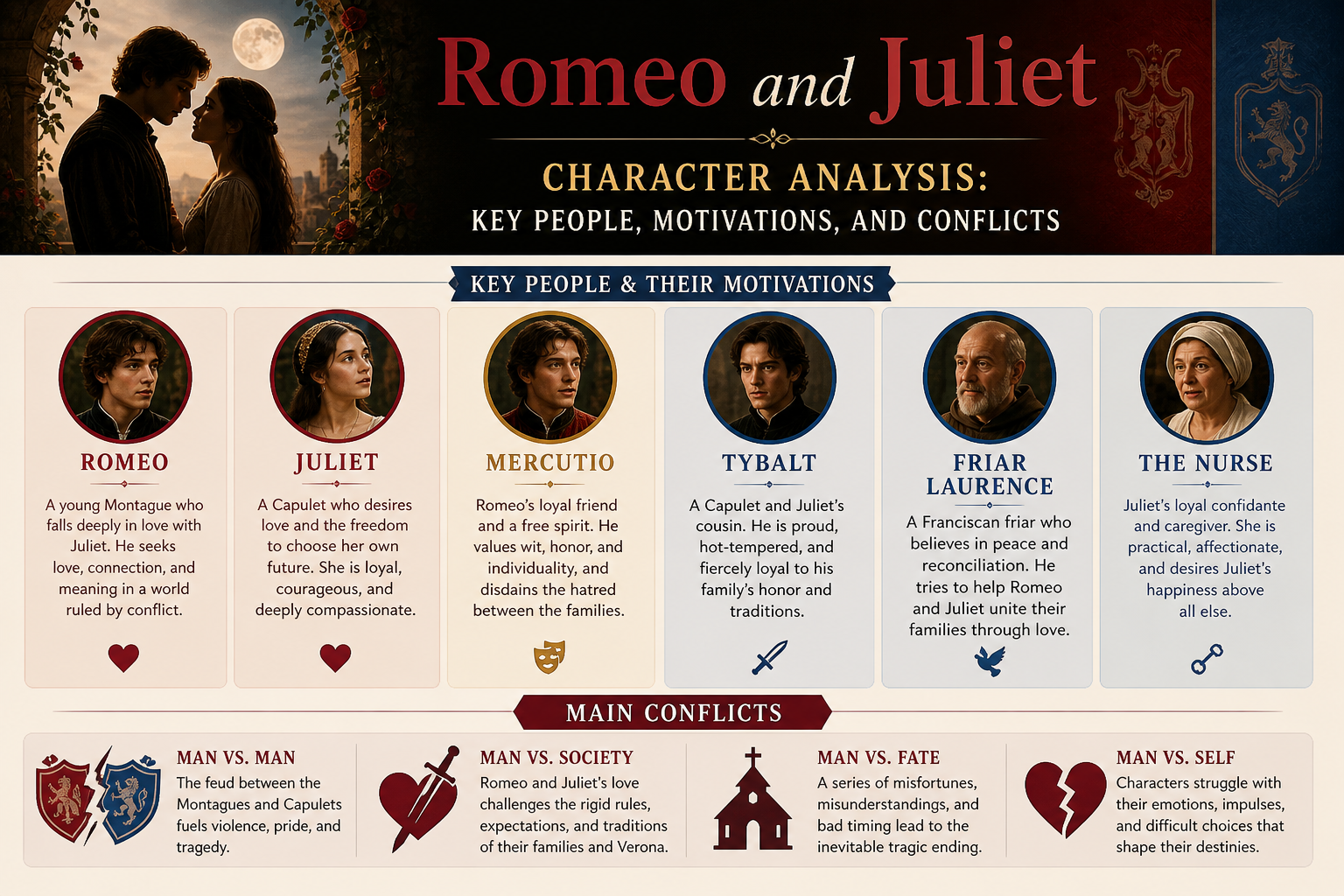
Romeo and Juliet Character Analysis: Key People, Motivations, and Conflicts

Romeo and Juliet character analysis

A practical breakdown of the main characters and how their choices shape the story.

Shakespeare’s tragedy works because each character wants something badly, then acts before the full truth is clear. This Romeo and Juliet character analysis breaks down the main characters, their motives, and the conflicts that push the play toward its tragic end.

This article contains affiliate links.

In this Guide

Romeo and Juliet character analysis

Romeo and Juliet Character Analysis: The Big Picture

The play is not only about young love. It is also about family pressure, pride, anger, and the cost of poor choices.

In a strong Romeo and Juliet character analysis, the key question is not just “Who is good?” or “Who is bad?” A better question is, “What does this person want, and what choice do they make because of it?”

Romeo wants love that feels total. Juliet wants control over her own life. Lord Capulet wants family honor. Tybalt wants respect through violence.

These wants crash into each other. That is why the plot feels fast, tense, and painful.

If you need a simple method for any character essay, this guide to analyzing characters in literature can help you build stronger claims.

Romeo and Juliet Character Analysis of Romeo Montague

Romeo is emotional, romantic, and quick to act. His heart often moves faster than his judgment.

At the start, Romeo feels crushed because Rosaline does not love him back. This matters because it shows how easily he turns love into an obsession.

When he meets Juliet, his feelings shift at once. This does not mean his love is fake. It does mean he trusts intense feeling more than careful thought.

Romeo’s main conflict is between desire and self-control. He wants peace with Tybalt after he marries Juliet, but he cannot control his rage after Mercutio dies.

That choice changes everything. Romeo kills Tybalt, gets banished, and loses the chance to build a future with Juliet in Verona.

For essays, Romeo is a strong example of a tragic character whose best traits create danger. His passion makes him loving, but it also makes him reckless.

image-slider-with-thumbnail1.jpeg
PlayPause
previous arrow
next arrow
image-slider-with-thumbnail1.jpeg
image-slider-with-thumbnail3.jpeg
image-slider-with-thumbnail4.jpeg
ChatGPT Image Jun 27, 2026, 06_33_13 PM
ChatGPT Image Jun 27, 2026, 06_36_37 PM
ChatGPT Image Jun 27, 2026, 06_38_39 PM
ChatGPT Image Jun 27, 2026, 06_31_22 PM
image-slider-with-thumbnail7.jpeg
ChatGPT Image Jun 27, 2026, 06_29_43 PM
ChatGPT Image Jun 27, 2026, 06_27_44 PM
image-slider-with-thumbnail6.jpeg
ChatGPT Image Jun 27, 2026, 06_15_07 PM
image-slider-with-thumbnail5.jpeg
ChatGPT Image Jun 27, 2026, 06_22_43 PM
ChatGPT Image Jun 27, 2026, 06_25_37 PM
ChatGPT Image Jun 27, 2026, 06_19_43 PM
ChatGPT Image Jun 27, 2026, 06_12_00 PM
ChatGPT Image Jun 27, 2026, 06_08_50 PM
ChatGPT Image Jun 26, 2026, 04_54_23 PM
ChatGPT Image Jun 27, 2026, 05_53_51 PM
ChatGPT Image Jun 28, 2026, 08_35_55 AM
previous arrow
next arrow

Romeo and Juliet Character Analysis of Juliet Capulet

Juliet starts the play as an obedient daughter. By the end, she becomes one of Shakespeare’s boldest young characters.

A strong Romeo and Juliet character analysis should treat Juliet as more than Romeo’s love interest. She makes major choices and takes major risks.

Juliet’s main motive is freedom. She wants to love Romeo, but she also wants the right to choose her own future.

Her conflict grows when her parents order her to marry Paris. To them, the match seems smart. To Juliet, it feels like a prison.

Juliet is often more practical than Romeo. She asks serious questions about marriage, timing, and danger. Still, she is young, trapped, and short on safe advice.

Her choice to take Friar Lawrence’s potion shows courage. It also shows how few options she has in a world ruled by family power.

Romeo and Juliet Character Analysis of the Capulets and Montagues

The older generation keeps the feud alive, even when the young people pay the price.

The Capulets and Montagues are not fully explained, which makes their hatred feel even more pointless. Shakespeare shows the effect of the feud, not a clear reason for it.

Lord Capulet can seem caring when he first protects Juliet from an early marriage. Later, he turns harsh when she refuses Paris.

His motive is control. He wants Juliet to obey because her marriage affects his honor and social plans.

Lady Capulet is more distant. She follows the rules of her class and expects Juliet to accept them too.

The Montagues have less stage time, but they also live inside the feud. Their name makes Romeo an enemy before he has done anything to Juliet’s family.

Romeo and Juliet Character Analysis of Key Supporting Characters

The supporting characters shape the lovers’ choices. Some try to help, while others make conflict worse.

Mercutio

Mercutio is witty, loyal, and sharp-tongued. He mocks romantic love and often turns serious moments into jokes.

His death is a turning point. His curse, “A plague o’ both your houses,” points blame at both families.

Tybalt

Tybalt is proud and violent. He sees Romeo’s presence at the Capulet party as an insult that must be answered.

In a Romeo and Juliet character analysis, Tybalt often stands for the feud itself. He does not want peace because his identity depends on family honor.

Benvolio

Benvolio tries to keep the peace. His name even suggests goodwill.

He fails not because he is weak, but because the world around him rewards anger more than patience.

Friar Lawrence

Friar Lawrence wants peace between the families. He sees Romeo and Juliet’s marriage as a chance to end the feud.

His plan is risky. Like Romeo, he acts with hope before he has enough control over the outcome.

The Nurse

The Nurse loves Juliet and gives her comfort. She also helps Juliet meet Romeo in secret.

Yet the Nurse later tells Juliet to marry Paris. This feels like betrayal because Juliet needs moral support, not just practical advice.

Romeo and Juliet Character Analysis Through Major Conflicts

Character conflict drives the play. Each clash reveals what people value most.

Love versus hate is the clearest conflict. Romeo and Juliet love each other, but their families have taught them to hate each other’s names.

Youth versus age also matters. The young characters act from feeling, while the older characters act from custom and status.

Fate versus choice is harder to judge. The prologue calls the lovers “star-crossed,” but their choices still matter.

This is similar to other famous tragedies. In Macbeth, prophecy matters, but Macbeth’s choices cause the bloodshed. In Oedipus Rex, fate is powerful, but human pride makes the ending hurt more.

For helpful background on the play and Shakespeare’s time, see Britannica’s overview of Romeo and Juliet. You can also explore Shakespeare’s sonnets and language at the Poetry Foundation.

How to Use This Romeo and Juliet Character Analysis in Essays

A good essay claim should connect a character trait to a result. Do not stop at “Romeo is emotional.” Explain how that emotion changes the plot.

Try a sentence like this: Romeo’s passion helps him love Juliet deeply, but it also leads him to kill Tybalt before he thinks about the cost.

For Juliet, you might argue that her courage grows as her choices shrink. That kind of claim gives you room to discuss family pressure, marriage, and the potion plan.

Use short quotes and explain them. A quote should support your idea, not replace it.

If you want a step-by-step tool for class notes, try this character analysis practice guide. You can pair it with our character analysis strategy article for essay planning.

Helpful Books for Romeo and Juliet Study

These books can help with close reading, class discussion, and quote-based analysis.

FAQ – Romeo and Juliet Character Analysis

Who is the most important character in Romeo and Juliet?

Romeo and Juliet are both central. Romeo drives many public conflicts, while Juliet shows the deepest personal growth.

What is Romeo’s main flaw?

Romeo’s main flaw is impulsiveness. He acts from intense feeling before he thinks through the result.

What makes Juliet a strong character?

Juliet becomes strong because she makes hard choices under pressure. She challenges family rules and risks her life for her chosen love.

Why is Tybalt important?

Tybalt keeps the feud active. His anger turns Romeo’s secret marriage into a public disaster.

How should I write a Romeo and Juliet character analysis essay?

Pick one character, name a clear trait, and show how that trait affects the plot. Use quotes, then explain what each quote proves.

Key Takeaway

The best Romeo and Juliet character analysis shows how motives lead to choices, and how those choices turn love into tragedy. The play feels timeless because its characters act from feelings students still understand today.

Literature News: Activist Writing, Digital Storytelling, & Literary Spaces

Literature news roundup for May 5, 2026: recent developments in literature are pointing toward memory, activism, access, and the changing shape of storytelling. Today’s highlights include books built from family archives, a student-led literary space for underrepresented voices, new protest-minded nonfiction, and fresh attention to writers working across genres.

Family Archives Become a Path Through Silence

Electric Literature spotlighted seven books that use family records to uncover stories that were once hard, or even impossible, to tell. These works draw from photographs, poems, comics, letters, and other saved materials to examine what families pass down and what they leave unsaid.

The piece shows how personal artifacts can become more than background details. In the hands of skilled writers, they help reveal hidden histories, trauma, migration, identity, and memory.

This matters because many readers are drawn to books that feel intimate but also speak to larger social histories. It also reminds us that close reading is not only for fiction; it can help readers notice how documents, images, and fragments shape a powerful narrative.

Beyond the Page Builds a Space for Underrepresented Writers

At Indiana University Bloomington, Beyond the Page created a literary space focused on writers and readers who often feel left out of traditional academic and publishing circles. The group hosted public speaking events, literature discussions, and writing workshops during the semester.

The project’s title, “Different Realms,” reflects its goal of making room for many kinds of voices and experiences. Instead of treating literature as something distant or elite, the program invited students to see writing as a living community practice.

For readers, this is a reminder that literary culture grows strongest when more people can take part in it. Workshops and open conversations can help young writers build confidence, find mentors, and imagine themselves as part of the literary world.

Jewish Authors Turn Protest History into How-To Literature

The Times of Israel reported on a growing “mini-genre” of Jewish activism books that mix history, practical advice, and moral reflection. These new works arrive during a time of political division and protest fatigue, when many readers want guidance on how to act without burning out.

The books look back to older traditions of dissent and civic courage. Rather than simply telling readers what happened in the past, they ask how those lessons might help people respond to injustice now.

This trend matters because nonfiction is increasingly becoming a tool for public action, not just private learning. Readers interested in the theme of resistance will find that these books connect memory, ethics, and real-world choices.

Rabat Book Fair Debates the Future of Writing in the Digital Age

At the Rabat Book Fair, a major discussion explored how digital media is changing the line between journalism and literature. Writers, thinkers, and cultural leaders considered how online platforms, fast news cycles, and new reading habits are reshaping what stories look like.

The debate focused on a question many readers already feel: where does reporting end and literary storytelling begin? In the digital age, essays, long-form journalism, memoir, and criticism often overlap in style and purpose.

This matters because readers now meet literature in many forms, from printed novels to online essays and multimedia projects. The conversation suggests that literary value may depend less on format and more on voice, depth, and craft.

May Swenson Papers Bring a Poet’s Process into View

Washington University Libraries highlighted a new digital exhibit connected to the May Swenson Papers and the publication of The Key to Everything: May Swenson, A Writer’s Life by Margaret Brucia. The exhibit draws attention to manuscripts and archival materials that help illuminate Swenson’s creative life.

Swenson, an important American poet, left behind drafts and documents that show how carefully a writer shapes voice, image, and form. These materials help readers see the labor behind finished poems.

For anyone who loves poetry, archives like this are valuable because they make the writing process more visible. They also show why literary collections matter: they preserve not just final works, but the thinking and revision behind them.

Literature News – Closing Thoughts

These stories suggest that today’s literary world is looking both backward and forward. Writers are returning to archives, protest traditions, and manuscripts, while also testing new spaces for community and digital storytelling.

For readers, the trend is clear: literature is not standing still. It is becoming more open, more personal, and more connected to the urgent questions of public life.

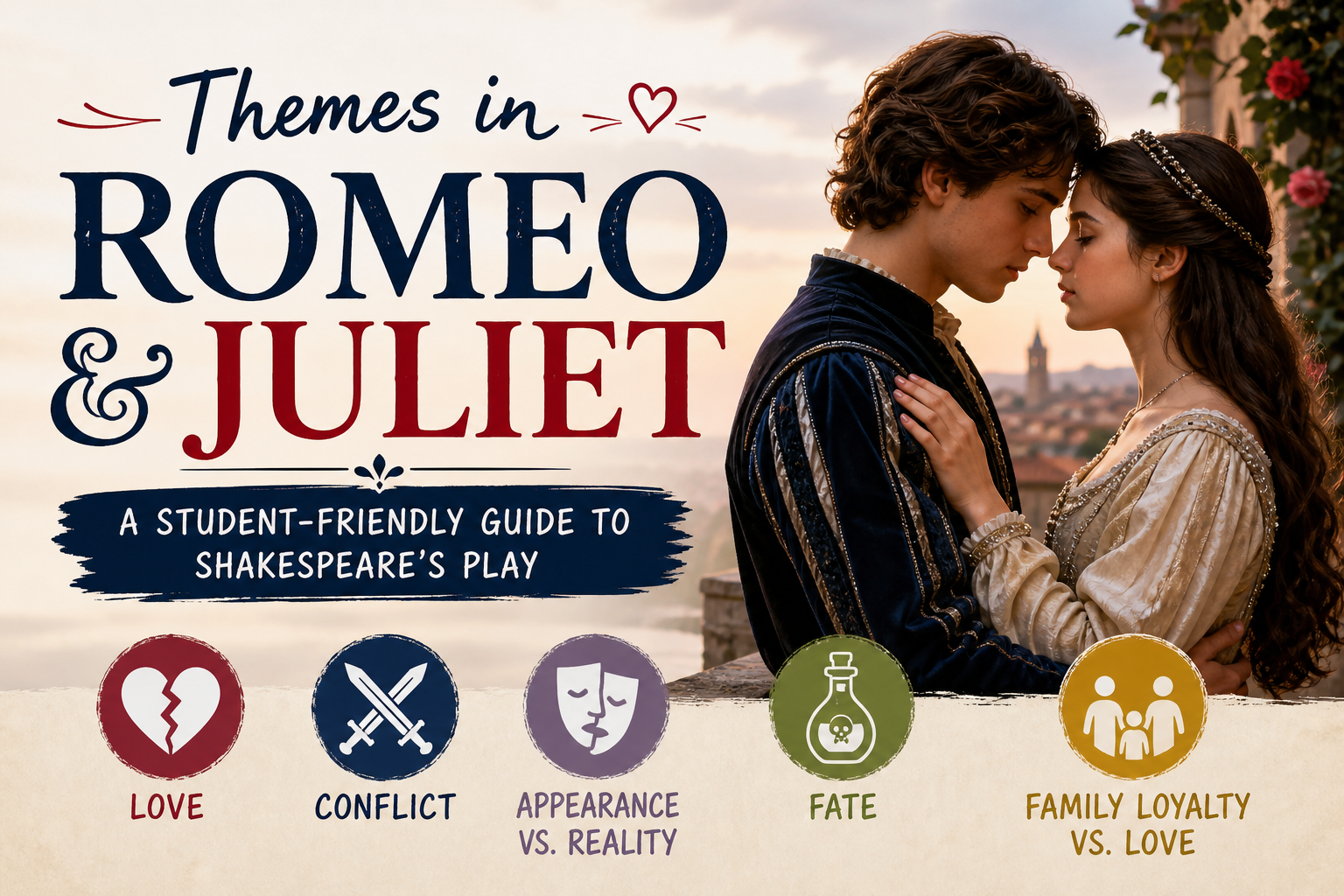
Themes in Romeo and Juliet: An In-Depth Guide

themes in Romeo and Juliet

Shakespeare’s tragedy can feel fast, emotional, and hard to sort out at first. This guide explains the major themes in Romeo and Juliet so you can connect the plot to the bigger ideas in the play.

themes in Romeo and Juliet

In this Guide

  • Why theme matters in the play
  • Love and desire
  • Fate and timing
  • Family conflict
  • Youth and identity
  • Writing about theme

This article contains affiliate links.

What Makes the Themes in Romeo and Juliet So Important?

The play is not only about two teenagers who fall in love. It is about what happens when private feelings crash into public hate.

The themes in Romeo and Juliet help readers see why the ending feels both shocking and expected. Shakespeare shows a world where love is powerful, but it is not strong enough to escape anger, pride, and bad choices.

Need a quick refresher before you write? Read our guide on how to identify theme in literature.

Love as One of the Central Themes in Romeo and Juliet

Love in this play is intense, sudden, and dangerous. Romeo and Juliet do not fall in love slowly. They meet, speak, kiss, and decide that life without each other would feel empty.

Among all the themes in Romeo and Juliet, love may be the easiest to notice. Yet Shakespeare does not show love as simple or safe. Love gives the characters courage, but it also pushes them toward risk.

Romeo’s feelings for Rosaline seem dramatic but shallow. His love for Juliet feels deeper because it changes how he sees himself, his family, and his future.

This type of intense love also appears in works like Wuthering Heights by Emily Brontë, where passion can feel larger than reason. In both texts, love has beauty, but it also has a cost.

Fate and Timing in the Themes in Romeo and Juliet

The play asks a hard question: are Romeo and Juliet doomed, or do people make choices that lead to doom?

Fate is one of the most debated themes in Romeo and Juliet. The Prologue calls the lovers “star-cross’d,” which suggests their lives are shaped by forces beyond their control.

Bad timing appears again and again. Romeo meets Juliet right after his pain over Rosaline. The secret wedding happens too fast. Friar Lawrence’s letter never reaches Romeo.

Still, fate does not erase choice. Tybalt chooses violence, Romeo chooses revenge, and the adults choose to keep old hatred alive.

Family Conflict: One of the Harshest Themes in Romeo and Juliet

The feud between the Montagues and Capulets shapes the whole play. It turns ordinary places, such as streets and homes, into unsafe spaces.

Family loyalty should protect young people, but here it traps them. Romeo and Juliet cannot love openly because their names carry a history of hate.

This theme fits with other works about social conflict, such as West Side Story, which is based on Shakespeare’s play. Both stories show how group identity can crush personal desire.

image-slider-with-thumbnail1.jpeg
PlayPause
previous arrow
next arrow
image-slider-with-thumbnail1.jpeg
image-slider-with-thumbnail3.jpeg
image-slider-with-thumbnail4.jpeg
ChatGPT Image Jun 27, 2026, 06_33_13 PM
ChatGPT Image Jun 27, 2026, 06_36_37 PM
ChatGPT Image Jun 27, 2026, 06_38_39 PM
ChatGPT Image Jun 27, 2026, 06_31_22 PM
image-slider-with-thumbnail7.jpeg
ChatGPT Image Jun 27, 2026, 06_29_43 PM
ChatGPT Image Jun 27, 2026, 06_27_44 PM
image-slider-with-thumbnail6.jpeg
ChatGPT Image Jun 27, 2026, 06_15_07 PM
image-slider-with-thumbnail5.jpeg
ChatGPT Image Jun 27, 2026, 06_22_43 PM
ChatGPT Image Jun 27, 2026, 06_25_37 PM
ChatGPT Image Jun 27, 2026, 06_19_43 PM
ChatGPT Image Jun 27, 2026, 06_12_00 PM
ChatGPT Image Jun 27, 2026, 06_08_50 PM
ChatGPT Image Jun 26, 2026, 04_54_23 PM
ChatGPT Image Jun 27, 2026, 05_53_51 PM
ChatGPT Image Jun 28, 2026, 08_35_55 AM
previous arrow
next arrow

Youth, Identity, and Rebellion

Romeo and Juliet are young, but Shakespeare does not treat them as silly. He shows how young people can see truths that adults refuse to face.

Juliet grows quickly across the play. At first, she listens to her parents. Soon, she makes bold choices about love, marriage, and death.

Romeo also tries to step outside his family role. He wants to stop being just a Montague, but the feud pulls him back into violence after Mercutio dies.

Language, Light, and Darkness

Shakespeare uses images of light and darkness to show how love changes the world for Romeo and Juliet.

Juliet is compared to the sun, stars, and bright light. These images make love feel rare and almost sacred.

Darkness is not always evil in the play. Night gives the lovers privacy. Daylight often brings danger, rules, and separation.

This contrast helps readers see one of the quieter themes in Romeo and Juliet: the same world can feel safe or cruel depending on who has power.

Death, Tragedy, and the Cost of Hate

The ending is tragic because the deaths feel avoidable. Many people could have stopped the disaster earlier, but they do not.

Mercutio and Tybalt die before Romeo and Juliet. Their deaths show that the feud harms more than the lovers.

By the final scene, the families understand the cost of hate too late. The peace they reach is real, but it is built on loss.

For background on the play, see Britannica’s overview of Romeo and Juliet. You can also explore the Poetry Foundation’s page on William Shakespeare.

How to Write About the Themes in Romeo and Juliet

A strong theme essay should make a clear claim about what Shakespeare suggests, not just name a topic.

For example, do not only write, “The play is about love.” A stronger claim would be, “Shakespeare presents love as powerful but fragile when society is ruled by hate.”

Use short quotes and explain them in your own words. A quote does not prove your point unless you connect it to the theme.

For more help with this skill, review our student-friendly theme guide.

Helpful Books to Search for on Amazon or at Your Library

These books can help if you want a stronger grasp of the play and Shakespeare’s world.

FAQ: Themes in Romeo and Juliet

These quick answers can help with homework, test review, or essay planning.

What are the main themes in Romeo and Juliet?

The main themes include love, fate, family conflict, youth, violence, and the cost of hate.

Is love shown as good or bad in the play?

Love is shown as powerful and sincere. It becomes tragic because the world around the lovers is hostile.

Does fate cause the tragedy?

Fate plays a major role, but human choices matter too. Shakespeare mixes bad luck with rash action.

Why is family conflict so important?

The feud makes Romeo and Juliet hide their love. It also teaches young people that violence is normal.

Key Takeaway

The key insight: Shakespeare uses Romeo and Juliet’s love story to show how hate can destroy what is most innocent and hopeful.

error

Enjoy this article? Please spread the word :)

Follow by Email
BLUESKY
fb-share-icon
Reddit
LinkedIn
Share
RSS