This roundup of recent developments in literature for May 2, 2026, brings together major prize talk, global book culture, poetry, festivals, and publishing visibility. Today’s focus is on the latest book and literature news, with stories that show how readers are discovering books across borders, genres, and communities.
Pulitzer Fiction Speculation Begins to Heat Up
Electric Literature is looking ahead to the 2026 Pulitzer Prize for Fiction with a list of possible contenders and details on how readers can follow the announcement live. The Pulitzer remains one of the most closely watched honors in American letters, often changing the reach of a novel overnight.
For readers, these predictions are more than awards chatter. They can point people toward ambitious fiction they may have missed during the year.
The discussion also reminds us that prize season shapes how books are remembered, reviewed, and taught. A strong contender often invites deeper literary analysis, especially when critics begin debating style, structure, and meaning.
Laurence Laluyaux Wins Major Honor for International Literature
Publishing Perspectives reports that Laurence Laluyaux of Rogers, Coleridge & White has won the 2026 Ottaway Award for the Promotion of International Literature. The award recognizes people who help bring writing from around the world to wider audiences.
Laluyaux’s work has been praised by major literary figures, including Nobel Prize winner László Krasznahorkai. That support highlights how much translators, agents, and advocates matter behind the scenes.
This story matters because international literature depends on more than great books. It also needs champions who connect authors, publishers, translators, and readers across languages.
Climate Change Takes Center Stage Through Poetry
The Conversation has gathered ten poems about climate change chosen by experts. The selections span more than two centuries and explore grief, fear, wonder, and hope.
This list shows that environmental writing is not only a modern concern. Poets have long used nature, weather, and landscape to think about human responsibility and loss.
For readers, the article offers a powerful entry point into eco-literature. It also shows how poetry can make large global issues feel personal and emotionally immediate.
Dublin Festival Highlights Essays, Poetry, and New Voices
The Irish Times has shared highlights from the International Literature Festival Dublin, including prize news, poetry recognition, and upcoming literary events. Among the items noted is a Trinity College Dublin student from Gaza winning a major essay prize.
The roundup also points toward poetry honors and history-focused programming in Ireland. Together, these events show how festivals can bring many kinds of writing into one public conversation.
For readers, festivals like Dublin’s are useful because they spotlight both established writers and emerging voices. They help books travel beyond shelves and into live debate, performance, and community.
theGrio and BLK Bestsellers Partner to Spotlight Black Authors
theGrio has announced a partnership with the BLK Bestsellers list, which is connected to the African American Literature Book Club. The project aims to highlight top-selling books by Black authors using both sales information and editorial attention.
This matters because bestseller lists can strongly influence what readers notice, buy, and discuss. A dedicated list can help correct gaps in visibility that have long affected publishing.
For book lovers, the partnership offers a clearer way to find popular and important books by Black writers. It also signals a broader push for more accurate measures of literary success.
What These Stories Tell Us
This week’s literature news points to a book world shaped by prizes, festivals, advocacy, and wider representation. Readers are not only looking for the next big winner; they are also looking for voices that cross borders, address urgent issues, and reflect more communities.
The strongest trend is visibility. Whether through the Pulitzer, international awards, climate poems, or Black bestseller lists, literature continues to grow when more readers can find the work that speaks to them.
Here is a roundup of recent developments in literature for May 1, 2026. Today’s stories move from major prize judging and community festivals to library support, immigrant identity, and the moral power of fiction.
Sanchita Basu De Sarkar Joins the Children’s Booker Prize Judging Panel
British-Indian bookseller Sanchita Basu De Sarkar has been named one of the adult judges for the 2027 Children’s Booker Prize. Her role highlights the growing importance of booksellers in shaping conversations about children’s literature. Booksellers often see firsthand what young readers choose, revisit, and recommend to others.
This matters because children’s prizes can help bring fresh voices to wider attention. A judge with deep experience in bookselling may help spotlight stories that connect with readers beyond classroom lists and bestseller tables.
Swindon Festival of Literature Opens with a Free Woodland Event
The Swindon Festival of Literature is preparing to begin with a free public celebration set in the woods. The event aims to make literature feel lively, open, and connected to the local community. By placing books and storytelling in a natural setting, the festival is also inviting people who may not usually attend formal literary events.
For readers, this shows how festivals can turn literature into a shared experience. Free events lower barriers and remind us that book culture is not only found in libraries, classrooms, or bookshops.
Thayer Memorial Library Receives Gift to Support Literary Collections
Thayer Memorial Library in Lancaster, MA has received an unrestricted gift from Rich Marcello, president of the Seven Bridge Writers’ Collaborative. The donation will support the library’s ongoing work with reading, writing, and literary culture. Because the gift is unrestricted, the library has flexibility in deciding how to use it where it is needed most.
That kind of support can make a real difference for readers and writers in a local community. Strong library collections help people discover new books, build better reading strategies, and stay connected to literary life close to home.
Hasan Dudar Reflects on Palestinian American Identity in Carryout
In a conversation with Electric Literature, author Hasan Dudar discusses his work Carryout and the experience of being Palestinian American in Toledo, Ohio. The piece explores the tension between feeling “othered” and finding a sense of belonging. Dudar reflects on immigrant life, cultural memory, and the pull of a homeland that remains emotionally present.
This story matters because literature often gives shape to experiences that are hard to explain in everyday speech. For readers, it offers a way to think about identity, family, and place without reducing them to simple labels.
A New Essay Looks at Truth, Falsity, and Moral Questions in Fiction
An essay from Word on Fire considers how fiction can draw readers into difficult questions about truth, falsehood, and moral judgment. The discussion centers on the idea that stories do more than entertain; they help readers test values and choices through imagined lives. Good fiction often works because it refuses easy answers.
For anyone interested in literary analysis, this is a useful reminder that stories can be both art and argument. The best novels and short stories often ask readers to think carefully about motive, consequence, and theme.
Taken together, these stories show literature moving across many spaces: prize panels, forests, libraries, essays, and immigrant communities. The current book world seems especially focused on access, identity, and the ways stories help readers make sense of complicated truths.
This roundup looks at the latest literature and book news as of April 30, 2026. From public book festivals to publishing power structures, today’s stories show how books keep shaping classrooms, communities, and the wider culture.
Literature to Life Plans Benefit Events in New York and Washington
Literature to Life is preparing spring benefit events in New York City and Washington, D.C. The gatherings will include live performances, refreshments, and time for supporters to connect around the group’s mission.
Money raised will help fund educational programs for students in both cities. That matters because Literature to Life uses performance to make books feel immediate and alive, especially for young readers who may not always see literature as accessible.
Programs like this also show how storytelling can move beyond the page. For students, seeing a book performed can build confidence with close reading by helping them notice voice, emotion, and meaning in a fresh way.
LitFest in the Dena Returns With a Focus on Community and Change
Pasadena’s LitFest in the Dena is returning with a two-day celebration of books, writers, readers, and social change. The festival continues its goal of lifting up literary voices while bringing the community together.
Events like this give local readers a chance to meet authors, discover new work, and hear conversations that connect books to real life. The focus on social change also reminds us that literature often does more than entertain.
For readers, a festival can be a doorway into books they might not have found on their own. It also helps emerging writers feel part of a larger creative world.
A New Look at the Power of Literary Agents
A Public Books essay is drawing attention to the role literary agents play in shaping what gets published. The piece points back to a major publishing trial in Washington, D.C., when industry questions moved from behind closed doors into public view.
The article explores how agents influence the journey from manuscript to bookstore shelf. That influence can affect which writers get attention, which books receive large deals, and which stories reach wide audiences.
This matters because readers often see the finished book but not the system that helped create it. Understanding that system can make us more aware of how taste, money, and access shape the literary world.
University of Montana Literature Cut Raises Liberal Arts Concerns
The University of Montana’s decision to end its literature master’s program has sparked concern among faculty and students. Some see the move as part of a larger question about the school’s commitment to the liberal arts.
The cut may also affect other programs that depend on graduate-level literature study. When advanced programs disappear, the impact can spread to teaching, research, and the intellectual life of a campus.
For readers and students, this story matters because universities help train future teachers, scholars, editors, and writers. Strong literature programs also support skills like interpretation, debate, and literary analysis, which reach far beyond English departments.
Laurence Laluyaux to Receive International Literature Honor
Laurence Laluyaux, head of RCW International at the RCW Literary Agency, will receive the 2026 Ottaway Award for the Promotion of International Literature. The award is set to be presented in New York City.
Laluyaux is being recognized for work that helps books travel across languages and borders. International publishing depends on people who connect writers, translators, editors, and readers in different countries.
This award matters because global literature gives readers access to stories they may never encounter otherwise. It also highlights the important behind-the-scenes work that brings translated and international books into the spotlight.
Taken together, these stories show a literary world that is active in many places at once: on stages, at festivals, inside universities, and across global publishing networks. They also suggest that readers are paying more attention to access, community, and the systems that decide which books reach us.
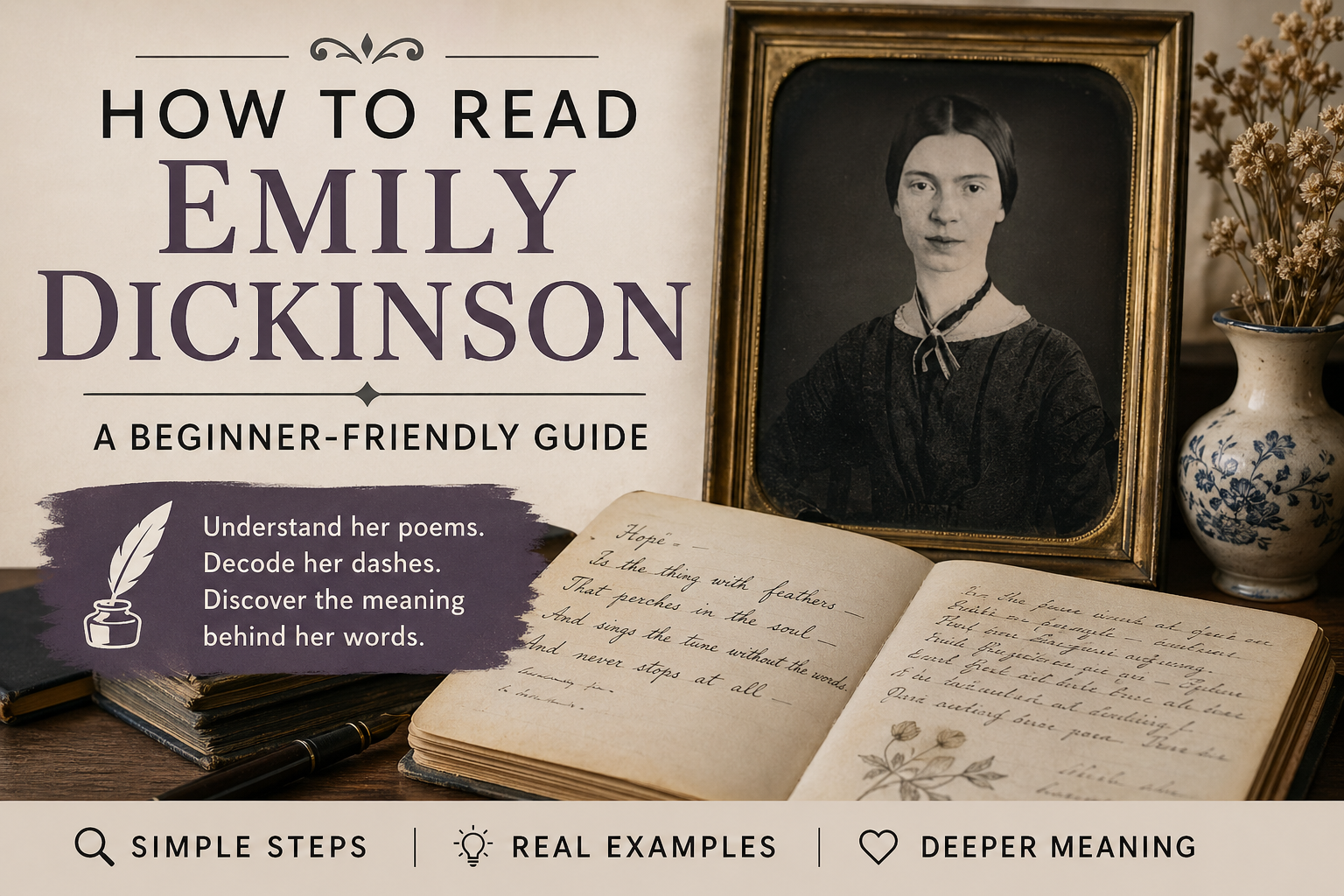
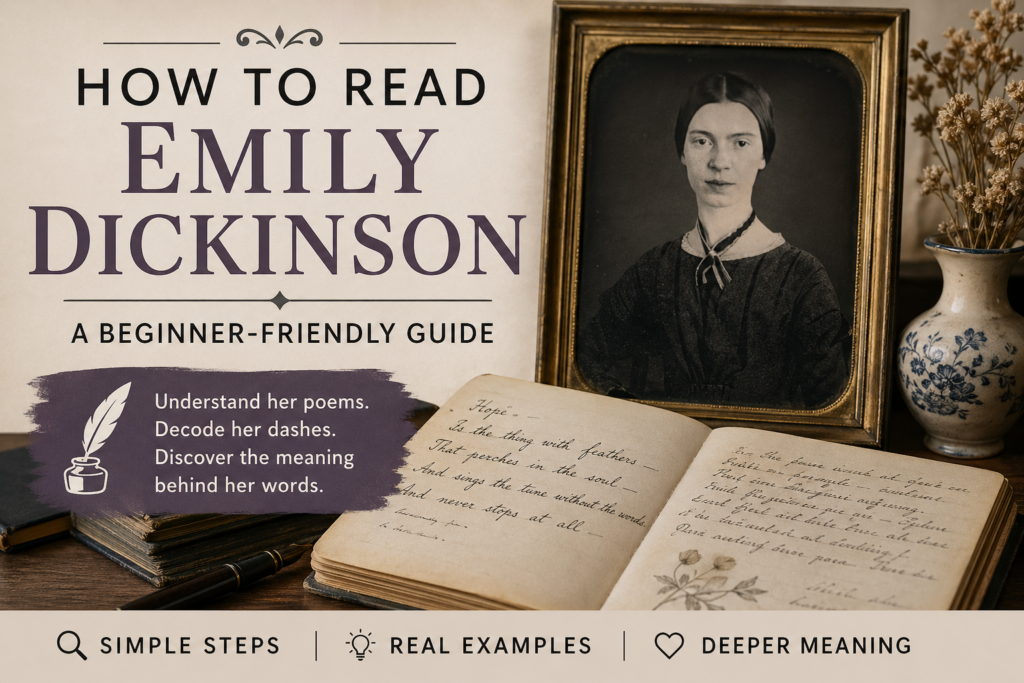
A clear, step-by-step way to understand Dickinson’s poems—even if they feel confusing at first
Emily Dickinson can feel strange the first time you read her. The short lines, the dashes, the capital letters, and the deep ideas can make even simple poems feel hard to follow. But once you learn how to read Emily Dickinson, her poems become surprisingly clear, powerful, and even personal. This guide will walk you through a simple method you can use right away, with real examples from her most famous poems.
This article contains affilate links.
In this Guide
Why Emily Dickinson feels difficult
Step 1: Read the poem slowly
Step 2: Look at punctuation and dashes
Step 3: Identify the speaker and situation
Step 4: Find the central idea or theme
Step 5: Notice imagery and symbolism
Step 6: Paraphrase the poem
Step 7: Connect it to a bigger meaning
FAQs about reading Emily Dickinson
Key takeaway
Why Learning How to Read Emily Dickinson Matters
Emily Dickinson’s poetry looks simple, but it carries deep meaning in very small spaces.
When you learn how to read Emily Dickinson, you are learning how to slow down and notice details. Her poems often deal with death, hope, faith, and the inner life, which makes them widely taught in schools. For example, in “Hope is the thing with feathers,” she turns hope into a bird. That sounds simple, but the meaning grows as you read more closely.
When learning how to read Emily Dickinson, the biggest mistake is rushing. Her poems are short, so each word matters.
For example, in “Because I could not stop for Death,” the opening line seems calm: “Because I could not stop for Death – He kindly stopped for me –”
At first, it sounds polite. But if you slow down, you notice something strange: Death is personified as a polite driver. That small detail changes the tone completely.
Her poems are compressed and leave out context. She expects readers to fill in the gaps.
What do the dashes mean?
They create pauses, emphasize ideas, and show shifts in thought or emotion.
Do Dickinson’s poems have one correct meaning?
No. Many poems allow for multiple interpretations, as long as they are supported by the text.
Where should beginners start?
Start with well-known poems like “Hope is the thing with feathers” and “Because I could not stop for Death.”
Key Takeaway
Learning how to read Emily Dickinson is about slowing down and noticing details. Her poems may look simple, but they reward careful reading. When you pay attention to punctuation, imagery, and theme, her work becomes clear and deeply meaningful.
How the American West shapes theme, character, and meaning in literature
The American West is more than a backdrop. In nature and isolation in Western writing, the land shapes how characters think, feel, and survive. Wide skies, long distances, and quiet towns create a kind of pressure that shows up in the writing itself. When you read Western literature, the land is never just scenery. It acts on people. It tests them. Sometimes, it often leaves them alone with themselves.
This guide will help you read the Western landscape as part of the story. You will see how nature creates isolation, how that isolation shapes character, and how both work together to build meaning.
This article contains affiliate links.
In This Guide
What makes the Western landscape different in literature
Across many regions, setting supports the story. In Western writing, setting often drives it.
The land is open and exposed. There are fewer boundaries, fewer crowds, and fewer places to hide. This creates a different kind of tension. Characters cannot rely on social structures in the same way they might in a city or a small, dense town. The result is a stronger focus on the individual.
Distance matters here. A long road or an empty field is not just visual detail. It suggests time, effort, and sometimes risk. When a character travels across that space, the journey becomes part of the meaning of the story.
Silence also plays a role. In Western landscapes, quiet is not peaceful in a simple sense. It can feel heavy. Sometimes it forces reflection. It can leave characters facing thoughts they would rather avoid.
Nature and Isolation in Western Writing: What Makes the Landscape Unique
Isolation in Western writing is rarely just about being alone. It often reveals something deeper about identity, fear, or belief.
Characters in these settings tend to face three kinds of isolation:
First, physical isolation. The land itself separates people. Homes are far apart. Help is not close. This creates a sense of vulnerability that shapes decisions.
Second, emotional isolation. Without constant interaction, characters may struggle to express what they feel. This can lead to restraint, distance, or quiet tension between people.
Third, existential isolation. The scale of the landscape can make a person feel small. This often leads to questions about purpose, meaning, and place in the world.
You can see this clearly in works like My Ántonia by Willa Cather, where the Nebraska prairie creates both freedom and loneliness, or in Blood Meridian by Cormac McCarthy, where the harsh land reflects a deeper moral emptiness.
Nature as a Force, Not a Backdrop
In Western writing, nature often acts on characters rather than sitting behind them.
Weather can shape the plot. A storm may delay travel or create danger. Heat can wear a character down. Cold can isolate them further. These are not small details. They influence what characters can do and how they feel.
The land can also mirror inner states. A dry, empty desert may reflect a sense of loss. A wide, open field may suggest possibility, but also uncertainty. Writers use these connections to deepen meaning without stating it directly.
This is especially clear in The Grapes of Wrath by John Steinbeck, where the Dust Bowl is both a real event and a symbol of hardship and displacement.
How Isolation Shapes Character
Characters in Western settings often develop in response to the land.
They may become self-reliant. With fewer resources and less support, they learn to solve problems on their own. This can create strength, but it can also lead to emotional distance.
They may become observant. In a quiet landscape, small details matter. A change in weather, a distant figure, or a shift in light can carry meaning. Characters learn to notice what others might miss.
They may struggle with connection. When people are spread out, relationships can feel fragile. This can lead to missed opportunities or unspoken feelings.
When you read, watch how a character changes over time. Ask how much of that change comes from the land itself. In Western writing, the answer is often more than you expect.
How to Analyze Landscape in Any Text
You can apply a simple method when reading Western literature or any text where setting matters.
Start by asking what the land looks like. Focus on specific details. Is it open or closed, harsh or gentle, quiet or active?
Then ask how the land affects the character’s choices. Does it limit them, push them, or shape their path?
Next, look for emotional connections. Does the landscape reflect what the character feels, or does it contrast with it?
Finally, connect the setting to theme. Ask what the landscape suggests about larger ideas like freedom, survival, loneliness, or hope.
This approach keeps your analysis grounded in the text while still reaching deeper meaning.
Quick Reading Prompts
Use these when you are working through a Western text:
What does the landscape make possible, and what does it take away?
How does distance affect the character’s decisions?
Where do you see silence or emptiness, and what do they mean?
How would the story change in a different setting?
These questions can turn a simple reading into a more thoughtful analysis.
Why This Matters for Literary Analysis
When you begin to read landscape as part of the story, texts open up in new ways. You start to see how meaning is built through more than dialogue or plot. The environment becomes part of the language of the work.
For students, this skill strengthens essays and close readings. For general readers, it deepens the experience of the story. It allows you to see how writers use place to explore what it means to be human.
Key Takeaway
In Western writing, the landscape is never neutral. It shapes isolation, defines character, and carries meaning. When you learn to read the land, you begin to understand the story at a deeper level.
If you want step-by-step support with literary analysis, you can use these tools:
Why is the landscape so important in Western writing?
In Western literature, the landscape shapes the story in direct ways. The size of the land, the distance between people, and the quiet all affect how characters think and act. The setting often creates pressure that drives decisions, conflict, and growth.
What does isolation mean in Western literature?
Isolation in Western writing goes beyond being alone. It can be physical, emotional, or even spiritual. Characters may be separated by distance, struggle to connect with others, or feel small in a vast world. This isolation often reveals deeper truths about identity and purpose.
How does nature influence character development?
Nature often forces characters to adapt. Harsh weather, long distances, and limited resources can make characters more independent, but also more distant from others. These conditions shape how they respond to conflict and how they relate to the world around them.
How can I analyze landscape in a literary essay?
Start by describing the setting clearly. Then connect it to character choices and emotional tone. Finally, explain how the landscape supports the theme. Focus on how the environment influences action and meaning, rather than treating it as background detail.
Is this approach useful outside of Western literature?
Yes. While it is especially clear in Western writing, this approach works in any text where setting matters. Learning to read landscape as part of the story will strengthen your analysis across many types of literature.
What are examples of books that show nature and isolation in the American West?
Works like My Ántonia by Willa Cather, The Grapes of Wrath by John Steinbeck, and Blood Meridian by Cormac McCarthy all explore how the Western landscape shapes human experience. Each text uses the land to reflect deeper emotional and thematic concerns.
How Close Reading, Paradox, and Imagery Reveal Meaning in Dickinson’s Poetry
Literary theory gives us different lenses for interpreting literature. Each theory asks us to look at a text in a different way. Some theories focus on history. Some focus on the author. Others focus on culture or politics. New Criticism (also known as Formalism) is different because it tells us to focus only on the text itself.
When we read Emily Dickinson through New Criticism, we begin to notice how much meaning is hidden in her word choice, punctuation, rhyme, and imagery. Her poems are short, but they are very dense.
What New Criticism Is Key Ideas of New Criticism New Criticism Emily Dickinson Analysis Example Passages and Analysis How to Write a New Criticism Essay Final Thoughts FAQ
Image by Carla Paton
What Is New Criticism?
New Criticism Emily Dickinson begins with a simple idea: the meaning of a poem is inside the poem itself. We do not need the author’s biography. We do not need historical background. And, we do not need to know what the author intended.
Instead, we look closely at the words on the page. We pay attention to imagery, rhyme, paradox, irony, tone, and structure. New Critics believed that a poem is like a machine. Each part works together to create meaning.
New Criticism Emily Dickinson analysis usually focuses on a few important ideas. The first is close reading, which means reading slowly and paying attention to every word.
The second is paradox, which is when a poem contains ideas that seem to contradict each other but are both true.
The third is irony, where the meaning is different from what we expect.
The fourth is tension, which is the conflict between different ideas in the poem.
The fifth is unity, which means that all parts of the poem work together to create a single meaning.
Dickinson’s poetry is full of paradox and tension, which is why New Criticism works so well with her poems.
New Criticism Emily Dickinson analysis works well because Dickinson’s poems are very compact. She uses dashes, slant rhyme, and unusual capitalization. These are not random choices. New Critics would say that every punctuation mark matters. Every word matters. Every sound matters.
For example, in the poem “Because I could not stop for Death,” Death is described as kind and polite. This creates tension because death is normally frightening. The poem creates meaning through this contrast.
The slow rhythm of the poem also mirrors the slow carriage ride toward death. A New Critic would focus on how the rhythm, imagery, and tone all work together to create meaning.
Not on Dickinson’s life. Not on history. Only on the poem.
Let’s look at a short example from Emily Dickinson:
“Hope is the thing with feathers That perches in the soul”
A New Criticism Emily Dickinson reading would focus on the metaphor of the bird. Hope is not described as an idea. It is described as a living creature. The word “perches” suggests that hope stays and does not leave easily. The image of feathers suggests something light and gentle.
The poem never clearly defines hope, but the metaphor helps us understand it emotionally. The poem also creates tension because hope sings during storms. This creates a contrast between suffering and comfort.
A New Critic would argue that the meaning of the poem comes from this contrast and from the extended metaphor.
If you are writing a New Criticism Emily Dickinson essay, focus only on the poem. Do not write about Dickinson’s biography. Do not write about history unless it appears in the poem itself.
Start with a thesis about how the poem creates meaning through literary devices. Then write body paragraphs about imagery, paradox, tone, and structure.
Always include short quotations from the poem as evidence. Then explain how the words create meaning.
New Criticism Emily Dickinson analysis teaches us an important lesson. Great poems are carefully constructed. Every word matters. Every image matters. When we slow down and read carefully, we begin to see patterns, contrasts, and symbols that we did not notice at first.
Emily Dickinson’s poetry is perfect for this kind of reading because her poems are short but full of meaning. New Criticism helps us see how much meaning can fit into just a few lines of poetry. Once you learn this method, you will start to see poetry differently. You will start to see that poems are not just written. They are built.
Key Takeaway
New Criticism teaches us to focus on the text itself, and Emily Dickinson’s poetry shows us why this method works so well. Her poems create meaning through imagery, paradox, irony, and structure, and close reading helps us see how all the parts work together.
FAQ – New Criticism Emily Dickinson
What is New Criticism in simple terms?
New Criticism is a way of reading literature that focuses only on the text itself, not the author’s life or historical background.
Why is Emily Dickinson good for New Criticism?
Her poems are short, dense, and full of literary devices like paradox, symbolism, and irony, which makes them perfect for close reading.
What literary devices do New Critics look for?
They often look for paradox, irony, symbolism, imagery, tone, and structure.
Do New Critics care about the author’s life?
No. New Criticism focuses only on the text itself.
How do you write a New Criticism essay?
Focus on literary devices, include quotations, and explain how the words create meaning.
How to recognize the tools poets use to create meaning, emotion, and beauty
Poetry can sometimes feel confusing when you first read it. The language may seem strange, the lines may be short, and the meaning may not be obvious at first. Many students feel lost because poems do not always tell a clear story the way a novel does. But once you understand literary devices in poetry, poems become much easier to understand and much more enjoyable to read.
Poets use literary devices as tools. These tools help them create images, express emotions, and communicate ideas in powerful ways. When you learn to recognize these tools, you begin to see how a poem works instead of just guessing what it means.
Key idea: Literary devices are the tools poets use to create meaning.
In this guide, we will look at the most important literary devices in poetry, how to recognize them, and how they help you understand a poem more deeply.
In this Guide 📚
What are literary devices in poetry Why poets use literary devices Imagery Metaphor Simile Symbolism Personification Sound devices How literary devices create theme How to analyze literary devices in poetry
Image by Carla Paton
What Are Literary Devices in Poetry?
Literary devices in poetry are techniques that poets use to create meaning, emotion, and imagery. These devices include metaphor, simile, symbolism, imagery, personification, alliteration, and many others.
When poets write, they do not usually explain everything directly. Instead, they show ideas through language. Literary devices help them do this.
For example, instead of saying “I feel sad,” a poet might describe a dark sky, a cold wind, or a dying flower. These images help the reader feel the emotion rather than just read about it.
Poets use literary devices because poetry is meant to be felt as well as understood. Literary devices help poets compress meaning into a small number of words.
A poem is usually short, so every word matters. Literary devices allow poets to say more with fewer words.
For example, in Emily Dickinson’s poem: “Hope is the thing with feathers That perches in the soul”
Dickinson does not define hope in a dictionary way. Instead, she uses a metaphor. She compares hope to a bird. This image helps the reader understand that hope is alive, gentle, and always present.
This is why literary devices in poetry are not decorations. They are the meaning.
Imagery is one of the most important literary devices in poetry. Imagery is language that appeals to the senses. It helps the reader see, hear, feel, smell, or taste what is happening in the poem.
Consider these lines from William Wordsworth: “I wandered lonely as a cloud That floats on high o’er vales and hills”
This image helps us see the speaker floating above the landscape. The image also creates a feeling of calm and quiet.
When you look for imagery, ask yourself: What do I see? What do I hear? What do I feel?
Metaphor and simile are comparisons. They show how two different things are similar.
A simile uses the words “like” or “as.” A metaphor does not.
Example of simile from Robert Burns: “O my Luve’s like a red, red rose”
Example of metaphor from Langston Hughes: “Life is a broken-winged bird That cannot fly”
These comparisons help readers understand ideas through images. Instead of explaining life in abstract terms, Hughes compares life to a bird that cannot fly. This creates a strong emotional image.
When you find a metaphor or simile, ask what the comparison is trying to show you.
Symbolism in Poetry
Symbolism is when an object represents a larger idea.
In Robert Frost’s poem “The Road Not Taken,” the road is not just a road. It represents life choices.
Symbols often represent ideas like: Life Death Hope Freedom Time Innocence
Personification is when human qualities are given to animals, objects, or ideas.
Example from Emily Dickinson: “Because I could not stop for Death – He kindly stopped for me”
Death is described as a polite person. This changes how we think about death. Instead of something frightening, it becomes something calm and inevitable.
Personification helps poets turn abstract ideas into characters.
Sound Devices in Poetry
Poetry is meant to be heard as well as read. Sound devices are very important literary devices in poetry.
Common sound devices include: Alliteration – repetition of beginning sounds Assonance – repetition of vowel sounds Consonance – repetition of consonant sounds Rhyme – repetition of end sounds
Example of alliteration from Edgar Allan Poe: “While I nodded, nearly napping”
The repetition of the “n” sound creates rhythm and mood.
Sound devices help create music in poetry, which affects how the poem feels.
Image by Carla Paton
How Literary Devices Create Theme
Literary devices are not just small techniques. They help create the theme of the poem.
Theme is the main idea or message of a poem. Poets develop theme through imagery, symbolism, metaphor, and other literary devices.
For example, in many poems, night may symbolize death or loneliness, while morning may symbolize hope or new beginnings.
When analyzing literary devices in poetry, follow this simple process:
First, read the poem slowly. Second, look for imagery and comparisons. Third, look for symbols. Fourth, think about how these devices connect to the theme.
AffiliateThese are excellent resources for understanding literary devices in poetry and learning how to analyze poems more confidently. (Affilate links)
Literary devices in poetry are the tools poets use to create meaning, emotion, and theme. When you learn to recognize imagery, metaphor, symbolism, personification, and sound devices, poetry becomes clearer and more meaningful. Instead of feeling confusing, poems begin to feel like puzzles that you know how to solve.
FAQ – Literary Devices in Poetry
What are literary devices in poetry?
Literary devices in poetry are techniques such as metaphor, simile, imagery, symbolism, and sound devices that poets use to create meaning and emotion.
What are the most common literary devices in poetry?
The most common literary devices in poetry include imagery, metaphor, simile, symbolism, personification, alliteration, and rhyme.
Why are literary devices important in poetry?
Literary devices are important because they help poets express complex ideas and emotions in a small number of words.
How do you identify literary devices in poetry?
Look for descriptive language, comparisons, repeated sounds, and objects that may represent larger ideas.
Understanding the Major Themes in To Kill a Mockingbird A novel about growing up, justice, and moral courage in a divided society.
The major themes in To Kill a Mockingbird (affiliate link) help readers understand why this novel is still widely taught in schools today. On the surface, the story is about Scout Finch growing up in a small Southern town, but beneath that story, the novel explores serious issues like racism, injustice, empathy, courage, and innocence. Harper Lee uses the experiences of Scout and Jem to show how people learn right and wrong in a complicated world. The trial of Tom Robinson is the central event of the novel, but the book is really about moral growth and learning to see the world from other people’s perspectives.
In this guide, we will look at the most important themes in To Kill a Mockingbird and how they appear throughout the novel.
In This Guide
Racism and Injustice Moral Courage Coming of Age Empathy Social Class Good vs Evil Education Innocence
Image by Carla Paton
Racism and Injustice in To Kill a Mockingbird
The trial of Tom Robinson shows how prejudice can destroy justice.
One of the most important themes in To Kill a Mockingbird is racism and injustice. This theme is most clearly shown during the trial of Tom Robinson. Even though Atticus proves that Tom Robinson is innocent, the jury still finds him guilty. This shows that racism in Maycomb is so powerful that it overrides truth and justice. The courtroom is supposed to be a place of fairness, but in this case, prejudice determines the outcome.
The novel also shows the hypocrisy of Maycomb. Many people in the town believe they are good and moral, yet they support a system that treats Black citizens unfairly. Scout even notices that her teacher criticizes Hitler for prejudice while ignoring racism in her own town. Harper Lee uses this contrast to show that people often recognize injustice in other places but fail to see it in their own communities.
Tom Robinson represents the most tragic example of this theme. He is an innocent man who is destroyed by a racist society, which connects directly to the symbol of the mockingbird — an innocent creature harmed by others.
Moral Courage in To Kill a Mockingbird
Doing what is right even when you know you might lose.
Another major theme in To Kill a Mockingbird is moral courage. Atticus Finch represents this theme more than any other character. He agrees to defend Tom Robinson even though he knows the town will criticize him and that he will probably lose the case. Atticus explains that he must defend Tom because he has to live with his own conscience.
The novel also shows courage through Mrs. Dubose, who fights to overcome her morphine addiction before she dies. Atticus explains to Jem that real courage is not about physical strength, but about doing what is right even when you know the situation is difficult or hopeless.
Even Scout shows courage when she stands up for Walter Cunningham and when she unknowingly stops the mob at the jail by speaking politely to Mr. Cunningham. The novel shows that courage can be quiet and moral, not just physical.
Coming of Age in To Kill a Mockingbird
Scout and Jem grow up and learn that the world is not always fair.
To Kill a Mockingbird is a coming-of-age novel because Scout and Jem grow up and learn important lessons about the world. At the beginning of the novel, they are innocent and believe that the world is fair. They believe Boo Radley is a monster and that the legal system always tells the truth.
As the novel progresses, Jem and Scout begin to understand that people are more complicated and that the world is not always fair. Jem especially struggles after Tom Robinson is found guilty because he believed that the truth would lead to justice. This moment represents Jem’s loss of innocence.
By the end of the novel, Scout learns the most important lesson of all — empathy. When she stands on Boo Radley’s porch and sees the world from his perspective, she finally understands what Atticus has been trying to teach her.
Empathy in To Kill a Mockingbird
“You never really understand a person until you climb into his skin and walk around in it.”
Empathy is one of the central themes in To Kill a Mockingbird. Atticus teaches Scout that she must try to understand people by seeing the world from their perspective. This lesson appears many times in the novel and helps Scout understand Boo Radley, Mayella Ewell, and even the people who hate Atticus.
Scout shows empathy when she understands why Walter Cunningham cannot accept lunch money and when she speaks to Mr. Cunningham at the jail. Her kindness reminds him that he is part of a community, and the mob leaves. This moment shows that empathy can be powerful enough to stop violence.
By the end of the novel, Scout understands Boo Radley and realizes that he has been protecting them the entire time. The novel suggests that many conflicts and injustices happen because people fail to understand one another.
Social Class in To Kill a Mockingbird
Maycomb is divided into strict social groups.
Social class is another importanttheme in To Kill a Mockingbird. The town of Maycomb is divided into different social groups, including wealthy families, poor farmers like the Cunninghams, and very poor families like the Ewells. Black citizens are at the bottom of the social structure because of racism.
The Ewells are especially important because even though they are poor and uneducated, they are still treated as socially superior to Black citizens. This shows that race is more important than class in Maycomb’s social system.
Through these social divisions, Harper Lee shows that social class is often unfair and does not reflect a person’s character or morality.
Good vs Evil in To Kill a Mockingbird
The novel shows both kindness and cruelty in human nature.
The novel explores the theme of good versus evil by showing both kindness and cruelty. Characters like Atticus, Scout, Jem, and Boo Radley represent kindness, compassion, and moral courage. Characters like Bob Ewell represent cruelty, hatred, and ignorance.
However, the novel does not suggest that people are completely good or completely evil. Instead, it shows that most people are a mixture of both. Mayella Ewell is a good example of this because she is both a victim and a person who causes injustice.
The conflict between good and evil is most clearly shown in the trial and in Bob Ewell’s attack on Scout and Jem. Boo Radley’s rescue of the children shows that good can exist even in a world where evil is present.
Education in To Kill a Mockingbird
The novel shows that true education is moral education.
Education is an important theme in the novel, but Harper Lee suggests that education is not just what students learn in school. Scout’s teacher represents formal education, but she does not understand the students or the town of Maycomb. In contrast, Atticus and Calpurnia teach Scout important life lessons about empathy, respect, and responsibility.
The novel suggests that true education means learning how to think, how to understand people, and how to do what is right.
Innocence in To Kill a Mockingbird
The mockingbird represents innocent people who are harmed by society.
Innocence is one of the most important themes in To Kill a Mockingbird, and it is closely connected to the symbol of the mockingbird. A mockingbird represents innocence because it does no harm and only brings beauty into the world. Tom Robinson and Boo Radley are both compared to mockingbirds because they are innocent but are harmed by others.
Children also represent innocence in the novel. Scout and Jem begin the story as innocent children, but as they learn about racism and injustice, they lose some of that innocence and gain understanding.
The novel suggests that innocence is something valuable that should be protected.
Why These Themes Matter
If you understand the themes in To Kill a Mockingbird, you understand the novel. Most essay questions and test questions focus on themes, especially racism, courage, innocence, and empathy. These themes help explain the characters, the symbols, and the major events in the story.
If you are studying the novel for school, it is important to understand:
The most important themes in To Kill a Mockingbird are racism and injustice, moral courage, empathy, innocence, and coming of age. The novel teaches that doing what is right is not always easy, that people must try to understand one another, and that innocent people must be protected. Scout’s journey from innocence to understanding is what gives the novel its lasting meaning.
FAQ – Themes in To Kill a Mockingbird
What is the main theme in To Kill a Mockingbird?
The main theme is racism and injustice, shown through Tom Robinson’s trial.
What theme does Atticus represent?
Atticus represents moral courage and justice.
What theme does Boo Radley represent?
Boo Radley represents empathy and innocence.
Is To Kill a Mockingbird a coming-of-age novel?
Yes, it is a coming-of-age novel because Scout and Jem grow up and learn important moral lessons.
Why is the mockingbird important?
The mockingbird represents innocent people who are harmed by society, especially Tom Robinson and Boo Radley.
Understanding The Scarlet Letter symbolism is one of the fastest ways to unlock the meaning of Nathaniel Hawthorne’s novel.
What looks like a simple story about punishment quickly becomes something deeper—a story about identity, guilt, and how symbols shape the way we see people. If you’ve ever felt confused about what the scarlet “A” actually represents, you’re not alone. This guide will walk you through the most important symbols and show how they change throughout the novel.
In This Guide 📚
What the scarlet letter “A” means
How the meaning of the “A” changes
Pearl as a living symbol
The symbolism of the scaffold
The meaning of the forest
Why symbolism matters in essays
Image by Carla Paton
The Scarlet Letter Symbolism: The Meaning of the “A”
This is the heart of The Scarlet Lettersymbolism, and it’s where most students begin. At first, the letter “A” stands for adultery. It is meant to shame Hester Prynne publicly and permanently. The Puritan community uses it as a way to define her entire identity based on a single sin. (affiliate link)
But Hawthorne does something surprising. Over time, the meaning of the letter begins to change. Some in the community begin to say it stands for “Able” because of Hester’s strength and service.
👉 Key insight: The letter never settles into one meaning. It represents shame, strength, identity, and transformation all at once.
💡 Symbols in literature often evolve. The scarlet letter is one of the clearest examples of this.
If you’re writing about this, a strong thesis might argue that the letter shows how society’s labels can change—but never fully disappear.
The Scarlet Letter Symbolism: Pearl as a Living Symbol
Pearl is not just a character—she is part of The Scarlet Letter symbolism.
She represents the living consequence of Hester’s sin, but also something more powerful.
Pearl constantly asks questions, points out hidden truths, and refuses to accept false appearances.
She is often described as wild, emotional, and unpredictable. This reflects her role as a symbol of truth and honesty in a world full of secrecy.
👉 Key insight: Pearl forces others—especially Dimmesdale—to face what they are trying to hide.
📌 “Pearl is the scarlet letter made alive.”
In essays, you can argue that Pearl represents truth that cannot be ignored, no matter how much characters try to hide it.
The Scarlet Letter Symbolism: The Scaffold
The scaffold is one of the most important physical symbols in the novel. It appears in three major scenes, and each one shows a different stage of truth and confession.
In the beginning, Hester stands on the scaffold alone, publicly shamed. Later, Dimmesdale stands there at night in secret. Finally, he stands there in daylight and confesses.
👉 Key insight: The scaffold represents the journey from hidden guilt to public truth.
💡 Hawthorne uses repeated settings as symbols. When a place appears multiple times, pay attention to how it changes.
For analysis, you can argue that the scaffold shows that true freedom only comes through honesty.
The Scarlet Letter Symbolism: The Forest
The forest is another key part of The Scarlet Letter symbolism.
Unlike the town, which represents law and judgment, the forest represents freedom and secrecy. It is the one place where characters can speak honestly without fear of punishment.
Hester and Dimmesdale meet there to reveal the truth about Chillingworth and imagine a new life.
👉 Key insight: The forest is a space outside society—but it is not entirely safe or pure.
🌲 The forest represents both freedom and moral uncertainty.
In essays, you might argue that Hawthorne uses the forest to show that escaping society does not solve inner conflict.
The Scarlet Letter Symbolism: Why It Matters
So why does The Scarlet Letter symbolism matter so much?
Because Hawthorne is not just telling a story—he is asking readers to interpret meaning. The symbols force us to think about identity, judgment, and truth.
👉 Key insight: Symbols turn a simple plot into a complex moral question.
If you understand the symbols, you understand the novel. And more importantly, you can write stronger essays.
The Scarlet Letter symbolism shows that meaning is never fixed. The scarlet “A,” Pearl, the scaffold, and the forest all reveal that identity is shaped by both society and inner truth—and those two things are rarely the same.
FAQ – Scarlet Letter Symbolism
What does the scarlet letter “A” symbolize?
It begins as a symbol of adultery but grows to represent strength, identity, and transformation.
Why is Pearl considered a symbol?
Pearl represents the living truth of Hester’s actions and constantly exposes hidden guilt.
What does the scaffold symbolize?
It represents public judgment, confession, and the movement from secrecy to truth.
What does the forest symbolize in The Scarlet Letter?
The forest represents freedom from society, but also moral uncertainty and hidden truths.
Why is symbolism important in The Scarlet Letter?
Symbolism is how Hawthorne communicates deeper meaning about guilt, identity, and judgment beyond the surface story.
Count Dracula is one of the most famous villains in literature, yet his role goes far beyond a simple monster. In Dracula, he represents something deeper and more unsettling. He stands as a symbol of fear, moral decay, and the spread of corruption within society.
When readers look closely at his actions, his influence, and his presence in the novel, they begin to see that Dracula is not just a character. He is a force that threatens both the body and the soul.
This article contains affiliate links.
In this Guide 📚
What Dracula represents in the novel
How fear shapes his character
How corruption spreads through his victims
Why Dracula’s power goes beyond physical danger
What his defeat reveals about the novel’s message
Image by Carla Paton
Count Dracula as a Symbol of Fear and Corruption
Dracula is more than a villain. He represents a deeper threat that spreads through fear and moral decay.
At the beginning of the novel, Count Dracula appears calm, polite, and even refined. Jonathan Harker meets a nobleman who speaks with care and shows control. Yet something feels wrong from the start. His strange habits and silent movements create unease long before his true nature is revealed.
This early tension matters because it shows that fear does not always appear in obvious ways. Dracula does not rely on loud violence at first. He creates fear through mystery and uncertainty. Readers feel this same unease as Harker slowly realizes he is trapped in the castle.
📌 Key Insight: Fear in Dracula begins with the unknown, not with open danger.
Image by Carla Paton
How Dracula Represents Fear
Dracula’s power comes from his ability to appear, disappear, and remain unseen.
As the novel moves forward, Dracula’s supernatural abilities deepen this fear. He can change form, travel through darkness, and strike without warning. These traits make him difficult to fight because he cannot be understood in normal terms.
The characters struggle not just against a physical enemy, but against something they cannot fully explain. This sense of helplessness increases the tension of the story. Fear grows stronger when people feel they have no control.
Dracula’s presence also creates fear in the minds of his victims. He invades their thoughts and weakens their sense of self. This makes his threat feel personal and psychological, not just physical.
💬 “Fear grows strongest when it cannot be clearly seen or understood.”
Image by Carla Paton
How Dracula Symbolizes Corruption
Dracula does not only harm his victims—he changes them.
One of the clearest examples of corruption appears in Lucy Westenra. She begins as kind and gentle, yet after Dracula’s attacks, she transforms into something dangerous. Her change shows how Dracula spreads his influence like a disease.
This transformation is not just about becoming a vampire. It represents the loss of innocence and moral stability. Lucy becomes a version of herself that reflects Dracula’s influence rather than her own character.
Mina Harker’s experience deepens this idea. Even though she is strong and intelligent, Dracula forms a connection with her that threatens her mind and identity. This shows that no one is fully safe from corruption, even those with strong character.
📌 Key Insight: Corruption in Dracula spreads quietly, often before anyone realizes it is happening.
Dracula’s Power Over Others
Dracula seeks control, not just survival.
Dracula does not act randomly. He plans carefully and moves with purpose. His journey from Transylvania to England shows his desire to expand his reach. He wants to spread his influence into new places and create more victims.
This ambition makes him more than a monster. He becomes a symbol of invading corruption that moves through society. His goal is not only to exist, but to multiply his power through others.
The group led by Van Helsing must work together to stop him. Their unity stands in contrast to Dracula’s isolation and control. This contrast highlights the difference between community and corruption.
💬 “Where Dracula divides and dominates, the others unite and resist.”
What Dracula’s Defeat Reveals
The ending of the novel shows that fear and corruption can be overcome.
Dracula’s defeat does not come from one person alone. It requires trust, courage, and shared purpose. Each character plays a role in stopping him, which suggests that evil cannot be defeated in isolation.
The novel presents a clear message. Fear may spread quickly, and corruption may take root, but they are not unstoppable. When people stand together with conviction, they can resist even the darkest forces.
This ending gives the story its lasting meaning. Dracula may be powerful, but he is not invincible.
Image by Carla Paton
Why This Symbol Still Matters Today
Dracula remains powerful because his meaning goes beyond the story.
Readers still connect with Dracula because he represents fears that feel real. The fear of losing control, the fear of hidden danger, and the fear of moral decline all appear in modern life as well.
His character reminds us that the greatest threats are often the ones that spread quietly. They do not always appear as clear enemies. Instead, they work beneath the surface, shaping thoughts and actions over time.
Key Takeaway ✨
Count Dracula represents both fear and corruption, showing how evil can spread through secrecy, influence, and control—but also how it can be defeated through courage and unity.
FAQ – Count Dracula as a symbol of fear and corruption
Why is Dracula considered a symbol instead of just a villain?
Because his actions represent larger ideas like fear, moral decay, and loss of control rather than simple physical danger.
How does Dracula create fear in the novel?
He uses mystery, unpredictability, and psychological control, which makes him difficult to understand and resist.
What does Lucy’s transformation represent?
It shows how corruption spreads and how innocence can be lost through Dracula’s influence.
Why is Mina important to the symbolism?
She shows that even strong individuals can be affected, which makes Dracula’s threat more serious.
What is the main message of Dracula?
That fear and corruption are powerful, but they can be overcome through unity and moral strength.