If you have ever read a story about a young person who grows up, makes hard choices, and learns who they are, you may have read a bildungsroman. So, What Is a Bildungsroman? It is one of the most common and useful story types in literature.
This guide explains the term in simple language, shows why it matters, and gives examples you may know from class.
A bildungsroman is a story about personal growth from youth toward maturity.
The word comes from German. “Bildung” means education or formation, and “roman” means novel. A bildungsroman is often called a coming-of-age novel.
The short answer to What Is a Bildungsroman? is this: it is a novel that follows a character as they grow, learn, and change. The change is not just about age. It is about how the character sees the world.
In many bildungsroman stories, the main character starts with a limited view of life. By the end, they understand more about themselves and their place in society.
What Is a Bildungsroman? Key Traits to Notice
Most bildungsroman novels share a few clear patterns.
When a teacher asks, What Is a Bildungsroman?, they often want you to look for growth over time. The main character usually faces pressure from family, school, class, or society.
A bildungsroman often includes a young main character who feels out of place. That character may struggle with rules, unfair treatment, or a painful truth.
The story also tends to include a turning point. This moment forces the character to see life in a new way.
By the end, the character may not become happy or successful. But they usually gain self-knowledge. That inner change is what matters most.
What Is a Bildungsroman? Why It Matters in Literature
This story type helps readers track how people change under pressure.
The question What Is a Bildungsroman? matters because many major novels use this form. It gives writers a way to explore identity, class, race, gender, and belief without turning the story into a lecture.
For students, the bildungsroman is useful because it connects plot to character development. You can ask, “What did the character believe at the start?” Then ask, “What do they understand by the end?”
This can help with essays, class talks, and close reading. If you want a broader method for studying fiction, see this guide on how to read literature with a scholar’s eye.
Famous Bildungsroman Examples
Some of the most studied novels in English fit this pattern.
Jane Eyre by Charlotte Brontë is a classic bildungsroman. Jane begins as an orphan with little power. As the novel moves forward, she learns to defend her dignity and choose her own path.
Great Expectations by Charles Dickens also fits the form. Pip grows up with dreams of becoming a gentleman. His journey teaches him painful lessons about pride, love, and social class.
To Kill a Mockingbird by Harper Lee can be read as a bildungsroman, too. Scout Finch learns that the adult world can be unfair and cruel. Her growth comes from seeing people with more depth.
The Catcher in the Rye by J.D. Salinger is another common example. Holden Caulfield resists adulthood, but his voice shows fear, grief, and confusion beneath his anger.
If you ask What Is a Bildungsroman? while you read these books, focus on the character’s inner shift. The plot matters, but the growth matters more.
A bildungsroman is a novel about a character’s growth from youth toward maturity. It often focuses on identity, self-knowledge, and life lessons.
Is every coming-of-age story a bildungsroman?
Not always. A coming-of-age story may cover one key moment, while a bildungsroman often follows deeper growth over a longer span.
What is the main goal of a bildungsroman?
The main goal is to show how a character changes. The focus is not just what happens, but what the character learns.
Can a bildungsroman have a sad ending?
Yes. The ending does not need to be happy. The character may still gain insight, even after pain or failure.
Key Takeaway
What Is a Bildungsroman? It is a growth story that shows how a character becomes more aware of the world and themselves. When you read one, look for the moments that change how the character thinks, chooses, and sees life.
Understanding the themes in One Flew Over the Cuckoo’s Nest helps you see why Ken Kesey’s novel still matters in English classes today.
The book is not only about a hospital ward. It is about power, fear, freedom, and the fight to keep a human self alive.
In this Guide
Use this guide to track the novel’s biggest ideas and build stronger class notes.
Major themes at a glance
Control and institutional power
Freedom and conformity
Sanity and identity
Rebellion and sacrifice
Gender, power, and dated ideas
How to write about the novel
FAQ
Themes in One Flew Over the Cuckoo’s Nest at a Glance
The novel’s themes grow from the conflict between the individual and a system built to control him.
A strong reading of the themes in One Flew Over the Cuckoo’s Nest starts with the ward itself. The hospital seems calm on the surface, but it often works through fear, routine, and shame.
Chief Bromden sees this system as part of “the Combine,” his name for a huge social machine. His view may not always be literal, but it shows how trapped the patients feel.
McMurphy enters the ward as a force of disorder and energy. He challenges the rules, and his actions expose how much power Nurse Ratched holds over the men.
Themes in One Flew Over the Cuckoo’s Nest: Control and Institutional Power
Kesey shows how a system can control people without using open violence all the time.
Among the themes in One Flew Over the Cuckoo’s Nest, control is one of the most important. Nurse Ratched controls the ward through schedules, group meetings, medication, and public embarrassment.
Her power comes from making the men doubt themselves. If a patient feels weak, childish, or guilty, he is easier to manage.
The ward is not only a hospital in this reading. It becomes a symbol of any institution that values order more than real human life.
This is why the novel pairs well with George Orwell’s 1984. Both books show systems that crush private thought, though Kesey’s world feels more personal and psychological.
Themes in One Flew Over the Cuckoo’s Nest: Freedom and Conformity
The novel asks whether freedom is worth the risk of pain.
This is one of the clearest themes in One Flew Over the Cuckoo’s Nest because McMurphy refuses to act like the ward wants him to act. He jokes, gambles, argues, and laughs loudly.
At first, some patients see him as reckless. Over time, his confidence helps them remember that they have choices.
The fishing trip is a key example. Away from the ward, the men feel more capable and alive. They are still afraid, but they are no longer only patients in a system.
Kesey does not make freedom simple. McMurphy’s resistance has a cost, and the novel asks readers to think about how much a person should risk for dignity.
Sanity, Identity, and Who Gets to Define Normal
The novel challenges the line between “sane” and “insane.”
Chief Bromden’s narration makes this theme complex. He sees fog, wires, and machines, but his strange vision often reveals emotional truth.
The ward calls the men sick, yet the outside world also seems cruel and unhealthy. Kesey suggests that society may label people as “abnormal” because they do not fit its rules.
This theme is useful to compare with Charlotte Perkins Gilman’s The Yellow Wallpaper. In both texts, a person’s voice is ignored by those who claim to know what is best.
Students should be careful here. The novel uses old and sometimes harmful ideas about mental illness, but it still raises a serious question: who has the power to define reality?
Rebellion, Sacrifice, and the Cost of Resistance
McMurphy’s rebellion gives others courage, but it also makes him a target.
At first, McMurphy fights Nurse Ratched for selfish reasons. He wants comfort, status, and control over his own time.
Later, his role changes. He begins to see how much the other men need someone to stand up for them.
His final punishment shows how dangerous resistance can be in a closed system. Still, his influence remains after he cannot speak for himself.
Chief Bromden’s ending matters because it proves McMurphy’s rebellion was not wasted. Chief acts, escapes, and claims a life beyond the ward.
Kesey links power, masculinity, and fear in ways students should read with care.
Nurse Ratched is one of the most famous authority figures in modern fiction. She works through calm speech and strict control, not through loud anger.
The novel often presents her power as threatening because she is a woman with authority over men. That part of the book reflects dated gender ideas, and readers should not ignore it.
A strong essay can analyze this tension. You can argue that the novel attacks oppressive power, while also using troubling ideas about women and masculinity.
This makes the book more complex, not less. Literature often asks us to study both what a text reveals and what it fails to question.
Narration, Symbols, and Hidden Meaning
Chief Bromden’s voice shapes how readers understand the ward.
Because Chief narrates the story, readers see the hospital through fear, memory, and symbol. His “fog” shows confusion and emotional escape.
The machine images show how unnatural the ward feels to him. People seem turned into parts of a system, not treated as full human beings.
Laughter becomes another key symbol. When McMurphy laughs, he shows that Nurse Ratched does not control his whole spirit.
The best novels about literary symbolism help readers notice how objects, colors, places, and actions can carry deeper meaning. These books are useful for high school, AP Literature, and college students because they make close reading feel less scary and more rewarding.
Why the Best Novels About Literary Symbolism Matter
Symbolism turns a story into something deeper than plot.
In literature, a symbol is often a real thing that points to a larger idea. A light can suggest hope. A road can suggest choice. A house can suggest memory, fear, or family history.
The best novels about literary symbolism do not hide meaning from readers. They invite readers to look closer.
For students, this matters a lot. Symbolism often appears in essays, class talks, and AP Literature prompts. Once you learn how symbols work, you can explain theme with more confidence.
These books are strong choices because their symbols are clear, rich, and often taught in school.
When people discuss the best novels about literary symbolism, The Great Gatsby by F. Scott Fitzgerald is usually near the top. The green light across the water is one of the most famous symbols in American literature.
That light points to Gatsby’s dream of winning Daisy back. It also points to the American Dream itself, which looks bright from far away but may be impossible to reach.
Lord of the Flies by William Golding is another strong example. The conch shell stands for order, rules, and shared power. As the boys lose respect for the shell, their small society falls apart.
In To Kill a Mockingbird by Harper Lee, the mockingbird becomes a symbol of innocence. The novel teaches that harming innocent people is a moral failure.
The Scarlet Letter by Nathaniel Hawthorne also belongs in any talk about the best novels about literary symbolism. The letter “A” begins as a public mark of shame, but its meaning changes as Hester Prynne grows stronger.
Common Symbols and Themes to Watch For
Many novels use symbols that connect to big human questions.
One common symbol is color. In The Great Gatsby, green suggests desire, money, and hope. White can suggest beauty, but it can also hide emptiness or carelessness.
Nature is another common symbol. In The Grapes of Wrath by John Steinbeck, land, dust, and weather reflect hardship and survival. The natural world is not just a setting. It helps shape the novel’s meaning.
Objects often carry emotional weight. A letter, a shell, a ring, or a house may seem simple at first. Over time, that object can reveal guilt, love, power, or loss.
Many of the best novels about literary symbolism also link symbols to theme. A symbol is not just “there.” It helps the reader understand what the book says about life.
How to Read the Best Novels About Literary Symbolism
You do not need to guess wildly to find symbols.
Start by noticing anything that repeats. If an object, color, place, or phrase appears more than once, the writer may want you to pay attention.
Then ask what the symbol connects to. Does it appear during moments of fear, hope, conflict, or change?
Next, look at how the symbol shifts. In the best novels about literary symbolism, symbols often grow more complex as the story moves forward.
For example, the green light in The Great Gatsby first feels romantic. By the end, it feels sadder because Gatsby’s dream cannot survive reality.
A good rule is this: a symbol should connect to the story’s theme. If your idea about a symbol helps explain the book’s message, you are likely on the right track.
Symbolism matters most when it supports the theme of a novel.
In Beloved by Toni Morrison, the house at 124 is more than a place. It holds grief, trauma, memory, and the pain of slavery. The house feels alive because the past has not stayed in the past.
In Animal Farm by George Orwell, the farm represents a political system. The animals stand for groups of people, leaders, and social classes. The symbols help readers understand corruption and power.
In Jane Eyre by Charlotte Brontë, fire and ice often reflect emotion, control, and inner struggle. These images help readers see Jane’s fight for love and self-respect.
That is why the best novels about literary symbolism stay with us. They give us pictures we remember, then link those pictures to ideas we keep thinking about.
Recommended Books to Add to Your Shelf
These novels are easy to find and useful for students who want to study symbolism more closely.
The Great Gatsby by F. Scott Fitzgerald is a short novel with rich symbols. It is a smart pick for students who want to practice close reading.
Beloved by Toni Morrison is more advanced, but it is powerful. Its symbols connect deeply to memory, history, and identity.
These are two of the best novels about literary symbolism because each one rewards slow, careful reading.
Why Students Should Read Symbolic Novels
Symbolic novels help students build stronger reading habits.
They teach you to ask better questions. Why does this object return? Why does this color matter? Why does this place feel so important?
They also help with writing. If you can explain how a symbol supports a theme, your essay will sound more focused and thoughtful.
The best novels about literary symbolism are not only useful for class. They help readers see how stories can hold more than one meaning at the same time.
FAQs About the Best Novels About Literary Symbolism
What are the best novels about literary symbolism for beginners?
The Great Gatsby, Lord of the Flies, and To Kill a Mockingbird are strong beginner choices. Their symbols are clear but still deep enough for essays.
Why do authors use symbolism?
Authors use symbolism to add meaning without stating every idea directly. A symbol can make a theme feel more powerful and memorable.
How can I tell if something is a symbol?
Look for repetition, strong emotion, and links to theme. If an object or image keeps returning at key moments, it may be symbolic.
Are the best novels about literary symbolism hard to read?
Some are challenging, but many are very readable. Start with shorter novels, then move to more complex books as your confidence grows.
Key Takeaway
The best novels about literary symbolism teach us that stories often say more than they first seem to say. When you learn to notice symbols, you read with sharper eyes and find deeper meaning in every chapter. 📚
Joseph Heller’s Catch-22 turns war into a maze where rules sound logical but feel ridiculous. This guide to Catch-22 quotes explained helps students understand key lines, major themes, and smart ways to use them in essays.
In this Guide
Use this quick map to find the passage help you need.
Why Catch-22 still matters
The quote that explains the trap
Satire, fear, and survival
Power and absurd rules
How to use quotes in essays
Related books
FAQ
Catch-22 Quotes Explained: Why the Novel Still Matters
Heller uses comedy to show a world where common sense has failed.
Catch-22 is a war novel, but it is also a book about language. People in power use words to hide harm. That is why Catch-22 quotes explained often focus on rules that sound fair but trap people.
The novel follows Yossarian, a U.S. Army Air Forces bombardier in World War II. He wants to stay alive, but the system keeps sending him back into danger.
Catch-22 Quotes Explained: The Rule That Traps Yossarian
This short line names the central problem of the whole novel.
There was only one catch and that was Catch-22.
This quote matters because it shows the book’s main idea: the rule is built so no one can escape it. If a pilot asks to stop flying because he fears death, that fear proves he is sane. Since he is sane, he must keep flying.
If he does not fear death, he may be not be sane, but he will not ask to be removed. The logic folds in on itself.
Catch-22 quotes explained often point to this moment because it turns a military rule into a symbol. Today, people use the term catch-22 for any situation where every choice leads back to the same trap.
In an essay, you could argue that Heller uses circular logic to attack systems that protect themselves instead of people. This is similar to George Orwell’s 1984, where official language twists truth until lies sound normal.
Catch-22 Quotes Explained: Why the Joke Feels So Dark
The humor works because the situation is not funny for the men inside it.
That’s some catch, that Catch-22.
This line sounds casual, but it points to something cruel. The speaker sees the trap, understands it, and still cannot change it.
That is one reason the novel’s comedy is powerful. Heller does not use jokes to soften war. He uses jokes to show how strange and brutal war can feel.
For students, this passage is useful for writing about satire. Satire uses humor to expose a flaw in society. You can read more about the term in Britannica’s guide to satire.
Catch-22 Quotes Explained: Satire and War
Heller challenges the idea that war always creates clear heroes and clear enemies.
The enemy is anybody who’s going to get you killed.
This quote flips the usual war story. The enemy is not only the opposing side. For Yossarian, the enemy can also be anyone who treats his life as expendable.
That idea makes the novel feel more personal. Yossarian is not trying to be noble. He is trying to survive.
Catch-22 quotes explained in this way can help students write about moral confusion. The novel asks a hard question: what happens when a soldier fears his own leaders as much as the official enemy?
A strong comparison is Erich Maria Remarque’s All Quiet on the Western Front. Both books show how soldiers may feel trapped by commands, pride, and empty slogans.
Some of the novel’s shortest lines show Yossarian’s deepest conflict.
They’re trying to kill me.
Other characters may treat Yossarian as odd or selfish, but this line has a clear logic. In war, people really are trying to kill him.
The power of the quote comes from its double meaning. Yossarian sounds paranoid, yet he is also right.
This is useful in an essay about dramatic irony. Readers can see that Yossarian’s fear is not simple cowardice. It is a sane response to an out-of-control situation.
It was love at first sight.
This famous opening line sounds like it belongs in a romance. Heller uses it to set a strange tone right away.
The line pulls readers in with a familiar phrase, then the novel quickly bends that expectation. That shift prepares us for a story where serious events arrive in absurd forms.
Catch-22 Quotes Explained: Power, Paperwork, and Absurd Rules
The novel often shows power as a system of forms, orders, and excuses.
Many important moments in Catch-22 are not about battle scenes. They are about rules no one can question.
Officers raise the number of required missions. Men are moved around by paperwork. People speak in official language that hides pain.
Catch-22 quotes explained through this lens can support an essay about bureaucracy. In the novel, paperwork can become more powerful than human life.
How Students Can Use Catch-22 Quotes Explained in Essays
A good quote does not explain itself. Your job is to connect it to a claim.
The best Catch-22 quotes explained in essays follow a simple pattern. First, make a point about the novel. Then give brief context for the passage. After that, explain the words that matter most.
For example, do not just place the line about Catch-22 into a paragraph. Explain how the rule traps Yossarian and protects the system from blame.
A strong sentence might look like this:
Heller uses the rule of Catch-22 to show how authority can make injustice look logical.
Then you can use a short quote as proof and explain how the wording supports your point.
Books About Villains and Moral Complexity Every Student Should Read
Great villains do more than scare us. Books about Villains and Moral Complexity show how fear, pride, pain, and power can shape a person’s choices.
These stories help students ask deeper questions about guilt, justice, and what makes a character truly “bad.”
In this Guide
Why morally complex villains matter
Best books about villains and difficult choices
Symbols and themes linked to villain characters
How to study villains in class essays
FAQs about villains in literature
Why Villains and Moral Complexity Matter in Literature
The best villains often feel human, even when their actions are cruel.
A flat villain does evil just because the plot needs danger. A complex villain has motives, wounds, beliefs, or goals that make readers pause.
This is why Villains and Moral Complexity matter so much in literature. They force us to ask if evil comes from choice, pain, society, or ambition.
Think of Macbeth. He begins as a brave soldier, not a monster. His hunger for power grows until he destroys others and himself.
That fall is what makes him so powerful to study. He is guilty, but he is not simple.
Books About Villains and Moral Complexity Students Should Know
These works show how writers build villains with depth, conflict, and meaning.
Frankenstein by Mary Shelley is one of the best books for studying Villains and Moral Complexity. The creature commits terrible acts, but he is also lonely, rejected, and desperate for love.
Victor Frankenstein may seem like the hero at first. Yet his pride and refusal to take responsibility cause much of the tragedy.
Macbeth by William Shakespeare gives readers a villain who creates his own ruin. Macbeth knows murder is wrong, but ambition leads him forward.
Lady Macbeth also adds depth to the story. She pushes Macbeth toward violence, then breaks under the weight of guilt.
Paradise Lost by John Milton presents Satan as proud, bold, and persuasive. Readers may understand his anger, even while they see the danger in his pride.
For background on Shelley’s novel, Britannica has a clear overview of Frankenstein. The Poetry Foundation also offers helpful material on John Milton.
Amazon Book Suggestions for Villains and Moral Complexity
These titles are useful for students, book clubs, and AP Literature readers.
Frankenstein by Mary Shelley
Macbeth by William Shakespeare
Paradise Lost by John Milton
Each book gives a different view of Villains and Moral Complexity. One explores rejection, one explores ambition, and one explores pride.
Symbols and Themes in Villains and Moral Complexity
Writers often use symbols to show the hidden life of a villain.
In Macbeth, blood stands for guilt. Macbeth thinks he can wash it away, but the stain stays in his mind.
In Frankenstein, fire can mean knowledge and danger. The creature learns from fire, but he also learns pain from it.
In Paradise Lost, darkness often connects to pride and separation from God. Satan’s world reflects his inner state.
These symbols make Villains and Moral Complexity easier to see. They show that evil is not only action. It can also be fear, shame, or a broken view of the world.
How to Analyze Villains and Moral Complexity in Essays
A strong essay does not just say a villain is evil. It explains how the writer makes that villain feel complicated.
Start with the character’s choices. Ask what the villain wants, what they fear, and what they believe they deserve.
Then look at the cost of those choices. Who gets hurt? Does the villain feel guilt? Does the story ask readers to pity them?
When you write about Villains and Moral Complexity, use quotes that show inner conflict. A single line of guilt, fear, or pride can reveal more than a long plot summary.
What Makes a Villain Morally Complex?
A morally complex villain has reasons, but those reasons do not excuse the harm they cause.
This balance is important. If a story only excuses the villain, it loses moral weight. If it only condemns the villain, it may feel too simple.
Good stories about Villains and Moral Complexity keep both sides in view. They let readers understand the character without letting the character escape blame.
That is why students often enjoy writing about villains. These characters leave room for debate.
Modern Examples of Villains and Moral Complexity
Modern stories often blur the line between hero and villain.
In The Hunger Games, President Snow is clearly cruel. Yet the larger system around him also matters, since power protects itself through fear.
In Harry Potter, Severus Snape is not a simple villain. His choices are painful, flawed, and shaped by love, bitterness, and regret.
These examples show why Villains and Moral Complexity still matter today. Readers want characters who feel real, even when they make dark choices.
FAQs About Villains and Moral Complexity
What does moral complexity mean in literature?
Moral complexity means a character cannot be judged in a simple way. They may do wrong things for reasons readers can understand.
Why are complex villains more interesting?
Complex villains feel more human. They create conflict because readers may feel pity, anger, and doubt at the same time.
Is a morally complex villain the same as an antihero?
No. An antihero is often the main character and may still work toward a good goal. A villain usually causes harm or blocks the hero.
What is a good book for studying Villains and Moral Complexity?
Frankenstein is a strong choice. It asks readers to think about blame, cruelty, loneliness, and responsibility.
Conclusion: Why These Villains Stay With Us
The best villains are not memorable because they are evil. They stay with us because they reveal something true about human weakness.
Books about Villains and Moral Complexity help students read with more care. They show that literature can question judgment without removing responsibility.
Key Takeaway
Villains and Moral Complexity teach us that the darkest characters often reveal the hardest truths about choice, guilt, and power.
The themes in Catch-22 can feel funny at first, then darker as the novel moves on. Joseph Heller uses war, strange rules, and sharp satire to ask what happens when people get trapped inside systems that no longer care about human life.
In this Guide
Use these sections to track the novel’s biggest ideas as you read.
War as absurd theater
Bureaucracy and trap logic
Fear and survival under pressure
Symbolism in the novel
Why the book still matters
Books for more context
FAQ
Themes in Catch-22: War as Absurd Theater
Heller presents war as confusing, cruel, and often ridiculous.
This is one of the sharpest themes in Catch-22 because the novel refuses to treat war as noble or neat. The men fly dangerous missions, but the leaders often care more about promotion than safety.
Yossarian wants to live. That simple wish puts him at odds with a military system that calls fear a weakness, even when fear makes sense.
The humor matters. Heller uses jokes to show how strange the world has become. A scene may seem silly, but the danger behind it is real.
Kurt Vonnegut does something similar in Slaughterhouse-Five. Both novels use absurd situations to show that war can break normal ideas of order and meaning.
Themes in Catch-22: Bureaucracy and Trap Logic
The famous catch is a rule that traps people by pretending to offer a choice.
Among the themes in Catch-22, bureaucracy may be the most famous. A soldier can be grounded if he is insane, but if he asks to be grounded, that request proves he is sane.
That logic makes escape impossible. The rule protects the system, not the person.
Heller shows how official language can hide cruelty. Orders sound proper, but they often erase basic moral sense.
This theme fits well beside Franz Kafka’s The Trial. In both works, people face systems that speak with authority but make little human sense.
Themes in Catch-22: Fear and Survival Under Pressure
Yossarian’s fear is not a flaw. It is part of his moral vision.
These themes in Catch-22 become personal through Yossarian’s fight to stay alive. He does not want medals or praise. He wants the right to stop risking his life for leaders who keep raising the number of missions.
The novel asks a hard question: is it cowardly to refuse death, or is it honest?
Yossarian’s fear also helps him see the truth. He understands that patriotic language can be used to pressure people into silence.
In Tim O’Brien’s The Things They Carried, fear also shapes how soldiers act and remember. Both books show that courage is more complex than brave talk.
Moral Responsibility in a Broken System
The novel asks whether a person can stay decent inside an indecent machine.
Catch-22 is full of people who follow rules without asking what those rules do. Some officers act as if paperwork matters more than pain.
Yossarian is not perfect, but he keeps asking moral questions. That matters because the system around him rewards people who stop asking.
Milo Minderbinder is one of the clearest examples. His business empire turns everything into profit, even when people suffer.
This is where the book’s satire cuts deep. Heller does not just mock foolish people. He shows how ambition can crush conscience.
How the Themes in Catch-22 Work Through Symbolism
Objects, repeated phrases, and strange scenes help the novel’s deeper ideas stand out.
The themes in Catch-22 often appear through symbols, not speeches. The rule of Catch-22 itself becomes a symbol of any system that traps people with circular logic.
The hospital can also be read as a symbol. It is a place where soldiers may escape combat for a short time, but even there, the war’s pressure remains close.
Yossarian’s missions are more than plot events. Each new mission count shows how a goal can become cruel when power has no limit.
If you want help with this skill, see our guide on how to find symbolism in a story. It can help you connect small details to larger themes.
Relevant Books to Search on Amazon or at Your Library
These books can help you build context for essays or class discussion.
Catch-22 by Joseph Heller
Slaughterhouse-Five by Kurt Vonnegut
FAQ
Here are quick answers to common student questions about the novel.
What is the main theme of Catch-22?
The main theme is the absurd cruelty of systems that protect themselves instead of people. The novel shows this through war, rules, and military power.
Why is the phrase Catch-22 important?
It names a trap where every option leads back to the same problem. In the novel, it shows how logic can be twisted to control people.
Is Catch-22 anti-war?
Yes, but it is also more than that. It attacks the mindset that treats human life as a tool for power or profit.
Why is the novel so funny if it is about serious topics?
Heller uses humor to reveal horror. The jokes make the madness easier to see, not less serious.
Key Takeaway
Catch-22 uses absurd humor to expose a serious truth: when systems value rules over people, survival itself can become an act of resistance.
Slaughterhouse-Five by Kurt Vonnegut is one of the most unusual war novels students read in high school or college. This Slaughterhouse-Five summary and analysis gives you a clear path through the plot, structure, conflicts, and meaning without making the book feel harder than it is.
The novel is strange on purpose. Vonnegut uses time travel, dark humor, and broken order to show how war breaks the human mind.
In this Guide
Quick overview
Plot summary
Nonlinear structure
Main conflicts
Major themes
Key characters
Symbols and motifs
Close reading tips
Books to read next
FAQ
Key takeaway
Slaughterhouse-Five Summary and Analysis: Quick Overview
Vonnegut blends war fiction with science fiction to explore trauma and memory.
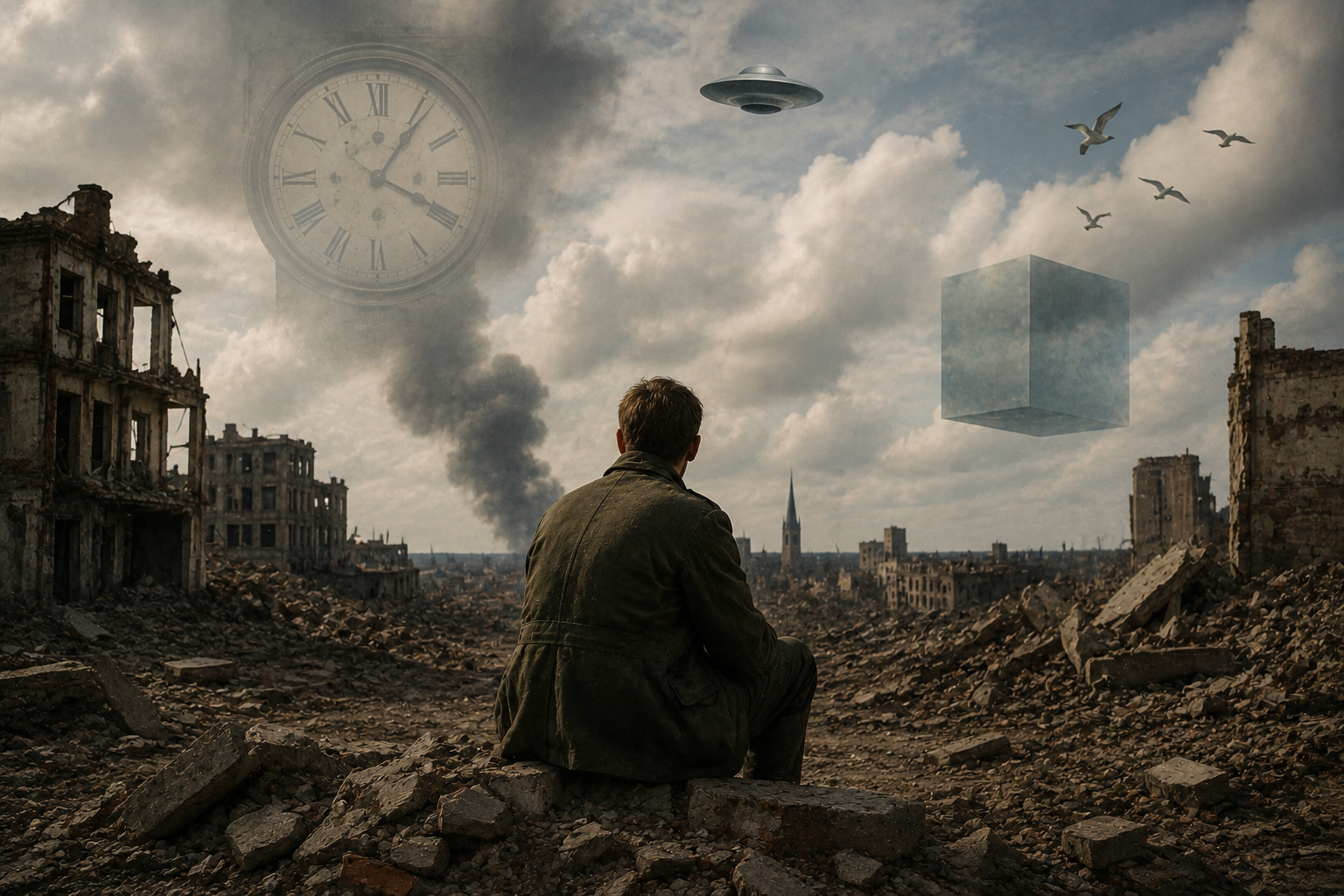
Slaughterhouse-Five follows Billy Pilgrim, an American soldier who survives the bombing of Dresden during World War II. After the war, Billy lives an ordinary-looking life, but his mind keeps jumping through time.
A good Slaughterhouse-Five summary and analysis should not treat those time jumps as random tricks. They are the heart of the novel. Billy does not move through life in a straight line because trauma does not feel straight.
The book was published in 1969, during the Vietnam War era. Vonnegut had survived Dresden as a prisoner of war, so the novel feels personal even when it becomes absurd.
Slaughterhouse-Five Summary and Analysis of the Plot
The plot moves across Billy Pilgrim’s life instead of following one straight timeline.
This Slaughterhouse-Five summary and analysis starts with the basic story. Billy Pilgrim is born in Ilium, New York. He becomes a weak and awkward soldier in World War II, then gets captured by German forces during the Battle of the Bulge.
Billy and other prisoners are taken to Dresden, Germany. They stay in a meat locker beneath a slaughterhouse, which saves them when Allied bombs destroy the city.
After the war, Billy returns home. He becomes an optometrist, marries Valencia, and has children. On the surface, he lives a safe middle-class life.
Yet Billy says he has become unstuck in time. He jumps from childhood to war, from marriage to old age, and from Earth to the planet Tralfamadore.
On Tralfamadore, aliens place Billy in a zoo-like exhibit with Montana Wildhack, a movie star. The aliens believe all moments exist at once. To them, death is only one moment among many.
The novel ends without a clean victory or lesson. After the Dresden bombing, silence fills the world. A bird calls out, and the odd sound shows how language fails after mass death.
How the Nonlinear Structure Works
The broken structure helps readers feel the damage that war leaves behind.
Most novels move from beginning to middle to end. Slaughterhouse-Five does not. It repeats scenes, skips years, and returns to Dresden again and again.
For any Slaughterhouse-Five summary and analysis, this structure matters as much as the plot. Billy’s life is not told out of order just to surprise the reader. The form matches his inner state.
Trauma often returns without warning. A smell, sound, or image can pull a person back into the past. Billy’s time travel works like that, even when the novel gives it a science fiction frame.
Other famous books use strange structure to show memory. The Great Gatsby moves through Nick’s memories, and The Odyssey uses travel to test what a person can survive. Vonnegut’s version is colder. Billy does not seem stronger after his journey.
The order also keeps readers from seeing war as a neat adventure. There is no proud march toward a heroic ending. There are only moments, some funny and some awful, placed side by side.
Main Conflicts in Slaughterhouse-Five
The novel’s conflicts are quiet, but they cut deep.
The biggest conflict is human life versus war. Soldiers are treated like objects. Cities become targets. Civilians die far from the battlefield.
Billy also faces an inner conflict. He cannot fully face what happened in Dresden, so his mind moves away from it. His time travel may be real inside the story, but it also acts like a symbol of escape.
Another conflict is free will versus fate. The Tralfamadorians claim that every moment is fixed. They tell Billy not to worry about death because all moments always exist.
This idea comforts Billy, but Vonnegut does not fully endorse it. If everything is fixed, people may stop taking responsibility. That danger matters in a book about war.
There is also a conflict between words and horror. Vonnegut wants to write about Dresden, but he knows words cannot fully explain it. That is why the novel often turns to silence, jokes, and repeated phrases.
Vonnegut asks readers to question war stories that make violence look noble.
One major theme is the absurdity of war. Soldiers do not always act like brave heroes. Many are scared, hungry, confused, or very young.
Many students use a Slaughterhouse-Five summary and analysis to understand why the book feels funny and sad at the same time. That mix is called dark humor. Vonnegut uses it because plain grief may not be enough.
Another key theme is trauma. Billy survives Dresden, but survival does not mean peace. His later life shows how the past can keep control over the present.
The novel also explores death. The repeated phrase so it goes appears after deaths large and small. It can sound calm, empty, or bitter depending on the scene.
Free will is another theme. The Tralfamadorians say no one can change anything. Vonnegut lets that idea stand, but he also warns readers not to accept cruelty too easily.
At its core, the novel suggests that war cannot be made beautiful by style, speeches, or patriotic myths. It leaves broken bodies and broken minds.
Key Characters to Know
The characters often feel odd because Vonnegut wants to challenge heroic war fiction.
Billy Pilgrim is the main character. He is passive, weak, and emotionally distant. This makes him very different from a classic war hero.
Kurt Vonnegut appears as a narrator figure. He reminds us that the story comes from memory, research, and personal pain.
Roland Weary is a cruel American soldier who wants to imagine himself as a hero. His fantasy of war clashes with the ugly truth.
Edgar Derby is an older soldier who seems decent and brave. His death feels senseless, which supports the book’s anti-war message.
Tralfamadorians are aliens who see all time at once. They help explain Billy’s worldview, but they also make that worldview seem strange and dangerous.
Montana Wildhack appears in Billy’s Tralfamadorian life. Her role shows how Billy’s imagined escape still has limits and problems.
Symbols and Motifs in Slaughterhouse-Five
Vonnegut uses repeated images to connect war, memory, and helplessness.
The slaughterhouse is the most important setting symbol. It saves Billy’s life, yet its name links humans to animals sent to be killed.
Time travel symbolizes trauma and escape. Billy moves through time because he cannot stay safely in one moment.
The phrase so it goes is a motif. It repeats after death and forces readers to notice how often death appears in the book.
Dresden becomes a symbol of mass destruction. The city is not just a place. It is a wound that the novel keeps touching.
The bird call near the end shows the failure of human speech. After horror, a simple sound may say more than a full speech.
How to Read Slaughterhouse-Five Closely
Close reading helps you see how Vonnegut builds meaning through small choices.
To turn this Slaughterhouse-Five summary and analysis into a strong essay, focus on patterns. Track repeated phrases, sudden time shifts, and moments where humor appears near death.
Ask why a scene appears where it does. If Billy jumps from a war scene to a normal family scene, Vonnegut may show that the past still lives inside the present.
Pay close attention to tone. A sentence may sound simple, but it may carry grief, shock, or anger under the surface.
If you need a method, read our guide to close reading in literature. It can help you move from summary to analysis.
Strong essay topics come from tension, not just from plot facts.
You could write about Billy Pilgrim as an anti-hero. Unlike a brave warrior in a traditional epic, Billy often drifts through events rather than shaping them.
You could also focus on time. Does Billy’s time travel protect him from pain, or does it trap him inside it?
Another strong angle is Vonnegut’s anti-war style. Instead of long battle scenes, he uses irony, plain language, and strange comedy.
A thesis might say: Vonnegut uses Billy’s broken timeline to show that trauma turns memory into a prison.
Another thesis might say: The Tralfamadorian view of time comforts Billy, but the novel warns readers against using fate as an excuse for violence.
Books to Read Next
These books pair well with Vonnegut because they also question war, memory, or moral choice.
Catch-22 by Joseph Heller
The Things They Carried by Tim O’Brien
Mother Night by Kurt Vonnegut
Each book asks what war does to truth. They can help you compare tone, structure, and point of view across modern literature.
FAQ: Slaughterhouse-Five Summary and Analysis
Here are quick answers to common student questions.
What is Slaughterhouse-Five mainly about?
The best Slaughterhouse-Five summary and analysis starts with Billy Pilgrim, a World War II survivor who becomes unstuck in time. The novel shows how Dresden haunts him for the rest of his life.
Is Slaughterhouse-Five an anti-war novel?
Yes. Vonnegut attacks the idea that war is noble or clean. He shows war as chaotic, absurd, and deeply harmful.
Why is the book out of order?
The broken order reflects trauma. Billy cannot leave the past behind, so the novel moves through time the way his mind does.
What do the Tralfamadorians mean?
They represent a view of time where every moment already exists. Their ideas comfort Billy, but they also raise hard questions about free will.
Why does the phrase so it goes repeat?
It appears after death. The repetition makes death feel common, but it also shows how hard it is to respond to loss.
Key Takeaway
A strong Slaughterhouse-Five summary and analysis should show that the novel is not confusing by accident. Its broken form, dark humor, and science fiction ideas all point to one truth: war damages people in ways a normal story cannot fully explain.
Famous Antiheroes in Literature can be some of the most interesting characters to study because they do not fit the usual hero mold. They may lie, hurt others, break rules, or act selfishly, yet readers still want to understand them.
These characters help us ask hard questions about guilt, power, survival, and what it really means to be “good.”
In this Guide
What makes an antihero different
Why antiheroes matter in literature
Major examples from classic books
How to analyze antiheroes for school
Helpful books to read next
FAQ and key takeaway
What Makes Famous Antiheroes in Literature Different?
An antihero is a main character who lacks many classic heroic traits.
A traditional hero is often brave, noble, and guided by a clear moral code. An antihero may still be brave, but that courage can come with pride, anger, fear, or deep moral weakness.
When students study Famous Antiheroes in Literature, they often notice one key idea: antiheroes are not simple villains. They may do wrong, but the story asks us to look deeper.
Antiheroes often feel real because people are not perfect. They can be selfish one moment and kind the next. That mix makes them useful for essays, class talks, and close reading.
Why Writers Use Antiheroes
Antiheroes help writers explore messy parts of human nature.
A perfect hero can inspire us, but an antihero can challenge us. These characters make readers ask, “Why do I care about someone who acts this way?”
Writers use antiheroes to show conflict inside the human mind. They may want justice but use cruel methods. They may seek love but push people away.
This makes antiheroes strong choices for literary analysis. If you need help with close reading, this guide on how to analyze characters in literature can help you build stronger claims.
Famous Antiheroes in Literature Students Should Know
Some antiheroes have shaped how readers think about character, choice, and morality.
Hamlet from William Shakespeare’s Hamlet is one of the most famous examples. He wants to avenge his father, but he delays, doubts himself, and causes great harm along the way.
Hamlet is not a clean hero. He is smart and sensitive, but he can also be cruel. His flaws make him a rich character for AP Literature and college essays.
Jay Gatsby from F. Scott Fitzgerald’s The Great Gatsby is another strong example. Gatsby dreams of love and success, but his dream rests on lies, crime, and an idealized past.
Readers may admire his hope, yet question his choices. That tension is why he remains one of the most discussed Famous Antiheroes in Literature.
Raskolnikov from Fyodor Dostoevsky’s Crime and Punishment is darker. He commits murder because he believes some people have the right to rise above normal rules.
The novel follows his guilt, fear, and possible path toward moral change. Raskolnikov is useful for students who want to study crime, conscience, and punishment.
Heathcliff from Emily Brontë’s Wuthering Heights is driven by pain, love, and revenge. His suffering helps explain him, but it does not excuse the damage he causes.
Heathcliff shows how an antihero can blur the line between victim and villain.
Famous Antiheroes in Literature and the Question of Morality
Antiheroes make readers judge actions, motives, and consequences.
One reason Famous Antiheroes in Literature stay popular is that they do not give easy answers. They force readers to ask if a person can do terrible things and still deserve sympathy.
Take Macbeth from Shakespeare’s Macbeth. He begins as a brave soldier, but ambition leads him toward murder and tyranny.
Macbeth is not born evil. His fall matters because readers can see the choices that shape him. That makes his story a warning about power and moral collapse.
Antiheroes also show how society shapes people. Some characters become morally broken because of poverty, abuse, war, or rejection. Literature asks us to notice both personal choice and outside pressure.
Common Traits of Antiheroes
Most antiheroes share patterns that make them easier to spot.
They often have serious flaws. These may include pride, anger, greed, fear, or a need for control.
They may also have a personal code. Even if their code is flawed, it helps explain why they act the way they do.
Many antiheroes want something deeply. Gatsby wants Daisy and the past. Macbeth wants power. Raskolnikov wants to prove he is above ordinary people.
When that desire grows too strong, it can lead to harm. This is where antiheroes often become tragic.
How to Study Famous Antiheroes in Literature
A strong character analysis looks at both behavior and meaning.
When you write about Famous Antiheroes in Literature, do not just call a character “bad” or “complicated.” Explain what the character wants, what choices they make, and how those choices affect others.
Start with the character’s goal. What do they want most? Then look at the methods they use to get it.
Next, study the cost. Who gets hurt? What does the character lose? What does the story suggest about those choices?
It also helps to track change. Some antiheroes grow, while others fall deeper into guilt or violence.
The difference often comes down to focus and sympathy.
A villain usually works against the main moral center of the story. A villain may tempt, attack, or destroy others without much inner conflict.
An antihero is often the main character or a major figure we follow closely. The story gives us access to their thoughts, pain, and reasons.
This does not mean the antihero is innocent. It means the story wants us to understand them, even when we reject their actions.
For example, Macbeth becomes a tyrant, yet the play lets us see his fear, guilt, and imagination. That inner life makes him more than a simple villain.
Why Famous Antiheroes in Literature Still Matter
Antiheroes remain powerful because they reflect real human struggle.
Famous Antiheroes in Literature are useful for students because they connect to major themes. These themes include ambition, guilt, identity, justice, and love.
They also make essays stronger. A simple hero may lead to a simple argument. An antihero gives you more room to explore conflict and contradiction.
Modern readers still care about antiheroes because they feel honest. They show that people can be damaged, selfish, loyal, brave, and afraid in the same story.
This is why characters like Hamlet, Gatsby, and Heathcliff continue to appear in classrooms. They are not easy to judge, and that makes them worth studying.
Books to Read Next
These books are strong choices if you want to explore antiheroes in classic literature.
Crime and Punishment by Fyodor Dostoevsky
Wuthering Heights by Emily Brontë
You can find these titles through your school library, public library, local bookstore, or Amazon. For poetry and Romantic-era background, the Poetry Foundation’s page on Lord Byron is also useful, since the “Byronic hero” influenced many later antiheroes.
FAQ About Famous Antiheroes in Literature
What is an antihero in literature?
An antihero is a main character who does not act like a traditional hero. They may be flawed, selfish, morally unclear, or driven by harmful desires.
Are antiheroes the same as villains?
No. A villain usually opposes the hero, while an antihero often stands at the center of the story. Readers may understand an antihero even when they dislike their choices.
Why are Famous Antiheroes in Literature important for students?
They help students study complex character motives, moral conflict, and theme. They also give writers strong material for essays.
Is Hamlet an antihero?
Yes, many readers see Hamlet as an antihero. He has noble goals, but his delay, cruelty, and inner conflict lead to tragedy.
Can an antihero change by the end of a story?
Yes. Some antiheroes grow or seek redemption. Others fall further because they refuse to face the truth about themselves.
Key Takeaway
Famous Antiheroes in Literature matter because they show that characters do not need to be perfect to be meaningful. Their flaws help readers think harder about choice, guilt, power, and what it means to be human.
Slaughterhouse-Five can feel strange at first because it moves through war, memory, and time in a loose way. This guide explains the themes in Slaughterhouse-Five so students can see how Kurt Vonnegut turns chaos into meaning.
In this Guide
Why the major themes matter
War and trauma
Time, fate, and free will
Death and the phrase “so it goes”
Dark humor and absurdity
Storytelling and memory
Books to read next
FAQ
Why the themes in Slaughterhouse-Five matter
Vonnegut does not write a simple war story.
The novel follows Billy Pilgrim, a man who survives the firebombing of Dresden during World War II. Yet the plot jumps across his life, which makes the book feel broken on purpose.
That broken form helps reveal the themes in Slaughterhouse-Five. The style shows how trauma can damage a person’s sense of time, truth, and self.
War and trauma: one of the central themes in Slaughterhouse-Five
The novel presents war as cruel, random, and deeply harmful.
Vonnegut does not make combat look noble. Soldiers are scared, confused, and often powerless. Billy is not a bold hero. He is weak, passive, and lost.
This matters because the book attacks the idea that war is glorious. The subtitle calls the novel a “children’s crusade,” which points to how young and unprepared many soldiers are.
The bombing of Dresden becomes the core wound of the novel. Billy survives, but survival does not mean he is whole.
These themes in Slaughterhouse-Five connect well with books like The Things They Carried by Tim O’Brien. Both works show that war can follow a person long after the battle ends.
Time, fate, and free will in the themes in Slaughterhouse-Five
Billy’s life does not move in a straight line.
He becomes “unstuck in time,” shifting from childhood to war to old age without warning. This strange structure makes readers ask whether Billy has control over his life.
The Tralfamadorians, the alien beings Billy describes, believe all moments exist at once. To them, death is just one moment, not the end of everything.
This idea can sound peaceful, but it can also feel cold. If everything has already happened, then choice may not matter.
Among the themes in Slaughterhouse-Five, free will is one of the hardest to pin down. Vonnegut leaves room for doubt. Billy may have found comfort in this belief, or he may use it to avoid pain.
Death and “so it goes”
The phrase “so it goes” appears again and again after death.
At first, it can seem funny or casual. Over time, it becomes disturbing because it follows deaths that are small, tragic, and huge.
Vonnegut uses repetition to show how often death appears in human life. The phrase can sound like acceptance, but it can also suggest numbness.
This is one reason the novel is so powerful. It does not ask readers to feel one simple emotion. It asks them to notice how people protect themselves when grief becomes too much.
How dark humor shapes the themes in Slaughterhouse-Five
Vonnegut uses humor to make horror easier to face, not to make it less serious.
The book is full of strange jokes, odd details, and absurd scenes. These moments may seem silly, but they help reveal how nonsensical war can be.
Dark humor also keeps the book from becoming a speech. Vonnegut does not simply tell readers that war is wrong. He creates a world where war looks foolish, broken, and cruel.
These themes in Slaughterhouse-Five fit the style of anti-war satire. A good comparison is Catch-22 by Joseph Heller, where comedy also exposes the madness of war.
Storytelling and memory in the themes in Slaughterhouse-Five
The novel asks how stories can speak about pain.
Vonnegut begins the book by telling readers he struggled to write about Dresden. This opening makes the act of writing part of the story.
That choice is important. It shows that trauma is not easy to explain in a clean plot. A neat story might make war seem too simple.
Billy’s time travel can be read as science fiction, but it can also be read as a picture of memory. Pain does not always stay in the past. It returns without warning.
If you are writing an essay, focus on how form supports meaning. The mixed-up timeline is not just a trick. It helps express the themes in Slaughterhouse-Five.
Many characters in the novel do not understand the forces around them.
Billy often seems childlike. He drifts through events rather than acts with clear purpose. This makes him different from the usual war hero.
The soldiers around him also seem unready for what they face. They are part of a massive war, but they rarely understand its full meaning.
This helps Vonnegut show moral confusion. In war, people may cause harm, suffer harm, or witness harm without clear answers.
Students can use this idea in essays about innocence. The novel suggests that war destroys not only bodies, but also the simple belief that the world makes sense.
How to write about themes in Slaughterhouse-Five
A strong theme paragraph should connect an idea to a pattern in the text.
Do not just say, “The theme is war is bad.” That is too broad. Try a sharper claim like this: Vonnegut shows war as a force that breaks time, memory, and moral order.
Then use evidence. You might discuss Billy’s time shifts, the bombing of Dresden, or the repeated phrase “so it goes.”
For more essay help, review character analysis strategies. Billy’s passivity, fear, and confusion all connect to theme.
These books pair well with Slaughterhouse-Five because they also explore war, memory, and moral pressure.
The Things They Carried by Tim O’Brien
Catch-22 by Joseph Heller
FAQ about themes in Slaughterhouse-Five
Use these quick answers to review before class or an essay.
What are the main themes in Slaughterhouse-Five?
The main themes include war trauma, free will, death, dark humor, and the limits of storytelling.
Why is time so important in the novel?
Time shows Billy’s trauma. His life feels scattered because his mind cannot leave the past behind.
Is Slaughterhouse-Five an anti-war novel?
Yes. Vonnegut shows war as absurd and cruel, not heroic or noble.
What does “so it goes” mean?
The phrase follows death throughout the book. It suggests acceptance, numbness, and the limits of human response.
How can I write a strong essay about the novel?
Choose one theme, connect it to a repeated pattern, and explain how Vonnegut’s style supports the meaning.
Key takeaway
The themes in Slaughterhouse-Five show a world where war breaks time, language, and belief. Vonnegut’s strange style helps readers feel that damage instead of just hear about it.
Books Every Human Nature readers choose often ask one big question: what do stories teach us about people? The best literature shows fear, love, pride, guilt, and hope in ways that feel real across time.
This guide explores classic and modern books that help us understand why humans act the way they do.
In this Guide
Why human nature matters in literature
Books Every Human Nature reader should explore
Major themes and symbols to watch for
How poetry reveals human truth
Recommended books to search on Amazon
FAQs
Key takeaway
Why Books Every Human Nature Readers Matter
Great books help us see people more clearly.
Literature is not only about plot. It is about choice. A character wants something, fears something, or hides something. That tension shows us what human nature looks like under pressure.
Books Every Human Nature readers return to often deal with hard questions. Are people born good? Does power change us? Can guilt shape a whole life?
These questions matter because they do not stay on the page. They show up in schools, families, friendships, and society.
Books Every Human Nature Reader Should Start With
Some books are famous because they capture people at their most honest.
To Kill a Mockingbird by Harper Lee shows both cruelty and courage. Scout learns that people can be unfair, but she also sees moral strength in Atticus Finch.
Lord of the Flies by William Golding asks what happens when rules disappear. The boys on the island slowly reveal fear, pride, and the hunger for control.
Frankenstein by Mary Shelley looks at loneliness, ambition, and blame. The creature becomes violent, but the novel also asks who made him that way.
These are strong Books Every Human Nature choices because they do not give easy answers. They ask readers to judge actions, motives, and consequences.
How Classic Literature Reveals Human Nature
Classic books last because their characters still feel human.
In Macbeth, Shakespeare shows how ambition can poison the mind. Macbeth wants power, but each choice makes him less free.
In Pride and Prejudice, Jane Austen explores pride, first impressions, and self-awareness. Elizabeth Bennet grows because she learns to question her own judgment.
In The Great Gatsby, F. Scott Fitzgerald shows the danger of desire. Gatsby builds a dream around Daisy, but the dream cannot survive reality.