Themes in 1984: A Student-Friendly Guide to Orwell’s Big Ideas

themes in 1984

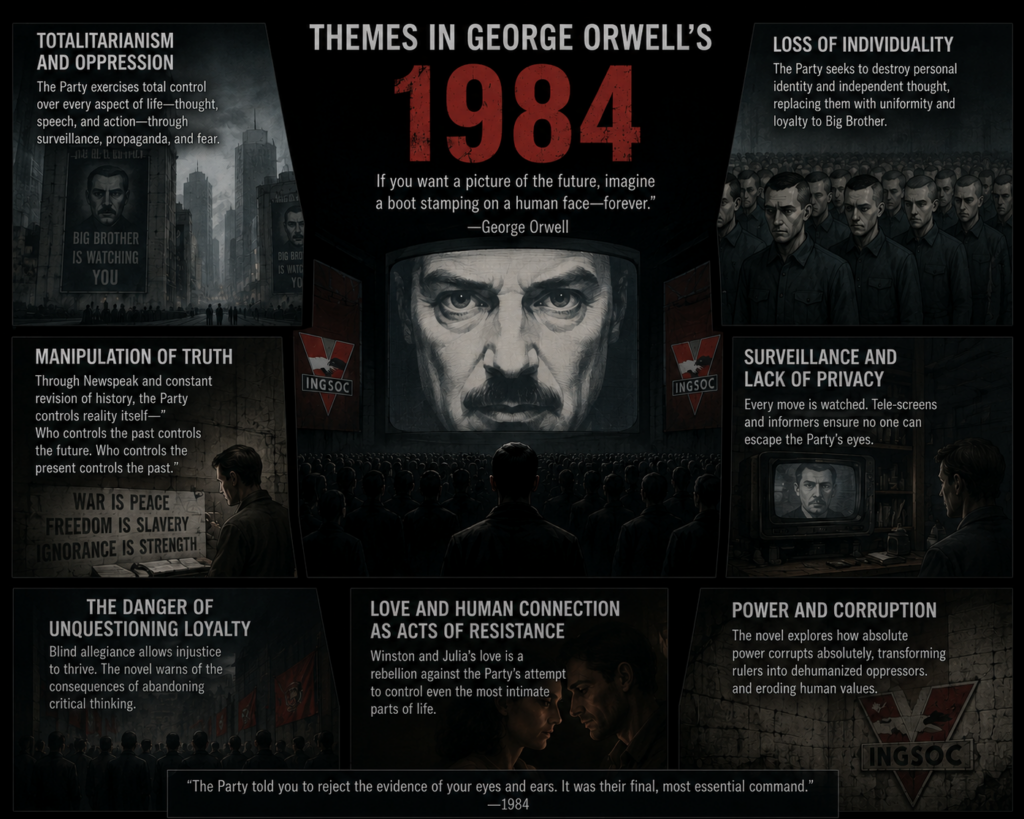
George Orwell’s 1984 is more than a dark story about a future society. The themes in 1984 help students see how power can shape truth, language, fear, and private thought.

This guide breaks down the major ideas you should notice for class discussion, close reading, and essays.

This article contains affiliate links.

In this Guide

Use this guide as a quick map before you write or review.

  • Understanding the major ideas in the novel
  • Power and control
  • Language and thought
  • Truth and memory
  • Fear and loyalty
  • Individual freedom
  • Books to read next
  • FAQ
themes in 1984

Understanding the Themes in 1984

Orwell uses Winston’s world to ask a simple but scary question: what happens when a government controls not just actions, but minds?

A theme is a big idea a text explores. In 1984, Orwell does not give readers easy answers. He shows a world where people may obey because they are afraid, tired, watched, or unsure what is true.

To study the novel well, do more than name the theme. Ask how Orwell builds it through setting, conflict, symbols, and character choices. If you need help with that step, see our guide on how to analyze characters in literature.

Winston matters because he wants the truth, even when truth feels dangerous. His struggle turns the novel’s ideas into a human story.

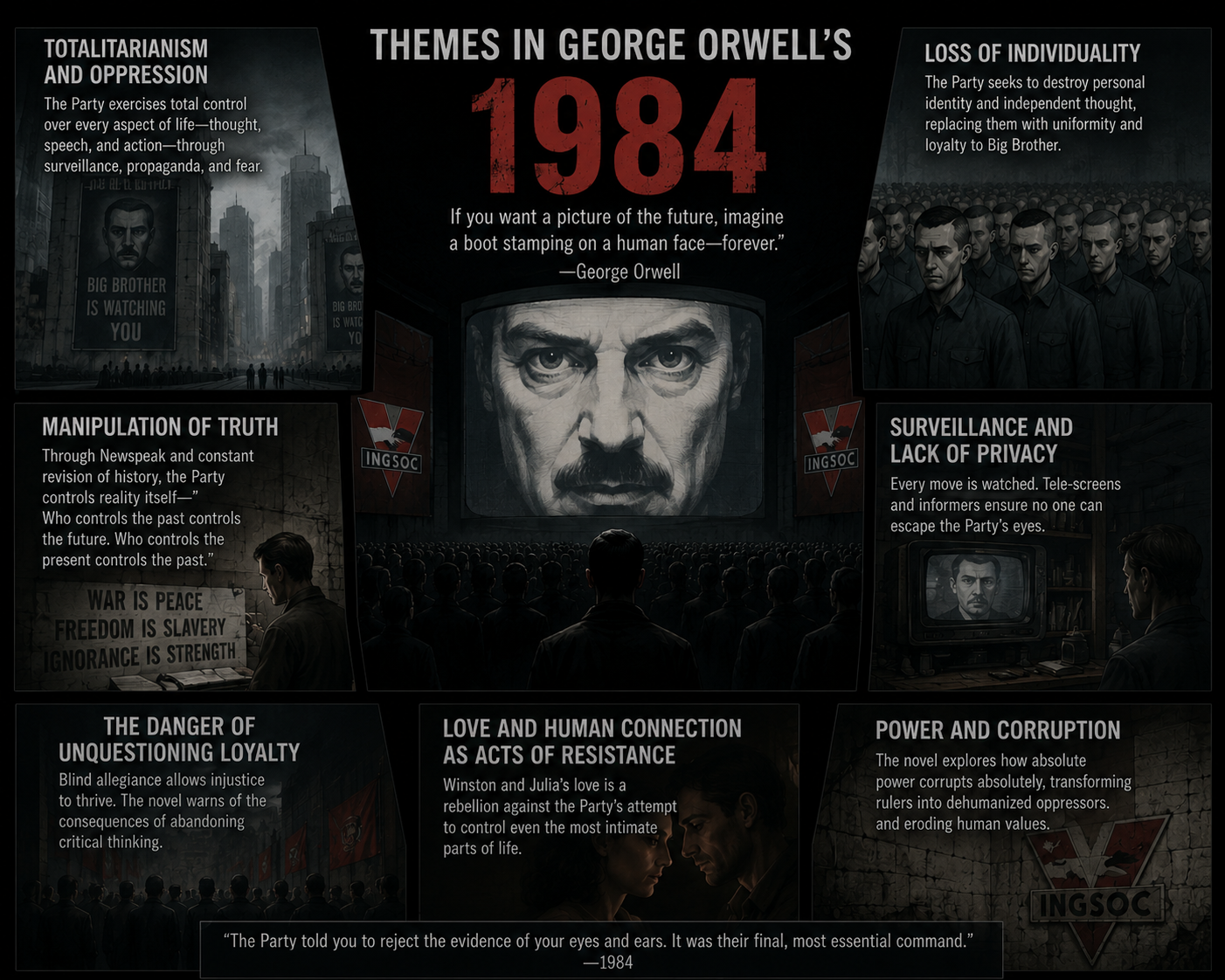
Themes in 1984: Power and Control

These themes in 1984 show that power works best when people believe they have no safe place to resist.

The Party controls public life through laws, screens, slogans, and punishment. Yet its deeper goal is mental control. It wants citizens to accept whatever the Party says, even if it changes from day to day.

Big Brother is the face of this power. He may or may not exist as a real person, but that almost does not matter. His image makes people feel watched at all times.

The telescreens are a clear symbol of this control. They turn private rooms into public spaces. Winston cannot fully relax, even in his own home.

This theme connects to many dystopian works. In The Hunger Games by Suzanne Collins, public fear and public display help the Capitol stay in power. In 1984, the Party goes even deeper because it tries to own thought itself.

Themes in 1984: Language and Thought

Orwell shows that language is not just a tool for speech. It can shape what people are able to think.

Newspeak is one of the most important ideas in the novel. The Party creates it to shrink language over time. If words for rebellion, freedom, or justice vanish, people may find it harder to imagine those ideas.

This is why the Party cares so much about words. It knows that clear language can protect clear thought. Confused language can hide lies.

The themes in 1984 become most clear when we see how slogans twist meaning. Phrases like War is Peace and Freedom is Slavery are not meant to make sense. They train people to accept contradiction without protest.

Students can compare this to propaganda in Shakespeare’s Julius Caesar. Mark Antony uses public speech to move the crowd. Orwell’s Party uses speech to block thought before it begins.

Themes in 1984: Truth, Memory, and History

In Orwell’s world, truth is not treated as something to discover. It is treated as something the Party can edit.

Winston works at the Ministry of Truth, but the name is a lie. His job is to change old records so the Party always appears right. If a prediction fails, the record changes. If a person becomes an enemy, the record erases that person.

This attack on history is one of the novel’s strongest warnings. If people cannot trust records, memory, or facts, they become easier to control.

When students study themes in 1984, this one often leads to strong essays. You can focus on how Orwell links truth to freedom. If citizens lose the past, they lose the power to question the present.

For more background on Orwell’s life and political concerns, visit Britannica’s overview of George Orwell.

Fear, Surveillance, and Self-Censorship

The Party does not need to punish everyone. It only needs people to believe punishment is always possible.

Fear shapes daily life in 1984. Citizens fear the Thought Police, their neighbors, and even their children. This fear causes people to hide their real feelings.

That is why surveillance is so powerful. The telescreen may not catch every action, but it changes behavior. People learn to police themselves.

This idea feels modern because many readers know what it means to act differently when they feel watched. Orwell pushes that feeling to an extreme. He asks what happens when privacy no longer exists.

Individual Freedom and Private Identity

Winston’s rebellion starts small because even small private acts matter in this world.

At first, Winston does not lead a movement. He writes in a diary. He remembers. He loves Julia. These acts matter because the Party wants no inner life outside its control.

The diary is especially important. It gives Winston a place to speak honestly, even if no one else reads it. In a world built on falsehood, private truth becomes a form of resistance.

Julia’s rebellion is different from Winston’s. She cares less about history and more about personal pleasure. Their differences help readers see that freedom can mean more than one thing.

To build a stronger essay, compare how Winston and Julia respond to control. Our character analysis guide can help you connect their choices to the novel’s larger ideas.

Why the Themes in 1984 Still Matter

Orwell’s novel still speaks to readers because it studies problems that do not belong to one time period.

The novel asks readers to care about truth, language, privacy, and power. These ideas matter in governments, schools, media, and personal life.

The key lesson is not only that total power is dangerous. Orwell also shows that people must protect the habits that keep freedom alive. Those habits include honest speech, memory, questions, and private thought.

This is why 1984 often appears in high school, AP Literature, and college courses. It gives students a strong way to discuss politics, ethics, and human behavior through fiction.

Books to Read Next

These books pair well with Orwell’s novel because they also ask how society shapes freedom and truth.

For a wider look at dystopian fiction as a genre, see Britannica’s page on dystopia.

FAQ About Themes in 1984

Use these quick answers for review before a quiz, seminar, or essay.

What are the main themes in 1984?

The main themes in 1984 include power, language, truth, fear, surveillance, and individual freedom. Each theme shows how the Party controls people from the outside and the inside.

What is the most important theme in 1984?

Many students choose control of truth as the most important theme. If the Party can rewrite facts, citizens lose the ability to challenge power.

How does Newspeak support the novel’s themes?

Newspeak limits thought by limiting words. Orwell suggests that people need rich, clear language to think freely.

Why does Winston keep a diary?

The diary lets Winston claim a private voice. It is a small act of rebellion because the Party wants to control even personal thoughts.

Key Takeaway

The themes in 1984 show how freedom can disappear when power controls truth, language, and private life. Orwell’s warning is clear: a free mind needs facts, memory, and the courage to question authority.
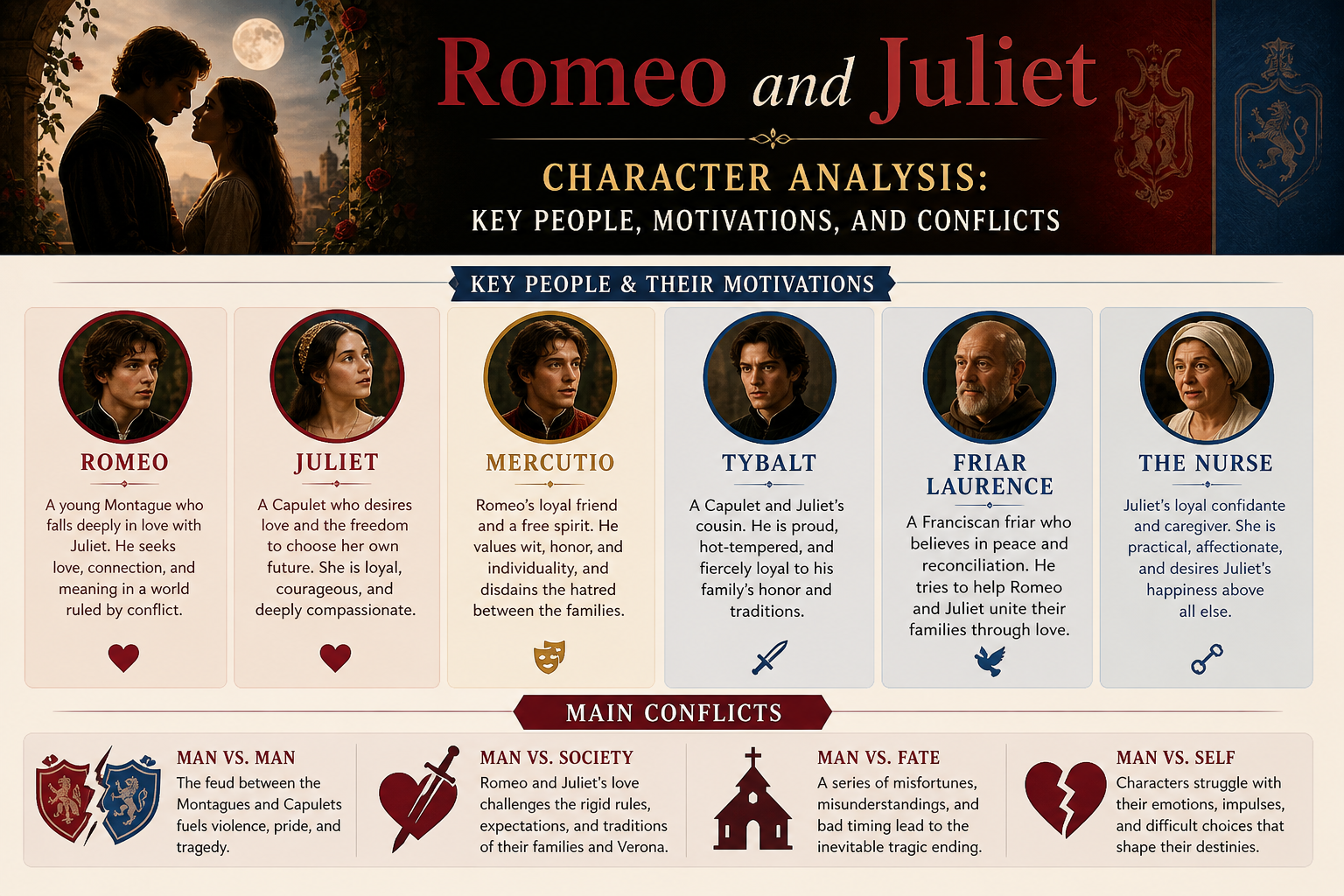
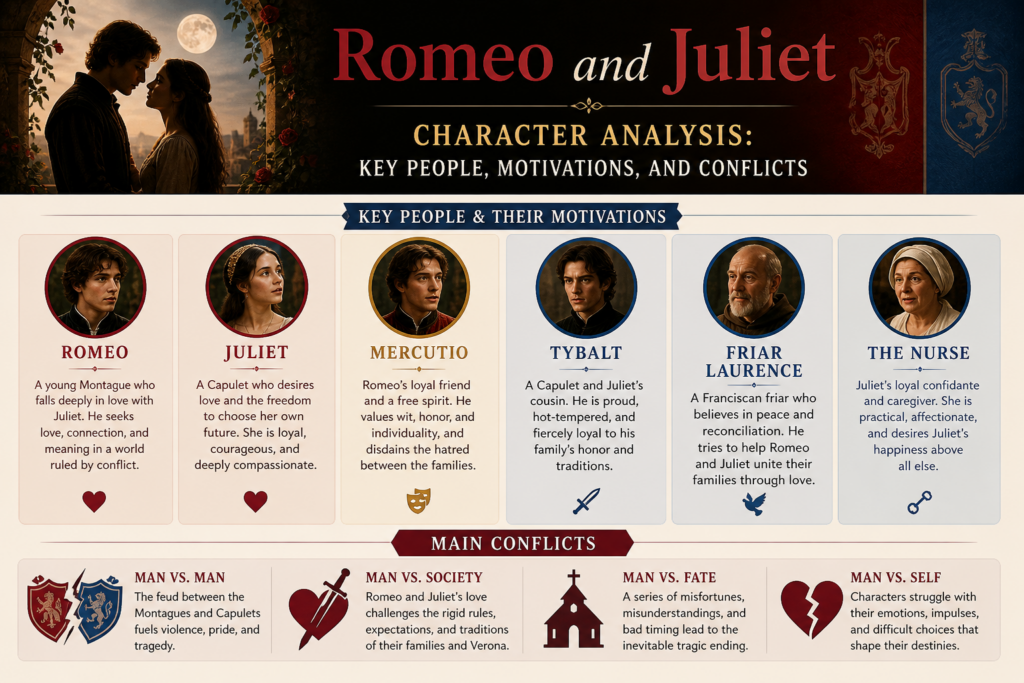
Romeo and Juliet Character Analysis: Key People, Motivations, and Conflicts

Romeo and Juliet character analysis

A practical breakdown of the main characters and how their choices shape the story.

Shakespeare’s tragedy works because each character wants something badly, then acts before the full truth is clear. This Romeo and Juliet character analysis breaks down the main characters, their motives, and the conflicts that push the play toward its tragic end.

This article contains affiliate links.

In this Guide

Romeo and Juliet character analysis

Romeo and Juliet Character Analysis: The Big Picture

The play is not only about young love. It is also about family pressure, pride, anger, and the cost of poor choices.

In a strong Romeo and Juliet character analysis, the key question is not just “Who is good?” or “Who is bad?” A better question is, “What does this person want, and what choice do they make because of it?”

Romeo wants love that feels total. Juliet wants control over her own life. Lord Capulet wants family honor. Tybalt wants respect through violence.

These wants crash into each other. That is why the plot feels fast, tense, and painful.

If you need a simple method for any character essay, this guide to analyzing characters in literature can help you build stronger claims.

Romeo and Juliet Character Analysis of Romeo Montague

Romeo is emotional, romantic, and quick to act. His heart often moves faster than his judgment.

At the start, Romeo feels crushed because Rosaline does not love him back. This matters because it shows how easily he turns love into an obsession.

When he meets Juliet, his feelings shift at once. This does not mean his love is fake. It does mean he trusts intense feeling more than careful thought.

Romeo’s main conflict is between desire and self-control. He wants peace with Tybalt after he marries Juliet, but he cannot control his rage after Mercutio dies.

That choice changes everything. Romeo kills Tybalt, gets banished, and loses the chance to build a future with Juliet in Verona.

For essays, Romeo is a strong example of a tragic character whose best traits create danger. His passion makes him loving, but it also makes him reckless.

image-slider-with-thumbnail1.jpeg
PlayPause
previous arrow
next arrow
image-slider-with-thumbnail1.jpeg
image-slider-with-thumbnail3.jpeg
image-slider-with-thumbnail4.jpeg
ChatGPT Image Jun 27, 2026, 06_33_13 PM
ChatGPT Image Jun 27, 2026, 06_36_37 PM
ChatGPT Image Jun 27, 2026, 06_38_39 PM
ChatGPT Image Jun 27, 2026, 06_31_22 PM
image-slider-with-thumbnail7.jpeg
ChatGPT Image Jun 27, 2026, 06_29_43 PM
ChatGPT Image Jun 27, 2026, 06_27_44 PM
image-slider-with-thumbnail6.jpeg
ChatGPT Image Jun 27, 2026, 06_15_07 PM
image-slider-with-thumbnail5.jpeg
ChatGPT Image Jun 27, 2026, 06_22_43 PM
ChatGPT Image Jun 27, 2026, 06_25_37 PM
ChatGPT Image Jun 27, 2026, 06_19_43 PM
ChatGPT Image Jun 27, 2026, 06_12_00 PM
ChatGPT Image Jun 27, 2026, 06_08_50 PM
ChatGPT Image Jun 26, 2026, 04_54_23 PM
ChatGPT Image Jun 27, 2026, 05_53_51 PM
ChatGPT Image Jun 28, 2026, 08_35_55 AM
previous arrow
next arrow

Romeo and Juliet Character Analysis of Juliet Capulet

Juliet starts the play as an obedient daughter. By the end, she becomes one of Shakespeare’s boldest young characters.

A strong Romeo and Juliet character analysis should treat Juliet as more than Romeo’s love interest. She makes major choices and takes major risks.

Juliet’s main motive is freedom. She wants to love Romeo, but she also wants the right to choose her own future.

Her conflict grows when her parents order her to marry Paris. To them, the match seems smart. To Juliet, it feels like a prison.

Juliet is often more practical than Romeo. She asks serious questions about marriage, timing, and danger. Still, she is young, trapped, and short on safe advice.

Her choice to take Friar Lawrence’s potion shows courage. It also shows how few options she has in a world ruled by family power.

Romeo and Juliet Character Analysis of the Capulets and Montagues

The older generation keeps the feud alive, even when the young people pay the price.

The Capulets and Montagues are not fully explained, which makes their hatred feel even more pointless. Shakespeare shows the effect of the feud, not a clear reason for it.

Lord Capulet can seem caring when he first protects Juliet from an early marriage. Later, he turns harsh when she refuses Paris.

His motive is control. He wants Juliet to obey because her marriage affects his honor and social plans.

Lady Capulet is more distant. She follows the rules of her class and expects Juliet to accept them too.

The Montagues have less stage time, but they also live inside the feud. Their name makes Romeo an enemy before he has done anything to Juliet’s family.

Romeo and Juliet Character Analysis of Key Supporting Characters

The supporting characters shape the lovers’ choices. Some try to help, while others make conflict worse.

Mercutio

Mercutio is witty, loyal, and sharp-tongued. He mocks romantic love and often turns serious moments into jokes.

His death is a turning point. His curse, “A plague o’ both your houses,” points blame at both families.

Tybalt

Tybalt is proud and violent. He sees Romeo’s presence at the Capulet party as an insult that must be answered.

In a Romeo and Juliet character analysis, Tybalt often stands for the feud itself. He does not want peace because his identity depends on family honor.

Benvolio

Benvolio tries to keep the peace. His name even suggests goodwill.

He fails not because he is weak, but because the world around him rewards anger more than patience.

Friar Lawrence

Friar Lawrence wants peace between the families. He sees Romeo and Juliet’s marriage as a chance to end the feud.

His plan is risky. Like Romeo, he acts with hope before he has enough control over the outcome.

The Nurse

The Nurse loves Juliet and gives her comfort. She also helps Juliet meet Romeo in secret.

Yet the Nurse later tells Juliet to marry Paris. This feels like betrayal because Juliet needs moral support, not just practical advice.

Romeo and Juliet Character Analysis Through Major Conflicts

Character conflict drives the play. Each clash reveals what people value most.

Love versus hate is the clearest conflict. Romeo and Juliet love each other, but their families have taught them to hate each other’s names.

Youth versus age also matters. The young characters act from feeling, while the older characters act from custom and status.

Fate versus choice is harder to judge. The prologue calls the lovers “star-crossed,” but their choices still matter.

This is similar to other famous tragedies. In Macbeth, prophecy matters, but Macbeth’s choices cause the bloodshed. In Oedipus Rex, fate is powerful, but human pride makes the ending hurt more.

For helpful background on the play and Shakespeare’s time, see Britannica’s overview of Romeo and Juliet. You can also explore Shakespeare’s sonnets and language at the Poetry Foundation.

How to Use This Romeo and Juliet Character Analysis in Essays

A good essay claim should connect a character trait to a result. Do not stop at “Romeo is emotional.” Explain how that emotion changes the plot.

Try a sentence like this: Romeo’s passion helps him love Juliet deeply, but it also leads him to kill Tybalt before he thinks about the cost.

For Juliet, you might argue that her courage grows as her choices shrink. That kind of claim gives you room to discuss family pressure, marriage, and the potion plan.

Use short quotes and explain them. A quote should support your idea, not replace it.

If you want a step-by-step tool for class notes, try this character analysis practice guide. You can pair it with our character analysis strategy article for essay planning.

Helpful Books for Romeo and Juliet Study

These books can help with close reading, class discussion, and quote-based analysis.

FAQ – Romeo and Juliet Character Analysis

Who is the most important character in Romeo and Juliet?

Romeo and Juliet are both central. Romeo drives many public conflicts, while Juliet shows the deepest personal growth.

What is Romeo’s main flaw?

Romeo’s main flaw is impulsiveness. He acts from intense feeling before he thinks through the result.

What makes Juliet a strong character?

Juliet becomes strong because she makes hard choices under pressure. She challenges family rules and risks her life for her chosen love.

Why is Tybalt important?

Tybalt keeps the feud active. His anger turns Romeo’s secret marriage into a public disaster.

How should I write a Romeo and Juliet character analysis essay?

Pick one character, name a clear trait, and show how that trait affects the plot. Use quotes, then explain what each quote proves.

Key Takeaway

The best Romeo and Juliet character analysis shows how motives lead to choices, and how those choices turn love into tragedy. The play feels timeless because its characters act from feelings students still understand today.

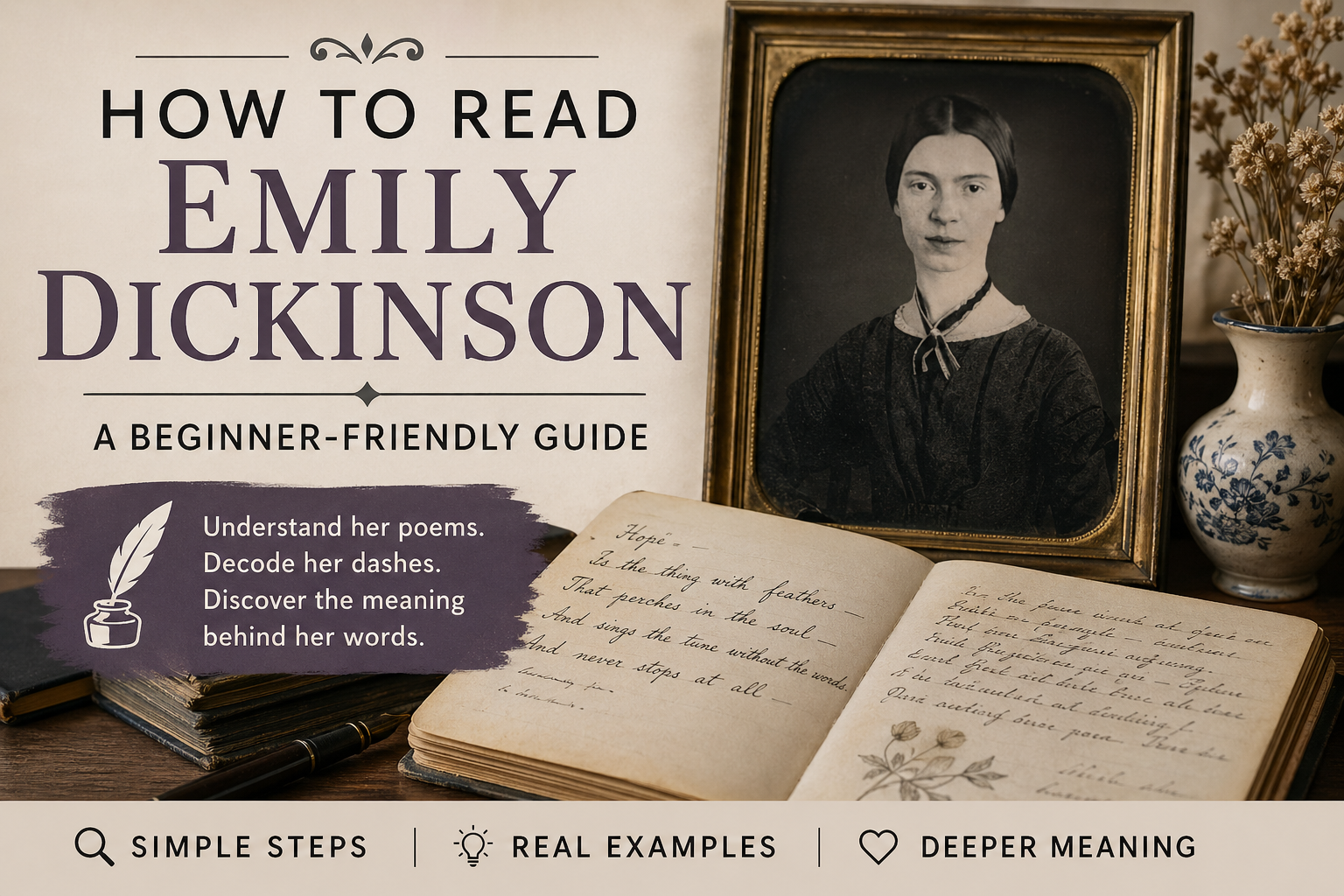
How to Read Emily Dickinson: A Beginner-Friendly Guide

how to read Emily Dickinson

A clear, step-by-step way to understand Dickinson’s poems—even if they feel confusing at first

Emily Dickinson can feel strange the first time you read her. The short lines, the dashes, the capital letters, and the deep ideas can make even simple poems feel hard to follow. But once you learn how to read Emily Dickinson, her poems become surprisingly clear, powerful, and even personal. This guide will walk you through a simple method you can use right away, with real examples from her most famous poems.

This article contains affilate links.

In this Guide

  • Why Emily Dickinson feels difficult
  • Step 1: Read the poem slowly
  • Step 2: Look at punctuation and dashes
  • Step 3: Identify the speaker and situation
  • Step 4: Find the central idea or theme
  • Step 5: Notice imagery and symbolism
  • Step 6: Paraphrase the poem
  • Step 7: Connect it to a bigger meaning
  • FAQs about reading Emily Dickinson
  • Key takeaway
how to read Emily Dickinson

Why Learning How to Read Emily Dickinson Matters

Emily Dickinson’s poetry looks simple, but it carries deep meaning in very small spaces.

When you learn how to read Emily Dickinson, you are learning how to slow down and notice details. Her poems often deal with death, hope, faith, and the inner life, which makes them widely taught in schools. For example, in “Hope is the thing with feathers,” she turns hope into a bird. That sounds simple, but the meaning grows as you read more closely.

If you already know how to use strategies like those in our guides on how to read literature like a scholar or how to analyze poetry step by step, this approach will feel familiar. Dickinson just asks you to apply those skills more carefully.

Step 1: Read the Poem Slowly

Take your time. Dickinson rewards slow reading.

When learning how to read Emily Dickinson, the biggest mistake is rushing. Her poems are short, so each word matters.

For example, in “Because I could not stop for Death,” the opening line seems calm:
“Because I could not stop for Death – He kindly stopped for me –”

At first, it sounds polite. But if you slow down, you notice something strange: Death is personified as a polite driver. That small detail changes the tone completely.

👉 If you need help building this habit, our guide on what is close reading in literature pairs perfectly with Dickinson.

Step 2: Pay Attention to Dashes and Punctuation

Dickinson’s punctuation is not random. It shapes meaning.

One of the keys to how to read Emily Dickinson is understanding her famous dashes. They often signal pauses, shifts in thought, or emotional tension.

In “I’m Nobody! Who are you?” she writes:
“How dreary – to be – Somebody!”

Those dashes slow the line down and emphasize the feeling. Without them, the line loses its rhythm and emotional weight.

Think of the dashes as moments to pause and reflect.

You can explore punctuation and tone more deeply in our post on tone vs mood in literature.

image-slider-with-thumbnail1.jpeg
PlayPause
previous arrow
next arrow
image-slider-with-thumbnail1.jpeg
image-slider-with-thumbnail3.jpeg
image-slider-with-thumbnail4.jpeg
ChatGPT Image Jun 27, 2026, 06_33_13 PM
ChatGPT Image Jun 27, 2026, 06_36_37 PM
ChatGPT Image Jun 27, 2026, 06_38_39 PM
ChatGPT Image Jun 27, 2026, 06_31_22 PM
image-slider-with-thumbnail7.jpeg
ChatGPT Image Jun 27, 2026, 06_29_43 PM
ChatGPT Image Jun 27, 2026, 06_27_44 PM
image-slider-with-thumbnail6.jpeg
ChatGPT Image Jun 27, 2026, 06_15_07 PM
image-slider-with-thumbnail5.jpeg
ChatGPT Image Jun 27, 2026, 06_22_43 PM
ChatGPT Image Jun 27, 2026, 06_25_37 PM
ChatGPT Image Jun 27, 2026, 06_19_43 PM
ChatGPT Image Jun 27, 2026, 06_12_00 PM
ChatGPT Image Jun 27, 2026, 06_08_50 PM
ChatGPT Image Jun 26, 2026, 04_54_23 PM
ChatGPT Image Jun 27, 2026, 05_53_51 PM
ChatGPT Image Jun 28, 2026, 08_35_55 AM
previous arrow
next arrow

Step 3: Identify the Speaker and Situation

Who is speaking, and what is happening?

Dickinson rarely tells a full story. Instead, she drops you into a moment.

In “Because I could not stop for Death,” the speaker is already riding in a carriage with Death. We are not told how it started.

That means you have to ask:

  • Who is the speaker?
  • What is happening right now?
  • What is the emotional tone?

This step connects closely to our guide on how to analyze characters in literature, even though the “character” may be more symbolic than realistic.

Step 4: Find the Central Idea or Theme

Every Dickinson poem circles around a central idea.

When practicing how to read Emily Dickinson, try to summarize the poem in one sentence.

For example, “Hope is the thing with feathers” explores the idea that hope is constant and resilient, even in hardship.

Look at these lines:
“And never stops – at all –”

That simple phrase captures the theme. Hope continues no matter what.

If you want to go deeper, our post on how to identify theme in literature gives a helpful framework for this step.

Step 5: Notice Imagery and Symbolism

Dickinson uses simple images to express complex ideas.

A big part of how to read Emily Dickinson is recognizing symbolism.

In “Hope is the thing with feathers,” the bird represents hope. But it is not just any bird. It:

  • Sings
  • Endures storms
  • Never asks for anything

That tells us hope is persistent, self-sustaining, and quiet.

👉 See more in our guide on how to find symbolism in a story.

Step 6: Paraphrase the Poem in Your Own Words

Put the poem into plain language.

This is one of the most effective ways to master how to read Emily Dickinson.

Take a line like:
“The Carriage held but just Ourselves – And Immortality.”

A paraphrase might be:
The speaker is riding with Death, and the journey represents entering eternity.
When you rewrite the poem this way, it becomes clearer.

Our guide on how to write a literary analysis essay can help you turn this understanding into strong writing.

Step 7: Connect the Poem to a Bigger Meaning

Ask why the poem matters.

Dickinson’s poems often move from a small moment to a big idea about life.

In “Because I could not stop for Death,” the carriage ride becomes a reflection on the nature of mortality and eternity.
This is where interpretation happens. You move from understanding the poem to explaining its significance.

👉 For practice, you can pair this step with our literary devices list to identify how the meaning is created.

If you want to go further with how to read Emily Dickinson, these are excellent resources:

More resources:

  1. Poetry Foundation: https://www.poetryfoundation.org/poets/emily-dickinson
  2. Academy of American Poets (https://poets.org/)

FAQs About How to Read Emily Dickinson

Why is Emily Dickinson so hard to understand?

Her poems are compressed and leave out context. She expects readers to fill in the gaps.

What do the dashes mean?

They create pauses, emphasize ideas, and show shifts in thought or emotion.

Do Dickinson’s poems have one correct meaning?

No. Many poems allow for multiple interpretations, as long as they are supported by the text.

Where should beginners start?

Start with well-known poems like “Hope is the thing with feathers” and “Because I could not stop for Death.”

Key Takeaway

Learning how to read Emily Dickinson is about slowing down and noticing details. Her poems may look simple, but they reward careful reading. When you pay attention to punctuation, imagery, and theme, her work becomes clear and deeply meaningful.

New Criticism and the Poetry of Emily Dickinson

New Criticism Emily Dickinson

How Close Reading, Paradox, and Imagery Reveal Meaning in Dickinson’s Poetry

Literary theory gives us different lenses for interpreting literature. Each theory asks us to look at a text in a different way. Some theories focus on history. Some focus on the author. Others focus on culture or politics. New Criticism (also known as Formalism) is different because it tells us to focus only on the text itself.

When we read Emily Dickinson through New Criticism, we begin to notice how much meaning is hidden in her word choice, punctuation, rhyme, and imagery. Her poems are short, but they are very dense.

This makes them perfect for close reading and formal analysis. If you want to learn the basics of close reading first, read this guide: https://rapidreadspress.com/what-is-close-reading-in-literature/

This article contains affiliate links.

In this Guide

What New Criticism Is
Key Ideas of New Criticism
New Criticism Emily Dickinson Analysis
Example Passages and Analysis
How to Write a New Criticism Essay
Final Thoughts
FAQ

New Criticism Emily Dickinson
Image by Carla Paton

What Is New Criticism?


New Criticism Emily Dickinson begins with a simple idea: the meaning of a poem is inside the poem itself. We do not need the author’s biography. We do not need historical background. And, we do not need to know what the author intended.

Instead, we look closely at the words on the page. We pay attention to imagery, rhyme, paradox, irony, tone, and structure. New Critics believed that a poem is like a machine. Each part works together to create meaning.

If you want to learn how to mark up a poem as you read, you may find this helpful: https://rapidreadspress.com/how-to-annotate-literature/

Key Ideas of New Criticism

New Criticism Emily Dickinson analysis usually focuses on a few important ideas. The first is close reading, which means reading slowly and paying attention to every word.

The second is paradox, which is when a poem contains ideas that seem to contradict each other but are both true.

The third is irony, where the meaning is different from what we expect.

The fourth is tension, which is the conflict between different ideas in the poem.

The fifth is unity, which means that all parts of the poem work together to create a single meaning.

Dickinson’s poetry is full of paradox and tension, which is why New Criticism works so well with her poems.

If you need a refresher on literary devices like paradox and irony, see this list: https://rapidreadspress.com/literary-devices-list/

image-slider-with-thumbnail1.jpeg
PlayPause
previous arrow
next arrow
image-slider-with-thumbnail1.jpeg
image-slider-with-thumbnail3.jpeg
image-slider-with-thumbnail4.jpeg
ChatGPT Image Jun 27, 2026, 06_33_13 PM
ChatGPT Image Jun 27, 2026, 06_36_37 PM
ChatGPT Image Jun 27, 2026, 06_38_39 PM
ChatGPT Image Jun 27, 2026, 06_31_22 PM
image-slider-with-thumbnail7.jpeg
ChatGPT Image Jun 27, 2026, 06_29_43 PM
ChatGPT Image Jun 27, 2026, 06_27_44 PM
image-slider-with-thumbnail6.jpeg
ChatGPT Image Jun 27, 2026, 06_15_07 PM
image-slider-with-thumbnail5.jpeg
ChatGPT Image Jun 27, 2026, 06_22_43 PM
ChatGPT Image Jun 27, 2026, 06_25_37 PM
ChatGPT Image Jun 27, 2026, 06_19_43 PM
ChatGPT Image Jun 27, 2026, 06_12_00 PM
ChatGPT Image Jun 27, 2026, 06_08_50 PM
ChatGPT Image Jun 26, 2026, 04_54_23 PM
ChatGPT Image Jun 27, 2026, 05_53_51 PM
ChatGPT Image Jun 28, 2026, 08_35_55 AM
previous arrow
next arrow

New Criticism Applied to Emily Dickinson

New Criticism Emily Dickinson analysis works well because Dickinson’s poems are very compact. She uses dashes, slant rhyme, and unusual capitalization. These are not random choices. New Critics would say that every punctuation mark matters. Every word matters. Every sound matters.

For example, in the poem “Because I could not stop for Death,” Death is described as kind and polite. This creates tension because death is normally frightening. The poem creates meaning through this contrast.

The slow rhythm of the poem also mirrors the slow carriage ride toward death. A New Critic would focus on how the rhythm, imagery, and tone all work together to create meaning.

Not on Dickinson’s life. Not on history. Only on the poem.

If you want to get better at poetry analysis, this guide will help: https://rapidreadspress.com/how-to-analyze-poetry-step-by-step/

Example Passages and Analysis

Let’s look at a short example from Emily Dickinson:

“Hope is the thing with feathers
That perches in the soul”

A New Criticism Emily Dickinson reading would focus on the metaphor of the bird. Hope is not described as an idea. It is described as a living creature. The word “perches” suggests that hope stays and does not leave easily. The image of feathers suggests something light and gentle.

The poem never clearly defines hope, but the metaphor helps us understand it emotionally. The poem also creates tension because hope sings during storms. This creates a contrast between suffering and comfort.

A New Critic would argue that the meaning of the poem comes from this contrast and from the extended metaphor.

If you want to learn how to turn an observation like this into an essay, read this: https://rapidreadspress.com/how-to-write-a-literary-analysis-essay/

How to Write a New Criticism Essay

If you are writing a New Criticism Emily Dickinson essay, focus only on the poem. Do not write about Dickinson’s biography. Do not write about history unless it appears in the poem itself.

Start with a thesis about how the poem creates meaning through literary devices. Then write body paragraphs about imagery, paradox, tone, and structure.

Always include short quotations from the poem as evidence. Then explain how the words create meaning.

If you need help writing a thesis, this guide will help: https://rapidreadspress.com/how-to-write-a-thesis-statement-for-a-literary-analysis-essay/

If you want to see full essay examples, you can also look here: https://rapidreadspress.com/product/literary-analysis-essay-examples/

Or if you want a full toolkit for literary analysis essays, see this: https://rapidreadspress.com/product/the-literary-analysis-essay-toolkit/

Final Thoughts

New Criticism Emily Dickinson analysis teaches us an important lesson. Great poems are carefully constructed. Every word matters. Every image matters. When we slow down and read carefully, we begin to see patterns, contrasts, and symbols that we did not notice at first.

Emily Dickinson’s poetry is perfect for this kind of reading because her poems are short but full of meaning. New Criticism helps us see how much meaning can fit into just a few lines of poetry. Once you learn this method, you will start to see poetry differently. You will start to see that poems are not just written. They are built.

Key Takeaway

New Criticism teaches us to focus on the text itself, and Emily Dickinson’s poetry shows us why this method works so well. Her poems create meaning through imagery, paradox, irony, and structure, and close reading helps us see how all the parts work together.

FAQ – New Criticism Emily Dickinson

What is New Criticism in simple terms?

New Criticism is a way of reading literature that focuses only on the text itself, not the author’s life or historical background.

Why is Emily Dickinson good for New Criticism?

Her poems are short, dense, and full of literary devices like paradox, symbolism, and irony, which makes them perfect for close reading.

What literary devices do New Critics look for?

They often look for paradox, irony, symbolism, imagery, tone, and structure.

Do New Critics care about the author’s life?

No. New Criticism focuses only on the text itself.

How do you write a New Criticism essay?

Focus on literary devices, include quotations, and explain how the words create meaning.

Tone vs Mood in Literature: What’s the Difference?

tone vs mood in literature

How authors shape emotion in stories—and how readers experience it

Many students confuse tone and mood because both describe feelings in a piece of writing. Yet they refer to two very different things.

Tone is the author’s attitude toward the subject. Mood is the feeling the reader experiences.

Understanding this difference can dramatically improve your literary analysis essays. Once you can identify tone and mood, you start seeing how authors guide readers’ emotions through word choice, imagery, and narrative voice.

In this guide, you’ll learn the clear difference between tone and mood, how to recognize them in classic literature, and how to write about them in literary analysis.

This article contains affiliate links.

tone vs mood in literature
Image by Carla Paton

In This Guide 📚

  • What Is Tone in Literature?
  • What Is Mood in Literature?
  • Tone vs Mood in Literature: The Key Difference
  • Examples from Classic Literature
  • How Authors Create Tone and Mood
  • How to Identify Tone and Mood While Reading
  • Why Tone and Mood Matter in Literary Analysis
  • Key Takeaway
  • FAQ

What Is Tone in Literature?

Tone reveals the author’s attitude toward the subject, characters, or events.

Tone comes from word choice, narration, and perspective. It reflects how the author or narrator feels about what is happening in the story.

Common tones include:

  • ironic
  • serious
  • playful
  • critical
  • hopeful
  • melancholic

For example, Jane Austen’s Pride and Prejudice uses a famously ironic tone.

The opening line says:

“It is a truth universally acknowledged, that a single man in possession of a good fortune, must be in want of a wife.”

The narrator sounds confident and formal. Yet the statement is clearly sarcastic. Austen uses this ironic tone to gently mock the social expectations surrounding marriage.

Tone tells us how the author feels about the world of the story.

📌 Quick Tip

Tone often appears through the narrator’s voice. Ask yourself:

Does the narrator sound amused, serious, critical, or sympathetic?

What Is Mood in Literature?

Mood is the emotional atmosphere a reader experiences while reading.

Where tone belongs to the author, mood belongs to the reader. It describes the feeling created by the setting, imagery, and events of the story.

Common moods include:

  • suspenseful
  • eerie
  • romantic
  • tense
  • hopeful
  • gloomy

Mood often changes from scene to scene.

For example, in Emily Brontë’s Wuthering Heights, the bleak landscape and passionate dialogue create a dark and intense atmosphere.

Heathcliff cries:

“I cannot live without my life! I cannot live without my soul!”

The emotional language and gothic setting create a haunting mood that surrounds the entire novel.

Mood pulls readers into the emotional world of the story.

📌 Remember

Tone = author’s attitude
Mood = reader’s emotional experience

Tone vs Mood in Literature: The Key Difference

Here is the simplest way to understand tone vs mood in literature:

ElementMeaningWho Controls It
ToneAuthor’s attitude toward the subjectThe author
MoodEmotional atmosphere felt by readersThe reader

Tone often influences mood, but they are not identical.

For example:

A sarcastic tone might create a humorous mood.

A dark tone might produce a tense or fearful mood.

But readers may react differently depending on their interpretation.

💡 Think of tone like a speaker’s voice and mood like the listener’s reaction.

Examples of Tone vs Mood in Classic Literature

Looking at famous works helps clarify the difference.

Example 1: Pride and Prejudice

Tone: ironic, witty
Mood: light, humorous, socially observant

Austen’s narrator frequently mocks social conventions through clever dialogue and narration.

For instance, Mr. Bennet often speaks sarcastically to his wife, which reinforces the novel’s playful tone.

Yet the overall mood remains warm and entertaining.

Example 2: Frankenstein

Tone: reflective and tragic
Mood: eerie and unsettling

In Mary Shelley’s Frankenstein, Victor Frankenstein often narrates his story with regret and guilt.

The gloomy landscapes, isolated laboratories, and tragic consequences create a dark mood for readers.

The tone of regret from Victor strengthens the feeling of dread.

Example 3: Dracula

Tone: suspenseful and ominous
Mood: fearful and mysterious

In Bram Stoker’s Dracula, letters and journal entries describe eerie castles, strange behavior, and supernatural events.

The author’s ominous tone creates a powerful mood of suspense that keeps readers anxious about what will happen next.

How Authors Create Tone and Mood

Authors shape tone and mood through several literary techniques.

Word Choice (Diction)

Words carry emotional weight.

Compare these descriptions:

  • “a quiet forest”
  • “a dark, suffocating forest”

The second description creates a more ominous mood.

Setting

Setting strongly affects mood.

A fog-covered castle produces suspense.
A sunny garden produces peace.

Imagery

Imagery appeals to the senses and intensifies emotional reactions.

Descriptions of sound, smell, and sight help build atmosphere.

Dialogue

Dialogue reveals tone through character attitudes.

Sarcastic dialogue creates a humorous tone.
Serious dialogue creates a tense tone.

How to Identify Tone and Mood While Reading

Students often struggle to identify tone and mood in literature.

Try these steps.

Step 1: Examine Word Choice

Look at adjectives and descriptive phrases.

Do the words sound critical, joyful, or gloomy?

Step 2: Consider the Narrator’s Perspective

Ask:

How does the narrator feel about the characters or events?

Step 3: Notice Your Emotional Reaction

Ask yourself:

How does this scene make me feel?

That feeling usually reveals the mood.

📚 Related Reading

If you want to strengthen your literary analysis skills, these guides can help:

Why Tone and Mood Matter in Literary Analysis

Understanding tone vs mood in literature helps readers move beyond simply summarizing a story.

Instead, you begin to analyze how the story works emotionally.

Tone reveals the author’s perspective.

Mood reveals the emotional impact on readers.

When you discuss these elements in essays, you show a deeper level of literary understanding.

These books help readers analyze language and literary techniques more closely.

Key Takeaway ✨

Tone and mood work together to shape a reader’s emotional experience.

Tone expresses the author’s attitude.

Mood describes the feeling created in the reader.

Once you learn to recognize both, literature becomes far richer and more meaningful.

📦 Want help writing literary analysis essays?

The Literary Analysis Essay Toolkit includes step-by-step guides, templates, and examples that make analyzing literature much easier.

FAQ – Tone vs Mood

What is the difference between tone and mood in literature?

Tone is the author’s attitude toward the subject. Mood is the emotional atmosphere that readers experience while reading.

Can tone and mood be the same?

Sometimes tone and mood align. A cheerful tone may create a happy mood. However, they are not identical because tone belongs to the author while mood belongs to the reader.

How do authors create mood?

Authors create mood through setting, imagery, word choice, and narrative perspective.

Why do students confuse tone and mood?

Both involve emotions in literature, so they are easy to mix up. The key difference is who experiences the feeling.

How to Understand Shakespearean Language

how to understand Shakespearean language

A Practical Guide to Reading Shakespeare Without Getting Lost

Many readers feel intimidated when they first encounter Shakespeare. The vocabulary seems unfamiliar, the sentence structure feels unusual, and the rhythm of the language may appear difficult to follow.

Yet once readers learn how to understand Shakespearean language, the plays become far more accessible. Shakespeare’s writing often looks complicated at first glance, but many passages become clear once you slow down and focus on how the language works.

Like other forms of classic literature, Shakespeare rewards readers who approach the text carefully. Paying attention to context, word order, and imagery helps reveal meaning line by line.

If you’re new to this type of reading, this guide may also help:

👉 https://rapidreadspress.com/how-to-read-difficult-classic-literature/

⭐ Key Takeaway

Understanding Shakespearean language becomes easier when readers focus on context, sentence structure, and imagery rather than trying to translate every word immediately.

📚 In This Guide

In this article you’ll learn:

  • How to understand Shakespearean language step by step
  • Why Shakespeare’s English feels different from modern English
  • How to decode unusual sentence structure
  • How imagery helps reveal meaning
  • Practical strategies for reading Shakespeare with confidence
how to understand Shakespearean language
Image by Carla Paton

Why Shakespearean Language Feels Difficult

Learning how to understand Shakespearean language begins with recognizing why it seems unfamiliar.

Shakespeare wrote in Early Modern English, which differs from contemporary English in vocabulary, grammar, and pronunciation.

For example, readers may encounter words like:

  • thee
  • thou
  • thy
  • hath
  • dost

These words were common during Shakespeare’s time but have largely disappeared from modern usage.

In addition, Shakespeare often rearranged word order to maintain rhythm and dramatic emphasis.

Understanding these patterns helps readers approach the language with more confidence.

📌 Shakespeare’s language often looks difficult because the sentence order is different—not because the ideas are complicated.

Step 1: Focus on the Context of the Scene

One of the most helpful strategies for how to understand Shakespearean language is paying attention to the broader context of the scene.

Ask yourself simple questions:

  • Who is speaking?
  • What just happened?
  • What does the character want?

Understanding the situation often clarifies the meaning of unfamiliar phrases.

This strategy is closely connected to close reading, which you can explore here:

👉 https://rapidreadspress.com/what-is-close-reading-in-literature/

ChatGPT Image Aug 5, 2026, 01_53_04 PM

Step 2: Break Long Sentences Into Smaller Parts

Shakespeare’s sentences can sometimes stretch across several lines.

Instead of reading the entire passage at once, try breaking the sentence into smaller pieces.

For example, Shakespeare may place the verb at the end of the sentence or rearrange subject and object.

By identifying:

  • the subject
  • the verb
  • the object

you can often reconstruct the sentence in modern word order.

This simple step makes understanding Shakespearean language much easier.

Step 3: Pay Attention to Imagery

Shakespeare frequently uses vivid imagery to express emotions and ideas.

Even if individual words seem unfamiliar, the images themselves often reveal meaning.

For example, Shakespeare frequently uses imagery related to:

  • light and darkness
  • storms and weather
  • illness and healing
  • nature and growth

Recognizing these images can help readers understand the emotional tone of a passage.

If you’re interested in identifying patterns like these, you may enjoy:

👉 https://rapidreadspress.com/how-to-find-symbolism-in-a-story/

📌 Shakespeare’s imagery often explains the meaning of a passage even when the vocabulary feels unfamiliar.

Step 4: Look for Emotional Clues in the Dialogue

Shakespeare’s plays were written to be performed, not just read.

This means that characters often express strong emotions through rhythm, repetition, and dramatic language.

When learning how to understand Shakespearean language, try listening for emotional cues.

Ask questions like:

  • Is the character angry or afraid?
  • Is the speaker persuading someone?
  • Is the character reflecting on a difficult decision?

The emotional context often clarifies the meaning of complex lines.

Example: Understanding Shakespearean Language

Consider this famous line from Hamlet (affiliate link):

“To be, or not to be: that is the question.”

At first glance, the language appears simple but philosophical.

By examining the context of the scene, readers see that Hamlet is reflecting on whether life is worth enduring.

The line expresses a deeper theme about existence, suffering, and human uncertainty.

This example shows that understanding Shakespeare often requires connecting language with the emotional situation of the character.

Another Example: Understanding Shakespearean Language in Romeo and Juliet

A second example can help illustrate how to understand Shakespearean language by focusing on context and imagery.

Consider this famous line spoken by Juliet:

“My bounty is as boundless as the sea,
My love as deep.”

At first glance, the word “bounty” may feel unfamiliar to modern readers. In Shakespeare’s context, it means generosity or abundance.

Juliet is comparing the depth of her love to the vastness of the ocean. The imagery of the sea suggests something powerful, limitless, and overwhelming.

Instead of translating each word individually, readers can focus on the emotional context of the scene. Juliet is confessing her love to Romeo, and the ocean imagery helps express how strong and expansive those feelings are.

This example shows an important principle of understanding Shakespearean language: even when some vocabulary seems unfamiliar, the imagery and emotional situation often reveal the meaning of the passage.

Folger Shakespeare Library – Romeo and Juliet

📌In Shakespeare, imagery often explains the meaning even when individual words feel unfamiliar.

Example: Decoding Shakespeare’s Word Order in Macbeth

Another key part of how to understand Shakespearean language is recognizing that Shakespeare sometimes rearranges normal word order.

In modern English, sentences usually follow this pattern:

Subject → Verb → Object

Shakespeare often shifts this order to create rhythm or emphasis.

Consider this line from Macbeth (affiliate link):

“So foul and fair a day I have not seen.”

At first glance, the sentence structure may feel confusing. But when we rearrange it into modern word order, the meaning becomes clearer:

“I have not seen a day so foul and fair.”

The line appears early in the play, when Macbeth reflects on the strange combination of victory and violence after a battle. The unusual phrase “foul and fair” also echoes the witches’ earlier line:

“Fair is foul, and foul is fair.”

This repetition hints at one of the play’s central themes: the blurred boundary between good and evil.

By recognizing how Shakespeare rearranges sentence structure, readers can more easily follow the meaning of complex lines.

📌 Shakespeare often rearranges word order for rhythm—reconstructing the sentence can reveal its meaning.

How Understanding Shakespeare Supports Literary Analysis

Learning how to understand Shakespearean language strengthens many literary reading skills.

When readers recognize imagery, symbolism, and patterns in Shakespeare’s writing, they can begin interpreting the themes of the play.

These observations often become the basis for essays and research papers.

If you’re interested in turning these insights into academic writing, see:

👉 https://rapidreadspress.com/how-to-write-a-literary-analysis-essay/

📚 Books That Help Readers Understand Shakespeare

These books provide helpful introductions to Shakespeare’s language and themes (affiliate links).

Shakespeare: The Invention of the Human — Harold Bloom

A widely discussed study of Shakespeare’s characters and influence.

Shakespeare After All — Marjorie Garber

A comprehensive and accessible guide to Shakespeare’s plays.

How to Read Literature Like a Professor — Thomas C. Foster

A helpful introduction to literary patterns often found in Shakespeare’s works.

Conclusion: Shakespeare Rewards Patient Readers

At first, Shakespeare’s language may feel unfamiliar. However, once readers learn how to understand Shakespearean language, the plays become far more engaging.

By paying attention to context, breaking down sentences, and recognizing imagery, readers gradually uncover the richness of Shakespeare’s writing.

Like many classic works, Shakespeare becomes clearer the more carefully you read.

FAQ — How to Understand Shakespearean Language

Why is Shakespeare’s language difficult?

Shakespeare wrote in Early Modern English, which includes older vocabulary and different sentence structures.

Do I need to translate every line?

Not necessarily. Understanding the scene and emotional context often reveals the meaning of difficult lines.

Is it helpful to read Shakespeare aloud?

Yes. Shakespeare’s writing was designed for performance, so hearing the rhythm can clarify meaning.

What is the best way to learn Shakespeare?

Reading slowly, annotating passages, and focusing on context are among the most effective strategies.

How to Read Difficult Classic Literature

how to read difficult classic literature

Practical Strategies for Understanding Challenging Novels and Older Writing

Many readers love the idea of reading classic literature but feel frustrated when they actually begin. Older vocabulary, unfamiliar sentence structures, and complex social settings can make classic novels feel slow or confusing.

Learning how to read difficult classic literature is less about intelligence and more about strategy. With the right reading habits, even challenging novels become engaging and rewarding.

In fact, many experienced readers approach difficult classics by slowing down, asking questions, and taking notes while reading. These habits make it easier to recognize characters, follow the plot, and understand the deeper ideas in the text.

If you’re new to this kind of reading, you may want to start with this guide:

👉 https://rapidreadspress.com/how-to-read-literature-like-a-scholar/

⭐ Key Takeaway

Reading difficult classic literature becomes easier when you slow down, take notes, and focus on patterns rather than trying to understand every word immediately.

📚 In This Guide

In this article you’ll learn:

  • How to read difficult classic literature step by step
  • Why classic novels often feel challenging
  • Practical strategies for understanding older language
  • A reading example from Pride and Prejudice (affiliate link)
  • Tools and resources that make classic literature easier
how to read difficult classic literature
Image by Carla Paton

Why Classic Literature Often Feels Difficult

Understanding how to read difficult classic literature begins with recognizing why these texts feel challenging.

Many classic novels were written in cultural and historical contexts that differ from modern life. Writers often used longer sentences and assumed readers understood social customs of their time.

For example, authors like Jane Austen frequently describe social rules, family expectations, and class relationships that may feel unfamiliar to modern readers.

Instead of trying to understand everything immediately, focus on the general situation of each scene. Meaning usually becomes clearer as the story unfolds.

For more help with tracking ideas while reading, see:

👉 https://rapidreadspress.com/how-to-take-notes-while-reading-a-novel/

📌Classic literature rewards patient readers who focus on patterns rather than perfection.

Strategy 1: Read Slowly and Reread Important Passages

One of the best strategies for how to read difficult classic literature is simple: slow down.

Classic authors often pack several ideas into a single paragraph. Reading quickly can make these passages feel overwhelming.

Instead:

  • read smaller sections at a time
  • pause after complex paragraphs
  • reread passages that seem important

Many readers discover that meaning becomes clearer during the second reading.

This process is closely related to close reading, which you can explore here:

👉 https://rapidreadspress.com/what-is-close-reading-in-literature/

Strategy 2: Keep Track of Characters

Another helpful technique for how to read difficult classic literature is tracking characters.

Many classic novels include large casts of characters with complex relationships.

You might keep a simple list such as:

Elizabeth Bennet — intelligent and observant
Mr. Darcy — reserved, proud, wealthy

Writing down short descriptions helps readers remember who is who.

Annotating passages can also make this easier:

👉 https://rapidreadspress.com/how-to-annotate-literature/

Strategy 3: Focus on Big Ideas, Not Every Word

A common mistake when learning how to read difficult classic literature is trying to understand every unfamiliar word immediately.

Instead, focus on:

  • the overall scene
  • the emotional tone
  • the character interactions

If an unfamiliar word appears but does not affect the overall meaning, you can continue reading and return to it later.

Many experienced readers rely on context clues to understand difficult passages.

image-slider-with-thumbnail1.jpeg
PlayPause
previous arrow
next arrow
image-slider-with-thumbnail1.jpeg
image-slider-with-thumbnail3.jpeg
image-slider-with-thumbnail4.jpeg
ChatGPT Image Jun 27, 2026, 06_33_13 PM
ChatGPT Image Jun 27, 2026, 06_36_37 PM
ChatGPT Image Jun 27, 2026, 06_38_39 PM
ChatGPT Image Jun 27, 2026, 06_31_22 PM
image-slider-with-thumbnail7.jpeg
ChatGPT Image Jun 27, 2026, 06_29_43 PM
ChatGPT Image Jun 27, 2026, 06_27_44 PM
image-slider-with-thumbnail6.jpeg
ChatGPT Image Jun 27, 2026, 06_15_07 PM
image-slider-with-thumbnail5.jpeg
ChatGPT Image Jun 27, 2026, 06_22_43 PM
ChatGPT Image Jun 27, 2026, 06_25_37 PM
ChatGPT Image Jun 27, 2026, 06_19_43 PM
ChatGPT Image Jun 27, 2026, 06_12_00 PM
ChatGPT Image Jun 27, 2026, 06_08_50 PM
ChatGPT Image Jun 26, 2026, 04_54_23 PM
ChatGPT Image Jun 27, 2026, 05_53_51 PM
ChatGPT Image Jun 28, 2026, 08_35_55 AM
previous arrow
next arrow

📌 Understanding the scene matters more than understanding every individual word.

Example: Reading Pride and Prejudice

Jane Austen’s Pride and Prejudice (affiliate link) is often recommended for readers beginning classic literature.

Early in the novel, the narrator describes the Bennet family’s excitement about the arrival of Mr. Bingley.

At first, the dialogue and narration may feel formal or indirect. However, by focusing on the character interactions and social expectations, readers begin to understand the humor in Austen’s writing.

For example, Mrs. Bennet’s enthusiasm about wealthy suitors reflects the social pressures surrounding marriage in the early nineteenth century.

By observing these patterns, readers gradually recognize the novel’s themes of social reputation, pride, and personal growth.

These same observations can later become ideas for literary essays:

👉 https://rapidreadspress.com/how-to-write-a-literary-analysis-essay/

Tools That Make Classic Literature Easier

Several resources can help readers practice how to read difficult classic literature.

Online reading guides

The Poetry Foundation and British Library provide helpful background on classic works.

https://www.poetryfoundation.org
https://www.bl.uk

Reading notes

Keeping a reading journal helps track characters and themes.

Audiobooks

Listening to a skilled narrator can clarify tone and rhythm in older language.

📚 Books That Help Readers Understand Classic Literature

These books offer helpful advice for readers exploring classic texts (affiliate links).

How to Read Literature Like a Professor — Thomas C. Foster

A widely used guide explaining patterns that appear in classic literature.

How to Read a Book — Mortimer J. Adler & Charles Van Doren

A classic introduction to thoughtful and analytical reading.

The Well-Educated Mind — Susan Wise Bauer

A practical guide to reading classic literature across different genres.

Conclusion: Difficult Books Become Clear With Practice

At first, classic literature may feel slow or confusing. However, once readers develop strategies for how to read difficult classic literature, these works become much more enjoyable.

By slowing down, tracking characters, and focusing on patterns in the story, readers begin to uncover the rich ideas that have made these books endure for centuries.

Classic novels reward patience. The deeper you read, the more they reveal.

FAQ — How to Read Difficult Classic Literature

Why is classic literature harder to read?

Many classics use older language and refer to historical social customs that modern readers may not recognize immediately.

Should I look up every unfamiliar word?

Not necessarily. Focus on the overall meaning of the passage first. If a word seems important, you can return to it later.

Is it normal to reread classic novels?

Yes. Many readers find that rereading helps clarify meaning and reveal deeper patterns.

What is the best way to understand classic literature?

Slow reading, note-taking, and attention to characters and themes are among the most effective strategies.

How to Find Symbolism in a Story

how to find symbolism in a story

A Practical Guide to Recognizing Hidden Meaning in Literature

Many stories contain objects, images, or actions that seem ordinary at first but gradually reveal deeper meaning. Learning how to find symbolism in a story helps readers recognize these subtle patterns.

Symbolism is one of the ways authors communicate ideas without stating them directly. A setting, an object, or even a repeated action may represent a larger idea about life, identity, or human relationships.

When readers learn how to find symbolism in a story, literature begins to feel richer and more layered. Instead of seeing only the plot, readers start noticing how authors use details to express deeper themes.

If you’re new to careful literary reading, you may want to begin with:

👉 https://rapidreadspress.com/how-to-read-literature-like-a-scholar/

That guide explains the reading habits that help uncover symbolism.

⭐ Key Takeaway

Symbolism often appears through repetition and context. When an image, object, or action appears several times in a story, it may represent a larger idea the author wants readers to notice.

📚 In This Guide

In this article you’ll learn:

  • How to find symbolism in a story step by step
  • What symbolism is and why authors use it
  • How repetition helps reveal symbolic meaning
  • A practical example from Wuthering Heights (affiliate link)
  • How symbolism connects to theme and literary analysis
how to find symbolism in a story
Image by Carla Paton

What Is Symbolism in Literature?

Learning how to find symbolism in a story begins with understanding what symbolism means.

A symbol is something concrete that represents a larger idea.

For example:

  • a storm may symbolize emotional conflict
  • light may symbolize knowledge or hope
  • winter may symbolize isolation or reflection

Symbols rarely appear in isolation. Authors usually develop symbolism through patterns across the story.

📌 Symbols rarely announce themselves directly. Readers discover them through patterns in the text.

Step 1: Look for Repetition

One of the most effective ways to practice how to find symbolism in a story is to look for repeated details.

Authors often repeat certain objects, images, or settings.

Examples include:

  • recurring landscapes
  • repeated objects
  • frequently mentioned colors
  • particular weather patterns

When something appears several times, it may have symbolic meaning.

Tracking these patterns becomes easier when readers annotate the text.

👉 https://rapidreadspress.com/how-to-annotate-literature/

Step 2: Pay Attention to Context

Context helps reveal why a symbol matters.

Ask questions like:

  • When does the object appear?
  • Which characters interact with it?
  • What emotions surround the moment?

Sometimes the same object may symbolize different ideas depending on how it appears in the story.

Understanding context is a key step in how to find symbolism in a story.

Step 3: Connect Symbols to Larger Ideas

Once you notice patterns, the next step in how to find symbolism in a story is interpretation.

Ask yourself:

  • What idea might this object represent?
  • Does it connect to the characters’ struggles?
  • Does it reinforce a theme in the story?

Symbols often reinforce the story’s central themes.

If you want to explore how theme develops, you may enjoy:

👉 https://rapidreadspress.com/how-to-identify-theme-in-literature/

Example: Symbolism in Wuthering Heights

Emily Brontë’s Wuthering Heights (affiliate link) offers a strong example of how to find symbolism in a story.

Throughout the novel, the wild moorland landscape appears repeatedly.

The moors are often described as harsh, stormy, and unpredictable.

At first, these descriptions may seem like simple background setting. However, a closer reading suggests something deeper.

The turbulent landscape mirrors the intense emotions of characters such as Heathcliff and Catherine.

The stormy weather and isolated setting symbolize the novel’s themes of passion, conflict, and emotional instability.

By observing how the landscape repeatedly reflects the characters’ emotional world, readers begin to uncover the story’s symbolic meaning.

📌 A symbol often becomes visible when readers connect physical details to emotional patterns in the story.

Many of the patterns readers notice while studying literature come from techniques known as literary devices. If you’re new to these techniques, this guide explains 32 literary devices with examples from classic literature.

How Symbolism Supports Literary Analysis

Recognizing symbolism is an important part of literary interpretation.

When readers identify symbols, they can begin explaining how those symbols contribute to the story’s themes.

For example, a literary essay might explore:

  • how weather imagery reinforces emotional conflict
  • how symbolic objects reflect character development
  • how recurring settings express thematic ideas

If you’re interested in turning observations like these into essays, see:

👉 https://rapidreadspress.com/how-to-write-a-literary-analysis-essay/

You may also find this external guide helpful:

Purdue Online Writing Lab – Writing About Literature

https://owl.purdue.edu/owl/subject_specific_writing/writing_in_literature/index.html

📚 Books That Help Readers Understand Symbolism

These books offer helpful introductions to literary interpretation (affiliate links).

How to Read Literature Like a Professor — Thomas C. Foster

A widely used guide explaining recurring literary patterns and symbols.

How to Read Poetry Like a Professor — Thomas C. Foster

An accessible introduction to symbolism and imagery in poetry.

How to Read a Book — Mortimer Adler & Charles Van Doren

A classic guide to active reading and thoughtful interpretation.

Conclusion: Symbols Reward Careful Readers

Learning how to find symbolism in a story does not require guessing the author’s hidden message. Instead, it involves observing patterns and asking thoughtful questions about what those patterns suggest.

As readers pay closer attention to objects, images, and repeated details, literature begins to reveal deeper layers of meaning.

With practice, symbolism becomes one of the most rewarding aspects of reading.

FAQ — How to Find Symbolism in a Story

What is symbolism in literature?

Symbolism occurs when an object, image, or action represents a larger idea within a story.

How can I tell if something is a symbol?

Look for repetition, emotional significance, and connections to the story’s themes.

Can a symbol have more than one meaning?

Yes. Symbols often carry multiple interpretations depending on context.

Why do authors use symbolism?

Symbolism allows authors to communicate ideas indirectly and add depth to their stories.

How to Identify Theme in Literature

how to identify theme in literature

A Practical Guide to Discovering the Deeper Meaning of Stories and Poems

Many readers enjoy novels and poems but feel unsure about how to explain what the text is really about. Teachers often ask students to identify the theme of a story, yet the idea can feel abstract at first.

Learning how to identify theme in literature becomes easier when you slow down and pay attention to patterns in the text. Themes rarely appear in a single sentence. Instead, they develop through characters, repeated images, conflicts, and the choices authors make throughout a narrative.

Once readers begin noticing these patterns, the theme gradually becomes clear. The process is closely connected to close reading and literary analysis.

If you’re new to that approach, you might begin with:

👉 https://rapidreadspress.com/what-is-close-reading-in-literature/

⭐ Key Takeaway

Themes emerge from patterns across a story. When readers pay attention to characters, conflicts, imagery, and repeated ideas, the deeper meaning of the text begins to appear.

how to identify theme in literature
Image by Carla Paton

📚 In This Guide

In this article you’ll learn:

  • How to identify theme in literature step by step
  • What themes actually are (and what they are not)
  • How patterns in characters and events reveal theme
  • A practical example from Frankenstein (affiliate link)
  • How theme connects to literary analysis

What Is a Theme in Literature?

Understanding how to identify theme in literature begins with a simple definition.

A theme is the central idea or insight that a work of literature explores about life, human nature, or society.

Themes often address questions such as:

  • responsibility
  • love and relationships
  • ambition and power
  • identity
  • isolation
  • morality

Unlike plot, which describes what happens, theme explains what the story suggests about those events.

Many stories explore multiple themes at the same time.

📌 Plot tells the story. Theme reveals what the story means.

Step 1: Look for Repeated Ideas

A helpful way to practice how to identify theme in literature is to look for repetition.

Authors often return to certain ideas or situations throughout a work.

For example, a novel might repeatedly show:

  • characters struggling with social expectations
  • conflicts between ambition and responsibility
  • tensions between freedom and duty

When these ideas appear several times, they often point toward the story’s theme.

Tracking these patterns becomes easier when readers annotate the text.

👉 If you’d like a guide to that process, see:
https://rapidreadspress.com/how-to-annotate-literature/

Step 2: Pay Attention to Character Development

Another key step in how to identify theme in literature involves examining how characters change.

Stories often explore theme through the decisions characters make and the consequences they face.

Ask questions like:

  • What does the protagonist learn?
  • What conflicts shape the character’s choices?
  • How do relationships change over time?

The answers often reveal the story’s deeper message.

Step 3: Notice Symbols and Imagery

Writers frequently use imagery and symbolism to reinforce theme.

Certain objects, settings, or descriptions may appear repeatedly.

Examples include:

  • storms representing emotional turmoil
  • winter symbolizing isolation
  • light suggesting hope or knowledge

These details may seem small, but they often help readers uncover the work’s central ideas.

Example: Identifying Theme in Frankenstein

Mary Shelley’s Frankenstein provides a strong example of how to identify theme in literature (affiliate link).

At first glance, the novel appears to be a Gothic story about a scientist creating a monster. However, a closer reading reveals deeper themes.

Throughout the novel, Victor Frankenstein pursues scientific knowledge without considering the consequences of his actions.

Several patterns reinforce this idea:

Ambition

Victor repeatedly describes his desire to unlock the secrets of nature.

Isolation

Both Victor and the creature become increasingly isolated from society.

Responsibility

Victor refuses to accept responsibility for the being he creates.

When these patterns are viewed together, a major theme emerges:

unchecked ambition can lead to destructive consequences.

This interpretation becomes clearer through careful reading and observation.

📌Themes often appear when readers connect patterns across an entire story.

Step 4: Turn Patterns Into a Thematic Statement

Once you recognize patterns, the next step in how to identify theme in literature is expressing the idea clearly.

Instead of writing a single word like ambition or love, try forming a complete thematic statement.

For example:

Weak theme:

Ambition

Stronger thematic statement:

Ambition without responsibility can lead to harmful consequences.

This type of statement explains the insight the story explores.

How Identifying Theme Supports Literary Analysis

Learning how to identify theme in literature plays an important role in literary study.

Themes often become the foundation of essays and research papers.

For example, a literary essay might explore how imagery, character development, and narrative structure all reinforce a specific theme.

If you’re interested in turning these observations into academic writing, see:

👉 https://rapidreadspress.com/how-to-write-a-literary-analysis-essay/

You may also enjoy this broader guide:

👉 https://rapidreadspress.com/how-to-read-literature-like-a-scholar/

📚 Books That Help Readers Understand Literary Themes

These books offer useful guidance for readers interested in literary interpretation (affiliate links).

How to Read Literature Like a Professor — Thomas C. Foster
Explains recurring literary patterns that often reveal theme.

How to Read Poetry Like a Professor — Thomas C. Foster
A helpful introduction to interpreting imagery and symbolism.

How to Read a Book — Mortimer Adler & Charles Van Doren
A classic guide to thoughtful reading and interpretation.

Conclusion: Theme Emerges Through Careful Reading

Identifying theme does not require guessing what the author intended. Instead, it involves noticing patterns in the text and asking thoughtful questions about what those patterns suggest.

When readers slow down and observe details in characters, imagery, and conflicts, the story’s deeper meaning gradually becomes visible.

With practice, learning how to identify theme in literature becomes one of the most rewarding parts of reading.

FAQ — How to Identify Theme in Literature

What is the easiest way to identify theme in literature?

Look for repeated ideas across the story, especially in character decisions, conflicts, and symbols.

Is theme the same as the moral of the story?

Not exactly. A moral usually offers a clear lesson, while a theme explores broader ideas about life and human behavior.

Can a story have more than one theme?

Yes. Many works of literature explore several themes at once.

Why do teachers ask students to identify theme?

Theme analysis helps readers understand how literature explores complex ideas about society, identity, and human relationships.

How to Analyze Poetry Step by Step

how to analyze poetry step by step

A Simple Guide to Understanding Poems One Line at a Time

Poetry can feel intimidating at first. Poems often compress ideas into a few lines, use unusual imagery, and leave important meanings unstated. Many readers enjoy poetry but wonder how to analyze poetry step by step in a clear and practical way.

The good news is that poetry analysis relies on the same skills used in close reading and literary interpretation. When you slow down and pay attention to language, patterns begin to appear.

Learning how to analyze poetry step by step means noticing details such as imagery, tone, structure, and repetition. These clues help reveal the poem’s deeper meaning.

If you’re new to close reading, you might first explore this guide:

👉 https://rapidreadspress.com/what-is-close-reading-in-literature/

That article explains the careful reading habits that make poetry analysis possible.

⭐ Key Takeaway

Learning how to analyze poetry step by step means paying attention to small details in language. Imagery, sound, structure, and repetition often reveal the poem’s central meaning.

📚 In This Guide

In this article you’ll learn:

  • How to analyze poetry step by step
  • What details scholars look for when reading poems
  • How imagery and sound shape meaning
  • A practical example using a public-domain poem
  • How poetry analysis connects to literary essays
how to analyze poetry step by step
Image by Carla Paton

Step 1: Read the Poem Slowly

A good way to begin how to analyze poetry step by step is to read the poem more than once.

The first reading helps you understand the general subject of the poem. The second reading allows you to notice details.

While reading, ask simple questions:

  • What seems to be happening?
  • Who is speaking?
  • What emotions appear in the poem?

Many scholars recommend reading poems aloud because the sound of the language often reveals meaning.

The Poetry Foundation provides helpful introductions to reading poetry carefully: https://www.poetryfoundation.org

📌Poetry often reveals its meaning through repetition, rhythm, and sound.

Step 2: Look for Imagery and Descriptive Language

Understanding how to analyze poetry step by step often begins with imagery.

Imagery refers to descriptions that appeal to the senses:

  • sight
  • sound
  • touch
  • smell
  • taste

Poets often use vivid images to communicate emotional ideas.

For example, winter imagery might suggest isolation, while spring imagery might symbolize renewal.

When reading a poem, underline or note words that create strong sensory impressions.

If you want to practice recording observations like these, this guide may help:

👉 https://rapidreadspress.com/how-to-annotate-literature/

Step 3: Notice Sound and Structure

Another important step in how to analyze poetry step by step involves paying attention to sound.

Poetry often uses sound devices such as:

Rhyme – similar ending sounds
Alliteration – repeated beginning sounds
Rhythm – patterns of stressed and unstressed syllables

These elements contribute to the poem’s mood and pacing.

Structure also matters. Poems may be organized into stanzas, repeated lines, or shifting perspectives.

Sometimes a structural change signals an important shift in meaning.

Step 4: Identify the Poem’s Central Idea

After observing imagery and sound, the next step in how to analyze poetry step by step is interpretation.

Ask yourself:

  • What idea or emotion does the poem explore?
  • What patterns repeat throughout the poem?
  • How do the images connect to each other?

At this point you begin forming a possible interpretation or thesis.

These insights often become the basis for a literary essay.

👉 If you want to see how interpretation turns into academic writing, read:

Example: Analyzing a Poem Step by Step

To see how to analyze poetry step by step, consider Robert Frost’s famous poem Stopping by Woods on a Snowy Evening (1923) (affiliate link).

“Whose woods these are I think I know.
His house is in the village though.”

A quick reading suggests a simple moment: a traveler pauses to observe snowy woods.

A closer reading reveals deeper ideas.

Imagery

The repeated references to snow and quiet woods create a calm, reflective atmosphere.

Tone

The speaker’s tone feels peaceful but slightly mysterious.

Theme

The poem may explore the tension between quiet reflection and human responsibilities, especially in the famous closing lines.

By moving through these steps—imagery, tone, and theme—we begin to understand the poem’s meaning.

📌A poem often reveals its meaning through patterns that appear across multiple lines.

How Poetry Analysis Connects to Literary Study

Learning how to analyze poetry step by step strengthens many literary skills.

The same methods used in poetry analysis appear in:

  • close reading
  • literary interpretation
  • research writing

For example, the careful observations you make while reading a poem may later become ideas for essays.

If you’re interested in the broader reading process, you may enjoy:

👉 https://rapidreadspress.com/how-to-read-literature-like-a-scholar/

image-slider-with-thumbnail1.jpeg
PlayPause
previous arrow
next arrow
image-slider-with-thumbnail1.jpeg
image-slider-with-thumbnail3.jpeg
image-slider-with-thumbnail4.jpeg
ChatGPT Image Jun 27, 2026, 06_33_13 PM
ChatGPT Image Jun 27, 2026, 06_36_37 PM
ChatGPT Image Jun 27, 2026, 06_38_39 PM
ChatGPT Image Jun 27, 2026, 06_31_22 PM
image-slider-with-thumbnail7.jpeg
ChatGPT Image Jun 27, 2026, 06_29_43 PM
ChatGPT Image Jun 27, 2026, 06_27_44 PM
image-slider-with-thumbnail6.jpeg
ChatGPT Image Jun 27, 2026, 06_15_07 PM
image-slider-with-thumbnail5.jpeg
ChatGPT Image Jun 27, 2026, 06_22_43 PM
ChatGPT Image Jun 27, 2026, 06_25_37 PM
ChatGPT Image Jun 27, 2026, 06_19_43 PM
ChatGPT Image Jun 27, 2026, 06_12_00 PM
ChatGPT Image Jun 27, 2026, 06_08_50 PM
ChatGPT Image Jun 26, 2026, 04_54_23 PM
ChatGPT Image Jun 27, 2026, 05_53_51 PM
ChatGPT Image Jun 28, 2026, 08_35_55 AM
previous arrow
next arrow

📚 Books That Help Readers Understand Poetry

These books provide helpful guidance for readers learning poetry analysis (affiliate links).

How to Read Poetry Like a Professor — Thomas C. Foster
A widely used introduction explaining how imagery, symbolism, and poetic structure shape meaning.

How to Read Literature Like a Professor — Thomas C. Foster
Explains recurring literary patterns that often appear in poetry and fiction.

How to Read a Book — Mortimer Adler & Charles Van Doren
A classic guide to thoughtful reading and interpretation.

These books reinforce many of the habits involved in analyzing poetry step by step.

Conclusion: Poetry Rewards Slow Reading

Once readers learn how to analyze poetry step by step, poems become less mysterious and more engaging.

Instead of feeling obscure, the poem begins to reveal patterns in its imagery, sound, and structure.

The process simply requires patience and curiosity. By noticing details, readers gradually uncover the ideas hidden within the poem.

FAQ — How to Analyze Poetry Step by Step

What is the first step in analyzing poetry?

The first step is reading the poem slowly and more than once. Repeated readings help reveal patterns that may not be obvious initially.

What should I look for when analyzing a poem?

Readers often examine imagery, sound devices, tone, structure, and repeated language.

Do I need to understand every word in a poem?

No. Poetry often leaves room for interpretation. Focus on patterns and impressions rather than trying to solve every line immediately.

Why do teachers ask students to analyze poetry?

Poetry analysis develops close reading skills and encourages readers to interpret how language creates meaning.

error

Enjoy this article? Please spread the word :)

Follow by Email
BLUESKY
fb-share-icon
Reddit
LinkedIn
Share
RSS