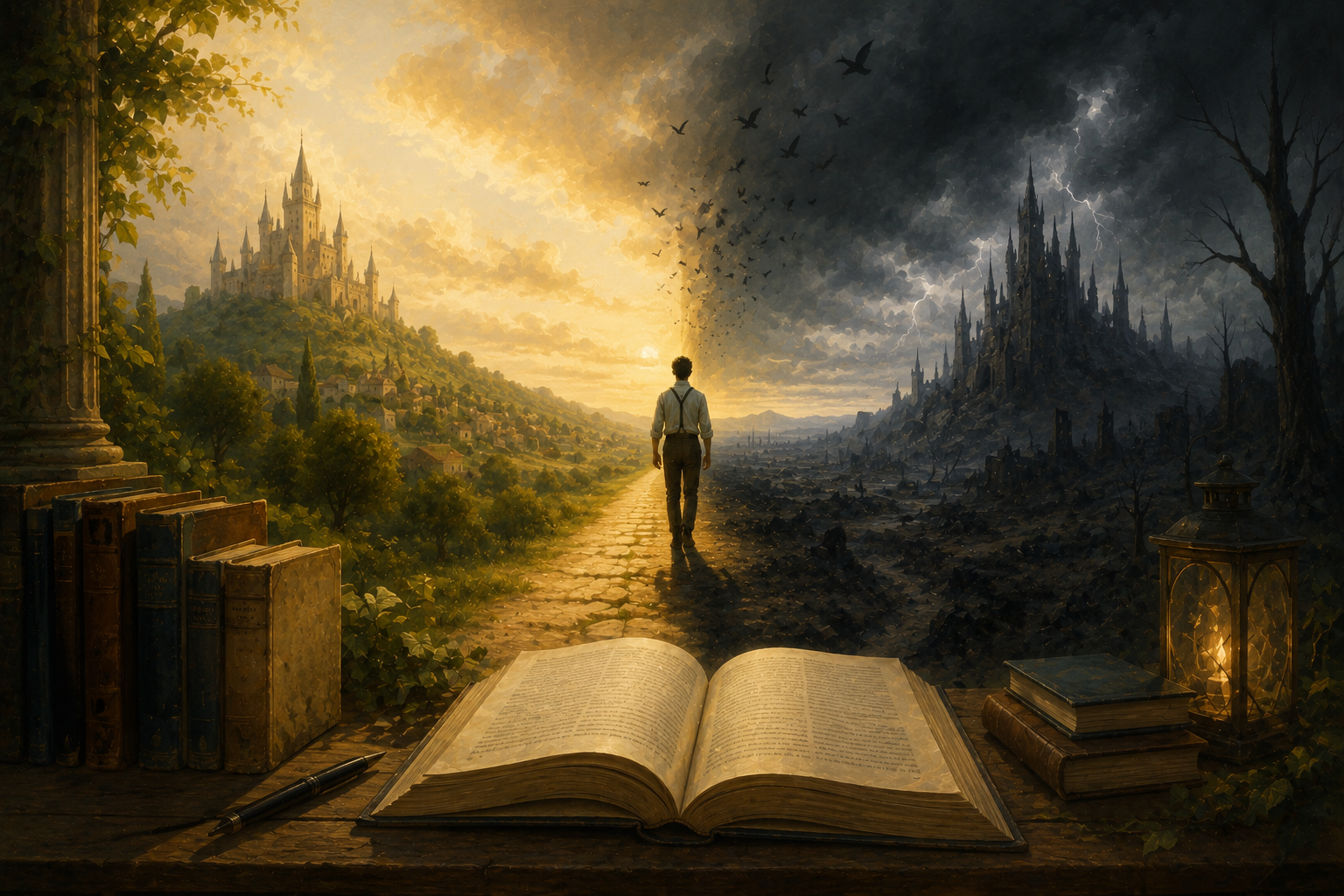
Books about good vs. evil have shaped how readers think about courage, choice, and human nature. These stories ask a simple question with no easy answer: what makes a person do right or wrong?
From ancient myths to modern novels, this conflict helps students see how literature turns moral struggle into powerful drama.
In this Guide
- Why good vs evil still matters
- Classic books about good vs evil
- Modern examples for students
- Common symbols and images
- Major themes to watch for
- Recommended books
- FAQs
- Key takeaway
Why Books About Good vs Evil Still Matter
Stories about moral conflict help readers test their own values from a safe distance.
Books about good vs. evil are not only about heroes fighting villains. The best ones show that good and evil can exist inside the same person.
This is why these stories work so well in school. They lead to strong essays, rich class talks, and deeper character study.
In many novels, the “evil” force is not just a monster or ruler. It can be fear, pride, greed, or the pressure to obey.
That makes the conflict feel real. Most readers will never face a dragon, but they will face moments when the right choice is hard.
Classic Books About Good vs Evil
Classic literature often uses clear conflict to explore messy moral questions.
Classic Books About Good vs. Evil include works in which the hero must choose between comfort and duty. These stories often show that goodness takes effort.
In The Lord of the Rings by J.R.R. Tolkien, the One Ring stands for power that corrupts. Frodo does not win because he is strong. He wins because he keeps choosing the hard path.
In Dr. Jekyll and Mr. Hyde by Robert Louis Stevenson, good and evil live inside one body. The novel asks if people can fully hide their darker side.
And in To Kill a Mockingbird by Harper Lee, evil appears through racism and injustice. Atticus Finch shows that goodness can mean standing firm when a whole town turns away.
These books last because they do not give easy answers. They show that moral courage often has a cost.
Modern Books About Good vs Evil for Students
Modern stories often make the line between good and evil harder to see.
Many modern Books About Good vs Evil focus on systems, not just people. A character may face a cruel government, a violent culture, or a society built on silence.
In The Hunger Games by Suzanne Collins, Katniss fights a government that turns suffering into entertainment. The story asks what people owe each other when survival is on the line.
In Harry Potter by J.K. Rowling, evil grows through fear, prejudice, and the hunger for control. Harry’s choices matter because he refuses to become like the enemy he fights.
And in The Book Thief by Markus Zusak, goodness appears in small acts during a brutal time. A hidden person, a shared book, and a quiet risk can become acts of moral strength.
These works are useful for students because they connect moral conflict to identity, power, and fear.
Common Symbols in Books About Good vs Evil
Symbols help writers turn moral struggle into images readers can remember.
In many Books About Good vs Evil, light often points to truth, hope, or moral clarity. Darkness may suggest fear, secrecy, or corruption.
But strong literature does not always keep symbols simple. A bright place can hide danger. A dark setting can protect someone who needs safety.
Objects also carry moral weight. Tolkien’s Ring is one of the clearest examples. It looks small, but it holds a huge pull toward evil.
Doors, roads, forests, and storms can also show a character’s inner struggle. A journey through wild land may reflect a journey through doubt.
For more on how setting can shape meaning, see our guide to nature and isolation in Western writing.
Writers also use names, colors, and seasons to show moral change. A cold winter may suggest loss, while spring can point to renewal.
Major Themes in Books About Good vs Evil
The best moral conflicts are less about winning and more about choosing.
One major theme in Books About Good vs Evil is temptation. A character may want power, safety, or revenge, even when that desire harms others.
Another key theme is free will. Many stories ask whether people are born good or evil, or whether their choices define them.
Redemption also matters. Some characters fall into darkness but still have a chance to change. This makes the story more human.
Justice is a common concern, too. In works like To Kill a Mockingbird, goodness is tied to truth, fairness, and moral duty.
For a deeper look at how thinkers define evil, students can explore the Stanford Encyclopedia of Philosophy entry on evil.
Recommended Books About Good vs Evil
These books are strong choices for students who want clear conflict and rich themes.
If you want to read more Books About Good vs Evil, start with works that offer both action and moral depth.
- The Lord of the Rings by J.R.R. Tolkien
- Dr. Jekyll and Mr. Hyde by Robert Louis Stevenson
- The Book Thief by Markus Zusak
The Lord of the Rings is best for readers who enjoy epic journeys and symbolic objects. It also works well for essays about temptation and sacrifice.
Dr. Jekyll and Mr. Hyde is short, but it has deep ideas about identity. It is a strong pick for students who like Gothic fiction.
The Book Thief shows moral courage in everyday choices. It is moving without losing sight of history.
For background on William Blake, whose poetry often explores innocence and moral conflict, visit the Poetry Foundation’s William Blake page.
How to Analyze Books About Good vs Evil in an Essay
A strong essay should focus on choices, not just labels.
When you write about Books About Good vs Evil, avoid saying one character is “good” and another is “bad” without proof. Look at actions, motives, and change over time.
Ask what the story rewards. Does it value mercy? Does it punish pride? Or does it show that silence can help evil grow?
Pay close attention to setting. A lonely place, a harsh landscape, or a closed room can reveal fear and conflict. You can connect this idea to our article on isolation in Western writing.
Use symbols to support your claim. If light appears during moments of truth, explain how that pattern shapes the theme.
FAQs About Books About Good vs Evil
What are Books About Good vs Evil?
They are stories built around moral conflict. This conflict may be between characters, inside one person, or within a society.
Why do students study good vs evil in literature?
Students study it because it reveals character, theme, and conflict. It also helps readers think about real moral choices.
Is good vs evil always simple in books?
No. Strong literature often shows that people are complex. A “good” person may fail, and a flawed person may seek redemption.
What is a good short book about good vs evil?
Dr. Jekyll and Mr. Hyde is a strong short choice. It is easy to read, but its ideas are deep.
What symbols often appear in these stories?
Common symbols include light, darkness, roads, mirrors, and powerful objects. These images help show moral struggle.
Key Takeaway
Books about good vs. evil matter because they show that moral choices shape who we become. The strongest stories do not just ask who wins. They ask what each character is willing to lose for what is right.