Literary Devices: A Clear Student Guide with Examples

literary devices

Literary devices help writers shape meaning, mood, and character. When you learn how they work, poems, novels, and plays become easier to understand.

This guide explains literary devices in plain language, with examples from books students often read in class.

This article contains affiliate links.

In this Guide

  • What literary devices are
  • Why they matter in literature
  • Common examples students should know
  • How to analyze them in essays
  • Helpful books and study links
  • FAQ
literary devices

What Are Literary Devices?

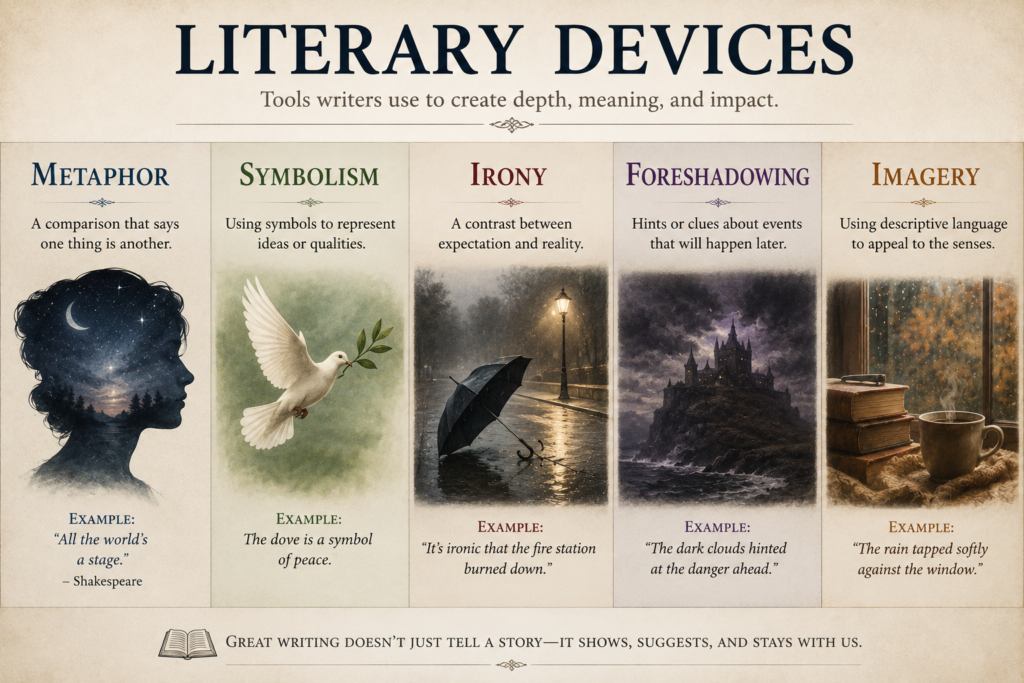
Literary devices are tools writers use to create meaning beyond the basic plot.

A writer may use a symbol, a repeated image, or a sharp contrast to guide how readers feel. These choices help turn a simple story into art.

For example, in The Great Gatsby, the green light is not just a light. It stands for Gatsby’s dream, his hope, and his distance from the life he wants.

Why Literary Devices Matter in Literature

They help you see how a text works, not just what happens in it.

Plot tells you the events. Literary devices show you why those events feel powerful.

In Romeo and Juliet, Romeo calls Juliet the sun. This metaphor shows how bright and life-giving she seems to him. It also reveals his intense, risky view of love.

Once you spot these choices, your essays become stronger. You can explain the author’s craft instead of only retelling the story.

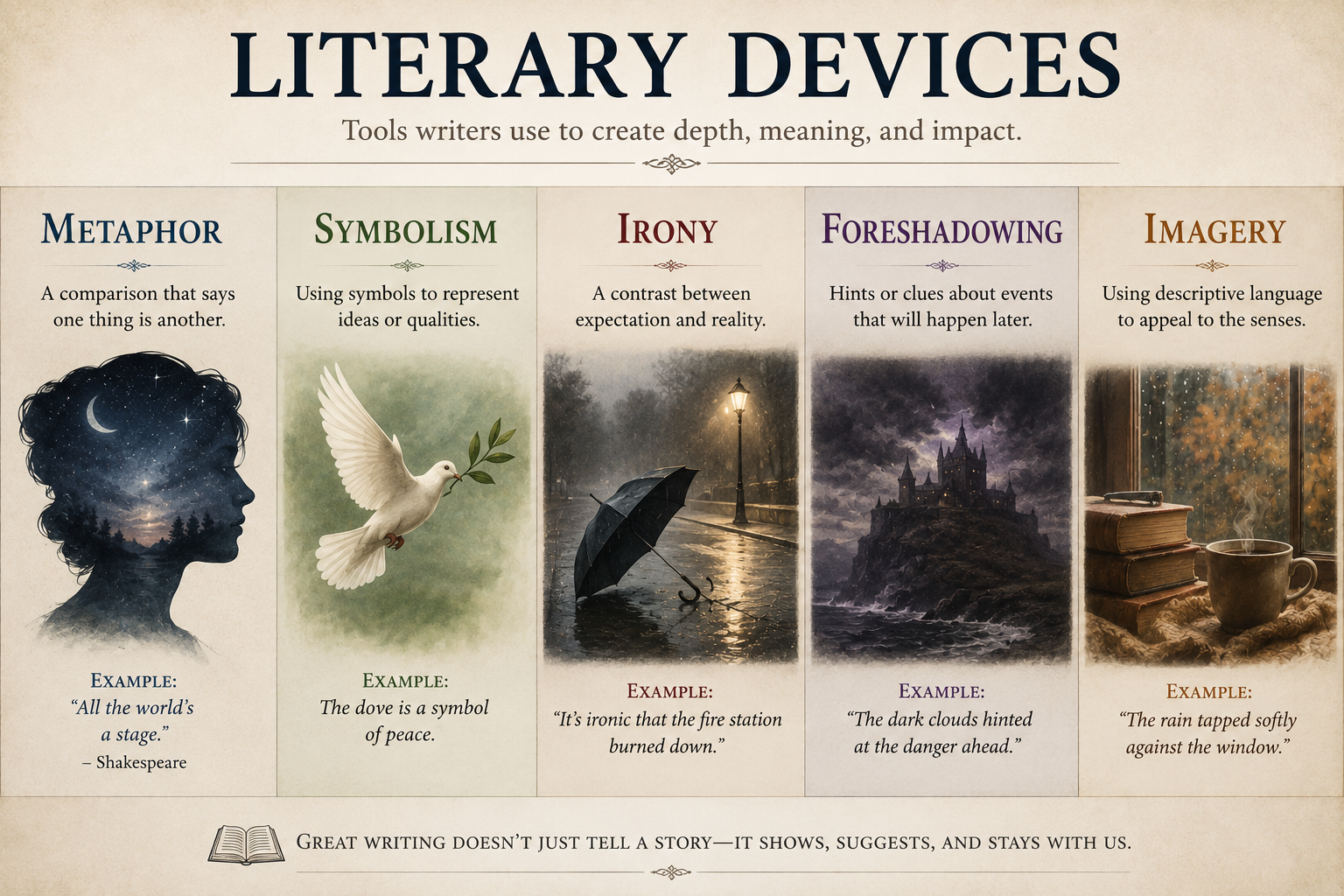
Common Literary Devices Students Should Know

Start with the terms that appear most often in class texts and exams.

Metaphor

A metaphor compares two unlike things without using “like” or “as.” It helps readers see one idea in a fresh way.

When Shakespeare writes that Juliet is the sun, he gives Romeo’s love a bright and dramatic force.

Symbolism

A symbol is an object, place, or image that stands for a larger idea. Symbols often grow in meaning as the story moves on.

The conch in Lord of the Flies stands for order and shared rules. As the conch loses power, the boys lose control.

Irony

Irony creates a gap between what seems true and what is true. It can add humor, tension, or sadness.

In Oedipus Rex, Oedipus seeks the truth about a crime, but the truth points back to him. That irony makes the tragedy hit harder.

Foreshadowing

Foreshadowing hints at what may happen later. It builds tension and helps the ending feel earned.

In Of Mice and Men, early scenes prepare readers for the final choice George must make.

Imagery

Imagery uses sensory details to help readers picture a scene. It can appeal to sight, sound, touch, taste, or smell.

Poetry often relies on imagery. You can explore more terms in the Poetry Foundation glossary.

How to Analyze Literary Devices in an Essay

Good analysis connects the device to meaning.

Do not stop after naming the device. Explain what it does in the text.

A strong sentence might sound like this: “The green light in The Great Gatsby symbolizes Gatsby’s dream, but its distance shows that the dream may never become real.”

This sentence names the symbol, explains its meaning, and connects it to the novel’s larger theme.

For more help with close reading, see our guide to analyzing literature quotes. If you want a faster study plan, try our literature study guide bundle.

Quick Study Tips for Literary Devices

You do not need to memorize every term at once.

Choose a few key terms and practice with short passages. Ask: What stands out? What feeling does it create? How does it connect to theme?

When you mark a passage, look for repeated images or unusual word choices. Repetition often points to meaning.

For a broader view of literature as an art form, you can also read Britannica’s overview of literature.

Relevant Books to Read

These books can help students build confidence with analysis.

FAQ About Literary Devices

What are literary devices in simple terms?

They are writing tools that help authors create deeper meaning, emotion, or style.

What is the easiest device to spot?

Symbolism is often easy to find because it links a concrete object to a larger idea.

Are literary devices only used in poetry?

No. They appear in novels, plays, short stories, speeches, and songs.

How many should I discuss in an essay?

Focus on one or two strong examples. It is better to explain them well than to list many terms.

Key Takeaway

Literary devices help you move from summary to real analysis. When you ask how a writer creates meaning, you read with more skill and write with more confidence.


Literature News Roundup: Pulitzer Risk-Taking, Lord of the Flies on TV, and Access Battles

literature news roundup

This literature news roundup for May 8, 2026, looks at recent developments in literature, from major prizes to debates over access to books. Today’s stories show how classic novels, experimental fiction, poetry, and community reading programs are all shaping the book world right now.

This article contains affiliate links.

literature news roundup

Lord of the Flies Heads to Television for the First Time

William Golding’s Lord of the Flies is getting its first television adaptation as a new miniseries. The news is striking because the novel, now a staple of classrooms and classic literature discussions, was once rejected many times before it found a publisher.

The story’s path from nearly unpublished manuscript to screen adaptation shows how unpredictable literary success can be. Readers who know the book for its dark look at power, fear, and group behavior may find the new version a fresh way to revisit its central conflict.

It also reminds us that adaptations can introduce older books to new audiences. For students and longtime readers alike, the miniseries may spark renewed interest in Golding’s harsh but powerful vision of human nature.

Daniel Kraus Wins Pulitzer for a One-Sentence War Novel

Daniel Kraus’s Angel Down has won a Pulitzer Prize, drawing attention for both its subject and its daring form. The novel is described as a punctuation-free war story written as a single sentence, a choice that turns style into part of the reading experience.
This kind of formal risk matters because it challenges what readers expect a novel to do. Instead of using a familiar structure, Kraus appears to use breathless momentum to mirror fear, chaos, and survival.

The Pulitzer recognition suggests that ambitious experiments in fiction still have a strong place in literary culture. For readers interested in literary analysis, Angel Down may become a fascinating example of how form and meaning work together.

Russian Officials Seize British Children’s Books

Russian customs officials have reportedly seized a shipment of British children’s books, labeling some of the material as “extremist literature.” The incident raises fresh concerns about censorship, especially when the books involved are meant for young readers.

Children’s literature often plays a major role in helping young people understand other cultures, emotions, and ideas. When books for children are blocked or restricted, it can limit curiosity and narrow the range of stories available to families and schools.

For readers, this story is a reminder that book access is not just a publishing issue. It is also tied to politics, education, and the freedom to encounter different viewpoints through reading.

Marianne Boruch Receives the Jackson Poetry Prize

Marianne Boruch has won the $100,000 Jackson Poetry Prize, an award honoring a poet with a strong and lasting body of work. Judges praised her attention to both the natural world and the inner life, pointing to the deeply human quality of her writing.

The award arrives at a time when many readers and writers are asking what art means in an age shaped by artificial intelligence. Boruch’s win highlights the value of careful observation, emotional depth, and the surprises that come from lived experience.
For readers who want to better understand poems like hers, learning how to approach poetry can make the form feel more open and rewarding. Prizes like this also help bring serious public attention to poets whose work may otherwise reach a smaller audience.
Bookmobiles Bring Reading Beyond Library Walls

Two recent stories show how bookmobiles continue to matter in communities where access to books is not always simple. In East Baton Rouge Parish, library buses and vans are bringing books and library services directly to people across the area.
Meanwhile, the Native women-led NDN Girls Book Club is working to raise funds for a permanent bookmobile. After earlier trips across Navajo and Hopi reservations and through Southeast Alaska, the group hopes to expand its reach across Indian Country.

These programs matter because they treat reading as something that should travel to meet people where they are. They also show that the future of books is not only digital or urban; it can be local, mobile, and built around trust.

Closing Thoughts

These stories point to a lively and sometimes tense moment in literature. Awards are honoring bold forms, classic books are finding new screens, and communities are fighting to keep reading accessible.

At the same time, censorship concerns show that the freedom to read remains uneven around the world. Together, this week’s developments suggest that books still carry real power—on the page, on screen, and in public life.

Romeo and Juliet Character Analysis: Key People, Motivations, and Conflicts

Romeo and Juliet character analysis

A practical breakdown of the main characters and how their choices shape the story.

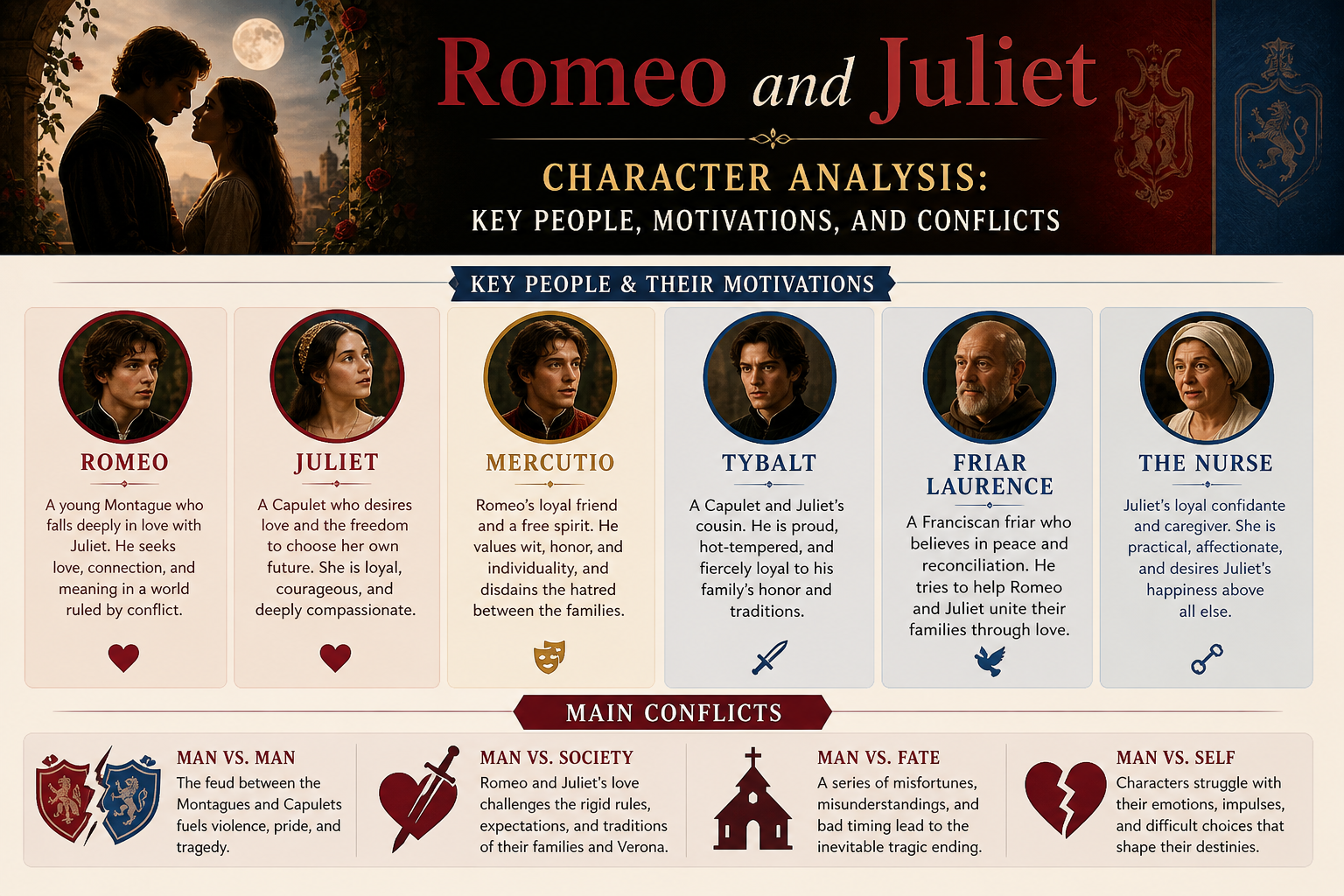
Shakespeare’s tragedy works because each character wants something badly, then acts before the full truth is clear. This Romeo and Juliet character analysis breaks down the main characters, their motives, and the conflicts that push the play toward its tragic end.

This article contains affiliate links.

In this Guide

Romeo and Juliet character analysis

Romeo and Juliet Character Analysis: The Big Picture

The play is not only about young love. It is also about family pressure, pride, anger, and the cost of poor choices.

In a strong Romeo and Juliet character analysis, the key question is not just “Who is good?” or “Who is bad?” A better question is, “What does this person want, and what choice do they make because of it?”

Romeo wants love that feels total. Juliet wants control over her own life. Lord Capulet wants family honor. Tybalt wants respect through violence.

These wants crash into each other. That is why the plot feels fast, tense, and painful.

If you need a simple method for any character essay, this guide to analyzing characters in literature can help you build stronger claims.

Romeo and Juliet Character Analysis of Romeo Montague

Romeo is emotional, romantic, and quick to act. His heart often moves faster than his judgment.

At the start, Romeo feels crushed because Rosaline does not love him back. This matters because it shows how easily he turns love into an obsession.

When he meets Juliet, his feelings shift at once. This does not mean his love is fake. It does mean he trusts intense feeling more than careful thought.

Romeo’s main conflict is between desire and self-control. He wants peace with Tybalt after he marries Juliet, but he cannot control his rage after Mercutio dies.

That choice changes everything. Romeo kills Tybalt, gets banished, and loses the chance to build a future with Juliet in Verona.

For essays, Romeo is a strong example of a tragic character whose best traits create danger. His passion makes him loving, but it also makes him reckless.

image-slider-with-thumbnail1.jpeg
PlayPause
previous arrow
next arrow
image-slider-with-thumbnail1.jpeg
image-slider-with-thumbnail3.jpeg
image-slider-with-thumbnail4.jpeg
ChatGPT Image Jun 27, 2026, 06_33_13 PM
ChatGPT Image Jun 27, 2026, 06_36_37 PM
ChatGPT Image Jun 27, 2026, 06_38_39 PM
ChatGPT Image Jun 27, 2026, 06_31_22 PM
image-slider-with-thumbnail7.jpeg
ChatGPT Image Jun 27, 2026, 06_29_43 PM
ChatGPT Image Jun 27, 2026, 06_27_44 PM
image-slider-with-thumbnail6.jpeg
ChatGPT Image Jun 27, 2026, 06_15_07 PM
image-slider-with-thumbnail5.jpeg
ChatGPT Image Jun 27, 2026, 06_22_43 PM
ChatGPT Image Jun 27, 2026, 06_25_37 PM
ChatGPT Image Jun 27, 2026, 06_19_43 PM
ChatGPT Image Jun 27, 2026, 06_12_00 PM
ChatGPT Image Jun 27, 2026, 06_08_50 PM
ChatGPT Image Jun 26, 2026, 04_54_23 PM
ChatGPT Image Jun 27, 2026, 05_53_51 PM
ChatGPT Image Jun 28, 2026, 08_35_55 AM
previous arrow
next arrow

Romeo and Juliet Character Analysis of Juliet Capulet

Juliet starts the play as an obedient daughter. By the end, she becomes one of Shakespeare’s boldest young characters.

A strong Romeo and Juliet character analysis should treat Juliet as more than Romeo’s love interest. She makes major choices and takes major risks.

Juliet’s main motive is freedom. She wants to love Romeo, but she also wants the right to choose her own future.

Her conflict grows when her parents order her to marry Paris. To them, the match seems smart. To Juliet, it feels like a prison.

Juliet is often more practical than Romeo. She asks serious questions about marriage, timing, and danger. Still, she is young, trapped, and short on safe advice.

Her choice to take Friar Lawrence’s potion shows courage. It also shows how few options she has in a world ruled by family power.

Romeo and Juliet Character Analysis of the Capulets and Montagues

The older generation keeps the feud alive, even when the young people pay the price.

The Capulets and Montagues are not fully explained, which makes their hatred feel even more pointless. Shakespeare shows the effect of the feud, not a clear reason for it.

Lord Capulet can seem caring when he first protects Juliet from an early marriage. Later, he turns harsh when she refuses Paris.

His motive is control. He wants Juliet to obey because her marriage affects his honor and social plans.

Lady Capulet is more distant. She follows the rules of her class and expects Juliet to accept them too.

The Montagues have less stage time, but they also live inside the feud. Their name makes Romeo an enemy before he has done anything to Juliet’s family.

Romeo and Juliet Character Analysis of Key Supporting Characters

The supporting characters shape the lovers’ choices. Some try to help, while others make conflict worse.

Mercutio

Mercutio is witty, loyal, and sharp-tongued. He mocks romantic love and often turns serious moments into jokes.

His death is a turning point. His curse, “A plague o’ both your houses,” points blame at both families.

Tybalt

Tybalt is proud and violent. He sees Romeo’s presence at the Capulet party as an insult that must be answered.

In a Romeo and Juliet character analysis, Tybalt often stands for the feud itself. He does not want peace because his identity depends on family honor.

Benvolio

Benvolio tries to keep the peace. His name even suggests goodwill.

He fails not because he is weak, but because the world around him rewards anger more than patience.

Friar Lawrence

Friar Lawrence wants peace between the families. He sees Romeo and Juliet’s marriage as a chance to end the feud.

His plan is risky. Like Romeo, he acts with hope before he has enough control over the outcome.

The Nurse

The Nurse loves Juliet and gives her comfort. She also helps Juliet meet Romeo in secret.

Yet the Nurse later tells Juliet to marry Paris. This feels like betrayal because Juliet needs moral support, not just practical advice.

Romeo and Juliet Character Analysis Through Major Conflicts

Character conflict drives the play. Each clash reveals what people value most.

Love versus hate is the clearest conflict. Romeo and Juliet love each other, but their families have taught them to hate each other’s names.

Youth versus age also matters. The young characters act from feeling, while the older characters act from custom and status.

Fate versus choice is harder to judge. The prologue calls the lovers “star-crossed,” but their choices still matter.

This is similar to other famous tragedies. In Macbeth, prophecy matters, but Macbeth’s choices cause the bloodshed. In Oedipus Rex, fate is powerful, but human pride makes the ending hurt more.

For helpful background on the play and Shakespeare’s time, see Britannica’s overview of Romeo and Juliet. You can also explore Shakespeare’s sonnets and language at the Poetry Foundation.

How to Use This Romeo and Juliet Character Analysis in Essays

A good essay claim should connect a character trait to a result. Do not stop at “Romeo is emotional.” Explain how that emotion changes the plot.

Try a sentence like this: Romeo’s passion helps him love Juliet deeply, but it also leads him to kill Tybalt before he thinks about the cost.

For Juliet, you might argue that her courage grows as her choices shrink. That kind of claim gives you room to discuss family pressure, marriage, and the potion plan.

Use short quotes and explain them. A quote should support your idea, not replace it.

If you want a step-by-step tool for class notes, try this character analysis practice guide. You can pair it with our character analysis strategy article for essay planning.

Helpful Books for Romeo and Juliet Study

These books can help with close reading, class discussion, and quote-based analysis.

FAQ – Romeo and Juliet Character Analysis

Who is the most important character in Romeo and Juliet?

Romeo and Juliet are both central. Romeo drives many public conflicts, while Juliet shows the deepest personal growth.

What is Romeo’s main flaw?

Romeo’s main flaw is impulsiveness. He acts from intense feeling before he thinks through the result.

What makes Juliet a strong character?

Juliet becomes strong because she makes hard choices under pressure. She challenges family rules and risks her life for her chosen love.

Why is Tybalt important?

Tybalt keeps the feud active. His anger turns Romeo’s secret marriage into a public disaster.

How should I write a Romeo and Juliet character analysis essay?

Pick one character, name a clear trait, and show how that trait affects the plot. Use quotes, then explain what each quote proves.

Key Takeaway

The best Romeo and Juliet character analysis shows how motives lead to choices, and how those choices turn love into tragedy. The play feels timeless because its characters act from feelings students still understand today.

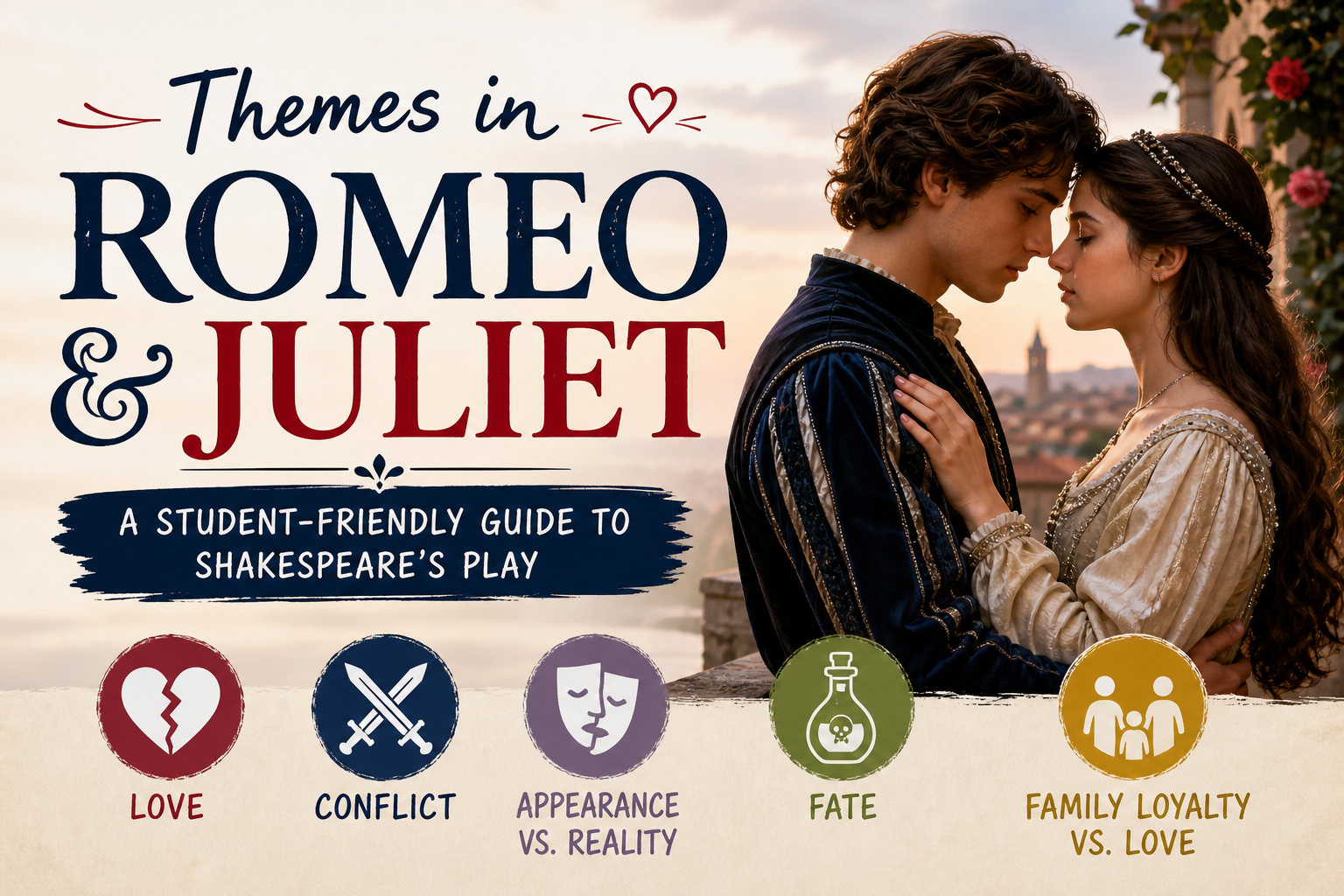
Themes in Romeo and Juliet: An In-Depth Guide

themes in Romeo and Juliet

Shakespeare’s tragedy can feel fast, emotional, and hard to sort out at first. This guide explains the major themes in Romeo and Juliet so you can connect the plot to the bigger ideas in the play.

themes in Romeo and Juliet

In this Guide

  • Why theme matters in the play
  • Love and desire
  • Fate and timing
  • Family conflict
  • Youth and identity
  • Writing about theme

This article contains affiliate links.

What Makes the Themes in Romeo and Juliet So Important?

The play is not only about two teenagers who fall in love. It is about what happens when private feelings crash into public hate.

The themes in Romeo and Juliet help readers see why the ending feels both shocking and expected. Shakespeare shows a world where love is powerful, but it is not strong enough to escape anger, pride, and bad choices.

Need a quick refresher before you write? Read our guide on how to identify theme in literature.

Love as One of the Central Themes in Romeo and Juliet

Love in this play is intense, sudden, and dangerous. Romeo and Juliet do not fall in love slowly. They meet, speak, kiss, and decide that life without each other would feel empty.

Among all the themes in Romeo and Juliet, love may be the easiest to notice. Yet Shakespeare does not show love as simple or safe. Love gives the characters courage, but it also pushes them toward risk.

Romeo’s feelings for Rosaline seem dramatic but shallow. His love for Juliet feels deeper because it changes how he sees himself, his family, and his future.

This type of intense love also appears in works like Wuthering Heights by Emily Brontë, where passion can feel larger than reason. In both texts, love has beauty, but it also has a cost.

Fate and Timing in the Themes in Romeo and Juliet

The play asks a hard question: are Romeo and Juliet doomed, or do people make choices that lead to doom?

Fate is one of the most debated themes in Romeo and Juliet. The Prologue calls the lovers “star-cross’d,” which suggests their lives are shaped by forces beyond their control.

Bad timing appears again and again. Romeo meets Juliet right after his pain over Rosaline. The secret wedding happens too fast. Friar Lawrence’s letter never reaches Romeo.

Still, fate does not erase choice. Tybalt chooses violence, Romeo chooses revenge, and the adults choose to keep old hatred alive.

Family Conflict: One of the Harshest Themes in Romeo and Juliet

The feud between the Montagues and Capulets shapes the whole play. It turns ordinary places, such as streets and homes, into unsafe spaces.

Family loyalty should protect young people, but here it traps them. Romeo and Juliet cannot love openly because their names carry a history of hate.

This theme fits with other works about social conflict, such as West Side Story, which is based on Shakespeare’s play. Both stories show how group identity can crush personal desire.

image-slider-with-thumbnail1.jpeg
PlayPause
previous arrow
next arrow
image-slider-with-thumbnail1.jpeg
image-slider-with-thumbnail3.jpeg
image-slider-with-thumbnail4.jpeg
ChatGPT Image Jun 27, 2026, 06_33_13 PM
ChatGPT Image Jun 27, 2026, 06_36_37 PM
ChatGPT Image Jun 27, 2026, 06_38_39 PM
ChatGPT Image Jun 27, 2026, 06_31_22 PM
image-slider-with-thumbnail7.jpeg
ChatGPT Image Jun 27, 2026, 06_29_43 PM
ChatGPT Image Jun 27, 2026, 06_27_44 PM
image-slider-with-thumbnail6.jpeg
ChatGPT Image Jun 27, 2026, 06_15_07 PM
image-slider-with-thumbnail5.jpeg
ChatGPT Image Jun 27, 2026, 06_22_43 PM
ChatGPT Image Jun 27, 2026, 06_25_37 PM
ChatGPT Image Jun 27, 2026, 06_19_43 PM
ChatGPT Image Jun 27, 2026, 06_12_00 PM
ChatGPT Image Jun 27, 2026, 06_08_50 PM
ChatGPT Image Jun 26, 2026, 04_54_23 PM
ChatGPT Image Jun 27, 2026, 05_53_51 PM
ChatGPT Image Jun 28, 2026, 08_35_55 AM
previous arrow
next arrow

Youth, Identity, and Rebellion

Romeo and Juliet are young, but Shakespeare does not treat them as silly. He shows how young people can see truths that adults refuse to face.

Juliet grows quickly across the play. At first, she listens to her parents. Soon, she makes bold choices about love, marriage, and death.

Romeo also tries to step outside his family role. He wants to stop being just a Montague, but the feud pulls him back into violence after Mercutio dies.

Language, Light, and Darkness

Shakespeare uses images of light and darkness to show how love changes the world for Romeo and Juliet.

Juliet is compared to the sun, stars, and bright light. These images make love feel rare and almost sacred.

Darkness is not always evil in the play. Night gives the lovers privacy. Daylight often brings danger, rules, and separation.

This contrast helps readers see one of the quieter themes in Romeo and Juliet: the same world can feel safe or cruel depending on who has power.

Death, Tragedy, and the Cost of Hate

The ending is tragic because the deaths feel avoidable. Many people could have stopped the disaster earlier, but they do not.

Mercutio and Tybalt die before Romeo and Juliet. Their deaths show that the feud harms more than the lovers.

By the final scene, the families understand the cost of hate too late. The peace they reach is real, but it is built on loss.

For background on the play, see Britannica’s overview of Romeo and Juliet. You can also explore the Poetry Foundation’s page on William Shakespeare.

How to Write About the Themes in Romeo and Juliet

A strong theme essay should make a clear claim about what Shakespeare suggests, not just name a topic.

For example, do not only write, “The play is about love.” A stronger claim would be, “Shakespeare presents love as powerful but fragile when society is ruled by hate.”

Use short quotes and explain them in your own words. A quote does not prove your point unless you connect it to the theme.

For more help with this skill, review our student-friendly theme guide.

Helpful Books to Search for on Amazon or at Your Library

These books can help if you want a stronger grasp of the play and Shakespeare’s world.

FAQ: Themes in Romeo and Juliet

These quick answers can help with homework, test review, or essay planning.

What are the main themes in Romeo and Juliet?

The main themes include love, fate, family conflict, youth, violence, and the cost of hate.

Is love shown as good or bad in the play?

Love is shown as powerful and sincere. It becomes tragic because the world around the lovers is hostile.

Does fate cause the tragedy?

Fate plays a major role, but human choices matter too. Shakespeare mixes bad luck with rash action.

Why is family conflict so important?

The feud makes Romeo and Juliet hide their love. It also teaches young people that violence is normal.

Key Takeaway

The key insight: Shakespeare uses Romeo and Juliet’s love story to show how hate can destroy what is most innocent and hopeful.

Reading the Landscape: Nature and Isolation in Western Writing

nature and isolation in Western writing

How the American West shapes theme, character, and meaning in literature

The American West is more than a backdrop. In nature and isolation in Western writing, the land shapes how characters think, feel, and survive. Wide skies, long distances, and quiet towns create a kind of pressure that shows up in the writing itself. When you read Western literature, the land is never just scenery. It acts on people. It tests them. Sometimes, it often leaves them alone with themselves.

This guide will help you read the Western landscape as part of the story. You will see how nature creates isolation, how that isolation shapes character, and how both work together to build meaning.

This article contains affiliate links.

In This Guide

  • What makes the Western landscape different in literature
  • How isolation functions as a theme
  • Key examples from American writing
  • How to analyze landscape in any text
  • Quick reading prompts you can use right away
  • FAQ – Nature and isolation in Western writing

Across many regions, setting supports the story. In Western writing, setting often drives it.

The land is open and exposed. There are fewer boundaries, fewer crowds, and fewer places to hide. This creates a different kind of tension. Characters cannot rely on social structures in the same way they might in a city or a small, dense town. The result is a stronger focus on the individual.

Distance matters here. A long road or an empty field is not just visual detail. It suggests time, effort, and sometimes risk. When a character travels across that space, the journey becomes part of the meaning of the story.

Silence also plays a role. In Western landscapes, quiet is not peaceful in a simple sense. It can feel heavy. Sometimes it forces reflection. It can leave characters facing thoughts they would rather avoid.

Nature and Isolation in Western Writing: What Makes the Landscape Unique

Isolation in Western writing is rarely just about being alone. It often reveals something deeper about identity, fear, or belief.

Characters in these settings tend to face three kinds of isolation:

First, physical isolation. The land itself separates people. Homes are far apart. Help is not close. This creates a sense of vulnerability that shapes decisions.

Second, emotional isolation. Without constant interaction, characters may struggle to express what they feel. This can lead to restraint, distance, or quiet tension between people.

Third, existential isolation. The scale of the landscape can make a person feel small. This often leads to questions about purpose, meaning, and place in the world.

You can see this clearly in works like My Ántonia by Willa Cather, where the Nebraska prairie creates both freedom and loneliness, or in Blood Meridian by Cormac McCarthy, where the harsh land reflects a deeper moral emptiness.

Nature as a Force, Not a Backdrop

In Western writing, nature often acts on characters rather than sitting behind them.

Weather can shape the plot. A storm may delay travel or create danger. Heat can wear a character down. Cold can isolate them further. These are not small details. They influence what characters can do and how they feel.

The land can also mirror inner states. A dry, empty desert may reflect a sense of loss. A wide, open field may suggest possibility, but also uncertainty. Writers use these connections to deepen meaning without stating it directly.

This is especially clear in The Grapes of Wrath by John Steinbeck, where the Dust Bowl is both a real event and a symbol of hardship and displacement.

How Isolation Shapes Character

Characters in Western settings often develop in response to the land.

They may become self-reliant. With fewer resources and less support, they learn to solve problems on their own. This can create strength, but it can also lead to emotional distance.

They may become observant. In a quiet landscape, small details matter. A change in weather, a distant figure, or a shift in light can carry meaning. Characters learn to notice what others might miss.

They may struggle with connection. When people are spread out, relationships can feel fragile. This can lead to missed opportunities or unspoken feelings.

When you read, watch how a character changes over time. Ask how much of that change comes from the land itself. In Western writing, the answer is often more than you expect.

How to Analyze Landscape in Any Text

You can apply a simple method when reading Western literature or any text where setting matters.

Start by asking what the land looks like. Focus on specific details. Is it open or closed, harsh or gentle, quiet or active?

Then ask how the land affects the character’s choices. Does it limit them, push them, or shape their path?

Next, look for emotional connections. Does the landscape reflect what the character feels, or does it contrast with it?

Finally, connect the setting to theme. Ask what the landscape suggests about larger ideas like freedom, survival, loneliness, or hope.

This approach keeps your analysis grounded in the text while still reaching deeper meaning.

Quick Reading Prompts

Use these when you are working through a Western text:

  • What does the landscape make possible, and what does it take away?
  • How does distance affect the character’s decisions?
  • Where do you see silence or emptiness, and what do they mean?
  • How would the story change in a different setting?

These questions can turn a simple reading into a more thoughtful analysis.

Why This Matters for Literary Analysis

When you begin to read landscape as part of the story, texts open up in new ways. You start to see how meaning is built through more than dialogue or plot. The environment becomes part of the language of the work.

For students, this skill strengthens essays and close readings. For general readers, it deepens the experience of the story. It allows you to see how writers use place to explore what it means to be human.

Key Takeaway

In Western writing, the landscape is never neutral. It shapes isolation, defines character, and carries meaning. When you learn to read the land, you begin to understand the story at a deeper level.

If you want step-by-step support with literary analysis, you can use these tools:

Literary Analysis Essay Examples

Literary Analysis Essay Toolkit

FAQ: Nature and Isolation in Western Writing

Why is the landscape so important in Western writing?

In Western literature, the landscape shapes the story in direct ways. The size of the land, the distance between people, and the quiet all affect how characters think and act. The setting often creates pressure that drives decisions, conflict, and growth.

What does isolation mean in Western literature?

Isolation in Western writing goes beyond being alone. It can be physical, emotional, or even spiritual. Characters may be separated by distance, struggle to connect with others, or feel small in a vast world. This isolation often reveals deeper truths about identity and purpose.

How does nature influence character development?

Nature often forces characters to adapt. Harsh weather, long distances, and limited resources can make characters more independent, but also more distant from others. These conditions shape how they respond to conflict and how they relate to the world around them.

How can I analyze landscape in a literary essay?

Start by describing the setting clearly. Then connect it to character choices and emotional tone. Finally, explain how the landscape supports the theme. Focus on how the environment influences action and meaning, rather than treating it as background detail.

Is this approach useful outside of Western literature?

Yes. While it is especially clear in Western writing, this approach works in any text where setting matters. Learning to read landscape as part of the story will strengthen your analysis across many types of literature.

What are examples of books that show nature and isolation in the American West?

Works like My Ántonia by Willa Cather, The Grapes of Wrath by John Steinbeck, and Blood Meridian by Cormac McCarthy all explore how the Western landscape shapes human experience. Each text uses the land to reflect deeper emotional and thematic concerns.

error

Enjoy this article? Please spread the word :)

Follow by Email
BLUESKY
fb-share-icon
Reddit
LinkedIn
Share
RSS