Best Gothic Journey Symbolism: Paths, Darkness, and Self-Discovery in Gothic Literature

gothic journey symbolism

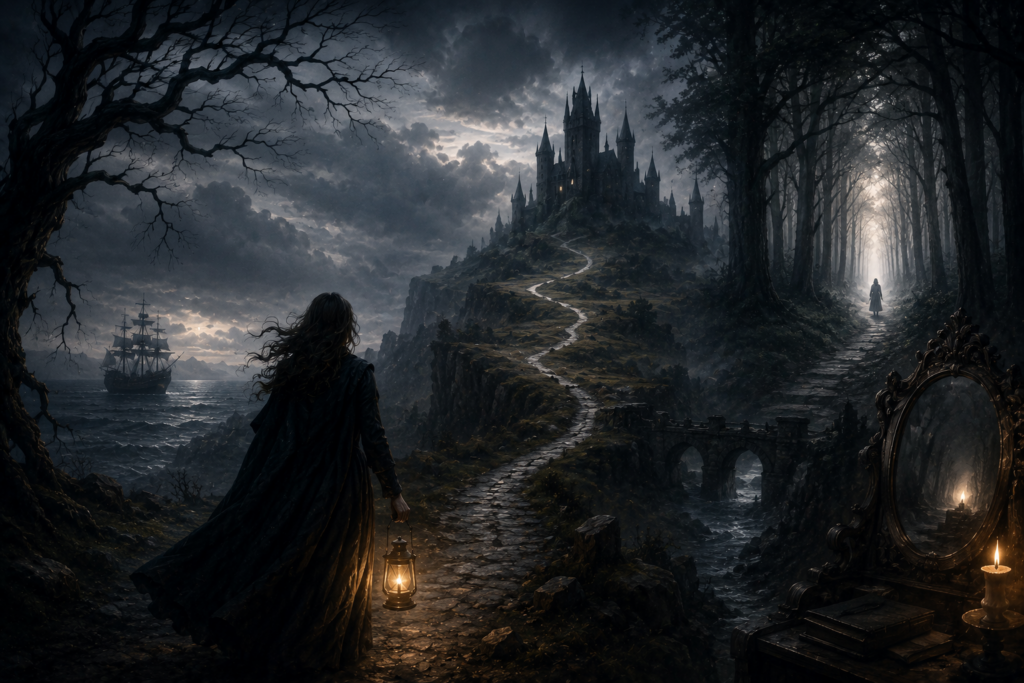
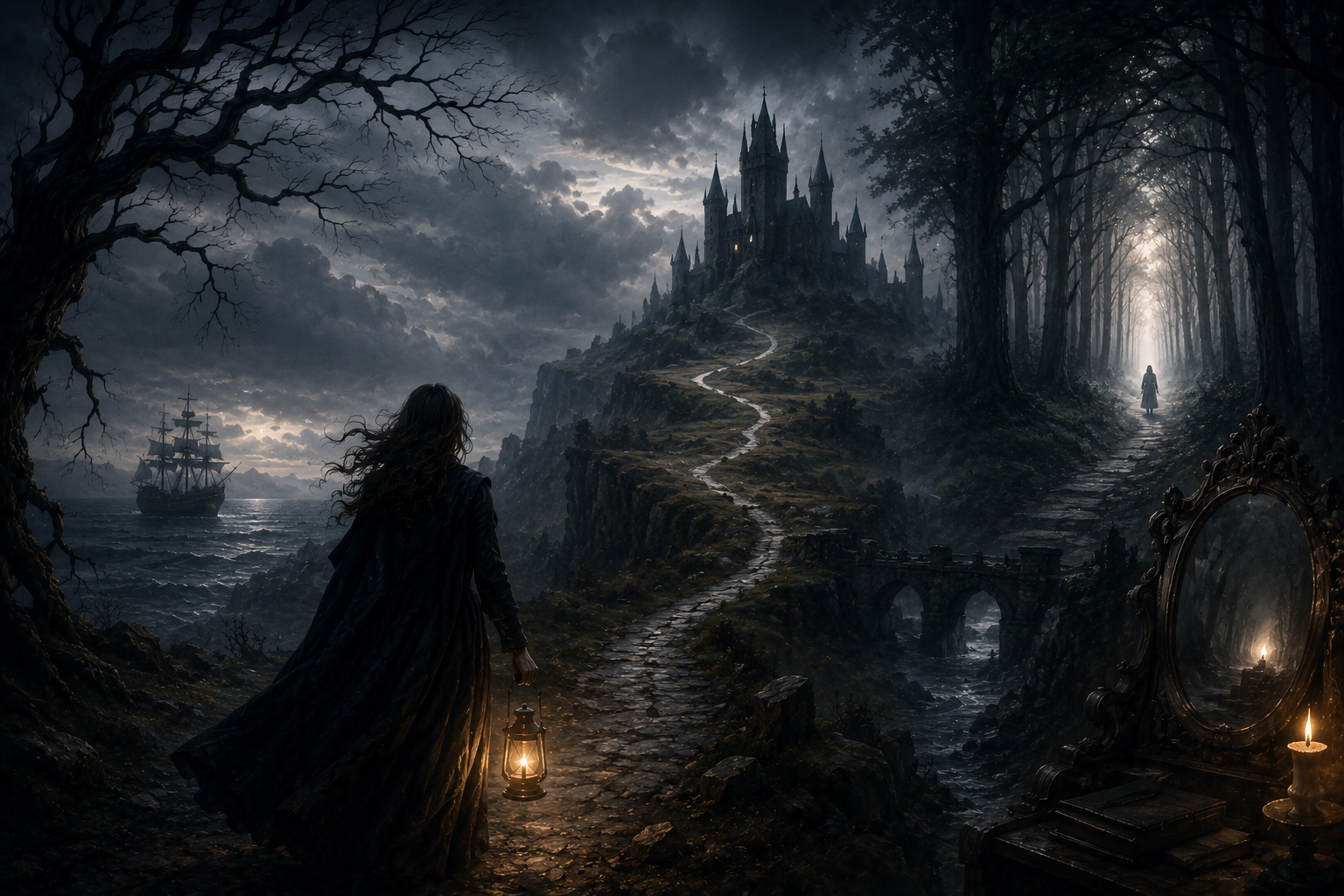
Best Gothic Journey Symbolism helps readers understand why Gothic stories often send characters into dark houses, wild landscapes, and strange inner worlds. These journeys are rarely simple trips. They often reveal fear, guilt, desire, and hidden truth.

In this Guide

  • What Gothic journey symbolism means
  • Why journeys matter in Gothic literature
  • Classic examples from famous books
  • Common symbols and themes
  • Recommended books to read
  • How to spot Gothic journey symbols
  • FAQs
gothic journey symbolism

What Best Gothic Journey Symbolism Means

A Gothic journey is both a real path and an emotional test.

In many Gothic works, a character travels to a strange place. It might be a castle, a ruined house, a lonely road, or a locked room. That place often reflects what the character fears most.

Best Gothic Journey Symbolism shows how movement can reveal the mind. The road, the house, or the storm is not just scenery. It becomes a sign of danger, memory, and inner conflict.

Gothic journeys often move from safety to fear. A character may begin in a familiar world, then enter a place where rules break down. This shift helps the reader feel the character’s loss of control.

Why Best Gothic Journey Symbolism Matters in Gothic Literature

Gothic journeys turn setting into meaning.

Best Gothic Journey Symbolism matters because Gothic stories use place to shape emotion. A dark hallway can suggest secrets. A long road can suggest fate. A locked door can suggest a truth that a character does not want to face.

These journeys also show change. A character who enters a haunted place rarely leaves the same. The journey may lead to knowledge, madness, freedom, or ruin.

This is why Gothic travel feels different from adventure travel. In an adventure story, the goal may be treasure or victory. In Gothic fiction, the goal is often hidden truth.

For more help with symbols in fiction, read this guide on how to find symbolism in a story.

Best Gothic Journey Symbolism in Classic Gothic Novels

Famous Gothic books often use journeys to pull characters into fear.

One of the clearest examples of Best Gothic Journey Symbolism appears in Mary Shelley’s Frankenstein. Victor Frankenstein travels through mountains, ice, and lonely places. These settings reflect his guilt and isolation.

In Bram Stoker’s Dracula, Jonathan Harker’s trip to Castle Dracula feels like a journey away from reason. The castle stands for danger, old power, and the unknown. His travel deeper into Transylvania becomes a move into fear.

In Charlotte Brontë’s Jane Eyre, Jane’s journeys mark her search for dignity and self-respect. Thornfield Hall is not just a home. It is a place of mystery, desire, and moral choice.

The Gothic tradition has a long history. You can learn more about its roots from Britannica’s overview of the Gothic novel.

Common Symbols in Best Gothic Journey Symbolism

Gothic journeys often repeat certain images because they carry strong emotional weight.

Roads often symbolize fate. A character may think they have a choice, but the path seems to pull them toward danger.

Castles and old houses often symbolize the past. Their locked rooms and hidden spaces suggest family secrets, guilt, or buried trauma.

Storms often symbolize emotional chaos. When thunder breaks or wind rises, the character’s inner world may be under stress too.

Dark forests often symbolize confusion. They make the character feel lost, both in the world and in the mind.

In Best Gothic Journey Symbolism, these images work together. The journey becomes a map of fear.

Themes Behind Gothic Journey Symbolism

Gothic journeys often ask what happens when people face what they hide.

One major theme is isolation. Many Gothic characters travel alone or feel alone, even near others. This loneliness makes fear stronger.

Another theme is the return of the past. A journey into an old house or ancient land often brings buried secrets back into the present.

A third key theme is identity. Characters may discover that they are not who they thought they were. The journey forces them to see themselves more clearly.

Best Gothic Journey Symbolism works because it connects outer movement with inner truth. The character moves through the world, but the real battle takes place inside.

Books That Show Best Gothic Journey Symbolism Well

These books are useful for students who want strong Gothic examples.

Frankenstein by Mary Shelley follows Victor Frankenstein through science, guilt, and frozen landscapes. The Arctic journey shows the cost of ambition.

Dracula by Bram Stoker uses travel, letters, ships, and trains to build fear. The movement between places shows how evil can cross borders.

Jane Eyre by Charlotte Brontë uses homes and roads to trace Jane’s growth. Her journey shows her fight for love, faith, and self-worth.

You can find these books on Amazon, at local bookstores, or through most school and public libraries.

How to Spot Best Gothic Journey Symbolism in a Story

Look at where the character goes and what changes after each place.

To spot Best Gothic Journey Symbolism, ask what the setting seems to reveal. Does the house hide a secret? Does the road lead to danger? Or does the weather match the character’s mood?

Pay attention to repeated images. If a story keeps showing doors, shadows, mirrors, or staircases, those details may carry symbolic meaning.

Also ask what the character learns. A Gothic journey often ends with a truth that cannot be ignored.

If you want a simple method, use this helpful post on finding symbolism in literature.

Gothic Journey Symbolism in Poetry and Short Fiction

Gothic journeys do not only appear in novels.

Edgar Allan Poe often uses rooms, houses, and mental spaces as symbolic journeys. In “The Fall of the House of Usher,” the narrator enters a decaying house that reflects sickness and collapse.

The house becomes more than a setting. It feels alive with fear. The narrator’s visit becomes a journey into family decay and mental breakdown.

You can explore Poe’s work through the Poetry Foundation’s page on Edgar Allan Poe.

Why Students Should Study Best Gothic Journey Symbolism

This topic helps students move beyond plot summary.

When you study Best Gothic Journey Symbolism, you learn how setting, mood, and character work together. You see that a journey can mean more than travel.

This is useful for essays because it gives you clear evidence. You can connect a place to a theme, then explain how that place changes the character.

For AP Literature and college classes, this kind of analysis can make an essay stronger. It shows close reading and deeper thought.

FAQs About Best Gothic Journey Symbolism

What is Gothic journey symbolism?

Gothic journey symbolism is the use of travel, setting, and movement to show fear, guilt, secrets, or inner change. The journey often reflects the character’s mind.

What is the best example of Best Gothic Journey Symbolism?

Dracula is one strong example. Jonathan Harker’s trip to Castle Dracula shows a move from the normal world into danger and mystery.

Why do Gothic stories use old houses and castles?

Old houses and castles often stand for the past. They suggest secrets, family history, and hidden fear.

How can I write about Gothic journey symbolism in an essay?

Choose one journey or setting. Explain what it represents, then connect it to a theme like fear, identity, or guilt.

Is Gothic journey symbolism only found in classic books?

No. Modern horror, mystery, and fantasy stories also use Gothic journeys. Any story can use a dark path, strange house, or haunted space as a symbol.

Key Takeaway

Best Gothic Journey Symbolism shows that Gothic travel is never just about distance. The path into darkness often leads to the truth a character fears most.

When readers notice these symbols, Gothic literature becomes richer and more powerful. The road, the house, and the storm all speak.
Most Beautiful Water Symbolism in Literature: Meaning, Themes, and Books to Read

water symbolism
water symbolism

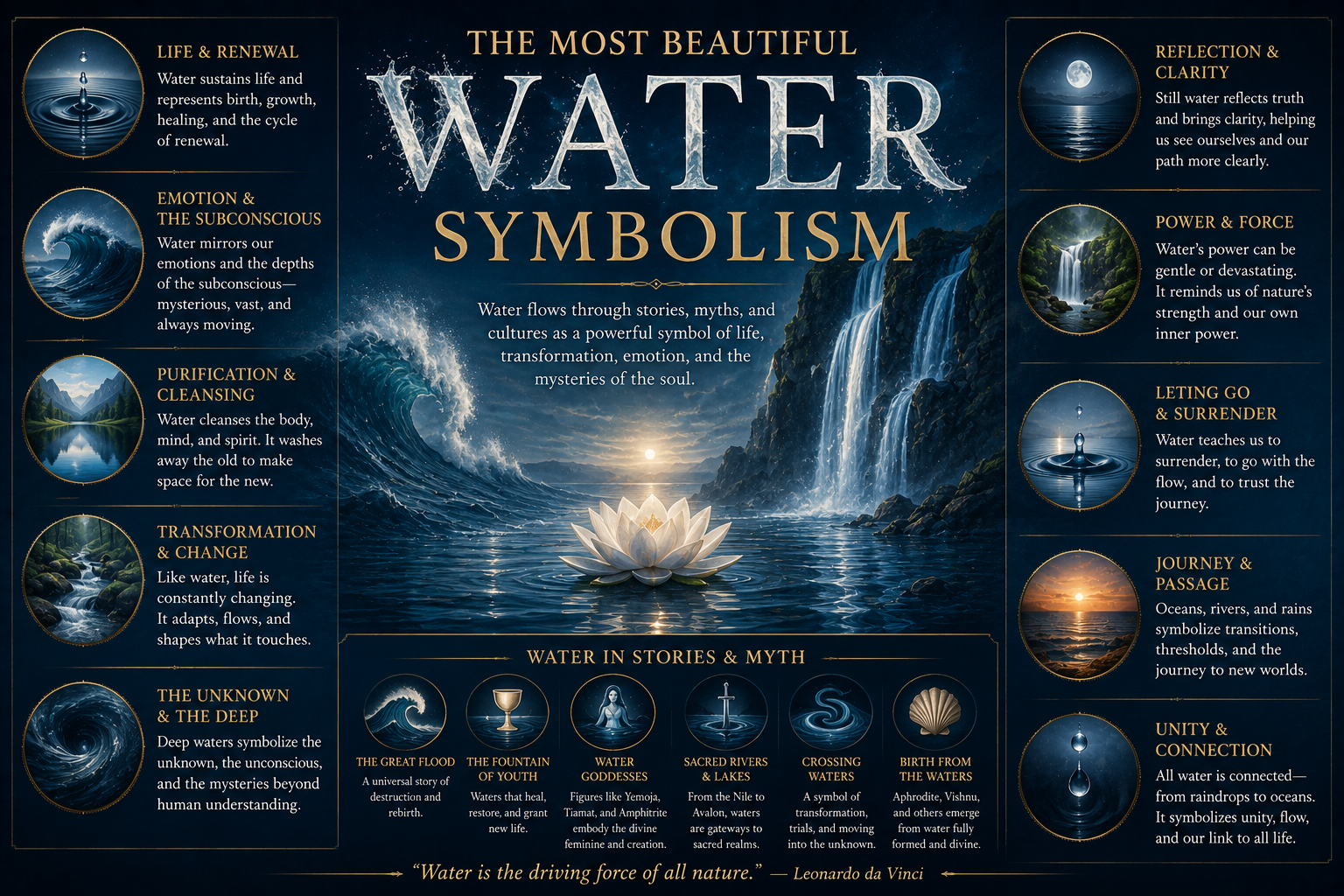
Most Beautiful Water Symbolism shows how rivers, rain, oceans, and lakes can carry deep meaning in a story. Water can stand for life, change, fear, memory, grief, or hope, often in the same scene.

For students, water is one of the easiest symbols to notice because it appears in so many famous books and poems. Once you learn what to look for, it can make a story feel richer and more alive.

In this Guide

  • What water symbolism means
  • Why Most Beautiful Water Symbolism matters
  • Common meanings of water in literature
  • Famous examples from books and poems
  • Recommended books to read
  • FAQs about water symbolism

What Does Water Symbolism Mean?

Water often points to emotions that characters cannot say out loud.

In literature, water is rarely just water. A river can show a journey. Rain can mark sorrow or renewal. An ocean can suggest freedom, danger, or the unknown.

Writers use water because readers already feel its power. We know water can heal, destroy, wash away, and return again. That makes it a strong symbol for human life.

If you want a simple method for spotting symbols, this guide on how to find symbolism in a story can help you build the skill step by step.

Why Most Beautiful Water Symbolism Feels So Powerful

The beauty of water symbolism comes from its many sides.

Most Beautiful Water Symbolism works because water is never only one thing. It can be calm in one scene and violent in the next. It can save a character or trap them.

This is why water feels so human. People also change. We can feel peaceful, afraid, hopeful, or lost, sometimes all in one day.

In many stories, water becomes a mirror. It reflects what a character hides inside. A quiet lake may show calm, but it may also hide pain below the surface.

Most Beautiful Water Symbolism and Common Meanings

Water symbols often connect to life, death, change, and truth.

One common meaning is rebirth. A character who enters water may come out changed. This can feel like a fresh start, even if the story stays painful.

Water can also mean danger. Storms, floods, and deep seas often show forces that people cannot control. This makes water a strong symbol for fate or fear.

Another meaning is memory. Rivers and oceans move, but they also seem ancient. In this way, Most Beautiful Water Symbolism can connect a character’s private life to a larger past.

Water can also suggest truth. A clear pool may show what is hidden. Muddy water may suggest confusion, lies, or moral doubt.

Famous Examples of Water Symbolism in Literature

Many classic works use water to shape mood and meaning.

In The Odyssey by Homer, the sea is both a road and an enemy. Odysseus wants to return home, but the ocean delays him again and again. The water stands for struggle, distance, and the test of human will.

In Moby-Dick by Herman Melville, the ocean feels endless and mysterious. It becomes a place where obsession grows. Captain Ahab’s search across the sea shows how the unknown can pull a person toward ruin.

In Shakespeare’s The Tempest, a storm at sea begins the action. The water helps create fear, magic, and change. It pushes characters into a strange world where old wrongs must face judgment.

In T. S. Eliot’s poem The Waste Land, water is tied to both need and fear. The poem’s dry land suggests spiritual emptiness, while water hints at renewal. You can read more about the poem through the Poetry Foundation.

Most Beautiful Water Symbolism in Modern Reading

Modern readers still connect with water because it feels close to daily life.

Most Beautiful Water Symbolism is not limited to old books. It appears in novels about family, identity, trauma, and survival. Water often helps writers show emotions that are hard to name.

For example, rain in a modern novel may mark grief after a death. A beach may show escape from stress. A river may stand for a choice that cannot be undone.

This is why water symbols work well in class essays. They let you connect setting, character, and theme in a clear way.

Recommended Books with Most Beautiful Water Symbolism

These books are strong choices for students who want to study water symbols.

  • The Odyssey by Homer: A classic journey story where the sea tests courage, pride, and longing for home.
  • Moby-Dick by Herman Melville: A deep study of obsession, mystery, and the danger of chasing one idea too far.

Both books show Most Beautiful Water Symbolism in very different ways. One treats water as a hard path home. The other turns the ocean into a vast space of fear and wonder.

For a wider look at how symbols work in literature, Britannica’s overview of symbolism gives useful background.

How to Write About Water Symbolism in an Essay

A strong essay links the water image to a clear idea.

Start with the scene. Ask what kind of water appears. Is it rain, ocean, river, lake, or flood?

Then ask what the character feels in that moment. Water symbolism is strongest when it connects to conflict, choice, or change.

Last, connect the symbol to a theme. If a character crosses a river, the theme may involve growth or loss. If a storm breaks, the theme may involve fear, guilt, or truth.

For more practice, use this helpful guide on finding symbolism in fiction before you draft your paragraph.

Most Beautiful Water Symbolism and Major Themes

Water often gives a story its emotional center.

Most Beautiful Water Symbolism often links to change. Water moves, shifts, and reshapes the world. Characters who meet water often face a turning point.

It also links to cleansing. A bath, rainfall, or river can suggest a wish to remove guilt or pain. Yet the story may ask whether a person can truly wash the past away.

Water also links to the unknown. Deep water can hide danger, secrets, or truth. This makes it useful in stories about fear and discovery.

FAQs About Most Beautiful Water Symbolism

What is Most Beautiful Water Symbolism in literature?

Most Beautiful Water Symbolism refers to powerful water images that carry deep meaning. These images may show life, change, danger, memory, or renewal.

Why do writers use water as a symbol?

Writers use water because it is familiar and emotional. Readers understand its power to comfort, harm, hide, and reveal.

What does rain usually symbolize?

Rain can symbolize sadness, cleansing, rebirth, or tension. The meaning depends on the scene and the character’s state of mind.

What does the ocean symbolize in books?

The ocean often symbolizes mystery, freedom, danger, or the unknown. In many stories, it also shows how small people feel against nature.

How can I find water symbolism in a story?

Look for repeated water images and ask what changes when they appear. If water appears during a key choice or crisis, it likely has symbolic meaning.

Key Takeaway

Most Beautiful Water Symbolism matters because water can hold many truths at once. It can show hope and fear, peace and danger, life and loss.

When you notice water in a story, slow down. Ask what it reveals about the character, the mood, and the theme. That simple question can open the whole text. 🌊

Literary Devices: A Clear Student Guide with Examples

literary devices

Literary devices help writers shape meaning, mood, and character. When you learn how they work, poems, novels, and plays become easier to understand.

This guide explains literary devices in plain language, with examples from books students often read in class.

This article contains affiliate links.

In this Guide

  • What literary devices are
  • Why they matter in literature
  • Common examples students should know
  • How to analyze them in essays
  • Helpful books and study links
  • FAQ
literary devices

What Are Literary Devices?

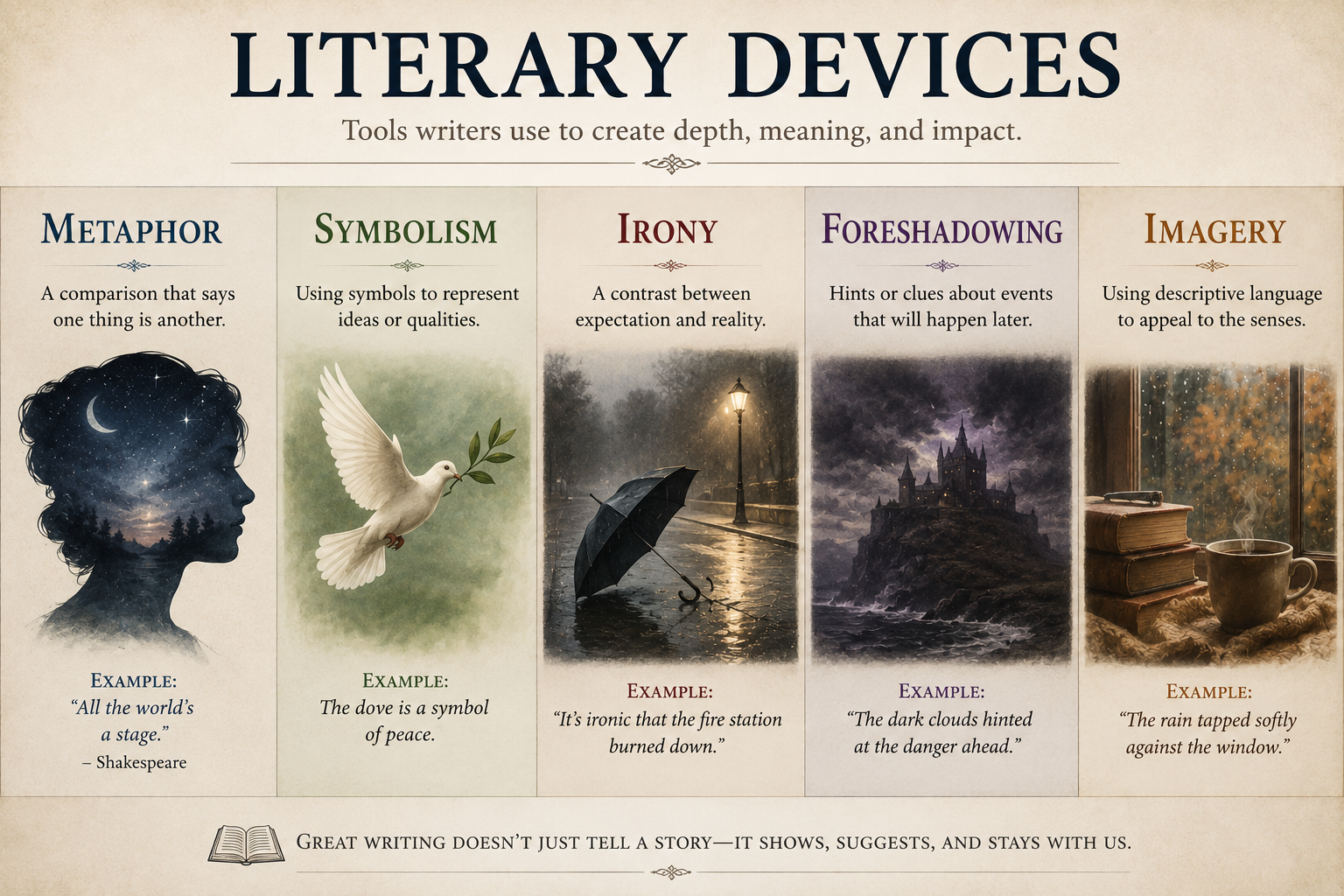
Literary devices are tools writers use to create meaning beyond the basic plot.

A writer may use a symbol, a repeated image, or a sharp contrast to guide how readers feel. These choices help turn a simple story into art.

For example, in The Great Gatsby, the green light is not just a light. It stands for Gatsby’s dream, his hope, and his distance from the life he wants.

Why Literary Devices Matter in Literature

They help you see how a text works, not just what happens in it.

Plot tells you the events. Literary devices show you why those events feel powerful.

In Romeo and Juliet, Romeo calls Juliet the sun. This metaphor shows how bright and life-giving she seems to him. It also reveals his intense, risky view of love.

Once you spot these choices, your essays become stronger. You can explain the author’s craft instead of only retelling the story.

Common Literary Devices Students Should Know

Start with the terms that appear most often in class texts and exams.

Metaphor

A metaphor compares two unlike things without using “like” or “as.” It helps readers see one idea in a fresh way.

When Shakespeare writes that Juliet is the sun, he gives Romeo’s love a bright and dramatic force.

Symbolism

A symbol is an object, place, or image that stands for a larger idea. Symbols often grow in meaning as the story moves on.

The conch in Lord of the Flies stands for order and shared rules. As the conch loses power, the boys lose control.

Irony

Irony creates a gap between what seems true and what is true. It can add humor, tension, or sadness.

In Oedipus Rex, Oedipus seeks the truth about a crime, but the truth points back to him. That irony makes the tragedy hit harder.

Foreshadowing

Foreshadowing hints at what may happen later. It builds tension and helps the ending feel earned.

In Of Mice and Men, early scenes prepare readers for the final choice George must make.

Imagery

Imagery uses sensory details to help readers picture a scene. It can appeal to sight, sound, touch, taste, or smell.

Poetry often relies on imagery. You can explore more terms in the Poetry Foundation glossary.

How to Analyze Literary Devices in an Essay

Good analysis connects the device to meaning.

Do not stop after naming the device. Explain what it does in the text.

A strong sentence might sound like this: “The green light in The Great Gatsby symbolizes Gatsby’s dream, but its distance shows that the dream may never become real.”

This sentence names the symbol, explains its meaning, and connects it to the novel’s larger theme.

For more help with close reading, see our guide to analyzing literature quotes. If you want a faster study plan, try our literature study guide bundle.

Quick Study Tips for Literary Devices

You do not need to memorize every term at once.

Choose a few key terms and practice with short passages. Ask: What stands out? What feeling does it create? How does it connect to theme?

When you mark a passage, look for repeated images or unusual word choices. Repetition often points to meaning.

For a broader view of literature as an art form, you can also read Britannica’s overview of literature.

Relevant Books to Read

These books can help students build confidence with analysis.

FAQ About Literary Devices

What are literary devices in simple terms?

They are writing tools that help authors create deeper meaning, emotion, or style.

What is the easiest device to spot?

Symbolism is often easy to find because it links a concrete object to a larger idea.

Are literary devices only used in poetry?

No. They appear in novels, plays, short stories, speeches, and songs.

How many should I discuss in an essay?

Focus on one or two strong examples. It is better to explain them well than to list many terms.

Key Takeaway

Literary devices help you move from summary to real analysis. When you ask how a writer creates meaning, you read with more skill and write with more confidence.

Most Influential Mirror Symbolism in Literature: What Reflections Reveal

mirror symbolism in Literature

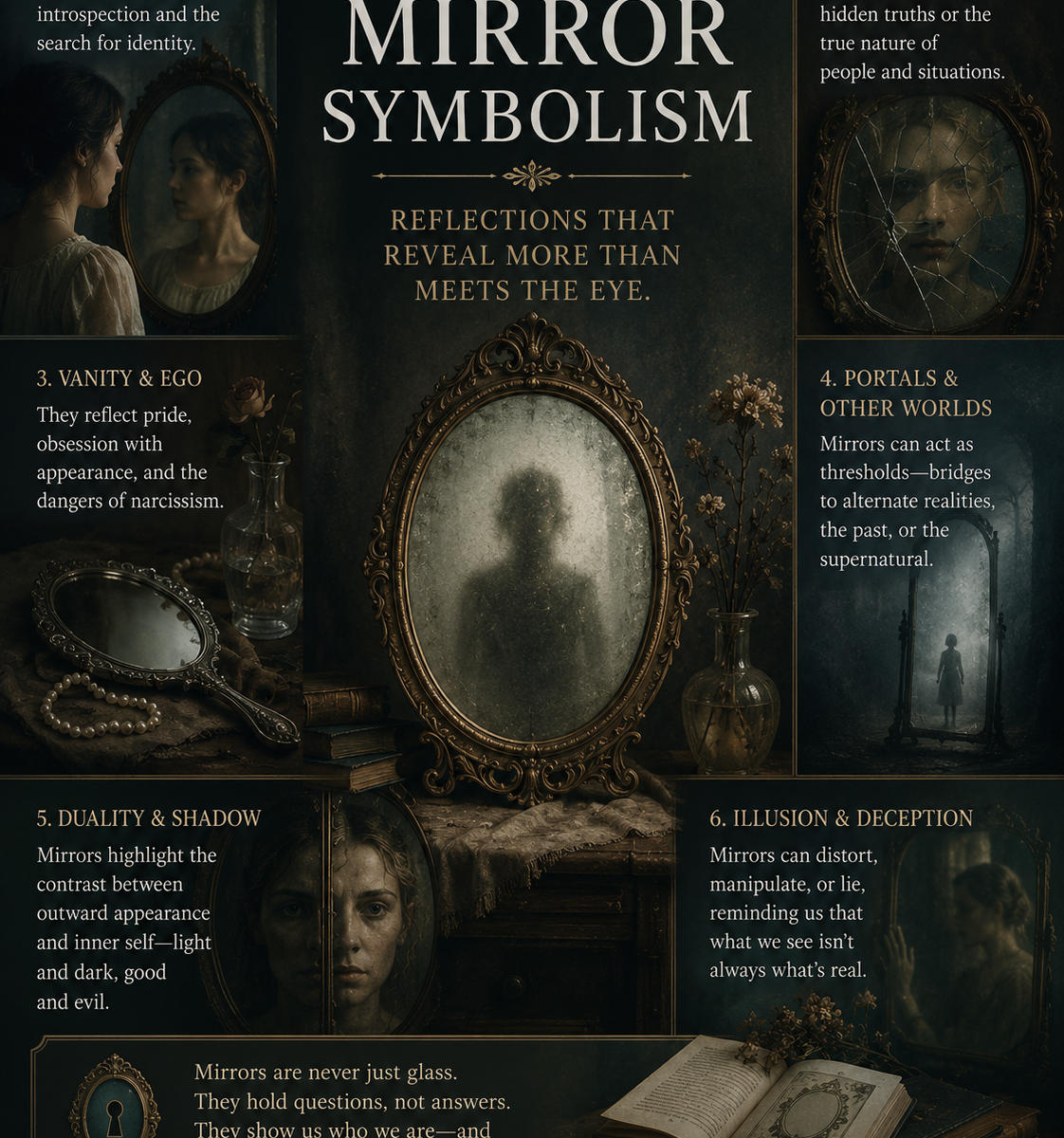
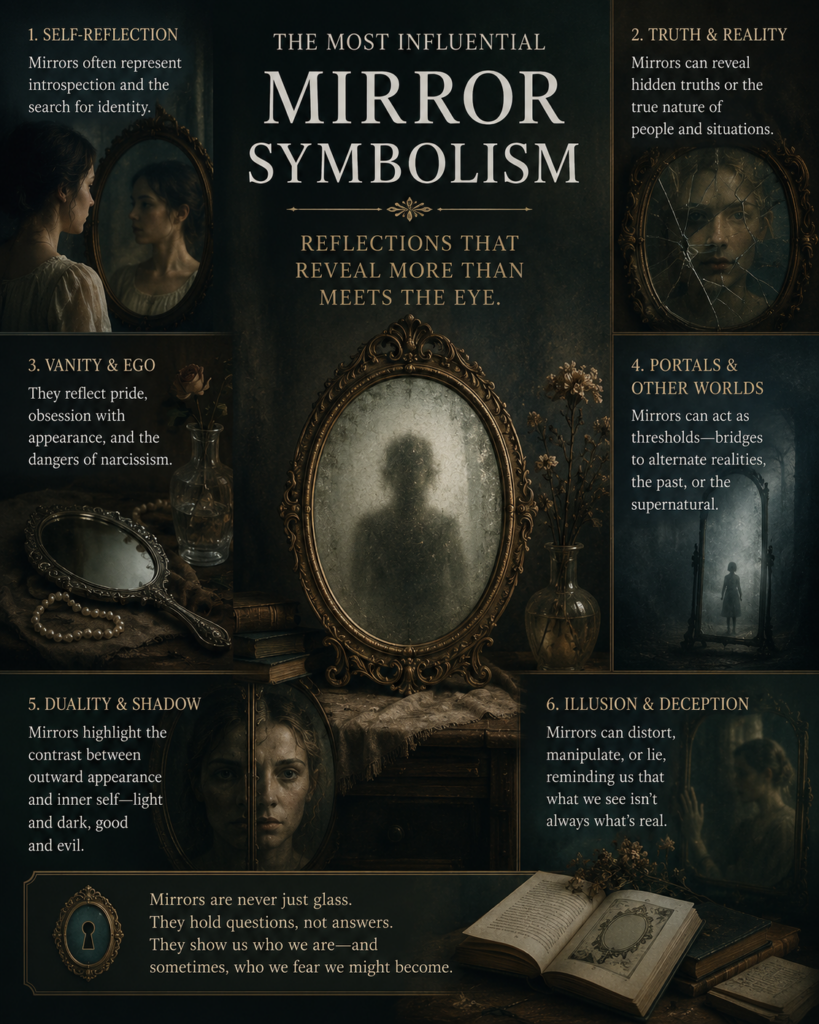
Mirrors in stories do more than show a face. The Most Influential Mirror Symbolism often reveals truth, fear, desire, or a hidden part of the self.

From fairy tales to modern poems, mirror scenes help readers see what a character cannot say out loud. That is why this symbol still feels fresh in classrooms and book clubs today.

In this Guide

  • Why mirror symbolism matters
  • Most Influential Mirror Symbolism in classic literature
  • Mirror symbolism in poems and fairy tales
  • Common themes linked to mirrors
  • Recommended books with mirror symbolism
  • How to analyze mirror scenes
  • FAQs about mirror symbolism
mirror symbolism in Literature

Why the Most Influential Mirror Symbolism Still Matters

Mirrors are simple objects, but writers use them to ask hard questions.

The Most Influential Mirror Symbolism often deals with identity. A character looks into a mirror and faces a version of the self that may feel strange, broken, proud, or false.

This makes mirrors useful in stories about growing up, guilt, beauty, madness, and truth. A mirror can show what society values, but it can also show what society hides.

Readers often remember mirror scenes because they feel private. A character alone with a reflection can reveal more than a long speech.

Most Influential Mirror Symbolism in Classic Literature

Classic works use mirrors to expose desire, fear, and the danger of self-image.

One famous example appears in “Snow White.” The magic mirror does not just answer a question about beauty. It shows how power and jealousy can grow from obsession.

The queen needs the mirror to confirm her worth. When it stops doing that, she turns cruel. This is one reason the Most Influential Mirror Symbolism often connects beauty with control.

In Mary Shelley’s Frankenstein, the creature sees his reflection and understands how others may see him. That moment is painful because it joins self-awareness with rejection.

Oscar Wilde’s The Picture of Dorian Gray does not center on a mirror, but the portrait works like one. It reflects Dorian’s inner corruption while his face stays young.

This is a key mirror-like symbol. It asks whether a person can hide from the truth if the surface still looks perfect.

Mirror Symbolism in Poems and Fairy Tales

Poets and fairy-tale writers often use mirrors to make truth feel sharp.

Sylvia Plath’s poem “Mirror” is one of the clearest examples of the Most Influential Mirror Symbolism in modern literature. The mirror speaks as if it has no feelings, yet the poem feels deeply emotional.

The speaker says it reflects “faithfully.” Still, that honesty hurts the woman who looks into it. You can read the poem at the Poetry Foundation.

In fairy tales, mirrors often know what humans refuse to admit. They may act like judges, warnings, or magical doors.

Lewis Carroll’s Through the Looking-Glass turns the mirror into a passage. Alice steps through it and enters a world where logic shifts. Here, the mirror suggests a second reality that sits just behind ordinary life.

Common Themes in the Most Influential Mirror Symbolism

Mirror symbols often return to the same deep concerns.

Identity is the most common theme. A mirror can make a character ask, “Who am I really?” This matters in stories where people feel split between public image and private truth.

Vanity also appears often. When a character trusts the mirror too much, the story may warn against pride or shallow judgment.

Self-knowledge is another major idea. The Most Influential Mirror Symbolism often marks the moment when a character can no longer avoid the truth.

Mirrors can also show social pressure. A character may not see the real self, but instead the version shaped by beauty rules, class, gender, or power.

For more help with symbols in general, read our guide on how to find symbolism in a story.

Recommended Books with Powerful Mirror Symbolism

These works are strong choices for students who want to study reflection, identity, and truth.

  • Through the Looking-Glass by Lewis Carroll
  • Frankenstein by Mary Shelley

Both books show why the Most Influential Mirror Symbolism lasts across time. Carroll uses the mirror as a doorway into strange logic. Shelley uses reflection to show pain, isolation, and self-awareness.

If you want a shorter text, pair either book with Sylvia Plath’s “Mirror.” It works well for poetry study, AP Literature practice, or a quick close reading lesson.

How to Analyze the Most Influential Mirror Symbolism

A good mirror scene usually changes how we understand a character.

Start by asking what the mirror shows. Does it reveal beauty, fear, age, guilt, or desire?

Then ask what the character feels. A calm reaction means something very different from panic, shame, or anger.

Look at the setting too. A mirror in a bedroom feels private. A magic mirror in a palace may connect reflection with power.

The Most Influential Mirror Symbolism becomes clearer when you ask what truth the character wants to avoid. If the mirror forces that truth into view, it is likely doing important symbolic work.

Mirror Symbolism and Literary Culture

Mirrors remain popular because they fit the way people think about image today.

Modern readers live in a world full of photos, screens, and self-presentation. That makes mirror symbolism feel even more relevant.

Stories with mirrors ask whether the image we show is the same as the person we are. This question appears in old myths, Gothic novels, poems, and young adult fiction.

The Most Influential Mirror Symbolism also links literature with art history and psychology. For background on symbolism as a larger movement, see Britannica’s overview of Symbolism.

FAQs About Most Influential Mirror Symbolism

What does a mirror usually symbolize in literature?

A mirror often symbolizes identity, truth, vanity, or self-knowledge. It can show how a character sees the self or how society judges that character.

Why do writers use mirrors in stories?

Writers use mirrors because they create strong visual moments. A reflection can reveal inner conflict without long explanation.

What is the best example of mirror symbolism?

“Snow White” is one of the best-known examples. Sylvia Plath’s “Mirror” is one of the strongest literary examples for close reading.

Can a mirror symbolize lies?

Yes. A mirror can seem truthful, but it may also reflect a false image, a shallow value system, or a character’s distorted view of the self.

How do I write about mirror symbolism in an essay?

Focus on what the mirror shows, how the character reacts, and what theme the scene supports. Connect the symbol to the larger meaning of the work.

Key Takeaway

The Most Influential Mirror Symbolism in literature helps readers see hidden truths. In literature, a mirror is rarely just glass. It reflects identity, pressure, fear, and the difficult act of knowing yourself.

When a character looks into a mirror, pay attention. The story may be showing its deepest truth in plain sight.

Symbols in The Catcher in the Rye: Meanings, Themes, and Why They Matter

Catcher in the Rye symbols

A simple explanation of the most important symbols and images in the text.

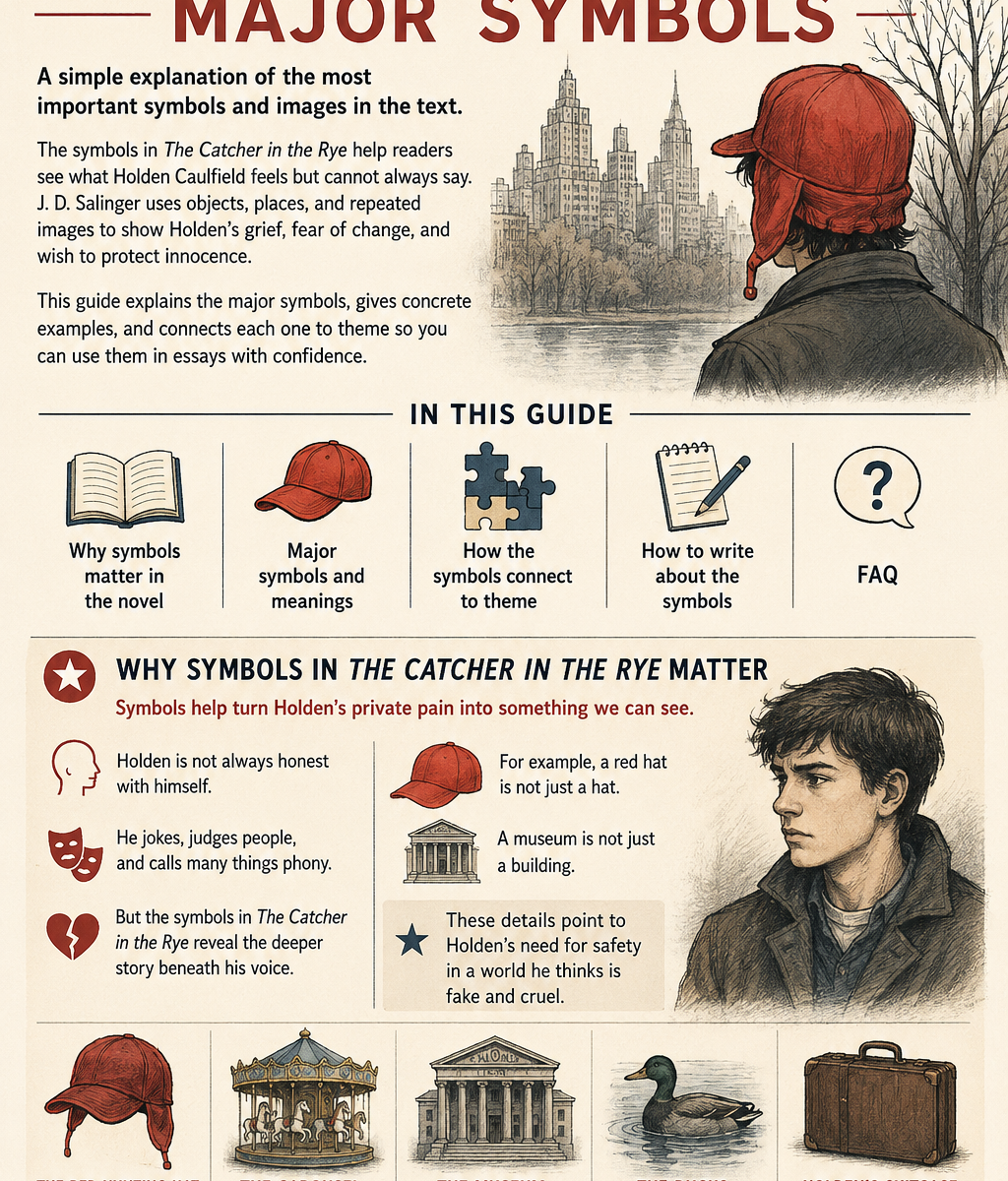
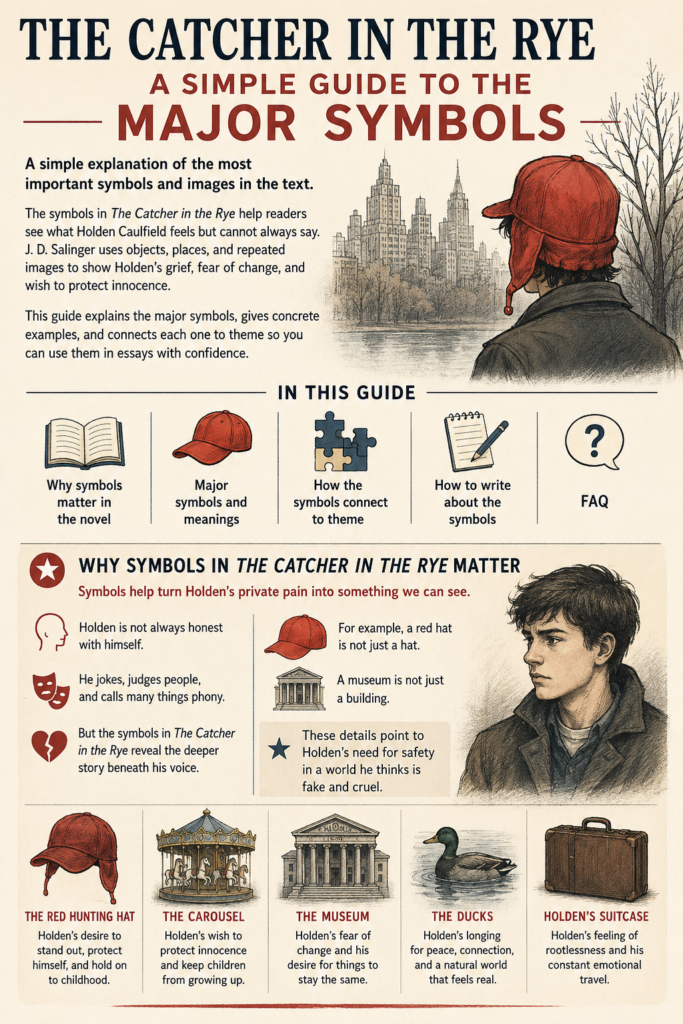
The symbols in The Catcher in the Rye help readers see what Holden Caulfield feels but cannot always say. J. D. Salinger uses objects, places, and repeated images to show Holden’s grief, fear of change, and wish to protect innocence.

This guide explains the major symbols, gives concrete examples, and connects each one to theme so you can use them in essays with confidence.

In this Guide

Catcher in the Rye symbols

Why Symbols in The Catcher in the Rye Matter

Symbols help turn Holden’s private pain into something we can see.

Holden is not always honest with himself. He jokes, judges people, and calls many things phony. But the symbols in The Catcher in the Rye reveal the deeper story beneath his voice.

For example, a red hat is not just a hat. A museum is not just a building. These details point to Holden’s need for safety in a world he thinks is fake and cruel.

If you need a quick refresher on symbolism as a literary tool, see this guide on how to find symbolism in a story.

Major Symbols in The Catcher in the Rye

The novel’s most important symbols show Holden’s inner conflict.

The most famous symbols in The Catcher in the Rye include the red hunting hat, the ducks in Central Park, the Museum of Natural History, and the catcher in the rye image. Each one connects to a major theme in the book.

The Red Hunting Hat

Holden’s red hunting hat is one of the clearest symbols in the novel. He buys it in New York after losing the fencing team’s equipment, which already links the hat to failure and shame.

The hat makes Holden feel unique. It helps him stand apart from other people, even while he feels lonely.

The color red may also connect to Allie, Holden’s dead brother, who had red hair. Because of that, the hat becomes a quiet sign of memory and grief.

Theme connection: The hat shows Holden’s need for identity and protection. He wants to be different, but he also wants comfort.

The Ducks in Central Park

Holden keeps asking where the ducks go when the lagoon freezes. This question seems odd at first, but it matters a lot.

The ducks stand for survival during change. Holden wants to know if living things can disappear and still be safe somewhere else.

This connects to his fear after Allie’s death. If the world can change so fast, Holden wants proof that someone or something will take care of the vulnerable.

Theme connection: The ducks show Holden’s fear of loss and his search for reassurance.

The Museum of Natural History

Holden loves the museum because nothing changes there. The displays stay the same each time he visits.

That matters because Holden hates the way real life keeps moving. People grow up. Families change. Innocence fades.

The museum offers a frozen world. Holden knows this is not real life, but he still wants it.

Theme connection: The museum represents Holden’s desire to stop time and avoid adulthood.

The Catcher in the Rye Image

The title symbol comes from Holden’s dream of standing in a field of rye, catching children before they fall off a cliff. He imagines himself as a protector of innocence.

But Holden misunderstands the Robert Burns poem he hears. That mistake matters because his dream is beautiful, but it is also impossible.

Children will grow up. Holden cannot stop every fall. He must learn that care does not mean control.

Theme connection: The catcher image shows Holden’s wish to protect innocence and his fear of growing up.

How Symbols in The Catcher in the Rye Connect to Theme

Every strong symbol in the novel points back to Holden’s fear of change.

Many symbols in The Catcher in the Rye connect to the same core struggle. Holden wants the world to stay simple and safe, but the world will not do that for him.

The red hat offers protection. The museum offers stillness. The ducks offer hope that change does not mean death. The catcher image offers a fantasy where no child has to fall.

This is similar to symbols in other well-known novels. In The Great Gatsby, the green light points to a dream that Gatsby can never fully reach. In Lord of the Flies, the conch shows order that slowly breaks apart.

Salinger’s symbols work the same way. They take a large theme and place it inside a clear image.

Writing About Symbols in The Catcher in the Rye

A good symbolism paragraph explains both the object and the idea behind it.

When students write about symbols in The Catcher in the Rye, they often stop too early. It is not enough to say the red hunting hat means individuality. You also need to explain why Holden needs that feeling.

Try this pattern: name the symbol, describe where it appears, explain what it suggests, and connect it to theme.

For example, you might write that the Museum of Natural History symbolizes Holden’s wish for a world without change. Then you can link that idea to his grief over Allie and his fear of adulthood.

For more help, read our full guide on spotting symbolism in fiction. You can also review RapidReads Press literature study resources for essay practice and reading support.

Quick Reference: Symbol Meanings

Use this section as a fast study tool before a quiz or essay.

  • Red hunting hat: protection, identity, grief, and the need to feel special.
  • Ducks: change, survival, and Holden’s fear of being left behind.
  • Museum: stillness, safety, and the wish to stop time.
  • Catcher image: innocence, protection, and Holden’s impossible dream.
  • Allie’s baseball glove: memory, love, and the pain of loss.

Allie’s Baseball Glove

Allie’s glove is a personal symbol of love and grief.

The glove belonged to Holden’s younger brother, Allie, who died of leukemia. Allie wrote poems on it so he could read them during baseball games.

This detail shows that Allie was thoughtful and creative. To Holden, the glove is not just a memory. It is proof that someone pure and good was taken from the world.

Theme connection: The glove shows how grief shapes Holden’s view of innocence.

Author and Context

Knowing a little background can help, but the text should still lead your ideas.

J. D. Salinger published The Catcher in the Rye in 1951. The novel became famous for its teen narrator, direct voice, and honest look at alienation.

You can read more about the novel’s history at Britannica’s overview of The Catcher in the Rye. For author background, see Britannica’s biography of J. D. Salinger.

Helpful Books to Read Next

These books can deepen your understanding of Salinger and coming-of-age fiction.

  • The Catcher in the Rye by J. D. Salinger
  • Nine Stories by J. D. Salinger

FAQ About Symbols in The Catcher in the Rye

What are the main symbols in The Catcher in the Rye?

The main symbols in The Catcher in the Rye are the red hunting hat, the ducks, the museum, the catcher image, and Allie’s baseball glove.

What does Holden’s red hunting hat symbolize?

It symbolizes protection, identity, and Holden’s grief. It helps him feel different, but it also shows how badly he wants comfort.

What do the ducks symbolize?

The ducks symbolize change and survival. Holden wants to know where they go because he fears loss and uncertainty.

Why is the Museum of Natural History important?

The museum matters because it never changes. Holden likes it because it gives him the stillness he cannot find in real life.

What does the catcher in the rye symbolize?

It symbolizes Holden’s dream of saving children from pain and adulthood. The image shows his kindness, but also his struggle to accept change.

Key Takeaway

The symbols in The Catcher in the Rye matter because they reveal Holden’s hidden fears. They show a teenager who wants to protect innocence, hold back change, and find safety after loss.

Best Classic Moon Symbolism in Literature: Meaning, Themes, and Books to Read

Moon symbolism

The Best Classic Moon Symbolism in literature often points to mystery, change, hidden truth, and emotion. Writers use the moon because it feels familiar, but it also feels strange and powerful.

From Gothic novels to Romantic poems, the moon can light up secrets that characters try to hide. It can also show fear, love, madness, or hope in a quiet way.

Moon symbolism

In this Guide

  • What moon symbolism means in classic literature
  • How Gothic writers use the moon
  • Moon symbolism in poetry
  • Famous examples from novels and plays
  • Common moon themes
  • Books to read for moon symbolism
  • FAQs about moon symbolism

What Is Best Classic Moon Symbolism?

The moon often acts like a mirror for a character’s inner life.

In classic literature, the moon is rarely just part of the setting. It can show that a scene is strange, emotional, secret, or unsafe.

The Best Classic Moon Symbolism works because the moon changes shape. It grows, fades, disappears, and returns. That makes it a strong symbol for change, time, memory, and unstable feelings.

The moon also rules the night. Since night often hides what daylight reveals, moonlight can create tension. It lets readers see a little, but not everything.

For more help with symbols in fiction, read our guide on how to find symbolism in a story.

Best Classic Moon Symbolism in Gothic Literature

Gothic writers use the moon to make fear feel beautiful and dangerous.

In Gothic literature, moonlight often falls on castles, graveyards, windows, and wild landscapes. It gives scenes a dreamlike look, but it can also make them feel unsafe.

In Dracula by Bram Stoker, the night world matters. The moon helps build a mood of danger because Dracula’s power grows after dark. Moonlit scenes remind readers that evil can move quietly when people feel most helpless.

In Frankenstein by Mary Shelley, moonlight often appears during lonely or fearful moments. Victor sees the world through guilt and dread, so the moon can feel cold instead of calm.

This is why the Best Classic Moon Symbolism in Gothic fiction often connects to fear, isolation, and the unknown. The moon does not comfort the characters. It watches them.

Best Classic Moon Symbolism in Romantic and Victorian Poetry

Poets often turn the moon into a symbol of longing, beauty, and deep thought.

Romantic poets loved nature because they saw it as a path to feeling and imagination. The moon gave them a perfect image for quiet sadness, wonder, and spiritual mystery.

Percy Bysshe Shelley’s poem To the Moon presents the moon as tired and wandering. It feels almost human. You can read the poem at the Poetry Foundation.

Emily Dickinson also uses the moon in striking ways. In poems like “The Moon was but a Chin of Gold,” the moon becomes strange, almost like a face in the sky. Her moon is not simple or soft. It feels alive and hard to explain.

The Best Classic Moon Symbolism in poetry often depends on mood. A moon can feel romantic in one poem and lonely in another. The symbol changes with the speaker’s mind.

Famous Examples of Moon Symbolism in Classic Literature

Many famous works use the moon to show love, secrecy, or a shift in power.

In Shakespeare’s A Midsummer Night’s Dream, the moon is tied to romance, magic, and confusion. Lovers meet in the woods at night, where moonlight helps create a world that feels playful but unstable.

In Nathaniel Hawthorne’s The Scarlet Letter, moonlight matters during scenes of guilt and hidden truth. The night does not fully hide sin. Instead, the moon gives just enough light to make secrets feel visible.

In Jane Eyre by Charlotte Brontë, the moon often has a guiding role. Jane sometimes sees it as calm and almost motherly. It can reflect her need for safety, love, and moral direction.

These examples show why moon symbolism stays popular in classrooms. It helps readers track a character’s fear, desire, or private struggle without a long speech.

Best Classic Moon Symbolism and Common Themes

The moon can carry many meanings, but a few themes appear again and again.

Change is one of the most common meanings. Because the moon has phases, it often points to growth, decline, or a coming shift.

Mystery is another key theme. Moonlight reveals shapes but not details. That makes it perfect for scenes where characters do not fully understand what they face.

Madness also appears in older literature and folklore. The word “lunatic” comes from an old belief that the moon could affect the mind. You can learn more about the moon’s cultural history through Britannica’s overview of the Moon.

Love is a softer meaning. Moonlit scenes can feel private and emotional, which is why writers often place lovers under the moon.

The Best Classic Moon Symbolism does not have one fixed meaning. The scene, character, and genre all shape what the moon suggests.

How to Spot Best Classic Moon Symbolism in a Story

Look at what happens when the moon appears.

Ask what the moon changes in the scene. Does it make the setting feel peaceful, eerie, romantic, or tense?

Notice who sees the moon. A lonely character may read the moon as cold. A hopeful character may see it as beautiful.

Pay attention to light and shadow. Moonlight often sits between darkness and full truth. That makes it useful when a story deals with secrets.

If you want a simple method, use this symbolism reading guide to practice with any poem, novel, or short story.

Recommended Books for Studying Best Classic Moon Symbolism

These books are strong choices for students who want clear examples of moon imagery and symbolism.

  • Dracula by Bram Stoker
  • Jane Eyre by Charlotte Brontë
  • The Poems of Emily Dickinson by Emily Dickinson

Dracula is useful if you want to study moonlight, fear, and Gothic mood. The night scenes show how setting can shape terror.

Jane Eyre gives a different kind of moon symbol. The moon often feels moral, emotional, and personal.

Emily Dickinson’s poetry is a great choice for close reading. Her moon images are short, strange, and rich with meaning.

FAQs About Moon Symbolism in Literature

What does the moon usually symbolize in literature?

The moon often symbolizes mystery, change, emotion, secrecy, or the hidden self. Its meaning depends on the scene and the character.

Why do Gothic writers use the moon so often?

Gothic writers use the moon because it creates fear and beauty at the same time. Moonlight makes a scene visible but still unclear.

Is moon symbolism always romantic?

No. The moon can suggest romance, but it can also suggest danger, madness, loneliness, or guilt.

How can I analyze moon symbolism for school?

Start with the mood of the scene. Then ask what the moon reveals, what it hides, and how the character reacts to it.

Key Takeaway: Best Classic Moon Symbolism Still Matters

The Best Classic Moon Symbolism works because the moon feels both close and mysterious. It lights the dark without removing the dark completely.

That is why writers keep returning to it. The moon can show love, fear, change, and secret truth in one quiet image.

When you see the moon in a classic text, pause for a moment. It may be telling you what the characters cannot say out loud.

Themes in Of Mice and Men: A Student-Friendly Guide

themes in of mice and men

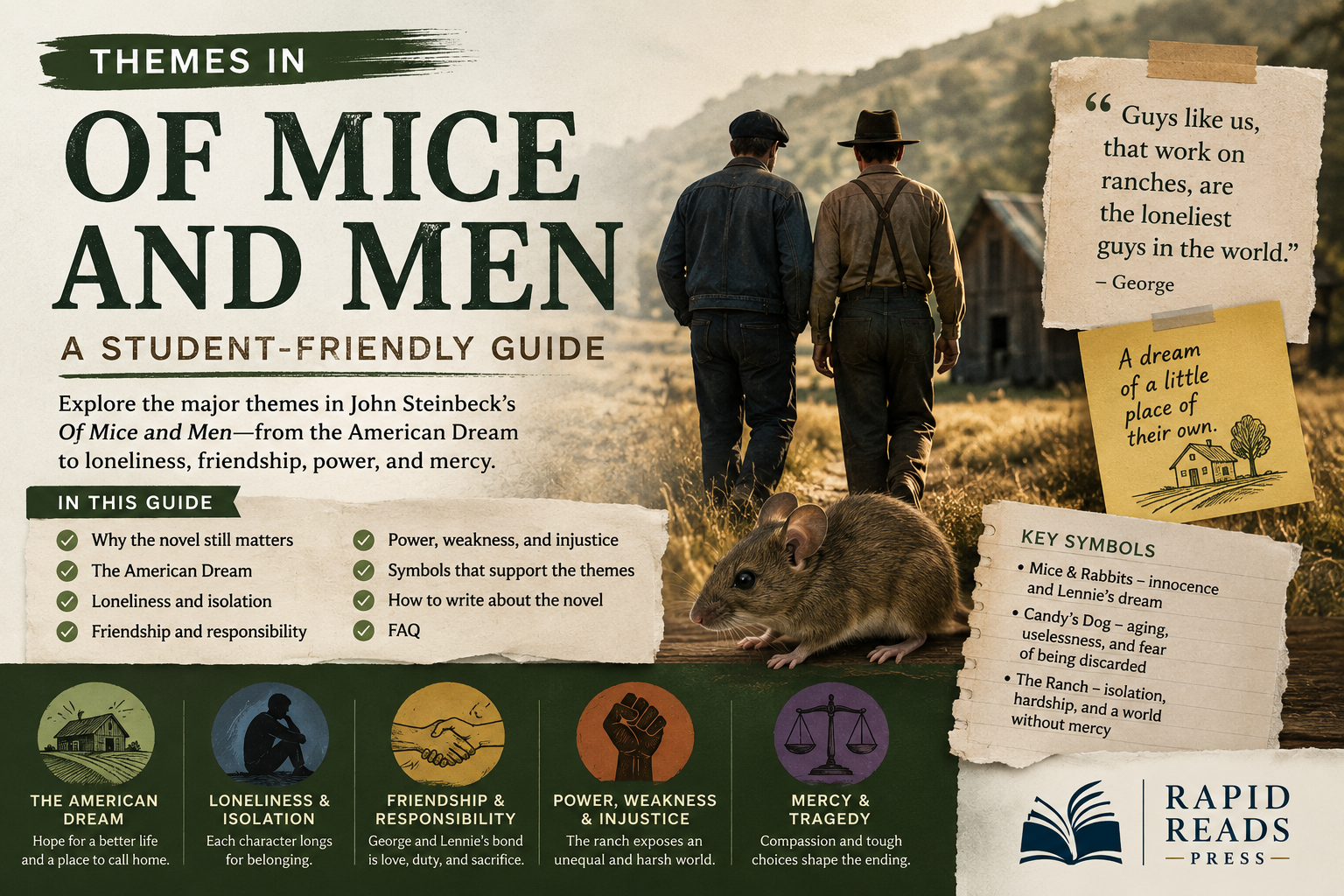
The themes in Of Mice and Men help students see why John Steinbeck’s short novel still feels powerful. The book is about two migrant workers, but it also asks hard questions about dreams, loneliness, power, and mercy.

This guide explains the major ideas in clear language so you can use them in class discussion, essays, or AP Literature notes.

This article contains affiliate links.

In this Guide

  • Why the novel still matters
  • The American Dream
  • Loneliness and isolation
  • Friendship and responsibility
  • Power, weakness, and injustice
  • Symbols that support the themes
  • How to write about the novel
  • FAQ
themes in of mice and men

Why the themes in Of Mice and Men Still Matter

Steinbeck writes about a small group of workers, but their problems feel much bigger than one ranch.

The themes in Of Mice and Men matter because they connect private pain to public hardship. George and Lennie want a home, safety, and control over their lives. Those hopes sound simple, but the world around them makes those hopes hard to reach.

The novel takes place during the Great Depression, when many workers moved from job to job. They had little money and almost no security. You can learn more about Steinbeck’s life and context through the Britannica profile of John Steinbeck.

Like The Grapes of Wrath, this book shows how poverty can crush people’s plans. It also shows how people hold on to hope even when hope seems fragile.

Main Themes in Of Mice and Men Students Should Know

Most strong essays on this novel start with a theme and then connect it to character choices.

The main themes in Of Mice and Men include the dream of a better life, the pain of loneliness, and the abuse of power. These ideas do not sit apart from each other. They overlap in almost every major scene.

George and Lennie’s dream farm gives them hope. Candy joins the dream because he fears becoming useless. Crooks wants in for a moment because he also wants safety and belonging.

Each character shows a different side of the same problem. They all want a place where they matter. Steinbeck suggests that this need is human, but the world of the ranch makes it hard to protect.

The American Dream in Of Mice and Men

The dream farm is the heart of the novel’s hope and heartbreak.

George and Lennie dream of owning a small piece of land. They want rabbits, crops, and freedom from bosses. To them, the farm means dignity.

This dream is powerful because it is so modest. They do not want to be rich. They just want peace and control over their days.

Yet the novel keeps warning us that the dream may not survive. George has told the story many times, almost like a bedtime tale. Lennie loves to hear it because it makes the future feel safe.

In this way, Steinbeck questions the American Dream. He asks whether hard work is enough when poverty, disability, and social class stand in the way.

Loneliness and Isolation

Nearly every character in the novel feels cut off from others.

George says that ranch workers are the loneliest people in the world. They travel alone, spend their money, and move on. His friendship with Lennie makes him different.

Crooks is isolated because of racism. He lives apart from the other men and knows that the dream of equality is not real for him. Curley’s wife is isolated because she is the only woman on the ranch and because the men treat her as a threat instead of a person.

Candy fears loneliness too. After his old dog is killed, he sees his own future more clearly. He worries that age will leave him unwanted.

This theme helps explain why the dream farm matters so much. It is not only about land. It is about escape from being alone.

Friendship, Loyalty, and Responsibility

George and Lennie’s bond gives the novel its emotional center.

George often complains about Lennie, but he still protects him. Lennie depends on George for almost everything. Their friendship is not simple, but it is real.

Steinbeck shows that loyalty can be both loving and painful. George cares for Lennie, but that care also traps him. He cannot live the free life he sometimes imagines.

This makes the ending so hard. George’s final choice forces readers to ask what mercy means. Is it an act of love, an act of despair, or both?

Students can compare this to works like Romeo and Juliet, where love leads to painful choices. In both texts, strong bonds shape tragic endings.

Power, Weakness, and Injustice

The ranch has a clear social order, and the weakest people suffer most.

Curley uses his status to threaten others. He is the boss’s son, so men fear him even when they dislike him. His power does not make him wise or kind.

Other characters lack power for different reasons. Lennie has great physical strength, but he has little social protection. Crooks is smart and sharp, but racism limits his life. Curley’s wife has some power over Crooks in one scene, yet she also has almost no freedom of her own.

Steinbeck does not present power as simple. A person can be hurt in one moment and hurt someone else in the next. That makes the novel more honest and more troubling.

How Symbolism Supports the Themes in Of Mice and Men

Symbols help Steinbeck show big ideas through small details.

When you study the themes in Of Mice and Men, pay close attention to animals, settings, and repeated images. Lennie’s dead mouse, Candy’s dog, and the rabbits all point to innocence, danger, and loss.

Candy’s dog is one of the clearest symbols. The dog is old and no longer useful, so the men decide it should die. This moment reflects Candy’s fear that the ranch will one day treat him the same way.

The rabbits symbolize Lennie’s dream of comfort. They also show how gentle desires can become dangerous when Lennie cannot control his strength.

If you want more help with this skill, read our guide on how to find symbolism in a story. It can help you turn small details into stronger essay points.

Fate, Foreshadowing, and Tragedy

The novel feels tragic because the ending is prepared from the start.

Steinbeck uses foreshadowing to build dread. Lennie kills small animals by accident. George tells him to hide in the brush if trouble comes. Candy regrets not killing his own dog himself.

These moments prepare us for the ending. They make the final scene feel shocking but not random.

The structure is close to classical tragedy. A character has a deep flaw or limit, the world gives little mercy, and the result feels almost unavoidable. Lennie does not mean harm, but his lack of control creates danger.

Nature, Violence, and the Loss of Innocence

The natural world in the novel looks peaceful, but danger is never far away.

The book opens near the river, a place that seems calm and safe. By the end, the same setting becomes the place of George’s terrible choice. Steinbeck uses this return to show how innocence has been lost.

Animals are central to this idea. Lennie loves soft things, but his touch often ends in harm. The pattern shows the gap between intention and result.

This theme is useful for essays because it links character, plot, and symbol. Lennie wants gentleness, but the world of the novel turns gentleness into grief.

How to Write About the Themes in Of Mice and Men

A strong essay needs a clear claim, not just a topic.

A strong essay about the themes in Of Mice and Men should explain what Steinbeck is saying about human life. Do not just write that loneliness is a theme. Write what the novel argues about loneliness.

For example, you could argue that Steinbeck shows loneliness as both a personal pain and a social problem. Then you could use Crooks, Candy, and Curley’s wife as proof.

You can also connect symbols to theme. The dream farm is not only a setting George and Lennie want. It represents the hope that people can build a life where they are safe and valued.

For extra support, our student literature study guide can help you organize notes, themes, and evidence before you draft.

Need more practice with symbols? Our guide to reading symbols in fiction is a useful next step.

Helpful Related Books

These books pair well with Steinbeck’s novel because they explore class, dreams, justice, and social pressure.

  • The Grapes of Wrath by John Steinbeck
  • To Kill a Mockingbird by Harper Lee
  • Death of a Salesman by Arthur Miller

For more author background, the Nobel Prize biography of John Steinbeck gives a helpful overview of his work and reputation.

FAQ About the Themes in Of Mice and Men

Use these quick answers to review before a quiz, class talk, or essay draft.

What are the main themes in Of Mice and Men?

The main themes are dreams, loneliness, friendship, power, and injustice. The novel shows how hard it is for vulnerable people to find safety.

What does the dream farm represent?

The dream farm represents hope, freedom, and belonging. It gives George, Lennie, and Candy a reason to imagine a better future.

Why is loneliness so important in the novel?

Loneliness shapes almost every character. Steinbeck shows that people need connection, but prejudice, fear, and poverty keep them apart.

Is George and Lennie’s friendship healthy?

It is caring, but it is also unequal. George protects Lennie, yet he also carries a heavy burden because Lennie cannot live safely on his own.

How does Steinbeck use symbolism?

He uses animals, the dream farm, and the river setting to show deeper ideas. These symbols connect hope with loss.

Key Takeaway

The themes in Of Mice and Men show that people need dreams and companionship, but harsh social forces can destroy both. Steinbeck’s novel stays powerful because its tragedy feels deeply human.

Symbols in 1984: What They Mean and Why They Matter

symbols in 1984

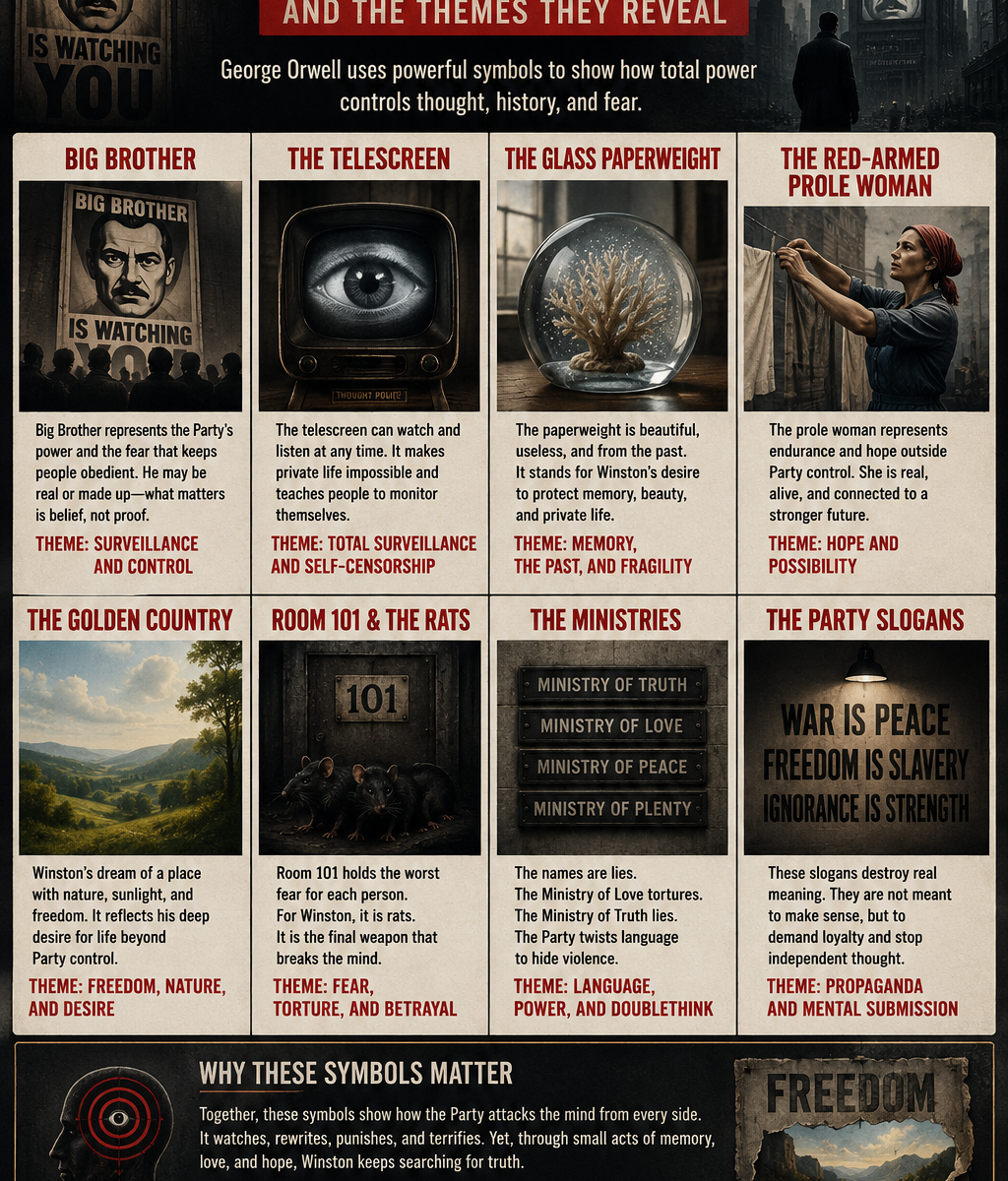
George Orwell uses strong images to show how a government can control thought, history, and fear. This guide explains the most important symbols in 1984 and connects each one to a major theme in the novel.

If you need a quick review of the basics, see our guide on how to find symbolism in a story.

In this Guide

  • What symbolism does in the novel
  • Big Brother and the telescreen
  • The paperweight, the prole woman, and the Golden Country
  • Room 101, rats, and fear
  • How to write about these symbols
  • FAQ and key takeaway

This article contains affiliate links.

symbols in 1984

What Symbols in 1984 Do

Orwell’s symbols make abstract ideas feel concrete and hard to ignore.

The main symbols in 1984 help readers see how total power works. Instead of only telling us that the Party is cruel, Orwell gives us objects and images that show fear, control, and lost freedom.

This is why symbolism matters in literature. A symbol can carry a larger meaning, like the green light in The Great Gatsby or the conch in Lord of the Flies.

In Orwell’s novel, symbols often show the gap between private life and public control. Winston wants truth and love, but the Party tries to own both.

Big Brother as One of the Key Symbols in 1984

Big Brother stands for the Party’s power and the fear that keeps people obedient.

The famous poster says, “Big Brother is watching you.” This image appears across the city and makes people feel watched even when no one may be there.

Big Brother may be a real person, or he may be a made-up figure. That uncertainty is part of the point. The Party does not need proof. It needs belief.

As one of the central symbols in 1984, Big Brother connects to the theme of surveillance. He also shows how a government can replace family, faith, and personal loyalty with loyalty to the state.

The Telescreen and Total Surveillance

The telescreen turns private space into public property.

Winston’s telescreen can send out Party messages, but it can also watch him. He cannot fully turn it off. Even his face and body can betray him.

This symbol matters because it makes control feel constant. The Party does not only punish crimes. It hunts for thoughts, doubts, and small signs of rebellion.

The telescreen also connects to the theme of self-censorship. Winston learns to hide his feelings because the world around him has no safe corner.

The Glass Paperweight and the Lost Past

The paperweight shows Winston’s desire to protect beauty, memory, and private life.

Winston buys the glass paperweight because it feels useless in the Party’s world. It is old, delicate, and connected to a time before constant control.

The piece of coral inside the glass seems sealed away from history. Winston imagines his room above Mr. Charrington’s shop in the same way. It feels like a small world where he and Julia can exist apart from the Party.

When the Thought Police smash the paperweight, the meaning becomes clear. The Party can break private dreams as easily as glass.

This is one of the most painful symbols in 1984 because it links memory to fragility. The past can matter deeply, but it can also be destroyed.

The Red-Armed Prole Woman

The prole woman symbolizes endurance and a hope that exists outside Party control.

Winston watches her as she hangs laundry and sings. She is not rich or powerful, but she seems alive in a way Party members are not.

Her body, voice, and daily work suggest strength. Winston starts to believe that the proles may hold the future because they have not been fully emptied by Party life.

This symbol connects to the theme of hope. Orwell does not make that hope simple, though. The proles have numbers, but they lack political awareness.

The Golden Country

The Golden Country represents freedom, natural life, and desire without fear.

Winston dreams of a place with grass, sunlight, and open space. It feels like the opposite of London, where rooms are watched and language is policed.

When Winston later meets Julia in the countryside, the setting echoes this dream. For a short time, nature seems to offer a space beyond Party control.

Yet the Golden Country is never fully safe. As with many symbols in 1984, it shows both hope and danger. Freedom exists in Winston’s mind, but the Party works to reach even there.

Room 101, Rats, and Fear

Room 101 symbolizes the final weapon of the Party: personal terror.

O’Brien tells Winston that everyone knows what waits in Room 101. It is the worst thing in the world for that person. For Winston, it is rats.

The rats are not just animals. They represent panic that cannot be argued with. Winston can resist pain for a time, but pure fear breaks the part of him that loves Julia.

This symbol connects to the theme of betrayal. The Party does not only want Winston to obey. It wants him to give up the person he loves most.

The Ministries and Party Slogans

The false names of the Ministries show how language can hide violence.

The Ministry of Love deals with torture. The Ministry of Truth spreads lies. These names are cruel because they force people to accept the opposite of reality.

The Party slogans work the same way. Their purpose is not clear thought. Their purpose is mental submission.

These are important symbols in 1984 because they connect language to power. If the Party can control words, it can weaken a person’s ability to resist.

Why Symbols in 1984 Matter for Themes

The novel’s symbols all point back to the same core question: who gets to control reality?

Big Brother and the telescreen show public control. The paperweight and Golden Country show private hope. Room 101 shows how fear can destroy even deep love.

Together, the symbols in 1984 reveal how the Party attacks the mind from every side. It changes history, watches behavior, twists language, and uses fear when all else fails.

For more background on the novel, you can read Britannica’s overview of Nineteen Eighty-four.

How to Write About Symbols in 1984

A strong paragraph should name the symbol, explain its meaning, and connect it to a theme.

Do not stop at saying that Big Brother is a symbol of control. Show how the poster, the watching eyes, and the repeated slogan make people police themselves.

You can use this simple sentence frame: In 1984, [symbol] represents [idea] because [specific detail], which helps Orwell develop the theme of [theme].

For more help with this skill, review our step-by-step post on finding symbols in fiction.

Books to Pair with 1984

These books pair well with Orwell’s novel because they also explore power, language, and freedom.

FAQ About Symbols in 1984

These quick answers can help with homework, essays, or class discussion.

What is the most important symbol in 1984?

Big Brother is often the most important symbol because he represents the Party’s total power and constant watchfulness.

What does the paperweight symbolize in 1984?

The paperweight symbolizes Winston’s love of the past and his hope for a private life outside Party control.

What do rats symbolize in 1984?

Rats symbolize Winston’s deepest fear. They also show how the Party uses terror to force betrayal.

Why does Orwell use so many symbols?

Orwell uses symbols to make political control feel personal. The images help readers see how power reaches into daily life.

Are the symbols in 1984 still relevant today?

Yes. Many readers still connect the novel’s symbols to debates about privacy, propaganda, and truth.

Key Takeaway

The most important symbols in 1984 show how the Party controls people through fear, false language, lost memory, and constant surveillance. Orwell’s images matter because they turn big political ideas into scenes we can feel.

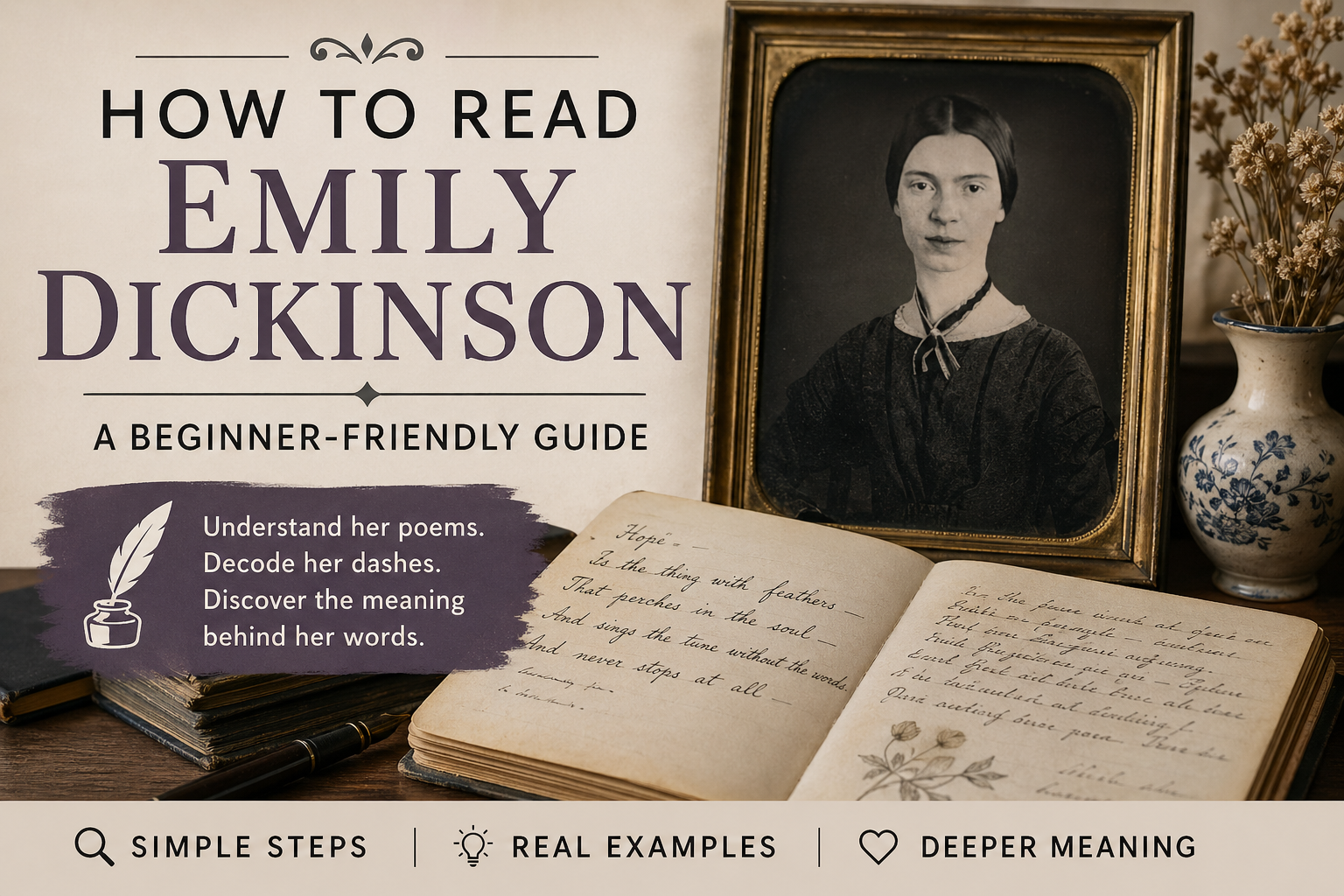
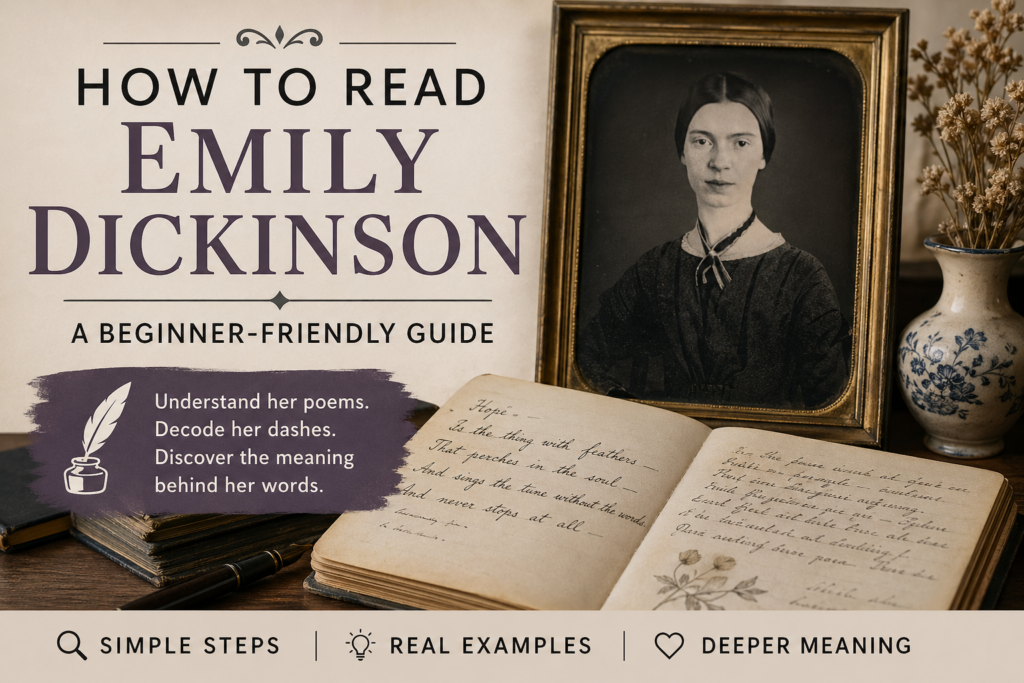
How to Read Emily Dickinson: A Beginner-Friendly Guide

how to read Emily Dickinson

A clear, step-by-step way to understand Dickinson’s poems—even if they feel confusing at first

Emily Dickinson can feel strange the first time you read her. The short lines, the dashes, the capital letters, and the deep ideas can make even simple poems feel hard to follow. But once you learn how to read Emily Dickinson, her poems become surprisingly clear, powerful, and even personal. This guide will walk you through a simple method you can use right away, with real examples from her most famous poems.

This article contains affilate links.

In this Guide

  • Why Emily Dickinson feels difficult
  • Step 1: Read the poem slowly
  • Step 2: Look at punctuation and dashes
  • Step 3: Identify the speaker and situation
  • Step 4: Find the central idea or theme
  • Step 5: Notice imagery and symbolism
  • Step 6: Paraphrase the poem
  • Step 7: Connect it to a bigger meaning
  • FAQs about reading Emily Dickinson
  • Key takeaway
how to read Emily Dickinson

Why Learning How to Read Emily Dickinson Matters

Emily Dickinson’s poetry looks simple, but it carries deep meaning in very small spaces.

When you learn how to read Emily Dickinson, you are learning how to slow down and notice details. Her poems often deal with death, hope, faith, and the inner life, which makes them widely taught in schools. For example, in “Hope is the thing with feathers,” she turns hope into a bird. That sounds simple, but the meaning grows as you read more closely.

If you already know how to use strategies like those in our guides on how to read literature like a scholar or how to analyze poetry step by step, this approach will feel familiar. Dickinson just asks you to apply those skills more carefully.

Step 1: Read the Poem Slowly

Take your time. Dickinson rewards slow reading.

When learning how to read Emily Dickinson, the biggest mistake is rushing. Her poems are short, so each word matters.

For example, in “Because I could not stop for Death,” the opening line seems calm:
“Because I could not stop for Death – He kindly stopped for me –”

At first, it sounds polite. But if you slow down, you notice something strange: Death is personified as a polite driver. That small detail changes the tone completely.

👉 If you need help building this habit, our guide on what is close reading in literature pairs perfectly with Dickinson.

Step 2: Pay Attention to Dashes and Punctuation

Dickinson’s punctuation is not random. It shapes meaning.

One of the keys to how to read Emily Dickinson is understanding her famous dashes. They often signal pauses, shifts in thought, or emotional tension.

In “I’m Nobody! Who are you?” she writes:
“How dreary – to be – Somebody!”

Those dashes slow the line down and emphasize the feeling. Without them, the line loses its rhythm and emotional weight.

Think of the dashes as moments to pause and reflect.

You can explore punctuation and tone more deeply in our post on tone vs mood in literature.

Step 3: Identify the Speaker and Situation

Who is speaking, and what is happening?

Dickinson rarely tells a full story. Instead, she drops you into a moment.

In “Because I could not stop for Death,” the speaker is already riding in a carriage with Death. We are not told how it started.

That means you have to ask:

  • Who is the speaker?
  • What is happening right now?
  • What is the emotional tone?

This step connects closely to our guide on how to analyze characters in literature, even though the “character” may be more symbolic than realistic.

Step 4: Find the Central Idea or Theme

Every Dickinson poem circles around a central idea.

When practicing how to read Emily Dickinson, try to summarize the poem in one sentence.

For example, “Hope is the thing with feathers” explores the idea that hope is constant and resilient, even in hardship.

Look at these lines:
“And never stops – at all –”

That simple phrase captures the theme. Hope continues no matter what.

If you want to go deeper, our post on how to identify theme in literature gives a helpful framework for this step.

Step 5: Notice Imagery and Symbolism

Dickinson uses simple images to express complex ideas.

A big part of how to read Emily Dickinson is recognizing symbolism.

In “Hope is the thing with feathers,” the bird represents hope. But it is not just any bird. It:

  • Sings
  • Endures storms
  • Never asks for anything

That tells us hope is persistent, self-sustaining, and quiet.

👉 See more in our guide on how to find symbolism in a story.

Step 6: Paraphrase the Poem in Your Own Words

Put the poem into plain language.

This is one of the most effective ways to master how to read Emily Dickinson.

Take a line like:
“The Carriage held but just Ourselves – And Immortality.”

A paraphrase might be:
The speaker is riding with Death, and the journey represents entering eternity.

When you rewrite the poem this way, it becomes clearer.

Our guide on how to write a literary analysis essay can help you turn this understanding into strong writing.

Step 7: Connect the Poem to a Bigger Meaning

Ask why the poem matters.

Dickinson’s poems often move from a small moment to a big idea about life.

In “Because I could not stop for Death,” the carriage ride becomes a reflection on the nature of mortality and eternity.

This is where interpretation happens. You move from understanding the poem to explaining its significance.

👉 For practice, you can pair this step with our literary devices list to identify how the meaning is created.

Recommended Books to Deepen Your Understanding

If you want to go further with how to read Emily Dickinson, these are excellent resources:

More resources:

  1. Poetry Foundation: https://www.poetryfoundation.org/poets/emily-dickinson
  2. Academy of American Poets (https://poets.org/)

FAQs About How to Read Emily Dickinson

Why is Emily Dickinson so hard to understand?

Her poems are compressed and leave out context. She expects readers to fill in the gaps.

What do the dashes mean?

They create pauses, emphasize ideas, and show shifts in thought or emotion.

Do Dickinson’s poems have one correct meaning?

No. Many poems allow for multiple interpretations, as long as they are supported by the text.

Where should beginners start?

Start with well-known poems like “Hope is the thing with feathers” and “Because I could not stop for Death.”

Key Takeaway

Learning how to read Emily Dickinson is about slowing down and noticing details. Her poems may look simple, but they reward careful reading. When you pay attention to punctuation, imagery, and theme, her work becomes clear and deeply meaningful.

Reading the Landscape: Nature and Isolation in Western Writing

nature and isolation in Western writing

How the American West shapes theme, character, and meaning in literature

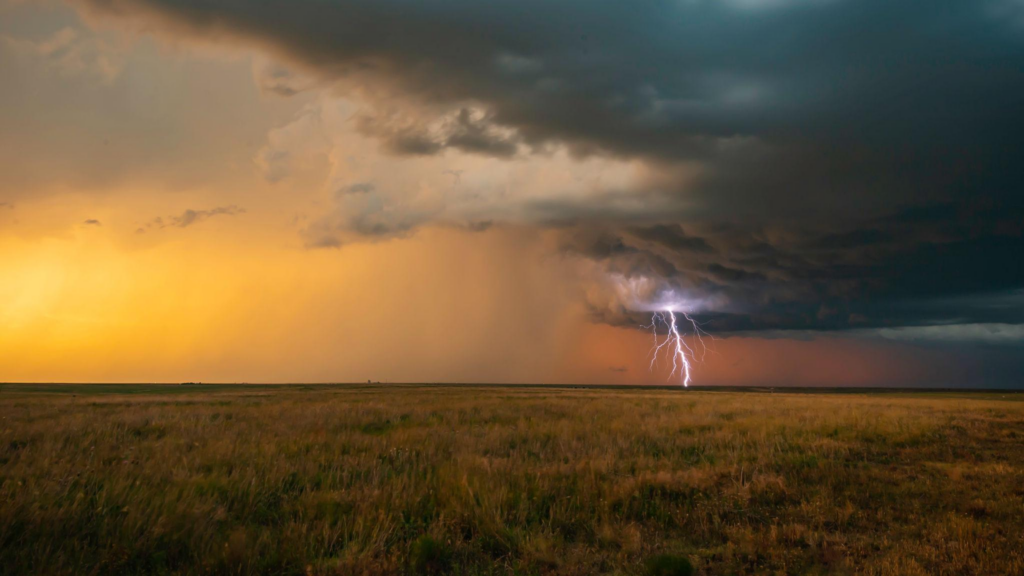
The American West is more than a backdrop. In nature and isolation in Western writing, the land shapes how characters think, feel, and survive. Wide skies, long distances, and quiet towns create a kind of pressure that shows up in the writing itself. When you read Western literature, the land is never just scenery. It acts on people. It tests them. Sometimes, it often leaves them alone with themselves.

This guide will help you read the Western landscape as part of the story. You will see how nature creates isolation, how that isolation shapes character, and how both work together to build meaning.

This article contains affiliate links.

In This Guide

  • What makes the Western landscape different in literature
  • How isolation functions as a theme
  • Key examples from American writing
  • How to analyze landscape in any text
  • Quick reading prompts you can use right away
  • FAQ – Nature and isolation in Western writing

Across many regions, setting supports the story. In Western writing, setting often drives it.

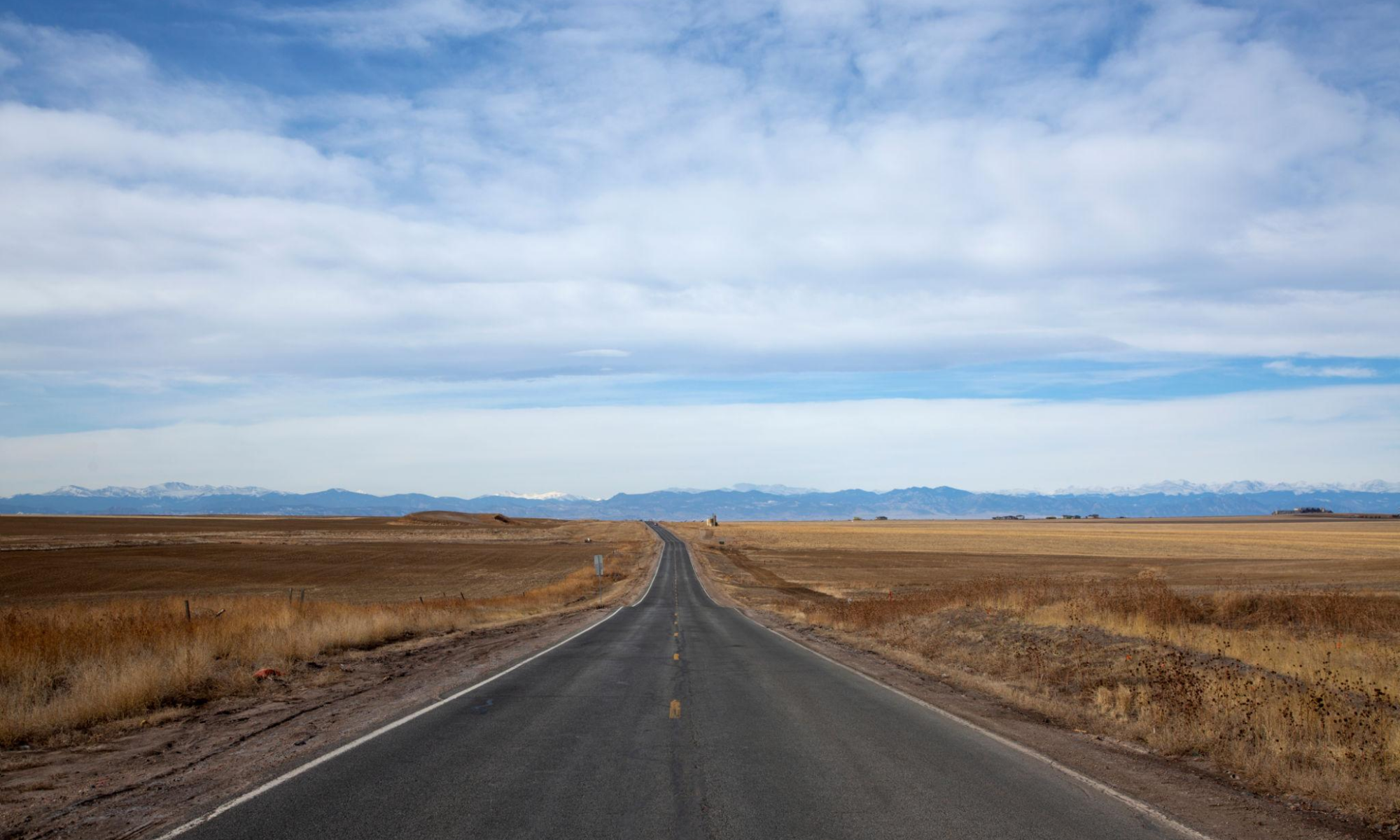
The land is open and exposed. There are fewer boundaries, fewer crowds, and fewer places to hide. This creates a different kind of tension. Characters cannot rely on social structures in the same way they might in a city or a small, dense town. The result is a stronger focus on the individual.

Distance matters here. A long road or an empty field is not just visual detail. It suggests time, effort, and sometimes risk. When a character travels across that space, the journey becomes part of the meaning of the story.

Silence also plays a role. In Western landscapes, quiet is not peaceful in a simple sense. It can feel heavy. Sometimes it forces reflection. It can leave characters facing thoughts they would rather avoid.

Nature and Isolation in Western Writing: What Makes the Landscape Unique

Isolation in Western writing is rarely just about being alone. It often reveals something deeper about identity, fear, or belief.

Characters in these settings tend to face three kinds of isolation:

First, physical isolation. The land itself separates people. Homes are far apart. Help is not close. This creates a sense of vulnerability that shapes decisions.

Second, emotional isolation. Without constant interaction, characters may struggle to express what they feel. This can lead to restraint, distance, or quiet tension between people.

Third, existential isolation. The scale of the landscape can make a person feel small. This often leads to questions about purpose, meaning, and place in the world.

You can see this clearly in works like My Ántonia by Willa Cather, where the Nebraska prairie creates both freedom and loneliness, or in Blood Meridian by Cormac McCarthy, where the harsh land reflects a deeper moral emptiness.

Nature as a Force, Not a Backdrop

In Western writing, nature often acts on characters rather than sitting behind them.

Weather can shape the plot. A storm may delay travel or create danger. Heat can wear a character down. Cold can isolate them further. These are not small details. They influence what characters can do and how they feel.

The land can also mirror inner states. A dry, empty desert may reflect a sense of loss. A wide, open field may suggest possibility, but also uncertainty. Writers use these connections to deepen meaning without stating it directly.

This is especially clear in The Grapes of Wrath by John Steinbeck, where the Dust Bowl is both a real event and a symbol of hardship and displacement.

How Isolation Shapes Character

Characters in Western settings often develop in response to the land.

They may become self-reliant. With fewer resources and less support, they learn to solve problems on their own. This can create strength, but it can also lead to emotional distance.

They may become observant. In a quiet landscape, small details matter. A change in weather, a distant figure, or a shift in light can carry meaning. Characters learn to notice what others might miss.

They may struggle with connection. When people are spread out, relationships can feel fragile. This can lead to missed opportunities or unspoken feelings.

When you read, watch how a character changes over time. Ask how much of that change comes from the land itself. In Western writing, the answer is often more than you expect.

How to Analyze Landscape in Any Text

You can apply a simple method when reading Western literature or any text where setting matters.

Start by asking what the land looks like. Focus on specific details. Is it open or closed, harsh or gentle, quiet or active?

Then ask how the land affects the character’s choices. Does it limit them, push them, or shape their path?

Next, look for emotional connections. Does the landscape reflect what the character feels, or does it contrast with it?

Finally, connect the setting to theme. Ask what the landscape suggests about larger ideas like freedom, survival, loneliness, or hope.

This approach keeps your analysis grounded in the text while still reaching deeper meaning.

Quick Reading Prompts

Use these when you are working through a Western text:

  • What does the landscape make possible, and what does it take away?
  • How does distance affect the character’s decisions?
  • Where do you see silence or emptiness, and what do they mean?
  • How would the story change in a different setting?

These questions can turn a simple reading into a more thoughtful analysis.

Why This Matters for Literary Analysis

When you begin to read landscape as part of the story, texts open up in new ways. You start to see how meaning is built through more than dialogue or plot. The environment becomes part of the language of the work.

For students, this skill strengthens essays and close readings. For general readers, it deepens the experience of the story. It allows you to see how writers use place to explore what it means to be human.

Key Takeaway

In Western writing, the landscape is never neutral. It shapes isolation, defines character, and carries meaning. When you learn to read the land, you begin to understand the story at a deeper level.

If you want step-by-step support with literary analysis, you can use these tools:

Literary Analysis Essay Examples

Literary Analysis Essay Toolkit

FAQ: Nature and Isolation in Western Writing

Why is the landscape so important in Western writing?

In Western literature, the landscape shapes the story in direct ways. The size of the land, the distance between people, and the quiet all affect how characters think and act. The setting often creates pressure that drives decisions, conflict, and growth.

What does isolation mean in Western literature?

Isolation in Western writing goes beyond being alone. It can be physical, emotional, or even spiritual. Characters may be separated by distance, struggle to connect with others, or feel small in a vast world. This isolation often reveals deeper truths about identity and purpose.

How does nature influence character development?

Nature often forces characters to adapt. Harsh weather, long distances, and limited resources can make characters more independent, but also more distant from others. These conditions shape how they respond to conflict and how they relate to the world around them.

How can I analyze landscape in a literary essay?

Start by describing the setting clearly. Then connect it to character choices and emotional tone. Finally, explain how the landscape supports the theme. Focus on how the environment influences action and meaning, rather than treating it as background detail.

Is this approach useful outside of Western literature?

Yes. While it is especially clear in Western writing, this approach works in any text where setting matters. Learning to read landscape as part of the story will strengthen your analysis across many types of literature.

What are examples of books that show nature and isolation in the American West?

Works like My Ántonia by Willa Cather, The Grapes of Wrath by John Steinbeck, and Blood Meridian by Cormac McCarthy all explore how the Western landscape shapes human experience. Each text uses the land to reflect deeper emotional and thematic concerns.