

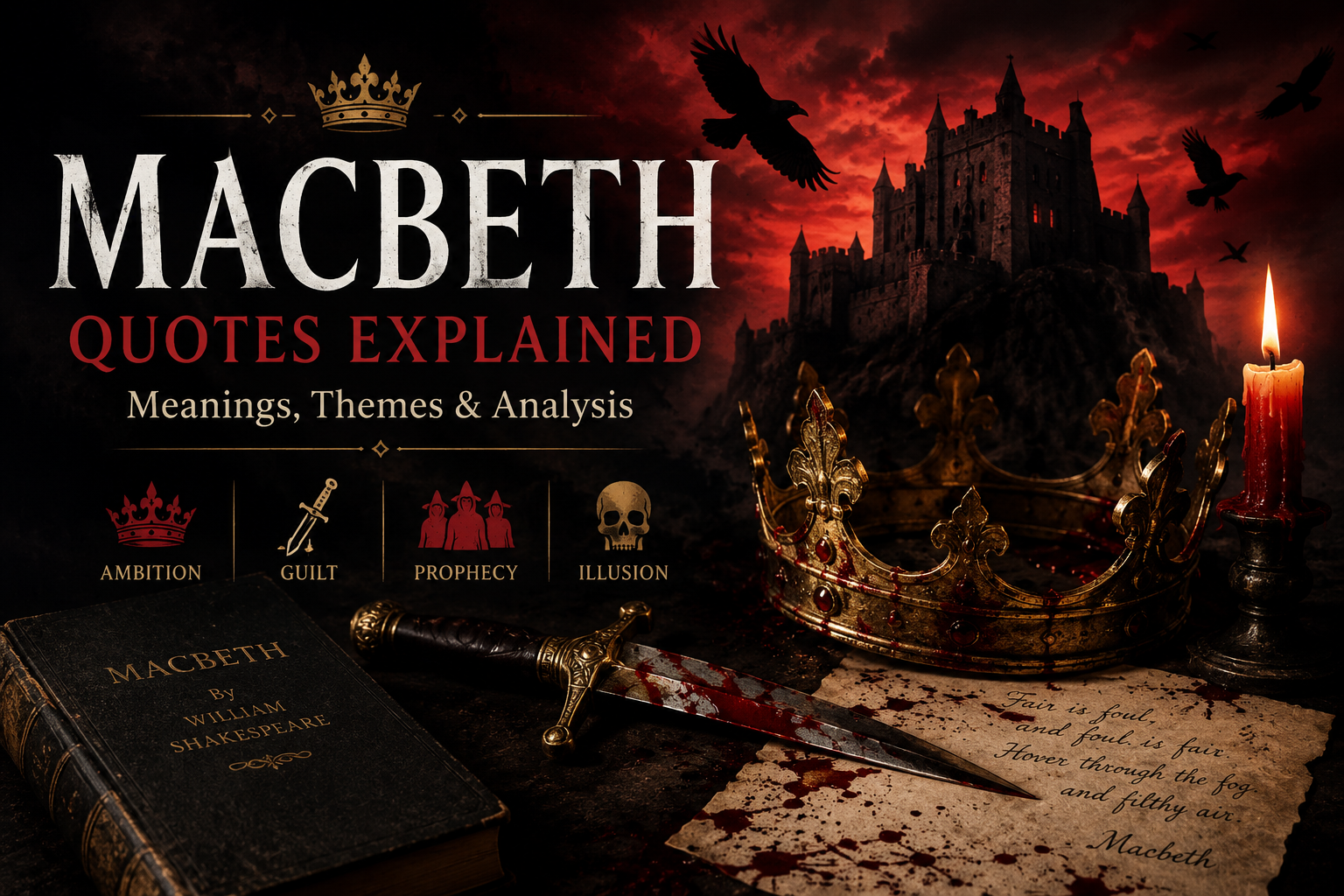
Macbeth is full of short lines that carry huge meaning. This guide offers Macbeth quotes explained in clear language so you can connect famous passages to theme and character change. Each quote below shows what the words mean and how to use them in an essay.
In this Guide
Use this quick map to find the passages that fit your class notes or essay topic.
- How to read important quotes
- Ambition and temptation
- Guilt and fear
- Appearance and reality
- Fate and choice
- Essay tips and study tools
Macbeth quotes explained: how to read the play
A strong quote is not just a famous line. It is proof of how the play builds meaning.
Start with context. Ask who speaks and what has just happened. Then explain how the line reveals a conflict, fear, or desire.
Do not drop a quote into a paragraph and move on. Your job is to show why the words matter. If you need help with that skill, read our guide on how to write a literary analysis essay.
Macbeth quotes explained for ambition and temptation
Macbeth’s rise begins with a promise, but his choices turn that promise into a trap.
“Stars, hide your fires”
Macbeth says this after he starts to imagine himself as king. He wants the stars to hide their light because he knows his thoughts are dark.
This line shows **secret ambition**. Macbeth does not act yet, but his mind has already crossed a moral line.
“Vaulting ambition”
Macbeth admits that ambition is the main force pushing him toward murder. The image suggests a rider who leaps too far and falls.
This is useful for essays about self-destruction. Like Victor Frankenstein, Macbeth wants power before he has the wisdom to handle it.
These Macbeth quotes work well when your claim focuses on how desire can overpower conscience.
Macbeth quotes explained for guilt and fear
After the murder of Duncan, guilt does not fade. It grows until it shapes how Macbeth and Lady Macbeth see the world.
“Sleep no more!”
Macbeth hears this cry after he kills Duncan. Sleep usually means peace, but Macbeth has destroyed that peace for himself.
The line suggests that guilt becomes a punishment. No guard has caught Macbeth yet, but his mind is already attacking him.
“Out, damned spot!”
Lady Macbeth imagines blood on her hands. The spot is not real, but her guilt is.
Earlier, she seemed cold and strong. By this point, Shakespeare shows that denial cannot protect her forever.
For a comparison, think of Raskolnikov in Crime and Punishment. In both works, the crime happens once, but the guilt keeps returning.
Macbeth quotes explained for appearance and reality
Many characters in the play hide what they want. Shakespeare uses false faces, strange language, and broken trust to show that appearances can mislead.
“Fair is foul, and foul is fair”
The witches speak this line near the start of the play. It means that good and evil will seem mixed up.
The line prepares us for a world where truth is hard to read. Macbeth looks loyal, but he plans betrayal.
“False face must hide what the false heart doth know”
Macbeth says he must hide his plan behind a false expression. His face becomes a mask.
This quote is strong evidence for essays about deception. It shows that Macbeth understands the evil of his choice, yet he chooses to act anyway.
Macbeth quotes explained for fate and choice
The witches predict Macbeth’s future, but they do not force his hand. That tension makes the play feel tragic.
“If chance will have me king”
At first, Macbeth wonders if fate will make him king without action. This shows hesitation.
Soon, he stops waiting. His shift matters because tragedy often grows from a person’s own decisions.
“I am in blood”
Macbeth feels trapped by the violence he has caused. He thinks he has gone too far to turn back.
This line shows how one crime leads to another. Macbeth quotes explained in this way help students argue that fate may tempt him, but choice destroys him.
How to use Macbeth quotes in essays
Good quote analysis connects words on the page to a clear claim. Keep your explanation focused and direct.
When you use Macbeth quotes in an essay, follow a simple pattern:
- Make a claim about the character or theme.
- Give brief context for the quote.
- Use a short quotation.
- Explain the words that prove your point.
For example, you might write: Macbeth’s line “Stars, hide your fires” shows that he knows his ambition is morally wrong. He wants darkness to cover his thoughts, which proves that guilt begins before the murder.
For quick review before a quiz, pair this post with our Macbeth quote study notes.
Helpful books for Macbeth students
These editions and study books can help you read the play with stronger notes.
- Macbeth by William Shakespeare, Folger Shakespeare Library edition
- Shakespeare After All by Marjorie Garber
Choose an edition with footnotes if the language feels hard. The notes can explain old words without replacing your own thinking.
Trusted online resources
Use reliable sources when you need background on Shakespeare or the play’s history.
For a clear overview, see Britannica’s article on Macbeth. For the full public-domain text with helpful tools, visit the Folger Shakespeare Library text of Macbeth.
FAQ: Macbeth quotes explained
Here are quick answers to common student questions about choosing and analyzing quotes.
What is the best Macbeth quote for ambition?
“Vaulting ambition” is one of the clearest choices. It shows that Macbeth understands the motive behind his crime.
What quote shows Macbeth’s guilt?
“Sleep no more!” is a strong guilt quote. It shows that Macbeth loses inner peace after killing Duncan.
What quote shows Lady Macbeth’s guilt?
“Out, damned spot!” shows her guilt in a vivid way. She imagines blood that cannot be washed away.
How many quotes should I use in a Macbeth essay?
Use enough to support your claim, not to fill space. Two well-explained quotes are often stronger than many rushed ones.
Key Takeaway
Macbeth quotes explained well do more than define old words. They show how ambition, guilt, and choice push Macbeth from brave soldier to tragic tyrant.


Get the Free Close Reading Worksheet Pack
Join my email list and receive the printable worksheet pack you can use with any novel or poem.
No spam. Just helpful guides for reading literature well.












