

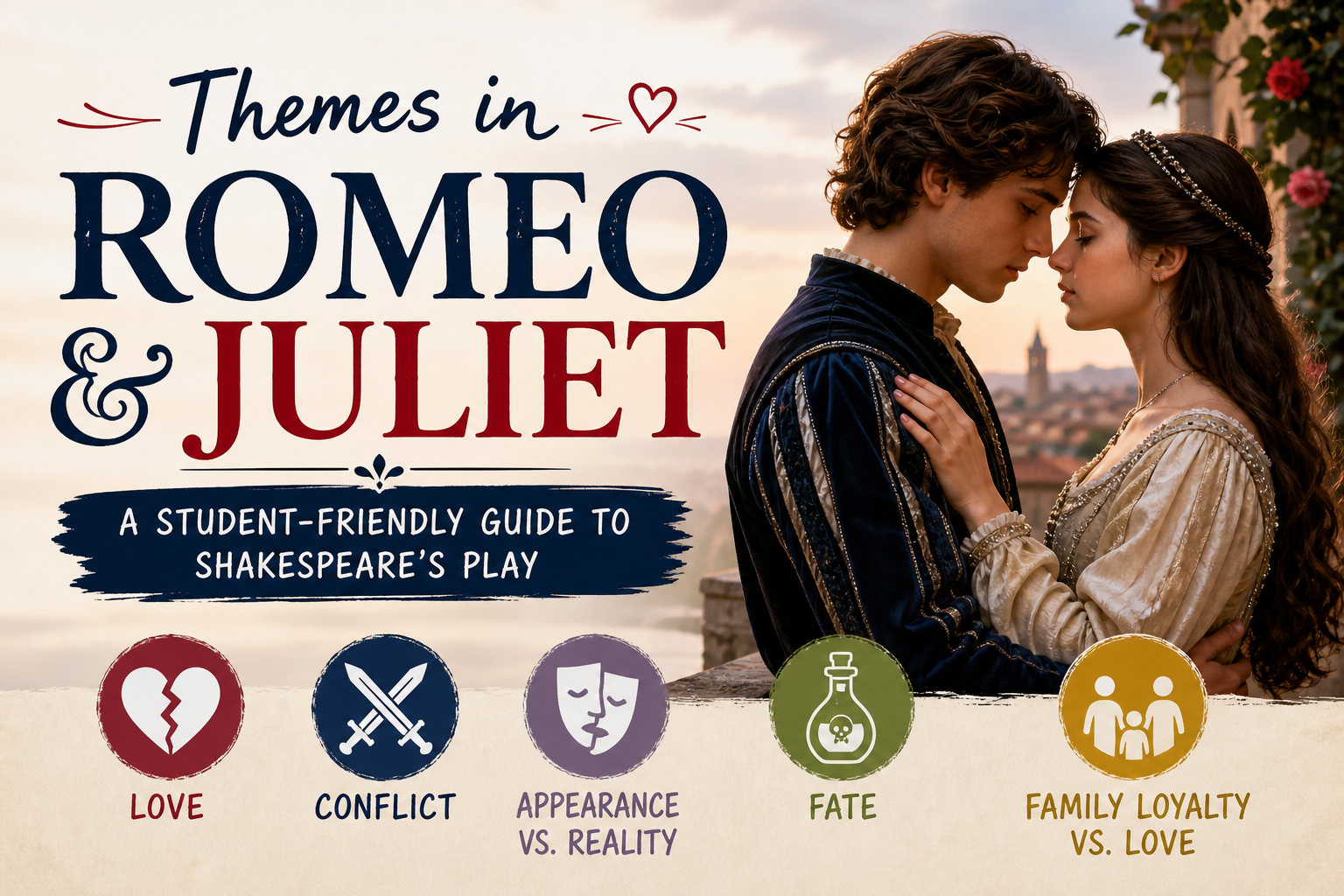
Shakespeare’s tragedy can feel fast, emotional, and hard to sort out at first. This guide explains the major themes in Romeo and Juliet so you can connect the plot to the bigger ideas in the play.
In this Guide
- Why theme matters in the play
- Love and desire
- Fate and timing
- Family conflict
- Youth and identity
- Writing about theme
This article contains affiliate links.
What Makes the Themes in Romeo and Juliet So Important?
The play is not only about two teenagers who fall in love. It is about what happens when private feelings crash into public hate.
The themes in Romeo and Juliet help readers see why the ending feels both shocking and expected. Shakespeare shows a world where love is powerful, but it is not strong enough to escape anger, pride, and bad choices.
Need a quick refresher before you write? Read our guide on how to identify theme in literature.
Love as One of the Central Themes in Romeo and Juliet
Love in this play is intense, sudden, and dangerous. Romeo and Juliet do not fall in love slowly. They meet, speak, kiss, and decide that life without each other would feel empty.
Among all the themes in Romeo and Juliet, love may be the easiest to notice. Yet Shakespeare does not show love as simple or safe. Love gives the characters courage, but it also pushes them toward risk.
Romeo’s feelings for Rosaline seem dramatic but shallow. His love for Juliet feels deeper because it changes how he sees himself, his family, and his future.
This type of intense love also appears in works like Wuthering Heights by Emily Brontë, where passion can feel larger than reason. In both texts, love has beauty, but it also has a cost.
Fate and Timing in the Themes in Romeo and Juliet
The play asks a hard question: are Romeo and Juliet doomed, or do people make choices that lead to doom?
Fate is one of the most debated themes in Romeo and Juliet. The Prologue calls the lovers “star-cross’d,” which suggests their lives are shaped by forces beyond their control.
Bad timing appears again and again. Romeo meets Juliet right after his pain over Rosaline. The secret wedding happens too fast. Friar Lawrence’s letter never reaches Romeo.
Still, fate does not erase choice. Tybalt chooses violence, Romeo chooses revenge, and the adults choose to keep old hatred alive.
Family Conflict: One of the Harshest Themes in Romeo and Juliet
The feud between the Montagues and Capulets shapes the whole play. It turns ordinary places, such as streets and homes, into unsafe spaces.
Family loyalty should protect young people, but here it traps them. Romeo and Juliet cannot love openly because their names carry a history of hate.
This theme fits with other works about social conflict, such as West Side Story, which is based on Shakespeare’s play. Both stories show how group identity can crush personal desire.
















Youth, Identity, and Rebellion
Romeo and Juliet are young, but Shakespeare does not treat them as silly. He shows how young people can see truths that adults refuse to face.
Juliet grows quickly across the play. At first, she listens to her parents. Soon, she makes bold choices about love, marriage, and death.
Romeo also tries to step outside his family role. He wants to stop being just a Montague, but the feud pulls him back into violence after Mercutio dies.
Language, Light, and Darkness
Shakespeare uses images of light and darkness to show how love changes the world for Romeo and Juliet.
Juliet is compared to the sun, stars, and bright light. These images make love feel rare and almost sacred.
Darkness is not always evil in the play. Night gives the lovers privacy. Daylight often brings danger, rules, and separation.
This contrast helps readers see one of the quieter themes in Romeo and Juliet: the same world can feel safe or cruel depending on who has power.
Death, Tragedy, and the Cost of Hate
The ending is tragic because the deaths feel avoidable. Many people could have stopped the disaster earlier, but they do not.
Mercutio and Tybalt die before Romeo and Juliet. Their deaths show that the feud harms more than the lovers.
By the final scene, the families understand the cost of hate too late. The peace they reach is real, but it is built on loss.
For background on the play, see Britannica’s overview of Romeo and Juliet. You can also explore the Poetry Foundation’s page on William Shakespeare.
How to Write About the Themes in Romeo and Juliet
A strong theme essay should make a clear claim about what Shakespeare suggests, not just name a topic.
For example, do not only write, “The play is about love.” A stronger claim would be, “Shakespeare presents love as powerful but fragile when society is ruled by hate.”
Use short quotes and explain them in your own words. A quote does not prove your point unless you connect it to the theme.
For more help with this skill, review our student-friendly theme guide.
Helpful Books to Search for on Amazon or at Your Library
These books can help if you want a stronger grasp of the play and Shakespeare’s world.
- Romeo and Juliet by William Shakespeare, Folger Shakespeare Library edition
- Shakespeare After All by Marjorie Garber
FAQ: Themes in Romeo and Juliet
These quick answers can help with homework, test review, or essay planning.
What are the main themes in Romeo and Juliet?
The main themes include love, fate, family conflict, youth, violence, and the cost of hate.
Is love shown as good or bad in the play?
Love is shown as powerful and sincere. It becomes tragic because the world around the lovers is hostile.
Does fate cause the tragedy?
Fate plays a major role, but human choices matter too. Shakespeare mixes bad luck with rash action.
Why is family conflict so important?
The feud makes Romeo and Juliet hide their love. It also teaches young people that violence is normal.
Key Takeaway
The key insight: Shakespeare uses Romeo and Juliet’s love story to show how hate can destroy what is most innocent and hopeful.


Get the Free Close Reading Worksheet Pack
Join my email list and receive the printable worksheet pack you can use with any novel or poem.
No spam. Just helpful guides for reading literature well.












