Flash Memoir Prompt: First Time You Saw Someone You Loved Cry

flash memoir prompt cry

A tender writing invitation about the first time you saw someone you loved cry, told through one small scene, one clear detail, and one honest feeling.

The room changes when someone you love cries for the first time in front of you. Maybe the person was a parent at the kitchen sink, a friend in the passenger seat, a grandparent in a hospital chair, or a sibling trying to stay quiet behind a closed door.

You may remember the sound before you remember the words. A shaky breath. A tissue pulled from a sleeve. The way you suddenly did not know where to put your hands.

This flash memoir prompt first time saw someone loved cry asks you to write about that moment before it turns into a full life story. Stay close to the scene. Let the memory reveal what it wants to reveal.

flash memoir prompt cry

The Prompt

Write about the first time you saw someone you loved cry.

This prompt can unlock a memory because it often marks a shift. Before that moment, you may have seen that person as strong, in charge, funny, distant, or unbreakable. Then, all at once, you saw something more human.

You do not have to explain the whole relationship. You do not have to know every reason behind the tears. A strong flash memoir can begin with what you noticed: the bent head, the red eyes, the silence after someone left the room.

Why This Memory Matters

The first time you saw someone you loved cry may have changed the way you understood them. It may have been the day you realized adults could feel lost. It may have been the first time you saw grief up close. It may have been a small, private moment that never made sense until years later.

These memories matter because they often hold two stories at once. There is the story of what happened in the room, and there is the story of what changed inside you.

Maybe you felt scared. Maybe you felt protective. Maybe you felt embarrassed because you did not know what to say. Those reactions belong in the piece. Memoir is not about making yourself look perfect. It is about telling the truth of how a moment felt from the inside.

If you are a student or a close reader of stories, this kind of prompt can also help you understand character moments in literature. When a character cries, shuts down, or hides pain, the scene often reveals more than a long explanation. You can explore that idea further in this guide on how to analyze characters in literature.

How to Approach This Prompt

Begin with one physical detail. Do not start with the whole backstory. Start with the thing your mind still holds.

Maybe it is your mother’s mascara on a napkin. Maybe it is your father sitting in the driveway after a funeral, the car still running. Maybe it is your best friend laughing too hard before the tears came.

Once you have that detail, narrow the memory to one scene. Where were you? What time of day was it? What could you hear? What did you do with your body? Did you move closer, freeze, leave, hand them something, or pretend not to notice?

Try to write what you noticed before you explain what it meant. For example, instead of opening with “That was when I learned my grandmother was lonely,” you might begin with her spoon resting untouched beside a bowl of soup. The meaning can arrive later.

It may help to give yourself a frame like this:

I saw the tears when _____. I was _____. The room smelled like _____. I wanted to _____. I understood later that _____.

You can change those lines as you write. They are only a doorway.

If you like to mark up your own drafts, try circling the strongest sensory detail after you finish. Then underline the sentence where the emotion feels most true. This is similar to the close-reading habit described in how to annotate literature, except the text is your own life.

A Quick Example

The first time I saw my older brother cry, he was sitting on the back steps with a basketball between his knees. It was almost dark, and the porch light kept flickering like it could not decide whether to help. He had just found out he did not make the varsity team. I expected him to be angry. He was always angry first. Instead, he kept rubbing his thumb over the cracked orange leather of the ball. His face was turned away, but I could see one tear fall onto his wrist. I stood in the doorway with two cans of soda, suddenly unsure if I was allowed to see him like that. I set one can beside him and said nothing. Years later, I think that was the kindest thing I knew how to do.

Try It Yourself

Set a timer for ten minutes and write the scene as plainly as you can. Do not worry about making it beautiful at first. Let the room, the person, and your younger self appear on the page.

If the memory feels heavy, write slowly. You can stop at any point. You can also write around the moment instead of straight through it. Describe the hallway, the weather, the plate on the table, or the shoes by the door.

A flash memoir prompt about the first time you saw someone you loved cry does not need a dramatic ending. Often, the strongest ending is small: what you did next, what you could not say, or what you understand now.

Want More Flash Memoir Prompts?

Explore all 365 prompts in The Memory Trigger: 365 Flash Memoir Writing Prompts. Use them one at a time when you want a short, focused way to return to real memories and shape them into honest pieces of writing.

Themes in Fahrenheit 451: A Student-Friendly Guide

Fahrenheit 451 themes

Fahrenheit 451 is not just a novel about book burning. The main themes in Fahrenheit 451 show what can happen when people stop asking hard questions.

This guide explains each idea in clear terms so you can use it in class discussion or an essay.

In this Guide

Use this quick map to find the section you need.

  • What theme means in the novel
  • Major themes in Fahrenheit 451
  • Censorship and fear of ideas
  • Technology and distraction
  • Conformity and the loss of self
  • Knowledge, memory, and hope
  • Symbols that build meaning
  • Essay tips for students
  • FAQ
Fahrenheit 451 themes

What Makes Theme Important in Fahrenheit 451?

A theme is the deeper message a writer builds through the story.

In Fahrenheit 451, Ray Bradbury does not only ask readers to feel shocked by burning books. He asks readers to ask why a whole society would allow it.

A topic is a subject, like censorship. A theme is a message about that subject, such as: a society that fears hard ideas may destroy its own freedom.

If you want a quick refresher, read our guide on how to identify theme in literature.

Think of The Great Gatsby. The green light is not only a light. It points to hope and illusion. In Fahrenheit 451, fire begins as a sign of control, then shifts toward change.

Major Themes in Fahrenheit 451

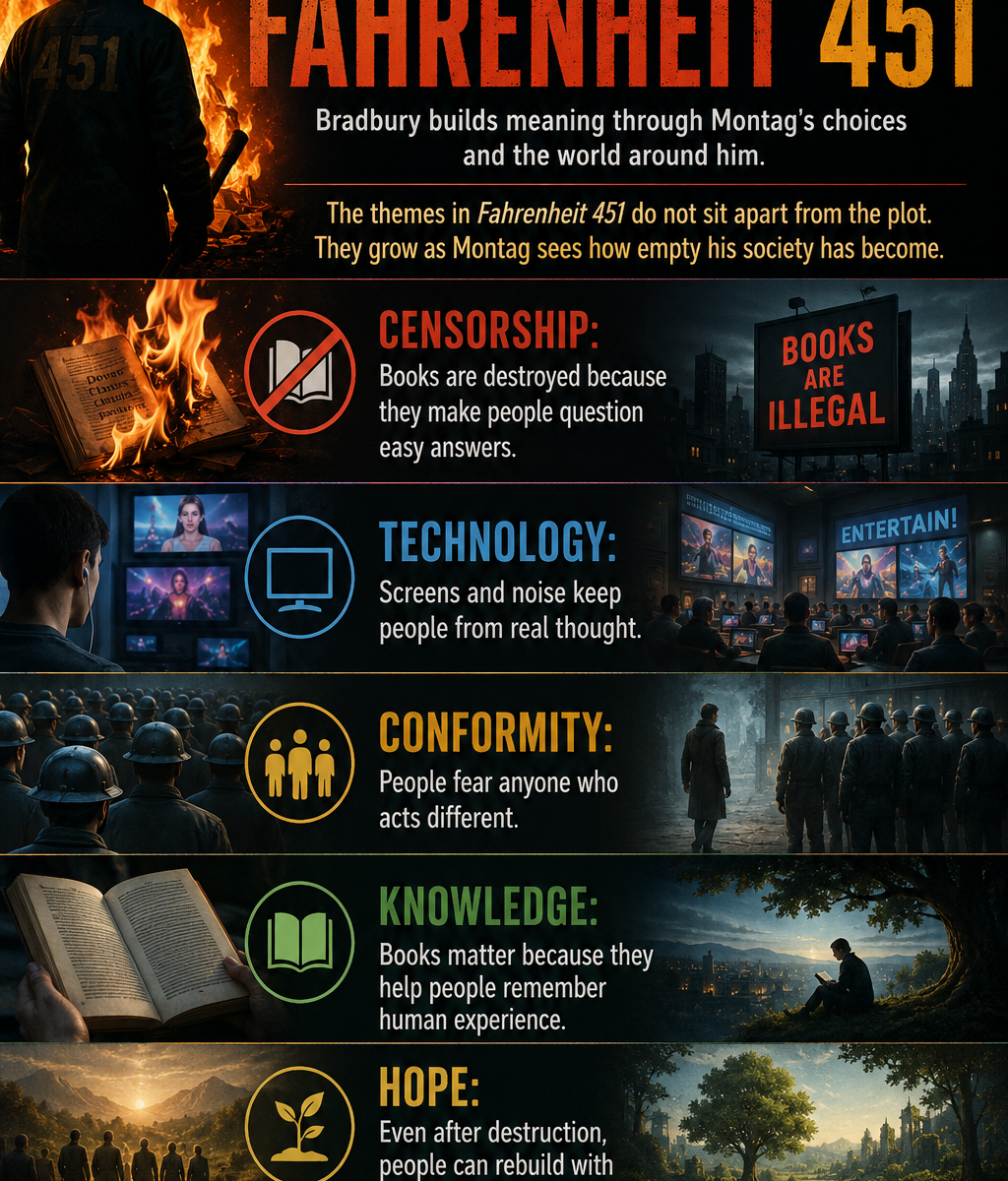
Bradbury builds meaning through Montag’s choices and the world around him.

The themes in Fahrenheit 451 do not sit apart from the plot. They grow as Montag sees how empty his society has become.

  • Censorship: Books are destroyed because they make people question easy answers.
  • Technology: Screens and noise keep people from real thought.
  • Conformity: People fear anyone who acts different.
  • Knowledge: Books matter because they help people remember human experience.
  • Hope: Even after destruction, people can rebuild with better values.

These ideas make the novel useful for high school and college essays because each theme connects to a clear conflict in the story.

Censorship and the Themes in Fahrenheit 451

Censorship is the novel’s most obvious warning, but Bradbury makes it more complex than a simple ban on books.

Montag starts as a fireman whose job is to burn books. This flips the normal meaning of firefighter. Instead of saving homes, he helps erase ideas.

The government in the novel fears books because books can create doubt. A person who reads may compare ideas, question leaders, or feel empathy for someone different.

This is one of the clearest themes in Fahrenheit 451: when comfort matters more than truth, freedom becomes weak.

Bradbury also suggests that censorship can come from the public. Beatty explains that people wanted fewer disputes and less discomfort. Over time, books became enemies because they made people feel uneasy.

This links well with George Orwell’s 1984, where the state controls language and history. Both novels show that power grows stronger when people lose access to honest thought.

Technology and Distraction in Fahrenheit 451

The novel does not say all technology is bad. It warns against technology that replaces thought.

Mildred spends much of her life with the parlor walls. These giant screens fill her home with noise, but they do not give her real comfort.

Her seashell radios also show how private space has been invaded. She can avoid silence at any moment. That matters because silence often gives people time to think.

The themes in Fahrenheit 451 show that distraction can become a form of control. If people stay entertained all the time, they may stop caring about war, death, or injustice.

This idea also appears in Aldous Huxley’s Brave New World. In that novel, pleasure helps keep citizens obedient. Bradbury’s world uses screens and speed in a similar way.

Conformity and the Loss of Self

Bradbury’s society punishes people who think or act outside the norm.

Clarisse is important because she asks simple questions. She notices rain, asks about happiness, and refuses to live on auto-pilot.

To Montag’s world, that makes her dangerous. She does not attack anyone. She just thinks for herself.

Montag slowly learns that conformity has made people less human. They laugh at violence, drive too fast, and avoid deep talk. They seem busy, but their lives feel hollow.

This theme helps explain why Montag changes. He does not become curious in one moment. Clarisse helps him notice what was already wrong.

Knowledge, Memory, and Hope

Books matter in the novel because they hold human memory.

Bradbury is not saying every book is perfect. He shows that books are valuable because they keep complex ideas alive.

Faber helps Montag understand this point. People need rich ideas and time to think about them. Without that, books alone cannot save anyone.

The book people at the end of the novel carry this theme forward. They memorize texts so the ideas can survive until the world is ready again.

This ending gives the novel hope. The city falls, but memory remains. Bradbury suggests that people can rebuild if they protect thought and listen to the past.

Fire, the Phoenix, and Other Symbols

Symbols help Bradbury turn big topics into deeper meaning.

Fire is the most important symbol. At first, it means destruction. Montag uses it to burn books and silence people.

Later, fire changes. When Montag finds the people outside the city, their small campfire gives warmth. The same element can destroy or help, based on how people use it.

The phoenix also matters. This mythical bird burns and rises again from ashes. At the end, it suggests that human society may learn from failure and begin again.

Students often miss how symbols connect to theme. If you need help with that skill, this guide to finding theme in literature can help.

How to Write About These Themes in an Essay

A strong literature essay needs a clear claim, not just a summary of events.

A strong essay on the themes in Fahrenheit 451 might argue that Bradbury presents censorship as both a government action and a public habit.

Start with a theme statement. Then choose scenes that prove it. Good moments include Montag meeting Clarisse, Mildred with the parlor walls, the old woman who dies with her books, and Montag’s talk with Faber.

Do not only say that books are important. Explain why they are important in the world of the novel. That turns your point from plot summary into analysis.

For extra help with practice prompts and student-friendly notes, you can use RapidReads Press theme study resources.

Why the Themes in Fahrenheit 451 Still Matter

Bradbury’s novel still feels current because its fears have not gone away.

These themes in Fahrenheit 451 feel close to modern life. Many people live with constant screens, fast news, and pressure to avoid hard debates.

That does not mean Bradbury predicted every detail of the future. It means he understood a human problem: people may give up freedom if comfort feels easier.

For helpful background on the author, see Britannica’s Ray Bradbury biography. The NEA Big Read page on Fahrenheit 451 also gives useful context for students.

Books to Look Up on Amazon or at the Library

These related books can help you compare dystopian themes across texts.

  • 1984 by George Orwell
  • Brave New World by Aldous Huxley

Both books pair well with Bradbury because they ask how power can shape private thought.

Key Takeaway

The core insight is simple: Fahrenheit 451 warns that a society can lose freedom when it rejects thought, memory, and honest conversation.

The novel’s ending leaves room for hope because people still have the power to remember and rebuild.

FAQ

Here are quick answers to common student questions.

What are the main themes in Fahrenheit 451?

The main themes are censorship, technology as distraction, conformity, knowledge, and hope after destruction.

Is censorship the most important theme?

Yes, censorship is central. It connects to almost every other theme in the novel.

What does fire symbolize in the novel?

Fire first symbolizes destruction. Later, it can also suggest warmth, survival, and renewal.

Why is Clarisse important to the themes?

Clarisse helps Montag question his life. Her curiosity shows what his society has lost.

What is a good theme statement for an essay?

Bradbury suggests that people who choose comfort over truth may help create their own oppression.

What Is Foreshadowing in Literature?

Foreshadowing in Literature

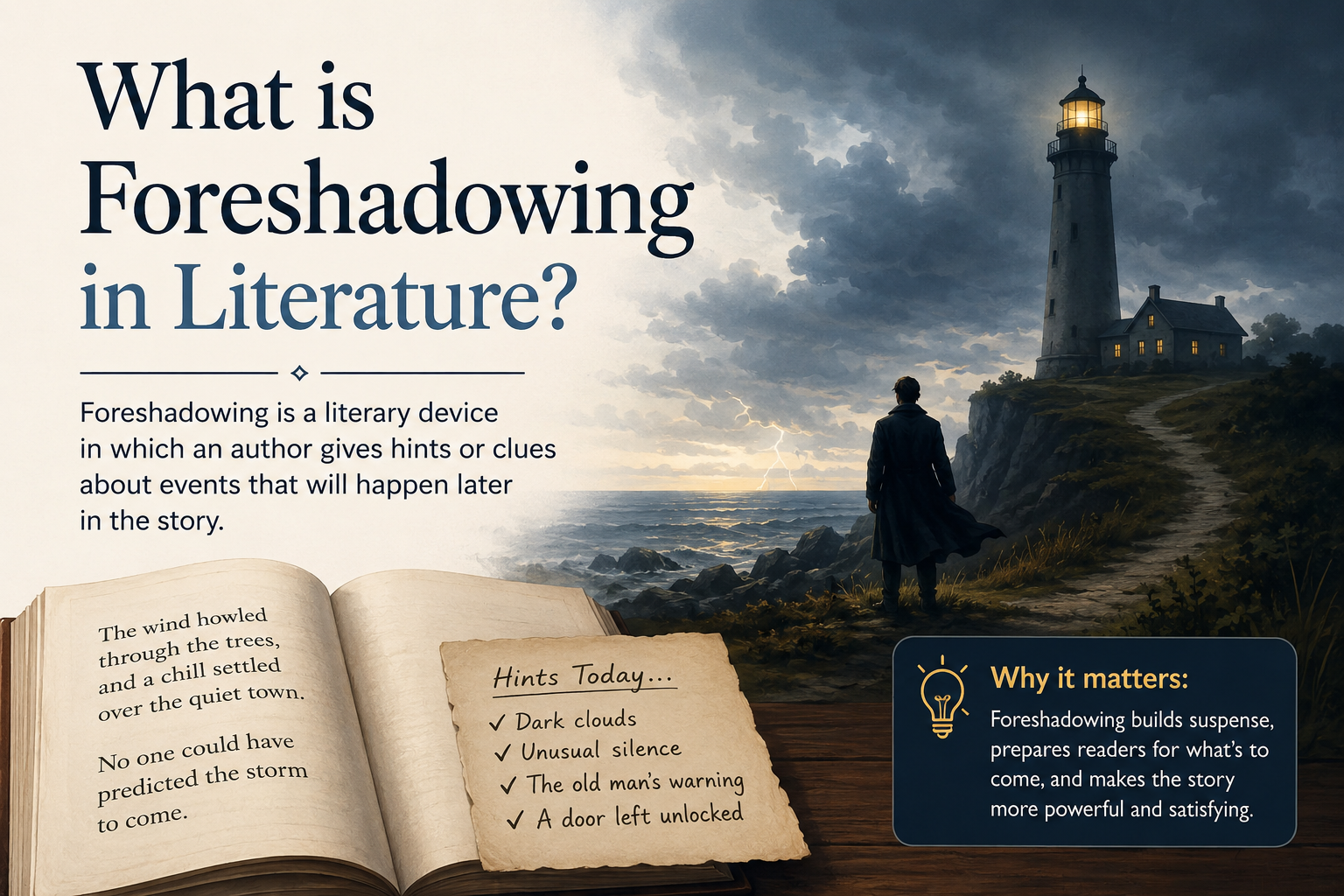
What Is Foreshadowing in Literature? It is a clue that hints at what may happen later in a story. Writers use it to build suspense, shape mood, and help readers notice that every detail can matter.

In this Guide

  • What foreshadowing means
  • Why writers use it
  • Common types of foreshadowing
  • Famous examples from literature
  • How to spot it as you read
  • Book suggestions
  • FAQ
Foreshadowing in Literature

What Is Foreshadowing in Literature? A Simple Definition

Foreshadowing is a hint that points toward a future event in a story.

So, What Is Foreshadowing in Literature? In simple terms, it is when an author plants a clue early so something later feels planned, not random.

Foreshadowing can be clear or subtle. A character may make a warning, a storm may signal danger, or an object may appear before it becomes important.

This device helps readers feel curious. It also rewards close reading because small details may gain meaning later.

If you want to study more tools like this, visit our literary devices list.

What Is Foreshadowing in Literature? Why It Matters

Foreshadowing gives a story shape and purpose.

What Is Foreshadowing in Literature? It is not just a “hint.” It is a way for writers to guide our expectations.

When used well, foreshadowing makes an ending feel earned. Readers may think, “I should have seen that coming,” which can make the story more powerful.

It also creates suspense. If a novel opens with a strange noise in the dark, we expect that noise to matter later.

Foreshadowing can also reveal theme. In many tragedies, early warnings show that fate, pride, or fear may lead to disaster.

What Is Foreshadowing in Literature? Common Types to Know

Foreshadowing can appear in more than one form.

Direct foreshadowing gives a clear warning. A character might say, “Nothing good will come from this.” That line tells readers to expect trouble.

Indirect foreshadowing is more hidden. A broken mirror, a dark dream, or a strange silence may hint at future conflict.

Symbolic foreshadowing uses images or objects. For example, a dying plant might suggest a failing relationship.

So, What Is Foreshadowing in Literature? It is any early clue that prepares readers for what comes next, even if they do not notice it right away.

Famous Examples of Foreshadowing

Well-known stories often use foreshadowing to build tension and meaning.

In Romeo and Juliet by William Shakespeare, Romeo has dark feelings about going to the Capulet party. His fear hints at the tragedy that follows.

In Of Mice and Men by John Steinbeck, the death of Candy’s dog foreshadows the later death of Lennie. Both scenes deal with mercy, weakness, and painful choices.

In Harry Potter and the Sorcerer’s Stone by J.K. Rowling, small details about Harry’s scar and Voldemort hint at a much larger conflict.

In The Lottery by Shirley Jackson, the nervous mood and strange village ritual foreshadow the shocking ending. The story shows how ordinary details can hide danger.

For more on literary terms and reading context, you can explore Britannica’s entry on foreshadowing.

How Foreshadowing Is Different from a Spoiler

A spoiler tells you what will happen. Foreshadowing only hints at it.

This difference matters. A spoiler removes surprise, but foreshadowing creates interest.

Good foreshadowing does not give away the whole plot. It gives just enough detail to make readers wonder.

When readers look back, the clue makes sense. That is why foreshadowing can make a story feel carefully built.

How to Spot Foreshadowing While You Read

Look for details that seem unusual, repeated, or too specific to ignore.

If a writer spends time on an object, warning, dream, or odd line of dialogue, mark it. Ask, “Why did the author include this?”

Pay close attention to first chapters. Many writers place key clues near the start of a story.

Also watch for changes in mood. A sudden shift from calm to tense may signal that something important is coming.

To connect foreshadowing with other story tools, review this guide to literary devices.

Books That Help You Study Foreshadowing

These books are useful if you want strong examples of foreshadowing in action:

  • Romeo and Juliet by William Shakespeare
  • Of Mice and Men by John Steinbeck
  • Harry Potter and the Sorcerer’s Stone by J.K. Rowling

FAQ: What Is Foreshadowing in Literature?

What Is Foreshadowing in Literature?

Foreshadowing is a clue that hints at a future event in a story. It helps readers expect that something important may happen later.

Why do authors use foreshadowing?

Authors use foreshadowing to build suspense, prepare readers, and make the ending feel connected to the rest of the story.

Is foreshadowing always obvious?

No. Some foreshadowing is clear, but some is hidden. Readers may only notice it after they finish the story.

What is an easy example of foreshadowing?

If a character says, “I have a bad feeling about this,” that line may foreshadow danger or conflict later.

Can foreshadowing be a symbol?

Yes. A symbol, such as a storm or broken object, can foreshadow a future event or emotional change.

Key Takeaway

What Is Foreshadowing in Literature? It is a clue that points ahead. When you read, circle strange details and ask how they might matter later. That simple habit can make your analysis much stronger.

Flash Memoir Prompt: First Time You Were in a Place Where You Didn’t Speak the Language

flash memoir prompt Language

A warm, specific flash memoir prompt for remembering the first time you stood in a place where every word around you felt locked, and one small moment told the truth. If you came looking for a flash memoir prompt first time place where didn’t speak the language, begin with the instant your face got hot and your hands had to do the talking.

flash memoir prompt Language

The Prompt

Write about the first time you were in a place where you didn’t speak the language.

This prompt works because it drops you into a clear scene right away. You may remember an airport, a train station, a classroom, a market, or a family dinner where everyone laughed and you were still trying to catch up.

Language is more than words. It is tone, gesture, speed, facial expression, and the strange little pause before you admit you do not understand. That pause can carry a whole story.

This flash memoir prompt asks you to find the moment when you felt outside the circle. Maybe you felt brave. Maybe you felt foolish. Maybe you felt lonely for five minutes, then helped by a stranger who pointed, smiled, or wrote a number on the back of a receipt.

Why This Memory Matters

The first time you are surrounded by a language you do not know, you notice things you might ignore at home. You watch mouths. You study signs. You guess from body language. A simple question, like asking where the bathroom is, can become an adventure.

That kind of memory can reveal how you handle uncertainty. Do you freeze? Do you laugh? Do you pretend to understand? Do you become very polite, very quiet, or very determined?

It can also uncover a story about dependence. Many of us like to feel capable. Then suddenly we need help ordering soup, buying a bus ticket, or finding a gate number. That shift can be humbling, and it can make a small kindness feel huge.

This is also a prompt about sound. The language around you may have felt musical, sharp, fast, soft, or impossible to separate into words. The signs may have looked like art at first. If you enjoy thinking about how unfamiliar words affect meaning, you might like this guide on how to understand Shakespearean language, since it explores how we make sense of language that first feels distant.

In a memoir piece, the event does not have to be dramatic. You do not need to write about getting lost for hours. The best memory might be the minute you pointed at a pastry in a glass case and hoped you had not chosen something filled with fish.

How to Approach This Prompt

Start with a physical detail. Do not begin by explaining the whole trip or naming every reason you were there. Begin with the menu you could not read, the ticket machine that blinked at you, the clerk who repeated the same sentence twice, or your own nervous smile reflected in a window.

Keep the memory to one scene. A strong flash memoir piece often happens in a small space. Pick the counter, the bus stop, the hotel desk, the kitchen table, or the street corner. Let the reader stand there with you.

Write what you noticed before you explain what it meant. For example, instead of starting with, “I felt helpless,” show us the blue sign, the crowded platform, and the way everyone else seemed to know where to go. Let the feeling rise from the details.

Then ask yourself one quiet question: What did I learn about myself in that moment? You might have learned that you were more stubborn than you thought. You might have learned that embarrassment fades when someone is kind. You might have learned that being silent can make you pay closer attention.

Try to avoid turning the piece into a travel report. You are not writing about every city, meal, or landmark. You are writing about one moment when language failed and something else had to take over.

Objects can help, too. A phrasebook, a phone screen, a paper map, or a handwritten note can hold meaning inside the scene. If you want to practice reading deeper meaning in ordinary details, this post on how to find symbolism in a story can help you see how small objects carry emotional weight.

A Quick Example

The first time I couldn’t speak the language, I was standing in a bakery in Lisbon with six people behind me and no idea how to ask for coffee. The woman at the counter waited with one hand on the register. I pointed at a round pastry because it was the only brave thing I could think to do. She said something I didn’t understand, and my face went hot. Then she held up one finger, raised her eyebrows, and I nodded like she had saved me from drowning. When she slid the plate across the counter, she added a tiny cup of coffee anyway. I sat near the window, embarrassed and grateful, eating slowly because every bite felt like a small apology.

Try It Yourself

Set a timer for ten minutes and write one scene from this memory. Begin with the place, then move straight to the problem. What did you need? Who was nearby? What sound or sign made you realize you were no longer in familiar territory?

Do not worry about perfect sentences at first. Let the memory arrive in pieces. You can clean it up later.

If you get stuck, write this sentence and keep going: “I realized I didn’t know how to say…” That line can open the door fast. It puts you back inside the body of the memory, where the best details often wait.

This flash memoir prompt first time place where didn’t speak the language is really an invitation to remember a moment of being human. We all reach points where we need help, patience, or a little courage. Write the scene honestly, and let it stay small enough to feel true.

Want More Flash Memoir Prompts?

If this prompt helped you find a vivid memory, keep going with short daily practice. Explore all 365 prompts in The Memory Trigger: 365 Flash Memoir Writing Prompts.

Themes in The Adventures of Huckleberry Finn: A Student-Friendly Guide

Huckleberry Finn themes

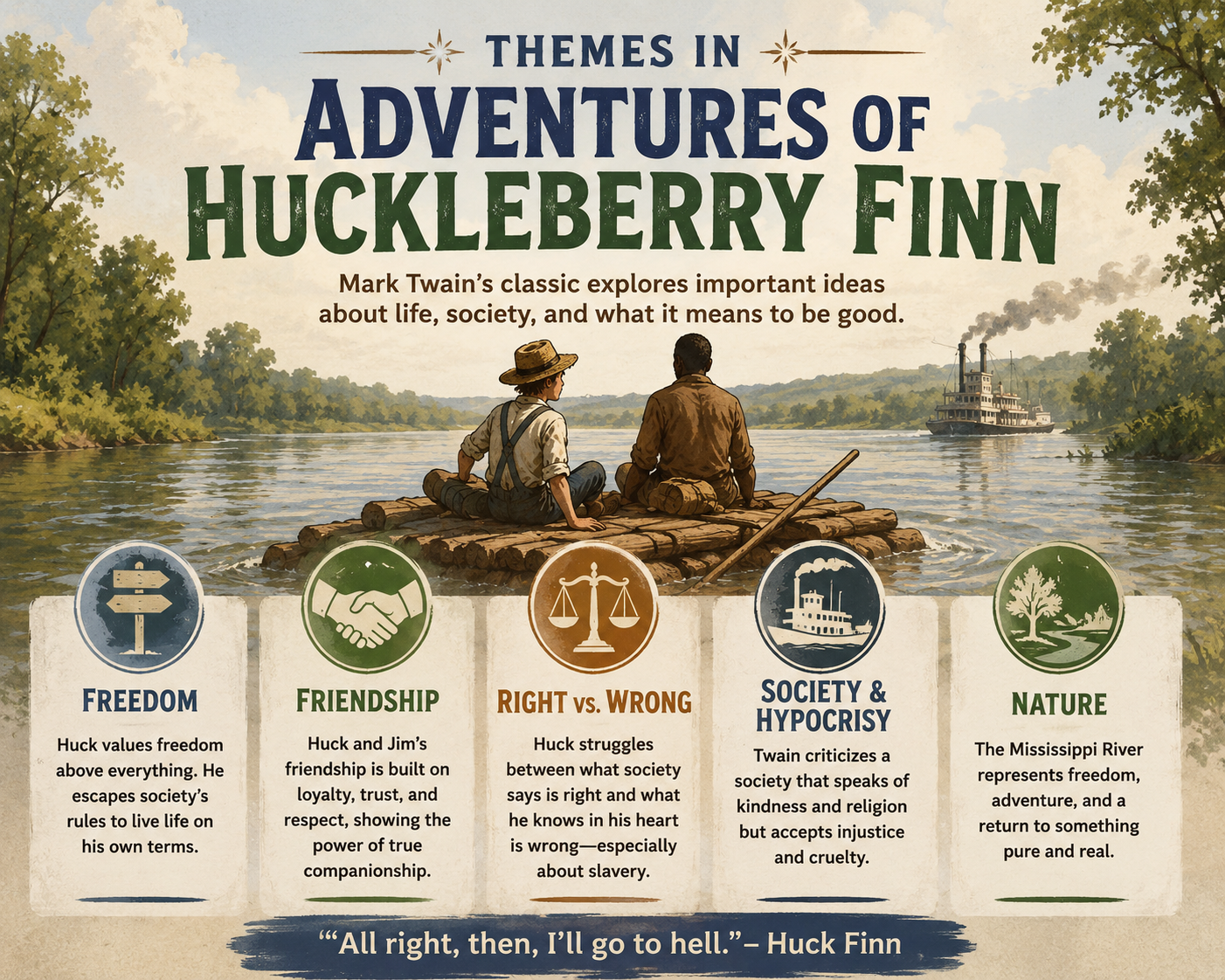
The Adventures of Huckleberry Finn can feel funny, strange, and painful all at once. The themes in The Adventures of Huckleberry Finn help students see how Mark Twain uses Huck’s journey to question slavery, racism, moral rules, and what it means to grow up.

This guide explains the major ideas in clear language, with examples you can use in class discussion or an essay.

In this Guide

Use these sections to review the novel’s key ideas and build stronger notes.

Huckleberry Finn themes

Why the themes in The Adventures of Huckleberry Finn matter

Twain’s novel is not just a river adventure. It is a sharp look at American life before the Civil War.

The themes in The Adventures of Huckleberry Finn matter because the book asks hard questions about right and wrong. Huck grows up in a world that teaches him slavery is normal, yet his own experience with Jim pushes him to doubt that belief.

This conflict makes the novel powerful, but also difficult. Twain uses satire, humor, and Huck’s plain voice to expose cruelty in society. The book also uses racist language that many readers find painful, so students should read it with care and context.

For background on Twain’s life and time period, the Britannica profile of Mark Twain is a useful starting point.

Major themes in The Adventures of Huckleberry Finn

The novel’s main themes work through Huck’s choices, Jim’s struggle, and the places they meet along the Mississippi River.

The themes in The Adventures of Huckleberry Finn often connect to one central question: should a person obey society or follow conscience? Huck’s answer changes as he learns to see Jim as a full human being, not as property.

Freedom and slavery

The most important theme is freedom. Jim seeks freedom from slavery. Huck seeks freedom from abuse, rules, and people who try to control him.

At first, Huck thinks of freedom as escape. He wants to avoid his father, school, and polite society. Jim’s freedom is far more serious because his life and family are at stake.

This difference matters. Twain shows that not all forms of escape are equal. Huck wants room to live his own way, while Jim fights a system that denies his humanity.

The river seems to offer freedom to both of them. On the raft, Huck and Jim form a bond that feels more honest than life on shore. Yet the river cannot fully protect them from slavery or racism.

Racism and dehumanization

The novel attacks a society built on racism, even though it also reflects racist language and ideas from its time. That tension makes the book hard to read and important to discuss.

Many white characters treat Jim as property. They talk about him as if he has no family, fear, or hope. Twain shows how ugly that mindset is by letting readers see Jim’s kindness and courage.

Jim cares for Huck, protects him from pain, and dreams of rejoining his family. These moments challenge the racist world around him.

Students should notice how Twain builds sympathy through action. Jim’s humanity is not shown through speeches. It is shown through care, loyalty, and sacrifice.

Conscience versus society

One of the strongest themes in The Adventures of Huckleberry Finn is the conflict between conscience and social rules. Huck has been taught that helping Jim escape is wrong.

His society tells him that the law supports slavery. His heart tells him that Jim is his friend. Huck must choose between what he has learned and what he knows from experience.

This theme appears most clearly when Huck decides not to betray Jim. He believes he may be doing something sinful, but he chooses loyalty over the values of his society.

Many works of literature use this same conflict. In Antigone by Sophocles, Antigone must choose between the king’s law and her duty to her brother. Like Huck, she faces a moral choice that society cannot solve for her.

Friendship and moral growth

Huck and Jim’s friendship changes Huck. At the start, Huck often repeats the racist ideas he has heard from others. Over time, he learns through shared danger and trust.

Jim becomes a father-like figure for Huck. He comforts him, watches over him, and treats him with more care than most adults in Huck’s life.

Huck’s moral growth does not happen in a neat way. He still has blind spots. Yet his bond with Jim teaches him to value human feeling over empty rules.

This makes the novel a coming-of-age story. Huck grows not because he becomes polite, but because he starts to reject cruelty.

Satire and social hypocrisy

Twain uses satire to mock people who appear civilized but act foolish or cruel. Many adults in the novel talk about religion, honor, and manners while they harm others.

The Grangerford and Shepherdson feud is a clear example. The families seem rich and refined, but they live by violence. Twain shows that social polish does not equal moral goodness.

The Duke and the King also reveal human weakness. They trick people for money and pretend to be noble. Their scams show how easily crowds can be fooled.

This theme still feels modern. Twain asks readers to look past nice words and judge people by their actions.

Childhood innocence and adult corruption

Huck sees the adult world from the outside. Because he is young, he notices lies that adults accept as normal.

He does not always understand the full meaning of events, but his plain voice helps readers see the truth. This gap between Huck’s view and the reader’s view creates irony.

Adults in the novel often fail to protect children. Pap is violent, judges make poor choices, and crowds act with little reason. Huck’s childhood is not safe, so the raft becomes a place of rare peace.

This theme connects to many coming-of-age novels. In To Kill a Mockingbird by Harper Lee, Scout also learns that adult society can be unfair and cruel.

Symbols that deepen the themes in The Adventures of Huckleberry Finn

Twain uses places and objects to make the novel’s ideas easier to feel.

The themes in The Adventures of Huckleberry Finn become clearer when you track the river, the raft, and the shore. These symbols help show the gap between freedom and social control.

The Mississippi River

The river often stands for freedom and movement. Huck and Jim can drift away from towns that judge or trap them.

Yet the river is not perfect freedom. It can be dangerous, and it leads them deeper into slave territory. Twain keeps the symbol complex so readers do not see escape as simple.

The raft

The raft is a small world where Huck and Jim can speak more honestly. It becomes a symbol of friendship and trust.

On the raft, Huck is not forced to play the role society gives him. Jim is not reduced to property in Huck’s eyes. Their life there is rough, but it is often more humane than life on shore.

The shore

The shore often represents society. Towns bring feuds, scams, mobs, and racist laws.

This pattern helps Twain criticize what people call civilization. The word sounds positive, but the shore often shows greed and violence.

How to write about themes in The Adventures of Huckleberry Finn

A strong essay should connect a theme to Huck’s choices and Twain’s larger criticism of society.

When you write about themes in The Adventures of Huckleberry Finn, avoid simple claims like the book is about freedom. Ask what Twain says about freedom. Is freedom possible in a racist society? Who gets freedom, and who is denied it?

A useful thesis might say: Twain uses Huck and Jim’s journey to show that true morality comes from sympathy, not from laws that support injustice.

Then prove the claim with scenes. You might discuss Huck’s decision not to betray Jim, the contrast between the raft and the shore, or the way Jim protects Huck.

If you need help turning notes into a full essay, read our guide on how to write a literary analysis essay.

For a quick review before class, you can also use our student theme review resource as a study companion.

Books to pair with your study of the novel

These books can help you understand Twain, the novel’s history, and the debate around the text.

  • The Adventures of Huckleberry Finn by Mark Twain
  • Mark Twain: A Life by Ron Powers
  • Was Huck Black? by Shelley Fisher Fishkin

Fishkin’s book is especially helpful for students who want to learn more about voice, race, and influence in Twain’s writing.

FAQ about themes in The Adventures of Huckleberry Finn

These quick answers can help you review before a quiz, seminar, or essay draft.

What are the main themes in The Adventures of Huckleberry Finn?

The main themes in The Adventures of Huckleberry Finn include freedom, racism, conscience, friendship, satire, and moral growth. The novel is most focused on how Huck learns to question the values of his society.

Why is conscience such an important theme?

Huck must choose between the law and his own sense of right and wrong. His choice to help Jim shows that moral feeling can be stronger than social pressure.

How does Twain use satire in the novel?

Twain mocks people who claim to be civilized but act cruelly. The feuding families and the con men both show how foolish and corrupt society can be.

Is the river a symbol of freedom?

Yes, but it is not simple. The river gives Huck and Jim space from society, yet it also carries them toward danger.

How can I pick a theme for an essay?

Choose one theme and connect it to a clear pattern in the novel. If you need structure, use this literary analysis essay guide to build your claim.

Key Takeaway

The best way to understand the novel is to watch Huck’s moral growth.

The themes in The Adventures of Huckleberry Finn show a young person learning that society can be wrong. Twain’s novel asks readers to question false morality and value human dignity over unjust rules.

Best Classic Moon Symbolism in Literature: Meaning, Themes, and Books to Read

Moon symbolism

The Best Classic Moon Symbolism in literature often points to mystery, change, hidden truth, and emotion. Writers use the moon because it feels familiar, but it also feels strange and powerful.

From Gothic novels to Romantic poems, the moon can light up secrets that characters try to hide. It can also show fear, love, madness, or hope in a quiet way.

Moon symbolism

In this Guide

  • What moon symbolism means in classic literature
  • How Gothic writers use the moon
  • Moon symbolism in poetry
  • Famous examples from novels and plays
  • Common moon themes
  • Books to read for moon symbolism
  • FAQs about moon symbolism

What Is Best Classic Moon Symbolism?

The moon often acts like a mirror for a character’s inner life.

In classic literature, the moon is rarely just part of the setting. It can show that a scene is strange, emotional, secret, or unsafe.

The Best Classic Moon Symbolism works because the moon changes shape. It grows, fades, disappears, and returns. That makes it a strong symbol for change, time, memory, and unstable feelings.

The moon also rules the night. Since night often hides what daylight reveals, moonlight can create tension. It lets readers see a little, but not everything.

For more help with symbols in fiction, read our guide on how to find symbolism in a story.

Best Classic Moon Symbolism in Gothic Literature

Gothic writers use the moon to make fear feel beautiful and dangerous.

In Gothic literature, moonlight often falls on castles, graveyards, windows, and wild landscapes. It gives scenes a dreamlike look, but it can also make them feel unsafe.

In Dracula by Bram Stoker, the night world matters. The moon helps build a mood of danger because Dracula’s power grows after dark. Moonlit scenes remind readers that evil can move quietly when people feel most helpless.

In Frankenstein by Mary Shelley, moonlight often appears during lonely or fearful moments. Victor sees the world through guilt and dread, so the moon can feel cold instead of calm.

This is why the Best Classic Moon Symbolism in Gothic fiction often connects to fear, isolation, and the unknown. The moon does not comfort the characters. It watches them.

Best Classic Moon Symbolism in Romantic and Victorian Poetry

Poets often turn the moon into a symbol of longing, beauty, and deep thought.

Romantic poets loved nature because they saw it as a path to feeling and imagination. The moon gave them a perfect image for quiet sadness, wonder, and spiritual mystery.

Percy Bysshe Shelley’s poem To the Moon presents the moon as tired and wandering. It feels almost human. You can read the poem at the Poetry Foundation.

Emily Dickinson also uses the moon in striking ways. In poems like “The Moon was but a Chin of Gold,” the moon becomes strange, almost like a face in the sky. Her moon is not simple or soft. It feels alive and hard to explain.

The Best Classic Moon Symbolism in poetry often depends on mood. A moon can feel romantic in one poem and lonely in another. The symbol changes with the speaker’s mind.

Famous Examples of Moon Symbolism in Classic Literature

Many famous works use the moon to show love, secrecy, or a shift in power.

In Shakespeare’s A Midsummer Night’s Dream, the moon is tied to romance, magic, and confusion. Lovers meet in the woods at night, where moonlight helps create a world that feels playful but unstable.

In Nathaniel Hawthorne’s The Scarlet Letter, moonlight matters during scenes of guilt and hidden truth. The night does not fully hide sin. Instead, the moon gives just enough light to make secrets feel visible.

In Jane Eyre by Charlotte Brontë, the moon often has a guiding role. Jane sometimes sees it as calm and almost motherly. It can reflect her need for safety, love, and moral direction.

These examples show why moon symbolism stays popular in classrooms. It helps readers track a character’s fear, desire, or private struggle without a long speech.

Best Classic Moon Symbolism and Common Themes

The moon can carry many meanings, but a few themes appear again and again.

Change is one of the most common meanings. Because the moon has phases, it often points to growth, decline, or a coming shift.

Mystery is another key theme. Moonlight reveals shapes but not details. That makes it perfect for scenes where characters do not fully understand what they face.

Madness also appears in older literature and folklore. The word “lunatic” comes from an old belief that the moon could affect the mind. You can learn more about the moon’s cultural history through Britannica’s overview of the Moon.

Love is a softer meaning. Moonlit scenes can feel private and emotional, which is why writers often place lovers under the moon.

The Best Classic Moon Symbolism does not have one fixed meaning. The scene, character, and genre all shape what the moon suggests.

How to Spot Best Classic Moon Symbolism in a Story

Look at what happens when the moon appears.

Ask what the moon changes in the scene. Does it make the setting feel peaceful, eerie, romantic, or tense?

Notice who sees the moon. A lonely character may read the moon as cold. A hopeful character may see it as beautiful.

Pay attention to light and shadow. Moonlight often sits between darkness and full truth. That makes it useful when a story deals with secrets.

If you want a simple method, use this symbolism reading guide to practice with any poem, novel, or short story.

Recommended Books for Studying Best Classic Moon Symbolism

These books are strong choices for students who want clear examples of moon imagery and symbolism.

  • Dracula by Bram Stoker
  • Jane Eyre by Charlotte Brontë
  • The Poems of Emily Dickinson by Emily Dickinson

Dracula is useful if you want to study moonlight, fear, and Gothic mood. The night scenes show how setting can shape terror.

Jane Eyre gives a different kind of moon symbol. The moon often feels moral, emotional, and personal.

Emily Dickinson’s poetry is a great choice for close reading. Her moon images are short, strange, and rich with meaning.

FAQs About Moon Symbolism in Literature

What does the moon usually symbolize in literature?

The moon often symbolizes mystery, change, emotion, secrecy, or the hidden self. Its meaning depends on the scene and the character.

Why do Gothic writers use the moon so often?

Gothic writers use the moon because it creates fear and beauty at the same time. Moonlight makes a scene visible but still unclear.

Is moon symbolism always romantic?

No. The moon can suggest romance, but it can also suggest danger, madness, loneliness, or guilt.

How can I analyze moon symbolism for school?

Start with the mood of the scene. Then ask what the moon reveals, what it hides, and how the character reacts to it.

Key Takeaway: Best Classic Moon Symbolism Still Matters

The Best Classic Moon Symbolism works because the moon feels both close and mysterious. It lights the dark without removing the dark completely.

That is why writers keep returning to it. The moon can show love, fear, change, and secret truth in one quiet image.

When you see the moon in a classic text, pause for a moment. It may be telling you what the characters cannot say out loud.

Best Books for Dark Academia

Dark Academia books
Dark Academia books

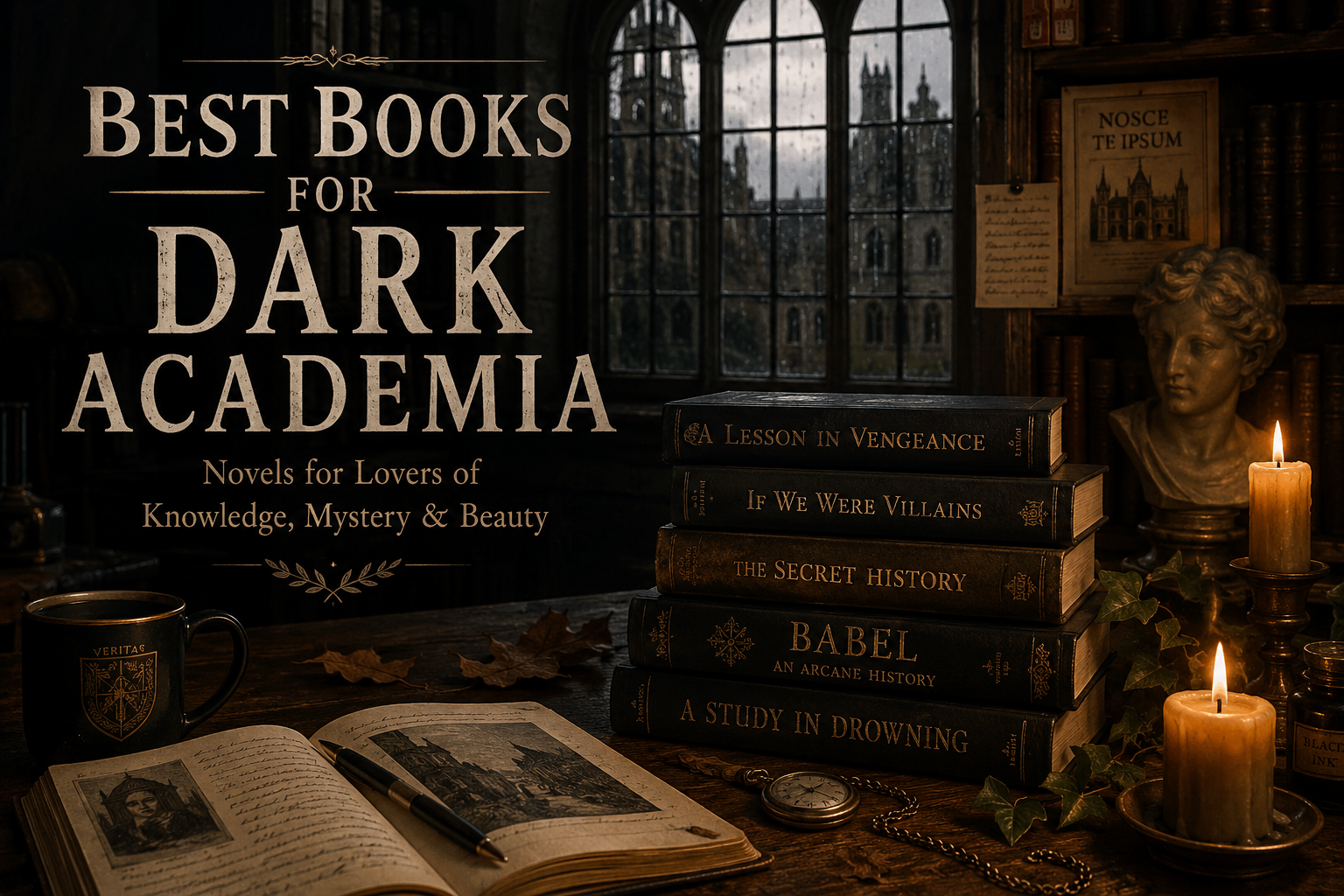
The Best Books for Dark Academia mix mystery, ambition, beauty, and danger. These stories often take place in schools, libraries, old houses, or elite circles where knowledge feels powerful and risky.

If you like candlelit study rooms, secret clubs, moral questions, and characters who want too much, this guide will help you find your next read.

In this Guide

  • What makes dark academia books so popular
  • Best Books for Dark Academia to read first
  • Major themes and symbols
  • Books worth buying or borrowing
  • How students can read dark academia well
  • FAQs

What Makes the Best Books for Dark Academia So Compelling?

Dark academia is about learning, but it is also about obsession.

The Best Books for Dark Academia often show smart characters who chase beauty, status, or truth. At first, their world looks polished. Soon, it starts to crack.

These books often include old campuses, Latin phrases, rare books, art, poetry, and hidden guilt. The setting matters because it makes learning feel grand, but also cold.

Dark academia also asks a hard question: What happens when intelligence is not matched by kindness?

Best Books for Dark Academia: Classic and Modern Picks

These books capture the mood of dark academia in different ways, from elite schools to haunted minds.

The Secret History by Donna Tartt

Many readers see The Secret History as the heart of dark academia. It follows a group of college students who study Greek classics under a strange and powerful professor.

The book explores beauty, guilt, and the danger of feeling above normal rules. It is one of the Best Books for Dark Academia because it turns scholarship into suspense.

If We Were Villains by M.L. Rio

This novel follows theater students who live and breathe Shakespeare. Their friendships are intense, and their roles begin to blur with real life.

The book is a strong choice for students who enjoy drama, rivalry, and literary clues. It also shows how art can shape identity in harmful ways.

Frankenstein by Mary Shelley

Frankenstein is not set in a modern university, but it fits the dark academia mood well. Victor Frankenstein wants knowledge so badly that he forgets his duty to others.

The novel warns readers about ambition without care. It is also a major work in Gothic literature, a tradition you can learn more about through Britannica’s overview of the Gothic novel.

The Picture of Dorian Gray by Oscar Wilde

This novel is full of art, beauty, style, and moral decay. Dorian wants to stay young while his portrait carries the damage of his choices.

It belongs with the Best Books for Dark Academia because it asks what people will trade for beauty and pleasure.

Jane Eyre by Charlotte Brontë

Jane Eyre has a strong Gothic mood, a mysterious house, and a heroine who values education and self-respect. Jane’s inner life matters as much as the plot.

The novel works well for students who want dark atmosphere but also moral strength.

Babel by R.F. Kuang

Babel is a modern dark academia novel about language, empire, and power. It takes place in Oxford and asks who benefits from elite education.

This book is a great pick for readers who want dark academia with sharp social criticism.

Major Themes in the Best Books for Dark Academia

Dark academia feels stylish, but its deepest power comes from its themes.

In the Best Books for Dark Academia, ambition often becomes dangerous. Characters want to be brilliant, rare, or admired. That desire can push them toward lies and harm.

Class is another major theme. Many dark academia stories show who gets access to elite schools, private libraries, and powerful mentors. The mood may feel romantic, but the system can be unfair.

Secrecy also plays a key role. Hidden rooms, private languages, and secret groups create suspense. They also show how knowledge can divide people.

For another look at wealth, image, and moral decline, read our Great Gatsby analysis. Gatsby is not a dark academia novel, but it shares the same interest in status and illusion.

Symbolism in the Best Books for Dark Academia

Symbols help dark academia feel rich, strange, and memorable.

Books and libraries often stand for power. They suggest wisdom, but they can also suggest control. A locked library may mean that knowledge is not open to everyone.

Old buildings often symbolize tradition. A stone campus or decaying mansion can look beautiful while hiding fear, guilt, or corruption.

Mirrors and portraits often show divided identity. In The Picture of Dorian Gray, the portrait becomes a symbol of the soul. It shows the truth that Dorian refuses to face.

Storms, fog, and candlelight also shape the mood. They make the world feel uncertain, which fits stories about secrets and guilt.

Books Worth Buying or Borrowing for a Dark Academia Shelf

If you want to start a small shelf, begin with books that show the range of the genre.

Here are a few strong choices you can find at many bookstores, libraries, or on Amazon without needing any special edition:

  • The Secret History by Donna Tartt
  • If We Were Villains by M.L. Rio

These titles are easy entry points because they have strong plots, literary references, and tense student groups.

How to Read the Best Books for Dark Academia in School

Dark academia books are fun to read, but they also reward close attention.

When you read the Best Books for Dark Academia, track what the main character wants. Then ask what they are willing to risk to get it.

Pay attention to setting. A classroom, library, or old house is never just a backdrop. It often reflects power, fear, or desire.

Notice references to art, poetry, and myth. These allusions can reveal what the characters admire. They can also show how characters use culture to excuse bad choices.

If you study poetry with dark academia themes, the Poetry Foundation’s page on T.S. Eliot is a helpful place to start. Eliot’s work often explores decay, memory, and modern anxiety.

Why the Best Books for Dark Academia Still Matter

Dark academia is not just an aesthetic. It speaks to real fears about success, pressure, and belonging.

Students may connect with these stories because school can feel intense. Grades, image, talent, and social status can seem like everything.

The Best Books for Dark Academia remind readers that knowledge should not come at the cost of empathy. A brilliant mind can still make cruel choices.

That warning is part of what makes the genre last.

FAQs About the Best Books for Dark Academia

Here are quick answers to common questions about the genre.

What are the Best Books for Dark Academia for beginners?

The Best Books for Dark Academia for beginners include The Secret History, If We Were Villains, and Frankenstein. These books show the genre’s mood, themes, and moral questions clearly.

Is dark academia always set at a school?

No. Many dark academia stories take place at schools or universities, but the genre can also include old houses, museums, libraries, and artistic circles.

Why is Frankenstein considered dark academia?

Frankenstein fits because it focuses on dangerous knowledge, ambition, and isolation. Victor wants to master life itself, but he ignores the human cost.

Are dark academia books good for AP Literature?

Yes, many are useful for AP Literature because they deal with theme, symbolism, character flaws, and moral conflict. Classics like Frankenstein and Jane Eyre are especially strong choices.

Key Takeaway

The Best Books for Dark Academia are not only about old libraries and clever students. They show how beauty, learning, and ambition can become dangerous when people forget compassion.

If you want books with mood, mystery, and serious ideas, dark academia is a rich place to begin. 📚

Round vs Flat Characters in Fiction: A Clear Guide

Round vs Flat Characters

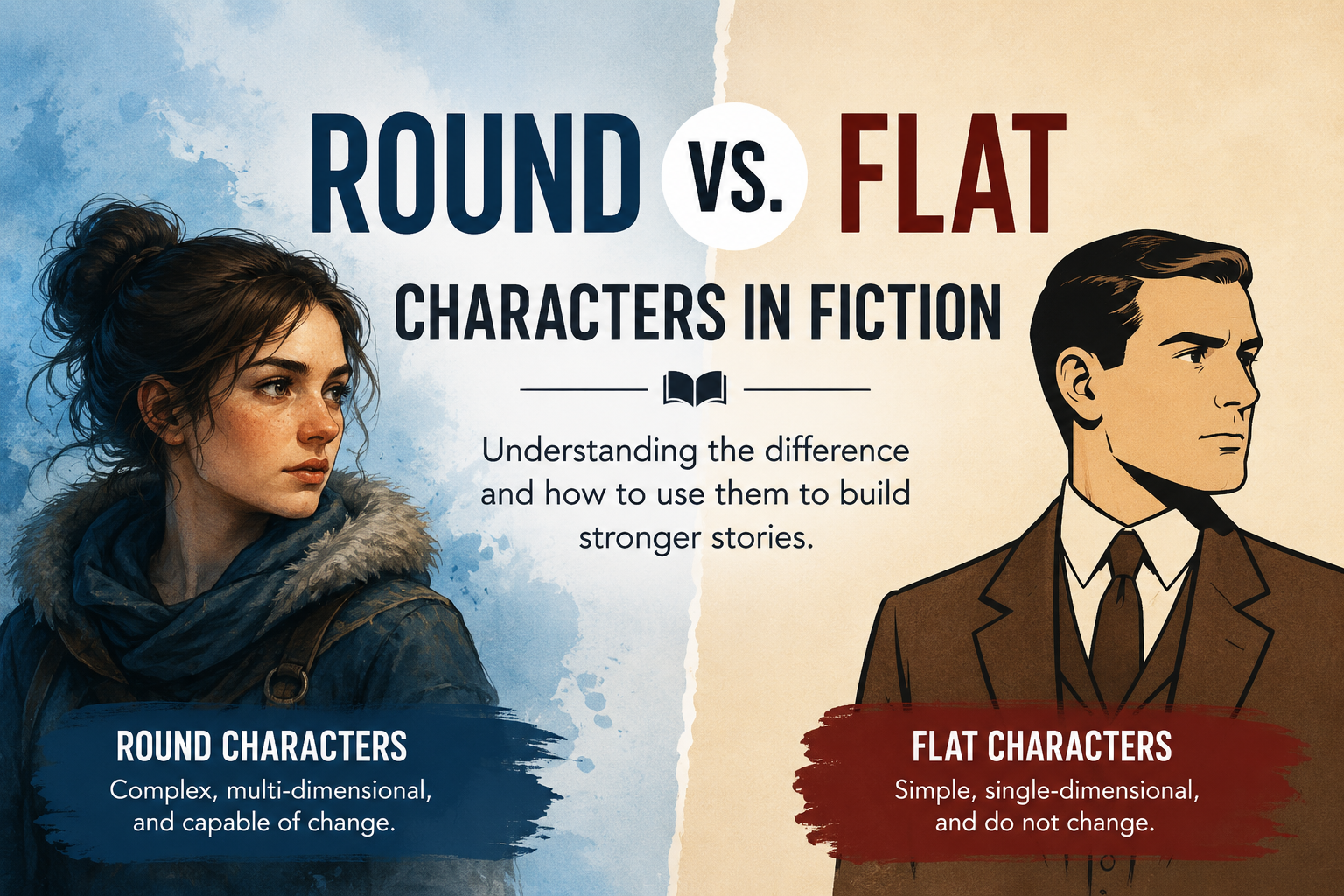
Round vs Flat Characters in Fiction is a key idea in literary analysis. Once you know the difference, you can explain why some characters feel real and complex while others serve a clear, simple role.

This guide breaks the idea down in plain language, with examples from famous books and tips you can use in essays.

In this Guide

  • What round characters are
  • What flat characters are
  • Round vs Flat Characters in Fiction examples
  • How to use the idea in literary analysis
  • Common mistakes to avoid
  • Book suggestions
  • FAQ
Round vs Flat Characters

What Are Round Characters?

Round characters feel complex, layered, and close to real people.

A round character has more than one side. They may have mixed feelings, personal flaws, hidden fears, or changing beliefs.

Round characters often surprise us, but their actions still make sense. They are not random. Their choices grow out of who they are.

Elizabeth Bennet in Pride and Prejudice is a strong example. She is smart and funny, but she also misjudges Darcy. Her pride affects how she sees others.

By the end of the novel, Elizabeth learns more about herself. That growth makes her feel human.

You can read more background on the novel through Britannica’s overview of Pride and Prejudice.

What Are Flat Characters?

Flat characters are simple, clear, and easy to understand.

A flat character usually has one main trait. They do not have deep inner conflict, and they may not change much.

This does not mean they are badly written. Flat characters can be useful. They can add humor, reveal a theme, or push the plot forward.

Mr. Collins in Pride and Prejudice is a good example. He is proud, awkward, and eager to please Lady Catherine. He does not have much depth, but he plays an important role.

Flat characters often help readers see the main characters more clearly.

Round vs Flat Characters in Fiction: The Main Difference

Round vs Flat Characters in Fiction comes down to depth and complexity.

A round character has an inner life. A flat character has a simpler role. One is built with layers, while the other is shaped around a clear purpose.

Think of Scrooge in A Christmas Carol. At first, he may seem flat because he is greedy and cold. But as the story moves forward, we see his fear, regret, and pain.

Scrooge becomes round because the story reveals why he acts the way he does. His change also matters to the whole meaning of the book.

In contrast, some minor characters in the same story stay simple. They may show kindness, poverty, or social pressure without much personal depth.

That contrast helps the story work.

Round vs Flat Characters in Fiction Examples from Literature

Examples make Round vs Flat Characters in Fiction much easier to understand.

In To Kill a Mockingbird, Scout Finch is round. She grows as she learns about justice, fear, and unfair treatment. Her view of the world changes.

Atticus Finch also has depth. He is calm and moral, but he faces pressure from his town. His choices show courage without making him perfect.

In Animal Farm, many characters are flatter on purpose. Napoleon often stands for power and control. Boxer stands for loyalty and hard work.

George Orwell uses flat characters to support satire. The point is not deep psychology. The point is political meaning.

In Harry Potter, Harry is round because he has fear, anger, love, and doubt. Some side characters are flatter, but they still help build the world.

Why Writers Use Both Round and Flat Characters

Good fiction does not need every character to be round.

If every character had a deep backstory, many stories would feel crowded. Flat characters help keep the focus on the main conflict.

A round character often carries the emotional weight of the story. A flat character may create pressure, offer comic relief, or show a social idea.

In Romeo and Juliet, Romeo and Juliet feel more complex than many side characters. Their feelings change quickly, and their choices shape the tragedy.

Characters like the Nurse have strong traits that are easy to spot. She is lively and practical, which makes her memorable even if she is less complex.

Round vs Flat Characters in Fiction and Character Change

Round vs Flat Characters in Fiction is related to change, but it is not the same thing.

A round character does not always change. Some round characters stay the same, but readers still see many sides of them.

A flat character can change in a small way, but still remain simple. The key question is depth, not just change.

For example, a villain may become nicer at the end of a story. If we do not learn much about their mind, fears, or motives, they may still feel flat.

On the other hand, Hamlet is round even before he makes final choices. He thinks deeply, doubts himself, and struggles with grief.

How to Analyze Round vs Flat Characters in Fiction

Round vs Flat Characters in Fiction can help you write stronger literary analysis.

Start by asking what the character wants. Then look at what makes the character hard to define. A round character often has tension inside them.

Ask these questions:

  • Does the character have more than one clear trait?
  • Does the character face inner conflict?
  • Does the character change how readers understand the theme?
  • Does the character mostly serve one purpose?

If you want a fuller method, see our guide on how to analyze characters in literature.

When you write about the distinction, do not just label the character. Explain why the label matters.

For example, do not only say, “Scrooge is round.” Say, “Scrooge is round because Dickens reveals his fear of loneliness, which helps the story argue that people can change.”

Common Mistakes with Round vs Flat Characters in Fiction

Many students think “round” means good and “flat” means bad. That is not true.

A flat character can be well written if the role is clear. A round character can still fail if the author does not make the person believable.

Another mistake is to confuse flat characters with minor characters. A minor character can be round if the story gives them depth.

Readers also mix up flat characters with static characters. A static character does not change much. A flat character lacks deep complexity.

The terms overlap sometimes, but they do not mean the same thing.

How to Use Round vs Flat Characters in Fiction in an Essay

Round vs Flat Characters in Fiction gives you a useful tool for claims about theme.

Your essay should connect character type to meaning. Ask why the author made a character simple or complex.

Here is a strong sentence frame:

“The author presents [character] as a [round/flat] character in order to show [theme or idea].”

Example:

“Orwell presents Boxer as a mostly flat character in order to show how loyalty can be used by those in power.”

This kind of sentence does more than name a term. It links the character to the author’s message.

Books to Look Up on Amazon

These books are useful if you want more practice with Round vs Flat Characters in Fiction.

  • Pride and Prejudice by Jane Austen
  • A Christmas Carol by Charles Dickens
  • Animal Farm by George Orwell

Each book gives clear chances to compare deep characters with simpler ones.

Quick Reference: Round vs Flat Characters in Fiction

Round vs Flat Characters in Fiction is easiest to remember this way:

  • Round characters have depth, conflict, and layers.
  • Flat characters have a simple role or main trait.
  • Both types can be useful in a strong story.

For more general background on fiction as a literary form, see Britannica’s article on the novel.

FAQ: Round vs Flat Characters in Fiction

What is the difference between round and flat characters?

A round character has depth and complexity. A flat character is simpler and usually has one main role or trait.

Can a flat character be important?

Yes. Flat characters can support the plot, reveal a theme, or make the main character stand out.

Is a round character always a main character?

No. Main characters are often round, but some minor characters can also have depth.

Is a flat character the same as a static character?

No. A static character does not change much. A flat character lacks depth. A character can be both, but the terms are different.

How do I write about round and flat characters in an essay?

Explain how the character type helps show a theme. Do not stop at the label.

Key Takeaway

Round vs Flat Characters in Fiction is not about good versus bad writing. It is about how much depth a character has and how that character helps the story make meaning.

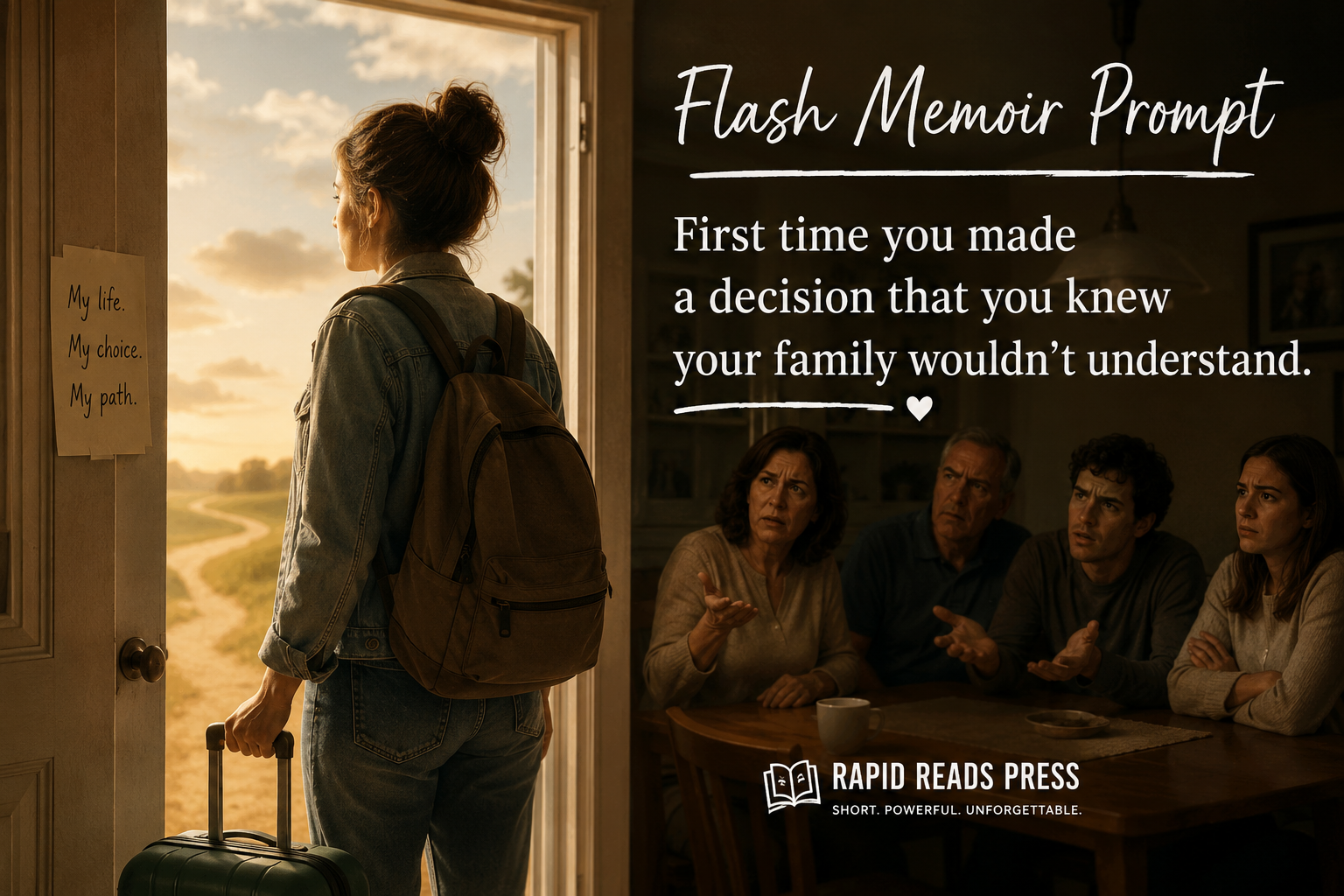
Flash Memoir Prompt: First Time You Made a Decision that You Knew Your Family Wouldn’t Understand

flash memoir prompt decision

A quiet flash memoir prompt for the first time you made a decision you knew your family would not understand, told through one brave moment, one clear scene, and the truth you could not explain yet.

Maybe you remember the room before you remember the words. The kitchen light felt too bright. Your phone sat heavy in your hand. Someone in your family was asking what you had decided, and you already knew your answer would sound wrong to them.

This flash memoir prompt first time made decision knew you would be misunderstood is about that tense little space between loyalty and self-trust. It asks you to write about the moment when you chose something that made sense to you, even if it made no sense to the people who loved you.

flash memoir prompt decision

The Prompt

Write about the first time you made a decision that you knew your family wouldn’t understand.

This prompt can open a powerful memory because it holds conflict right away. There is a choice. There is a family. There is a gap between what others expect and what you know you need.

You do not have to write about a dramatic fight or a life-changing announcement. The most honest version may live in a small scene. Maybe you chose a college far from home. Maybe you quit something everyone praised you for. Maybe you kept a relationship private, changed your plans, refused a tradition, or said no when everyone expected yes.

The heart of this prompt is not whether your family was right or wrong. The heart is the first time you felt the cost of having your own mind.

Why This Memory Matters

Family can shape our first ideas about safety, success, duty, and love. When you make a decision your family will not understand, you may feel guilt before anyone even says a word.

That feeling is worth writing about. It shows the reader who you were at the moment you began to separate your own voice from the voices around you.

This kind of memory may uncover a story about independence. It may also reveal fear, tenderness, or regret. You might find that your family’s reaction was less harsh than you expected. You might find that their silence hurt more than shouting.

In flash memoir, the power often comes from staying close to one moment. Instead of explaining your whole family history, you can show your father clearing his throat, your sister staring at the table, or your mother folding the same dish towel twice.

Those small actions can carry the weight of the scene. If you enjoy studying how people reveal themselves through action, you may also like this guide on how to analyze characters in literature. The same skill can help memoir writers notice what people say without saying it directly.

How to Approach This Prompt

For this flash memoir prompt first time made decision knew others would question, begin with a physical detail. Do not start by explaining the entire decision. Start with the thing your body remembers.

What did your hands do? Where were you sitting? Was there food on the table? Was the room quiet, messy, hot, cold, crowded, or strange?

Then narrow the memory to one scene. Choose the moment before you told them, the moment after, or the moment when you decided not to explain yourself anymore.

Try this opening move: “I knew they would not understand when…” Then finish the sentence with a concrete image instead of an abstract feeling.

For example:

“I knew they would not understand when I saw my mother place the nursing school brochure beside my untouched plate.”

That kind of sentence gives the reader a scene. It also gives you a doorway into the memory.

Write what you noticed before you explain what it meant. Let the scene breathe a little. If you jump too quickly to the lesson, you may miss the emotional texture of the moment.

Also, avoid trying to tell the whole story at once. You do not need to explain every family argument, every expectation, or every reason behind your choice. Flash memoir works best when one moment stands in for something larger.

If you want a simple structure, try this:

Start with the scene. Show the decision. End with what you could not say out loud at the time.

That is enough for a strong first draft.

A Quick Example

I knew they would not understand when my uncle laughed and said, “Art school?” like I had told him I planned to live on the moon. We were in my grandmother’s dining room, and the plastic cover on the table stuck to my wrist. Everyone had been talking about my cousin’s new job at the hospital. Then my mother asked if I had sent in my scholarship forms. I said yes, but not for nursing. The room went quiet in a way that felt practiced. My father looked down at his plate. I wanted to explain that drawing was the only place I felt awake, but the words sounded childish in my head. So I just said, “I already mailed it.” My voice shook, but I did not take it back.

Try It Yourself

Set a timer for ten minutes and write the scene as if you are back inside it. Do not worry about making the decision look wise. Do not try to defend yourself on the page.

Focus on what happened in the room, car, hallway, or phone call. Let the reader feel the pressure before you name it.

If the memory still feels charged, write around the edges first. Describe the weather that day. Describe what you wore. Describe the object closest to you. Often, the truth enters through the side door.

When you revise, look for one sentence that feels especially honest. It may be quiet. It may be uncomfortable. Keep that sentence and build the piece around it.

This flash memoir prompt first time made decision knew your family would not understand is not asking you to judge your family or prove you were right. It is asking you to remember the first time you heard your own inner voice and chose to follow it anyway.

Want More Flash Memoir Prompts?

If this prompt helped you find a memory with tension and heart, keep going. A daily prompt can give you a small, steady way to build scenes from your life without having to tell everything at once.

Explore all 365 prompts in The Memory Trigger: 365 Flash Memoir Writing Prompts.

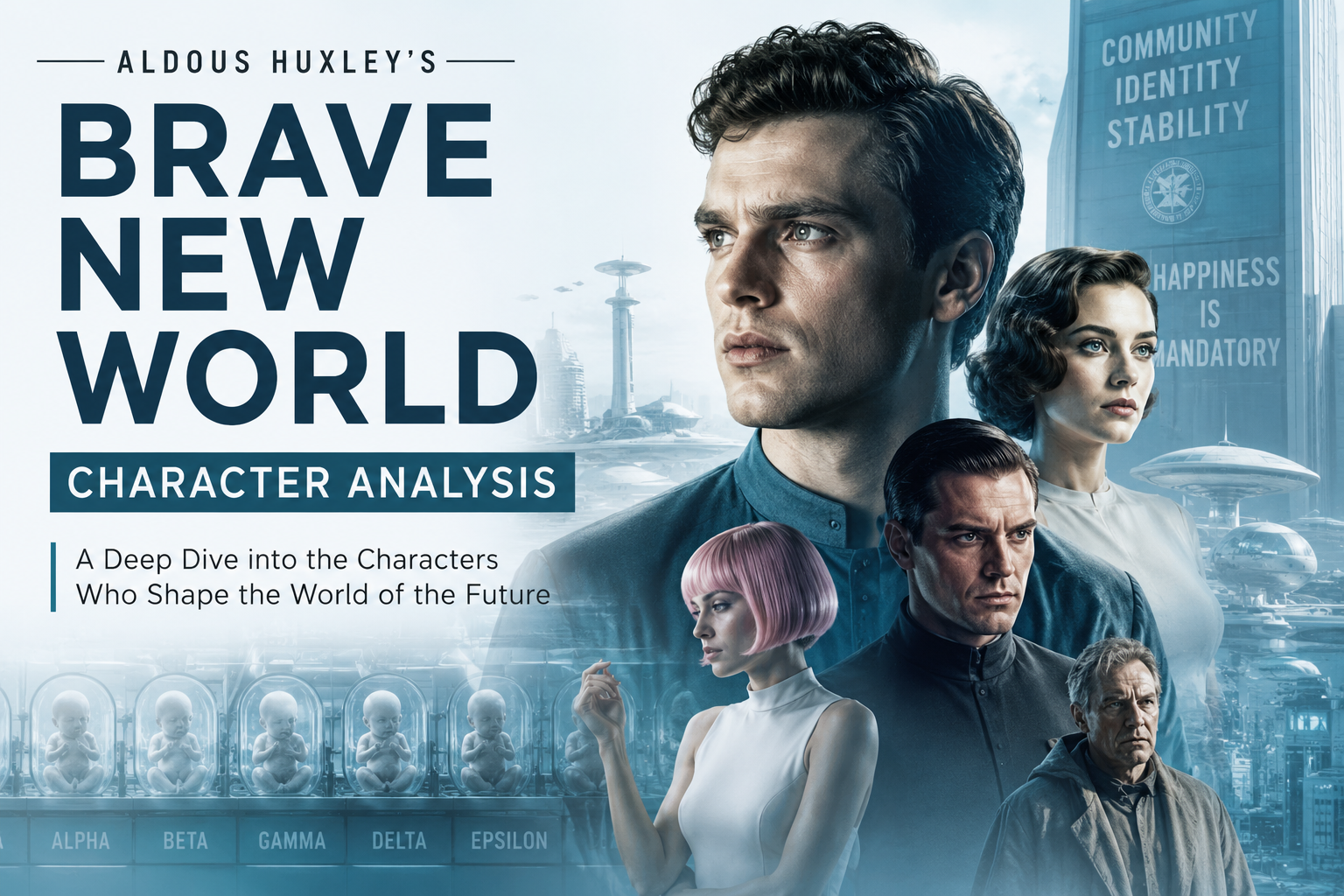
Brave New World Character Analysis: Key People, Motivations, and Conflicts

Brave New World

Brave New World character analysis helps readers see how Aldous Huxley builds a world where comfort costs people their freedom. Each major character shows a different response to control, pleasure, and pain.

This guide breaks down the main characters, their motives, and the conflicts that shape the novel.

In this Guide

  • Why character analysis matters in the novel
  • Bernard Marx and the need to feel special
  • John the Savage and the search for meaning
  • Lenina Crowne and social conditioning
  • Mustapha Mond and the price of stability
  • How to use this analysis in essays
  • FAQ
Brave New World

Brave New World character analysis: why characters matter

The novel uses characters to test the values of the World State.

In Brave New World, people are trained to avoid deep love, strong grief, and private thought. The main characters matter because they reveal cracks in that system.

A strong Brave New World character analysis should not only ask what each person does. It should ask why they act, what they fear, and what their choices show about the society around them.

If you want a simple method for studying motives and conflicts, see our guide on how to analyze characters in literature.

Brave New World character analysis of Bernard Marx

Bernard wants to be different, but he also wants the approval of the world he criticizes.

Bernard Marx is an Alpha, so he has high status. Yet he feels insecure because he does not fit the ideal Alpha image. People mock his body, and that shame shapes much of his behavior.

At first, Bernard seems brave because he questions soma, casual relationships, and public life. He wants private feeling in a society that fears privacy.

But Bernard’s rebellion is shaky. Once he gains fame through John, he enjoys attention. He becomes proud, rude, and eager to use the same social system that once hurt him.

His main conflict is between the desire for truth and the desire for status. This makes him a flawed but useful character for essays.

Bernard is similar to some uneasy figures in modern literature who dislike society but still crave its rewards. Like Winston in 1984, he feels trapped by a system that controls human desire. Unlike Winston, Bernard’s courage fades fast.

Brave New World character analysis of John the Savage

John is the novel’s clearest outsider, and his pain exposes the World State’s emptiness.

John grows up on the Savage Reservation, where he learns pain, shame, religion, and longing. He also reads Shakespeare, which gives him a rich language for love and suffering.

When John enters the World State, he hopes to find wonder. Instead, he finds a clean, safe world that avoids deep human feeling.

John’s main motive is to live with meaning. He wants love to be sacred, not casual. He wants suffering to count, not vanish through soma.

His conflict with the World State is moral and emotional. He cannot accept a life built on comfort without truth.

John’s tragedy comes from his extreme idealism. He sees clearly that this world is false, but he cannot find a healthy way to live outside it.

For background on Huxley and the novel’s place in literature, Britannica offers a helpful overview of Brave New World.

Brave New World character analysis of Lenina Crowne

Lenina is not a villain. She shows how deeply the World State shapes normal people.

Lenina Crowne follows the rules of her society. She takes soma, repeats slogans, and believes that desire should be simple.

Still, Lenina is not flat. She has real feelings for John, even if she cannot understand his values. Her attraction to him proves that human longing still exists beneath social training.

Her main conflict is between conditioning and emotion. She feels drawn to John, but she can only express love in the terms her culture has taught her.

This makes Lenina a strong character for quote-based analysis. Her words often sound shallow, but they reveal a world where language itself has been shaped by power.

She is very different from a character like Elizabeth Bennet in Pride and Prejudice, who studies people and questions social pressure. Lenina has been taught not to question much at all.

Brave New World character analysis of Mustapha Mond

Mustapha Mond understands the truth, yet he chooses control.

Mond is one of the World Controllers. He knows about science, history, art, and religion. He is not fooled by the system, and he helps run it.

This makes him one of the most important characters in the novel. He can explain why the World State removed old forms of freedom.

Mond’s main motive is stability. He believes art, faith, and deep love create conflict. To him, peace is worth the loss of truth.

His conflict with John is the heart of the novel’s argument. John says people need the right to suffer, choose, and believe. Mond says most people are happier without those burdens.

A useful Brave New World character analysis should treat Mond with care. He is not simple. He is frightening because his logic can sound calm and reasonable.

Helmholtz Watson and the need for real expression

Helmholtz shows what happens when talent outgrows a controlled culture.

He has success, charm, and intelligence. Unlike Bernard, he is not driven by social shame. His problem is deeper.

He feels that his words should matter more. As a writer, he wants language to carry real feeling, but his world gives him shallow topics and easy slogans.

Helmholtz connects with John because both care about powerful language. Yet Helmholtz is more balanced than John. He can face exile with a sense of purpose.

His conflict is between creative force and social limits. He proves that even high-status people can feel trapped by a world that fears depth.

Linda and the pain of not belonging

Linda shows the human cost of a society that cannot deal with age, grief, or shame.

She was raised in the World State, then left behind on the Reservation. She cannot fully belong to either place.

On the Reservation, people judge her behavior. In the World State, people reject her body because she looks old and worn.

Her motive is simple. She wants comfort and escape. Soma gives her that escape, but it also removes her from real life.

Linda’s story helps students see that the World State’s promise of happiness is cruel. It only works for people who stay useful, young, and controlled.

Major character conflicts in the novel

The strongest conflicts in the novel are not only between people. They are between values.

John vs. Mond is the key debate. John defends truth and suffering. Mond defends peace and pleasure.

Bernard vs. society shows the weak side of rebellion. Bernard wants freedom, but he also wants fame.

Lenina vs. John shows two different ideas of love. Lenina sees desire as normal and easy. John sees love as sacred and full of duty.

Helmholtz vs. the World State shows the need for art. He wants language that can hold real emotion.

How to Use This Brave New World character analysis in essays

A good essay should connect character choices to the novel’s larger ideas.

Start with a clear claim. For example: Bernard Marx is not a true rebel because his desire for status is stronger than his desire for freedom.

Then use short quotes and explain them. Do not drop a quote and move on. Show how the words reveal motive, conflict, or change.

For more support, try our character analysis strategy guide before you draft your response.

You can also use our literature study resources to plan discussion posts, essays, and quote notes.

Suggested books for deeper study

These books can help you compare Huxley’s ideas with other works about control and freedom.

  • Brave New World by Aldous Huxley
  • 1984 by George Orwell
  • Fahrenheit 451 by Ray Bradbury

For more on Huxley’s life and ideas, see Britannica’s page on Aldous Huxley.

FAQ: Brave New World character analysis

Who is the most important character in Brave New World?

John is often the most important because he directly challenges the World State. His clash with Mond reveals the novel’s main debate.

Is Bernard Marx a hero?

Bernard is not a clear hero. He questions society, but he also enjoys power when it benefits him.

What does Lenina Crowne represent?

Lenina represents social conditioning. She has real feelings, but she can only express them through the values she has been taught.

Why is Mustapha Mond important?

Mond explains the World State’s logic. He shows why comfort can become dangerous when it replaces freedom.

What is the best focus for a Brave New World character analysis essay?

Focus on one character’s main conflict. Then connect that conflict to a larger theme, such as freedom, stability, or truth.

Key Takeaway

A strong Brave New World character analysis shows that each major character tests the cost of comfort. Huxley’s novel asks whether a painless life is worth it if people must give up truth, art, and real love.

error

Enjoy this article? Please spread the word :)

Follow by Email
BLUESKY
fb-share-icon
Reddit
LinkedIn
Share
RSS