Flash Memoir Prompt: Last Time You Were in a Place You Loved

flash memoir place

A warm, specific writing invitation for remembering the last time you stood in a place you loved before you understood it would become part of your past.

You may remember the room before you remember the goodbye. The way the afternoon light hit the floor. The chipped mug near the sink. The smell of dust, laundry soap, rain, or old wood. At the time, it may have felt ordinary. You were just leaving for the day, closing a door, walking across grass, turning off a lamp.

Only later did you realize it was the last time.

This flash memoir prompt last time place loved before asks you to return to that strange kind of memory: the goodbye you did not know you were having. It is tender because the scene carries two versions of you at once. One version is inside the moment, unaware. The other is looking back, able to see what was already ending.

flash memoir place

The Prompt

Write about the last time you were in a place you loved, before you knew you were leaving it for good.

This prompt can unlock a powerful memory because it does not begin with a dramatic farewell. It begins with ordinary details. A porch step. A classroom desk. A childhood bedroom. A library table. A backyard gate that squeaked every time you opened it.

The place does not need to be beautiful to matter. It only needs to have held part of your life. When you write from this flash memoir prompt last time place loved before, you are not trying to explain everything that happened there. You are choosing one final visit and letting the details carry the feeling.

Why This Memory Matters

Places can hold memory in a way people sometimes cannot. They keep the shape of old routines. They remind us who we were when we still belonged there.

The place in your story might be your grandmother’s kitchen, where the radio was always too loud. It might be an apartment you were ready to leave until you actually had to. It might be a school hallway, a church basement, a summer cabin, or the corner store that closed without warning.

What makes this memory rich is the gap between what you knew then and what you know now. In the moment, you may have been distracted. You may have been annoyed, rushed, hungry, or thinking about something small. Looking back, those small things become charged with meaning.

That is often where memoir comes alive. The lesson does not have to be stated in a grand way. A single object can do quiet work. If you want to think more about how objects carry emotional meaning, you might enjoy this guide on how to find symbolism in a story. The same skill can help you notice symbols in your own life.

A place you loved can also reveal change. Maybe you left because of choice. Maybe someone else made the choice for you. Maybe the place changed first. In any case, the story is less about real estate and more about attachment. It asks: What did this place give you, and what did you lose when you could no longer return?

How to Approach This Prompt

Start with one physical detail. Do not begin by explaining why the place mattered. Begin with what your hand touched, what your eye noticed, or what sound filled the room.

For example, write about the dent in the screen door, the cold tile under your feet, the poster peeling near the ceiling, or the smell of pencil shavings in a classroom. Let the place become real before you name the emotion.

Next, narrow the memory to one scene. Stay in the last visit. Resist the urge to summarize every year you spent there. You can mention the larger story later, but the flash memoir will feel stronger if the reader can stand beside you in that final moment.

You might use a sentence like, “I did not know this was the last time I would…” Then complete it with a simple action. Sit on that porch. Open that locker. Sleep in that room. Walk down that driveway.

Write what you noticed before you write what it meant. This helps the memory feel honest instead of forced. If you are the kind of writer who likes to mark up details before drafting, the habits in how to annotate literature can also help you study your own memories. Circle the images that seem to glow. Those may be the ones your piece needs.

For this flash memoir prompt last time place loved before, try writing for ten minutes without stopping. If you get stuck, return to the room, the ground, the air, or the door. The body often remembers what the mind has filed away.

A Quick Example

I did not know it was the last time I would sit on the back steps of my father’s house. I was seventeen, eating cereal from a plastic bowl because all the real bowls were packed or missing. The yard looked tired. The dog had dug a hole under the fence again, and someone had left a blue tarp folded near the garage. I remember being annoyed that the milk was warm. I remember slapping a mosquito on my ankle. Nothing felt important enough to save. A week later, the house was sold, and my father moved two states away. Now, when I think of that place, I do not picture my bedroom or the living room. I picture those steps, the bowl balanced on my knee, and the morning acting like it would happen again.

Try It Yourself

Set a timer and write the scene as if you are walking back into it. Do not worry about making it polished. Your first job is to notice.

Where were you standing? What was close to your body? What did you hear? What were you thinking about instead of the goodbye?

If the memory feels sad, let it be sad without pressing too hard. If it feels funny or strange, trust that too. Sometimes the truest memories arrive crooked. You might write about losing a place and still remember a ridiculous argument, a bad sandwich, or the way the floor creaked in one exact spot.

This flash memoir prompt last time place loved before works best when you let the ordinary moment stay ordinary for a while. The meaning can enter slowly. It can arrive in the final sentence, or it can stay under the surface.

Want More Flash Memoir Prompts?

If this prompt opened a memory you want to keep exploring, you can build a steady writing habit one small scene at a time. Explore all 365 prompts in The Memory Trigger: 365 Flash Memoir Writing Prompts.
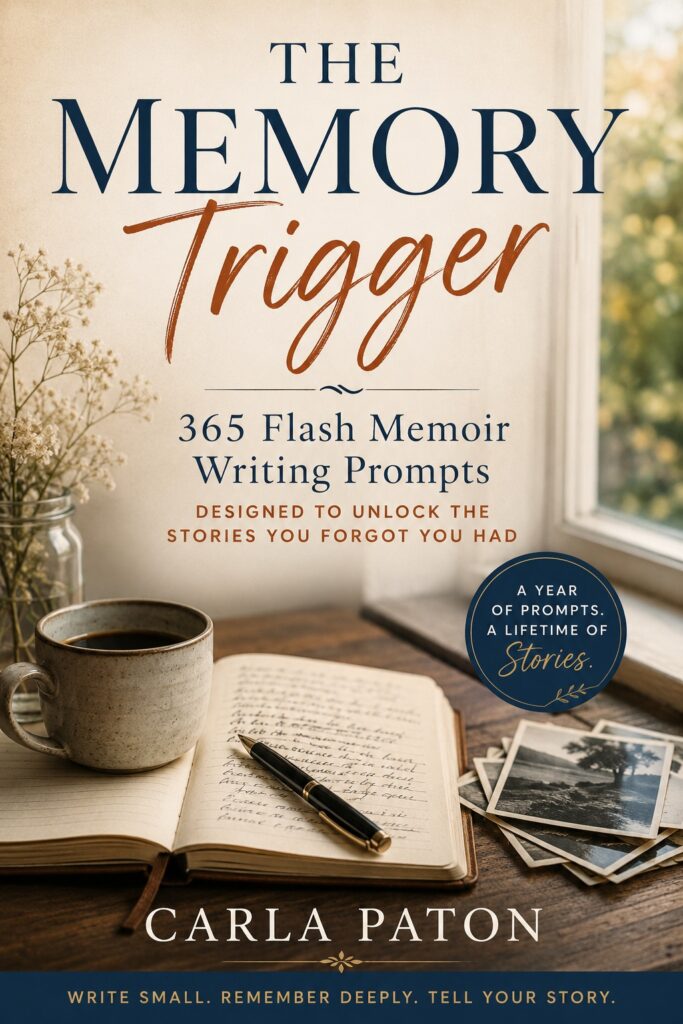
The Memory Trigger

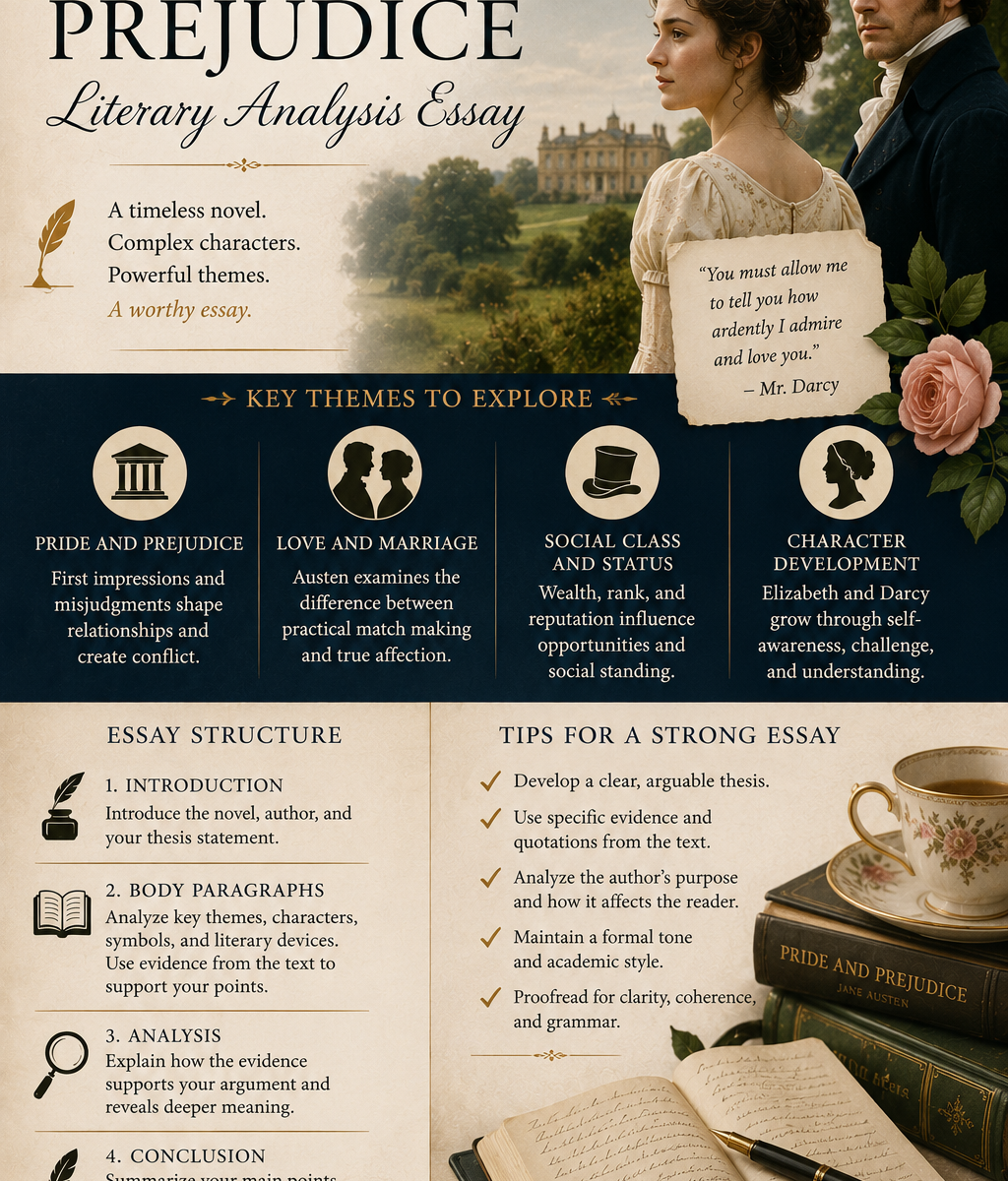
How to Write a Pride and Prejudice Literary Analysis Essay

Pride And Prejudice essay

A Pride and Prejudice literary analysis essay asks you to look past the romance and explain how Jane Austen builds meaning. This guide will help you choose a strong topic, write a clear thesis, and support your ideas with useful evidence.

In This Guide

  • What your essay should do
  • How to choose a focused topic
  • How to turn a topic into a question
  • Thesis statement examples
  • Evidence to use from the novel
  • Essay structure tips
  • Helpful books and links
  • FAQ
Pride And Prejudice essay

What a Pride and Prejudice Literary Analysis Essay Should Do

Your essay should make an argument about how the novel works.

Your Pride and Prejudice literary analysis essay should not retell the plot. And your reader already knows that Elizabeth Bennet and Mr. Darcy misunderstand each other before they change.

Instead, focus on how Austen shapes that change. You might study dialogue, social class, irony, marriage, pride, prejudice, or character growth.

A strong essay answers a question like this: how does Austen use Elizabeth’s changing view of Darcy to explore judgment?

If you need help with the larger essay process, start with this guide on how to write a literary analysis essay.

Step 1: Choose a Focused Pride and Prejudice Literary Analysis Essay Topic

A narrow topic leads to a stronger paper.

A strong Pride and Prejudice literary analysis essay topic should focus on one main idea. Do not try to cover the whole novel in one essay.

For example, a topic like marriage is too broad. A better topic is Austen’s criticism of marriage as a financial choice.

You could also focus on Elizabeth’s wit. That topic works well because her language often shows both intelligence and bias.

Here are focused topic ideas:

  • How Elizabeth’s first impressions shape the novel’s conflict
  • How Darcy’s letter changes the reader’s view of him
  • How Austen uses Mr. Collins to mock social climbing
  • How Charlotte Lucas shows the limits placed on women
  • How irony reveals the flaws of polite society

Step 2: Turn Your Topic into a Literary Question

A good question helps you move from summary to analysis.

Once you choose a topic, turn it into a question. This step gives your essay a clear job.

Topic: Darcy’s pride.

Question: How does Austen show that Darcy’s pride comes from both class privilege and personal fear?

Topic: Charlotte’s marriage.

Question: How does Charlotte’s choice reveal the pressure women face in a society built around property?

This method also works for other novels. In The Great Gatsby, a student might ask how wealth shapes identity. In Great Expectations, a student might ask how shame changes Pip’s choices.

Step 3: Write a Thesis for Your Pride and Prejudice Literary Analysis Essay

Your thesis is the main claim your essay will prove.

Your thesis should make your Pride and Prejudice literary analysis essay specific. It should name the literary element you plan to study and explain why it matters.

A weak thesis says: Elizabeth and Darcy change in the novel.

A stronger thesis says: Austen uses Elizabeth’s mistaken judgment of Darcy to show that pride and prejudice can hide moral growth until a person learns to read others with care.

That thesis works because it makes an argument. It also gives the essay a clear path.

Thesis Statement Examples

Use these examples as models, not as final answers to copy.

  • On Elizabeth: Austen presents Elizabeth Bennet’s wit as both a strength and a flaw, since it helps her see social hypocrisy but also makes her misread Darcy.
  • On Darcy: Darcy’s change is not a simple romantic shift; Austen uses his growth to question the pride that comes with rank.
  • On marriage: Through Charlotte Lucas and Lydia Bennet, Austen shows that marriage in the novel is shaped by fear as much as love.
  • On irony: Austen’s irony exposes the gap between polite manners and true moral character.

If thesis writing feels hard, The Literary Analysis Essay Toolkit can help you build stronger claims, topic sentences, and evidence notes faster.

Evidence to Use in a Pride and Prejudice Literary Analysis Essay

The best evidence comes from moments where a character’s words or choices reveal more than they mean to reveal.

In a Pride and Prejudice literary analysis essay, evidence should support your claim, not replace it. Quote short lines when possible, then explain how the language works.

Useful moments include Darcy’s first insult at the ball, Elizabeth’s reading of Darcy’s letter, Mr. Collins’s proposal, Charlotte’s acceptance of Mr. Collins, and Lady Catherine’s visit to Elizabeth.

Darcy’s first insult gives you evidence for pride and class. Elizabeth’s reaction gives you evidence for wounded pride and quick judgment.

Darcy’s letter is a major turning point. It forces Elizabeth to question her own view of Wickham and Darcy.

Charlotte’s marriage to Mr. Collins helps you discuss gender and security. She does not act like a romantic heroine, but Austen does not treat her choice as foolish.

You can read the novel through a free public-domain edition at Project Gutenberg. For author background, see Britannica’s Jane Austen overview.

How to Structure the Essay

A clear structure helps your reader follow your argument.

Start with an introduction that names the author, the novel, and your main claim. Keep the plot summary brief.

Each body paragraph should focus on one part of your thesis. Begin with a topic sentence that makes a claim, not a fact.

For example, do not write: Darcy gives Elizabeth a letter.

Write: Darcy’s letter changes the novel because it forces Elizabeth to admit that her judgment has been shaped by pride.

After each quote, explain the words. Do not expect the quote to prove the point by itself.

Your conclusion should not repeat the thesis word for word. It should show why your argument matters for the whole novel.

For a deeper breakdown of introductions, body paragraphs, and conclusions, see our literary analysis essay guide.

Sample Mini Outline

A simple outline can keep your draft focused.

Thesis: Austen uses Elizabeth’s changing view of Darcy to show that first impressions can feel certain while still being deeply flawed.

  • Introduction: Briefly introduce the novel and present the thesis.
  • Body Paragraph 1: Show how Elizabeth trusts her first judgment of Darcy.
  • Body Paragraph 2: Analyze how Wickham’s charm strengthens her bias.
  • Body Paragraph 3: Explain how Darcy’s letter forces her to revise her view.
  • Conclusion: Connect Elizabeth’s growth to Austen’s larger message about judgment.

Common Mistakes to Avoid

Small choices can weaken a strong idea.

Avoid plot summary. A short bit of context is fine, but your own analysis should take up most of the paragraph.

Avoid vague claims like Austen shows society is bad. Name the exact social rule or behavior you mean.

Avoid dumping long quotes into the essay. Choose shorter evidence and explain it in detail.

Avoid writing as if Austen is only telling a love story. The romance matters, but it also helps her study class, money, and self-knowledge.

Helpful Books for Essay Prep

These books can deepen your reading before you write.

  • Pride and Prejudice by Jane Austen
  • Jane Austen: A Life by Claire Tomalin

If your teacher allows outside sources, use them to support your thinking. Do not let a critic’s view replace your own claim.

FAQ: Pride and Prejudice Literary Analysis Essay

What is the best Pride and Prejudice literary analysis essay topic?

The best Pride and Prejudice literary analysis essay topic is one that is narrow and arguable. Elizabeth’s misjudgment of Darcy, Charlotte’s marriage, or Austen’s irony can all work well.

Can I write about love in Pride and Prejudice?

Yes, but make the topic more specific. Instead of love in the novel, write about how Austen connects love with respect, self-knowledge, or social pressure.

How long should my essay be?

Follow your teacher’s rules first. Many high school essays are 3 to 5 pages, while college essays may be longer.

Do I need quotes from the novel?

Yes. Use short quotes or clear references to key scenes, then explain how they support your thesis.

Key Takeaway

A Pride and Prejudice literary analysis essay works best when it makes a focused claim about how Austen builds meaning. Choose a narrow topic, write a clear thesis, and let each paragraph prove one part of your argument.

Ekphrastic Poetry Prompt: The Empty Bus Stop

ekphrastic poetry prompt bus stop

Sometimes the best poetry begins with an ordinary scene. This ekphrastic poetry prompt invites you to look closely at something easy to overlook: an empty bus stop on a quiet afternoon.

A metal bench waits beside the road. A few leaves collect near the curb. A faded transit map hangs behind scratched glass. Nothing dramatic appears to be happening. Yet the image feels full of possibility.

That is what makes this ekphrastic poetry prompt interesting. Every ordinary place contains stories that have not yet been told.

If you are new to writing from visual inspiration, you may find this guide helpful: https://rapidreadspress.com/how-to-analyze-poetry-step-by-step/

ekphrastic poetry prompt bus stop

Why This Ekphrastic Poetry Prompt Works

Many writers assume they need a spectacular image to inspire a poem. In reality, everyday scenes often create richer opportunities.

An empty bus stop raises questions.

Who was waiting here?

Who missed the bus?

And who arrived?

Who never showed up?

The image offers no answers. Instead, it gives the writer room to imagine.

A strong ekphrastic poetry prompt does not tell you what to think. It invites you to discover meaning for yourself.

Looking Closely at This Ekphrastic Poetry Prompt

Before you begin writing, spend a few minutes observing the details.

Notice the bench.

Notice the leaves.

And notice the road disappearing into the distance.

Ask yourself which object feels most important.

Perhaps the bench reminds you of loneliness.

Perhaps the route map represents choices.

Or perhaps the empty street suggests freedom.

Different writers will see different stories in the same image.

That diversity of interpretation lies at the heart of ekphrastic poetry.

Writing Ideas for This Ekphrastic Poetry Prompt

Try writing from one of these perspectives:

  • Someone waiting for news that never arrives
  • A student traveling home after a difficult day
  • An elderly person remembering a familiar route
  • The bus stop itself, watching people come and go
  • A traveler about to leave town forever

Focus on emotions rather than plot. Let the image guide your poem.

You may also want to experiment with symbolism, imagery, and personification. This overview of literary devices in poetry can help you develop those techniques: https://rapidreadspress.com/literary-devices-in-poetry/

Questions to Explore in This Ekphrastic Poetry Prompt

Consider one or more of the following questions:

  • What kind of person usually sits on this bench?
  • What destination matters most in this scene?
  • What memory lingers here?
  • What decision is about to be made?
  • What remains after everyone leaves?

Allow your answers to emerge through images and details rather than direct explanation.

A Challenge for This Ekphrastic Poetry Prompt

Write a poem that never mentions the bus stop directly.

Instead, reveal the setting through small observations: the schedule behind glass, the leaves at the curb, the approaching engine, the empty bench.

This approach encourages readers to participate in constructing the scene.

For additional inspiration and resources about poetry, visit the Academy of American Poets: https://poets.org/

The most memorable poems often begin with ordinary moments. This ekphrastic poetry prompt asks you to slow down, pay attention, and discover the stories hidden inside a place most people pass without noticing.

Themes in Lord of the Flies: A Student-Friendly Guide

themes in Lord of the Flies

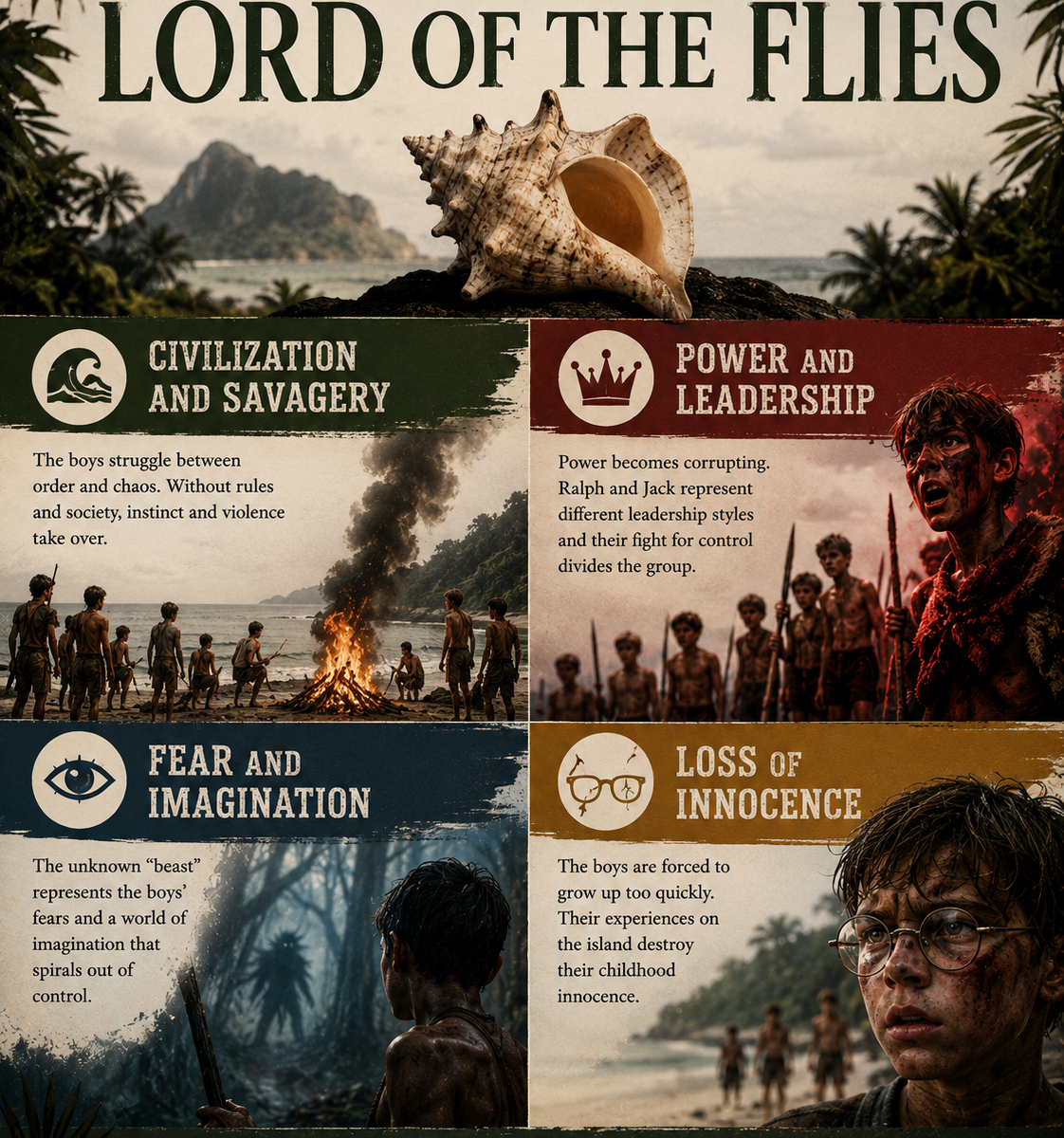
William Golding’s novel may look like a survival story, but it is really about human nature under pressure. This guide explains the major themes in Lord of the Flies so students can read the novel with more confidence.

You will see how power, fear, violence, and social order shape the boys’ choices on the island.

In this Guide

  • Why the themes matter
  • Civilization and savagery
  • Power and leadership
  • Fear and imagination
  • Loss of innocence
  • Symbols, essay ideas, and FAQs
themes in Lord of the Flies

Why the Themes in Lord of the Flies Matter

The novel asks a sharp question: what happens when rules disappear?

The main themes in Lord of the Flies help readers see that the island is more than a setting. It becomes a test of society, morality, and fear.

At first, the boys try to copy the adult world. They hold meetings, choose a leader, and use the conch to give each person a turn to speak. Yet that order starts to break down when fear grows and Jack gains power.

This is why the book often appears in high school and AP Literature classes. It gives students a clear way to study conflict, symbols, and character change.

Major Themes in Lord of the Flies: Civilization vs. Savagery

This is the central conflict of the novel.

One of the most important themes in Lord of the Flies is the struggle between order and violence. Ralph stands for rules, rescue, and shared responsibility. Jack stands for force, hunting, and control.

The conch shows civilization at first. When the boys respect it, they listen to each other. When they ignore it, the group loses its moral center.

Golding does not suggest that savagery comes from the island itself. The boys bring it with them. This makes the novel darker because the danger is not only outside them. It is inside them too.

A similar idea appears in Shakespeare’s Macbeth. Macbeth does not begin as a monster, but ambition and fear pull him toward violence. In both works, pressure reveals what a person may become.

The Theme of Power and Leadership

The boys’ leaders show two very different ways to gain control.

Ralph becomes leader because other boys trust him. He wants shelters, a signal fire, and a plan for rescue. His power depends on cooperation.

Jack uses fear, excitement, and punishment. He offers meat and the thrill of the hunt. His leadership feels easier because it gives the boys quick rewards.

This theme matters because Golding shows how fragile fair leadership can be. A group may choose safety and rules, but fear can make a harsh leader seem strong.

When you write about the themes in Lord of the Flies, it helps to compare Ralph and Jack. Their conflict is not just personal. It shows two models of society.

Fear, Imagination, and the Beast

The beast is powerful because the boys believe in it.

Fear is one of the most useful themes in Lord of the Flies for essays because it affects nearly every major event. The littluns fear a beast. The older boys try to explain it, but they cannot fully control the panic.

The beast also becomes a tool. Jack uses fear of the beast to gain loyalty. If the boys feel unsafe, they look to him for protection.

Simon understands the truth before the others do. The beast is not a real monster hiding in the jungle. It is the darkness within people.

This idea connects to Arthur Miller’s The Crucible. In that play, fear spreads through a community and makes people act against reason. Golding shows a similar pattern on the island.

Loss of Innocence in Lord of the Flies

The island changes the boys, but it also reveals them.

At the start, the boys act like schoolchildren on an adventure. They swim, explore, and treat the island like a game. That innocent mood does not last.

The deaths of Simon and Piggy mark a painful shift. After these moments, the reader can no longer see the island as a simple place of play.

Ralph’s final tears matter because he now understands what people can do. He cries for Piggy, for Simon, and for the end of his own innocence.

Among the major themes in Lord of the Flies, this one often feels the most personal. Students can trace how childhood trust gives way to guilt and grief.

The Theme of Human Nature

Golding presents a dark view of what people may become without moral limits.

The novel does not claim that every person is evil all the time. Ralph, Piggy, and Simon all show care or reason. Yet the book suggests that goodness needs support from rules, empathy, and courage.

Simon is the clearest moral figure. He helps the littluns, seeks truth, and sees beyond the group’s fear. His death shows how a crowd can destroy a person who stands apart.

This is one reason the themes in Lord of the Flies still matter. The novel asks readers to think about school groups, politics, teams, and any place where people follow a crowd.

Symbols That Support the Themes in Lord of the Flies

Golding uses simple objects to carry big ideas.

The conch stands for order and shared speech. When it breaks, the boys have lost more than a shell. They have lost the system that kept them human.

Piggy’s glasses stand for reason and practical knowledge. They help start the fire, which means they also connect to rescue and hope. When the glasses are stolen, reason is pushed aside.

The signal fire stands for connection to the outside world. When the boys care for it, they still want rescue. When they forget it, they drift further from civilized life.

The Lord of the Flies, the pig’s head on a stick, stands for corruption and inner evil. It gives shape to the fear that has haunted the group.

For a reliable background on the author and novel, students can visit Britannica’s page on William Golding.

How to Write About Themes in Lord of the Flies

A strong theme essay should make a claim, not just name a topic.

Do not write only that the novel is about power. Instead, explain what Golding says about power. For example: Golding shows that fear can make violent leadership seem attractive.

Then support your claim with scenes. You might use the election, Jack’s tribe, the killing of Simon, or the breaking of the conch.

If you need help shaping a thesis and using evidence, see our guide on how to write a literary analysis essay.

You can also build a paragraph around a symbol. For example, Piggy’s glasses show how reason can be useful, but also easy to steal when violence takes over.

For extra practice, you can use our student literature study resources to plan theme notes and essay ideas.

Helpful Books to Read Next

These books can help you understand the novel and its larger literary context.

  • Lord of the Flies by William Golding
  • How to Read Literature Like a Professor by Thomas C. Foster

For more context on major literary terms, the Poetry Foundation glossary is a helpful reference.

FAQ: Themes in Lord of the Flies

What is the main theme of Lord of the Flies?

The main theme is the conflict between civilization and savagery. Golding shows how quickly order can break down when fear and violence take control.

What does the beast symbolize?

The beast symbolizes the darkness within human beings. It is not just a creature the boys fear. It reflects their own capacity for violence.

How does Golding show loss of innocence?

Golding shows it through the boys’ shift from play to cruelty. Simon’s and Piggy’s deaths make the loss clear.

Why is the conch important?

The conch stands for rules, speech, and democracy. When it is destroyed, civilized order has fully collapsed.

How can I write a thesis about this novel?

Choose one theme, make a clear claim about Golding’s message, and connect it to key scenes. For more help, use this literary analysis essay guide.

Key Takeaway

The major themes in Lord of the Flies show that civilization is fragile. Golding’s novel warns that fear, power, and group pressure can reveal the darkest parts of human nature.

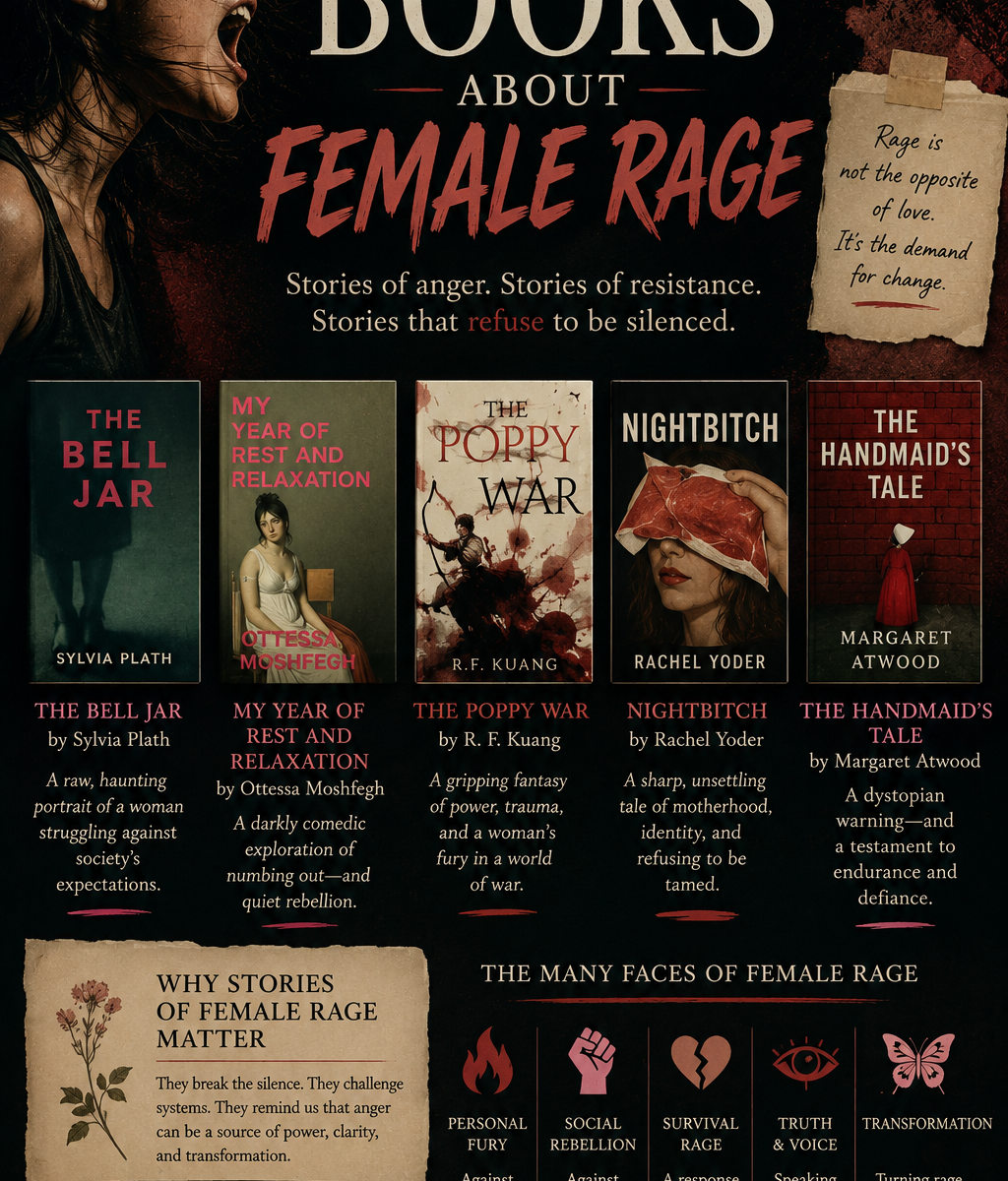
Best Books About Female Rage: Powerful Stories Students Should Read

Best Books about Female Rage

The best books about female rage show what happens when women are ignored, trapped, judged, or pushed too far. These stories do more than show anger. They reveal pain, power, and the cost of silence.

For students, these books can make classic themes feel urgent and real. They also help readers see how literature turns private anger into public meaning.

In this Guide

  • Why female rage matters in literature
  • Best books about female rage for students
  • Classic works that shaped the theme
  • Modern books with fierce female voices
  • Symbols and themes to watch for
  • Books to consider buying
  • FAQs
Best Books about Female Rage

Why the Best Books About Female Rage Matter

Female rage in literature is rarely just anger. It often grows from control, fear, shame, or loss.

The best books about female rage ask a hard question: what happens when a woman is denied a voice? Sometimes she fights back. Sometimes she breaks down. Or sometimes she changes the world around her.

These stories matter because they challenge old ideas about how women “should” act. A calm woman may be praised, but an angry woman is often called dangerous. Literature shows why that label is not always fair.

Female rage can also shape tone and mood. If you want a clear student-friendly guide to that difference, read this explanation of tone vs. mood in literature.

Best Books About Female Rage for Students

These works are useful for high school, AP Literature, and college readers because they connect emotion with theme.

The best books about female rage often pair personal pain with social pressure. That makes them strong choices for essays about gender, power, identity, and justice.

The Yellow Wallpaper by Charlotte Perkins Gilman

This short story is one of the clearest works about female anger under control. The narrator is trapped in a room by her husband and doctor, who claim they know what is best for her.

Her rage does not start as a loud protest. It builds through fear and isolation. The wallpaper becomes a symbol of the life she cannot escape.

This story works well for essays because it shows how silence can become madness. It also shows how medical power can be used against women.

Medea by Euripides

Medea is one of the oldest and most famous stories of female rage. She is betrayed by Jason, and her anger turns into revenge.

Readers may not agree with her choices, but the play forces us to face her pain. She is not a simple villain. She is a woman who has lost status, love, and safety.

You can read more about the myth and its long history through Britannica’s overview of Medea.

Jane Eyre by Charlotte Brontë

Jane’s rage is quieter than Medea’s, but it is just as important. She refuses to accept cruelty, even when she has little power.

Her anger helps her protect her self-worth. She says no when society expects her to obey.

This makes Jane Eyre a strong pick for readers who want a novel about inner strength. Jane’s rage is tied to dignity.

Classic Best Books About Female Rage

Classic literature often hides female rage under manners, silence, or tragedy.

Some of the best books about female rage are classics because they show how long women have had to fight for control over their lives.

The Awakening by Kate Chopin

Edna Pontellier feels trapped by marriage and motherhood. Her anger is not always direct, but it shapes her choices.

The sea becomes a key symbol in the novel. It suggests freedom, danger, and escape.

The Awakening is useful for essays about identity. It also raises hard questions about the cost of freedom.

Wide Sargasso Sea by Jean Rhys

This novel gives a voice to Bertha Mason from Jane Eyre. In Rhys’s version, Bertha is Antoinette, a woman shaped by racism, marriage, and loss.

Her rage comes from being renamed and controlled. The novel asks readers to rethink who gets called “mad.”

For students, this book is a great example of a literary response. It talks back to a classic text.

Beloved by Toni Morrison

Beloved shows rage born from slavery, grief, and memory. Sethe’s anger cannot be separated from the violence done to her body and family.

Morrison does not make rage simple. She shows how trauma lives in a house, a family, and a community.

This novel is often taught in college because it is rich with symbols. The ghost, the house, and the scars all carry deep meaning.

Modern Best Books About Female Rage

Modern writers often make female rage sharper, stranger, and more direct.

The best books about female rage today may use horror, satire, or myth to show anger in bold ways. These books can feel intense, but they speak to real pressures.

The Vegetarian by Han Kang

In The Vegetarian, Yeong-hye stops eating meat after a disturbing dream. Her choice seems small at first, but it becomes a deep refusal.

Her body becomes the place where others try to control her. And her silence feels like protest.

This novel is useful for readers who want to study power inside a family. It also shows how society can punish women who reject their assigned role.

Nightbitch by Rachel Yoder

Nightbitch mixes motherhood, rage, and dark humor. The main character believes she may be turning into a dog.

That strange idea becomes a symbol for anger that has no safe place to go. The novel uses the body to show frustration and hunger for freedom.

This book is best for older students or college readers because of its mature themes.

Circe by Madeline Miller

Circe retells Greek myth from the view of a woman often treated as a side character. Circe’s rage comes from exile, betrayal, and years of being dismissed.

Her power grows as she learns to trust herself. The novel turns anger into self-knowledge.

This makes Circe one of the more accessible modern choices for students who enjoy myth.

Symbols and Themes in the Best Books About Female Rage

Female rage often appears through strong images before it appears in direct speech.

In the best books about female rage, symbols help readers see what characters cannot say out loud. A room, a sea, a body, or a ghost can hold years of pain.

Rooms and houses

Rooms often show limits. In The Yellow Wallpaper, the room becomes a prison. In Beloved, the house holds the past like a wound.

These spaces show how private life can become a place of control.

Bodies

Many books use the female body as a site of conflict. In The Vegetarian, Yeong-hye’s body becomes a protest. In Nightbitch, the body becomes wild and strange.

This theme helps readers see how control over the body can connect to control over the self.

Fire and water

Fire often suggests revenge or destruction. Water often suggests freedom or escape.

In The Awakening, the sea calls to Edna with beauty and danger. In many rage stories, nature reflects a woman’s inner life.

To write about these symbols well, pay close attention to tone. The mood around a symbol can change its meaning. For a quick review, use Rapid Reads Press’s guide to tone and mood.

Recommended Books to Buy or Borrow

If you want to start with the best books about female rage, these titles are strong choices for study or personal reading.

  • The Bell Jar by Sylvia Plath
  • The Vegetarian by Han Kang
  • Circe by Madeline Miller

The Bell Jar is especially useful for students who want to study mental health, gender roles, and voice. You can learn more about Sylvia Plath through the Poetry Foundation’s Sylvia Plath profile.

How to Write About Female Rage in Literature

A strong essay about female rage should avoid one simple claim: “She is angry.” That is only the start.

Ask what causes the anger. Look at who has power. Notice what the character is allowed to say and what she must hide.

Good analysis also looks at form. A play like Medea uses speeches and public conflict. A story like The Yellow Wallpaper uses a private journal voice.

When you write, connect rage to a larger theme. Female rage may reveal injustice, loss, freedom, or identity.

FAQ: Best Books About Female Rage

What are the best books about female rage for AP Literature?

Strong choices include Medea, The Awakening, Beloved, and Jane Eyre. Each one offers rich themes and strong character analysis.

Is female rage always shown as violent?

No. Female rage can be quiet, hidden, or symbolic. It may appear through silence, refusal, or escape.

Why do so many books connect female rage with madness?

Many societies have labeled angry women as “mad” to dismiss them. Literature often questions that label and asks who benefits from it.

What symbols should I look for in books about female rage?

Look for rooms, locked doors, mirrors, bodies, fire, and water. These symbols often show pressure or a desire for freedom.

Are modern books about female rage good for students?

Yes, but some are better for older readers. Books like Circe are accessible, while Nightbitch fits college-level study better.

Key Takeaway

The best books about female rage show anger as more than an emotion. They show it as a response to control, silence, and harm.

These stories help readers understand why rage can be frightening, but also truthful. In literature, female rage often becomes a path to voice, power, and self-knowledge.

What Is a Motif in Literature?

Motif in Literature
Motif in Literature

What Is a Motif in Literature?

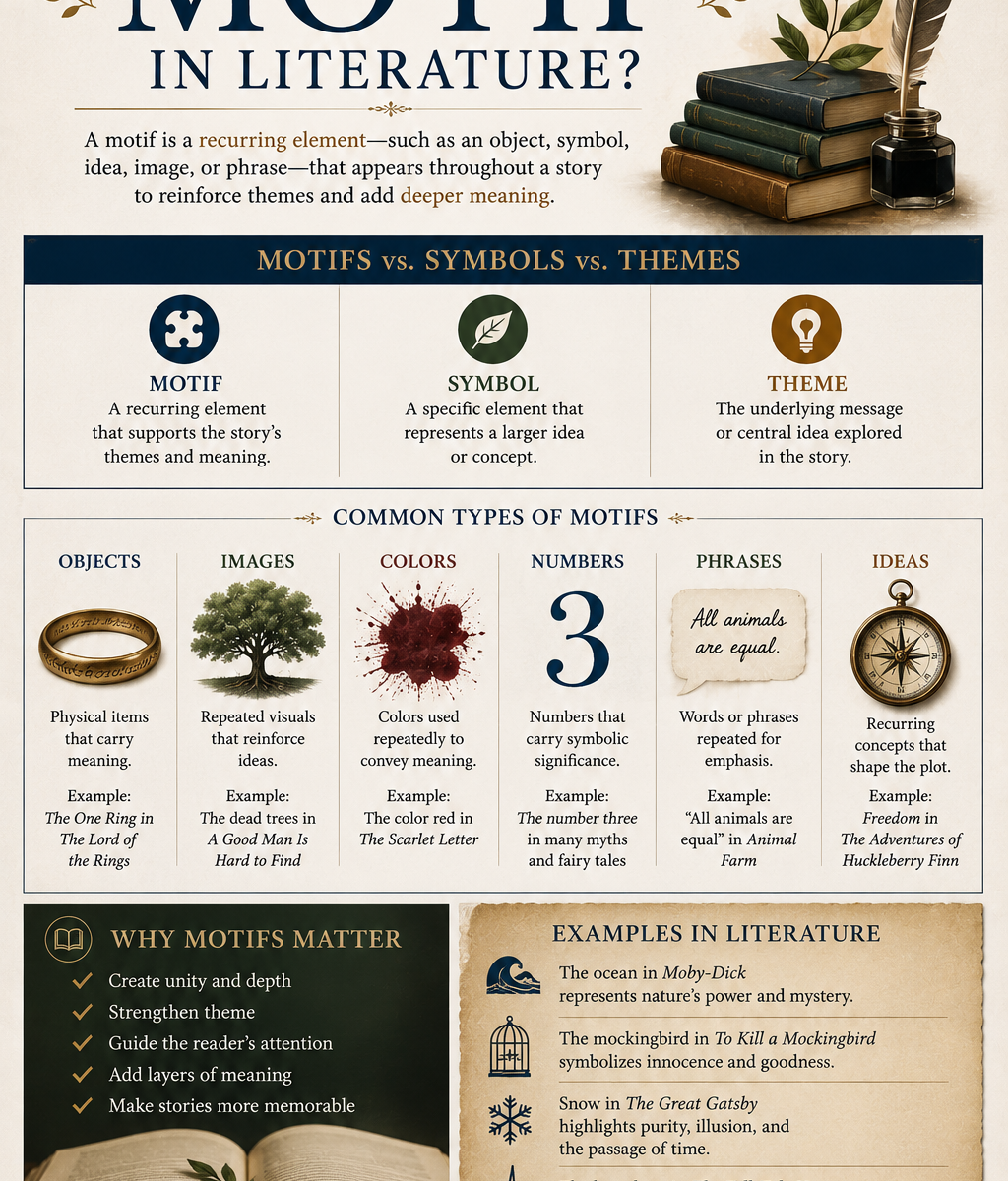
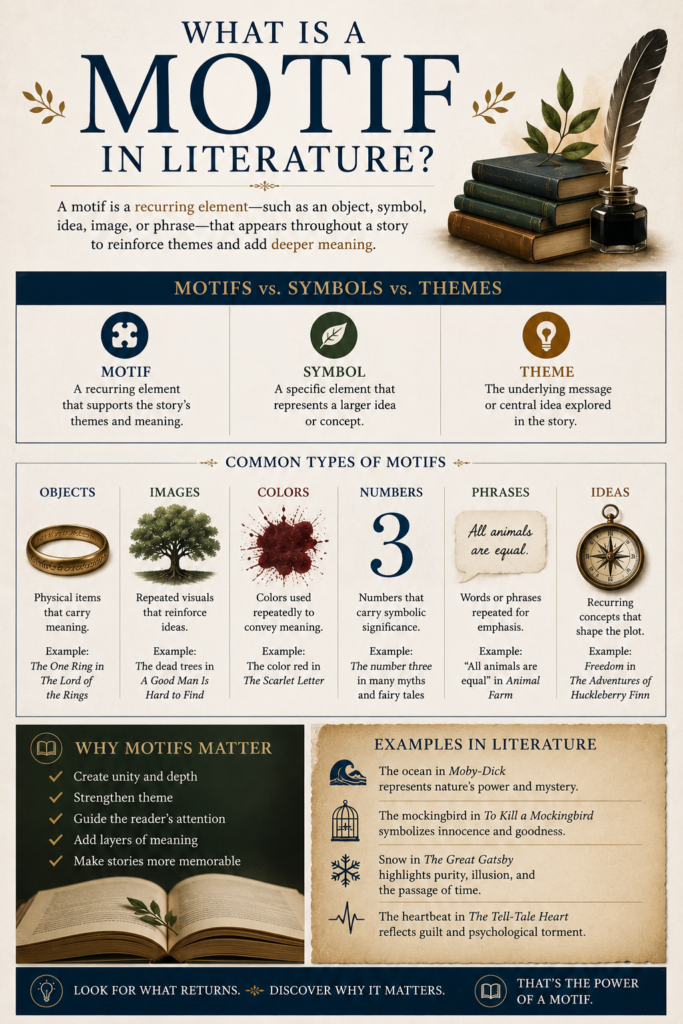
What Is a Motif in Literature? A motif is a repeated detail, image, word, object, or idea that helps build meaning in a story.

Once you know how to spot motifs, you can see how authors guide readers toward deeper themes without stating them directly.

In this Guide

  • What a motif means
  • Why motifs matter
  • Motif vs. theme
  • Famous motif examples
  • How to spot motifs while reading
  • Books that help you practice
  • FAQ

What Is a Motif in Literature? A Simple Definition

A motif is a repeated pattern that adds meaning to a text.

A motif can be an object, color, phrase, sound, place, or action that appears more than once. It is not random. The author repeats it for a reason.

The answer to What Is a Motif in Literature? is simple: it is a clue that points toward a larger idea.

For example, if a novel keeps showing locked doors, the motif may suggest secrets, fear, or limits. The door itself matters, but the repeated pattern matters more.

Why Motifs Matter in Literature

Motifs help readers notice what a story is really about.

Authors use motifs to connect scenes that may seem separate. A repeated image can remind you of a character’s struggle or a story’s main conflict.

Motifs also make literature feel richer. They give a text shape and rhythm. When a motif appears again, it often carries more meaning than it did before.

This is why teachers often ask students to track repeated details. A motif can lead you straight to a strong theme statement.

If you want to compare motifs with other tools writers use, this literary devices list is a helpful place to start.

What Is a Motif in Literature? Motif vs. Theme

A motif repeats. A theme reveals a message.

This is one of the most common points of confusion. A motif is a pattern inside the story. A theme is the deeper idea the story explores.

Think of it this way: rain might be a motif. The theme might be that grief changes how people see the world.

In Macbeth, blood appears again and again. Blood is a motif. It connects to themes of guilt, violence, and moral collapse.

You can read more about Shakespeare’s play through Britannica’s overview of Macbeth.

What Is a Motif in Literature? Common Examples Students Know

Many famous books use motifs that are easy to recognize once you look for them.

In The Great Gatsby by F. Scott Fitzgerald, the green light is a key motif. It appears across the water and comes to represent Gatsby’s hope, longing, and dream of a perfect future.

In To Kill a Mockingbird by Harper Lee, mockingbirds act as a motif tied to innocence. The repeated idea helps readers think about who gets harmed even when they have done no wrong.

In Lord of the Flies by William Golding, the conch shell becomes a motif connected to order and rules. As the boys lose respect for it, their society begins to break apart.

In poetry, a repeated image can work the same way. The Poetry Foundation offers many poems where repeated images carry meaning. You can explore examples at the Poetry Foundation.

How a Motif Builds Theme

A motif often acts like a bridge between details and big ideas.

When a writer repeats a detail, that detail starts to collect meaning. By the end of the story, it may reveal something about love, power, identity, or fear.

For example, a story may repeat images of mirrors. At first, they may seem like simple objects. Later, they may connect to a character’s struggle with self-image or truth.

This is why motifs are useful in essays. They give you evidence you can point to. You can quote the repeated detail, then explain how it supports the theme.

How to Spot a Motif While Reading

Look for details that return at important moments.

When students ask, What Is a Motif in Literature?, the best answer is often found through practice. Notice what keeps coming back.

Pay attention to repeated colors, objects, phrases, weather, places, or actions. Then ask what those details seem to suggest.

A good test is this: if the detail appeared only once, it might just be description. If it returns and gains meaning, it may be a motif.

For more help with related terms, see this guide to common literary devices.

Books to Practice Finding Motifs

These books make motif practice clear and useful.

  • The Great Gatsby by F. Scott Fitzgerald
  • Macbeth by William Shakespeare

Both texts use repeated images in ways that connect strongly to theme. They are also common in high school and college literature classes.

FAQ: What Is a Motif in Literature?

What is a motif in literature in simple words?

A motif is something that repeats in a story and helps create meaning. It can be an image, object, word, or idea.

How is a motif different from a symbol?

A symbol stands for something beyond itself. A motif repeats across the text and often includes symbols, images, or ideas.

Can a character be a motif?

A character is usually not a motif. But a repeated action, phrase, or role connected to a character can become one.

Why do teachers ask about motifs?

Motifs help students find themes. They also give strong evidence for literary analysis essays.

What Is a Motif in Literature? Why should I care?

It helps you read with more insight. Motifs show how small details connect to the story’s bigger message.

Key Takeaway

What Is a Motif in Literature? It is a repeated detail that helps reveal deeper meaning.

Here is a simple reading tip: when something shows up more than once, mark it. Then ask, “What idea does this pattern point toward?” That question can lead you to a stronger analysis.

Flash Memoir Prompt: First Time You Did Something Kind for a Stranger and Never Found Out What Happened Next

Flash Memoir Kind Stranger Prompt

A warm, focused writing invitation about a small act of kindness, the stranger who received it, and the quiet mystery of never knowing what happened next.

You may remember the moment by what was in your hand. A dollar bill. A paper cup of coffee. A grocery bag. A bus ticket. Maybe you remember the stranger’s face only in pieces, like tired eyes, wet hair, or a sleeve pulled over one hand.

This flash memoir prompt first time something kind stranger invites you to write about a moment when you acted without getting the ending. You did something kind, then life moved on. No thank-you note arrived. No update came. You never learned if your small choice mattered in the way you hoped.

That unknown ending is part of the story.

Flash Memoir Kind Stranger Prompt

The Prompt

Write about the first time you did something kind for a stranger and never found out what happened next.

This prompt can unlock a meaningful memory because it asks you to focus on a single human exchange. You do not need a dramatic rescue or a grand sacrifice. The kindness may have been simple, such as holding a door, paying a fare, giving directions, sharing food, or staying with someone until help came.

The power of this memory often comes from its unfinished shape. In many stories, we want to know what happened after. Memoir does not always give us that. Sometimes the truth is that we gave what we could, walked away, and carried the question for years.

Why This Memory Matters

This kind of memory can show you who you were becoming at the time. Maybe you were a child who had just learned that adults could be lonely. Maybe you were a teenager who acted brave before you felt brave. Maybe you were in a hard season yourself and still noticed someone else’s need.

A first act of kindness toward a stranger can reveal a lot about your values before you had words for them. It may show what you had been taught at home, what you rejected, or what you learned from watching someone else suffer.

The stranger matters, too, even if you know almost nothing about them. In memoir, a person can appear for one page and still change the emotional weather of a piece. If you want to strengthen that kind of observation, it can help to practice noticing people the way you would when you analyze characters in literature. Look at gesture, tone, silence, and choice.

This flash memoir prompt first time something kind stranger is also a way to explore uncertainty. You may have wondered if you did enough. You may have felt proud, embarrassed, scared, or strangely sad. You may have forgotten the details for years, then found that one image still stayed with you.

That image is a good place to begin.

How to Approach This Prompt

Start with one physical detail from the moment. Do not begin with the lesson. Begin with the thing you can still see, hear, smell, or touch.

Maybe the stranger’s coat was too thin for the weather. Maybe the coins in your palm felt warm. Maybe the train platform smelled like rain and metal. Maybe your own voice sounded strange when you asked, “Do you need help?”

Keep the memory to one scene. It is tempting to explain the whole period of your life, especially if the moment happened during a difficult year. Give the reader just enough background to understand why this act mattered. Then return to the scene.

Write what you noticed before you explain what it meant. This will make the piece feel alive instead of like a summary. For example, instead of writing, “I felt compassion for him,” you might write, “He kept smoothing the same folded bus schedule, though the last bus had already left.”

If you get stuck, use a simple sentence starter: “The first thing I noticed was…” Let that sentence carry you into the memory. You can revise later.

You might also annotate your own memory as you draft. Circle the strongest sensory detail. Underline the moment you make the choice to help. Put a star beside the line where the unknown ending appears. If that sounds useful, this guide on how to annotate literature can also help you read your own draft with more attention.

Do not try to make yourself look perfect. A good flash memoir often becomes more honest when the writer admits mixed feelings. Maybe you hesitated. Maybe you worried other people were watching. Maybe you helped quickly because you felt awkward. The truth will make the kindness feel real.

A Quick Example

The first time I remember helping a stranger, I was twelve and waiting outside the pharmacy while my mother picked up a prescription. An old man stood near the curb with a white paper bag in one hand and a cane in the other. His hat had blown into the gutter. I watched it roll in dirty water, and for some reason I looked around first, as if someone else had been assigned to care. No one moved. I ran into the street when the light changed and grabbed the hat by its brim. When I handed it back, he said, “That was my good one,” and smiled like we shared a secret. My mother came out then. We drove away. I never knew his name, but I still remember the hat dripping onto my shoes.

Try It Yourself

Set a timer for ten minutes and write the scene as directly as you can. Begin with the place. Then bring in the stranger. Let the act of kindness happen slowly enough that the reader can feel your choice.

You do not have to solve the mystery of what happened next. In fact, try leaving the ending open. Let the last line hold the question, the image, or the feeling that stayed with you.

If you write from this flash memoir prompt first time something kind stranger, pay attention to the size of the moment. Small is enough. A stranger’s life may have continued far beyond your view, but your memory of that brief exchange can still carry emotional weight.

Want More Flash Memoir Prompts?

If you enjoy short writing invitations that lead into real memories, you may like having a full year of them within reach. Explore all 365 prompts in The Memory Trigger: 365 Flash Memoir Writing Prompts.
The Memory Trigger


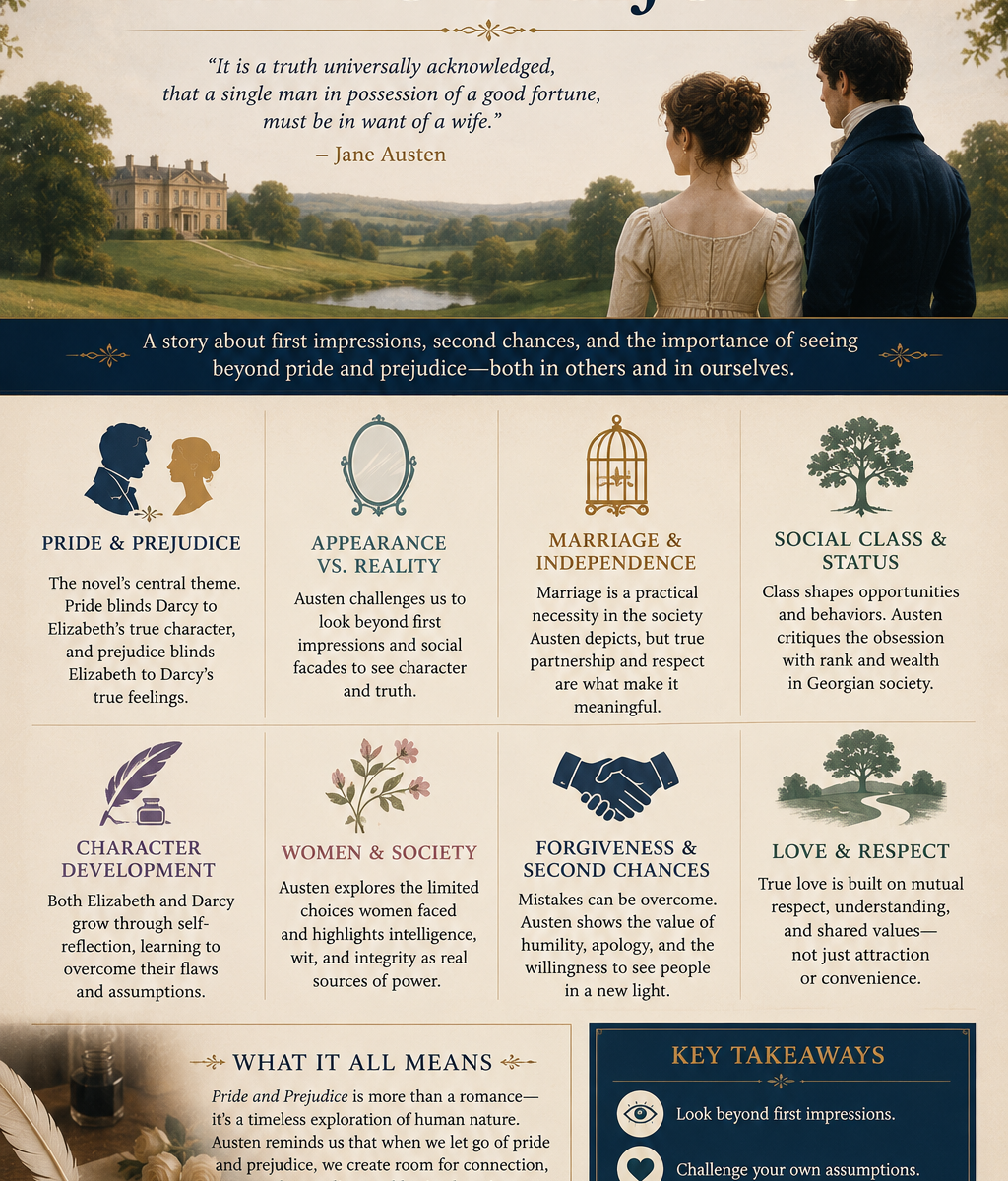
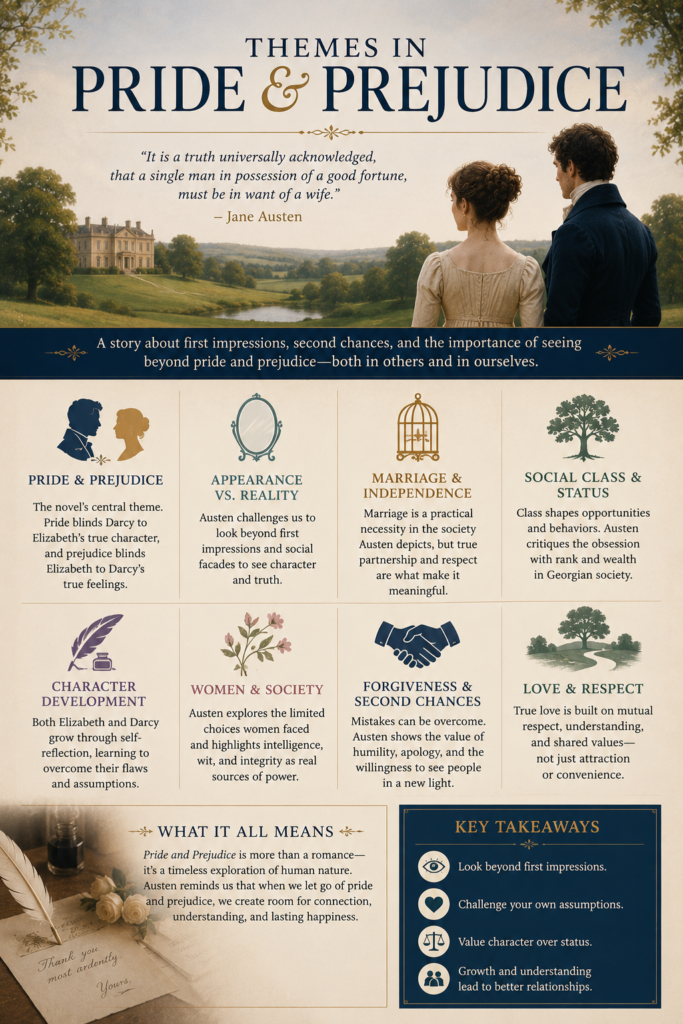
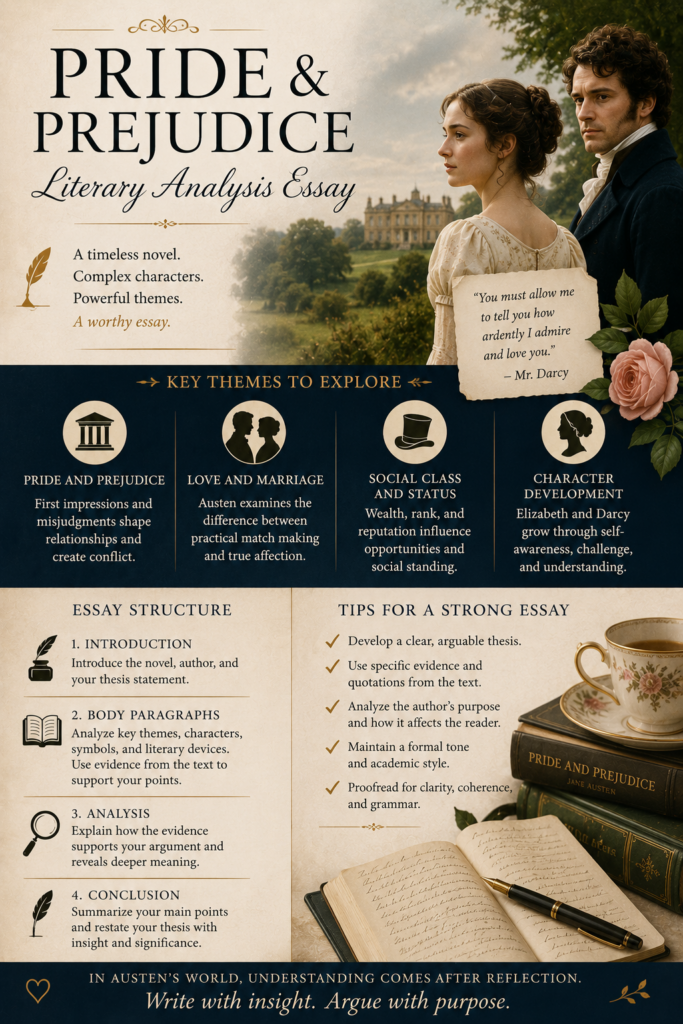
Themes in Pride and Prejudice: A Student-Friendly Guide

Themes in Pride and Prejudice

Jane Austen’s novel may look like a love story, but its ideas run much deeper. This guide explains the major themes in Pride and Prejudice so students can see how love, class, pride, and choice shape the whole book.

In this Guide

Use this quick map to find the part you need for class, notes, or an essay.

  • Why the ideas matter
  • Pride, prejudice, and self-knowledge
  • Love and marriage
  • Class and reputation
  • Money and limited choices
  • Gender and power
  • Family and education
  • Essay tips and FAQ
Themes in Pride and Prejudice

Why the themes in Pride and Prejudice matter

The novel’s themes help explain why a book from 1813 still feels fresh today.

Austen writes about people who judge too fast, protect their social rank, and search for a life with dignity. Those issues still matter in schools, friendships, and families.

The themes in Pride and Prejudice also help students see Austen’s craft. She does not preach. She uses wit, dialogue, and character change to make her ideas clear.

For helpful background on Austen’s life and era, see this overview from Britannica.

Theme 1: Pride, prejudice, and self-knowledge

Elizabeth and Darcy both have to face the truth about themselves.

Pride is not always bad in the novel. A person needs self-respect. But Darcy’s pride makes him cold, while Elizabeth’s confidence makes her judge him too quickly.

Prejudice means more than unfair dislike. It also means forming an opinion before you know the facts. Elizabeth believes Wickham because he seems charming. Darcy misreads Elizabeth’s family and social rank.

A central part of the themes in Pride and Prejudice is the need to grow. Elizabeth changes because she can admit error. Darcy changes because he can see how his behavior has hurt others.

This is similar to Pip in Great Expectations. Pip must learn that status does not equal worth. Both novels ask students to notice how a character’s wrong ideas shape the plot.

Theme 2: Love, marriage, and good judgment

Austen shows that love works best when feeling and reason stay linked.

Marriage is a major plot force in the novel. Mrs. Bennet wants her daughters married because their future is at risk. But Austen does not treat marriage as only a business deal.

Elizabeth refuses Mr. Collins because she knows a loveless match would harm her. Charlotte Lucas accepts him because she wants security. Neither choice is simple.

Another key part of the themes in Pride and Prejudice is the question of good judgment. Elizabeth and Darcy reach a strong love only after they face hard truths.

For quicker review, students can use Pride and Prejudice study resources alongside class notes.

Class and reputation as themes in Pride and Prejudice

Social rank affects how characters speak, marry, and judge one another.

Darcy has wealth and status, so others expect him to act with control. The Bennet family has less rank, so their behavior gets watched more closely.

Lady Catherine believes social class should decide marriage. She sees Elizabeth as beneath Darcy. Austen exposes how cruel that belief can be.

Reputation matters too. Lydia’s elopement threatens the whole family because society blames women more harshly than men. This shows a world where public opinion has real power.

The British Library offers useful context on Austen’s world and works at its Jane Austen page.

Theme 4: Money, security, and limited choices

Money is never just background in this novel.

The Bennet estate is entailed, which means the daughters cannot inherit it. This fact creates pressure from the first chapters.

The themes in Pride and Prejudice often connect love to economics. Characters may want romance, but they also need food, shelter, and respect.

Charlotte’s marriage to Mr. Collins can feel sad to modern readers. Yet Austen asks us to see her reason. Charlotte has few safe options, so she chooses stability.

This does not mean Austen supports every practical match. Instead, she shows how unfair systems limit personal freedom.

Theme 5: Gender and power in daily life

Austen shows how women must work within rules they did not create.

The Bennet sisters need marriage because the law and custom do not give them many paths. Their education, income, and public image all affect their futures.

Elizabeth stands out because she speaks with wit and courage. She refuses to obey Lady Catherine. She also refuses to marry without respect.

Among the themes in Pride and Prejudice, gender may be the easiest to connect to class discussion. Students can ask who has power, who lacks it, and how each character responds.

If you want help tracing those patterns, this guide on how to analyze characters in literature can help you build stronger claims.

Theme 6: Family, education, and influence

Family shapes each character’s choices, but it does not fully control them.

Mr. and Mrs. Bennet both affect their daughters. Mr. Bennet is clever, but he often avoids responsibility. Mrs. Bennet cares about security, but her panic causes trouble.

Elizabeth’s mind has been shaped by reading, talk, and sharp observation. Darcy’s values have been shaped by privilege and family pride.

This is one reason many themes in Pride and Prejudice feel personal. Austen shows that people inherit ideas, but they can still revise them.

How to write about themes in Pride and Prejudice

A strong theme paragraph needs a clear claim and proof from the story.

Do not write only that pride is a theme. Go further. Say what Austen suggests about pride, such as: pride becomes harmful when it blocks empathy and honest self-judgment.

Use a character, a choice, and a result. For example, Darcy insults Elizabeth, then later learns why his pride damaged his chance at love.

When writing about themes in Pride and Prejudice, connect the theme to Austen’s message. A theme is not just a topic. It is an idea the novel develops.

You can also review character analysis strategies to make your theme essay more focused.

Helpful books for deeper study

These books can support essays, class projects, or AP Literature prep.

  • Pride and Prejudice by Jane Austen
  • Jane Austen: A Life by Claire Tomalin

To understand the themes in Pride and Prejudice more fully, read the novel slowly and track how each major character changes.

FAQ about themes in Pride and Prejudice

These quick answers can help before a quiz, essay, or class discussion.

What are the main themes in Pride and Prejudice?

The main themes include pride, prejudice, marriage, class, money, gender roles, family influence, and self-knowledge.

What is Austen’s message about marriage?

Austen suggests that marriage should include respect and good judgment. Love matters, but so do character and security.

Why does social class matter so much in the novel?

Class affects how people judge each other and who they see as a proper match. Austen shows that this system can be unfair.

How does Elizabeth change?

Elizabeth learns that cleverness does not make her always right. Her growth comes from honest self-reflection.

Is Darcy’s pride completely bad?

No. Darcy has dignity, but his pride becomes harmful when it makes him look down on others.

Key Takeaway

The best way to read Pride and Prejudice is to watch how judgment changes. Austen shows that love and wisdom grow when people become honest about themselves.

Ekphrastic Poetry Prompt: The Empty Diner at the Edge of Town

Ekphrastic Poetry Prompt diner

This ekphrastic poetry prompt begins with an image that feels familiar yet unsettling. Picture an abandoned roadside diner somewhere along a lonely highway. Dust covers the chrome stools. A slice of pie sits untouched on a table. Sunlight stretches across the checkerboard floor. The jukebox still glows, though no one remains to choose a song.

Unlike dramatic landscapes or fantastical scenes, this image draws its power from ordinary objects. Every item seems to hint at a story that stopped before it reached its ending. That sense of absence creates fertile ground for poetry.

If you are new to reading and writing poetry, you may find this guide helpful: https://rapidreadspress.com/how-to-analyze-poetry-step-by-step/

Ekphrastic Poetry Prompt diner

Why This Ekphrastic Poetry Prompt Invites Storytelling

A strong ekphrastic poetry prompt does more than provide something to describe. It encourages questions.

Who ordered the pie?

Why was it left behind?

Who pinned the postcards to the bulletin board?

Why does the jukebox still glow?

Poetry often begins when a writer notices what is missing rather than what is present. The empty diner asks readers to imagine the people who once filled the room. Their stories linger in the objects they left behind.

As you study the image, resist the urge to explain everything. Allow mystery to remain. Sometimes a poem gains strength when it leaves space for the reader’s imagination.

Entering the World of This Ekphrastic Poetry Prompt

Choose a perspective before you begin writing.

You might write from the viewpoint of the waitress who worked her final shift.

You might become the traveler who arrives years after the diner closed.

Or you might speak as the jukebox, remembering every song it ever played.

You might even write from the perspective of the abandoned slice of pie waiting for someone who never returned.

The goal is not accuracy. The goal is emotional truth.

Focus on sensory details. What does the room smell like? What sounds echo through the empty building? How does the afternoon light change the mood of the scene?

Literary Techniques for This Ekphrastic Poetry Prompt

Because the image contains so many meaningful objects, symbolism can play a major role in your poem.

The pie might represent a broken promise.

The postcards might symbolize dreams of escape.

The empty stools might suggest loneliness.

The glowing jukebox might stand for memory refusing to fade.

If you would like ideas for using imagery, symbolism, and metaphor, explore this guide to literary devices in poetry: https://rapidreadspress.com/literary-devices-in-poetry/

Writing Questions for This Ekphrastic Poetry Prompt

Use one or more of these questions as a starting point:

  • What happened just before the diner became empty?
  • Who was expected to arrive but never did?
  • Which object in the room holds the most important memory?
  • What would the diner say if it could speak?
  • What does the silence reveal that conversation once concealed?

Choose the question that creates the strongest emotional response and follow it wherever it leads.

A Challenge for Your Poem

Write a poem that never directly mentions abandonment, loneliness, memory, or loss.

Instead, reveal those ideas through images and details. Let the pie, the postcards, the sunlight, and the jukebox carry the emotional weight.

For additional inspiration and examples of contemporary poetry, visit the Academy of American Poets at https://poets.org/.

The best poems often emerge from ordinary places. This ekphrastic poetry prompt invites you to discover the hidden stories waiting inside an empty diner where the coffee has gone cold, the music has stopped, and the questions remain.

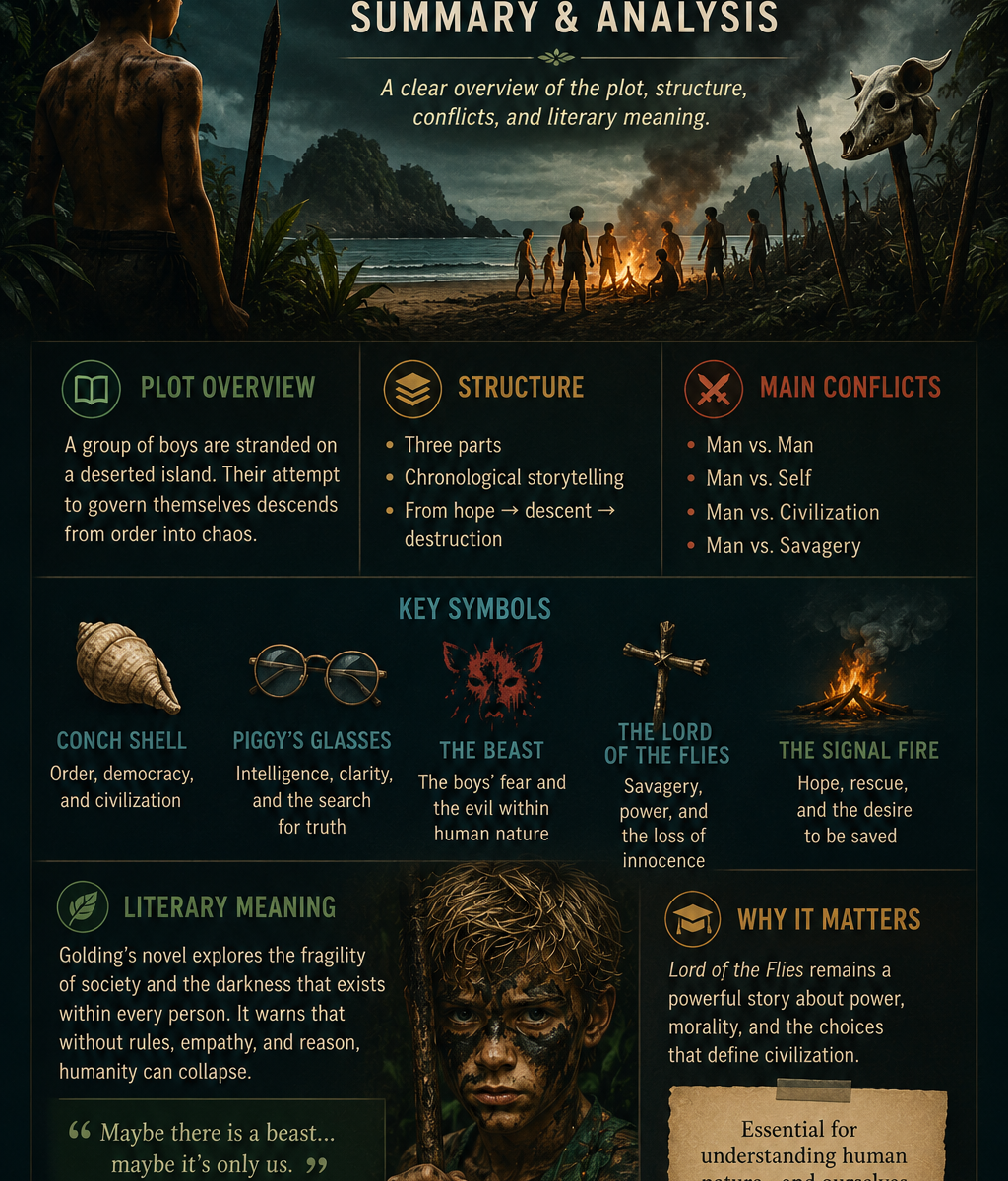
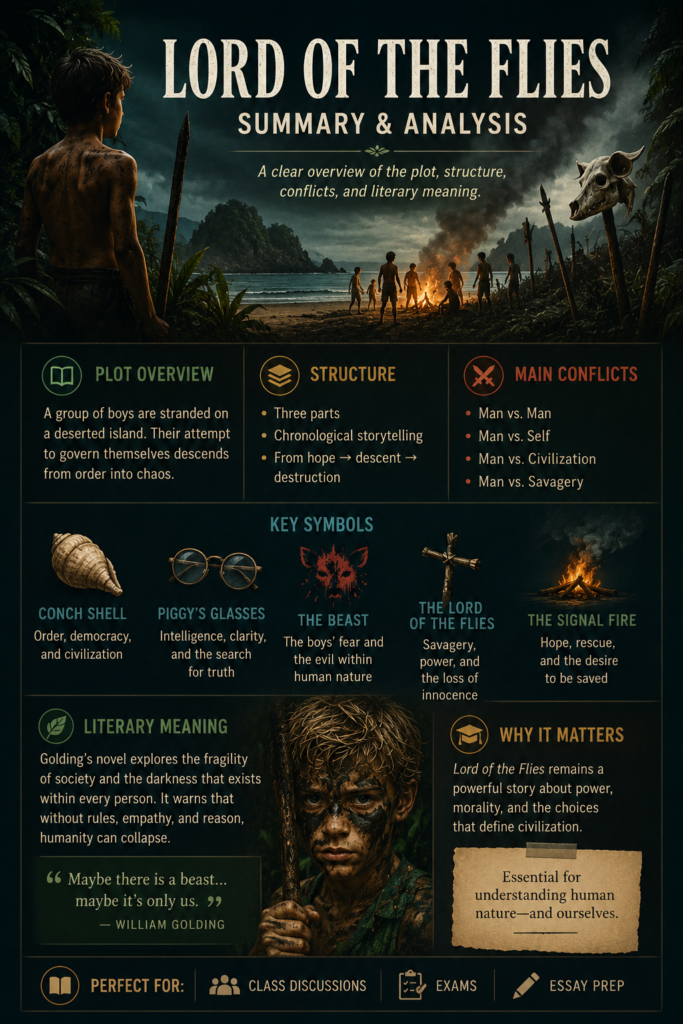
Lord of the Flies Summary and Analysis for Students

Lord of the Flies Summary

A clear overview of the plot, structure, conflicts, and literary meaning.

This Lord of the Flies summary and analysis gives students a clear path through William Golding’s famous novel. It covers the plot, main conflicts, key symbols, and deeper meaning without making the book feel harder than it is.

If you need a guided entry point for class, exams, or essay prep, this guide will help you see both what happens and why it matters.

In this Guide

  • Quick overview of the novel
  • Plot summary
  • Structure and conflict
  • Symbols and themes
  • Literary meaning
  • Study tips, book suggestions, and FAQ
Lord of the Flies Summary

Lord of the Flies Summary and Analysis: Quick Overview

Golding turns a survival story into a dark study of human nature.

Lord of the Flies follows a group of British schoolboys who crash on an empty island during a war. At first, the island seems like a place of freedom, but fear and power soon break their fragile order.

Ralph becomes the elected leader, with Piggy as his smart but ignored adviser. Jack, who leads the choirboys, wants control and becomes more focused on hunting than rescue.

A clear Lord of the Flies summary and analysis must notice this shift: the boys do not just lose rules. They lose trust, empathy, and a shared sense of right and wrong.

For basic background on Golding’s life and career, see Britannica’s William Golding biography.

Lord of the Flies Summary and Analysis: Plot by Chapters

The plot moves from hope to fear, then from fear to violence.

The novel opens after a plane crash leaves the boys without adults. Ralph and Piggy find a conch shell, which becomes a tool for calling meetings and giving people the right to speak.

The boys vote Ralph as chief. Jack accepts this at first, but he feels wounded because he wants power. Ralph wants shelters and a signal fire, while Jack wants meat and status.

Soon, the younger boys fear a beast on the island. Ralph tries to keep the group focused on rescue, but the fear spreads. A fire set by the boys burns out of control, and one small child may die.

Jack becomes skilled at hunting pigs. The hunters paint their faces, which lets them act with less shame. The paint works like a mask, much as costumes in plays can free characters from normal rules.

A ship passes the island, but the signal fire is out because Jack and his hunters left their post. Ralph is furious. This moment shows the main split between rescue and power.

Simon, the quiet and thoughtful boy, later finds the pig’s head that Jack’s group has placed on a stick. This head is called the Lord of the Flies. It seems to speak to Simon and tells him that the real beast is inside the boys.

Simon then discovers that the supposed beast on the mountain is only a dead parachutist. When he tries to tell the others, the boys mistake him for the beast during a wild dance and kill him.

After Simon’s death, Jack’s tribe grows stronger. They steal Piggy’s glasses, which are needed to make fire. Ralph and Piggy go to ask for them back, but Roger rolls a rock that kills Piggy and breaks the conch.

In the final chase, Jack’s tribe hunts Ralph across the island. They set the forest on fire to force him out. A naval officer arrives because of the smoke, and the boys are rescued, but their innocence is gone.

The best Lord of the Flies summary and analysis sees the ending as bitter, not simply happy. Rescue comes, but only after the island has shown what fear and violence can do.

Structure of the Novel

The structure works like a slow collapse.

Golding begins with an island that feels open and bright. The boys form meetings, choose a chief, and speak about rules. The conch gives the early chapters a sense of order.

As the story moves forward, the structure becomes darker. Meetings fail. The signal fire goes out. Jack’s tribe replaces speech with chants and force.

By the end, the island looks almost like a war zone. The fire that should have signaled rescue becomes a weapon. That reversal is one reason the structure feels so sharp.

Like Macbeth, the novel shows how the hunger for power can damage judgment. Like Animal Farm, it asks how a community can fall apart when fear and control replace fairness.

Lord of the Flies Summary and Analysis: Major Conflicts

The conflicts are simple on the surface, but they carry deep meaning.

The main conflict is between Ralph and Jack. Ralph stands for rescue, shared rules, and speech. Jack stands for force, hunting, and control.

There is also a conflict inside the group. The boys want safety, but they are drawn to the thrill of violence. Golding shows how a crowd can make people do things they might fear doing alone.

The beast creates another conflict. At first, the boys think it is an outside monster. Simon understands that the real danger comes from within their own hearts.

This part of the Lord of the Flies summary and analysis matters for essays because conflict in the novel is not just action. It reveals what Golding thinks about human nature.

Symbols in Lord of the Flies

Golding’s symbols turn ordinary objects into moral tests.

The conch shell stands for order and civil speech. When the conch breaks, the boys no longer respect shared rules.

Piggy’s glasses stand for reason and practical knowledge. They help the boys make fire, but Jack wants them for power, not wisdom.

The signal fire stands for hope and a link to the adult world. When the boys care about the fire, they care about rescue. When they abandon it, they drift toward the island’s violence.

The beast stands for fear. It also shows how people can invent enemies when they do not understand themselves.

The Lord of the Flies, the pig’s head on a stick, is the most disturbing symbol. It suggests decay, evil, and the cruel truth Simon sees before his death.

Key Themes for Students

The novel asks what happens when social rules lose power.

One major theme is civilization versus savagery. Golding does not show this as a simple split between good and bad people. He shows how quickly order can weaken.

Fear is another key theme. The boys fear the beast, but that fear makes them easier to control. Jack uses fear to gain loyalty.

The novel also explores the loss of innocence. The boys begin with games and meetings, but they end with murder and a hunt. Their childhood does not protect them from moral failure.

If you want to move from summary to evidence, try this guide to close reading in literature. It can help you connect symbols, word choice, and theme in your own notes.

Lord of the Flies Summary and Analysis: Literary Meaning

The novel’s meaning is harsh, but it is not hopeless.

Golding suggests that people need more than rules. They need moral courage and respect for others. Without those, rules can become empty sounds.

The boys are not evil because they are children. They are human, and that is the troubling point. Golding asks readers to face the darker parts of human behavior.

A good Lord of the Flies summary and analysis should not stop at the plot. The novel matters because it studies how fear, pride, and group pressure can break a community.

Golding later received the Nobel Prize in Literature. You can read more about his award at The Nobel Prize official site.

How to Study Lord of the Flies

Focus on patterns, not just events.

Track how the conch, fire, and glasses change in meaning. Each object starts with a useful role, then becomes part of a larger moral struggle.

Pay close attention to scenes with crowds. Golding often shows how chants, fear, and shared excitement pull the boys away from reason.

When you write about the novel, use short quotes and explain them closely. For help with that skill, see how close reading works in literature.

Relevant Books to Read Next

These books connect well with Golding’s ideas about power and society.

  • Animal Farm by George Orwell
  • The Coral Island by R. M. Ballantyne
  • Fahrenheit 451 by Ray Bradbury

The Coral Island is especially useful because Golding partly responds to its more hopeful view of boys stranded on an island.

FAQ: Lord of the Flies Summary and Analysis

What is the main idea of Lord of the Flies?

The main idea is that human beings can turn violent when fear, pride, and power replace moral responsibility.

What should a Lord of the Flies summary and analysis include?

It should include the crash, Ralph and Jack’s conflict, Simon’s discovery, Piggy’s death, the final hunt, and the novel’s themes.

Why is the conch important?

The conch stands for order, speech, and shared rules. When it breaks, the boys’ society fully falls apart.

Is Jack the villain of the novel?

Jack acts as the main antagonist, but Golding’s point is larger. Jack shows a violent desire for power that can exist in many people.

Why does Simon matter so much?

Simon understands that the beast is not a monster outside the group. It is the darkness inside human nature.

Key Takeaway

A strong Lord of the Flies summary and analysis shows that the novel is not only about boys on an island. It is about how quickly fear can weaken order, and why moral courage matters.

error

Enjoy this article? Please spread the word :)

Follow by Email
BLUESKY
fb-share-icon
Reddit
LinkedIn
Share
RSS