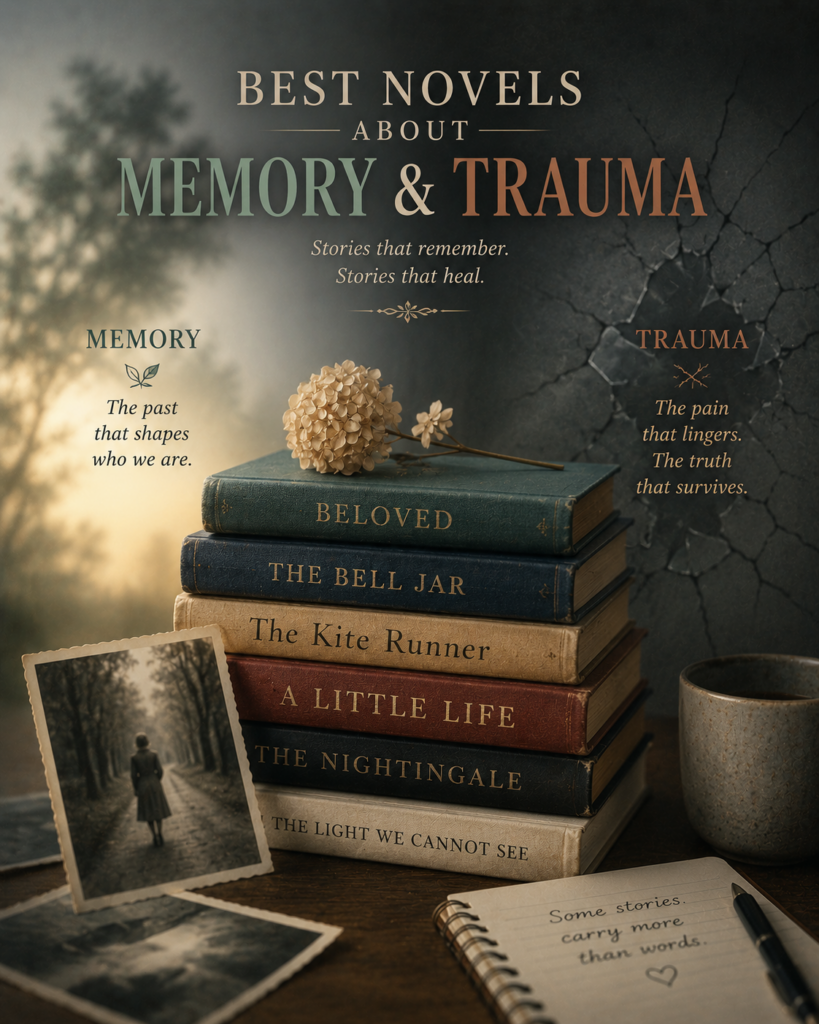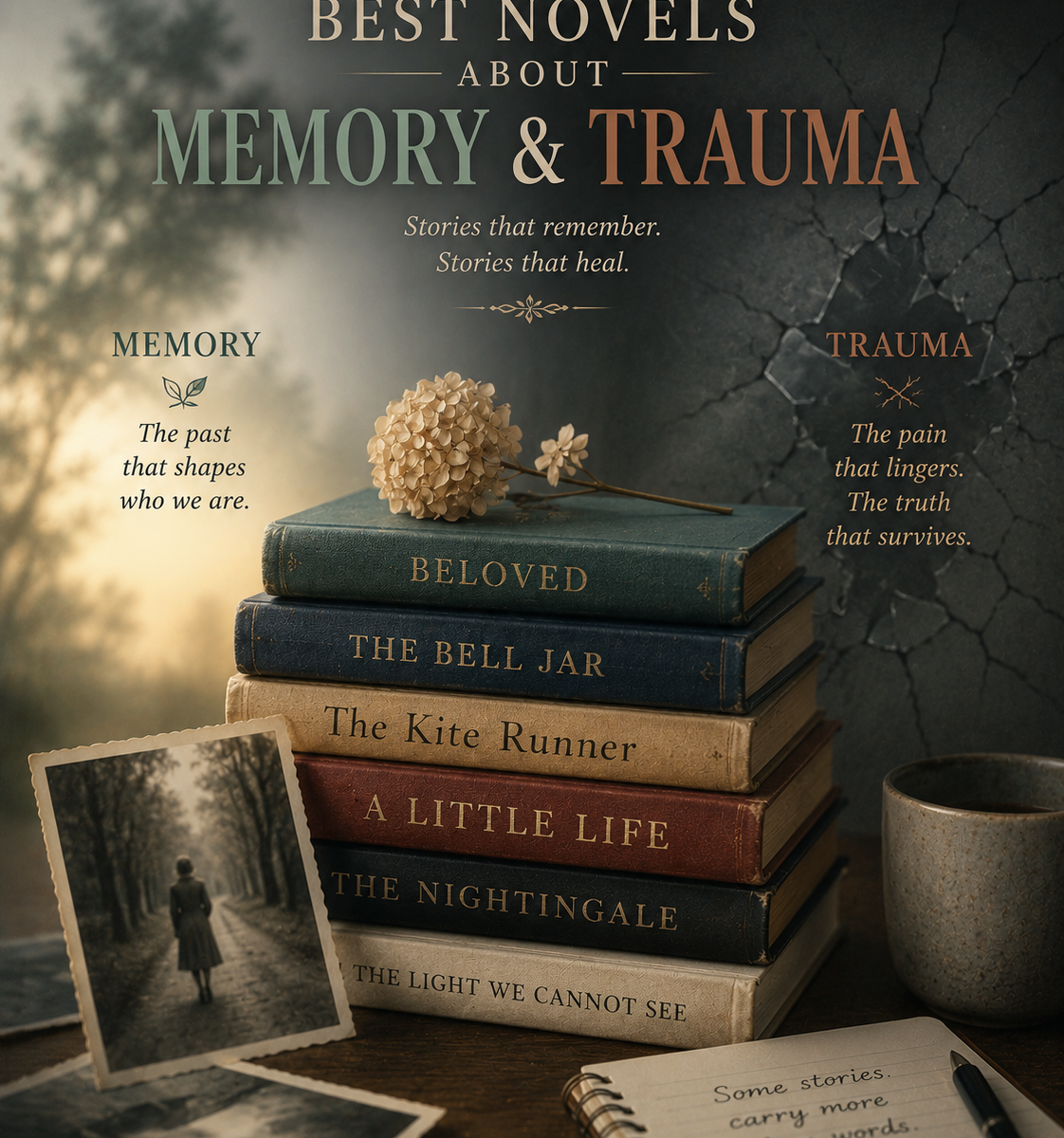
Best Novels About Memory and Trauma: Powerful Books That Stay with You

Best Novels about Memory and Trauma

The Best Novels About Memory and Trauma show how the past can shape a person’s life long after the event has ended. These books help readers understand pain, survival, silence, and the strange ways memory can return.

For students, these novels also offer rich themes, symbols, and character studies. They are strong choices for essays, class talks, and deeper reading.

In this Guide

  • Why novels about memory and trauma matter
  • Best novels to read first
  • How trauma changes storytelling
  • Common symbols and themes
  • How students can read these books with care
  • Book suggestions
  • FAQs
  • Key takeaway
Best Novels about Memory and Trauma

Why the Best Novels About Memory and Trauma Matter

These stories help readers see how the past lives inside the present.

The Best Novels About Memory and Trauma do not treat memory like a simple record. In these books, memory can be broken, hidden, repeated, or changed by fear.

That makes the reading experience feel more real. People who suffer often do not remember events in a neat order. A sound, place, smell, or word can bring the past back at once.

These novels also ask hard questions. Can a person heal if they cannot speak about what happened? Can a family move forward if it hides the truth? Or can a nation face its own violent history?

Books like Beloved by Toni Morrison and The Things They Carried by Tim O’Brien explore these questions with great care. They show that trauma is not only personal. It can also be passed through families, wars, and cultures.

Best Novels About Memory and Trauma to Read First

These books are strong starting points because they are often taught and widely discussed.

If you are new to the Best Novels About Memory and Trauma, start with books that use clear emotional conflicts and strong symbols. The stories below are well-known, but they still feel fresh because they ask deep human questions.

Beloved by Toni Morrison

Beloved is one of the most important American novels about memory, slavery, and grief. Set after the Civil War, it follows Sethe, a woman haunted by the past in both real and ghostly ways.

The novel shows how trauma can return through the body, the home, and family bonds. Morrison does not let the past stay buried. She turns memory into a living force.

You can learn more about Morrison’s life and impact through Britannica’s overview of Toni Morrison.

The Things They Carried by Tim O’Brien

This Vietnam War novel blurs the line between fact and fiction. O’Brien writes about soldiers, fear, guilt, and the stories people tell to survive.

Memory in this book is not perfect. It shifts because pain shifts it. That is part of the point.

The title itself is a symbol. The soldiers carry weapons and supplies, but they also carry shame, love, fear, and regret.

Slaughterhouse-Five by Kurt Vonnegut

Slaughterhouse-Five follows Billy Pilgrim, a man who becomes “unstuck in time.” His life moves back and forth between moments, including the bombing of Dresden during World War II.

The strange structure shows how trauma can break normal time. Billy does not simply remember the war. He seems trapped inside it.

This is one reason the novel remains one of the Best Novels About Memory and Trauma for students who want to study form and theme together.

The Remains of the Day by Kazuo Ishiguro

This quiet novel follows Stevens, an English butler who looks back on his life. At first, his memories seem calm and controlled.

As the story unfolds, readers see what he has avoided. His trauma comes through restraint, regret, and missed chances.

The book is a powerful example of emotional repression. It shows that silence can be just as painful as open grief.

Never Let Me Go by Kazuo Ishiguro

This novel may look like science fiction, but its deepest subject is memory. Kathy tells the story of her childhood at a strange boarding school and slowly reveals the truth about her life.

The novel studies how people remember youth when they know loss is near. It is calm on the surface, but deeply sad underneath.

For students, it is a great book for essays about identity, control, and the stories people tell themselves.

How Trauma Changes Storytelling

In many trauma novels, the form of the story reflects the mind of the character.

The Best Novels About Memory and Trauma often avoid a straight timeline. This is not a trick. It helps readers feel how trauma works.

A character may jump from the present to the past without warning. A scene may repeat with new details. A narrator may leave out facts because the truth is too painful.

In Beloved, memories arrive in pieces. In Slaughterhouse-Five, time itself feels broken. And in The Things They Carried, stories are retold because one version is never enough.

This style can feel hard at first. But it teaches readers to notice structure. The way a story is told can matter as much as what happens.

If you are studying older texts too, the same skill helps. Paying close attention to language and structure can make difficult works easier, as explained in this guide to understanding Shakespearean language.

Symbols and Themes in the Best Novels About Memory and Trauma

These novels often use objects, places, and repeated images to show what words cannot fully explain.

One common symbol is the house. In Beloved, the home is not just a setting. It holds grief, fear, and history.

Another key symbol is the body. Trauma often appears through scars, pain, habits, or silence. A character may not speak about the past, but the body still remembers.

Objects also carry meaning. In The Things They Carried, the items soldiers hold become signs of emotional weight. What they carry shows who they are and what they fear.

Time is another major theme. In the Best Novels About Memory and Trauma, the past is not really past. It presses into the present and changes how characters see themselves.

These books also focus on truth. A memory may be honest even if it is not fully accurate. That idea can lead to strong essay topics about narration and trust.

Why Memory Is Not Always Reliable

Memory can protect people, but it can also hide what hurts too much.

Many trauma novels use unreliable narrators. This does not always mean the narrator lies on purpose. Sometimes the narrator cannot face the full truth yet.

In The Remains of the Day, Stevens tells his life story in a careful voice. He seems proper and calm. But readers start to sense the sadness under his control.

In Never Let Me Go, Kathy’s memories feel gentle, but they lead toward a painful truth. Her calm tone makes the novel even more haunting.

This is why the Best Novels About Memory and Trauma reward close reading. Small details often reveal what the narrator cannot say directly.

How Students Can Read These Novels With Care

These books can be powerful, but some scenes may feel heavy.

When you read the Best Novels About Memory and Trauma, give yourself time. Do not rush through painful chapters just to finish the plot.

Take notes on repeated images, changes in time, and moments of silence. Ask what the character avoids. Ask what the book returns to again and again.

It also helps to learn basic facts about trauma. The National Institute of Mental Health page on PTSD offers clear information about how trauma can affect memory and daily life.

For class essays, focus on one clear idea. You might write about the haunted house in Beloved, the broken timeline in Slaughterhouse-Five, or the weight of objects in The Things They Carried.

Amazon Book Suggestions: Best Novels About Memory and Trauma

These titles are easy to find online, in libraries, and in many school reading lists.

If you want to build a reading list, these are strong choices:

  • Beloved by Toni Morrison
  • The Things They Carried by Tim O’Brien
  • Never Let Me Go by Kazuo Ishiguro

Each book gives a different view of memory and pain. Together, they show why the Best Novels About Memory and Trauma matter in modern literature.

Best Novels About Memory and Trauma for Essay Topics

These books offer rich ideas for literary analysis.

For an essay on symbolism, Beloved is a strong choice. You can study the house, the ghost, or the idea of rememory.

For an essay on structure, Slaughterhouse-Five works well. Its broken timeline shows how war changes the mind.

For an essay on narration, The Remains of the Day gives you a lot to explore. Stevens reveals his pain through what he refuses to admit.

If you need help with close reading, use skills that apply across many texts. This guide on how to understand difficult literary language can help you slow down and read with more focus.

FAQs About the Best Novels About Memory and Trauma

What makes a novel about memory and trauma powerful?

A powerful trauma novel shows how the past affects the present. It often uses symbols, broken timelines, or silence to reveal pain.

Are the Best Novels About Memory and Trauma hard to read?

Some can be emotionally difficult. They are worth reading with care, breaks, and class discussion when possible.

Which novel should students start with?

The Things They Carried is a good starting point because its chapters are short and its themes are clear. Beloved is deeper and more complex, but very rewarding.

Why do these novels often use non-linear time?

Trauma does not always feel like a normal memory. A broken timeline can show how the past returns without warning.

Can these books help with AP Literature essays?

Yes. The Best Novels About Memory and Trauma offer strong examples of theme, character, symbolism, and narrative structure.

Key Takeaway

The Best Novels About Memory and Trauma show that the past is never simple. These books help readers see how pain can shape identity, how silence can speak, and how stories can become a path toward truth.

For students, they are more than moving reads. They are some of the richest texts for close reading, essay writing, and serious thought.
Internal vs External Conflict Explained: A Student Guide to Literary Conflict

Internal vs External Conflict

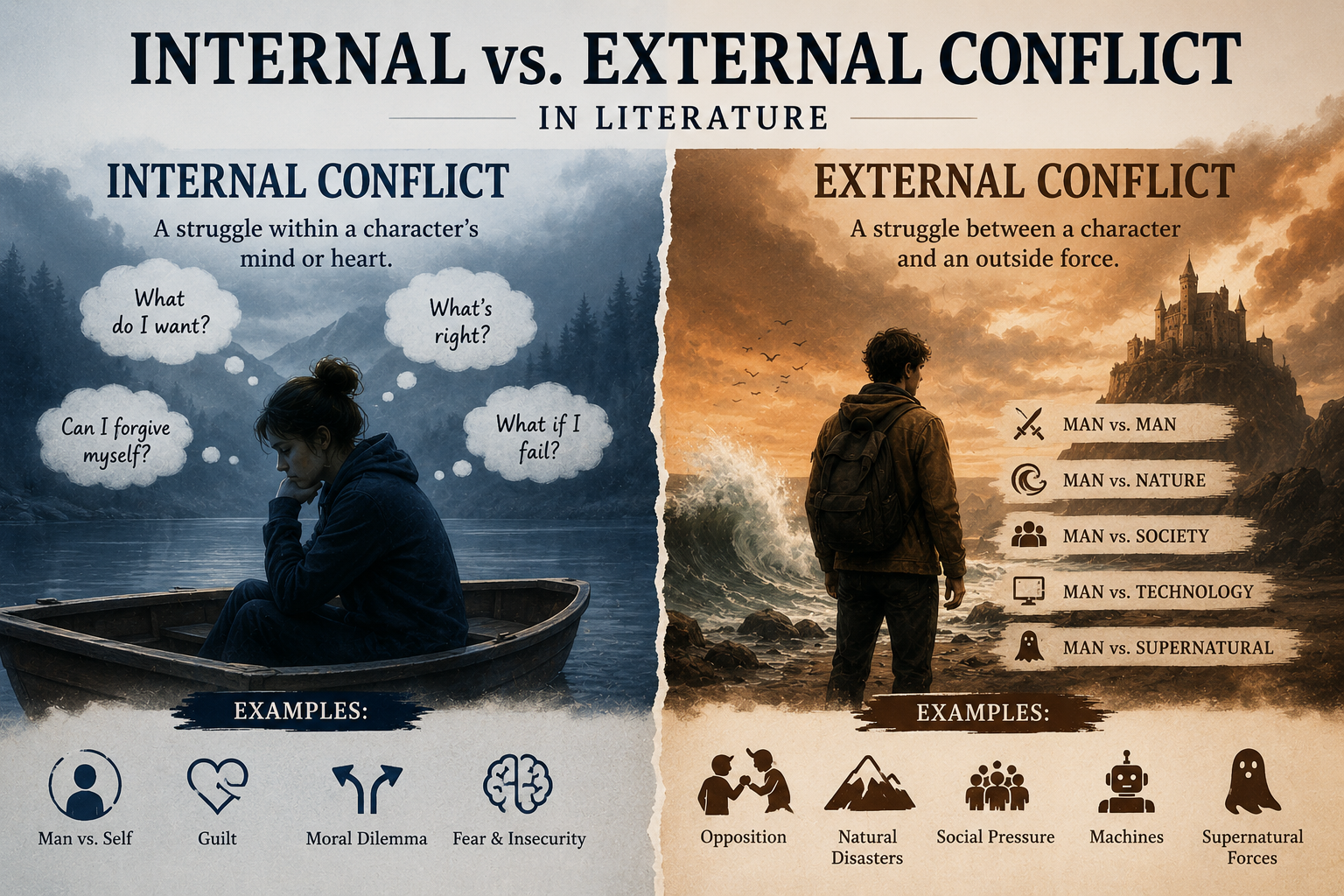
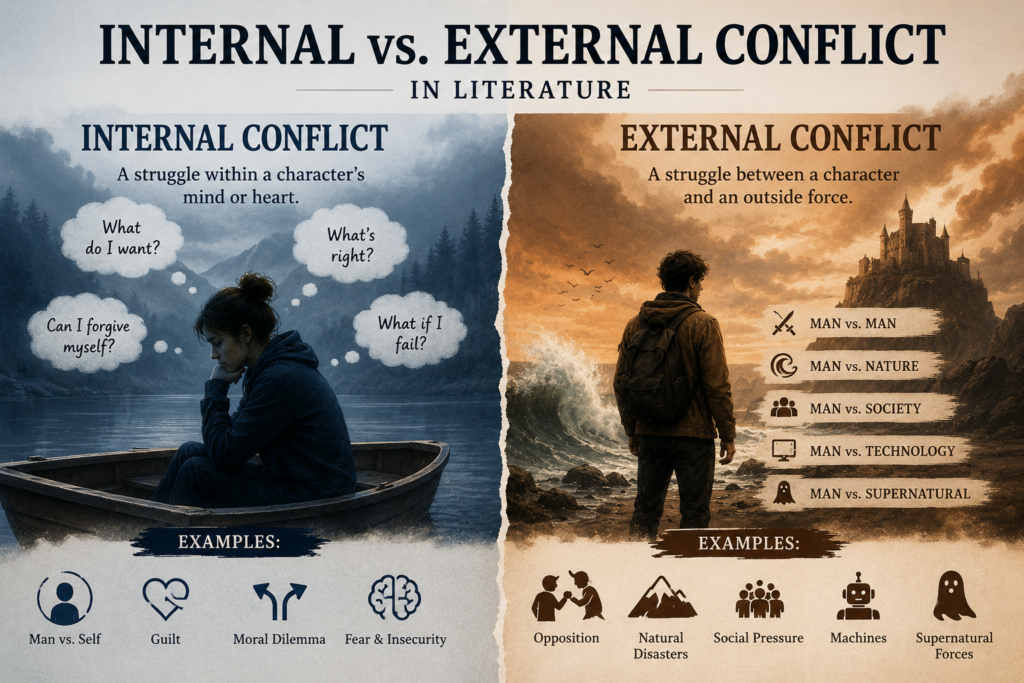
If a story feels tense, conflict is usually the reason. Internal vs External Conflict Explained helps you see whether a character struggles inside their own mind or against a force outside them.

This guide explains the difference in plain language, shows examples from literature, and helps you use conflict in stronger essays.

In this Guide

Internal vs External Conflict

Internal vs External Conflict Explained: The Basic Difference

Conflict is the struggle that drives a story forward.

An internal conflict happens inside a character. It may involve guilt, fear, doubt, desire, or a hard choice.

An external conflict happens between a character and an outside force. That force may be another person, society, nature, or fate.

The easiest way to keep Internal vs External Conflict Explained in your mind is this: internal conflict is private, while external conflict is visible.

A character can have both at the same time. In fact, many strong stories use both because outer problems often expose inner struggles.

What Is Internal Conflict?

Internal conflict is a battle within the character.

A character may want two things that cannot both happen. They may feel pressure to act, but fear the result.

In Shakespeare’s Hamlet, Hamlet struggles with grief, anger, doubt, and the need for revenge. His outer problem is Claudius, but his inner problem is his own hesitation.

That inner struggle makes him more complex. He is not just a prince with a mission. He is a person trapped by thought, pain, and fear.

You can read more about the play through Britannica’s overview of Hamlet.

What Is External Conflict?

External conflict is a struggle against something outside the character.

This kind of conflict is often easier to spot. A character may fight a villain, face unfair laws, survive a storm, or resist social pressure.

In The Hunger Games by Suzanne Collins, Katniss faces the Capitol, the arena, and the other tributes. These are external conflicts because they exist outside her mind.

Yet Katniss also has internal conflict. She must decide how far she will go to survive without losing her sense of right and wrong.

That mix of inner and outer pressure is one reason the story feels so intense.

Internal vs External Conflict Explained Through Literary Examples

Examples make the difference much easier to see.

In Macbeth, Macbeth’s external conflict includes battles, enemies, and threats to his power. His internal conflict comes from ambition, guilt, and fear.

His wife pushes him toward murder, but the deepest struggle happens inside him. He knows what he wants, but he also knows the cost.

In The Great Gatsby, Gatsby’s external conflict includes class barriers and his rivalry with Tom Buchanan. His internal conflict comes from his dream of repeating the past.

This is where Internal vs External Conflict Explained becomes useful. Gatsby’s real tragedy is not only that society blocks him. It is also that he cannot let go of an impossible dream.

For helpful background, see Britannica’s entry on The Great Gatsby.

Internal vs External Conflict Explained for Essay Analysis

Conflict helps you move from plot summary to real analysis.

Use Internal vs External Conflict Explained as a lens. Do not just say what happens. Ask what the conflict reveals about the character, theme, or author’s message.

Start by asking where the pressure comes from. Is it inside the character, outside the character, or both?

Then ask what choice the character faces. A good conflict usually forces a decision, even if the character avoids it for a while.

You can also ask how the conflict changes the character. Does the character grow, break, lie to themselves, or see the world more clearly?

For a deeper method, try our guide on how to read literature like a scholar. It can help you connect conflict to symbols, themes, and character arcs.

Common Mistakes in Internal vs External Conflict Explained

The most common mistake is treating every problem as the same kind of conflict.

If a character feels guilty, that is internal. If a character is chased by an enemy, that is external.

Another mistake is ignoring how the two types connect. A storm, war, or argument may create pressure, but the character’s response can reveal fear, pride, or guilt.

Strong essays often explain that link. The outer conflict shows what the character faces. The inner conflict shows who the character is.

Amazon Books That Show Conflict Well

These books are useful if you want to study conflict in action.

  • Macbeth by William Shakespeare: A strong example of ambition, guilt, and violence.
  • The Hunger Games by Suzanne Collins: A clear example of survival, power, and moral choice.

You can find these titles on Amazon, at school libraries, or through most public library systems.

FAQ: Internal vs External Conflict Explained

What is the main difference between internal and external conflict?

Internal conflict happens inside a character’s mind or heart. External conflict happens between a character and an outside force.

Can a story have both types of conflict?

Yes. Most strong stories use both. The external conflict creates pressure, while the internal conflict shows how the character reacts.

Why is Internal vs External Conflict Explained important for essays?

It helps you write about more than plot. You can explain how conflict reveals theme, character, and meaning.

Is fear an internal or external conflict?

Fear itself is internal. The thing causing the fear may be external, such as a villain, law, storm, or social rule.

Key Takeaway

Internal vs External Conflict Explained comes down to where the struggle happens. Internal conflict is inside the character, external conflict comes from outside, and the best analysis often shows how both work together.

Flash Memoir Prompt: First Time You Felt Like You Belonged Somewhere

Flash Memoir Belonging Prompt

A warm flash memoir prompt about the first time you felt truly wanted in a room, a group, a place, or even a quiet moment beside someone else.

Maybe it happened at a lunch table where someone saved you a seat. Maybe it was the first practice, club meeting, family gathering, classroom, bookstore, church basement, theater rehearsal, or neighborhood porch where you did not feel like you had to prove yourself.

Belonging can arrive softly. No spotlight. No grand speech. Just a small shift in the air that tells you, “I can stay here.” This flash memoir prompt first time felt like belonged asks you to return to that shift and notice what made it real.

Flash Memoir Belonging Prompt

The Prompt

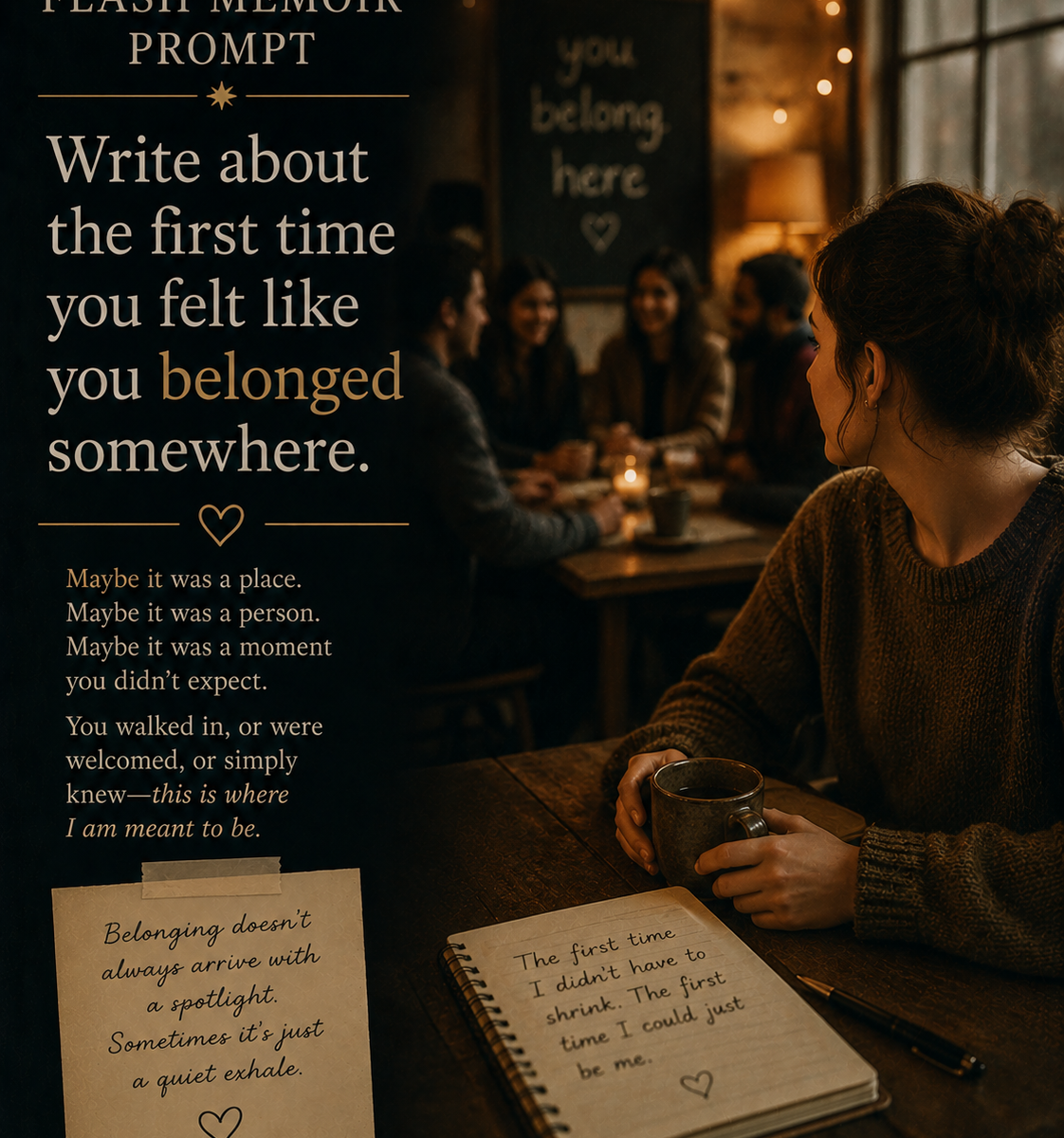
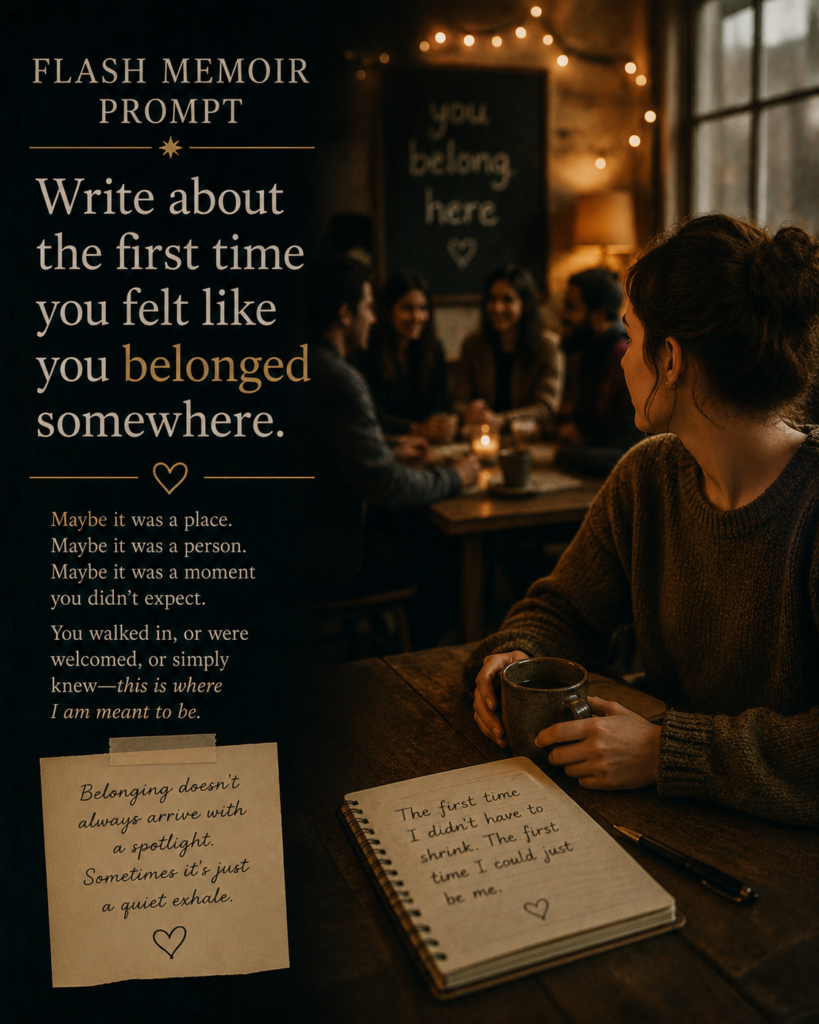
Write about the first time you felt like you belonged somewhere.

This prompt can unlock a meaningful memory because belonging is rarely just about a place. It is about the way people looked at you, the sound of your name in someone else’s mouth, the chair pulled closer, the joke you were included in, or the silence that did not feel awkward.

You do not need to write your whole life story. For flash memoir, one clear scene is enough. Choose one moment when you felt yourself relax into a place, even if you did not understand why at the time.

Why This Memory Matters

The first time you felt like you belonged somewhere may reveal a lot about what you needed then. Maybe you needed friendship. Maybe you needed safety. Maybe you needed someone to see the version of you that had been hidden at school, at home, or in a new town.

This kind of memory can also show contrast. Before the moment of belonging, there may have been loneliness, shyness, nerves, or the sharp feeling of being out of place. That contrast gives the story its shape.

A strong memoir scene often turns on one small detail. The detail might be a paper plate in your hand at a birthday party. It might be the smell of gym floor wax before your first team practice. It might be a teacher writing your name correctly on the board.

If you are a student or teacher exploring personal writing, this prompt also pairs well with close observation. The same skill used to study a story can help you study your own memory. If you want more help with that skill, this guide on how to annotate literature can help you notice images, patterns, and emotional turning points.

How to Approach This Prompt

Begin with a physical detail instead of an explanation. Do not start by saying, “I finally felt accepted.” Start with the chair, the snack table, the cold metal bleachers, the hallway, the borrowed hoodie, or the pencil someone handed you without being asked.

Then narrow the memory to one scene. Ask yourself: Where was I standing? Who was there? What did I notice first? What changed in my body when I realized I belonged?

Try to write what you noticed before you write what it meant. For example, you might remember that someone scooted over on a bench. At the time, it was just movement. Later, you understood it as an invitation.

That order matters. In memoir, meaning grows from the scene. Let the reader enter the room with you before you explain the feeling.

You can also let the memory stay a little complicated. Belonging does not have to be perfect to be real. Maybe you still felt nervous. Maybe you were surprised by how much you wanted to be included. Maybe the group did not last forever, but that one moment still mattered.

If you are turning this flash memoir prompt first time felt like belonged into a longer essay, look for the central change. What did you believe about yourself before that moment? What did the moment allow you to believe after it?

A Quick Example

The first time I felt like I belonged was in the back row of the school band room, holding a dented trumpet that smelled like metal and old spit valves. I had only been at the school for three weeks, and I still ate lunch too fast because I did not know what else to do. During warmups, I missed a note so badly that I felt my ears burn. Then Marcus, who sat beside me, leaned over and whispered, “That one gets everybody.” He grinned like we had already been friends for years. When the director counted us in again, Marcus tapped my music stand at the exact spot where I was supposed to come in. I played the note. It was shaky, but it was there. For the rest of class, I stopped feeling like the new kid and started feeling like a trumpet player.

Try It Yourself

Set a timer for ten minutes and write one scene from the first place where you felt welcome. Keep the focus small. One room. One person. One moment when something shifted.

If you get stuck, write this sentence and keep going: “I knew I belonged when…” Then replace the explanation with a detail. What did someone do? What did you hear? What did your body stop bracing for?

This flash memoir prompt first time felt like belonged works best when you trust the ordinary parts of the memory. A saved seat can carry a whole story. So can a shared laugh, a nickname, or a hand waving you over.

For writers who want to shape a personal memory into a stronger piece, it can help to study examples of focused writing. These literary analysis essay examples can show how one idea can be developed with clear evidence and reflection.

Want More Flash Memoir Prompts?

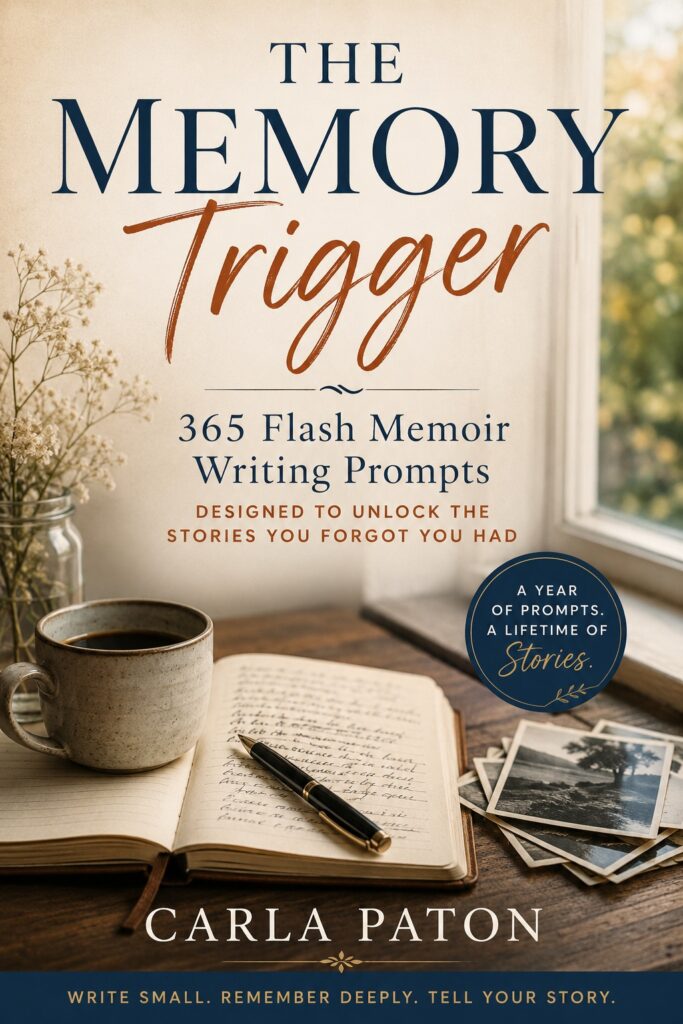
Explore all 365 prompts in The Memory Trigger: 365 Flash Memoir Writing Prompts. Each prompt is designed to help you find one vivid memory, write it with care, and discover the emotional truth inside it.

The Memory Trigger

Symbols in Death of a Salesman: What They Mean and Why They Matter

Symbols in Death of a Salesman

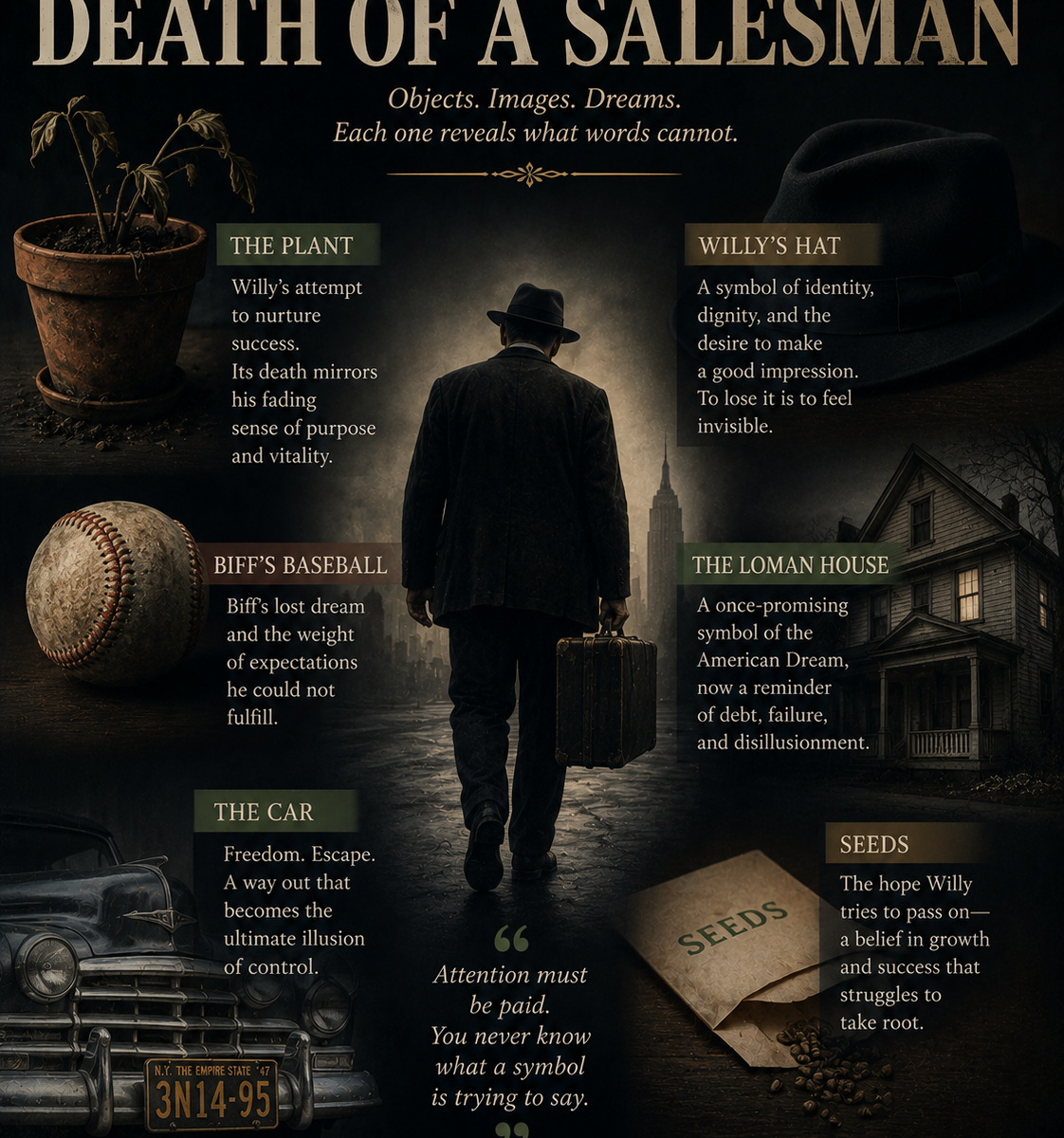
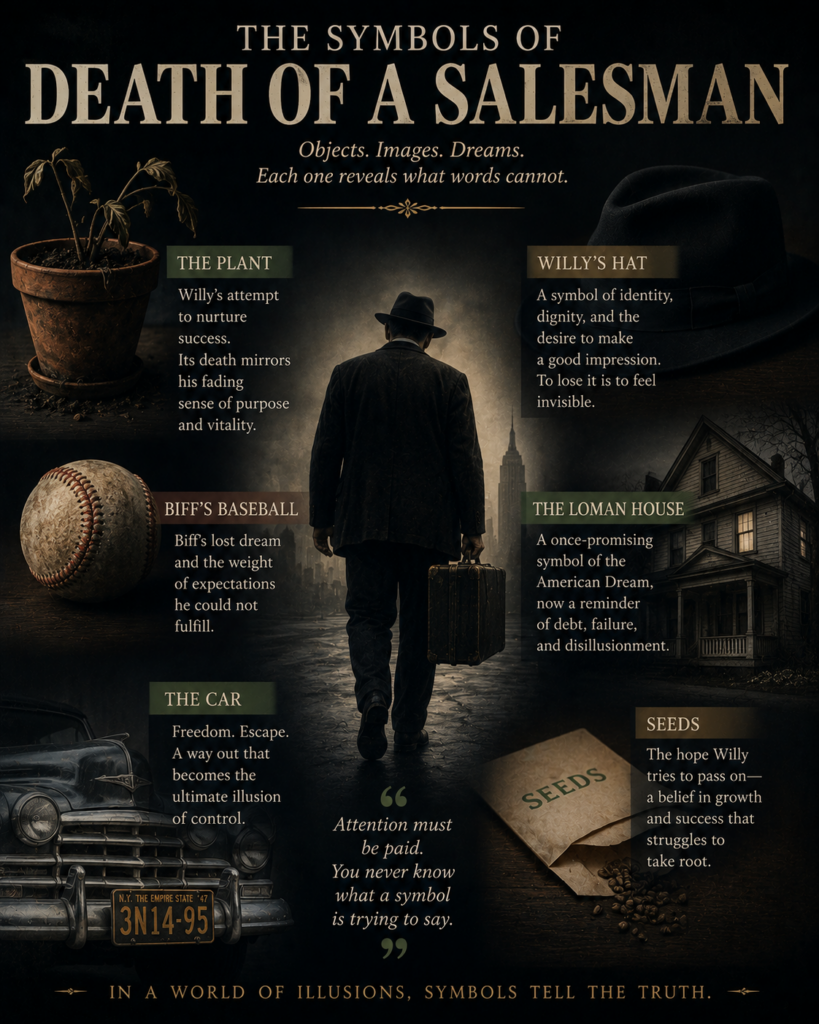
The symbols in Death of a Salesman help Arthur Miller show what Willy Loman wants, fears, and hides from himself. This guide explains the most important images in the play and connects each one to a major theme.

In this Guide

Symbols in Death of a Salesman

Why symbols in Death of a Salesman matter

Miller uses everyday objects to reveal deep pain.

A pair of stockings, a bag of seeds, or the sound of a flute may seem simple at first. Yet each one shows the gap between Willy’s dreams and his real life.

That is why the symbols in Death of a Salesman are so useful for students. They make the play easier to understand because they turn big ideas into clear images.

This is common in literature. In The Great Gatsby, the green light suggests Gatsby’s dream. In Macbeth, blood points to guilt. Miller does the same thing, but with objects from an ordinary home.

Major symbols in Death of a Salesman and what they mean

These symbols show Willy’s hopes, guilt, and fear of failure.

The major symbols in Death of a Salesman are tied to the American Dream. Willy believes success should bring money, respect, and love. The symbols show how that belief breaks down.

Seeds

The seeds are one of the clearest symbols in the play. Near the end, Willy tries to plant seeds in the dark.

On the surface, he wants a garden. On a deeper level, he wants proof that his life has meant something.

The seeds connect to the theme of legacy. Willy fears he has left nothing behind for Biff and Happy. His garden becomes a symbol of the future he failed to grow.

Stockings

Stockings carry guilt. Willy gives new stockings to The Woman, but Linda has to mend her old ones at home.

That image hurts because it reminds Willy of his affair. It also shows how money and shame mix in his mind.

The stockings connect to the theme of betrayal. Willy betrays Linda, but he also betrays the values he claims to protect.

The diamonds

Diamonds are linked to Ben, Willy’s older brother. Ben walked into the jungle and came out rich.

To Willy, the diamonds prove that success is real and visible. They are hard, bright, and valuable.

The problem is that Willy measures life by wealth. The diamonds connect to the theme of false success, since they make money look like the final proof of worth.

The rubber hose

The rubber hose is one of the darkest symbols in the play. Linda finds it near the gas pipe.

It points to Willy’s plan to die by suicide. It also shows that his despair has been hidden inside the house for a long time.

The hose connects to the theme of private suffering. Willy talks big in public, but at home his pain becomes impossible to ignore.

The car

The car stands for Willy’s work life. He travels as a salesman, so the road should mean freedom.

Instead, the car becomes a sign of danger and exhaustion. Willy crashes it, loses focus while he drives, and later uses it as part of his final plan.

The car connects to the theme of the cost of work. Willy’s job drains him until the tool of his career becomes a tool of destruction.

The flute

The flute music opens the play and returns throughout it. It is tied to Willy’s father, who made and sold flutes.

The sound suggests a world before crowded cities and business pressure. It feels softer than Willy’s harsh sales world.

The flute connects to the theme of lost roots. Willy has left behind a simpler life, but he has not found peace in the modern one.

The refrigerator and household objects

The refrigerator keeps breaking, even though Willy is still paying for it. Other household items bring the same problem.

These objects show the trap of consumer life. Willy buys things to feel modern and successful, but debt follows him.

This symbol connects to the theme of empty progress. New products do not fix Willy’s deeper problems.

How symbols in Death of a Salesman connect to theme

Symbolism matters most when it points to the play’s main ideas.

When you study symbols in Death of a Salesman, do not stop at the object. Ask what the object reveals about Willy, his family, or the world he lives in.

The seeds show that Willy wants a future. The stockings show guilt. The diamonds show his belief that money equals value.

These images all connect to the same central problem. Willy has built his life around a dream that does not love him back.

If you want a simple method for spotting clues like these, read our guide on how to find symbolism in a story.

How to write about symbols in Death of a Salesman

A strong paragraph links the object to a theme and a character choice.

For most essays, the symbols in Death of a Salesman work best when you use a clear claim. Do not write that seeds are important. Write that the seeds show Willy’s need to leave proof of his life behind.

Then use a scene. Mention Willy planting seeds in the dark. Explain how that action shows panic, hope, and failure at once.

A good sentence might look like this: The seeds symbolize Willy’s desperate wish to create a legacy after a life that feels wasted.

You can also pair this article with our quick symbolism study notes if you want a faster review before class.

Common mistakes to avoid

Symbolism should make the play clearer, not more confusing.

One mistake is to treat every object as a hidden code. Not every detail needs a secret meaning.

Another mistake is to name the symbol but skip the theme. A symbol matters because it shows something larger, such as guilt, ambition, or family pressure.

It also helps to connect the symbol to a moment in the play. A symbol without a scene can feel weak in an essay.

Helpful books to pair with this guide

These books can help you understand Miller’s play and its background.

  • Death of a Salesman by Arthur Miller
  • Arthur Miller: His Life and Work by Martin Gottfried

For more background on the author, see Britannica’s overview of Arthur Miller.

FAQ about symbols in Death of a Salesman

These quick answers can help you review before a quiz or essay.

What are the main symbols in Death of a Salesman?

The main symbols in Death of a Salesman include seeds, stockings, diamonds, the rubber hose, the car, and the flute.

What do the seeds symbolize?

The seeds symbolize Willy’s wish to leave a legacy. He wants proof that his life has produced something lasting.

What do the stockings symbolize?

The stockings symbolize guilt and betrayal. They remind Willy of his affair and his failure to care for Linda with honesty.

Why is the rubber hose important?

The rubber hose symbolizes Willy’s hidden despair. It shows that his mental pain has become dangerous.

How do symbols support the American Dream theme?

They show how Willy links success to money, status, and being liked. The symbols reveal how that dream damages him and his family.

Key takeaway

The best symbols in Death of a Salesman turn ordinary objects into signs of broken dreams. They matter because they show the emotional cost of chasing success without knowing what success should mean.

Ekphrasis Poetry Prompt: The Empty Chair in the Field

ekphrasis poetry prompt the empty chair

If you are looking for an ekphrasis poetry prompt that invites reflection, memory, and imagination, today’s image offers a rich place to begin. Picture a solitary white heron standing near an abandoned wooden chair in a field of golden grass. Mountains rise in the distance while the late afternoon sun casts long shadows across the landscape.

Ekphrastic poetry begins with close observation. The image becomes a doorway into emotion, story, symbolism, and personal insight. Whether you write free verse, formal poetry, or prose poetry, this scene provides many possible directions.

ekphrasis poetry prompt the empty chair

How to Approach This Ekphrasis Poetry Prompt

Before you begin writing, spend a few minutes studying the image. Notice the relationship between the bird and the chair. Ask yourself why the chair sits alone in the field. Consider who may have left it there and why the heron seems drawn to it.

An effective ekphrasis poetry prompt encourages curiosity rather than certainty. You do not need to explain the image. Instead, explore its possibilities.

You may find it helpful to review our guide on analyzing poetic imagery and meaning: https://rapidreadspress.com/how-to-analyze-poetry-step-by-step/

Writing Ideas for This Ekphrasis Poetry Prompt

The chair could symbolize absence, waiting, memory, or loss. The heron might represent patience, wisdom, solitude, or a messenger from another world.

Consider writing from one of these perspectives:

  • The heron observing the chair.
  • The former owner of the chair.
  • A traveler discovering the scene years later.
  • The chair itself telling its story.
  • An observer who believes the bird is guarding a secret.

You might focus on sensory details. What does the grass sound like in the wind? How does the sunlight change the mood of the landscape? What memories does the scene awaken?

Literary Devices for This Ekphrasis Poetry Prompt

Strong ekphrastic poems often rely on imagery, symbolism, metaphor, and personification. The contrast between the living bird and the abandoned chair creates natural tension that can drive a poem forward.

If you would like a refresher on poetic techniques, see our guide to literary devices: https://rapidreadspress.com/literary-devices-in-poetry/

For additional information about ekphrastic poetry as a literary form, the Poetry Foundation provides an excellent overview of poetry and poetic traditions: https://www.poetryfoundation.org/

The Prompt

Study the image carefully.

Write a poem about the relationship between the heron and the empty chair. Do not explain where they came from. Instead, allow the reader to discover their connection through images, actions, and details.

Challenge yourself to leave one important question unanswered by the end of the poem.

Final Thoughts

This ekphrasis poetry prompt works well because it balances mystery with simplicity. The image contains only a few elements, yet each one invites interpretation. Sometimes the most powerful poems emerge from scenes that appear quiet at first glance.

Take your time with the image. Let the landscape speak before you begin writing. Then follow the thread of curiosity wherever it leads.

Flash Memoir Prompt: First Time You Heard a Word You Didn’t Know

Flash Memoir Prompt word

A brief invitation to write about the first important word you heard before you understood it, and the moment you realized language could change the air in a room.

The Prompt

Write about the first time you heard a word that you didn’t understand, but knew was important.

Maybe the word came from a parent’s phone call. Maybe it floated across a classroom, a hospital hallway, a church basement, or the back seat of a car. You did not know the definition yet, but you knew the word carried weight.

This flash memoir prompt, first time heard word didn’t make sense right away, but still mattered, asks you to return to that small moment of alertness. It is a prompt about language, but it is also about instinct. Before you had meaning, you had feeling.

Flash Memoir Prompt word

Why This Memory Matters

Children often understand tone before vocabulary. A word can feel cold, sharp, secret, or official long before anyone explains it.

Think about words like eviction, diagnosis, adoption, layoff, custody, immigrant, gifted, probation, cancer, scholarship, or divorce. The word itself may not have been aimed at you. Still, you may have felt everyone around it change.

This kind of memory can uncover the first time you sensed that adults had a hidden language. It can show when you learned that words were not just schoolwork or spelling tests. Some words opened doors. Some closed them. Some made people whisper.

You do not need to write a dramatic history. In fact, this prompt works best when you stay close to one scene. The memory may be as small as your mother lowering her voice, your teacher writing a word on the board, or your grandfather folding a letter twice before putting it away.

If you enjoy thinking closely about language, you might also like this guide on how to understand Shakespearean language. Different words can feel strange at first, but the feeling they create can still reach us.

How to Approach This Flash Memoir Prompt

Begin with the place where you heard the word. Do not start with a dictionary definition. Start with the room.

What did the floor feel like under your feet? Was there food on the table? Was a television on? Did someone stop talking when you walked in?

Then write the word exactly as you remember hearing it. Let it stand on the page for a moment. You can even write a sentence like, “I did not know what foreclosure meant, but I knew it was not a word anyone wanted in our kitchen.”

Try to write what you noticed before you explain what it meant. This keeps the memory alive. If you rush into the lesson, the scene may begin to feel flat.

You might ask yourself:

  • Who said the word?
  • Who reacted to it?
  • What did you understand without being told?
  • When did you finally learn what the word meant?

Keep the memory narrow. You are not writing your whole life story. You are writing one flash of awareness.

If it helps, treat the word like a clue in a book. Mark the gestures, pauses, and sounds around it the way you might annotate a piece of literature. The meaning often lives in the details around the word, not only in the word itself.

This is why the flash memoir prompt first time heard word didn’t need to be understood fully can lead to such honest writing. It lets you write from the younger version of yourself, the version who listened hard and guessed from the room.

A Quick Example

The first time I heard the word “deposition,” I was sitting under the dining room table, tying knots in the fringe of the rug. My father was on the phone, and my mother kept looking at me like she had forgotten I could hear. “They want a deposition,” he said. I pictured something being deposited, like coins at the bank drive-through. But his voice was too tight for money. My mother pressed her fingers against her lips. The ice in her glass cracked. No one told me to leave, which made me feel even more like I should stay still. Years later, I learned what the word meant. That night, all I knew was that it had entered our house before the bad news did.

Try It Yourself

Set a timer for ten minutes. Write the scene where you first heard the word. Do not worry about spelling the whole memory perfectly. Just follow the sound of the word and the way people changed around it.

If you get stuck, write this sentence and continue from there: “I did not know what the word meant, but I knew from the way they said it that something had shifted.”

You may discover that the word was not the center of the memory. The real story may be in a glance, a silence, a hand on a doorknob, or the way someone tried to act normal.

That is enough for flash memoir. One word. One room. One younger version of you trying to understand.

Want More Flash Memoir Prompts?

Explore all 365 prompts in The Memory Trigger: 365 Flash Memoir Writing Prompts.

The Memory Trigger

Best Books About Revenge and Justice: Powerful Stories of Payback, Law, and Moral Choice

Best Books about Revenge and Justice

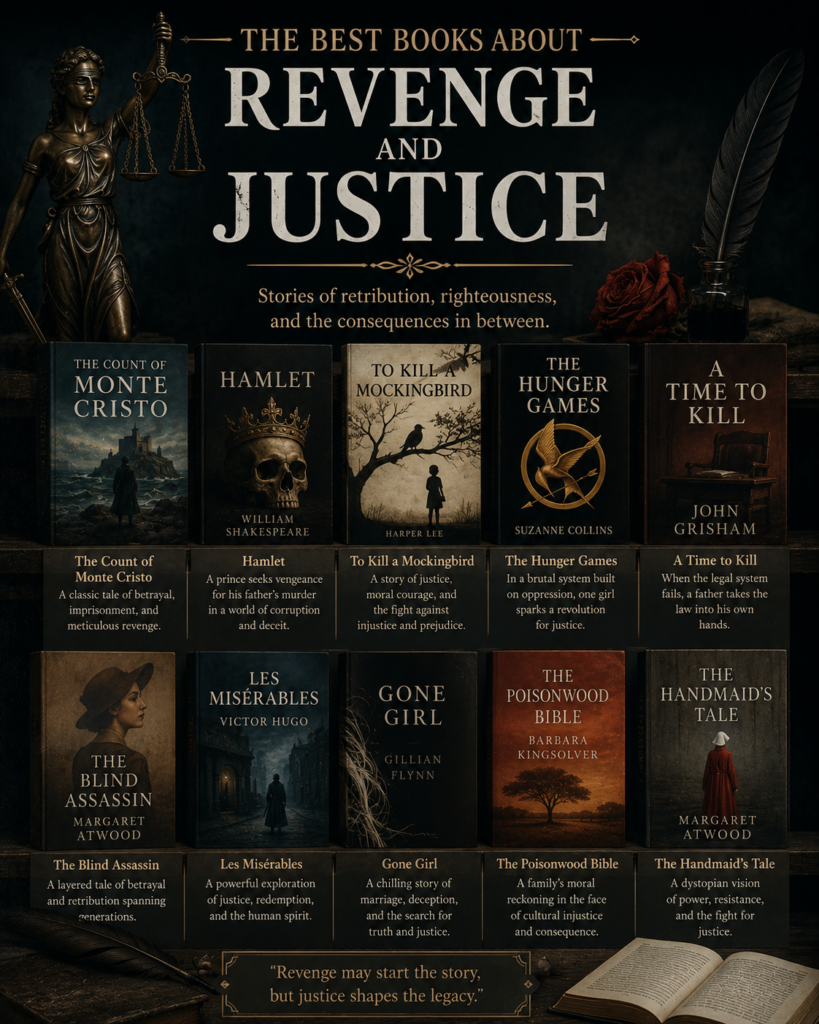
The Best Books About Revenge and Justice ask one hard question: what should happen after someone is wronged? These stories pull readers into pain, anger, punishment, and the search for fairness.

Some books show revenge as a trap. Others show justice as slow, painful, and worth the fight.

In this Guide

  • Why revenge and justice matter in literature
  • Best books to read first
  • Classic revenge and justice stories
  • Symbols and themes to watch for
  • Modern books about revenge and justice
  • FAQ

Why the Best Books About Revenge and Justice Still Matter

These stories stay popular because they deal with feelings almost everyone understands.

Revenge begins with a wound. A person is betrayed, hurt, or ignored by the law. The anger feels fair at first, but many books ask whether revenge can ever heal the damage.

Justice is different. It looks for truth, balance, and repair. In literature, justice often moves slowly, while revenge moves fast.

That tension makes the Best Books About Revenge and Justice so powerful. They do not give easy answers. They make readers ask what they would do in the same place.

Best Books About Revenge and Justice to Read First

Start with books that make the moral conflict clear and easy to follow.

The Count of Monte Cristo by Alexandre Dumas is one of the most famous revenge novels ever written. Edmond Dantès is betrayed, sent to prison, and stripped of his future. When he escapes, he builds a new life around revenge.

At first, his plan feels thrilling. His enemies deserve punishment. Yet the novel slowly asks whether revenge turns Edmond into the kind of person he hates.

Hamlet by William Shakespeare is another key text. Hamlet learns that his father was murdered, and he feels forced to act. But he doubts himself, delays, and studies the meaning of guilt.

This is why many teachers include Hamlet in lessons about revenge tragedy. The play is not only about payback. It is about thought, fear, grief, and the cost of violence.

If Shakespeare feels hard at first, try this helpful guide on how to read difficult classic literature. It can make older texts feel less stressful.

Classic Best Books About Revenge and Justice

Classic literature often treats revenge as both tempting and dangerous.

Medea by Euripides is one of the oldest and darkest revenge stories. Medea is betrayed by Jason, and her anger becomes deadly. The play shows how personal pain can grow into something beyond control.

Wuthering Heights by Emily Brontë also explores revenge across time. Heathcliff is hurt by class shame, rejection, and loss. Instead of finding peace, he spreads pain to the next generation.

Les Misérables by Victor Hugo offers a different view. Jean Valjean is punished by the law, but the law does not always equal justice. His story asks whether mercy can be more powerful than punishment.

The Best Books About Revenge and Justice often show that legal rules and moral truth are not always the same thing.

Symbols and Themes in the Best Books About Revenge and Justice

Revenge and justice stories often use strong symbols to show inner conflict.

In Hamlet, the skull reminds readers that death comes for everyone. It cuts through pride, revenge, and power. Hamlet must face the fact that all human plans end the same way.

In The Count of Monte Cristo, prison becomes a symbol of stolen life. Edmond loses his name, freedom, and trust. His escape feels like rebirth, but his new identity is shaped by anger.

Justice is often linked with light, truth, or confession. Revenge is often linked with masks, secrets, or poison. These symbols help readers see the difference between healing and harm.

A major theme in the Best Books About Revenge and Justice is moral change. The person seeking payback may become colder. The person seeking justice may need patience, courage, and self-control.

Modern Best Books About Revenge and Justice

Modern books often connect revenge and justice to race, gender, class, and history.

Beloved by Toni Morrison is not a simple revenge story. It is a novel about slavery, memory, trauma, and the deep need for justice. The past returns in a haunting form, and the characters must face what was done to them.

True Grit by Charles Portis follows Mattie Ross as she seeks justice for her father’s murder. Mattie is young, sharp, and determined. Her journey shows how revenge can look brave but still carry a heavy cost.

Gone Girl by Gillian Flynn uses revenge in a modern marriage plot. It shows how control, image, and public judgment can shape a person’s idea of justice.

These modern examples prove that the Best Books About Revenge and Justice are not stuck in the past. They still speak to today’s fears about truth, power, and fairness.

Recommended Books to Buy or Borrow

These books are strong choices for students, book clubs, or anyone who wants a deep story with moral conflict.

  • The Count of Monte Cristo by Alexandre Dumas
  • True Grit by Charles Portis

For background on Shakespeare’s revenge tragedy tradition, the Britannica entry on revenge tragedy is a useful place to start.

You can also explore author and poetry resources at the Poetry Foundation, especially if you want to connect themes of justice to poems.

How to Read the Best Books About Revenge and Justice for Class

Do not read these books only for plot. Pay attention to choices.

Ask what the wronged character wants. Is it truth, punishment, peace, or control? The answer often shows whether the story is moving toward justice or revenge.

Watch how the writer treats violence. If revenge seems exciting at first but empty later, that shift matters. Many authors want readers to feel the pull of revenge before they see its cost.

If a book feels slow or difficult, use notes, summaries, and rereading as tools. This guide to reading difficult classic literature can help you stay focused without losing the main ideas.

FAQ About the Best Books About Revenge and Justice

What are the Best Books About Revenge and Justice for beginners?

The Count of Monte Cristo and True Grit are great starting points. Both have clear plots, strong characters, and big moral questions.

Why do authors write so much about revenge?

Revenge creates instant conflict. It also lets authors explore grief, anger, pride, and the limits of human judgment.

Is revenge ever shown as good in literature?

Sometimes revenge feels justified at first. But many books show that it damages the person who seeks it.

What is the difference between revenge and justice?

Revenge is personal payback. Justice seeks truth, fairness, and a result that is larger than one person’s anger.

Key Takeaway

The Best Books About Revenge and Justice show that payback may feel powerful, but it rarely brings peace.

Great literature asks readers to look past anger and think about truth, mercy, guilt, and repair. That is why these stories still matter in classrooms and in everyday life.

In the end, the strongest revenge and justice books do more than punish villains. They ask what kind of person we become when we decide what others deserve.

Types of Conflict in Literature: A Student Guide with Clear Examples

Types of Conflict in Literature

Understanding the Types of Conflict in Literature makes stories easier to read and analyze. Conflict is the struggle that pushes a character to act, change, or fail.

When you know what kind of conflict drives a story, you can write stronger essays and choose books that fit your interests.

In this Guide

Use this guide to move from basic definitions to real literary examples.

  • Why conflict matters in literature
  • The main types of conflict
  • Internal conflict
  • External conflict
  • How to identify conflict in a text
  • Examples from popular books
  • Book suggestions
  • FAQ
Types of Conflict in Literature

Why Types of Conflict in Literature Matter

Conflict gives a story its energy.

Without conflict, a story can feel flat. A character may want something, but there must be a problem in the way.

When students study the Types of Conflict in Literature, they learn to ask better questions. What does the character want? Who or what blocks that goal? What changes because of the struggle?

Conflict also helps reveal theme. In Romeo and Juliet, the conflict between the lovers and their families shows how hate can destroy love. In To Kill a Mockingbird, the conflict between justice and racism helps readers see the cost of doing what is right.

The Main Types of Conflict in Literature

Most stories use more than one conflict, but one usually stands out.

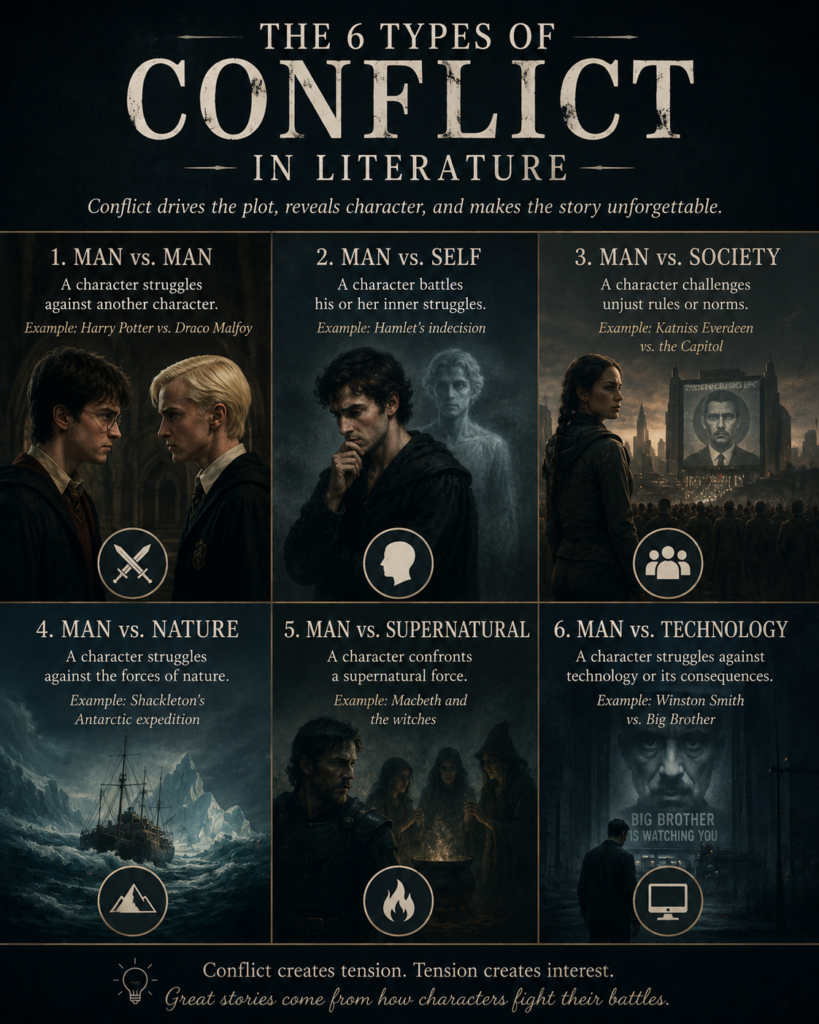
The Types of Conflict in Literature can be split into two broad groups: internal conflict and external conflict.

Internal conflict happens inside a character. The character may face fear, guilt, doubt, or a hard choice.

External conflict happens between a character and an outside force. That force may be another person, a group, nature, technology, fate, or something supernatural.

Many great books combine both. A character may fight an enemy while also fighting fear inside their own mind.

Internal Conflict: Character vs. Self

This type of conflict takes place inside the character’s mind or heart.

In a character vs. self conflict, the main struggle is personal. The character may not know what choice to make. They may feel torn between what they want and what they believe is right.

In Hamlet by William Shakespeare, Hamlet struggles with grief, revenge, and doubt. His enemy is not only Claudius. Hamlet also battles his own thoughts.

In The Catcher in the Rye by J.D. Salinger, Holden Caulfield struggles with sadness and fear of growing up. Much of the novel’s conflict comes from his inner pain.

This conflict is useful in essays because it often connects to character growth. Ask yourself: does the character learn from the struggle, or do they stay trapped?

External Conflict: Character vs. Character

This conflict happens when one character blocks another character’s goal.

Character vs. character conflict is common because people often disagree, compete, or hurt each other. The conflict can be physical, emotional, or moral.

In Harry Potter and the Sorcerer’s Stone by J.K. Rowling, Harry faces Voldemort as a major outside threat. Their conflict grows across the series as Harry learns more about courage and sacrifice.

In Othello by William Shakespeare, Iago works against Othello through lies and manipulation. The conflict is not just about power. It also shows how jealousy can break trust.

When you see this conflict, look at what each character wants. The clash between their goals often drives the plot.

External Conflict: Character vs. Society

This conflict places one person against the rules or beliefs of a group.

In character vs. society conflict, the problem is larger than one enemy. The character may face unfair laws, social pressure, prejudice, or strict traditions.

In The Hunger Games by Suzanne Collins, Katniss Everdeen fights against the Capitol’s cruel control. Her conflict is not only with individual villains. She faces a whole system built on fear.

In Fahrenheit 451 by Ray Bradbury, Guy Montag lives in a society that burns books. His conflict grows when he starts to question the world around him.

This is one of the most powerful Types of Conflict in Literature because it often asks moral questions. What should a person do when society is wrong?

External Conflict: Character vs. Nature

This conflict happens when a character struggles against the natural world.

Nature can include storms, hunger, cold, wild animals, or disease. The key point is that the character faces a force that cannot be reasoned with.

In The Old Man and the Sea by Ernest Hemingway, Santiago struggles with the sea and a great marlin. His battle shows patience, pride, and human endurance.

In Hatchet by Gary Paulsen, Brian must survive alone in the wilderness after a plane crash. The natural world tests his body and mind.

Character vs. nature stories often focus on survival. They may also show how small humans can feel when faced with forces beyond control.

External Conflict: Character vs. Technology

This conflict focuses on machines, science, or systems created by humans.

Character vs. technology is common in science fiction, but it can appear in other genres too. The conflict may involve artificial intelligence, surveillance, weapons, or a machine that changes human life.

In Frankenstein by Mary Shelley, Victor Frankenstein creates life through science and then loses control of what he has made. The novel asks if humans should create something just because they can.

In many dystopian stories, technology helps those in power control people. The danger is not only the machine. The danger is how people use it.

This type of conflict is useful for modern readers because it connects to real questions about privacy, power, and responsibility.

External Conflict: Character vs. Fate or the Supernatural

This conflict involves forces that feel beyond normal human power.

A character may face destiny, prophecy, ghosts, gods, curses, or unseen forces. The struggle often asks whether people control their lives or follow a path already set for them.

In Macbeth by William Shakespeare, the witches give Macbeth a prophecy. He chooses violent actions, but the supernatural pushes him toward ambition and fear.

In Greek tragedy, fate often plays a major role. You can learn more about the tradition of tragic drama through Britannica’s overview of tragedy.

This conflict works well in analysis because it blends choice and pressure. Ask whether the character causes the downfall or becomes trapped by forces outside human control.

How to Identify Types of Conflict in Literature

You can find conflict by tracking what the character wants and what stands in the way.

A quick way to spot the Types of Conflict in Literature is to focus on the main problem. If the problem comes from inside the character, it is internal. If the problem comes from outside, it is external.

Try asking these questions as you read:

  • What does the main character want?
  • What blocks that goal?
  • Is the struggle inside the character or outside the character?
  • Does the conflict change the character?
  • What larger idea does the conflict reveal?

If you want to build stronger reading habits, this guide on how to read literature like a scholar can help you notice deeper patterns in a text.

Types of Conflict in Popular Books

Well-known books often use several conflicts at once.

In Lord of the Flies by William Golding, the boys face nature on the island, but their deeper conflict is with each other and their own fear. The novel shows how quickly order can fall apart.

In Things Fall Apart by Chinua Achebe, Okonkwo faces personal pride, family pressure, and the arrival of colonial power. His conflicts help reveal the strain between tradition and change.

In The Great Gatsby by F. Scott Fitzgerald, Gatsby struggles against class barriers and his own dream of the past. The conflict shows how desire can turn into illusion.

These examples show why the Types of Conflict in Literature matter for essays. Conflict is rarely just a problem. It is often the key to the book’s meaning.

How Conflict Shapes Theme

Conflict and theme often work together.

Theme is the message or insight a story gives about life. Conflict helps create that message because characters reveal who they are under pressure.

In Animal Farm by George Orwell, the animals fight against human control, but they later face corruption inside their own new society. The conflict helps show how power can twist noble ideas.

In The Odyssey, Odysseus faces monsters, storms, and temptation. His long journey shows the value of loyalty and cleverness.

When you write about the Types of Conflict in Literature, do not stop at naming the conflict. Explain what it teaches the reader.

Common Mistakes Students Make with Types of Conflict in Literature

Many students can name conflict, but strong analysis goes one step deeper.

One common mistake is to choose the first conflict that appears. A story may start with one problem but focus on a deeper one later.

Another mistake is to ignore internal conflict. A character may seem to fight a person or society, but the real struggle may be fear, guilt, or pride.

Students also sometimes list the conflict without linking it to theme. A better answer explains how the conflict changes the character or reveals the author’s message.

For deeper reading practice, use scholar-style reading strategies to connect conflict with symbols, setting, and character choices.

Books That Help You Study Conflict

These books are strong choices for students who want clear examples of conflict.

  • Lord of the Flies by William Golding
  • Things Fall Apart by Chinua Achebe

Both novels are often available through school libraries, local bookstores, and Amazon. They also work well for essays because each book includes internal and external conflict.

Helpful Outside Resources

Use trusted literary sources when you need background or context.

The Poetry Foundation is useful for poems, poet biographies, and literary terms. Britannica also offers clear background on major forms, authors, and literary history.

FAQ About Types of Conflict in Literature

Here are quick answers to common student questions.

What are the main Types of Conflict in Literature?

The main types are internal conflict and external conflict. External conflict can include character vs. character, society, nature, technology, fate, or the supernatural.

Can a story have more than one conflict?

Yes. Most strong stories use more than one conflict. One conflict may drive the plot, while another shows the character’s inner struggle.

Why is conflict important in a story?

Conflict creates tension and gives characters a reason to act. It also helps reveal theme and character growth.

How do I write about conflict in an essay?

Name the conflict, give a clear example, and explain why it matters. Connect it to the character’s change or the story’s main idea.

Key Takeaway

The Types of Conflict in Literature help readers see what drives a story. Once you understand the main struggle, you can better explain character, theme, and meaning.

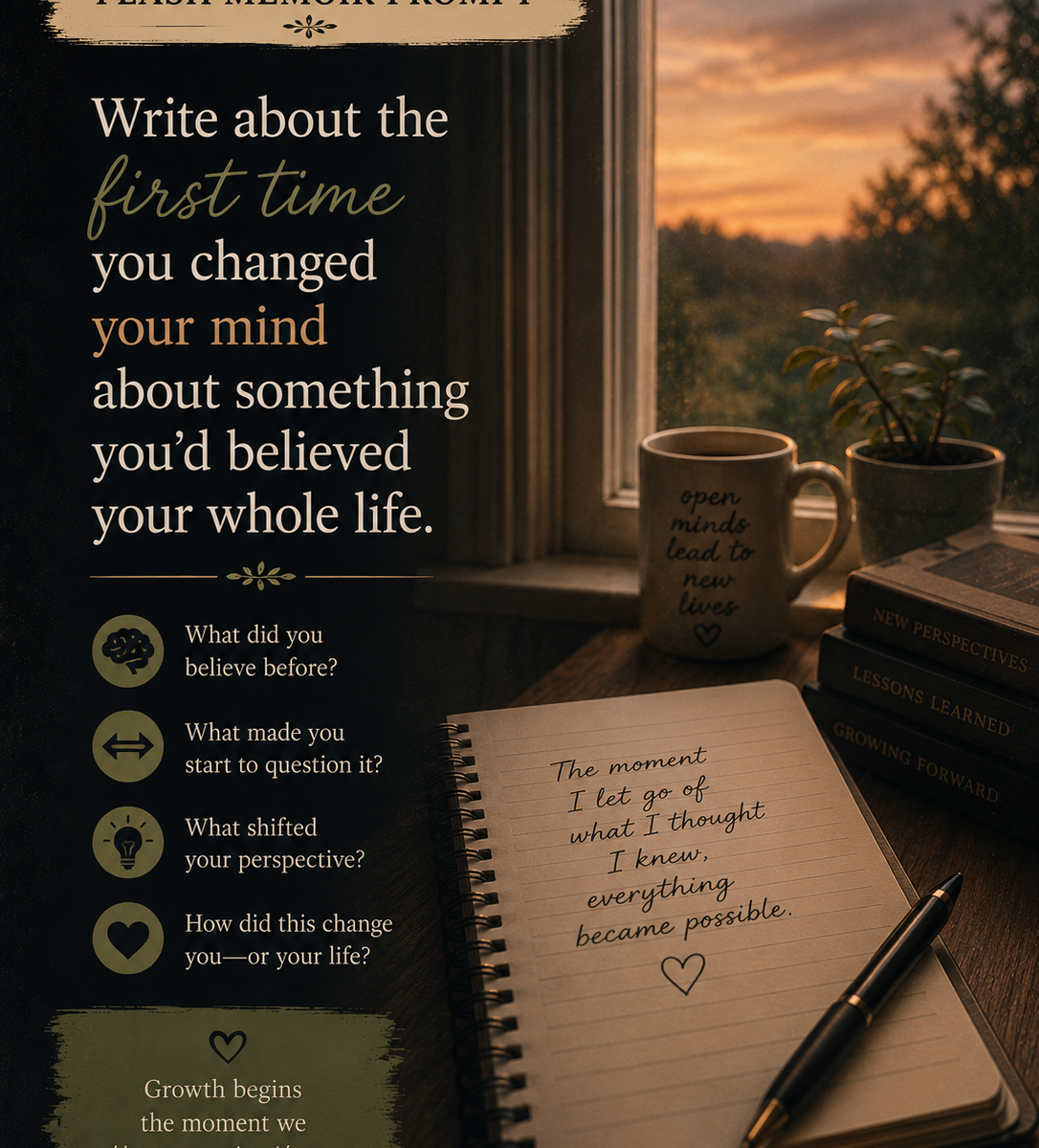
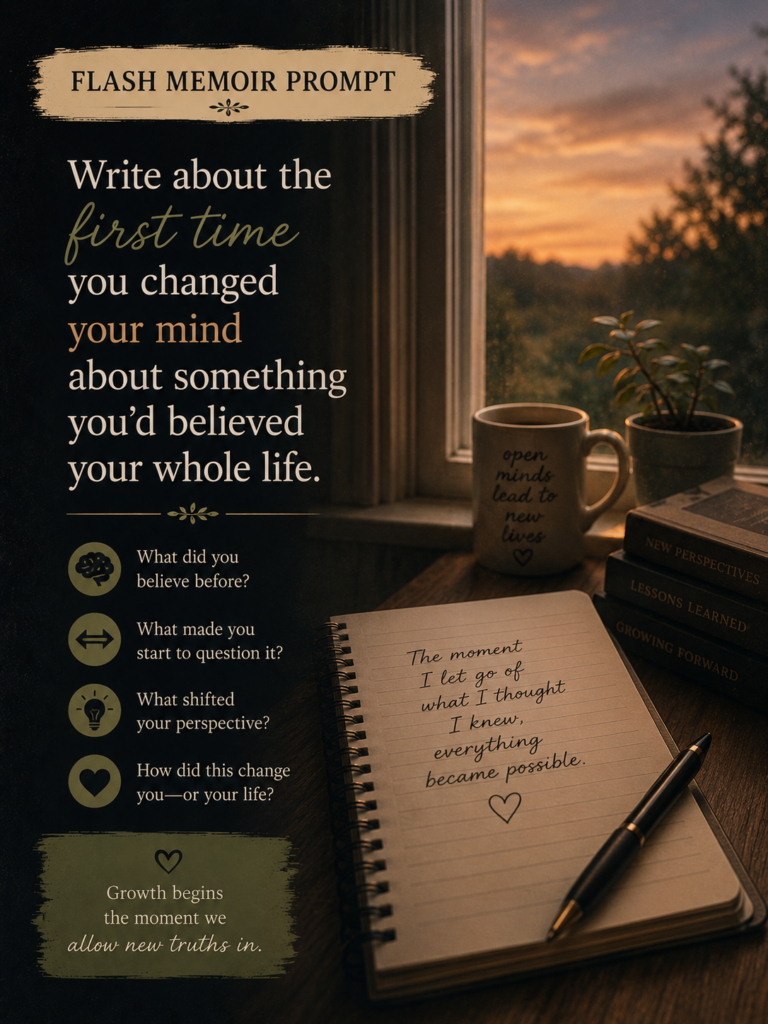
Flash Memoir Prompt: First Time You Changed Your Mind About Something You’d Believed Your Whole Life

Flash memoir prompt changed your mind

A focused writing invitation about the first time a lifelong belief cracked open, using one clear memory, one honest detail, and the quiet surprise of realizing you were wrong. Maybe it happened at a kitchen table, in a classroom, during a car ride, or while watching someone you loved do the opposite of what you expected. This flash memoir prompt first time changed mind something asks you to return to that small turning point, before it became a lesson you could explain.

Changing your mind can feel embarrassing at first. You may remember the heat in your face, the need to defend yourself, or the strange silence that came after you realized the old answer no longer fit. The moment may have been loud and dramatic, or so quiet that no one else even noticed.

Flash memoir prompt changed your mind

The Prompt

Write about the first time you changed your mind about something you’d believed your whole life.

This prompt can unlock a meaningful memory because it points to a shift. Memoir often lives in the space between who you were then and who you became later. A belief you carried for years might have come from family, faith, school, culture, fear, or love. Then one scene made you pause.

You do not need to write about a huge public issue. You might write about the first time you realized your parent was not always right, the first time you doubted a rule you had followed, or the first time you saw someone you had judged with more kindness. The power is in the moment when certainty gives way.

Why This Memory Matters

A changed mind is rarely just about facts. It is usually about identity. When you let go of a belief, even a small one, you may also let go of a version of yourself.

That is why this flash memoir prompt first time changed mind something can lead to a layered story. On the surface, you may be writing about an argument, a book, a teacher, a friend, a news story, or a family secret. Underneath, you may be writing about loyalty, shame, courage, or grief.

For example, maybe you grew up believing that asking for help meant weakness. Then you watched someone strong reach out when life became too heavy. That memory is not only about changing an opinion. It is about seeing strength in a new shape.

Or maybe you believed your hometown was boring and small until you left it. One ordinary street, seen after months away, might reveal something tender you had missed. A good flash memoir does not need to announce its theme. It lets the reader feel it through the scene. If you want to think more about that deeper meaning, this guide on how to identify theme in literature can also help you notice the theme inside your own memories.

How to Approach This Prompt

Begin with the exact second before your mind started to change. Do not start with the lesson. Start with the room, the weather, the smell of coffee, the sound of someone’s voice, or the object your hands were holding.

Try to narrow the memory to one scene. If you try to explain your whole belief system from childhood to adulthood, the piece may grow too wide. Flash memoir works best when you choose one clear moment and let it carry the weight.

You might begin with a sentence like, “I still believed my father knew everything when he got lost on the way to the hospital.” Or, “I was sixteen and certain rich people were happy until I saw my aunt cry in her parked car.” Sentences like these place the reader inside a moment and hint at change.

Write what you noticed before you explain what it meant. What did the person say? What did you want to say back? Did you feel defensive, confused, relieved, or angry? Let the first draft stay close to the body.

After you draft the scene, you can look back and mark the turning point. If you enjoy close reading your own work, these tips on how to annotate literature can be useful for rereading your draft. Circle the sentence where the old belief starts to loosen.

For this flash memoir prompt first time changed mind something, avoid trying to make yourself look wise too quickly. Let the younger version of you be sincere. The reader will trust the change more if they can see why the old belief once made sense.

A Quick Example

I believed teachers lived at school until third grade, and I mean I truly believed it. They were part of the building, like the flagpole or the pencil sharpener bolted to the wall. Then one Saturday morning, I saw Mrs. Alvarez in the cereal aisle at the grocery store. She wore jeans and old sneakers. Her hair was wet, and she had a box of cornflakes tucked under one arm. I ducked behind my mother’s cart because it felt wrong, like seeing the moon in daylight. Mrs. Alvarez smiled and said, “Good morning, Daniel.” I could barely answer. All week, she had seemed like a person who knew every answer. That morning, she looked tired and kind and real. I never listened to her the same way again.

Try It Yourself

Set a timer for ten minutes and write one scene from the first time you changed your mind about something you had always believed. Keep the focus small. Choose one place, one conversation, or one image that stayed with you.

If the memory feels uncomfortable, write around the edge of it first. Describe the chair, the light, the food on the table, or the sound in the room. You can move toward the emotional truth slowly.

When you finish, ask yourself one question: What did I believe at the beginning of this scene that I could no longer believe by the end? That answer may become the final line, or it may stay hidden beneath the story. Either way, it will shape the piece.

Want More Flash Memoir Prompts?

If this prompt helped you find a turning point worth writing about, you may enjoy a full year of short, focused memory invitations. Explore all 365 prompts in The Memory Trigger: 365 Flash Memoir Writing Prompts.

The Memory Trigger

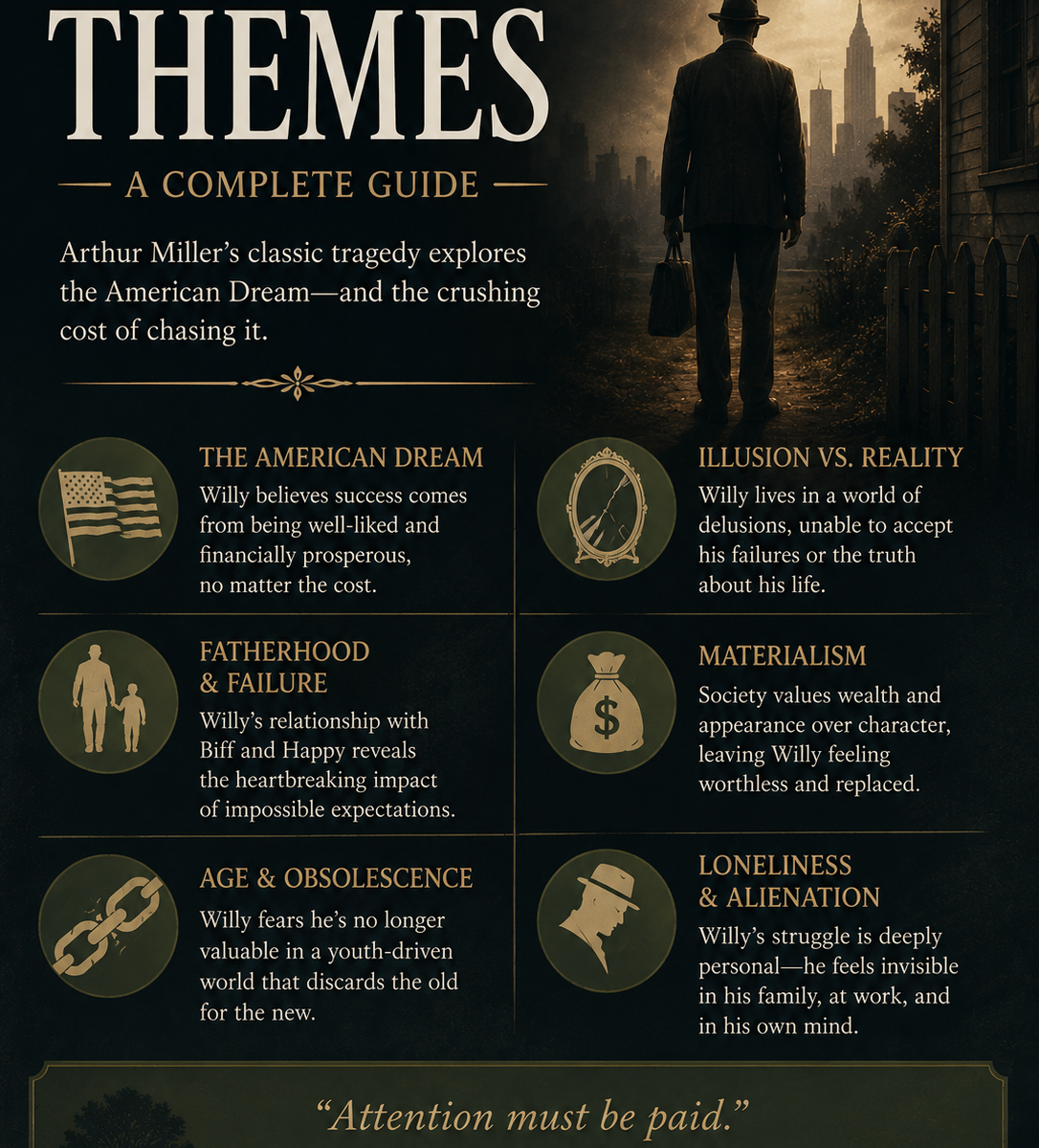
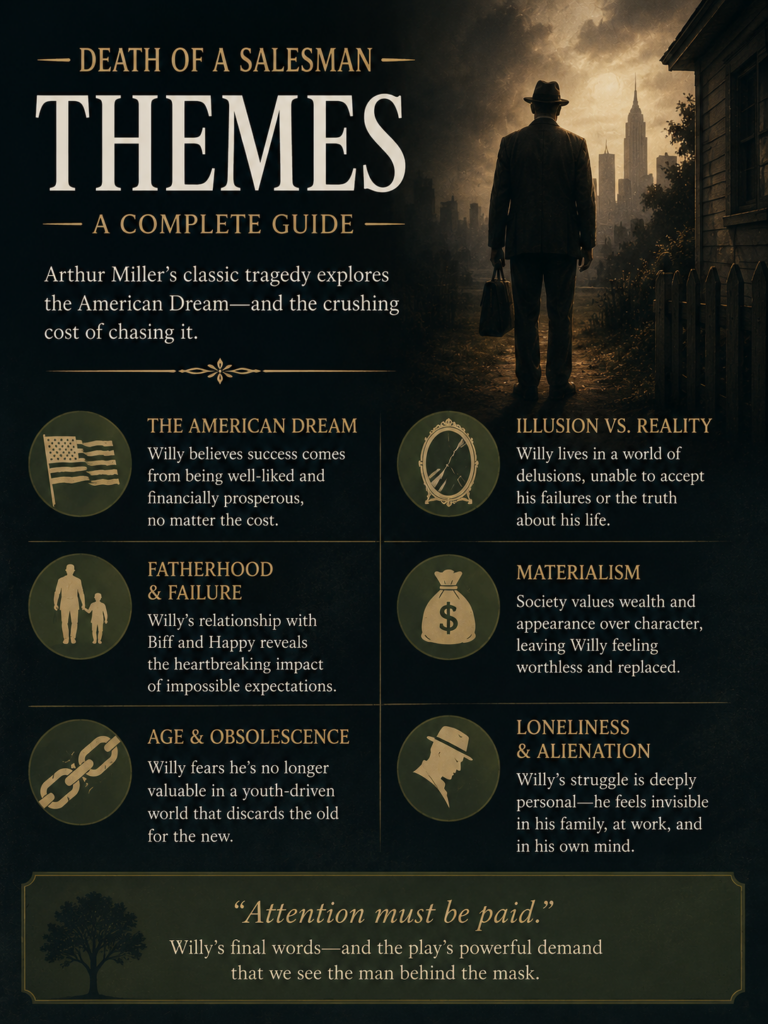
Themes in Death of a Salesman: A Student-Friendly Guide

Themes in Death of a Salesman

Death of a Salesman is a short play with big questions about dreams, work, family, and self-worth. This guide explains the themes in Death of a Salesman in a clear way so students can read the play with more confidence.

Arthur Miller does not give easy answers. He asks us to look closely at what happens when a person builds a life on a dream that may not be true.

In this Guide

Use these sections to review the play, plan an essay, or prepare for class discussion.

Themes in Death of a Salesman

Why the themes in Death of a Salesman Matter

The play is not only about one salesman. It is about a culture that tells people their value depends on success.

When students study the themes in Death of a Salesman, they often notice that Willy Loman wants more than money. He wants respect. He wants proof that his life mattered.

A theme is not just a topic like money or family. It is the deeper message a work builds around that topic. If you want a quick refresher, see our guide on how to identify theme in literature.

Themes in Death of a Salesman: The American Dream and False Success

Willy believes success comes from charm, popularity, and being well-liked. The play slowly shows how dangerous that belief can be.

Of all the themes in Death of a Salesman, the American Dream is the most famous. Willy thinks America should reward him if he works hard and presents himself well. Yet his life proves that the dream can be unfair, narrow, and cruel.

Biff sees this more clearly than Willy. He knows he has failed by his father’s standards, but he also knows those standards are broken. His conflict shows that a person can only heal by telling the truth.

This theme connects well with The Great Gatsby by F. Scott Fitzgerald. Both works question the dream of wealth and status. Both show people who chase an image of success and lose themselves along the way.

Themes in Death of a Salesman: Family, Love, and Pressure

The Loman family loves each other, but love often turns into pressure. That pressure shapes every major conflict in the play.

The themes in Death of a Salesman become painful inside the home. Willy wants his sons to succeed because he sees them as proof of his own worth. Biff wants freedom, but he also wants his father to understand him.

Linda often tries to protect Willy. Her care is real, but it also keeps some hard truths hidden. Happy copies Willy’s false confidence, which suggests that family patterns can repeat if no one breaks them.

The play asks a hard question: can love still hurt people? Miller’s answer seems to be yes, especially when love comes with impossible demands.

Illusion Versus Reality

Willy often chooses the story he wants over the truth he needs. That gap creates much of the tragedy.

Many themes in Death of a Salesman depend on the battle between illusion and reality. Willy remembers the past as brighter than it was. He also imagines success as something close, even when the facts say otherwise.

The play uses symbols to show this struggle. Seeds suggest Willy’s wish to leave something behind. Stockings remind him of guilt. The flute music points to a simpler life he never chose.

This conflict is clear in Biff’s final honesty. He does not become a perfect hero, but he sees the truth more clearly than his father. That makes his insight important.

Themes in Death of a Salesman: Identity and Self-Worth

Willy’s tragedy grows from the way he ties his identity to his job. When the job rejects him, he feels like his whole life has failed.

The themes in Death of a Salesman show how easy it is to confuse what a person does with who a person is. Willy is not just a worker, yet he has been taught to measure himself as one.

His last name, Loman, sounds like low man. That detail fits his place in the business world. He wants to feel large, but the system makes him feel small.

This theme can remind students of The Metamorphosis by Franz Kafka. Gregor Samsa is also valued for his work until he can no longer perform. Both texts ask what happens when human worth depends on usefulness.

Capitalism, Work, and Human Value

Miller’s play criticizes a world that treats people like products. Willy sells goods, but he also feels forced to sell himself.

The play does not say work is bad. It asks why a person must lose dignity just to survive. Willy gives years to his company, but that loyalty does not protect him.

This makes the play a social critique as well as a family tragedy. For more background on the play and Miller’s place in American drama, visit Britannica’s overview of Death of a Salesman.

Students should notice how work affects every family member. Money problems shape the mood of the house, and success feels like a test no one can pass.

How to Write About themes in Death of a Salesman

A strong essay should connect theme to character choices, symbols, and conflict. Do not just name a theme. Show how the play builds it.

For example, you could argue that Willy’s dream fails because it depends on appearance instead of truth. You could also argue that Biff’s honesty offers the only real escape from the family’s cycle.

If you need help turning ideas into a thesis, review our step-by-step theme guide. You can also explore our student literature study resources for more support with close reading and essay prep.

Here is a simple thesis frame:

  • In Death of a Salesman, Arthur Miller shows that the American Dream becomes harmful when it teaches people to value image over truth.
  • Through Willy and Biff, Miller suggests that self-worth must come from honesty rather than public approval.

Relevant Books for Further Reading

If you want more context, these books pair well with the play:

  • Death of a Salesman by Arthur Miller
  • The Crucible by Arthur Miller
  • A Raisin in the Sun by Lorraine Hansberry

FAQ About the themes in Death of a Salesman

What are the main themes in Death of a Salesman?

The main themes include the American Dream, family pressure, illusion versus reality, self-worth, and the value of work.

What is the most important theme in the play?

The American Dream is often seen as the central theme. Willy believes success will prove his worth, but that belief destroys him.

How does Biff connect to the play’s themes?

Biff challenges Willy’s false dream. His honesty shows that truth can be painful but necessary.

Is Willy Loman a tragic hero?

Many readers see him as a modern tragic figure. He is flawed, but his pain reflects larger problems in society.

Key Takeaway

The themes in Death of a Salesman matter because they still feel real. Miller shows how dreams can inspire people, but he also shows how a false dream can break a family and a life.

error

Enjoy this article? Please spread the word :)

Follow by Email
BLUESKY
fb-share-icon
Reddit
LinkedIn
Share
RSS