Have you ever looked at an image and felt as though it was trying to tell you a story?
This ekphrastic poetry prompt invites you to step into a dreamlike scene filled with mystery, beauty, and unanswered questions. Ekphrastic writing encourages poets to respond to visual art with words. Instead of describing every detail, the goal is to explore the emotions, memories, and ideas the image awakens.
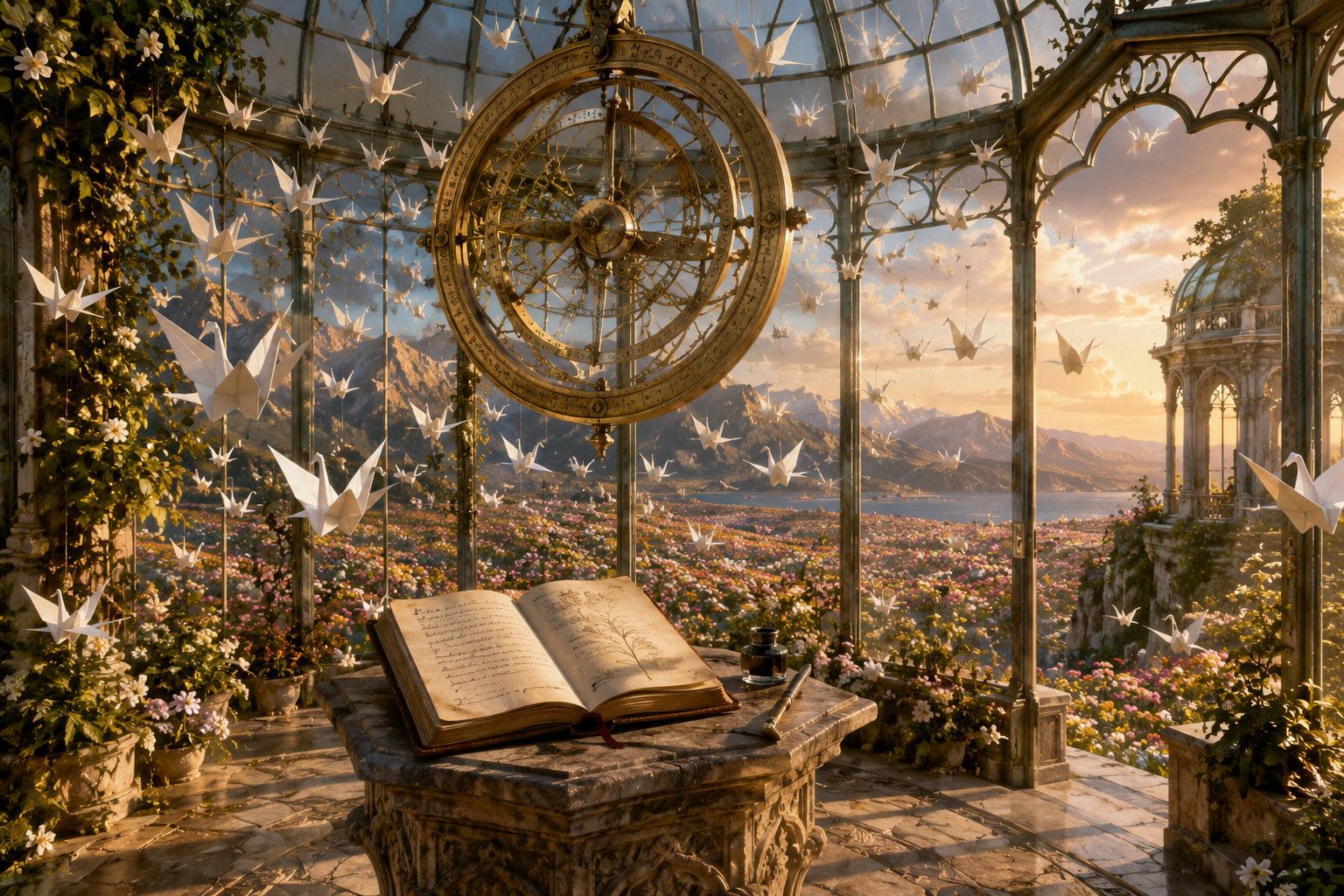
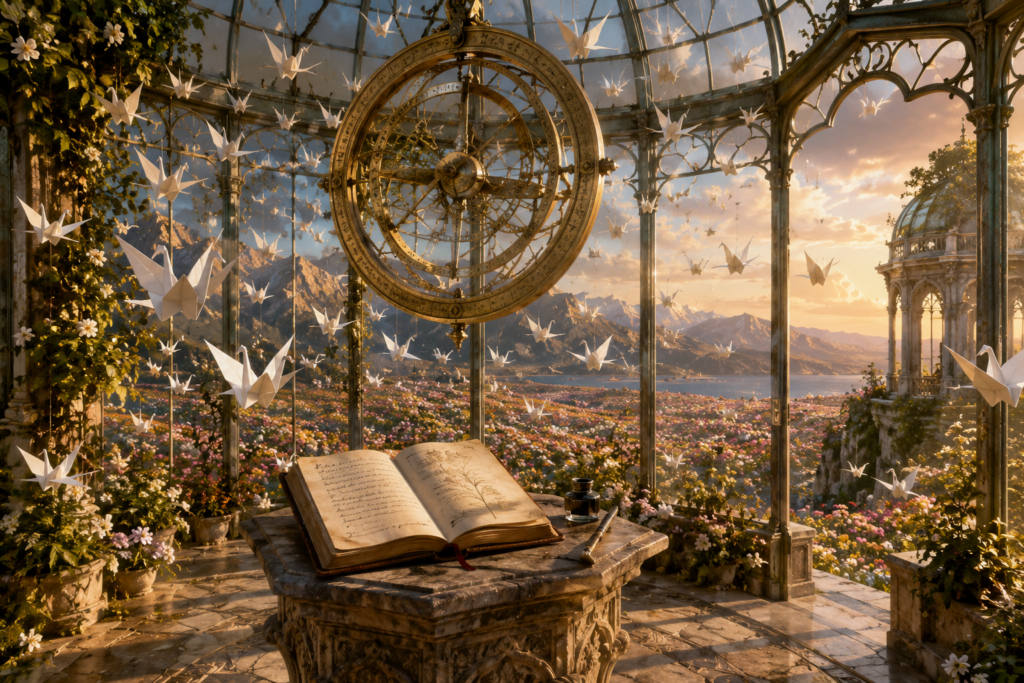
The image presents a strange but inviting setting. A glass conservatory sits above an endless field of flowers. White paper cranes move through the air. A giant astrolabe hangs suspended as if time itself has paused. An open journal waits on a stone pedestal.
Each object raises questions.
Who built this place? Why are the cranes gathering? What has been written in the journal? Is the astrolabe measuring stars, memories, or something else entirely?
Strong poetry often begins with curiosity. This ekphrastic poetry prompt gives you several symbolic elements that can spark a narrative, a meditation, or a lyrical exploration.
The Image
Imagine standing inside the conservatory. Sunlight filters through the glass walls. The scent of flowers drifts upward from the valley below. Hundreds of paper cranes circle overhead while the brass astrolabe slowly turns.
An open journal rests before you.
One page contains a message.
You cannot see all of the words.
You can only read the first sentence.
Write the poem that follows.
Writing From This Ekphrastic Poetry Prompt
You do not need to explain every detail in the scene. Focus on the element that captures your attention most strongly.
Perhaps the journal belongs to a traveler who never returned. Maybe the paper cranes carry messages from lost loved ones. The astrolabe could represent fate, memory, hope, or a search for direction.
As you write, pay attention to imagery and symbolism. If you would like a refresher on poetic techniques, our guide to literary devices in poetry offers useful examples: https://rapidreadspress.com/literary-devices-in-poetry/
Questions to Explore
What is written in the journal?
Why do the paper cranes circle the conservatory?
Who visits this place?
What does the astrolabe measure?
What emotion fills the space?
Or, what happens when the final crane lands?
You may answer one question or many. The strongest poems often grow from a single image that refuses to leave your mind.
A Creative Challenge
Write your poem in the voice of the conservatory itself.
What has it witnessed over the years?
What secrets does it keep?
How does it feel when visitors arrive searching for answers?
Changing the speaker can transform a familiar description into something surprising and memorable.
Learn More About Ekphrastic Poetry
Many poets throughout history have responded to visual art. The Academy of American Poets provides an excellent introduction to the tradition and examples of famous ekphrastic works: https://poets.org/glossary/ekphrasis
Whether your poem becomes a story, a reflection, or a meditation on wonder, this ekphrastic poetry prompt offers a rich visual world filled with symbols waiting for interpretation.
Take a few minutes to study the scene. Then begin with the first sentence you can imagine appearing in that journal and see where it leads.
A focused flash memoir prompt about the quiet, painful moment when you understood a friendship had ended before anyone said goodbye.
You may remember the moment as a small shift. A seat left empty beside you. A text that sounded polite instead of familiar. A laugh you were no longer part of. The strange thing about losing a friendship is that it often happens before the final conversation, if there ever is one.
This flash memoir prompt first time realized friendship already over asks you to notice that in-between space. The friendship may have looked normal from the outside, but inside you knew something had changed. That is a powerful place to write from because it holds confusion, loyalty, embarrassment, grief, and maybe relief.
The Prompt
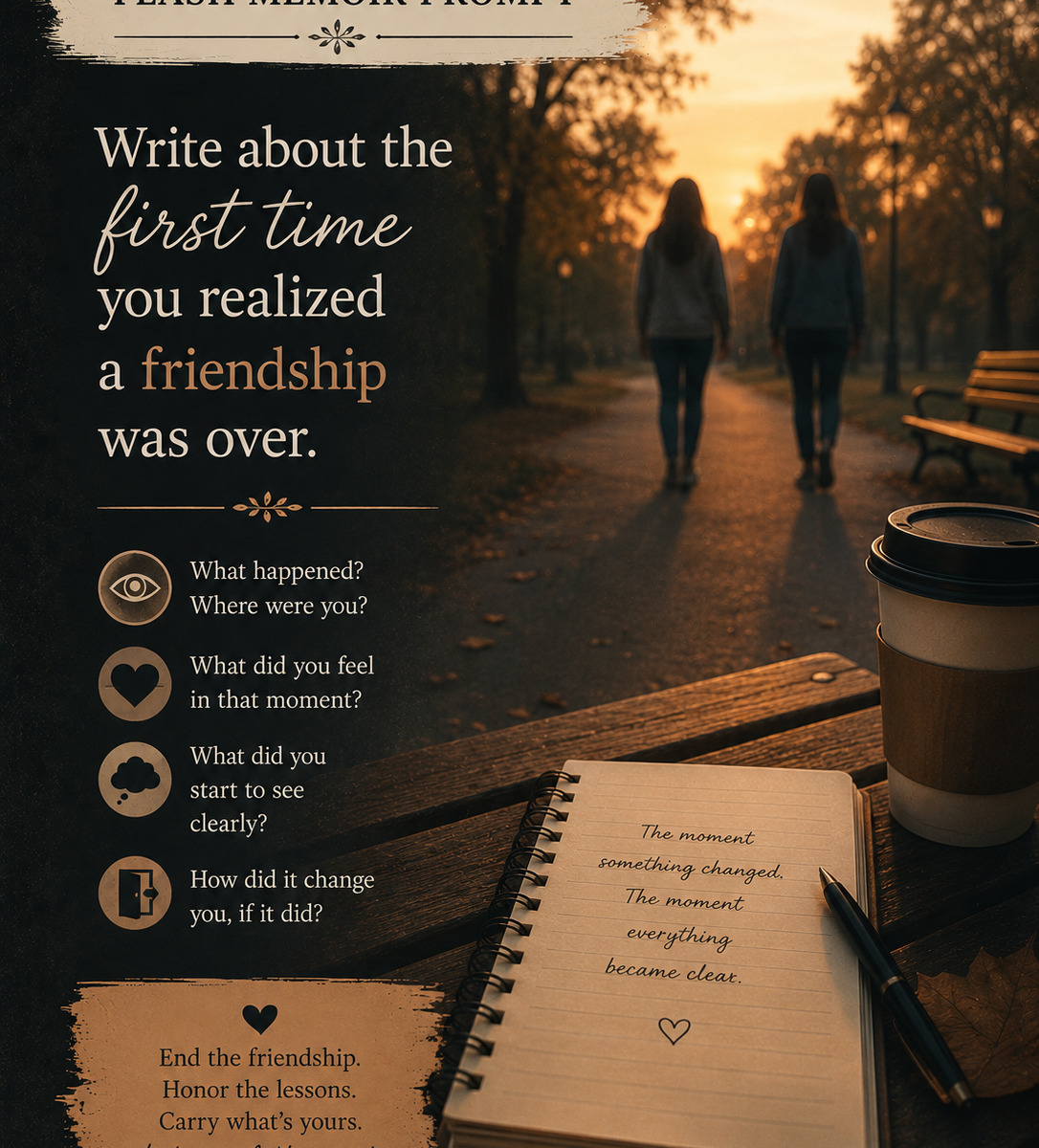
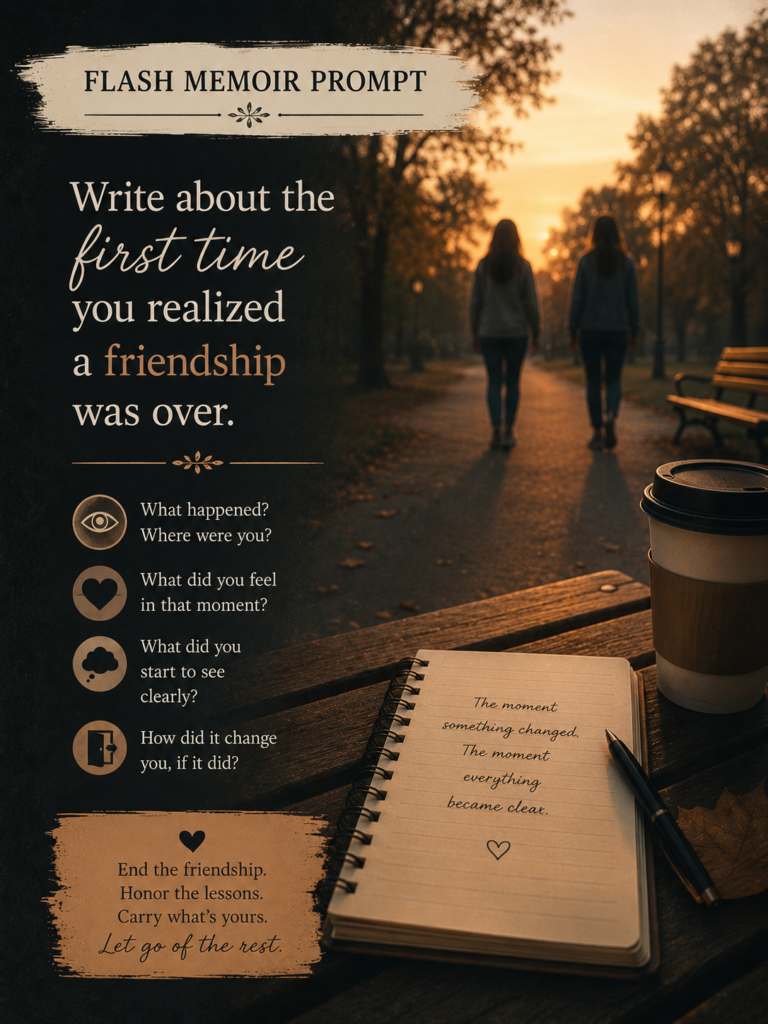
Write about the first time you realized a friendship was already over, even though no one had said so.
This prompt can unlock a meaningful memory because it does not ask for the whole history of the friendship. It asks for one moment of recognition. Maybe you were sitting across from someone you used to tell everything to and could not think of one honest thing to say. Maybe you saw them with new friends and felt less jealous than you expected. Maybe you noticed you had stopped saving funny stories for them.
The best flash memoir pieces often begin with a tiny moment that carries a larger truth. This one invites you to write about silence, distance, and the quiet way people sometimes leave each other.
Why This Memory Matters
A friendship ending can feel harder to explain than a breakup. There may be no clear fight, no final line, and no one to blame. That can make the memory slippery. You know it mattered, but you may not know where to begin.
This is where the prompt helps. It asks you to focus on the first time you realized the friendship was already over. That moment has shape. It may have a room, a season, a smell, a sound. It may have a sentence that landed wrong or a pause that lasted too long.
Writing about this kind of memory can reveal who you were then. Maybe you were trying hard to act normal. Maybe you were angry and refused to admit you were hurt. Maybe you kept making excuses for the other person because admitting the truth felt too final.
The story does not need to prove who was right. It does not need to solve the friendship. It only needs to show the moment when your body knew before your words did.
If you are a student or a newer writer, this kind of prompt can also help you build stronger scenes. When you study people in stories, you look for what they say and what they avoid saying. The same skill matters in memoir. This guide on how to analyze characters in literature can help you think about memory with the same close attention.
How to Approach This Prompt
Begin with a physical detail. Do not start by explaining the entire friendship. Start with the cafeteria table, the bus window, the phone screen, the birthday party, the hallway, or the sound of their voice when it no longer sounded like home.
Choose one scene. Keep the memory narrow. If you try to tell how you met, how close you became, what changed, and where you are now, the piece may grow too large. Flash memoir works best when the writer trusts one clear moment.
Write what you noticed before you explain what it meant. For example, instead of starting with “I knew we were no longer friends,” you might begin with, “She saved a chair for someone else and did not look up when I walked in.” That kind of detail lets the reader feel the shift with you.
You can also pay attention to what you did next. Did you pretend not to care? Did you make a joke? Did you leave early? Did you sit there and act like nothing had happened? Your reaction may reveal the emotional truth of the memory.
If you want to sharpen your scene, try marking the details that feel alive on the page. Notice the lines where the tension rises or where the silence says more than speech. This simple practice is close to how to annotate literature, except this time the text is your own life.
For this flash memoir prompt first time realized friendship already over, you do not have to write with blame. You can write with honesty. Let the memory be as mixed as it was.
A Quick Example
At lunch, Maya sat at the far end of the table with her new choir friends. She saw me come in. I know she did because her eyes moved over my face, quick as a camera flash, before she looked back down at her tray. There was one open chair beside her, but her backpack was on it. I stood there with my milk carton getting cold in my hand and waited for her to move it. She did not. Someone at the table said something, and Maya laughed in that high, bright way she used when she wanted people to like her. I walked to another table before anyone could notice I had been waiting. That was the first time I understood we were not in a fight. We were already finished.
Try It Yourself
Set a timer for ten minutes and write the scene without stopping. Begin with the first physical detail you remember. Let the place do some of the work. The chipped table, the message bubble, the empty seat, or the closed bedroom door can carry more feeling than a long explanation.
If the memory still hurts, write it gently. You do not have to name every reason the friendship ended. You can stay with the moment when you realized the truth and let that be enough for today.
This flash memoir prompt first time realized friendship already over is really about recognition. It asks you to recall the instant when pretending became harder than knowing. That instant may be small, but it can hold a whole story.
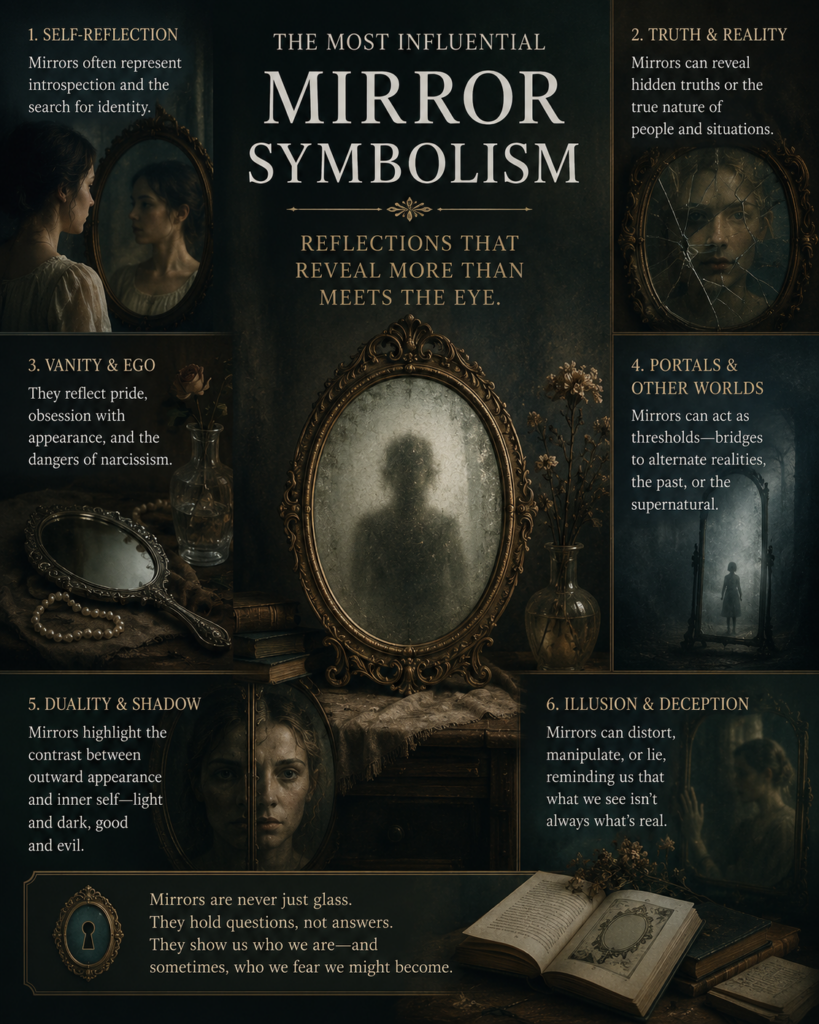
Mirrors in stories do more than show a face. The Most Influential Mirror Symbolism often reveals truth, fear, desire, or a hidden part of the self.
From fairy tales to modern poems, mirror scenes help readers see what a character cannot say out loud. That is why this symbol still feels fresh in classrooms and book clubs today.
In this Guide
Why mirror symbolism matters
Most Influential Mirror Symbolism in classic literature
Mirror symbolism in poems and fairy tales
Common themes linked to mirrors
Recommended books with mirror symbolism
How to analyze mirror scenes
FAQs about mirror symbolism
Why the Most Influential Mirror Symbolism Still Matters
Mirrors are simple objects, but writers use them to ask hard questions.
The Most Influential Mirror Symbolism often deals with identity. A character looks into a mirror and faces a version of the self that may feel strange, broken, proud, or false.
This makes mirrors useful in stories about growing up, guilt, beauty, madness, and truth. A mirror can show what society values, but it can also show what society hides.
Readers often remember mirror scenes because they feel private. A character alone with a reflection can reveal more than a long speech.
Most Influential Mirror Symbolism in Classic Literature
Classic works use mirrors to expose desire, fear, and the danger of self-image.
One famous example appears in “Snow White.” The magic mirror does not just answer a question about beauty. It shows how power and jealousy can grow from obsession.
The queen needs the mirror to confirm her worth. When it stops doing that, she turns cruel. This is one reason the Most Influential Mirror Symbolism often connects beauty with control.
In Mary Shelley’s Frankenstein, the creature sees his reflection and understands how others may see him. That moment is painful because it joins self-awareness with rejection.
Oscar Wilde’s The Picture of Dorian Gray does not center on a mirror, but the portrait works like one. It reflects Dorian’s inner corruption while his face stays young.
This is a key mirror-like symbol. It asks whether a person can hide from the truth if the surface still looks perfect.
Mirror Symbolism in Poems and Fairy Tales
Poets and fairy-tale writers often use mirrors to make truth feel sharp.
Sylvia Plath’s poem “Mirror” is one of the clearest examples of the Most Influential Mirror Symbolism in modern literature. The mirror speaks as if it has no feelings, yet the poem feels deeply emotional.
The speaker says it reflects “faithfully.” Still, that honesty hurts the woman who looks into it. You can read the poem at the Poetry Foundation.
In fairy tales, mirrors often know what humans refuse to admit. They may act like judges, warnings, or magical doors.
Lewis Carroll’s Through the Looking-Glass turns the mirror into a passage. Alice steps through it and enters a world where logic shifts. Here, the mirror suggests a second reality that sits just behind ordinary life.
Common Themes in the Most Influential Mirror Symbolism
Mirror symbols often return to the same deep concerns.
Identity is the most common theme. A mirror can make a character ask, “Who am I really?” This matters in stories where people feel split between public image and private truth.
Vanity also appears often. When a character trusts the mirror too much, the story may warn against pride or shallow judgment.
Self-knowledge is another major idea. The Most Influential Mirror Symbolism often marks the moment when a character can no longer avoid the truth.
Mirrors can also show social pressure. A character may not see the real self, but instead the version shaped by beauty rules, class, gender, or power.
These works are strong choices for students who want to study reflection, identity, and truth.
Through the Looking-Glass by Lewis Carroll
Frankenstein by Mary Shelley
Both books show why the Most Influential Mirror Symbolism lasts across time. Carroll uses the mirror as a doorway into strange logic. Shelley uses reflection to show pain, isolation, and self-awareness.
If you want a shorter text, pair either book with Sylvia Plath’s “Mirror.” It works well for poetry study, AP Literature practice, or a quick close reading lesson.
How to Analyze the Most Influential Mirror Symbolism
A good mirror scene usually changes how we understand a character.
Start by asking what the mirror shows. Does it reveal beauty, fear, age, guilt, or desire?
Then ask what the character feels. A calm reaction means something very different from panic, shame, or anger.
Look at the setting too. A mirror in a bedroom feels private. A magic mirror in a palace may connect reflection with power.
The Most Influential Mirror Symbolism becomes clearer when you ask what truth the character wants to avoid. If the mirror forces that truth into view, it is likely doing important symbolic work.
Mirror Symbolism and Literary Culture
Mirrors remain popular because they fit the way people think about image today.
Modern readers live in a world full of photos, screens, and self-presentation. That makes mirror symbolism feel even more relevant.
Stories with mirrors ask whether the image we show is the same as the person we are. This question appears in old myths, Gothic novels, poems, and young adult fiction.
The Most Influential Mirror Symbolism also links literature with art history and psychology. For background on symbolism as a larger movement, see Britannica’s overview of Symbolism.
FAQs About Most Influential Mirror Symbolism
What does a mirror usually symbolize in literature?
A mirror often symbolizes identity, truth, vanity, or self-knowledge. It can show how a character sees the self or how society judges that character.
Why do writers use mirrors in stories?
Writers use mirrors because they create strong visual moments. A reflection can reveal inner conflict without long explanation.
What is the best example of mirror symbolism?
“Snow White” is one of the best-known examples. Sylvia Plath’s “Mirror” is one of the strongest literary examples for close reading.
Can a mirror symbolize lies?
Yes. A mirror can seem truthful, but it may also reflect a false image, a shallow value system, or a character’s distorted view of the self.
How do I write about mirror symbolism in an essay?
Focus on what the mirror shows, how the character reacts, and what theme the scene supports. Connect the symbol to the larger meaning of the work.
Key Takeaway
The Most Influential Mirror Symbolism in literature helps readers see hidden truths. In literature, a mirror is rarely just glass. It reflects identity, pressure, fear, and the difficult act of knowing yourself.
When a character looks into a mirror, pay attention. The story may be showing its deepest truth in plain sight.
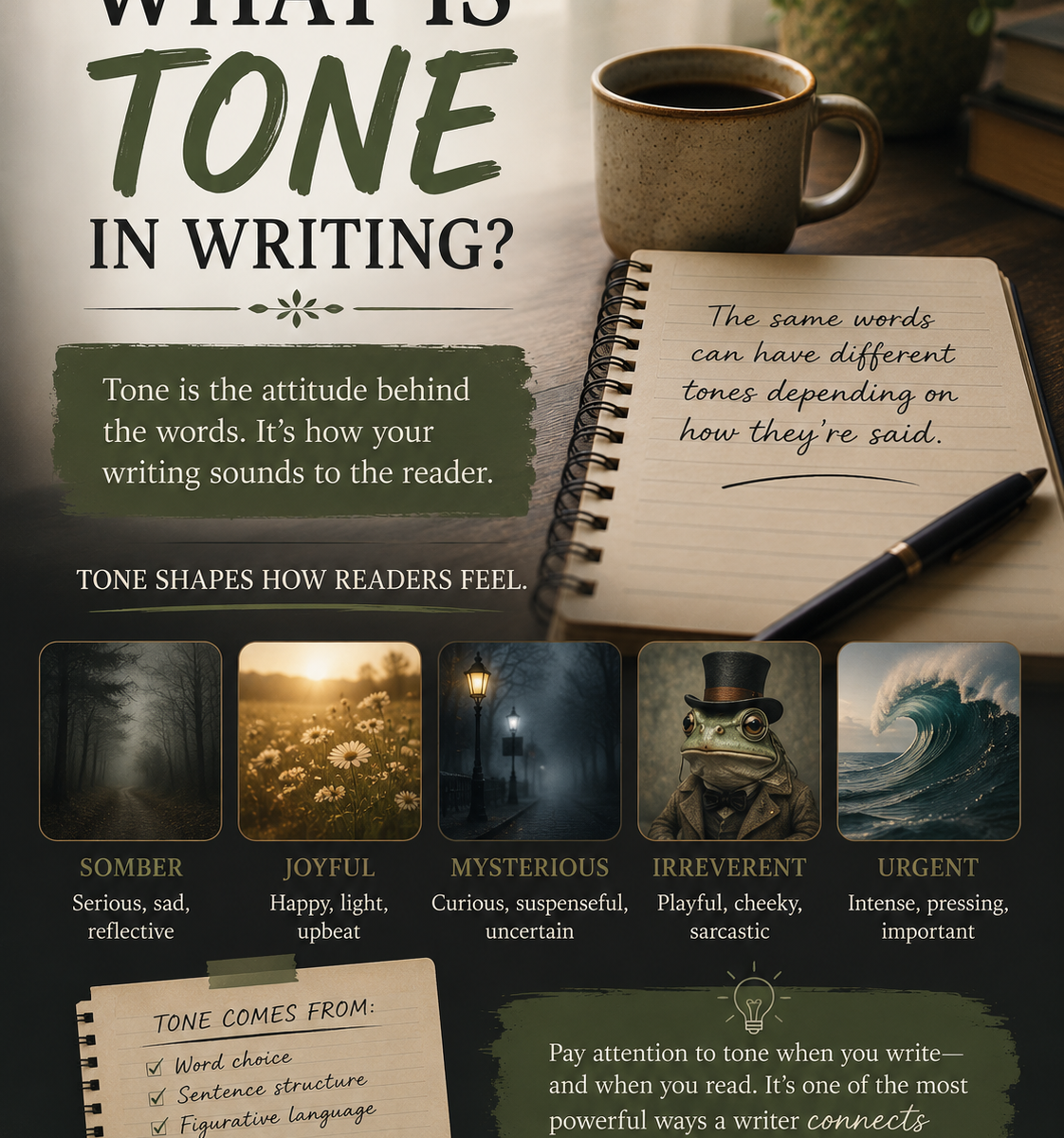
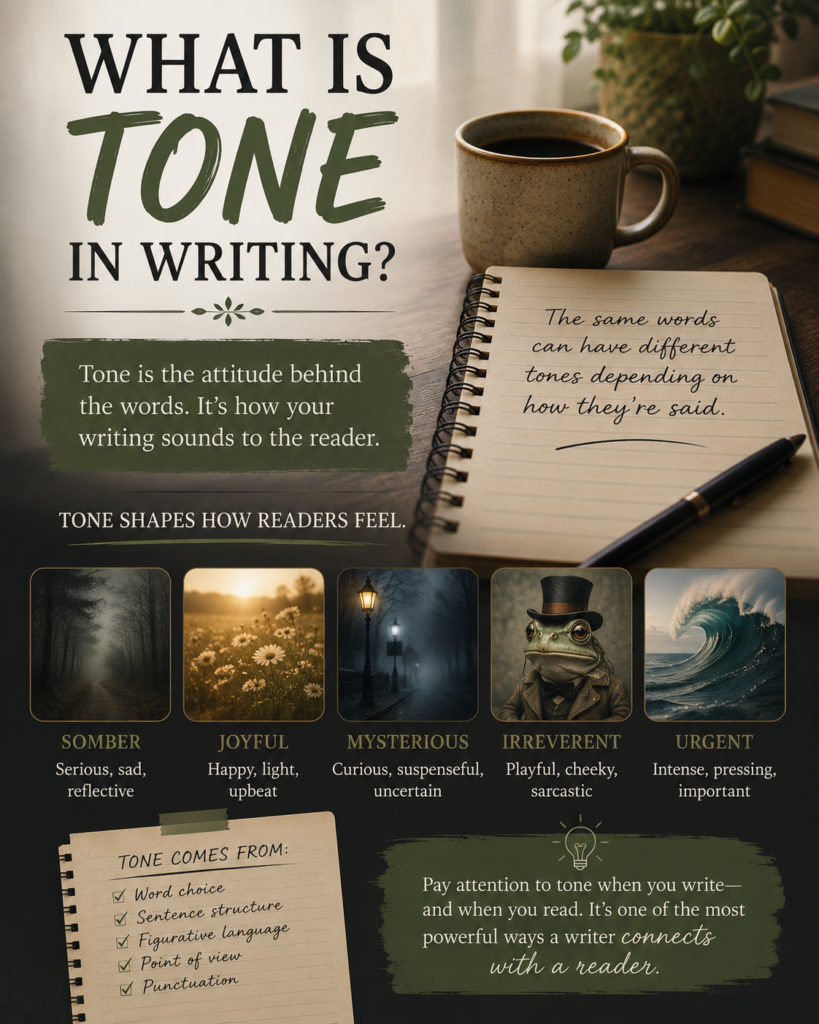
A simple answer to What Is Tone in Writing? is this: tone shows how the author feels about what is happening. That feeling comes through word choice, sentence style, details, and dialogue.
For example, a narrator might describe a storm as “wild and beautiful.” That sounds excited or impressed. Another narrator might call the same storm “cruel and endless.” That sounds fearful or bitter.
Tone is not always direct. A writer may never say, “I feel angry.” Instead, the anger appears in sharp words, short sentences, or harsh images.
What Is Tone in Writing? Why It Matters in Literature
Tone changes how readers understand a scene.
When students ask What Is Tone in Writing?, they are really asking how a writer guides our reaction. Tone can make a character seem foolish, brave, selfish, or kind.
In literature, tone also helps reveal theme. A sad tone may show loss. A mocking tone may point out pride or weakness. A hopeful tone may suggest that change is possible.
On an essay or AP Literature exam, tone is often the key to a strong analysis. If you can explain the tone, you can explain how the author creates meaning.
What Is Tone in Writing? Examples from Famous Literature
Examples make tone easier to hear.
In Edgar Allan Poe’s “The Tell-Tale Heart,” the tone is tense and nervous. The narrator keeps trying to prove he is sane, but his words make him sound more unstable.
In Jane Austen’s Pride and Prejudice, the tone is often witty and ironic. Austen gently mocks pride, social rules, and quick judgments.
In George Orwell’s 1984, the tone is bleak and serious. The cold language helps readers feel the danger of a world where the government controls truth.
The best way to answer What Is Tone in Writing? is to look at how the author’s attitude shapes each passage. Tone is not just what happens. It is how the writing feels about what happens.
What Is Tone in Writing? Tone vs. Mood
Mood and tone are related, but they are not the same.
Tone is the author’s attitude. Mood is the feeling created in the reader.
For example, a story might have a fearful tone because the narrator describes danger with panic. That tone can create a scary mood for the reader.
What Is Tone in Writing? How to Spot It While Reading
You can find tone by paying close attention to small choices.
Start with word choice. Ask if the words sound warm, cold, respectful, bitter, excited, or calm.
Then look at sentence style. Short sentences can sound tense or blunt. Longer sentences can feel thoughtful or emotional, depending on the words around them.
Dialogue also gives clues. A character who says, “How wonderful,” may sound sincere in one scene and sarcastic in another.
When you ask What Is Tone in Writing?, do not stop at naming a tone word. Always connect that word to proof from the text.
Common Tone Words Students Can Use
Tone words help you describe the author’s attitude with more care.
Serious
Playful
Angry
Hopeful
Mocking
Sad
Respectful
Suspicious
Try to avoid vague words like “good” or “bad.” A stronger tone word makes your analysis clearer.
A Practical Tip for Reading Tone
Use this quick method when you read a passage.
Circle two or three words that show attitude. Then write one tone word in the margin.
After that, ask: “How does this tone affect the meaning of the passage?” This turns a simple observation into real literary analysis.
As you read, pause after key scenes and ask how the author’s attitude comes through.
FAQ: What Is Tone in Writing?
What Is Tone in Writing?
Tone is the author’s attitude toward the subject, characters, or audience. It shows through words, details, and style.
How is tone different from mood?
Tone is the writer’s attitude. Mood is the feeling the reader gets from the text. For a full explanation, see this guide to the difference between tone and mood.
Can a story have more than one tone?
Yes. A story may start with a playful tone and later become serious. Tone can shift as events change.
Why does tone matter in an essay?
Tone helps you explain how the author creates meaning. It gives you a clear path from evidence to interpretation.
Key Takeaway
What Is Tone in Writing? It is the attitude behind the words. To analyze it well, name the tone, prove it with text, and explain why it matters.
A brief writing invitation for remembering the first time fear attached itself to another person, through one clear scene, body detail, and honest emotional truth. The flash memoir prompt first time felt genuinely afraid asks you to return to a moment when your body understood danger before your mind had words for it.
Maybe it was a look across a kitchen table. Maybe it was someone blocking a doorway. Maybe it was a stranger on the street whose footsteps matched yours for too long. Fear of another person has a different weight than fear of the dark or fear of failing a test. It can make the room feel smaller. It can make your own voice vanish.
This prompt does not ask you to solve the whole past. It asks you to notice one moment clearly enough to tell the truth about it.
The Prompt
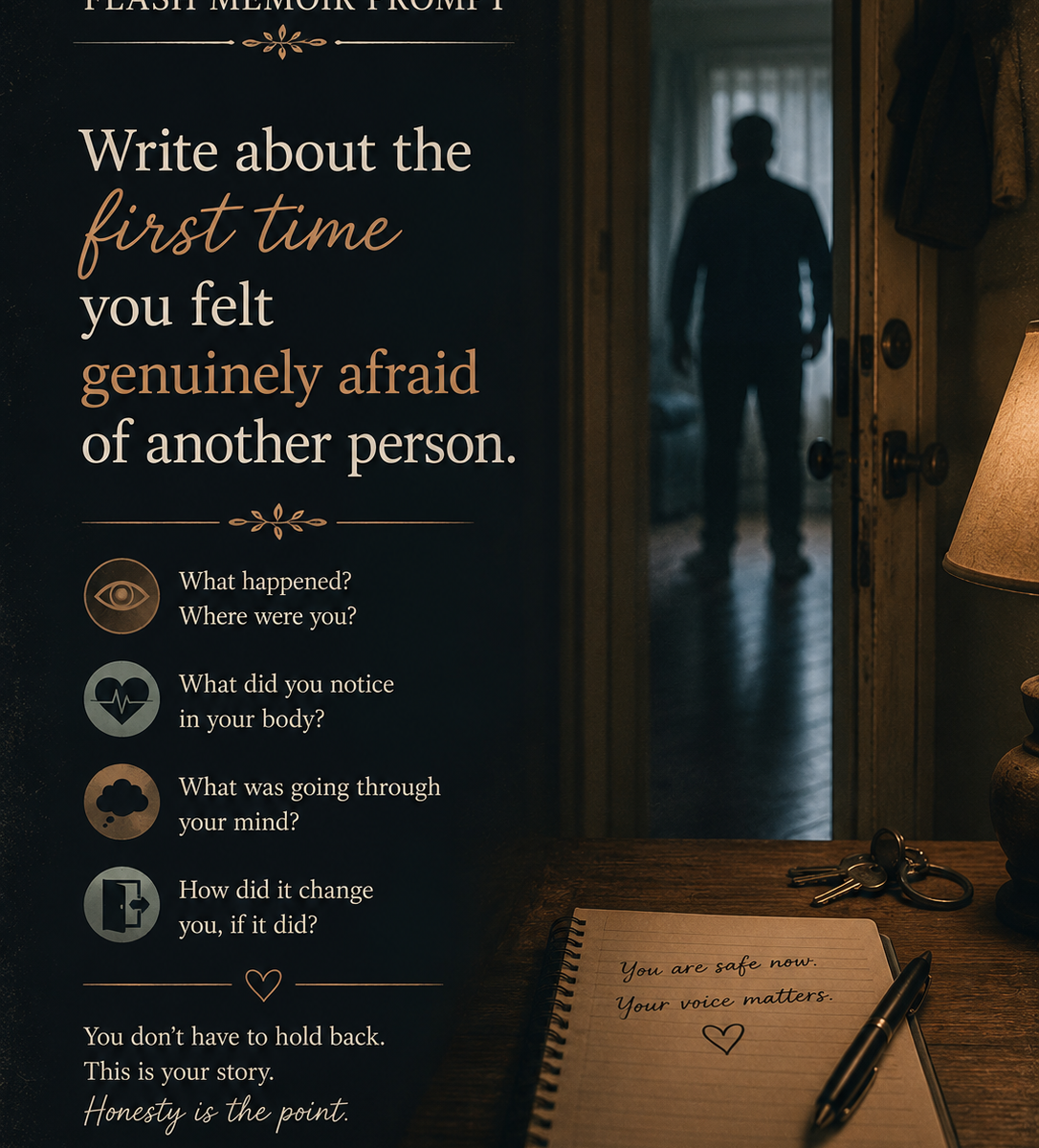
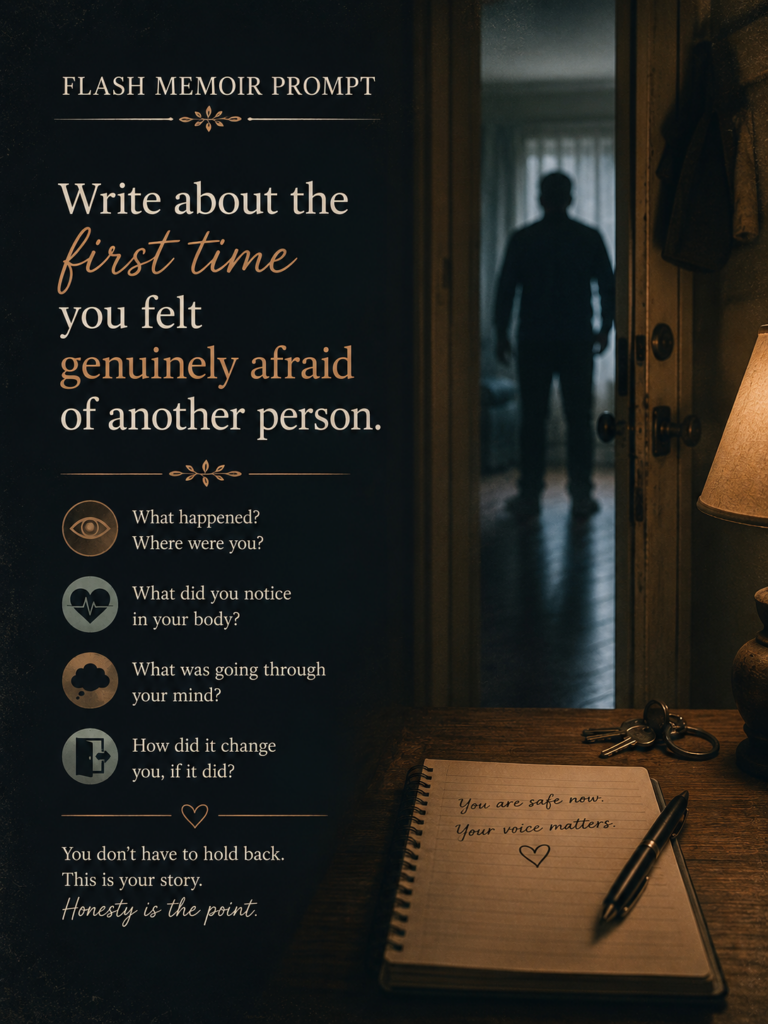
Write about the first time you felt genuinely afraid of another person.
This prompt can unlock a powerful memory because it brings you back to the first time you understood that another person could affect your sense of safety. That realization may have come in childhood, at school, at work, in a relationship, or in a place where you expected to feel safe.
A flash memoir prompt first time felt genuinely afraid is not about making the scene dramatic for a reader. It is about letting the memory stay close to the body. What did you hear? Where were your hands? What did the air feel like? Those details often carry more truth than a long explanation.
Why This Memory Matters
The first time you felt genuine fear of another person may have changed how you moved through the world. You may have become quieter. More alert. Faster to read faces. Slower to trust certain tones of voice. These changes can shape a life in subtle ways.
This kind of memory matters because it often marks a before and after. Before, you may have believed adults were always safe, friends could always be trusted, or public places were neutral. After, you knew better. That knowledge may have protected you, but it may have cost you something too.
You do not need to name the person in your writing. You do not need to explain everything that happened before or after. In flash memoir, one small scene can hold the larger emotional truth.
If you are thinking about how the feeling of a piece of writing differs from the writer’s attitude, you may find it helpful to revisit this guide to tone vs. mood in literature. A memory about fear can have a tense mood, while the narrator’s tone might be calm, confused, angry, or reflective.
How to Approach This Prompt
Begin with a physical detail, not background information. Write the first thing your body noticed. A dry mouth. A locked jaw. A hand on your shoulder that stayed too long. A hallway that suddenly felt empty.
Then narrow the memory to one scene. Do not try to tell the whole history of the person, the relationship, or the aftermath. Stay in the moment when fear arrived. Let the reader stand beside you there.
You might start with a sentence like:
“I knew I was afraid when I stopped breathing normally.”
Or:
“The first thing I noticed was how still everyone else became.”
After that, write what you noticed before you explain what it meant. Describe the room, the voice, the silence, the object in your hand. Memory often becomes more honest when you let the image come before the lesson.
If the memory feels too intense, give yourself limits. Set a timer for ten minutes. Write in third person if that gives you distance. Stop before the part that feels overwhelming. You are allowed to protect yourself while writing the truth.
You can also make notes in the margin of your draft as you go. If that helps you notice patterns, this guide on how to annotate literature may give you a simple way to mark images, repeated words, or emotional shifts in your own writing.
For this flash memoir prompt first time felt genuinely afraid, the goal is not to create a perfect essay. The goal is to catch the exact moment when fear became real.
A Quick Example
I was twelve, sitting in the back seat of my uncle’s truck, when he turned down the radio without looking at me. That was the first sign. He had been laughing a minute earlier, telling some story about work, but the truck went quiet all at once. My cousin stopped chewing her gum. I remember the smell of vinyl seats and wet leaves on the floor mat. He asked who had taken the money from the cup holder. No one answered. At the red light, he turned around slowly and looked straight at me. I had not taken it, but my face got hot like I had. I learned that day that truth did not always protect you.
Try It Yourself
Take ten to fifteen minutes and write from the prompt: Write about the first time you felt genuinely afraid of another person.
Start close to the body. Let the scene stay small. You do not have to explain why the person acted that way, and you do not have to forgive anyone on the page. Just write what happened as honestly as you can.
If the memory feels distant, try listing five details from the place where it happened. If the memory feels too close, write only the first thirty seconds. A brief piece can still be complete.
This flash memoir prompt first time felt genuinely afraid may bring up a hard memory, so give yourself care afterward. Stand up, drink water, look around the room you are in now. Writing about fear should not trap you inside it. It should give you a way to place the memory on the page, where you can see it with some space around it.
Want More Flash Memoir Prompts?
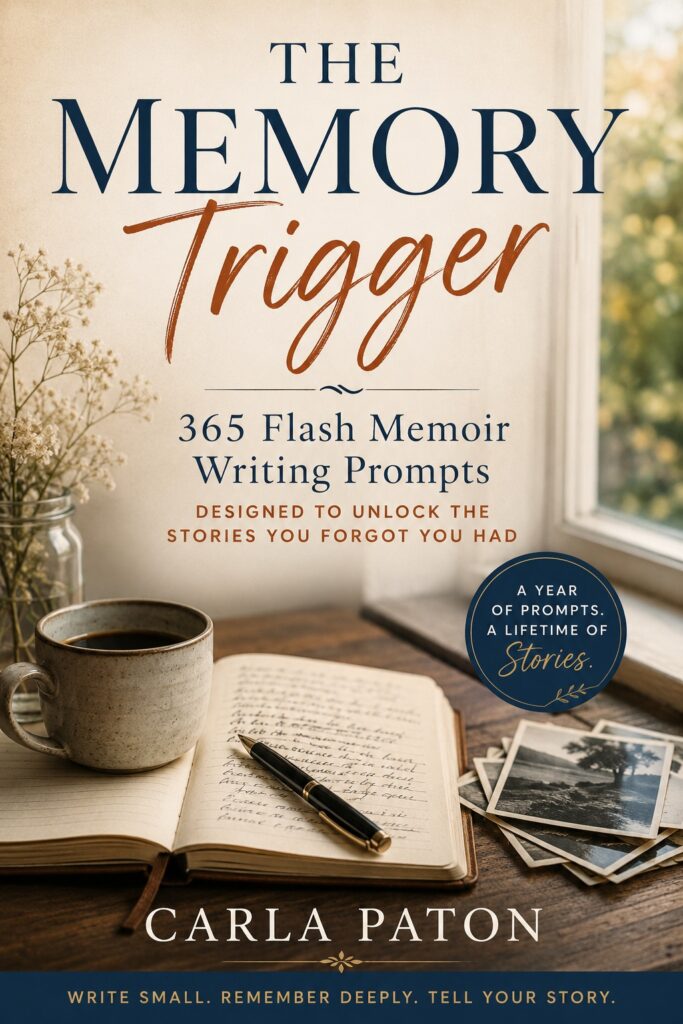
If you want a full year of short, focused memory invitations, explore all 365 prompts in The Memory Trigger: 365 Flash Memoir Writing Prompts. Each prompt is designed to help you write one vivid scene at a time.
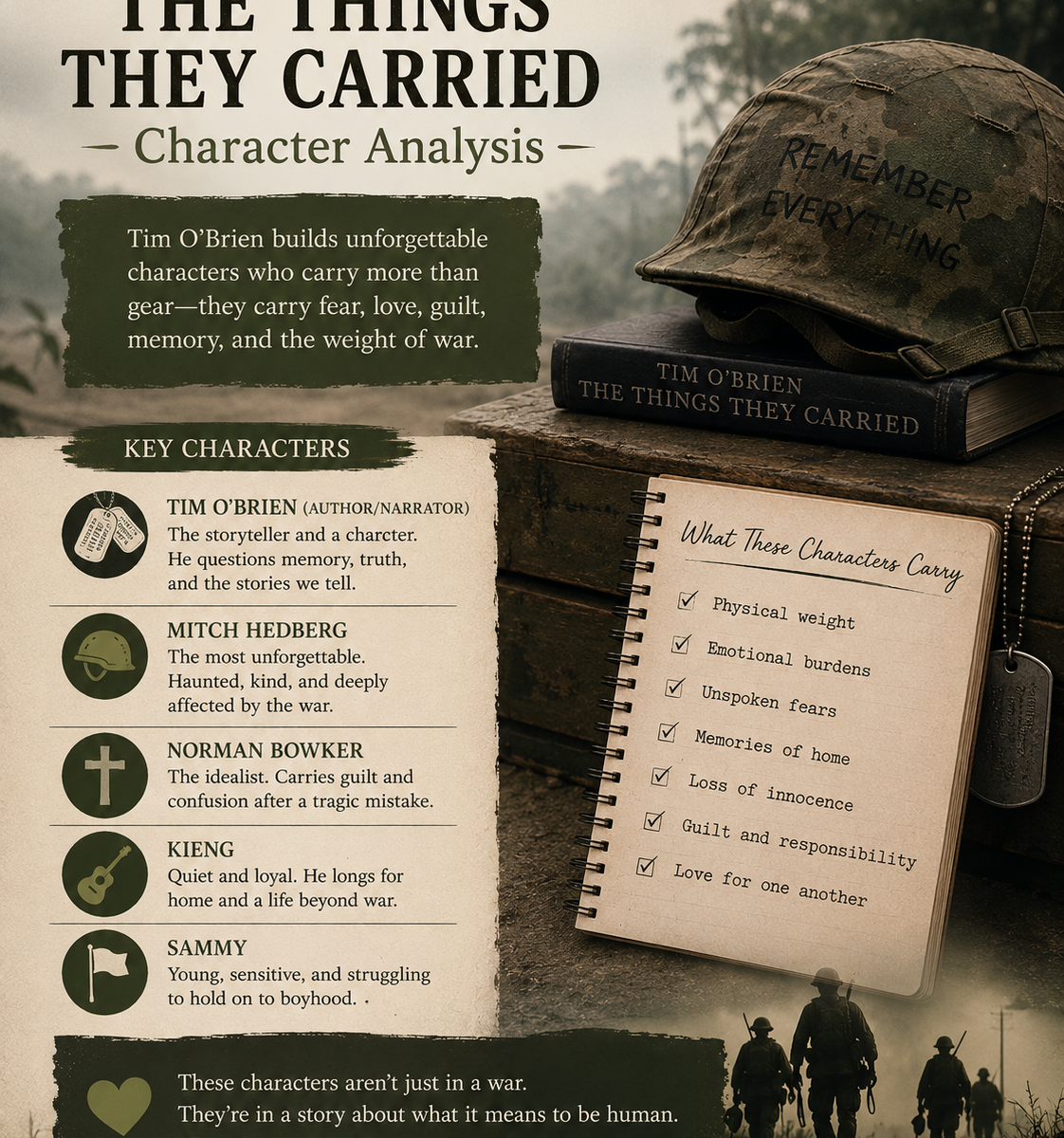
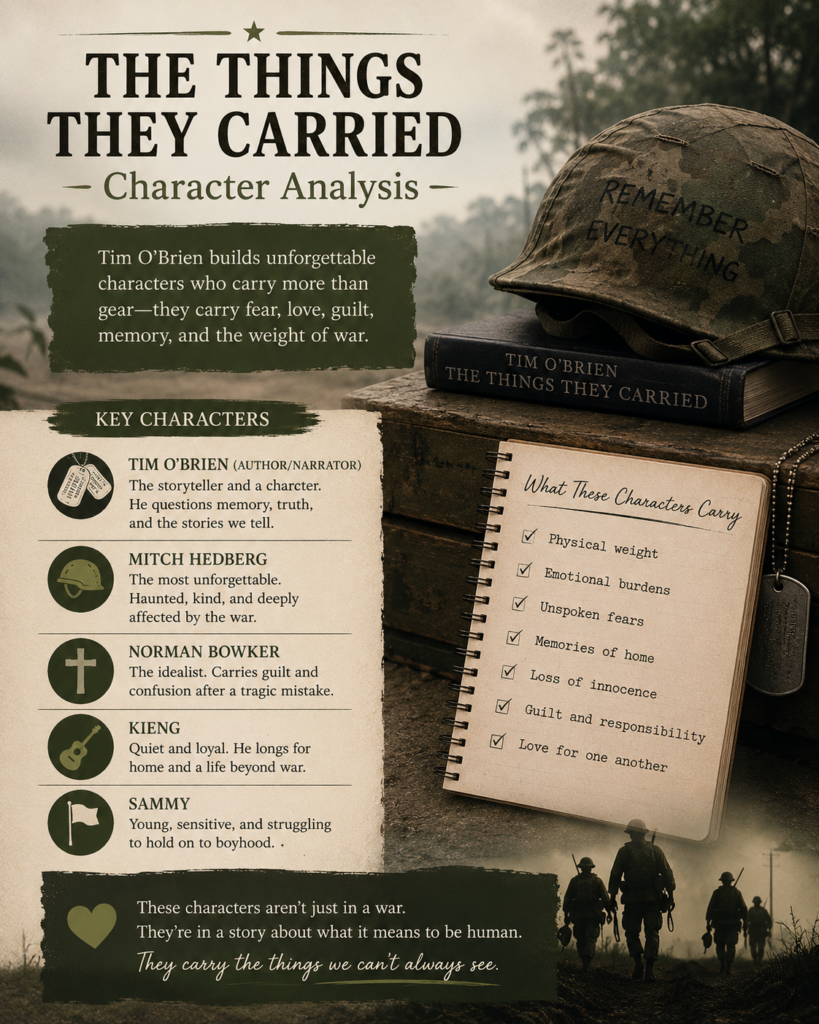
A strong The Things They Carried character analysis helps you see why war in Tim O’Brien’s book feels so personal. The soldiers carry weapons and gear, but they also carry fear, shame, love, and memory.
This guide breaks down the main characters, their motives, and the conflicts that shape each story.
In this Guide
Use these sections to move from quick review to essay-ready ideas.
The Things They Carried Character Analysis: Quick Overview
The characters matter because each one shows a different cost of war.
O’Brien does not present the platoon as a simple group of heroes. He shows them as young men under pressure, often scared, often ashamed, and often unsure of what courage even means.
In a The Things They Carried character analysis, it helps to separate what each person carries on the outside from what each person carries inside. The outside items are easy to name. The inner burdens are harder, and that is where the best analysis begins.
Tim O’Brien carries memory and guilt. Jimmy Cross carries love and blame. Kiowa carries faith and calm. Norman Bowker carries silence after the war.
These people do not stay in neat roles. A brave man may panic. A funny man may hide pain. That mix makes the book feel honest.
The Things They Carried character analysis of Tim O’Brien
Tim O’Brien is both a character and the voice that shapes the book.
O’Brien, the narrator, looks back on Vietnam years later. He tells stories because memory will not leave him alone. He also tells stories because plain facts do not seem large enough to hold the truth of war.
This makes him a complex narrator. He does not always ask readers to trust every detail. Instead, he asks them to feel the emotional truth behind the story.
A good The Things They Carried character analysis should note that O’Brien often fights himself. He hates the war, but he goes anyway. He fears shame more than danger. That fear pushes him toward a choice he does not fully believe in.
His inner conflict is clear in “On the Rainy River.” He wants to flee to Canada, yet he cannot bear what his town may think of him. Like Hamlet, he spends much of his time caught between action and doubt.
O’Brien’s motive is not glory. He wants to make sense of trauma. He wants to give shape to memory before it fades or turns false.
Jimmy Cross shows how private dreams can clash with public duty.
Lieutenant Jimmy Cross is the platoon’s leader, but he often feels more like a lonely young man than a strong commander. He loves Martha, a college student back home, and he reads her letters as if they can protect him.
His love is not really based on a shared life. It is based on hope. Martha becomes a symbol of the world he wants to return to.
After Ted Lavender dies, Cross blames himself. He thinks his thoughts of Martha made him weak. He burns her letters and photos, but that act does not free him from guilt.
In The Things They Carried character analysis, Cross is useful because he shows one of the book’s central questions: What does responsibility mean when death can happen at random?
Cross wants control, but Vietnam gives him no clear rules. His conflict is not only with the enemy. It is with his own mind.
Key soldiers and what they reveal
The platoon works like a group portrait, with each soldier adding a new angle on fear.
Kiowa
Kiowa is thoughtful, steady, and deeply human. He carries a Bible and often acts as a moral center for the group.
His death in the sewage field is one of the book’s most painful moments. It feels wrong because Kiowa represents kindness in a world that does not reward it.
Kiowa’s conflict is quiet. He tries to hold onto decency while war pushes everyone toward numbness.
Norman Bowker
Norman Bowker survives the war, but survival does not bring peace. At home, he circles a lake and cannot find a way to speak about what happened.
His pain shows that war does not end when soldiers return. His conflict is with silence, memory, and a town that cannot understand him.
Bowker is one of the strongest examples for The Things They Carried character analysis because his story links war trauma to isolation.
Rat Kiley
Rat Kiley is the medic. He tells wild stories, jokes, and tries to keep fear at a distance.
Yet he is not careless. His job forces him close to pain. When the pressure becomes too much, he wounds himself to leave the war.
Rat’s conflict shows how even trained helpers can break under constant fear.
Curt Lemon
Curt Lemon wants to seem brave. He takes risks because he fears looking weak.
His death is sudden and almost unreal. O’Brien describes it in a way that mixes beauty with horror, which makes the moment hard to forget.
Lemon’s motive is pride. His conflict is the gap between real courage and the performance of courage.
Ted Lavender
Ted Lavender carries tranquilizers because he is scared. O’Brien does not mock him for this.
Lavender’s death sets much of the book in motion, especially Jimmy Cross’s guilt. He reminds readers that fear is not a flaw in war. It is a normal response to danger.
Henry Dobbins
Henry Dobbins is large, gentle, and superstitious. He wears his girlfriend’s pantyhose as a charm.
That detail may seem strange, but it shows how soldiers reach for comfort. Dobbins needs belief, even if the belief looks odd from the outside.
Mitchell Sanders and Azar
Mitchell Sanders often tells stories and comments on what happens around him. He helps build the book’s focus on storytelling.
Azar, by contrast, can be cruel. His jokes show how war can twist humor into something harsh.
Together, they show two ways men respond to fear: one tries to explain it, while the other tries to laugh at pain.
Mary Anne Bell: innocence changed by war
She shows that Vietnam changes anyone who enters its world.
Mary Anne arrives as Mark Fossie’s girlfriend. At first, she seems innocent and out of place. Soon, she becomes drawn to the land, the danger, and the freedom she feels there.
Her change disturbs the men because it breaks their idea of what women should be. She does not stay a symbol of home. She becomes part of the war’s strange power.
In The Things They Carried character analysis, Mary Anne is important because she proves that war is not only a setting. It is a force that transforms identity.
Her story also asks a hard question: Did Vietnam reveal something hidden in her, or did it create something new?
The Things They Carried character analysis: major conflicts
The main conflicts are often internal, even when the war seems like the obvious battle.
Man vs. self appears again and again. O’Brien fights shame. Cross fights guilt. Bowker fights silence.
Man vs. society also matters. The soldiers feel trapped by ideas about courage, masculinity, and patriotism. They fear judgment from people who are not even in Vietnam.
Man vs. war shapes the whole book. The soldiers face danger, but they also face confusion. The war has no clear moral path for them.
This is why a The Things They Carried character analysis should not only ask, “What happens to this person?” It should also ask, “What pressure changes this person?”
In Macbeth, guilt grows after a violent act. In O’Brien’s book, guilt often comes from living through violence and not knowing how to explain it.
Using The Things They Carried character analysis in essays
Strong essays connect character choices to larger themes.
Start with a clear claim about one character. Do not just say that Jimmy Cross feels guilty. Say that his guilt shows how war makes leadership feel impossible.
Then use a quote or moment from the text. Explain how the detail works. A strong The Things They Carried character analysis links evidence to meaning, not just plot.
You can also compare characters. For example, Cross and Bowker both carry guilt, but Cross still has a duty to lead, while Bowker feels lost after his duty ends.
These books can help you build context for class discussion or a longer essay.
The Things They Carried by Tim O’Brien
Going After Cacciato by Tim O’Brien
All Quiet on the Western Front by Erich Maria Remarque
Remarque’s novel is a useful comparison because it also shows young soldiers changed by fear, duty, and loss.
FAQ: The Things They Carried character analysis
These quick answers can help you review before a discussion post or essay.
Who is the main character in The Things They Carried?
Tim O’Brien is the main voice and central character, but the book also works as a group portrait of the platoon.
What is Jimmy Cross’s main conflict?
Jimmy Cross struggles with guilt. He believes his love for Martha distracted him from his duty as a leader.
Why is Norman Bowker important?
Norman Bowker shows the pain of life after war. His story reveals how trauma can survive long after combat ends.
What does Kiowa represent?
Kiowa often represents faith, kindness, and moral balance. His death shows how war can destroy what is most humane.
How do I write a The Things They Carried character analysis paragraph?
Make a claim, choose a strong detail, and explain how that detail reveals motive or conflict. Keep the focus on meaning, not plot summary.
Key takeaway
The best The Things They Carried character analysis shows that each person carries more than physical weight. O’Brien’s characters carry guilt, fear, love, and memory, which makes the book a lasting study of war’s human cost.
An ekphrasis poetry prompt asks you to step inside an image and listen for the story hidden beneath its surface. The best ekphrastic poems do more than describe what appears in front of the eye. They uncover memory, tension, grief, hope, or desire inside the scene.
In this ekphrasis poetry prompt, the image becomes a quiet abandoned greenhouse filled with vines, sunlight, birdcages, and scattered handwritten letters. The place feels beautiful, but something inside it also feels unfinished. Someone left. Someone stayed silent. Something important never reached its destination.
An ekphrasis poetry prompt gives writers a concrete place to begin. Instead of staring at a blank page, you react to details already present inside the image.
The greenhouse scene creates emotional tension because it mixes care with abandonment. Plants continue to grow even after people disappear. Letters remain unread. Birdcages suggest voices trapped or forgotten.
Many strong poems begin this way. A single visual detail opens a deeper emotional question.
The Poetry Foundation offers several excellent examples of ekphrastic poetry if you want to study how other poets respond to visual imagery: https://www.poetryfoundation.org/
Ekphrasis Poetry Prompt
Look closely at the image.
A greenhouse stands empty beneath afternoon sunlight. Vines climb over cracked glass walls. Old birdcages hang from the ceiling. Dozens of handwritten letters scatter across the floor, some folded shut and others opened by the wind.
Write a poem from inside this scene.
You might write as the person who left the letters behind. You might become the greenhouse itself. You might focus on one specific object, such as a birdcage, a flower, or a single unread page.
Do not try to explain everything. Let the image carry part of the meaning.
Questions to Help You Begin the Ekphrasis Poetry Prompt
Ask yourself what kind of silence exists in this place.
Who wrote the letters?
Why were they never sent?
What happened to the birds?
Why does the greenhouse still feel alive after abandonment?
An ekphrasis poetry prompt often becomes stronger when you focus on one emotional thread instead of trying to describe the entire image at once.
You do not need to copy these lines, but they can help you hear the emotional tone of the scene:
“The flowers kept opening after you disappeared.”
“Every cage in the greenhouse faced the mountain.”
“The letters curled slowly in the heat like dying leaves.”
Good ekphrastic poems usually depend on sharp images more than explanation. Let the objects inside the scene reveal emotion naturally.
What This Ekphrasis Poetry Prompt Teaches Writers
This ekphrasis poetry prompt helps writers practice emotional atmosphere, symbolism, and visual detail at the same time.
The greenhouse image encourages poets to think about memory, silence, isolation, and unfinished communication. Those themes appear often in both modern poetry and classic literature.
You can also return to the same image later and write from a different perspective. One image can produce many completely different poems.
An ekphrasis poetry prompt reminds us that images hold emotional stories long before words arrive. A forgotten greenhouse can become a poem about grief. A birdcage can become a symbol of fear or protection. A scattered letter can become the center of an entire voice.
Do not worry about writing a perfect poem on the first attempt. Stay inside the image long enough for something honest to emerge.
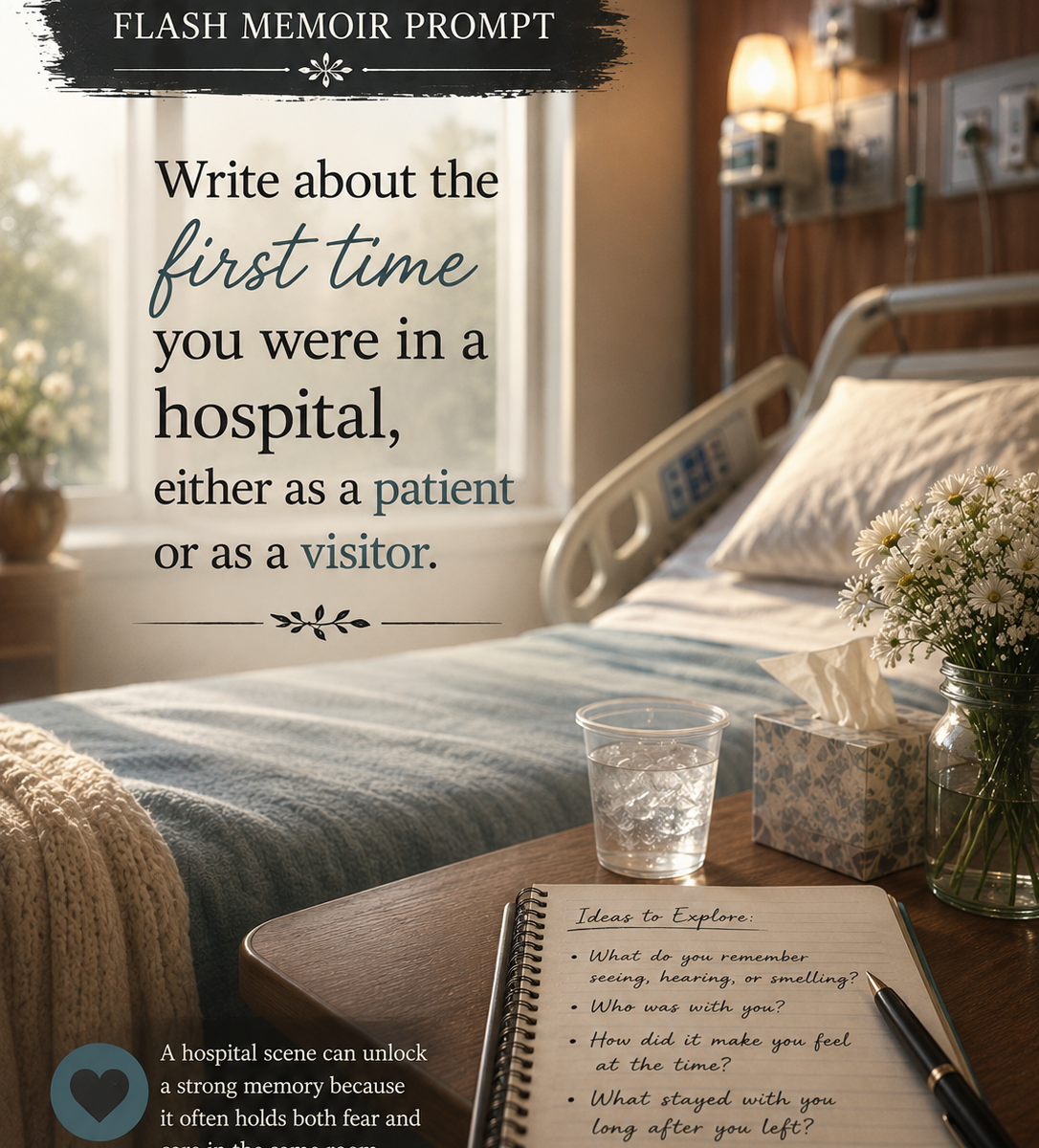
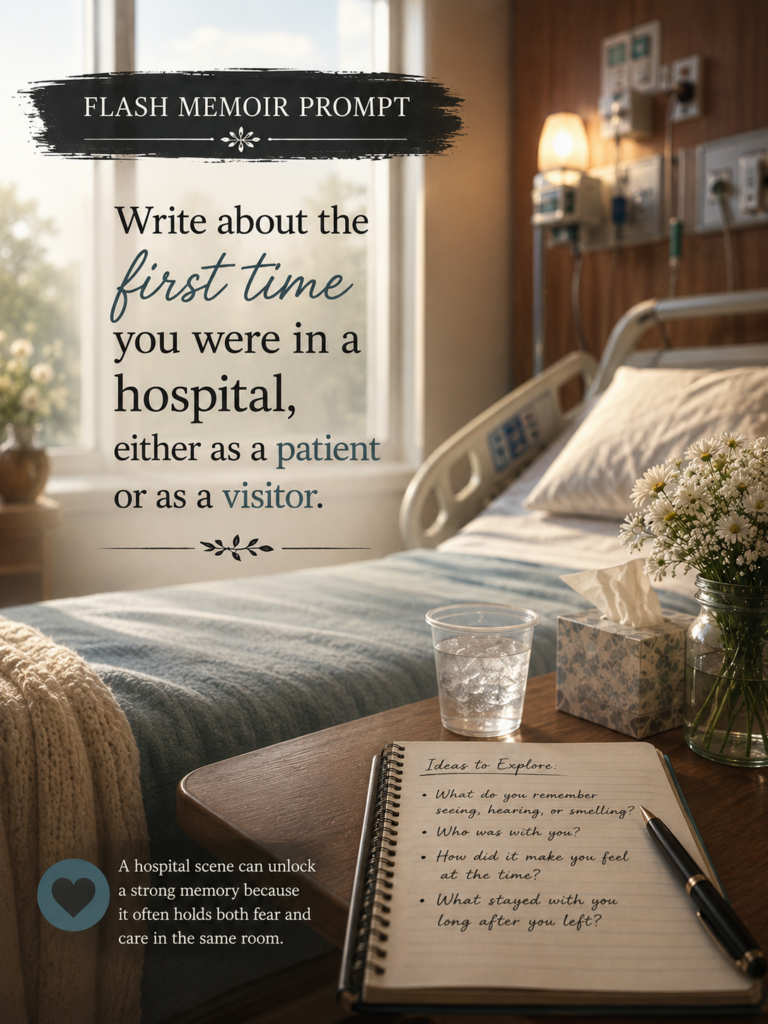
The first hospital memory may come back through a smell, a waiting room chair, or the quiet moment when someone tried to look brave for you.
The Prompt
Write about the first time you were in a hospital, either as a patient or as a visitor.
This flash memoir prompt: first time in the hospital, either as a patient or a visitor, asks you to return to a place most people remember with unusual clarity. Hospitals have their own world. The lights are too bright. The floors shine. People speak softly, even when nothing quiet is happening.
Your memory may be serious, scary, confusing, or even strangely ordinary. Maybe you were a child with a broken arm. Maybe you visited a grandparent and noticed the cup of melting ice beside the bed. Maybe you were too young to understand what was wrong, but old enough to understand the adults were worried.
A hospital scene can unlock a strong memory because it often holds both fear and care in the same room.
Why This Memory Matters
The first time you enter a hospital, you may notice how different life feels there. Time slows down. People wait. Nurses appear and disappear. A vending machine can seem louder than it should. A small kindness can stay with you for years.
This kind of memory matters because it often shows you meeting vulnerability for the first time. That vulnerability may have been your own. It may have belonged to someone you loved. Either way, the scene can reveal what you thought safety meant at that age.
If you were the patient, you might write about the moment before treatment, when you were told to sit still or be brave. If you were a visitor, you might write about walking into a room and not knowing what to say. Both versions count. A flash memoir does not need a dramatic ending. It needs one honest scene.
You can also explore the tone and mood of the memory. Was the room tense, calm, lonely, hopeful, or oddly funny? The feeling in the room may be more important than the medical reason you were there.
How to Approach This Prompt
Begin with a physical detail. Do not start by explaining the whole hospital visit. Start with the bracelet on your wrist, the squeak of shoes in the hallway, the paper cup of water, or the stiff chair where you waited.
Then narrow the memory to one scene. You might choose the moment you first saw the hospital bed. You might focus on the ride in the elevator. You might write about sitting beside someone and watching their hand move under the blanket.
Try to write what you noticed before you write what it meant. Memoir becomes stronger when readers can stand inside the memory with you. Instead of saying, “I was scared,” show the way you counted ceiling tiles or kept asking the same question.
If the memory feels big, give yourself limits. Write about ten minutes, not the whole day. Write about one room, not the whole building. Write about one person’s voice, not every conversation.
You can treat your memory the way you might treat a short text in class. Look closely at small details, underline what matters in your mind, and ask why it stayed with you. If that kind of close looking helps, this guide on how to annotate literature can also give you a useful way to study your own memory.
For this flash memoir prompt first time hospital either patient, the goal is not to give a medical report. The goal is to capture the human part of the scene.
A Quick Example
I was seven the first time I went to a hospital. My brother had fallen from the monkey bars, and my mother drove with one hand on the wheel and the other pressed against his knee, as if holding him together. In the waiting room, I sat under a poster of a smiling tooth, though we were not there for teeth. My brother stopped crying after a while, which scared me more than the crying. A nurse gave me a grape lollipop from a drawer, even though I was not the patient. I remember holding it in my lap, unopened, while my mother signed forms. It felt wrong to eat something sweet while everyone else looked so serious.
Try It Yourself
Set a timer for ten minutes and write about your first hospital memory. Choose one moment and stay there. Let the smells, sounds, and small gestures lead you.
If you cannot remember exact words, write the feeling of the words. If you cannot remember every person in the room, write the one face you do remember. Flash memoir allows you to work with fragments, as long as you stay honest about what you know.
You might begin with one of these openings: “The first thing I noticed was…” or “No one told me why the room felt so quiet.” You can also start with the object your younger self could not stop looking at.
When you finish, read the piece once and ask what changed inside the scene. Did you understand something new? Did someone comfort you? Did you realize adults could be afraid too? That small shift may be the heart of the memoir.
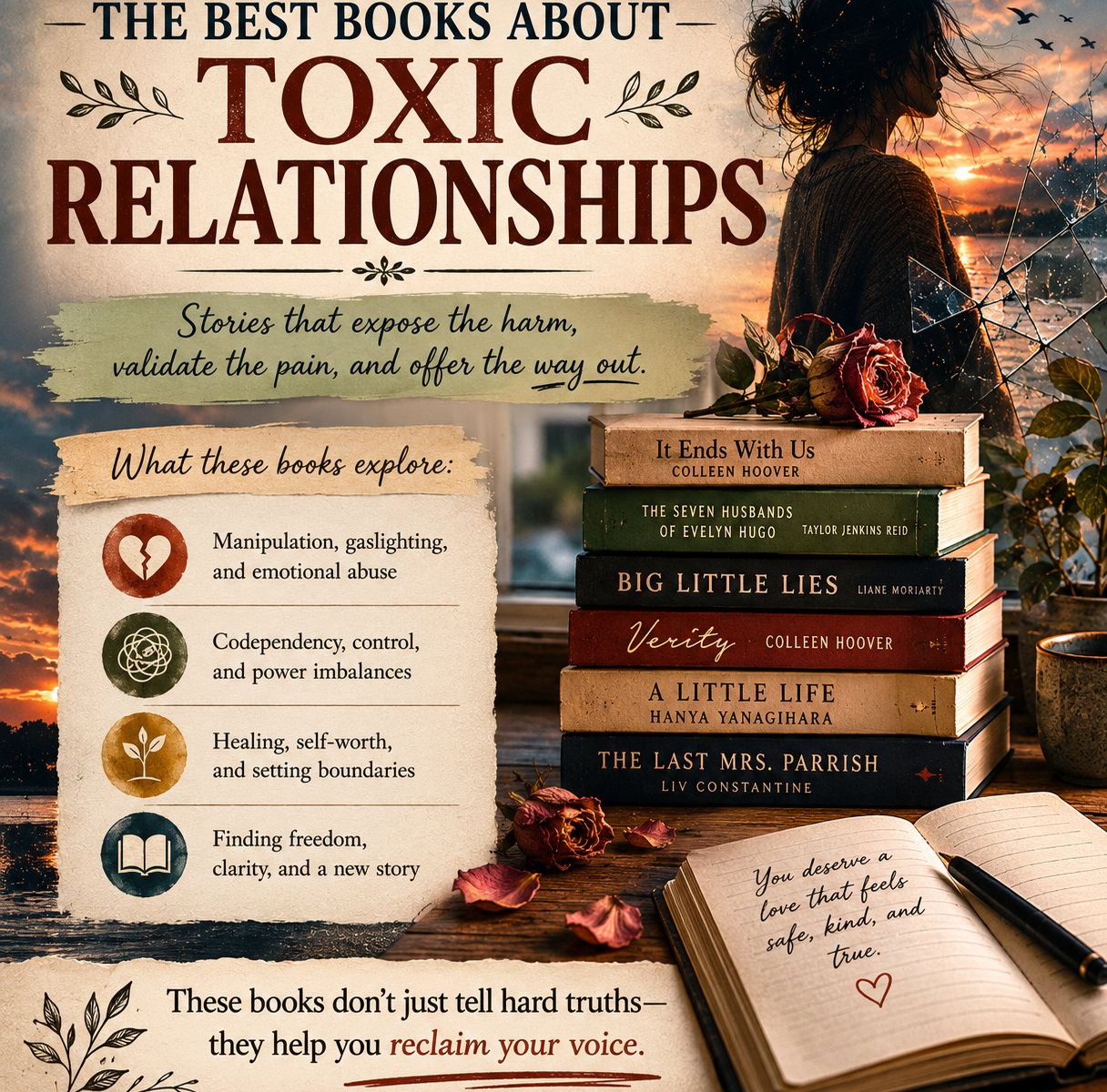
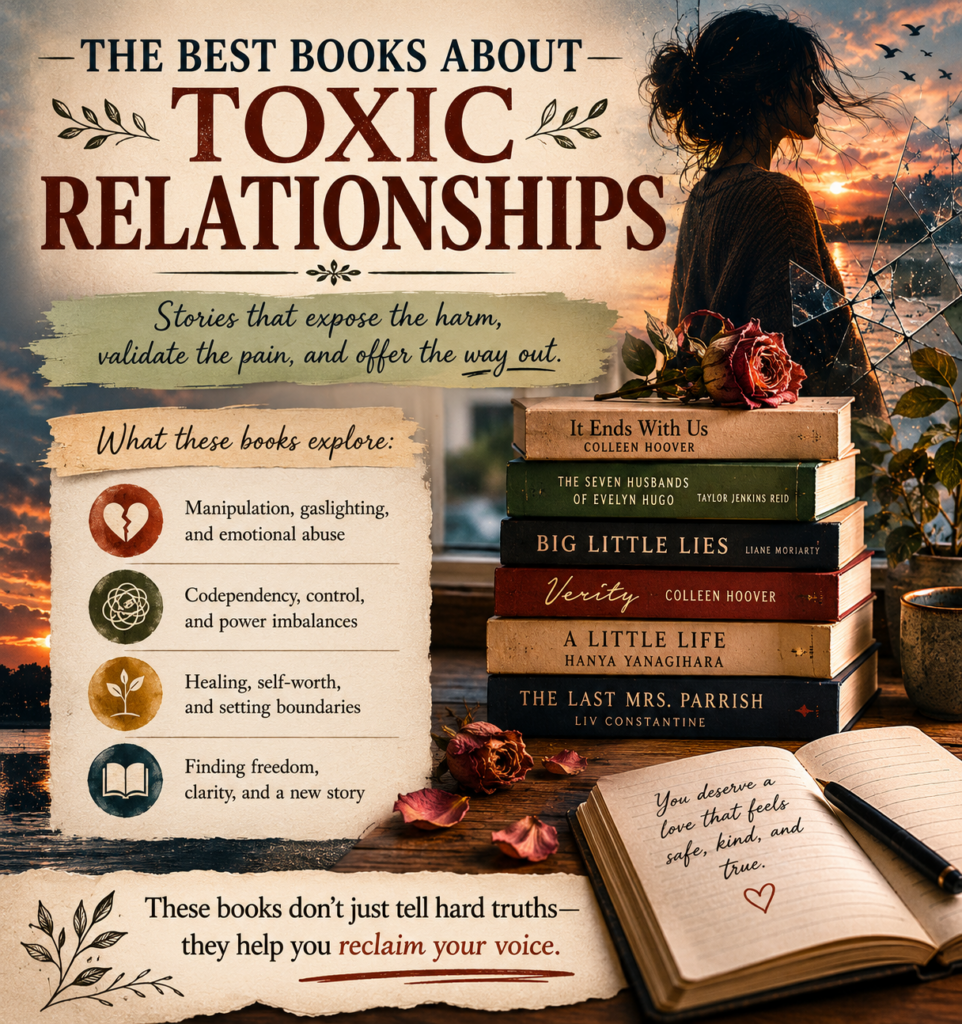
The Best Books About Toxic Relationships do more than show romance gone wrong. They help readers see how love can turn into control, obsession, fear, or self-loss.
These books can be hard to read, but they often teach us how people hide pain, excuse harm, and search for freedom.
In this Guide
What makes a toxic relationship in literature
Best Books About Toxic Relationships to read first
Key themes and symbols
Why students study these books
FAQs
Key takeaway
What Makes the Best Books About Toxic Relationships So Powerful?
The strongest stories show that toxic love is not always easy to spot at first.
In literature, a toxic relationship often begins with charm, beauty, or intense emotion. Over time, the bond becomes harmful. One person may control the other, lie often, use guilt, or treat love like ownership.
The Best Books About Toxic Relationships show this shift with care. They do not just say, “This is bad.” They show how people get trapped, why they stay, and what it costs them.
That is why these books matter in school. They help students talk about power, gender roles, class, trauma, and identity through stories that feel personal.
Best Books About Toxic Relationships to Read First
These classic and modern books give readers strong examples of unhealthy love, obsession, and control.
1. Wuthering Heights by Emily Brontë
Wuthering Heights is one of the Best Books About Toxic Relationships because it shows love as wild, painful, and destructive.
Heathcliff and Catherine love each other deeply, but their bond hurts almost everyone around them. Their relationship is full of pride, revenge, class shame, and emotional cruelty.
The moors in the novel act as a symbol of their love. They are open and beautiful, but also harsh and dangerous.
2. The Great Gatsby by F. Scott Fitzgerald
The Great Gatsby may look like a love story, but it is really about fantasy, wealth, and emotional damage.
Gatsby’s love for Daisy becomes a dream he cannot let go. Daisy and Tom’s marriage is also toxic because it rests on money, lies, and carelessness.
Rebecca is a gothic novel about jealousy, fear, and control inside marriage.
The unnamed narrator feels trapped by the memory of her husband’s first wife. Manderley, the great house, becomes a symbol of pressure and silence.
This novel is one of the Best Books About Toxic Relationships because it shows how a person can feel erased inside a relationship.
More Best Books About Toxic Relationships for Students
Some books show toxic love through romance. Others show it through family, friendship, or social pressure.
Jane Eyre by Charlotte Brontë
Jane Eyre asks a key question: Can love be healthy if one person has far more power?
Jane cares for Mr. Rochester, but she refuses to lose her self-respect. That choice makes the novel different from many toxic love stories.
A Streetcar Named Desire by Tennessee Williams
This play shows a violent and harmful marriage through Stanley and Stella.
It also shows how desire, class conflict, and denial can trap people. The play is often studied in AP Literature because its symbols are clear and rich.
Normal People by Sally Rooney
This modern novel shows a bond that is loving, painful, and confusing.
Connell and Marianne care for each other, but their relationship suffers because of shame, class pressure, and poor communication.
Symbols in the Best Books About Toxic Relationships
Writers often use objects and places to show emotional danger.
In The Great Gatsby, the green light stands for Gatsby’s dream of Daisy. It also shows how desire can turn into illusion. You can explore this symbol more in our guide to The Great Gatsby.
In Rebecca, Manderley is more than a house. It stands for memory, fear, and a past that controls the present.
In Wuthering Heights, the moors reflect wild emotion. They feel free, but they also suggest danger and isolation.
These symbols help make the Best Books About Toxic Relationships more than simple warnings. They turn private pain into something readers can see and study.
Common Themes in the Best Books About Toxic Relationships
Toxic relationships in literature often reveal larger problems in society.
Power is one major theme. Many harmful relationships grow when one person has more money, status, age, or control.
Obsession is another key theme. Gatsby does not love Daisy as she really is. He loves the dream he built around her.
Identity also matters. In many of the Best Books About Toxic Relationships, a character must decide whether love is worth losing the self.
For background on major authors and classic texts, resources like Britannica’s overview of the novel can help students place these works in a wider literary tradition.
Why Readers Are Drawn to Best Books About Toxic Relationships
These stories are intense because they feel close to real life.
Many readers know what it feels like to want approval, fear rejection, or excuse bad behavior from someone they love. Literature gives those feelings shape.
The Best Books About Toxic Relationships also help readers ask better questions. Is this love, or control? Is this loyalty, or fear? Is this passion, or harm?
Good books do not always give easy answers. They make readers think with more care.
Recommended Books to Add to Your Reading List
If you want to explore this topic, start with books that are rich, readable, and often taught in school.
Wuthering Heights by Emily Brontë
The Great Gatsby by F. Scott Fitzgerald
Rebecca by Daphne du Maurier
These are some of the Best Books About Toxic Relationships because they show different forms of harm. One focuses on revenge, one on illusion, and one on fear inside marriage.
How to Read Toxic Relationship Stories in Class
Read these books with attention to both emotion and structure.
Notice who has power in each scene. Look at who speaks, who stays silent, and who gets believed.
Track symbols as they repeat. A house, a light, a room, or a landscape can show what a character cannot say out loud.
It also helps to read author background from trusted sources. The Poetry Foundation has useful material on many writers, movements, and literary terms.
FAQs About the Best Books About Toxic Relationships
These quick answers can help students choose and study the right book.
What are the Best Books About Toxic Relationships for high school students?
The Great Gatsby, Jane Eyre, and Wuthering Heights are strong choices. They are often taught and offer clear themes to analyze.
Are toxic relationship books only about romance?
No. They can also focus on family, friendship, class pressure, or social control.
Why do teachers assign books about toxic relationships?
Teachers use them to discuss power, choice, identity, and moral conflict. These topics help students build deeper reading skills.
Is The Great Gatsby about a toxic relationship?
Yes. Gatsby’s dream of Daisy is unhealthy because it turns her into an ideal. Tom and Daisy’s marriage is also built on privilege and harm.
Key Takeaway
The Best Books About Toxic Relationships show that love in literature is not always safe, pure, or simple.
These stories matter because they reveal how control can hide inside romance, wealth, memory, and desire. When readers study them closely, they learn to see both the beauty of language and the warning signs in human behavior.
A brief writing invitation for returning to the quiet room, the folded tissues, and the first moment you understood that grief changes the air around people.
The Prompt
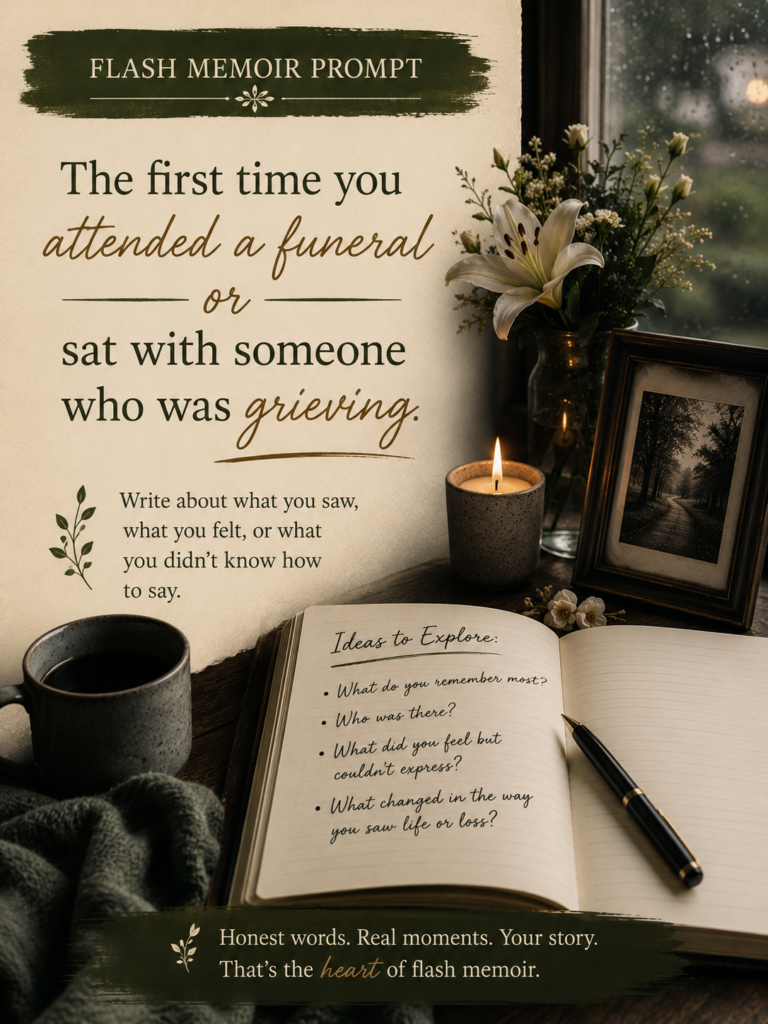
Write about the first time you attended a funeral or sat with someone who was grieving.
This flash memoir prompt first time attended funeral sat with someone grieving asks you to remember a moment when loss became real in a new way. Maybe you were a child in stiff shoes. Maybe you were a teenager unsure where to put your hands. Maybe you were an adult, but grief still caught you off guard because you had never been that close to someone else’s pain.
You do not have to explain death, faith, family history, or healing. For a flash memoir, one small scene is enough. A hallway outside a chapel. A casserole on a kitchen counter. A handkerchief pressed into a palm. The sound of someone trying not to cry.
This kind of prompt works because grief often sharpens memory. Even years later, you may remember the smell of flowers, the scratch of dress clothes, the low murmur of adults, or the quiet shock of seeing someone strong come undone.
Why This Memory Matters
The first time you witness grief, you often learn something without anyone giving you a lesson. You may learn that adults do not always know what to say. You may learn that silence can be a form of care. You may learn that sadness has its own motions, like folding napkins, making coffee, or sitting beside someone without reaching for the perfect words.
This memory may uncover a story about innocence. If you were young, you might have noticed odd details before you understood the meaning of the day. The shiny shoes. The cold church pew. The strange way people smiled and cried in the same breath.
It may also be a story about discomfort. Many people remember feeling embarrassed by grief, not because they were cruel, but because they did not know the rules. Should you hug the person? Should you look at the casket? Should you speak? Should you stay quiet?
That uncertainty can make the writing honest. A strong memoir moment does not need you to act perfectly. It needs you to tell the truth about who you were then.
If you want to deepen the emotional atmosphere of your scene, it can help to think about the difference between tone and mood in literature. In a grief memory, the mood might be heavy or hushed, while your tone as the writer might be tender, confused, distant, or even gently surprised.
How to Approach This Prompt
Start with a physical detail. Do not begin with “I learned that life is short.” Begin with the tissue box. Begin with the too-bright funeral flowers. Begin with the black dress that made your neck itch. Let the reader enter the room before you tell them what it meant.
For this flash memoir prompt first time attended funeral sat with someone grieving, narrow the memory to one scene. Do not try to cover the illness, the death, the service, the family conflict, and the years that followed. Choose one moment you can still see.
You might write about arriving. You might write about sitting beside someone. You might write about the ride home after the funeral, when everyone was quiet and the world outside the car looked strangely normal.
Once you choose the scene, write what you noticed before you explain your feelings. This keeps the piece from becoming too general. Instead of saying, “Everyone was sad,” show one person smoothing a program until the paper softened at the fold.
If you sat with someone who was grieving, let their body language guide the scene. Did they talk too much, go very still, laugh at a strange moment, or ask you to stay? People reveal themselves in small ways during loss. If you enjoy studying those small human signals, you may also like this guide on how to analyze characters in literature, since memoir often asks you to observe real people with the same care.
Be gentle with yourself as you write. This prompt can bring up tender material. You can stop before the hardest part. You can write around the center of the memory and return later if you want to.
A Quick Example
I remember my first funeral mostly by the carpet. It was dark red with tiny gold shapes, and I stared at it because I did not know where else to look. My grandmother sat beside me with her purse in her lap, both hands gripping the clasp. I had never seen her hands so still. Usually she was patting my knee, finding gum, fixing my collar. That day she seemed made of stone. When the music started, she opened her purse and took out a tissue, but she did not use it. She just held it flat between her fingers. I wanted to ask if she was okay, but even at nine I knew it was the wrong question. Instead, I leaned my shoulder against her arm. After a minute, she leaned back.
Try It Yourself
Set a timer for ten minutes and write the scene as if you are walking into it again. Where are you sitting? What do you hear? Who is near you? What do you understand, and what do you misunderstand?
Do not worry about making the memory sound wise right away. First drafts are allowed to be plain. They are allowed to sound young, unsure, or unfinished. In fact, that may be where the truth is.
If the funeral itself feels too large, write about one object from the day. A program, a coat, a plate of food, a flower arrangement, a card on a table. Let that object pull the rest of the memory into focus.
If you choose the “sat with someone grieving” side of the prompt, pay attention to what you did with your body. Maybe you washed dishes, filled a glass of water, sat on the floor, or stood in the doorway. Often, the story lives in what we do when words are too small.
Want More Flash Memoir Prompts?
If this prompt helped you find one clear memory, keep going. Short prompts can open doors to stories you did not know you still carried. Explore all 365 prompts in The Memory Trigger: 365 Flash Memoir Writing Prompts.