
Flash Memoir Prompt: Way Your Family Handled Someone’s Grief

flash memoir prompt grief

A focused flash memoir prompt about the way your family handled someone’s grief, told through one scene, one sensory detail, and one honest emotional truth.

Maybe you remember the casserole dishes first. Or the way everyone lowered their voices when they stepped into the hallway. Grief often changes the volume of a house before anyone explains what has happened.

This flash memoir prompt way family handled someone’s grief invites you to look at one moment when sadness entered your home, or your extended family, and watch what people did with it. Did they speak openly? Did they make food? Did they avoid the name of the person who was gone? Did someone become practical because feelings felt too large?

You do not have to solve the grief on the page. You only have to notice how your family carried it.

flash memoir prompt grief

The Prompt

Write about the way your family handled someone’s grief.

This prompt can unlock a meaningful memory because grief often reveals family patterns. Some families gather. Some scatter. Some whisper, joke, clean, cook, pray, argue, or pretend they are fine. The story may not be about the loss itself. It may be about the way people acted around the person who was hurting.

For this flash memoir prompt way family handled someone’s grief, try to choose one scene instead of a full history. A kitchen after a funeral. A car ride home from the hospital. A living room where someone kept folding the same blanket. One small scene can hold more truth than a long explanation.

Why This Memory Matters

The way a family responds to grief can tell you what was allowed in that house. Were tears welcome? Was silence respected? Did people reach for comfort, or did they make themselves useful so they would not have to feel helpless?

You might discover that your family showed love in a language you did not understand at the time. Maybe your aunt never said the right words, but she filled the freezer with soup. Maybe your father left the room whenever your grandmother cried, and only years later did you realize he was crying in the garage.

This kind of memory matters because grief often strips family life down to habit. People fall back on what they know. That can be painful, tender, awkward, or even strangely funny. A flash memoir does not need to turn your family into heroes or villains. It can simply show them as people trying to stand near sorrow without knowing exactly how.

If you are thinking about how emotion sits inside a scene, you may find it useful to consider the difference between tone and mood in literature. In memoir, the room may feel heavy, but your adult voice might sound calm, curious, or forgiving. That contrast can make the piece feel more layered.

How to Approach This Prompt

Begin with a physical detail. Do not start by explaining who died, how long the grief lasted, or what everyone believed about loss. Start with what you saw.

Maybe there was a paper plate bending under potato salad. Maybe someone kept rubbing a thumb over a wedding ring. Maybe the TV stayed on with the sound muted because nobody wanted to sit in silence, but nobody wanted noise either.

Once you have the detail, build one scene around it. Where are you? Who is in the room? What does each person do when grief becomes visible? Let action carry the meaning for a while before you name what it meant.

For example, instead of writing, “My family avoided sadness,” you might write, “When my mother started crying, my uncle stood up and asked who wanted coffee.” That single action says a great deal. It also gives the reader space to feel the meaning rather than be told what to think.

Try to avoid telling the whole story at once. You do not need to cover the illness, the funeral, the months after, and every family conflict connected to it. Flash memoir works best when the frame is small. One afternoon can reveal the larger truth.

If you want to shape the memory into a stronger piece later, tools for organizing scenes and evidence can help. The Literary Analysis Essay Toolkit is designed for students, but its focus on close reading can also help writers study their own scenes with care.

The Flash Memoirist
previous arrow
next arrow

A Quick Example

After my grandfather died, my grandmother sat at the kitchen table in her church shoes while everyone moved around her. My mother washed dishes that were already clean. My uncle took out the trash three times. Nobody said Grandpa’s name until my little cousin asked why his chair was empty. The room froze. My grandmother looked at the chair, then at the window above the sink. For a second I thought she had not heard. Then she reached for the sugar bowl and pushed it toward my cousin. “He always took too much,” she said. Everyone laughed softly, even my mother, who had soap up to her wrists. That was how grief entered our family, not as a scream, but as a chair nobody wanted to move.

Try It Yourself

Set a timer for ten minutes and write from the prompt: Write about the way your family handled someone’s grief. Choose one person who was grieving and one scene where your family responded. Stay close to the room. Notice hands, dishes, shoes, light, sound, or silence.

Do not worry about making the memory neat. Grief rarely arrives in a neat form. Your job is to write what happened, then let the emotional truth rise from the details.

If the memory feels heavy, give yourself permission to stop after one page. You can return later. A flash memoir prompt way family handled someone’s grief should help you explore the past with care, not force you to relive more than you are ready to face.

Want More Flash Memoir Prompts?

Explore all 365 prompts in The Memory Trigger: 365 Flash Memoir Writing Prompts. Each prompt is built to help you enter one focused memory and turn it into a short, honest piece of writing.
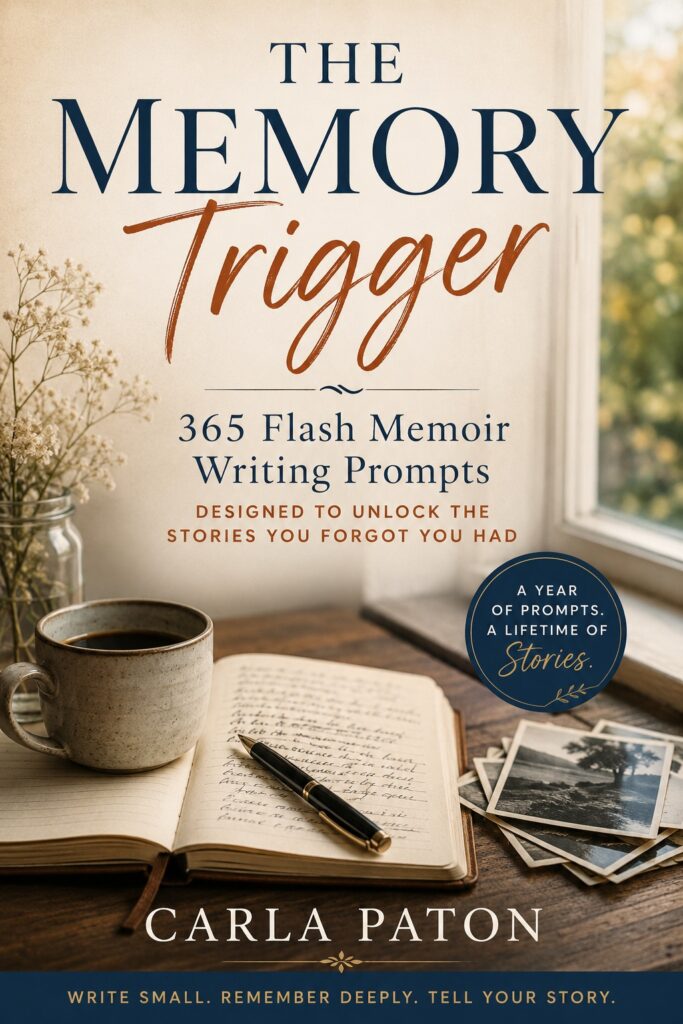

The Memory Trigger

Flash Memoir Prompt: Family Member Who Saw You Most Clearly

flash memoir prompt family member

At a noisy kitchen table, someone notices you have gone quiet before you even know how to say what is wrong. This flash memoir prompt family member who saw most clearly invites you to write about the person in your family who understood something true about you, even if they never made a speech about it.

flash memoir prompt family member

The Prompt: Flash Memoir Prompt Family Member Who Saw Most Clearly

Write about the family member who saw you most clearly.

This prompt can open a powerful memory because being seen often happens in small ways. It might be a grandmother who knew you hated crowds. A brother who understood your jokes before anyone else did. An aunt who noticed your talent long before you called it a dream.

You do not need to explain your whole relationship with this person. In fact, the best response may come from one narrow scene. Think of a moment when someone in your family recognized who you were, what you needed, or what you were trying to hide.

Why This Memory Matters

Many family stories focus on conflict, tradition, loss, or love. This one asks a quieter question: who noticed you?

That kind of memory can be tender, but it can also be complicated. Maybe the person who saw you clearly was not the person you expected. Maybe they understood one part of you and missed another. Maybe they offered comfort, blunt honesty, or a look across the room that said, “I know.”

When you write about this person, you may uncover the shape of your younger self. You may remember what you wanted others to know about you. You may also see how much it mattered when one person paid attention.

This prompt is especially useful because it helps you write from evidence instead of summary. Rather than saying, “My uncle understood me,” you can show him leaving a library book on your bed. Rather than saying, “My sister knew I was scared,” you can show her sliding into the seat beside you without asking questions.

If you enjoy looking closely at people, this kind of memoir work has something in common with learning how to analyze characters in literature. The goal is to notice action, speech, silence, and detail. A real person, like a character on the page, becomes clearer through what they do.

How to Approach This Prompt

Begin with a physical detail. Do not start with the meaning. Start with the room, the weather, the smell of dinner, the sound of a screen door, or the way your family member stood with one hand on the counter.

Then place yourself in one scene. Choose one moment when this person seemed to understand you better than others did. Keep the memory small enough to hold in your hand.

You might ask yourself:

What did they notice about me that others missed?

What did they say, or choose not to say?

How did my body feel when I realized they understood?

Try to write what happened before you explain what it meant. Let the reader see the gesture first. The meaning can arrive later, often in the final few lines.

For example, you might write about your father quietly fixing the strap on your backpack before the first day at a new school. You might write about your cousin laughing at the strange drawing in your notebook and asking to see more. You might write about your mother knowing you were pretending to like a sport and handing you a sketchpad instead.

A good flash memoir does not need a grand ending. It needs a clear moment. If you are used to marking up books for clues, you can use a similar habit here. Notice the details you would underline if this scene appeared in a story. If that helps, these tips on how to annotate literature can also remind you how much meaning can live in a small phrase or image.

As you write, avoid trying to prove that this person always saw you clearly. People are rarely that simple. Instead, write one true memory. Let it stand on its own.

The Flash Memoirist
previous arrow
next arrow

A Quick Example

My grandfather never asked why I brought a book to every family party. Everyone else teased me for reading beside the cooler while cousins played tag in the yard. He just lowered himself into the lawn chair next to mine and handed me a paper plate with a hot dog on it. “Good spot,” he said, looking toward the maple tree that gave the best shade. Later, when my aunt called me antisocial, he tapped the cover of my book with one finger. “She’s listening,” he said. “Just differently.” I remember the mustard on my thumb, the grass stuck to my sandals, and the relief of not having to defend myself. He did not make me louder. He made quiet feel allowed.

Try It Yourself

Set a timer for ten minutes and write about the family member who saw you most clearly. If the memory feels too big, shrink it. Start with where you were sitting. Start with the sound of their voice. Start with the thing they noticed before anyone else did.

You can write this as a tribute, a question, or even a complicated memory. The person may still be in your life, or they may be gone. They may have seen the artist, the worrier, the reader, the caretaker, the rebel, or the child who needed a little more room.

Return to this flash memoir prompt family member who saw most clearly whenever you want to write about recognition without turning it into a speech. Let one scene carry the feeling.

Want More Flash Memoir Prompts?

If this prompt opened a memory, keep going. A daily prompt can help you build a steady writing habit without needing a large plan first. Explore all 365 prompts in The Memory Trigger: 365 Flash Memoir Writing Prompts.

The Memory Trigger

Flash Memoir Prompt: Moment when Your Family Surprised You by Being Exactly What You Needed

flash memoir prompt family surprise

A focused writing invitation for remembering the moment your family became exactly the help, comfort, or steady presence you did not know how to ask for. Maybe you expected a lecture. Maybe you expected silence. Maybe you expected your family to miss the point, tease you, or make the whole thing louder than it already felt. Then, somehow, they did the right thing. They brought the blanket, made the call, sat beside you, changed the subject, or simply stayed. This flash memoir prompt about a moment family surprised you by being what you needed asks you to look closely at that small shift.

flash memoir prompt family surprise

The Prompt

Write about a moment when your family surprised you by being exactly what you needed.

This prompt can open a memory that may look ordinary from the outside. A ride home. A quiet dinner. A hand on your shoulder. A sibling who did not joke for once. A parent who did not ask questions. Flash memoir works well when the moment is small enough to hold in one scene, yet charged with feeling.

The focus is not proving that your family was perfect. It is noticing one time when the people around you met the moment better than you expected. That kind of memory often carries both surprise and relief.

Why This Memory Matters

Family stories can get stuck in old patterns. We remember who always talks too much, who avoids hard topics, who fixes things, who disappears, and who thinks food can solve everything. Those patterns may be true, but they are not the whole story.

This prompt invites you to write about a break in the pattern. Maybe your loud family went quiet because you needed peace. Maybe your practical father cried with you instead of offering advice. Maybe your sister, who usually competed with you, defended you without being asked.

That surprise matters because it shows change, tenderness, and complexity. In literature, we often pay attention to character shifts because they reveal what someone values under pressure. The same idea can help in memoir. If you want more practice noticing those changes, this guide on how to analyze characters in literature can also help you observe real people with more care.

A flash memoir prompt moment family surprised by being present at the right time may uncover a story about illness, grief, embarrassment, fear, or a day when you felt unseen. It may also uncover humor. Some families show love in strange ways. A burned casserole, an awkward pep talk, or a badly wrapped gift can still become the exact thing you needed.

The Flash Memoirist
previous arrow
next arrow

How to Approach This Prompt

Begin with the physical detail that proves you were inside the moment. Do not start with the lesson. Start with the chair, the kitchen light, the sound of tires on wet pavement, the smell of coffee, or the way your brother kept tapping his foot because he did not know what to say.

Then narrow the memory to one scene. You do not need to explain your whole family history. Let the reader understand the pattern through what happens in that moment. If your mother usually gave advice, show the moment she stayed quiet. If your cousins usually joked, show the moment they carried your boxes without making fun of you.

Write what you noticed before you explain what it meant. For example, you might write, “My father put my favorite mug beside me and left the room,” before you write, “That was how I knew he understood.” The detail gives the feeling room to rise on its own.

It can also help to make quick notes before drafting. Mark the moment when your expectation changed. What did you think would happen? What actually happened? What did your body do when you realized they had helped? If you like breaking a text into small clues, the same habit used to annotate literature can help you mark your own memory for meaning.

Try not to polish the family into saints. The power of this flash memoir prompt moment family surprised by being exactly enough comes from honesty. They may have been clumsy. They may have said the wrong thing first. The surprise may be that, after all that, they still showed up.

A Quick Example

I called my older brother from the grocery store parking lot because I had failed my driving test. Again. I expected him to laugh. He had passed on the first try and had never let me forget it. Instead, he said, “Stay there.” Fifteen minutes later, his truck pulled in beside my mother’s car. He handed me a cherry slushie and took the passenger seat. “Show me the route,” he said. For an hour, he let me drive around the empty streets behind the high school. He did not sing, tease, or grab the door handle. When I made a wide turn, he only said, “Try that one again.” By the time we pulled back into the parking lot, the ice in my cup had melted, but my hands had stopped shaking.

Try It Yourself

Set a timer for ten minutes and write one scene from this prompt. Keep your attention on what happened in the room, car, hallway, yard, or kitchen. Let the meaning arrive after the action.

If you get stuck, write this sentence and continue from there: “I thought they would _____, but instead they _____.” That contrast can lead you straight into the memory. You may find that the real story is not about dramatic rescue. It may be about being known in a quiet, specific way.

This flash memoir prompt moment family surprised by being what you needed can be tender, funny, or bittersweet. Trust the version that feels true. A short piece does not need a perfect ending. It only needs one honest turn.

Want More Flash Memoir Prompts?

If this prompt helped you remember one surprising family moment, keep going. Small memories often lead to deeper ones when you give them time and attention. Explore all 365 prompts in The Memory Trigger: 365 Flash Memoir Writing Prompts.

The Memory Trigger

Flash Memoir Prompt: Argument You Witnessed Between Adults in Your Family as a Child

flash memoir prompt argument

A focused writing invitation for remembering an argument you witnessed between adults in your family as a child, through one clear scene, one sharp detail, and the emotions you were too young to name.

The room may have changed before anyone raised a voice. Maybe a fork stopped halfway to someone’s mouth. Maybe a door shut too hard. Maybe you were sitting on the carpet, pretending to watch TV while every part of you listened.

This flash memoir prompt about an argument witnessed between adults in your family asks you to return to a moment when childhood met adult conflict. You do not have to solve the argument. You do not have to judge anyone. You only have to remember what it felt like to be there.

flash memoir prompt argument

The Prompt

Write about an argument you witnessed between adults in your family as a child.

This prompt can unlock a powerful flash memoir because children often notice what adults think they are hiding. You may remember the sound of a voice, the smell of dinner burning, or the way someone looked away instead of answering.

A memory like this does not need a full family history behind it. In fact, it may work better if you stay with one moment. A flash memoir prompt about an argument witnessed between adults in your family becomes strongest when it focuses on what the child saw, heard, and misunderstood.

Why This Memory Matters

Family arguments can mark a child’s understanding of safety, loyalty, silence, and power. Even if the argument was ordinary to the adults, it may have felt huge to you. Children often measure danger by tone, posture, and what happens after the shouting stops.

This kind of memoir does not have to accuse anyone. It can simply tell the truth of a child’s view. Maybe you thought the argument was your fault. Maybe you learned which parent to avoid. Maybe you discovered that adults could be scared too.

Writing this scene may also show how your younger self made meaning from limited information. That gap between what happened and what you understood is often where the deepest memoir writing lives.

If you are practicing close observation, the same skill you might use to analyze characters in literature can help here. Notice action before explanation. What did each person do with their hands? Who moved closer? Who left the room? Those details can reveal more than a summary ever could.

How to Approach This Prompt

Begin with a physical detail. Choose one object, sound, or movement from the scene. It might be a cracked plate, a buzzing kitchen light, a suitcase by the door, or your own knees pulled under your chin.

Then narrow the memory to one scene. Do not try to explain every argument your family ever had. Stay inside a short stretch of time. Let the reader stand where you stood.

You might write the first draft in present tense, as if the child is living it now. For example: “I am under the dining room table. My father’s shoes are beside my mother’s bare feet.” This can help you stay close to the original feeling.

Write what you noticed before you explain what it meant. A child may not understand divorce, money trouble, jealousy, grief, or stress. The child may only know that someone’s voice has changed. Let that limited understanding guide the piece.

If you feel stuck, make a quick note map before drafting. Write down where you were, who was there, what you heard, and what you did with your body. This is close to the way readers annotate literature, except you are marking your own memory instead of a page.

Try not to rush toward the lesson. The emotional truth may be small. Maybe the scene explains why you dislike closed doors. Maybe it shows the first time you realized adults could say things they could not take back.

The Flash Memoirist
previous arrow
next arrow

A Quick Example

I was nine, sitting on the stairs with my spelling book open on my lap. The word was “separate,” and I kept writing the second “a” too close to the “r.” In the kitchen, my aunt said my mother’s name like it was something breakable. Then my grandfather slapped his palm on the table, and all the glasses jumped. No one knew I was there, or maybe they did and decided I was too small to count. I remember the smell of onions in the pan and my mother’s voice getting very quiet. That scared me more than the shouting. When my uncle came into the hall, he smiled at me like nothing had happened. I looked back at my paper and wrote “separate” five more times.

Try It Yourself

Give yourself ten minutes with this prompt. Start with the room, not the reason. Let the memory stay partial if that is how it comes back to you.

You may choose to write from the child’s point of view first, then add one or two lines from your adult self at the end. That contrast can create depth without forcing a neat conclusion.

A flash memoir prompt about an argument witnessed between adults in your family can bring up strong feelings, so write at a pace that feels safe. You can change names, skip details, or stop after one paragraph. The goal is not to expose everything. The goal is to catch one honest moment on the page.

Want More Flash Memoir Prompts?

If this prompt helped you find a memory worth exploring, keep going with short, focused pieces. Explore all 365 prompts in The Memory Trigger: 365 Flash Memoir Writing Prompts.

The Memory Trigger

Flash Memoir Prompt: Toy or Object from Childhood that You Loved in a Way that Felt Almost Serious

memoir prompt toy

A small childhood object can hold a surprisingly serious kind of love, and this flash memoir prompt about a toy or object from childhood you loved in a way that felt almost serious invites you to return to one focused memory, one sensory detail, and one emotional truth.

Maybe it was a stuffed animal you slept with long after you were “too old.” Maybe it was a plastic horse, a cracked action figure, a music box, a blanket, a toy truck with one missing wheel, or a rock you truly believed had chosen you. Whatever it was, you did not love it casually. You gave it a job. You trusted it. You may have protected it like it had a life of its own.

That is the heart of this flash memoir prompt toy object childhood loved way. It asks you to remember the time before you had adult words for attachment, comfort, loneliness, imagination, or loyalty. You only had the object. You only had how it felt in your hand.

memoir prompt toy

The Prompt

Write about a toy or object from childhood that you loved in a way that felt almost serious.

This prompt can unlock a strong memory because children often pour large feelings into small things. A toy can become a friend. A blanket can become safety. A keychain, shell, doll, or baseball card can become proof that the world is still in order.

You do not need to explain your whole childhood. In fact, this prompt works best when you stay close to one scene. Choose one moment when your love for the object showed itself clearly. Maybe you hid it from a sibling. Maybe you panicked when it went missing. Maybe you packed it first for a trip. Maybe you whispered something to it that you would not say to anyone else.

Why This Memory Matters

Objects in memoir often work like symbols, even when we do not plan them that way. A teddy bear is never just a teddy bear if it helped you survive the dark. A toy sword is never only plastic if it made you feel brave. If you want to think more about how objects carry meaning in stories, this guide on how to find symbolism in a story can help you notice the deeper layers without forcing them.

This kind of memory matters because it shows who you were before you knew how to hide your feelings. Children are often very direct in their loves. They name things. They repair things with tape. They tuck things into backpacks for protection. They believe an object can miss them back.

As an adult, you may feel tempted to laugh at that younger self. Try not to rush there. The seriousness is the point. What did that object do for you? Did it make you feel less alone? Did it give shape to your imagination? Did it help you feel steady during a time that felt uncertain?

A strong flash memoir response does not need a dramatic plot. It needs attention. The story may be as small as the moment you found your beloved toy under the bed after thinking it was gone forever. If the feeling was real, the memory is worth writing.

How to Approach This Prompt

Begin with the object itself. Do not start by explaining why it mattered. Start with what it looked like.

Was the fur matted? Was the paint chipped? Did it smell like dust, soap, crayons, or your old bedroom? Did it fit in your palm, or did you have to drag it by one arm? Physical detail gives the reader a doorway into the memory.

Then narrow the memory to one scene. Avoid trying to tell the whole story of every toy you ever loved. Choose one object and one moment. For example, write about the day you brought it to school in your coat pocket, or the night you could not sleep until someone found it.

Let the younger version of you act first. Show what you did before telling us what it meant. Maybe you lined the toy up beside your dinner plate. Maybe you cried when someone joked about throwing it away. Maybe you washed it carefully in the bathroom sink and felt guilty for getting it wet.

The Flash Memoirist
previous arrow
next arrow

If you are teaching this prompt to students, you might also ask them to mark sensory details in their own drafts. This simple practice is close to the skill used when students annotate literature: notice what stands out, circle the charged detail, and ask why it matters.

One helpful opening sentence is: “I knew I loved it too much when…” That line moves you straight into a moment of action. It also lets the seriousness of the love appear naturally.

A Quick Example

I knew I loved the blue marble too much when I refused to trade it for five stickers and a grape soda. It was not even the prettiest marble in my shoebox. It had a cloudy spot inside, like a tiny storm had been trapped there. I kept it in the front pocket of my jeans and rubbed it with my thumb when adults talked too loudly in the kitchen. Once, my brother took it and rolled it under the couch. I screamed so hard my throat hurt. My mother found it covered in dust and placed it in my palm without a word. I closed my fingers around it and felt my whole body calm down, as if the world had clicked back into place.

Try It Yourself

Set a timer for ten minutes and write about one childhood toy or object you loved with real seriousness. Stay with one scene. Let the object be seen, touched, lost, found, protected, or carried.

If you get stuck, write about your hands. What did they do with the object? Did they clutch it, hide it, clean it, fix it, or pass it to someone else with great caution? Hands often remember what the mind tries to skip.

Do not worry about making the memory sound important. Let it be small. Let it be a little funny if it was funny. Let it be tender if it still feels tender. The goal of this flash memoir prompt toy object childhood loved way is to honor how real that attachment felt at the time.

When you finish, read your draft once and underline the sentence that feels most alive. That sentence may point to the real center of the memory.

Want More Flash Memoir Prompts?

If this prompt opened a door, keep going. Short memoir practice can help you collect the small scenes that shaped you, one memory at a time. Explore all 365 prompts in The Memory Trigger: 365 Flash Memoir Writing Prompts.

The Memory Trigger

Flash Memoir Prompt: Walk or Ride to School that You Took So Many Times You Stopped Seeing It

memoir prompt school

A warm, specific writing invitation for remembering the walk or ride to school you repeated so often that the details became invisible.

There is a strange feeling that comes from realizing you can still picture an old route to school better than you can picture what you ate yesterday. The cracked sidewalk. The bus seat with the split vinyl. The corner where you waited in the cold and pretended you were not nervous about the day ahead.

The phrase flash memoir prompt walk ride school took so many times sounds plain, but it can open a surprisingly vivid memory. A route you stopped noticing may hold the exact shape of who you were then.

memoir prompt school

The Prompt: Walk or Ride to School

Write about the walk or ride to school that you took so many times you stopped seeing it.

This prompt works because repeated places often hide strong memories. You may think there is nothing to write about because the route was ordinary. That is the point. Ordinary paths collect small fears, private hopes, daily weather, old friendships, and quiet changes.

You do not need to remember every street or every stop. Choose one morning. Choose one turn. Choose one window view. Let the memory begin there.

Why This Memory Matters

A school route is rarely just a route. It is a line between home and the version of yourself you had to become in public.

Maybe you walked alone and counted cracks in the pavement. Maybe you rode with a sibling who ignored you until you both got near the school doors. Maybe you sat on the bus behind kids who seemed older, louder, and sure of themselves.

The path to school can show what you carried before the day even began. A backpack. A lunch. A secret. A test you did not study for. A hope that someone would save you a seat.

This kind of memory may also show change without saying, “Everything changed.” One year you may have skipped down the block. Another year you may have walked slower because you did not want to arrive. The same road can hold two very different versions of you.

That is why this flash memoir prompt walk ride school took so many times can lead to more than nostalgia. It can help you notice how repetition shaped your inner life.

The Flash Memoirist
previous arrow
next arrow

How to Approach This Prompt

Start with one physical detail. Do not begin with a big life lesson. Begin with the sound of the bus brakes, the smell of wet leaves, the weight of your backpack strap cutting into one shoulder, or the way your shoes scraped the same patch of gravel each morning.

Once you have that detail, keep the memory small. Pick one scene from one day. You might write about waiting at the same corner in the rain, sitting next to someone you liked, or passing a house where a dog barked every morning.

Try to write what you noticed before you explain what it meant. This is close to the skill of close reading in literature, except the text is your own memory. Look carefully before you interpret.

If you get stuck, draw the route on a scrap of paper. Mark the place where something always happened. Mark the place where you felt your mood shift. You may find that one corner, stop sign, bus seat, or hallway entrance gives you the beginning you need.

You can also treat your memory almost like a page you are studying. Circle the details that repeat. Underline the moment that still feels alive. If that process helps, you may enjoy these ideas on how to annotate literature, since the same habits can help you notice patterns in your own story.

Avoid trying to tell your whole school life at once. You are writing flash memoir, so the power comes from focus. One morning can suggest an entire year. One bus ride can reveal a friendship. One walk can show loneliness without naming it too soon.

A Quick Example

Every morning in seventh grade, I walked past the blue house with the broken birdbath. I barely looked at it then. I was usually busy pulling my sleeves over my hands and rehearsing what I would say if Hannah asked why I had not called her back. The sidewalk dipped in front of that house, and after rain, a puddle formed there. I always stepped over it with my left foot first. I remember that more clearly than any class from that year. One cold morning, I saw my reflection in the puddle, warped by oil and sky, and thought I looked like someone trying to disappear. Then the crossing guard waved me on, and I kept walking.

Try It Yourself

Set a timer for ten minutes and write the route as if you are traveling it again. Begin with your feet, your seat, your hands, or the view from the window.

Do not worry if the first sentences feel boring. Stay with the scene. Often, the feeling arrives after the detail. The memory may start with a sidewalk and end with a truth about fear, freedom, friendship, or growing up.

If this flash memoir prompt walk ride school took so many times brings up more than one memory, choose the one with the clearest image. The chipped curb. The bus smell. The frozen breath at the stop. Let that image carry the piece.

You are not writing to prove that the route was special. You are writing to see what was there all along.

Want More Flash Memoir Prompts?

Explore all 365 prompts in The Memory Trigger: 365 Flash Memoir Writing Prompts.

The Memory Trigger

Flash Memoir Prompt: Sound from Childhood that You Haven’t Heard Since

memoir prompt sound from childhood

A warm flash memoir prompt for following one vanished childhood sound into a clear scene, a sensory detail, and the feeling it still carries.

You may not think about the sound for years. Then one day, something close to it reaches you: the squeak of a screen door, the groan of an old bus, the click of a rotary dial in a movie. For half a second, you are not where you are. You are back in a kitchen, a classroom, a basement, a backyard, or the back seat of a car.

This flash memoir prompt about a sound from childhood you haven’t heard since invites you to listen for that small, lost piece of your past. The sound does not need to be dramatic. In fact, the quieter ones often hold the most power.

memoir prompt sound from childhood

The Prompt

Write about a sound from childhood that you haven’t heard since.

That sound might be the rattle of milk bottles, a parent’s key in the door, a cartoon theme song, a church bell, a playground whistle, or the hum of a machine no one owns anymore. It could be a sound tied to a place that has changed or a person who is gone.

A prompt like this works because sound can bypass the usual way we remember. You may not recall the full story at first, but you might remember the exact pitch of a garage door, the rhythm of someone’s footsteps, or the hollow thump of a wooden drawer. From there, the memory begins to open.

Why This Memory Matters

Sounds often mark the borders of childhood. They told us when someone was home, when dinner was ready, when school had ended, or when it was time to be quiet. Some sounds made us feel safe. Others made us tense before we even understood why.

This flash memoir prompt sound childhood haven’t heard since can uncover more than nostalgia. It may reveal a family routine, a neighborhood that no longer exists, or a version of yourself who knew the world through small signals.

Maybe the sound belonged to a person. The scrape of your grandfather’s chair. Your sister’s laugh through a bedroom wall. Your mother’s bracelets as she reached for the light switch. These details can carry emotion without needing a large explanation.

Sound also helps writers stay close to the scene. If you want to build sharper memories, it can help to practice the same careful attention used in close reading in literature. Notice what is actually there before you decide what it means.

How to Approach This Prompt

Begin with the sound itself. Do not start by explaining your whole childhood or naming the lesson. Write the sound as clearly as you can.

Was it sharp, dull, tinny, soft, uneven, far away, or too close? Did it happen once a day or only in one season? Did you wait for it, dread it, or barely notice it until it disappeared?

Then narrow the memory to one scene. Choose one room, one afternoon, one car ride, or one walk home. A flash memoir works best when it gives the reader a small door instead of a whole house.

You might write, “The sound was the metal snap of my lunchbox closing,” or “The sound was my father clearing his throat before each phone call.” Let that physical detail lead you.

After you have the moment on the page, ask what was happening around it. Who was there? What did you want? What did you not know yet? Try to write what you noticed before you explain what it meant.

If you get stuck, read your draft like a student marking a passage. Circle the strongest image. Underline the most honest sentence. If that method appeals to you, this guide on how to annotate literature can also help you look closely at your own writing.

Avoid trying to tell the whole story at once. The sound is enough. Trust it to carry the memory.

The Flash Memoirist
previous arrow
next arrow

A Quick Example

The sound I haven’t heard since childhood is the clack of my grandmother’s ice cube tray. It was metal, with a handle she pulled up like she was starting a machine. The cubes cracked loose all at once, sharp and bright, and she dropped them into tall plastic cups that had faded flowers on the sides. I would sit at her yellow table and wait for the lemonade, pretending not to watch the sugar sink. Her kitchen was always too warm, even with the window open. I remember the clack more clearly than her voice now, which makes me sad if I think about it too long. That sound meant she had noticed I was thirsty before I said anything.

Try It Yourself

Set a timer for ten minutes and write about one sound from childhood that you haven’t heard since. Stay with the sound longer than feels natural. Let it echo in the room of the memory.

You do not need a perfect ending. You only need one true detail and one honest feeling. If the memory leads somewhere unexpected, follow it. If it stays small, let it stay small.

This flash memoir prompt sound childhood haven’t heard since is less about the past being gone and more about what your mind kept. A sound can be a tiny archive. Open it carefully.

Want More Flash Memoir Prompts?

If this prompt helped you find a memory, keep going. Short prompts can make a daily writing practice feel simple and meaningful. Explore all 365 prompts in The Memory Trigger: 365 Flash Memoir Writing Prompts.

The Memory Trigger

Flash Memoir Prompt: First Time You Understood that Your Family Was Different from Other Families

memoir prompt family

The moment might arrive at a friend’s dinner table, when everyone seems to know the same rules and you suddenly realize your house has its own language, its own silences, and its own way of surviving. This flash memoir prompt first time understood family different invites you to return to that small, sharp moment when comparison became awareness.

memoir prompt family

The Prompt

Write about the first time you understood that your family was different from other families.

This prompt can unlock a memory that may have seemed ordinary at the time. Maybe you noticed how loudly another family laughed, how calmly they spoke to each other, how much food filled their cabinets, or how no one seemed afraid of a ringing phone.

The power of this prompt is in the first noticing. You do not have to explain your whole childhood. You only need to find the moment when something shifted inside you and you thought, even briefly, “Oh. We are not like them.”

Why This Memory Matters

Every family has a private culture. Some families show love through teasing. Some through food. Some through rules, work, quiet, religion, jokes, secrets, or routines no outsider would understand.

As children, we often think our family is the whole world. We assume everyone eats dinner the same way, argues the same way, celebrates the same way, or avoids the same topics. Then we visit another home, hear another parent speak, or watch a friend move through life with a freedom we did not know existed.

This kind of memory may uncover pride, shame, confusion, anger, love, or even humor. You might write about realizing your family had less money. You might remember learning that other parents hugged their children more easily. You might recall the opposite, discovering that your family’s odd customs made you feel lucky.

A flash memoir prompt first time understood family different is not about judging your family from a distance. It is about honoring the moment when your view widened. That moment can reveal who you were then and what you understand now.

If you enjoy looking closely at how people behave in stories, you may also like this guide on how to analyze characters in literature. Memoir often asks you to study real people with the same care, including yourself.

How to Approach This Prompt

Begin with one physical detail. Do not start with a big explanation like, “My family was different because…” Start with the thing you saw, heard, smelled, or touched.

Maybe it was the plastic cover on your grandmother’s couch. Maybe it was your friend’s father asking about your day and then actually waiting for the answer. Maybe it was the way another family left cereal boxes on the table instead of hiding food in the pantry until payday.

Keep the memory to one scene. A kitchen. A car ride. A school event. A sleepover. A birthday party. The smaller the scene, the stronger the writing can become.

Write what you noticed before you explain what it meant. Let the reader stand beside you in that moment. Let them see the socks on the floor, the quiet hallway, the full refrigerator, the locked bedroom door, or the way your mother’s face changed when another adult asked a harmless question.

You can also treat the memory like a page you are marking up for meaning. If that helps, try this simple method for how to annotate literature, then apply the same idea to your own memory. Notice what repeats. Notice what feels charged. Notice what you still remember clearly.

Try not to tell the whole family history at once. Flash memoir works best when one small moment carries the weight. You can hint at the larger story without explaining every cause, every wound, or every person involved.

For this flash memoir prompt first time understood family different, ask yourself: Where was I? Who was there? What did I notice first? What did I pretend not to notice? What do I understand now that I did not understand then?

The Flash Memoirist
previous arrow
next arrow

A Quick Example

At Maya’s house, her mother knocked before opening the bedroom door. I remember the sound more than anything, two soft taps, like she was asking permission from the wood. Maya said, “Come in,” without looking up from her magazine. Her mom entered with a plate of apple slices and asked if we wanted lemonade. No one checked our backpacks. No one told us to keep the door open. No one shouted from another room. I sat cross-legged on the carpet and stared at the plate. The apples were peeled in thin green curls, arranged in a circle. When I went home that night, our apartment felt louder than usual. My mother asked why I was so quiet. I said I was tired, but really I was trying to understand that some children had doors people knocked on.

Try It Yourself

Set a timer for ten minutes and write the scene as plainly as you can. Do not worry about making it beautiful at first. Your only job is to return to the room, the street, the car, or the table where the realization began.

If the memory feels tender, give yourself permission to write around it before you write into it. You can begin with the weather, the furniture, the clothes you wore, or the sound of someone’s voice. Often, the emotional truth appears after the details are already on the page.

You do not have to decide whether your family was better or worse than anyone else’s. You only have to write the moment when you noticed difference. That is enough for a strong flash memoir draft.

Want More Flash Memoir Prompts?

If this prompt opened a memory you did not expect, keep going. Short prompts can help you build a steady writing practice, one focused scene at a time. Explore all 365 prompts in The Memory Trigger: 365 Flash Memoir Writing Prompts.

The Memory Trigger

Flash Memoir Prompt: Specific Corner or Spot in Your Childhood Home Where You Went to Be Alone

memoir prompt childhood alone

A quiet writing invitation for remembering the small private place in your childhood home where you went to be alone, and what that spot still knows about you.

Maybe it was the space behind the living room chair. Maybe it was the top bunk, the basement steps, the closet floor, or the patch of carpet beside the heater vent. Every childhood home has a place where a child can disappear without really leaving.

This flash memoir prompt specific corner spot childhood home invites you to return to one of those private places. Not the whole house. Not your entire childhood. Just one spot where you sat with your thoughts before you had the words for them.

memoir prompt childhood alone

The Prompt

Write about a specific corner or spot in your childhood home where you went to be alone.

This prompt works because a place can hold a feeling better than a summary can. If you write, “I was lonely,” the reader may understand you. But if you describe the dusty gap between the couch and the wall where you hid with a comic book and a sleeve of crackers, the reader can feel the loneliness without being told what to feel.

Try to choose one real place. The more specific, the better. “My room” may be too broad. “The triangle of floor between my bed and the radiator” gives your memory a clear shape.

Why This Memory Matters

The spot you chose as a child says something about what you needed. Maybe you wanted quiet in a loud house. Maybe you wanted control in a home where adults made all the decisions. Or maybe you wanted to cry where no one would ask questions.

Some childhood hiding places were peaceful. Others were protective. A few were just funny, like squeezing into a laundry basket because you wanted to read without a sibling stealing the book. The emotional truth does not have to be dramatic. It only has to be honest.

This kind of memory can also reveal what you noticed as a child. The smell of old coats in a closet. The hum of the refrigerator near the kitchen floor. The scratchy wallpaper beside your cheek. Those details can become symbols without you forcing them. If you want help noticing how objects and places carry meaning, you may enjoy this guide on how to find symbolism in a story.

Your private corner may also show how you learned to be with yourself. Did you make up stories there? Did you rehearse arguments? Or did you pray, sulk, read, listen, or dream? A small place can hold a large part of who you were becoming.

The Flash Memoirist
previous arrow
next arrow

How to Approach This Prompt

Begin with a physical detail. Do not start by explaining your family, your personality, or the whole history of the house. Start with the carpet. The door hinge. The slant of afternoon light.

You might write one sentence like, “The corner behind the blue recliner smelled like dust and peppermint candy.” That sentence gives you a doorway into the memory.

Then narrow the memory to one scene. Choose one day, one hour, or one moment when you went to that spot. What had just happened? What did you carry with you? Or what could you hear from the rest of the house?

Write what you noticed before you explain what it meant. If your parents were arguing, you do not need to describe every argument they ever had. Show the television volume rising in the next room. Show your hand tracing the crack in the wall. Let the scene do some of the work.

If you teach writing or use prompts with students, this is also a great exercise in close observation. Writers can mark sensory details, repeated images, and emotional shifts just as they would when they annotate literature. The same skills that help us read a story can help us write one from memory.

Do not try to tell the whole story of your childhood home at once. For this flash memoir prompt specific corner spot childhood home, the power is in the small frame. Stay in the corner. Let the rest of the house remain just outside the scene.

A Quick Example

The best place to be alone was under the sewing table in my mother’s room. The machine sat on top like a quiet animal, heavy and black, with gold letters I could not read yet. I fit beneath it if I pulled my knees close and kept my head bent. Fabric scraps hung over the edge, so no one saw me unless they were looking. I went there after my older brother called me a baby for crying during a thunderstorm. From under the table, the thunder sounded softer, like someone moving furniture far away. I held a square of yellow cloth against my cheek and watched my mother’s foot pedal rest above the carpet. I did not know how to ask for comfort, so I borrowed it from the things she had touched.

Try It Yourself

Set a timer for ten minutes and write about your childhood hiding spot without stopping to fix the sentences. Let the memory arrive in pieces. The shape of the room may come first. The feeling may come later.

If you get stuck, answer one simple question: What could you see from that spot that no one else noticed? That view may lead you straight into the heart of the scene.

You do not need to make the memory neat. You do not need a perfect ending. A flash memoir can close with a single image, like a closet door left open, a book hidden under a pillow, or the last square of sunlight on the floor.

Want More Flash Memoir Prompts?

If this prompt helped you remember a place you had almost forgotten, keep going. One small memory often opens the door to another. Explore all 365 prompts in The Memory Trigger: 365 Flash Memoir Writing Prompts.

The Memory Trigger

Flash Memoir Prompt: Tradition that Ended when a Person Left

Flash memoir prompt tradition

Use this flash memoir prompt about a tradition that ended when a person left to return to one small ritual, one changed room, and the feeling you could not name at the time.

The first clue may have been the quiet. No chair scraped across the kitchen floor at 6 p.m. No one called out the same joke before dinner. No burnt toast, no card game, no Sunday drive, no extra place set at the table. A tradition can disappear so softly that no one announces its ending. One person leaves, and the custom they carried with them goes too.

This kind of memory often holds more than nostalgia. It can show how families work, how friendships change, and how love sometimes lives inside small habits. A flash memoir prompt tradition ended person left story does not need to explain an entire relationship. It only needs to notice what stopped.

Flash memoir prompt tradition

The Prompt

Write about a tradition that ended when a person left.

This prompt can unlock a strong memory because traditions are often tied to people more than we realize. We may think the tradition belonged to the whole family, the whole class, or the whole group. Then one person moves away, dies, graduates, divorces, or simply stops showing up, and the ritual loses its center.

You might write about a holiday meal that never tasted the same after your grandmother was gone. You might remember a neighbor who organized block parties until he moved. Maybe a friend left your school, and suddenly no one met by the vending machine before first period.

The point is not to prove that the person was important. The missing tradition already proves it.

Why This Memory Matters

A tradition that ends can reveal the shape of a relationship. It shows what someone held together, often without much credit. The person may have been loud and central, or they may have worked quietly in the background. Either way, their absence changed the pattern.

This prompt may uncover grief, but it can also bring up relief, confusion, or even humor. Maybe the tradition was annoying while it lasted. Maybe everyone complained about it, then missed it once it was gone. That tension can make the writing feel real.

Memory is rarely one clean emotion. You may have loved your uncle’s yearly slideshow and dreaded it at the same time. You may have rolled your eyes when your older sister made everyone sing on birthdays, then felt the silence when she left for college.

That mix matters. If you are unsure how to name the feeling in your piece, it may help to think about the difference between tone and mood in literature. Your memory might sound funny on the surface while the mood underneath feels lonely.

A strong flash memoir often lives in that gap between what people did and what it meant later.

How to Approach This Prompt

Begin with the object or action that belonged to the tradition. Do not start by summarizing the whole history. Start with the coffee can where game-night money was kept. Start with the dented pot used every New Year’s Day. Start with the folding chair someone always brought from the garage.

Choose one scene. The last time the tradition happened can work well, but so can the first time it did not happen. That missing moment may be more powerful than the farewell itself.

Try writing what you noticed before you explain what it meant. Let the reader see the cold porch light, the unused recipe card, or the empty passenger seat. Small details help the emotion arrive without forcing it.

If the memory feels too large, ask yourself one narrow question: What did I expect to happen that day, and what happened instead?

You do not need to explain why the person left right away. In flash memoir, a little restraint can help. You can let the reader feel the absence first. Once the scene has weight, add only the background needed to understand the change.

If you like marking up your own drafts, try reading your piece once just for sensory details. Circle what can be seen, heard, touched, or smelled. This is similar to the close attention readers use when they annotate literature, and it can help you find the strongest parts of your own memory.

Keep the focus tight. A flash memoir prompt tradition ended person left piece works best when it trusts one moment to carry the larger story.

A Quick Example

After my brother left for the Army, my mother stopped making pancakes on Saturday mornings. No one said that was why. The first Saturday, she poured cereal into three bowls and left the griddle in the cabinet. My father read the newspaper like he had somewhere to hide behind it. I sat at the table and stared at the syrup bottle, sticky around the cap, still wearing its red plastic lid. My brother had always made the first pancake too big and too pale, then eaten it standing at the stove. I used to tell him it looked raw. That morning, I wanted the raw one. I wanted to hear him laugh and call me dramatic. Instead, my spoon clicked against the bowl, too loud in the kitchen.

Try It Yourself

Set a timer for ten minutes and write about the tradition without trying to make it perfect. Start with the moment you realized it was gone. If that feels too direct, start with the place where it used to happen.

Let yourself write plainly. “We used to do this.” “Then she left.” “After that, no one did it again.” Simple sentences can hold deep feeling when the detail is honest.

When you revise, look for the strongest image. It might be the untouched pie plate, the quiet phone, or the song no one played anymore. Build the piece around that image and trim anything that pulls too far away from it.

You may discover that the tradition was really a form of care. You may also discover that the person who left was the only one brave enough, stubborn enough, or cheerful enough to keep it alive. Follow what the memory shows you.

Want More Flash Memoir Prompts?

If this prompt opened a door, keep going. Explore all 365 prompts in The Memory Trigger: 365 Flash Memoir Writing Prompts.

The Memory Trigger
error

Enjoy this article? Please spread the word :)

Follow by Email
BLUESKY
fb-share-icon
Reddit
LinkedIn
Share
RSS