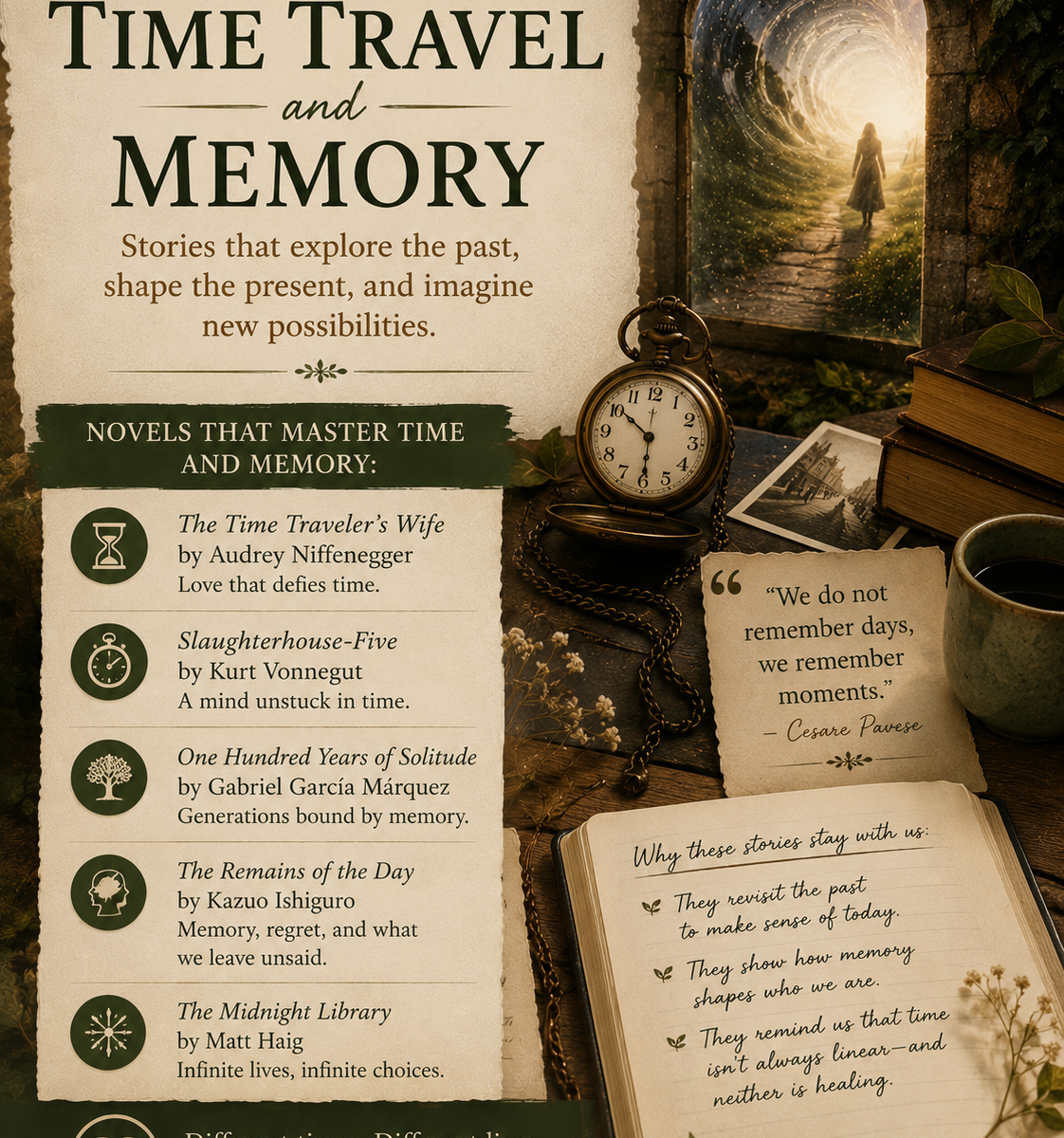
Best Literary Time Travel and Memory: Books, Themes, and Symbols That Bend Time

Literary time travel

Best Literary Time Travel and Memory is a rich topic because books often treat time as more than a clock. In literature, time can reveal grief, guilt, love, trauma, and the deep need to understand the past.

From science fiction to modern novels, writers use time travel and memory to ask one big question: can people ever escape what happened before?

In this Guide

  • Why time travel and memory matter in literature
  • Best Literary Time Travel and Memory in famous books
  • Recommended books to read
  • Key themes and symbols
  • How students can analyze these stories
  • FAQs
  • Key takeaway
Literary time travel

Why Best Literary Time Travel and Memory Still Matters

Stories about time often feel strange, but their emotions are easy to understand.

Best Literary Time Travel and Memory matters because it shows how the past shapes the present. A character may travel through time, but the real journey is often inside the mind.

Memory can comfort a character. It can also trap them. In many books, the past returns because someone has not faced it yet.

This is why time travel stories are not only about machines or magic. They are also about regret, hope, and the wish to fix what cannot be fixed.

Best Literary Time Travel and Memory in Classic and Modern Books

Many famous books bend time to show how people live with pain, history, and desire.

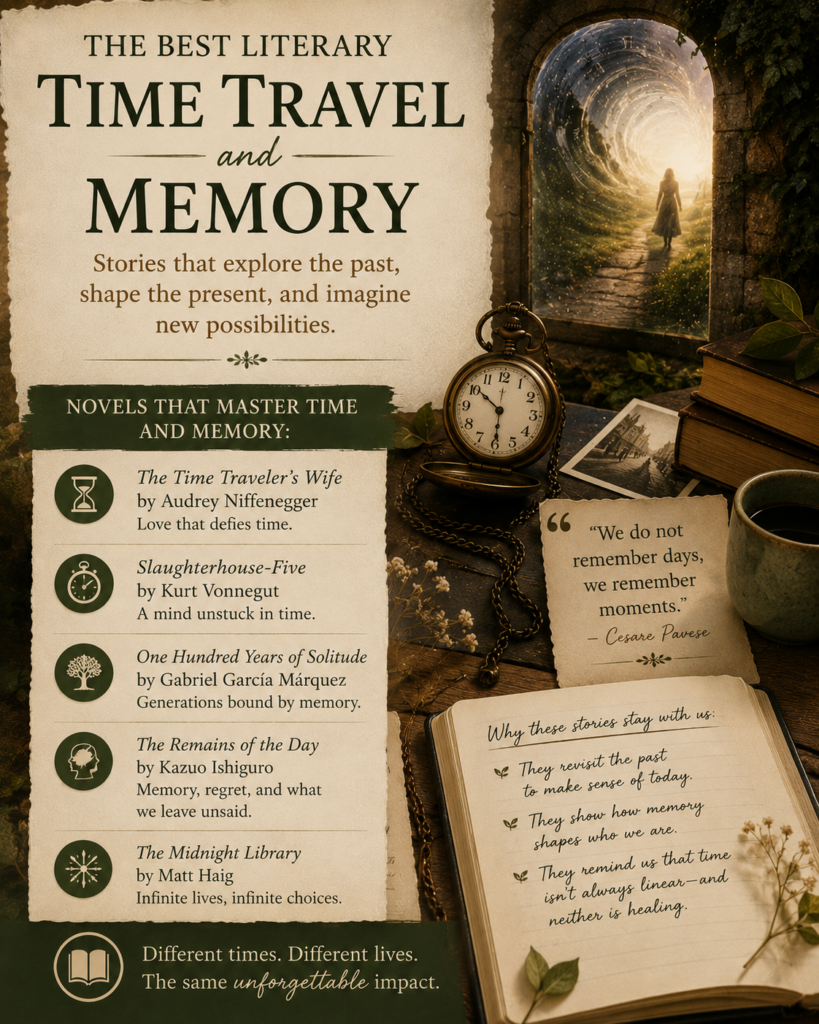
In Slaughterhouse-Five by Kurt Vonnegut, Billy Pilgrim becomes “unstuck in time.” He moves between war, home, and alien spaces. The broken timeline mirrors the shock of trauma.

In Kindred by Octavia E. Butler, Dana travels from 1970s California to the era of slavery. The time travel is direct and frightening. It forces readers to see history as something alive, not distant.

In The Time Traveler’s Wife by Audrey Niffenegger, time travel affects love and family. The story asks whether love can survive when time itself feels unfair.

Best Literary Time Travel and Memory also appears in books without actual time machines. In Mrs Dalloway by Virginia Woolf, memory carries characters back into old choices and lost chances.

Recommended Books for Best Literary Time Travel and Memory

These books are strong picks for students who want clear examples of time, memory, and identity.

  • Kindred by Octavia E. Butler
  • Slaughterhouse-Five by Kurt Vonnegut
  • The Time Traveler’s Wife by Audrey Niffenegger

Kindred works well for class discussion because it connects time travel to race, power, and family history.

Slaughterhouse-Five is a key text for war literature. It uses a strange time structure to show how trauma changes memory.

The Time Traveler’s Wife gives the theme a personal focus. It shows how time can feel romantic, painful, and out of human control.

Memory as a Form of Time Travel

Not every story needs a time machine to move through time.

Memory is often the most common form of time travel in literature. A smell, place, photo, or sound can pull a character into the past.

In In Search of Lost Time by Marcel Proust, a small taste of cake brings back a flood of memory. The moment is famous because it shows how the past can return without warning.

In Beloved by Toni Morrison, memory is painful and hard to escape. The past becomes almost physical. It enters the home, the body, and the lives of the characters.

This is why Best Literary Time Travel and Memory fits both science fiction and literary fiction. Both forms ask how the past still touches the present.

Symbols in Best Literary Time Travel and Memory Stories

Writers often use simple objects to make time feel visible.

Clocks are the clearest symbol. They can show order, pressure, or fear. A broken clock may suggest that normal time no longer works.

Photographs also matter. They freeze one moment, but they can stir deep emotion. A photo may seem still, yet it can move a character back into loss or love.

Doors, roads, mirrors, and rivers often appear in stories about time. Each one can suggest a passage from one state of life to another.

Nature can also shape memory. A desert, forest, or lonely plain may hold the weight of the past. For more on place and meaning, read our guide to nature and isolation in Western writing.

Major Themes in Best Literary Time Travel and Memory

The best time travel stories use big ideas in personal ways.

Regret is one major theme. Characters often want to change a mistake, save a loved one, or choose a different path.

Trauma is another key theme. In many novels, time feels broken because the mind cannot leave a painful event behind.

Identity also matters. If memory shapes who we are, then a change in memory can change the self.

These themes make Best Literary Time Travel and Memory useful for AP Literature and college essays. The topic helps students connect plot structure to deeper meaning.

How Time Structure Shapes the Reader’s Experience

A story’s timeline can affect how readers feel.

A straight timeline feels steady. A broken timeline feels uncertain. When scenes jump between past and present, readers may feel the same confusion as the character.

Vonnegut uses this method in Slaughterhouse-Five. The jumps in time are not random. They show how war has damaged Billy’s sense of reality.

Woolf uses memory in a different way. In Mrs Dalloway, one day in London opens into many years of feeling and thought.

For background on memory as a human process, the Britannica overview of memory offers a helpful starting point.

Why Students Should Study Best Literary Time Travel and Memory

This topic helps students read beyond the surface.

When a book moves through time, ask why. The author may want readers to feel grief, suspense, shock, or longing.

Students can also look for patterns. What moments return? Which memories repeat? What does the character avoid?

Best Literary Time Travel and Memory gives students a strong way to discuss theme, structure, symbol, and character at once.

It also connects well to place. A setting can act like a memory bank, especially when nature reflects loss or silence. Our article on landscape and isolation in literature explores this idea in more depth.

Poetry, Time, and Memory

Poetry often treats time as brief, fragile, and emotional.

Many poems look back at childhood, lost love, or death. The speaker may not travel through time in a literal way, but memory creates the same effect.

T.S. Eliot’s poetry often explores time, history, and spiritual longing. You can learn more about Eliot through the Poetry Foundation’s T.S. Eliot page.

Poems are useful for this topic because they can turn one moment into a doorway. A single image can open years of memory.

How to Write About Best Literary Time Travel and Memory

A strong essay starts with the reason behind the time shift.

Do not only say that a story jumps in time. Explain what the jump reveals. Does it show trauma, love, fear, or guilt?

Use short quotes that show the pattern. Then connect those quotes to the character’s inner life.

A helpful thesis might say: “The broken timeline shows that the character cannot separate the present from the past.”

This keeps your essay focused on meaning, not just plot summary.

FAQs About Best Literary Time Travel and Memory

What is literary time travel?

Literary time travel means a story moves across different points in time. This can happen through science fiction, magic, dreams, or memory.

Is memory a form of time travel in literature?

Yes. Memory can move a character back into the past in an emotional way. It may feel as powerful as real time travel.

What book is best for studying time travel and memory?

Kindred by Octavia E. Butler is one of the best choices. It uses time travel to explore history, family, and power.

Why do authors use broken timelines?

Authors use broken timelines to show how people think and feel. This structure can reveal trauma, regret, or deep longing.

Can this topic help with AP Literature essays?

Yes. Best Literary Time Travel and Memory is useful because it connects structure, theme, and character change.

Key Takeaway

Best Literary Time Travel and Memory shows that the past is never fully gone. In literature, time can break, bend, and return because characters still carry what they have loved, lost, or feared.

The strongest stories about time are not only about where a character goes. They are about what the character finally understands.
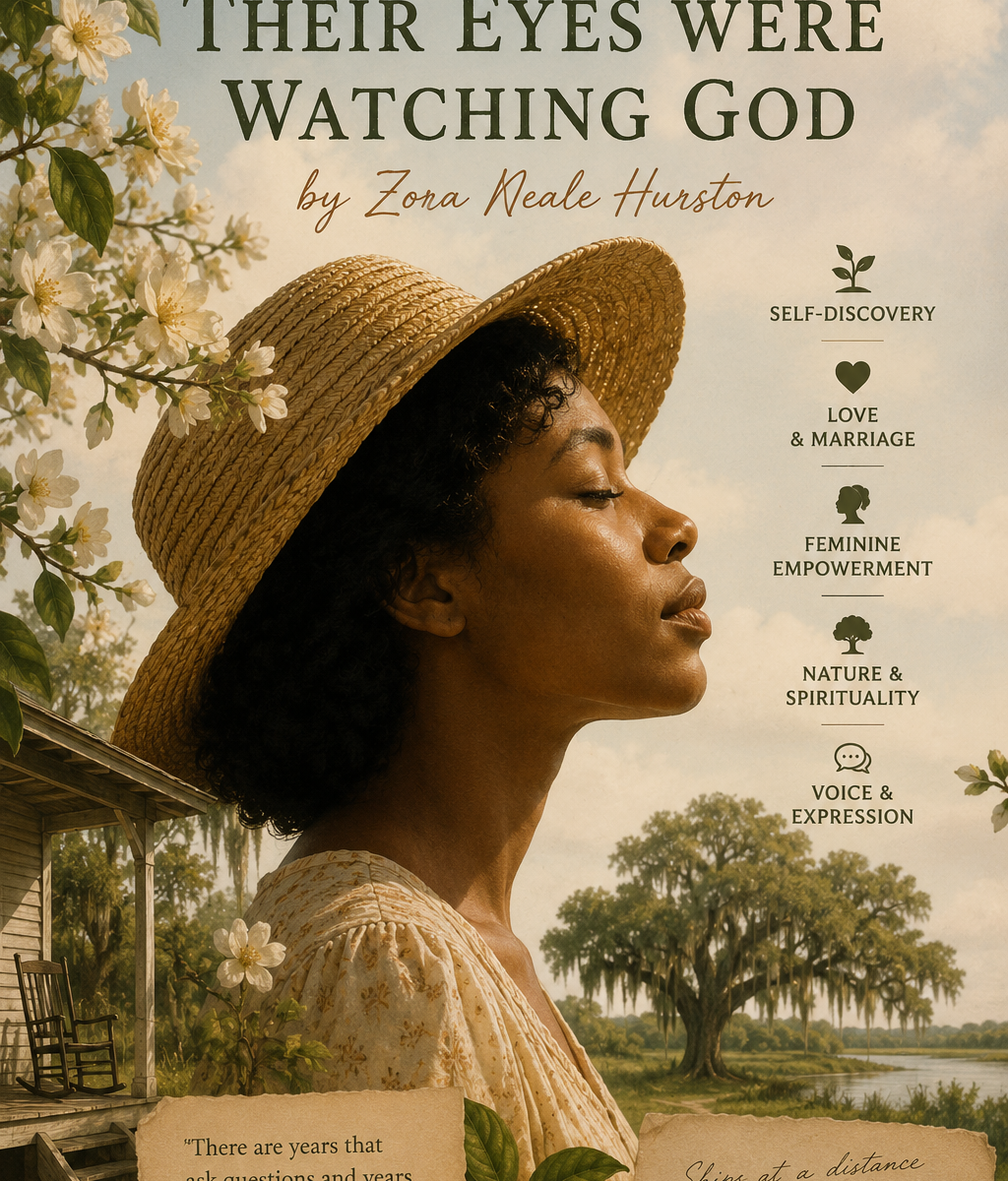
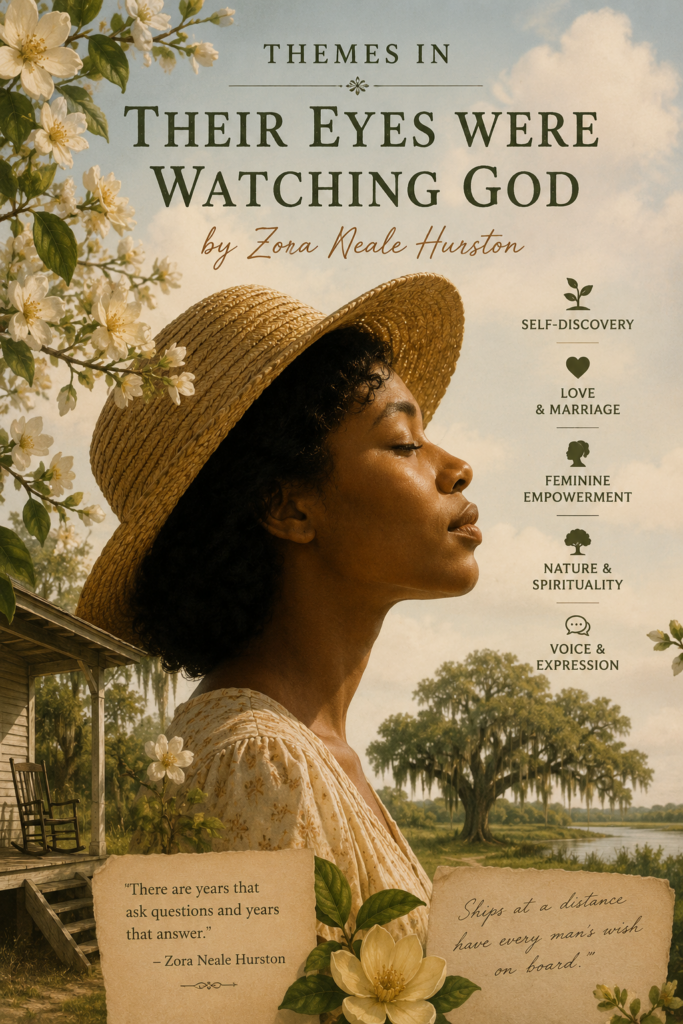
Themes in Their Eyes Were Watching God: A Student-Friendly Guide

Their Eyes Were Watching God Themes

Zora Neale Hurston’s novel follows Janie Crawford as she searches for love, voice, and a life that feels like her own. The themes in Their Eyes Were Watching God help students see why Janie’s story still matters in classrooms today.

In this Guide

Use this guide to focus your reading and prepare for class discussion.

Their Eyes Were Watching God Themes

Why the themes in Their Eyes Were Watching God Matter

The novel is not just about what happens to Janie. It is about what she learns as she moves through love, pain, and freedom.

The themes in Their Eyes Were Watching God show how hard it can be to find yourself when others keep trying to define you. Janie’s life is shaped by family pressure, marriage, gossip, race, and gender roles.

Hurston also writes with deep respect for Black Southern speech and culture. You can learn more about her life and work through Britannica’s profile of Zora Neale Hurston.

Major themes in Their Eyes Were Watching God

These are the main ideas students should track as they read the novel.

Self-discovery and voice

Janie’s biggest journey is the search for her own voice. At first, other people speak for her or decide what her life should mean.

Logan Killicks sees her as labor. Jody Starks sees her as a symbol of his power. Tea Cake gives her more space to speak, but Janie still must learn to stand on her own.

This theme is clear at the end when Janie tells her story to Pheoby. Her voice becomes proof that she survived and grew.

Love and control

Love and power are often tied together in the novel. Hurston asks whether love can be real if one person tries to control the other.

Janie’s first marriage gives her safety but no joy. Her second marriage gives her status but takes away freedom. With Tea Cake, love feels more alive, but it is not perfect.

A useful comparison is Jane Eyre by Charlotte Brontë. Like Janie, Jane wants love, but she also wants respect and self-rule.

Gender roles and power

Janie lives in a world where men often expect women to stay quiet. Jody makes this clear when he keeps Janie off the porch and away from public talk.

The porch becomes more than a place. It shows who has a voice and who gets pushed aside.

Janie’s growth comes when she stops living only by other people’s rules. She does not reject love, but she refuses to disappear inside it.

Race, community, and judgment

The novel shows Black community life with humor, beauty, conflict, and pressure. Eatonville is a place of pride, but it is also full of gossip and judgment.

People watch Janie closely because she does not always fit what they expect. Her return in overalls shocks the town because they judge her before they hear her story.

This is one reason the frame story matters. Janie’s own account pushes back against the town’s narrow view of her life.

Nature, God, and fate

Nature is powerful in the novel. The pear tree, the mule, the horizon, and the hurricane all point to forces larger than daily life.

The hurricane is one of the clearest examples. It reminds readers that human plans can be broken by forces no one can control.

The title itself points to this idea. During the storm, the characters look toward God because they know human power has limits.

Symbols That Support the themes in Their Eyes Were Watching God

Hurston’s symbols help turn ideas into images students can remember.

The pear tree represents Janie’s early dream of love. She sees beauty, union, and desire in the natural world.

The horizon stands for possibility. Janie keeps reaching toward a life that feels wider than the one others choose for her.

The mule shows burden and mistreatment. It connects to the way people, especially women, can be used by others.

These symbols make the themes in Their Eyes Were Watching God easier to trace. If you want more help with this skill, read our guide on how to find symbolism in a story.

How Hurston’s Style Builds Meaning

The way Hurston tells the story is just as important as the plot.

Hurston uses a frame story, which means Janie tells her past from a later point in her life. This gives Janie control over her own story.

The novel also shifts between poetic narration and spoken dialogue. This mix helps readers hear both Janie’s inner life and the life of her community.

For context on the wider literary movement around Hurston’s era, see Poetry Foundation’s introduction to the Harlem Renaissance.

How to Write About themes in Their Eyes Were Watching God

A strong essay should connect a theme to Janie’s growth, not just name the theme.

When you write about themes in Their Eyes Were Watching God, start with a clear claim. For example, you might argue that Janie’s voice becomes stronger each time she leaves a life that limits her.

Then use key scenes. Good choices include Janie under the pear tree, Jody silencing her in the store, the hurricane, and Janie’s final talk with Pheoby.

You can also connect theme and symbol. The horizon works well because it follows Janie’s desire for freedom across the novel. For extra practice, use this symbolism reading strategy as you gather evidence.

Related Books Students May Find Helpful

These books can help you compare voice, identity, and freedom across different works.

  • Their Eyes Were Watching God by Zora Neale Hurston
  • Jane Eyre by Charlotte Brontë
  • The Color Purple by Alice Walker

FAQ About themes in Their Eyes Were Watching God

These quick answers can help with review before a quiz or essay.

What are the main themes in Their Eyes Were Watching God?

The main themes include self-discovery, voice, love, power, gender roles, race, community, nature, and fate.

Why is Janie’s voice important?

Janie’s voice shows her growth. By telling her own story, she claims the meaning of her life.

What does the pear tree symbolize?

The pear tree symbolizes Janie’s dream of love, beauty, and emotional connection.

How does the hurricane connect to the title?

The hurricane shows that people are not fully in control. In that moment, the characters look toward God and face the power of nature.

Is Tea Cake the answer to Janie’s search?

Not fully. Tea Cake helps Janie experience a freer kind of love, but Janie’s final strength comes from within herself.

Key Takeaway

Janie’s story is about more than romance. The deepest themes in Their Eyes Were Watching God show a woman learning to speak, choose, and live as herself.

Themes in The Outsiders: A Student-Friendly Guide

The Outsiders themes

S.E. Hinton’s The Outsiders is short, but it gives students a lot to study. The themes in The Outsiders focus on class conflict, loyalty, violence, and the search for identity.

This guide explains the big ideas behind the story so you can discuss them with confidence in class or in an essay.

In this Guide

  • Why the novel’s themes matter
  • Major ideas students should know
  • Class conflict between Greasers and Socs
  • Loyalty, family, and friendship
  • Violence and loss
  • How to write about the novel
  • FAQ and key takeaway
The Outsiders themes

Why the themes in The Outsiders Matter

A theme is a message a story builds through choices, conflict, and change.

The themes in The Outsiders matter because the novel is not just about rival groups. It asks why people judge each other and what happens when pain turns into violence.

Ponyboy’s world may seem simple at first: Greasers versus Socs. As the story moves on, that line becomes less clear. The novel shows that people are more complex than their labels.

Major themes in The Outsiders Students Should Know

The novel’s biggest ideas connect to real questions about belonging and fairness.

Several themes in The Outsiders appear again and again. The most important ones include **social class**, **loyalty**, **violence**, identity, and the loss of innocence.

These ideas help explain why the story still feels fresh to students. The setting may belong to the 1960s, but the problems feel familiar in school, families, and friendships today.

For background on the novel and its place in young adult literature, you can read Britannica’s overview of The Outsiders.

Social Class as One of the themes in The Outsiders

Class conflict drives much of the novel’s tension.

The Greasers and Socs live close to each other, but they do not have the same lives. The Socs have money, clean cars, and social power. The Greasers face poverty and public judgment.

Hinton shows that class shapes how people see themselves. Ponyboy knows that adults and strangers often expect Greasers to be trouble.

Yet the Socs are not shown as fully happy either. Cherry helps Ponyboy see that wealth does not erase pain. This makes the class conflict more human and less simple.

A useful comparison is Romeo and Juliet. Shakespeare’s play also shows two groups trapped by old hatred. In both works, young people pay the price for a conflict they did not start.

Loyalty, Family, and Chosen Bonds

In the novel, family is not only about blood.

Ponyboy, Sodapop, and Darry are brothers, but their home life is hard after their parents die. Darry acts strict because he fears losing his family. Ponyboy often mistakes that fear for anger.

The Greasers also form a chosen family. They protect each other because the world often does not protect them.

Johnny’s bond with the group is especially important. His home is unsafe, so the Greasers become the people he trusts. His story shows why loyalty can feel like survival.

If you want to study how Ponyboy, Johnny, or Darry reveal theme, this guide on how to analyze characters in literature can help.

Violence and the Cost of Conflict

The novel does not treat violence as exciting or harmless.

Fights in The Outsiders often begin because characters feel trapped, scared, or ashamed. Violence may seem like power, but it leaves grief behind.

The church fire changes the way we see Johnny and Ponyboy. They risk their lives to save children, which proves they are not the criminals others expect them to be.

Bob’s death, Johnny’s injuries, and Dally’s final moments show the cost of a world built on revenge. Hinton makes readers ask what might have happened if the characters had more support.

Identity and Seeing People Clearly

Ponyboy learns that people cannot be understood by group names alone.

At first, the labels seem fixed: Greaser and Soc. Over time, Ponyboy sees that these labels hide real feelings.

Cherry tells Ponyboy that things are rough all over. That line matters because it does not erase class differences, but it does challenge hate. It asks Ponyboy to see people more clearly.

This theme resembles part of To Kill a Mockingbird by Harper Lee. Both novels ask readers to look past easy judgments and notice the person beneath the label.

Innocence, Loss, and the Meaning of Stay Gold

The phrase “stay gold” is one of the novel’s most famous ideas.

Johnny tells Ponyboy to “stay gold” near the end of the story. He wants Ponyboy to keep his kindness, wonder, and sense of beauty.

This idea connects to Robert Frost’s poem “Nothing Gold Can Stay,” which Ponyboy and Johnny discuss. You can read about Frost at the Poetry Foundation.

The message is sad, but it is not hopeless. Ponyboy cannot stay innocent in the same way, but he can still choose empathy.

How to Write About themes in The Outsiders

Strong theme writing connects an idea to evidence from the story.

When you write about themes in The Outsiders, avoid a sentence like “This book has loyalty.” That is too plain. Try a claim that explains what the novel says about loyalty.

For example: Hinton shows that loyalty can protect people, but it can also keep them stuck in dangerous conflicts.

Then use scenes with the Greasers, Johnny, or Darry as evidence. Explain how the scene proves your point. Do not just retell the plot.

If you want a simple study tool for planning theme paragraphs, try our literature theme analysis worksheet.

Books That Pair Well with The Outsiders

These books can help students compare similar ideas about class, identity, and growing up.

  • That Was Then, This Is Now by S.E. Hinton
  • To Kill a Mockingbird by Harper Lee
  • Romeo and Juliet by William Shakespeare

Each title gives students a way to compare conflict across time and place.

FAQ About themes in The Outsiders

These short answers can help with homework, class notes, or essay prep.

What are the main themes in The Outsiders?

The main themes in The Outsiders include social class, loyalty, violence, identity, and loss of innocence.

What is the most important theme in The Outsiders?

Many readers see social class as the most important theme because the Greaser and Soc conflict shapes the whole story.

What does “stay gold” mean?

It means to keep your goodness and sense of wonder, even after pain or loss.

How does Ponyboy change?

Ponyboy learns to question labels and see people with more empathy.

Key Takeaway

The themes in The Outsiders show that people are more than their group, their money, or their worst moment.

Hinton’s novel reminds students that empathy is not weak. It is the first step toward understanding.

Symbols in The Catcher in the Rye: Meanings, Themes, and Why They Matter

Catcher in the Rye symbols

A simple explanation of the most important symbols and images in the text.

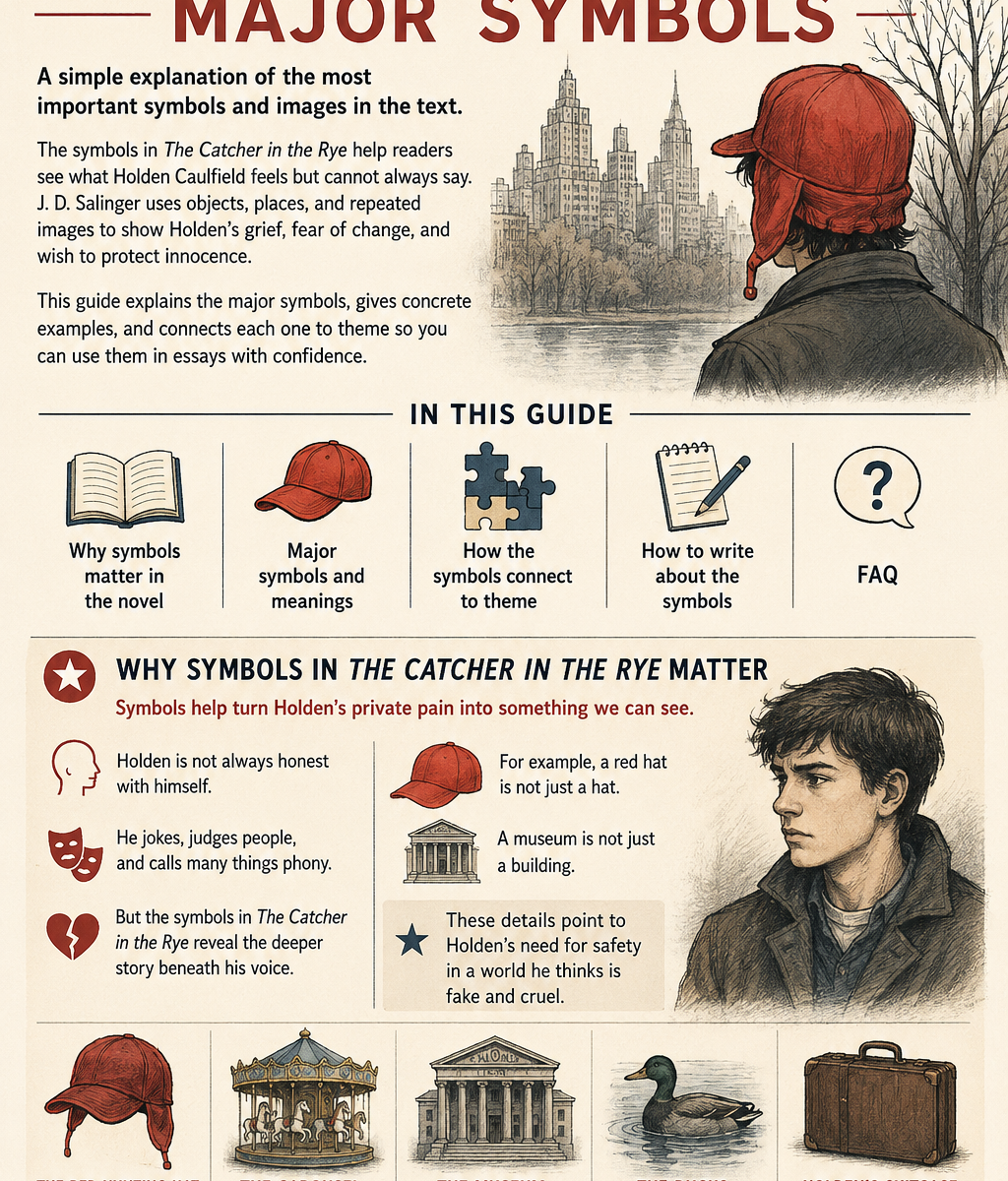
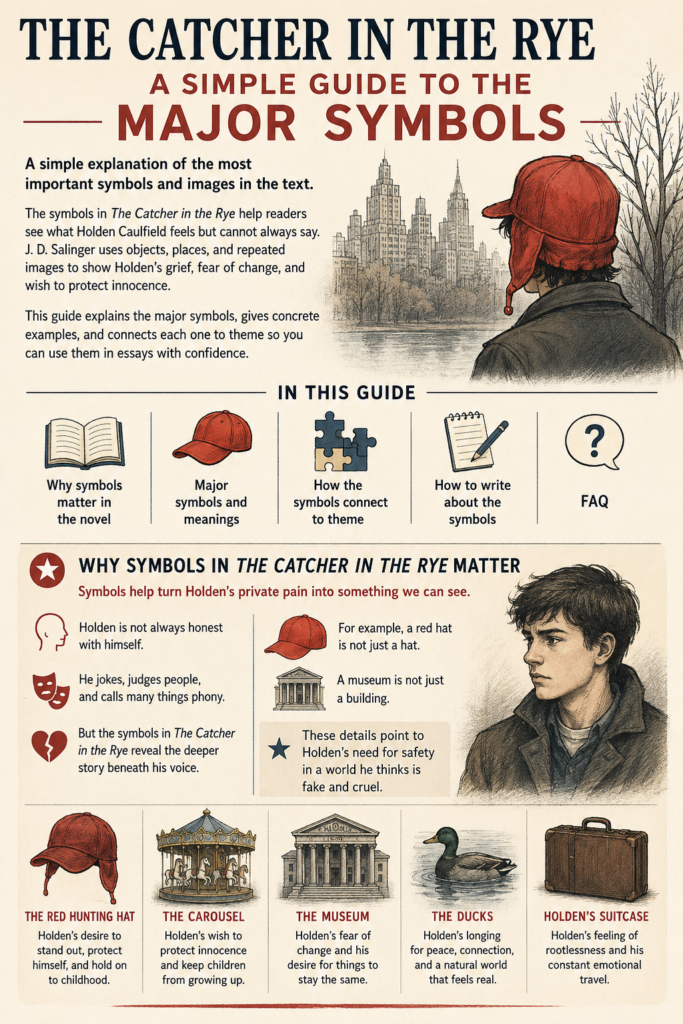
The symbols in The Catcher in the Rye help readers see what Holden Caulfield feels but cannot always say. J. D. Salinger uses objects, places, and repeated images to show Holden’s grief, fear of change, and wish to protect innocence.

This guide explains the major symbols, gives concrete examples, and connects each one to theme so you can use them in essays with confidence.

In this Guide

Catcher in the Rye symbols

Why Symbols in The Catcher in the Rye Matter

Symbols help turn Holden’s private pain into something we can see.

Holden is not always honest with himself. He jokes, judges people, and calls many things phony. But the symbols in The Catcher in the Rye reveal the deeper story beneath his voice.

For example, a red hat is not just a hat. A museum is not just a building. These details point to Holden’s need for safety in a world he thinks is fake and cruel.

If you need a quick refresher on symbolism as a literary tool, see this guide on how to find symbolism in a story.

Major Symbols in The Catcher in the Rye

The novel’s most important symbols show Holden’s inner conflict.

The most famous symbols in The Catcher in the Rye include the red hunting hat, the ducks in Central Park, the Museum of Natural History, and the catcher in the rye image. Each one connects to a major theme in the book.

The Red Hunting Hat

Holden’s red hunting hat is one of the clearest symbols in the novel. He buys it in New York after losing the fencing team’s equipment, which already links the hat to failure and shame.

The hat makes Holden feel unique. It helps him stand apart from other people, even while he feels lonely.

The color red may also connect to Allie, Holden’s dead brother, who had red hair. Because of that, the hat becomes a quiet sign of memory and grief.

Theme connection: The hat shows Holden’s need for identity and protection. He wants to be different, but he also wants comfort.

The Ducks in Central Park

Holden keeps asking where the ducks go when the lagoon freezes. This question seems odd at first, but it matters a lot.

The ducks stand for survival during change. Holden wants to know if living things can disappear and still be safe somewhere else.

This connects to his fear after Allie’s death. If the world can change so fast, Holden wants proof that someone or something will take care of the vulnerable.

Theme connection: The ducks show Holden’s fear of loss and his search for reassurance.

The Museum of Natural History

Holden loves the museum because nothing changes there. The displays stay the same each time he visits.

That matters because Holden hates the way real life keeps moving. People grow up. Families change. Innocence fades.

The museum offers a frozen world. Holden knows this is not real life, but he still wants it.

Theme connection: The museum represents Holden’s desire to stop time and avoid adulthood.

The Catcher in the Rye Image

The title symbol comes from Holden’s dream of standing in a field of rye, catching children before they fall off a cliff. He imagines himself as a protector of innocence.

But Holden misunderstands the Robert Burns poem he hears. That mistake matters because his dream is beautiful, but it is also impossible.

Children will grow up. Holden cannot stop every fall. He must learn that care does not mean control.

Theme connection: The catcher image shows Holden’s wish to protect innocence and his fear of growing up.

How Symbols in The Catcher in the Rye Connect to Theme

Every strong symbol in the novel points back to Holden’s fear of change.

Many symbols in The Catcher in the Rye connect to the same core struggle. Holden wants the world to stay simple and safe, but the world will not do that for him.

The red hat offers protection. The museum offers stillness. The ducks offer hope that change does not mean death. The catcher image offers a fantasy where no child has to fall.

This is similar to symbols in other well-known novels. In The Great Gatsby, the green light points to a dream that Gatsby can never fully reach. In Lord of the Flies, the conch shows order that slowly breaks apart.

Salinger’s symbols work the same way. They take a large theme and place it inside a clear image.

Writing About Symbols in The Catcher in the Rye

A good symbolism paragraph explains both the object and the idea behind it.

When students write about symbols in The Catcher in the Rye, they often stop too early. It is not enough to say the red hunting hat means individuality. You also need to explain why Holden needs that feeling.

Try this pattern: name the symbol, describe where it appears, explain what it suggests, and connect it to theme.

For example, you might write that the Museum of Natural History symbolizes Holden’s wish for a world without change. Then you can link that idea to his grief over Allie and his fear of adulthood.

For more help, read our full guide on spotting symbolism in fiction. You can also review RapidReads Press literature study resources for essay practice and reading support.

Quick Reference: Symbol Meanings

Use this section as a fast study tool before a quiz or essay.

  • Red hunting hat: protection, identity, grief, and the need to feel special.
  • Ducks: change, survival, and Holden’s fear of being left behind.
  • Museum: stillness, safety, and the wish to stop time.
  • Catcher image: innocence, protection, and Holden’s impossible dream.
  • Allie’s baseball glove: memory, love, and the pain of loss.

Allie’s Baseball Glove

Allie’s glove is a personal symbol of love and grief.

The glove belonged to Holden’s younger brother, Allie, who died of leukemia. Allie wrote poems on it so he could read them during baseball games.

This detail shows that Allie was thoughtful and creative. To Holden, the glove is not just a memory. It is proof that someone pure and good was taken from the world.

Theme connection: The glove shows how grief shapes Holden’s view of innocence.

Author and Context

Knowing a little background can help, but the text should still lead your ideas.

J. D. Salinger published The Catcher in the Rye in 1951. The novel became famous for its teen narrator, direct voice, and honest look at alienation.

You can read more about the novel’s history at Britannica’s overview of The Catcher in the Rye. For author background, see Britannica’s biography of J. D. Salinger.

Helpful Books to Read Next

These books can deepen your understanding of Salinger and coming-of-age fiction.

  • The Catcher in the Rye by J. D. Salinger
  • Nine Stories by J. D. Salinger

FAQ About Symbols in The Catcher in the Rye

What are the main symbols in The Catcher in the Rye?

The main symbols in The Catcher in the Rye are the red hunting hat, the ducks, the museum, the catcher image, and Allie’s baseball glove.

What does Holden’s red hunting hat symbolize?

It symbolizes protection, identity, and Holden’s grief. It helps him feel different, but it also shows how badly he wants comfort.

What do the ducks symbolize?

The ducks symbolize change and survival. Holden wants to know where they go because he fears loss and uncertainty.

Why is the Museum of Natural History important?

The museum matters because it never changes. Holden likes it because it gives him the stillness he cannot find in real life.

What does the catcher in the rye symbolize?

It symbolizes Holden’s dream of saving children from pain and adulthood. The image shows his kindness, but also his struggle to accept change.

Key Takeaway

The symbols in The Catcher in the Rye matter because they reveal Holden’s hidden fears. They show a teenager who wants to protect innocence, hold back change, and find safety after loss.

Themes in The Catcher in the Rye: A Student-Friendly Guide

Catcher themes

The themes in The Catcher in the Rye help readers see why Holden Caulfield feels so lost, angry, and afraid. His voice can sound casual, but the novel raises serious questions about pain, honesty, and what it means to grow up.

In this Guide

Use this guide to review the novel, plan essays, or prepare for class discussion.

  • Why the themes matter
  • Major ideas in the novel
  • Important symbols
  • Essay tips for students
  • FAQ and key takeaway
Catcher themes

Why the Themes in The Catcher in the Rye Matter

This novel is short, but its ideas are deep.

Studying the themes in The Catcher in the Rye helps you move past plot summary. Instead of only saying what Holden does, you can explain what his choices reveal.

Holden tells the story in his own voice. That matters because he often hides his real pain behind jokes, insults, and sharp opinions.

The main conflict is not just Holden against other people. It is also Holden against change, grief, and his fear of adult life.

Major Themes in The Catcher in the Rye

The novel returns to a few strong ideas again and again.

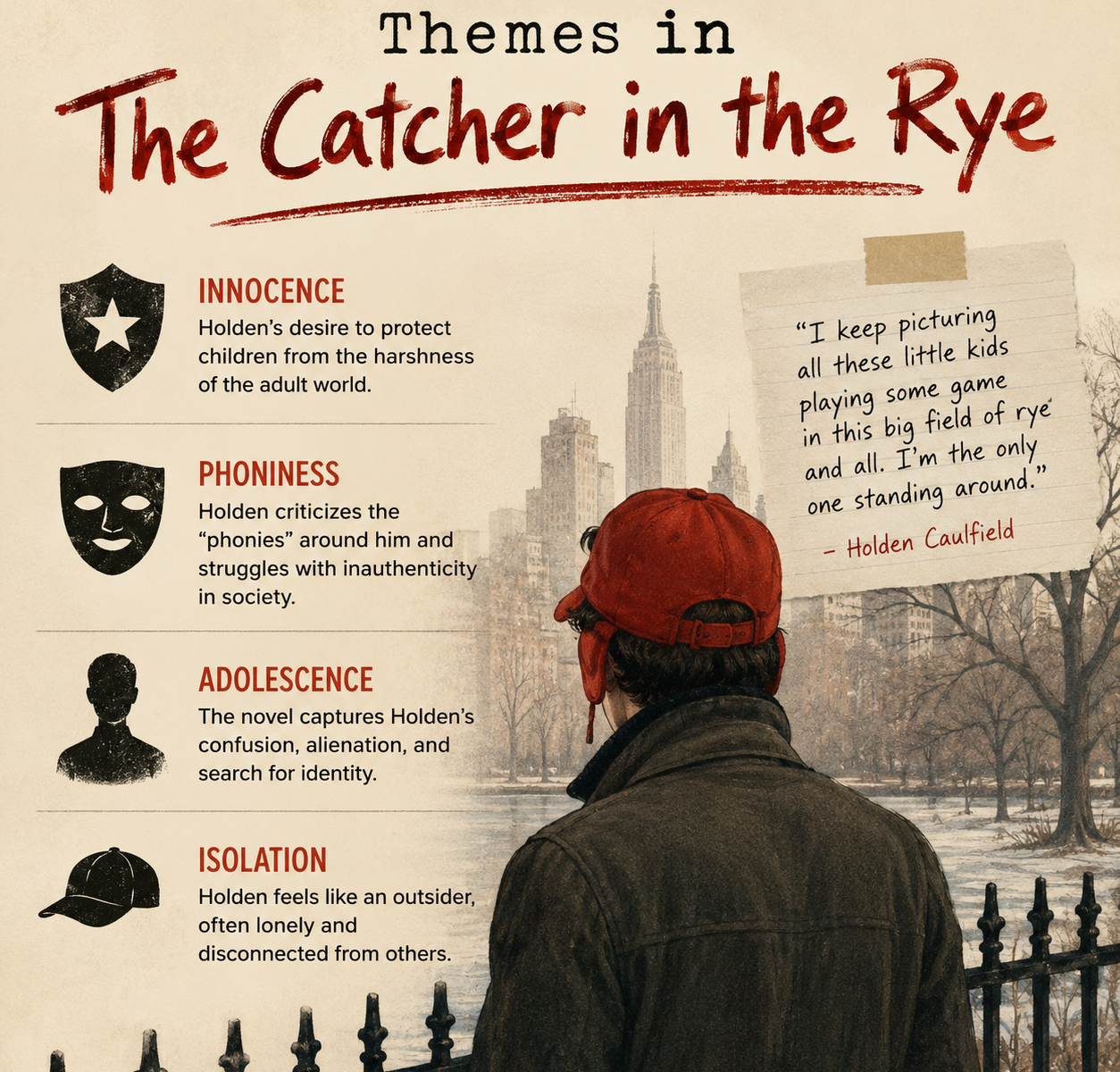
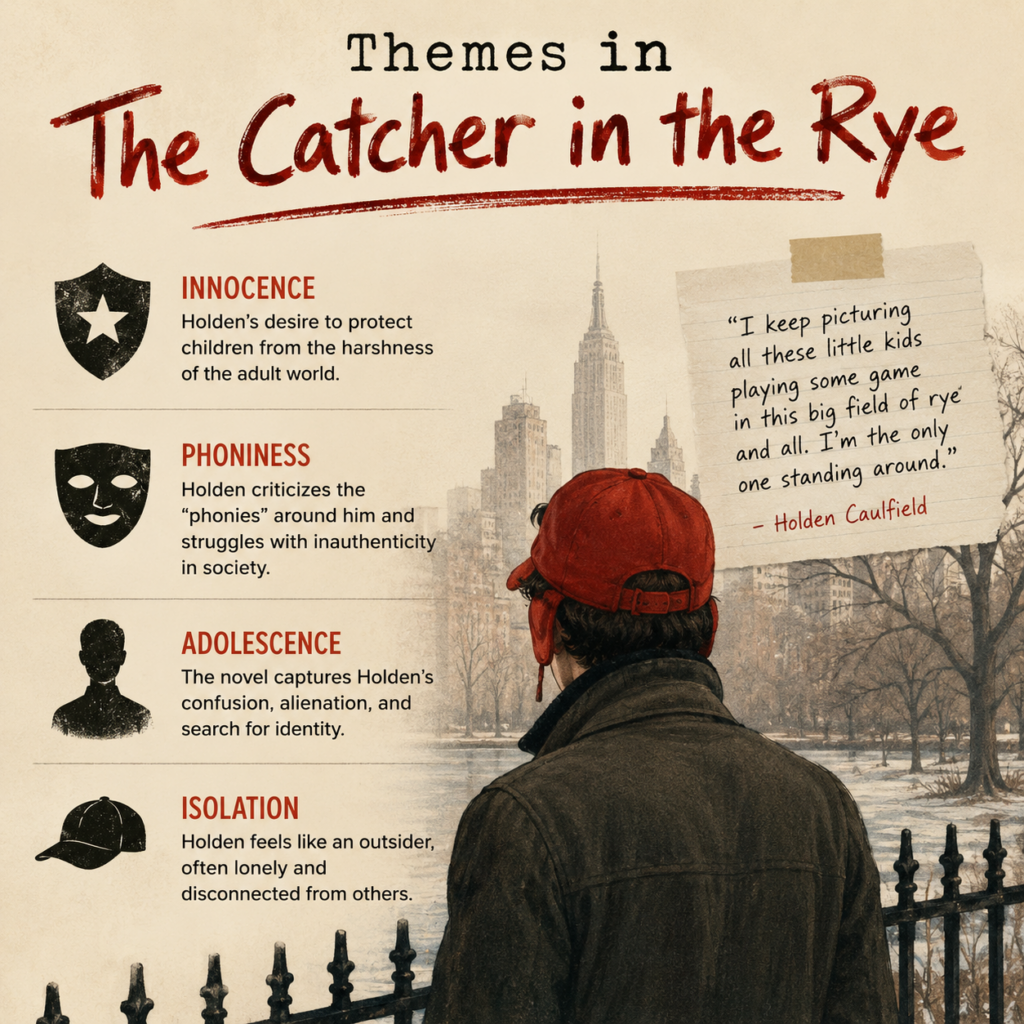
The major themes in The Catcher in the Rye include innocence, phoniness, isolation, grief, and identity. These ideas connect to Holden’s view of the world.

Holden wants people to be honest, but he also lies. He wants connection, but he pushes people away. That tension makes him feel real.

Like Scout in To Kill a Mockingbird, Holden sees adult life as confusing and unfair. Both characters learn that growing up means facing truth, even when truth hurts.

The Theme of Innocence and Protection

Holden wants to protect childhood because it feels safe to him.

One of the clearest themes in The Catcher in the Rye is the loss of innocence. Holden fears that children will be hurt by the adult world.

This is why the image of the “catcher in the rye” matters so much. Holden imagines himself saving children before they fall off a cliff.

The cliff can stand for adulthood, pain, or knowledge that cannot be undone. Holden does not want children to lose their purity.

His love for Phoebe shows this theme in a tender way. She is not perfect, but she reminds him of honesty and warmth.

The Theme of Phoniness

Holden uses the word “phony” to judge people, but the word also reveals his fear.

Holden calls many adults fake. He hates social rules, shallow success, and people who pretend to care.

At school, in hotels, and at parties, Holden feels trapped by manners that seem empty. He often thinks adults perform roles instead of showing real feeling.

Yet Holden is not always honest either. He lies to strangers, changes his story, and hides his feelings.

This makes the theme more complex. The novel does not say Holden is always right. It shows how hard honesty can be when a person feels wounded.

The Theme of Isolation and the Need for Connection

Holden often feels alone, even when he is around people.

Isolation is one of the most painful themes in The Catcher in the Rye. Holden wants someone to understand him, but he rarely lets people get close.

He calls old friends, visits teachers, and talks to strangers. Still, most of these moments fail because Holden feels judged or unsafe.

This pattern is common in literature. In Romeo and Juliet, the young lovers also feel cut off from the adult world around them.

Holden’s loneliness does not mean he hates people. It means he wants real care, but he does not know how to ask for it.

The Theme of Grief and Emotional Pain

Much of Holden’s behavior comes from loss.

Holden’s brother Allie has died, and that loss shapes the whole novel. Holden talks about Allie with love, but also with deep sadness.

He has not made peace with this grief. His anger, fear, and restless travel through New York can be read as signs of inner pain.

The red hunting hat also connects to this theme. It helps Holden feel separate, but it also gives him comfort.

If you want help reading objects like that, see our guide to finding symbolism in a story.

The Theme of Growing Up and Identity

Holden is caught between childhood and adulthood.

He does not want to be a child forever, but he fears the adult world. This conflict shapes his identity.

Holden rejects school, rules, and career talk. He thinks these things push people into fake lives.

At the same time, he cannot escape responsibility. By the end, he starts to see that he cannot control Phoebe’s life or protect every child.

The carousel scene is important here. Holden lets Phoebe reach for the gold ring, even though she might fall. That moment shows a small but real shift.

Key Symbols That Support the Themes

The novel’s symbols make its ideas easier to see.

The red hunting hat shows Holden’s wish to be different and protected. He wears it when he feels unsure or exposed.

The museum shows his desire for a world that does not change. The displays stay the same, unlike people.

The ducks in Central Park show Holden’s worry about survival. He wants to know where they go in winter because he also feels lost.

These symbols help explain the themes in The Catcher in the Rye without turning the novel into a simple lesson. For more support, read this clear guide on how symbols reveal meaning.

How to Write About Themes in The Catcher in the Rye

A strong essay needs a clear claim, not just a topic.

When you write about themes in The Catcher in the Rye, do not say, “This book is about growing up.” That is too broad.

Try a sharper claim: “Salinger shows that growing up requires accepting change, even when change feels dangerous.”

Then use scenes to prove it. The catcher fantasy, the museum, and the carousel can all support that idea.

For quick review before a quiz or essay, you may also want student literature study guide resources.

Helpful Books and Sources

Use outside sources to support your reading, but let the novel lead your ideas.

Books to search on Amazon or at your library:

  • The Catcher in the Rye by J. D. Salinger
  • Franny and Zooey by J. D. Salinger

For background, read Britannica’s overview of The Catcher in the Rye or its short page on J. D. Salinger.

FAQ: Themes in The Catcher in the Rye

Here are quick answers to common student questions.

What are the main themes in The Catcher in the Rye?

The main themes in The Catcher in the Rye are innocence, phoniness, isolation, grief, and growing up.

Why does Holden hate phoniness?

Holden hates phoniness because he sees it as a sign that adults hide truth. He also uses the word to protect himself from pain.

What does the Catcher in the Rye idea mean?

It shows Holden’s wish to protect children from harm, adulthood, and loss of innocence.

Is Holden a reliable narrator?

Not completely. He is honest about some feelings, but he also lies, exaggerates, and avoids painful truths.

Key Takeaway

The themes in The Catcher in the Rye show a teenager who wants truth, love, and safety in a world that feels false and unstable. The novel’s power comes from that conflict.

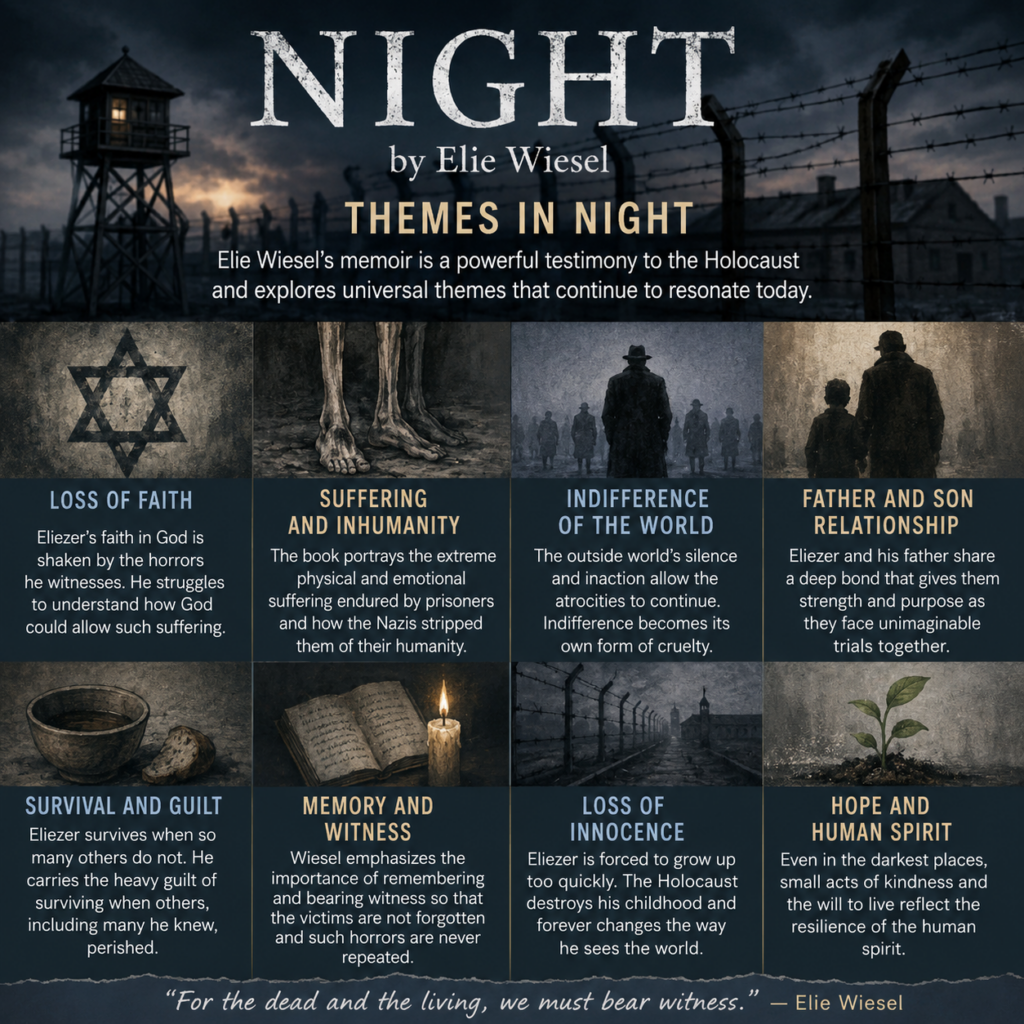
Themes in Night: A Student-Friendly Guide

themes in Night

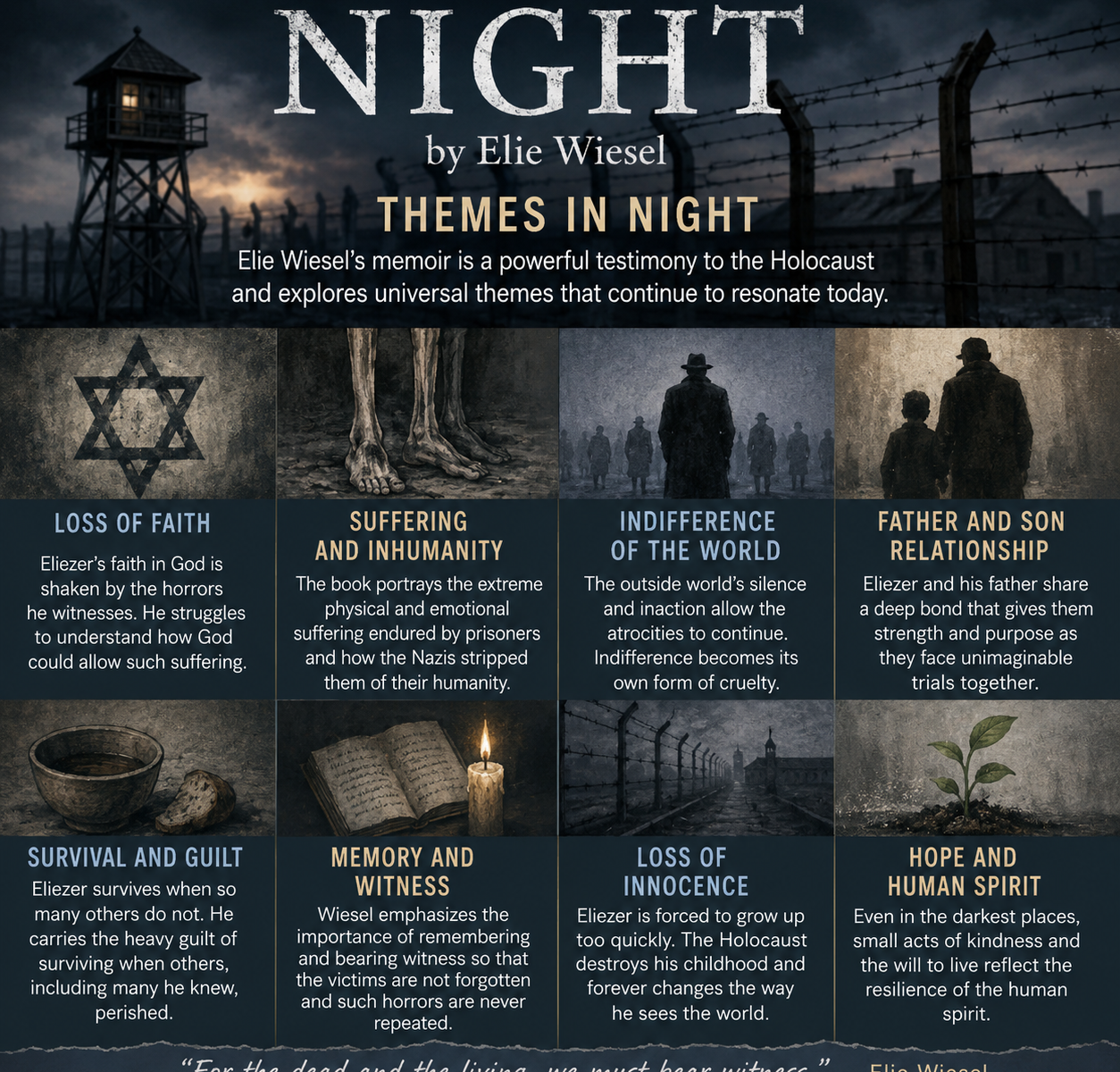
Elie Wiesel’s Night is a short memoir, but its ideas are deep and hard to forget. The themes in Night help students understand how the book explores faith, cruelty, silence, memory, and survival during the Holocaust.

This guide explains the major ideas in clear terms so you can use them in class talks, essays, and exams.

In this Guide

  • Why the themes in Night matter
  • Faith and doubt
  • Dehumanization and identity
  • Silence and responsibility
  • Memory and witness
  • How to write about theme
  • FAQ
themes in Night

Why the themes in Night matter

The memoir is not just about what happened to Elie Wiesel. It asks what happens to a person’s beliefs, family bonds, and sense of self under extreme evil.

The themes in Night matter because they show how history affects real human lives. Wiesel does not let readers stay distant from the suffering he describes.

Before you write about theme, remember this key point: the book is a memoir, not a made-up story. Its themes come from lived experience.

If you need a quick review of the basic idea of theme, this guide to how to identify theme in literature can help.

Themes in Night: Faith and Doubt

Wiesel shows faith as something that can be tested, wounded, and changed.

At the start, Elie has a deep interest in religion. He studies Jewish texts and wants to understand God in a serious way.

After he enters the camps, his faith faces horror that seems impossible to explain. He sees children suffer. He sees people pray while death surrounds them.

This is one of the most painful themes in Night because Wiesel does not give an easy answer. He shows how suffering can make someone question the beliefs that once gave life meaning.

A useful comparison is Job from the Bible. Job also suffers and questions God, but Wiesel’s world feels even more broken because the evil is made by humans.

For essays, avoid saying Elie simply loses faith. A stronger claim is that his faith changes into anger, doubt, and silence.

Themes in Night: Dehumanization and Identity

The camps try to strip people of names, dignity, and personal worth.

One of the clearest themes in Night is dehumanization. Prisoners are shaved, numbered, starved, beaten, and forced to live in fear.

This matters because Wiesel shows that genocide does not begin with murder alone. It begins when people are treated as less than human.

Elie’s identity changes as the camps take away parts of his former life. He is no longer just a son, student, or believer. He becomes a prisoner who must fight to stay alive.

This theme connects to other Holocaust texts, such as The Diary of a Young Girl by Anne Frank. Both works show how hatred targets identity, but Wiesel shows the inside of the camp system with direct force.

When you write about this theme, focus on how language and treatment change the prisoners. A number replaces a name. Hunger replaces normal thought. Fear replaces daily life.

Family, Survival, and Moral Conflict

Wiesel shows how extreme suffering can strain even the strongest family bond.

Elie and his father depend on each other. Their relationship helps both of them survive for much of the memoir.

Yet the camps create terrible moral pressure. Elie sometimes feels fear, guilt, and frustration as he tries to care for his father while he is also weak.

This theme is hard because it does not judge Elie in a simple way. Instead, it shows how evil systems can force people into choices no one should have to face.

A similar idea appears in King Lear, where family love is tested by power and suffering. In Night, the test is not pride or politics. It is hunger, terror, and death.

Themes in Night: Silence and Responsibility

Silence in the memoir can mean fear, failure, or unanswered pain.

Among the themes in Night, silence is one of the most important. Many people outside the camps do not act in time. Some witnesses turn away. God also seems silent to Elie during the worst moments.

Wiesel uses this silence to ask a serious question: what do people owe each other when evil becomes visible?

The memoir suggests that silence can protect the guilty when innocent people need help. This is why Wiesel later became known as a voice for human rights and memory.

For historical background, students can read the United States Holocaust Memorial Museum page on Elie Wiesel.

Themes in Night: Memory and Witness

Wiesel writes so the dead are not erased by time.

Memory is one of the central themes in Night because the memoir itself is an act of witness. Wiesel tells what he saw so readers cannot claim ignorance.

This does not mean the book only records facts. It also shows how memory carries pain. The past remains alive in the mind of the survivor.

Many works of literature use memory to fight loss. In Beloved by Toni Morrison, memory also forces readers to face violence that society may want to forget.

In Night, memory has a moral purpose. To remember is to honor victims and warn the living.

Loss of Innocence in Night

Elie’s view of the world changes because he sees what humans can do to each other.

At first, Elie is young, curious, and devoted to study. He trusts religious learning and family life.

By the end, his childhood has been destroyed. The famous mirror scene shows a person who has survived but has been deeply changed.

Loss of innocence is not only about growing older. In this memoir, it means being forced to see cruelty before the mind is ready.

How to write about themes in Night

A strong theme statement should say more than one word.

Do not write, “The theme is faith.” That is a topic. Write a full idea, such as, “Wiesel shows that extreme suffering can turn faith into doubt, anger, and silence.”

Use short evidence. Then explain how the evidence proves your point.

Here is a simple pattern: name the theme, connect it to a key moment, and explain what Wiesel wants readers to understand.

Helpful books to read with Night

These books can help students build context and compare ideas:

  • The Diary of a Young Girl by Anne Frank
  • Man’s Search for Meaning by Viktor E. Frankl

These works are different from Night, but they also deal with suffering, memory, and the human search for meaning.

FAQ about themes in Night

What are the main themes in Night?

The main themes in Night include faith and doubt, dehumanization, family bonds, silence, memory, and loss of innocence.

Is Night a novel or a memoir?

Night is a memoir. It is based on Elie Wiesel’s own experience during the Holocaust.

What is the most important theme in Night?

Many students choose faith and doubt because Elie’s relationship with God changes so much. Dehumanization is also central to the book.

How do I find evidence for a theme?

Look for repeated moments, changes in Elie’s thoughts, and scenes that show conflict. Then explain what those moments reveal.

Key Takeaway

The themes in Night show how cruelty attacks faith, identity, family, and memory. Wiesel’s memoir asks readers not only to understand the past, but to carry its warning forward.

Themes in Fahrenheit 451: A Student-Friendly Guide

Fahrenheit 451 themes

Fahrenheit 451 is not just a novel about book burning. The main themes in Fahrenheit 451 show what can happen when people stop asking hard questions.

This guide explains each idea in clear terms so you can use it in class discussion or an essay.

In this Guide

Use this quick map to find the section you need.

  • What theme means in the novel
  • Major themes in Fahrenheit 451
  • Censorship and fear of ideas
  • Technology and distraction
  • Conformity and the loss of self
  • Knowledge, memory, and hope
  • Symbols that build meaning
  • Essay tips for students
  • FAQ
Fahrenheit 451 themes

What Makes Theme Important in Fahrenheit 451?

A theme is the deeper message a writer builds through the story.

In Fahrenheit 451, Ray Bradbury does not only ask readers to feel shocked by burning books. He asks readers to ask why a whole society would allow it.

A topic is a subject, like censorship. A theme is a message about that subject, such as: a society that fears hard ideas may destroy its own freedom.

If you want a quick refresher, read our guide on how to identify theme in literature.

Think of The Great Gatsby. The green light is not only a light. It points to hope and illusion. In Fahrenheit 451, fire begins as a sign of control, then shifts toward change.

Major Themes in Fahrenheit 451

Bradbury builds meaning through Montag’s choices and the world around him.

The themes in Fahrenheit 451 do not sit apart from the plot. They grow as Montag sees how empty his society has become.

  • Censorship: Books are destroyed because they make people question easy answers.
  • Technology: Screens and noise keep people from real thought.
  • Conformity: People fear anyone who acts different.
  • Knowledge: Books matter because they help people remember human experience.
  • Hope: Even after destruction, people can rebuild with better values.

These ideas make the novel useful for high school and college essays because each theme connects to a clear conflict in the story.

Censorship and the Themes in Fahrenheit 451

Censorship is the novel’s most obvious warning, but Bradbury makes it more complex than a simple ban on books.

Montag starts as a fireman whose job is to burn books. This flips the normal meaning of firefighter. Instead of saving homes, he helps erase ideas.

The government in the novel fears books because books can create doubt. A person who reads may compare ideas, question leaders, or feel empathy for someone different.

This is one of the clearest themes in Fahrenheit 451: when comfort matters more than truth, freedom becomes weak.

Bradbury also suggests that censorship can come from the public. Beatty explains that people wanted fewer disputes and less discomfort. Over time, books became enemies because they made people feel uneasy.

This links well with George Orwell’s 1984, where the state controls language and history. Both novels show that power grows stronger when people lose access to honest thought.

Technology and Distraction in Fahrenheit 451

The novel does not say all technology is bad. It warns against technology that replaces thought.

Mildred spends much of her life with the parlor walls. These giant screens fill her home with noise, but they do not give her real comfort.

Her seashell radios also show how private space has been invaded. She can avoid silence at any moment. That matters because silence often gives people time to think.

The themes in Fahrenheit 451 show that distraction can become a form of control. If people stay entertained all the time, they may stop caring about war, death, or injustice.

This idea also appears in Aldous Huxley’s Brave New World. In that novel, pleasure helps keep citizens obedient. Bradbury’s world uses screens and speed in a similar way.

Conformity and the Loss of Self

Bradbury’s society punishes people who think or act outside the norm.

Clarisse is important because she asks simple questions. She notices rain, asks about happiness, and refuses to live on auto-pilot.

To Montag’s world, that makes her dangerous. She does not attack anyone. She just thinks for herself.

Montag slowly learns that conformity has made people less human. They laugh at violence, drive too fast, and avoid deep talk. They seem busy, but their lives feel hollow.

This theme helps explain why Montag changes. He does not become curious in one moment. Clarisse helps him notice what was already wrong.

Knowledge, Memory, and Hope

Books matter in the novel because they hold human memory.

Bradbury is not saying every book is perfect. He shows that books are valuable because they keep complex ideas alive.

Faber helps Montag understand this point. People need rich ideas and time to think about them. Without that, books alone cannot save anyone.

The book people at the end of the novel carry this theme forward. They memorize texts so the ideas can survive until the world is ready again.

This ending gives the novel hope. The city falls, but memory remains. Bradbury suggests that people can rebuild if they protect thought and listen to the past.

Fire, the Phoenix, and Other Symbols

Symbols help Bradbury turn big topics into deeper meaning.

Fire is the most important symbol. At first, it means destruction. Montag uses it to burn books and silence people.

Later, fire changes. When Montag finds the people outside the city, their small campfire gives warmth. The same element can destroy or help, based on how people use it.

The phoenix also matters. This mythical bird burns and rises again from ashes. At the end, it suggests that human society may learn from failure and begin again.

Students often miss how symbols connect to theme. If you need help with that skill, this guide to finding theme in literature can help.

How to Write About These Themes in an Essay

A strong literature essay needs a clear claim, not just a summary of events.

A strong essay on the themes in Fahrenheit 451 might argue that Bradbury presents censorship as both a government action and a public habit.

Start with a theme statement. Then choose scenes that prove it. Good moments include Montag meeting Clarisse, Mildred with the parlor walls, the old woman who dies with her books, and Montag’s talk with Faber.

Do not only say that books are important. Explain why they are important in the world of the novel. That turns your point from plot summary into analysis.

For extra help with practice prompts and student-friendly notes, you can use RapidReads Press theme study resources.

Why the Themes in Fahrenheit 451 Still Matter

Bradbury’s novel still feels current because its fears have not gone away.

These themes in Fahrenheit 451 feel close to modern life. Many people live with constant screens, fast news, and pressure to avoid hard debates.

That does not mean Bradbury predicted every detail of the future. It means he understood a human problem: people may give up freedom if comfort feels easier.

For helpful background on the author, see Britannica’s Ray Bradbury biography. The NEA Big Read page on Fahrenheit 451 also gives useful context for students.

Books to Look Up on Amazon or at the Library

These related books can help you compare dystopian themes across texts.

  • 1984 by George Orwell
  • Brave New World by Aldous Huxley

Both books pair well with Bradbury because they ask how power can shape private thought.

Key Takeaway

The core insight is simple: Fahrenheit 451 warns that a society can lose freedom when it rejects thought, memory, and honest conversation.

The novel’s ending leaves room for hope because people still have the power to remember and rebuild.

FAQ

Here are quick answers to common student questions.

What are the main themes in Fahrenheit 451?

The main themes are censorship, technology as distraction, conformity, knowledge, and hope after destruction.

Is censorship the most important theme?

Yes, censorship is central. It connects to almost every other theme in the novel.

What does fire symbolize in the novel?

Fire first symbolizes destruction. Later, it can also suggest warmth, survival, and renewal.

Why is Clarisse important to the themes?

Clarisse helps Montag question his life. Her curiosity shows what his society has lost.

What is a good theme statement for an essay?

Bradbury suggests that people who choose comfort over truth may help create their own oppression.

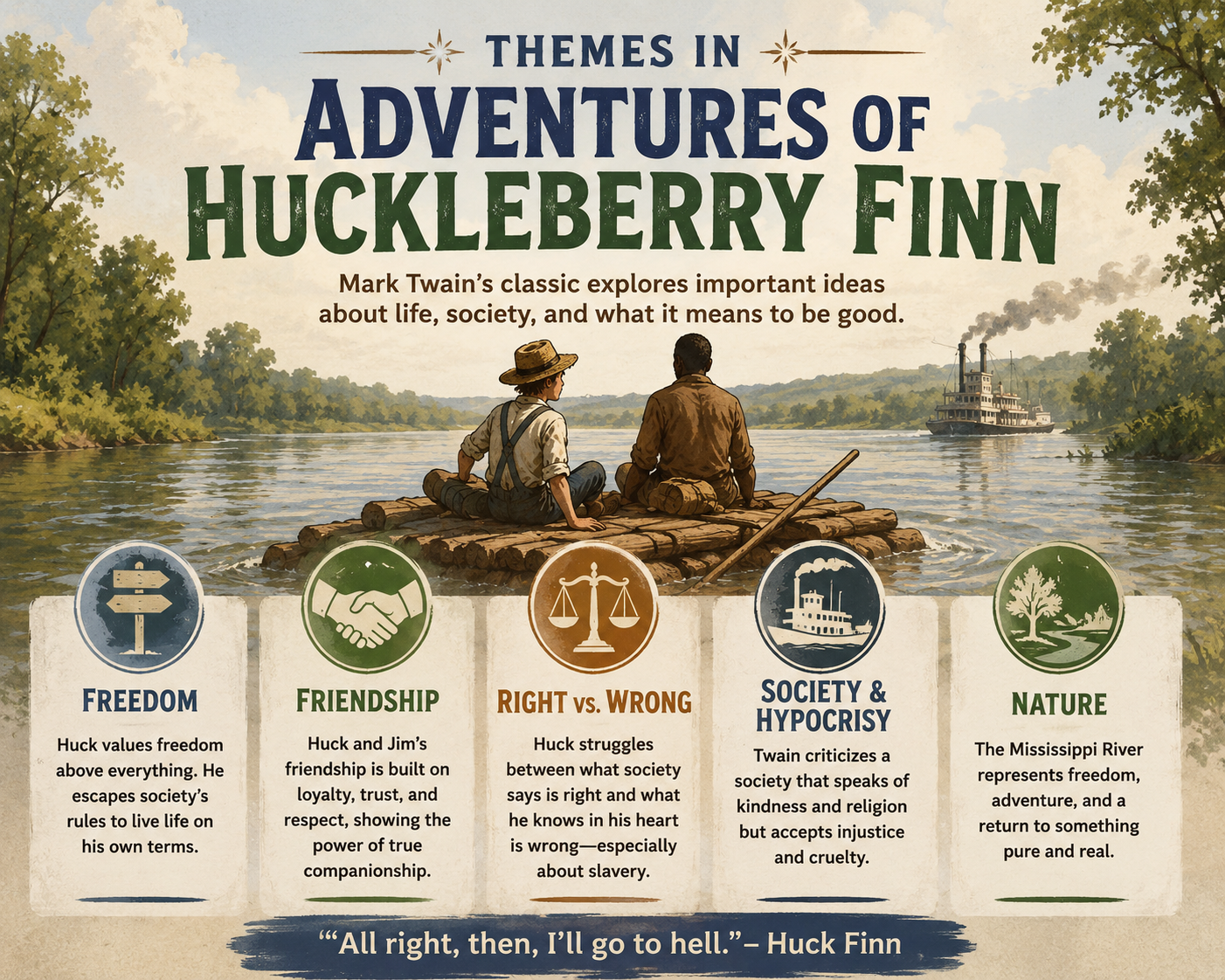
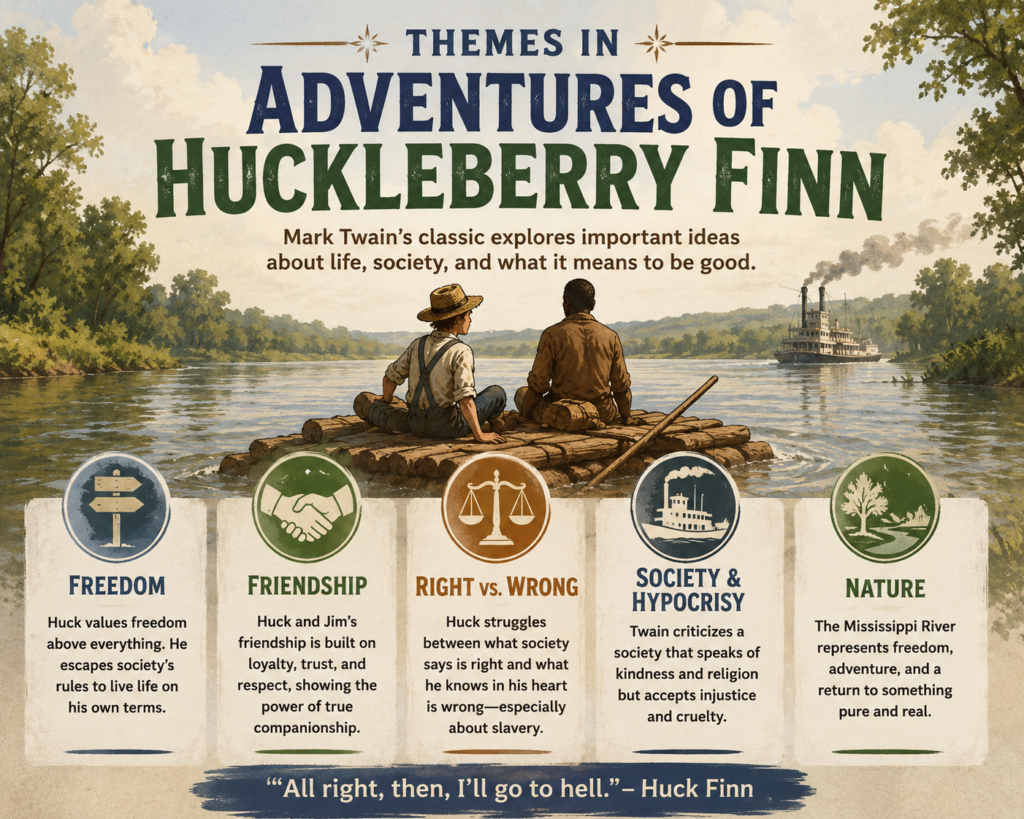
Themes in The Adventures of Huckleberry Finn: A Student-Friendly Guide

Huckleberry Finn themes

The Adventures of Huckleberry Finn can feel funny, strange, and painful all at once. The themes in The Adventures of Huckleberry Finn help students see how Mark Twain uses Huck’s journey to question slavery, racism, moral rules, and what it means to grow up.

This guide explains the major ideas in clear language, with examples you can use in class discussion or an essay.

In this Guide

Use these sections to review the novel’s key ideas and build stronger notes.

Huckleberry Finn themes

Why the themes in The Adventures of Huckleberry Finn matter

Twain’s novel is not just a river adventure. It is a sharp look at American life before the Civil War.

The themes in The Adventures of Huckleberry Finn matter because the book asks hard questions about right and wrong. Huck grows up in a world that teaches him slavery is normal, yet his own experience with Jim pushes him to doubt that belief.

This conflict makes the novel powerful, but also difficult. Twain uses satire, humor, and Huck’s plain voice to expose cruelty in society. The book also uses racist language that many readers find painful, so students should read it with care and context.

For background on Twain’s life and time period, the Britannica profile of Mark Twain is a useful starting point.

Major themes in The Adventures of Huckleberry Finn

The novel’s main themes work through Huck’s choices, Jim’s struggle, and the places they meet along the Mississippi River.

The themes in The Adventures of Huckleberry Finn often connect to one central question: should a person obey society or follow conscience? Huck’s answer changes as he learns to see Jim as a full human being, not as property.

Freedom and slavery

The most important theme is freedom. Jim seeks freedom from slavery. Huck seeks freedom from abuse, rules, and people who try to control him.

At first, Huck thinks of freedom as escape. He wants to avoid his father, school, and polite society. Jim’s freedom is far more serious because his life and family are at stake.

This difference matters. Twain shows that not all forms of escape are equal. Huck wants room to live his own way, while Jim fights a system that denies his humanity.

The river seems to offer freedom to both of them. On the raft, Huck and Jim form a bond that feels more honest than life on shore. Yet the river cannot fully protect them from slavery or racism.

Racism and dehumanization

The novel attacks a society built on racism, even though it also reflects racist language and ideas from its time. That tension makes the book hard to read and important to discuss.

Many white characters treat Jim as property. They talk about him as if he has no family, fear, or hope. Twain shows how ugly that mindset is by letting readers see Jim’s kindness and courage.

Jim cares for Huck, protects him from pain, and dreams of rejoining his family. These moments challenge the racist world around him.

Students should notice how Twain builds sympathy through action. Jim’s humanity is not shown through speeches. It is shown through care, loyalty, and sacrifice.

Conscience versus society

One of the strongest themes in The Adventures of Huckleberry Finn is the conflict between conscience and social rules. Huck has been taught that helping Jim escape is wrong.

His society tells him that the law supports slavery. His heart tells him that Jim is his friend. Huck must choose between what he has learned and what he knows from experience.

This theme appears most clearly when Huck decides not to betray Jim. He believes he may be doing something sinful, but he chooses loyalty over the values of his society.

Many works of literature use this same conflict. In Antigone by Sophocles, Antigone must choose between the king’s law and her duty to her brother. Like Huck, she faces a moral choice that society cannot solve for her.

Friendship and moral growth

Huck and Jim’s friendship changes Huck. At the start, Huck often repeats the racist ideas he has heard from others. Over time, he learns through shared danger and trust.

Jim becomes a father-like figure for Huck. He comforts him, watches over him, and treats him with more care than most adults in Huck’s life.

Huck’s moral growth does not happen in a neat way. He still has blind spots. Yet his bond with Jim teaches him to value human feeling over empty rules.

This makes the novel a coming-of-age story. Huck grows not because he becomes polite, but because he starts to reject cruelty.

Satire and social hypocrisy

Twain uses satire to mock people who appear civilized but act foolish or cruel. Many adults in the novel talk about religion, honor, and manners while they harm others.

The Grangerford and Shepherdson feud is a clear example. The families seem rich and refined, but they live by violence. Twain shows that social polish does not equal moral goodness.

The Duke and the King also reveal human weakness. They trick people for money and pretend to be noble. Their scams show how easily crowds can be fooled.

This theme still feels modern. Twain asks readers to look past nice words and judge people by their actions.

Childhood innocence and adult corruption

Huck sees the adult world from the outside. Because he is young, he notices lies that adults accept as normal.

He does not always understand the full meaning of events, but his plain voice helps readers see the truth. This gap between Huck’s view and the reader’s view creates irony.

Adults in the novel often fail to protect children. Pap is violent, judges make poor choices, and crowds act with little reason. Huck’s childhood is not safe, so the raft becomes a place of rare peace.

This theme connects to many coming-of-age novels. In To Kill a Mockingbird by Harper Lee, Scout also learns that adult society can be unfair and cruel.

Symbols that deepen the themes in The Adventures of Huckleberry Finn

Twain uses places and objects to make the novel’s ideas easier to feel.

The themes in The Adventures of Huckleberry Finn become clearer when you track the river, the raft, and the shore. These symbols help show the gap between freedom and social control.

The Mississippi River

The river often stands for freedom and movement. Huck and Jim can drift away from towns that judge or trap them.

Yet the river is not perfect freedom. It can be dangerous, and it leads them deeper into slave territory. Twain keeps the symbol complex so readers do not see escape as simple.

The raft

The raft is a small world where Huck and Jim can speak more honestly. It becomes a symbol of friendship and trust.

On the raft, Huck is not forced to play the role society gives him. Jim is not reduced to property in Huck’s eyes. Their life there is rough, but it is often more humane than life on shore.

The shore

The shore often represents society. Towns bring feuds, scams, mobs, and racist laws.

This pattern helps Twain criticize what people call civilization. The word sounds positive, but the shore often shows greed and violence.

How to write about themes in The Adventures of Huckleberry Finn

A strong essay should connect a theme to Huck’s choices and Twain’s larger criticism of society.

When you write about themes in The Adventures of Huckleberry Finn, avoid simple claims like the book is about freedom. Ask what Twain says about freedom. Is freedom possible in a racist society? Who gets freedom, and who is denied it?

A useful thesis might say: Twain uses Huck and Jim’s journey to show that true morality comes from sympathy, not from laws that support injustice.

Then prove the claim with scenes. You might discuss Huck’s decision not to betray Jim, the contrast between the raft and the shore, or the way Jim protects Huck.

If you need help turning notes into a full essay, read our guide on how to write a literary analysis essay.

For a quick review before class, you can also use our student theme review resource as a study companion.

Books to pair with your study of the novel

These books can help you understand Twain, the novel’s history, and the debate around the text.

  • The Adventures of Huckleberry Finn by Mark Twain
  • Mark Twain: A Life by Ron Powers
  • Was Huck Black? by Shelley Fisher Fishkin

Fishkin’s book is especially helpful for students who want to learn more about voice, race, and influence in Twain’s writing.

FAQ about themes in The Adventures of Huckleberry Finn

These quick answers can help you review before a quiz, seminar, or essay draft.

What are the main themes in The Adventures of Huckleberry Finn?

The main themes in The Adventures of Huckleberry Finn include freedom, racism, conscience, friendship, satire, and moral growth. The novel is most focused on how Huck learns to question the values of his society.

Why is conscience such an important theme?

Huck must choose between the law and his own sense of right and wrong. His choice to help Jim shows that moral feeling can be stronger than social pressure.

How does Twain use satire in the novel?

Twain mocks people who claim to be civilized but act cruelly. The feuding families and the con men both show how foolish and corrupt society can be.

Is the river a symbol of freedom?

Yes, but it is not simple. The river gives Huck and Jim space from society, yet it also carries them toward danger.

How can I pick a theme for an essay?

Choose one theme and connect it to a clear pattern in the novel. If you need structure, use this literary analysis essay guide to build your claim.

Key Takeaway

The best way to understand the novel is to watch Huck’s moral growth.

The themes in The Adventures of Huckleberry Finn show a young person learning that society can be wrong. Twain’s novel asks readers to question false morality and value human dignity over unjust rules.

Best Classic Moon Symbolism in Literature: Meaning, Themes, and Books to Read

Moon symbolism

The Best Classic Moon Symbolism in literature often points to mystery, change, hidden truth, and emotion. Writers use the moon because it feels familiar, but it also feels strange and powerful.

From Gothic novels to Romantic poems, the moon can light up secrets that characters try to hide. It can also show fear, love, madness, or hope in a quiet way.

Moon symbolism

In this Guide

  • What moon symbolism means in classic literature
  • How Gothic writers use the moon
  • Moon symbolism in poetry
  • Famous examples from novels and plays
  • Common moon themes
  • Books to read for moon symbolism
  • FAQs about moon symbolism

What Is Best Classic Moon Symbolism?

The moon often acts like a mirror for a character’s inner life.

In classic literature, the moon is rarely just part of the setting. It can show that a scene is strange, emotional, secret, or unsafe.

The Best Classic Moon Symbolism works because the moon changes shape. It grows, fades, disappears, and returns. That makes it a strong symbol for change, time, memory, and unstable feelings.

The moon also rules the night. Since night often hides what daylight reveals, moonlight can create tension. It lets readers see a little, but not everything.

For more help with symbols in fiction, read our guide on how to find symbolism in a story.

Best Classic Moon Symbolism in Gothic Literature

Gothic writers use the moon to make fear feel beautiful and dangerous.

In Gothic literature, moonlight often falls on castles, graveyards, windows, and wild landscapes. It gives scenes a dreamlike look, but it can also make them feel unsafe.

In Dracula by Bram Stoker, the night world matters. The moon helps build a mood of danger because Dracula’s power grows after dark. Moonlit scenes remind readers that evil can move quietly when people feel most helpless.

In Frankenstein by Mary Shelley, moonlight often appears during lonely or fearful moments. Victor sees the world through guilt and dread, so the moon can feel cold instead of calm.

This is why the Best Classic Moon Symbolism in Gothic fiction often connects to fear, isolation, and the unknown. The moon does not comfort the characters. It watches them.

Best Classic Moon Symbolism in Romantic and Victorian Poetry

Poets often turn the moon into a symbol of longing, beauty, and deep thought.

Romantic poets loved nature because they saw it as a path to feeling and imagination. The moon gave them a perfect image for quiet sadness, wonder, and spiritual mystery.

Percy Bysshe Shelley’s poem To the Moon presents the moon as tired and wandering. It feels almost human. You can read the poem at the Poetry Foundation.

Emily Dickinson also uses the moon in striking ways. In poems like “The Moon was but a Chin of Gold,” the moon becomes strange, almost like a face in the sky. Her moon is not simple or soft. It feels alive and hard to explain.

The Best Classic Moon Symbolism in poetry often depends on mood. A moon can feel romantic in one poem and lonely in another. The symbol changes with the speaker’s mind.

Famous Examples of Moon Symbolism in Classic Literature

Many famous works use the moon to show love, secrecy, or a shift in power.

In Shakespeare’s A Midsummer Night’s Dream, the moon is tied to romance, magic, and confusion. Lovers meet in the woods at night, where moonlight helps create a world that feels playful but unstable.

In Nathaniel Hawthorne’s The Scarlet Letter, moonlight matters during scenes of guilt and hidden truth. The night does not fully hide sin. Instead, the moon gives just enough light to make secrets feel visible.

In Jane Eyre by Charlotte Brontë, the moon often has a guiding role. Jane sometimes sees it as calm and almost motherly. It can reflect her need for safety, love, and moral direction.

These examples show why moon symbolism stays popular in classrooms. It helps readers track a character’s fear, desire, or private struggle without a long speech.

Best Classic Moon Symbolism and Common Themes

The moon can carry many meanings, but a few themes appear again and again.

Change is one of the most common meanings. Because the moon has phases, it often points to growth, decline, or a coming shift.

Mystery is another key theme. Moonlight reveals shapes but not details. That makes it perfect for scenes where characters do not fully understand what they face.

Madness also appears in older literature and folklore. The word “lunatic” comes from an old belief that the moon could affect the mind. You can learn more about the moon’s cultural history through Britannica’s overview of the Moon.

Love is a softer meaning. Moonlit scenes can feel private and emotional, which is why writers often place lovers under the moon.

The Best Classic Moon Symbolism does not have one fixed meaning. The scene, character, and genre all shape what the moon suggests.

How to Spot Best Classic Moon Symbolism in a Story

Look at what happens when the moon appears.

Ask what the moon changes in the scene. Does it make the setting feel peaceful, eerie, romantic, or tense?

Notice who sees the moon. A lonely character may read the moon as cold. A hopeful character may see it as beautiful.

Pay attention to light and shadow. Moonlight often sits between darkness and full truth. That makes it useful when a story deals with secrets.

If you want a simple method, use this symbolism reading guide to practice with any poem, novel, or short story.

Recommended Books for Studying Best Classic Moon Symbolism

These books are strong choices for students who want clear examples of moon imagery and symbolism.

  • Dracula by Bram Stoker
  • Jane Eyre by Charlotte Brontë
  • The Poems of Emily Dickinson by Emily Dickinson

Dracula is useful if you want to study moonlight, fear, and Gothic mood. The night scenes show how setting can shape terror.

Jane Eyre gives a different kind of moon symbol. The moon often feels moral, emotional, and personal.

Emily Dickinson’s poetry is a great choice for close reading. Her moon images are short, strange, and rich with meaning.

FAQs About Moon Symbolism in Literature

What does the moon usually symbolize in literature?

The moon often symbolizes mystery, change, emotion, secrecy, or the hidden self. Its meaning depends on the scene and the character.

Why do Gothic writers use the moon so often?

Gothic writers use the moon because it creates fear and beauty at the same time. Moonlight makes a scene visible but still unclear.

Is moon symbolism always romantic?

No. The moon can suggest romance, but it can also suggest danger, madness, loneliness, or guilt.

How can I analyze moon symbolism for school?

Start with the mood of the scene. Then ask what the moon reveals, what it hides, and how the character reacts to it.

Key Takeaway: Best Classic Moon Symbolism Still Matters

The Best Classic Moon Symbolism works because the moon feels both close and mysterious. It lights the dark without removing the dark completely.

That is why writers keep returning to it. The moon can show love, fear, change, and secret truth in one quiet image.

When you see the moon in a classic text, pause for a moment. It may be telling you what the characters cannot say out loud.

Themes in Brave New World: A Student-Friendly Guide

Themes in Brave New World

The themes in Brave New World help readers see why Aldous Huxley’s novel still feels sharp today. This guide breaks down the major ideas in the book so students can connect plot, character, and meaning without getting lost.

In this Guide

Use this as a quick map before you read or review.

  • Why the novel still matters
  • Social control and comfort
  • Pleasure and distraction
  • Identity and family
  • Science and technology
  • Freedom and truth
  • How to write about the novel
  • FAQ
Themes in Brave New World

Why themes in Brave New World Still Matter

Huxley’s world looks strange at first, but its fears are easy to recognize.

Brave New World was published in 1932, but many of its questions feel modern. What happens when comfort becomes more important than freedom? Can a society be peaceful and still deeply wrong?

Studying the themes in Brave New World helps students see that the novel is not only about the future. It is also about choices people make in any age.

For brief background on the novel and Huxley, Britannica offers a helpful overview of Brave New World.

Social Control and the themes in Brave New World

The World State controls people by making control feel normal.

In many dystopian stories, governments use fear. In Brave New World, the government often uses pleasure, routine, and comfort instead.

Citizens are trained from birth to accept their social class. They do not choose their work, values, or relationships in a free way. The state creates people to fit a system, then teaches them to love their place in it.

This is one of the key themes in Brave New World because it asks a hard question: if people do not know they are controlled, are they still trapped?

Students often compare this to George Orwell’s 1984. Orwell shows control through fear and punishment. Huxley shows control through comfort and desire.

Pleasure, Distraction, and the themes in Brave New World

In Huxley’s novel, happiness can become a tool of power.

The people in the World State are taught to avoid pain at all costs. They use soma, attend feelies, and repeat slogans that make deep thought seem useless.

Among the themes in Brave New World, this one is especially important for modern readers. Huxley suggests that nonstop pleasure can weaken the mind if it replaces thought, grief, love, and choice.

The novel does not say that happiness is bad. It warns that fake happiness can hide real loss.

Ray Bradbury’s Fahrenheit 451 explores a related fear. In that novel, entertainment keeps people from asking serious questions. Huxley’s world does the same, but in a smoother and more cheerful way.

Identity, Family, and the themes in Brave New World

The World State breaks identity down before people can build it for themselves.

In this society, family is treated as shameful. Words like “mother” and “father” make people uncomfortable. Children grow in bottles, not homes.

The themes in Brave New World become clearer when we notice what the society removes. It removes parents, privacy, lasting love, and personal history. Without these, people have little space to form a deep self.

Bernard Marx feels different from others, which makes him uneasy and proud. Helmholtz Watson wants language to mean more. John, raised outside the World State, believes in love, suffering, and moral choice.

Each character shows a different struggle with identity. None of them fits the system well.

Science, Technology, and the themes in Brave New World

The novel does not attack science itself. It attacks science without moral limits.

The World State uses technology to create people, shape behavior, and keep society stable. Babies are sorted before birth. Children are conditioned through repeated lessons. Adults are managed by drugs and pleasure.

One reason themes in Brave New World work so well is that Huxley does not make technology look evil by itself. The danger comes from how people use it.

This connects well to Mary Shelley’s Frankenstein. Both novels ask whether invention should move faster than responsibility.

In class essays, be careful not to say “technology is bad.” A stronger claim is this: Huxley warns that technology becomes dangerous when it serves control instead of human dignity.

Freedom, Truth, and the Cost of Happiness

Huxley asks whether comfort is worth the loss of truth.

Mustapha Mond, one of the World Controllers, understands the trade-off. He knows that art, religion, family, and deep truth have been sacrificed for social stability.

John cannot accept that bargain. He believes people need the freedom to suffer, choose, fail, and seek meaning. His famous demand for “the right to be unhappy” shows the deep conflict at the heart of the novel.

This conflict makes the themes in Brave New World more than simple warnings. The book asks readers to decide what makes life fully human.

Symbols That Support the Novel’s Themes

Many of Huxley’s symbols point back to control, identity, and lost freedom.

Soma is one of the clearest symbols in the novel. It stands for escape without growth. People take it when they feel upset, but it prevents them from facing pain in a real way.

Ford is another major symbol. The World State treats Henry Ford almost like a god because mass production shapes its values. People are made to be useful parts in a larger machine.

If you want a simple method for spotting symbols in this novel or any other text, see our guide on how to find symbolism in a story.

How to Write About themes in Brave New World

A strong essay connects a theme to specific choices Huxley makes.

Do not just name a theme. Show how it appears through setting, character, conflict, and symbol.

For example, instead of writing, “The book is about control,” try a sharper claim: “Huxley shows that control is most powerful when people mistake it for happiness.”

Then use evidence. You might discuss soma, conditioning, the caste system, or John’s conflict with Mustapha Mond.

If you want more help with literature essays, explore our RapidReads Press study resources for student-friendly tools.

Related Books to Read Next

These books pair well with Huxley’s novel for class discussion or essays.

  • 1984 by George Orwell
  • Fahrenheit 451 by Ray Bradbury

You can search these titles through your school library, local library, or major booksellers such as Amazon. No special edition is required for most student reading.

FAQ About themes in Brave New World

Here are quick answers to common student questions.

What are the main themes in Brave New World?

The main themes include social control, false happiness, identity, technology, and freedom. Each theme shows what people lose when stability becomes the highest goal.

What is the most important theme in the novel?

The most important theme is the conflict between happiness and freedom. Huxley asks whether a painless life is worth living if people cannot choose truth.

Is Brave New World against science?

No. The novel warns against science used without ethics. Huxley’s concern is not invention, but control.

How does soma connect to the novel’s meaning?

Soma represents escape, comfort, and control. It keeps people calm, but it also keeps them from facing real emotions.

Key Takeaway

Brave New World warns that comfort can become dangerous when it replaces freedom, truth, and human connection. That is why the novel still matters, especially for students learning how literature questions the world around them.

error

Enjoy this article? Please spread the word :)

Follow by Email
BLUESKY
fb-share-icon
Reddit
LinkedIn
Share
RSS