

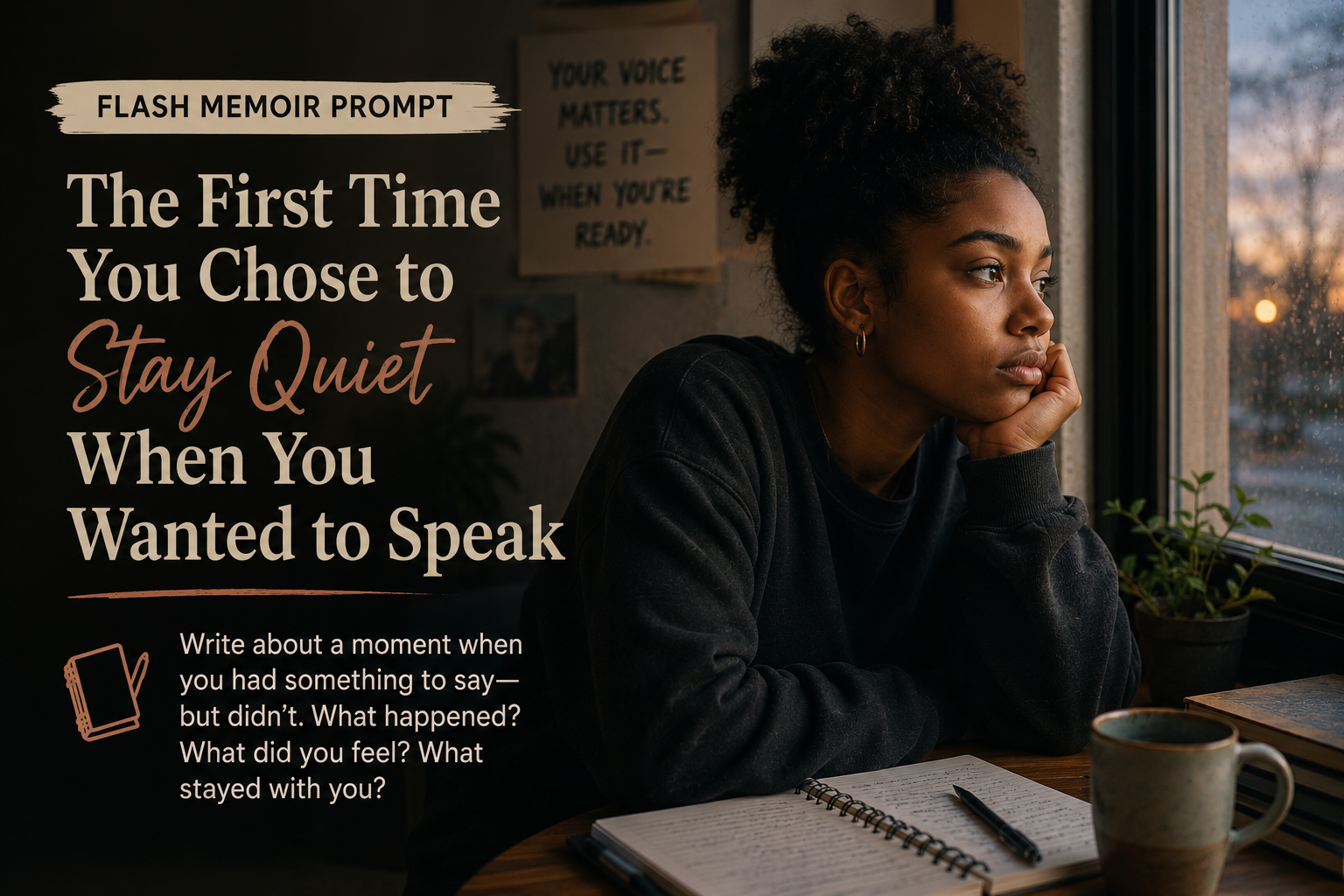
A quiet invitation to write about the first time you swallowed your words, noticed the room around you, and understood that silence can carry its own story.
Maybe you remember the heat in your face before you remember the words you did not say. Maybe you remember a teacher looking past you, a parent waiting for an answer, a friend saying something that stung. Your mouth opened, or almost did. Then you chose quiet.
This flash memoir prompt, for the first time, asks you to stay quiet and return to that small, charged moment. It is not about judging your younger self. It is about noticing what was at stake when silence felt safer, kinder, smarter, or more painful than speaking.
The Prompt
Write about the first time you chose to stay quiet when you wanted to speak.
This prompt can unlock a meaningful memory because silence is rarely empty. It often holds fear, love, shame, strategy, respect, confusion, or regret. When you write about the first time you held back your words, you may find a story about power, family rules, friendship, school, belonging, or the first time you understood that words can change a room.
A strong response to this flash memoir prompt first time chose stay quiet does not need to explain your whole life. It can focus on one scene: where you were, who was there, what you wanted to say, and what made you stop.
Why This Memory Matters
The first time you chose silence may have taught you something about the world before you had language for it. Maybe you learned that adults did not always want the truth. Maybe you learned that speaking up could cost you a friendship. Maybe you learned that staying quiet could protect someone else.
These memories matter because they show the gap between the outside and the inside. On the outside, you may have looked calm. You may have nodded, stared at your desk, or kept eating dinner. On the inside, you may have been full of sentences.
That contrast is powerful in memoir. Readers do not need a dramatic event to care. They need a real human moment. A child in a classroom who knows the answer but lowers her hand. A teenager at a lunch table who hears a cruel joke and says nothing. A grown person in a hospital hallway who decides not to correct someone because grief has already taken up too much space.
Writing this kind of memory can also help you see your old silence with more compassion. Silence is not always weakness. Sometimes it is practice. Sometimes it is survival. Sometimes it is the only choice you knew how to make at the time.
How to Approach This Prompt
Begin with a physical detail. Do not start by explaining the full backstory. Start with the thing your body remembers: your tongue pressed against your teeth, your hand under the table, your shoes on the carpet, the sound of a clock, the smell of cafeteria pizza, the weight of a backpack on one shoulder.
Then narrow the memory to one scene. Stay in the room where the silence happened. Who was nearby? What had just been said? What did you want to say back? Try to write the exact sentence you kept inside, even if you are not fully sure of it. You can use, “I think I wanted to say…” if that feels more honest.
Write what you noticed before you explain what it meant. This helps your reader enter the moment with you. If you jump too quickly to the lesson, the scene may lose its force.
For example, instead of writing, “That was when I learned my opinion did not matter,” you might write, “My fork tapped the plate once. Everyone looked at Uncle Ray except me. I stared at the peas and counted five of them before I swallowed.” The meaning can come later.
If you are helping students build stronger personal writing, this prompt also pairs well with close observation. The same skill used to annotate literature can help writers notice repeated images, tone, and emotional clues in their own memories.
You do not have to make yourself the hero. You do not have to make the silence wrong. Let the younger version of you be complicated. Maybe you wish you had spoken. Maybe you are grateful you did not. Maybe both are true.
A Quick Example
I was nine, sitting in the back seat of our old blue station wagon, when my mother told my grandfather that I loved piano lessons. I did not. I hated the slippery bench and the teacher’s sharp pencil tapping the music stand. I wanted to say, “No, I don’t.” The words rose so fast I could feel them crowd my throat. But my grandfather smiled into the rearview mirror and said, “Good girl. Music makes a person disciplined.” My mother’s eyes met mine in the mirror for half a second. Not angry. Just tired. I looked down at my patent leather shoes and pressed the toes together until they squeaked. “Yes,” I said, though no one had asked me anything.
Try It Yourself
Set a timer for ten minutes and write the scene without stopping. Begin with the moment right before you chose quiet. Let the memory unfold through action, sound, and what your body did.
If you get stuck, use this sentence starter: “I wanted to say…” Then keep going. You can revise later. For now, focus on telling the truth of the moment as clearly as you can.
This flash memoir prompt first time chose stay quiet can lead to a tender piece, a funny one, or a memory that still feels sharp. Let the tone be what it is. The goal is not to force a lesson. The goal is to catch one honest moment on the page.
If your memory involves a book, class, or difficult text that shaped what you did or did not say, you may also enjoy this guide on understanding Shakespearean language, especially if silence, power, and hidden meaning are themes you want to explore in student writing.
Want More Flash Memoir Prompts?
If this prompt opened a memory you did not expect, keep going. Short prompts can help you build a steady writing habit without pressure to finish a full life story at once. Explore all 365 prompts in The Memory Trigger: 365 Flash Memoir Writing Prompts.


Get the Free Close Reading Worksheet Pack
Join my email list and receive the printable worksheet pack you can use with any novel or poem.
No spam. Just helpful guides for reading literature well.












