Flash Memoir Prompt: Feeling of Being in the Backseat of a Car on a Long Drive as a Child

memoir prompt long drive

A warm, specific flash memoir prompt for remembering the backseat of a car on a long childhood drive, where boredom, safety, motion, and longing often shared the same window.

Maybe you remember the seat belt rubbing your neck, the hum of tires on pavement, or the strange feeling of watching the world pass while someone else decided where you were going. This flash memoir prompt feeling being backseat car long drive invites you to return to one small scene from childhood, before you had the words for everything you felt.

Long drives can hold more memory than we expect. A child in the backseat may feel trapped, cozy, ignored, free, sleepy, carsick, or full of questions. Sometimes the story is not about the destination at all. It is about what you noticed from the window.

memoir prompt long drive

The Prompt

Write about the feeling of being in the backseat of a car on a long drive as a child.

This prompt works because it places you inside a clear physical space. You are not trying to cover your whole childhood. You are returning to one car, one road, one stretch of time. That small frame can help you find a memory with real emotional weight.

You might remember a family vacation, a move to a new town, a drive to visit relatives, or a quiet ride home after something changed. The backseat is a powerful point of view because a child often sees and hears more than adults realize.

Why This Memory Matters

Being a child in the backseat can mean many things at once. You may have felt protected by the adults in the front seats. You may have felt powerless because you had no control over the route, the radio, or the stops. You may have watched your parents talk in low voices and tried to guess what was wrong.

The backseat can also be a place of imagination. Fence posts become a rhythm. Clouds become animals. Passing houses make you wonder who lives there. If you had siblings beside you, the memory may include elbow fights, shared snacks, or the strict invisible line down the middle of the seat.

This kind of memory has built-in contrast. The car moves forward, but the child is still. The world changes outside, but the child is buckled in. That tension can reveal a deeper story about family, trust, fear, or belonging.

If your memory includes an object that carries meaning, like a cracked vinyl seat or a plastic toy on the floor, you might explore it as a symbol. For more practice with that skill, this guide on how to find symbolism in a story can help you notice how ordinary details can hold emotional meaning.

The Flash Memoirist
previous arrow
next arrow

How to Approach This Prompt

Begin with a physical detail. Do not start by explaining the whole trip. Start with what your body remembers.

Maybe your bare legs stuck to the seat. Maybe the window was cold against your forehead. Maybe the car smelled like gum, gasoline, fast food, or your father’s coffee. A strong sensory detail can pull the memory open without forcing it.

Choose one scene. You do not need to write about the full vacation or every mile of the drive. Pick one moment in the car. It could be the hour when everyone fell silent. It could be the moment you woke up in the dark and saw your parent’s face lit by the dashboard.

Write what you noticed before you explain what it meant. As a child, you may not have understood the adult conversation in the front seat. You may not have known why the drive felt sad or exciting. Let the child’s view lead the piece.

For example, instead of writing, “We were poor, and the trip was stressful,” you might write, “My mother counted coins at the gas station while my brother and I pretended not to watch.” That kind of detail lets the reader feel the truth with you.

If you like to mark up your own draft as you revise, try reading it like a short piece of literature. Circle the strongest sensory details, underline the emotional shift, and cross out anything that explains too much. You can also use ideas from this student-friendly guide on how to annotate literature to study your own writing more closely.

A Quick Example

I sat behind my mother on the way to my grandmother’s house, my knees pressed into the pouch on the back of her seat. The car smelled like oranges because she had peeled one with her thumb and passed the sections back to me without turning around. My father kept both hands on the wheel. Nobody talked much after we left the highway. I watched the telephone poles dip and rise, dip and rise, like they were nodding to something I did not know yet. When we stopped for gas, my mother stayed in the car. She looked at me in the rearview mirror and smiled, but it was the kind of smile adults use when they are trying to keep a room from breaking.

Try It Yourself

Set a timer for ten minutes and write from the backseat. Stay inside the car for the whole piece. Let the road, the window, the radio, and the people in the front seats do some of the work.

You can use this flash memoir prompt feeling being backseat car long drive to explore a memory that feels simple at first. Do not worry if the meaning shows up late. Often, the strongest part of a flash memoir comes after you describe the ordinary details closely enough.

If you get stuck, answer one question: what could you see from the backseat that the adults did not know you were seeing? That question may lead you to the real heart of the scene.

Want More Flash Memoir Prompts?

If you enjoyed this flash memoir prompt feeling being backseat car long drive, you may like having a full year of small, focused invitations to keep your memory moving. Explore all 365 prompts in The Memory Trigger: 365 Flash Memoir Writing Prompts.

The Memory Trigger

A Separate Peace Summary and Analysis for Students

A Separate Peace Summary

A clear overview of the plot, structure, conflicts, and literary meaning.

This A Separate Peace summary and analysis explains John Knowles’s novel in a way that is easy to use for class. The book looks simple at first, but its story about friendship, guilt, and war has deep meaning.

Use this guide to review the plot, study Gene and Finny, and prepare for essays or discussion.

In this Guide

Start with the big picture, then move into meaning.

  • Quick overview
  • Plot by section
  • Character analysis
  • Main conflicts
  • Themes and symbols
  • Structure and style
  • Essay help and FAQ
A Separate Peace Summary

A Separate Peace Summary and Analysis: Quick Overview

The novel is about two boys at a boarding school during World War II.

A Separate Peace is set at Devon School in New Hampshire. The narrator, Gene Forrester, looks back on his youth after returning to the school as an adult.

Gene remembers his close friendship with Phineas, usually called Finny. Finny is brave, charming, and free from the fear that controls many other students.

Gene admires Finny, but he also feels jealous of him. That jealousy leads to the novel’s central crisis: Gene shakes a tree limb, Finny falls, and Finny’s life changes forever.

This A Separate Peace summary and analysis shows how the novel turns a school story into a study of the human heart. The war outside Devon matters, but the war inside Gene matters even more.

For a short background source, see Britannica’s overview of A Separate Peace.

A Separate Peace Summary and Analysis: Plot by Section

The plot moves through memory, from adult reflection to the painful events of youth.

Gene returns to Devon

The novel begins years after the main events. Gene visits Devon School and notices two places that still trouble him: a tree by the river and a marble staircase.

These places act like doorways into the past. Gene is not just remembering school. He is facing guilt that has stayed with him for years.

The summer session

Gene thinks back to the summer of 1942. He and Finny live at Devon while the war grows in the background.

Finny creates games, breaks rules, and charms teachers. His most famous game is Blitzball, a sport with shifting rules that fit his wild energy.

Finny also starts the Super Suicide Society of the Summer Session. Members jump from a tree into the river. Gene joins, even though the tree scares him.

The fall from the tree

Gene starts to believe that Finny wants to beat him in school by distracting him. This belief says more about Gene than about Finny.

At the tree, Gene and Finny stand on the limb together. Gene moves the branch, and Finny falls. The fall shatters Finny’s leg and ends his dream of athletic greatness.

Gene later tries to confess, but Finny refuses to accept the truth. Their friendship becomes a mix of love, denial, and pain.

The winter session

School becomes colder and more serious. The war feels closer. Older boys talk about enlistment, and military duty shapes daily life.

Leper Lepellier enlists after seeing a ski troop video. His choice seems brave at first, but he later breaks down and returns home in fear.

Brinker Hadley pushes Gene to face what happened to Finny. A student trial takes place, and the boys question Gene in front of Finny.

Finny’s second fall and death

Finny runs from the truth after the trial. He falls down the marble stairs and breaks his leg again.

During surgery, bone marrow enters his bloodstream, and Finny dies. His death is sudden, quiet, and deeply painful.

Gene does not cry at the funeral. He says it feels like his own funeral, which reveals how closely his identity was tied to Finny.

Setting and Historical Context

Devon looks peaceful, but the war reaches into every part of school life.

In a strong A Separate Peace summary and analysis, Devon is more than a backdrop. It is a place where boys prepare to become soldiers, even before they understand themselves.

The novel takes place during World War II, but it is not a battlefield novel. Knowles is more interested in fear, pride, and private guilt.

This is similar to Lord of the Flies by William Golding. In both books, young people live away from adult power, and their hidden conflicts rise to the surface.

The title suggests a private truce. Gene seeks a separate peace not with another nation, but within himself.

Gene and Finny: Character Analysis

The friendship between Gene and Finny drives the whole novel.

Gene Forrester is smart, careful, and deeply self-aware. He tells the story years later, so readers must decide how much to trust his memory.

Gene’s main flaw is envy. He wants to believe Finny is his rival because that excuse makes his own jealousy feel less shameful.

Finny is athletic, bold, and almost innocent. He does not seem to understand rivalry in the same way Gene does. That makes Gene’s suspicion even more tragic.

Finny also denies painful truths. He denies that Gene meant harm, and for a time he even denies the reality of the war. His charm protects him, but it also blinds him.

Their friendship is real, yet it is not pure. Knowles shows that people can love someone and still hurt them.

Main Conflicts in A Separate Peace

The novel’s biggest battles are emotional and moral.

An A Separate Peace summary and analysis should connect the outer war to Gene’s inner war. World War II creates pressure, but Gene’s jealousy creates the central wound.

Gene vs. Finny

Gene imagines a rivalry that Finny may not feel. This false conflict leads Gene to act from fear instead of trust.

Gene vs. himself

After the fall, Gene struggles with guilt. He wants punishment, but he also wants to hide from the truth.

Youth vs. adulthood

Devon is a place between childhood and war. The boys still play games, but adult violence waits just beyond the school gates.

This conflict makes the novel feel sad and tense. The students are not ready for war, yet war is already shaping them.

Themes and Symbols in A Separate Peace

Knowles uses simple objects to carry heavy meaning.

This A Separate Peace summary and analysis also tracks the novel’s key themes. The most important ones are guilt, lost innocence, and the search for peace.

Friendship and jealousy

Gene and Finny’s friendship shows how envy can poison love. Gene does not hate Finny. He hates the way Finny makes him feel small.

War outside and war inside

The boys talk about joining the military, but Gene has already fought a private war. By the end, he understands that his enemy was never Finny.

The tree

The tree is a symbol of fear, youth, and guilt. As an adult, Gene sees it as smaller than he remembered. That change shows how memory can enlarge pain.

The marble stairs

The stairs connect to Finny’s second fall. Unlike the tree, they are hard and built by adults. They suggest that pain does not end when childhood ends.

The winter carnival

Finny creates the carnival to keep joy alive at Devon. It is brief, bright, and fragile, much like Finny himself.

Narration, Structure, and Style

The novel is told as a memory, which makes every scene feel shaped by time.

A Separate Peace summary and analysis often focuses on plot, but the narration is just as important. Gene tells the story as an adult, so readers hear both the boy he was and the man he became.

This creates a reflective tone. Gene does not simply report events. He tries to understand what they meant.

The structure is circular. The story starts at Devon in the present, moves into the past, and returns to Gene’s final insight.

Like The Catcher in the Rye by J. D. Salinger, the novel uses a young man’s voice to explore pain. Both books ask readers to notice what the narrator says and what he avoids.

If you need help with this kind of reading, review our guide on how to practice close reading in literature.

Why the Ending Matters

The ending is quiet, but it changes how we see the whole book.

Gene says that he never killed anyone during the war because his own war ended before he joined the military. This is one of the novel’s most important lines.

He means that he had already faced his real enemy: the fear and envy inside himself.

Finny’s death does not bring simple peace. It leaves Gene with a hard truth. He must live with what he did and with what he learned about human weakness.

The ending asks students to think about responsibility. Gene is not a cartoon villain. He is a flawed person who harms someone he loves.

How to Read the Novel for Class

A focused reading plan can make the novel much easier to understand.

For students, A Separate Peace summary and analysis works best when paired with careful notes. Track moments when Gene feels jealous, afraid, or unsure of himself.

Pay close attention to scenes at the tree, the trial, and the stairs. These moments reveal the novel’s moral structure.

You can also mark symbols in the margins and connect them to themes. If that feels hard, use our close reading guide for students to slow down key passages.

For extra support, you can pair your notes with our student literature study guide collection.

These books pair well with Knowles’s novel for class study.

  • A Separate Peace by John Knowles
  • Lord of the Flies by William Golding

Both books explore youth under pressure. They also show how fear can change a closed community.

FAQ

These quick answers help with common class questions.

What is A Separate Peace about?

It is about Gene Forrester’s memory of his friendship with Finny at Devon School during World War II. The story centers on guilt after Gene causes Finny’s fall.

Did Gene mean to hurt Finny?

The novel leaves some room for debate, but Gene’s guilt suggests that the act came from jealousy. It may not have been planned, yet it was not innocent.

What does Finny symbolize?

Finny often represents innocence, freedom, and trust. His death marks the loss of those qualities for Gene.

What is the main theme of A Separate Peace?

The main theme is the struggle to face the enemy within. Gene learns that fear and envy can cause deep harm.

Why is the title important?

The title points to Gene’s private search for peace. He must come to terms with his guilt before he can understand the larger war.

Key Takeaway

The novel is small in scope, but its moral problem is large.

Use this A Separate Peace summary and analysis as a starting point, not a replacement for the book. Knowles shows that growing up often means facing the truth about yourself, even when that truth hurts.

Flash Memoir Prompt: Phrase or Expression One of Your Parents Used So Often It Became Part of Your Internal Vocabulary

memory prompt expression parents

That little saying may come back at the strangest time: while you are washing a cup, locking the door, or warning yourself to slow down in traffic. This flash memoir prompt phrase expression one parents used invites you to follow one familiar line back to the person, place, and feeling it came from.

Maybe your father always said, “Measure twice, cut once.” Maybe your mother sighed, “We’ll cross that bridge when we get there.” Maybe the phrase was funny, sharp, loving, worried, or so ordinary you never thought of it as important.

Then one day, you hear yourself say it.

memory prompt expression parents

The Prompt

Write about a phrase or expression one of your parents used so often it became part of your internal vocabulary.

This prompt works because family language can carry a whole childhood inside a few words. A repeated phrase is more than a sentence. It can hold a kitchen, a mood, a rule, a fear, a joke, or a kind of love that was easier to say sideways.

For this flash memoir prompt phrase expression one parents used, you do not need to explain your entire relationship with that parent. You only need one moment when the phrase appears clearly. Let the words lead you back to a scene.

Why This Memory Matters

Parents often leave their marks through habits. The way they fold towels. The way they check the stove. The way they answer bad news. Their repeated phrases become part of the weather in a home.

At first, you may have accepted the phrase without question. Later, you may have rolled your eyes at it. Years after that, you may have found it sitting in your own mouth, ready to use.

That shift can make a strong memoir moment. It shows how language travels. It shows how we resist parts of our parents, then discover those parts have been packed inside us all along.

This kind of memory may uncover tenderness, but it might also uncover tension. Some family phrases comfort us. Others still sting. Some were used to avoid hard conversations. Some were clumsy attempts at guidance.

If the phrase has mixed feelings attached to it, let those feelings stay mixed. Memoir does not require you to make the memory neat. In fact, the most honest pieces often leave room for love and irritation to stand side by side.

How to Approach This Prompt

Begin with the exact phrase. Write it down in quotation marks. Do not improve it. Do not make it sound smarter or smoother. Keep the original rhythm, even if the grammar is odd or the wording belongs to another time.

Next, choose one scene where you heard it. Narrow the memory as much as you can. Maybe you are in the back seat of the car. Maybe you are at the dinner table. Maybe you are standing in a doorway while your parent searches for keys.

Start with a physical detail. What did the room smell like? What was your parent holding? What were you doing with your hands? These small details help the memory feel real before you explain what it meant.

Try to write what you noticed first. Save the meaning for later. For example, instead of beginning with, “My mother was always anxious,” begin with her checking the lock three times and saying, “Better safe than sorry.” Let the reader feel the pattern before you name it.

You might also listen for tone. Was the phrase said with a laugh? A warning? A tired breath? The same words can mean different things depending on how they land.

If you enjoy close reading, this prompt can feel a little like character study. You are looking at how a person reveals themselves through repeated language. For more practice with that skill, you may find this guide on how to analyze characters in literature helpful, especially when you turn that same attention toward real people in your life.

As you draft, avoid trying to tell the whole story of your parent. One phrase cannot explain everything. Let it open one door. That is enough for a flash memoir piece.

The Flash Memoirist
previous arrow
next arrow

A Quick Example

My dad said, “Let’s not borrow trouble,” whenever my mother worried out loud. He said it in the garage, under the yellow pull-chain light, while sorting coffee cans full of nails. I was twelve, waiting for a call about whether I had made the school play. I kept asking what would happen if I didn’t. Dad lined up two screws on the workbench and said it again, calm as weather: “Let’s not borrow trouble.” I hated it then. It felt like he was closing a door on my fear. Years later, I said the same words to my son before his first driving test. I heard my father’s voice come out of my mouth, and for once, it sounded less like dismissal and more like mercy.

Try It Yourself

Set a timer for ten minutes and write the phrase at the top of the page. Then place yourself back in one scene where you heard it. Stay close to the moment. Let your parent speak. Let your younger self react.

You do not have to decide whether the phrase was good advice. You do not have to forgive, praise, judge, or explain everything. Just notice what the words carried then, and what they carry now.

If you get stuck, treat the phrase like a note in the margin of your life. Ask what it underlined. Was it caution? Humor? Pride? Faith? Fear? If you like marking up text to see what matters, the same idea applies to memory. This guide on how to annotate literature may help you think about which details deserve a second look.

This flash memoir prompt phrase expression one parents used can become a small but powerful piece because it begins with something real: words you have already carried for years.

Want More Flash Memoir Prompts?

Explore all 365 prompts in The Memory Trigger: 365 Flash Memoir Writing Prompts.

The Memory Trigger

Themes in A Separate Peace: A Student-Friendly Guide

A Separate Peace themes

The themes in A Separate Peace help students see why John Knowles’s novel still feels intense and personal. The book may seem quiet at first, but its ideas about envy, guilt, war, and growing up give it real emotional power.

This guide breaks those ideas into clear parts so you can discuss the novel with more confidence in class or in an essay.

In this Guide

  • Why the novel’s themes matter
  • Friendship and rivalry
  • Guilt and responsibility
  • War and peace
  • Loss of innocence
  • Identity and self-deception
  • Essay tips, book suggestions, and FAQ
A Separate Peace themes

Why the themes in A Separate Peace matter

Knowles uses a boarding school story to explore deep emotional conflict.

A Separate Peace takes place at Devon School during World War II. Yet much of the real battle happens inside Gene Forrester.

That is why the themes in A Separate Peace are so useful for literary analysis. The novel connects private feelings with larger historical fear.

Students should notice how Gene’s memory shapes the story. He does not just tell us what happened. He tries to understand what it meant.

For background on the author, you can read this short overview from Britannica’s John Knowles biography.

Themes in A Separate Peace: friendship and rivalry

The friendship between Gene and Finny is warm, painful, and unstable.

At first, Gene admires Finny. Finny is athletic, bold, and charming. He seems free in a way Gene is not.

But admiration starts to mix with envy. Gene begins to believe Finny wants to compete with him, even when Finny may not think that way at all.

This theme matters because the novel shows how friendship can turn dark when one person feels insecure. Gene’s jealousy says more about Gene than about Finny.

The tree scene shows this conflict most clearly. Gene’s action causes Finny’s fall, but the deeper cause is Gene’s confused fear of being less special.

Students often compare this to other stories about close friendship and rivalry, such as Shakespeare’s Othello, where envy twists how one character sees another. In both works, false ideas become dangerous.

Guilt and responsibility

Gene’s guilt drives much of the novel’s emotional force.

After Finny falls, Gene keeps trying to decide what kind of person he is. Did he mean to hurt Finny? Was it an accident? Can he ever tell the whole truth?

The novel does not give easy answers. That is one reason the themes in A Separate Peace work well for essays. Knowles leaves room for debate.

Gene’s guilt does not appear only in words. It appears in silence, avoidance, and fear. He wants forgiveness, but he also wants to protect himself.

This theme connects to a larger question: Can a person be responsible for harm even when the truth feels unclear? The novel pushes readers to sit with that question.

If you plan to write about guilt in the novel, this guide on how to write a literary analysis essay can help you turn ideas into a strong thesis.

Themes in A Separate Peace: war and inner conflict

World War II shapes the setting, but Gene’s inner war shapes the plot.

The boys at Devon live in the shadow of a global conflict. They know enlistment, danger, and adulthood wait for them.

Finny tries to create a private peace away from that fear. His games, jokes, and made-up rules help the boys escape the outside world for a while.

Yet the novel suggests that war is not only a public event. Gene carries conflict inside himself. His jealousy and fear become a private battlefield.

This is one of the central themes in A Separate Peace: the real enemy may come from within. Gene later says that wars can grow from something rooted in the human heart.

That idea makes the title more meaningful. A “separate peace” is not just a break from World War II. It is the peace Gene searches for within himself.

Loss of innocence

The novel shows how young people lose simple beliefs about themselves and others.

Before Finny’s fall, Devon can seem like a protected place. The summer session feels bright and almost dreamlike.

After the accident, that feeling changes. Gene can no longer pretend that life is simple or safe.

Finny also loses innocence. He must face pain, limits, and betrayal. His belief in friendship is shaken by what happened at the tree.

Loss of innocence is common in coming-of-age novels. In To Kill a Mockingbird, Scout learns that society can be cruel and unfair. In A Separate Peace, Gene learns that cruelty can also come from inside the self.

This makes the themes in A Separate Peace feel personal. The novel is not only about history. It is about the hard moment when a young person sees the truth more clearly.

From Idea to Novel Blueprint

Identity and self-deception

Gene struggles to know who he is because he lies to himself.

Gene wants to see himself as decent and loyal. Yet his actions make that image hard to keep.

Instead of facing his feelings, he often creates stories in his mind. He tells himself Finny is his rival. He tells himself certain truths are impossible to say.

Self-deception is one of the most important themes in A Separate Peace because it affects the whole narration. Gene tells the story years later, but he is still sorting through old pain.

Finny also has a form of self-deception. He refuses to accept the war at first. This denial may seem childish, but it also shows how badly he needs safety and trust.

Both boys protect themselves with false beliefs. The tragedy comes when those beliefs break.

Nature, setting, and symbols

Devon School becomes a symbol of memory, youth, and hidden danger.

The tree is the most famous symbol in the novel. It represents fear, testing, friendship, and the turning point in Gene’s life.

The rivers also matter. The Devon River feels calm and familiar, while the Naguamsett River feels muddy and unsettling. These settings reflect Gene’s movement from innocence toward moral confusion.

Knowles uses these places to support the themes in A Separate Peace without over-explaining them. The setting helps us feel what Gene cannot always say.

When you write about symbols, connect them to a bigger idea. Do not stop at “the tree is important.” Ask what the tree reveals about guilt, fear, or lost innocence.

How to write about themes in A Separate Peace

A strong theme essay should make an arguable claim, not just name a topic.

For example, “guilt is a theme” is too broad. A stronger claim might say, “Knowles presents guilt as a force that changes how Gene remembers friendship, even years later.”

Use short quotes and explain them closely. Focus on how Gene thinks, what he avoids, and how his view of Finny changes.

You can also compare a theme across the novel. Track Gene before the fall, after the fall, and years later as an adult narrator.

For more help with thesis statements and evidence, visit this step-by-step guide to writing a literary analysis essay.

If you want a ready study tool, you can also check out our student literature guide resources for extra support.

If you want more novels with similar ideas, these books pair well with A Separate Peace:

  • Lord of the Flies by William Golding
  • The Catcher in the Rye by J. D. Salinger
  • All Quiet on the Western Front by Erich Maria Remarque

For a wider look at World War II literature, the Poetry Foundation’s World War II poets collection offers helpful context.

FAQ about themes in A Separate Peace

What is the main theme of A Separate Peace?

The main theme is the struggle to find peace within the self. Gene’s greatest conflict comes from envy, guilt, and fear.

How does friendship work as a theme?

Friendship in the novel is both loving and painful. Gene cares for Finny, but his insecurity damages their bond.

Why is war important if most of the story happens at school?

World War II creates pressure outside Devon. It also mirrors Gene’s private conflict with himself.

What does Finny represent?

Finny often represents innocence, freedom, and trust. His fall marks a loss of those qualities for both boys.

What is a good essay topic for this novel?

You could argue that Gene’s memory reveals how guilt shapes identity long after the event itself has passed.

Key takeaway

The themes in A Separate Peace show that growing up often means facing uncomfortable truths. Gene’s story reminds us that peace is not just found in the world around us. It must also be won inside the self.

Flash Memoir Prompt: Way Your Childhood Bedroom Looked Right before You Fell Asleep

memoir prompt childhood bedroom

Right after the light clicked off, when the hallway glow slid under the door and the room felt suddenly honest, this flash memoir prompt way childhood bedroom looked right before sleep invites one small memory to come forward.

memoir prompt childhood bedroom

The Prompt

Write about the way your childhood bedroom looked right before you fell asleep.

This prompt works because bedtime is a border. You were still in the real world, but your mind was already drifting toward dreams, worries, wishes, or secret plans. The room may have looked different at night than it did in the morning. A toy could seem watchful. A poster could feel like company. A pile of clothes could turn into a monster until you learned what it was.

You do not have to remember every detail of your childhood bedroom. For this flash memoir prompt about the way your childhood bedroom looked right before sleep, one clear image is enough. Start with the glow, the shadow, the blanket, the door, or the one object your eyes always found before you closed them.

Why This Memory Matters

A childhood bedroom is rarely just a room. It can hold safety, loneliness, imagination, fear, comfort, or the strange mix of all of those at once. The way it looked right before sleep may reveal what you were carrying then, even if you did not have words for it yet.

Maybe your room was neat because someone in your house cared about order. Maybe it was crowded because you shared it with a sibling. Maybe it had hand-me-down furniture, glow-in-the-dark stars, sports trophies, library books, or a chair stacked with clothes. Each detail can tell the reader something about your younger self without a long explanation.

This is where a small object can become powerful. The night-light might stand for protection. A cracked ceiling might stand for worry. A stuffed animal might stand for the kind of love you could hold in your hands. If you want to think more about how ordinary objects can carry meaning, this guide on how to find symbolism in a story can help you notice that same skill in your own memories.

The value of a flash memoir prompt way childhood bedroom looked right before sleep is that it keeps the story close. You are not trying to explain your whole family history. You are watching light move across a wall. You are listening to the house settle. You are remembering what it felt like to be small in a room that knew you.

The Flash Memoirist
previous arrow
next arrow

How to Approach This Prompt

Choose one night, even if the memory is really made from many nights. Memoir often works this way. You gather the feeling of a repeated experience and place it into one scene so the reader can enter it with you.

Begin with a physical detail. Write the first thing your eyes would have seen from the bed. Was it the closet door? A window? A lamp shade? A shelf? The edge of a blanket pulled up under your chin?

Try to write what you noticed before you explain what it meant. Instead of starting with “I was scared,” show the reader the dark shape in the corner and the way you kept checking it. Instead of starting with “I felt safe,” show the reader the strip of light from the hallway or the sound of someone washing dishes nearby.

With a flash memoir prompt way childhood bedroom looked right before sleep, scale matters. Stay in the bed. Stay in the room. Let the memory unfold from that one point of view. If you try to tell the whole story of your childhood, the piece may become too broad. If you stay with one wall, one shadow, or one bedtime object, the emotion can grow on its own.

You might also mark up your draft after you write it. Circle the strongest image. Underline the sentence that feels most honest. Cross out any line that explains too much too soon. If you are a student or teacher, these same close-reading habits connect well with how to annotate literature, because both skills ask you to notice small details and ask why they matter.

A Quick Example

When I was ten, my bedroom looked blue right before sleep, even though the walls were yellow in the daytime. The streetlight came through the blinds and laid thin stripes across my blanket. My school shoes sat beside the closet, toes pointing at me like they expected an answer. On the dresser, my plastic horse collection made a jagged little skyline. I remember staring at the crack in the ceiling above my bed because it looked like a road on a map. My parents were arguing softly in the kitchen, trying to keep their voices polite. I decided that if I followed the crack from one end to the other without blinking, they would stop. I did it three times. The room did not change, but I felt less alone inside it.

Try It Yourself

Set a timer for ten minutes and return to the view from your bed. Do not worry about making the memory beautiful. Let it be plain first. The plain details often carry the most truth.

If you get stuck, finish this sentence: “Right before I fell asleep, my room looked like…” Then keep going. Describe the light. Describe the thing you always looked at. Describe what you hoped would happen before morning.

This flash memoir prompt about the way your childhood bedroom looked right before sleep is small by design. A small memory can still hold a whole younger version of you.

Want More Flash Memoir Prompts?

If this prompt opened a door, keep following the smaller memories. Explore all 365 prompts in The Memory Trigger: 365 Flash Memoir Writing Prompts.

The Memory Trigger

The Poisonwood Bible Literary Analysis Essay: How to Write One

Rapid Reads Press

Writing about Barbara Kingsolver’s novel can feel huge because it deals with family, faith, language, power, and history. The Poisonwood Bible literary analysis essay is strongest when you choose one clear pattern and explain how it shapes the novel’s meaning.

This guide will help you move from a rough idea to a focused essay with a strong thesis, useful evidence, and clear analysis.

In this Guide

Use this quick map to plan your essay one step at a time.

  • What the novel is really about
  • How to choose a focused question
  • The Poisonwood Bible literary analysis essay thesis ideas
  • Topic ideas that work well
  • Evidence you can use
  • Common mistakes to avoid
  • Helpful books and tools
Poisonwood Bible Essay

Understand What The Poisonwood Bible Is Really About

A strong essay starts with the novel’s deeper conflicts, not just its plot.

The Poisonwood Bible follows the Price family, who move from Georgia to the Congo under Nathan Price’s strict missionary rule. Yet the novel is not only about one family. It asks who has power, who gets to speak, and what happens when people refuse to listen.

Kingsolver uses several female narrators to show how truth changes from person to person. This matters because Nathan speaks as if his view is the only right one.

For author background, you can read the Britannica profile of Barbara Kingsolver.

The Poisonwood Bible Literary Analysis Essay: Start with a Focused Question

A focused question keeps your essay from turning into a book report.

Do not start with a broad theme like guilt or religion. Start with a question you can prove through scenes, narration, and symbols.

For example, you might ask: How does Kingsolver use the Price daughters’ voices to challenge Nathan’s certainty?

You could also ask: How does Adah’s language show that truth can be twisted or hidden?

Both questions lead to analysis. They push you to explain how the novel works, not just what happens.

If you need a broader method, use our step-by-step literary analysis essay guide before you draft.

The Poisonwood Bible Literary Analysis Essay Thesis Examples

Your thesis should name a pattern and explain why it matters.

In The Poisonwood Bible literary analysis essay writing, a weak thesis says the novel has many themes. A strong thesis argues how Kingsolver creates meaning through a specific choice.

Here are thesis statement examples you can adapt:

  • Kingsolver uses the five Price women as narrators to show that truth is shaped by gender, memory, and power.
  • Through Nathan Price’s failed mission, the novel argues that faith becomes harmful when it is tied to control instead of compassion.
  • Adah’s wordplay and reversed language reveal that speech can hide truth as much as it can reveal it.
  • Leah’s changing view of the Congo shows that moral growth begins when a person learns to listen.

Each thesis gives you room to analyze scenes. It also gives your essay a clear path.

Topic Ideas for The Poisonwood Bible Literary Analysis Essay

The best topics are narrow enough to prove in a short paper.

Here are strong topic angles:

  • Narration and authority: Study how the Price women tell different versions of the same family story.
  • Language and misunderstanding: Focus on mistranslation, Adah’s word games, or Nathan’s sermons.
  • Faith and control: Analyze how Nathan confuses belief with power.
  • Colonialism and blindness: Show how the Price family’s mission reflects larger political forces.
  • Leah’s moral change: Trace how Leah moves from loyalty to self-awareness.

Pick one angle. Then choose two or four scenes that clearly support it.

Build Body Paragraphs That Analyze, Not Summarize

Your body paragraphs should explain how evidence supports your claim.

Start each paragraph with a clear point. Then bring in a short scene, image, or detail from the novel. After that, explain how the detail proves your thesis.

For example, do not only say that Nathan plants a garden and fails. Explain how the failed garden shows his refusal to understand the land and people around him.

This same skill matters in many books. In Things Fall Apart, Achebe also shows the danger of outsiders who misread a culture. In Heart of Darkness, Conrad explores empire through a darker and more limited voice.

Evidence to Use in The Poisonwood Bible Literary Analysis Essay

Good evidence makes your argument feel grounded in the novel.

For The Poisonwood Bible literary analysis essay, choose evidence that reveals a pattern. You do not need the longest quote. You need the most useful moment.

  • The family’s arrival in the Congo and their first signs of confusion
  • Nathan’s failed garden as a symbol of pride and ignorance
  • Methuselah the parrot as a symbol of freedom and harm
  • Adah’s palindromes, silence, and sharp view of language
  • Ruth May’s voice and the novel’s sense of loss
  • Leah’s slow break from Nathan’s worldview

After each piece of evidence, ask: What does this reveal about power, belief, or voice?

Common Mistakes in The Poisonwood Bible Literary Analysis Essay

Small choices can make your essay much stronger.

Avoid writing a plot summary. Your teacher already knows the story.

Do not write about every theme in the novel. A focused paper often earns a stronger grade than a wide one.

Do not treat Nathan as the only important figure. The novel’s structure gives major weight to the women who survive, remember, and speak.

Do not drop quotes into a paragraph without comment. Your analysis should be longer than the evidence itself.

Helpful Books to Search on Amazon or at Your Library

These books can deepen your context without replacing your own analysis.

  • The Poisonwood Bible by Barbara Kingsolver
  • King Leopold’s Ghost by Adam Hochschild
  • Things Fall Apart by Chinua Achebe

Use context carefully. Your essay should still focus on Kingsolver’s language, structure, and choices.

Use a Literary Analysis Essay Tool to Draft Faster

A clear template can help you turn ideas into paragraphs.

If you want thesis frames, paragraph models, and planning pages, try The Literary Analysis Essay Toolkit. It is built to help students move from notes to a polished essay with less stress.

You can also pair it with our complete literary analysis essay guide if you want more support with structure.

FAQ: The Poisonwood Bible Literary Analysis Essay

Here are quick answers to common student questions.

What is a good thesis for The Poisonwood Bible?

A good thesis should focus on one literary choice, such as narration, symbolism, or language. It should also explain what that choice reveals about power or truth.

Can I write about Nathan Price?

Yes, but do not only describe him as strict. Analyze how Kingsolver uses him to criticize pride, control, or cultural blindness.

Which character is best for analysis?

Adah, Leah, and Orleanna all work well because their voices show deep change and conflict.

How many quotes should I use?

Use enough evidence to prove each point. In a short essay, one strong quote or scene per body paragraph can work well.

Key Takeaway

A strong The Poisonwood Bible literary analysis essay does not try to cover the whole novel. It follows one clear idea, uses precise evidence, and explains how Kingsolver’s choices create meaning.

Flash Memoir Prompt: Specific Book

memoir prompt book

A warm flash memoir prompt about a specific book, song, or television show from childhood, and the small repeated comfort it gave you before you had words for why.

Maybe it was the book with the cracked spine that always fell open to the same page. Maybe it was the song you played until someone yelled from the next room to turn it off. Or maybe it was a television show you watched from the carpet, chin in your hands, while dinner sounds came from the kitchen.

Childhood favorites can hold more than entertainment. They can hold safety, longing, escape, humor, or a private version of who we hoped to become. This flash memoir prompt specific book song television show memory asks you to return to one familiar object from childhood and notice what it meant to keep choosing it.

memoir prompt book

The Prompt

Write about a specific book, song, or television show from childhood that you returned to again and again.

This prompt works because repetition is rarely random. The thing you returned to may have met a need. It may have made you feel brave, understood, distracted, powerful, or less alone. You do not have to explain your entire childhood. You only need to remember one time you reached for that book, pressed play on that song, or waited for that show to begin.

Try to name the exact title if you can. If you cannot remember, describe what you do remember: the cover color, the tune, the couch, the theme song, the room, the person who sat nearby, or the feeling that came over you when it started.

Why This Memory Matters

The stories we repeated as children often became quiet companions. A book could be a hiding place. A song could become a private anthem. A television show could offer a family that felt calmer, sillier, or more predictable than real life.

This kind of memory may reveal what you were hungry for at that age. Maybe you loved a mystery series because it made the world feel solvable. Maybe you watched the same cartoon because the ending never changed. Maybe you sang along with one song because it let you feel dramatic in a house where big feelings were not welcome.

You might also discover a story about access. Who bought the book? Who controlled the remote? Did you hear the song on the radio, on a cassette, in a car, or at a school dance? Those details matter because they place the memory in a real body, in a real room, at a real age.

If you enjoy looking closely at texts, this prompt can also connect with the habit of close reading in literature. You are not analyzing a poem for class here, but you are paying close attention to what a repeated detail reveals.

The Flash Memoirist
previous arrow
next arrow

How to Approach This Prompt

Begin with one physical detail. Do not start by saying what the book, song, or show meant to you. Start with what you saw, heard, touched, or did.

For a book, you might begin with the feel of the pages, the smell of the library plastic, or the way you tucked it under your pillow. For a song, start with the button you pushed, the scratch of the CD, or the radio dial in the family car. For a show, begin with the glow of the television, the snack you ate, or the exact place you sat.

Then narrow the memory to one scene. Choose one afternoon, one bedtime, one car ride, one Saturday morning. A flash memoir does not need the whole history of your childhood. It needs one charged moment that lets the larger truth peek through.

Write what you noticed before you explain what it meant. For example, instead of starting with “That show helped me feel safe,” you might write, “At 4:00, I sat on the floor close enough to feel static on my arms.” The meaning can arrive later. Let the scene do some of the work.

If you want to mark up the memory before drafting, jot notes the way a student might mark a page. Circle sensory details. Underline the emotional turn. Make a note beside anything that surprises you. This is close to the skill of annotating literature, except the text is your own memory.

For this flash memoir prompt specific book song television show response, give yourself permission to be exact and ordinary. The title does not need to be impressive. A silly show, a pop song, or a worn-out paperback can carry a serious truth.

A Quick Example

I checked out Matilda so many times the librarian stopped scanning it before she looked at me. She would just smile and say, “Again?” I liked the weight of it in my backpack on the walk home. I liked knowing the same girl was waiting inside, small and quiet and secretly powerful. One winter afternoon, I read under the dining room table while my parents argued about a bill in the kitchen. The tablecloth hung down like a wall. I remember pressing my thumb against the page when Matilda made the chalk move. I did not think, “I need escape.” I thought, “Again.” I wanted the part where someone finally noticed what a child could do.

Try It Yourself

Set a timer for ten minutes and write about the first title that comes to mind. Do not worry if it seems too childish, too popular, or too small. The repeated thing is the doorway.

Use one scene. Put yourself back in the room, car, library, bedroom, kitchen, or basement where you returned to it. What did your body do? Who else was there? What line, image, sound, or moment kept pulling you back?

If you get stuck, use this sentence starter: “I went back to it because…” Then cross that sentence out if it sounds too direct and start again with a detail. The remote in your hand. The chorus on the radio. The corner of the page folded down.

This flash memoir prompt specific book song television show exercise is less about reviewing the thing you loved and more about meeting your younger self through it. Let the memory stay small. Let it tell the truth quietly.

Want More Flash Memoir Prompts?

If this prompt opened a memory you had not thought about in years, keep going. Explore all 365 prompts in The Memory Trigger: 365 Flash Memoir Writing Prompts.

The Memory Trigger

Themes in The Poisonwood Bible: A Student-Friendly Guide

The Poisonwood Bible Themes

Barbara Kingsolver’s novel can feel huge at first, but its ideas become clearer once you track the themes in The Poisonwood Bible. The book follows the Price family in the Congo and asks hard questions about faith, power, guilt, language, and survival.

This guide breaks those ideas into student-friendly parts so you can use them in class discussion, AP Literature writing, or a college essay.

In this Guide

Use these sections to move from the big ideas to essay-ready details.

  • Why the themes matter
  • Faith and religious pride
  • Colonialism and power
  • Voice, gender, and control
  • Guilt, memory, and responsibility
  • Nature, survival, and symbols
  • FAQ and key takeaway
The Poisonwood Bible Themes

Why the Themes in The Poisonwood Bible Matter

The novel is not just about one family in a new place. It is about what happens when people bring pride into a world they do not understand.

The themes in The Poisonwood Bible help readers see the Price family’s private problems next to larger historical forces. Nathan Price wants to control his family and the people of Kilanga. At the same time, foreign governments and colonial powers try to control the Congo.

That parallel is a major reason the novel works well for literary analysis. The family story and the political story reflect each other.

If you are writing an essay, look for moments where a private conflict reveals a public one. That is the kind of link teachers often want to see.

Faith and Religious Pride

Kingsolver shows the difference between sincere belief and harmful pride.

Nathan Price comes to the Congo as a missionary, but he does not listen well. He treats his own view of Christianity as the only truth, even when it harms his family or pushes others away.

This theme is not simply “religion is bad.” The novel is more careful than that. It questions **religious pride**, not faith itself.

Nathan wants to baptize the villagers in a river even though crocodiles make it dangerous. He keeps preaching in ways that do not fit the local culture. He also fails to understand the language, which turns his message into confusion.

A useful comparison is Arthur Miller’s The Crucible. In that play, people use religion to gain control or prove their own purity. Kingsolver does something similar with Nathan, who uses faith as a weapon instead of a source of care.

For an essay, you might argue that Nathan’s failure comes from his refusal to learn. He speaks often, but he rarely hears.

Colonialism and Power: One of the Central Themes in The Poisonwood Bible

The novel connects family control with political control.

Colonialism is one of the most important themes in The Poisonwood Bible because the Prices arrive in a country shaped by outside rule. The Congo has been exploited by European powers, and the novel shows how that history still affects daily life.

Nathan’s attitude mirrors colonial thinking. He assumes he has the right to teach, correct, and judge people who know far more about their own land than he does.

The political background matters. The Congo is moving toward independence, but foreign influence does not vanish. For brief context, Britannica offers a helpful overview of the Democratic Republic of the Congo.

These themes in The Poisonwood Bible also connect well with Chinua Achebe’s Things Fall Apart. Both novels show how outsiders can damage a culture when they mistake power for truth.

In class writing, avoid saying the novel is only about “Africa” in a broad way. Be specific. Kingsolver is writing about the Congo, the Price family, and the long reach of colonial power.

Language and Misunderstanding

Words matter in this novel because language can connect people or break trust.

Nathan’s mistakes with Kikongo are more than comic errors. They show his deeper failure to respect the world around him.

The famous “poisonwood” mistake shows this clearly. Nathan means to call Jesus beloved, but his poor pronunciation changes the meaning. His message becomes linked with a plant that causes pain.

This is a strong symbol because it joins language, faith, and harm. Nathan’s words do not heal because he refuses to learn how they are heard.

If you want to sharpen this part of your analysis, our guide on how to find symbolism in a story can help you turn details like this into stronger essay points.

Voice and Gender in the Themes in The Poisonwood Bible

The novel gives women the power to tell the story.

Among the themes in The Poisonwood Bible, voice is one of the most important. The book is narrated by Orleanna and her daughters, not by Nathan. That choice matters.

Nathan tries to rule the family, but the women shape the novel’s meaning. Each daughter sees the Congo in a different way. Their voices show how one event can carry many truths.

Rachel often focuses on comfort and status. Leah begins as loyal to Nathan, then changes as she sees his damage more clearly. Adah has a sharp, poetic way of seeing that challenges what others miss. Ruth May gives the story innocence and danger.

Orleanna’s voice is full of regret. She looks back and asks what she should have done. Her sections help make guilt a major part of the novel.

This structure is useful for AP Literature essays because narration affects theme. Who tells the story changes what the story can mean.

Guilt, Memory, and Responsibility

The past does not stay still in this novel.

Orleanna and her daughters carry memory in different ways. Some try to escape it. Some try to understand it. Some build a new life from what they have lost.

Guilt is not the same for every character. Orleanna feels guilt for staying with Nathan and for not protecting her children sooner. Leah feels a wider guilt tied to American power and her own early blindness.

Kingsolver asks a hard question: What do people owe after harm has been done?

This theme makes the novel more than a story of personal growth. It becomes a story about responsibility. The characters must face what their family has done and what their country has supported.

A helpful comparison is Toni Morrison’s Beloved, another novel where memory acts like a living force. In both books, the past shapes the present even when characters want to move on.

Nature, Survival, and Limits

The land is not a backdrop. It is a force with its own rules.

Nathan thinks he can force his plans onto Kilanga, but the environment proves him wrong. His garden fails because he does not understand the soil, the seasons, or local knowledge.

This failure matters. It shows that survival depends on humility. The villagers know how to live in their place because they respect its limits.

Nature also reveals the weakness of Nathan’s worldview. He sees problems as tests of will, but the novel shows that willpower without wisdom can become dangerous.

For students, this theme is easy to support with evidence. Look at the garden, the river, the ants, and the poisonwood tree. Each one shows that the natural world cannot be controlled by pride.

From Idea to Novel Blueprint

Symbols That Support the Themes in The Poisonwood Bible

Symbols help turn the novel’s big ideas into concrete images.

Many themes in The Poisonwood Bible become clearer through repeated objects and natural details. The poisonwood tree connects language with pain. The failed garden shows Nathan’s arrogance. The river suggests danger, change, and the limits of his mission.

The ants are another strong symbol. When they swarm, human plans collapse. Characters must act fast, and the crisis reveals what they value most.

These symbols do not stand alone. They gain meaning because they connect to character choices and larger conflicts.

If symbols feel hard to track, revisit this short guide to spotting symbolism in literature. It can help you move from “this object is important” to “this object supports the theme.”

How to Write About the Themes in The Poisonwood Bible

A strong essay should connect theme to character, structure, and setting.

Do not just name a theme. Explain how Kingsolver builds it. A simple claim like “colonialism is bad” is too broad. A stronger claim would say that Kingsolver links Nathan’s control over his family to the wider control of foreign powers in the Congo.

Use scenes, not plot summary. Focus on Nathan’s sermons, Orleanna’s reflections, the failed garden, or the family’s different responses to crisis.

You can also write about narration. Since the women tell the story, the novel pushes back against Nathan’s control. The structure itself becomes part of the meaning.

If you want a faster way to review before a quiz or essay, try our student literature study resources for clear study support.

Helpful Books for More Context

These books can deepen your grasp of the novel and its background.

  • The Poisonwood Bible by Barbara Kingsolver
  • Things Fall Apart by Chinua Achebe
  • King Leopold’s Ghost by Adam Hochschild

For author background, Britannica also has a concise page on Barbara Kingsolver.

FAQ: Themes in The Poisonwood Bible

These quick answers can help with review or essay planning.

What are the main themes in The Poisonwood Bible?

The main themes in The Poisonwood Bible include religious pride, colonial power, guilt, voice, language, and survival. The novel shows how personal choices connect to history.

Is The Poisonwood Bible against religion?

Not exactly. The novel criticizes pride and control done in the name of religion. It does not reject sincere faith or moral care.

Why are there multiple narrators?

The multiple narrators show that truth is complex. Each woman in the Price family understands events in her own way, which makes the story richer.

What is the most important symbol in the novel?

The poisonwood tree is one of the most important symbols. It connects Nathan’s language mistakes with pain, pride, and failed understanding.

How can I use these themes in an essay?

Choose one theme and connect it to specific scenes. Then explain how Kingsolver uses narration, setting, or symbols to develop that idea.

Key Takeaway

The strongest insight is that pride can become dangerous when people refuse to listen.

The themes in The Poisonwood Bible show how family, history, faith, and guilt are tied together. Kingsolver’s novel asks readers to notice who has power, who gets heard, and what it costs when people mistake control for truth.

Flash Memoir Prompt: Childhood Fear that Seems Small Now but Felt Enormous Then

memoir prompt childhood fear

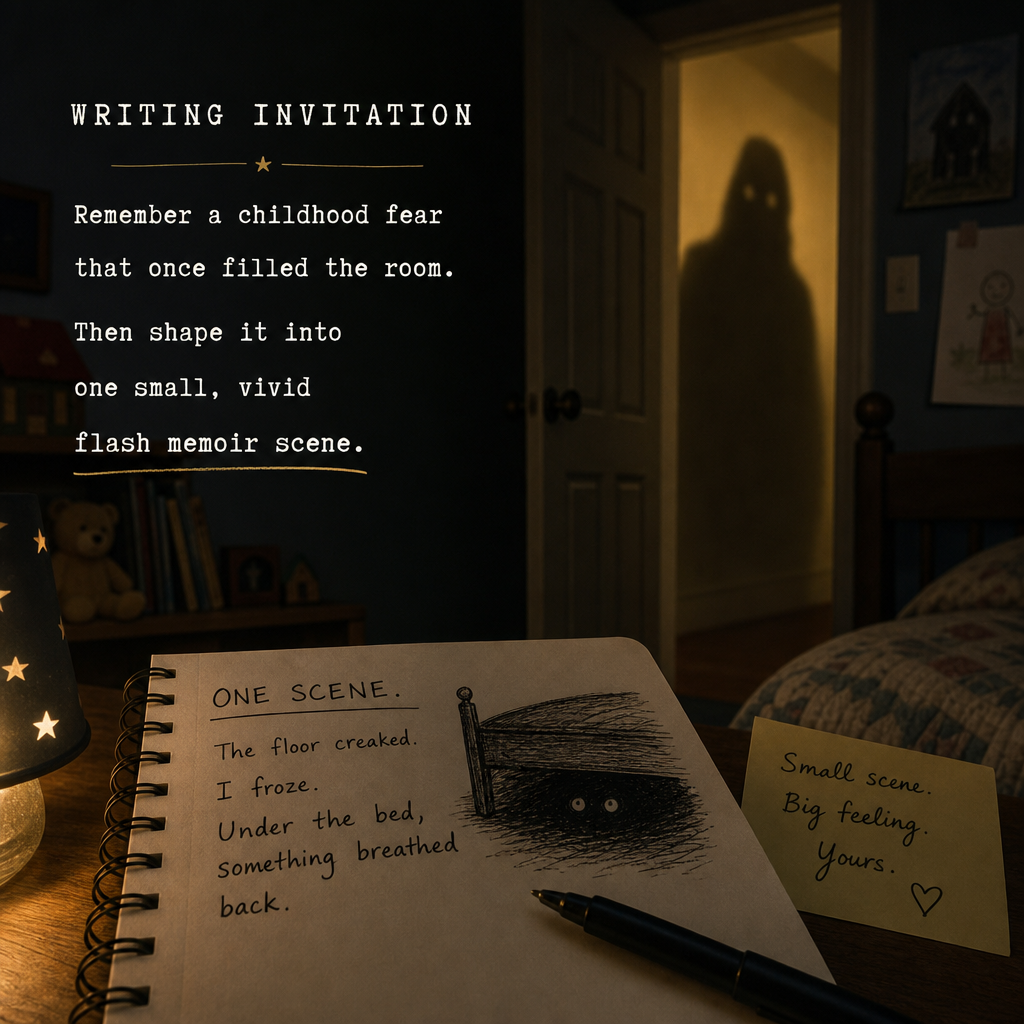
A brief writing invitation for remembering a childhood fear that once filled the room, then shaping it into one small, vivid flash memoir scene.

Maybe it was the basement stairs after dark. Maybe it was the sound of the furnace, the shadow behind a curtain, or the deep end of the pool. As an adult, you may laugh a little at what scared you. But the child in that memory was not being silly. The fear was real, and because it was real, it can become powerful material on the page.

This flash memoir prompt childhood fear seems small now invites you to return to that younger version of yourself with care. The goal is not to judge the fear. The goal is to remember how big the world felt when you were small inside it.

The Prompt

Write about a childhood fear that seems small now but felt enormous then.

This prompt works because small fears often carry large emotional truth. A barking dog, a dark hallway, a strict teacher, a bee at recess, or a monster under the bed may seem minor from the adult side of memory. But in childhood, fear can take up the whole body.

When you write about one of these fears, you are really writing about size, safety, imagination, trust, and the way children make sense of things they do not yet understand. A flash memoir prompt childhood fear seems small now can open a door into a scene that is simple on the surface and deep underneath.

Why This Memory Matters

Childhood fears reveal what we believed about the world before we had words for everything. They show what felt dangerous, what felt unknown, and who did or did not help us feel safe.

You might remember hiding from thunder beneath a blanket, certain the house could split open. You might remember refusing to look in the mirror at night because someone had told you a ghost story. You might remember being afraid of the school bus because you did not know where to sit.

These moments matter because they hold the emotional logic of childhood. Adults often measure fear by facts. Children measure fear by feeling. That difference can make your writing tender, funny, eerie, or bittersweet.

This kind of memory also gives you a chance to explore tone and mood in your writing. The same fear can be written with humor, sadness, suspense, or warmth. Your choice depends on what you understand now and what you want the reader to feel.

How to Approach This Prompt

Begin with one physical detail. Do not start by explaining the fear. Start with the thing your body remembers.

Maybe your feet were cold on the kitchen tile. Maybe your hand held the banister too tightly. Maybe your stomach dropped when the lights went out. Physical details help the reader enter the scene before you explain what the scene means.

Keep the memory narrow. Choose one moment, not the whole history of the fear. If you were afraid of dogs, do not write every dog story from childhood. Pick the one dog behind the one fence on the one afternoon when you walked home faster than usual.

Try writing the scene as your younger self first experienced it. What did you notice? What did you misunderstand? What did the adults say? What did you believe anyway?

After you have the scene on the page, you can add a final line or short reflection from your adult point of view. That contrast often gives flash memoir its meaning. The adult understands the fear was small. The child remembers it as enormous. Both are true.

If you like to study your own memory more closely, you can borrow a technique from students who annotate literature. Read your draft and mark the places where fear shows up in the body, the setting, and the voice. Those marked spots may be the heart of the piece.

The Flash Memoirist
previous arrow
next arrow

A Quick Example

I was afraid of the laundry room because the dryer had a habit of thumping like something trapped inside it. My mother would send me down the hall with a basket of folded towels, and I would stop at the doorway, toes just behind the strip of metal that separated carpet from linoleum. The room smelled like bleach and warm lint. The light buzzed overhead. Then the dryer would bang once, hard, and I would drop the towels and run. My brother told me it was only sneakers tumbling around, but I knew better. At seven, I believed machines could get angry. I believed they waited until adults were gone. Now I own a dryer that knocks when the load is uneven, and I still listen for one second before opening the door.

Try It Yourself

Set a timer for ten minutes and write about one fear from childhood. Choose a fear that feels almost too small to matter now. That is often where the best memory lives.

Give yourself permission to write it from the child’s point of view. Let the fear be as large as it felt then. Do not rush to make fun of it or explain it away. Stay in the room, the yard, the classroom, or the hallway where it happened.

When you finish, read the piece once and ask yourself one question: what did this fear teach me about the world at that age? You do not need a neat answer. A clear image may be enough.

If you want to revise, look for one place where you can add sound, smell, or touch. A childhood fear becomes more believable when the reader can hear the floor creak or feel the blanket pulled up to the chin.

This flash memoir prompt childhood fear seems small now is a useful exercise because it respects the younger self. It reminds you that memory is not only made of major events. It is also made of tiny storms that once felt large enough to change the weather.

Want More Flash Memoir Prompts?

If this prompt helped you remember a moment you had not thought about in years, keep going. One small memory often leads to another. Explore all 365 prompts in The Memory Trigger: 365 Flash Memoir Writing Prompts.

The Memory Trigger

Symbols in The Alchemist: What They Mean and Why They Matter

Alchemist Symbols

A simple explanation of the most important symbols and images in the text.

The symbols in The Alchemist help readers see Santiago’s trip as more than a search for buried gold. Each key image points to a deeper lesson about dreams and self-knowledge.

Paulo Coelho uses simple objects, places, and natural forces to show how a person learns to trust a calling. That is why the novel works so well for class discussion and essays.

In this Guide

Use this quick map to follow the main ideas in the post.

  • Why symbolism matters in the novel
  • The desert, the pyramids, and the treasure
  • The sheep, the stones, and the alchemist
  • The wind, the sun, and the oasis
  • How to write about the symbols
  • FAQ and key takeaway
Alchemist Symbols

Why Symbols in The Alchemist Matter

Symbols turn Santiago’s journey into a lesson about how people grow.

The best symbols in The Alchemist are easy to picture but rich in meaning. A desert is not just a desert. A treasure is not just gold.

Coelho links ordinary images to big themes like purpose, faith, and courage. If you need a quick refresher, see our guide on how to find symbolism in a story.

The Desert: One of the Key Symbols in The Alchemist

The desert represents struggle, silence, and spiritual growth.

And the desert is harsh. It can kill people who do not respect it. Yet it also teaches Santiago to slow down, watch closely, and listen.

In the desert, Santiago learns that the world speaks through signs. This connects to the theme that wisdom often comes through hardship.

The desert also strips life down to what matters. Santiago cannot hide behind comfort there. He has to face fear and trust his Personal Legend.

The Pyramids and Treasure: Symbols in The Alchemist That Point Home

The pyramids and treasure show that a dream can lead you away from home so you can see home clearly.

At first, the pyramids seem like the goal. They are far away, mysterious, and tied to Santiago’s dream of treasure.

By the end, the real treasure sits near the ruined church where Santiago began. These symbols in The Alchemist suggest that the journey changes the traveler more than the prize does.

This is much like the green light in F. Scott Fitzgerald’s The Great Gatsby. The object seems to promise a dream, but its real meaning has more to do with longing and illusion.

The Shepherd and the Sheep

Santiago’s life as a shepherd shows the pull of comfort and routine.

The sheep trust Santiago, but they do not seek much beyond food and rest. They represent a safe life without a larger dream.

Santiago cares for the sheep, yet he knows he wants more. His choice to sell them marks the start of his inner change.

The theme is clear: safety has value, but it can also make life small.

Urim and Thummim: Small Signs with Big Meaning

The black and white stones symbolize guidance when Santiago feels lost.

Melchizedek gives Santiago Urim and Thummim to help him make choices. The stones show that help exists, but they are not meant to replace courage.

Santiago must learn to read omens without becoming passive. The theme here is that signs can guide a person, but the person still has to act.

The Wind and the Sun as Symbols in The Alchemist

The sun and wind show that all parts of creation are connected.

The wind symbolizes change. It moves across borders and carries voices, dust, and life. When Santiago speaks with the wind, he learns that nature is not separate from him.

The sun suggests wisdom and power. It helps Santiago understand that love is part of the Soul of the World.

The novel is not a strict allegory, but it often feels close to one. For more context on that form, see Britannica’s entry on allegory in art and literature.

The Alchemical Library Course

Unlock the symbolic language of alchemy — from ancient philosophy to Jungian psychology — and learn to read one of history’s most fascinating traditions of transformation with clarity and confidence.

The Oasis: Safety and Love

The oasis represents rest, but it also tests Santiago’s commitment to his dream.

At the oasis, Santiago finds safety after the danger of the desert. He also meets Fatima, whose love matters deeply to him.

The oasis could become a reason to stop. Yet Fatima does not ask Santiago to give up his Personal Legend. Their love supports growth rather than fear.

This symbol connects to one of the novel’s main themes: true love does not trap a person. It gives that person courage.

The Alchemist as a Symbol of the Teacher

The alchemist himself represents wisdom that pushes a student to act.

He does not solve every problem for Santiago. He guides him, tests him, and refuses to make the path too easy.

In that way, he is like Athena in The Odyssey. A wise guide can help the hero, but the hero must still make the hard choices.

The alchemist also shows that knowledge is not only found in books. It must be lived.

How to Write About Symbols in The Alchemist

A strong paragraph about symbolism starts with a concrete image and ends with theme.

When you write about symbols in The Alchemist, pick one symbol and ask what it teaches Santiago. Then connect that lesson to the novel’s larger message.

  • Name the symbol and a clear moment from the plot.
  • Explain how that moment reveals a theme.

For more help, you can review our full lesson on finding symbolism in fiction. You can also use our RapidReads Press symbolism study guide to plan a cleaner essay response.

Books That Pair Well with The Alchemist

These books also use simple stories to explore deep spiritual questions.

  • Siddhartha by Hermann Hesse
  • The Little Prince by Antoine de Saint-Exupéry

Both pair well with Coelho’s novel because they focus on travel, wisdom, and the search for meaning.

Helpful Outside Context

A little author background can make the novel easier to understand.

For a reliable overview of Paulo Coelho’s life and work, see Britannica’s biography of Paulo Coelho.

FAQ About Symbols in The Alchemist

Here are short answers to common student questions.

What are the most important symbols in The Alchemist?

The most important symbols in The Alchemist include the desert, the pyramids, the treasure, Urim and Thummim, the wind, and the oasis.

What does the treasure symbolize?

The treasure symbolizes Santiago’s dream, but it also shows that the journey to reach a dream can reveal what matters most.

What does the desert symbolize?

The desert symbolizes hardship and spiritual growth. It teaches Santiago patience, awareness, and trust.

Is The Alchemist an allegory?

It has strong allegorical elements, but it is best read as a symbolic quest story. Santiago’s trip reflects the inner journey toward purpose.

Key Takeaway

The novel’s symbols matter because they turn a simple adventure into a story about faith, courage, and self-discovery.

The best way to understand symbols in The Alchemist is to connect each image to Santiago’s growth. If a symbol changes how he sees the world, it likely points to one of the novel’s biggest themes. ✨

error

Enjoy this article? Please spread the word :)

Follow by Email
BLUESKY
fb-share-icon
Reddit
LinkedIn
Share
RSS