


A warm flash memoir prompt about a specific book, song, or television show from childhood, and the small repeated comfort it gave you before you had words for why.
Maybe it was the book with the cracked spine that always fell open to the same page. Maybe it was the song you played until someone yelled from the next room to turn it off. Or maybe it was a television show you watched from the carpet, chin in your hands, while dinner sounds came from the kitchen.
Childhood favorites can hold more than entertainment. They can hold safety, longing, escape, humor, or a private version of who we hoped to become. This flash memoir prompt specific book song television show memory asks you to return to one familiar object from childhood and notice what it meant to keep choosing it.

The Prompt
Write about a specific book, song, or television show from childhood that you returned to again and again.
This prompt works because repetition is rarely random. The thing you returned to may have met a need. It may have made you feel brave, understood, distracted, powerful, or less alone. You do not have to explain your entire childhood. You only need to remember one time you reached for that book, pressed play on that song, or waited for that show to begin.
Try to name the exact title if you can. If you cannot remember, describe what you do remember: the cover color, the tune, the couch, the theme song, the room, the person who sat nearby, or the feeling that came over you when it started.
Why This Memory Matters
The stories we repeated as children often became quiet companions. A book could be a hiding place. A song could become a private anthem. A television show could offer a family that felt calmer, sillier, or more predictable than real life.
This kind of memory may reveal what you were hungry for at that age. Maybe you loved a mystery series because it made the world feel solvable. Maybe you watched the same cartoon because the ending never changed. Maybe you sang along with one song because it let you feel dramatic in a house where big feelings were not welcome.
You might also discover a story about access. Who bought the book? Who controlled the remote? Did you hear the song on the radio, on a cassette, in a car, or at a school dance? Those details matter because they place the memory in a real body, in a real room, at a real age.
If you enjoy looking closely at texts, this prompt can also connect with the habit of close reading in literature. You are not analyzing a poem for class here, but you are paying close attention to what a repeated detail reveals.


How to Approach This Prompt
Begin with one physical detail. Do not start by saying what the book, song, or show meant to you. Start with what you saw, heard, touched, or did.
For a book, you might begin with the feel of the pages, the smell of the library plastic, or the way you tucked it under your pillow. For a song, start with the button you pushed, the scratch of the CD, or the radio dial in the family car. For a show, begin with the glow of the television, the snack you ate, or the exact place you sat.
Then narrow the memory to one scene. Choose one afternoon, one bedtime, one car ride, one Saturday morning. A flash memoir does not need the whole history of your childhood. It needs one charged moment that lets the larger truth peek through.
Write what you noticed before you explain what it meant. For example, instead of starting with “That show helped me feel safe,” you might write, “At 4:00, I sat on the floor close enough to feel static on my arms.” The meaning can arrive later. Let the scene do some of the work.
If you want to mark up the memory before drafting, jot notes the way a student might mark a page. Circle sensory details. Underline the emotional turn. Make a note beside anything that surprises you. This is close to the skill of annotating literature, except the text is your own memory.
For this flash memoir prompt specific book song television show response, give yourself permission to be exact and ordinary. The title does not need to be impressive. A silly show, a pop song, or a worn-out paperback can carry a serious truth.
A Quick Example
I checked out Matilda so many times the librarian stopped scanning it before she looked at me. She would just smile and say, “Again?” I liked the weight of it in my backpack on the walk home. I liked knowing the same girl was waiting inside, small and quiet and secretly powerful. One winter afternoon, I read under the dining room table while my parents argued about a bill in the kitchen. The tablecloth hung down like a wall. I remember pressing my thumb against the page when Matilda made the chalk move. I did not think, “I need escape.” I thought, “Again.” I wanted the part where someone finally noticed what a child could do.
Try It Yourself
Set a timer for ten minutes and write about the first title that comes to mind. Do not worry if it seems too childish, too popular, or too small. The repeated thing is the doorway.
Use one scene. Put yourself back in the room, car, library, bedroom, kitchen, or basement where you returned to it. What did your body do? Who else was there? What line, image, sound, or moment kept pulling you back?
If you get stuck, use this sentence starter: “I went back to it because…” Then cross that sentence out if it sounds too direct and start again with a detail. The remote in your hand. The chorus on the radio. The corner of the page folded down.
This flash memoir prompt specific book song television show exercise is less about reviewing the thing you loved and more about meeting your younger self through it. Let the memory stay small. Let it tell the truth quietly.
Want More Flash Memoir Prompts?
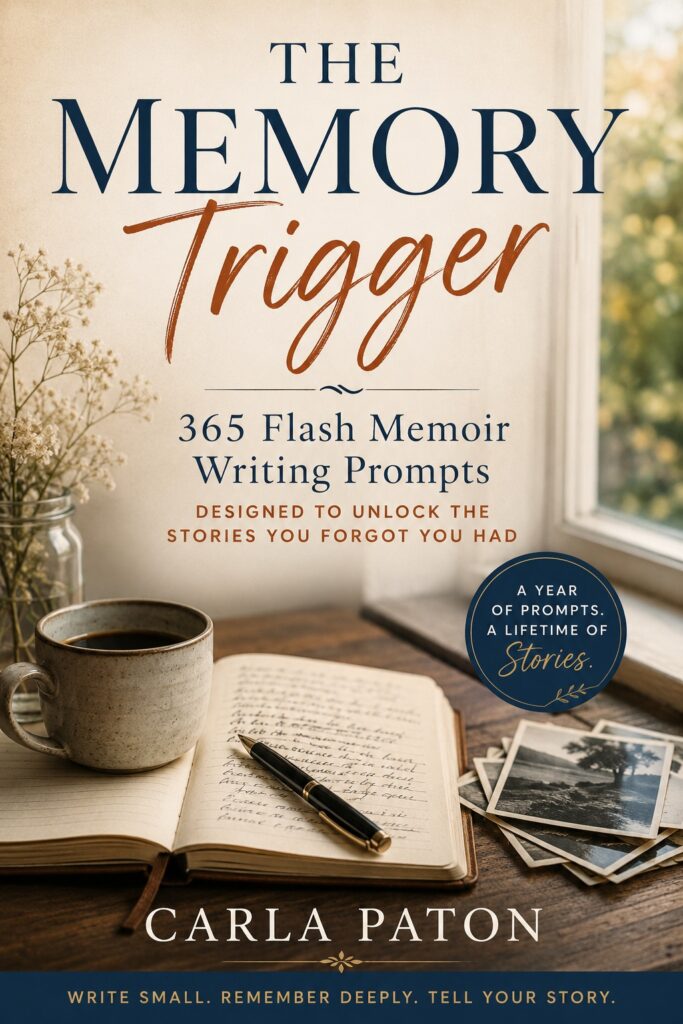
If this prompt opened a memory you had not thought about in years, keep going. Explore all 365 prompts in The Memory Trigger: 365 Flash Memoir Writing Prompts.


Get the Free Close Reading Worksheet Pack
Join my email list and receive the printable worksheet pack you can use with any novel or poem.
No spam. Just helpful guides for reading literature well.












