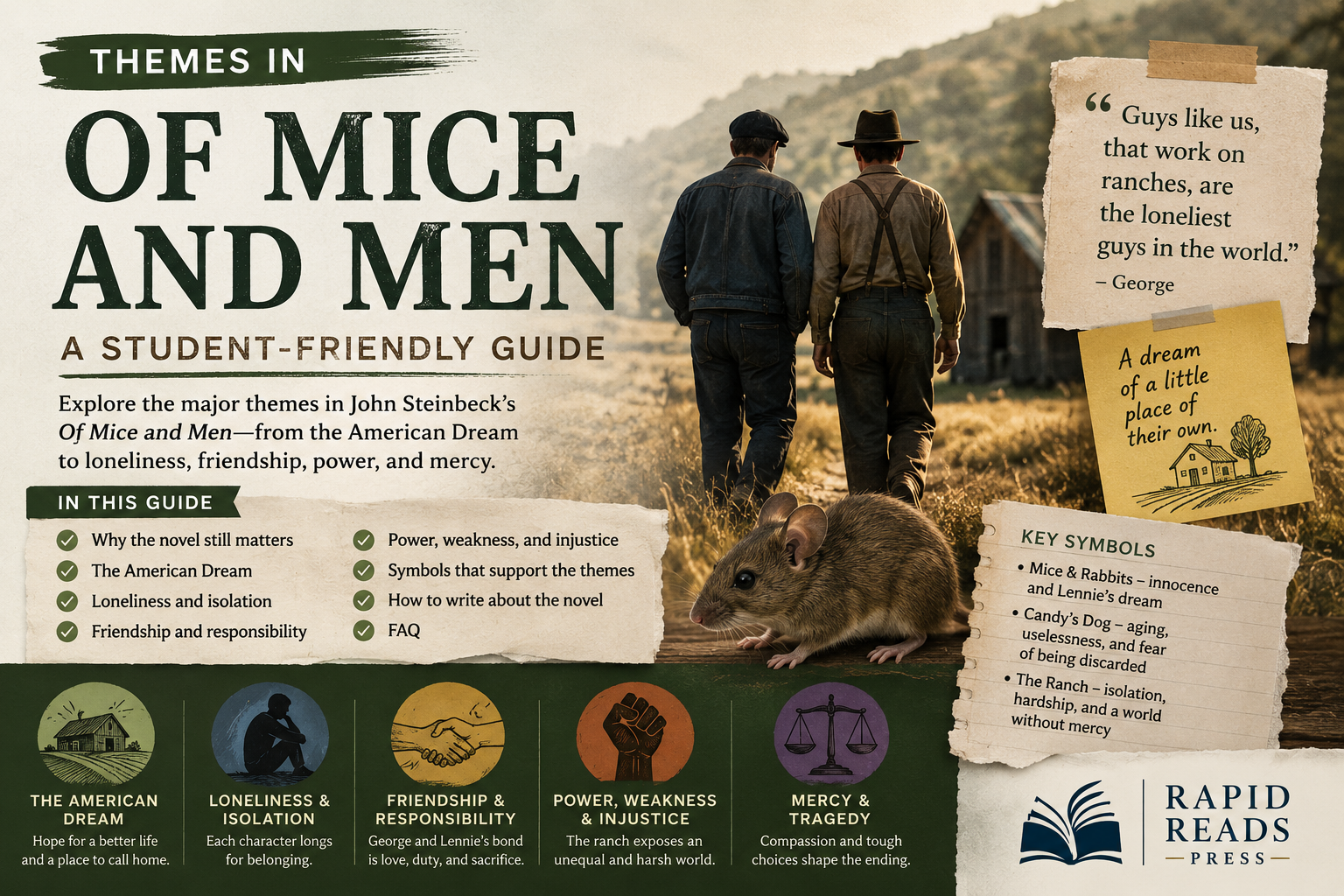
Themes in Of Mice and Men: A Student-Friendly Guide

themes in of mice and men

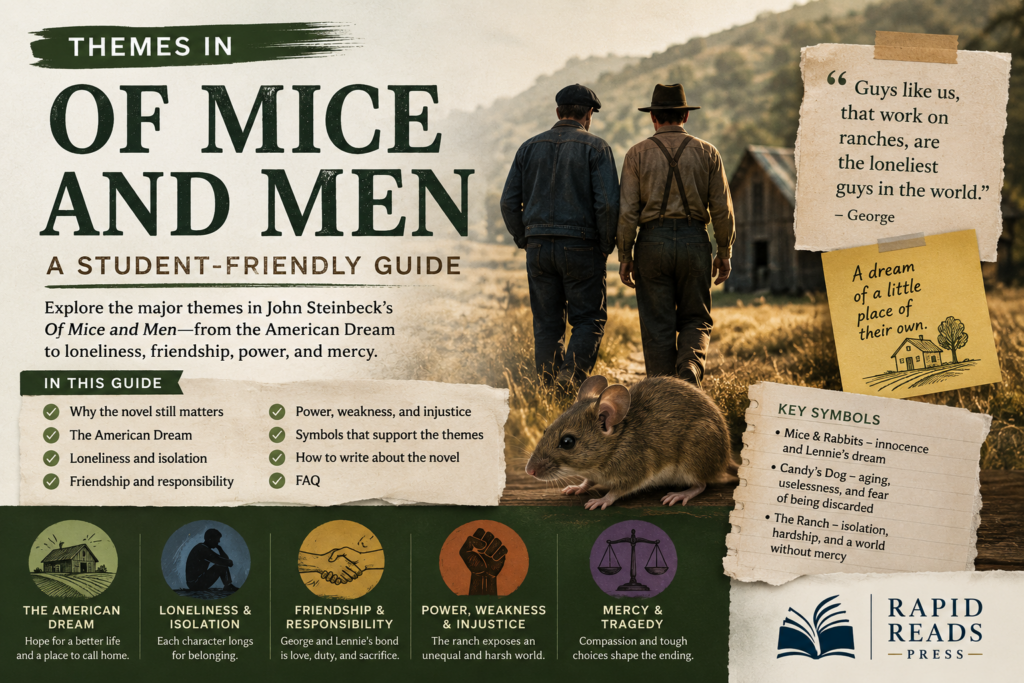
The themes in Of Mice and Men help students see why John Steinbeck’s short novel still feels powerful. The book is about two migrant workers, but it also asks hard questions about dreams, loneliness, power, and mercy.

This guide explains the major ideas in clear language so you can use them in class discussion, essays, or AP Literature notes.

This article contains affiliate links.

In this Guide

  • Why the novel still matters
  • The American Dream
  • Loneliness and isolation
  • Friendship and responsibility
  • Power, weakness, and injustice
  • Symbols that support the themes
  • How to write about the novel
  • FAQ
themes in of mice and men

Why the themes in Of Mice and Men Still Matter

Steinbeck writes about a small group of workers, but their problems feel much bigger than one ranch.

The themes in Of Mice and Men matter because they connect private pain to public hardship. George and Lennie want a home, safety, and control over their lives. Those hopes sound simple, but the world around them makes those hopes hard to reach.

The novel takes place during the Great Depression, when many workers moved from job to job. They had little money and almost no security. You can learn more about Steinbeck’s life and context through the Britannica profile of John Steinbeck.

Like The Grapes of Wrath, this book shows how poverty can crush people’s plans. It also shows how people hold on to hope even when hope seems fragile.

Main Themes in Of Mice and Men Students Should Know

Most strong essays on this novel start with a theme and then connect it to character choices.

The main themes in Of Mice and Men include the dream of a better life, the pain of loneliness, and the abuse of power. These ideas do not sit apart from each other. They overlap in almost every major scene.

George and Lennie’s dream farm gives them hope. Candy joins the dream because he fears becoming useless. Crooks wants in for a moment because he also wants safety and belonging.

Each character shows a different side of the same problem. They all want a place where they matter. Steinbeck suggests that this need is human, but the world of the ranch makes it hard to protect.

The American Dream in Of Mice and Men

The dream farm is the heart of the novel’s hope and heartbreak.

George and Lennie dream of owning a small piece of land. They want rabbits, crops, and freedom from bosses. To them, the farm means dignity.

This dream is powerful because it is so modest. They do not want to be rich. They just want peace and control over their days.

Yet the novel keeps warning us that the dream may not survive. George has told the story many times, almost like a bedtime tale. Lennie loves to hear it because it makes the future feel safe.

In this way, Steinbeck questions the American Dream. He asks whether hard work is enough when poverty, disability, and social class stand in the way.

Loneliness and Isolation

Nearly every character in the novel feels cut off from others.

George says that ranch workers are the loneliest people in the world. They travel alone, spend their money, and move on. His friendship with Lennie makes him different.

Crooks is isolated because of racism. He lives apart from the other men and knows that the dream of equality is not real for him. Curley’s wife is isolated because she is the only woman on the ranch and because the men treat her as a threat instead of a person.

Candy fears loneliness too. After his old dog is killed, he sees his own future more clearly. He worries that age will leave him unwanted.

This theme helps explain why the dream farm matters so much. It is not only about land. It is about escape from being alone.

Friendship, Loyalty, and Responsibility

George and Lennie’s bond gives the novel its emotional center.

George often complains about Lennie, but he still protects him. Lennie depends on George for almost everything. Their friendship is not simple, but it is real.

Steinbeck shows that loyalty can be both loving and painful. George cares for Lennie, but that care also traps him. He cannot live the free life he sometimes imagines.

This makes the ending so hard. George’s final choice forces readers to ask what mercy means. Is it an act of love, an act of despair, or both?

Students can compare this to works like Romeo and Juliet, where love leads to painful choices. In both texts, strong bonds shape tragic endings.

Power, Weakness, and Injustice

The ranch has a clear social order, and the weakest people suffer most.

Curley uses his status to threaten others. He is the boss’s son, so men fear him even when they dislike him. His power does not make him wise or kind.

Other characters lack power for different reasons. Lennie has great physical strength, but he has little social protection. Crooks is smart and sharp, but racism limits his life. Curley’s wife has some power over Crooks in one scene, yet she also has almost no freedom of her own.

Steinbeck does not present power as simple. A person can be hurt in one moment and hurt someone else in the next. That makes the novel more honest and more troubling.

How Symbolism Supports the Themes in Of Mice and Men

Symbols help Steinbeck show big ideas through small details.

When you study the themes in Of Mice and Men, pay close attention to animals, settings, and repeated images. Lennie’s dead mouse, Candy’s dog, and the rabbits all point to innocence, danger, and loss.

Candy’s dog is one of the clearest symbols. The dog is old and no longer useful, so the men decide it should die. This moment reflects Candy’s fear that the ranch will one day treat him the same way.

The rabbits symbolize Lennie’s dream of comfort. They also show how gentle desires can become dangerous when Lennie cannot control his strength.

If you want more help with this skill, read our guide on how to find symbolism in a story. It can help you turn small details into stronger essay points.

Fate, Foreshadowing, and Tragedy

The novel feels tragic because the ending is prepared from the start.

Steinbeck uses foreshadowing to build dread. Lennie kills small animals by accident. George tells him to hide in the brush if trouble comes. Candy regrets not killing his own dog himself.

These moments prepare us for the ending. They make the final scene feel shocking but not random.

The structure is close to classical tragedy. A character has a deep flaw or limit, the world gives little mercy, and the result feels almost unavoidable. Lennie does not mean harm, but his lack of control creates danger.

Nature, Violence, and the Loss of Innocence

The natural world in the novel looks peaceful, but danger is never far away.

The book opens near the river, a place that seems calm and safe. By the end, the same setting becomes the place of George’s terrible choice. Steinbeck uses this return to show how innocence has been lost.

Animals are central to this idea. Lennie loves soft things, but his touch often ends in harm. The pattern shows the gap between intention and result.

This theme is useful for essays because it links character, plot, and symbol. Lennie wants gentleness, but the world of the novel turns gentleness into grief.

How to Write About the Themes in Of Mice and Men

A strong essay needs a clear claim, not just a topic.

A strong essay about the themes in Of Mice and Men should explain what Steinbeck is saying about human life. Do not just write that loneliness is a theme. Write what the novel argues about loneliness.

For example, you could argue that Steinbeck shows loneliness as both a personal pain and a social problem. Then you could use Crooks, Candy, and Curley’s wife as proof.

You can also connect symbols to theme. The dream farm is not only a setting George and Lennie want. It represents the hope that people can build a life where they are safe and valued.

For extra support, our student literature study guide can help you organize notes, themes, and evidence before you draft.

Need more practice with symbols? Our guide to reading symbols in fiction is a useful next step.

Helpful Related Books

These books pair well with Steinbeck’s novel because they explore class, dreams, justice, and social pressure.

  • The Grapes of Wrath by John Steinbeck
  • To Kill a Mockingbird by Harper Lee
  • Death of a Salesman by Arthur Miller

For more author background, the Nobel Prize biography of John Steinbeck gives a helpful overview of his work and reputation.

FAQ About the Themes in Of Mice and Men

Use these quick answers to review before a quiz, class talk, or essay draft.

What are the main themes in Of Mice and Men?

The main themes are dreams, loneliness, friendship, power, and injustice. The novel shows how hard it is for vulnerable people to find safety.

What does the dream farm represent?

The dream farm represents hope, freedom, and belonging. It gives George, Lennie, and Candy a reason to imagine a better future.

Why is loneliness so important in the novel?

Loneliness shapes almost every character. Steinbeck shows that people need connection, but prejudice, fear, and poverty keep them apart.

Is George and Lennie’s friendship healthy?

It is caring, but it is also unequal. George protects Lennie, yet he also carries a heavy burden because Lennie cannot live safely on his own.

How does Steinbeck use symbolism?

He uses animals, the dream farm, and the river setting to show deeper ideas. These symbols connect hope with loss.

Key Takeaway

The themes in Of Mice and Men show that people need dreams and companionship, but harsh social forces can destroy both. Steinbeck’s novel stays powerful because its tragedy feels deeply human.
Themes in The Crucible: A Student-Friendly Guide

Themes in The Crucible

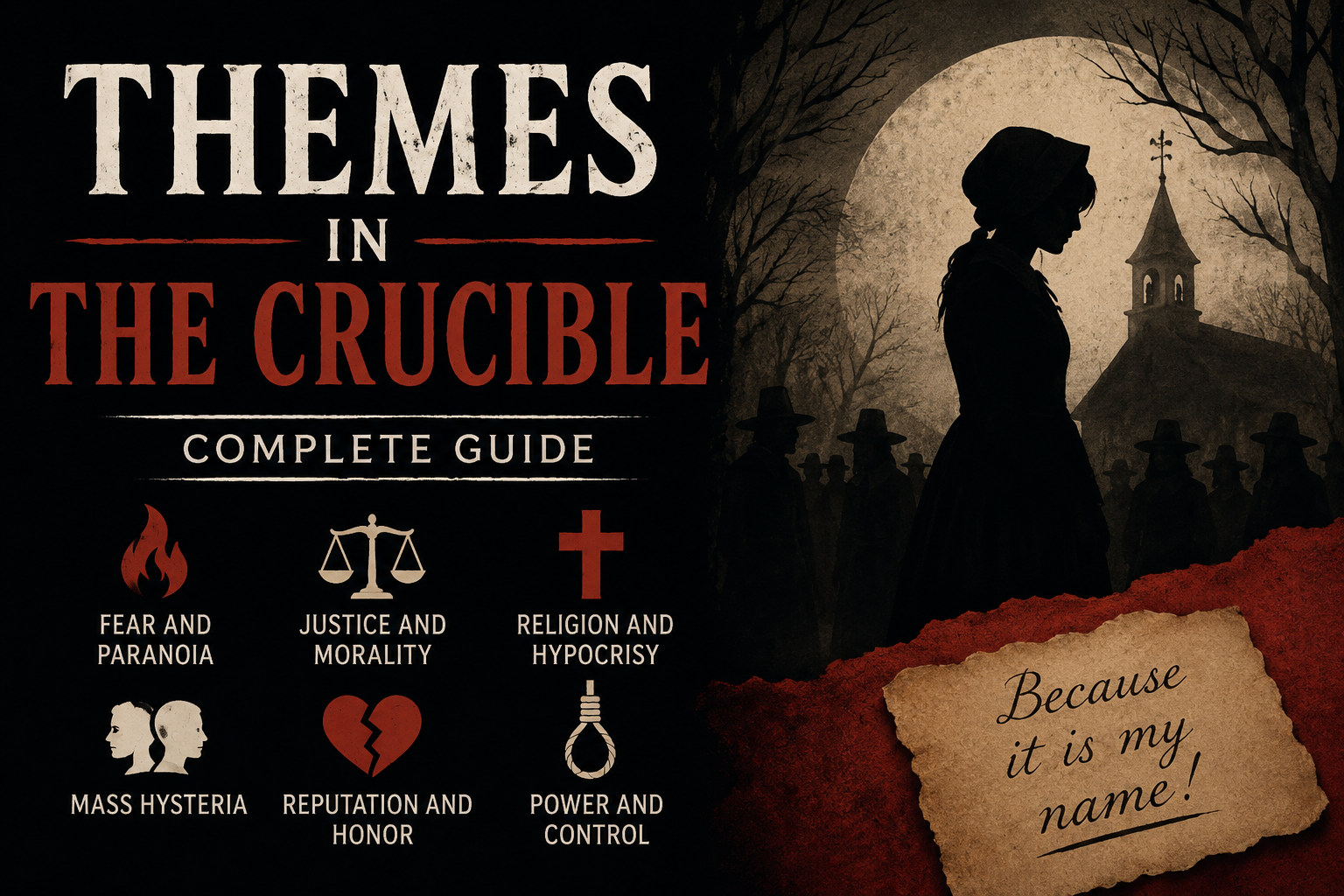
The main themes in The Crucible help students see why Arthur Miller’s Salem drama still feels tense and modern. In this guide, we will look at fear, public shame, power, justice, and truth so you can discuss the play with more confidence.

Themes in The Crucible

In this Guide

Use this table of contents to find the idea you need.

  • Why the play’s themes matter
  • Fear and mass hysteria
  • Reputation and public shame
  • Power and corrupt authority
  • Justice and truth
  • Essay tips and study resources
  • FAQ

Why the themes in The Crucible Matter

Arthur Miller wrote about Salem, but he was also speaking to his own time.

The Crucible is set during the Salem witch trials of 1692. In that world, a rumor can ruin a life. A court can twist faith into a weapon. A person can lose everything by telling the truth.

The themes in The Crucible matter because the play asks a hard question: what happens when a society values fear more than honesty?

Miller wrote the play during the age of McCarthyism, when many Americans were accused of Communist ties with weak proof. You can read more about Miller’s life at Britannica, or learn about McCarthyism from the National Archives.

Themes in The Crucible: Fear and Mass Hysteria

Fear spreads faster than facts in Salem.

At the start of the play, the town is already tense. People worry about sin, reputation, and punishment. When the girls begin to accuse others of witchcraft, fear takes over the town.

Mass hysteria means a group panic becomes more powerful than reason. In Salem, people accept wild claims because they are scared. They fear the Devil, but they also fear being accused.

Abigail Williams uses this fear to gain control. Once the court believes her, she can point at almost anyone. Her words become more powerful than evidence.

These themes in The Crucible connect to George Orwell’s Animal Farm. In both works, fear helps leaders control a group. People stop asking questions because the cost feels too high.

Themes in The Crucible: Reputation and Public Shame

In Salem, a good name can matter more than a good heart.

Reputation is one of the most painful forces in the play. Many characters care deeply about how others see them. They know that one bad rumor can lead to court, prison, or death.

Reverend Parris fears damage to his position. He worries that trouble in his house will make him look weak. His first concern is not truth, but public image.

John Proctor also struggles with his reputation. He has sinned, and he feels deep guilt. Yet his main conflict is not only private guilt. He must decide whether to save his life with a lie or keep his name clean by telling the truth.

The themes in The Crucible become personal here. Miller shows that shame can trap people. Nathaniel Hawthorne’s The Scarlet Letter also studies public shame, but Miller makes shame feel like a public trial.

Power, Control, and Corrupt Authority

The play shows how power can become dangerous when no one can question it.

The court in Salem claims to serve God and justice. Yet it often acts with pride and fear. Judge Danforth refuses to admit the court may be wrong because that would weaken his authority.

This makes the court more dangerous. If the judges admit one mistake, the whole system starts to fall apart. So they protect the court, even when innocent people suffer.

Abigail’s power is different. She has no official office, but she learns how to use the court. Her false claims give her control over adults who once had power over her.

This theme is useful for AP Literature essays because it shows conflict between public power and private truth. The play asks whether authority deserves respect when it refuses proof.

Justice, Lies, and the Demand for Proof

The Crucible turns the court into a place where truth becomes hard to recognize.

A fair court should ask for proof. In Salem, the court often accepts fear as proof. It trusts dramatic words, screams, and visions that no one else can see.

This is why the play feels so tense. The accused cannot defend themselves in a normal way. If they deny witchcraft, the court may see the denial as more proof of guilt.

Mary Warren’s failed confession shows this problem. She tries to tell the truth, but pressure breaks her. The court’s mood matters more than her facts.

Miller does not suggest that justice is simple. He shows that a legal system can fail when leaders care more about control than evidence.

Truth, Integrity, and Personal Courage

The play’s deepest question is whether truth is worth suffering for.

John Proctor is not a perfect hero. That is part of why students often find him interesting. He has lied before, and he has hurt others. Still, he wants to become honest before the end.

His final choice is painful. If he signs a false confession, he may live. If he refuses, he will die. His decision shows that integrity can cost more than comfort.

Elizabeth Proctor helps us see this theme too. She admits her own limits and gives John space to choose. Her quiet strength matters because she does not force him to become a symbol.

This theme also appears in Sophocles’ Antigone. Antigone, like Proctor, faces a state that demands obedience. Both characters must choose between survival and moral truth.

How to Write About Themes in The Crucible

A strong essay connects a theme to a clear claim about the whole play.

When you write about themes in The Crucible, do not just name the idea. Explain what Miller says about that idea. For example, do not write, “Fear is a theme.” Write, “Miller shows that fear can destroy justice when people value safety over truth.”

That second sentence gives you an argument. It tells your reader what the play reveals about fear.

Use short quotations if your teacher allows them. Then explain how the words prove your claim. The best analysis spends more time on meaning than plot summary.

If you need help with structure, use our guide to writing a literary analysis essay. It can help you build a clear thesis and stronger body paragraphs.

Recommended Books for Deeper Study

These books can help you understand the play and its background.

  • The Crucible by Arthur Miller
  • Arthur Miller: His Life and Work by Martin Gottfried

FAQ: Themes in The Crucible

Here are quick answers to common student questions.

What are the main themes in The Crucible?

The main themes in The Crucible include fear, reputation, power, justice, and integrity. Each theme connects to the Salem trials and Miller’s view of panic in society.

What is the most important theme in the play?

Many students choose fear as the most important theme. Fear drives the accusations and makes people accept weak proof.

How does reputation affect John Proctor?

Proctor wants to protect his name, but he also wants to be honest. His final choice shows that integrity matters more to him than survival.

Why did Arthur Miller write about Salem?

Miller used Salem to comment on his own time. He saw links between the witch trials and anti-Communist fear in the 1950s.

How can I write a strong theme paragraph?

Start with a claim about what the play says. Use one clear example from the text, then explain how it supports your idea.

Key Takeaway

The strongest themes in The Crucible show how fear can twist truth, damage justice, and test a person’s character. Miller’s play lasts because those problems still feel real today.

Symbols in 1984: What They Mean and Why They Matter

symbols in 1984

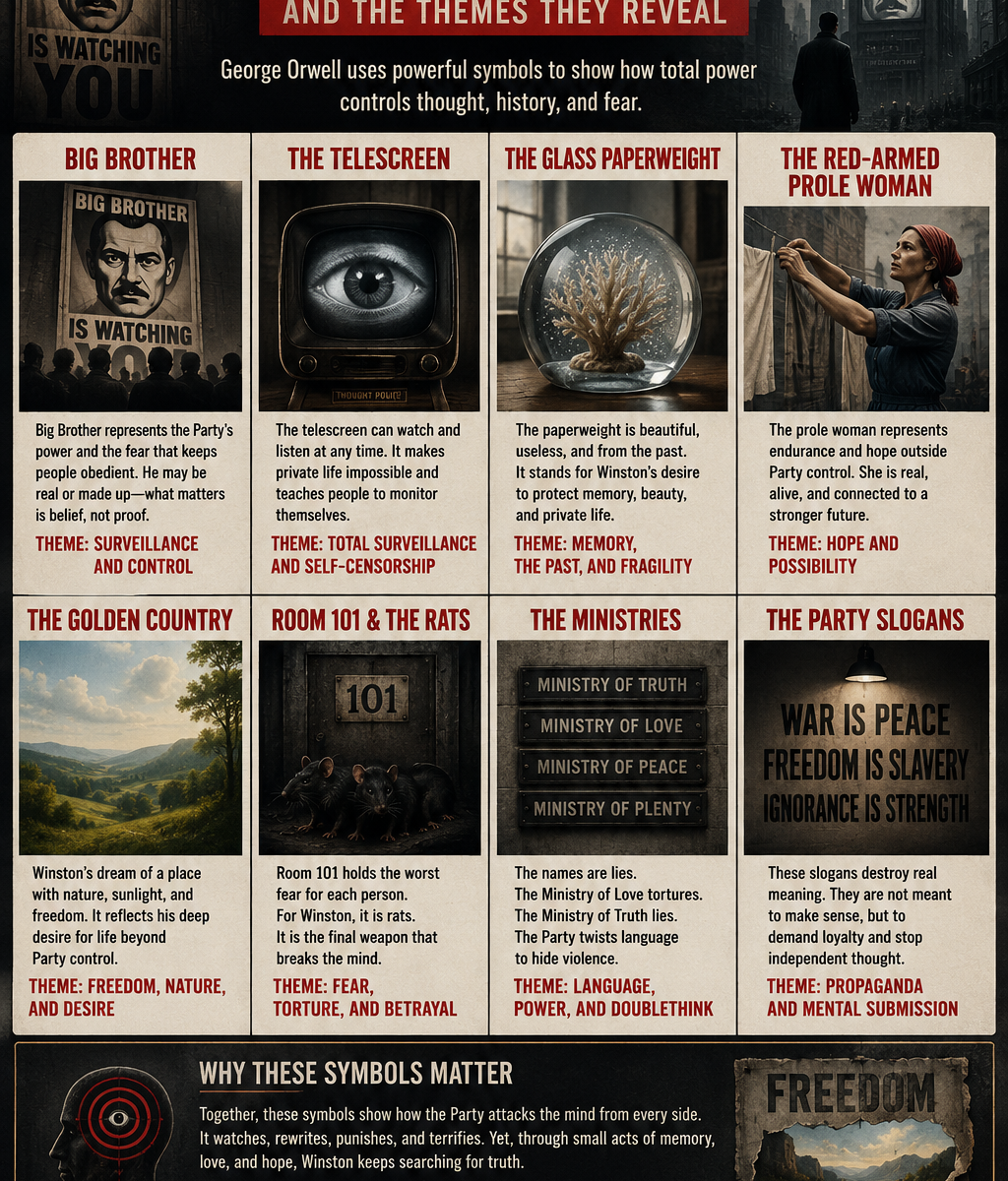
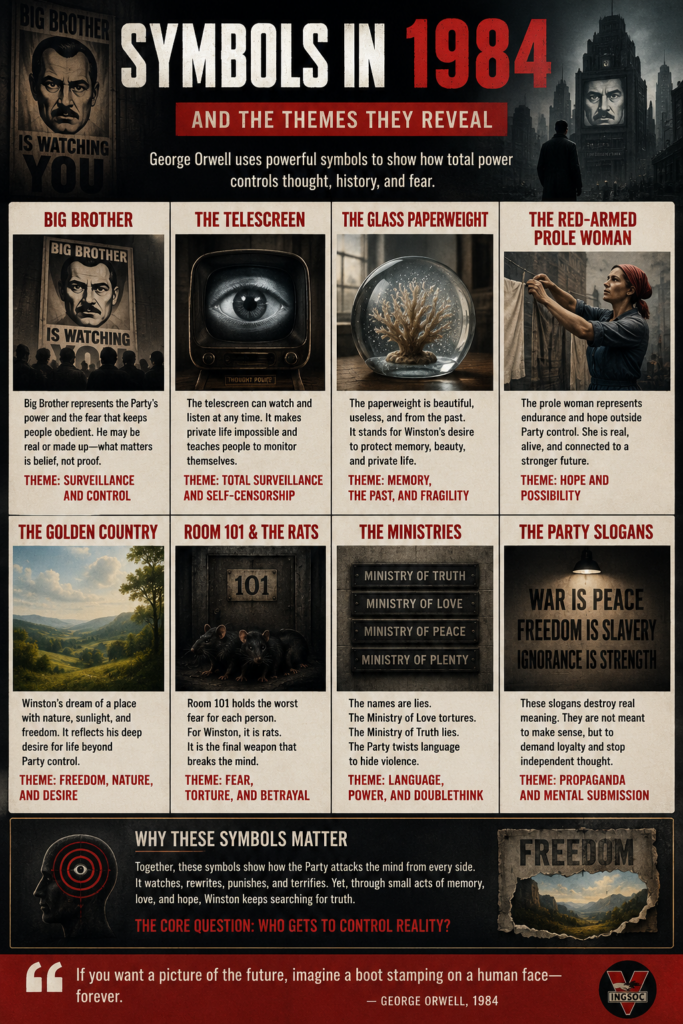
George Orwell uses strong images to show how a government can control thought, history, and fear. This guide explains the most important symbols in 1984 and connects each one to a major theme in the novel.

If you need a quick review of the basics, see our guide on how to find symbolism in a story.

In this Guide

  • What symbolism does in the novel
  • Big Brother and the telescreen
  • The paperweight, the prole woman, and the Golden Country
  • Room 101, rats, and fear
  • How to write about these symbols
  • FAQ and key takeaway

This article contains affiliate links.

symbols in 1984

What Symbols in 1984 Do

Orwell’s symbols make abstract ideas feel concrete and hard to ignore.

The main symbols in 1984 help readers see how total power works. Instead of only telling us that the Party is cruel, Orwell gives us objects and images that show fear, control, and lost freedom.

This is why symbolism matters in literature. A symbol can carry a larger meaning, like the green light in The Great Gatsby or the conch in Lord of the Flies.

In Orwell’s novel, symbols often show the gap between private life and public control. Winston wants truth and love, but the Party tries to own both.

Big Brother as One of the Key Symbols in 1984

Big Brother stands for the Party’s power and the fear that keeps people obedient.

The famous poster says, “Big Brother is watching you.” This image appears across the city and makes people feel watched even when no one may be there.

Big Brother may be a real person, or he may be a made-up figure. That uncertainty is part of the point. The Party does not need proof. It needs belief.

As one of the central symbols in 1984, Big Brother connects to the theme of surveillance. He also shows how a government can replace family, faith, and personal loyalty with loyalty to the state.

The Telescreen and Total Surveillance

The telescreen turns private space into public property.

Winston’s telescreen can send out Party messages, but it can also watch him. He cannot fully turn it off. Even his face and body can betray him.

This symbol matters because it makes control feel constant. The Party does not only punish crimes. It hunts for thoughts, doubts, and small signs of rebellion.

The telescreen also connects to the theme of self-censorship. Winston learns to hide his feelings because the world around him has no safe corner.

The Glass Paperweight and the Lost Past

The paperweight shows Winston’s desire to protect beauty, memory, and private life.

Winston buys the glass paperweight because it feels useless in the Party’s world. It is old, delicate, and connected to a time before constant control.

The piece of coral inside the glass seems sealed away from history. Winston imagines his room above Mr. Charrington’s shop in the same way. It feels like a small world where he and Julia can exist apart from the Party.

When the Thought Police smash the paperweight, the meaning becomes clear. The Party can break private dreams as easily as glass.

This is one of the most painful symbols in 1984 because it links memory to fragility. The past can matter deeply, but it can also be destroyed.

The Red-Armed Prole Woman

The prole woman symbolizes endurance and a hope that exists outside Party control.

Winston watches her as she hangs laundry and sings. She is not rich or powerful, but she seems alive in a way Party members are not.

Her body, voice, and daily work suggest strength. Winston starts to believe that the proles may hold the future because they have not been fully emptied by Party life.

This symbol connects to the theme of hope. Orwell does not make that hope simple, though. The proles have numbers, but they lack political awareness.

The Golden Country

The Golden Country represents freedom, natural life, and desire without fear.

Winston dreams of a place with grass, sunlight, and open space. It feels like the opposite of London, where rooms are watched and language is policed.

When Winston later meets Julia in the countryside, the setting echoes this dream. For a short time, nature seems to offer a space beyond Party control.

Yet the Golden Country is never fully safe. As with many symbols in 1984, it shows both hope and danger. Freedom exists in Winston’s mind, but the Party works to reach even there.

Room 101, Rats, and Fear

Room 101 symbolizes the final weapon of the Party: personal terror.

O’Brien tells Winston that everyone knows what waits in Room 101. It is the worst thing in the world for that person. For Winston, it is rats.

The rats are not just animals. They represent panic that cannot be argued with. Winston can resist pain for a time, but pure fear breaks the part of him that loves Julia.

This symbol connects to the theme of betrayal. The Party does not only want Winston to obey. It wants him to give up the person he loves most.

The Ministries and Party Slogans

The false names of the Ministries show how language can hide violence.

The Ministry of Love deals with torture. The Ministry of Truth spreads lies. These names are cruel because they force people to accept the opposite of reality.

The Party slogans work the same way. Their purpose is not clear thought. Their purpose is mental submission.

These are important symbols in 1984 because they connect language to power. If the Party can control words, it can weaken a person’s ability to resist.

Why Symbols in 1984 Matter for Themes

The novel’s symbols all point back to the same core question: who gets to control reality?

Big Brother and the telescreen show public control. The paperweight and Golden Country show private hope. Room 101 shows how fear can destroy even deep love.

Together, the symbols in 1984 reveal how the Party attacks the mind from every side. It changes history, watches behavior, twists language, and uses fear when all else fails.

For more background on the novel, you can read Britannica’s overview of Nineteen Eighty-four.

How to Write About Symbols in 1984

A strong paragraph should name the symbol, explain its meaning, and connect it to a theme.

Do not stop at saying that Big Brother is a symbol of control. Show how the poster, the watching eyes, and the repeated slogan make people police themselves.

You can use this simple sentence frame: In 1984, [symbol] represents [idea] because [specific detail], which helps Orwell develop the theme of [theme].

For more help with this skill, review our step-by-step post on finding symbols in fiction.

Books to Pair with 1984

These books pair well with Orwell’s novel because they also explore power, language, and freedom.

FAQ About Symbols in 1984

These quick answers can help with homework, essays, or class discussion.

What is the most important symbol in 1984?

Big Brother is often the most important symbol because he represents the Party’s total power and constant watchfulness.

What does the paperweight symbolize in 1984?

The paperweight symbolizes Winston’s love of the past and his hope for a private life outside Party control.

What do rats symbolize in 1984?

Rats symbolize Winston’s deepest fear. They also show how the Party uses terror to force betrayal.

Why does Orwell use so many symbols?

Orwell uses symbols to make political control feel personal. The images help readers see how power reaches into daily life.

Are the symbols in 1984 still relevant today?

Yes. Many readers still connect the novel’s symbols to debates about privacy, propaganda, and truth.

Key Takeaway

The most important symbols in 1984 show how the Party controls people through fear, false language, lost memory, and constant surveillance. Orwell’s images matter because they turn big political ideas into scenes we can feel.

Themes in 1984: A Student-Friendly Guide to Orwell’s Big Ideas

themes in 1984

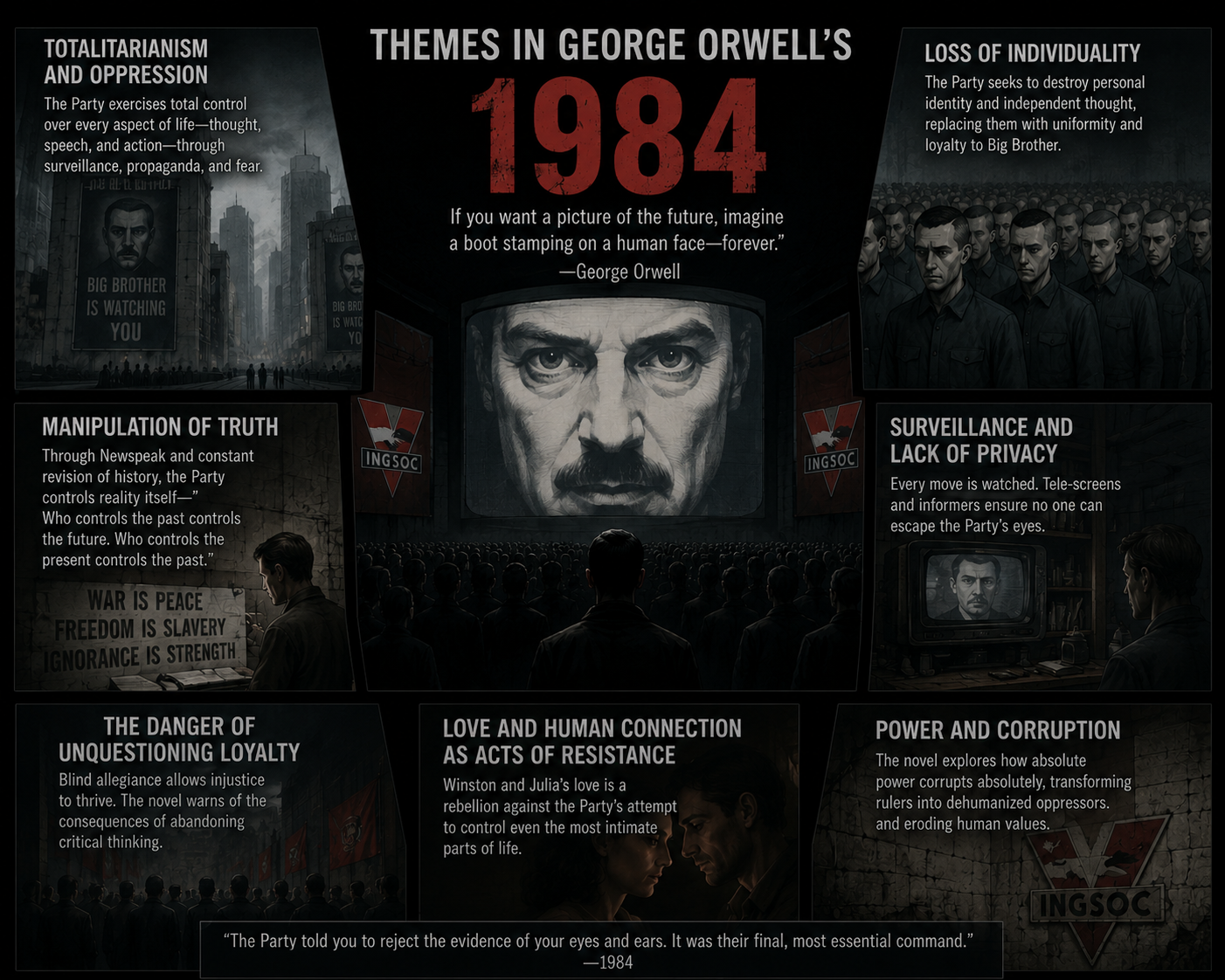
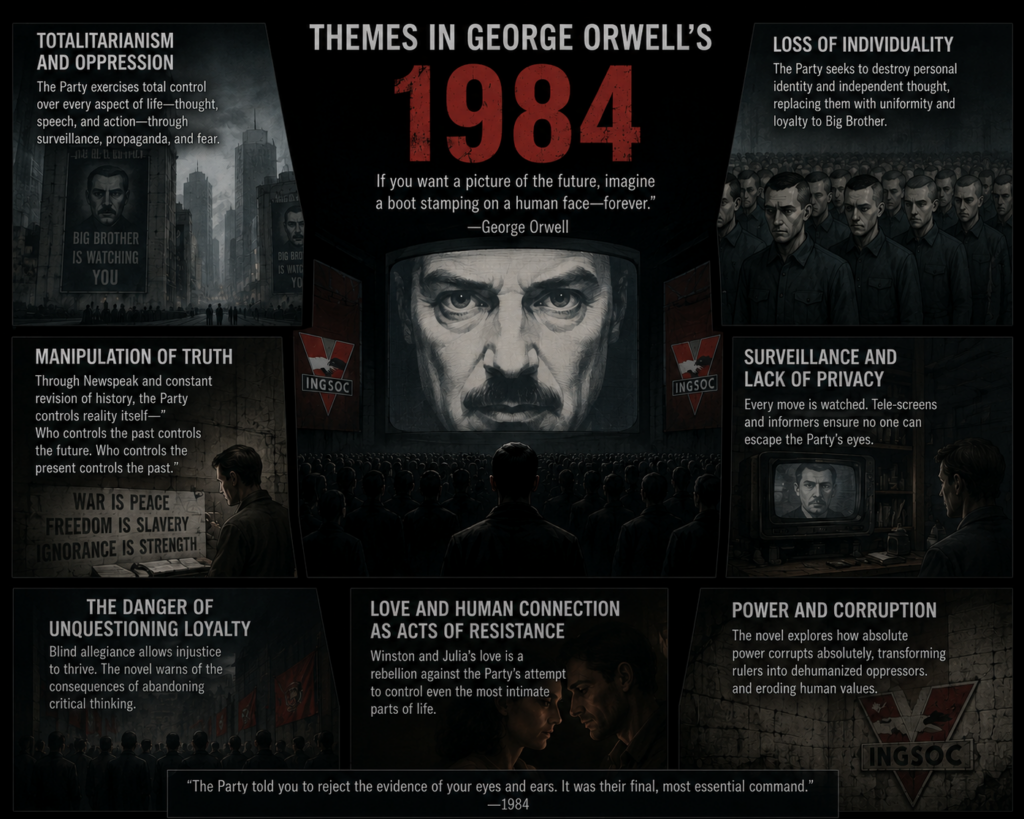
George Orwell’s 1984 is more than a dark story about a future society. The themes in 1984 help students see how power can shape truth, language, fear, and private thought.

This guide breaks down the major ideas you should notice for class discussion, close reading, and essays.

This article contains affiliate links.

In this Guide

Use this guide as a quick map before you write or review.

  • Understanding the major ideas in the novel
  • Power and control
  • Language and thought
  • Truth and memory
  • Fear and loyalty
  • Individual freedom
  • Books to read next
  • FAQ
themes in 1984

Understanding the Themes in 1984

Orwell uses Winston’s world to ask a simple but scary question: what happens when a government controls not just actions, but minds?

A theme is a big idea a text explores. In 1984, Orwell does not give readers easy answers. He shows a world where people may obey because they are afraid, tired, watched, or unsure what is true.

To study the novel well, do more than name the theme. Ask how Orwell builds it through setting, conflict, symbols, and character choices. If you need help with that step, see our guide on how to analyze characters in literature.

Winston matters because he wants the truth, even when truth feels dangerous. His struggle turns the novel’s ideas into a human story.

Themes in 1984: Power and Control

These themes in 1984 show that power works best when people believe they have no safe place to resist.

The Party controls public life through laws, screens, slogans, and punishment. Yet its deeper goal is mental control. It wants citizens to accept whatever the Party says, even if it changes from day to day.

Big Brother is the face of this power. He may or may not exist as a real person, but that almost does not matter. His image makes people feel watched at all times.

The telescreens are a clear symbol of this control. They turn private rooms into public spaces. Winston cannot fully relax, even in his own home.

This theme connects to many dystopian works. In The Hunger Games by Suzanne Collins, public fear and public display help the Capitol stay in power. In 1984, the Party goes even deeper because it tries to own thought itself.

Themes in 1984: Language and Thought

Orwell shows that language is not just a tool for speech. It can shape what people are able to think.

Newspeak is one of the most important ideas in the novel. The Party creates it to shrink language over time. If words for rebellion, freedom, or justice vanish, people may find it harder to imagine those ideas.

This is why the Party cares so much about words. It knows that clear language can protect clear thought. Confused language can hide lies.

The themes in 1984 become most clear when we see how slogans twist meaning. Phrases like War is Peace and Freedom is Slavery are not meant to make sense. They train people to accept contradiction without protest.

Students can compare this to propaganda in Shakespeare’s Julius Caesar. Mark Antony uses public speech to move the crowd. Orwell’s Party uses speech to block thought before it begins.

Themes in 1984: Truth, Memory, and History

In Orwell’s world, truth is not treated as something to discover. It is treated as something the Party can edit.

Winston works at the Ministry of Truth, but the name is a lie. His job is to change old records so the Party always appears right. If a prediction fails, the record changes. If a person becomes an enemy, the record erases that person.

This attack on history is one of the novel’s strongest warnings. If people cannot trust records, memory, or facts, they become easier to control.

When students study themes in 1984, this one often leads to strong essays. You can focus on how Orwell links truth to freedom. If citizens lose the past, they lose the power to question the present.

For more background on Orwell’s life and political concerns, visit Britannica’s overview of George Orwell.

Fear, Surveillance, and Self-Censorship

The Party does not need to punish everyone. It only needs people to believe punishment is always possible.

Fear shapes daily life in 1984. Citizens fear the Thought Police, their neighbors, and even their children. This fear causes people to hide their real feelings.

That is why surveillance is so powerful. The telescreen may not catch every action, but it changes behavior. People learn to police themselves.

This idea feels modern because many readers know what it means to act differently when they feel watched. Orwell pushes that feeling to an extreme. He asks what happens when privacy no longer exists.

Individual Freedom and Private Identity

Winston’s rebellion starts small because even small private acts matter in this world.

At first, Winston does not lead a movement. He writes in a diary. He remembers. He loves Julia. These acts matter because the Party wants no inner life outside its control.

The diary is especially important. It gives Winston a place to speak honestly, even if no one else reads it. In a world built on falsehood, private truth becomes a form of resistance.

Julia’s rebellion is different from Winston’s. She cares less about history and more about personal pleasure. Their differences help readers see that freedom can mean more than one thing.

To build a stronger essay, compare how Winston and Julia respond to control. Our character analysis guide can help you connect their choices to the novel’s larger ideas.

Why the Themes in 1984 Still Matter

Orwell’s novel still speaks to readers because it studies problems that do not belong to one time period.

The novel asks readers to care about truth, language, privacy, and power. These ideas matter in governments, schools, media, and personal life.

The key lesson is not only that total power is dangerous. Orwell also shows that people must protect the habits that keep freedom alive. Those habits include honest speech, memory, questions, and private thought.

This is why 1984 often appears in high school, AP Literature, and college courses. It gives students a strong way to discuss politics, ethics, and human behavior through fiction.

Books to Read Next

These books pair well with Orwell’s novel because they also ask how society shapes freedom and truth.

For a wider look at dystopian fiction as a genre, see Britannica’s page on dystopia.

FAQ About Themes in 1984

Use these quick answers for review before a quiz, seminar, or essay.

What are the main themes in 1984?

The main themes in 1984 include power, language, truth, fear, surveillance, and individual freedom. Each theme shows how the Party controls people from the outside and the inside.

What is the most important theme in 1984?

Many students choose control of truth as the most important theme. If the Party can rewrite facts, citizens lose the ability to challenge power.

How does Newspeak support the novel’s themes?

Newspeak limits thought by limiting words. Orwell suggests that people need rich, clear language to think freely.

Why does Winston keep a diary?

The diary lets Winston claim a private voice. It is a small act of rebellion because the Party wants to control even personal thoughts.

Key Takeaway

The themes in 1984 show how freedom can disappear when power controls truth, language, and private life. Orwell’s warning is clear: a free mind needs facts, memory, and the courage to question authority.

Themes in To Kill a Mockingbird: A Complete Guide

Themes in To Kill a Mockingbird

Understanding the Major Themes in To Kill a Mockingbird
A novel about growing up, justice, and moral courage in a divided society.

The major themes in To Kill a Mockingbird (affiliate link) help readers understand why this novel is still widely taught in schools today. On the surface, the story is about Scout Finch growing up in a small Southern town, but beneath that story, the novel explores serious issues like racism, injustice, empathy, courage, and innocence. Harper Lee uses the experiences of Scout and Jem to show how people learn right and wrong in a complicated world. The trial of Tom Robinson is the central event of the novel, but the book is really about moral growth and learning to see the world from other people’s perspectives.

In this guide, we will look at the most important themes in To Kill a Mockingbird and how they appear throughout the novel.

In This Guide

Racism and Injustice
Moral Courage
Coming of Age
Empathy
Social Class
Good vs Evil
Education
Innocence

Themes in To Kill a Mockingbird
Image by Carla Paton

Racism and Injustice in To Kill a Mockingbird

The trial of Tom Robinson shows how prejudice can destroy justice.

One of the most important themes in To Kill a Mockingbird is racism and injustice. This theme is most clearly shown during the trial of Tom Robinson. Even though Atticus proves that Tom Robinson is innocent, the jury still finds him guilty. This shows that racism in Maycomb is so powerful that it overrides truth and justice. The courtroom is supposed to be a place of fairness, but in this case, prejudice determines the outcome.

The novel also shows the hypocrisy of Maycomb. Many people in the town believe they are good and moral, yet they support a system that treats Black citizens unfairly. Scout even notices that her teacher criticizes Hitler for prejudice while ignoring racism in her own town. Harper Lee uses this contrast to show that people often recognize injustice in other places but fail to see it in their own communities.

Tom Robinson represents the most tragic example of this theme. He is an innocent man who is destroyed by a racist society, which connects directly to the symbol of the mockingbird — an innocent creature harmed by others.

Moral Courage in To Kill a Mockingbird

Doing what is right even when you know you might lose.

Another major theme in To Kill a Mockingbird is moral courage. Atticus Finch represents this theme more than any other character. He agrees to defend Tom Robinson even though he knows the town will criticize him and that he will probably lose the case. Atticus explains that he must defend Tom because he has to live with his own conscience.

The novel also shows courage through Mrs. Dubose, who fights to overcome her morphine addiction before she dies. Atticus explains to Jem that real courage is not about physical strength, but about doing what is right even when you know the situation is difficult or hopeless.

Even Scout shows courage when she stands up for Walter Cunningham and when she unknowingly stops the mob at the jail by speaking politely to Mr. Cunningham. The novel shows that courage can be quiet and moral, not just physical.

Coming of Age in To Kill a Mockingbird

Scout and Jem grow up and learn that the world is not always fair.

To Kill a Mockingbird is a coming-of-age novel because Scout and Jem grow up and learn important lessons about the world. At the beginning of the novel, they are innocent and believe that the world is fair. They believe Boo Radley is a monster and that the legal system always tells the truth.

As the novel progresses, Jem and Scout begin to understand that people are more complicated and that the world is not always fair. Jem especially struggles after Tom Robinson is found guilty because he believed that the truth would lead to justice. This moment represents Jem’s loss of innocence.

By the end of the novel, Scout learns the most important lesson of all — empathy. When she stands on Boo Radley’s porch and sees the world from his perspective, she finally understands what Atticus has been trying to teach her.

Empathy in To Kill a Mockingbird

“You never really understand a person until you climb into his skin and walk around in it.”

Empathy is one of the central themes in To Kill a Mockingbird. Atticus teaches Scout that she must try to understand people by seeing the world from their perspective. This lesson appears many times in the novel and helps Scout understand Boo Radley, Mayella Ewell, and even the people who hate Atticus.

Scout shows empathy when she understands why Walter Cunningham cannot accept lunch money and when she speaks to Mr. Cunningham at the jail. Her kindness reminds him that he is part of a community, and the mob leaves. This moment shows that empathy can be powerful enough to stop violence.

By the end of the novel, Scout understands Boo Radley and realizes that he has been protecting them the entire time. The novel suggests that many conflicts and injustices happen because people fail to understand one another.

Social Class in To Kill a Mockingbird

Maycomb is divided into strict social groups.

Social class is another important theme in To Kill a Mockingbird. The town of Maycomb is divided into different social groups, including wealthy families, poor farmers like the Cunninghams, and very poor families like the Ewells. Black citizens are at the bottom of the social structure because of racism.

The Ewells are especially important because even though they are poor and uneducated, they are still treated as socially superior to Black citizens. This shows that race is more important than class in Maycomb’s social system.

Through these social divisions, Harper Lee shows that social class is often unfair and does not reflect a person’s character or morality.

Good vs Evil in To Kill a Mockingbird

The novel shows both kindness and cruelty in human nature.

The novel explores the theme of good versus evil by showing both kindness and cruelty. Characters like Atticus, Scout, Jem, and Boo Radley represent kindness, compassion, and moral courage. Characters like Bob Ewell represent cruelty, hatred, and ignorance.

However, the novel does not suggest that people are completely good or completely evil. Instead, it shows that most people are a mixture of both. Mayella Ewell is a good example of this because she is both a victim and a person who causes injustice.

The conflict between good and evil is most clearly shown in the trial and in Bob Ewell’s attack on Scout and Jem. Boo Radley’s rescue of the children shows that good can exist even in a world where evil is present.

Education in To Kill a Mockingbird

The novel shows that true education is moral education.

Education is an important theme in the novel, but Harper Lee suggests that education is not just what students learn in school. Scout’s teacher represents formal education, but she does not understand the students or the town of Maycomb. In contrast, Atticus and Calpurnia teach Scout important life lessons about empathy, respect, and responsibility.

The novel suggests that true education means learning how to think, how to understand people, and how to do what is right.

Innocence in To Kill a Mockingbird

The mockingbird represents innocent people who are harmed by society.

Innocence is one of the most important themes in To Kill a Mockingbird, and it is closely connected to the symbol of the mockingbird. A mockingbird represents innocence because it does no harm and only brings beauty into the world. Tom Robinson and Boo Radley are both compared to mockingbirds because they are innocent but are harmed by others.

Children also represent innocence in the novel. Scout and Jem begin the story as innocent children, but as they learn about racism and injustice, they lose some of that innocence and gain understanding.

The novel suggests that innocence is something valuable that should be protected.

Why These Themes Matter

If you understand the themes in To Kill a Mockingbird, you understand the novel. Most essay questions and test questions focus on themes, especially racism, courage, innocence, and empathy. These themes help explain the characters, the symbols, and the major events in the story.

If you are studying the novel for school, it is important to understand:

  • What each theme means
  • Which characters represent each theme
  • Which events develop each theme
  • Which quotes connect to each theme

For a full breakdown of chapter summaries, character analysis, symbols, quotes, essay topics, and test questions, you can use this complete study guide:
https://rapidreadspress.com/product/to-kill-a-mockingbird-study-guide/

To Kill a Mockingbird Study Guide

If you are writing a literary analysis essay, this guide may also help:
https://rapidreadspress.com/product/literary-analysis-essay-examples/

For more historical background on the novel and the Civil Rights era, you can also visit:
https://www.britannica.com/topic/To-Kill-a-Mockingbird
https://www.history.com/topics/civil-rights-movement

Key Takeaway

The most important themes in To Kill a Mockingbird are racism and injustice, moral courage, empathy, innocence, and coming of age. The novel teaches that doing what is right is not always easy, that people must try to understand one another, and that innocent people must be protected. Scout’s journey from innocence to understanding is what gives the novel its lasting meaning.

FAQ – Themes in To Kill a Mockingbird

What is the main theme in To Kill a Mockingbird?

The main theme is racism and injustice, shown through Tom Robinson’s trial.

What theme does Atticus represent?

Atticus represents moral courage and justice.

What theme does Boo Radley represent?

Boo Radley represents empathy and innocence.

Is To Kill a Mockingbird a coming-of-age novel?

Yes, it is a coming-of-age novel because Scout and Jem grow up and learn important moral lessons.

Why is the mockingbird important?

The mockingbird represents innocent people who are harmed by society, especially Tom Robinson and Boo Radley.

error

Enjoy this article? Please spread the word :)

Follow by Email
BLUESKY
fb-share-icon
Reddit
LinkedIn
Share
RSS