Flash Memoir Prompt: First Time You Were in a Hospital

flash memoir prompt hospital

The first hospital memory may come back through a smell, a waiting room chair, or the quiet moment when someone tried to look brave for you.

The Prompt

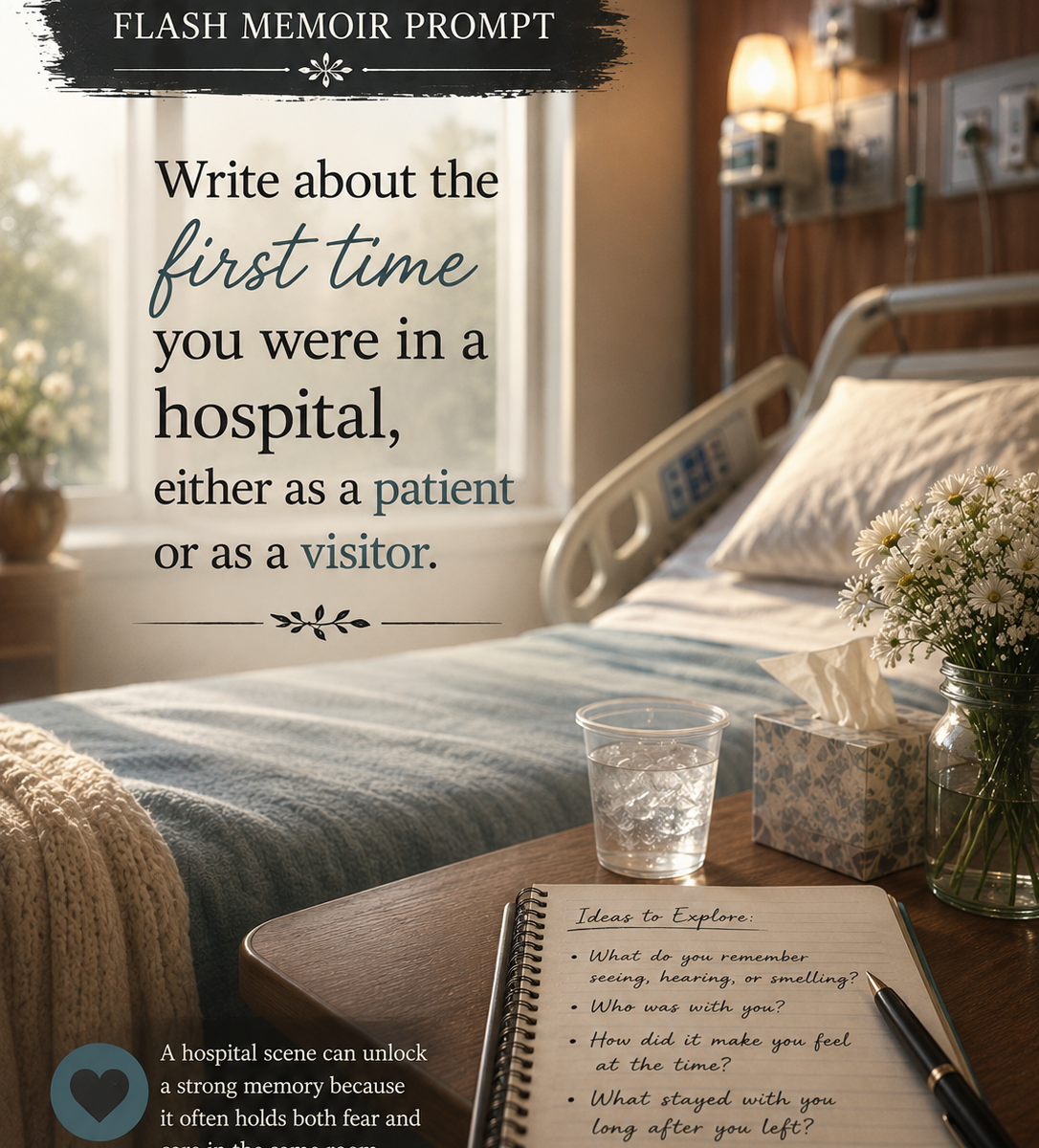
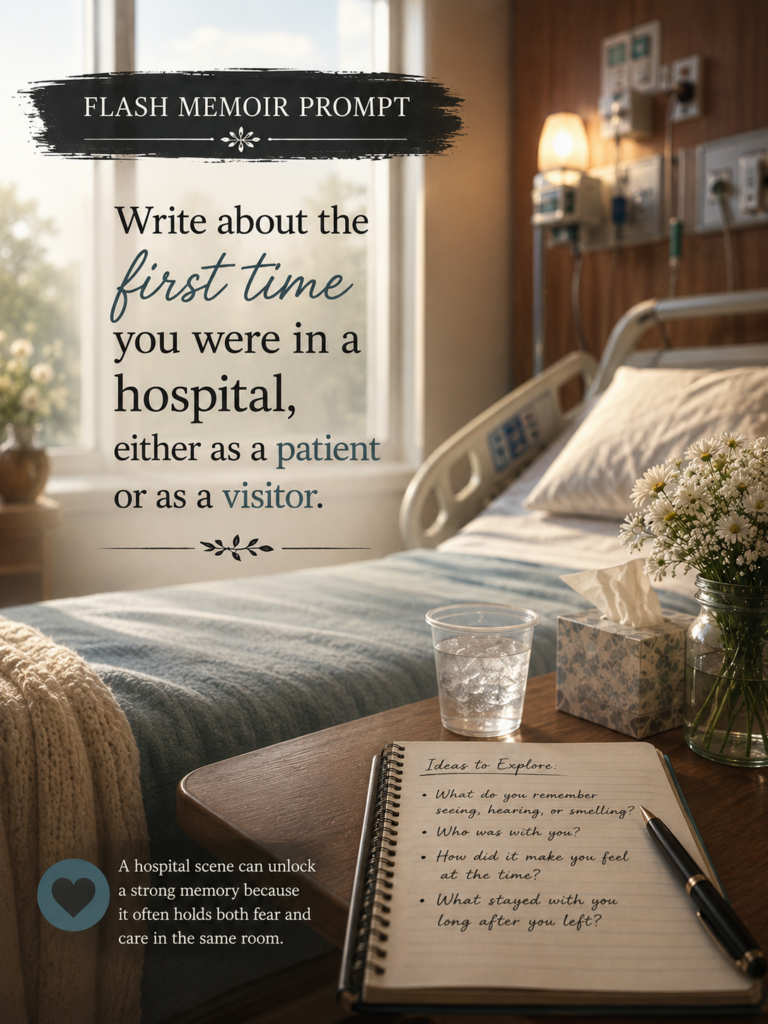
Write about the first time you were in a hospital, either as a patient or as a visitor.

This flash memoir prompt: first time in the hospital, either as a patient or a visitor, asks you to return to a place most people remember with unusual clarity. Hospitals have their own world. The lights are too bright. The floors shine. People speak softly, even when nothing quiet is happening.

Your memory may be serious, scary, confusing, or even strangely ordinary. Maybe you were a child with a broken arm. Maybe you visited a grandparent and noticed the cup of melting ice beside the bed. Maybe you were too young to understand what was wrong, but old enough to understand the adults were worried.

A hospital scene can unlock a strong memory because it often holds both fear and care in the same room.

flash memoir prompt hospital

Why This Memory Matters

The first time you enter a hospital, you may notice how different life feels there. Time slows down. People wait. Nurses appear and disappear. A vending machine can seem louder than it should. A small kindness can stay with you for years.

This kind of memory matters because it often shows you meeting vulnerability for the first time. That vulnerability may have been your own. It may have belonged to someone you loved. Either way, the scene can reveal what you thought safety meant at that age.

If you were the patient, you might write about the moment before treatment, when you were told to sit still or be brave. If you were a visitor, you might write about walking into a room and not knowing what to say. Both versions count. A flash memoir does not need a dramatic ending. It needs one honest scene.

You can also explore the tone and mood of the memory. Was the room tense, calm, lonely, hopeful, or oddly funny? The feeling in the room may be more important than the medical reason you were there.

How to Approach This Prompt

Begin with a physical detail. Do not start by explaining the whole hospital visit. Start with the bracelet on your wrist, the squeak of shoes in the hallway, the paper cup of water, or the stiff chair where you waited.

Then narrow the memory to one scene. You might choose the moment you first saw the hospital bed. You might focus on the ride in the elevator. You might write about sitting beside someone and watching their hand move under the blanket.

Try to write what you noticed before you write what it meant. Memoir becomes stronger when readers can stand inside the memory with you. Instead of saying, “I was scared,” show the way you counted ceiling tiles or kept asking the same question.

If the memory feels big, give yourself limits. Write about ten minutes, not the whole day. Write about one room, not the whole building. Write about one person’s voice, not every conversation.

You can treat your memory the way you might treat a short text in class. Look closely at small details, underline what matters in your mind, and ask why it stayed with you. If that kind of close looking helps, this guide on how to annotate literature can also give you a useful way to study your own memory.

For this flash memoir prompt first time hospital either patient, the goal is not to give a medical report. The goal is to capture the human part of the scene.

A Quick Example

I was seven the first time I went to a hospital. My brother had fallen from the monkey bars, and my mother drove with one hand on the wheel and the other pressed against his knee, as if holding him together. In the waiting room, I sat under a poster of a smiling tooth, though we were not there for teeth. My brother stopped crying after a while, which scared me more than the crying. A nurse gave me a grape lollipop from a drawer, even though I was not the patient. I remember holding it in my lap, unopened, while my mother signed forms. It felt wrong to eat something sweet while everyone else looked so serious.

Try It Yourself

Set a timer for ten minutes and write about your first hospital memory. Choose one moment and stay there. Let the smells, sounds, and small gestures lead you.

If you cannot remember exact words, write the feeling of the words. If you cannot remember every person in the room, write the one face you do remember. Flash memoir allows you to work with fragments, as long as you stay honest about what you know.

You might begin with one of these openings: “The first thing I noticed was…” or “No one told me why the room felt so quiet.” You can also start with the object your younger self could not stop looking at.

When you finish, read the piece once and ask what changed inside the scene. Did you understand something new? Did someone comfort you? Did you realize adults could be afraid too? That small shift may be the heart of the memoir.

Want More Flash Memoir Prompts?

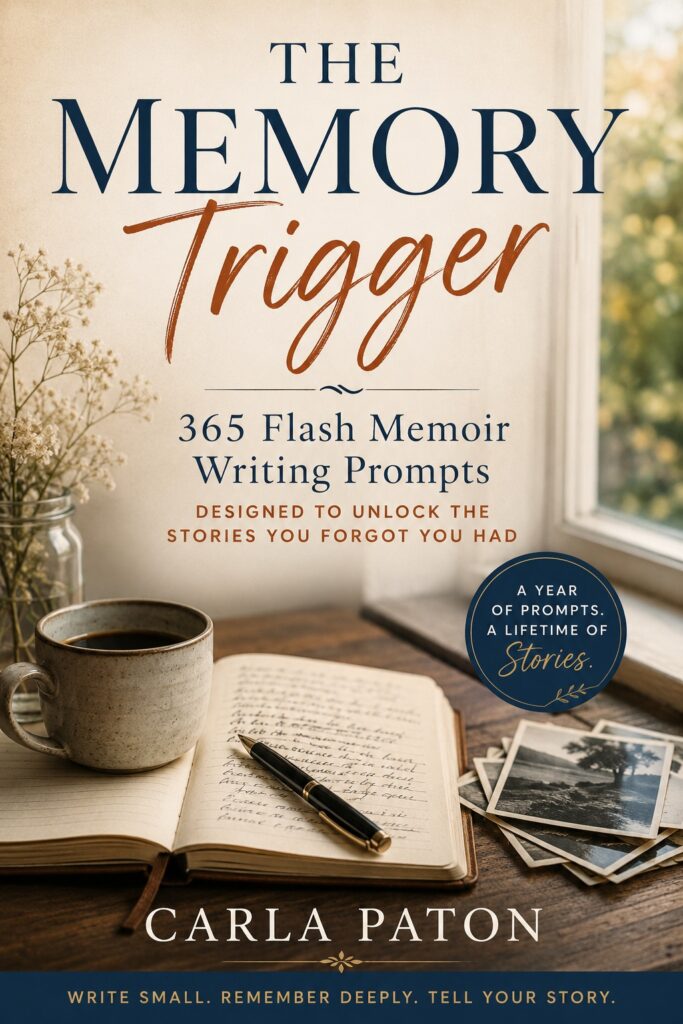
If you want to keep building a steady memoir practice, use one small prompt at a time. Explore all 365 prompts in The Memory Trigger: 365 Flash Memoir Writing Prompts.

The Memory Trigger

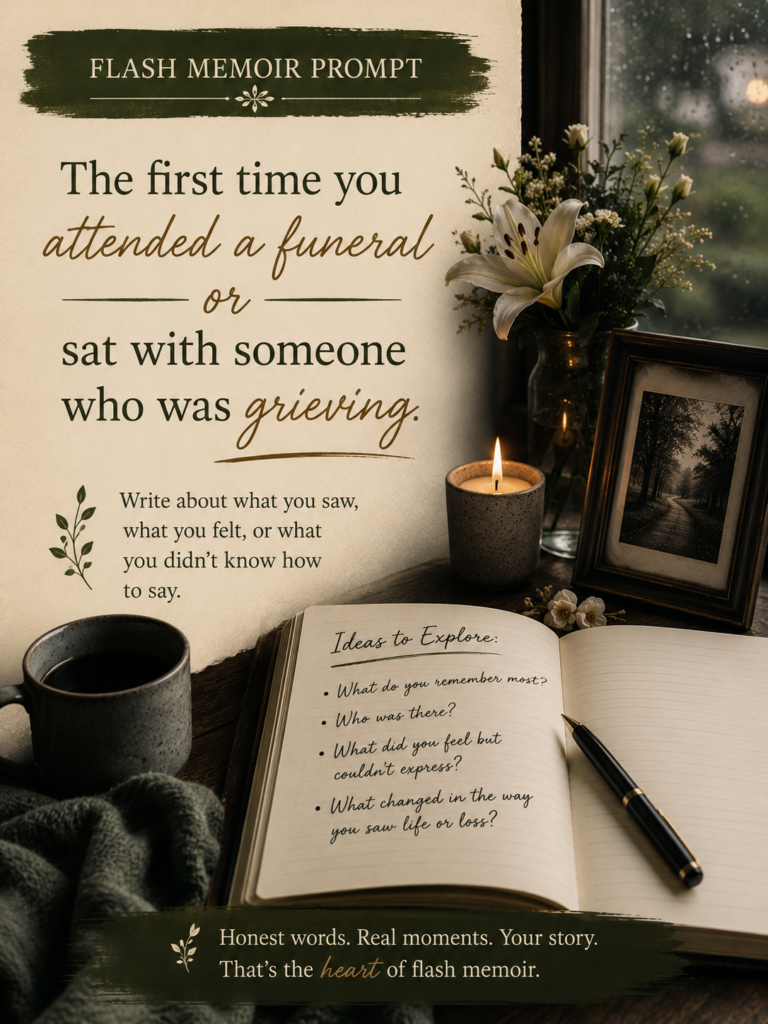
Flash Memoir Prompt: First Time You Attended a Funeral or Sat with Someone Who Was Grieving

Flash Memoir prompt funeral

A brief writing invitation for returning to the quiet room, the folded tissues, and the first moment you understood that grief changes the air around people.

The Prompt

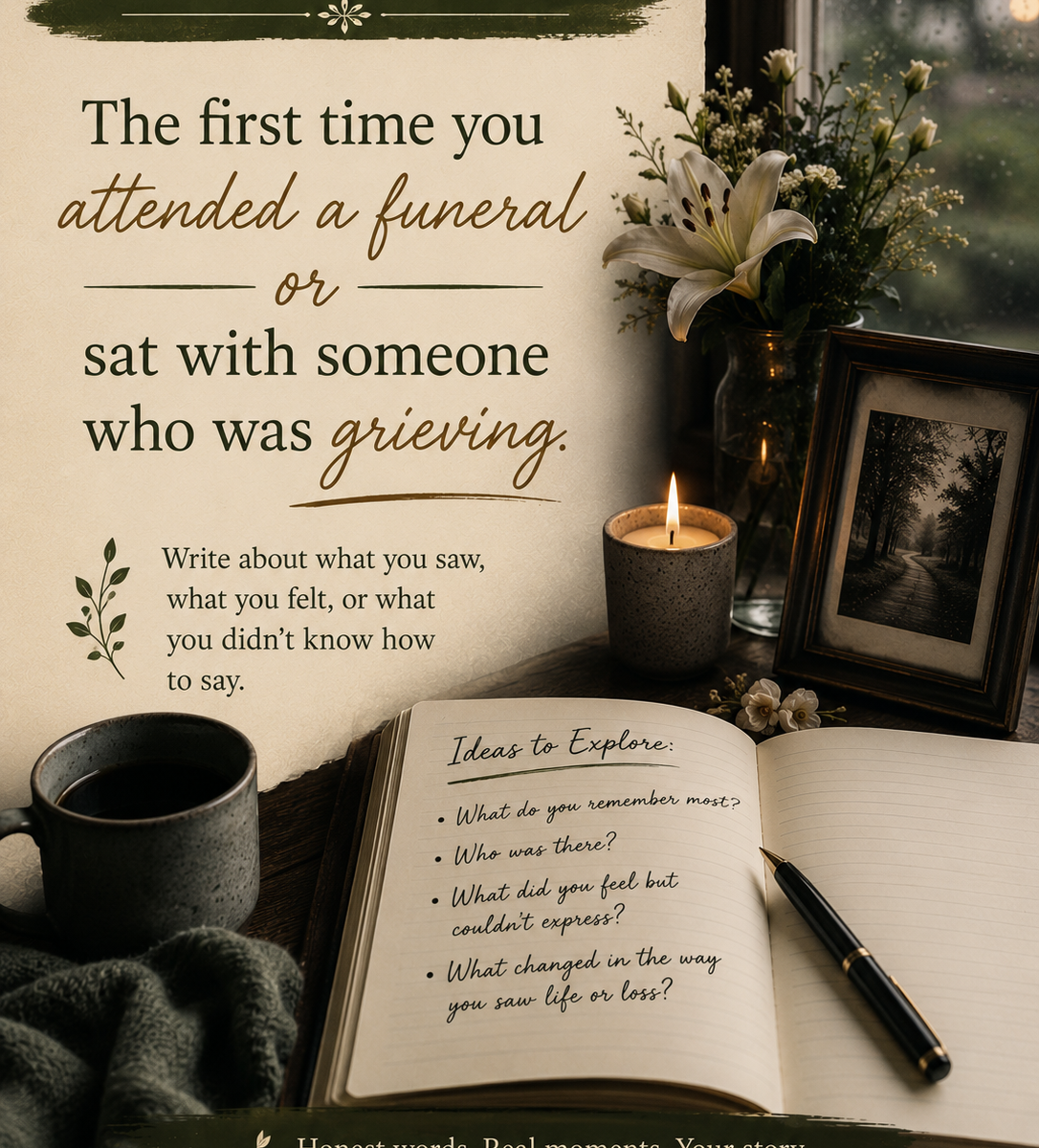
Write about the first time you attended a funeral or sat with someone who was grieving.

This flash memoir prompt first time attended funeral sat with someone grieving asks you to remember a moment when loss became real in a new way. Maybe you were a child in stiff shoes. Maybe you were a teenager unsure where to put your hands. Maybe you were an adult, but grief still caught you off guard because you had never been that close to someone else’s pain.

You do not have to explain death, faith, family history, or healing. For a flash memoir, one small scene is enough. A hallway outside a chapel. A casserole on a kitchen counter. A handkerchief pressed into a palm. The sound of someone trying not to cry.

This kind of prompt works because grief often sharpens memory. Even years later, you may remember the smell of flowers, the scratch of dress clothes, the low murmur of adults, or the quiet shock of seeing someone strong come undone.

Flash Memoir prompt funeral

Why This Memory Matters

The first time you witness grief, you often learn something without anyone giving you a lesson. You may learn that adults do not always know what to say. You may learn that silence can be a form of care. You may learn that sadness has its own motions, like folding napkins, making coffee, or sitting beside someone without reaching for the perfect words.

This memory may uncover a story about innocence. If you were young, you might have noticed odd details before you understood the meaning of the day. The shiny shoes. The cold church pew. The strange way people smiled and cried in the same breath.

It may also be a story about discomfort. Many people remember feeling embarrassed by grief, not because they were cruel, but because they did not know the rules. Should you hug the person? Should you look at the casket? Should you speak? Should you stay quiet?

That uncertainty can make the writing honest. A strong memoir moment does not need you to act perfectly. It needs you to tell the truth about who you were then.

If you want to deepen the emotional atmosphere of your scene, it can help to think about the difference between tone and mood in literature. In a grief memory, the mood might be heavy or hushed, while your tone as the writer might be tender, confused, distant, or even gently surprised.

How to Approach This Prompt

Start with a physical detail. Do not begin with “I learned that life is short.” Begin with the tissue box. Begin with the too-bright funeral flowers. Begin with the black dress that made your neck itch. Let the reader enter the room before you tell them what it meant.

For this flash memoir prompt first time attended funeral sat with someone grieving, narrow the memory to one scene. Do not try to cover the illness, the death, the service, the family conflict, and the years that followed. Choose one moment you can still see.

You might write about arriving. You might write about sitting beside someone. You might write about the ride home after the funeral, when everyone was quiet and the world outside the car looked strangely normal.

Once you choose the scene, write what you noticed before you explain your feelings. This keeps the piece from becoming too general. Instead of saying, “Everyone was sad,” show one person smoothing a program until the paper softened at the fold.

If you sat with someone who was grieving, let their body language guide the scene. Did they talk too much, go very still, laugh at a strange moment, or ask you to stay? People reveal themselves in small ways during loss. If you enjoy studying those small human signals, you may also like this guide on how to analyze characters in literature, since memoir often asks you to observe real people with the same care.

Be gentle with yourself as you write. This prompt can bring up tender material. You can stop before the hardest part. You can write around the center of the memory and return later if you want to.

A Quick Example

I remember my first funeral mostly by the carpet. It was dark red with tiny gold shapes, and I stared at it because I did not know where else to look. My grandmother sat beside me with her purse in her lap, both hands gripping the clasp. I had never seen her hands so still. Usually she was patting my knee, finding gum, fixing my collar. That day she seemed made of stone. When the music started, she opened her purse and took out a tissue, but she did not use it. She just held it flat between her fingers. I wanted to ask if she was okay, but even at nine I knew it was the wrong question. Instead, I leaned my shoulder against her arm. After a minute, she leaned back.

Try It Yourself

Set a timer for ten minutes and write the scene as if you are walking into it again. Where are you sitting? What do you hear? Who is near you? What do you understand, and what do you misunderstand?

Do not worry about making the memory sound wise right away. First drafts are allowed to be plain. They are allowed to sound young, unsure, or unfinished. In fact, that may be where the truth is.

If the funeral itself feels too large, write about one object from the day. A program, a coat, a plate of food, a flower arrangement, a card on a table. Let that object pull the rest of the memory into focus.

If you choose the “sat with someone grieving” side of the prompt, pay attention to what you did with your body. Maybe you washed dishes, filled a glass of water, sat on the floor, or stood in the doorway. Often, the story lives in what we do when words are too small.

Want More Flash Memoir Prompts?

If this prompt helped you find one clear memory, keep going. Short prompts can open doors to stories you did not know you still carried. Explore all 365 prompts in The Memory Trigger: 365 Flash Memoir Writing Prompts.

The Memory Trigger

Flash Memoir Prompt: First Time You Realized You Were Good at Something No One Had Told You to Be Good at

Flash Memoir prompt good at something

A brief writing invitation for remembering the first time your private talent stepped into the light, even before anyone gave it a name.

Maybe it happened in the corner of a classroom, while everyone else was trying to finish the real assignment. You were doodling in the margin, fixing a broken toy, making a younger sibling laugh, or solving a problem faster than the adults expected. Then came that small shock: wait, I can do this.

This flash memoir prompt, the first time you realized you were good at something no one had told you to value, is about that quiet moment of self-recognition. It may not come with applause. It may not even come with a compliment. Sometimes the first person to notice your gift is you.

Flash Memoir prompt good at something

The Prompt

Write about the first time you realized you were good at something no one had told you to be good at.

This prompt can unlock a meaningful memory because it asks you to look for a talent before it became part of your identity. Before the award, the grade, the job, the label, or the expectation, there may have been one ordinary scene where you surprised yourself.

The memory might be small. You folded paper into something beautiful. You calmed a nervous friend. You heard the rhythm in a sentence. You spotted the flaw in a plan. You understood an animal, a machine, a recipe, a song, or a person before anyone explained it to you.

That is enough for a flash memoir. The point is not to prove that you became excellent. The point is to return to the first spark.

Why This Memory Matters

Many of us remember what we were told to be good at. Get good grades. Be polite. Win the game. Sit still. Speak clearly. Follow the rules. Those skills often come with pressure attached.

But the abilities we discover on our own can feel different. They may feel freer. They may also feel confusing, especially if no one around us knows how to respond.

This flash memoir prompt first time realized good at memory may uncover a story about hidden confidence. It may bring back the first clue that you had a way of seeing the world that belonged to you. That clue might have changed how you moved through a room, even if only for a minute.

There can also be tenderness in this kind of story. Maybe you were good at making peace because your house was tense. Maybe you were good at reading faces because you had to be. Maybe you were good at making people laugh because silence felt too heavy.

A memoir scene does not have to turn every talent into a victory. Sometimes the gift came with a cost. Sometimes you felt proud and embarrassed at the same time. That mix is where the real story often lives.

If you are writing this for a class or personal project, it may help to think about theme. A memory like this often points to a larger idea about identity, attention, or courage. If you want help naming that larger idea, this guide on how to identify theme in literature can also help you think about theme in your own life writing.

How to Approach This Prompt

Begin with one physical detail from the scene. Do not start by announcing the lesson. Start with the thing your hands touched, the sound in the room, or the face of the person nearby.

For example, you might begin with the smell of sawdust in a garage, the squeak of sneakers on a gym floor, the blue ink on your fingers, or the weight of a baby cousin in your lap. A clear detail can pull the whole memory closer.

Next, narrow the memory to one scene. You are not writing your full life story. You are writing the moment when you noticed something about yourself.

Ask yourself: Where was I? What was I doing? Who was there? What happened right before I realized I was good at it?

Then write what you noticed before you explain what it meant. If you were good at drawing, show the pencil moving. If you were good at fixing things, show the stuck part loosening. If you were good at comforting people, show the person’s breathing change.

Try to avoid turning the piece into a resume. You do not need to tell us every later success. A flash memoir works best when it trusts one moment to carry the weight.

You can also reread your draft like you would study a short text. Mark the strongest image, the emotional turn, and the sentence where the meaning becomes clear. This simple habit is close to how to annotate literature, and it can make your own writing sharper.

A Quick Example

I was nine, sitting under the card table at my aunt’s house, because the adults had taken every chair. My cousin Leo was crying over a spaceship model with one wing snapped clean off. No one wanted to deal with it. I picked up the tiny gray piece and turned it in my fingers until I saw how the broken edge matched the gluey scar on the ship. I asked for tape, then a toothpick, then held the wing still until my arm hurt. When Leo stopped crying, he looked at the ship like I had saved a real one from crashing. I remember feeling heat rise in my face. I had not known I could fix things. I had only known I hated seeing broken things stay broken.

Try It Yourself

Set a timer for ten minutes and write from the prompt without trying to sound impressive. Let the memory arrive in plain language.

If you get stuck, begin with this sentence: “The first clue was…” Then name one object from the scene. Follow that object into the memory.

As you write, stay close to the child, teen, or younger version of yourself who lived the moment. What did they believe was happening? What did they feel in their body? Did they feel proud, shy, startled, or suddenly older?

This flash memoir prompt first time realized good at something no one had assigned you can help you find a quieter kind of origin story. It is the story of a talent before it had a title.

Want More Flash Memoir Prompts?

If this prompt opened a memory you did not expect, keep following that thread. Short prompts can lead to honest scenes, especially when you give yourself permission to write one small truth at a time. Explore all 365 prompts in The Memory Trigger: 365 Flash Memoir Writing Prompts.

Flash Memoir Prompt: First Time You Went Somewhere You Weren’t Supposed to Go

Flash Memoir prompt first time

A focused writing invitation for returning to the forbidden hallway, locked gate, empty classroom, or off-limits room where curiosity felt stronger than the rule.

Your hand is on the knob. Your foot is over the line. And, your stomach knows before your brain says it out loud: you are not supposed to be here. That tiny moment can hold a surprising amount of story. A flash memoir prompt first time went somewhere weren’t supposed to go can bring back childhood nerve, teenage pride, family secrets, or the strange thrill of crossing a boundary just to see what was on the other side.

Flash Memoir prompt first time

The Prompt

Write about the first time you went somewhere you weren’t supposed to go.

This prompt works because it gives you a clear scene right away. There is a place, a rule, and a choice. You do not need to explain your whole childhood or every rule you ever broke. You only need to return to one moment when you entered a space that felt forbidden.

Maybe it was your older sibling’s bedroom. Maybe it was the woods behind your school. Or, maybe it was the teacher’s lounge, the roof of an apartment building, a neighbor’s yard, or the church basement after everyone had gone upstairs.

The place matters, but the feeling matters more. Were you scared? Proud? Lonely? Did you want to belong? Did you want to prove you were brave? This kind of flash memoir prompt first time went somewhere weren’t supposed to go invites you to explore the reason beneath the action.

Why This Memory Matters

Going somewhere off-limits is rarely just about the place. It is often about power. Someone else made a rule, and for one small moment, you stepped outside it.

That does not mean the memory has to be dramatic. The best flash memoir pieces often come from ordinary disobedience. A child opens a drawer. A student slips into a room after school. A teenager walks past the sign that says “Employees Only.” The action is small, but the feeling can be huge.

This prompt may uncover your first taste of independence. It may show the first time you questioned authority. Or, it may remind you of a secret you kept, a punishment you feared, or a silence you never forgot.

It can also be funny. Maybe you snuck into the wrong place and found nothing but cleaning supplies. Maybe you expected danger and found a bored cat. Humor belongs in memoir, too, especially when it reveals how serious everything felt at the time.

If you are a student, this prompt can also help you understand how writers build meaning from small scenes. The same close attention you use when you annotate literature can help you notice the details in your own memory.

How to Approach This Prompt

Begin with a physical detail. Do not start by explaining the rule. Start with the sound of the door, the smell of dust, the cold metal of a fence, or the way your shoes felt too loud on the floor.

Try to narrow the memory to one scene. The stronger choice is not “I was always sneaking around as a kid.” The stronger choice is “I pushed open the door to my father’s workshop when no one was home.” A flash memoir needs focus. One doorway is enough.

Write what you noticed before you explain what it meant. Let the reader stand with you in the moment. What did the light look like? What did you hear behind you? Or, what did you think would happen if you were caught?

You can ask yourself one simple question before you begin: What did I hope to find there?

That answer may surprise you. You may have wanted candy, privacy, proof, adventure, or a glimpse of the adult world. You may have wanted to feel less small.

As you draft, avoid trying to tell the whole story at once. Stay with the moment of crossing over. The best part of this flash memoir prompt first time went somewhere weren’t supposed to go is that it creates a natural turning point. Before, you were outside. After, you were inside. That shift is your story.

If your writing starts to reveal a bigger idea, such as freedom, guilt, curiosity, or trust, you might find it helpful to read about how to identify theme in literature. Memoir has themes too, even when the story begins with a simple mistake.

A Quick Example

The first place I remember sneaking into was my grandmother’s sewing room. She called it “my room,” which made it sound like no one else belonged there. I was eight, and the door was usually shut. One Saturday, while she napped, I turned the glass knob and stepped inside. The room smelled like warm fabric and dust. Spools of thread sat in neat rows, brighter than candy. I opened the top drawer and found a pair of silver scissors shaped like a bird. I held them for three seconds before guilt rushed up my neck. Nothing happened. No alarm. No shout. Just the quiet fact that I had crossed into her private world and still did not understand her any better.

Try It Yourself

Set a timer for ten minutes and write the scene without stopping. Start at the edge of the forbidden place. Do not begin with background. Begin with your hand, your foot, your breath, or the sound that made you pause.

If you get stuck, write this sentence and keep going: “I knew I was not supposed to be there because…”

You do not need to make yourself look good. You also do not need to make the memory more serious than it was. Tell the truth of the moment as you remember it. The fear, thrill, embarrassment, or disappointment is enough.

When you finish, underline one sentence that feels alive. That may be the real beginning of your piece.

Want More Flash Memoir Prompts?

If this prompt opened a door to another memory, keep going. Explore all 365 prompts in The Memory Trigger: 365 Flash Memoir Writing Prompts.

Flash Memoir Prompt: First Time You Stood Up for Yourself and Meant It

Flash Memoir Prompt First time

A brief flash memoir prompt first time stood up meant for exploring the moment your voice finally sounded like your own.

Your hand may have shaken. Your face may have gone hot. Maybe your words came out too loud, or too quiet, or in a rush you barely recognized. But something changed in that moment. You stopped trying to keep the peace at any cost. You stopped swallowing the sentence that had been sitting in your throat for years.

This kind of memory is rarely neat. It might have happened in a classroom, a kitchen, a workplace, a car, or a crowded hallway. The first time you stood up for yourself and meant it may not have looked brave to anyone else. But inside, it may have felt like a door opening.

Flash Memoir Prompt First time

The Prompt

Write about the first time you stood up for yourself and meant it.

This flash memoir prompt first time stood up meant invites you to return to one focused moment when you chose your own dignity. It does not ask you to prove you were right. It asks you to remember what it felt like to stop hiding your honest thought.

A prompt like this can unlock a memory because it has tension built into it. There is usually a before and an after. Before, you may have stayed quiet, laughed something off, or told yourself it did not matter. After, even if things were awkward, you knew you had crossed a line in yourself.

Why This Memory Matters

Standing up for yourself can look dramatic, but it can also be very small. It might be one sentence: “Don’t talk to me that way.” It might be refusing to apologize for something you did not do. It might be saying no when everyone expected you to say yes.

These moments matter because they often show a hidden part of your growth. The memory may reveal what you were taught about being “nice,” “easy,” “respectful,” or “difficult.” It may show the first time you questioned those lessons.

For some writers, this prompt leads to a proud memory. For others, it brings up regret, anger, or grief. Maybe you wish someone had stood up for you sooner. Maybe you wish your younger self had known that self-respect was allowed.

If you are trying to understand the deeper meaning of this memory, it can help to think the way a reader thinks about story. What changed? What belief was challenged? What pattern broke? If you enjoy looking for meaning in stories, you may find this guide on how to identify theme in literature useful for reading your own memory with more attention.

Your flash memoir does not need a perfect lesson at the end. In fact, it may be stronger if you let the moment stay a little unresolved. Real courage often feels messy while it is happening.

How to Approach This Prompt

Begin with the body, not the explanation.

What did your body do right before you spoke? Did your throat tighten? Did your palms sweat? Did you look at the floor, the person’s shoes, the edge of a table? A physical detail can pull the reader into the scene faster than a long backstory.

Try to narrow the memory to one scene. Do not start with every reason you finally reached that point. Instead, begin close to the moment. A strong opening might sound like, “I was holding a paper cup of coffee when she said it again,” or “The classroom went quiet after I pushed my chair back.”

Write what you noticed before you explain what it meant. The color of the room, the scrape of a chair, the smell of rain on your jacket, or the sound of your own voice may carry more power than a summary.

You can always add context later. For the first draft, stay inside the scene. Let the reader feel the pressure before the words come out.

If you like to mark up drafts or study the shape of a scene, you might also use simple notes in the margins after you write. Circle the strongest detail. Underline the sentence where the emotional shift happens. This is similar to the close reading process described in how to annotate literature, except this time the text is your own life.

For this flash memoir prompt first time stood up meant, your goal is not to make yourself sound fearless. Your goal is to be honest about the fear and the choice you made anyway.

A Quick Example

I was seventeen, standing behind the counter at the bakery, dusted in flour up to my elbows. My manager had just blamed me for an order I had never taken. Usually I would have nodded, apologized, and cried later in the walk-in freezer where no one could see me. That day, I looked at the pink box in his hand and said, “No. I didn’t write that ticket.” My voice cracked on “no,” which annoyed me, but I kept my eyes on him. The other cashier stopped tying ribbon. For a second, the whole shop seemed to pause, even the oven timer. He frowned, checked the stack of slips, and found the right one. He did not apologize. Still, I felt taller for the rest of my shift.

Try It Yourself

Set a timer for ten minutes and write the scene as directly as you can. Start with where you were and what your body noticed. Then let the words arrive when they arrived in real life.

If the memory feels big, choose one small part of it. You might write only the moment before you spoke, or only what happened right after. A flash memoir does not need to cover the whole history of the relationship or conflict.

Use this flash memoir prompt first time stood up meant as a way to listen for your own turning point. Maybe the scene was loud. Maybe it was quiet. Either way, give the moment space on the page.

Want More Flash Memoir Prompts?

If this prompt opened up a memory, keep going. Short prompts can help you build a steady writing habit without pressure to finish a full essay right away. Explore all 365 prompts in The Memory Trigger: 365 Flash Memoir Writing Prompts.

Flash Memoir Prompt: First Time You Chose to Stay Quiet When You Wanted to Speak

Flash memoir prompt

A quiet invitation to write about the first time you swallowed your words, noticed the room around you, and understood that silence can carry its own story.

Maybe you remember the heat in your face before you remember the words you did not say. Maybe you remember a teacher looking past you, a parent waiting for an answer, a friend saying something that stung. Your mouth opened, or almost did. Then you chose quiet.

This flash memoir prompt, for the first time, asks you to stay quiet and return to that small, charged moment. It is not about judging your younger self. It is about noticing what was at stake when silence felt safer, kinder, smarter, or more painful than speaking.

Flash memoir prompt

The Prompt

Write about the first time you chose to stay quiet when you wanted to speak.

This prompt can unlock a meaningful memory because silence is rarely empty. It often holds fear, love, shame, strategy, respect, confusion, or regret. When you write about the first time you held back your words, you may find a story about power, family rules, friendship, school, belonging, or the first time you understood that words can change a room.

A strong response to this flash memoir prompt first time chose stay quiet does not need to explain your whole life. It can focus on one scene: where you were, who was there, what you wanted to say, and what made you stop.

Why This Memory Matters

The first time you chose silence may have taught you something about the world before you had language for it. Maybe you learned that adults did not always want the truth. Maybe you learned that speaking up could cost you a friendship. Maybe you learned that staying quiet could protect someone else.

These memories matter because they show the gap between the outside and the inside. On the outside, you may have looked calm. You may have nodded, stared at your desk, or kept eating dinner. On the inside, you may have been full of sentences.

That contrast is powerful in memoir. Readers do not need a dramatic event to care. They need a real human moment. A child in a classroom who knows the answer but lowers her hand. A teenager at a lunch table who hears a cruel joke and says nothing. A grown person in a hospital hallway who decides not to correct someone because grief has already taken up too much space.

Writing this kind of memory can also help you see your old silence with more compassion. Silence is not always weakness. Sometimes it is practice. Sometimes it is survival. Sometimes it is the only choice you knew how to make at the time.

How to Approach This Prompt

Begin with a physical detail. Do not start by explaining the full backstory. Start with the thing your body remembers: your tongue pressed against your teeth, your hand under the table, your shoes on the carpet, the sound of a clock, the smell of cafeteria pizza, the weight of a backpack on one shoulder.

Then narrow the memory to one scene. Stay in the room where the silence happened. Who was nearby? What had just been said? What did you want to say back? Try to write the exact sentence you kept inside, even if you are not fully sure of it. You can use, “I think I wanted to say…” if that feels more honest.

Write what you noticed before you explain what it meant. This helps your reader enter the moment with you. If you jump too quickly to the lesson, the scene may lose its force.

For example, instead of writing, “That was when I learned my opinion did not matter,” you might write, “My fork tapped the plate once. Everyone looked at Uncle Ray except me. I stared at the peas and counted five of them before I swallowed.” The meaning can come later.

If you are helping students build stronger personal writing, this prompt also pairs well with close observation. The same skill used to annotate literature can help writers notice repeated images, tone, and emotional clues in their own memories.

You do not have to make yourself the hero. You do not have to make the silence wrong. Let the younger version of you be complicated. Maybe you wish you had spoken. Maybe you are grateful you did not. Maybe both are true.

A Quick Example

I was nine, sitting in the back seat of our old blue station wagon, when my mother told my grandfather that I loved piano lessons. I did not. I hated the slippery bench and the teacher’s sharp pencil tapping the music stand. I wanted to say, “No, I don’t.” The words rose so fast I could feel them crowd my throat. But my grandfather smiled into the rearview mirror and said, “Good girl. Music makes a person disciplined.” My mother’s eyes met mine in the mirror for half a second. Not angry. Just tired. I looked down at my patent leather shoes and pressed the toes together until they squeaked. “Yes,” I said, though no one had asked me anything.

Try It Yourself

Set a timer for ten minutes and write the scene without stopping. Begin with the moment right before you chose quiet. Let the memory unfold through action, sound, and what your body did.

If you get stuck, use this sentence starter: “I wanted to say…” Then keep going. You can revise later. For now, focus on telling the truth of the moment as clearly as you can.

This flash memoir prompt first time chose stay quiet can lead to a tender piece, a funny one, or a memory that still feels sharp. Let the tone be what it is. The goal is not to force a lesson. The goal is to catch one honest moment on the page.

If your memory involves a book, class, or difficult text that shaped what you did or did not say, you may also enjoy this guide on understanding Shakespearean language, especially if silence, power, and hidden meaning are themes you want to explore in student writing.

Want More Flash Memoir Prompts?

If this prompt opened a memory you did not expect, keep going. Short prompts can help you build a steady writing habit without pressure to finish a full life story at once. Explore all 365 prompts in The Memory Trigger: 365 Flash Memoir Writing Prompts.

Flash Memoir Prompt: First Time You Traveled Somewhere Alone

Flash memoir prompt alone

A brief, honest writing invitation for remembering the first time you traveled somewhere alone through one clear scene, a few sensory details, and the feeling that followed you. Maybe you can still picture it: your hand on a ticket, your bag feeling heavier than it should, your eyes moving from sign to sign while you tried to look like someone who knew exactly where to go. This flash memoir prompt first time traveled somewhere alone is less about the trip itself and more about the quiet shift that happened when no one else was there to decide the next step.

Flash memoir prompt alone

The Prompt

Write about the first time you traveled somewhere alone.

This prompt can unlock a memory because solo travel often makes ordinary moments feel sharp. A bus station bathroom, a delayed flight, a motel key, a wrong turn, or the first meal alone can hold more meaning than the destination.

When you write from this flash memoir prompt first time traveled somewhere alone, you do not need to cover every mile. You only need to return to the moment when you realized you were responsible for yourself in a new way.

Why This Memory Matters

The first time you travel alone can reveal a version of you that had been waiting for space. Maybe you felt proud. Maybe you felt scared. Maybe you felt both within the same five minutes.

That tension is useful for memoir. A strong flash memoir often lives inside mixed feelings. You might remember acting brave while secretly checking your phone every few minutes. You might remember missing home, then surprising yourself by enjoying the silence.

This kind of memory can also show a change in identity. Before the trip, you may have been someone’s child, roommate, student, partner, or friend. During the trip, you had to become the person who read the schedule, guarded the wallet, asked for help, and chose what to do next.

If you are studying memoir as part of a class, this prompt can also help you practice finding meaning without forcing a moral. Like learning how to identify theme in literature, memoir asks you to notice what a moment keeps pointing toward. Freedom. Fear. Trust. Loneliness. Independence.

The best part is that the memory does not have to be dramatic. You do not need a missed train or a life-changing disaster. Sometimes the most powerful part is sitting alone with a paper cup of coffee and realizing no one knows where you are.

How to Approach This Prompt

Begin with one physical detail from the trip. Choose something you can still see, hear, smell, or touch. It might be the vinyl seat on a bus, the stale air of an airport gate, the pull of a backpack strap, or the blue glow of a phone map at night.

Let that detail lead you into one scene. Do not try to tell the whole story of the trip. A flash memoir works best when it narrows the lens. Pick the moment before departure, the moment you arrived, or the moment you first felt truly alone.

Write what you noticed before you explain what it meant. For example, instead of starting with “I learned to be independent,” start with the vending machine humming beside you while you counted your change. Let readers feel the scene first.

You can also ask yourself one simple question: What did I pretend not to feel? Many first solo trips involve a small performance. You may have pretended to be calm, older, tougher, or more prepared than you were. That gap between outside and inside can become the heart of the piece.

If you like to mark up readings or mentor texts before writing your own, try the same habit with your memory. Notice the details that repeat or stand out, the way you might when you annotate literature. Circle the small moments in your mind and choose the one with the most charge.

For this flash memoir prompt first time traveled somewhere alone, avoid ending too neatly. You do not have to prove that you became fearless. It may be more honest to say you were still afraid, but you kept walking anyway.

A Quick Example

The first time I traveled alone, I took a train to visit my cousin in Chicago. I was seventeen and had memorized the schedule like it was a speech I had to give. At the station, I bought a bottle of orange juice even though I was not thirsty, just so I could look busy. My mother had waved from the parking lot until I turned away first. On the train, I sat by the window and kept my ticket in my sweatshirt pocket, touching it every few minutes to make sure it was still there. When the conductor passed, he barely looked at me. That almost disappointed me. I had expected the world to notice I was doing something brave. Instead, it kept moving, which made me feel both smaller and freer.

Try It Yourself

Set a timer for ten minutes and return to one scene from your first solo trip. Start with where your body was: standing in line, sitting by a window, walking through a station, or waiting near a curb.

Then write toward the feeling you did not fully understand at the time. Were you nervous, proud, lonely, excited, embarrassed, or relieved? Let the emotion stay a little messy. Real memories usually are.

If you get stuck, describe what you carried. A suitcase, a backpack, a purse, a phone charger, a snack, or a folded address can reveal what you thought you needed. It can also reveal what you could not prepare for.

This prompt is not asking for a travel essay. It is asking for a flash of memory. One place. One version of you. One moment when being alone changed the way you heard your own thoughts.

Want More Flash Memoir Prompts?

Explore all 365 prompts in The Memory Trigger: 365 Flash Memoir Writing Prompts. It is designed to help you find small, true stories from everyday life and turn them into focused pieces of memoir.

Flash Memoir Prompt: First Time You Were Paid for Something You Made or Did

flash memoir

A warm flash memoir prompt for remembering the first dollar, check, tip, or thank-you envelope that made your effort feel real. Maybe you can still picture the way the money arrived: folded into your palm, tucked inside a card, sent through an app, or handed over with a casual “thanks” that did not feel casual to you at all.

The first time someone pays you for something you made or did can be strangely powerful. It might be a few coins for mowing a lawn, babysitting money stuffed into your pocket, a craft fair sale, a paycheck from a summer job, or five dollars from a neighbor who loved the brownies you baked. The amount may have been small. The feeling may have been huge.

This flash memoir prompt first time paid something made invites you to return to that moment before it became part of your life story. Before you had a resume. Before you knew what your work was worth. Before you learned to act calm when someone gave you money for your time, skill, care, or courage.

flash memoir

The Prompt

Write about the first time you were paid for something you made or did.

This prompt can unlock a memory because payment is rarely just payment. It can carry pride, surprise, pressure, embarrassment, or a sudden sense of being seen. In memoir, money often points to something deeper: independence, value, effort, family expectations, or the first tiny feeling of adulthood.

You do not have to write about a major job or a big success. In fact, this prompt works best when you stay close to one small exchange. Focus on the hand, the envelope, the register, the kitchen table, or the moment you counted the money later when no one was watching.

Why This Memory Matters

The first paid moment often marks a quiet shift. Someone outside yourself decided your work had value. That can feel thrilling, awkward, or even confusing.

Maybe you were a child selling lemonade, and you suddenly understood that warm coins could come from your own idea. Maybe you were a teenager with tired feet after a long shift, holding a paycheck that looked official and disappointing at the same time. Maybe you created something personal, like art, music, writing, or food, and payment made you feel proud and exposed.

This kind of memory may also reveal how you learned about work. Did your family celebrate the moment? Did someone tell you to save it? Did you spend it right away? Did you feel guilty taking money for something that had felt easy, fun, or natural?

Those questions matter because memoir is built from meaning hiding inside ordinary scenes. If you need help seeing that deeper layer, you might enjoy this guide on how to identify theme in literature. The same skill can help you notice the theme inside your own memory.

How to Approach This Prompt

Begin with a physical detail. Do not start by explaining your whole relationship with money or work. Start with the exact thing you remember seeing or touching.

For example, write about the paper route bag rubbing your shoulder. Write about the smell of wet grass after you finished mowing. Write about the purple ink on the check. Write about the sticky table at the bake sale or the way the babysitting cash felt too crisp to spend.

Then narrow the memory to one scene. This is flash memoir, so you do not need to cover every job you ever had. Choose one moment: the making, the doing, the handoff, or the private moment after.

Try to write what you noticed before you explain what it meant. If you jump too quickly to the lesson, the piece may feel flat. Let the reader stand beside you first.

You might begin with a sentence like, “The first money I ever earned smelled like chlorine,” or “Mrs. Alvarez paid me in quarters from a blue ceramic bowl.” A concrete start gives the memory a place to live.

If you are writing for school, this same habit can help with close reading. When you learn how to annotate literature, you practice noticing small details before making big claims. Memoir works in a similar way. Notice first. Explain later.

A Quick Example

The first time I got paid, I was eleven, and Mrs. Gentry gave me three dollars for pulling weeds along her fence. The bills were soft and faded, like they had already passed through every hand in town. I remember the dirt under my fingernails more than the money. I remember trying to act like three dollars was normal, like I was the kind of person who earned cash on Saturday mornings. My knees were green from the grass, and my back hurt in a way I felt proud of. At home, I laid the bills on my dresser and kept checking to see if they were still there. I did not buy anything for a week. I just liked knowing they had come from my own hands.

Try It Yourself

Set a timer for ten minutes and write one scene from the first time you were paid for something you made or did. Keep the focus tight. Where were you? Who gave you the money? What did your body feel like in that instant?

If you get stuck, write about the object connected to the memory. The coins, the check, the craft, the tool, the apron, the lawn mower, the receipt, or the envelope can carry the story for you.

Do not worry about making the memory sound impressive. The best flash memoir prompt first time paid something made pieces often come from small, almost funny moments. A crooked bracelet sold at a school fair can hold as much meaning as a first paycheck.

After you draft, read it once and underline the sentence that feels most honest. That sentence may be the real center of the piece.

Want More Flash Memoir Prompts?

If this prompt helped you remember a small but meaningful first, you may enjoy building a steady memoir practice one scene at a time. Explore all 365 prompts in The Memory Trigger: 365 Flash Memoir Writing Prompts.

Flash Memoir Prompt: First Time You Saw Your Parents as Imperfect

flash memoir

A brief, tender writing invitation for remembering the first moment a parent became fully human in your eyes. Maybe it happened at the kitchen table, in the car, or during a small mistake no one else noticed. For writers searching for a flash memoir prompt first time saw parents imperfect, this prompt can open a memory that still carries surprise, confusion, and love.

flash memoir

There is a strange silence that comes after you realize an adult does not have all the answers. One minute, your parent is the person who fixes things, pays bills, finds lost shoes, and knows where to turn. The next, you see a crack in that certainty. Maybe your mother cried in the laundry room. Maybe your father got lost and snapped at the map. Maybe you heard fear in a voice you thought was always steady.

This kind of memory can be hard to write because it changes the shape of childhood. It does not always come with a dramatic scene. Often, it arrives through one look, one overheard sentence, or one ordinary day that suddenly feels different.

The Prompt

Write about the first time you saw your parents as imperfect.

This flash memoir prompt first time saw parents imperfect invites you to write about the moment when childhood certainty shifted. You do not need to judge your parent or explain your whole family history. The strongest piece may come from one small scene where you noticed something you could not unsee.

Maybe you saw your parent make a mistake. Maybe you realized they were tired, lonely, afraid, jealous, forgetful, or wrong. Maybe the imperfection was harmless and almost funny. Maybe it was painful. Either way, the memory matters because it marks a change in how you understood them and yourself.

Why This Memory Matters

Many of us grow up believing our parents are larger than life. They seem to know the rules of the world. They control bedtime, money, meals, permission, and punishment. Even when we fight them, we often imagine they are solid in a way we are not.

Then one day, that image shifts. You see your parent as a person with limits. This can feel scary because it means no one is as in control as you thought. It can also feel tender. That moment may be the start of compassion, even if you did not understand it that way at the time.

This prompt can uncover a story about growing up without using those exact words. It may reveal the first time you felt protective of a parent. It may show when anger became confusion, or when judgment became understanding. It may even show a moment when you realized you were allowed to disagree with someone you loved.

If you are used to studying people in books, this prompt asks you to turn that same close attention toward real life. Thinking about how writers reveal flaws in fictional people can help too. You might find it useful to revisit this guide on how to analyze characters in literature and notice how small actions reveal hidden truth.

How to Approach This Prompt

Begin with what your body remembers. Do not start with the lesson. Start with the room, the light, the sound, or the object in your hand. Was there a coffee mug on the counter? Was the car heater blowing too hot? Did your parent’s face look different in the hallway light?

Try to narrow the memory to one scene. A flash memoir does not have room for every reason your parent was complicated. Choose one moment and stay there. Let the reader notice things as you noticed them.

For this flash memoir prompt first time saw parents imperfect, it may help to write in two layers. First, describe what happened as your younger self saw it. Then, add a few lines from your older self looking back. This gives the piece depth without turning it into a long explanation.

You might write a first sentence like one of these:

“I was ten when I saw my father lose his patience with a vending machine.”

“My mother missed the turn three times before she admitted she was lost.”

“The first clue was the unpaid bill folded under the salt shaker.”

After that, stay close to the scene. Let the meaning rise from the details. If you want to practice close observation before you draft, this guide on how to annotate literature can also help you slow down and notice what matters on the page.

A Quick Example

I was twelve when my dad burned the grilled cheese. It should not have mattered. Everyone burns food sometimes. But my mother was in the hospital, and he had been acting like the house was a machine he could keep running if he pushed the right buttons. He stood at the stove in his work shirt, scraping black bread into the trash. The kitchen smelled sharp and smoky. My little brother started to cry because he was hungry. Dad put both hands on the counter and lowered his head. For a second, I thought he was angry. Then I saw his shoulders shake. I had never seen him cry before. I looked away fast, as if I had walked in on him changing clothes. That night, I ate cereal for dinner and learned he was not a wall. He was just tired.

Try It Yourself

Set a timer for ten minutes and write the scene without stopping. Do not worry about making your parent look good or bad. Focus on being honest with the memory you have.

Ask yourself what you noticed first. Was it a voice, a mistake, a silence, or a look? Then ask what changed in you after that moment. You may have felt sad, embarrassed, angry, or strangely grown up. Let that feeling stay on the page without rushing to fix it.

This flash memoir prompt first time saw parents imperfect works best when you resist the urge to explain your entire relationship. A single scene can carry more truth than a full summary. Trust the small moment.

Want More Flash Memoir Prompts?

If this prompt opened a memory you did not expect, keep going. Short prompts can help you return to the past one clear scene at a time, without forcing a full life story all at once. Explore all 365 prompts in The Memory Trigger: 365 Flash Memoir Writing Prompts.

Flash Memoir Prompt: First Time You Failed at Something You’d Worked Hard for

flash memoir

A focused flash memoir prompt first time failed at something can help you return to the exact moment when effort met disappointment, and when a younger version of you had to decide what to do next.

Maybe you still remember the room before you remember the failure. The squeak of a gym floor. The smell of pencil shavings during an exam. The heavy silence after an audition, a game, a race, a contest, or a project you wanted badly.

Failure can feel too large to write about, especially when you worked hard for the thing you did not get. But a flash memoir does not need the whole history. It only needs one clear moment when hope shifted into something else.

flash memoir

The Prompt

Write about the first time you failed at something you’d worked hard for.

This prompt works because it asks you to remember effort, not just outcome. The story is not only about losing, missing, falling short, or being told no. It is about the hours before that moment. It is about the version of you who believed effort would protect you from disappointment.

A flash memoir prompt first time failed at something can uncover a memory that still has energy in it. You may remember who was there, what you expected, and how your body reacted when you realized things had gone wrong.

Why This Memory Matters

The first serious failure often changes how we understand fairness. Before it happens, we may believe hard work always leads to the result we want. After it happens, we learn something more complicated.

That does not mean the story has to end with a big lesson. In fact, it may be stronger if it stays close to the scene. Maybe you remember stuffing a rejected application into your backpack. Maybe you remember smiling so no one would ask if you were upset. Maybe you remember your parent saying the wrong thing in the car because neither of you knew what else to say.

These small details carry the emotional truth. They show the reader what the moment felt like without forcing a moral onto it.

If you are trying to understand the deeper meaning of this memory, you might find it helpful to think about theme. This guide on how to identify theme in literature can also help memoir writers notice the ideas hiding inside a personal story.

Your memory may be about shame, pride, pressure, family expectation, resilience, or the pain of wanting something in public. Let the scene show you which one matters most.

How to Approach This Prompt

Begin with one physical detail from the moment you knew you had failed. Do not start with your whole life story. Start with the trophy table you did not reach, the computer screen with the score, the teacher’s red pen, or the phone call that ended too fast.

Then narrow the memory to one scene. You might choose the minute before the result, the moment you found out, or the ride home afterward. A flash memoir works best when it holds the camera steady.

Try to write what you noticed before you explain what it meant. If your hands shook, write that. If the room felt too bright, write that. If someone near you celebrated while you stood still, write that too.

You do not have to make yourself look wise. You can let yourself be young, hurt, angry, embarrassed, or confused. That honesty is often what makes the piece feel alive.

If you like marking up memories the way students mark up texts, you can borrow a few ideas from how to annotate literature. Circle the strongest image in your draft. Underline the sentence that feels most true. Build the rest of the piece around those clues.

For this flash memoir prompt first time failed at something, avoid covering every practice, every hope, and every later success. Stay with the first crack in the plan. That is where the story lives.

A Quick Example

The envelope was thinner than I expected. I knew that before I opened it. All week, I had imagined a thick packet with forms to sign and a letter that began with “Congratulations.” I had practiced my audition song until my throat felt raw. I had even stopped drinking soda because I thought serious singers probably made serious choices. In the kitchen, my mother watched me slide one finger under the flap. The paper inside made a soft scraping sound. “Thank you for auditioning,” it said. I read the first line three times. My mother asked if I was okay, and I nodded because crying felt like one more thing I might do badly. Outside, the neighbor’s dog barked and barked, as if it had already heard the news.

Try It Yourself

Set a timer for ten minutes and write about the first time you failed at something you had worked hard for. Choose one scene and stay there. Let the memory be awkward if it was awkward. Let it be unfair if it felt unfair.

You can begin with this sentence: “I knew I had failed when…” Then follow the memory into the room, the field, the hallway, the stage, or the kitchen where it happened.

When you finish, read your draft once and look for the most honest sentence. That sentence may be quiet. It may not explain everything. Keep it anyway. It might be the center of the piece.

This flash memoir prompt first time failed at something is not asking you to prove that failure made you stronger. It is asking you to remember what it cost to care that much.

Want More Flash Memoir Prompts?

If this prompt opened a memory you did not expect, keep writing. Short prompts can help you build a steady memoir practice one small scene at a time. Explore all 365 prompts in The Memory Trigger: 365 Flash Memoir Writing Prompts.

error

Enjoy this article? Please spread the word :)

Follow by Email
BLUESKY
fb-share-icon
Reddit
LinkedIn
Share
RSS