

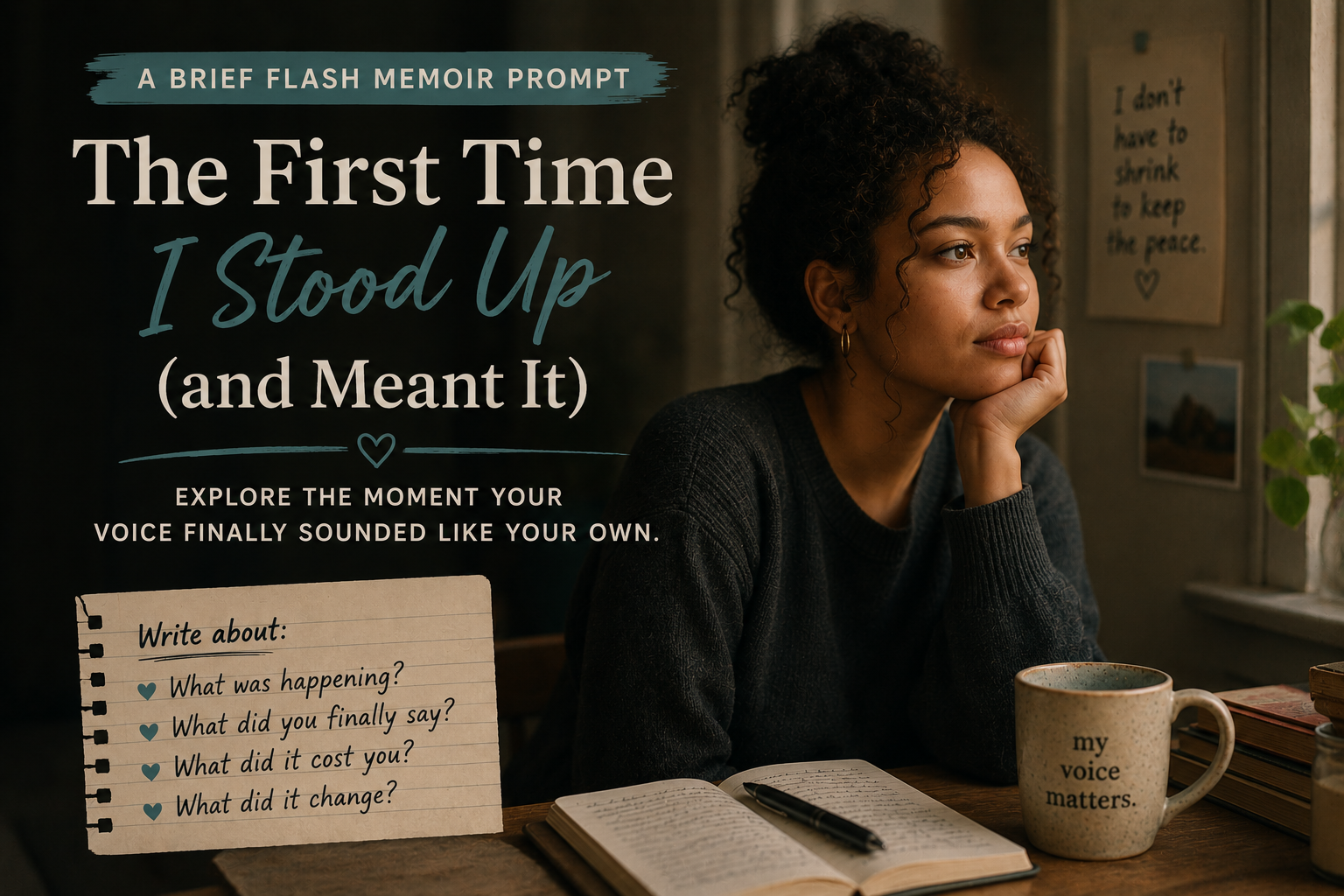
A brief flash memoir prompt first time stood up meant for exploring the moment your voice finally sounded like your own.
Your hand may have shaken. Your face may have gone hot. Maybe your words came out too loud, or too quiet, or in a rush you barely recognized. But something changed in that moment. You stopped trying to keep the peace at any cost. You stopped swallowing the sentence that had been sitting in your throat for years.
This kind of memory is rarely neat. It might have happened in a classroom, a kitchen, a workplace, a car, or a crowded hallway. The first time you stood up for yourself and meant it may not have looked brave to anyone else. But inside, it may have felt like a door opening.
The Prompt
Write about the first time you stood up for yourself and meant it.
This flash memoir prompt first time stood up meant invites you to return to one focused moment when you chose your own dignity. It does not ask you to prove you were right. It asks you to remember what it felt like to stop hiding your honest thought.
A prompt like this can unlock a memory because it has tension built into it. There is usually a before and an after. Before, you may have stayed quiet, laughed something off, or told yourself it did not matter. After, even if things were awkward, you knew you had crossed a line in yourself.
Why This Memory Matters
Standing up for yourself can look dramatic, but it can also be very small. It might be one sentence: “Don’t talk to me that way.” It might be refusing to apologize for something you did not do. It might be saying no when everyone expected you to say yes.
These moments matter because they often show a hidden part of your growth. The memory may reveal what you were taught about being “nice,” “easy,” “respectful,” or “difficult.” It may show the first time you questioned those lessons.
For some writers, this prompt leads to a proud memory. For others, it brings up regret, anger, or grief. Maybe you wish someone had stood up for you sooner. Maybe you wish your younger self had known that self-respect was allowed.
If you are trying to understand the deeper meaning of this memory, it can help to think the way a reader thinks about story. What changed? What belief was challenged? What pattern broke? If you enjoy looking for meaning in stories, you may find this guide on how to identify theme in literature useful for reading your own memory with more attention.
Your flash memoir does not need a perfect lesson at the end. In fact, it may be stronger if you let the moment stay a little unresolved. Real courage often feels messy while it is happening.
How to Approach This Prompt
Begin with the body, not the explanation.
What did your body do right before you spoke? Did your throat tighten? Did your palms sweat? Did you look at the floor, the person’s shoes, the edge of a table? A physical detail can pull the reader into the scene faster than a long backstory.
Try to narrow the memory to one scene. Do not start with every reason you finally reached that point. Instead, begin close to the moment. A strong opening might sound like, “I was holding a paper cup of coffee when she said it again,” or “The classroom went quiet after I pushed my chair back.”
Write what you noticed before you explain what it meant. The color of the room, the scrape of a chair, the smell of rain on your jacket, or the sound of your own voice may carry more power than a summary.
You can always add context later. For the first draft, stay inside the scene. Let the reader feel the pressure before the words come out.
If you like to mark up drafts or study the shape of a scene, you might also use simple notes in the margins after you write. Circle the strongest detail. Underline the sentence where the emotional shift happens. This is similar to the close reading process described in how to annotate literature, except this time the text is your own life.
For this flash memoir prompt first time stood up meant, your goal is not to make yourself sound fearless. Your goal is to be honest about the fear and the choice you made anyway.
A Quick Example
I was seventeen, standing behind the counter at the bakery, dusted in flour up to my elbows. My manager had just blamed me for an order I had never taken. Usually I would have nodded, apologized, and cried later in the walk-in freezer where no one could see me. That day, I looked at the pink box in his hand and said, “No. I didn’t write that ticket.” My voice cracked on “no,” which annoyed me, but I kept my eyes on him. The other cashier stopped tying ribbon. For a second, the whole shop seemed to pause, even the oven timer. He frowned, checked the stack of slips, and found the right one. He did not apologize. Still, I felt taller for the rest of my shift.
Try It Yourself
Set a timer for ten minutes and write the scene as directly as you can. Start with where you were and what your body noticed. Then let the words arrive when they arrived in real life.
If the memory feels big, choose one small part of it. You might write only the moment before you spoke, or only what happened right after. A flash memoir does not need to cover the whole history of the relationship or conflict.
Use this flash memoir prompt first time stood up meant as a way to listen for your own turning point. Maybe the scene was loud. Maybe it was quiet. Either way, give the moment space on the page.
Want More Flash Memoir Prompts?
If this prompt opened up a memory, keep going. Short prompts can help you build a steady writing habit without pressure to finish a full essay right away. Explore all 365 prompts in The Memory Trigger: 365 Flash Memoir Writing Prompts.


Get the Free Close Reading Worksheet Pack
Join my email list and receive the printable worksheet pack you can use with any novel or poem.
No spam. Just helpful guides for reading literature well.












