Flash Memoir Prompt: First Time You Felt Genuinely Afraid of Another Person

flash memoir prompt fear

A brief writing invitation for remembering the first time fear attached itself to another person, through one clear scene, body detail, and honest emotional truth. The flash memoir prompt first time felt genuinely afraid asks you to return to a moment when your body understood danger before your mind had words for it.

Maybe it was a look across a kitchen table. Maybe it was someone blocking a doorway. Maybe it was a stranger on the street whose footsteps matched yours for too long. Fear of another person has a different weight than fear of the dark or fear of failing a test. It can make the room feel smaller. It can make your own voice vanish.

This prompt does not ask you to solve the whole past. It asks you to notice one moment clearly enough to tell the truth about it.
flash memoir prompt fear

The Prompt

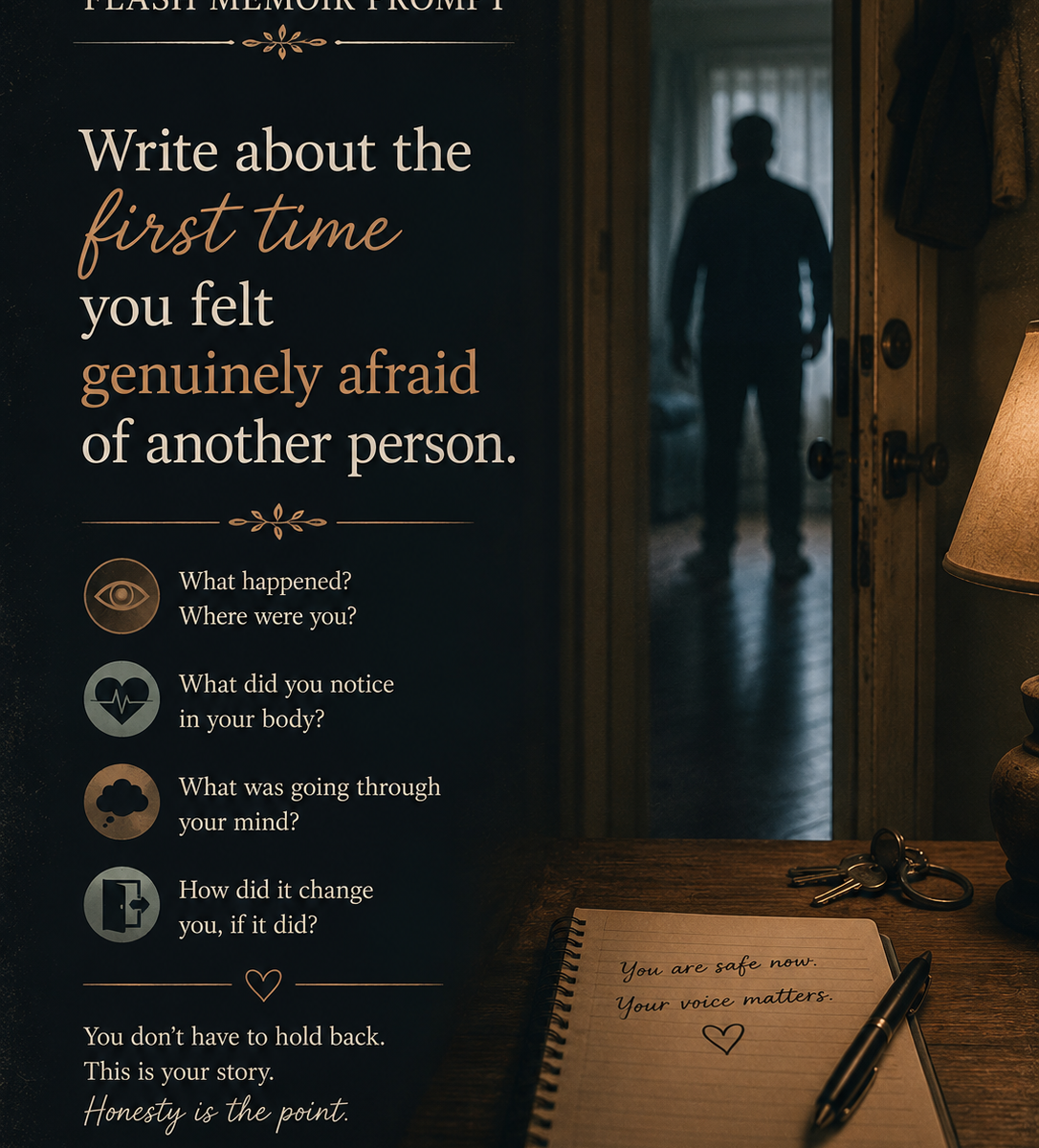
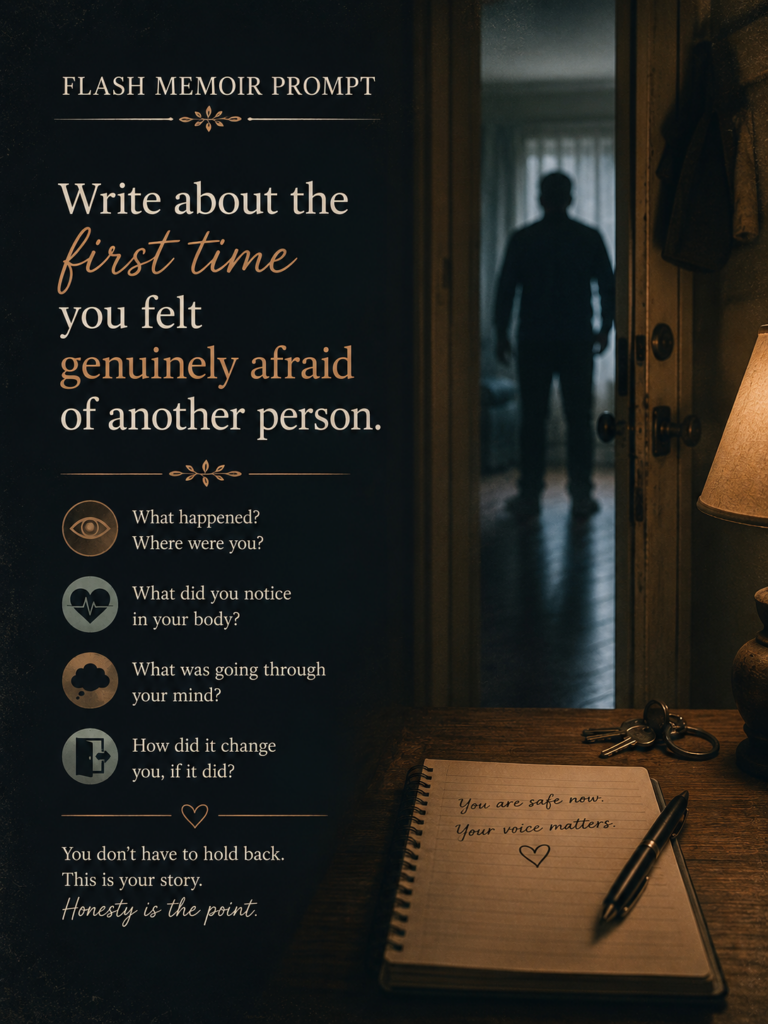
Write about the first time you felt genuinely afraid of another person.

This prompt can unlock a powerful memory because it brings you back to the first time you understood that another person could affect your sense of safety. That realization may have come in childhood, at school, at work, in a relationship, or in a place where you expected to feel safe.

A flash memoir prompt first time felt genuinely afraid is not about making the scene dramatic for a reader. It is about letting the memory stay close to the body. What did you hear? Where were your hands? What did the air feel like? Those details often carry more truth than a long explanation.

Why This Memory Matters

The first time you felt genuine fear of another person may have changed how you moved through the world. You may have become quieter. More alert. Faster to read faces. Slower to trust certain tones of voice. These changes can shape a life in subtle ways.

This kind of memory matters because it often marks a before and after. Before, you may have believed adults were always safe, friends could always be trusted, or public places were neutral. After, you knew better. That knowledge may have protected you, but it may have cost you something too.

You do not need to name the person in your writing. You do not need to explain everything that happened before or after. In flash memoir, one small scene can hold the larger emotional truth.

If you are thinking about how the feeling of a piece of writing differs from the writer’s attitude, you may find it helpful to revisit this guide to tone vs. mood in literature. A memory about fear can have a tense mood, while the narrator’s tone might be calm, confused, angry, or reflective.

How to Approach This Prompt

Begin with a physical detail, not background information. Write the first thing your body noticed. A dry mouth. A locked jaw. A hand on your shoulder that stayed too long. A hallway that suddenly felt empty.

Then narrow the memory to one scene. Do not try to tell the whole history of the person, the relationship, or the aftermath. Stay in the moment when fear arrived. Let the reader stand beside you there.

You might start with a sentence like:

“I knew I was afraid when I stopped breathing normally.”

Or:

“The first thing I noticed was how still everyone else became.”

After that, write what you noticed before you explain what it meant. Describe the room, the voice, the silence, the object in your hand. Memory often becomes more honest when you let the image come before the lesson.

If the memory feels too intense, give yourself limits. Set a timer for ten minutes. Write in third person if that gives you distance. Stop before the part that feels overwhelming. You are allowed to protect yourself while writing the truth.

You can also make notes in the margin of your draft as you go. If that helps you notice patterns, this guide on how to annotate literature may give you a simple way to mark images, repeated words, or emotional shifts in your own writing.

For this flash memoir prompt first time felt genuinely afraid, the goal is not to create a perfect essay. The goal is to catch the exact moment when fear became real.

A Quick Example

I was twelve, sitting in the back seat of my uncle’s truck, when he turned down the radio without looking at me. That was the first sign. He had been laughing a minute earlier, telling some story about work, but the truck went quiet all at once. My cousin stopped chewing her gum. I remember the smell of vinyl seats and wet leaves on the floor mat. He asked who had taken the money from the cup holder. No one answered. At the red light, he turned around slowly and looked straight at me. I had not taken it, but my face got hot like I had. I learned that day that truth did not always protect you.

Try It Yourself

Take ten to fifteen minutes and write from the prompt: Write about the first time you felt genuinely afraid of another person.

Start close to the body. Let the scene stay small. You do not have to explain why the person acted that way, and you do not have to forgive anyone on the page. Just write what happened as honestly as you can.

If the memory feels distant, try listing five details from the place where it happened. If the memory feels too close, write only the first thirty seconds. A brief piece can still be complete.

This flash memoir prompt first time felt genuinely afraid may bring up a hard memory, so give yourself care afterward. Stand up, drink water, look around the room you are in now. Writing about fear should not trap you inside it. It should give you a way to place the memory on the page, where you can see it with some space around it.

Want More Flash Memoir Prompts?

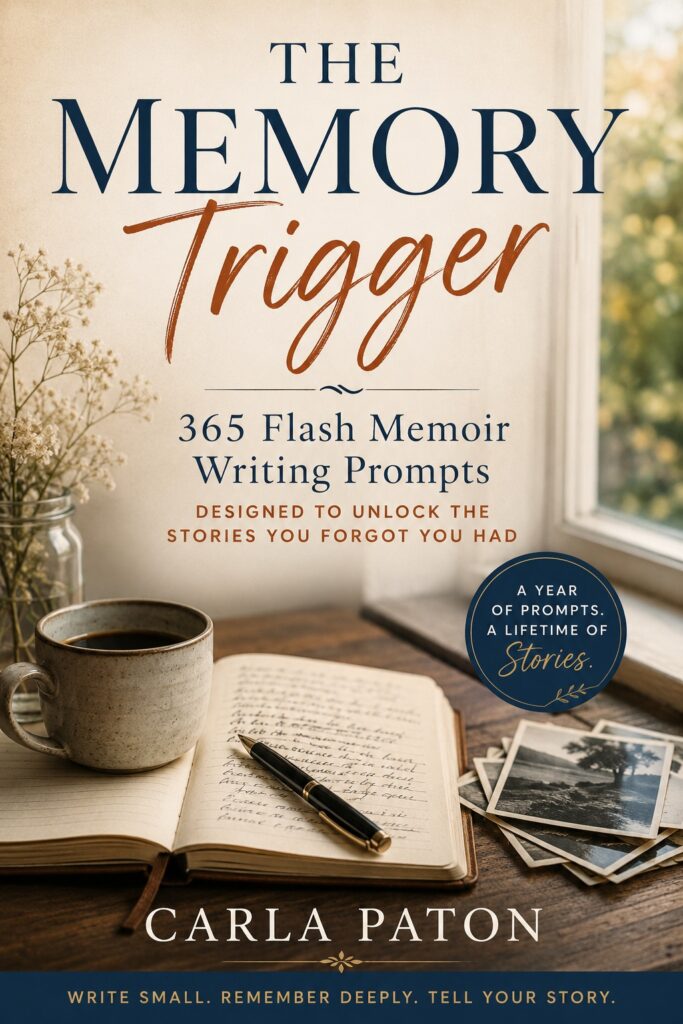
If you want a full year of short, focused memory invitations, explore all 365 prompts in The Memory Trigger: 365 Flash Memoir Writing Prompts. Each prompt is designed to help you write one vivid scene at a time.
The Memory Trigger


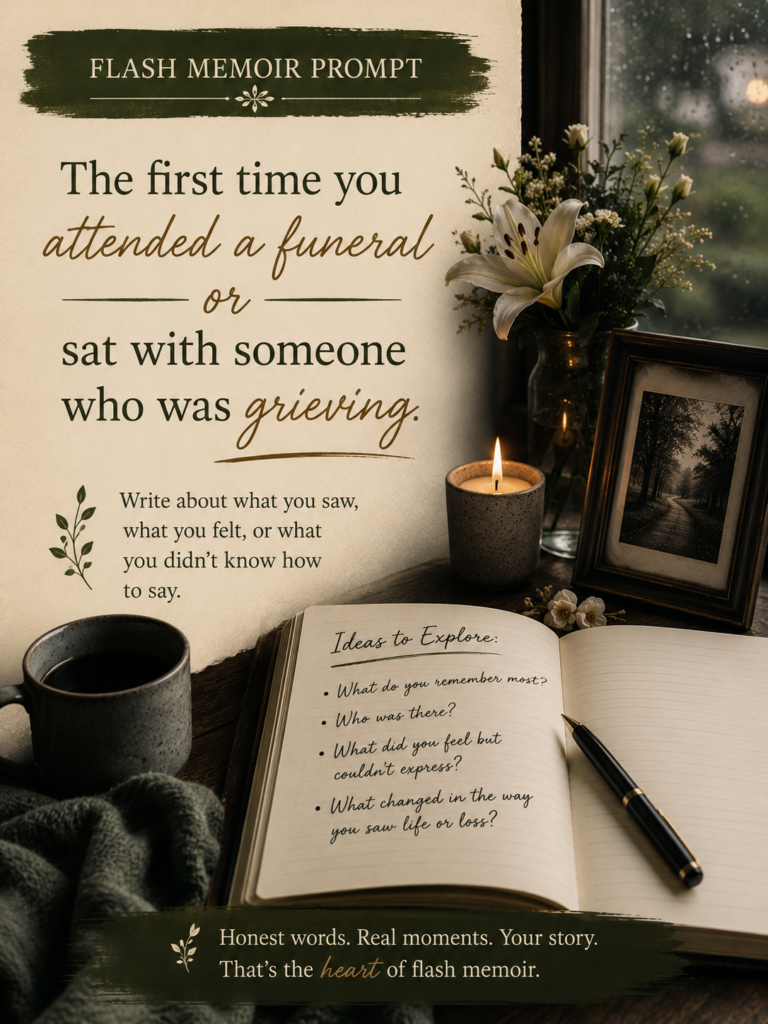
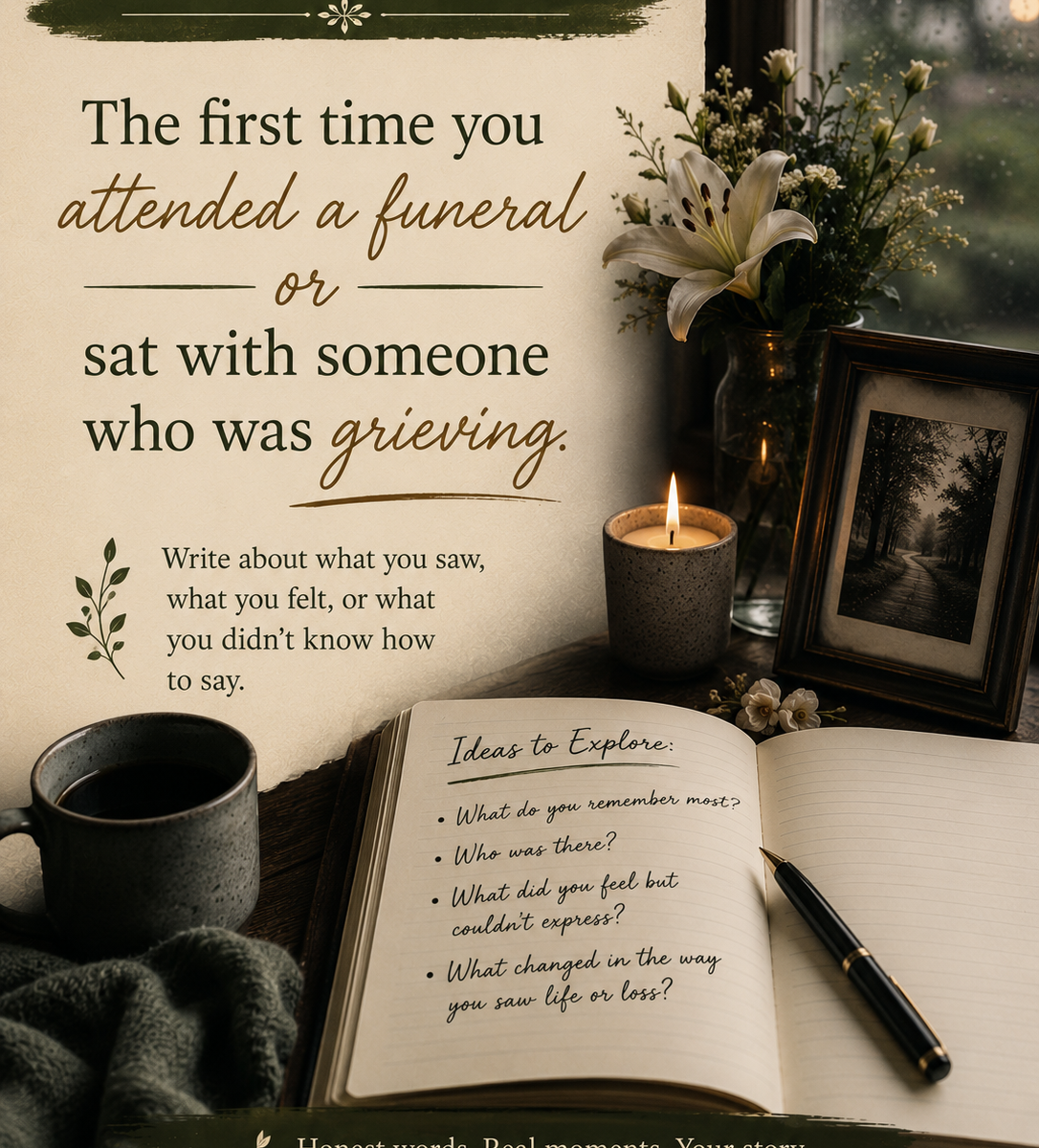
Flash Memoir Prompt: First Time You Attended a Funeral or Sat with Someone Who Was Grieving

Flash Memoir prompt funeral

A brief writing invitation for returning to the quiet room, the folded tissues, and the first moment you understood that grief changes the air around people.

The Prompt

Write about the first time you attended a funeral or sat with someone who was grieving.

This flash memoir prompt first time attended funeral sat with someone grieving asks you to remember a moment when loss became real in a new way. Maybe you were a child in stiff shoes. Maybe you were a teenager unsure where to put your hands. Maybe you were an adult, but grief still caught you off guard because you had never been that close to someone else’s pain.

You do not have to explain death, faith, family history, or healing. For a flash memoir, one small scene is enough. A hallway outside a chapel. A casserole on a kitchen counter. A handkerchief pressed into a palm. The sound of someone trying not to cry.

This kind of prompt works because grief often sharpens memory. Even years later, you may remember the smell of flowers, the scratch of dress clothes, the low murmur of adults, or the quiet shock of seeing someone strong come undone.

Flash Memoir prompt funeral

Why This Memory Matters

The first time you witness grief, you often learn something without anyone giving you a lesson. You may learn that adults do not always know what to say. You may learn that silence can be a form of care. You may learn that sadness has its own motions, like folding napkins, making coffee, or sitting beside someone without reaching for the perfect words.

This memory may uncover a story about innocence. If you were young, you might have noticed odd details before you understood the meaning of the day. The shiny shoes. The cold church pew. The strange way people smiled and cried in the same breath.

It may also be a story about discomfort. Many people remember feeling embarrassed by grief, not because they were cruel, but because they did not know the rules. Should you hug the person? Should you look at the casket? Should you speak? Should you stay quiet?

That uncertainty can make the writing honest. A strong memoir moment does not need you to act perfectly. It needs you to tell the truth about who you were then.

If you want to deepen the emotional atmosphere of your scene, it can help to think about the difference between tone and mood in literature. In a grief memory, the mood might be heavy or hushed, while your tone as the writer might be tender, confused, distant, or even gently surprised.

How to Approach This Prompt

Start with a physical detail. Do not begin with “I learned that life is short.” Begin with the tissue box. Begin with the too-bright funeral flowers. Begin with the black dress that made your neck itch. Let the reader enter the room before you tell them what it meant.

For this flash memoir prompt first time attended funeral sat with someone grieving, narrow the memory to one scene. Do not try to cover the illness, the death, the service, the family conflict, and the years that followed. Choose one moment you can still see.

You might write about arriving. You might write about sitting beside someone. You might write about the ride home after the funeral, when everyone was quiet and the world outside the car looked strangely normal.

Once you choose the scene, write what you noticed before you explain your feelings. This keeps the piece from becoming too general. Instead of saying, “Everyone was sad,” show one person smoothing a program until the paper softened at the fold.

If you sat with someone who was grieving, let their body language guide the scene. Did they talk too much, go very still, laugh at a strange moment, or ask you to stay? People reveal themselves in small ways during loss. If you enjoy studying those small human signals, you may also like this guide on how to analyze characters in literature, since memoir often asks you to observe real people with the same care.

Be gentle with yourself as you write. This prompt can bring up tender material. You can stop before the hardest part. You can write around the center of the memory and return later if you want to.

A Quick Example

I remember my first funeral mostly by the carpet. It was dark red with tiny gold shapes, and I stared at it because I did not know where else to look. My grandmother sat beside me with her purse in her lap, both hands gripping the clasp. I had never seen her hands so still. Usually she was patting my knee, finding gum, fixing my collar. That day she seemed made of stone. When the music started, she opened her purse and took out a tissue, but she did not use it. She just held it flat between her fingers. I wanted to ask if she was okay, but even at nine I knew it was the wrong question. Instead, I leaned my shoulder against her arm. After a minute, she leaned back.

Try It Yourself

Set a timer for ten minutes and write the scene as if you are walking into it again. Where are you sitting? What do you hear? Who is near you? What do you understand, and what do you misunderstand?

Do not worry about making the memory sound wise right away. First drafts are allowed to be plain. They are allowed to sound young, unsure, or unfinished. In fact, that may be where the truth is.

If the funeral itself feels too large, write about one object from the day. A program, a coat, a plate of food, a flower arrangement, a card on a table. Let that object pull the rest of the memory into focus.

If you choose the “sat with someone grieving” side of the prompt, pay attention to what you did with your body. Maybe you washed dishes, filled a glass of water, sat on the floor, or stood in the doorway. Often, the story lives in what we do when words are too small.

Want More Flash Memoir Prompts?

If this prompt helped you find one clear memory, keep going. Short prompts can open doors to stories you did not know you still carried. Explore all 365 prompts in The Memory Trigger: 365 Flash Memoir Writing Prompts.

The Memory Trigger

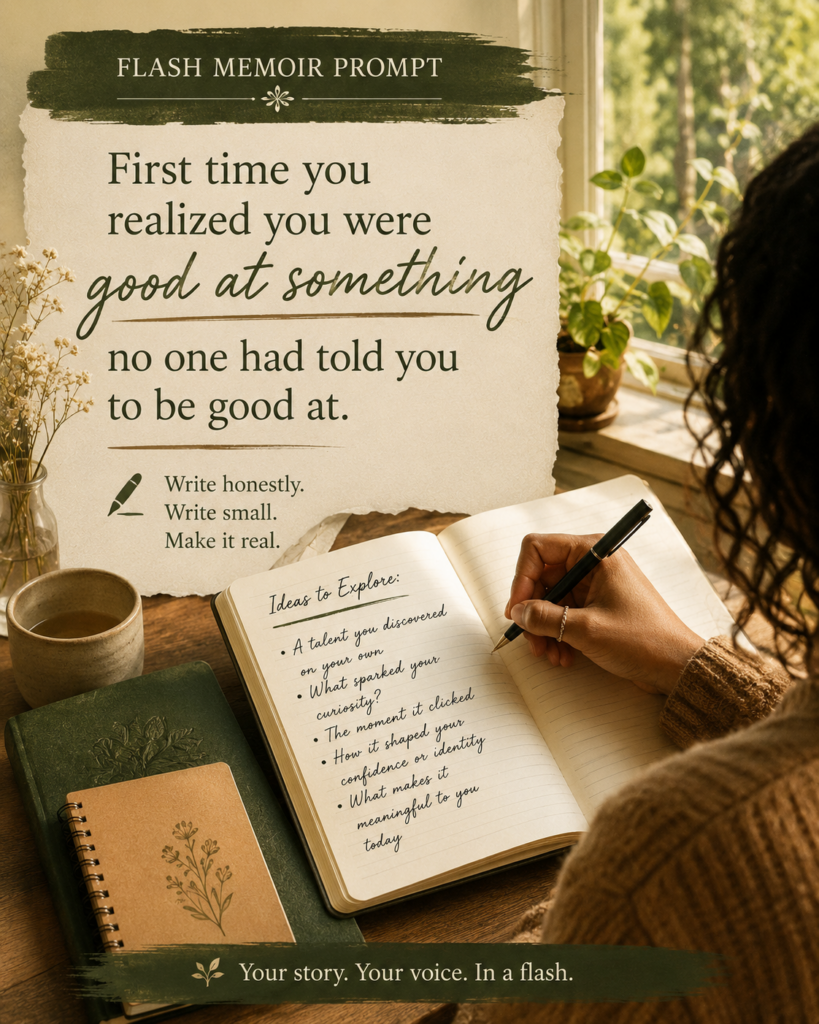
Flash Memoir Prompt: First Time You Realized You Were Good at Something No One Had Told You to Be Good at

Flash Memoir prompt good at something

A brief writing invitation for remembering the first time your private talent stepped into the light, even before anyone gave it a name.

Maybe it happened in the corner of a classroom, while everyone else was trying to finish the real assignment. You were doodling in the margin, fixing a broken toy, making a younger sibling laugh, or solving a problem faster than the adults expected. Then came that small shock: wait, I can do this.

This flash memoir prompt, the first time you realized you were good at something no one had told you to value, is about that quiet moment of self-recognition. It may not come with applause. It may not even come with a compliment. Sometimes the first person to notice your gift is you.

Flash Memoir prompt good at something

The Prompt

Write about the first time you realized you were good at something no one had told you to be good at.

This prompt can unlock a meaningful memory because it asks you to look for a talent before it became part of your identity. Before the award, the grade, the job, the label, or the expectation, there may have been one ordinary scene where you surprised yourself.

The memory might be small. You folded paper into something beautiful. You calmed a nervous friend. You heard the rhythm in a sentence. You spotted the flaw in a plan. You understood an animal, a machine, a recipe, a song, or a person before anyone explained it to you.

That is enough for a flash memoir. The point is not to prove that you became excellent. The point is to return to the first spark.

Why This Memory Matters

Many of us remember what we were told to be good at. Get good grades. Be polite. Win the game. Sit still. Speak clearly. Follow the rules. Those skills often come with pressure attached.

But the abilities we discover on our own can feel different. They may feel freer. They may also feel confusing, especially if no one around us knows how to respond.

This flash memoir prompt first time realized good at memory may uncover a story about hidden confidence. It may bring back the first clue that you had a way of seeing the world that belonged to you. That clue might have changed how you moved through a room, even if only for a minute.

There can also be tenderness in this kind of story. Maybe you were good at making peace because your house was tense. Maybe you were good at reading faces because you had to be. Maybe you were good at making people laugh because silence felt too heavy.

A memoir scene does not have to turn every talent into a victory. Sometimes the gift came with a cost. Sometimes you felt proud and embarrassed at the same time. That mix is where the real story often lives.

If you are writing this for a class or personal project, it may help to think about theme. A memory like this often points to a larger idea about identity, attention, or courage. If you want help naming that larger idea, this guide on how to identify theme in literature can also help you think about theme in your own life writing.

How to Approach This Prompt

Begin with one physical detail from the scene. Do not start by announcing the lesson. Start with the thing your hands touched, the sound in the room, or the face of the person nearby.

For example, you might begin with the smell of sawdust in a garage, the squeak of sneakers on a gym floor, the blue ink on your fingers, or the weight of a baby cousin in your lap. A clear detail can pull the whole memory closer.

Next, narrow the memory to one scene. You are not writing your full life story. You are writing the moment when you noticed something about yourself.

Ask yourself: Where was I? What was I doing? Who was there? What happened right before I realized I was good at it?

Then write what you noticed before you explain what it meant. If you were good at drawing, show the pencil moving. If you were good at fixing things, show the stuck part loosening. If you were good at comforting people, show the person’s breathing change.

Try to avoid turning the piece into a resume. You do not need to tell us every later success. A flash memoir works best when it trusts one moment to carry the weight.

You can also reread your draft like you would study a short text. Mark the strongest image, the emotional turn, and the sentence where the meaning becomes clear. This simple habit is close to how to annotate literature, and it can make your own writing sharper.

A Quick Example

I was nine, sitting under the card table at my aunt’s house, because the adults had taken every chair. My cousin Leo was crying over a spaceship model with one wing snapped clean off. No one wanted to deal with it. I picked up the tiny gray piece and turned it in my fingers until I saw how the broken edge matched the gluey scar on the ship. I asked for tape, then a toothpick, then held the wing still until my arm hurt. When Leo stopped crying, he looked at the ship like I had saved a real one from crashing. I remember feeling heat rise in my face. I had not known I could fix things. I had only known I hated seeing broken things stay broken.

Try It Yourself

Set a timer for ten minutes and write from the prompt without trying to sound impressive. Let the memory arrive in plain language.

If you get stuck, begin with this sentence: “The first clue was…” Then name one object from the scene. Follow that object into the memory.

As you write, stay close to the child, teen, or younger version of yourself who lived the moment. What did they believe was happening? What did they feel in their body? Did they feel proud, shy, startled, or suddenly older?

This flash memoir prompt first time realized good at something no one had assigned you can help you find a quieter kind of origin story. It is the story of a talent before it had a title.

Want More Flash Memoir Prompts?

If this prompt opened a memory you did not expect, keep following that thread. Short prompts can lead to honest scenes, especially when you give yourself permission to write one small truth at a time. Explore all 365 prompts in The Memory Trigger: 365 Flash Memoir Writing Prompts.

Flash Memoir Prompt: First Time You Chose to Stay Quiet When You Wanted to Speak

Flash memoir prompt

A quiet invitation to write about the first time you swallowed your words, noticed the room around you, and understood that silence can carry its own story.

Maybe you remember the heat in your face before you remember the words you did not say. Maybe you remember a teacher looking past you, a parent waiting for an answer, a friend saying something that stung. Your mouth opened, or almost did. Then you chose quiet.

This flash memoir prompt, for the first time, asks you to stay quiet and return to that small, charged moment. It is not about judging your younger self. It is about noticing what was at stake when silence felt safer, kinder, smarter, or more painful than speaking.

Flash memoir prompt

The Prompt

Write about the first time you chose to stay quiet when you wanted to speak.

This prompt can unlock a meaningful memory because silence is rarely empty. It often holds fear, love, shame, strategy, respect, confusion, or regret. When you write about the first time you held back your words, you may find a story about power, family rules, friendship, school, belonging, or the first time you understood that words can change a room.

A strong response to this flash memoir prompt first time chose stay quiet does not need to explain your whole life. It can focus on one scene: where you were, who was there, what you wanted to say, and what made you stop.

Why This Memory Matters

The first time you chose silence may have taught you something about the world before you had language for it. Maybe you learned that adults did not always want the truth. Maybe you learned that speaking up could cost you a friendship. Maybe you learned that staying quiet could protect someone else.

These memories matter because they show the gap between the outside and the inside. On the outside, you may have looked calm. You may have nodded, stared at your desk, or kept eating dinner. On the inside, you may have been full of sentences.

That contrast is powerful in memoir. Readers do not need a dramatic event to care. They need a real human moment. A child in a classroom who knows the answer but lowers her hand. A teenager at a lunch table who hears a cruel joke and says nothing. A grown person in a hospital hallway who decides not to correct someone because grief has already taken up too much space.

Writing this kind of memory can also help you see your old silence with more compassion. Silence is not always weakness. Sometimes it is practice. Sometimes it is survival. Sometimes it is the only choice you knew how to make at the time.

How to Approach This Prompt

Begin with a physical detail. Do not start by explaining the full backstory. Start with the thing your body remembers: your tongue pressed against your teeth, your hand under the table, your shoes on the carpet, the sound of a clock, the smell of cafeteria pizza, the weight of a backpack on one shoulder.

Then narrow the memory to one scene. Stay in the room where the silence happened. Who was nearby? What had just been said? What did you want to say back? Try to write the exact sentence you kept inside, even if you are not fully sure of it. You can use, “I think I wanted to say…” if that feels more honest.

Write what you noticed before you explain what it meant. This helps your reader enter the moment with you. If you jump too quickly to the lesson, the scene may lose its force.

For example, instead of writing, “That was when I learned my opinion did not matter,” you might write, “My fork tapped the plate once. Everyone looked at Uncle Ray except me. I stared at the peas and counted five of them before I swallowed.” The meaning can come later.

If you are helping students build stronger personal writing, this prompt also pairs well with close observation. The same skill used to annotate literature can help writers notice repeated images, tone, and emotional clues in their own memories.

You do not have to make yourself the hero. You do not have to make the silence wrong. Let the younger version of you be complicated. Maybe you wish you had spoken. Maybe you are grateful you did not. Maybe both are true.

A Quick Example

I was nine, sitting in the back seat of our old blue station wagon, when my mother told my grandfather that I loved piano lessons. I did not. I hated the slippery bench and the teacher’s sharp pencil tapping the music stand. I wanted to say, “No, I don’t.” The words rose so fast I could feel them crowd my throat. But my grandfather smiled into the rearview mirror and said, “Good girl. Music makes a person disciplined.” My mother’s eyes met mine in the mirror for half a second. Not angry. Just tired. I looked down at my patent leather shoes and pressed the toes together until they squeaked. “Yes,” I said, though no one had asked me anything.

Try It Yourself

Set a timer for ten minutes and write the scene without stopping. Begin with the moment right before you chose quiet. Let the memory unfold through action, sound, and what your body did.

If you get stuck, use this sentence starter: “I wanted to say…” Then keep going. You can revise later. For now, focus on telling the truth of the moment as clearly as you can.

This flash memoir prompt first time chose stay quiet can lead to a tender piece, a funny one, or a memory that still feels sharp. Let the tone be what it is. The goal is not to force a lesson. The goal is to catch one honest moment on the page.

If your memory involves a book, class, or difficult text that shaped what you did or did not say, you may also enjoy this guide on understanding Shakespearean language, especially if silence, power, and hidden meaning are themes you want to explore in student writing.

Want More Flash Memoir Prompts?

If this prompt opened a memory you did not expect, keep going. Short prompts can help you build a steady writing habit without pressure to finish a full life story at once. Explore all 365 prompts in The Memory Trigger: 365 Flash Memoir Writing Prompts.

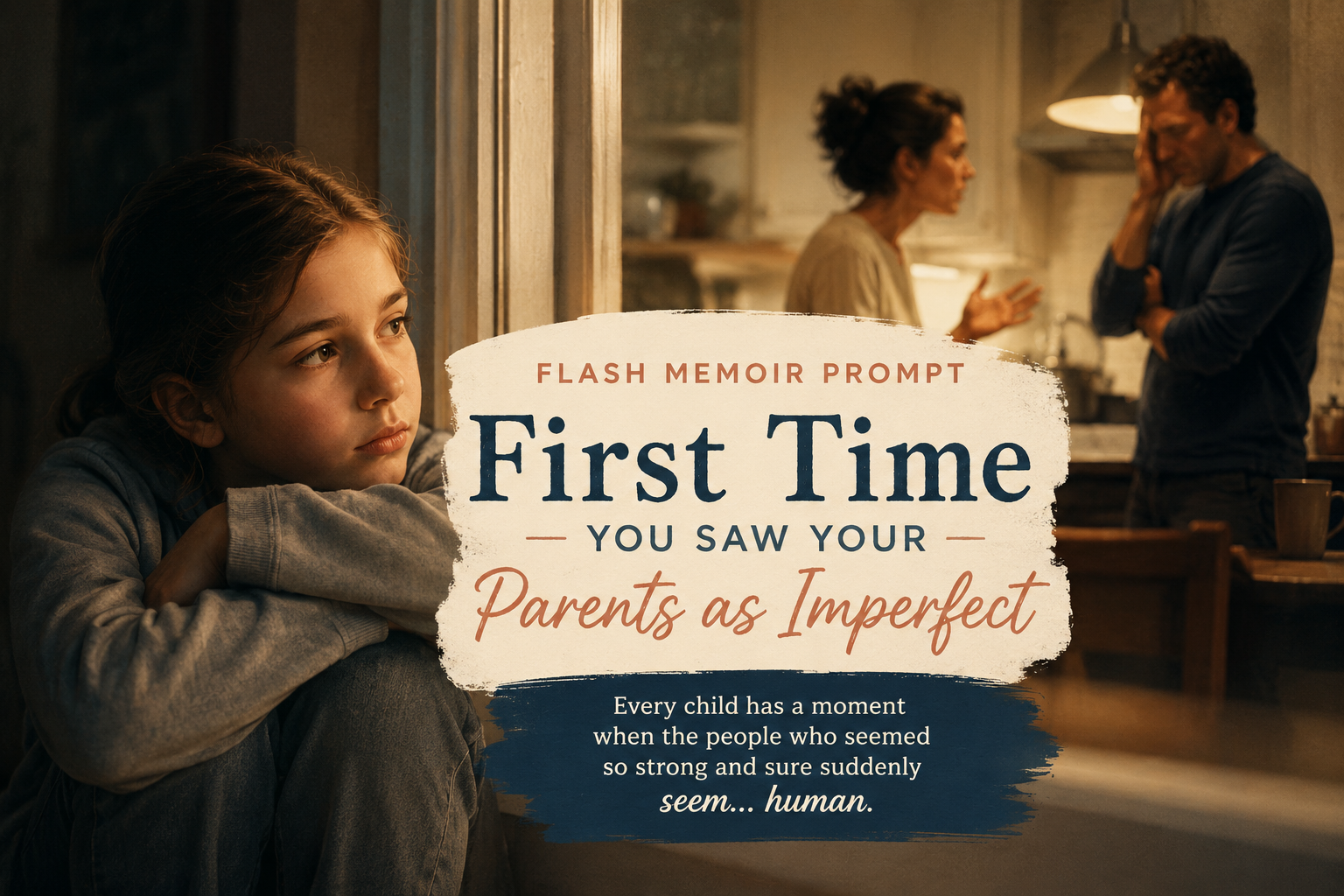
Flash Memoir Prompt: First Time You Saw Your Parents as Imperfect

flash memoir

A brief, tender writing invitation for remembering the first moment a parent became fully human in your eyes. Maybe it happened at the kitchen table, in the car, or during a small mistake no one else noticed. For writers searching for a flash memoir prompt first time saw parents imperfect, this prompt can open a memory that still carries surprise, confusion, and love.

flash memoir

There is a strange silence that comes after you realize an adult does not have all the answers. One minute, your parent is the person who fixes things, pays bills, finds lost shoes, and knows where to turn. The next, you see a crack in that certainty. Maybe your mother cried in the laundry room. Maybe your father got lost and snapped at the map. Maybe you heard fear in a voice you thought was always steady.

This kind of memory can be hard to write because it changes the shape of childhood. It does not always come with a dramatic scene. Often, it arrives through one look, one overheard sentence, or one ordinary day that suddenly feels different.

The Prompt

Write about the first time you saw your parents as imperfect.

This flash memoir prompt first time saw parents imperfect invites you to write about the moment when childhood certainty shifted. You do not need to judge your parent or explain your whole family history. The strongest piece may come from one small scene where you noticed something you could not unsee.

Maybe you saw your parent make a mistake. Maybe you realized they were tired, lonely, afraid, jealous, forgetful, or wrong. Maybe the imperfection was harmless and almost funny. Maybe it was painful. Either way, the memory matters because it marks a change in how you understood them and yourself.

Why This Memory Matters

Many of us grow up believing our parents are larger than life. They seem to know the rules of the world. They control bedtime, money, meals, permission, and punishment. Even when we fight them, we often imagine they are solid in a way we are not.

Then one day, that image shifts. You see your parent as a person with limits. This can feel scary because it means no one is as in control as you thought. It can also feel tender. That moment may be the start of compassion, even if you did not understand it that way at the time.

This prompt can uncover a story about growing up without using those exact words. It may reveal the first time you felt protective of a parent. It may show when anger became confusion, or when judgment became understanding. It may even show a moment when you realized you were allowed to disagree with someone you loved.

If you are used to studying people in books, this prompt asks you to turn that same close attention toward real life. Thinking about how writers reveal flaws in fictional people can help too. You might find it useful to revisit this guide on how to analyze characters in literature and notice how small actions reveal hidden truth.

How to Approach This Prompt

Begin with what your body remembers. Do not start with the lesson. Start with the room, the light, the sound, or the object in your hand. Was there a coffee mug on the counter? Was the car heater blowing too hot? Did your parent’s face look different in the hallway light?

Try to narrow the memory to one scene. A flash memoir does not have room for every reason your parent was complicated. Choose one moment and stay there. Let the reader notice things as you noticed them.

For this flash memoir prompt first time saw parents imperfect, it may help to write in two layers. First, describe what happened as your younger self saw it. Then, add a few lines from your older self looking back. This gives the piece depth without turning it into a long explanation.

You might write a first sentence like one of these:

“I was ten when I saw my father lose his patience with a vending machine.”

“My mother missed the turn three times before she admitted she was lost.”

“The first clue was the unpaid bill folded under the salt shaker.”

After that, stay close to the scene. Let the meaning rise from the details. If you want to practice close observation before you draft, this guide on how to annotate literature can also help you slow down and notice what matters on the page.

A Quick Example

I was twelve when my dad burned the grilled cheese. It should not have mattered. Everyone burns food sometimes. But my mother was in the hospital, and he had been acting like the house was a machine he could keep running if he pushed the right buttons. He stood at the stove in his work shirt, scraping black bread into the trash. The kitchen smelled sharp and smoky. My little brother started to cry because he was hungry. Dad put both hands on the counter and lowered his head. For a second, I thought he was angry. Then I saw his shoulders shake. I had never seen him cry before. I looked away fast, as if I had walked in on him changing clothes. That night, I ate cereal for dinner and learned he was not a wall. He was just tired.

Try It Yourself

Set a timer for ten minutes and write the scene without stopping. Do not worry about making your parent look good or bad. Focus on being honest with the memory you have.

Ask yourself what you noticed first. Was it a voice, a mistake, a silence, or a look? Then ask what changed in you after that moment. You may have felt sad, embarrassed, angry, or strangely grown up. Let that feeling stay on the page without rushing to fix it.

This flash memoir prompt first time saw parents imperfect works best when you resist the urge to explain your entire relationship. A single scene can carry more truth than a full summary. Trust the small moment.

Want More Flash Memoir Prompts?

If this prompt opened a memory you did not expect, keep going. Short prompts can help you return to the past one clear scene at a time, without forcing a full life story all at once. Explore all 365 prompts in The Memory Trigger: 365 Flash Memoir Writing Prompts.

Flash Memoir Prompt: First Time You Failed at Something You’d Worked Hard for

flash memoir

A focused flash memoir prompt first time failed at something can help you return to the exact moment when effort met disappointment, and when a younger version of you had to decide what to do next.

Maybe you still remember the room before you remember the failure. The squeak of a gym floor. The smell of pencil shavings during an exam. The heavy silence after an audition, a game, a race, a contest, or a project you wanted badly.

Failure can feel too large to write about, especially when you worked hard for the thing you did not get. But a flash memoir does not need the whole history. It only needs one clear moment when hope shifted into something else.

flash memoir

The Prompt

Write about the first time you failed at something you’d worked hard for.

This prompt works because it asks you to remember effort, not just outcome. The story is not only about losing, missing, falling short, or being told no. It is about the hours before that moment. It is about the version of you who believed effort would protect you from disappointment.

A flash memoir prompt first time failed at something can uncover a memory that still has energy in it. You may remember who was there, what you expected, and how your body reacted when you realized things had gone wrong.

Why This Memory Matters

The first serious failure often changes how we understand fairness. Before it happens, we may believe hard work always leads to the result we want. After it happens, we learn something more complicated.

That does not mean the story has to end with a big lesson. In fact, it may be stronger if it stays close to the scene. Maybe you remember stuffing a rejected application into your backpack. Maybe you remember smiling so no one would ask if you were upset. Maybe you remember your parent saying the wrong thing in the car because neither of you knew what else to say.

These small details carry the emotional truth. They show the reader what the moment felt like without forcing a moral onto it.

If you are trying to understand the deeper meaning of this memory, you might find it helpful to think about theme. This guide on how to identify theme in literature can also help memoir writers notice the ideas hiding inside a personal story.

Your memory may be about shame, pride, pressure, family expectation, resilience, or the pain of wanting something in public. Let the scene show you which one matters most.

How to Approach This Prompt

Begin with one physical detail from the moment you knew you had failed. Do not start with your whole life story. Start with the trophy table you did not reach, the computer screen with the score, the teacher’s red pen, or the phone call that ended too fast.

Then narrow the memory to one scene. You might choose the minute before the result, the moment you found out, or the ride home afterward. A flash memoir works best when it holds the camera steady.

Try to write what you noticed before you explain what it meant. If your hands shook, write that. If the room felt too bright, write that. If someone near you celebrated while you stood still, write that too.

You do not have to make yourself look wise. You can let yourself be young, hurt, angry, embarrassed, or confused. That honesty is often what makes the piece feel alive.

If you like marking up memories the way students mark up texts, you can borrow a few ideas from how to annotate literature. Circle the strongest image in your draft. Underline the sentence that feels most true. Build the rest of the piece around those clues.

For this flash memoir prompt first time failed at something, avoid covering every practice, every hope, and every later success. Stay with the first crack in the plan. That is where the story lives.

A Quick Example

The envelope was thinner than I expected. I knew that before I opened it. All week, I had imagined a thick packet with forms to sign and a letter that began with “Congratulations.” I had practiced my audition song until my throat felt raw. I had even stopped drinking soda because I thought serious singers probably made serious choices. In the kitchen, my mother watched me slide one finger under the flap. The paper inside made a soft scraping sound. “Thank you for auditioning,” it said. I read the first line three times. My mother asked if I was okay, and I nodded because crying felt like one more thing I might do badly. Outside, the neighbor’s dog barked and barked, as if it had already heard the news.

Try It Yourself

Set a timer for ten minutes and write about the first time you failed at something you had worked hard for. Choose one scene and stay there. Let the memory be awkward if it was awkward. Let it be unfair if it felt unfair.

You can begin with this sentence: “I knew I had failed when…” Then follow the memory into the room, the field, the hallway, the stage, or the kitchen where it happened.

When you finish, read your draft once and look for the most honest sentence. That sentence may be quiet. It may not explain everything. Keep it anyway. It might be the center of the piece.

This flash memoir prompt first time failed at something is not asking you to prove that failure made you stronger. It is asking you to remember what it cost to care that much.

Want More Flash Memoir Prompts?

If this prompt opened a memory you did not expect, keep writing. Short prompts can help you build a steady memoir practice one small scene at a time. Explore all 365 prompts in The Memory Trigger: 365 Flash Memoir Writing Prompts.

Flash Memoir Prompt: First Time You Said “I Love You” and Meant It in a Way You Hadn’t Before

Flash Memoir Prompt Love

A quiet writing invitation for returning to the first “I love you” that felt different, heavier, braver, or more honest than the ones that came before.

The Prompt

There is a certain kind of silence that happens after someone says “I love you.” You may remember the room, the sidewalk, the car, or the way your own voice sounded strange to you. This flash memoir prompt first time said i love asks you to return to that moment and notice what made it different.

Write about the first time you said “I love you” and meant it in a way you hadn’t before.

This prompt is powerful because the words themselves are simple. Most of us have heard them many times. We may have said them to family, friends, pets, crushes, or people we were trying not to lose. But one moment may stand apart because the meaning changed.

Maybe it was romantic love. Maybe it was the first time you said it to a child and understood how much fear could fit inside love. Maybe it was said to a parent after years of distance. Maybe you whispered it to someone who was leaving. The prompt asks you to find the moment when the phrase stopped being automatic and became a choice.

Flash Memoir Prompt Love

Why This Memory Matters

“I love you” can be a habit, a promise, an apology, or a risk. In memoir, small phrases often carry a larger story. The words matter, but the scene around them matters just as much.

This memory may uncover a turning point. You might write about growing up, forgiving someone, trusting another person, or realizing that love did not feel the way you expected. The story may also show a younger version of you trying to understand what love required.

Try not to decide too quickly what the memory “means.” Let the details do some of the work. A hand on a steering wheel, a kitchen light left on, a cracked phone screen, or the smell of hospital soap can tell the reader more than a long explanation.

If you are a student, this kind of prompt can also help you practice finding deeper meaning in a scene. The same skill matters when you read stories, poems, or novels. If you want help with that, this guide on how to identify theme in literature can show how small moments often point to larger ideas.

A flash memoir prompt, first time said I love is not asking for your full relationship history. It is asking for one clear memory where the words carried new weight.

How to Approach This Prompt

Begin with the body, not the lesson. What did your throat feel like before you said it? Were your hands busy? Were you looking at the person or looking away?

Narrow the memory to one scene. Do not start with how you met the person, every argument you had, or what happened years later. Start close to the moment when the words were about to leave your mouth.

You might begin with a sentence like, “I was standing by the back door with my coat still on,” or “The phone was warm against my ear.” A physical detail gives the reader a place to stand.

After that, write what you noticed before you explain what it meant. Did the other person laugh? Did they go quiet? Did you regret saying it for one second and then feel relieved? Let the scene move in real time.

If you get stuck, try writing the memory in short lines first. You can always shape it later. Some writers find it helpful to mark the strongest sensory details as they revise, much like they would when they annotate literature for important clues.

Keep the focus tight. This is flash memoir, so a small moment can hold the whole truth. The goal is not to prove that the love lasted. The goal is to show why that one “I love you” felt unlike the others.

A Quick Example

The first time I said it and understood myself, we were outside the laundromat at 10 p.m. My sister had just dropped a basket of warm towels into my trunk because my apartment dryer was broken again. She was tired from work, still in her grocery store polo, and she had one sock half-falling off inside her sandal. I said, “I love you,” the way I always did when we said goodbye. But that night, I heard it differently. I meant, thank you for showing up. I meant, I see how hard you try. She shut the trunk and said, “Love you too, dummy,” and walked back to her car. I stood there longer than I needed to, holding my keys, surprised by how full my chest felt.

Try It Yourself

Set a timer for ten minutes and write the scene without stopping. Do not worry about sounding polished. Focus on where you were, what happened just before the words, and how the room or place changed after you said them.

If the memory feels too tender, write around it at first. Describe the weather, the object in your hand, or the other person’s shoes. Sometimes the safest way into a hard memory is through one ordinary detail.

Once you have a draft, look for the sentence that feels most true. That sentence may not be the prettiest one. It may be plain. Keep it. In flash memoir, plain truth often has the strongest voice.

This flash memoir prompt first time said i love can lead to a sweet piece, a sad one, or something more complicated. Let it be honest before you try to make it neat.

Want More Flash Memoir Prompts?

If this prompt opened a memory you had not thought about in years, keep going. One small scene can lead to another, and a daily practice can help you build a fuller record of your life. Explore all 365 prompts in The Memory Trigger: 365 Flash Memoir Writing Prompts.

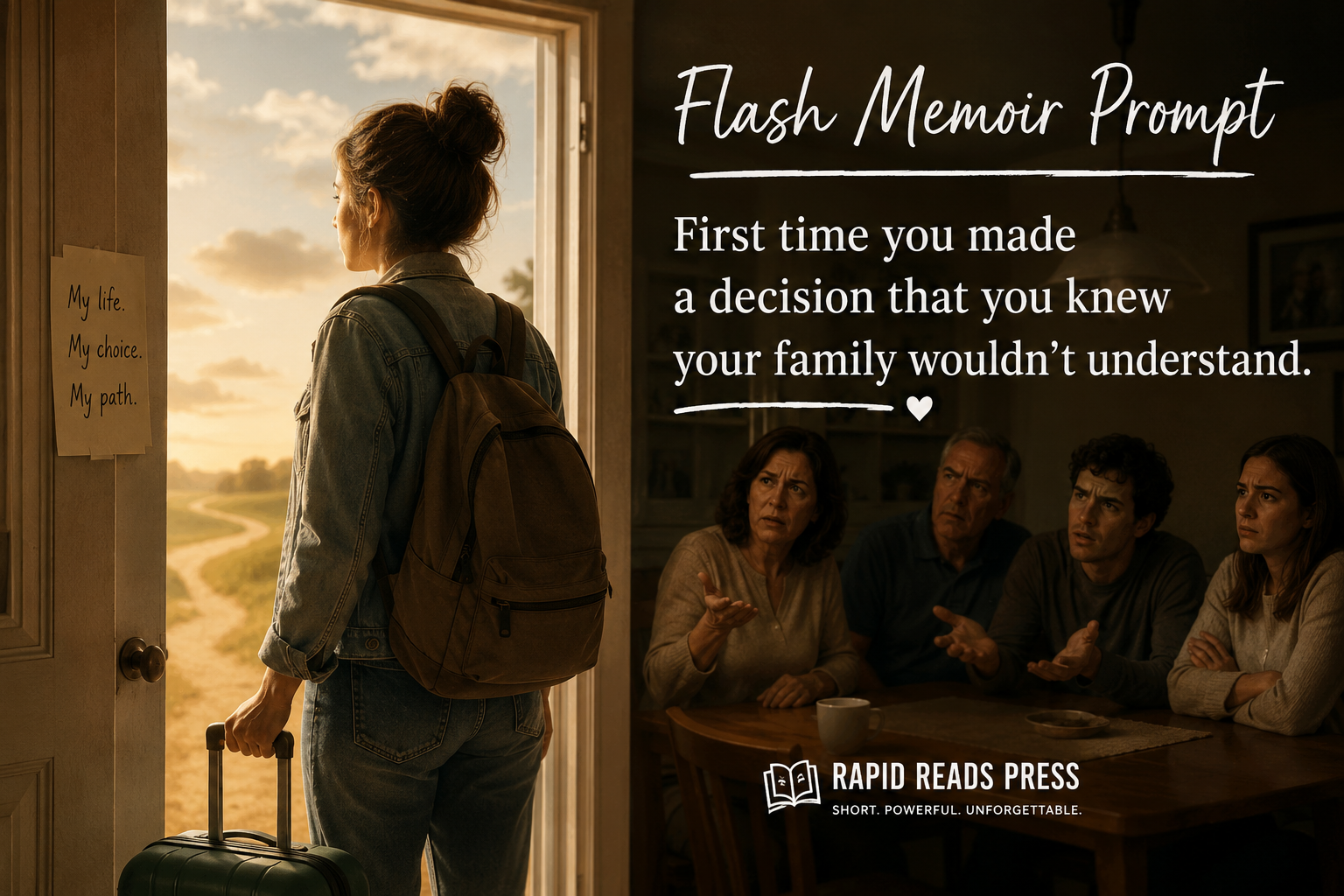
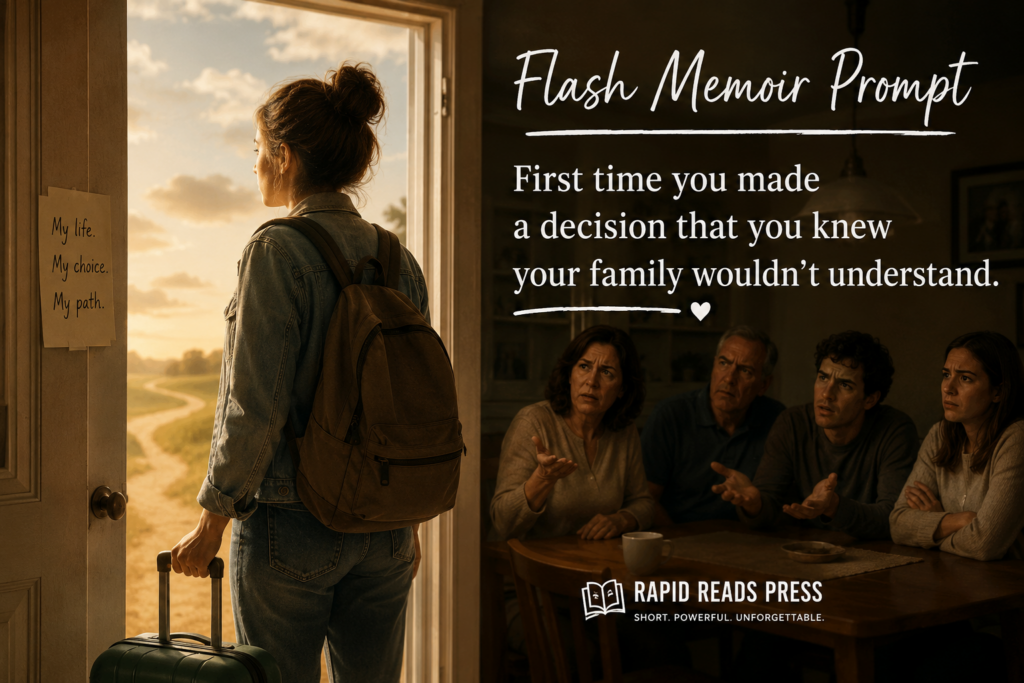
Flash Memoir Prompt: First Time You Made a Decision that You Knew Your Family Wouldn’t Understand

flash memoir prompt decision

A quiet flash memoir prompt for the first time you made a decision you knew your family would not understand, told through one brave moment, one clear scene, and the truth you could not explain yet.

Maybe you remember the room before you remember the words. The kitchen light felt too bright. Your phone sat heavy in your hand. Someone in your family was asking what you had decided, and you already knew your answer would sound wrong to them.

This flash memoir prompt first time made decision knew you would be misunderstood is about that tense little space between loyalty and self-trust. It asks you to write about the moment when you chose something that made sense to you, even if it made no sense to the people who loved you.

flash memoir prompt decision

The Prompt

Write about the first time you made a decision that you knew your family wouldn’t understand.

This prompt can open a powerful memory because it holds conflict right away. There is a choice. There is a family. There is a gap between what others expect and what you know you need.

You do not have to write about a dramatic fight or a life-changing announcement. The most honest version may live in a small scene. Maybe you chose a college far from home. Maybe you quit something everyone praised you for. Maybe you kept a relationship private, changed your plans, refused a tradition, or said no when everyone expected yes.

The heart of this prompt is not whether your family was right or wrong. The heart is the first time you felt the cost of having your own mind.

Why This Memory Matters

Family can shape our first ideas about safety, success, duty, and love. When you make a decision your family will not understand, you may feel guilt before anyone even says a word.

That feeling is worth writing about. It shows the reader who you were at the moment you began to separate your own voice from the voices around you.

This kind of memory may uncover a story about independence. It may also reveal fear, tenderness, or regret. You might find that your family’s reaction was less harsh than you expected. You might find that their silence hurt more than shouting.

In flash memoir, the power often comes from staying close to one moment. Instead of explaining your whole family history, you can show your father clearing his throat, your sister staring at the table, or your mother folding the same dish towel twice.

Those small actions can carry the weight of the scene. If you enjoy studying how people reveal themselves through action, you may also like this guide on how to analyze characters in literature. The same skill can help memoir writers notice what people say without saying it directly.

How to Approach This Prompt

For this flash memoir prompt first time made decision knew others would question, begin with a physical detail. Do not start by explaining the entire decision. Start with the thing your body remembers.

What did your hands do? Where were you sitting? Was there food on the table? Was the room quiet, messy, hot, cold, crowded, or strange?

Then narrow the memory to one scene. Choose the moment before you told them, the moment after, or the moment when you decided not to explain yourself anymore.

Try this opening move: “I knew they would not understand when…” Then finish the sentence with a concrete image instead of an abstract feeling.

For example:

“I knew they would not understand when I saw my mother place the nursing school brochure beside my untouched plate.”

That kind of sentence gives the reader a scene. It also gives you a doorway into the memory.

Write what you noticed before you explain what it meant. Let the scene breathe a little. If you jump too quickly to the lesson, you may miss the emotional texture of the moment.

Also, avoid trying to tell the whole story at once. You do not need to explain every family argument, every expectation, or every reason behind your choice. Flash memoir works best when one moment stands in for something larger.

If you want a simple structure, try this:

Start with the scene. Show the decision. End with what you could not say out loud at the time.

That is enough for a strong first draft.

A Quick Example

I knew they would not understand when my uncle laughed and said, “Art school?” like I had told him I planned to live on the moon. We were in my grandmother’s dining room, and the plastic cover on the table stuck to my wrist. Everyone had been talking about my cousin’s new job at the hospital. Then my mother asked if I had sent in my scholarship forms. I said yes, but not for nursing. The room went quiet in a way that felt practiced. My father looked down at his plate. I wanted to explain that drawing was the only place I felt awake, but the words sounded childish in my head. So I just said, “I already mailed it.” My voice shook, but I did not take it back.

Try It Yourself

Set a timer for ten minutes and write the scene as if you are back inside it. Do not worry about making the decision look wise. Do not try to defend yourself on the page.

Focus on what happened in the room, car, hallway, or phone call. Let the reader feel the pressure before you name it.

If the memory still feels charged, write around the edges first. Describe the weather that day. Describe what you wore. Describe the object closest to you. Often, the truth enters through the side door.

When you revise, look for one sentence that feels especially honest. It may be quiet. It may be uncomfortable. Keep that sentence and build the piece around it.

This flash memoir prompt first time made decision knew your family would not understand is not asking you to judge your family or prove you were right. It is asking you to remember the first time you heard your own inner voice and chose to follow it anyway.

Want More Flash Memoir Prompts?

If this prompt helped you find a memory with tension and heart, keep going. A daily prompt can give you a small, steady way to build scenes from your life without having to tell everything at once.

Explore all 365 prompts in The Memory Trigger: 365 Flash Memoir Writing Prompts.

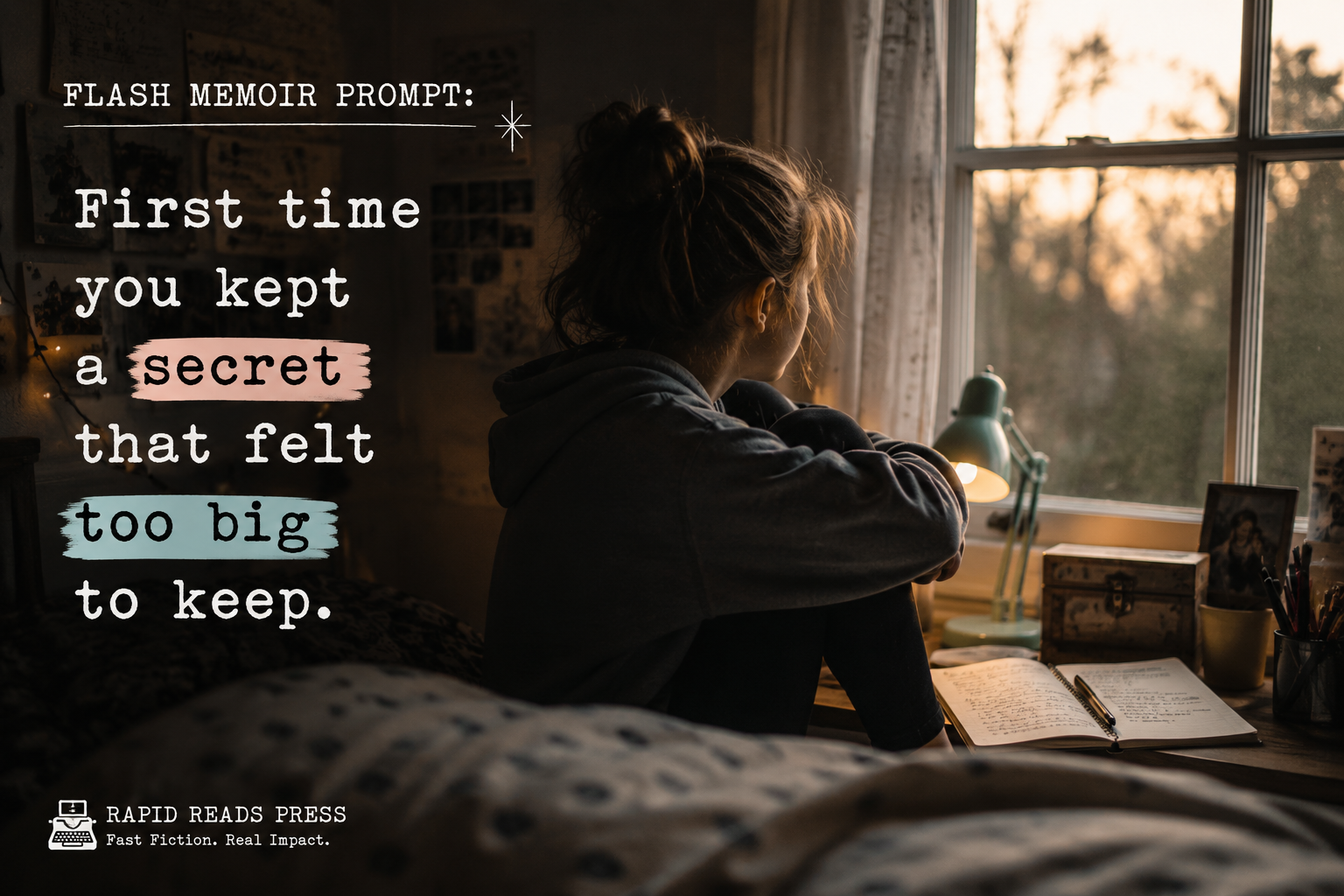
Flash Memoir Prompt: First Time You Kept a Secret that Felt Too Big to Keep

Flash memoir prompt secret

A brief writing invitation for returning to the first secret that felt bigger than your hands, and finding the small scene where silence began to weigh something.

You might remember the moment by its temperature. A hot face. Cold fingers. A stomach that seemed to drop before anyone even asked a question.

If you need a flash memoir prompt, first time kept secret felt too big for your own chest, begin with the moment you knew you would stay quiet. That moment may have lasted only a few seconds, but it can hold a whole story.

Secrets are strange in childhood and young adulthood. Sometimes they make you feel chosen. Sometimes they make you feel trapped. Sometimes you do not even know whether the secret belongs to you, but there you are, carrying it anyway.

Flash memoir prompt secret

The Prompt

Write about the first time you kept a secret that felt too big to keep.

This prompt can unlock a meaningful memory because it asks you to write about pressure. The secret itself matters, but the real story may be in what it did to your body, your voice, and your sense of right and wrong.

You do not need to reveal every detail if the memory still feels private. A flash memoir can work around the edges. You can write about the hallway, the dinner table, the unanswered phone call, or the way someone looked at you as if they knew.

For this flash memoir prompt first time kept secret felt heavy, try to focus on one clear scene instead of the whole history around it. The smaller the moment, the stronger the memory often becomes.

Why This Memory Matters

The first secret that felt too big often marks a change. Before it, you may have believed adults knew everything, friends always told the truth, or families said what needed to be said. After it, the world may have felt more complicated.

This kind of memory may uncover a story about loyalty. Maybe you kept a friend’s secret because you did not want to betray them. Maybe you held in something you had seen because speaking would have changed the room forever.

It may also uncover a story about fear. You might have worried someone would be angry, hurt, disappointed, or blamed. A secret can make a child feel powerful for a moment, then powerless for much longer.

In literature, secrets often push a story forward because they affect how people act when no one says the truth out loud. If you want to see how hidden truth and public judgment can shape a character, the Scarlet Letter study guide offers a clear example of secrecy at the center of a story.

In memoir, though, the point is not to turn your life into a lesson. The point is to notice what the secret changed. Did you become more careful? Did you start listening at doors? Did you learn that silence can feel loud?

How to Approach This Prompt

Start with a physical detail. Do not begin by explaining the whole situation. Begin with a hand on a doorknob, a folded note in a pocket, the smell of cafeteria pizza, or the sound of your own breathing while someone waited for your answer.

Then narrow the memory to one scene. Ask yourself: Where was I standing or sitting when I first understood this secret was mine to carry? Who else was there? What did I do with my face?

For this flash memoir prompt first time kept secret felt too big, try writing what you noticed before you write what it meant. Maybe you noticed your mother’s keys on the counter, your best friend’s red eyes, or the way your notebook paper tore when you erased too hard.

Let the meaning arrive later. Memory often works that way. First comes the small object. Then comes the feeling.

You may also want to think about the mood of the scene. Was it tense, quiet, weirdly normal, or almost funny because everyone was acting like nothing had happened? If you need help naming the feeling of a scene, this guide to tone vs. mood in literature can help you separate the narrator’s voice from the atmosphere around the memory.

Avoid trying to tell the entire secret from beginning to end. Flash memoir works best when it trusts one image. You can leave some things unsaid. In fact, a story about a secret may feel more honest when it does not explain everything.

A Quick Example

I was nine when I found the birthday present hidden behind the water heater. It was a blue bike with silver streamers curled like ribbon candy from the handlebars. My father saw me see it. For one second, we both froze in the basement light. Then he put one finger to his mouth and smiled, but his smile looked nervous, as if I had caught him doing something worse than being kind. At dinner, my mother asked why I was so quiet. I stared at my peas and said I was tired. The secret buzzed in me all week. By Saturday, when she rolled the bike into the yard, I had practiced surprise so many times that my real joy came out wrong.

Try It Yourself

Set a timer for ten minutes and write this sentence at the top of the page: “The first secret I remember keeping was…” Then move straight into a scene.

Do not worry yet about whether the secret was serious enough. If it felt big to you then, it belongs on the page. Childhood size and adult size are not the same, and memoir often lives in that difference.

If the memory feels tender, give yourself permission to write around it. Describe the room. Describe the weather. Describe what your hands did. You can decide later what to keep, change, or leave private.

This flash memoir prompt first time kept secret felt too big to keep is really an invitation to study the weight of silence. What did you carry? Why did you carry it? What did that younger version of you understand before they had the words?

Want More Flash Memoir Prompts?

Explore all 365 prompts in The Memory Trigger: 365 Flash Memoir Writing Prompts. Use them one at a time, and let each small memory become a doorway into a fuller story.

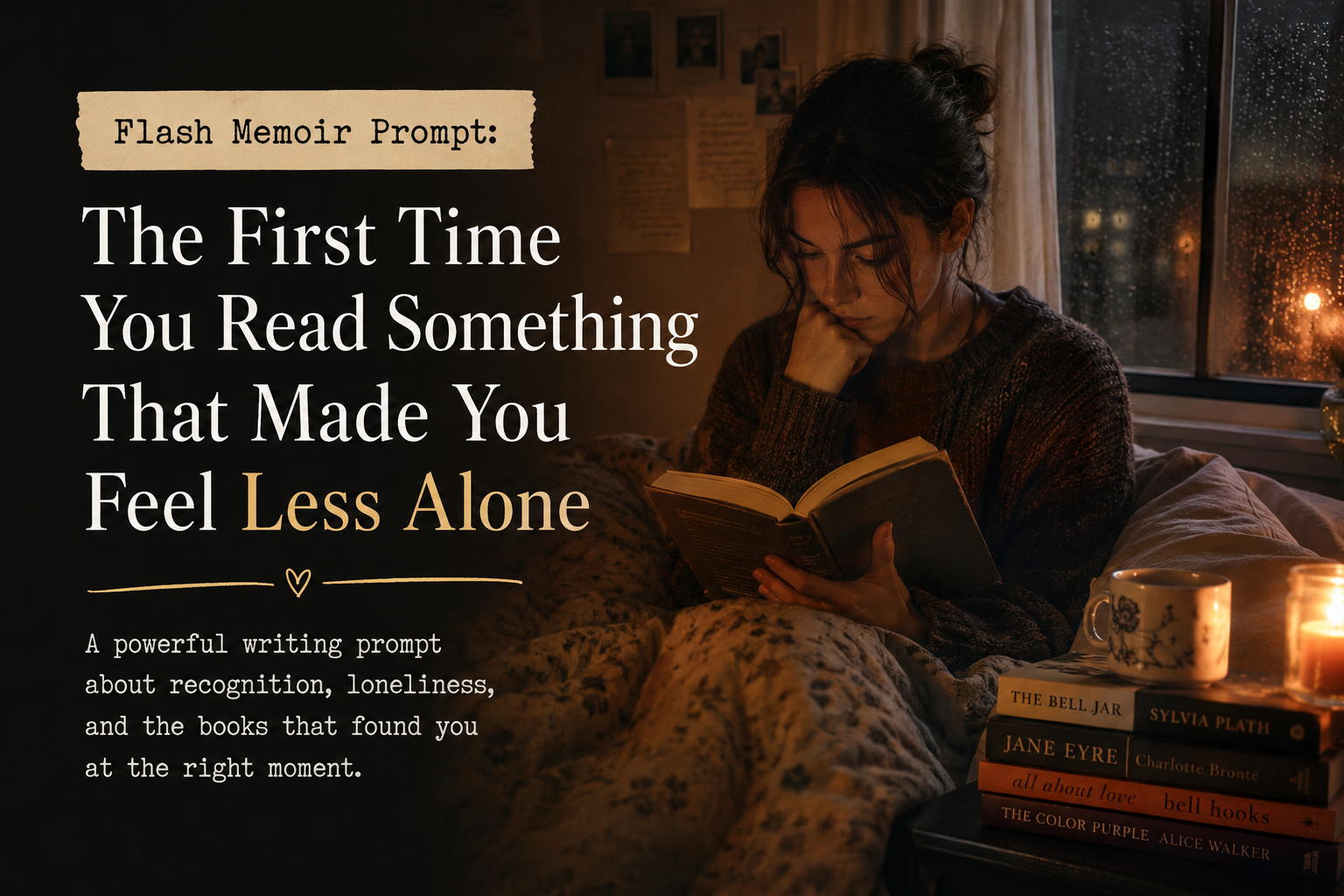
Flash Memoir Prompt: First Time You Read Something that Made You Feel Less Alone

flash memoir prompt alone

A brief writing invitation about the first time a book, poem, essay, or line on a page made you feel seen instead of separate.

Maybe you remember sitting alone at a kitchen table, a school desk, a bus stop, or the edge of your bed, holding a book that suddenly seemed to know something about you. The room may have stayed the same, but something inside you shifted. A sentence named a feeling you had never said out loud.

This flash memoir prompt first time read something made you feel less alone is about that quiet shock of recognition. It is not really about proving that a text changed your whole life. It is about finding one small moment when words reached across the distance and said, “You too?”

flash memoir prompt alone

The Prompt

Write about the first time you read something that made you feel less alone.

This prompt can unlock a meaningful memory because reading is often private. No one else may have known what was happening inside you. You might have been reading a novel for class, a library book you picked at random, a poem online, a comic, a memoir, or even a paragraph in a magazine.

The power of this memory may come from contrast. Before the reading, you felt strange, embarrassed, left out, confused, or quiet. After the reading, you still had the same life, but you had a new kind of company.

Why This Memory Matters

Stories about reading can reveal who we were before we had the words for ourselves. You may remember the first character who had your fear, your family problem, your secret hope, or your sense of being different. You may remember a writer who made sadness feel less like a flaw.

This kind of flash memoir does not need a dramatic plot. The drama can be internal. A page turns. A line lands. Your shoulders loosen. You underline a sentence so hard the paper almost tears.

For students, this prompt can also connect personal writing to literary study. When a text makes you feel seen, you are already doing a form of close attention. If you want to explore that skill more deeply, you might enjoy this guide to what close reading means in literature.

The memory may also show how reading helped you survive a season of life. Maybe you were the new kid, the grieving kid, the quiet kid, the angry kid, or the kid who laughed at the wrong time because laughing felt safer than crying.

A strong response to this flash memoir prompt first time read something made you feel less alone should stay close to the moment. Let the reader feel the room, the book in your hands, and the strange comfort of being understood by someone you had never met.

How to Approach This Prompt

Begin with one physical detail. Do not start by explaining the entire backstory. Start with the book’s cracked spine, the fluorescent classroom light, the smell of a used paperback, or the way your thumb rested under one sentence.

Then narrow the memory to one scene. Where were you? How old were you? What did you read? What sentence, character, or idea caught you off guard?

Write what you noticed before you explain what it meant. For example, you might write, “I read the same paragraph three times,” before you write, “It was the first time I knew other people felt that kind of loneliness.” This lets the reader discover the meaning with you.

If you saved the book, remember what it looked like. If you do not remember the title, that is okay. You can write around the missing detail. Sometimes the emotional truth matters more than the exact citation.

If the text was assigned in school, you might also write about the gap between the classroom discussion and your private reaction. Maybe everyone else talked about themes while you sat there thinking, “This is me.” If you like marking those private reactions as you read, this guide on how to annotate literature can help you turn small notes into stronger reflections.

Try to avoid telling the whole story of your life. This is a flash memoir prompt. Let one reading moment carry the weight. Trust the small scene.

A Quick Example

I was twelve, hiding in the school library during lunch because the cafeteria felt too loud. I pulled a thin paperback off the shelf because the cover was blue, my favorite color that year. I do not remember the title now, but I remember a girl in the story counting ceiling tiles while her parents argued downstairs. I stopped reading and looked up at the library ceiling. Square tiles. Water stain near the vent. Someone else knew that trick. Someone else had made a game out of waiting for noise to pass. I kept my finger on the sentence so I would not lose it. When the bell rang, I checked out the book and carried it against my chest like proof.

Try It Yourself

Set a timer for ten minutes and write the scene as clearly as you can. Begin with where you were, then move toward the line, page, or character that found you.

You do not have to explain why the reading mattered right away. Let the memory unfold. Let the younger version of you react honestly, even if the feeling seems small now.

If you get stuck, use this sentence starter: “I did not know anyone else felt that way until I read…” Then follow the memory wherever it leads.

This flash memoir prompt first time read something made you feel less alone can become a tender piece about books, school, family, identity, or grief. It can also become a funny piece about the strange comfort of meeting yourself in an unexpected place.

Want More Flash Memoir Prompts?

Explore all 365 prompts in The Memory Trigger: 365 Flash Memoir Writing Prompts.

error

Enjoy this article? Please spread the word :)

Follow by Email
BLUESKY
fb-share-icon
Reddit
LinkedIn
Share
RSS