

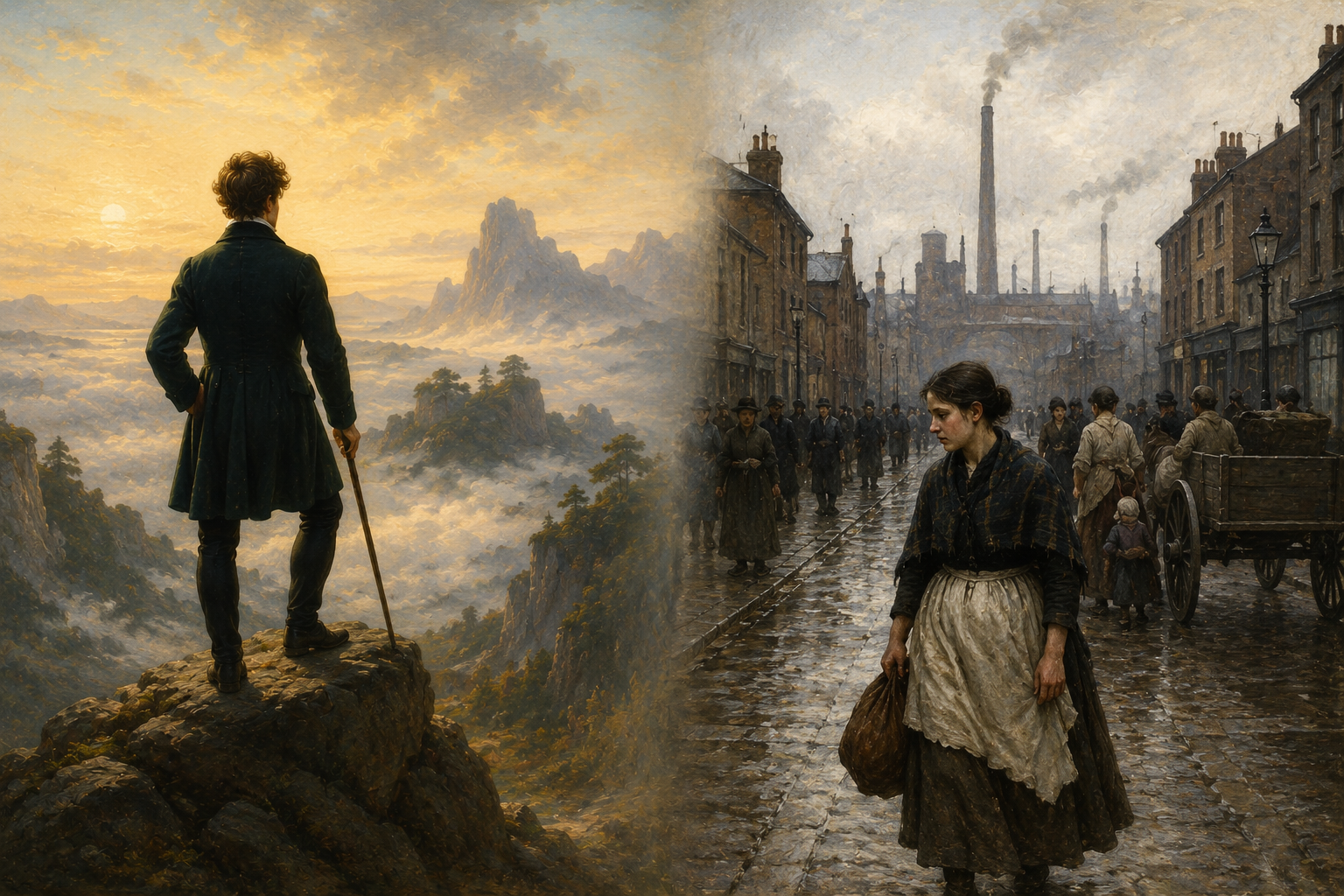
If you have ever mixed up Romanticism and Realism, you are not alone. Romanticism vs Realism Explained can help you spot what a writer values, how a story works, and what kind of world the text wants you to see.
This guide breaks the difference down in plain language, with clear examples from famous literature.
In this Guide
- The simple difference between the two movements
- What Romanticism values
- What Realism values
- Major themes to compare
- Examples from literature
- How to use the difference in analysis
- Common mistakes to avoid
- Suggested books
- FAQ
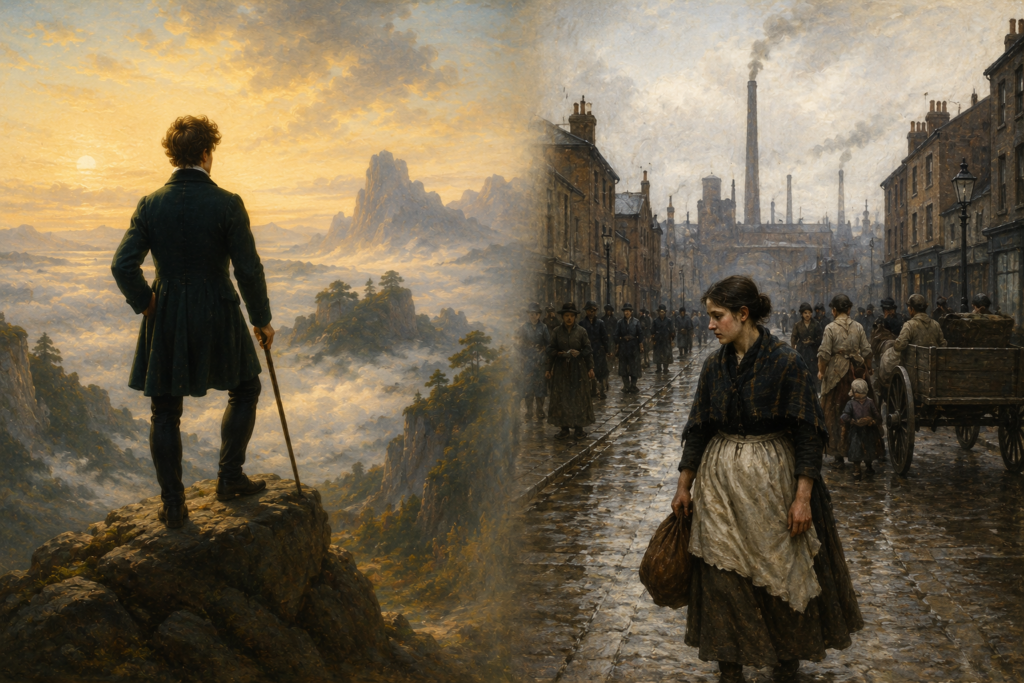
Romanticism vs Realism Explained: The Simple Difference
Romanticism focuses on emotion, imagination, nature, and the inner life.
Realism focuses on ordinary life, social problems, believable people, and the world as it is.
At its heart, Romanticism vs Realism Explained means this: Romantic writers often ask, “What does the soul feel?” Realist writers often ask, “What is life really like?”
Romanticism tends to lift life into something intense or mysterious. Realism tends to pull life back down to daily choices, money, work, class, family pressure, and moral limits.
What Romanticism Values
Romanticism began as a reaction against strict reason and social control.
Romantic writers believed that deep feeling could reveal truth. They often valued the individual, especially the person who feels trapped by society.
Nature also matters a lot in Romantic writing. A mountain, storm, forest, or lake can reflect a character’s mind.
In Mary Shelley’s Frankenstein, Victor’s ambition feels larger than normal life. The novel explores mystery, fear, creation, guilt, and isolation. Those are all strong Romantic concerns.
Romantic poetry gives clear examples too. William Wordsworth often treats nature as a source of wisdom. Percy Bysshe Shelley and John Keats use beauty, imagination, and longing to explore human experience.
For a useful overview of the movement, see the Poetry Foundation’s page on Romanticism.
What Realism Values
Realism grew stronger in the 1800s as writers turned toward everyday life.
Realist writers often show people dealing with money, marriage, work, class, and social rules. Their characters may dream, but the world usually pushes back.
Realism does not mean boring. It means the writer tries to make events feel possible and human.
In Gustave Flaubert’s Madame Bovary, Emma wants a grand romantic life. But the novel shows how fantasy, debt, and social pressure shape her choices.
George Eliot’s Middlemarch also fits Realism. It studies marriage, ambition, politics, and moral growth in a small English town.
Britannica offers helpful background on Realism as a wider artistic movement.
Romanticism vs Realism Explained Through Major Themes
The two movements often treat the same topics in very different ways.
Love is a good example. In Romanticism, love may feel powerful, spiritual, or tragic. In Realism, love is often tied to money, status, family approval, and daily habits.
Nature also changes meaning. Romantic writers often see nature as alive with feeling. Realist writers may use nature as setting, but they usually focus more on human society.
The hero is different too. Romantic heroes can seem lonely, intense, gifted, or misunderstood. Realist characters tend to feel more ordinary, with flaws that come from real social life.
When you use Romanticism vs Realism Explained in class, ask what the text seems to trust more: inner feeling or outer reality.
Romanticism vs Realism Explained with Literature Examples
Examples make the difference much easier to see.
In Frankenstein, the story is full of wild landscapes, emotional extremes, and questions about the limits of human power. Victor does not just make a scientific mistake. He crosses a moral and spiritual line.
That is why Romanticism vs Realism Explained helps with Shelley’s novel. The book cares about imagination, fear, ambition, and the hidden cost of desire.
Now compare that with Madame Bovary. Emma also wants a life full of passion and beauty. But Flaubert shows how her dreams clash with ordinary life.
The Realist style makes Emma’s world feel sharp and specific. Her choices have social and financial costs. The novel does not rescue her with fantasy.
You can also compare Romantic poetry with Realist fiction. Wordsworth may turn a walk in nature into a moment of spiritual insight. Eliot may turn a dinner conversation into a study of class, pride, and moral weakness.
How to Use Romanticism vs Realism Explained in Essays
The best analysis does more than label a text.
Do not just write, “This work is Romantic” or “This work is Realist.” Explain how the style shapes meaning.
For Romanticism, look for intense emotion, symbolic nature, mystery, rebellion, and the power of the imagination.
For Realism, look for social detail, believable dialogue, ordinary settings, and pressure from money or class.
A strong essay might say: “Shelley uses Romantic elements to show that Victor’s imagination is both powerful and dangerous.”
A Realist analysis might say: “Flaubert uses detailed social scenes to show that Emma’s fantasies cannot survive the limits of her real world.”
If you want a deeper way to build literary arguments, read how to read literature like a scholar.
Common Mistakes Students Make
One common mistake is thinking Romanticism only means love stories.
In literature, Romanticism is much wider than romance. It deals with emotion, nature, imagination, freedom, and the self.
Another mistake is thinking Realism has no emotion.
Realist novels can be deeply emotional. The difference is that emotion appears inside a believable social world.
Students also sometimes treat movements as strict boxes. Many works mix styles. A novel can have Romantic themes and Realist details.
That is why Romanticism vs Realism Explained works best as a tool, not a rulebook.
Suggested Books to Read
These books are useful if you want to see the contrast for yourself. You can search for them on Amazon, at a local bookstore, or through your library.
- Frankenstein by Mary Shelley
- Madame Bovary by Gustave Flaubert
Frankenstein is a strong Romantic text because it explores ambition, nature, terror, and isolation.
Madame Bovary is a strong Realist text because it studies social pressure, desire, debt, and disappointment in daily life.
FAQ: Romanticism vs Realism Explained
What is the main difference between Romanticism and Realism?
Romanticism focuses on emotion, imagination, and the inner life. Realism focuses on ordinary life, social detail, and believable experience.
Is Romanticism only about love?
No. Romanticism can include love, but it also explores nature, freedom, mystery, rebellion, and the power of feeling.
Is Realism the same as being depressing?
No. Realism can be sad, funny, sharp, or hopeful. Its main goal is to show life in a believable way.
Can one book be both Romantic and Realist?
Yes. Many works mix elements. A novel may use Romantic emotion while also showing Realist social detail.
Key Takeaway
Romanticism vs Realism Explained comes down to focus: Romanticism looks inward toward feeling and imagination, while Realism looks outward toward society and daily life. Use that difference to explain how a text creates meaning, not just to name its style.


Get the Free Close Reading Worksheet Pack
Join my email list and receive the printable worksheet pack you can use with any novel or poem.
No spam. Just helpful guides for reading literature well.












