

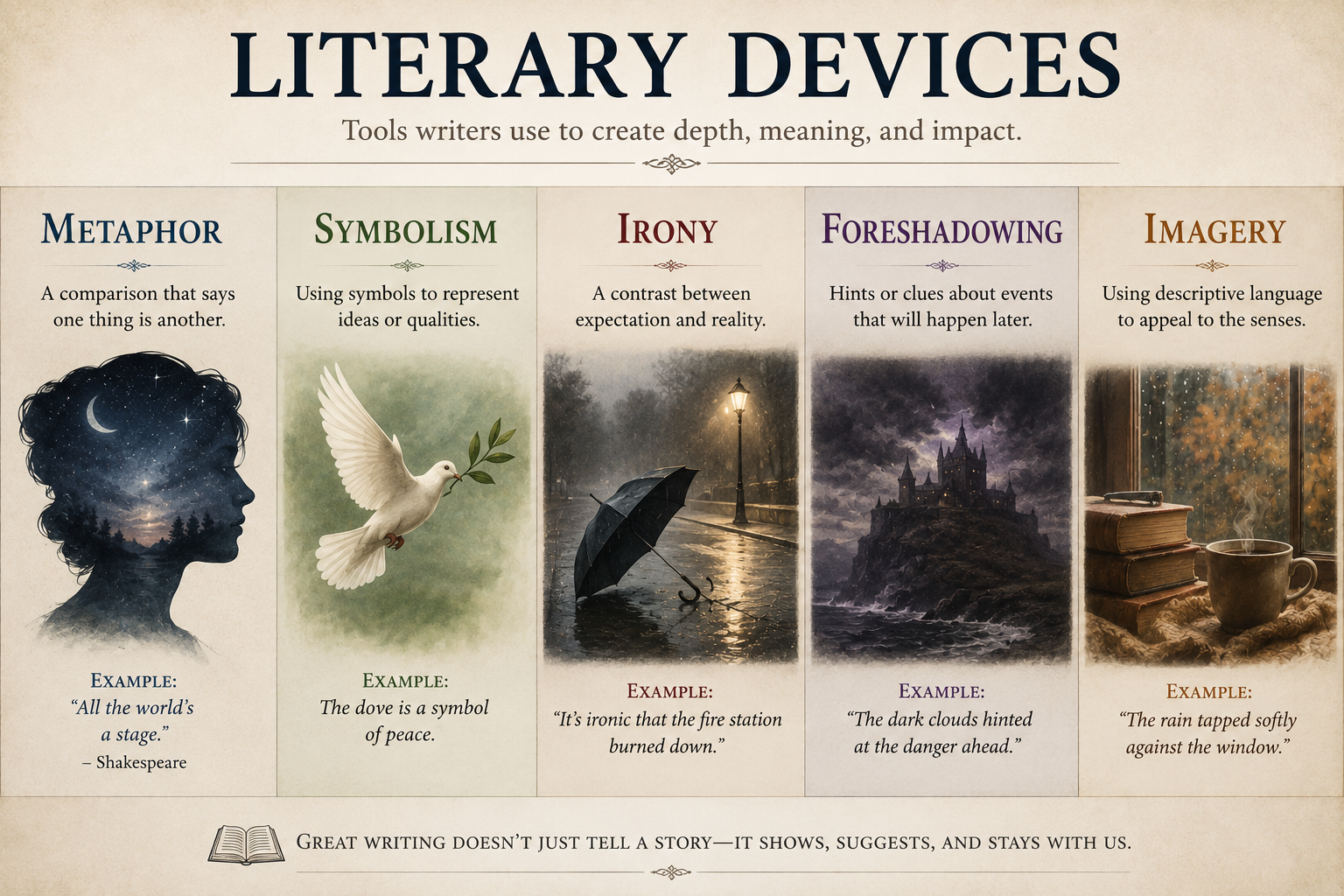
Literary devices help writers shape meaning, mood, and character. When you learn how they work, poems, novels, and plays become easier to understand.
This guide explains literary devices in plain language, with examples from books students often read in class.
This article contains affiliate links.
In this Guide
- What literary devices are
- Why they matter in literature
- Common examples students should know
- How to analyze them in essays
- Helpful books and study links
- FAQ
What Are Literary Devices?
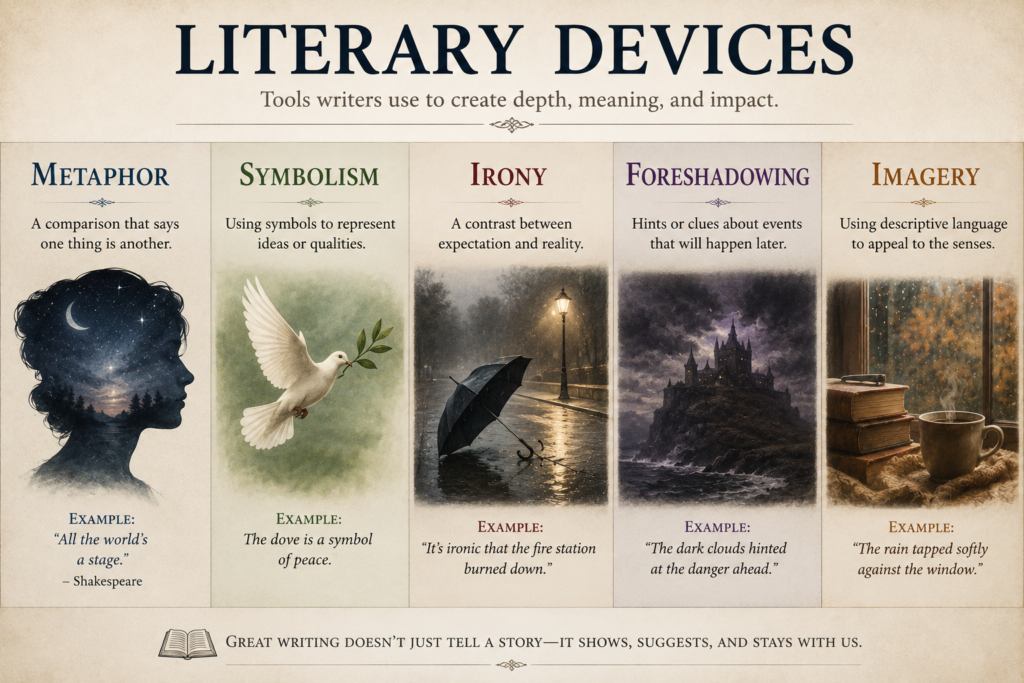
Literary devices are tools writers use to create meaning beyond the basic plot.
A writer may use a symbol, a repeated image, or a sharp contrast to guide how readers feel. These choices help turn a simple story into art.
For example, in The Great Gatsby, the green light is not just a light. It stands for Gatsby’s dream, his hope, and his distance from the life he wants.
Why Literary Devices Matter in Literature
They help you see how a text works, not just what happens in it.
Plot tells you the events. Literary devices show you why those events feel powerful.
In Romeo and Juliet, Romeo calls Juliet the sun. This metaphor shows how bright and life-giving she seems to him. It also reveals his intense, risky view of love.
Once you spot these choices, your essays become stronger. You can explain the author’s craft instead of only retelling the story.
Common Literary Devices Students Should Know
Start with the terms that appear most often in class texts and exams.
Metaphor
A metaphor compares two unlike things without using “like” or “as.” It helps readers see one idea in a fresh way.
When Shakespeare writes that Juliet is the sun, he gives Romeo’s love a bright and dramatic force.
Symbolism
A symbol is an object, place, or image that stands for a larger idea. Symbols often grow in meaning as the story moves on.
The conch in Lord of the Flies stands for order and shared rules. As the conch loses power, the boys lose control.
Irony
Irony creates a gap between what seems true and what is true. It can add humor, tension, or sadness.
In Oedipus Rex, Oedipus seeks the truth about a crime, but the truth points back to him. That irony makes the tragedy hit harder.
Foreshadowing
Foreshadowing hints at what may happen later. It builds tension and helps the ending feel earned.
In Of Mice and Men, early scenes prepare readers for the final choice George must make.
Imagery
Imagery uses sensory details to help readers picture a scene. It can appeal to sight, sound, touch, taste, or smell.
Poetry often relies on imagery. You can explore more terms in the Poetry Foundation glossary.
How to Analyze Literary Devices in an Essay
Good analysis connects the device to meaning.
Do not stop after naming the device. Explain what it does in the text.
A strong sentence might sound like this: “The green light in The Great Gatsby symbolizes Gatsby’s dream, but its distance shows that the dream may never become real.”
This sentence names the symbol, explains its meaning, and connects it to the novel’s larger theme.
For more help with close reading, see our guide to analyzing literature quotes. If you want a faster study plan, try our literature study guide bundle.
Quick Study Tips for Literary Devices
You do not need to memorize every term at once.
Choose a few key terms and practice with short passages. Ask: What stands out? What feeling does it create? How does it connect to theme?
When you mark a passage, look for repeated images or unusual word choices. Repetition often points to meaning.
For a broader view of literature as an art form, you can also read Britannica’s overview of literature.
Relevant Books to Read
These books can help students build confidence with analysis.
- How to Read Literature Like a Professor by Thomas C. Foster
- A Glossary of Literary Terms by M. H. Abrams and Geoffrey Galt Harpham
FAQ About Literary Devices
What are literary devices in simple terms?
They are writing tools that help authors create deeper meaning, emotion, or style.
What is the easiest device to spot?
Symbolism is often easy to find because it links a concrete object to a larger idea.
Are literary devices only used in poetry?
No. They appear in novels, plays, short stories, speeches, and songs.
How many should I discuss in an essay?
Focus on one or two strong examples. It is better to explain them well than to list many terms.
Key Takeaway
Literary devices help you move from summary to real analysis. When you ask how a writer creates meaning, you read with more skill and write with more confidence.


Get the Free Close Reading Worksheet Pack
Join my email list and receive the printable worksheet pack you can use with any novel or poem.
No spam. Just helpful guides for reading literature well.












