

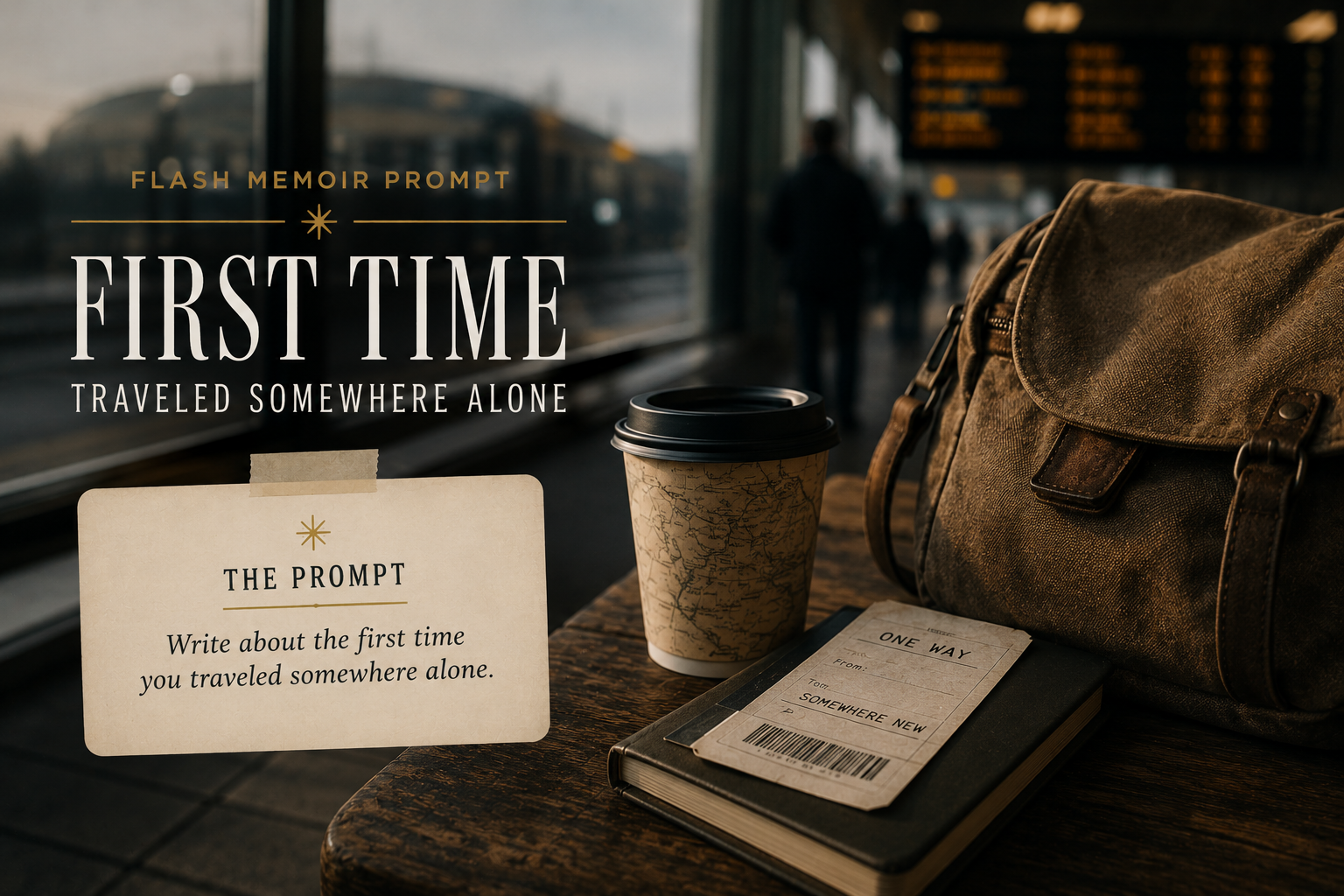
A brief, honest writing invitation for remembering the first time you traveled somewhere alone through one clear scene, a few sensory details, and the feeling that followed you. Maybe you can still picture it: your hand on a ticket, your bag feeling heavier than it should, your eyes moving from sign to sign while you tried to look like someone who knew exactly where to go. This flash memoir prompt first time traveled somewhere alone is less about the trip itself and more about the quiet shift that happened when no one else was there to decide the next step.
The Prompt
Write about the first time you traveled somewhere alone.
This prompt can unlock a memory because solo travel often makes ordinary moments feel sharp. A bus station bathroom, a delayed flight, a motel key, a wrong turn, or the first meal alone can hold more meaning than the destination.
When you write from this flash memoir prompt first time traveled somewhere alone, you do not need to cover every mile. You only need to return to the moment when you realized you were responsible for yourself in a new way.
Why This Memory Matters
The first time you travel alone can reveal a version of you that had been waiting for space. Maybe you felt proud. Maybe you felt scared. Maybe you felt both within the same five minutes.
That tension is useful for memoir. A strong flash memoir often lives inside mixed feelings. You might remember acting brave while secretly checking your phone every few minutes. You might remember missing home, then surprising yourself by enjoying the silence.
This kind of memory can also show a change in identity. Before the trip, you may have been someone’s child, roommate, student, partner, or friend. During the trip, you had to become the person who read the schedule, guarded the wallet, asked for help, and chose what to do next.
If you are studying memoir as part of a class, this prompt can also help you practice finding meaning without forcing a moral. Like learning how to identify theme in literature, memoir asks you to notice what a moment keeps pointing toward. Freedom. Fear. Trust. Loneliness. Independence.
The best part is that the memory does not have to be dramatic. You do not need a missed train or a life-changing disaster. Sometimes the most powerful part is sitting alone with a paper cup of coffee and realizing no one knows where you are.
How to Approach This Prompt
Begin with one physical detail from the trip. Choose something you can still see, hear, smell, or touch. It might be the vinyl seat on a bus, the stale air of an airport gate, the pull of a backpack strap, or the blue glow of a phone map at night.
Let that detail lead you into one scene. Do not try to tell the whole story of the trip. A flash memoir works best when it narrows the lens. Pick the moment before departure, the moment you arrived, or the moment you first felt truly alone.
Write what you noticed before you explain what it meant. For example, instead of starting with “I learned to be independent,” start with the vending machine humming beside you while you counted your change. Let readers feel the scene first.
You can also ask yourself one simple question: What did I pretend not to feel? Many first solo trips involve a small performance. You may have pretended to be calm, older, tougher, or more prepared than you were. That gap between outside and inside can become the heart of the piece.
If you like to mark up readings or mentor texts before writing your own, try the same habit with your memory. Notice the details that repeat or stand out, the way you might when you annotate literature. Circle the small moments in your mind and choose the one with the most charge.
For this flash memoir prompt first time traveled somewhere alone, avoid ending too neatly. You do not have to prove that you became fearless. It may be more honest to say you were still afraid, but you kept walking anyway.
A Quick Example
The first time I traveled alone, I took a train to visit my cousin in Chicago. I was seventeen and had memorized the schedule like it was a speech I had to give. At the station, I bought a bottle of orange juice even though I was not thirsty, just so I could look busy. My mother had waved from the parking lot until I turned away first. On the train, I sat by the window and kept my ticket in my sweatshirt pocket, touching it every few minutes to make sure it was still there. When the conductor passed, he barely looked at me. That almost disappointed me. I had expected the world to notice I was doing something brave. Instead, it kept moving, which made me feel both smaller and freer.
Try It Yourself
Set a timer for ten minutes and return to one scene from your first solo trip. Start with where your body was: standing in line, sitting by a window, walking through a station, or waiting near a curb.
Then write toward the feeling you did not fully understand at the time. Were you nervous, proud, lonely, excited, embarrassed, or relieved? Let the emotion stay a little messy. Real memories usually are.
If you get stuck, describe what you carried. A suitcase, a backpack, a purse, a phone charger, a snack, or a folded address can reveal what you thought you needed. It can also reveal what you could not prepare for.
This prompt is not asking for a travel essay. It is asking for a flash of memory. One place. One version of you. One moment when being alone changed the way you heard your own thoughts.
Want More Flash Memoir Prompts?
Explore all 365 prompts in The Memory Trigger: 365 Flash Memoir Writing Prompts. It is designed to help you find small, true stories from everyday life and turn them into focused pieces of memoir.


Get the Free Close Reading Worksheet Pack
Join my email list and receive the printable worksheet pack you can use with any novel or poem.
No spam. Just helpful guides for reading literature well.












