

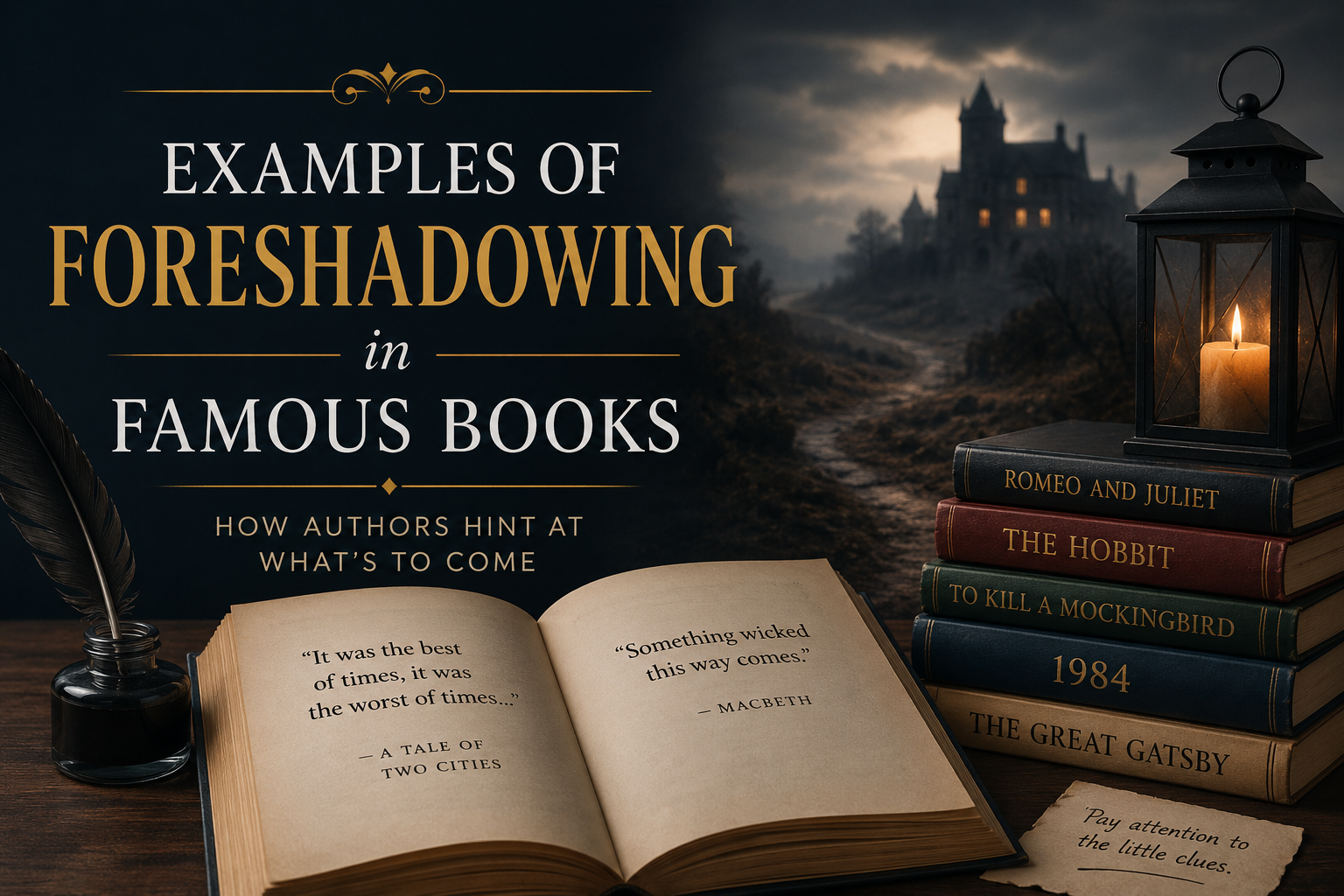
Examples of Foreshadowing in Famous Books can help students see how authors prepare readers for key events before they happen.
Foreshadowing is a clue, hint, image, or line of dialogue that points toward a future moment in the story. Once you know how to spot it, major plot turns often feel less random and more carefully planned.
In this Guide
- What foreshadowing means
- Examples of Foreshadowing in Famous Books
- How each example works
- How to write about foreshadowing in an essay
- Books to read for more practice
- FAQ
What Is Foreshadowing?
Foreshadowing gives readers a clue about what may happen later.
It can appear through a warning, a symbol, a dream, a strange detail, or a character’s fear. The clue may be clear right away, or it may only make sense after the ending.
Writers use foreshadowing to build suspense. They also use it to make a story feel complete, since the ending often grows from details planted earlier.
Examples of Foreshadowing in Famous Books: Romeo and Juliet
Shakespeare gives away the tragic ending before the play truly starts.
In Romeo and Juliet, the Prologue calls the lovers “star-crossed” and says they will take their own lives. This is direct foreshadowing because the audience learns that Romeo and Juliet will die.
This does not ruin the play. Instead, it creates dread. Readers watch each happy moment with the knowledge that disaster is ahead.
Romeo also senses danger before he goes to the Capulet party. He says he fears “some consequence yet hanging in the stars.” This line hints that the party will start a chain of events he cannot control.
In an essay, you could argue that Shakespeare uses foreshadowing to make fate feel powerful. The characters make choices, but the early warnings make their deaths seem almost written in the stars.
For background on the play, you can read Britannica’s overview of Romeo and Juliet.
Examples of Foreshadowing in Famous Books: Of Mice and Men
John Steinbeck uses small deaths to prepare us for a much larger one.
In Of Mice and Men, Lennie kills soft animals by accident because he does not know his own strength. Early in the novel, he carries a dead mouse in his pocket. Later, he kills his puppy.
These moments foreshadow the death of Curley’s wife. Lennie does not mean to hurt her, but the earlier scenes show that his strength can turn harmless contact into tragedy.
Candy’s old dog also foreshadows the ending. Carlson shoots the dog because he sees it as weak and useless. Candy later says he should have shot the dog himself.
That moment points toward George’s final choice. George kills Lennie himself rather than let a violent mob do it.
Students can write about how Steinbeck uses foreshadowing to make the ending feel painful but not sudden. The clues show that Lennie’s fate has been building from the start.
Examples of Foreshadowing in Famous Books: Macbeth
The witches in Macbeth turn prophecy into a warning.
At the start of the play, the witches tell Macbeth he will become king. Their words foreshadow his rise to power, but they also lead him toward murder.
Later, the witches give Macbeth new predictions. They say he should beware Macduff, that no one “of woman born” can harm him, and that he is safe until Birnam Wood moves to Dunsinane.
Macbeth thinks these clues mean he cannot lose. In the end, each prophecy comes true in a tricky way. Macduff was born by a surgical birth, and soldiers carry branches from Birnam Wood as they march.
This is one of the best examples of foreshadowing in famous books because the clues are both clear and misleading. Shakespeare lets the audience hear the warnings, but Macbeth misreads them.
In an essay, focus on how the prophecies reveal Macbeth’s flaw. He hears what he wants to hear, which helps cause his fall.
Examples of Foreshadowing in Famous Books: The Great Gatsby
F. Scott Fitzgerald fills The Great Gatsby with signs of coming loss.
Early in the novel, Gatsby reaches toward the green light across the bay. The light stands for Daisy and the future he wants. It also foreshadows that his dream will stay out of reach.
Cars also foreshadow danger. The novel shows careless driving more than once, including a car crash after one of Gatsby’s parties. These moments prepare readers for Myrtle’s death by car later in the story.
Nick’s first chapter also looks back with sadness. He says Gatsby turned out “all right” in the end, but he also hints that Gatsby was destroyed by what preyed on him.
That early tone tells readers not to expect a simple love story. It points toward tragedy before the plot reaches it.
When you discuss this in an essay, connect foreshadowing to the novel’s critique of the American Dream. Gatsby’s future looks bright from a distance, but the early clues show that the dream is fragile.
Examples of Foreshadowing in Famous Books: Lord of the Flies
William Golding uses fear and violence to hint at the boys’ collapse.
In Lord of the Flies, the boys worry about a “beast” on the island. At first, the beast seems like a real creature. Over time, it becomes clear that the true danger comes from the boys themselves.
This fear foreshadows the violence that follows. The boys’ terror gives them an excuse to act cruelly.
Piggy’s glasses also foreshadow the loss of order. At first, the glasses help start fires, which can lead to rescue. When they break, it shows that reason and safety have begun to fail.
The falling rock that kills Piggy also has early hints. The boys play near rocks and use them as tools of power. By the time the rock strikes Piggy, the island has turned fully savage.
This is one of the darker Examples of Foreshadowing in Famous Books because the clues show a moral fall, not just a plot event.
Examples of Foreshadowing in Famous Books: Harry Potter and the Sorcerer’s Stone
J.K. Rowling uses foreshadowing to hide answers in plain sight.
In Harry Potter and the Sorcerer’s Stone, Harry believes Snape is the main threat. Many clues seem to support this idea. Snape acts cold, follows Harry, and seems connected to the mystery.
Yet other clues point to Quirrell. He is nervous, often overlooked, and linked to strange moments that do not seem important at first.
The Mirror of Erised also foreshadows the final scene. It shows deep desire, not truth. Later, Harry can get the Stone because he wants to find it, not use it.
This example helps students see that foreshadowing can work with red herrings. A red herring points readers in the wrong direction, while real clues still sit nearby.
In an essay, you could write that Rowling uses foreshadowing to reward careful readers. The ending feels surprising, but the earlier details make it fair.
Examples of Foreshadowing in Famous Books: To Kill a Mockingbird
Harper Lee uses early danger to prepare us for the final attack.
In To Kill a Mockingbird, Bob Ewell threatens Atticus after the trial. This warning foreshadows his later attack on Jem and Scout.
The children also fear Boo Radley for much of the novel. They imagine him as a monster, but this fear prepares a reversal. In the end, Boo becomes their protector.
Scout’s ham costume also matters. It seems funny at first, but it helps save her during the attack because the costume blocks the knife.
These clues show how Lee mixes danger with childhood misunderstanding. The children do not fully see the threat, but readers can sense it.
This is one of the most useful Examples of Foreshadowing in Famous Books for essays about innocence. The clues show that Scout’s world is less safe than she thinks.
How to Discuss Examples of Foreshadowing in Famous Books in an Essay
A strong essay does more than point out a clue. It explains why the clue matters.
Start by naming the moment that hints at the future. Then explain the later event it prepares. After that, connect both moments to a theme.
Here is a simple sentence frame:
The author uses [early clue] to foreshadow [later event], which reveals [theme or character truth].
For example:
Steinbeck uses Lennie’s dead mouse to foreshadow the death of Curley’s wife, which reveals that Lennie’s innocence cannot protect him from the harm his strength causes.
You can also compare two clues. In Macbeth, the witches’ prophecies foreshadow Macbeth’s rise and his fall. This shows how ambition can twist a warning into false confidence.
When you write about Examples of Foreshadowing in Famous Books, avoid saying only, “This creates suspense.” That is true, but it is not enough.
Ask what the foreshadowing reveals about fate, power, guilt, fear, or desire. That deeper point will make your essay stronger.
Why Authors Use Foreshadowing
Foreshadowing helps a story feel planned instead of random.
It also builds tension. Readers may not know exactly what will happen, but they sense that something important is coming.
Some authors use clear warnings, like the Prologue in Romeo and Juliet. Others use symbols, like Gatsby’s green light.
Foreshadowing can also reveal character. Macbeth hears warnings but trusts his pride. Gatsby sees the green light but cannot accept that the past is gone.
To study more tools that work with foreshadowing, visit this guide to common literary devices.
Books to Read for More Examples of Foreshadowing in Famous Books
These books are useful if you want more practice spotting foreshadowing.
- Of Mice and Men by John Steinbeck
- The Great Gatsby by F. Scott Fitzgerald
- Lord of the Flies by William Golding
Each one uses early clues that become more important by the end. They are also common in high school and college literature classes.
Quick Practice: Find the Foreshadowing
Try this with any novel or play you read.
Look for a strange detail that gets extra attention. Ask if it returns later in a bigger way.
Watch for warnings, dreams, symbols, and repeated images. These often point toward a future conflict.
You can also mark moments where a character says something that feels larger than the scene. In literature, casual lines often carry hidden weight.
FAQ: Examples of Foreshadowing in Famous Books
What is a simple definition of foreshadowing?
Foreshadowing is a hint about something that will happen later in a story.
What is one clear example of foreshadowing?
In Romeo and Juliet, the Prologue says the lovers will die. This directly foreshadows the tragic ending.
Can foreshadowing be a symbol?
Yes. Gatsby’s green light is a symbol that also foreshadows his unreachable dream.
How do I write about foreshadowing in an essay?
Name the clue, explain the later event, and connect both to a theme or character flaw.
Is foreshadowing always obvious?
No. Some clues are easy to spot, while others only make sense after you finish the story.
Key Takeaway
Examples of Foreshadowing in Famous Books show that great endings rarely come from nowhere.
Authors plant clues early, then let those clues grow into conflict, tragedy, or surprise. When students notice those clues, they can write sharper essays and read with more confidence. 📚


Get the Free Close Reading Worksheet Pack
Join my email list and receive the printable worksheet pack you can use with any novel or poem.
No spam. Just helpful guides for reading literature well.












